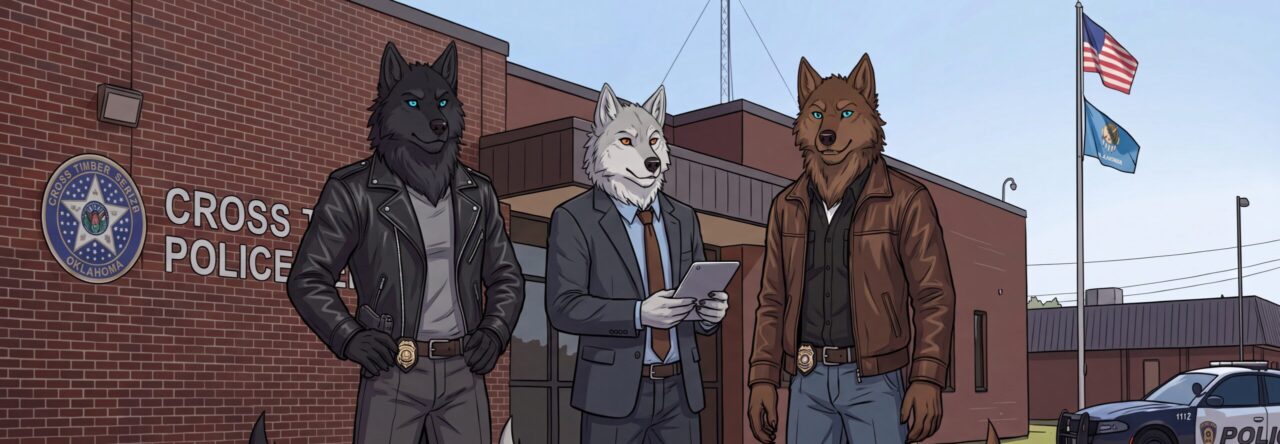
Author: Thane Page 14 of 17

Chapter 33 — Before the Rain

The west trailhead sat beyond the developed edge of Cross Timber, where the city gave way to creek beds, low woods, and service roads that had once belonged to ranch land before trails, picnic tables, and weathered information signs had tried to civilize them.

At night, it was mostly dark.

The trail kiosk stood beneath a single yellow security lamp. The lot was gravel and packed dirt, bordered by scrub oak and cedar. Beyond that, the tree line folded into blackness.

Storm clouds had swallowed the moon.

Thane drove the Humvee through the trailhead entrance and slowed as patrol tape appeared in the headlights.

The gray crossover sat at the far end of the lot, near the service-road gate.

Its headlights were off.

Its interior dome light glowed dimly through rain-speckled glass.

Two patrol cars blocked the entrance. A fire-rescue unit sat near the crossover with its emergency lights dark but ready. A maintenance truck stood beneath the kiosk awning, its driver beside an officer, both of them looking toward the vehicle as though staring hard enough might change what was inside it.

Thane parked where Bell had directed over the radio.

Gabriel was out before the Humvee’s engine had fully settled.

Mark followed with his case bag and notebook tucked beneath one arm. He had not yet customized the notebook cover with anything other than his name and a tiny gold-star sticker that still clung near the bottom corner.

Voss and Rusk arrived seconds later in an unmarked SUV.

Bell met them at the edge of the taped perimeter.

He wore a patrol jacket over his uniform, rain darkening the shoulders. His eyes went first to Voss, then to the trio.

“Victim is female,” he said. “Early thirties, maybe. Maintenance worker found her about ten minutes ago. He says the vehicle was not here when he made his sunset check.”

“Doors?” Voss asked.

“Locked when he found it. Patrol documented that through body cam. Fire used a lockout tool on the passenger side because they had a possible medical emergency. EMS confirmed death once they got access. Driver-side door, trunk, and hood have not been touched beyond visual observation.”

“Any obvious trauma?” Rusk asked.

“Nothing obvious through the glass. Seatbelt was fastened. Purse is on the passenger floorboard. Keys are visible in the center console. No phone that we can see.”

Voss looked toward the sky.

The clouds were moving low and fast over the tree line.

“And the rain?”

Bell glanced up.

“Forecast said twenty minutes.”

Gabriel looked at the black horizon.

“Forecast has never once been right when we need it to be.”

Bell’s mouth almost moved.

Almost.

Voss turned to the trio.

“Night Shift. This is yours.”

Mark straightened slightly.

Gabriel’s humor went quiet.

Thane looked through the rain-speckled glass at the woman in the driver’s seat.

“Do not hurry,” Voss said. “Do not freeze. Work.”

Thane nodded once.

“Yes.”


The woman sat reclined slightly behind the wheel.

Her head rested against the headrest at an angle that looked almost peaceful until a person looked long enough to understand it was not. Her seatbelt crossed her chest. One hand lay near her lap. The other rested loosely against the center console.

Her face was pale.

No obvious blood marked the glass or upholstery.

The purse on the passenger-side floor had tipped open just enough to show a wallet, a compact, a packet of tissues, and a set of keys on a ring separate from the vehicle key fob.

No phone.

No weapon.

No visible signs of a struggle.

A person could look at the scene and see a woman who had driven to a quiet trailhead, locked herself in her car, and died alone.

Thane did not look at it that way.

Not yet.

He stayed outside the vehicle, moving slowly around the perimeter without touching the doors or stepping too close to the tire impressions in the wet gravel.

Bell followed at a respectful distance, scene notebook open.

“What do you have?” Bell asked.

Thane lowered his head slightly near the rear driver-side door.

Rain was coming. He could smell it in the wind now—wet stone, cold soil, ozone, the heavy green smell of leaves about to be beaten down.

Under that, closer to the vehicle, something else lingered.

Bleach.

Not fresh enough to burn his nose. Not old enough to be irrelevant.

Floral hand sanitizer.

Artificial lavender, sweet and sharp, caught in the seam around the rear door and low along the rocker panel.

Another scent too.

Adult woman.

Recent.

Not the victim’s.

Thane moved toward the rear hatch, then paused.

The trunk seam carried a thin metallic note.

Possible blood.

Possible rust, old tools, contaminated fabric, anything.

Not enough to call it blood.

Not from outside.

Not yet.

He looked down.

The trailhead lot was mostly compacted gravel and pine needles, darkened by the first misting rain. Beneath the rear tire area, however, he caught damp clay and crushed wild mint.

That ground did not match the lot.

It smelled like the service road beyond the gate, where the terrain dropped toward a creek bed and the dirt stayed red longer after rain.

A second set of tire impressions sat near the rear passenger side of the crossover. Not clean enough to identify a make. Not yet. But something had backed close to the victim’s vehicle, then turned away toward the service road.

Thane stepped back.

“I have observations consistent with another person being near the vehicle recently,” he said.

Bell wrote.

“Go on.”

“Recent adult female scent around the driver-side exterior and rear hatch. Bleach, floral hand sanitizer, artificial lavender laundry scent near the rear door and office-side cabin area.” Thane paused. “I also detect a metallic odor around the trunk seam. It may be blood. It may not. I cannot identify source or age from exterior position.”

Bell nodded.

“Anything with the ground?”

“Red clay and crushed wild mint beneath the rear tire area. That does not match the lot. There are tire impressions consistent with a second vehicle backing near the crossover before leaving.”

“Can you place the second driver inside the car?”

“No.”

“Can you say why they were here?”

“No.”

Thane looked through the driver-side glass again.

“I can say the scene needs more than one explanation.”

Bell looked at him.

For a moment, the rain and lights seemed to fall away.

“Good,” Bell said quietly.

Not praise for Thane’s senses.

Praise for the sentence.

Thane felt it.

Then nodded.

“Mark needs the vehicle time data.”

Bell glanced toward the crossover.

“Go.”

Mark stood near the passenger side with an officer’s report in one hand and his notebook in the other. He had already written three short columns on the page.

Observed
Reported
Unverified

Thane stopped beside him.

“Anything?”

“The dash display reads 9:18,” Mark said. “The first patrol officer noted it because the center console was illuminated when they made emergency entry.”

“Time now is?”

“Ten-oh-seven.”

“Maybe it stopped.”

“Maybe.” Mark looked at the dark screen through the glass. “Or it was set wrong. The maintenance worker says he passed through at nine-thirty and the lot was empty. The trailhead camera shows a vehicle entering at nine-forty-two.”

Thane glanced toward the kiosk.

“That makes the worker wrong.”

Mark’s ears shifted once.

“Not necessarily.”

“Why?”

“Because the camera clock may be wrong. The dash clock may be wrong. The worker may be estimating. Three bad clocks do not make one liar.”

Thane looked at him.

Mark tapped the page.

“I asked dispatch for a comparison against the camera feed from an earlier patrol call. The trailhead camera captured a public-works truck at eight-thirty-six. Dispatch logged the truck’s radio contact at eight-twenty-four.”

“Twelve minutes fast,” Thane said.

“Probably.” Mark’s eyes brightened slightly. “If the camera is twelve minutes fast, it places the crossover entering at nine-thirty.”

“Exactly when the worker said he passed.”

“Yes.”

Thane looked toward the awning.

“So he was not wrong.”

Mark gave him a small look.

“The scene has an inaccurate clock. That does not make the witness inaccurate.”

Voss, approaching from the perimeter, heard it.

“Good,” she said. “Keep the difference.”

Mark nodded.

Thane looked toward Gabriel.

Gabriel had moved beneath the kiosk awning with the maintenance worker.

The man was maybe fifty-five, rain jacket zipped too high, baseball cap clenched in both hands. He looked wet, tired, and terrified that everyone at the scene was about to decide he had done something wrong.

Gabriel sat on the bench across from him rather than standing over him.

He kept his hands visible.

“You are Eli Booker?” Gabriel asked.

The man nodded.

“Yeah.”

“I’m Detective Gabriel. You found the vehicle?”

“Yeah.”

“Tell me what happened.”

Eli looked toward the crossover.

“I was checking the gate. Saw the car. Tried the door. Saw her inside. Called.”

Gabriel nodded.

“You are not in trouble for finding her when you found her.”

Eli’s mouth tightened.

“I should’ve been here earlier.”

Gabriel waited.

The rain began ticking harder against the kiosk roof.

“I do a pass at sunset,” Eli said. “Usually. I check the gate, make sure nobody’s parked back here after dark, see if the trail signs are still standing.” His eyes flicked toward the service-road gate. “I had to leave early.”

“For what?”

“My wife’s medicine. Pharmacy closes at seven. She’s got heart trouble, and I forgot to pick it up yesterday.” He swallowed. “So I left around six-fifteen. Came back a little after nine.”

“You think you should have found her sooner.”

“I should’ve been here.”

Gabriel’s expression stayed calm.

“Maybe. But right now I need the last time you were here before you found her.”

Eli rubbed both hands over his cap.

“Sunset. I don’t know. Nine-thirty, maybe. I drove through. Lot was empty.”

“You are sure?”

“Sure enough. I’d remember that car. It was right there, plain as day.”

Gabriel nodded.

“What else did you see?”

Eli frowned.

“Nothing.”

“Take your time.”

The man looked out toward the service road.

Then back.

“There was a white crossover by the gate.”

Gabriel waited.

“Before or after your pass through the lot?”

“Before. Maybe ten minutes before. I was coming in from the east road. It was just sitting there, engine on.”

“Did you see who was driving?”

“No.”

“Anyone else inside?”

“No.”

“Was it the same vehicle as the one at the trailhead?”

“No. Different shape. Taller. White.”

“Anything else?”

Eli closed his eyes.

“There was something in the back window. Bright.”

“Like what?”

“Safety vest, maybe. Reflective stripes. I thought it was a contractor. We get them sometimes.”

“Which way did it go?”

“Service road.”

“Toward the main exit?”

“No. The old road. Toward the creek.”

Gabriel wrote it down.

He did not say, That’s our suspect.

He did not say, That white crossover staged the scene.

He asked for the next fact.

“Could you identify the driver if you saw them again?”

Eli shook his head.

“Not really.”

“Could you identify the vehicle?”

“Maybe.”

“Okay.” Gabriel closed the notebook. “That is useful.”

Eli looked at him.

“Am I going to get fired?”

Gabriel’s face softened.

“I do not know your employer’s rules. But you did the right thing when you found her. You called. You stayed. You told us what you remembered.”

Eli nodded, breathing shakily.

Gabriel stood.

“An officer will stay with you until we are done here.”

As he walked back toward the vehicle, Rusk met him under the edge of the awning.

“Anything?”

“White crossover. Reflective vest in the rear window. Service-road direction around nine-twenty.”

Rusk looked toward the gate.

“Could be connected.”

“Could be a contractor.”

“Could be both.”

Gabriel nodded.

“Exactly.”

Rusk gave him a sideways glance.

“You are learning.”

“Try not to sound surprised.”

“My soul retired years ago. Surprise is all I have left.”


The victim’s name came from her wallet.

Alicia Monroe. Thirty-five.

Her sister was listed as emergency contact.

By the time Alicia’s identity had been confirmed through her driver’s license and the first records check, the rain had become a steady curtain beyond the trailhead lights.

Mara Monroe arrived in a raincoat over pajamas, hair pulled back badly, eyes wide enough to show she had driven too fast and would not remember doing it.

Voss met her near the patrol tape.

“Ms. Monroe?”

Mara nodded.

“My sister? Is she—”

Voss did not make her say it.

“I am sorry,” she said. “Your sister is dead.”

Mara’s face folded.

Not theatrically.

Not loudly.

She simply seemed to lose the shape of herself for a second.

Gabriel stepped close enough to support if she fell, but not close enough to touch without permission.

Mara turned toward the crossover.

“Can I see her?”

“Not yet,” Voss said gently. “We need to preserve the scene. I promise someone will talk you through what happens next.”

Mara pressed both hands over her mouth.

Gabriel stayed beside her.

After a moment, he said, “Could we sit somewhere dry?”

She looked at him.

Then nodded.

They moved to the back seat of a patrol SUV, warm air running low through the vents.

Gabriel sat across from her.

“Before we talk about anyone who may have hurt Alicia,” he said, “tell me about her.”

Mara blinked at him.

“What?”

“Tell me who she was.”

For a moment, the grief in her face changed.

Alicia became more than a body in a locked car.

“She was… organized,” Mara said, voice trembling. “Painfully organized. She made lists for vacations. She bought birthday gifts in July. She was always the one who remembered Mom’s prescriptions and Dad’s doctor appointments after he got sick.”

Gabriel nodded.

“What did she do for work?”

“Payroll compliance. Cedarline Contracting.”

“Did she like it?”

“She liked catching people being sloppy.” Mara almost smiled, then the expression broke. “She said payroll was numbers, but numbers told on people.”

Gabriel wrote that down.

“Did she have problems recently? Anyone she was afraid of?”

Mara looked out at the rain.

“Her ex-fiancé.”

“Nate Wilcox?”

“Yes.”

“What happened?”

“They broke up three weeks ago. He was angry. He kept saying she had ruined his life.”

“Did he threaten her?”

“He sent messages.”

“Do you still have them?”

“Some. She sent me screenshots.”

“Can we see them?”

Mara unlocked her phone with shaking fingers and pulled up the thread.

One message appeared in a screenshot.

YOU DO NOT GET TO WALK AWAY WITH WHAT IS MINE.

Another:

YOU THINK YOU CAN MAKE ME THE BAD GUY AND TAKE EVERYTHING.

A third, sent two days earlier:

I KNOW WHERE YOU GO WHEN YOU WANT TO FEEL IMPORTANT.

Gabriel stared at the words.

Mara’s voice became smaller.

“He has gambling debts. Alicia told me. He borrowed money from her. He wanted more.”

“Did he know her routine?”

“Yes.”

“Did he know she came out here?”

“Maybe.”

Gabriel nodded.

“Did Alicia mention anyone else?”

Mara shook her head.

“Work? Friends? A disagreement?”

“She was stressed.” Mara wiped at her face. “But I thought it was Nate.”

“Why?”

“Because that was what she talked about.”

Gabriel let the sentence sit.

Then asked, “Did she say anything about work?”

Mara frowned.

“Not exactly.”

“Anything you remember.”

“She said someone there was making her feel watched.” Mara looked down at her hands. “I thought she meant Nate. I kept telling her to block him.”

Gabriel wrote it down.

“What did she say?”

Mara closed her eyes, trying to hear her sister.

“‘Someone at work knows I found it.’”

Gabriel’s pen stopped.

“What did she find?”

“I don’t know.” Mara shook her head. “She wouldn’t tell me. Said she had to make sure before Monday.”

“Did she name anyone?”

“No.”

“Did she mention a meeting tonight?”

Mara’s expression changed.

“She said she had to stop by Cedarline. Something about a report. She was supposed to meet someone.”

“Who?”

“I don’t know.”

Gabriel looked through Alicia’s schedule notes in the case file.

No name yet.

But the shape of the case had shifted.

Not away from Nate.

Not entirely.

But wider.

When Gabriel stepped out of the SUV, Rusk waited beneath the open hatch of the crime-scene unit.

“Former fiancé?” Rusk asked.

“Strong lead,” Gabriel said. “Threats, debt, dark blue truck, knows her habits.”

Rusk waited.

Gabriel looked back toward Mara.

“Not a conclusion.”

Rusk’s tired face softened slightly.

“Good.”


The medical examiner arrived just as the rain became hard enough to turn the lot into a shining blur.

Dr. Ellen Ward was a compact woman in a dark waterproof shell, gray hair tied back under a hood. She moved with the calm of someone who had spent decades entering rooms after the worst part had already happened.

The evidence technicians had completed the first exterior documentation. Ward examined Alicia through the opened passenger side before allowing the body to be removed.

Voss, Rusk, Mark, Gabriel, and Thane stood beneath the crime-scene tent as Ward spoke.

“Preliminary only,” Ward said. “Do not write a cause of death into a report based on what I am about to say.”

“No one will,” Voss said.

Ward nodded.

“There is a small but serious impact injury concealed behind the victim’s left hairline. I have not completed an internal examination. I cannot tell you the exact mechanism or timing yet.”

“Could it be from a fall?” Rusk asked.

“Could be. Could be a strike. Could be contact with a hard surface. At this point, I am not going to guess.”

She looked toward the driver’s seat.

“But there is very little blood in the cabin. There is transfer in the hair, but not enough visible blood in the vehicle to support this being the primary injury location.”

“Meaning?” Mark asked.

Ward looked at him.

“Meaning the locked car may not be where she was injured.”

Thane looked toward the dark service road.

The white crossover.

The red clay.

The mint.

The second vehicle close behind Alicia’s.

Gabriel looked at the body being prepared for transport.

“So this is a staging scene.”

Ward gave him the careful answer.

“It is consistent with a staging scene.”

Voss nodded once.

“Good enough for now.”

The scene changed after that.

Not in volume.

In purpose.

The vehicle was no longer simply a locked car with a dead woman inside.

It was a question someone had arranged to make look simple.

Mark moved beneath the tent with his notebook already open.

“Scene log needs a secondary location for the service road,” he said. “We should lock down the gate and preserve both approaches before the rain destroys the track pattern.”

Voss looked at Bell.

“Get patrol on the service road. Nobody enters without logging.”

Bell nodded and keyed his radio.

“Three-oh-four, set a hard perimeter from the old gate to the creek crossing. No civilian traffic. Preserve tire and foot impressions as best you can.”

Thane looked at Voss.

“Authorization to work the road edge?”

Voss held his gaze.

“Special Capabilities Support. Exterior only. You point. Evidence collects.”

“Yes, Detective.”

Thane moved into the rain.

Bell went with him.

The service road ran behind the trailhead lot, narrow and uneven, with red clay exposed between patches of wet grass. In the dark, it looked like a black ribbon disappearing into trees.

Thane stayed at the edge until a crime-scene technician marked his route.

Then he worked slowly.

He found the second vehicle’s tire pattern where it had turned in from the old gate.

He found crushed wild mint along the shoulder.

He found fine industrial dust—pale gray, almost chalky—caught in the wet tread imprint near the place where the vehicle had backed close to Alicia’s crossover.

And three feet away, half pressed into mud, he found a small reflective safety clip.

Not a full vest.

A clip-on strip, the kind workers fastened to jackets or bags.

The technician photographed it before lifting it.

Thane stood back.

“Same material?” Bell asked.

“Reflective strip. Could be related to what Eli saw. Could be unrelated.”

“Anything else?”

Thane closed his eyes for one second, drawing in the rain-heavy air.

The scents were washing out already.

But the path remained.

White crossover at the service road.

Close to Alicia’s vehicle.

Something transferred from the service road to the rear of the crossover.

No clear sign of Nate’s truck.

No sharp gasoline-and-cigarette trace from his vehicle.

No familiar dark pickup tire pattern.

Thane opened his eyes.

“I cannot place the white-crossover driver in Alicia’s vehicle,” he said. “I can place a second vehicle near this location after Alicia’s arrival, with trace material linking the service road to the rear of the victim vehicle.”

Bell looked at him.

“That is the sentence.”

Thane nodded.

“Put it in the report.”


Nate Wilcox was located at a sports bar on the south edge of Cross Timber just after eleven.

Patrol found his dark blue pickup in the lot.

The truck had rain beading across the hood and a cracked tail light on the passenger side. It looked bad for him. Everything about Nate Wilcox looked bad for him.

He was at the bar.

He was angry.

He had been drinking.

He had sent messages that read like threats.

He was exactly the sort of man an entire city could decide had killed someone before he ever sat across from a detective.

Rusk and Gabriel met him in an interview room at the station.

Nate had sobered enough to be loud rather than incoherent.

He sat in a plastic chair with his arms crossed, face red, eyes hard.

“You people already decided,” he said.

Gabriel took the chair across from him.

“You are a strong lead.”

Nate laughed without humor.

“Same thing.”

“No,” Gabriel said. “It is not.”

Nate looked at him.

Gabriel’s voice stayed quiet.

“Being a strong lead means we have reasons to ask questions. It does not mean you are guilty. Tell me what you know.”

Nate looked at Rusk.

Rusk leaned against the wall near the door, arms folded.

“You can talk to the black wolf,” he said. “He is irritatingly competent.”

Gabriel glanced back at him.

“Thank you.”

“That was not praise.”

Nate rubbed both hands over his face.

“I yelled at her.”

“What about?”

“Money.”

“Whose money?”

“Mine. Hers. I don’t know.” He stared at the table. “She kept saying I had to get help. Like I didn’t know that.”

“Did you ask her for money?”

“Yes.”

“Did she give you any?”

“Before. Not lately.”

“Did she tell you why?”

“She said she had things going on. Work things.”

“Did you threaten her?”

“I sent messages.”

“Did you mean them?”

Nate’s jaw tightened.

“I was mad.”

“That is not what I asked.”

Nate looked at him.

Then away.

“I wanted her to answer.”

“Did you intend to hurt her?”

“No.”

“Did you hurt her?”

“No.”

“Were you at the trailhead tonight?”

“No.”

“Your truck was seen in the area?”

“I drove past her apartment around eight. Then I went to the bar.”

“What time?”

“Eight-thirty. Maybe eight-forty-five.”

“Can anyone confirm that?”

“The bartender. People there.”

“Did you leave after you got there?”

“No.”

“Not once?”

“No.”

Gabriel watched him.

Not for a tremor. Not for the kind of theatrical lie detectives saw on television.

For what could be checked.

“Why did you drive by her apartment?”

“I wanted to apologize.”

“Did you?”

“No.”

“Why not?”

Nate’s face twisted.

“Because I saw a light on. I figured she was ignoring me. So I went to the bar.”

Rusk left the room briefly.

When he returned, he had a phone in his hand.

“Bartender says he remembers him,” Rusk said. “Nate complained about the Thunder game before nine. Security footage has him entering at eight-forty-eight. He does not leave until after ten-fifteen.”

Nate looked at Gabriel.

“So?”

Gabriel held his gaze.

“So you did not put Alicia at the trailhead.”

Nate’s face changed.

Not relief.

Not completely.

Something like grief trying to find a place to go.

“You think somebody did?”

Gabriel looked down at the file.

“I think somebody did.”

Nate swallowed.

“You think I helped?”

“I do not know.”

“I didn’t.”

“Then keep telling us what you know.”

Nate’s shoulders lowered a fraction.

“She said somebody at work was stealing,” he said. “She told me that once. I thought she was making excuses.”

“Who?”

“She didn’t say.” He looked at the table. “She was always talking about this finance lady, though. Marin. Said she was too polished. Too nice.”

Gabriel looked up.

“Marin who?”

“Cole. Finance director, I think.”

“Did Alicia meet her tonight?”

“I don’t know.”

“Did you ever see Marin’s vehicle?”

Nate frowned.

“White crossover. Like a Buick. She had one of those little reflective vest things in the back because she went out to job sites.”

Gabriel and Rusk looked at each other.

Nate saw it.

“What?”

Gabriel stood.

“Thank you, Nate.”

“That’s it?”

“For now.”

“You believe me?”

Gabriel paused at the door.

“I believe the facts that support you.”

Then he left.

In the hallway, Rusk looked at him.

“How do you feel about clearing the guy everyone hated?”

Gabriel leaned against the wall.

“Like that is why we have to do it.”

Rusk nodded.

“Welcome to detectives.”


By midnight, Cedarline Contracting had become the center of the case.

Mark sat in the Night Shift office with a laptop, three printed spreadsheets, Alicia Monroe’s calendar metadata, and a legal pad covered in dates.

Voss stood behind him.

Rusk had returned with Gabriel. Thane and Bell came in from the trailhead with rain darkening their jackets and a fresh evidence supplement already submitted to the case file.

The office no longer felt new.

It felt used.

Files spread across the desks. Evidence requests printing from the small machine by the wall. A map of Cross Timber filling with circles and arrows. Coffee cooling untouched beside a stack of property logs.

Mark had been working through Cedarline’s payroll records obtained under the emergency preservation request and the warrant Voss had secured while the crime scene was still active.

Alicia Monroe’s job title had sounded boring until the numbers began to line up.

Payroll compliance analyst.

She checked duplicate payments.

Inactive employee IDs.

Vendor reimbursements.

Project labor allocations.

The small errors that did not matter until someone added them together.

Mark tapped one line on the screen.

“This account should have been closed eleven months ago.”

Voss leaned closer.

“Why was it not?”

“It belongs to an employee who left Cedarline last year. His ID remained active in the reimbursement system.” Mark clicked again. “Small payments continued after his departure.”

“How small?” Gabriel asked.

“Two hundred forty dollars. Three hundred eighty. Five hundred. Different descriptions. Fuel. site cleanup. specialty tools.”

“Total?”

“Over thirty thousand dollars in seven months.”

Rusk whistled softly.

Mark pulled up a second spreadsheet.

“Several reimbursements route through a vendor called Redline Project Services. There is no physical office listed. The business registration address is a mailbox store in Norman.”

“Who approved them?” Voss asked.

Mark looked at the authorization records.

“Finance director.”

The room quieted.

“Marin Cole,” Mark said.

Thane stood near the whiteboard, rainwater dripping slowly from the edge of his jacket onto the floor mat.

“What did Alicia find?”

Mark opened a recovered draft folder from Alicia’s corporate account.

A single file sat under a personal directory.

CHECK BEFORE MONDAY

He clicked.

The document contained screenshots of inactive employee IDs, vendor payment patterns, and a note Alicia had started but not finished.

Reimbursement pattern is not accidental. MC is approving payee records after employee separation. Need confirm whether she knows company vehicle logs—

The note ended there.

Mark looked up.

“Alicia was not just finding a payroll error,” he said. “She was building a fraud report.”

Voss looked at the screen.

“And Marin knew.”

“Probably,” Mark said. “Alicia had a calendar event at seven-forty-five tonight. Meeting title: ‘Records Review.’ Attendee: Marin Cole.”

Gabriel leaned forward.

“Where?”

“Cedarline office.”

“Was the building open?”

“Not officially. Most staff leave by six.”

Thane looked toward the whiteboard.

The locked car.

The white crossover.

The safety clip.

The blood scent at the trunk.

The washed-out service road.

“Alicia met Marin,” he said.

“Likely,” Voss said.

“Then something happened at Cedarline,” Thane continued.

“Likely,” Voss repeated.

“And the trailhead was where Marin left her.”

Rusk looked at him.

“Strong theory.”

Thane nodded.

“Not a conclusion.”

Gabriel’s mouth moved at one corner.

Mark did not look away from the screen.

But his ears lifted.

Voss pointed at the employee-access report.

“Keep going.”

Mark brought up badge data.

“Alicia entered Cedarline at seven-forty-one. Marin’s badge registered at seven-thirty-eight.”

“Anyone else?” Voss asked.

“Not according to the main entrance log.”

“What about rear access?”

Mark scrolled.

“At eight-sixteen, the rear loading entrance opened.”

“By whom?”

“Badge log does not identify the person. It was a request-to-exit sensor.”

“Camera?”

“Preserved but not yet downloaded.”

“What else?”

“Marin’s badge registers near the loading corridor at eight-nineteen. Alicia’s badge never registers leaving.”

The room went still.

“Marin’s vehicle?” Rusk asked.

“White crossover exits the rear gate at eight-thirty-one.”

Thane’s eyes went to the clock on the wall.

“Trailhead car arrives at nine-thirty,” he said.

“Approximately,” Mark said. “Once the camera clock is corrected.”

“An hour,” Gabriel said.

“The missing hour,” Mark said quietly.

The phrase settled over the office.

Alicia entered Cedarline alive.

Marin entered Cedarline alive.

An hour later, Marin’s white crossover left through the rear gate.

Another hour later, Alicia’s vehicle appeared at the trailhead with Alicia dead inside it.

The first theory had been Nate.

A clean story of rage and an ex-fiancé who looked terrible.

But the facts had done something harder.

They had opened another door.

Gabriel looked down at Alicia’s case photo on the file.

“Mara thought Alicia was scared of Nate.”

“She may have been,” Rusk said.

“Yeah,” Gabriel said. “But she was also scared of work.”

Thane looked at the board.

“Phone.”

Voss looked at him.

“Alicia’s phone is gone,” he said. “If Marin knew Alicia had records, she may have taken the phone to destroy the rest.”

Mark’s eyes sharpened.

“Her sister said Alicia changed the phone password because she thought someone at work tried to look through it.”

Rusk picked up his keys.

“Get a warrant for Marin’s vehicle, home, office, work devices, and account records.”

“I am already drafting it,” Voss said.

Gabriel looked at the laptop.

“Can we see whether Marin accessed Alicia’s files after Alicia died?”

Mark’s paws moved across the keyboard.

“Maybe.”

He opened the company remote-access logs.

The page loaded slowly.

Rain battered the windows.

For a few seconds, only the old coffee maker gurgled in the corner.

Then Mark stopped moving.

“What?” Voss asked.

Mark leaned closer to the screen.

“Marin’s work laptop connected remotely at ten-oh-two.”

“From where?” Rusk asked.

“Unknown network at the moment.”

“What did it access?”

Mark’s face changed.

“Alicia’s payroll folder.”

Voss stepped behind him.

“Is it still active?”

Mark clicked again.

A red progress line appeared across the screen.

The folder list was shrinking.

One file vanished.

Then another.

Then another.

“She is deleting it now,” Mark said.

The room snapped into motion.

“Lock the account,” Voss said.

“I am requesting it.”

“Call IT.”

“Already calling.”

Rusk grabbed the warrant packet from the printer tray.

“Where is Marin?”

Mark pulled up the employee file.

“Cross Timber home address. But she has a company vehicle and access to three active Cedarline project sites.”

Gabriel stepped toward the map.

“Can we track the company vehicle?”

“Maybe, if the telematics account is active.”

“Maybe?” Gabriel asked.

Mark’s ears shifted.

“Do you want me to make it work faster by being insulted?”

Gabriel lifted both hands.

“No. Please continue being terrifyingly competent.”

Thane looked through the rain-smeared office window.

The storm had moved east, hard and low, swallowing the far streetlights in gray water.

“She has an hour,” he said.

Gabriel looked at him.

“Why an hour?”

Thane turned toward the wall map.

“Because once the storm reaches the eastern roads, every service route gets worse. Low-water crossings. gravel access. Construction sites. She knows where the cameras are and where they are not.”

Rusk looked at the map too.

“You think she is running.”

“I think she knows the files are gone if she stays.”

Voss took the warrant packet.

“Then we find her before the rain hides the rest.”

The new office disappeared behind movement.

Mark had IT on speaker, preserving what it could from Marin’s remote session.

Gabriel called Mara Monroe again, asking whether Alicia had ever mentioned Marin’s address, family, habits, or favorite places.

Rusk called patrol units toward the company sites.

Voss reviewed the warrant language one last time.

Thane stood at the map, eyes on the eastern edge of Cross Timber.

Three project sites.

A home address.

A white crossover.

A missing phone.

An hour that did not fit.

The city outside had gone dark under the storm.

Their first night as detectives had begun with a locked car at the edge of the woods.

By midnight, they had a murdered woman, a false answer, a disappearing trail—

—and one hour to catch the truth before the rain carried it away.

Chapter 32 — Night Shift

Before dawn, the cabin smelled like coffee, rain, and nerves.

Thane came down the hall to the sound of Gabriel and Mark already arguing in the kitchen.

Gabriel leaned against the counter beside the coffee maker, black fur still sleep-ruffled around his ears. Mark sat at the dining table with a slim binder open in front of him.

It was so much smaller than the first detective-study binder that Thane stopped in the doorway for a second.

Mark noticed.

“It is not comprehensive,” he said.

Gabriel looked over at him.

“You made a two-page binder.”

“It is an outline.”

“You made a two-page outline.”

“It contains the relevant points.”

Gabriel stared at him.

“Mark. You have grown.”

Mark’s ears shifted back.

“I am capable of concise preparation.”

“Somewhere, three filing cabinets just burst into flames.”

Thane crossed into the kitchen and reached for the coffee pot.

Three months ago, he might have taken it without thinking, stepped between them, and made some comment about Mark treating an exam like a military campaign.

Now he paused just long enough to look at the binder first.

“That all you got?” he asked.

Mark slid it toward him.

“Four reminders.”

Gabriel poured coffee into a dark travel mug and set it beside Thane’s hand.

“No motivational speech,” he said. “You hate those.”

“Correct.”

“You are going to do fine.”

Thane looked at him.

Gabriel’s mouth shifted.

Then he corrected himself.

“You are going to do the work. That is better.”

Something tightened in Thane’s chest.

Not panic.

Not shame.

Something steadier.

“Yeah,” he said. “I am.”

Thane opened the binder.

Four lines filled the first page.

State the strongest theory.
State what could prove it wrong.
Preserve evidence that supports and contradicts both.
Do not confuse urgency with certainty.

Thane read them twice.

Then he looked at Mark.

“You made this for me?”

Mark looked down at the binder.

“You do not have to use it.”

“I am using it.”

Mark closed the binder.

“Your retest is not asking whether you can find a suspect.”

“I know.”

“It is asking whether you can keep looking after you find one.”

“I know.”

Gabriel picked up his own coffee.

“Also, if the panel asks anything ridiculous, remember that you are allowed to take a breath before you answer.”

Thane looked at him.

“I know how to take a breath.”

Gabriel smiled.

“You did not always.”

That could have hurt once.

Instead, Thane nodded.

“No,” he said. “I didn’t.”

The rain had stopped by the time they reached the Humvee.

The matte green truck sat under the carport with water beading across the hood, broad and stubborn and entirely Thane’s. He climbed into the driver’s seat. Gabriel settled into the passenger side. Mark took the rear bench with his small binder tucked carefully beside him.

For a few minutes, nobody spoke.

The Humvee rolled down the long gravel drive and through the trees. Early light spread pale across Cross Timber. Houses appeared through the mist. A school bus passed in the opposite direction, yellow against the wet road.

Thane drove steadily.

Not like he was proving he could.

Not like he was holding the wheel together through force.

Just steady.

Gabriel rested one arm on the door.

“You know,” he said, “for a detective exam, you are surprisingly calm.”

Thane glanced at him.

“I am not calm.”

“You smell calmer than last time.”

“That is a low standard.”

Gabriel nodded.

“Fair.”

From the back, Mark said, “It is also measurable.”

Gabriel turned halfway around.

“You are not allowed to make emotional stability into a spreadsheet.”

“I have not.”

“Yet.”

Mark did not answer.

Which was answer enough.

Thane let out a short breath through his nose.

Not quite a laugh.

But close.

The station appeared at the end of the next block.

The same building. Same windows. Same flag moving lightly in the damp morning air.

Thane parked the Humvee in its usual place.

For one second, he sat with both hands on the steering wheel.

Gabriel did not rush him.

Mark did not say anything.

Then Thane opened the door.

“Let’s go.”


Sergeant Hale waited in the briefing room with coffee in one hand and a sealed packet in the other.

The room was smaller than the one used for the original eligibility exam. No line of candidates. No stack of score envelopes. No separate stations with laminated signs.

Just one table.

One chair.

One packet.

And five people who knew exactly why Thane was there.

Mercer stood near the window, silver hair neat, expression unreadable. Priya Shah sat at the table with her aligned pens and a legal pad. Melissa Carver from the district attorney’s office stood beside the file cabinet, arms folded. Lieutenant Fields leaned against the wall with the tired patience of a man who had spent thirty years watching people decide whether they wanted the truth or a victory.

Voss and Rusk stood behind the glass wall separating the room from the adjacent observation area.

Not scoring.

Not intervening.

Watching.

Hale looked at Thane.

“This is not the friendly version.”

Thane nodded.

“I know.”

“Good.” Hale held out the packet. “Then do not come in here trying to prove you deserve it.”

Thane took the envelope.

“Show us how you think.”

He sat.

The chair felt too small beneath him, though everything in the department had long ago been reinforced or widened for the trio. He set the unopened packet on the table and looked at the seal for one breath.

Priya spoke first.

“Officer Thane, your original score established strengths in ethics, testimony, sensory documentation, witness handling, and evidence preservation.”

He nodded.

“Your deficit was not intelligence,” she continued. “It was investigative narrowing. You identified a strong lead and treated it as a conclusion before competing theories received equal consideration.”

“Yes, ma’am.”

“Today, we are evaluating whether you can recognize a strong lead without turning it into a conclusion.”

Thane looked at the sealed packet.

“Yes, ma’am.”

“Begin.”

He opened it.

The fictional case involved a contractor named Ramon Silva.

Ramon had been found unconscious behind the office of his small construction company. The rear door had been locked. A safe had been opened. Cash was missing. His wallet remained in his pocket. His phone had been wiped of several recent messages.

The obvious suspect was Mason Crowley, Ramon’s business partner.

Mason had threatened Ramon over unpaid invoices. He knew the alarm code. His truck had been captured near the office at approximately the right time. He had gambling debts. A witness had heard a man say, You stole from me.

Thane felt the answer arrive.

Mason.

Mason had motive. Access. Opportunity. Anger. Debt.

The old part of him wanted to circle the name.

He could almost feel the pen press down.

Then he looked again.

The safe had been opened with a code, not forced.

The missing cash totaled less than Mason claimed Ramon owed him.

A bookkeeping discrepancy showed Ramon may have been hiding money from the business.

An employee had access to the alarm system and had recently changed shifts.

The witness had heard two voices, but described the second voice as female.

The office camera timeline might have been offset by twelve minutes.

Deleted messages had come from an unknown number.

Thane picked up his pen.

At the top of the page, he wrote:

Primary lead: Mason Crowley.

Then he stopped.

Below it, he wrote:

Required competing theories:

1. Financial fraud or concealed theft by Ramon Silva.
2. Employee-facilitated robbery or access-code misuse.
3. Third-party coercion connected to deleted communications.

He looked at the list.

His chest tightened once.

Not with fear.

With recognition.

The old Thane would have written the other theories below Mason’s name, like footnotes. Things to check after he had squeezed the obvious answer hard enough to make it confess.

This time, he gave each one the same question.

What would prove this wrong?

He began building the plan.

Preserve Ramon’s medical statement if he regained consciousness.

Secure alarm and access-code logs before they could be overwritten.

Preserve the camera system and independently establish whether the clock was wrong.

Request recovery of deleted communications.

Separate Mason, the employee, and Ramon’s financial records.

Protect the safe and office scene for evidence of lawful access, code entry, and handling.

Interview the witness without giving them Mason’s name.

He did not write interview Mason first.

He wrote:

Separate all involved parties before disclosure of competing facts.

Fields watched him from the wall.

Thane could feel the eyes in the room, but he did not look up.

He worked the packet.

Not fast.

Not slow.

Carefully enough that every lead had somewhere to go besides the conclusion he wanted.

When the written portion ended, Mercer stood.

“Walk us through it.”

Thane sat back.

“Mason Crowley is the strongest current lead,” he said.

Mercer nodded.

“Why?”

“Documented conflict over unpaid invoices. Familiarity with the alarm code. Vehicle proximity. Gambling debt. A possible threat statement overheard by a witness.”

“Are you building the case around him?”

“No.”

“Why not?”

“Because the case is not about whether Mason looks guilty. It is about what happened to Ramon Silva.”

Mercer watched him.

“Mason may be part of that answer,” Thane continued. “He may not be.”

Priya opened the file.

“Why preserve financial records before you have ruled out Mason?”

“Because financial records can disappear. Because they may explain the amount missing from the safe. Because they may establish motive for Ramon, Mason, an employee, or a third party.”

“And if Mason is guilty?”

“Then the records still matter.”

“Why?”

“Because evidence that complicates my first theory matters as much as evidence that supports it. If I wait until Mason is cleared to investigate another path, I may lose the truth that clears him. Or the truth that proves him.”

Carver looked at the case packet.

“What is your first investigative action?”

“Preserve Ramon’s initial medical statement if he can provide one.”

“Why not seize Mason’s truck?”

“Because the truck can be secured by patrol while I preserve information more likely to disappear immediately. Ramon’s memory may change. The alarm logs may overwrite. The camera time offset needs independent verification before we assign meaning to the vehicle sighting.”

Fields pushed away from the wall.

“What do you do when your first theory feels obvious?”

The room went quiet.

Thane looked at the case file.

Then at the phrase Mark had written that morning.

Do not confuse urgency with certainty.

He looked back at Fields.

“I write it down,” he said. “Then I work the facts that could prove me wrong.”

No one moved.

“If it survives that, I keep it,” Thane continued. “If it doesn’t, I do not get to want it harder.”

Fields held his gaze.

Then nodded once.

Priya turned a page.

The next questions came harder.

Would he seek an emergency warrant for the deleted-message account?

Yes, if the facts established probable cause and the risk of destruction.

Would he interview Mason before or after reviewing the alarm logs?

After preserving the logs, unless an immediate safety threat required contact sooner.

Would he tell the witness Mason’s name?

No.

Would he treat the female voice as proof of an accomplice?

No. It was an observation requiring corroboration.

Would he treat Mason’s gambling debt as motive?

Possible motive. Not proof.

Would he seek a warrant for the employee’s home?

Not until access records, financial links, or other independent facts created probable cause.

The questions pressed him from every side.

But Thane did not feel trapped.

He felt tested.

There was a difference.

He could say what he knew.

He could say what he did not.

He could name what would change his mind.

For once, being asked to consider another answer did not feel like someone taking strength away from him.

It felt like being trusted with more of the truth.

Then Priya closed the case file.

Her hands rested beside her pen.

“Officer Thane,” she said, “why should this department trust your judgment after your off-duty conduct six months ago?”

The question landed cleanly.

No one looked away.

Not Mercer.

Not Hale.

Not Voss behind the glass.

Not Rusk.

Thane felt the old urge to brace.

To explain the pain first.

The score. The shame. The feeling of being left behind.

But that was not the question.

And it was not the answer.

“It should not trust me because I want it to,” he said.

Priya’s expression did not change.

Thane continued.

“It should trust the record of what I did after.”

He held still in the chair.

“I reported what I did. I accepted the consequences. I got help. I changed how I respond before anger becomes someone else’s danger.”

Behind the glass, Voss did not move.

Rusk’s eyes lowered briefly.

“I cannot erase what I did to Mark and Gabriel,” Thane said. “I cannot make them feel safe because I say I am sorry. I cannot ask them to make it smaller because I am ashamed.”

His throat tightened.

He kept going.

“I can refuse to hide from it. I can refuse to minimize it. I can show, over time, that I do not let pride decide what facts mean. Or what people mean.”

Priya leaned back.

“And if you feel that old anger again?”

“I leave before it becomes someone else’s problem. I name it. I call someone. I do not decide what another person means without asking.”

Mercer spoke from the end of the table.

“What does Alpha mean to you now?”

Thane looked at him.

The answer did not arrive quickly.

That was all right.

“Making sure the people around me feel safe enough to tell me no.”

No one spoke.

Hale’s coffee cup stopped halfway to his mouth.

Then Mercer nodded once.

“Thank you, Officer.”

The retest was over.


Gabriel waited outside the evaluation room with two coffees.

He sat in one of the hard hallway chairs, long legs stretched out, ears angled toward the door. Mark sat beside him with his gold-star notebook open on his knee, though he had not turned a page in several minutes.

When Thane stepped out, Gabriel stood.

He handed him a coffee without asking.

“You look like you argued with a courthouse.”

Thane took the cup.

“Close.”

Mark looked up.

“Did you answer the alternate-theory question?”

Thane looked at him.

“Yes.”

Mark nodded once.

“Good.”

Gabriel watched Thane’s face.

“Did they ask the other question?”

Thane knew what he meant.

“Yes.”

Gabriel’s expression changed.

Not fear.

Not guilt.

Not the old uncertainty.

Just attention.

“What did you say?”

Thane held the coffee in both hands.

“The truth.”

Gabriel nodded.

“Good.”

No one asked for more.

Not there.

Not in the hallway.

They walked out together.

The three of them returned to the Humvee.

Thane drove.

Gabriel sat passenger.

Mark took the back.

The ride home was not quiet because anyone was afraid to speak. It was quiet because nobody knew what came next.

At a stoplight, Gabriel looked over.

“You hungry?”

“Yes.”

Mark glanced up from the notebook.

“You said that too quickly.”

“I have not eaten since before dawn.”

“That is fair.”

Gabriel pointed toward a diner on the corner.

“Breakfast?”

Thane looked at the sign.

Then at the two of them.

“Breakfast.”

They ate in a booth near the back, where the server knew them well enough not to stare and not well enough to stop being faintly impressed every time three full-grown wolves ordered pancakes.

Gabriel ordered eggs, bacon, hash browns, and coffee.

Mark ordered oatmeal, fruit, toast, and coffee.

Thane ordered the breakfast plate that came with enough food to make the server pause.

Gabriel looked at the order ticket.

“Trying to eat your feelings?”

Thane looked at him.

“No.”

Gabriel lifted both hands.

“Good. Because I am not equipped to fight a pancake.”

Mark drank coffee.

“That is not how pancakes work.”

“You have no imagination.”

The server returned with food.

For ten minutes, they talked about nothing important.

A weird call Gabriel had handled the previous week involving a man who believed his neighbor’s leaf blower was broadcasting messages from the federal government.

Mark corrected three details in Gabriel’s retelling.

Gabriel accused him of keeping a secret timeline of all fun.

Thane listened.

And for the first time since the retest began, he did not feel like he was waiting for something to be decided about him.

He was just with them.

That mattered more than he expected.


The result arrived the next afternoon.

Mercer called Thane to the conference room.

No explanation.

No tone in the message.

Just:

Conference room B. 1400 hours.

Mark and Gabriel were already there when Thane arrived.

Voss and Rusk stood near the windows. Hale leaned against the wall with his coffee. Priya sat at the table beside a single envelope.

The room smelled like paper, coffee, nerves, and all the careful things nobody was saying.

Thane took the chair in the middle.

The envelope waited in front of him.

Mercer stood at the head of the table.

“Open it.”

Thane did.

The page inside was simple.

SCORE: 90.0
RESULT: ELIGIBLE

For a second, the words would not settle.

Then they did.

Eligible.

The room remained quiet.

Gabriel’s mouth opened in a smile so bright he had to look away for a second.

Mark’s ears lifted.

Thane read the score again.

Ninety.

Not ninety-six.

Not the top.

Not perfect.

It did not need to be.

His feedback read:

Strengths: Proper weighting of competing theories. Clear investigative priorities. Improved articulation of uncertainty. Strong evidence discipline. Mature judgment and accountability.

Then the final note:

Continue practicing this discipline under live-case pressure.

Thane looked at the sentence.

Then he smiled.

Small.

Real.

Of course there was still an improvement note.

There should be.

Mercer watched him.

“You did not score highest.”

Thane looked up.

“No, sir.”

“You did something more important.”

Thane waited.

“You showed that when an answer feels obvious, you now know to ask what it costs to be wrong.”

The words settled deeper than the score.

“Thank you, sir.”

Mercer nodded once.

Then closed the folder in front of him.

“Eligibility is not an assignment.”

Gabriel’s smile dimmed.

Mark’s posture sharpened.

Thane folded the score paper carefully and set it on the table.

“Yes, sir.”

Mercer looked toward Voss and Rusk.

Voss stepped forward.

“Cross Timber has enough cases that develop after normal business hours to justify an expanded after-hours investigative detail,” she said. “Violent assaults. Missing persons. Suspicious deaths. Major scenes where the first hours matter more than anyone likes to admit.”

Rusk added, “We also have enough detectives who would prefer not to receive calls after ten at night.”

Gabriel nodded solemnly.

“A tragic but understandable problem.”

Rusk looked at him.

“Do not make me regret this in the first ten seconds.”

Gabriel’s ears tilted back.

“Noted.”

Voss ignored both of them.

“We need investigators who understand patrol. Who know what it is to arrive before a scene has become a file. Who can preserve facts, work with responding officers, and think before the trail gets cold.”

She looked at Mark.

“You build cases that hold together.”

Mark did not move.

But his tail shifted once beneath his chair.

Voss looked at Gabriel.

“You get people to tell the truth without giving them the ending.”

Gabriel’s expression went serious.

Then Voss looked at Thane.

“You know what it means to have a strong answer and still keep looking.”

Thane held her gaze.

“Effective at eighteen hundred hours,” Mercer said, “all three of you are assigned to the Investigations Bureau, Night Shift Detail.”

The words seemed to change the air.

Mercer placed three folders on the table.

One in front of Mark.

One in front of Gabriel.

One in front of Thane.

Each folder contained the same assignment memorandum.

CROSS TIMBER POLICE DEPARTMENT
INVESTIGATIONS BUREAU
DETECTIVE I — NIGHT SHIFT DETAIL
SUPERVISION: DETECTIVES VOSS AND RUSK

Thane looked at the page.

His hand did not shake.

But it wanted to.

Mercer continued.

“You are not being assigned because you are a pack.”

Gabriel glanced at Mark.

Mark looked at the memorandum.

“You are being assigned because each of you brings something the other two do not.”

Mercer’s eyes moved between them.

“Thane gets results. Gabriel gets answers. Mark gets cases that hold together.”

Rusk raised one finger.

“And together, apparently, you will be useful.”

Mercer nodded.

“Individually, you will remain accountable.”

That mattered too.

Not a wolf team that could hide inside its own legend.

Not three friends given special treatment because the city liked them.

Three detectives.

Each responsible.

Each necessary.

Each still answerable.

Hale pushed off the wall.

“Congratulations.”

The word sounded strange from him.

Gabriel looked at him.

“Was that pride?”

“No.”

“Was it almost pride?”

“Also no.”

Mark looked down at the folder.

“Thank you, Sergeant.”

Hale’s expression softened by one impossible degree.

“You earned it.”

Thane looked at the assignment memorandum again.

Then at Mark.

Gabriel.

Voss.

Rusk.

The people who had seen him at his worst.

The people who had not let him hide from it.

The people who had not made him stay there either.

“Thank you,” he said.

He meant it.


At seventeen fifty-eight, the Humvee rolled into the station lot.

Thane drove.

Gabriel sat passenger with a detective case bag at his feet.

Mark rode in the back with a second bag, his notebook, and a stack of blank evidence forms that he had somehow acquired before officially reporting for the shift.

Thane parked in the space closest to the side entrance.

Gabriel looked at the clock on the dash.

“You know, as detectives, we should probably start parking less like a military convoy.”

Thane looked at him.

“It fits.”

“Two spaces.”

“It fits in two spaces.”

Mark leaned forward from the back.

“Technically, it occupies portions of three.”

Gabriel turned.

“Do not encourage him.”

Thane shut off the engine.

For a moment, none of them moved.

The station lights shone through the damp evening. The city beyond it was settling into night: restaurants filling, streetlights blinking on, people going home, people leaving home, people beginning the kinds of nights that turned into calls.

Thane looked at his new badge wallet.

The word DETECTIVE had been stamped beneath his name.

It was not heavier than his patrol badge.

It just carried a different kind of responsibility.

They entered together.

Nina Alvarez saw them through the dispatch glass.

Her eyes went first to the badge wallets, then to the folders in their hands.

“About time,” she said.

Gabriel leaned toward the window.

“Were you rooting for us?”

Nina looked at Mark.

“I was rooting for the paperwork.”

Mark nodded.

“That is fair.”

Their new office was down a short hallway behind the detective bullpen.

It had once been an interview room.

Now it contained three desks, a battered metal evidence cabinet, a corkboard, a large wall map of Cross Timber, and a coffee maker that looked as though it had survived at least one homicide.

Gabriel stood in the doorway.

“We have an office.”

Mark walked directly to the storage cabinet.

“We have insufficient storage.”

“We have desks.”

“We have one shared supply drawer.”

Gabriel crossed to the desk closest to the window.

“This one is mine.”

Mark looked at it.

“It receives glare after nineteen hundred.”

“Then it is mine and tragic.”

Thane stepped inside last.

The room smelled like dust, stale coffee, old carpet, and possibility.

Three desks.

Three chairs.

Three names waiting to be added to the small whiteboard by the door.

He looked at the empty map wall.

Soon there would be strings.

Photographs.

Reports.

Victims.

Questions.

The things people did in darkness and the slow work of proving what had happened.

Voss entered carrying a thin case file.

“You have desks for six minutes.”

Gabriel blinked.

Voss handed him the file.

Rusk followed behind her, already holding his keys.

“A woman was found in a locked vehicle at the west trailhead. No obvious cause of death. No phone. Rain due before midnight.”

Mark took the file from Gabriel and opened it.

“Who found her?”

“Trail maintenance worker,” Voss said. “He says the car was not there at sunset.”

“Medical examiner?” Mark asked.

“En route.”

Gabriel looked up.

“Any sign of forced entry?”

“Not yet.”

Thane looked toward the wall map.

“Who is on scene?”

“Patrol has the perimeter,” Voss said. “Bell is holding the first responding unit. He asked for you specifically.”

Thane’s ears shifted.

Not pride.

Something warmer.

Something earned.

Voss looked at all three of them.

“Night Shift,” she said. “You are with me.”

The office vanished behind motion.

Mark grabbed his case bag, notebook, and an evidence kit without needing to be told. Gabriel clipped his badge wallet into place and checked the batteries in his recorder. Thane picked up his own bag, then paused long enough to look back at the three desks.

At Mark’s notebook.

At Gabriel’s grin.

At the badge wallet in his hand.

The city had spent two years teaching them how to survive the night.

Now it was time to find out what the night had been hiding.

Chapter 31 — Second Look

Three months after the night Thane put his hands on Gabriel’s throat, he stopped entering rooms without asking.

It was not dramatic.

No one announced it. No one kept a chart on the refrigerator. Mark did not make a color-coded household protocol, though Gabriel had suggested one in a tone that was joking only halfway.

It was simply what Thane did now.

He stopped at doorways.

He asked.

And he waited for the answer.

That morning, rain tapped softly against the high windows of the cabin kitchen. Gabriel stood at the counter in an old black T-shirt, making coffee with the careful concentration of someone who had not yet decided whether he was awake enough to speak to another living creature.

Thane came down the hall and stopped at the threshold.

Gabriel heard him.

He always heard him.

For a second, neither moved.

Then Thane said, “Can I come in?”

Gabriel’s shoulders shifted.

Not fear.

Not exactly.

A memory of it.

He looked over his shoulder.

“Yes.”

Thane entered.

Slowly.

Not because he thought the kitchen would break if he moved too fast. Because three months ago, he would have walked in and taken up the room without noticing. He would have assumed there was space for him because there had always been space for him.

Now he noticed.

Gabriel had one hand around a mug. The other rested on the counter near the coffee grinder. His throat no longer showed bruising beneath the dark fur, but Thane still saw the place anyway.

He saw it every time.

Thane crossed to the cabinet, stopped two feet away from Gabriel, and took down another mug.

“Do you want yours here,” he asked, “or should I leave it on the table?”

Gabriel looked at him.

The question was small.

That was why it hurt.

“Here is fine,” he said.

Thane filled the mug and set it down beside Gabriel’s hand without touching him.

“Thanks,” Gabriel said.

Thane nodded.

No joke followed.

That had been another change.

Gabriel still joked. Of course he did. The cabin would have felt haunted without him doing it. But he no longer used humor to force a room back into normal. And Thane no longer expected humor to pull him out of whatever he refused to name.

Mark came in from the garage carrying a cardboard box against his chest.

Thane saw it immediately.

His body moved before his mind did.

Then he stopped.

Mark noticed.

The box was not heavy. It contained printer paper, folders, and a stack of old case binders Mark had brought home from the detective rotation because he distrusted leaving anything “temporarily unsorted” at the station.

Thane looked at the box.

“Do you want help?”

Mark looked back at him.

The pause was not long.

It still mattered.

“Yes.”

Thane stepped forward, took the box only after Mark shifted it toward him, and carried it to the dining table.

He did not make a joke about it being light.

He did not say he could have carried ten more.

He set it down carefully.

Mark nodded once.

“Thank you.”

Thane nodded back.

That was all.

It was not enough to repair what he had done.

Nothing that small could be.

But it was one more thing he did not take.

The department review had not been quick.

The formal finding had stayed in his personnel file. The administrative leave had become a conditional return plan. He had met with Dr. Price twice a week at first, then once a week, then whenever the work became harder than he could name alone.

He had surrendered his duty weapon for a time.

He had completed a fitness-for-duty evaluation.

He had written the accountability statement and given it to Mark and Gabriel in sealed envelopes because Dr. Price had told him not to stand over them while they read it.

He had not asked whether they had.

He had not asked whether they forgave him.

He had not asked whether they still loved him.

He already knew the answer to that one was complicated.

That was the point.

The first time Dr. Price had asked how he was doing after his return-to-work review, Thane had said, “Better.”

She had stared at him over the top of her glasses.

“Better than what?”

Thane had hated the question.

He hated it because it worked.

“I was angry yesterday,” he told her eventually. “A driver cut me off outside the grocery store. I wanted to follow him.”

“What did you do?”

“I pulled into the next lot. Sat there. Called Bell.”

“Did you tell Bell you wanted to follow him?”

“Yes.”

“Did you leave before you made it someone else’s problem?”

“Yes.”

Dr. Price nodded.

“That is an answer.”

Thane had learned to give answers now.

Not conclusions.

Answers.

There was a difference.

That evening, Bell arrived at the cabin in an unmarked department SUV.

Thane saw him through the front window and felt the old reflex to go out first, get in the driver’s seat, turn a routine ride into proof that he had control of something.

He did not.

Bell knocked once, then let himself in after Thane opened the door.

“You ready?” Bell asked.

“Yes.”

Bell looked past him toward the kitchen, where Mark and Gabriel sat at opposite ends of the table reviewing separate case files.

Thane’s work return had come with conditions.

He could patrol.

He could carry a weapon again.

He could respond to calls.

But for the first several shifts, Bell would ride with him.

“This is not a demotion,” Bell had said the first night back.

Thane had buckled into the driver’s seat of his patrol unit and stared through the windshield.

“It is a safeguard.”

“For everyone,” Bell said.

“Yes.”

Bell looked at him.

“You understand that I am not here because I think you are a monster.”

Thane kept his eyes forward.

“I know.”

“I am here because you proved you can become unsafe. So did everyone else. You do not get to be offended by the caution you earned.”

Thane nodded.

“I am not offended.”

Bell watched him for a moment.

“Good.”

Tonight, Bell took the passenger seat again.

Thane drove.

The roads were dry. The sky over Cross Timber had turned deep blue above the trees, the last light caught behind low clouds. Dispatch was already busy with the ordinary machinery of the city: a minor crash, a loose dog, a noise complaint, an alarm at a pharmacy, a welfare check.

Nothing heroic.

Nothing dramatic.

Just people needing police officers.

For the first hour, Thane handled ordinary calls.

A man yelling at a tow-truck driver because his car had been impounded.

A neighbor dispute about a backyard fire pit.

A woman who had called three times because her ex-boyfriend had driven past her apartment slowly, twice, and then once more.

Thane took each call carefully.

He gave people space.

He did not crowd doors.

He did not let his voice become larger than the room needed.

At the third call, Bell watched him stand outside an apartment threshold while the frightened woman explained the slow passes.

Two years ago, Thane might have gone looking for the ex-boyfriend before he had all the facts.

Tonight, he took down the plate number.

Asked whether she had saved any messages.

Asked whether there were prior reports.

Asked whether there was a protective order.

Asked whether she had somewhere she felt safe tonight.

Then he called another unit to check the ex-boyfriend’s listed address while he stayed with her.

When they cleared, Bell said nothing for a block.

Then, “Good work.”

Thane kept driving.

“Thank you.”

Bell looked out the passenger window.

“You did not decide what the car passes meant.”

“No.”

“You let the facts tell you whether they meant something.”

“Yes.”

Bell nodded.

“Keep doing that.”

The violent home invasion came in at 10:43 p.m.

“Three-oh-one, Three-oh-four, respond priority to 1800 block of Hawthorne. Adult female assaulted during possible burglary. Victim conscious, EMS en route. Caller reports forced entry, possible suspect fled in a dark pickup.”

Bell looked at Thane.

Thane had already turned toward the call.

“Go.”

The house sat near the old part of Cross Timber where mature oaks hung over narrow streets and brick homes carried the quiet weight of people who had lived in them for decades.

Patrol units were already arriving.

An ambulance waited at the curb, lights washing red across wet pavement. A neighbor stood under a blanket on the porch next door, crying into both hands.

The front door of Evelyn Hart’s house hung open.

The lock had been pried loose.

Thane parked behind a unit, stepped out, and stopped.

The air carried blood.

Fear.

Rain dampness.

A woman’s expensive perfume, faded beneath the copper sharpness of injury.

Bell was beside him.

“Scene safety first.”

“Yes.”

They entered after the first officers confirmed the suspect was gone.

Evelyn Hart lay on the living-room floor with a paramedic beside her. She was in her seventies, white hair loose around her face, one side of her forehead dark with blood. Her breathing was shallow but steady.

Her safe stood open behind a framed landscape painting.

Drawers had been pulled from a desk in the adjoining office.

Papers covered the floor.

One of the patrol officers looked toward Bell.

“Grandson did it.”

Bell did not answer.

The officer continued.

“Neighbor saw his truck earlier. He has a theft conviction. He had a screaming match with her last week. She told people she was cutting him off.”

Thane felt the answer form.

It was immediate.

Angry grandson. Money. Safe. Forced door. Old woman injured.

Rory Hart.

The name was already in the air.

A neighbor had found Evelyn. The neighbor stood near the ambulance now, speaking fast to another officer.

“He was here,” she said. “I saw that truck. Dark blue pickup. It was outside around eight-thirty.”

The paramedic lifted a broken prescription bottle from the floor near the office desk.

“Belonged to the grandson?” someone asked.

“Maybe,” the neighbor said. “He’s had trouble with pills.”

Everything wanted to point one way.

Thane caught a familiar male scent in the house.

Old.

Woven into the rug by the front door and the hallway where family photographs stood on a table.

Rory visited.

That much was clear.

He had been here.

But when?

Thane stood near the office doorway.

Bell watched him.

“What do we know?”

“Evelyn Hart was assaulted during a forced-entry burglary,” Thane said. “Safe and office drawers were accessed. Neighbor reports seeing a dark pickup earlier. The victim’s grandson, Rory Hart, has a recent conflict with her and may have a history involving theft or controlled medication.”

Bell nodded.

“What else?”

“Rory’s scent is present in the residence.”

“Does that put him here tonight?”

“No.”

“What would prove you wrong?”

The question went through Thane like cold water.

He looked around the office again.

The open safe.

The prescription bottle.

The family photographs.

The desk.

The forced front door.

“Rory’s scent could be old,” he said. “The bottle may not be connected. The truck sighting could have been earlier. The voicemail or argument proves anger, not entry.”

Bell waited.

“Keep going.”

Thane moved slowly through the room.

Not touching.

Not deciding.

Looking.

The pry damage at the front door was narrow and clean. A thin tool had been used, not a broad crowbar. The splinter pattern was shallow, near the latch. Someone knew how to force the lock without destroying the frame.

He smelled something in the office.

Not Evelyn’s perfume.

Not the wet blood near the living room.

Bleach.

Floral hand sanitizer.

Artificial lavender from detergent or fabric spray.

Fresh enough to sit above the older household scents.

It lingered near the desk drawers and the open safe.

There was another trail too.

A woman’s scent.

Not strong.

Not from a stranger who had stood in one place briefly.

It moved from the office to the bedroom and back.

It belonged in the house often enough to overlap with everything else.

But it had been here recently.

Thane stepped back.

“Bell.”

Bell joined him at the office doorway.

“There is a recent adult female scent in the office and bedroom,” Thane said. “I detect bleach, floral hand sanitizer, and an artificial-lavender laundry product. The scent trail is fresh enough to be relevant. I cannot identify the person.”

Bell looked at the open safe.

“Could it be medical?”

“Possibly. Could be a family member, caregiver, cleaner, or someone else with access.”

“Report it.”

Thane keyed his radio.

“Three-oh-one, interior observation. Rory Hart remains a strong lead based on reported conflict and possible prior presence. However, I have identified additional facts requiring separate examination before narrowing focus: narrow forced-entry damage inconsistent with a broad tool, recent adult female scent in office and bedroom areas, and fresh odors consistent with bleach and floral laundry products near financial records and safe area. Request detectives and evidence.”

He released the button.

No one spoke for a moment.

The first officer who had said Rory did it looked toward him.

“You think it was a woman?”

Thane looked at the scene.

“I think we need to find out.”

Bell’s mouth shifted slightly.

Not a smile.

Close.

“That,” he said quietly, “is a detective sentence.”

Thane looked at him.

“It is a patrol report.”

“Exactly.”

Evelyn Hart was transported alive.

The house became a controlled scene.

Evidence technicians arrived with cameras and bags. Patrol held the perimeter. Bell and Thane kept the neighbor separated from the growing cluster of curious people who had begun appearing behind porch curtains.

The name of Evelyn’s home-health aide surfaced within twenty minutes.

Darla Wynn.

She had visited Evelyn three times a week for meal preparation, medication reminders, transportation, and “light financial organization,” according to the neighbor.

Darla had been at the house that afternoon.

She had keys.

She had access to Evelyn’s office.

She had reportedly helped sort bills and banking paperwork.

And, the neighbor added, she wore lavender sweaters all the time.

Thane did not react.

He documented it.

That was all.

Voss arrived with Rusk forty minutes later.

Mark and Gabriel came with them.

They were in plain clothes now more often than uniforms, though neither had yet settled into the look of it. Mark wore a dark button-down with the sleeves rolled neatly above his wrists. Gabriel had on a charcoal jacket over an open-collar shirt, badge clipped at his belt.

For a second, seeing them together made Thane’s chest tighten.

The old feeling tried to rise.

They were moving forward.

They were detectives.

He was patrol.

Then he stopped.

That was not the whole truth.

Mark and Gabriel had earned this.

And he was still here.

He was still useful.

He waited where he was until Voss addressed him.

“Officer Thane.”

“Yes, Detective.”

“Brief us.”

Thane stood near the front walk with Bell beside him.

He gave the facts.

Not the story he wanted.

Not the story the neighborhood wanted.

The facts.

“Evelyn Hart was found assaulted in her residence after forced entry. Safe and office drawers were accessed. Neighbor reports seeing a dark blue pickup in the area around eight-thirty. Adult grandson Rory Hart has recent documented conflict with Evelyn and may have financial pressure. His scent is present in the residence, but I cannot place him here tonight.”

Mark’s ears shifted slightly.

Thane continued.

“Front-door pry damage is narrow and controlled. It does not appear consistent with the broad crowbar described in Rory’s prior arrest report. I observed recent adult female scent in the bedroom and office areas, with odors consistent with bleach, floral hand sanitizer, and artificial lavender laundry product. I also observed the scent near the safe and financial-record area.”

Voss looked at him.

“Primary suspect?”

Thane held her gaze.

“Rory Hart is a strong lead.”

A pause.

“Not a conclusion.”

Mark looked at him.

Gabriel did too.

Neither said anything.

But something in Gabriel’s posture eased.

Small.

Real.

Voss nodded.

“Good. Mark, financials and access. Gabriel, Rory. Rusk and I will handle warrants and scene coordination. Bell, keep patrol support on the exterior. Thane, you stay on the scene perimeter until we know whether the aide is located.”

“Yes, Detective.”

No frustration rose in him.

No need to argue that he could do more.

He had been given a role.

He did it.

Mark took over the dining-room table with a stack of bank statements, a laptop, and the careful expression he wore when facts began trying to hide from one another.

Evelyn’s niece had provided account access information. The bank had flagged several small transfers over the last two months, all beneath the threshold that triggered immediate fraud review.

Three hundred dollars.

Four hundred fifty.

Two hundred.

Different dates.

Different descriptions.

Each transfer had gone to a prepaid debit account.

Mark followed the paper trail without rushing.

The home-health aide had helped Evelyn organize bills.

But she had not been authorized to access investment accounts.

The bank records showed a recent attempt to update a beneficiary designation.

It had failed because the signature did not match an older file.

Then Mark found the assisted-signature form.

Darla Wynn’s handwriting appeared in the notes section.

Not as a signature.

As a witness.

Mark stared at it.

Then built the timeline.

The small transfers began after Darla started making extra visits.

The beneficiary-change attempt came one week before the home invasion.

The safe had contained hard-copy investment papers.

The office drawers had been searched not for cash alone, but for documents.

He looked up from the screen.

“The missing records are not random,” he said.

Voss stepped beside him.

“They are the reason for the scene.”

Mark nodded.

“The robbery was probably meant to look like Rory’s relapse. Darla needed the paperwork gone before Evelyn or the bank noticed the transfers.”

Voss looked at the account history.

“Get the warrant packet ready.”

Mark’s ears lifted.

“Yes.”

Across town, Gabriel sat across from Rory Hart in an interview room.

Rory was exactly the kind of person everyone wanted to blame.

He was thirty-two. Broad-shouldered. Unshaven. Tired around the eyes. He wore a stained work shirt and had the defensive posture of someone who had spent enough time being judged that he had learned to prepare for it before anyone spoke.

His dark blue truck was parked outside.

It had been in the neighborhood earlier.

He had left angry messages for Evelyn.

He had a prior theft conviction.

He smelled of cigarettes, old engine oil, and the kind of exhaustion that came from too many bad choices.

Gabriel sat across from him.

Rory stared at the table.

“You people already decided.”

Gabriel did not answer too quickly.

“You are a strong lead.”

Rory laughed without humor.

“Same thing.”

“No,” Gabriel said. “It is not.”

Rory looked at him.

Gabriel’s voice stayed even.

“Being a strong lead means we have reasons to ask questions. It does not mean you are guilty. Tell me what you know.”

Rory’s jaw worked.

“I yelled at her.”

“What about?”

“Money.”

“Whose money?”

“Mine. Hers. I don’t know.” He rubbed both hands over his face. “She was giving money to that woman.”

“Darla?”

“Yeah. Darla.” Rory leaned forward. “That woman was always there. Telling Grandma what pills to take. What bills to pay. Who was bad for her heart.”

“What did you mean by that?”

“She kept telling her I was bad for her. That I made her stressed. Like I was some monster.”

Gabriel let the words rest.

“Did you see Darla today?”

“Yesterday. She had on that stupid lavender sweater. Sat in the kitchen for an hour with Grandma’s papers spread out.”

“Did she say what she was doing?”

“Said she was helping her organize.”

“Did you go back tonight?”

“No.”

“Your truck was seen in the neighborhood.”

“I went by at eight-thirty. I was going to apologize.” Rory looked away. “I saw Darla’s car. So I left.”

“Why?”

“Because I didn’t want to fight with her there.”

“Did you enter the house?”

“No.”

“Did you take anything?”

“No.”

“Did you hurt Evelyn?”

Rory’s eyes came up hard.

“No.”

Gabriel watched him.

Not for whether he sounded like a person he wanted to believe.

For whether the facts could be checked.

“What kind of vehicle does Darla drive?”

“White crossover. Old Buick thing.”

“Where was it parked?”

“By the back gate.”

“Did you see anyone else?”

“No.”

“Did you see a dark pickup?”

Rory frowned.

“My truck.”

“Anyone else’s?”

“No.”

Gabriel nodded.

“Okay.”

Rory looked at him.

“That’s it?”

“That is what you know?”

“Yes.”

“For now.”

Gabriel stood.

Rory watched him go.

At the door, Gabriel paused.

“Rory.”

“What?”

“You were right about one thing.”

Rory’s face tightened.

“Which thing?”

“A strong lead is not the same as guilty.”

He left before Rory could decide what to do with that.

The warrant for Darla’s apartment and vehicle came through before dawn.

She was not home.

Her phone went unanswered.

Her employer said she had called in sick.

Her bank account showed a recent transfer from the prepaid debit card to a cash-app account, then an attempt to withdraw money at a bus-station ATM outside Cross Timber.

Mark found the purchase next.

A one-way bus ticket.

Southbound.

Departure in forty-eight minutes.

Voss gave the instruction over the radio.

“Patrol containment at Cross Timber Transit. Do not initiate contact unless necessary. We have probable cause, but keep it controlled until units are set.”

Bell and Thane were closest.

They took the rear service entrance.

Not the lead.

Not the entry team.

Containment.

Thane knew the difference now.

The bus depot sat beneath hard white lights, half empty at that hour. A row of long-distance buses idled along the far curb. People waited beneath the covered platform with backpacks, paper tickets, worn suitcases, sleeping children, and the blank expressions of people who had decided leaving was easier than explaining.

Darla Wynn stood near the rear service gate.

She wore a pale lavender sweater beneath a rain jacket.

Her white crossover was parked crookedly near the employee lot.

One hand held a small overnight bag.

The other held a utility knife.

Not raised.

Not hidden.

Visible enough.

Bell and Thane held position behind a parked shuttle van.

“Knife,” Bell said.

“Yes.”

“Distance.”

“Yes.”

“Hold.”

Thane held.

Darla looked toward the service gate.

Saw the patrol units shift into position.

Saw the plainclothes detectives arriving from the front.

Her face broke.

“You don’t understand,” she called.

Thane did not move.

A department negotiator had already begun speaking from the front side, calm and measured.

“Darla, put the knife down. We can talk.”

Darla shook her head hard.

“He would have taken everything.”

“Who would?”

“Rory.” Her voice cracked. “He was going to drain her dry. He was always asking for money. She was scared of him.”

Gabriel stood near Voss by the front entrance.

He did not speak yet.

This was not his interview room.

This was not his conversation to own.

Thane could smell Darla’s fear.

Sharp.

Bitter.

Desperate.

He could also smell old blood in the rear cargo space of her crossover. Bleach. Lavender detergent. Paper. Evelyn’s home.

He did not say it.

Not yet.

The warrant team would search the vehicle.

It would be found or it would not.

Darla’s grip tightened on the knife.

Bell’s voice stayed low.

“Hold.”

Thane held.

Every muscle in him wanted to end it.

One fast move.

One disarm.

One clean conclusion.

He could do it.

That was never the question.

The question was whether he should.

Darla looked toward him.

Recognition came slowly.

Everyone in Cross Timber knew his face.

The woman who had tried to frame an angry grandson looked at the wolf who had become famous for taking a bullet and putting down an armed suspect.

Her hand shook.

“You’re not going to hurt me.”

It was not a question.

Thane looked at her.

“No.”

She stared.

His voice stayed low.

“Put the knife down. No one is taking anything from you right now.”

“I did what I had to.”

“Maybe,” Thane said. “But you do not have to make this worse.”

Darla’s eyes filled.

The negotiator kept talking.

Voss waited.

Gabriel remained still.

Mark stood near the command vehicle, tracking the perimeter and the timing and every available exit.

No one rushed her.

No one treated her fear as an excuse.

No one treated her fear as a reason to prove they were stronger.

After nearly two minutes, Darla’s shoulders collapsed.

The knife fell to the pavement.

Thane stepped forward only after command directed it.

He approached with his hands visible.

Darla dropped to her knees.

Thane cuffed her carefully.

No extra pressure.

No angry grip.

No performance for the officers watching.

When the cuffs clicked, he released her arm immediately.

The evidence technicians found Evelyn’s paperwork in the rear cargo area of Darla’s crossover.

A blood-stained throw blanket.

Two pieces of stolen jewelry.

The prepaid debit card.

The forged assisted-signature form.

The search of Darla’s apartment found the remaining investment documents hidden in a laundry hamper beneath bags of lavender-scented dryer sheets.

By noon, the case had its shape.

Darla Wynn had taken small amounts from Evelyn’s accounts for months. When the bank began questioning the beneficiary change and Evelyn’s niece planned to review the paperwork, Darla panicked. She staged the robbery to look like Rory’s relapse, attacked Evelyn when she came home too early, and took the documents that could expose the theft.

Rory had been angry.

Rory had been close.

Rory had been easy to blame.

But he had not done it.

At the evidence van, Voss stood with Mark, Gabriel, Thane, and Bell.

The bags were sealed now.

The paperwork would become exhibits.

The statements would become reports.

The case would move through court, through prosecutors, through all the slow machinery that made truth more than a story people believed for one night.

Voss looked at Thane.

“Officer Thane, your initial report kept the second theory alive long enough for us to find the truth.”

Thane looked at the evidence bags.

“I almost made Rory the answer.”

Voss nodded.

“But you did not.”

Mark stood beside him, hands tucked into the pockets of his jacket.

“You tested it.”

Gabriel looked at Thane.

His expression was tired.

Open.

“You looked again.”

The words did not erase anything.

They were not supposed to.

They did not say we forgot.

They did not say you are fixed.

They said only what was true.

They had seen him choose differently.

For now, that was enough.

At the cabin that evening, the great room waited.

The same great room.

The same stone fireplace.

The same wall where Gabriel had hit hard enough to leave a faint mark that Mark had quietly had repaired without mentioning it.

Thane stood at the entryway with his keys in one hand.

Mark and Gabriel had arrived in the Xterra ahead of him.

They were already inside.

For a moment, Thane could not cross the room.

Gabriel noticed.

“You can come in,” he said.

Thane entered slowly.

Mark sat on the couch. Gabriel sat beside him, one leg tucked beneath him, a case file closed on his lap.

Thane stayed standing near the end of the coffee table.

“I do not expect today to erase anything,” he said.

Mark looked at him.

“It does not.”

“I know.”

Gabriel looked toward the fireplace wall.

Then back at Thane.

“I do not forgive you because you got a case right.”

Thane nodded.

“I know.”

“I forgive you because you have spent months proving you understand what you did.” Gabriel’s voice was steady, but softer than usual. “And because when you had a chance to make someone afraid today, you chose not to.”

Thane’s eyes closed briefly.

The room blurred for one second.

He opened them again.

“Thank you.”

Mark’s ears shifted.

“I am still angry sometimes.”

Mark looked at him.

“But I am not afraid of you every day anymore.”

That was the sentence that broke something open in Thane.

Not loudly.

Not dramatically.

He just had to sit down.

He lowered himself onto the far end of the couch, hands open on his knees, and stared at the floor.

Gabriel stood.

Thane looked up.

Gabriel took one step toward him, then stopped.

“Can I hug you?”

The question was everything.

Thane swallowed.

“Yes.”

Gabriel crossed the remaining distance and wrapped his arms around him.

Not cautiously.

Not as a test.

With intention.

Thane held him gently.

So gently that every muscle in his arms seemed to speak.

You can leave.

I will let you.

I am choosing this.

Gabriel leaned into him for one second longer.

Then Mark stood too.

He looked at them both.

“If you squeeze either of us,” Mark said, “I am filing a report.”

Gabriel, muffled against Thane’s shoulder, said, “I am the report.”

A sound came out of Thane before he could stop it.

Not a growl.

Not a sigh.

A laugh.

Small.

Real.

The first one in months.

Mark joined them.

The pack closed around itself again.

Everyone inside it knew they were allowed to be safe.

Later that night, after Mark had fallen asleep on the couch beneath a blanket and Gabriel had drifted off with one foot hanging over the armrest, Thane sat at the kitchen table with his laptop open.

A new email waited in his department inbox.

DETECTIVE ELIGIBILITY RETEST SCHEDULED
Monday, 0800 Hours

Six months had passed.

The words did not feel like a verdict this time.

They felt like a door.

Thane looked across the great room.

Gabriel slept with his face turned toward the fireplace, one hand loose against the cushion.

Mark’s notebook rested open on his chest. The gold-star sticker still clung to the cover.

Thane closed the laptop.

For the first time since the first detective exam, he did not think:

I have to prove I belong with them.

He thought:

I have to show what I learned.

The pack was whole again.

Not because nothing had broken.

Because they had learned how to build safety from the pieces.

Chapter 30 — Not Yet

Thane woke with his uniform still on.

For several seconds, he did not know why.

The room was gray with early morning. Rain pressed softly against the bedroom windows. His duty shirt was wrinkled beneath him. His score packet rested on the floor beside the bed.

Then memory returned.

Not all at once.

Gabriel’s voice.

Emotional-support patrol wolf.

The hot, immediate certainty that they were laughing at him.

The wall.

Gabriel’s hands at his wrist.

Mark saying his name.

Mark flying backward.

The sound of him hitting the couch.

And then—

Gabriel’s fear.

Mark’s fear.

The smell of both of them, sharp in the great room, cutting through everything else.

Thane sat upright too quickly.

The cabin was quiet.

Not normal quiet.

There was no music low in the kitchen. No irritated clicking from Mark’s keyboard. No coffee grinder. No Gabriel singing badly to himself while he looked for something to eat.

There was sound, but it was careful sound.

A cabinet closing softly.

A mug set down with too much control.

Someone moving down the hall, stopping, then moving again.

They were awake.

They knew he was awake.

And they were measuring where he was.

Thane sat on the edge of the bed, both hands hanging between his knees.

He could smell the distance.

Gabriel’s scent was subdued beneath coffee and soap, but the fear was still there. Not panic. Not fresh terror. Something worse in a way—controlled fear. The kind a person held onto because they did not know whether they needed it.

Mark’s was tighter.

Pain. Caution. Anger pressed flat beneath the careful order of his morning routine.

Thane closed his eyes.

The detective score had hurt.

That much had been true.

It had hurt because Mark had passed. Because Gabriel had passed. Because they had stepped through a door he had wanted so badly, and he had been left standing on the other side of it with seventy-eight point five points and six months of waiting.

But that was not what he had done.

Gabriel had made a joke.

Mark had tried to stop him.

Thane had chosen to hurt them.

The thought did not soften because he said it honestly.

It only became clearer.

He stood.

For a moment, he reached automatically toward his duty belt.

Then stopped.

The belt sat on the dresser where he had dropped it the night before. Badge. radio. holster. Everything that had meant he was allowed to carry power into other people’s worst moments.

He left it there.

When he opened his bedroom door, he did it slowly.

The great room was washed in cold morning light.

Gabriel sat at the far end of the couch with a mug held in both hands. He wore a loose dark shirt and sweatpants. There was faint discoloration beneath the fur at his throat, visible only because Thane knew where to look. His voice would probably be rough today.

Mark stood at the kitchen counter rather than sitting at the table. He held one arm closer to his side than usual. His face was composed in the way it became when composition was the only thing he trusted.

Both looked up.

Neither moved toward him.

Neither smiled.

Thane stopped several feet from the end of the couch.

He did not come closer.

For a few seconds, he could not make words happen.

Then he did.

“I put my hands on you.”

Gabriel’s fingers tightened around the mug.

Thane looked at Mark.

“I threw you.”

Mark did not nod.

Did not need to.

“You made a joke,” Thane said, his voice low. “I chose to hurt you. That was mine. Not yours.”

Gabriel looked down into his coffee.

Thane continued.

“I made both of you afraid.”

His throat tightened around the next words.

“I will not say I was upset like that explains it. I will not say you pushed me. I will not say I did not mean it. I did it.”

The rain ticked quietly against the glass.

“You do not have to forgive me today,” Thane said. “You do not have to be near me today. You do not have to pretend it did not happen.”

Gabriel finally looked at him.

His voice was rough.

“I was scared of you.”

Thane held still.

Gabriel’s blue eyes did not leave his.

“Not for one second. Not because you yelled.” He swallowed. “I was scared you were going to keep going.”

The words struck harder than Mercer’s score sheet.

Harder than not eligible.

Harder than six months.

Thane’s ears lowered.

“I know.”

Gabriel shook his head once.

“No. You do not get to say that like it makes it finished.”

Thane nodded.

“You’re right.”

Mark spoke from the counter.

His voice was quiet.

Thane looked at him.

Mark’s brown eyes were steady and furious.

“The Alpha is supposed to make the pack safer,” he said. “You did the opposite.”

The cabin seemed to narrow around the sentence.

Thane did not defend himself.

“Yes.”

Mark set his untouched coffee down.

“Here is what happens today.”

Thane waited.

“You do not patrol. You report what happened to Crowe. You tell her the truth.”

“We take the Xterra to our detective rotation.”

Thane felt something twist beneath his ribs.

The Xterra was what Mark and Gabriel took when Thane was not with them.

“You do not follow us to the station,” Mark continued. “You do not wait in the lot. You do not treat us taking distance as rejection.”

“Yes.”

“You do not come into a room after either of us tells you to leave.”

“Yes.”

“You do not touch either of us unless we ask you to.”

“Yes.”

Mark’s expression did not soften.

Gabriel watched him for a long moment.

Then said, “I should have stopped when Mark told me to stop.”

Thane looked at him.

Gabriel’s mouth twisted.

“I heard him. I knew you were upset. I thought I could fix it by being funny.” He looked down. “I was wrong.”

“You did not make me do that,” Thane said.

Gabriel’s eyes lifted.

“No,” he said. “I didn’t.”

Thane nodded.

“No.”

The word sat there.

Clear.

Unshared.

No place to hide.

Mark picked up his keys from the counter.

Gabriel rose slowly from the couch.

The movement made Thane tense in a way he hated. He forced himself not to step forward. Not to offer help. Not to ask whether Gabriel’s throat hurt.

That was not his right this morning.

Gabriel noticed the effort.

His expression changed by a fraction.

Not forgiveness.

Not yet.

But he noticed.

Mark passed Thane without brushing against him.

Gabriel followed.

At the front door, Gabriel paused.

Thane stood in the middle of the great room with his hands open at his sides.

“I’ll call Crowe,” he said.

Mark nodded once.

“Do that.”

Then they left.

The Xterra started in the garage.

Thane stood near the front windows, watching through the rain-streaked glass as Mark backed it carefully down the drive.

Gabriel sat in the passenger seat.

No music.

No argument.

No laughing about the detective score.

No Thane behind the wheel of the Humvee, pretending he hated how Mark navigated when they both knew Mark had memorized every road in Cross Timber.

The Xterra rolled through the trees and disappeared.

Gabriel looked back once through the passenger window.

Not angry.

Not warm.

Uncertain.

That uncertainty hurt more than anything.

Thane stayed at the window until the sound of the engine was gone.

Then he turned back to the empty cabin.

The great room looked wrong without them.

The couch where Mark had landed still held a crooked throw pillow. Gabriel’s mug sat on the coffee table, half full. A faint impression marked the wall beside the fireplace where Gabriel’s shoulders had hit.

Thane stared at it.

Then picked up his phone.

Crowe answered on the second ring.

“Thane.”

“I need to report something.”

Her voice changed immediately.

“Tell me.”

He stood at the kitchen counter, looking at the wood grain beneath his claws.

“I had an off-duty domestic incident at home. I put my hands on Gabriel’s throat. I threw Mark when he tried to intervene.”

Silence.

Not long.

One breath.

But long enough for Thane to understand that the words had become real outside the cabin.

“Are either of them in immediate danger?” Crowe asked.

“No.”

“Are you?”

“No.”

“Are you alone?”

“Yes.”

“Do you have your department weapon?”

“It is in my duty belt. It is secured in my bedroom.”

“Do not touch it.”

“Yes, ma’am.”

“Do not report for patrol. Do not drive yourself to the station. I am documenting this and initiating an administrative review. You will provide a full statement later today. You will also be placed on immediate administrative leave pending clinical review.”

“Yes, ma’am.”

Crowe paused.

“You did the right thing by calling.”

Thane shut his eyes.

“That does not make what happened smaller,” she continued.

“No, ma’am.”

“I am sending Bell to pick you up. He will secure your duty equipment and bring you in. Contact Dr. Price as soon as we disconnect.”

“Yes.”

“Thane.”

He waited.

“Today is not about whether you can drive safely. It is about whether you need to.”

The words found the same raw place Mark’s boundaries had found.

“Yes, ma’am.”

Crowe hung up.

Thane looked toward the hallway.

The Humvee keys sat in their bowl near the garage door.

For the first time in months, he did not reach for them.

Bell arrived twenty minutes later in an unmarked department SUV.

He did not knock loudly.

He stood at the front door when Thane opened it, rain on his shoulders, a sealed equipment bag tucked beneath one arm.

Neither of them spoke for a moment.

Then Bell said, “Show me the duty belt.”

Thane led him to the bedroom.

Bell did not look around. Did not ask questions. Did not make the room into a scene.

He checked the service weapon according to procedure, logged the radio, badge, spare magazines, and duty equipment, then sealed them into the bag.

The absence of the belt from the dresser felt enormous.

Bell picked up the bag.

“You called.”

“After.”

“Yes,” Bell said. “After.”

Thane looked at the floor.

Bell’s voice softened without becoming gentle.

“Now you keep calling. Every time you need to.”

They rode to the station in silence.

Bell drove.

Thane sat in the passenger seat of the unmarked SUV and watched Cross Timber pass under low clouds.

A bakery opening for the morning. A kid waiting at a bus stop under a red umbrella. An old woman walking a yellow dog in a raincoat.

Ordinary life.

Everyone moving through their day without knowing the person who had stood in front of a bullet, carried someone out of floodwater, and spoken carefully at a press conference had nearly strangled the person he loved because he could not bear being left behind.

The station felt different without his gear.

Crowe met him in a small conference room.

No uniformed officers waiting. No audience. No drama.

Just Crowe, an internal-affairs lieutenant Thane knew only slightly, and a recorder on the table.

Crowe sat across from him.

“Start from the beginning.”

Thane did.

The exam.

The results.

The score.

Gabriel’s first joke in the Humvee.

Mark’s warning.

The second joke.

The silence.

The cabin.

He did not call it a fight.

He did not call it a pack conflict.

He did not say he “lost control” as though control had wandered off by itself.

“I assaulted Gabriel,” he said. “I used force against Mark. I stopped only after I recognized they were afraid of me.”

The internal-affairs lieutenant looked down at his notes.

Crowe did not look away.

“Did Gabriel strike you?”

“No.”

“Did Mark strike you?”

“No.”

“Did either of them present an immediate physical threat?”

“No.”

“Did you believe either had committed a crime?”

“No.”

“Did you believe they needed to be restrained?”

“No.”

“Then why did you use force?”

Thane’s throat tightened.

“Because I was angry.”

Crowe waited.

That was not enough.

“Because I was ashamed,” he said. “And I wanted them to stop being ahead of me.”

The room stayed quiet.

Crowe looked toward the recorder for a moment, then back at him.

“You are being placed on administrative leave pending the department’s review and your clinical fitness-for-duty assessment.”

“Yes, ma’am.”

“You will have no armed-duty responsibilities. No patrol duties. No independent use of department equipment. Do you understand?”

“Yes.”

“You may be directed not to return to the station except for required appointments.”

“Yes.”

Crowe’s face changed slightly.

Disappointment showed through.

Not anger.

That would have been easier.

“You have worked very hard to become someone this department can trust,” she said. “Today, you are telling me you broke trust with the people closest to you.”

Thane looked down.

“Yes.”

“Your reporting this does not erase it.”

“I know.”

“It does mean we can begin deciding what safe looks like.”

He nodded.

Crowe stood.

“Call Dr. Price.”

Dr. Price saw him that afternoon.

Her office had not changed.

The same low bookshelves. The same muted lamp in the corner. The same chair that had once seemed too soft for the kind of questions she asked.

Thane sat in it now and hated that his body remembered how to be comfortable there.

Dr. Price listened while he explained.

Not every detail.

She had enough from Crowe’s preliminary contact to know the shape of it.

But she made him say the parts that mattered.

“I missed the exam by one and a half points,” he said.

Dr. Price waited.

Thane looked at the carpet.

“Mark scored ninety-six. Gabriel got eighty-seven point five.”

She waited.

“I have to wait six months.”

She waited.

Thane looked up, frustrated.

“That matters.”

“It matters,” Dr. Price said. “It is not why you put your hands on Gabriel.”

He looked away.

“You were angry because they passed.”

“Yes.”

“Were you angry because they passed, or because you believed their passing meant something about you?”

Thane’s ears shifted back.

“They moved forward.”

“And?”

“I stayed behind.”

“And?”

He did not answer.

Price let the silence do its work.

Finally, Thane said, “I thought they would not need me.”

Her expression softened only slightly.

“Is that what you believed?”

“Yes.”

“What did the score say about you?”

“That I was not good enough.”

“For what?”

“For them.”

The answer surprised him as soon as he said it.

Price watched him.

“You have spent a long time believing your job in the pack is to stand in front,” she said.

“Yes.”

“To be strongest.”

“Yes.”

“To take the hit. Carry the weight. Break down the thing that threatens them.”

“Yes.”

“And when Mark and Gabriel passed something you did not?”

Thane’s claws pressed slowly into the chair arms.

“I felt small.”

Price nodded.

“And what did you do with that feeling?”

“I got angry.”

“What did you want them to feel?”

Thane did not want to answer.

Price waited.

He hated her for how well she could wait.

“I wanted them to stop being ahead of me.”

“That is not a feeling.”

“No.”

“What did you want them to feel?”

He swallowed.

“Small.”

The word sat between them.

Ugly.

True.

Price did not flinch.

“You wanted the room to remember you were stronger.”

“Yes.”

“You wanted them to need you.”

“Yes.”

She leaned back.

“You confused being needed with being owed.”

Thane’s ears lowered.

“You confused fear with respect.”

He looked at the floor.

“I know.”

“No,” Price said quietly. “You are beginning to know.”

Her voice was not cruel.

That made it worse.

“Your strength did not fail you last night,” she said. “Your values did.”

Thane shut his eyes.

The words struck cleanly.

No defense against them.

No report language.

No legal distinction.

Nothing but the truth.

When he opened his eyes again, Price had a legal pad in front of her.

“You are going to do several things,” she said.

He nodded.

“First: continued counseling. Not because I am deciding whether you are a monster. Because you have demonstrated that shame can become entitlement before you notice it. That is dangerous.”

“Yes.”

“Second: no physical contact during conflict. Ever. Not to calm someone. Not to stop them leaving. Not to make a point. If conflict becomes physically charged, you leave the room.”

“Yes.”

“Third: you create a leave-before-escalation protocol. You identify the first signs—physical and emotional—that tell you you are no longer thinking clearly. You call a designated person. Me, Bell, Crowe if necessary. Someone who does not need to be standing in front of you to matter.”

“Yes.”

“Fourth: you write an accountability statement. Not an apology they are required to read. Not something designed to make you feel clean. A statement of what you did, what it cost them, and what you will do differently. Mark and Gabriel decide whether they want it.”

Thane nodded.

“Fifth,” Price said, “you identify the first thought that turns pain into entitlement.”

He looked at her.

She held his eyes.

“What did you think when Gabriel made the joke?”

Thane’s throat tightened.

“They think they are better than me.”

“And when Mark reached for your shoulder?”

“He was stopping me.”

“Was he?”

“Yes.”

“Was he challenging you?”

Thane thought of Mark’s hand on his shoulder.

The grounding touch.

The fear already in his scent.

“No.”

“What did you decide it meant?”

“That he thought I was weak.”

Price nodded.

“There it is.”

Thane sat very still.

His first answer had been himself.

Every time.

They are leaving me.

They think they are better.

He is challenging me.

He had not asked.

He had not looked.

He had decided.

Price wrote something down.

Then asked, “What do you do when your first answer is yourself?”

Thane stared at the rain against the window.

The detective exam surfaced in his mind.

Mercer’s voice.

You found a suspect. We asked you to build a case.

He looked back at her.

“I test it.”

Price nodded.

“Good.”

She closed the legal pad.

“Now prove it.”

Across town, Mark drove the Xterra into the detective lot.

Gabriel sat beside him, one hand near his throat whenever he forgot not to.

Neither spoke for the first several minutes.

The detective bureau occupied a quieter part of the station complex, separated from patrol by a glass corridor and an abundance of locked doors. The change felt more formal than either of them expected.

No night-shift briefing board.

No radio crackle from a dozen units.

No immediate call waiting to be answered.

Instead: case files. Evidence boxes. whiteboards covered in names and arrows. Phones ringing behind half-closed office doors.

Voss met them near the entrance.

“Congratulations,” she said.

The word caught both of them off guard.

Mark looked at her.

Gabriel looked away.

Voss noticed.

“I know today is complicated,” she said. “You are allowed to be proud of your scores and hurt by what happened. Those are not competing emotions.”

Mark’s ears lowered.

Gabriel swallowed.

Voss did not press.

“Mark, you are with me. Fatal hit-and-run. Conflicting vehicle descriptions, a delayed report, and a street camera that may or may not have the time wrong.”

Mark looked up despite himself.

Voss’s mouth shifted.

“Yes. You may be useful.”

“Thank you.”

“Gabriel, Rusk has a burglary-assault case. Victim is overwhelmed, distrustful, and has already told responding officers she does not want to talk to ‘another person with a clipboard.’”

Gabriel looked toward Rusk’s desk.

Rusk lifted a file without looking up.

“Try not to become a clipboard.”

Gabriel managed a faint smile.

“I will work on it.”

Mark sat with Voss at a side table, a collision diagram spread between them.

A woman had been killed two nights earlier after a dark pickup ran a stop sign and struck her car. The original report had come in late because witnesses thought the truck had fled into another jurisdiction. One witness described a black truck. Another said blue. A third said the truck had chrome running boards. Street camera footage showed a vehicle shape but no readable plate.

Mark began building the timeline.

Call times.

Witness locations.

Traffic-light sequence.

Road conditions.

Camera timestamps.

He checked the street camera against the dispatch log.

Then checked it again.

Voss watched him.

“You are trying to control something.”

Mark did not look up.

“The timeline has inconsistencies.”

“It does.”

“The witness sequence is not stable.”

“It is not.”

Mark placed one hand flat against the edge of the diagram.

Voss waited.

Finally, he said, “And something else is not stable.”

Voss nodded.

“You are allowed to be angry with him.”

Mark’s eyes stayed on the report.

“I am.”

“You are allowed to be hurt.”

“I am.”

“You are allowed to be proud that you passed.”

Mark went quiet.

That one seemed hardest.

Voss leaned forward slightly.

“Those feelings do not cancel each other out.”

Mark looked at his score packet, still folded in the side pocket of his case folder.

“I do not want to be happy while he is—”

“You are not responsible for making your achievement smaller because someone else is hurting,” Voss said. “Especially when that person hurt you.”

Mark’s claws rested against the table edge.

Then he nodded.

“Okay.”

Voss tapped the camera log.

“Now. What is the first fact we can trust?”

Mark looked at the timestamps.

The question steadied him.

“The dispatch time,” he said. “It is generated independently.”

“Good. Build from there.”

Across the hall, Gabriel sat across from a woman named Sienna Morales.

She had a split lip, bruising near one eye, and both arms folded close to her chest. Her apartment had been broken into three nights earlier. She had tried to stop the intruder. The intruder had pushed her into a cabinet, taken a small lockbox, and left before patrol arrived.

Sienna had given responding officers a minimal statement.

Now Rusk needed more.

Gabriel sat at the table with his hands visible.

Sienna watched him carefully.

“I already told them everything.”

“I read what you told them,” Gabriel said. “You do not have to start over from the beginning if that feels like too much.”

“Then why am I here?”

“Because some of the things that seem small at first become important later. But I do not want you to guess, and I do not want you to give me answers you think I want.”

Sienna looked toward the door.

“I should have known better.”

Gabriel opened his mouth.

Normally, he would have said something quick. Warm. Reassuring.

You did nothing wrong.

The sentence sat there.

True, perhaps.

But not the part she needed first.

He paused.

“You do not have to earn help by blaming yourself first,” he said.

Sienna looked at him.

Something in her face loosened.

Then she began to talk.

Not quickly.

Not cleanly.

But honestly.

About the lockbox.

About a former roommate who knew where it was kept.

About a strange text message she had ignored that morning.

About the sound of someone in the hall before the door opened.

Gabriel listened.

He did not pull her toward a story.

He made room for the one she had.

Afterward, Rusk found him standing near the vending machines with a bottle of water he had not opened.

“You okay?” Rusk asked.

Gabriel gave a small laugh.

“No.”

Rusk nodded.

“Good. At least you know.”

Gabriel looked at him.

Rusk leaned against the wall.

“You do not have to decide what forgiveness looks like before you decide what safety does.”

Gabriel stared at the bottle in his hand.

“I know he is hurting.”

“Yes.”

“I know what that feels like.”

“Also yes.”

Gabriel looked down the hallway toward the interview room.

“And I am still scared.”

Rusk nodded once.

“Then listen to that too.”

By the time Mark and Gabriel returned to the cabin, evening had settled over the trees.

The Xterra rolled up the drive beneath a bruised purple sky.

Neither spoke as Mark parked.

The Humvee sat in its usual place beneath the carport.

Still.

Too large.

Too familiar.

Mark turned off the engine.

Gabriel looked toward the cabin.

“Do you think he is here?”

“Yes.”

“How do you know?”

“His bedroom light is on.”

Gabriel nodded.

Neither moved for several seconds.

Then Mark opened the door.

Inside, the cabin smelled different.

Not because Thane was gone.

Because he had made himself smaller.

No duty gear.

No weapon oil.

No sharp edge of adrenaline.

Just cedar, coffee, paper, and the faint exhausted scent of someone who had spent the day looking directly at himself and not liking what he found.

Thane sat at the kitchen table.

He wore a plain dark shirt and loose pants. No badge. No holster. No radio. His department equipment was gone.

A legal pad sat in front of him.

Only three lines had been written.

I hurt you.
I am responsible.
I will not ask you to make me feel better.

When Mark and Gabriel entered, Thane stood.

Then stopped himself from taking even one step toward them.

“I called Crowe,” he said. “I gave a full statement. I saw Dr. Price.”

Mark set his keys on the counter.

“What did she say?”

Thane looked at the legal pad.

“That being ashamed does not make me safe.”

Gabriel went quiet.

Thane continued.

“I am off duty. I am not carrying a weapon. I am on administrative leave pending review.”

He said it plainly.

Not waiting for sympathy.

Mark looked at him for a long moment.

“Do you understand that this could affect more than the detective exam?”

“Yes.”

“The department could decide you are not fit for armed duty.”

“Yes.”

“Do you understand why?”

“Yes.”

Thane’s voice caught only slightly.

“Because I was not safe.”

Gabriel looked toward the fireplace wall.

The place where his shoulders had hit.

Thane followed his gaze and looked away.

“I will not touch either of you unless you ask me to. I will leave a room when either of you tells me to.”

He looked at them.

“I am not asking you to forgive me.”

Gabriel’s throat worked once before he answered.

“I do not forgive you yet.”

Thane nodded.

“I know.”

Mark’s eyes stayed fixed on him.

“I do not know how safe I feel with you yet.”

“I know.”

Gabriel looked down at his hands.

For a moment, Thane thought he might say nothing else.

Then Gabriel spoke.

“I still love you.”

Thane’s eyes closed.

Only for a second.

Gabriel continued before he could answer.

“That does not make this okay. It does not make it gone. It does not mean I am ready to joke with you like nothing happened.” His voice roughened. “It just means I do not want to lie about that too.”

Thane opened his eyes.

“I love you too.”

Gabriel nodded once.

The words did not repair anything.

They were not supposed to.

Mark looked between them.

Then pulled out one of the chairs at the far end of the kitchen table.

“We are still a pack,” he said. “But you do not get to decide what that means alone anymore.”

Thane looked at him.

The sentence was not soft.

It was not cruel.

It was true.

“You’re right,” Thane said.

Mark sat down.

Gabriel took the chair beside him.

Not close to Thane.

Not yet.

But in the same room.

Thane remained standing for a moment, then sat at the opposite end of the table.

The three of them occupied the cabin together in a new shape.

No one turned on music.

No one made dinner right away.

No one pretended they were fine.

Rain began again beyond the windows.

Thane picked up his score packet from beside the legal pad.

He had read the feedback so many times the fold lines were beginning to wear soft.

Broaden investigative theories earlier.
Give contradictory evidence equal weight.
Distinguish a strong lead from a sufficiently tested conclusion.

He looked at the words.

Then at Gabriel’s throat.

Then at Mark’s guarded posture.

His first explanation had been I was left behind.

His second had been they think they are better than me.

His third had been Mark is challenging me.

Every conclusion had come fast.

Every one had centered himself.

Every one had become dangerous because he had not stopped to ask what else might be true.

Thane picked up the pen.

On the legal pad, beneath the three unfinished lines, he wrote:

When I hurt, I will not decide what anyone else means before I ask.

He set the pen down.

No one said anything.

They did not need to.

He was not ready to be a detective.

More frighteningly, he had learned he was not yet ready to call himself the pack’s safest place.

Not yet.

Chapter 29 — One Answer at a Time

The detective exam’s practical portion began in a hallway with too many closed doors.

Thane stood between Gabriel and Mark beneath a row of laminated signs taped neatly to the walls.

ORAL BOARD
MOCK WITNESS INTERVIEW
TESTIMONY EVALUATION
JUDGMENT SCENARIO
CANDIDATE WAITING AREA

The signs made the police department feel less like a station and more like a courthouse that had decided nobody in it deserved peace.

Gabriel looked down the corridor.

“This feels less like an exam and more like a building that wants to deny us insurance.”

Mark studied the printed schedule in his hand.

“Thirty minutes per section is objectively insufficient.”

Gabriel glanced at him.

“That sentence visibly hurts you.”

“It is a fact.”

Thane said nothing.

He had been quiet since they left the cabin.

Not tense in the way he was before a difficult patrol call. Not alert. Not waiting.

Just contained.

The Humvee sat outside in the lot, locked beneath the gray morning sky. Thane had driven them, of course. It was his vehicle. His hands had stayed steady on the steering wheel. His turns had been smooth. His lane changes clean.

But Gabriel had noticed the silence.

Mark had noticed the silence.

Neither had said anything.

The detective process had started a week earlier with pencils, case files, and enough paper to make Thane suspicious of civilization. Today would be different.

No written answers to revise.

No page to cross out.

No time to sit with a question until it stopped feeling like a trap.

Today they would have to answer in the room.

Sergeant Hale appeared at the end of the corridor with a coffee cup in one hand and a thin stack of folders in the other.

“No discussing answers.”

Gabriel looked at him.

“We were discussing emotional preparation.”

“Prepare emotionally in silence.”

Gabriel nodded.

“Understood.”

Hale handed each of them a small white card.

Different station orders.

Different reporting times.

Different rooms.

No pack support.

No glances across the table.

No quiet corrections under the breath.

Thane looked down at his card.

TESTIMONY EVALUATION — 0900
MOCK WITNESS INTERVIEW — 0945
CASE DEFENSE — 1030
JUDGMENT SCENARIO — 1115

Gabriel read his own.

“Witness interview first,” he murmured. “That seems unfairly on-brand.”

Mark looked at the schedule on his card.

“Oral board.”

Gabriel smiled.

“You have fun.”

“I will not.”

“You will have the best time anyone has ever had being interrogated by municipal leadership.”

Mark’s ears went flat.

“Please stop.”

Hale looked between them.

“Separate doors. Now.”

The three of them stood there one moment longer.

Thane looked at Gabriel.

Gabriel’s blue eyes were bright, but not carefree. The humor was there because Gabriel always found a place to put it. But beneath it was nerves. Real ones.

Mark’s posture was exact. His uniform was spotless. His folder was held too carefully.

They were ready.

They were frightened.

They were each pretending the other two could not tell.

Then Hale said, “Move.”

And the pack separated.


Priya Shah had arranged the testimony room like a courtroom because she enjoyed making things difficult.

At least, that was what Gabriel had once said.

Thane had not believed it until now.

A table stood at the front of the room. A chair faced it alone. Priya sat behind the table with a file open in front of her. Beside her sat an outside evaluator from the county district attorney’s office, a broad-shouldered woman with silver hair and a nameplate that read MELISSA CARVER.

Hale stood at the back wall.

Not helping.

Not judging visibly.

Just there.

Thane entered, closed the door behind him, and sat in the chair.

Priya looked up.

“Officer Thane.”

“Ma’am.”

“This is a fictional scenario. You are not being evaluated on whether you know the anticipated answer. You are being evaluated on whether you can explain what you know, what you do not know, and why that difference matters.”

“Yes, ma’am.”

Priya slid a report toward him.

The scenario was familiar in structure.

A patrol officer had responded to a suspicious vehicle parked near a closed construction site. The officer had detected an unfamiliar chemical odor and a scent consistent with fresh gun oil near a drainage channel behind the site. The officer documented the observation, notified a supervisor, and an evidence technician later recovered a firearm from a shallow depression within the lawfully searched area.

Carver folded her hands.

“Officer, are you asking a jury to trust your nose?”

Thane met her eyes.

“No.”

Carver waited.

Thane continued.

“I am asking them to evaluate evidence recovered through lawful investigation. The officer’s observation was documented as an observation. It helped identify an area that required attention. It did not prove what was there.”

Priya leaned forward slightly.

“So your senses do not replace evidence?”

“No.”

“They do not create probable cause by themselves?”

“Not by themselves.”

“They do not make you more credible than any other witness?”

Thane considered the question.

“No,” he said. “They make me responsible for being more precise.”

Carver’s expression did not change.

But Priya’s pen paused.

“Explain.”

“I can notice something other officers might not. That does not mean I get to claim more than I know. If I smell gun oil, I say I detected an odor consistent with gun oil. I do not say there was definitely a firearm. If an evidence technician finds a firearm after that, then the firearm is evidence. My observation is part of how we got there. It is not the conclusion.”

Priya turned a page.

“What if defense counsel says your unusual senses make your testimony unfairly persuasive?”

“Then I explain exactly what I perceived and exactly what I did not know at the time. The evidence still has to stand on its own.”

“And if it does not?”

“Then it does not matter how certain I felt.”

The room stayed quiet.

Hale took a sip of coffee.

Priya asked questions about warrants. Scene boundaries. Documentation. Body-camera footage. The line between sensory observation and unsupported inference.

Thane answered each one cleanly.

Not quickly.

Not slowly.

He had learned that a pause did not always mean weakness.

Sometimes it meant he was choosing the truth before the answer.

At one point, Carver asked, “Would you ever omit a sensory observation because you were afraid a jury might misunderstand it?”

“No.”

“Why not?”

“Because it happened.”

“And if it creates confusion?”

“Then I explain it clearly. I do not hide facts to make a report easier.”

Priya closed the file.

“Thank you, Officer.”

Thane stood.

“Thank you.”

He did not know whether he had done well.

But he knew he had not lied.

For that part, he was proud.


Mark’s oral board began with a question designed to make him want to answer six questions at once.

The panel sat behind a conference table.

Mercer in the center.

Priya to one side.

Carver to the other.

A fourth evaluator sat at the far end, an investigator from the Oklahoma County Sheriff’s Office named Lieutenant Fields. He was older, quiet, and wore the expression of someone who had heard every answer people rehearsed in mirrors.

Mark sat alone across from them.

Mercer opened a folder.

“Officer Mark. You are assigned a burglary case. A witness identifies a suspect after viewing a social-media post that names that person. Stolen property is later recovered from a shared apartment. One roommate has an alibi. The other refuses to speak. What is your first priority?”

Mark began to answer.

“The first priority is to preserve the recovered property, identify the chain of possession, clarify the social-media exposure, separate the witnesses, determine whether the witness—”

Priya lifted one finger.

“One answer, Officer.”

Mark stopped.

His ears shifted back.

He looked down at the table for a fraction of a second.

Then up.

“Preserve the identification circumstances and separate the witnesses,” he said. “The social-media exposure may affect the statement, and I need to know what was independently observed before I treat the identification as reliable.”

Fields nodded once.

“What would make you abandon your suspect theory?”

Mark’s answer came more easily.

“Evidence that the identification, possession timeline, plate information, or access to the recovered property cannot be independently connected to that person. The identification is a lead, not a conclusion.”

Mercer looked at him.

“Why does that distinction matter?”

“Because a conclusion narrows the investigation. A lead directs it. If I treat an untested lead as a conclusion, I can miss the evidence that proves the lead is wrong.”

Carver turned a page.

“The witness is overwhelmed. They jump around in time, mention an employee they dislike, tell you about a divorce from fifteen years ago, and refuse to answer direct questions. What do you do?”

Mark had a complete answer.

He had a system.

He had a list of steps.

He could feel all of it rise at once.

Then he remembered the morning in the hospital entrance, the blocked ambulance lane, the impatient drivers, the need to choose the next correct thing before the whole scene became a knot.

He answered simply.

“I let them tell me what happened from the moment they first noticed something was wrong. I will ask about details after.”

Fields leaned forward.

“You let them ramble?”

“I let them establish a narrative. Then I clarify sequence, identify what is directly observed, and separate facts from interpretation.”

“And if they keep blaming the employee they dislike?”

“I document the allegation. I do not adopt it.”

Mercer’s expression gave nothing away.

Priya opened another file.

“Officer, you created a timeline chart for a complicated investigation. Defense counsel asks whether you are asking the court to accept your conclusion because you made a chart.”

Mark’s ears shifted.

“No,” he said. “The chart proves nothing. It organizes independently documented facts so the sequence can be evaluated clearly.”

“And if the chart is wrong?” Priya asked.

“Then the underlying records should show it. The chart is not evidence. It is a tool.”

“Why make one at all?”

“Because investigators and jurors are people. Complex facts are easier to evaluate when they are organized honestly.”

Carver watched him for a long moment.

Then said, “Thank you, Officer.”

Mark left the room with his heart beating too fast and the conviction that he had said at least three things badly.

He found the waiting area, sat in an empty chair, and stared at the carpet.

Cass came out of another room a minute later.

She glanced at him.

“You look like you are calculating the percentage chance you said something wrong.”

Mark blinked.

“I am not calculating a percentage.”

Cass sat two chairs away.

“That was not a denial.”

Mark looked at the closed oral-board door.

“Thirty minutes is insufficient for accurate self-assessment.”

Cass’s mouth shifted.

“Probably.”


Gabriel’s mock witness interview took place in a small training room with a camera mounted in one corner and an evaluator seated behind a glass panel.

The role player sat across from him at a plain table.

A woman in her late twenties, hair tied back, hands clenched around a paper cup. She looked exhausted in a way that had been carefully practiced.

The scenario file said she was an employee at a small retail store. She had seen an assault and robbery. The suspected offender had been in the store for less than a minute. She was afraid he would find out she had talked to police.

Gabriel sat down across from her.

He did not smile too brightly.

He did not lean in.

He gave her space.

“My name is Gabriel. You are not in trouble.”

The woman looked at him.

“Do I have to do this?”

“I cannot tell you what happens later,” Gabriel said. “But I can tell you what happens right now. I want to understand what you saw in your own words.”

Her shoulders tightened.

“He is going to know I told you.”

“I cannot promise what he will or will not learn through a case,” Gabriel said. “But I can make sure I write down what you tell me accurately. I can also make sure you know who to contact if you are worried about safety.”

The woman looked at the paper cup.

“I just saw him come in.”

“What was the first thing you noticed?”

“He was angry.”

Gabriel waited.

“What did you see that made you think he was angry?”

She looked up at him.

“He was moving fast. His shoulders were up. He kept looking at the counter.”

“What happened after that?”

“He yelled at Malik. The cashier.”

“What did you hear?”

“He said, ‘Give me the money.’ Then he hit him.”

“With what?”

“A knife.”

Gabriel held still.

“When you say knife, what did you actually see?”

The woman frowned.

“Something shiny.”

“Did you see a blade?”

“No. I saw metal. It was quick.”

“Okay. So you saw a metallic object. You are not sure whether it was a knife.”

She nodded slowly.

“No. I guess I am not sure.”

“That is okay. I would rather know what you are sure of.”

The woman’s shoulders dropped by a fraction.

Gabriel continued.

“What made you look toward him?”

“The yelling.”

“What did he look like?”

She gave a description.

Height, maybe.

Build, maybe.

Jacket color.

Dark hair.

No, perhaps a hat.

Yes, maybe a hood.

Everything uncertain.

Everything still useful if it stayed honest.

When she asked whether she would have to testify, Gabriel did not tell her no.

He did not tell her she would be safe.

He told her the truth.

“I cannot promise what will happen. I can tell you that prosecutors and victim advocates can explain your options. Right now, you are helping us understand what happened.”

The interview ended.

The role player left through a side door.

Gabriel stayed seated for one extra breath.

Then stood.

The evaluator’s door opened.

Carver entered with a clipboard.

“You did not reinforce her certainty about the weapon.”

“No.”

“Why?”

“Because she did not have certainty. She had fear.”

Carver nodded.

“And fear is?”

“Important. But not the same thing as a fact.”

Carver made a note.

Gabriel tried not to look pleased.

He failed a little.


Thane’s mock witness interview was harder in a different way.

The role player was a man in his fifties, broad-shouldered, red-eyed, and visibly furious before Thane sat down.

The scenario: the man’s adult daughter had disappeared after an argument with her boyfriend. The father believed the boyfriend had hurt her and wanted him arrested immediately.

The father slammed both hands onto the table.

“You need to get him.”

Thane sat across from him.

“I need to understand what happened.”

“He did something.”

“What do you know?”

“I know he hurt her.”

“What did you see?”

The man glared at him.

“You people always do this.”

“Do what?”

“Make me prove it before you care.”

Thane felt the instinct in the man.

The raw need for a target.

The fury that came from being powerless while someone you loved might be in danger.

He knew that instinct.

Too well.

“I care,” Thane said. “That is why I need facts. Tell me the last time you spoke to her.”

The man looked away.

“Yesterday morning.”

“What did she say?”

“She said they had a fight.”

“Exact words.”

The man’s face twisted.

“She said he was ‘being impossible.’ That he kept asking where she was. Who she was with.”

“Did she say he threatened her?”

“No.”

“Did she say he hit her?”

“No.”

“Did she tell you she was afraid?”

The man was silent.

“Did she have a vehicle?”

“Yes.”

“What kind?”

“White Kia. Older one. She has a crack in the windshield.”

“Phone?”

“iPhone.”

“Location sharing?”

“I do not know.”

“Friends? Coworkers? Places she goes when she is upset?”

The father rubbed both hands over his face.

“Her friend Tessa. She goes to a lake road sometimes. The old boat ramp.”

“Did she tell anyone she was going there?”

“I do not know.”

“Who saw her last?”

The man looked up at Thane.

“You are not going to arrest him.”

“Not until I know what I can prove.”

“He did this.”

“Maybe,” Thane said. “But I need to know before I build everything around him.”

The sentence came out before Thane understood why it mattered.

The father stared at him.

Then nodded once.

Not agreement.

Not peace.

Just the beginning of giving him what he needed.

The interview continued.

Locations.

Texts.

Friends.

Phone carriers.

Previous reports.

A small piece of information at a time.

When it ended, Thane stood and felt the room remain inside him.

The father’s anger had been easy to understand.

The harder thing had been refusing to let it decide the case.


The case defense came last.

Thane knew it as soon as he entered the room.

The Kestrel Motors fire packet sat in front of Mercer, Priya, Carver, and Fields.

His written plan rested beside it.

The one he had gone over in his head every night since the exam.

The one where Damon Pike sat at the top.

Mercer looked at him.

“Officer Thane. Who is your primary investigative focus?”

Thane sat.

“Damon Pike.”

“Why?”

“Pike sent threatening messages to the owner. He knew the building layout and alarm system. His vehicle was captured near the relevant time. He had a recent employment conflict and possible motive.”

“Reasonable,” Mercer said. “What facts complicate that theory?”

Thane answered.

“The traffic footage may show Pike traveling away from the dealership. The internal camera system was disabled from inside the office. The owner had recently increased insurance. There were missing title files that may indicate a financial motive. The security guard heard two voices arguing before he was struck.”

Fields leaned forward.

“Why is Pike still your primary focus?”

“Because the available facts put him closest to direct involvement.”

Priya turned a page in his report.

“Your action plan prioritizes Pike’s phone, Pike’s vehicle, Pike’s clothing, Pike’s messages, and Pike’s alibi. Why are the owner’s insurance records and alarm-system logs lower?”

Thane looked at the page.

“Because Pike is the most immediate lead.”

Mercer’s voice stayed calm.

“Most immediate, or most persuasive?”

The words landed harder than they should have.

Thane’s ears shifted back.

“Both.”

Fields looked at him.

“Those are not necessarily the same thing.”

Thane held still.

Priya tapped the report.

“You note that the owner increased the policy six weeks before the fire. You note the camera disablement came from inside. You note the title-file discrepancy. Why are those not equal first-day priorities?”

“The financial records and alarm logs should be preserved immediately,” Thane said.

“But you did not prioritize them equally,” Priya said.

“No.”

“Why?”

Thane looked at the reports.

At Pike’s threats.

At the traffic camera.

At the building familiarity.

At the answer he had reached quickly and held onto because it made sense.

“Because Pike looked like the person who did it.”

Mercer nodded once.

“Maybe he was.”

The room waited.

Mercer continued.

“The security guard is now more alert. He remembers one of the voices saying, ‘You said no one would get hurt.’ The voice may have belonged to the owner.”

Thane felt the scenario shift.

“You have Pike’s vehicle secured,” Mercer said. “The owner is available for interview. The guard’s statement may change. What do you do first?”

The answer rose in him.

Pike.

Secure Pike’s phone. Check Pike’s car. Verify Pike’s route. Lock down the lead before it changed.

He heard himself almost say it.

Then stopped.

“I preserve the guard’s statement,” he said. “I preserve the alarm logs. I interview Pike and the owner separately.”

Priya nodded.

“In what order?”

Thane’s mind moved too fast.

The guard could lose memory. The logs could be overwritten. Pike could destroy evidence. The owner could shape a story. The fire scene could change. The insurance records could move.

Every fact mattered.

Every path mattered.

And suddenly he could see that his written plan had treated some of them as roads leading toward Pike, not roads that might lead somewhere else.

“In—” Thane began.

He paused.

Too long.

Fields watched him.

Mercer did not rescue him.

Finally Thane said, “I preserve the guard’s statement first. Then the alarm logs. Then I separate and interview Pike and the owner.”

“Why the guard first?”

“Because memory can change.”

“And the alarm logs?”

“Because they may be overwritten.”

“And Pike?”

“Because he is still a possible suspect.”

“Possible,” Mercer said.

Thane nodded.

“Possible.”

It was a better answer.

But he knew it had come after the panel had forced him to the edge of it.

He left the room feeling neither failed nor successful.

He had been seen.

Not as the wolf who took a bullet.

Not as the officer who found a woman in floodwater.

Not as the person who criminals recognized and feared.

As a candidate with an answer that arrived too early.


The judgment scenario was worse because it did not give anyone enough time to be certain.

A violent-felony suspect might be leaving town.

A witness was unstable.

A warrant application was incomplete.

A digital account could delete itself remotely.

The victim’s family was demanding immediate answers.

Every candidate received the same prompt.

Every candidate had ten minutes.

Mark went first.

He assigned parallel tasks through command.

Preserve the digital account through an emergency request.

Protect the witness’s spontaneous statement.

Complete the warrant application with the facts already available.

Send patrol to watch—not stop—the possible fleeing suspect until legal authority was clear.

Contact the family with an honest update and a named point of contact.

Fields asked him, “What do you let wait?”

Mark answered, “Anything that does not disappear before the next unit arrives.”

Gabriel’s scenario was next.

He prioritized victim safety, the unstable witness’s first statement, and a clear boundary with the family.

“I do not give them an answer I do not have just because silence feels cruel,” he said.

Priya’s pen paused again.

Thane’s scenario came last.

He identified the digital evidence risk.

The potential flight risk.

The need to protect the witness.

But he spoke about the likely suspect first.

Fields asked him, “What if the suspect is not the person who harmed the victim?”

Thane answered, “Then we need to know before we build the rest of the case around him.”

It was true.

It was good.

But it came after the question.

After the prompt.

After someone else had made him say what should have been at the center of his answer.

When Hale dismissed him, Thane walked out into the hallway and found Gabriel waiting near the water cooler.

Gabriel looked him over.

“You look like you fought a filing cabinet.”

Thane looked at him.

“Did you do well?”

Gabriel’s expression shifted.

“Not discussing answers.”

“Right.”

Gabriel tilted his head.

“You?”

“Not discussing answers.”

“Fair.”

Mark came out of the oral-board room a few minutes later.

He looked pale.

Gabriel immediately said, “You look like you calculated your own death.”

Mark blinked.

“I did not.”

“That was not a no.”

Hale appeared down the hall.

“All candidates are dismissed. Results will be delivered Tuesday. Go home. Do not find each other in the parking lot and compare answers.”

Gabriel raised one hand.

Hale closed his eyes.

Gabriel lowered it again.

“Nothing.”


Tuesday came too quickly.

The score packets waited face down in the conference room.

No public ranking board. No names projected on a wall. No dramatic row of chairs.

Just a long table.

Ten sealed envelopes.

Mercer stood at the head of the room. Crowe leaned against the far wall. Priya sat nearby with her aligned pens. Hale stood beside the door. Voss and Rusk watched from the side, neither of them smiling.

The candidates sat.

Thane sat between Gabriel and Mark.

He could smell them both.

Gabriel’s nerves were sharp and bright.

Mark’s anxiety was quieter, contained beneath paper, coffee, and the faint electrical smell of the phone charger in his pocket.

Thane’s own scent was flat.

He hated that.

Mercer spoke.

“The eligibility cutoff is eighty. Candidates who meet or exceed it will be placed on the detective eligibility list. Candidates who do not may retest after six months, provided they remain in good standing.”

No one moved.

Mercer looked around the table.

“This process is not a judgment of your worth as officers. It is an evaluation of readiness for a specific kind of work. Read your packet. Individual feedback will follow.”

The envelopes opened.

Paper tore softly.

Mark looked down first.

His eyes moved once.

Then stopped.

Gabriel leaned toward him.

“Top of the class?”

Mark did not look up.

“I do not know everyone else’s score.”

Gabriel leaned closer.

“That was not a no.”

Mark’s score sheet read:

SCORE: 96.0
RESULT: ELIGIBLE

For a second, Mark did not breathe.

Then he looked at the feedback.

Evidence discipline.

Legal reasoning.

Organization.

Clear investigative priorities.

Strong recognition of unknowns and contradictions.

Concise, usable written work.

One improvement note waited at the bottom.

Continue practicing concise verbal presentation under time constraints.

Mark looked personally offended.

Gabriel saw it.

“They said you talk too much.”

“They did not.”

“They said it in administrative language.”

Mark looked at him.

“You are not allowed to be mean today.”

Gabriel put a hand over his chest.

“I have not even opened mine.”

Then he did.

His smile appeared immediately.

He tried to hide it.

Failed.

SCORE: 87.5
RESULT: ELIGIBLE

The feedback praised his interview discipline, witness-centered judgment, rapport without improper influence, and honest self-awareness.

The improvement note read:

Avoid over-investing in relational sequencing when rapid operational decisions are required.

Gabriel stared at it.

“They are saying I talk too much.”

Mark looked at him.

“In administrative language.”

Gabriel pointed at him.

“You got ninety-six. You have surrendered your right to sarcasm for twenty-four hours.”

Mark folded his packet.

“I do not believe that is enforceable.”

Thane had not opened his envelope yet.

He could hear Gabriel’s breath shift.

Could smell Mark’s pleased disbelief.

Could see their packets on the table, both marked with the same word.

ELIGIBLE.

He was proud of them.

He was.

The feeling existed.

Small.

True.

Buried beneath something hotter.

He opened his envelope.

The number sat at the top of the page.

SCORE: 78.5
RESULT: NOT ELIGIBLE — RETEST AVAILABLE IN SIX MONTHS

For one second, the words did not mean anything.

Then they did.

Thane read them again.

The number did not move.

Seventy-eight point five.

One and a half points beneath the line.

His eyes moved down the page.

Strengths: Calm under pressure. Strong ethics and use-of-force reasoning. Precise sensory documentation. Effective witness handling. Sound evidence-preservation instincts.

Then the part that mattered.

Development required: Broaden investigative theories earlier. Give contradictory evidence equal weight. Distinguish a strong lead from a sufficiently tested conclusion. Articulate why alternate paths must be preserved before narrowing focus.

The room had changed.

He could smell it.

Gabriel’s happiness had stopped.

Mark’s satisfaction had folded into concern.

The other candidates kept reading their own results, but the sound of paper seemed too loud.

Mercer approached Thane’s place at the table.

Not making a spectacle.

Not lowering his voice so much that it became pity.

Just speaking directly.

“You found a suspect,” Mercer said. “We asked you to build a case.”

Thane’s ears lowered.

“I know.”

“You were not wrong because Pike was a bad lead. You were incomplete because every road in your plan led back to proving Pike right.”

“He was the likely suspect.”

Mercer nodded.

“Probably.”

Thane looked up.

Mercer’s expression stayed steady.

“But detectives do not get to want the likely answer harder than the facts support it.”

The words landed somewhere raw.

Mercer continued.

“You did not fall short because you were wrong. You fell short because you stopped testing whether you were right.”

Thane looked at the packet.

His hands were steady.

Too steady.

“Yes, sir.”

Mercer rested one hand on the table edge.

“Six months is not forever.”

Thane did not answer.

Mercer nodded once and moved away.

The meeting ended without celebration.

Candidates who qualified were told where to report for eligibility-list paperwork. Candidates who had not were offered supervisor follow-up and retest guidance.

Mark kept looking at Thane.

Gabriel did too.

Thane could smell the concern beginning before either of them said anything.

And beneath his own fur, beneath the clean uniform fabric and the paper in his hands, something else was rising.

Hot.

Bitter.

Shame, first.

Then anger.

Then something sharp enough to make the air around him feel wrong.

Mark noticed it first.

His ears shifted backward.

He did not look at Thane directly. He just folded his score packet once and held it in both hands.

Gabriel noticed a moment later.

He saw Thane’s jaw set.

Saw the way his claws pressed lightly against the table edge.

Gabriel did not understand what he was smelling.

Not fully.

He thought Thane needed air.

Normal words.

A way out of the awful silence.

Thane stood.

“Let’s go.”

His voice was flat.

Mark rose quietly.

Gabriel folded his packet.

“Yeah.”

No one said congratulations.

Not yet.

Maybe not ever.

Outside, the Humvee waited in the parking lot.

Thane drove.

Of course he drove.

Gabriel sat in the passenger seat. Mark climbed into the rear with the score packets folded in his lap.

The first few minutes passed in silence.

The Humvee moved through Cross Timber with its usual heavy, steady growl.

Thane did not drive fast.

He did not drive recklessly.

He drove too carefully.

Every stop exact.

Every turn clean.

Both hands fixed on the wheel.

No music.

No radio.

No comments about traffic.

No argument when Mark checked the route even though there was only one route home.

Mark watched Thane’s shoulders.

Gabriel watched the side of Thane’s face.

The anger in the cab grew heavier.

Gabriel finally tried to make the air move.

“Well,” he said lightly, “Detective Mark, try not to make us call you sir.”

Mark looked at him.

“Do not.”

Gabriel glanced at Thane.

“We will still let you sit with us at lunch, Officer.”

Thane said nothing.

Mark’s ears lowered.

“Gabriel.”

Gabriel heard the warning.

But he misread it.

He thought Mark was trying to protect Thane’s pride.

He thought Thane needed the normal pack rhythm. A little teasing. A little proof that nothing had changed between them.

So he kept going.

“It is fine,” Gabriel said. “Every detective team needs someone who can carry evidence boxes and intimidate the copier.”

Mark’s voice sharpened.

“Gabriel. Stop.”

Thane did not turn his head.

Did not glare.

Did not growl.

That was worse.

His scent was changing now.

Not disappointment.

Not sadness.

Anger sat under it.

Resentment.

A hot, sour edge that made Mark’s fur rise along his shoulders.

Gabriel finally stopped smiling.

The rest of the ride passed without another word.

When they reached the cabin, Thane parked the Humvee perfectly.

Not half over a line.

Not angled across the gravel.

Perfectly centered beneath the carport.

Mark noticed.

It was the kind of control that meant the rest of him was barely holding together.

Thane got out before either of them spoke.

He went inside without waiting.

The great room was warm and familiar.

Heavy timber beams.

The long couch.

The stone fireplace dark for the afternoon.

A half-finished puzzle on the wide coffee table because Gabriel had insisted it was “a low-pressure pack activity” and Mark had then organized the edge pieces by color.

Thane walked through the room without taking off his duty belt.

Without setting down the score packet still clenched in one hand.

He headed toward the hall.

Gabriel followed.

“Thane.”

No answer.

Mark stayed near the door, one hand still on the strap of his patrol bag.

Watching.

Gabriel took another step.

“Hey.”

Thane stopped at the mouth of the hall.

His back stayed turned.

Gabriel looked at Mark.

Mark’s eyes had gone wide.

A silent warning.

Do not.

Gabriel saw it.

And still thought silence was more dangerous.

Still thought a joke could pull Thane back.

“Look at it this way,” Gabriel said, trying to smile. “When Mark and I make detective, we can always request you as our emotional-support patrol wolf.”

Thane turned.

There was no warning.

No sarcastic reply.

No growl first.

One moment Gabriel stood in the center of the great room.

The next, Thane was on him.

Gabriel barely had time to step backward before his shoulders struck the wall beside the fireplace.

Thane’s hand closed around his throat.

Not claws.

Not piercing.

But enormous and absolute.

Gabriel’s feet barely found the floor.

The score packet fell from Thane’s other hand and fluttered onto the hardwood.

Gabriel’s hands went to Thane’s wrist.

Not fighting.

Not trying to make it worse.

Just trying to breathe.

For the first time in all the years they had known each other, Gabriel was not impressed by Thane’s strength.

He was afraid of it.

Thane’s eyes were wide.

Blue gone dark.

His fur stood along his shoulders.

His voice came out low and rough.

“You think you are better than me because you got a number on a piece of paper?”

Gabriel tried to answer.

No sound came.

Mark moved.

“Thane. Stop.”

He crossed the room fast and reached for Thane’s shoulder.

The touch barely landed.

Thane reacted without thinking.

A violent turn.

A sharp movement of shoulder and hip.

Mark was suddenly airborne.

He hit the couch hard enough to knock the breath from him, one arm catching the edge as he landed twisted against the cushions.

The impact made the whole room go silent.

Gabriel’s eyes widened.

Mark lay there for one stunned second, staring at Thane as if he did not recognize him.

Thane turned back.

The anger broke open.

Not the anger he had learned to control.

Not the fierce, focused thing that came during a call and sharpened into action.

This was older.

Ugly.

Fear dressed in teeth.

“I am stronger than both of you combined,” Thane shouted.

Gabriel’s claws scraped against Thane’s wrist.

Thane did not seem to notice.

“I am the one who stands in front when things go bad.”

His voice shook the timber walls.

“I am the reason people stop pulling guns.”

Mark pushed himself upright on the couch, one hand pressed against his ribs.

“Thane—”

“I deserve to be a detective!”

The words came louder.

Rawer.

“I deserve more than you.”

Gabriel stared at him.

Not angry.

Just scared.

That was what finally reached Thane.

Gabriel’s fear.

Mark’s fear.

The smell of it, sharp and undeniable in the room.

Not from suspects.

Not from strangers.

From his pack.

From the two people who had trusted him more than anyone.

Thane’s grip loosened.

Gabriel dropped to the floor against the wall, coughing hard, one hand pressed to his throat.

Thane stepped backward.

His chest heaved.

His claws flexed once.

Then went still.

The anger folded inward so quickly it almost looked like pain.

He looked at Gabriel.

At Mark.

At the score packet on the floor between them.

Then he looked away.

“Forget it,” he said.

The words came out broken.

He backed toward the hallway.

Mark did not move.

Gabriel did not speak.

Thane turned, went down the hall, entered his bedroom, and slammed the door hard enough to shake the cabin.

The silence afterward was worse than the shout.

Gabriel stayed on the floor with his back against the wall.

His breathing was uneven.

Mark sat half-upright on the couch, one hand still braced against his side.

Neither of them looked toward the hallway at first.

Neither spoke.

The fireplace stones seemed too close.

The cabin felt too large.

Too empty.

Finally, Gabriel swallowed hard and whispered, “That was not him.”

Mark looked toward the closed bedroom door.

His eyes were wide.

His voice was quiet.

“It was.”

The room went still again.

And for the first time, neither of them knew whether they were safe walking past Thane’s door.

Chapter 28 — The Dreaded Detective Exam

The detective exam began with silence.

Not the comfortable silence of the cabin at dawn, when rain tapped the windows and Gabriel slept too late and Mark pretended he had not been awake for an hour already.

Not the familiar silence of a patrol car before a call, when everyone knew the radio could break it at any second.

This was formal silence.

Measured silence.

The kind created by individual desks spaced evenly across a briefing room, water bottles placed beside sharpened pencils, and sealed packets thick enough to make Thane suspicious before he had even opened one.

He stood in the doorway with Gabriel and Mark on a Saturday morning, all three in clean uniforms, all three without their patrol bags, radios, or normal shift gear.

The room looked wrong without clutter.

No maps on the walls.

No officers coming and going.

No open laptops or coffee cups near keyboards.

Just ten desks.

Ten packets.

Ten candidates.

And a large clock mounted above the whiteboard, its second hand moving with the steady indifference of something that had never been asked to pass an oral board.

Gabriel looked at the room.

“Well,” he said quietly, “this feels inviting.”

Mark looked at the cover page of the nearest packet without touching it.

“There is a word limit.”

Gabriel turned toward him.

“We have been inside for three seconds.”

“It is listed on the cover sheet.”

Thane stared at the packet.

It was thick.

Thicker than it needed to be.

“This has too many pages.”

From the back wall, Sergeant Hale took a sip of coffee.

“Crime has paperwork.”

Gabriel’s ears lifted.

“He waited years to say that.”

Hale did not look at him.

“I can make you leave before you begin.”

Gabriel lowered his head.

“Understood.”

The other candidates were already finding their seats.

Cass Morgan sat near the front row, shoulders squared, dark hair pulled back, expression calm enough to make everyone else feel louder by comparison. She gave the trio a small nod when she noticed them.

A few other patrol officers filled the room: a traffic officer with six years on, a senior night-shift patrolwoman Thane knew only as Rodriguez, two officers from days, and a detective-assignment hopeful from the county task-force rotation.

No one was there to make the wolves comfortable.

No one was there to celebrate what they had done.

They were candidates now.

That was all.

Deputy Chief Mercer entered at exactly eight.

He wore the same gray suit he wore during press conferences, command meetings, disciplinary reviews, and any other event that required a person to look calm while everyone else became nervous around him.

Assistant City Attorney Priya Shah entered behind him, carrying a thin binder and three aligned pens. Voss and Rusk took seats against the side wall. Crowe stood near the door. Hale remained at the rear with his coffee.

Mercer waited until everyone had found a seat.

“This examination creates an eligibility list,” he said. “It does not guarantee an assignment, a title, an office, a badge change, or a desk with a window.”

Gabriel glanced toward Mark.

Mark did not look back.

Mercer continued.

“It establishes who is qualified to compete when a detective opening exists. The people who pass will not all become detectives immediately. Some may never be assigned. That is not failure. This is a standard, not a promise.”

He looked across the room.

“The standard exists because detectives do not simply respond to facts. They organize them. They preserve them. They question them. They decide what can be proved, what cannot yet be proved, and what must be done next before the truth disappears.”

Priya Shah stepped forward.

“The job is not to identify a person you think did it.”

Her eyes moved across the candidates.

“The job is to build a case that can survive everyone who wants to prove you wrong.”

Thane sat a little straighter.

That sentence did not feel like a legal lecture.

It felt aimed.

Priya continued.

“You will be evaluated on law, evidence, ethics, procedure, investigative planning, report quality, witness handling, and judgment. You will not be evaluated on confidence, reputation, physical ability, popularity, or how many people recognize you from the news.”

Gabriel’s ears lowered slightly.

Priya looked at him.

“Especially not that.”

Gabriel nodded once.

“Fair.”

Hale cleared his throat.

“Phones in the lockers. Watches off. No talking. No signaling. No helping each other. You are not a pack for the next four hours.”

The room got quieter.

Thane glanced at Gabriel.

Gabriel was looking at the sealed packet.

Mark was already sitting with both hands flat beside his pencil, as if physically holding himself away from opening it early.

Hale looked at the clock.

“You may begin.”

The packets opened with a low rustle.

Thane turned the first page.

DETECTIVE ELIGIBILITY WRITTEN EXAMINATION
SECTION ONE: INVESTIGATIVE LAW, EVIDENCE, ETHICS, AND REPORT STANDARDS

He read the first question.

A witness had been shown a social-media photograph by an officer before giving a formal identification statement. The witness then claimed the pictured person was the suspect.

Which step was required?

Document the officer’s action.

Preserve the original social-media source.

Avoid treating the identification as independent.

Conduct an appropriate follow-up procedure.

The answer was not hard.

The answer was just longer than Thane liked.

He selected the most complete choice and moved on.

The next question involved a patrol officer who smelled a chemical odor near a vehicle but could not identify the substance.

What could be written?

What required corroboration?

What could not be claimed?

Thane’s pencil moved more easily.

He knew this one.

Officer may document detected odor, describe it without unsupported identification, and note its relevance to scene assessment. Officer may not state the odor proves criminal intent or chemical identity without corroboration.

He paused.

Read it again.

Then moved to the next.

A suspect made an ambiguous request for counsel.

A victim recanted after an assault.

A body-camera video appeared to show an incident but had missing metadata.

A welfare check revealed evidence in plain view.

Every question came down to the same thing.

What did you know?

What could you say?

What could you do next?

And what did you have to leave alone until you had the right authority?

Mark wrote with relentless steadiness.

Not fast.

Not slow.

His pencil moved, stopped, circled a phrase, moved again.

On a question involving a confused witness and a partially suggested identification, he frowned at two answers that were both incomplete in different ways.

He looked at the clock.

Then at the options.

Then back at the clock.

Complete was not always useful.

Correct enough to act was better than perfect too late.

He chose the answer that preserved the witness statement, documented the contamination, and created a path for a clean follow-up.

Then he kept moving.

Gabriel reached a question about an injured witness who had asked whether the suspect would be told they had spoken with police.

His first instinct was toward the answer that emphasized reassurance and support.

He almost selected it.

Then he reread.

The question was not asking how to make the witness feel safe.

It was asking how to preserve a voluntary statement without making promises an officer could not keep.

Ortiz’s voice came back to him, dry and exact.

You are here to hear the part they can tell.

Gabriel chose the answer that protected the witness without directing them.

Then he let out a slow breath and moved on.

Thane reached Question Twenty-Seven.

A likely suspect had motive, opportunity, prior threats, and proximity to the scene. There was no direct physical evidence.

Which investigative step was most appropriate?

He read the answers.

Interview the suspect immediately.

Seek a warrant for the suspect’s residence.

Preserve the suspect’s known communications and verify the suspect’s movements through independent evidence.

Contact the victim’s family and advise them the suspect had been identified.

The third one was obvious.

He marked it.

Then a follow-up asked which evidence should be prioritized first and why.

Thane wrote in the margin before he could stop himself.

Find evidence.

He stared at the words.

That was not an answer.

Not really.

Not enough.

What evidence?

Whose evidence?

What disappeared first?

What could prove him wrong?

The question had too many roads.

He selected the best option, but the unsettled feeling remained.

By the time Hale called the first break, Thane’s neck ached.

The candidates stood quietly, stretched, drank water, and avoided looking at one another as if eye contact might accidentally exchange an answer.

Gabriel went to the water dispenser.

Mark stood beside the window with both hands clasped behind his back.

Thane leaned against the far wall.

Cass crossed the room to refill her bottle. She passed them without speaking, then paused just long enough to say, “No one looks comfortable.”

Gabriel gave her a thin smile.

“That is because this is a welcoming environment.”

Cass glanced toward Hale.

“He looks thrilled.”

Hale did not look up from his coffee.

“I can hear you.”

Cass nodded.

“Then it is working.”

The second packet arrived after the break.

Thane saw the title and felt the room shift.

CASE FILE EXERCISE: KESTREL MOTORS FIRE

Mercer stood at the front again.

“You are not being asked to solve the case,” he said. “You are being asked to build the first forty-eight hours of the investigation.”

Priya added, “A strong case file does not reward the person who falls in love with the first suspect. It rewards the person who protects enough paths to discover what is actually true.”

Thane’s ears shifted.

She did not look at him.

That did not help.

The file was thick.

Of course it was.

A used-car dealership called Kestrel Motors had burned at 2:13 a.m. The office was heavily damaged. The night security guard had been struck while attempting to leave. The guard was alive but hospitalized.

The obvious suspect was Damon Pike, a recently fired employee.

Pike had sent angry texts to the owner two days earlier.

A witness had seen a man in a dark hoodie near the lot around midnight.

Pike knew the alarm system and rear access layout.

A traffic camera had captured his vehicle two miles away near the relevant time.

The owner claimed Pike had threatened to burn the place down.

Thane read those facts once.

Then again.

Damon Pike.

The answer assembled itself quickly.

Anger. Access. Opportunity. Threats. Vehicle near the scene.

He could see the road already.

Then the file complicated it.

The business owner had increased the fire-insurance policy six weeks before the blaze.

The internal camera system had been disabled from inside the office.

The owner was behind on inventory payments.

The security guard reported hearing two voices arguing before he was struck.

The eyewitness could not identify the hoodie wearer’s face, height, or build.

The traffic camera might show Pike traveling in the opposite direction from the dealership.

An accounting discrepancy suggested someone had been removing vehicle-title files from the office.

The instructions followed.

Submit:

  1. Ranked investigative priorities.
  2. At least three plausible theories.
  3. Facts supporting and contradicting each theory.
  4. Warrant or consent issues.
  5. Witness-interview plan.
  6. Evidence-preservation steps.
  7. Concise probable-cause summary for the next action.

Mark’s first page became an investigation matrix.

Not a giant flowchart.

Not the kind of sprawling, immaculate document Gabriel made fun of at home.

A working order.

Fire-origin scene preservation first.

Security guard’s initial spontaneous statement and medical status.

Exterior and interior video recovery.

Alarm-system access logs.

Insurance policy and claims history.

Financial records.

Title-file discrepancies.

Pike’s work schedule, phone data, vehicle movements, and communications.

Owner’s timeline.

Identification of the second voice.

He wrote the list.

Then ranked it.

Then crossed out three words.

Then rewrote a sentence.

The word limit sat at the top of the page like a threat.

Mark hated it.

Gabriel saw the people first.

The owner’s allegation against Pike sounded persuasive.

Too persuasive.

A recently fired employee. Angry text messages. A supposedly direct threat. A fire.

That kind of story came ready-made.

Gabriel wrote down the owner’s statement, then added a note beneath it:

Obtain exact language of alleged threat; distinguish direct quotation from owner interpretation.

He flagged the security guard as urgent but not uncomplicated.

Injured.

Possibly medicated.

Possibly frightened.

Possibly carrying the only unshaped memory of the argument.

He wrote:

Preserve first spontaneous account before interview contamination; coordinate medically appropriate follow-up.

He added the witness in the hoodie.

Establish observation conditions before treating description as identification.

Lighting.

Distance.

Duration.

Prior familiarity.

Whether anyone had mentioned Pike’s name before the witness gave a description.

Gabriel’s instinct was to build a path through people.

That was useful.

It could also become too much.

He caught himself writing a full paragraph about building trust with the security guard.

Then looked at the instruction.

Operational plan.

Not therapy plan.

He cut it down.

Thane wrote Damon Pike at the top of his page.

Not in large letters.

Not dramatically.

Just as a working lead.

Then he built around it.

Locate Pike.

Preserve his vehicle.

Seek legally appropriate phone-location data.

Verify his route and alibi.

Preserve the threat messages.

Compare his familiarity with alarm systems and rear access.

Locate clothing and footwear.

Check for injuries consistent with a struggle.

It was clean.

Useful.

Strong.

Then he reached the instruction:

What facts would most seriously undermine your primary theory?

Thane stopped.

The traffic camera might show Pike traveling away from the scene.

The camera system had been disabled from inside.

The owner had increased insurance.

The title files were missing.

Two voices had argued before the guard was struck.

He wrote them down.

But he wrote them as complications.

Questions around Pike.

Not alternate roads.

The file asked for three plausible theories.

He gave them.

Pike acting alone.

Owner-or-insider financial motive.

Third-party theft or title-fraud scheme involving internal access.

But when he ranked priorities, Pike came first.

Pike’s phone.

Pike’s route.

Pike’s clothing.

Pike’s messages.

The owner’s financial records appeared lower.

The security guard’s second voice appeared lower.

He was not ignoring them.

He was just moving toward the suspect who made sense first.

His pencil paused above the page.

He thought of Bell.

What would prove you wrong?

Thane wrote down the traffic camera contradiction.

Then moved on.

The final written exercise came after lunch.

By then, the room smelled faintly of pencils, bottled water, anxiety, and the sandwiches people had eaten in near silence.

Hale distributed a stack of disorganized supplemental reports.

Conflicting witness accounts.

Partial CCTV timestamps.

A vague social-media post.

An anonymous tip that might be nothing.

A patrol officer’s scent observation.

An incomplete property inventory.

A pending digital-evidence request.

The instruction was one sentence.

Write the report an incoming detective needs at 3:00 a.m. to understand what is known, what is uncertain, and what must happen next.

Mark made five pages of notes.

He knew they had two pages.

He hated that.

He organized the reports into categories:

Known facts.

Unverified claims.

Evidence at risk.

Contradictions.

Next steps.

Then he began cutting.

A sentence became a phrase.

A phrase became a precise bullet.

He removed a useful detail because it did not change the next decision.

It hurt.

But when he reached the end, he had a report that could be read quickly by a tired detective and used immediately.

No unnecessary language.

No loose claims.

No missing steps.

Gabriel’s report was readable in the way a good conversation was readable.

He wrote people clearly without turning them into characters.

He almost wrote that a witness was clearly terrified.

Then he stopped.

He crossed it out.

Instead, he wrote:

Witness spoke quietly, cried intermittently, and repeatedly asked whether the suspect would be told she had called police.

That was better.

Thane wrote a direct summary.

Clear.

Structured.

No overstatement.

No unsupported scent claims.

He identified the key evidence.

He listed uncertainties.

He made sure the incoming detective would know what needed immediate preservation.

But his first paragraph named a primary suspect.

Based on the victim’s prior conflict with Pike, Pike’s knowledge of the facility, and traffic-camera capture near the relevant time frame, Pike should be considered the primary investigative focus pending corroboration.

It was not wrong.

The owner’s insurance increase appeared later.

The internal camera access appeared later.

The second voice appeared later.

All present.

All noted.

But the report had already leaned.

The angle was there.

The written portion ended at 2:45.

Hale collected the packets one desk at a time.

No one spoke.

No one compared answers.

No one asked whether anyone else had noticed the owner’s insurance policy or the camera timing or the witness who could not identify a face.

When Hale reached Thane’s desk, he took the packet, looked at the cover page, and nodded once.

“Done.”

Thane watched it disappear into the stack.

For the first time in years, he wished he could rewrite something after submitting it.

Hale faced the room.

“You have completed the written portion. Congratulations. You are now forbidden from replaying every answer in your head for the rest of the weekend.”

Gabriel raised a hand.

Hale stared at him.

Gabriel lowered it.

“Nothing.”

“Good.”

Hale’s gaze moved across the room.

“Oral boards and practical interview evaluations begin next week. Do not come in thinking charm will replace preparation. Do not come in thinking a good written score will replace judgment. And do not come in thinking strength is relevant.”

His eyes landed on Thane for half a second.

Thane did not look away.

The candidates were dismissed.

Outside the station, the afternoon had gone soft and gray. Spring clouds stretched over Cross Timber, and a light rain had started somewhere beyond the parking lot.

The three wolves walked to the Humvee in silence.

Gabriel opened the passenger door, sat down, and stared through the windshield.

Mark climbed into the back with the grim posture of someone who had just survived a difficult system audit.

Thane got behind the wheel but did not start the engine.

For a while, no one said anything.

Then Gabriel exhaled.

“I think I did well.”

Mark looked up from the back seat.

“You cannot know that.”

“I know I did not humiliate myself.”

“That is not the same as doing well.”

Gabriel considered that.

“Still progress.”

Thane kept both hands on the steering wheel.

Gabriel turned toward him.

“What?”

Thane looked through the windshield at the station doors.

“The fire case.”

Mark went quiet.

“We cannot discuss answers,” he said.

“I know.”

Gabriel’s voice lowered.

“You think you missed something?”

Thane’s ears shifted back.

“I think I found the answer fast.”

Mark watched him carefully.

“That is not always bad.”

“No.”

Gabriel waited.

Thane looked down at his hands.

“But I do not know if I looked hard enough at the other answers.”

The Humvee held the silence.

Mark did not offer false reassurance.

Gabriel did not make a joke.

Finally, Mark said, “Then the oral board is where you show them you know the difference.”

Thane looked at him.

Gabriel nodded.

“And if you do not,” he said, “you learn it before someone’s real case depends on it.”

That was how they loved each other.

Not by saying the hard part was easy.

By refusing to pretend it was not hard.

Thane started the engine.

The Humvee rumbled awake beneath them.

At home that night, Mark built an oral-board study schedule.

Of course he did.

He spread printed policies, old case summaries, evidence references, and a notebook across the long kitchen table. The schedule had columns. Categories. Time blocks. Color coding.

Gabriel stood over his shoulder with a mug of tea.

“This is color-coded.”

“The colors represent topic categories.”

“You made interrogation theory green.”

“It is a calming color.”

Thane sat at the far end of the table, reading the oral-board preparation sheet for the third time.

“There are too many sections.”

Mark looked up.

“There are six.”

“Too many.”

Gabriel leaned back against the counter.

“I think we should practice.”

Mark looked suspicious.

“Practice what?”

“Answers. Questions. Being emotionally harassed by a panel of people who enjoy making us uncomfortable.”

“That is not a formal testing category.”

“It should be.”

Thane looked at the schedule.

“Who is on the panel?”

“Not listed,” Mark said.

Gabriel smiled.

“Then we assume everyone.”

Mark went back to the papers.

“Panel interview. Mock witness interview. Case-presentation defense. Testimony under adversarial questioning. Judgment scenario.”

He paused.

“They only gave us thirty minutes per section.”

Gabriel looked at him.

“That is because God loves us and wants you to suffer.”

Mark stared at the page.

“This is not a theological conclusion.”

Thane looked at the date.

One week.

One week before they sat in front of people who would not care how fast he could run, how much he could lift, how much fear he could smell in a room, or whether a criminal dropped a gun when he arrived.

They would care how he thought.

How he chose.

How he explained what he knew and what he did not.

Monday morning, each candidate received an email.

DETECTIVE ELIGIBILITY PROCESS — ORAL BOARD ASSIGNMENT

The message was brief.

Panel interview. Mock witness interview. Case-presentation defense. Testimony under adversarial questioning. Judgment scenario.

Gabriel read the words panel interview and smiled.

Mark read the schedule and looked personally betrayed by the time limits.

Thane read the email twice.

Then a third time.

The written test had asked them to find the road.

The oral board would ask whether they could defend every step they took upon it.

Chapter 27 — Clear to Solo

The first night without an FTO began with the Humvee taking up two parking spaces.

Mark stood beside it in the damp gray light before roll call, his patrol bag over one shoulder and his newly issued solo-unit keys in one hand.

He looked at the Humvee.

Then at the two painted white lines it had straddled.

Then at Thane.

Thane waited.

Gabriel waited too, leaning against the passenger door with the calm, interested posture of someone who knew an argument might happen and was determined to enjoy it if it did.

Mark drew in a breath.

“We are solo officers now.”

Thane nodded.

“Yes.”

Mark looked back at the vehicle.

“I am still documenting my objection.”

Gabriel smiled.

“Some traditions hold civilization together.”

Thane locked the Humvee with a heavy electronic chirp and started toward the station.

Mark followed, muttering something about width restrictions and municipal parking standards.

That also felt traditional.

Inside, the department was quiet in the particular way it became quiet before a night shift began. Day watch had mostly cleared out. The lobby lights were warmer than the fluorescent wash of the report room. Dispatch screens glowed behind Nina’s glass window. Somewhere deeper in the building, someone was reheating something that smelled aggressively like onion soup.

Nina saw the three of them enter.

“Congratulations,” she said.

Gabriel put a hand to his chest.

“Thank you.”

“I was congratulating the department.”

Gabriel nodded solemnly.

“Still accepted.”

Nina’s eyes moved to Thane.

“You have a kid waiting by the front window.”

Thane looked.

A boy of maybe seven stood with his father near the lobby doors, backpack still on, cheeks round with the exhausted determination of someone who had refused to leave until he got what he wanted.

When Thane noticed him, the boy’s whole face lit up.

He waved.

Thane lifted one hand.

The boy looked at his father.

“See?”

His father smiled apologetically.

“Sorry, Officer. He saw you on the news a while back. He thinks you’re the coolest person alive.”

Thane’s ears went back.

Gabriel made a soft, pained noise behind him.

Mark was already trying not to smile.

The boy came closer, stopping a respectful distance away.

“Are you really a police wolf?”

Thane looked down at him.

“Yes.”

“Can you smell bad guys?”

Thane thought about that.

“Sometimes.”

The boy considered this carefully.

“Can you smell my dad?”

His father sighed.

“Eli.”

Thane’s muzzle shifted.

“Mostly coffee.”

The boy looked delighted.

His father laughed, then sobered slightly.

“Thank you,” he said. “For what you all do.”

Thane nodded.

“Have a good night.”

The boy waved again as his father led him out.

Gabriel waited exactly three seconds before speaking.

“You handled that surprisingly well.”

“He asked a question.”

“He asked you to confirm you were cooler than his father.”

“I did not.”

“Your silence was legally an admission,” Gabriel said.

Mark adjusted the strap on his uniform vest.

“Please do not explain legal standards to children.”

Crowe appeared in the briefing-room doorway.

“Inside.”

This time, nobody made a joke.

The room had changed since their last shift as probationary officers.

Their names were no longer grouped under a late-phase FTO roster. Bell, Ortiz, and Cho were still there, all assigned to the same night watch, but they stood among the other patrol officers now. No one occupied the passenger seats in the three units assigned to Thane, Gabriel, and Mark.

The empty seats felt larger than they should have.

Crowe stood at the front with the nightly board behind her.

“Congratulations again,” she said. “You are clear to solo patrol. Enjoy the feeling for exactly eight seconds.”

Gabriel glanced at the clock.

Crowe saw him.

“Seven left.”

He lowered his eyes.

Crowe continued.

“No passenger seat tonight. No FTO to quietly rewrite your report before it becomes the record. No one to tell you where to stand before you stand there wrong. No one to reach for the radio before you decide you should have.”

Her gaze passed over the three of them.

“That does not mean you are alone. You call for backup when you need it. You call a supervisor when the scene needs one. You ask questions when you do not know. That is not failure. That is police work.”

Thane felt Bell’s eyes on him from across the room.

Not judgment.

Not instruction.

Something closer to trust.

Crowe assigned zones.

“Thane, north industrial corridor and business district. Gabriel, central residential and apartment sector. Mark, east side—hospital corridor, traffic routes, and commercial response.”

She tapped the board.

“Special Capabilities Support remains active. You may be requested when appropriate. That does not turn you into independent search teams, canine units, tactical assets, or a reason to skip procedure. You are patrol officers first.”

Mark wrote that down.

Cho saw it.

“Not everything needs to become a note.”

“It is direct operational guidance.”

“It is already on the board.”

Mark closed his notebook.

Crowe gave final notices, then dismissed them.

Three separate patrol units rolled out into Cross Timber’s night.

For the first time, no one else’s hand rested near the radio first.

Thane’s first solo call came twenty-six minutes into shift.

A business owner on the north side reported a suspicious person behind a closed appliance store. The caller had seen someone near the loading docks with a long metal bar and assumed they were trying to force open the rear door.

Thane arrived first.

The store sat dark beneath a strip of yellow security lighting. A delivery truck was parked on the neighboring lot. The air smelled of wet asphalt, cardboard, discarded packing foam, and the faint electrical heat of a rooftop unit.

A figure stood near the rear storage area.

Male. Thin. Hood pulled up. Crowbar in one hand.

Thane parked at an angle that kept distance and coverage, notified dispatch, and stepped out.

“Cross Timber Police,” he called. “Set the bar down.”

The man startled hard.

The crowbar came up.

Not like a weapon.

Like a shield.

Thane stopped.

The man’s scent was fear, sweat, stale rainwater, and the sharp bitter edge of panic.

“No,” the man said. “No, no, no. I heard somebody.”

“Set the bar down,” Thane repeated.

“I heard somebody in there.”

Thane looked past him toward the storage shed at the end of the loading dock. A small detached structure, padlocked, no lights inside.

“Who?”

“A girl.” The man’s voice broke. “I heard her crying.”

Thane kept his hands open at his sides.

“Did you see her?”

“No.”

“Did you call anyone?”

“My phone died.”

The man looked toward the shed again.

“I was trying to get it open.”

The crowbar lowered slightly.

Thane had a possible burglary. A possible trespass. A possible person trapped inside. And a man with a tool who might be frightened enough to make a bad decision if Thane made one first.

He keyed his radio.

“Three-oh-one to dispatch. I have one male with a crowbar behind Morrow Appliance. Subject reports possible person trapped in detached storage shed. Request additional unit and fire for welfare access.”

“Copy,” Nina said. “Unit Three-oh-seven en route.”

Thane looked at the man again.

“Set the bar down. Then step away from it.”

The man swallowed.

Thane waited.

The crowbar hit the pavement with a hollow metal clack.

The man stepped back.

“Good,” Thane said. “What is your name?”

“Caleb.”

“Caleb, stay where you are. We are going to check the shed.”

The second unit arrived two minutes later. Officer Janice Bell—not Bell, but a different Bell from day watch, which had confused Thane for the first three weeks of academy—took position with him.

They checked the shed.

The padlock had not been broken. No one was inside.

But they did find the source of the crying: a small orange cat wedged in an open gap beneath the rear flooring, scared and yowling every time the wind shifted.

Caleb sat on the curb while animal control was called.

He had not been trying to steal anything. He had been sleeping in the nearby bus shelter, heard the cat, and convinced himself a child was trapped because the sound had pulled at something old in him.

Officer Bell ran his name. No active warrants.

The appliance-store manager, reached by phone, did not want trespass charges.

Thane stood with Caleb while they waited.

“You did not need to pry the shed open,” he said.

“I know.”

“You could have called.”

“My phone was dead.”

“You could have gone to the fire station. Or the convenience store. Or found somebody.”

Caleb looked down at his hands.

“I thought if I left, it would stop.”

Thane understood that answer more than he wanted to.

“The next time you think someone is trapped,” he said, “you get help before you make a hole.”

Caleb nodded.

“Yes, Officer.”

The cat came out on its own before animal control arrived, streaking beneath the loading dock and vanishing into the dark.

Caleb watched it go.

“Guess it wasn’t a kid.”

“No.”

“You going to arrest me?”

Thane looked at the crowbar resting beside the patrol unit.

“No.”

Caleb blinked.

“Why?”

“Because nobody was hurt. Nothing was damaged. And now you know what to do differently.”

Caleb nodded slowly.

Thane wrote the report himself.

No Bell in the passenger seat to tell him he had been too hard or too soft.

No one to remind him that a crowbar did not automatically make a person a burglar.

When he submitted it, he read it once more.

Facts.

Commands.

Welfare check.

Disposition.

The next morning, Crowe left one short comment in the system.

Good judgment.

Thane read it three times.

Gabriel’s first solo call that night was an apartment disturbance in a building he already knew too well.

The caller said someone was inside an elderly woman’s apartment. The woman herself had called, whispering that she could hear a man moving in her kitchen.

Gabriel arrived with another unit because he had called for one before getting out of his car.

That felt like progress in itself.

The apartment door stood partially open.

Gabriel announced.

“Cross Timber Police. Ms. Halverson?”

A voice from inside, thin and frightened.

“In here.”

Gabriel and Officer Lattimore cleared the apartment together.

No intruder.

No broken window.

No forced entry.

The kitchen was empty except for a small radio playing softly on the counter.

Ms. Halverson sat in a chair in the living room with both hands wrapped around a cordless phone. She was eighty-two, maybe, with silver hair pinned up and fear bright in her eyes.

“I heard him,” she said. “He was in the kitchen.”

Gabriel crouched far enough away not to crowd her.

“Who did you hear?”

“My husband.”

“Where is your husband now?”

The answer took time.

Her eyes shifted toward a framed photograph on the side table.

“He’s at work,” she said.

Gabriel followed her gaze.

The photograph showed a younger man in a Navy uniform.

On the table beside it sat a folded funeral program.

Gabriel felt his chest pull tight.

He did not correct her immediately.

He did not tell her she was confused.

He asked, “What does he do for work?”

“He drove the bus. Nights.” Her mouth trembled. “He always came in after midnight. Made tea. I heard him in the kitchen.”

Gabriel glanced toward the radio.

It was playing old jazz quietly.

The kind of thing someone might have put on after midnight.

Officer Lattimore found the home-health schedule on the refrigerator. Ms. Halverson’s daughter had missed a scheduled evening check-in because of a delayed flight.

Gabriel called the daughter, then sat with Ms. Halverson until a neighbor arrived.

He did not perform kindness.

He did not turn the room into a stage.

He made tea.

When the daughter finally came through the door, crying and apologizing, Ms. Halverson looked at Gabriel and said, “He found you?”

Gabriel swallowed once.

“No,” he said softly. “But your daughter came home.”

The woman’s hand found his.

She held it for a moment.

“You have kind eyes,” she said.

Gabriel looked toward the kitchen.

“Sometimes.”

When he wrote the report, he used language Ortiz would have approved of.

No indication of forced entry or unauthorized person present. Ms. Halverson appeared disoriented regarding the death of her spouse and was released to the care of her adult daughter. Family provided information regarding follow-up medical and welfare resources.

No dramatics.

No poetry.

Just the truth.

Mark’s first solo night went badly at a hospital entrance.

Not dangerously.

Logistically.

Which, in Mark’s opinion, could be nearly as bad.

A three-car crash had blocked the main ambulance lane outside Cross Timber Regional. One vehicle had rear-ended another. The second had clipped a parked SUV. Everyone involved was awake, mobile, angry, and very certain they had been wronged.

An ambulance sat trapped behind them with lights flashing.

A man in a polo shirt was yelling at a woman with a toddler in the back seat of her car.

A second driver was trying to call his insurance company, his boss, and his wife at the same time.

The hospital security officer kept saying, “We need this lane open.”

Mark arrived, took one look at the scene, and felt every part of him want to understand everything before moving anyone.

Then he saw the ambulance.

“Everybody stop,” he said.

No one did.

Mark raised his voice.

“Everyone stop talking.”

They did.

Not because he shouted.

Because there was something in his tone that made the sentence sound like the next correct thing.

He pointed to the man in the polo shirt.

“You. Step to the sidewalk.”

The man stared at him.

“I’m the one who got hit.”

“You are blocking an ambulance.”

The man looked over his shoulder.

Saw the ambulance.

His face changed.

Mark pointed to the second driver.

“You. Put your car in neutral when the tow operator tells you. Do not move until then.”

Then to the woman with the toddler.

“Are you injured?”

“No.”

“Is your child injured?”

“No.”

“Can you move your vehicle if I guide you?”

“Yes.”

“Good. We are clearing the lane first. Statements come second.”

The scene untangled one instruction at a time.

Ambulance moved.

Vehicles repositioned.

Tow truck called.

Drivers separated.

Statements taken.

By the time Cho arrived as a supervisor assist—more out of habit than necessity—the lane was clear and Mark had three concise statements, photographs, and a scene diagram in progress.

Cho stood beside him with coffee.

“You cleared the lane first.”

“Yes.”

“You did not try to solve the crash before making room for the ambulance.”

“No.”

Cho nodded.

“Good.”

Mark looked at the three drivers now standing quietly apart.

“I still need to determine fault.”

“You will.”

“They are all telling different versions.”

“They usually do.”

Mark looked at the damaged cars.

“I need the whole truth.”

Cho’s expression softened by one degree.

“Not all at once.”

Mark nodded.

That night, near shift end, the three met in the report room by accident.

Or perhaps by instinct.

Thane sat at one terminal, reading his suspicious-person report for the final time. Gabriel leaned in the doorway with a paper cup of bad coffee. Mark stood beside the printer, waiting for a crash supplement to emerge in clean pages.

No FTOs sat beside them.

Bell walked past the room, glanced inside, and kept moving.

Ortiz appeared long enough to steal Gabriel’s coffee.

Cho stopped behind Mark, looked at the printout, and said, “One sentence too long.”

Mark stared at it.

“Which one?”

“The fourth.”

Mark read it.

Then removed six words.

Cho nodded and walked away.

Gabriel watched him go.

“I miss Ortiz.”

Mark looked up.

“No, you miss being corrected before you submit something embarrassing.”

Gabriel turned to Thane.

“He misses Bell telling him his report is too blunt.”

Thane kept typing.

“My report is not blunt.”

Mark looked over.

“It is four sentences.”

“It is accurate.”

“It is accurate in a way that feels personally offended by adjectives.”

Thane looked at both of them.

“You are not my FTOs.”

Gabriel smiled.

“No. We are worse.”

The first month of solo patrol taught them that being alone did not mean being isolated.

It meant knowing when not to be.

Thane called for backup before entering dark buildings.

Gabriel called victim advocates before he tried to become one.

Mark called supervisors before he turned a simple property dispute into an all-night legal seminar.

They made mistakes.

Small ones.

A radio call that should have been clearer. A report submitted too quickly. A witness statement that needed one more question. A traffic stop that ran too long because Mark wanted every answer before deciding whether to issue a warning.

But they learned.

And Cross Timber learned them.

By the end of autumn, people recognized all three wolves before they stepped from their patrol units.

A cashier at a grocery store waved at Mark through the window of a parked cruiser.

“You’re the gray officer who writes everything down!”

Mark paused halfway through walking to a shoplifting call.

“That is accurate,” he said.

The cashier’s little daughter stood beside the register with a sheet of gold-star stickers.

She held one out.

“For your notebook.”

Mark looked at the sticker.

Then at the shoplifting suspect sitting quietly beside Officer Reed near the front door.

Then at the child.

“After the call,” he said.

The girl’s face fell.

Mark added, “But yes.”

Her smile returned instantly.

After the report was finished, the child placed the gold star on the inside cover of Mark’s notebook.

He did not remove it.

Gabriel noticed two days later.

“You kept it.”

“It does not interfere with the notebook’s function.”

“It is a gold star.”

“It is adhesive.”

Gabriel leaned close.

“You are sentimental.”

Mark’s ears went flat.

“I am evidence-based.”

Thane looked over from the kitchen table.

“She gave it to you.”

Mark looked at him.

“Yes.”

“That is why you kept it.”

Mark opened his mouth.

Then closed it.

Gabriel smiled.

“Pack emotional breakthrough. Write it down.”

Thane’s public attention came differently.

People saw the size of him first.

Then the badge.

Then the footage they had watched and replayed and discussed at kitchen tables all over Cross Timber.

Some people were afraid before they recognized him.

Then the fear softened.

A man whose work truck Thane helped recover from a drainage ditch shook his hand twice and said, “I saw what you did for Officer Bell. Glad you’re on our side.”

A restaurant owner tried to give him free dinner after a burglary alarm.

Thane said no.

The owner tried again.

Thane said no again.

The owner finally said, “Then let me at least send food to the station.”

Thane considered that.

“Other officers too.”

“All of them.”

“Not just me.”

“Not just you.”

Thane nodded.

That felt acceptable.

Gabriel became the easiest for people to approach.

Victims hugged him after calls. Teenagers whispered to each other when they saw him walk into a school lobby. Old ladies patted his arm and told him he was handsome in ways that made him briefly lose his usual ability to respond.

But Ortiz’s lessons stayed with him.

During a welfare check one winter morning, a mother hugged him in the hallway outside her apartment while her teenage daughter sat silent on the couch inside.

Gabriel accepted the hug for two seconds.

Then gently shifted the woman toward the victim advocate who had arrived.

“She needs you in there,” he said.

The mother looked at her daughter.

The hug ended.

The family went back inside.

Gabriel stayed by the door and let the room become about the people who lived in it.

Later, Ortiz happened to be in the station parking lot when he returned.

“You handled that well,” she said.

Gabriel looked at her.

“Was that praise?”

“Do not get addicted.”

“Too late.”

Crime changed.

Not all at once.

Not cleanly.

But the city’s officers noticed.

Calls involving somebody openly waving a gun during a robbery or street dispute fell. Armed suspects still existed. Guns still existed. Violence still happened. But the people who had once relied on a weapon to own the whole room had watched what happened when a gun was fired at Thane.

They had watched him take the shot.

Stay standing.

Take the weapon away.

They had watched the suspect’s hand collapse beneath power Thane had immediately stopped using once the danger ended.

A gun had always changed a room.

Now, sometimes, the sight of a patrol unit with a wolf behind the wheel changed it back.

Thane saw that one cold February night at a convenience store on the north side.

The alarm came in as a panic-button activation. A cashier called dispatch in a whisper, then the line went dead.

Thane arrived first.

He parked behind a row of dark pumps and saw a man exit the store with a handgun in his right hand and a cash drawer tucked under one arm.

The man looked toward the street.

Saw Thane’s patrol unit.

Then saw Thane step out.

For a second, nobody moved.

The man’s face changed.

Recognition.

Not surrender.

Not goodness.

Calculation.

His hand tightened around the pistol.

Thane stopped behind the engine block, drew his weapon, and gave clear commands.

“Drop the gun!”

The man stared at him.

Thane did not step closer.

Did not assume the video had made him safe.

Did not let the man’s fear become Thane’s advantage.

“Drop the gun,” he said again.

The suspect looked at the handgun.

Then at Thane.

Then toward the store window, where the cashier crouched out of sight.

“Nope,” the man said.

His voice cracked.

“Not doing that.”

He dropped the gun.

The cash drawer hit the pavement a second later.

Then he lifted both hands.

Thane kept him there until backup arrived.

The weapon stayed on the ground until another officer secured it.

The suspect was cuffed without force.

At the station later, a young officer from another shift said, “Guess he knew better than to try it.”

Thane looked up from his report.

“He still had a gun.”

The officer’s smile faded.

Thane continued writing.

That was the part people sometimes missed.

Fear of him did not make a scene safe.

It only changed the choices people made inside it.

And crime found other ways to hurt people.

Later that same night, Thane answered a domestic-disturbance call in an apartment where no one raised a weapon, nobody yelled when police arrived, and every injury had been hidden beneath long sleeves and careful explanations.

The woman who answered the door said she had fallen.

The man behind her said the same thing.

The child in the hallway said nothing at all.

Thane could smell fear.

He could smell fresh bruising beneath makeup and lotion.

He could smell the man’s anger, banked down into stillness because the police were there.

But he could not pull a confession from scent.

He could not arrest a person because the truth lived in the room but would not speak.

He separated them.

Called another unit.

Got a victim advocate.

Documented every observation he could lawfully document.

Asked the woman if she needed medical help.

Asked the child if there was anywhere safe they could go.

He stayed until the woman had resources, a number to call, and a way to leave later if she chose.

Then he walked back to his patrol unit angry at himself for not doing more.

Bell’s unit rolled into the lot as Thane prepared to clear.

Bell had not been assigned to the call. He was simply nearby.

He took one look at Thane’s posture.

“Bad one?”

“Yes.”

“What did you do?”

“Everything I could.”

Bell nodded.

“That is not always the same as everything you wanted.”

Thane looked toward the apartment door.

“No.”

Bell stood beside him quietly.

“It still matters.”

Thane did not answer.

But he wrote the report carefully.

Every detail he could prove.

Every resource offered.

Every time the woman’s story changed.

Every observation that might matter if she called again.

Patrol did not always stop the bad night.

Sometimes it made sure the next person who arrived did not start from nothing.

Months passed.

Then more.

Special Capabilities Support stopped feeling new.

It became part of how Cross Timber worked.

When the department had a reason to request them, it did.

When it did not, it did not.

No capes.

No special unit patches.

No dramatic announcements over the radio.

Just officers using what they had, inside policy, under command.

In the spring, a handgun disappeared after a traffic stop near a drainage ditch behind an abandoned commercial strip. The driver had fled on foot, been caught two blocks away, and insisted he had never possessed a weapon.

The search area stretched through wet grass, broken pallets, rusted chain-link, and the remains of an old loading ramp.

A supervisor requested Thane through the Special Capabilities channel.

Thane arrived with an evidence technician and Officer Bell.

Bell looked at the ditch.

“Find it?”

“I will look.”

“Good answer.”

They walked the legal search area slowly.

No one expected Thane to point at a gun like it had a beacon on it.

The ditch held too many smells: mud, oil, old trash, rainwater, animal trails, rust, discarded food wrappers.

Then—

Gun oil.

Fresh disturbed soil.

A faint human scent leading from the road to a patch beneath broken brush.

Thane stopped.

“Possible location,” he said.

He pointed.

“I detect odor consistent with weapon lubricant and recently disturbed soil in that area.”

The evidence technician approached with gloves, camera, and marker flags.

She found the handgun beneath a shallow layer of wet dirt and leaves.

Thane did not touch it.

Did not pose near it.

Did not act like he had done more than help someone else find the next fact.

Bell watched the technician bag the weapon.

“Good work.”

Thane looked at him.

“Evidence found it.”

“You got them to the right square foot.”

Thane nodded.

That felt different than being praised for strength.

It felt better.

Gabriel’s request came during a summer storm.

A small apartment building had been evacuated after lightning struck a transformer behind it and smoke filled the rear hallway. Fire crews cleared the building once, then received a report that a child might still be inside.

The report was uncertain.

A neighbor thought she had heard crying.

Another thought she had seen the child leave with family.

Fire crews prepared to search again.

Gabriel arrived with Ortiz, who had been assigned as patrol liaison.

“Do not go inside,” Ortiz said before he could say anything.

“I know.”

“You are listening from outside.”

“I know.”

“Do not become offended by the reminder.”

“I am not offended.”

“You are visibly offended.”

Gabriel listened near the rear stairwell while firefighters checked equipment.

Smoke drifted from a broken window.

Rain hit the pavement.

Somewhere inside, a pipe hissed.

Then, beneath it—

A child crying.

Small.

High.

Muffled behind a wall.

Gabriel keyed his radio.

“Possible child vocalization, second floor rear unit. Repeating cry approximately every ten seconds. I cannot confirm exact room.”

Fire command redirected the search.

The child had hidden in a bedroom closet after being separated from an older sibling during the evacuation.

Gabriel stayed outside the door as firefighters entered.

“Hey,” he called through the smoke-darkened hallway once the room was located. “My name is Gabriel. You do not have to come out by yourself. They are coming to get you.”

The crying changed.

“Are you a wolf?”

Gabriel looked at Ortiz.

She covered her mouth with one hand.

“Yes,” he said.

“Like the police wolves?”

“Yes.”

The child sniffed loudly.

“Are you scary?”

Gabriel looked toward the burned light fixture and the firefighters moving through the hallway.

“Not to you.”

The child came out holding a firefighter’s hand.

Mark arrived afterward to assist with the response log and discovered the second search had missed the child because the original evacuation list had been incomplete.

Not negligence.

Chaos.

A neighbor had assumed the child left with an aunt. The aunt had assumed the child left with the neighbor.

Mark corrected the log, matched names to units, and made sure no family member was left unaccounted for before the building residents were released to temporary shelter.

At the station, he wrote the corrected evacuation matrix into the supplemental report.

Cho, reviewing it later, paused at the table.

“You found the gap.”

Mark shook his head.

“The gap was already there.”

Cho nodded.

“Yes. But you found it.”

By the second winter after their solo certification, they were no longer the newest officers in the room.

New academy graduates came in wide-eyed and stiff-backed.

Some stared at Thane too long.

Some tried too hard not to stare.

One young probationary officer asked Mark, quietly, whether it was strange working alongside full-time wolves.

Mark considered the question.

“Yes,” he said.

The probationary officer looked alarmed.

Mark continued.

“It is also normal now.”

That was the truth.

Thane became known around the department as the officer who could settle a loud room without raising his voice.

He still looked intimidating. That never changed.

But he learned how to stand farther back from a frightened person. How to let a doorway remain open. How to give people choices in sentences short enough they could hear them.

He became very good at documenting what he smelled without claiming more than he knew.

Detected fresh cigarette odor near the rear access point.

Detected a strong petroleum-based cleaner odor not consistent with the location’s usual commercial products.

Observed subject’s behavior change after being advised of the witness account.

No more claiming certainty where he had only instinct.

No more letting the first answer become the only answer.

He was good at seeing the likely explanation quickly.

That was why Bell kept warning him about it.

After one burglary call involving a warehouse employee, a broken window, and a suspiciously convenient alibi, Thane found the likely suspect in minutes.

The employee smelled of fresh glass dust, machine oil, and the same paint thinner used near the damaged storage room. His story made no sense.

Thane had him.

Or thought he did.

Then Bell, called in as backup because he was nearby, asked one question.

“What would prove you wrong?”

Thane looked at him.

Bell nodded toward the employee.

“You are probably right. That is not the question.”

The security footage later showed the employee had entered the warehouse after the burglary to remove a personal item from his locker. The real suspect was his cousin, who had used a copied access card and left before patrol arrived.

Thane’s first instinct had been close.

Close enough to be dangerous.

Bell leaned against the patrol unit after the actual suspect was identified.

“Your instincts are good,” he said.

Thane looked at the warehouse lights.

“Yes.”

“That is why they are dangerous.”

“Because I trust them?”

Bell shook his head.

“Because everyone else does too.”

Thane carried that sentence home.

Gabriel became the officer people talked to when they had almost decided not to talk to police at all.

Witnesses remembered details around him.

Teenagers gave him the real version after first giving everyone else the version they thought adults wanted.

Victims who had been dismissed elsewhere sometimes looked at him and decided they could try one more time.

But he had to learn that comfort was not the same thing as direction.

During an assault investigation, a frightened witness told Gabriel she was sure the man in a photo lineup was the attacker.

Gabriel believed her.

He wanted to believe her.

The woman had been hurt. The man had a history. The fear in her voice was real.

But the lineup administrator noted her uncertainty before Gabriel entered the room. A security camera later showed the attacker had been wearing a different jacket and was several inches shorter.

Gabriel had not pushed her.

Not exactly.

But he had wanted her certainty enough that he heard it before it was fully there.

Ortiz found him later in the station parking lot.

“You are not here to give people the ending they want,” she said.

Gabriel looked down at his hands.

“I know.”

“You are here to hear the part they can tell.”

He nodded.

“That is harder.”

“Yes,” Ortiz said. “That is why it counts.”

Mark became the officer supervisors requested when a scene was complicated enough to collapse under its own paperwork.

A multi-vehicle crash. A landlord dispute involving five tenants and two competing leases. A missing-person report where every family member had a different last-known location. A robbery scene where witnesses contradicted each other but all described the same detail in different language.

Mark could hold it.

Not all at once.

Not perfectly.

But enough.

One detective came into the report room after reviewing a burglary packet and stopped beside Mark’s desk.

“Who wrote this?”

Mark looked up.

“I did.”

The detective, a woman from property crimes named DeLeon, flipped through the report.

“You included every camera location, every contact attempt, the times the alarm system was armed and disarmed, and the exact wording of the neighbor’s statement.”

“Yes.”

DeLeon nodded slowly.

“Get me more of him.”

Mark blinked.

“I am assigned to patrol.”

“I know. I am speaking aspirationally.”

She walked away before he could answer.

Gabriel appeared beside Mark’s desk as if he had been waiting behind a filing cabinet.

“Get me more of him.”

Mark’s ears flattened.

“She was complimenting the report.”

“She was flirting with your paperwork.”

“She was not.”

Gabriel leaned closer.

“Mark, you are blushing.”

“I am not.”

Thane looked up from across the room.

“You are.”

Mark looked between them.

“I dislike both of you.”

That was another tradition.

By the time they reached two full years of sworn service, the city had changed around them.

Not because three wolves had solved everything.

Because patrol had become a little more visible. A little more trusted. A little more careful.

People still waved.

People still brought food.

Sometimes, after a scene was truly over, someone offered a handshake or a hug.

Sometimes, someone did not.

The wolves learned to read that too.

The city’s criminals changed, as criminals always did.

Some carried weapons more carefully.

Some fled faster.

Some tried to work through stolen access cards and quiet threats instead of open force.

Some believed the wolves were everywhere.

They were not.

That was the point.

The city still needed every officer.

Every report.

Every witness statement.

Every patrol car arriving in the dark to a person who had decided, finally, to call.

Voss began requesting the trio more often by then.

Not as detectives.

Never that.

As patrol officers who preserved first facts well.

On a warehouse fire, she asked Thane to walk the lawful exterior perimeter before fire suppression destroyed every scent and document what he observed.

On an assault case, she asked Gabriel to take the initial witness statement because the victim had shut down with everyone else.

On a fraud case involving a chaotic elderly couple and three contradictory bank timelines, she asked Mark to organize the first-day sequence before the financial-crimes unit arrived.

Every time, she made the line clear.

“You are patrol support,” she told them one night after Mark handed over a clean timeline that helped secure a warrant. “Do not start calling yourself detectives.”

Gabriel smiled.

“I would never.”

Voss looked at him.

Gabriel paused.

“Out loud.”

Rusk, standing beside her, said, “That was almost self-awareness.”

Gabriel looked pleased.

“It is growing on me.”

Thane said nothing.

He watched Voss take Mark’s timeline and add it to the case file.

Every time they helped investigators, something inside him tightened.

Not jealousy.

Not exactly.

Want.

The desire to follow a case past the first night.

To know what happened after the patrol report went through.

To find out whether the warrant worked. Whether the victim was safe. Whether the person who had lied eventually ran out of places to hide.

But wanting a door did not make it open.

He knew that better than anyone.

The eligibility notice appeared on a Tuesday night in early spring.

No announcement over the radio.

No special meeting.

Just a bright white page posted on the briefing-room board beside shift assignments, parking notices, and a reminder that someone had left an entire box of unlabeled evidence bags in the copy room.

Mark saw it first.

He stopped in front of the board.

Read it.

Then read it again.

Gabriel, coming in behind him with coffee, nearly walked into his back.

“What?”

Mark stepped aside.

The notice was simple.

CROSS TIMBER POLICE DEPARTMENT
DETECTIVE ELIGIBILITY EXAMINATION
Applications Open

Below it, the requirements.

Two full years sworn service.

Probation completed.

No active corrective action.

Satisfactory patrol evaluations.

Approval through chain of command.

Successful completion of written examination, case-file analysis, investigative planning scenario, report-writing exercise, oral board, and testimony evaluation.

Mark reached into his pocket for a pen.

Then stopped.

Gabriel looked at the words oral board and smiled.

“Finally. A test with an audience.”

Mark looked at him.

“That is not a positive feature.”

Thane read the list.

Case-file analysis.

Evidence review.

Investigative planning.

Report writing.

Oral board.

Testimony evaluation.

Too many words.

Gabriel saw his expression.

“Too many pages?”

Thane looked at the notice.

“Too many words.”

Mark adjusted the edge of the paper without touching it.

“That is how crime works.”

“Crime needs fewer words.”

Gabriel lifted his coffee.

“Tell the criminals.”

Bell entered the room from one side, Ortiz from another, and Cho from the rear hallway with his usual clipboard tucked beneath one arm.

They had clearly known the notice was coming.

No one said anything at first.

Bell stopped beside Thane.

“You do not have to apply.”

Thane nodded.

“I know.”

Ortiz looked at Gabriel.

“You do not get to charm the oral board.”

Gabriel looked wounded.

“That seems discriminatory.”

“It is preventative.”

Cho looked at Mark.

“There will be word limits.”

Mark went very still.

Gabriel smiled broadly.

“That is crueler than anything you have ever said to me.”

Cho looked at him.

“You have said a great many things to me.”

Crowe stepped to the front of the room as the rest of night watch filtered in.

“You have earned the right to apply,” she said. “That is not the same as earning a detective badge. If you enter the process, you will be measured against the same standard as every other candidate.”

Her eyes went to the trio.

“No special exceptions because you are unusual. No special credit because you are popular. No discount because you have done impressive things.”

Gabriel’s ears lowered a fraction.

Crowe continued.

“The detectives who come out of this process will carry cases that change lives. They will make decisions that put people in jail, clear people who should not be there, and determine whether the truth survives contact with court. The standard is high because it has to be.”

Voss stood in the doorway.

No one had seen her arrive.

She looked at Thane first.

Then Gabriel.

Then Mark.

“You wanted to help people,” she said. “And you wanted to do it right.”

Thane held her gaze.

“This is the next test.”

The application packets sat on a table near the front.

Mark reached for one immediately.

Gabriel reached for one with a grin that was too bright to be entirely confident.

Thane waited half a second longer.

Then stepped forward and took one too.

The packet was thick.

Of course it was.

He looked at the first page.

DETECTIVE ELIGIBILITY APPLICATION

For two years, patrol had taught them how to arrive after the world went wrong.

The detective exam waited to ask whether they could explain why.

Chapter 26 — The Pattern

The woman at the front desk had brought cookies.

That was new.

Not entirely new. Cross Timber had been smiling at the wolves more often since the press conference and the flood rescue. People waved from porches. Kids pressed their hands to patrol-car windows. Older people offered handshakes with both hands and said things like I saw the video or my nephew works at the hospital or thank you for coming when my husband was confused last month.

But cookies were still a development.

The woman stood just inside the police department lobby with a metal tin tucked against her chest. She was in her sixties, maybe, hair pinned neatly beneath a knitted cap, a long raincoat buttoned wrong at the top.

Thane saw the tin and stopped.

Gabriel saw Thane stop and immediately looked delighted.

Mark saw the tin and looked cautious.

The woman smiled at all three of them.

“Morning, officers.”

Not wolves.

Not heroes.

Officers.

Thane’s ears shifted.

“Morning.”

“I brought these for the shift,” she said. “Not just you three. Everyone. That feels important.”

Gabriel nodded solemnly.

“It does.”

She opened the tin a fraction. Peanut butter cookies. Still warm.

“My husband was the gentleman at the QuickMart,” she said, looking toward Thane. “The one who was confused. Low blood sugar. You were there.”

Thane remembered.

The broken glass. The false knife. The customer who had been terrified until they realized the man needed help, not force.

“Yes.”

“He talks about you all the time now. Mostly about how you did not make him feel stupid.”

Thane stood still.

He was better at handling armed suspects than gratitude.

The woman saw it and softened.

“You don’t have to say anything. I just wanted you to know it mattered.”

She held out one hand.

Thane looked at it.

Bell’s voice appeared in his head, dry and exact.

A handshake after a call is fine. A hug during a domestic disturbance is not.

Thane took her hand gently.

Her grip was small. Warm.

“Thank you,” he said.

The woman nodded, then looked at Gabriel.

“You must be the funny one.”

Gabriel placed a hand over his chest.

“Professionally, sometimes.”

“And you,” she said to Mark, “you’re the gray one who writes everything down.”

Mark blinked.

“Yes.”

“My husband says that is why the ambulance people believed what happened right away.”

Mark’s ears lifted.

“Your husband provided useful information.”

“He says you gave him a blanket and wrote down the name of his favorite baseball team.”

Mark glanced at Gabriel.

Gabriel was grinning now.

“That was operationally relevant,” Mark said.

The woman laughed.

“I am sure it was.”

Then she pushed the cookie tin gently toward them.

“Please make sure the others get some.”

Nina leaned out through the dispatch window.

“Leave them there. If Gabriel touches the tin first, nobody else gets cookies.”

Gabriel looked offended.

“I distribute joy.”

“You distribute crumbs.”

The woman set the tin beside Nina’s keyboard and went on her way.

Thane watched her leave through the glass doors.

Outside, rain had stopped sometime before dawn. The street glistened beneath low gray clouds. A teenager across the road saw Thane through the lobby window and waved hard enough to nearly drop his backpack.

Thane raised one hand.

The teenager grinned and kept walking.

Gabriel leaned close.

“Public relations suit you.”

“No.”

“Your first fan club has baked goods.”

“No.”

Mark adjusted the strap of his duty belt.

“The cookies were for the department.”

Gabriel looked at him.

“That is exactly what someone says while preserving the best one for later.”

Mark’s ears flattened.

“I did not preserve anything.”

Nina lifted the tin lid.

“There are eighteen.”

Gabriel looked at Mark.

“Top of class math says there are now seventeen.”

Mark stared at the ceiling.

“I am not discussing this.”

Crowe’s voice carried from the briefing-room doorway.

“Inside. Now.”

The room quieted when they entered.

Not because the three wolves had arrived.

That part had become normal enough.

Because the board at the front of the room listed the overnight call summary, and the numbers at the bottom were not normal.

Armed robbery reports: 0
Shots-fired calls: 0
Gun-brandishing complaints: 1

Crowe stood at the front with a tablet in hand.

“Before anyone congratulates themselves,” she said, “we are not becoming complacent because the city has had a quieter month.”

She tapped the screen behind her.

“Open displays of firearms during robberies and street disputes are down. Dramatically. We all know why.”

A few eyes shifted toward Thane.

He did not move.

Crowe continued.

“People saw a gun fired at an officer. They saw that officer stay upright. They saw a suspect lose control of that weapon. Some of the criminals who used to wave guns around like they were magic are thinking harder before they do it.”

Bell leaned against the wall beside Thane’s row, arms folded.

“But,” Crowe said, “do not confuse a lower gun-display rate with a lower danger rate. Cowards adapting is not the same thing as crime disappearing.”

The room settled further.

“Domestic abuse does not stop because somebody is afraid of being filmed. Stalking does not stop. Fraud does not stop. Planned theft does not stop. The people who want power simply get quieter about how they take it.”

She let that stay in the room.

“Which means patrol work gets harder, not easier. You do not wait for a weapon to appear before you take a call seriously.”

Mark made a small note in the margin of his briefing pad.

Cho saw it.

“Do not turn that into a quote poster.”

“It is relevant guidance.”

“It is a sentence.”

“Those can be relevant.”

Cho took a sip of coffee.

“Your FTO evaluation is nearly complete. I can still write ‘unable to distinguish useful note from decorative note.’”

Mark closed the pad.

Crowe moved on.

“Final late-phase FTO week. Bell with Thane. Ortiz with Gabriel. Cho with Mark. You have more responsibility. That does not mean you have less supervision. Your FTOs are evaluating whether you can carry the job without someone standing over every sentence you write.”

Gabriel raised a hand.

Crowe stared at him.

“Why?”

“Do we get a ceremony?”

“No.”

“A small pin?”

“No.”

“Maybe a laminated—”

“No.”

Gabriel lowered his hand.

“Hostile workplace.”

Bell muttered, “You will survive.”

“Emotionally, uncertain.”

Crowe finished assignments.

“Routine patrol. Business checks. Theft reports. Traffic complaints. Do your jobs. And remember: just because the city is smiling at you does not mean it gets to distract you from the call.”

The briefing broke.

Bell stopped Thane near the door.

“Ready?”

“Yes.”

Bell looked at him.

“Not what I asked.”

Thane waited.

Bell folded his arms.

“You have been doing well. That is true. Today could be boring. It could be loud. It could be nothing at all. Your job is not to make the day important.”

Thane nodded.

“Be useful.”

Bell’s mouth shifted.

“Now you’re learning.”

They split.

Three patrol cars. Three FTOs. Three rookies who were almost not rookies anymore.

The city went on around them.

Thane’s first call was a security alarm at a closed insurance office.

Bell made him check the building.

Doors. Windows. Rear access. Roofline. Alarm panel. No forced entry. No suspect. A loose exterior sign had shifted in the wind and tripped a motion sensor.

Thane wrote the report in four sentences.

Bell read it from the passenger seat.

“Good.”

Thane turned his head.

“No correction?”

“Don’t get used to it.”

Thane looked back at the laptop.

“You say that every time.”

“Because every time, you look like you expect applause.”

“I do not.”

Bell’s expression made clear that he did.

By ten-thirty, they had handled a parking complaint outside a dentist’s office, a minor crash in a grocery-store lot, and a welfare check on an elderly man who had been asleep with his phone on silent.

At the welfare check, the man opened the door, saw Thane, and immediately smiled.

“Hell, it’s the bulletproof officer.”

Thane’s ears went back.

Bell stepped in before Thane could answer.

“Sir, Officer Thane is not bulletproof. We are here because your daughter could not reach you.”

The man’s smile faded.

“Right. Sorry.”

Thane said, “It’s okay.”

The man looked at him.

“I saw you on television.”

“I know.”

“Scared me.”

Thane did not know what to do with that either.

The man continued.

“Then I saw you talk at the station. You said you were a rookie trying not to screw up.”

Gabriel would have loved that.

Thane tried not to.

The man smiled again.

“That sounded honest.”

Thane looked at Bell.

Bell gave him nothing.

So Thane looked back at the man.

“It was.”

The old man nodded.

“Good. Keep doing that.”

They cleared the call.

Bell drove for two blocks before speaking.

“Not a landmark.”

Thane looked at him.

“Good.”

“Then stop standing like one.”

Thane stared out the window.

The radio cracked.

“Three-oh-four, available for a commercial burglary alarm at Cedar Ridge Animal Clinic, rear access. Keyholder en route. Alarm company reports rear motion and glass-break activation.”

Bell’s hands shifted on the wheel.

“Now we have a call.”

They arrived at Cedar Ridge Animal Clinic under a pale noon sky that still held the gray edge of weather.

The clinic sat on a quiet side street behind a grooming salon and a feed store. The front windows were bright with cartoon cats and dogs. A hand-painted sign near the door advertised low-cost vaccination clinics on Saturdays.

The rear alley was different.

Trash bins.

Delivery crates.

A narrow strip of damp pavement.

A broken rear window.

Bell parked without lights, radioed their arrival, and stepped out.

“Talk me through it.”

Thane looked at the building.

“Commercial burglary. Rear window forced. Unknown number of suspects. Possible animal medications or equipment inside. We establish perimeter, wait for backup and keyholder unless immediate threat is visible.”

Bell nodded.

“Good. What do you not do?”

“Go through the window because I can fit.”

“Especially because you can fit.”

Thane’s ears shifted.

Bell glanced toward the broken glass.

“See anything?”

“Broken pane. No blood visible. One boot print near the sill. Looks like someone entered.”

“Anything else?”

Thane stopped.

The alley smelled of wet cardboard, old fryer grease from the diner behind the block, dog shampoo, disinfectant, and something sharper underneath.

Citrus industrial cleaner.

Clove cigarettes.

Damp canvas.

He looked down.

The scent trail did not belong in an alley behind an animal clinic.

Not with the forced window.

“Two people,” Thane said.

Bell looked at him.

“Facts.”

“Two distinct adult scent trails. One crossed the window sill and entered the building. One remained in the alley near the delivery gate. Both carried the same citrus cleaner and clove-cigarette odor.”

“Can you identify them?”

“No.”

“Can you tell when?”

“Recent. Rain and wind make it difficult to narrow further.”

Bell keyed his radio.

“Three-oh-four on scene. Forced rear entry confirmed. Possible two suspects, one inside and one outside based on observable tracks and officer sensory observations. Request backup and keyholder.”

Nina answered.

“Copy. Three-twelve and Three-eighteen available nearby.”

Gabriel and Mark were both close.

That was unusual.

Thane’s ears shifted.

Bell noticed.

“Do not turn it into a reunion.”

“I wasn’t.”

“You were thinking it loud.”

Thane said nothing.

The clinic keyholder arrived before anyone else: a woman in scrubs named Dr. Mallory Venn, hair damp from the rain, face white when she saw the window.

“Oh God.”

Bell held up one hand.

“Stay by the patrol unit. We will clear it.”

Dr. Venn nodded, shaking.

“I don’t understand. There’s no cash back there. The register is empty. We don’t keep—”

She stopped.

Bell looked at her.

“What do you keep?”

“Medication. Some regulated medication. Sedatives. Pain medicine. But it’s locked.”

“Who has access?”

“Me, my office manager, two technicians. Why?”

“Let us clear the building first.”

Backup arrived.

Ortiz and Gabriel took the front entrance. Cho and Mark held the east side near the side gate. Bell and Thane waited at the rear.

The clearing was standard.

Professional.

Slow.

No one asked the wolves to lead with their senses. No one treated them like a shortcut through danger.

Bell announced.

“Cross Timber Police! If you’re inside, make yourself known!”

Nothing.

They entered through the rear with Dr. Venn’s key after the warrantless emergency-burglary protocol was met and the building was cleared for safety.

The clinic smelled like animals, antiseptic, fur, wet food, and fear.

No human inside.

No animal injured.

The medication cabinet in the treatment room had been opened.

Not broken.

Opened.

A key had been used.

Mark met them in the hallway with Cho behind him.

“Rear window entry confirmed,” Mark said. “Interior office door accessed without force. Medication cabinet accessed without force. Cash drawer untouched. Computers untouched.”

Cho lifted one eyebrow.

“Patrol-sized.”

Mark adjusted.

“Specific medication and access items taken. Other valuables left.”

Bell looked at Dr. Venn.

“What was taken?”

She checked the cabinet, hands trembling.

“Ketamine. Butorphanol. Buprenorphine. Small quantities. A few sedatives. Nothing huge.”

“Anything else?”

She opened a nearby drawer.

Her face changed.

“The cabinet key log.”

Bell looked at her.

“Key log?”

“We document who checks out controlled medication keys. It’s a state requirement.”

Mark glanced toward Cho.

Cho gave him the smallest nod.

Relevant.

Dr. Venn kept looking.

“And the delivery schedule.”

“Delivery schedule for what?”

“Heartland Animal Health. They bring most of our regulated inventory from their regional warehouse.”

The room changed.

Not loudly.

Not visibly.

But Thane felt it.

Bell looked toward Mark.

Mark had gone still.

Gabriel, standing near the front desk, looked at Ortiz.

The same thought had crossed all of them.

No one said it first.

That was the training.

Bell said, “We document this call fully. Nobody builds a theory on one burglary.”

Mark’s ears lowered a fraction.

“Yes.”

Thane looked toward the rear window.

The cigarette and cleaner scent still sat in his nose.

He remembered it.

He did not call it a pattern.

Not yet.

Gabriel’s call came thirty-six minutes later.

He and Ortiz were at a convenience store on North Mayfield, standing beside a young clerk who kept apologizing for calling police.

“I know it sounds stupid,” she said. “He didn’t do anything. He was just weird.”

Ortiz stood beside the front counter, calm and direct.

“We are here because you called. Start where it makes sense.”

The clerk’s name was Brianna. She was nineteen, maybe twenty, with a dark green store polo and a nervous habit of pulling at the cuff of her sleeve.

Gabriel stood a little to the side.

Not crowding.

Not smiling too warmly.

Not making the words easier than they were.

He had learned that part.

“He came in three times this week,” Brianna said. “Maybe four. Always late. Like right before closing.”

“Same person each time?” Ortiz asked.

“Yes.”

“Describe him.”

“White guy. Maybe thirty. Brown hair. Gray work jacket. He had a hat one night. Like a ball cap. He smelled like smoke.”

Gabriel’s ears shifted.

Ortiz saw it.

She did not react.

“What did he say?” she asked.

Brianna looked down at the counter.

“He flirted.”

Gabriel did not move.

“How?”

“He called me pretty. Asked if I was always here alone. Asked if I had a boyfriend. Just normal creepy-guy stuff.”

Ortiz nodded.

“What else?”

Brianna hesitated.

“That’s why I feel dumb.”

“You do not have to feel dumb,” Gabriel said.

Ortiz looked at him.

He held up one hand slightly.

Not taking over.

Just keeping the door open.

Brianna looked at him.

“He asked which cameras worked.”

Gabriel’s expression stayed still.

“What exactly did he ask?”

“Like… which ones were for show. He said the front one looked fake.”

“Did he touch any cameras?”

“He pointed.”

“Where?”

Brianna showed them.

The front register camera. The one above the cooler aisle. The one pointed toward the door.

“What else?”

“He asked what time deliveries came. Asked if the armored truck still came Wednesdays. Asked if we had a panic button.”

Ortiz’s posture changed.

“Did he ask who had keys?”

Brianna nodded.

“And he asked about the animal clinic.”

Gabriel looked at her.

“Which animal clinic?”

“Cedar Ridge. Across from the alley. He said he saw someone loading medicine over there once. He asked if they stayed open late.”

“Did he say why?”

“No.”

“Did he mention a vehicle?”

Brianna looked toward the parking lot.

“Dark van. Cargo van. No back windows. He parked by the dumpsters.”

“What color?”

“Maybe blue. Or dark gray.”

“Anything distinctive?”

She thought.

“There was a sticker on the back window. Like a county fair thing? I remember because it was peeling.”

Gabriel’s ears shifted again.

“Did you see a plate?”

“No. I’m sorry.”

“You have nothing to apologize for.”

Ortiz looked at him.

Gabriel kept his eyes on Brianna.

“Did he ever say a name?”

“He said his name was Dean, but I don’t think it was. He had one of those fake-friendly voices. Like he was trying to make you feel bad for being nervous.”

Gabriel understood that kind of voice.

He did not like it when someone else used it.

“Did he ever threaten you?”

“No.”

“Did he ever block you from leaving?”

“No.”

“Did he ask anything else about police response?”

Brianna nodded slowly.

“He asked how fast police usually came if a place got hit.”

Ortiz’s face stayed calm.

“Okay. That matters.”

Brianna looked nervous again.

“Am I in trouble?”

“No,” Ortiz said. “You did the right thing.”

Gabriel added, “You noticed something felt wrong before someone gave you permission to call it wrong. That is useful.”

Brianna’s eyes watered slightly.

“That’s what my mom says. She says I always make a big deal.”

Gabriel’s voice softened.

“Your mom is not on this call.”

Ortiz’s mouth shifted.

Very slightly.

Brianna laughed despite herself.

They requested the store’s security footage. The man appeared on camera only in pieces—gray work jacket, ball cap, dark cargo van beyond the glass. He never committed a visible crime. He never touched the clerk. He never stole anything.

He just watched.

Asked.

Measured.

When the call cleared, Ortiz sat in the patrol unit with Gabriel for a moment before starting the engine.

“You wanted to tell her she was right to be worried.”

“She was.”

“Yes.”

“You wanted me to wait.”

“I wanted you to let her tell us why.”

Gabriel looked at the rain-blurred store behind them.

“She did.”

Ortiz nodded.

“She did. Good.”

Gabriel leaned his head against the seat.

“That is nearly praise.”

“It is not.”

“Cruel.”

“Accurate.”

Mark’s call came an hour later at a medical-supply delivery company on the west side of town.

The building was plain, low, and forgettable. White warehouse walls. Three delivery vans. A loading dock. Faded blue company lettering.

The operations manager met Cho and Mark in the lot with a clipboard clenched in both hands.

“I don’t understand what they wanted,” he said. “They left everything valuable.”

Cho looked at him.

“Start from the beginning.”

The man’s name was Emilio Vargas. He led them to one of the company vans parked under a security light.

The passenger-side window had been pried open.

Inside, the glove box hung open.

The driver’s wallet sat untouched on the seat.

A company tablet rested in its charging mount.

A small cash pouch was still tucked beneath a clipboard.

Mark looked through the open van door without touching anything.

“What is missing?” Cho asked.

Vargas checked a list on his clipboard.

“Gate fob. Dock access badge. Key ring for two route vans. A route packet. Delivery schedule clipboard.”

“Anything else?”

“Not that I can see.”

“Are any of those items valuable?”

“Not by themselves.”

Mark’s ears shifted.

“What does the route packet include?”

“Stops. Time windows. Delivery contacts. Secure-access instructions for some sites. Medical offices, clinics, retirement homes. Some veterinary locations.”

“Which veterinary locations?”

Vargas looked down the list.

“Cedar Ridge Animal Clinic. Hillside Vet. Heartland Animal Health Distribution.”

Mark went still.

Cho saw it.

“What do we know?”

Mark looked at the van.

“The offender took access tools, route information, keys, and facility-specific delivery instructions. They left cash, electronics, and personal property.”

“What does that tell us?”

“It could indicate the items are more useful for entering locations than selling them.”

Cho nodded.

“Could.”

Mark looked at the route list still in Vargas’s hand.

“Heartland Animal Health Distribution is on this list.”

Cho looked at him.

“And?”

“Cedar Ridge’s delivery schedule was taken this morning.”

Cho said nothing.

Mark continued more carefully.

“The veterinary clinic burglary and this vehicle entry may be connected by access to the same supply chain. The clerk report may also be relevant because the man asked about the clinic and camera coverage.”

Cho nodded once.

“Now we have something.”

Mark’s chest warmed.

Not because he had solved it.

Because he had said it right.

Cho keyed his radio.

“Three-eighteen to command. Request Lieutenant Crowe review three related reports: Cedar Ridge Animal Clinic burglary, North Mayfield convenience-store suspicious contact, and medical-supply vehicle entry. Possible common access and supply-chain link.”

Crowe’s response came after a pause.

“Copy. All three FTO units return to station for briefing. Preserve scene. Do not extend beyond your assigned call.”

Mark looked at the route packet.

The map was there.

Not the answer.

Not yet.

But the beginning of one.

The briefing room filled again before the afternoon had fully settled.

Crowe stood at the front with the three reports open on the large monitor.

Bell leaned against the wall beside Thane.

Ortiz stood near Gabriel.

Cho sat beside Mark, coffee in hand, unreadable.

Voss appeared on the screen through a secure video call from investigations. Rusk sat beside her, looking like he had been interrupted during something he would rather have ignored.

Crowe pointed to the first report.

“Cedar Ridge Animal Clinic. Forced rear entry. Controlled veterinary medications taken. Controlled-medication key log taken. Delivery schedule for Heartland Animal Health Distribution taken.”

Then the second.

“North Mayfield convenience store. Suspicious male asks clerk about camera placement, keys, delivery times, panic systems, police response times, and Cedar Ridge Animal Clinic. Described dark cargo van with county-fair sticker. Gray work jacket. Cigarette odor.”

Then the third.

“Medical-supply company. Cargo van entered. Cash and electronics left. Gate fob, dock access badge, route information, keys, and delivery schedule taken. Heartland Animal Health Distribution listed as destination.”

The room went quiet.

Crowe looked at the trio.

“Talk.”

Thane looked at Bell first.

Bell gave him a slight nod.

“Two people at Cedar Ridge,” Thane said. “One entered. One waited outside. Both had citrus industrial cleaner and clove-cigarette odor.”

Gabriel picked up from there.

“The clerk described one male in a gray work jacket who smelled of smoke. He asked about camera coverage, keys, delivery schedules, and response times. He watched the animal clinic.”

Mark looked at the reports.

“The stolen items are not primarily valuable for resale. They provide access. Gates, docks, route information, delivery timing, keys. The crew may be preparing to enter a larger location without forced entry.”

Crowe tapped the Heartland listing.

“Likely target?”

Mark nodded.

“Heartland Animal Health Distribution.”

Voss looked through the screen.

“Why?”

Mark answered without rushing.

“They have regulated veterinary medication, temperature-controlled inventory, exterior loading access, and regular delivery windows. The stolen materials would help someone identify blind spots, access doors, and response times.”

Rusk leaned toward the screen.

“Or?”

Mark paused.

“Or they are building access to multiple smaller sites and Heartland is only one of them.”

Voss nodded.

“Good.”

Thane looked at the screen.

“They already know where to go.”

Gabriel added, “They were checking who would notice.”

Crowe folded her arms.

“That is the pattern.”

The words landed heavily.

Not because it was detective work.

Because it was patrol work done well enough to become useful before the next crime happened.

Voss spoke through the screen.

“Do not chase the pattern. Position for the next likely move and let them show you what they intend to do.”

Rusk sighed.

“I hate when she says that because it means we are about to sit somewhere cold for several hours.”

Crowe looked around the room.

“Heartland has been notified quietly. They are cooperating. We do not light up the place with marked units and scare this crew into choosing another target. Patrol units will hold low-visibility positions. Command will coordinate.”

She looked at Bell, Ortiz, and Cho.

“Your rookies have earned more responsibility. They are not running this operation. You are.”

Bell said, “Understood.”

Ortiz said, “Understood.”

Cho nodded.

Crowe looked at the trio.

“You are not detectives. You are not bait. You are not a trap. You are patrol officers under supervision who happened to recognize a pattern. Continue being useful.”

Gabriel raised one finger.

Crowe stared at him.

He lowered it.

“Nothing.”

The operation began after sunset.

Heartland Animal Health Distribution sat on the edge of Cross Timber’s industrial district, surrounded by trucking companies, storage lots, and dark stretches of road that held their own silence after business hours.

The warehouse was large but unremarkable: broad concrete walls, three loading bays, a guarded front entrance, and a fenced rear lot with a service road running along the southwest side.

The public knew nothing.

No social-media live feeds. No waving citizens. No kids holding signs.

Just patrol cars positioned where they could see without being seen.

Bell and Thane took the rear loading lane.

Bell parked behind an equipment shed with a clean view of the southwest service exit.

“Talk me through our role.”

Thane looked at the dark warehouse.

“Containment. Observation. Report movements. Prevent escape if command directs.”

Bell nodded.

“What are you not?”

“A trap.”

“What else?”

“Entry team. Breach team. Tactical unit.”

“Good.”

Thane watched the loading dock.

The air smelled like wet pavement, diesel, cardboard, cooling machinery, and industrial disinfectant.

Then the citrus cleaner.

Then clove cigarettes.

Then three adult human scent trails.

His body went still.

Bell noticed.

“What?”

“Three adults. Two moving toward southeast dock. One remains in the cargo van.”

“Anything else?”

Thane listened.

The warehouse hum. A distant train. Rainwater dripping from a gutter. The quiet shift of people trying to be quiet.

“Odor consistent with weapon lubricant from at least one source,” he said. “I cannot confirm a firearm.”

Bell nodded.

“Report it.”

Thane keyed his radio.

“Rear perimeter to command. Three distinct adult scent sources. Two approaching southeast loading dock. One remains in dark cargo van. Detecting citrus cleaner and clove-cigarette odor consistent with prior scenes. Possible weapon lubricant from at least one subject. No visual firearm confirmation.”

Crowe answered from command.

“Copy. Maintain position. Front team, stand by.”

Gabriel and Ortiz were positioned near the front service entrance where a single loading-door light cast a weak cone across wet pavement.

From there, Gabriel could see the front offices through the glass and hear the warehouse’s internal machinery humming behind the walls.

Ortiz stood beside him.

“Do not narrate.”

Gabriel sighed.

“You make that sound like a chronic illness.”

“It is.”

He listened.

A door opened somewhere on the far side of the building.

A faint beep.

Access badge.

Then a muffled voice.

One male. Angry.

Another voice answered.

Gabriel caught only pieces through metal and rain.

“—said cameras—”

“—doesn’t matter—”

“—alarm shouldn’t—”

The second voice tightened.

Panic.

Gabriel keyed his radio.

“Front access. Two voices inside or immediately adjacent to southeast dock. One subject appears agitated. Possible dispute regarding alarm or camera system. No visual.”

Crowe’s response came fast.

“Copy. Hold.”

Mark and Cho were in a quiet command position inside a warehouse manager’s office across the lot, watching a facility map, exterior-camera feeds, and a simple incident board.

Nothing glamorous.

A portable radio.

A dry-erase marker.

A printed site plan.

A stack of blank perimeter logs.

Mark had been assigned to track confirmed unit positions, camera failures, door status, and vehicle movement.

Normal patrol support.

Important patrol support.

Cho stood beside him.

“What do you see?”

Mark studied the camera screen.

The cargo van sat near the southeast dock.

Not backed into a bay.

Not positioned to load.

It angled toward the southwest service road.

The only route that bypassed the front entrance.

The only route currently visible only to Bell and Thane.

“Van is staged for departure,” Mark said.

“Why?”

“Driver-side orientation. Nose pointed toward southwest service exit. It is not aligned with the dock. If it moves, it can avoid the front access point and clear the lot through the rear road.”

Cho looked at the map.

“Anything else?”

“The rear route passes a blind spot between the equipment shed and the fence line.”

Cho looked at him.

“Report it.”

Mark keyed the radio.

“Command, vehicle analysis. Cargo van at southeast dock is angled toward southwest service exit, not loading position. Likely escape route through rear service lane. Recommend coverage adjustment to avoid blind spot between equipment shed and perimeter fence.”

Crowe answered immediately.

“Copy. Unit Five, shift south on Mark’s recommendation. Hold service lane.”

Mark looked at the map as the unit marker moved.

Cho said, “Good.”

Mark waited.

Cho added, “Do not smile at the map.”

“I was not.”

“You were thinking it loud.”

That phrase had spread.

Mark disliked that.

At 9:17 p.m., the first suspect emerged from the southeast loading door.

Gray work jacket.

Ball cap.

He carried a small duffel bag.

Gabriel saw him first.

“Visual. Gray jacket exiting southeast dock. Carrying duffel. Hands not visible.”

Ortiz raised her radio.

“Cross Timber Police! Stop where you are! Show us your hands!”

The man froze.

For one moment, he looked toward the dark cargo van.

Then toward the warehouse.

Then toward the officers.

His hands came up.

The duffel fell to the wet pavement.

“Get on your knees!” Ortiz commanded.

He did.

No drama.

No fight.

Gabriel approached only when Ortiz directed, maintaining the angle she taught him in training. The man kept looking over his shoulder.

“Where’s the gun?” Ortiz asked.

“I don’t have one.”

Gabriel smelled the lie.

Not a scent. A body response. Sweat sharpened. Breath changed. Eyes went away from the duffel too fast.

He did not say anything.

Ortiz had already seen it.

“Keep your hands up.”

The second suspect came through the loading door two seconds later.

He saw the police.

Saw the first suspect on his knees.

Then ran back inside.

Gabriel moved instinctively.

Ortiz caught his shoulder.

“Hold.”

He stopped.

Every part of him wanted to go through the doorway.

The suspect was inside a warehouse filled with unknown rooms, unknown inventory, unknown lines of fire.

Not his call.

Not his door.

Ortiz keyed her radio.

“Second suspect retreated into warehouse from southeast dock. Entry team requested.”

Crowe answered.

“Copy. Warehouse manager confirms building clear except security staff staged in office. Entry team moving. Front units hold.”

Gabriel stood at the door and listened.

The second suspect ran deeper inside.

Fast.

Then a metallic crash.

Then silence.

Ortiz looked at Gabriel.

“What?”

“Back loading corridor,” he said. “He went west.”

“Report it.”

He did.

Across the lot, the cargo van’s engine started.

Thane heard it before the headlights came on.

The familiar citrus cleaner and clove smoke shifted in the air.

The third suspect was still inside.

Bell straightened.

“Vehicle moving.”

The van rolled away from the dock.

Not fast.

Not yet.

It turned toward the southwest service road exactly as Mark had predicted.

Bell keyed his radio.

“Rear perimeter. Cargo van moving toward southwest exit.”

Crowe came back.

“Service units in position. Hold until vehicle commits.”

The van accelerated.

It hit the wet gravel at the corner, tires sliding slightly as it swung toward the service road.

A marked unit appeared ahead, quiet until then, blocking the route.

The van braked hard.

For a second, it sat angled in the lane, headlights washing across the fence.

Then the driver door opened.

A man jumped out.

His hand went to his waistband.

Thane saw it.

Bell saw it.

The driver saw Thane.

The dark cargo van’s headlights lit the brown fur, blue eyes, badge, open hands, and enormous frame beside Officer Bell’s patrol unit.

Something crossed the man’s face.

Recognition.

Fear.

Calculation.

He pulled a handgun halfway free.

Then stopped.

Thane did not move.

Bell’s voice was steady.

“Drop the weapon.”

The man looked at Thane again.

The gun lowered.

He let it fall into the wet gravel.

“Nope,” he said.

The word came out thin.

“I’m not doing that.”

Bell did not react.

“Step away from the weapon. Hands up.”

The man stepped away.

Then ran.

Bell looked at Thane.

“Take him.”

Thane moved.

Not with the blind violence of an old instinct.

Not with a camera pointed at him.

Not with a crowd watching.

With a command.

A fleeing suspect.

A lawful reason.

The man was fast.

He cut along the fence line, trying to reach the narrow gap between the warehouse and a stacked row of pallets.

Thane closed the distance in seconds.

The suspect heard him coming.

Thane knew because the man’s breath changed.

He turned as if to swing.

Then saw Thane’s badge.

Thane caught his upper arm, turned him away from the fence, and guided him down onto the wet ground.

Controlled.

Not gentle enough to let him escape.

Not hard enough to break anything.

The suspect hit the pavement, cursed, tried to pull free once, and stopped when Thane’s weight settled beside him.

“Hands behind your back,” Thane said.

The man obeyed.

Bell arrived with cuffs.

“Hands open.”

Thane released the instant Bell had control.

Bell cuffed the suspect, checked him, and rolled him to his side.

The man panted into the wet pavement.

“I saw the video,” he said.

Bell looked at him.

“Then you know how this works.”

The suspect squeezed his eyes shut.

“I wasn’t gonna shoot.”

Bell said, “You had a gun in your hand.”

“I dropped it.”

“You did.”

The man looked at Thane.

Thane stood, rainwater streaking down the dark fabric of his uniform trousers.

“You should have,” he said.

No speech.

No threat.

Just truth.

Inside the warehouse, the second suspect was found hiding behind shrink-wrapped pallets in the western loading corridor.

He had taken off his jacket and tried to blend into the shadows.

Gabriel heard his breathing before the entry team saw him.

He reported it.

He did not rush in.

The entry team found the suspect, gave commands, and took him into custody without anyone getting hurt.

The duffel bag contained stolen access badges, gate fobs, medication keys, a small laptop, two handheld radio scanners, and a printed list of delivery routes.

The van held the missing route packet, a set of bolt cutters, several boxes of stolen veterinary medication, and a whiteboard listing camera blind spots at locations across Cross Timber.

Not a huge criminal empire.

Not a mastermind operation.

A small crew.

Careful enough to be dangerous.

Quiet enough to keep moving until patrol noticed the pieces.

Voss and Rusk arrived after the scene was secure.

They stepped out of the unmarked sedan just as evidence technicians began photographing the van.

Voss looked at the three arrested suspects.

Then at the recovered property.

Then at the trio standing with their FTOs near the loading dock.

“You did not solve a case you were not assigned,” she said.

Gabriel’s ears lowered slightly.

Voss continued.

“You recognized a pattern. You preserved the next target. You gave patrol command a reason to position units. And you gave investigators something we can build on.”

Rusk looked toward the van.

“Which is, annoyingly, what good detectives do.”

Gabriel smiled.

“That sounded almost complimentary.”

Rusk looked at him.

“Don’t ruin it.”

Mark stared at the whiteboard recovered from the van.

The neat lines. The camera notes. The route numbers.

A map built by criminals.

Not as good as his.

But organized.

Useful.

Dangerous.

Cho followed his eyes.

“Do not touch it.”

“I was not going to.”

“You were thinking about reorganizing it.”

Mark looked offended.

“It is already evidence.”

“Good. Then let it stay evidence.”

Thane stood beside Bell as the suspect he had caught was led toward a transport unit.

Bell looked at him.

“You did what?”

Thane knew the test.

“Moved on command. Controlled the suspect. Released when the threat ended.”

Bell nodded.

“What did you not do?”

“Punish him.”

“Good.”

Thane watched the suspect disappear into the back of the transport vehicle.

For a long moment, the warehouse lights hummed around them.

No one had been shot.

No one had been hurt.

The guns had stayed in the gravel and holsters.

That was not an accident.

That was work.

The final FTO evaluations happened after midnight.

Not in a ceremonial room.

Not with candles or speeches or framed certificates.

In the same tired report room where all three had learned to cut conclusions, reduce sentences, and stop treating every report like a personal war against incompleteness.

Bell sat beside Thane at one table.

Ortiz sat across from Gabriel.

Cho stood beside Mark, holding three folders.

Crowe waited near the back wall.

Voss and Rusk had gone back to investigations.

The warehouse case had already expanded beyond patrol. Search warrants, evidence inventories, interviews, charging packets.

The kind of work that would continue long after everyone in the room went home.

Bell opened Thane’s folder.

For once, there was no immediate correction.

No red marks.

No highlighted sentence.

Thane looked at the pages.

Then at Bell.

Bell rested his forearms on the table.

“You are still dangerous.”

Thane said nothing.

Bell continued.

“That part is not going away.”

Thane nodded.

“No.”

“But now I know what you do with it.”

The room stayed quiet.

Bell looked at the final evaluation sheet.

“You report before motion. You take direction. You can be corrected. You can stand still when standing still is the work. And when it is time to move, I trust you to move for the right reason.”

Thane felt something in his chest shift.

Not pride.

Something heavier.

Bell slid the folder across the table.

His signature sat at the bottom.

FIELD TRAINING COMPLETE

Thane looked at it.

Bell said, “Do not make this weird.”

“I won’t.”

“You are making it weird with your face.”

Thane looked away.

Bell’s mouth twitched.

Across the room, Ortiz had Gabriel’s folder open.

Gabriel leaned back in his chair, trying for casual. It did not quite work.

Ortiz read from the evaluation first.

“Strong communication. Good situational awareness. Excellent rapport under stress. Needs continued discipline around unnecessary commentary.”

Gabriel nodded.

“Fair.”

“Also,” Ortiz said, “you know how to make people listen.”

Gabriel’s expression changed.

Just a little.

He waited.

Ortiz held his eyes.

“Now you know when they need you to listen first.”

Gabriel’s ears lowered slightly.

Then lifted.

“Thank you.”

Ortiz nodded.

“Do not make me regret it.”

“Never.”

She gave him a look.

Gabriel sighed.

“Probably.”

Ortiz signed the final page and slid it across the table.

Gabriel looked at the words.

FIELD TRAINING COMPLETE

For once, he did not make a joke.

Mark was last.

Cho stood beside him with his folder closed.

Mark sat straight, hands folded, ears neutral in the careful way that meant he was feeling too much and trying to make it a posture problem.

Cho opened the folder.

“Strong reports. Strong law. Strong evidence handling. Strong scene awareness. You see patterns early.”

Mark nodded once.

Cho looked down at the page.

“You will never have all the facts.”

Mark said, “I know.”

Cho looked at him.

“No.”

Mark went quiet.

Cho’s voice softened by one degree.

“You know it now.”

Mark’s throat moved.

He looked at the report room around them.

At the endless files. The evidence lockers beyond the glass. The lives that came in fragments and had to be handled before they made sense.

“Yes,” he said.

Cho signed the page.

Then handed it over.

Mark looked down at the words.

FIELD TRAINING COMPLETE

He checked the signature line once.

Then twice.

Gabriel saw it.

“Top-of-class behavior.”

Mark did not look up.

“It is an official document.”

Thane said, “You checked Bell’s signature too.”

Mark looked at him.

“I did not.”

Bell said, “He did.”

Mark’s ears flattened.

Crowe stepped forward.

The room went quiet again.

She looked at the three completed folders.

Then at the officers who had trained them.

“Effective next shift,” Crowe said, “Probationary Officer status ends. You are cleared to solo patrol.”

No one spoke.

The words were simple.

They changed everything.

No FTO in the passenger seat.

No one to quietly correct a radio call before dispatch heard it.

No one to kick a report back before it became the record.

No one to tell them where to stand.

They would still have supervisors.

They would still have policies.

They would still have Bell, Ortiz, and Cho if they needed them.

But the decisions would be theirs.

And so would the consequences.

Gabriel looked at Thane.

Then at Mark.

Mark looked down at the folders.

Thane’s hands rested open on the table.

Crowe continued.

“You are not finished learning. You are not independent because you are exceptional. You are independent because you have shown you can ask for help, follow command, document your actions, and carry the job without making it about yourselves.”

She paused.

“Do not make me regret the distinction.”

Gabriel said, “Never.”

Crowe stared at him.

Gabriel lowered his head.

“Probably.”

The door opened behind them.

Voss stood there with Mercer.

Mercer wore his usual gray suit and his usual expression of administrative fatigue, but there was something warmer behind it tonight.

Voss looked at the three folders.

“You keep turning routine patrol calls into the beginning of good cases.”

Gabriel’s ears lifted.

Mark looked toward her.

Thane held still.

Mercer folded his hands.

“That does not make you detectives.”

Gabriel’s ears lowered again.

Mercer looked at all three of them.

“It makes you officers who may someday be ready to try.”

The words settled softly.

Not a promise.

Not a promotion.

A door somewhere ahead.

Voss added, “For now, learn solo patrol. Get good at the work no one applauds. Build a reputation that survives when nobody is watching.”

Rusk’s voice came from the hallway behind her.

“And try not to start any more international incidents with goats.”

Gabriel looked up.

“That goat respected Officer Thane.”

Bell said, “The goat slept on him.”

“Exactly.”

Mark closed his folder.

“Was that report ever finalized?”

Everyone looked at him.

Mark blinked.

“The animal-control report.”

Crowe rubbed a hand over her face.

“Go home.”

The Humvee waited outside in the dark lot.

For the first time, there were no FTOs behind them.

Bell, Ortiz, and Cho stood near the station doors under the yellow overhead lights, watching the trio cross the parking lot.

Thane reached the driver’s side and held up the keys.

Mark looked at them.

For a moment, he opened his mouth.

Then stopped.

Thane waited.

Gabriel waited.

Mark looked at the huge green vehicle occupying two spaces.

Then at the police department behind them.

Then at the signed folder tucked under his arm.

“We are solo now,” he said.

Thane nodded.

“Yes.”

Mark looked at the lot again.

“I am still documenting my objection.”

Gabriel grinned.

“Some things survive promotion.”

Thane started the engine.

The Humvee rumbled awake.

Bell raised one hand from the doorway.

Thane returned it.

Ortiz did the same.

Cho nodded once.

The three wolves pulled out of the parking lot and into Cross Timber’s sleeping streets.

No FTO rode with them.

No one sat beside them to say slow down, write it shorter, stop talking, take one step back, hands open.

Those voices would still be there.

Inside them now.

The city stretched ahead under a dark Oklahoma sky.

Not theirs to save.

Theirs to serve.

And for the first time, they were going to do it alone.

Chapter 25 — The Search Grid

Seven weeks after Emily Carter came out of the trailer alive, the department stopped pretending the wolves’ abilities were an administrative inconvenience.

It did not stop being careful.

That part mattered.

It just stopped treating every useful thing the three of them could do as something dangerous that needed to stay locked in a drawer.

The policy arrived as a twelve-page general order with three appendices, two signature blocks, a training acknowledgment form, and a title that Mark insisted was “surprisingly efficient for government writing.”

SPECIAL CAPABILITIES SUPPORT

Gabriel had read the title over Mark’s shoulder at breakfast and said, “That sounds like we are being issued as optional equipment.”

Mark had not looked up from the packet.

“It means they have created a formal structure for requesting our assistance during appropriate incidents.”

Thane took the Humvee keys from the bowl beside the garage door.

“It means we get called when useful.”

Mark looked up.

“It means we get called when directed.”

Thane considered that.

“Same thing.”

“It is not remotely the same thing.”

Gabriel leaned against the kitchen counter with coffee in one hand and an expression of deep satisfaction.

“The Alpha has spoken. The systems wolf has filed a dissent.”

Mark folded the policy packet carefully.

“Humvee use is unrelated to Special Capabilities Support.”

Thane opened the garage door.

“Still driving it.”

“Of course you are.”

The storm had begun before dawn.

Rain hammered the cabin roof in long, hard sheets. Water ran down the windows in silver ropes. The gravel drive had become dark mud between the trees, and the low places near the creek were already filling.

For once, Mark had not objected to the Humvee.

Not out loud.

That was as close as anyone was getting to victory.

The Humvee pushed through standing water on the way into Cross Timber, tires hissing through rain-black streets. Gabriel sat in the passenger seat with his coffee secured between his knees. Mark sat in back with the Special Capabilities packet open again, reading it for perhaps the fourth time.

Thane glanced in the mirror.

“You memorizing it?”

“I am verifying the language.”

“You already read it.”

“Yes.”

“Four times.”

Mark looked up.

“Three.”

Gabriel smiled.

“Top of class.”

Mark’s ears flattened.

“Relevant policy review is not a character flaw.”

“Not by itself,” Gabriel said.

The station parking lot was nearly empty when they arrived. Most officers had already been inside for briefing. The rain came down hard enough to blur the cruiser lights and turn every puddle into a trembling mirror.

The Humvee rolled into its usual two spaces.

Mark got out, looked at the angle, looked at the rain, and said nothing.

Thane noticed.

“Nothing?”

Mark shut the rear door.

“Ground clearance is currently operationally justified.”

Gabriel stopped in the rain.

“Did anyone hear that?”

“No,” Mark said immediately.

“You just complimented the Humvee.”

“I did not.”

“You did.”

“I made a narrow, weather-dependent observation.”

Thane started toward the station.

“Alpha review complete.”

Mark made a sound from behind him that was too tired to become an argument.

Inside, the department had that particular storm-day energy where everyone moved faster and no one smiled. Wet uniforms. Damp boots. Radios carrying flooded-road reports. Dispatch screens filled with yellow weather alerts and traffic notifications.

Nina looked through the dispatch window as the three wolves came in.

“Morning.”

Gabriel blinked.

“No insult?”

“I have seventeen flooded-road calls holding, three alarm systems reporting water intrusion, one tree in a power line, and a woman on River Road who has called six times because her neighbor’s trampoline blew into her koi pond.”

Gabriel nodded solemnly.

“Crisis conditions.”

“Exactly.”

Crowe stood near the briefing-room doorway with a tablet in hand.

“Inside. Now.”

The briefing room was full.

Bell stood near the front wall, arms crossed. Ortiz sat with one boot hooked beneath her chair. Cho had a paper cup of coffee in one hand and a stack of weather-response forms in the other.

Voss and Rusk were not there.

That made sense.

The Emily Carter case had gone to investigators after Kyle Brenner and Derek Vane were charged. Patrol had done its part. Now detectives, prosecutors, victim advocates, evidence technicians, and people with offices took over the longer work.

The trio had returned to patrol.

Real patrol.

Flooded roads. Welfare checks. Public-assistance calls. Broken-down cars. Alarm calls. Routine reports. Traffic direction. The thousand small things that kept a city from becoming worse before anyone noticed.

Crowe began.

“Storm conditions are expected to continue through midday. Low-water crossings are closed. Do not drive around barricades. Do not let citizens drive around barricades. If somebody says, ‘I know this road,’ you say, ‘That is not the same as knowing where the water is.’”

She tapped the tablet.

“Fire and county rescue are handling a flooding response east of town. We may be called for traffic management, evacuation support, or search assistance. Use your heads.”

Her eyes settled briefly on the trio.

“Today is also the first operational day under General Order 4.17.”

A few officers looked toward them.

Not with suspicion.

Not exactly.

With awareness.

Crowe continued.

“Special Capabilities Support does not mean three probationary officers are suddenly a superhero team. It means their documented abilities may be requested by incident command during appropriate events. Search. Rescue. Evacuation. Hazardous conditions. Evidence location. Every use is directed. Every use is documented. Every officer remains subject to the same standards, the same command structure, and the same common sense.”

Gabriel raised a hand.

Crowe closed her eyes.

“Why?”

“Can we get jackets?”

“No.”

“Patches?”

“No.”

“Small embroidered—”

“No.”

Mark said, “The policy does not authorize visual insignia.”

Gabriel turned toward him.

“You read the appendix?”

“There are three.”

Crowe pointed at the trio.

“Bell. Ortiz. Cho. Same assignments. Later-phase FTO means they will take more lead responsibility today. It does not mean you stop supervising them.”

Bell nodded.

Ortiz nodded.

Cho sipped coffee.

Crowe’s expression shifted as Nina’s voice came through the room speaker.

“Lieutenant, Fire Command requesting Special Capabilities Support at Hollow Creek crossing. Missing adult female. Vehicle located. Possible water rescue and search operation.”

The room changed.

Crowe glanced at the dispatch screen.

“Details.”

Nina came back immediately.

“Thirty-one-year-old female, Megan Rourke. Vehicle found partially off the low-water crossing at Hollow Creek Road east of town. Caller is her employer. Rourke left the hospital night shift approximately ninety minutes ago and sent a partial emergency call after her vehicle entered floodwater. Call disconnected. Vehicle located by county deputy. Driver absent. Rescue teams searching downstream.”

Crowe looked at Bell, Ortiz, and Cho.

“You are requested.”

Thane’s posture changed.

Bell saw it.

“Not yet.”

Thane looked at him.

“We are not moving until command says move.”

“Yes.”

Crowe handed Bell a printout.

“Fire Command has incident control. You do exactly what they ask, nothing they do not ask. This is not a police rescue with firefighters invited.”

Bell nodded.

“Understood.”

Crowe looked at the trio.

“Listen to your FTOs. Listen to fire command. Do not make me regret policy implementation before lunch.”

Gabriel stood.

“No capes.”

Crowe stared at him.

Gabriel raised both hands.

“No capes.”

The drive east took fifteen minutes through rain and standing water.

Thane drove the Humvee because it was their vehicle, because the roads were bad, and because Bell had looked at the weather and said only, “Take something that won’t float away.”

Mark had sat in the back without argument.

That was still victory.

The road narrowed as they left the developed part of Cross Timber. Trees crowded close to the shoulders. Fields had become shallow lakes. Ditches ran brown and fast. Low clouds pressed close enough to feel like another layer of weather under the sky.

The radio gave them fragments.

“—county unit holding east approach—”

“—water rising at bridge marker—”

“—vehicle confirmed unoccupied—”

“—fire command requests the three probationary officers stage at south command—”

Gabriel looked out the windshield.

“Does anybody else hate the phrase ‘vehicle confirmed unoccupied’?”

No one answered.

They all did.

Hollow Creek crossing had vanished beneath water.

What had been a narrow concrete road over a shallow creek was now a broad, fast-moving brown channel cutting across the countryside. Rainwater rushed through the trees on either side, pulling branches and trash and broken fence posts along with it.

Fire engines lined the south approach. County rescue trucks stood farther back. A sheriff’s office command trailer sat on higher ground with its awning down against the rain. Personnel in bright rain gear moved between vehicles, carrying rope bags, radios, helmets, and equipment that looked designed for situations everyone hoped never occurred.

Megan Rourke’s car rested at an angle near the far edge of the crossing.

A gray sedan.

Front end partly submerged in the runoff.

Driver’s door open.

Rear lights blinking weakly beneath the rain.

Thane saw it and felt his stomach tighten.

Bell parked the Humvee where directed. It looked almost normal beside the rescue trucks for once.

Almost.

A woman in a yellow incident-command jacket approached them. She was in her late forties, broad-shouldered, rain plastered across the edges of her dark hair, and carried herself with the calm of someone who had already made twenty decisions before anyone else finished asking questions.

“Battalion Chief Calder,” she said. “You’re the police support?”

Bell stepped forward.

“Officer Bell. These are Probationary Officers Thane, Gabriel, and Mark. Their FTOs are present.”

Calder looked at the trio.

Not with awe.

Not with fear.

With evaluation.

“Good. I need useful.”

Bell nodded.

“That’s what they do.”

Calder’s eyes went to Thane first.

“Your people can track?”

Thane answered carefully.

“Yes, ma’am. Under the right conditions.”

“Can you tell me whether she left the vehicle?”

“Possibly.”

“Can you hear beyond what my people can?”

Gabriel said, “Sometimes.”

“Can you organize search coverage?”

Mark said, “Yes.”

Calder looked at all three again.

“Good. You work under my command while we are on this incident. You do not enter water, unstable ground, or a rescue zone unless I approve it. You report observations. You do not turn observations into conclusions. You do not become casualties.”

Thane nodded.

“Yes, ma’am.”

Calder pointed toward the vehicle.

“First question. Did Megan Rourke leave the car, and if so, where did she go?”

The sedan sat beyond a rope line established by fire rescue. A deputy in rain gear stood near it, keeping anyone from approaching too close. Two rescue technicians had already assessed the vehicle from a tethered position and confirmed no one was trapped inside.

Bell walked with Thane toward the edge of the safe approach.

“Same rules,” he said.

Thane looked at the floodwater.

“Yes.”

“Say them.”

“I report before motion. I do not enter water without command approval. I do not assume. I do not run because I smell something.”

Bell nodded.

“Good.”

They stopped where the ground began to slope toward the submerged crossing.

Thane closed his eyes.

Rain complicated everything.

Water carried scents apart, blended them, broke them open against mud and grass and wet stone. The air smelled like runoff, gasoline, soaked wood, exhaust, creek silt, wet leaves, frightened people, rescue gear, and rain itself.

But beneath it—

Megan.

Not from memory. From her jacket, perhaps, or the car interior. A human scent that separated from the rest because it traveled away from the vehicle.

Thane opened his eyes.

“She left the car.”

Bell looked at him.

“Direction?”

Thane pointed toward the downstream tree line.

“Southwest. She went toward the trees, not the road.”

“Can you tell when?”

“No. Rain damages it.”

“Any injury?”

Thane hesitated.

“Blood. Small amount. Not enough to tell how serious.”

Bell keyed his radio.

“Fire Command, police support. Probationary Officer Thane reports adult female scent leaves vehicle area heading southwest toward tree line. Possible small blood presence. Rain degradation prevents time estimate. Recommend search focus downstream on southwest bank.”

Calder answered.

“Copy. Search Group One, shift southwest. Marking that as Zone Bravo.”

Mark heard it from the command trailer and looked toward the terrain map spread across a folding table.

Cho stood beside him.

“What does that change?”

Mark leaned over the map.

The crossing. The creek. The slope. The drainage channel. A washed-out footpath that ran along the southwest bank before disappearing beneath tree cover.

“The road rises here,” Mark said. “If she left the car and tried to get away from the water, she would likely move uphill toward the old maintenance trail. But the floodwater cuts that trail off about four hundred yards down.”

Cho nodded.

“Likely shelter?”

Mark studied the map.

“Old footbridge support. There is a raised concrete culvert here. If she reached it before the water rose, it would provide cover from wind and visibility from the creek.”

Calder looked over from the command position.

“You certain?”

Mark shook his head.

“No. It is the next place I would search.”

Calder nodded.

“Good. That is all I need.”

She pointed to the map.

“Search Group One takes the southwest bank. Group Two checks the maintenance trail. Group Three works the bridge and culvert. Mark, you stay at command with Cho. Update the grid as teams clear zones.”

Mark blinked.

He looked toward the woods.

Then toward the map.

Then toward the radio log.

“Yes, ma’am.”

Cho watched him.

“You heard her.”

“Yes.”

“What is your job?”

“Give people the next place to look.”

Cho nodded.

“Then do it.”

Gabriel and Ortiz were assigned near the south bank where the tree line began.

A rescue team in helmets and harnesses moved ahead along the cleared edge, probing the ground for washouts. Ortiz stood beside Gabriel near a temporary marker line, both of them in rain gear over their uniforms.

“Do not wander,” Ortiz said.

“I know.”

“You are not a search dog.”

Gabriel looked at her.

“I am very aware of that distinction.”

“Good. You are an officer with ears.”

“That is somehow less flattering.”

Ortiz glanced down the slope.

“It is more legally accurate.”

Gabriel listened.

The creek roared beneath the rain.

Wind shoved through bare branches. Water slapped against half-submerged rocks. Rescue radios crackled. People called out Megan’s name in measured intervals.

“Megan!”

Nothing.

“Megan Rourke!”

Nothing.

Gabriel tilted his head.

There.

Not a voice.

Not exactly.

A thin, high sound beneath the flood noise.

Three notes.

Pause.

Two more.

He looked toward the downstream culvert.

Ortiz saw the change in him.

“What?”

Gabriel held up one hand.

He listened again.

Three notes.

Pause.

Two.

A whistle.

Weak.

Farther than it should have carried.

“Over there,” Gabriel said.

Ortiz followed his gaze.

“You hear her?”

“I hear something.”

“Report it.”

Gabriel keyed his radio.

“Search Group One to command. Possible whistle signal downstream near the old footbridge culvert, southwest bank. Repeating pattern, three notes, pause, two notes. Request search team check.”

Calder’s answer came immediately.

“Copy. Group Three redirecting. Do not self-deploy.”

Gabriel did not move.

Every part of him wanted to.

The sound came again.

Fainter.

Three.

Pause.

Two.

Ortiz watched him remain where he was.

“That hard?”

“Yes.”

“Good.”

Gabriel gave her a look.

“You and Bell have been hanging out.”

“No. You are all just predictable.”

At command, Mark marked the sound location on the map.

Then he looked again at the terrain.

The culvert sat beneath what had once been a pedestrian footbridge. The footbridge itself had collapsed years ago and been closed off, but the concrete abutments remained. Water now ran around both sides, forming a deep pocket where debris collected.

If Megan had gone there for shelter, she might be trapped.

If the water rose much higher, she might lose the only ground under her.

Mark picked up the radio.

“Command, mapping update. Culvert pocket is accessible from south bank via old maintenance trail, but the direct route crosses unstable ground near the washout. Recommend rescue team approach from east with rope line, not from creek side.”

Calder looked at him across the table.

“You see that from the map?”

“And the contour lines. Water is draining toward the low point here.”

Calder nodded.

“Rescue, confirm approach from east. Marking south trail as unstable.”

Cho looked down at the grid.

“You are not drawing a perfect map.”

Mark’s eyes stayed on the paper.

“I know.”

“You are giving people the next place to look.”

Mark nodded.

“Yes.”

The first search team found Megan’s shoe near the maintenance trail.

The second found a small smear of blood on a broken branch.

Thane smelled both before the technicians reached them.

He did not touch them.

Did not move them.

Did not follow the trail without direction.

He stood beside Bell at the rope line and reported what he could.

“Same scent.”

“Any change?”

“Stronger.”

“Direction?”

“Toward culvert.”

Bell relayed it.

Calder approved movement.

“Thane, you may accompany Rescue Team Three to the east approach. You stay tethered. You follow their instructions. You do not enter the water unless ordered.”

Bell looked at him.

Thane met his eyes.

“Yes.”

Bell checked the harness himself.

It was custom-fitted, adapted for Thane’s shoulders, tail, chest, and the reality that a normal rescue harness had not been designed for a full-time werewolf built like a truck.

The straps were reinforced.

The line anchored to a rescue technician.

A second rescuer checked the buckle.

Bell watched all of it.

“You feel it pull wrong, you stop.”

“Yes.”

“You lose footing, you call it.”

“Yes.”

“You see her, you report before you move.”

“Yes.”

Bell held his gaze.

“You are not the rescuer until they tell you you are.”

Thane nodded.

“Yes.”

The east approach was worse than it looked from the map.

Mud sucked at Thane’s footpaws. Water ran through the grass in thin brown rivers. The trees leaned over the bank, roots exposed where the ground had washed away beneath them.

The rescue team moved ahead slowly.

One technician tested each step with a probe.

Another managed rope.

Thane stayed between them, not leading, not pushing, not trying to save time by being faster than everyone else.

That was harder than the terrain.

At the edge of the culvert pocket, the whistle sounded again.

Three.

Pause.

Two.

Gabriel heard it from above and answered through the radio.

“Possible victim signal confirmed.”

Then, from the other side of the ravine, his voice rose.

“Megan! This is Cross Timber Police! If you can hear me, whistle again!”

The answer came.

Three.

Pause.

Two.

Thane saw her then.

A shape beneath the remains of the old footbridge.

Megan Rourke lay against the concrete abutment on a narrow shelf of mud and broken stones. One leg was trapped beneath a fallen tree limb. Her rain jacket was torn at the shoulder. Her face was pale beneath wet hair.

But she was conscious.

Her eyes were open.

Thane stopped.

“Victim located,” he said into the radio. “Adult female, conscious. Lower leg trapped beneath fallen limb. Water rising around location.”

The rescue team moved into practiced motion.

“Do not approach yet,” the lead technician said.

Thane’s body went tight.

Megan saw him through the rain.

Her eyes widened.

He understood why.

A huge brown wolf in a police uniform, standing in stormwater beneath a broken bridge, was not what anyone expected to see when they thought they might die.

Gabriel’s voice carried from the higher bank.

“Megan! You’re not alone. We have rescue teams with you. Keep talking to us if you can.”

Megan tried to answer.

Her voice did not carry.

She lifted one hand.

Gabriel called back.

“That’s enough. We see you.”

The rescue technician assessed the limb.

Too heavy to shift by hand.

The tree had been carried down in the flood and wedged against the concrete abutment. Moving it wrong could worsen her leg injury or push debris into the water.

The technician looked at Thane.

Then at the branch.

Then at the command radio.

“Fire Command, Rescue Three. We have victim trapped by approximately ten-inch tree limb. Request authorization for special capabilities support to stabilize and lift obstruction.”

Calder’s voice came fast.

“Approved. Thane, follow Rescue Three lead. Lift only when directed. Maintain position until victim is clear.”

Thane’s chest tightened.

“Yes, ma’am.”

The technician moved beside him.

“Listen carefully. You take the limb here and here. Do not pull it upstream. Lift vertical just enough for us to free her leg. We will tell you when. If it shifts, stop.”

Thane nodded.

He stepped into position.

Mud pressed cold between his toes. Water surged around his ankles. His rope line tightened behind him.

Megan looked at him.

Afraid.

Thane kept his voice low.

“I’m going to move the tree. They are going to get your leg free.”

Her lips parted.

“You’re—”

“Police,” he said.

The rescue technician gave the signal.

“Lift.”

Thane placed both hands beneath the limb.

He felt the weight.

Wet wood. Mud. Water. The pressure of the branch against stone.

He did not rip it aside.

He did not throw it.

He lifted.

Slowly.

A few inches.

The limb groaned.

The technician slid a stabilization block beneath it.

“Hold.”

Thane held.

Water pushed against his legs. His muscles locked. The rope line pulled taut.

One rescuer worked at Megan’s trapped boot and lower leg. Another kept her head steady and checked circulation.

“Almost there,” the rescuer said.

Megan made a sound between pain and fear.

Gabriel’s voice carried down through the rain.

“Megan, look at me if you can.”

She turned her face toward the sound.

“You are doing exactly what you need to do. Stay with us.”

The rescuer called, “Clear!”

The technician looked at Thane.

“Lower it slow. Not on her.”

Thane lowered the limb onto the stabilization block and let it settle.

Then he stepped back.

Immediately.

The rescuers moved Megan onto a rescue blanket and secured a harness around her torso.

Calder’s voice came through the radio.

“Water is rising. Can she be moved through the east route?”

The lead technician looked toward the narrow slope.

“Not safely on foot. We can guide-line her, but the shelf is collapsing.”

The rope team studied the route.

Thane looked at Megan.

She was shivering hard now.

Her lips had turned pale.

The technician looked at him again.

“Thane.”

He turned.

“You have the strength to carry her through the first section?”

“Yes.”

“Can you do it without losing balance?”

“Yes.”

“Not your estimate. Can you do it tethered, guided, with two rescuers alongside?”

Thane looked at the route.

At the ropes.

At the shallow-but-fast water between the culvert shelf and the higher ground.

At the rescue technician.

“Yes.”

The technician keyed command.

“Request authorization to use Thane as assisted extraction carrier. Victim will be secured in rescue harness and guide-lined. Two rescuers alongside. Route checked.”

Calder did not hesitate.

“Approved. Rescue Three lead maintains control.”

Bell’s voice came over the radio.

“Thane.”

Thane answered immediately.

“Yes.”

“Slow.”

“Yes.”

“One percent.”

Thane looked at the water.

“Maybe two.”

For the first time all morning, Bell’s voice changed.

“Good.”

They secured Megan against Thane’s chest with a rescue harness and a guide line anchored to the east bank. One rescuer stayed at Megan’s side, checking her airway and keeping her head supported. Another moved beside Thane with the main safety line.

Thane stood.

Megan’s weight was almost nothing.

The route was everything.

He took one step.

Tested the mud.

Second step.

Water pushed against his legs.

Third.

The current shoved harder.

The rope line tightened.

“Stop,” the technician said.

Thane stopped.

A branch rolled past downstream, fast enough to remind everyone what the water could do.

“Two feet right,” the technician directed.

Thane moved two feet right.

“Good. Keep coming.”

Gabriel stood on higher ground where Megan could see him between branches and rain.

“You’re doing it,” he called. “You’re almost out.”

Megan’s fingers clenched weakly in Thane’s uniform shirt.

He kept his eyes on the ground.

Not the strength.

Not the weight.

The next safe place.

Step.

Check.

Step.

Check.

The slope rose.

The water lowered.

Rescuers moved in closer.

Then Thane reached solid ground.

The team took Megan from him immediately, transferring her to the stretcher with practiced hands.

Thane stepped back as the paramedics closed around her.

He was soaked through. Mud streaked his uniform. His shoulders ached from holding still more than from lifting the tree or carrying her.

Bell reached him first.

“You okay?”

“Yes.”

Bell looked at the water behind him.

Then at Megan on the stretcher.

Then back at Thane.

“You listen?”

Thane breathed hard once.

“Yes.”

Bell nodded.

“Good.”

Megan’s eyes fluttered open as paramedics prepared to move her toward the ambulance.

She looked toward the line of officers and rescue workers.

Then found Gabriel.

He came close enough to be heard, not close enough to crowd.

“You made it,” he said.

Megan’s voice was barely there.

“I heard you before I saw you.”

Gabriel’s ears softened.

“That was the plan.”

She looked past him at Thane, then Mark standing near the command map, then the rescue workers.

“Thank you,” she whispered.

Gabriel shook his head slightly.

“Save your strength.”

The ambulance doors closed around her.

They drove away through rain and flashing lights.

No applause followed.

No crowd waited behind barricades.

No one chanted.

The storm went on.

But there was a woman alive inside that ambulance who had not been alive in the plan an hour earlier.

That was enough.

At command, Calder stood over the damp map with Mark and Cho.

The search grid was full of colored marks now. Vehicle location. Last phone point. scent trail. whistle location. discovered shoe. blood on branch. teams cleared. unstable ground. safe route.

A map of every place they had looked.

And one place they had found her.

Calder tapped the culvert mark.

“Good work.”

Mark looked at the map.

“Thank you.”

“You got the teams to the right place.”

“I suggested a route.”

“You did not order anyone into danger. You gave command a better decision.”

Mark’s ears lifted.

Cho looked at him.

“Write that down later.”

Mark blinked.

“Write down praise?”

“No. Write down the process that got us there. The next person needs the road.”

Mark nodded.

“Yes.”

Mercer arrived just as the incident shifted from rescue to recovery.

He stood beneath an umbrella that did nothing useful against the wind and watched the teams pack rope, fold equipment, mark evidence, and reload vehicles.

Crowe stood beside him.

The three wolves gathered with their FTOs near the command trailer, wet and exhausted.

Mercer looked at each of them.

Then at Bell, Ortiz, and Cho.

Then at Calder.

“This is exactly what General Order 4.17 was written for,” he said.

No speech.

No podium.

No cameras.

Just the truth.

Calder nodded.

“I requested support. I got support. Nobody freelanced. Nobody became the problem. Your officers helped find her, helped keep her alive, and followed command.”

Mercer looked at the trio again.

“We did not spend months teaching you restraint so we could leave your strengths in a drawer.”

The rain softened around them.

“We taught you restraint so this department could use them without fearing them.”

Thane felt the words settle somewhere beneath his ribs.

Gabriel looked down briefly.

Mark’s hands tightened around the damp edge of his clipboard.

Bell stood beside Thane.

Quiet.

Solid.

After a moment, Bell said, “You used what you are.”

Thane looked at him.

“Yes.”

“You did not make us rescue the rescuer.”

“No.”

“You did not treat the command structure like a suggestion.”

“No.”

Bell nodded.

“That is progress.”

Gabriel smiled faintly.

“High praise.”

Ortiz looked at him.

“You heard the whistle. You reported it. You stayed in position until the team could act.”

Gabriel nodded.

“Yes.”

“You did not ask her for her story while she was trapped.”

“No.”

“You helped her hold on.”

Gabriel’s expression softened.

“That part I can do.”

Ortiz nodded.

“I know.”

Cho turned to Mark.

“You built a search grid with incomplete information in bad weather.”

Mark looked at the soaked map.

“It was not complete.”

“No.”

“I did not know where she was.”

“No.”

“I only knew where to look next.”

Cho’s eyes held his.

“That is enough more often than you think.”

For once, Mark did not argue.

They returned to the station near the end of shift.

The Humvee was covered in mud along the lower doors. The front tires looked like they had been used to excavate a creek bed.

Mark saw it and took a long breath.

Thane waited.

Gabriel waited.

Mark looked at the mud.

Then at Thane.

“Ground clearance remained operationally justified.”

Thane nodded.

“Alpha review complete.”

Mark got into the back before the argument could start.

At the station, reports waited.

Of course they did.

Fire Command’s incident log. Patrol supplemental reports. Support use documentation. Search-grid preservation. Witness summaries. Vehicle recovery notes. Medical transfer times. Team locations. Every small thing that had become part of the route to Megan Rourke alive in an ambulance.

Gabriel sat beside Ortiz at a report terminal.

“I have to write that I heard a whistle.”

“Yes.”

“That sounds insane.”

“You heard a whistle.”

“I heard it better than anyone else.”

“Then write exactly that.”

He sighed.

“Do I get to say I have excellent ears?”

“No.”

Mark built the search grid again in the department system, cleaner this time, with the zones, terrain hazards, team routes, and corrected time stamps.

Cho stood behind him.

“You are making it too pretty.”

“It needs to be readable.”

“It needs to be usable.”

Mark removed one shading layer.

Thane sat beside Bell, staring at the line where he had written:

At the direction of Rescue Team Three and under Battalion Chief Calder’s incident command, I lifted the fallen limb approximately six inches to permit rescuers to free Megan Rourke’s lower leg.

Bell tapped the screen.

“Good.”

Thane looked at him.

“No correction?”

“Not yet.”

Thane waited.

Bell read the next sentence.

I then transported Rourke through the approved east extraction route while she was secured in a rescue harness and guide line, accompanied by two rescue technicians.

Bell nodded.

“Also good.”

Thane looked at him suspiciously.

Bell continued.

“Do not get used to it.”

There it was.

Normal again.

At the end of the night, the three of them walked out to the Humvee together.

The storm had finally moved east.

Clouds broke over Cross Timber, leaving the pavement dark and shining beneath the streetlights. The creek water would keep rising for a while. Roads would remain closed. The city would continue needing patrol officers for ordinary trouble.

Gabriel climbed into the passenger seat and let his head rest against the window.

“We saved someone.”

Thane started the engine.

“Yes.”

Mark sat in the back with the folded Special Capabilities policy packet in his hands.

“No,” he said quietly.

Gabriel opened one eye.

“No?”

Mark looked down at the pages.

“Fire rescue saved her. EMS saved her. Command made the decisions. We helped.”

Thane looked at him in the rearview mirror.

Mark looked back.

Then added, “But we helped well.”

Gabriel smiled.

“There he is.”

The Humvee pulled away from the station.

Mud dried along its doors.

The city slid past in wet reflections.

They were still probationary officers.

Still in field training.

Still writing reports that came back with corrections.

Still doing parking complaints, welfare checks, found property, barking dogs, bad traffic, worse weather, and every small human disaster that never went viral.

But somewhere east of town, a woman who had nearly disappeared into floodwater was alive.

The department had asked the wolves to be wolves.

And they had known exactly how.

Chapter 24 — The Door Opens

No one said anything about the Humvee.

That was how Thane knew it was serious.

It sat at the edge of the East Ridge staging lot beneath a dim early-morning sky, broad and matte green and entirely too large for the marked parking space. Under ordinary circumstances, Mark would have looked at the angle, the extra half-space claimed by the rear tire, the nearby patrol units forced to compensate around it, and produced at least one exhausted remark about geometry.

This morning, he only got out.

Gabriel noticed.

“No memorandum?”

Mark checked the seal on his bodycam.

“Not today.”

That was all.

The lot behind the vacant hardware store had become a quiet machine.

Marked patrol units sat dark along the outer edge. An unmarked detective sedan waited nearer the entrance. A mobile command van idled behind a row of trees. Officers moved between vehicles with radios low and coffee forgotten in cup holders. Evidence personnel loaded bags and cameras. EMS waited one block over, close enough to reach the scene quickly and far enough away not to announce themselves.

No lights.

No sirens.

No crowd.

No cameras.

No viral spectacle.

The city did not know what was happening yet.

That was intentional.

Thane stepped away from the Humvee and felt the morning settle around him. Wet grass. Cold pavement. vehicle exhaust. Coffee. anxious humans trying not to smell anxious.

Gabriel came around the front of the vehicle, his black fur flattened neatly beneath the collar of his patrol uniform. He had not made a joke since they left the cabin.

Mark stood beside him, gray-white ears alert, eyes moving over the staging layout with the contained focus of someone who wanted to understand every position, every route, every unit designation, and had been told repeatedly that this morning was not his system to command.

Thane understood the feeling.

They had all spent the night waiting.

Waiting while Rusk’s surveillance team watched Kyle Brenner’s apartment.

Waiting while Voss finished the warrant paperwork.

Waiting while a judge signed it.

Waiting while the department decided what came next.

The warrant had arrived.

Now the waiting had changed shape.

Bell approached from the patrol line, vest adjusted, radio clipped high on his shoulder. He looked at Thane first.

“You good?”

“Yes.”

“That means nothing.”

“I am ready.”

Bell nodded.

“That means less than nothing.”

Thane’s ears shifted back.

Bell’s expression did not.

“You are not going to be the breach team.”

“Yes.”

“You are not going to be the entry team.”

“Yes.”

“You are not going to take initiative because you smell something bad.”

Thane held his gaze.

“Yes.”

Bell paused.

“Good.”

Then, quieter:

“I believe you.”

That landed differently.

The staging briefing took place in the narrow shadow of the command van.

Deputy Chief Mercer stood at the front with Lieutenant Crowe, Voss, Rusk, a warrant-team sergeant named McCall, Priya Shah, and enough senior personnel that the trio knew no one expected this to remain a routine missing-person follow-up.

Mercer held a folder under one arm.

His eyes moved across the assembled officers.

“This is a judicially authorized search operation tied to the disappearance of Emily Carter. Warrants have been signed for Kyle Brenner’s apartment, his known vehicle, and associated property under his control. We are operating from facts, not assumptions. We will execute those warrants cleanly. We will preserve what we find. We will not get ahead of the evidence.”

His gaze briefly touched the trio.

That part was for everyone.

It was especially for them.

Voss stepped forward.

“Emily Carter has been missing since Monday night. Her sister, Riley Nash, gave information placing Emily at the East Ridge apartment before she disappeared. A juvenile witness observed a dark SUV, an unknown male, and an argument outside the apartment. Security video preserved by patrol shows Emily near the vehicle and an unidentified covered object placed in its rear compartment before the SUV departed.”

Mark stood a little straighter.

Voss noticed.

“Probationary Officer Mark’s preservation of that footage and documentation of the timestamp discrepancy are included in the warrant affidavit.”

Mark’s ears lifted.

Only slightly.

Cho, beside him, said quietly, “Do not celebrate with your face.”

Mark’s ears went neutral.

Mostly.

Voss continued.

“Officer Bell and Probationary Officer Thane: rear perimeter and escape-route coverage. You hold your area. You relay observations. You move only on command.”

Bell nodded.

Thane nodded after him.

“Officer Ortiz and Probationary Officer Gabriel: front-side access control, civilian contact, and medical corridor. You manage anyone who comes out of the building and keep the route clear for EMS.”

Gabriel’s expression stayed calm.

Ortiz leaned toward him.

“You are not there to get a statement.”

“Yes.”

“You are there to keep someone breathing.”

Gabriel nodded once.

“Yes.”

“Officer Cho and Probationary Officer Mark: evidence staging, scene-log support, and vehicle documentation. You will assist evidence personnel when directed. Your records need to be exact.”

Cho glanced at Mark.

“Today, perfect paperwork matters because this may become every kind of court case.”

Mark looked at the warrant folder in Mercer’s hands.

“Yes, Officer Cho.”

Mercer closed the briefing.

“Everyone knows their role. Everyone knows their limits. We are not hunting. We are not punishing. We are serving a warrant and looking for a missing woman.”

His eyes moved over the officers.

“Do the work right.”

The apartment complex looked different in daylight.

Building C was no less worn than it had been the day before. The brick still held rain-dark streaks. The narrow breezeway still smelled like damp carpet, cigarettes, laundry soap, and old arguments. The dead planter beside Kyle’s door still held broken soil and a snapped garden stake.

But now there were officers in positions that had been planned.

Marked units were out of sight where possible. The warrant team moved quietly into place. Bell and Thane took the rear route near the carport and service lane. Ortiz and Gabriel stood near the front walkway with a clear line toward the entrance and enough open pavement to move someone safely toward EMS.

Cho and Mark stood beside the evidence van, near the black SUV with the cracked right taillight and faded county-fair sticker.

The vehicle had not moved overnight.

The same reddish-brown smear remained on the rear hatch.

The same rain-dulled dirt clung to the lower panels.

Now it was inside a lawful boundary.

That mattered.

McCall’s warrant team approached Kyle’s apartment.

The announcement came firm and clear.

“Cross Timber Police. Search warrant. Kyle Brenner, come to the door.”

Nothing.

A second announcement.

Nothing.

Thane listened from the rear perimeter.

Television low.

A refrigerator hum.

One male heartbeat.

Not Kyle’s?

Maybe.

The smell of bleach was stronger than yesterday.

Old iron underneath it.

Old blood.

He felt every muscle along his shoulders tighten.

Bell stood beside him, not looking toward the apartment.

“What do you have?”

Thane kept his eyes forward.

“Cleaning chemical. Old iron odor. One adult male inside. I cannot identify him.”

“Anything else?”

“No clear indication of Emily.”

Bell nodded.

“Relay it.”

Thane keyed his radio.

“Rear perimeter. From exterior position, I detect strong cleaning chemical odor and odor consistent with old iron or blood near Apartment C-12. One adult male scent present inside. Cannot identify or confirm source from exterior.”

Voss answered from command.

“Copy. Documented.”

The warrant team made entry.

The door did not explode inward. No one shouted like a movie. There was a sharp controlled sound, then officers moving in sequence, then commands through the opening.

“Police! Show me your hands!”

A man came out from inside with both hands raised.

Not Kyle.

Thane knew it before the man hit the walkway.

Different scent.

Tall. Gray jacket. Ball cap.

The witness description.

Rusk’s voice came over the radio.

“Unknown male detained. Identify as Derek Vane. Hold for interview.”

Derek Vane looked over his shoulder as officers cuffed him.

His eyes landed on Thane in the rear lot.

For a moment, something passed over his face.

Not surprise.

Recognition.

Then calculation.

Thane did not move.

Bell saw the look.

“Stay where you are.”

“Yes.”

The apartment search took twenty minutes.

Then thirty.

Then forty-five.

No Emily.

No Kyle.

But there was evidence.

A broken lamp in the living room. A wall patch that had been painted over badly. Small reddish stains in grout near the kitchen threshold. A trash bag full of chemical-cleaner bottles. A torn strip of Emily’s jacket lining caught beneath the edge of a bedroom dresser.

And in the closet, behind a stack of old moving boxes, a duffel bag containing a gray jacket, a ball cap, duct tape, disposable gloves, and a secondary prepaid phone.

Derek’s phone.

None of it was enough to say everything.

All of it was enough to say the day had become worse.

The SUV search began while the apartment evidence team continued inside.

Mark stood beside Cho at the rear passenger side, both wearing evidence gloves now, both working under the direction of a technician who had opened the vehicle’s center-console storage compartment.

The contents came out one item at a time.

Registration papers.

Fast-food receipts.

A flashlight.

A folded map.

A cheap multi-tool.

Two unopened energy drinks.

A plastic bag with a cracked phone charger.

A ring of keys.

And a small black access fob, no larger than a thumbprint, attached to a receipt folded twice around it.

The technician held it up.

Mark leaned forward only after she offered it.

“Can you read the receipt?”

“Yes.”

“Read it.”

Mark unfolded it carefully.

The print was faded but legible.

Hollow Creek Storage & RV
Outdoor Storage Lease
Unit 17
Customer: Kyle Brenner

His ears lifted.

Cho saw it.

“Facts.”

“Receipt for Outdoor Storage Unit 17 at Hollow Creek Storage and RV. Dated two weeks ago. Fob attached.”

The technician took the receipt back and photographed it where it lay.

Mark saw another line lower down.

Not a normal storage unit.

Travel Trailer Space
Rear Yard Access

His heart moved hard once.

“Officer Cho.”

Cho looked at him.

“Rear-yard access. Travel trailer space.”

Cho did not react outwardly.

“Relay through command.”

Mark keyed the radio.

“Evidence team, vehicle search. Lawful inventory from center-console compartment located a storage receipt and access fob for Hollow Creek Storage and RV, Unit 17, listed as rear-yard travel trailer space under Kyle Brenner.”

There was a pause.

Then Voss.

“Copy. Preserve item. Rusk, verify lease and access records now.”

Rusk answered.

“Already moving.”

Cho looked at Mark.

“You did not find the answer.”

Mark’s ears dipped.

Cho continued.

“You found the next door.”

Mark looked at the fob inside the evidence technician’s gloved hand.

It weighed almost nothing.

A little piece of plastic.

A receipt.

A place no one had known to look.

The evidence technician bagged it.

Mark logged it.

Every number.

Every transfer.

Every time.

Hollow Creek Storage & RV sat on the edge of town beyond a row of industrial lots and a creek line choked with winter-bare brush.

The front half was ordinary enough: chain-link fence, keypad gate, storage buildings, rows of boats under covers, aging travel trailers parked in numbered lanes.

The rear yard was something else.

It stretched beyond the main facility behind a maintenance shed and a line of dead trees, hidden from the road by stacked shipping containers and a tall privacy fence. Old RVs sat there in various stages of decay. Some had flat tires. Some were missing windows. Some looked like they had not moved in years.

Unit 17 was at the far end.

A white travel trailer with faded blue stripes, one cracked side window, and a heavy steel bar bolted across the front door from the outside.

The trailer looked empty.

That was the problem.

There were no cars in the main lane nearby. No civilians. No curious phones. The storage manager stood well back with Ortiz and Gabriel, pale and shaking, his keys clutched against his chest.

“I thought he kept tools in there,” the manager said. “He said he worked oilfield maintenance. I never— I never went inside. He paid on time.”

Ortiz kept her voice gentle.

“You did the right thing calling us.”

Gabriel stood beside her, watching the man’s face.

Not asking questions he did not need to answer yet.

Not making him relive the wrong thing.

The supplemental warrant had arrived quickly.

Voss had taken the receipt, lease verification, apartment evidence, witness statement, and vehicle information to the judge through a secure emergency process. The warrant covered the trailer and rear-yard storage space controlled by Kyle Brenner.

That was why they were here.

Not because Thane had smelled fear.

Not because Mark had found a fob.

Not because everyone wanted to believe the answer was behind the steel bar.

Because they had facts.

Because a judge had read them.

Because the law had opened the path.

The warrant team formed outside the trailer.

Bell and Thane took rear perimeter near the service road, where the fence line opened into a muddy track leading toward a wooded drainage corridor.

Thane stopped the moment they reached position.

The scent hit him.

Not faint.

Not old.

Emily.

Fear.

Blood.

Sweat.

Plastic.

Stale air.

Human waste.

Pain.

He could not tell if she was moving.

Could not tell if she was conscious.

But she was there.

Every part of him wanted to be at the trailer door.

Bell saw him lock in place.

“What do you have?”

Thane did not look away from the trailer.

“Adult female scent consistent with Emily Carter’s clothing from the apartment. Blood. Fear. Stale air. One additional male scent. I cannot confirm whether she is conscious.”

Bell keyed his radio.

“Rear perimeter confirms probable adult female scent consistent with Carter inside trailer. Possible blood. Unknown condition.”

Command went quiet.

McCall stepped closer to the trailer door.

The steel bar had been bolted through welded brackets on either side of the frame. The door itself looked old enough that a normal forced entry risked collapsing part of the front wall inward.

The team examined it.

No one rushed.

Thane hated that too.

Then—

Knock.

A small, uneven sound from inside.

Everyone froze.

Knock.

Knock.

Pause.

Knock.

Knock.

Thane’s breath stopped.

Emily.

Alive.

McCall keyed his radio.

“Possible victim responsive inside. Upgrading urgency.”

Voss’s voice came fast but controlled.

“Proceed under warrant. Preserve safe entry. EMS move to corridor.”

The warrant team moved.

An officer examined the welded bar again.

“It’ll take time to cut. Door frame’s weak.”

McCall looked at the bar.

Then toward Bell.

Then toward Thane.

Bell met his eyes.

The entire world seemed to pause there.

Not because Thane wanted it.

Because command had finally reached the point where his body was useful.

McCall said, “Officer Thane.”

Thane stepped forward.

“Yes, sir.”

“On my command, remove the exterior bar only. Do not open the door. Do not enter. You remove the obstruction, then clear back. Understood?”

Thane’s chest tightened.

“Yes, sir.”

Bell walked with him toward the trailer.

“Slow,” Bell said.

Thane looked at the steel bar.

“Slow.”

“One percent.”

Thane’s ears shifted.

Bell added, “Maybe two.”

For a moment, despite everything, Thane almost smiled.

Then he put both hands on the bar.

Cold steel.

Rust.

Welded brackets.

The door shivered faintly beneath his palms.

Emily knocked again from the other side.

Thane found the points where the bar held to the frame.

Not the door.

The frame.

He breathed.

Not anger.

Not strength.

Control.

Then he pulled.

The first bracket bent with a low metal groan.

The second resisted.

Thane adjusted his grip and applied more.

Not much.

Enough.

The bolts tore free from rotten wood with a sharp crack. The bar came loose into his hands.

The trailer door stayed intact.

The frame did not split.

No walls caved in.

No one inside was harmed.

Thane stepped back immediately and placed the steel bar carefully on the ground.

McCall’s team took over.

“Police! Emily, if you can hear me, we’re coming in!”

The door opened.

The smell hit harder.

Thane’s body wanted forward.

Bell’s hand touched his arm.

Not holding.

Anchoring.

“Stay.”

Thane stayed.

The officers went in.

Commands.

Movement.

Then one voice:

“Female located!”

Another:

“Victim alive!”

The world moved again.

Emily Carter came out on a stretcher beneath a gray emergency blanket.

She was conscious.

Barely.

Her face was bruised. Her lips were dry. One wrist was wrapped in makeshift restraint material that had cut into the skin. Her eyes were wide and distant until the light hit her face and she realized there were people around her.

Uniforms.

Police.

The ambulance corridor.

Gabriel stepped forward only when Ortiz nodded.

He did not crouch close.

Did not fill her vision.

He stayed beside the stretcher, just outside the space where the paramedics worked.

“Emily,” he said gently. “You’re safe.”

Her eyes found him.

Black fur.

Blue eyes.

Badge.

For a second, she flinched.

Gabriel did not move closer.

“You do not have to answer anything,” he said. “You do not have to explain anything. We are getting you out of here.”

Emily’s mouth moved.

No sound came.

Gabriel kept his voice low.

“Just breathe. Let them help you.”

Her hand shifted beneath the blanket.

Gabriel held one open palm beside the stretcher rail.

Not touching.

Offering.

After a moment, Emily’s fingers found his.

She held on.

Gabriel did not look away.

“You’re doing good,” he told her. “You’re out. You made it out.”

The paramedics moved her toward the ambulance.

Gabriel walked with them until the corridor ended.

Then Ortiz touched his shoulder.

“Let them work.”

Gabriel released Emily’s hand.

She was loaded into the ambulance.

Alive.

Not fixed.

Not safe forever.

But alive.

The ambulance doors closed.

For one breath, the entire storage yard seemed to hold that fact.

Then Mark saw the tire tracks.

He had been standing near the evidence staging table with Cho, logging the steel bar removal, noting the time of entry, listing personnel who crossed the perimeter line.

Normal work.

Serious work.

Necessary work.

The muddy rear lane behind the trailer had been quiet for the entire operation.

Now it was not.

Fresh tracks cut across the wet gravel from the service road.

Dark, sharp-edged treads over rain-softened mud.

Not old.

Not from police units.

Mark turned toward the rear fence.

A dark SUV sat beyond the tree line near the maintenance shed.

It had not been there ten minutes earlier.

He knew because he had logged the vehicle positions.

Driver inside.

Passenger too.

Movement.

Wrong.

He did not run.

He did not chase.

He keyed his radio.

“Evidence staging to command. Fresh vehicle movement on rear service lane. Dark SUV beyond maintenance shed. Two occupants visible. Vehicle not in perimeter log. Possible suspect movement.”

Cho was already looking.

“Good call.”

Command came alive.

“Rear perimeter, possible vehicle at maintenance shed. Observe. Do not approach until coordinated.”

Bell heard it.

Thane heard it.

The dark SUV rolled forward.

Not fast at first.

Then faster.

The service road curved toward the rear gate.

The driver had seen the police.

The passenger turned his head.

Kyle Brenner.

Thane knew him from the scent before he saw his face clearly.

Bell moved behind the patrol unit, weapon up but not pointed blindly.

“Rear vehicle, stop! Police!”

The SUV accelerated.

It hit the loose gravel hard, fishtailing as it tried to turn toward the gate.

The rear wheels spun.

Mud sprayed.

The vehicle stopped at an angle.

For half a second, no one moved.

Then the passenger door flew open.

Kyle ran.

He ran toward the tree line with one hand at his waistband.

Bell’s voice cut through everything.

“Thane. Take him.”

That was all.

Thane moved.

Not as a monster.

Not as a miracle.

As an officer with a lawful command and a fleeing kidnapping suspect in front of him.

Kyle saw him coming.

His hand came free from his waistband holding a handgun.

For a heartbeat, Thane saw the weapon.

Kyle saw Thane see it.

The gun dropped into the mud.

Kyle kept running.

Thane did not touch the gun.

“Gun in the mud!” he shouted into the radio. “Rear lane!”

Then he kept moving.

Kyle was fast for a human.

Fast enough that, in another life, Thane might have admired it.

But this was not another life.

Thane closed the distance near the fence line.

Kyle hit the chain-link barrier and tried to climb.

Thane caught him by the upper arm.

Not the throat.

Not the spine.

Not anything that would satisfy the old anger.

He turned Kyle away from the fence, controlled the arm, and guided him down into the wet ground.

Kyle hit the mud hard and screamed.

Thane followed him down, one knee beside his hip, one hand controlling the arm, the other holding his shoulder down.

Kyle thrashed.

“Get off me!”

“Hands behind your back,” Thane said.

“You can’t touch me!”

Thane’s breath came hard through his muzzle.

“I can arrest you.”

Kyle tried to pull free.

Thane applied pressure.

Only enough.

Kyle’s arm stopped fighting.

Bell arrived seconds later, cuffs in hand.

“Hands open,” Bell said.

Thane released pressure the instant Bell had control.

Bell cuffed Kyle, checked him, secured him, and rolled him to his side.

Kyle was crying now.

Not from injury alone.

From fear.

From the reality finally catching him.

“He was supposed to move her,” Kyle said. “That’s all. She was supposed to calm down.”

Bell looked at him.

“Save it for detectives.”

Kyle’s eyes found Thane.

“You don’t understand.”

Thane stood.

Mud streaked his uniform trousers. His claws were dark with wet dirt. His chest rose and fell.

“No,” he said. “I understand enough.”

Behind them, Derek Vane’s SUV had been boxed in near the maintenance shed. Other officers pulled him from the driver’s seat and took him into custody without a shot fired.

The handgun lay in the mud beneath an evidence marker.

No one touched it until the evidence team arrived.

No one needed to.

By the time the scene settled, the sky had gone orange at the horizon.

The ambulance carrying Emily was long gone.

Derek and Kyle had been transported separately.

The travel trailer stood open beneath the storage-yard lights, its ruined steel bar resting on the ground beside the door.

No crowd watched.

No phones recorded.

No one cheered.

That made the silence feel bigger.

Voss walked toward the trio with Rusk beside her.

Crowe followed.

Bell stood near Thane, mud drying on the lower edge of his uniform. Ortiz stood with Gabriel. Cho stood with Mark, one hand still resting on the perimeter log clipboard.

For the first time since the trailer door opened, the three wolves stood together.

Not touching.

Not speaking.

Just there.

Voss looked at them.

“You did not solve this because you were wolves.”

Thane held still.

Gabriel’s ears shifted.

Mark’s eyes lowered briefly.

Voss continued.

“You helped solve it because you became officers before you needed to be.”

The words landed one at a time.

Thane thought of the door at Kyle’s apartment.

Closed.

The trailer door.

Closed.

The steel bar under his hands.

The urge to break everything between him and the people who needed help.

The reports.

The waiting.

The warrant.

The command.

Voss looked at Thane.

“You waited.”

He nodded.

“Yes.”

“You reported what you observed.”

“Yes.”

“You did not force entry until you were authorized.”

“Yes.”

She looked at Gabriel.

“You got Emily out without trying to extract her life story while she was injured.”

Gabriel’s expression softened.

“Yes.”

Then Mark.

“You preserved a video. You documented an item. You reported a vehicle movement instead of chasing it.”

Mark’s ears lifted.

“Yes.”

Rusk leaned against the side of the evidence van.

“The wolves helped.”

Voss looked at him.

Rusk shrugged.

“Both things can be true.”

Crowe exhaled.

“That is the first reasonable thing you have said all day.”

Rusk smiled faintly.

“Write it down.”

Bell stayed beside Thane after the others moved toward command.

For a while, they looked at the trailer.

The open door.

The dark interior.

The bar Thane had removed without breaking the frame.

Bell spoke quietly.

“You wanted to tear that door apart.”

“Yes.”

“You didn’t.”

Thane looked at the steel bar.

“She was inside.”

Bell nodded.

“And she is out.”

That was the win.

Not the captured suspect.

Not the gun in the mud.

Not the warrant packet.

Not the dark SUV.

Emily Carter was alive.

Thane let himself breathe.

Behind them, Gabriel approached with Mark.

Gabriel’s uniform sleeve carried a faint smear where Emily had gripped him. He looked exhausted in the way only people who had held a stranger’s fear without trying to fix it could look exhausted.

Mark held the scene log folder against his chest.

“It will be a long report,” he said.

Gabriel looked at him.

“That is your love language.”

“It is evidence preservation.”

Thane looked between them.

“Same thing.”

Mark blinked.

Then said, “That is not technically correct.”

Gabriel smiled.

“But emotionally?”

Mark considered it.

“Possibly.”

Crowe’s voice carried across the lot.

“Rookies. Reports.”

Gabriel groaned.

Mark straightened.

Thane looked back at the trailer one last time.

The door had opened.

Not because he had forced his way through too soon.

Because they had done the work to open it right.

And Emily had come out alive.

Page 14 of 17

COPYRIGHT © 2026 · THREE WEREWOLVES LLC