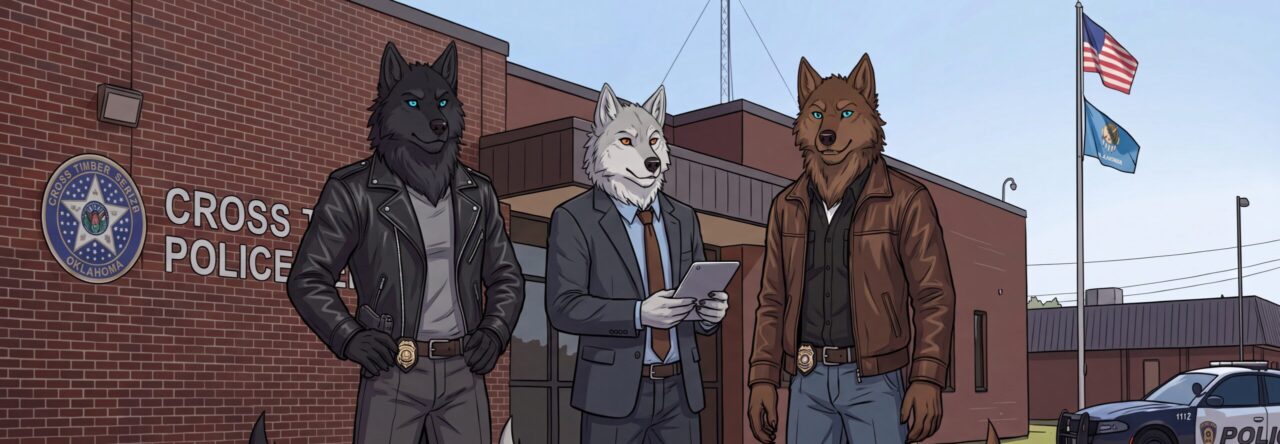
Author: Thane Page 12 of 17

Chapter 53 — Good Faith

The invoice arrived at 16:11 on Thursday afternoon.

Mark found it first.

He was seated at the long dining table in the cabin with his laptop open, a mug of coffee going cold beside him, and three different documents spread across the screen: the latest Cross Timber Community Fund update, a Red River Community Foundation compliance notice, and the City of Cross Timber’s preliminary acknowledgment of the restricted fleet-renewal grant.

Gabriel was in the kitchen trying to decide whether leftover pasta counted as breakfast, lunch, or a personal failure.

Thane stood at the counter, reading a patrol summary from the burglary cases and trying not to think about white cargo vans.

Mark’s phone chimed.

He glanced down.

Then frowned.

“Eli sent an invoice.”

Gabriel looked up from the refrigerator.

“An invoice?”

“Apparently.”

Thane turned.

“For the fund work?”

Mark opened the email.

“Cross Timber Community Fund. Safe Steps. Quiet Response compliance review. Municipal fleet grant structure. City Legal coordination.”

Gabriel shut the refrigerator door with his hip.

“That is a lot of lawyer hours.”

“It is.”

“How much?”

Mark’s eyes moved across the itemized document.

Then stopped.

His brow furrowed.

Gabriel looked at Thane.

“That is never a good face.”

Mark rotated the laptop so they could see.

The invoice was formatted exactly like every other invoice Elias Carroway had ever sent them.

Clean white page.

Carroway & Wexler LLP letterhead.

Matter number.

Date range.

Detailed service entries.

Professional services rendered: 16.8 hours
Rate: $400.00 per hour
Subtotal: $6,720.00

Gabriel nodded.

“That seems like Eli.”

Mark scrolled down.

Then paused again.

Below the subtotal was one additional line.

Good-faith charitable-services adjustment: -$6,720.00

At the bottom:

Amount Due: $0.00

For a moment, no one spoke.

Gabriel leaned closer.

“Is that a typo?”

Mark shook his head.

“It is not.”

Thane looked at the number again.

Eli had always charged four hundred dollars an hour.

He had earned it.

He had charged it for acquisition documents, real-estate structures, trust revisions, civil matters, contract fights, corporate cleanup, and a long list of things Thane only vaguely understood but knew were important because Mark read every page twice and Eli never raised his voice when explaining them.

Sixteen-point-eight hours of Eli’s time should have been expensive.

It had been expensive.

It just was not being charged to them.

Gabriel looked at Thane.

“Call him.”

Thane did.

Eli answered on the first ring.

“Thane.”

“Eli.”

“You received the invoice.”

“We did.”

“And?”

“It says zero.”

“Yes.”

Gabriel leaned into the speakerphone from the kitchen island.

“Did your billing department get kidnapped?”

Eli was quiet for half a beat.

Then he said, “My billing department is one of the most frightening forces in the state of Oklahoma. Nobody kidnapped them.”

Mark closed the laptop halfway.

“Then why did you waive the fees?”

Eli’s voice softened.

Not much.

But enough.

“Because I cannot, in good conscience, charge you money for the work you are doing to help people.”

Thane leaned one hip against the counter.

“We hired you.”

“Yes.”

“We expect to pay you.”

“You do pay me.”

“For this work too.”

“No,” Eli said. “Not for this.”

Gabriel looked at Mark.

Mark looked equally confused.

Eli continued.

“You came to me because you wanted to build something that would help people without humiliating them, obligating them, or making yourselves the center of it. You have followed every safeguard I put in front of you. You have listened when I said no. You have allowed professionals to make decisions you could have tried to control.”

“That was the point,” Thane said.

“I know,” Eli replied. “And I appreciate it.”

The words settled quietly into the kitchen.

Outside, the late afternoon sun fell through the trees in long gold strips. The cabin smelled like coffee, pasta sauce, and the cedar-clean scent of the woodwork warming in the light.

Eli went on.

“Carroway & Wexler has a pro bono and community-service practice. We take on matters that do not make the firm money because that is part of being a firm with the resources to do it. I am assigning the Cross Timber Community Fund, Safe Steps, the Quiet Response account, and the municipal grant work to that side of the ledger.”

Gabriel blinked.

“So you are doing pro bono work.”

“For you, yes.”

Gabriel’s ears lifted.

“A lawyer doing something for free. We should document this.”

“Do not.”

“Put it in a museum.”

“Gabriel.”

“Call the mayor. She likes ceremonial things.”

Eli sighed.

“I am revising my earlier opinion. You may be my most exhausting clients.”

Mark opened the invoice again.

“Will this create any issue with the fund’s compliance?”

“No. The fund receives proper legal services. The firm independently chooses not to bill the clients for those services. The accounting remains accurate. There are no hidden charges, no tax games, and no special favors waiting to happen later.”

Thane looked down at the phone.

“You do not have to do this.”

“I know.”

“Then why?”

Eli was quiet for a second.

When he spoke again, his voice held none of the practiced attorney polish he used in meetings.

“Because I have represented wealthy people for most of my adult life. I have watched people spend absurd amounts of money making themselves feel important. I have watched clients buy influence, recognition, access, and the right to have their names placed on buildings they did not need.”

Gabriel’s expression changed.

Eli continued.

“And then I have three clients who call me because they hear an officer crying behind a police station, or see somebody who needs a hotel room, or realize the local shelter cannot keep enough beds clean, or overhear that patrol officers are driving twelve-year-old vehicles until something breaks.”

Thane said nothing.

“You three have good hearts,” Eli said. “You are trying to do good without making anyone owe you for it. I am not charging you money in the pursuit of that.”

The kitchen had gone entirely quiet.

Then Gabriel cleared his throat.

“Wow.”

Mark looked down at the invoice.

Thane swallowed once.

“Thank you, Eli.”

“You are welcome.”

Gabriel leaned into the speakerphone again.

“So this is what happens when lawyers develop feelings.”

Eli said, “This is what happens when clients finally behave in a manner that does not require emergency legal triage.”

“That is harsh.”

“That is accurate.”

Mark’s mouth twitched.

Gabriel pointed at him.

“Do not encourage him.”

Eli added, “And do not get used to it. The next time you call me because one of you has driven a military vehicle through a restricted-access ornamental fountain, I will charge you double.”

Thane’s ears tipped back.

“That happened once.”

“It happened once too many times.”

Gabriel smiled.

“Could the foundation buy a fountain?”

“No.”

“Could it buy a zoo?”

“No.”

“Could it buy a zoo with a fountain?”

“Goodbye, Gabriel.”

The line went dead.

For a moment, the three wolves stood around the kitchen island in the warm quiet.

Then Mark closed the laptop.

“He is a good attorney.”

Gabriel looked at him.

“You are becoming emotional.”

“I am making an accurate statement.”

Thane picked up the phone and looked at the zero-dollar invoice once more.

Then set it down.

“Good hearts,” he said quietly.

Gabriel looked at him.

“Yeah.”

Mark nodded.

“Now we need to go to work.”


The station was busy when Night Shift arrived.

Not overwhelmed.

Not in crisis.

Just carrying the dense, humming energy of a city that had reached Thursday evening and was already beginning to make plans for the weekend.

Patrol units checked in and out through Dispatch. The front desk phone rang twice before someone answered it. A records clerk pushed a cart full of archived case boxes past the bullpen. The break room smelled like microwave popcorn and burned coffee.

The patrol-duty board had no poster on it.

The Night Shift office case board had no poster on it either.

Thane noticed both facts immediately.

Gabriel noticed him noticing.

“See?” he said. “I learn.”

“You hid the original in Mark’s cabinet.”

“I preserved a cultural artifact.”

Mark walked past them.

“It is secured.”

“It is evidence,” Gabriel said.

“It is not.”

“It documents a workplace incident.”

Thane stopped.

Mark stopped too.

Gabriel looked between them.

Then smiled.

“You are both still mad.”

“No,” Thane said.

“Yes,” Mark said.

Gabriel looked pleased.

“Good.”

They entered the conference room for the evening handoff.

Voss stood at the case board with a thick folder in one hand and a smaller stack of property-crimes reports in the other. Rusk leaned against the conference table, coffee in hand. Kessler sat at the laptop station, jacket still on, reviewing vehicle-registration records.

Mercer was nowhere in sight.

The fleet grant had moved quietly through City Legal. No public notice had gone out yet. No speeches. No council announcement. Just the slow machinery of municipal process doing what it had to do.

Thane liked that.

The board carried two new headings beneath Leah Moreno’s active-prosecution file.

ACCESS BURGLARIES
LUIS ORTEGA ASSAULT / DEVELOPMENT THEFT

Voss tapped the first.

“Property crimes first,” she said.

Mark opened his notebook.

“Since the Mullen burglary, we have two additional reports that fit the pattern. Same general neighborhood type. Same daylight time window. No obvious valuables taken. Smart-home systems briefly disrupted.”

Kessler clicked a map onto the screen.

Five red markers appeared across Cross Timber.

The homes sat in different subdivisions, but the map revealed what the individual reports had hidden.

They formed a loose arc around the northern and western edges of the city.

Not random.

Not yet a clean line either.

“Items taken are still access and identity materials,” Kessler said. “Spare keys. garage remotes. mail. old phones. vehicle documents. insurance cards. one home had a binder containing family schedules, school pickup information, and account-recovery printouts.”

Gabriel’s ears lowered.

“They are building profiles.”

“Possibly,” Voss said.

“They are,” Mark said, then corrected himself immediately. “The items support that possibility.”

Rusk pointed at the map.

“White cargo van appears near three of the five scenes. No readable plate yet. We found a rental-company logo on one partial frame from a neighborhood camera, but the image is blurred.”

“Rental company?” Thane asked.

“MetroWorks Fleet Rental,” Kessler said. “They rent commercial vans, utility trucks, trailers. Their corporate office is in Oklahoma City. We have preservation requests moving.”

Mark studied the map.

“Any common vendor for the home-security systems?”

“Yes,” Kessler said. “All five homes use either BrightNest Home Systems or a reseller called HomeLink Integrations.”

Thane looked up.

“Same company?”

“Related,” Kessler said. “BrightNest is the platform. HomeLink is a local installation contractor. Their technicians install cameras, routers, smart locks, garage integrations, all of it.”

Gabriel looked at the missing-property lists.

“So somebody with access to the installation side has a target list.”

“Maybe,” Voss said.

“Or someone acquired a target list,” Rusk added. “We do not have proof that the installer is involved. We have a lead.”

Kessler changed the screen.

A router-log summary appeared.

“Mark was right about the remote restarts,” he said. “The systems are not simply losing power. An unauthorized administrator credential is accessing the routers and initiating remote reboots.”

Mark’s ears tipped forward.

“Credential type?”

“Compromised technician credential, possibly. We are still working with BrightNest security. There are indications the access is coming through a legacy service account.”

“Could a former employee still have it?” Mark asked.

“Yes.”

“Or somebody using a former employee’s account,” Voss said.

Gabriel leaned back in his chair.

“Do we have names?”

“Not yet,” Kessler said. “But HomeLink provided a list of former technicians with expired access credentials. We are narrowing it.”

Voss looked at Night Shift.

“Tonight you have a fresh burglary scene in Stonebridge. Homeowner came home from a business dinner, found the garage side door open, and says the family command center was disturbed. Same general property profile.”

Thane nodded.

“Understood.”

Voss tapped the second heading.

“Luis Ortega.”

The room shifted.

Kessler brought up a development-site map.

“Luis is stable. Surgery on his leg went well. His concussion is mild. He is tired, medicated, and angry that we will not let him walk out of the hospital.”

Gabriel’s mouth moved faintly.

“Good.”

“His wife says that is the first normal thing he has done all week,” Rusk said.

Voss continued.

“Prairie Ridge has admitted there are material discrepancies. Copper, plumbing fixtures, HVAC components, tools, and some high-value electrical equipment. Not huge amounts from any one lot. Enough across several months to become serious.”

“Who has access?” Mark asked.

“Too many people,” Voss said. “Site supervisor. logistics coordinator. foremen. delivery drivers. subcontractors. warehouse staff. several company trucks.”

Kessler brought up another list.

“Luis’s note references ‘M.’ We now have three plausible M names: Mason Vail, logistics coordinator; Miguel Alvarez, equipment operator; and Matt Reddin, assistant site supervisor.”

Gabriel looked at the screen.

“Any of them own or use a blue vehicle?”

“All three can access Prairie Ridge fleet trucks,” Kessler said. “Mason Vail had a blue company pickup assigned to him Thursday. The paint transfer near the culvert is consistent with Prairie Ridge fleet blue, but that does not narrow it to one vehicle.”

Thane looked at the information.

“Luis say anything new?”

“Not enough to identify his attacker,” Voss said. “But he remembers being told, ‘You should have let it go.’ He also remembers the smell of citrus hand cleaner.”

Gabriel glanced at the board.

“Common on construction sites.”

“Very,” Rusk said.

“Any video?” Mark asked.

“Development cameras cover the main entrance and trailer. Not the south drainage easement. We have one camera at a nearby fuel station that may catch outbound vehicles. The footage is being preserved.”

Voss looked at Night Shift.

“You will start at Stonebridge. Once that scene is stable, meet Bell at Prairie Ridge. Luis has agreed to a short follow-up conversation tonight if his doctor clears it. Do not make him relive the assault. We are looking for what he had found before he was attacked.”

Gabriel nodded.

“Understood.”

Voss closed the folder.

“One more thing. Do not decide that these two cases are connected to anything else because both involve access, information, or theft. Cross Timber is allowed to have more than one bad thing happening at a time.”

Gabriel looked at Thane.

“She said that directly at us.”

“She did,” Thane said.

Rusk took a drink of coffee.

“She is learning.”


Stonebridge was quieter than Brookstone Estates.

The houses were still expensive, still neat, still built around lawns that looked professionally maintained by people who did not enjoy lawn work. But there were more trees, narrower streets, and older construction. The neighborhood had grown in layers rather than all at once.

The home belonged to Darren and Nora Whitcomb.

They stood in their kitchen when Night Shift arrived, still wearing the formal clothes they had left for dinner in.

Nora held a dish towel in both hands.

Darren stood at the back counter, staring at the open door that led to the garage.

Officer Grant met the wolves near the entryway.

“Garage side door was found open when they got home. No one inside now. Same weird item list.”

Thane nodded.

“Camera?”

“BrightNest. Connection gap from 19:36 to 19:48.”

Mark’s expression tightened.

“Same window length?”

“Almost exactly.”

The kitchen smelled like lemon cleaner, coffee, old wood, and the faint warm scent of a family meal that had been planned but never made.

There was also the unfamiliar scent of work gloves, faintly rubberized, and a thread of citrus hand cleaner near the garage door.

Thane did not say anything yet.

Citrus hand cleaner was not proof.

It was a smell.

A common one.

But common things could still matter if they kept appearing in places they did not belong.

Mark moved toward the family command center mounted beside the refrigerator.

The board held the ordinary architecture of a household.

School calendars.

Soccer schedules.

A dry-cleaning coupon.

A pediatrician’s appointment card.

A list of emergency contacts.

A sheet of paper titled GATE CODES / HOME INFO.

Several pages were missing.

Mark photographed the board before anyone touched it.

Gabriel stood beside Nora.

“What do you think is gone?”

Nora swallowed.

“I do not know. It is not like jewelry was taken. Nothing like that.”

“Walk us through what you have noticed.”

“The garage remote from my car. Our spare house key. An old tablet from the desk drawer. A folder with insurance papers and vehicle information.”

“Anything from your children?”

Nora looked toward the hallway.

“My daughter’s old phone. It was in a drawer upstairs. She has a new one now, but all her old photos were on that phone.”

Gabriel’s ears lowered.

“Was it password protected?”

“I think so.”

“Think?”

“She is thirteen.”

Gabriel nodded slightly.

“Fair.”

Thane looked at the garage door.

The side entrance showed no damage.

The deadbolt had been unlocked.

The home’s main router sat in a cabinet near the command center.

Mark had already found the router event logs.

“Same administrator credential,” he said. “Same style of remote reboot. The camera system was intentionally looped, not merely disabled.”

Grant looked over.

“Same person?”

“Same access method,” Mark said. “That is not the same thing.”

A sound came from the back of the house.

A soft electronic chirp.

Then another.

Nora looked toward the stairs.

“That is my son’s room.”

Everyone went still.

Grant raised his radio.

Thane moved first, not rushing, but fast enough that the others followed.

The upstairs hallway was empty.

No intruder.

No moving shadow.

No sound except the regular hum of air conditioning.

The chirp came again.

From a small smart speaker sitting on a desk near the boy’s bed.

The device’s ring light pulsed blue.

Mark stepped closer.

“Do not touch it.”

The speaker chimed once more.

Then a synthetic voice said:

“Your device is offline.”

Nora stared at it.

“That was not offline earlier.”

Mark checked his tablet.

“The smart-home account is receiving another access attempt.”

Thane looked at the device.

“From where?”

Mark’s fingers moved quickly.

“Not enough information yet. But someone is trying to connect to their system right now.”

Gabriel’s ears tipped forward.

“From the house?”

“No,” Mark said. “Remote request.”

Grant keyed his radio.

“Dispatch, can you advise whether units are available for an increased visibility pass at the Whitcomb address? Possible ongoing smart-home intrusion.”

Dispatch acknowledged.

Mark’s expression stayed focused.

“The request is routing through a cellular data connection. The address is not visible.”

“Can BrightNest trace it?” Thane asked.

“Eventually.”

“Eventually is not now.”

“No,” Mark agreed.

Nora stood in the doorway, pale.

“Are they watching us?”

Gabriel turned toward her.

“We do not know that. But we are going to make sure they cannot get back in tonight.”

He looked at Mark.

“What do we need?”

“Disconnect the system from the network. Change the router credentials through a clean device. Disable remote administration. Reset every smart lock, garage integration, and account-recovery email.”

Nora looked overwhelmed.

“That sounds impossible.”

“It is not,” Mark said. “It is just a list.”

Thane looked at Grant.

“Can patrol stay visible until they are secure?”

Grant nodded.

“I can arrange it.”

For the next forty minutes, the three detectives did the work nobody would call dramatic.

Mark walked Nora and Darren through account resets and physical disconnections.

Gabriel helped their teenage daughter understand why her old phone needed to be preserved as possible evidence without making her feel like she had done something wrong.

Thane helped Darren re-secure the garage door and confirm every spare key location in the house.

The family did not leave.

They did not want to.

So Night Shift helped make the place feel like theirs again.

Before they left, Mark received a secure message from BrightNest.

He read it once.

Then looked at Thane.

“Connection attempt was routed through a MetroWorks rental van hotspot.”

Thane’s ears tipped forward.

“Can they identify it?”

“Not yet. But MetroWorks has a fleet telemetry request coming. We may have a live vehicle soon.”

Gabriel looked toward the street.

“The van might be out there right now.”

“Maybe,” Mark said.

Thane looked at the secure home.

The disabled smart devices.

The scared family trying to regain the ordinary shape of their evening.

“Then we find it.”


Prairie Ridge was darker than it had been the night Luis was found.

Most of the work lights were off. The half-built homes stood in black silhouettes against the sky. The temporary office trailer glowed at the main entrance, and one security vehicle moved slowly along the unfinished road.

Officer Bell waited near the trailer, hands tucked into his jacket pockets.

“Hospital cleared him for a short interview,” he said. “He is tired. No pressure.”

“Good,” Gabriel said.

The hospital room was dim.

Luis Ortega sat propped up in bed with a bulky cast on his lower leg and an IV in one arm. He looked pale, bruised, and deeply unhappy about being in a hospital gown.

His wife, Marina, sat beside him with a paper cup of coffee and the exhausted expression of someone who had not left the room for long enough to sleep properly.

When the wolves entered, Luis tried to sit straighter.

Gabriel immediately lifted one hand.

“Do not.”

Luis gave a small, tired smile.

“Hard to look useful like this.”

“You are allowed not to be useful for a while,” Gabriel said.

Marina’s eyes softened.

Mark took the chair near the window. Thane remained beside the door, giving Luis room.

Gabriel sat across from the bed.

“We are not here to make you tell the whole story again.”

Luis nodded.

“Good.”

“We are trying to understand what you found before somebody hurt you.”

Luis looked at the ceiling for a moment.

Then closed his eyes.

“Materials were disappearing,” he said. “Not all at once. A few pipes. fixture boxes. copper bundles. specialty wire. Things that could be written off as delivery mistakes or breakage.”

“Who had access to the records?” Mark asked.

“Everyone with a reason,” Luis said. “But not everyone had the same reason.”

“Did you tell anyone?” Gabriel asked.

“My supervisor first. He told me to document it. So I did.”

“Who else?”

Luis’s mouth tightened.

“Mason Vail.”

“The logistics coordinator?” Mark asked.

Luis nodded.

“He said I was overthinking it. Said the counts always looked messy at the end of a project phase.”

“What did you think?” Thane asked.

“I thought he was scared.”

Gabriel’s expression stayed gentle.

“Why?”

“Because he got angry too fast.”

Luis looked down at the blanket over his legs.

“I did not think he would hurt me. I thought he was stealing. Or covering for somebody stealing.”

“Did you see him the night you were attacked?” Gabriel asked.

Luis shook his head.

“No. I heard a truck. Someone walked up behind me. I turned and got hit. I remember the ground. The culvert. A voice.”

“Could you identify the voice?”

“No.”

“Did it sound like Mason?”

Luis hesitated.

“I do not know. Maybe. But I do not know.”

Gabriel nodded immediately.

“Then we do not put that in your mouth.”

Luis looked grateful.

Mark opened a small evidence folder.

“Your note mentioned altered trailer records and Lot 17 and Lot 22. Do you have copies anywhere else?”

Luis was quiet.

Then looked at Marina.

She looked back at him.

“You can tell them,” she said.

Luis nodded once.

“I took photos.”

“Of what?” Mark asked.

“Delivery sheets. Inventory spreadsheets. Truck logs. I took pictures because the numbers changed after I entered them.”

“Where are the photos?” Thane asked.

Luis looked embarrassed.

“On my phone.”

“Which is still missing.”

“Yeah.”

“Anywhere else?”

Luis shook his head.

Then stopped.

“Wait.”

Gabriel leaned forward slightly.

“What?”

“My old laptop.”

“Where?”

“In the garage at home. I copied some stuff there because I did not want it on my work tablet.”

Marina sat up.

“The laptop in the blue storage bin?”

Luis nodded.

“I think so.”

Mark’s pen moved quickly.

“Would you consent to us collecting it?”

“Yes.”

“Thank you.”

Luis looked at Thane.

“Did you find who did this?”

“No,” Thane said.

Luis’s face tightened.

“But we are closer,” Thane added.

Luis watched him.

“Do not make it worse for my wife.”

Thane held his gaze.

“We will not.”

Marina looked from one wolf to another.

Then nodded.

The interview ended there.

Not because they had everything.

Because they had enough for now.


At 22:48, Night Shift went to Luis Ortega’s house with Marina’s written consent and a patrol officer for the property log.

The garage smelled like dust, motor oil, old cardboard, and the clean citrus scent of laundry soap.

The blue storage bin sat under a workbench beneath a stack of holiday decorations.

Inside was an aging laptop wrapped in a gray sweatshirt.

Mark photographed it before touching it.

“Power status?”

“Off,” Thane said.

“Good.”

“Could it contain something?”

“It could contain anything,” Mark replied.

Gabriel crouched beside the bin.

“Optimism is a beautiful thing.”

Mark looked at him.

“It is not optimism. It is data preservation.”

The laptop went into an evidence bag.

A small thing.

A gray plastic machine with a cracked hinge and an old sticker from a college football team on the lid.

But it might contain the copy Luis had made before he disappeared.

It might explain the altered records.

It might tell them why someone had decided to leave him hurt in a drainage culvert.

Outside, the night remained quiet.

Too quiet, Thane thought.

The kind of quiet that did not mean nothing was happening.

The kind that meant somebody else was waiting to see whether the things they had hidden stayed hidden.


At 00:16, Dispatch interrupted their evidence return.

“Night Shift, Patrol Four is requesting your assistance at Westgate Service Road. Possible white cargo van matching the property-crimes BOLO. Vehicle is stopped on an equipment-light violation. Driver is cooperative. Requesting investigative response.”

Gabriel sat up in the passenger seat.

“That was fast.”

Thane turned the Humvee toward Westgate.

The van sat on the side of the road beneath a broken streetlight.

White cargo body.

No company lettering.

Rental sticker low on the rear bumper.

Officer Grant stood near the driver’s door while another patrol officer watched the passenger side.

The driver was a heavyset man in his forties wearing a gray work shirt.

His hands rested visibly on the steering wheel.

Thane pulled behind the patrol unit.

Mark checked the plate through the secure system before they stepped out.

“MetroWorks rental,” he said. “Reserved to a Bryan Latham. Rental began three days ago. Return date Monday.”

“Any connection to HomeLink?” Gabriel asked.

“Not yet.”

Grant met them near the rear of the van.

“Equipment light was out. Dispatch flagged the rental company and vehicle profile. Driver says he is moving office equipment for his brother.”

“Cargo area?” Thane asked.

“Locked. He declined consent.”

“His right,” Mark said.

Grant nodded.

“Driver has no warrants. License valid. Rental agreement matches his name. He has been polite.”

Thane looked through the open driver-side window.

The van smelled of fast food, old coffee, sweat, rubber gloves, and a faint electrical-plastic scent.

There was something else beneath it.

A familiar sharp note.

Citrus hand cleaner.

Common.

Still common.

The front seat held a receipt, a high-visibility vest, and a folded clipboard.

Nothing obvious.

Nothing that gave them legal grounds to force the cargo door open.

Gabriel approached the driver’s window with Grant.

“Mr. Latham?”

“Yeah.”

“I am Detective Gabriel. We are following up on a few property-crime cases involving a vehicle that may resemble this one.”

The man’s eyes shifted briefly toward the mirrors.

“I have not robbed anybody.”

“We did not say you did.”

“I am moving stuff for my brother.”

“Okay. What kind of stuff?”

“Office stuff. Chairs. Desks. A copier.”

“Where from?”

“Storage unit in Edmond.”

“Where to?”

“His place.”

“Where is that?”

The driver named an apartment complex on the south side.

Mark checked it quietly from behind the patrol unit.

No obvious connection.

Gabriel looked at the man.

“Have you done any home-security work recently?”

“No.”

“Ever work for BrightNest or HomeLink?”

“No.”

“Ever work in installation or IT?”

“No.”

The answers came quickly.

Too quickly, Thane thought.

But speed was not proof.

Fear was not proof.

A citrus smell was certainly not proof.

Grant returned the driver’s license.

“Mr. Latham, your equipment light needs to be repaired. You are receiving a warning.”

The man looked relieved.

Not enough for anyone else to notice.

Enough for Thane.

He drove away after the warning.

The van’s taillights disappeared down Westgate Service Road.

Gabriel watched it go.

“That was him.”

Mark looked at him.

“That was a man who was nervous during a traffic stop.”

“He lied.”

“Maybe.”

“He said he was moving office equipment. There was no office-equipment smell.”

Mark stared at him.

“Office equipment has a smell?”

“Yes.”

“What does it smell like?”

“Dust. old carpet. stale paper. cables. printer toner. chairs that have been in a conference room for ten years.”

Thane looked at the road.

“Gabriel is right about one thing.”

Mark glanced at him.

“What?”

“The van did not smell like it was moving office equipment.”

Grant heard that.

“Can you use that?”

“Not alone,” Thane said.

“Not even close,” Mark added.

But Mark was already entering the rental information into the case file.

Bryan Latham.

White MetroWorks cargo van.

Three-day rental.

No known HomeLink employment.

Citrus hand cleaner.

High-visibility vest.

A lie that might be nothing.

A lie that might be the first loose thread in a larger pattern.

They let it go.

Because they had to.

Because good police work was not grabbing every suspicious person and hoping the evidence arrived later.

Because the law did not bend just because a detective’s instincts were loud.

Gabriel climbed back into the passenger seat.

“I hate letting him go.”

Thane started the engine.

“I know.”

Mark looked down at his laptop.

“We did not let him go. We documented him.”

Gabriel looked over his shoulder.

“That is a very Mark answer.”

“It is the correct answer.”

Thane pulled back onto the road.

“Then we make it useful.”


The rest of the shift was quieter.

Not empty.

Never empty.

A minor traffic collision at a four-way stop.

A panic alarm at a laundromat triggered by a malfunctioning dryer-control panel.

A welfare check on an elderly man whose neighbor had not seen him collect his newspaper in two days—he was fine, deeply annoyed, and had simply switched to digital news.

At 03:11, Dispatch sent Night Shift to the municipal golf course.

The caller reported “a large animal screaming near the seventh green.”

Gabriel read the call description twice.

“Large animal screaming.”

Thane looked at him.

“Do not say goat.”

“I was thinking peacock.”

“Why?”

“Because I have heard a peacock before. They sound haunted.”

Mark looked up from the back seat.

“Peacocks are not common at municipal golf courses.”

“Neither are screaming animals, Mark.”

The animal turned out to be a very offended fox caught in a loose section of decorative fencing.

It was not injured.

It was just extremely committed to making everyone aware that it resented assistance.

Thane carefully lifted the fence panel while Gabriel coaxed the fox backward with quiet words and Mark held the flashlight.

The fox bolted free, crossed the green, and vanished into the tree line.

Gabriel watched it go.

“That was not a peacock.”

“No,” Mark said.

“Still haunted, though.”

Thane got back into the Humvee.

“Write it clean.”

“I am not writing the report.”

“Good.”

At 04:02, they returned to the station to complete reports and secure Luis Ortega’s laptop.

Mark placed the evidence bag into the temporary digital-evidence locker and documented the chain of custody twice.

Gabriel sat at his desk, staring at the map of the burglary victims.

Thane stood near the case board.

Two cases.

A white van.

A missing phone.

A cracked old laptop.

A construction worker who had tried to prove a theft.

A group of burglars collecting the pieces of other people’s lives.

Nothing resolved.

Not yet.

But the city was beginning to show them where the seams were.

At 04:28, Mark’s laptop chimed.

He checked the incoming evidence notification.

Then went still.

Gabriel looked at him.

“What?”

“Digital forensics completed a preliminary extraction from Luis’s laptop.”

“That fast?” Thane asked.

“Luis had a simple local folder. No encryption. The examiner was able to image it immediately.”

Mark turned the screen toward them.

The folder list showed photographs and spreadsheets.

PRAIRIE RIDGE — KEEP COPIES
TRUCK LOGS
LOT 17
LOT 22
DO NOT LET M CHANGE

Gabriel’s ears lowered.

“‘Do not let M change.’”

Mark opened the last folder.

Inside were photos of handwritten delivery sheets beside screenshots of the same entries after they had been altered in the trailer system.

One name appeared repeatedly in the audit history.

Mason Vail

Not a full answer.

Not proof that Mason had attacked Luis.

But proof that Luis had not imagined the changes.

Proof that someone had been manipulating the records.

And proof that Mason Vail’s login credentials had been used to change them.

Thane looked at the screen.

“Send it to Voss.”

Mark did.

Within two minutes, a reply came back.

Preserve everything. Do not contact Vail. We will build the next warrant correctly. Good work. — Voss

Gabriel leaned back in his chair.

“One case gets a name.”

“Maybe,” Mark said.

“One case gets a rental van.”

“Maybe.”

Thane looked at both open folders.

“Then tomorrow we find out what those names open.”

The sky outside the station windows had begun to pale.

At 06:30, Voss, Rusk, and Kessler arrived for the handoff.

Voss read the forensic summary without speaking.

Then she looked at the three wolves.

“Mason Vail is no longer simply a possibility,” she said. “He is a person whose account changed the records Luis was tracking.”

Mark nodded.

“But we still need to establish who used the account, who benefited, and who assaulted Luis.”

“Exactly,” Voss said.

Kessler reviewed the MetroWorks rental summary.

“Bryan Latham has an old arrest for property theft in Tulsa. Nothing recent. No documented employment with HomeLink, BrightNest, or any registered smart-home company.”

Gabriel looked at him.

“Can we get his rental history?”

“Already requested.”

“Phone records?”

“Need more. But we are getting there.”

Rusk gathered his coffee.

“Good work tonight.”

Thane looked at him.

“Thank you.”

Rusk paused at the doorway.

Then added, “And for what it is worth, Carroway is a terrible influence.”

Gabriel blinked.

“What?”

Rusk gave him a look.

“Do not make me explain jokes.”

Then he left.

Voss’s eyes moved briefly to the three wolves.

Not suspicious.

Not exactly.

Just thoughtful.

Then she picked up the case files.

“Go home,” she said.

Night Shift stood.

The city was waking again.

Somewhere, a white cargo van sat in a parking lot or storage unit, full of things that looked too small to matter until someone understood what they were meant to open.

Somewhere else, Mason Vail woke up unaware that Luis Ortega’s old laptop had kept copies.

And in a downtown office, Elias Carroway had decided that helping people was worth more than sixteen-point-eight billable hours.

The pack walked out together.

The work waited.

But so did home.

Chapter 52 — What Opens

The first thing Thane noticed when they entered the station was that Deputy Chief Mercer’s office door was open.

The second thing he noticed was Mercer’s voice.

Not loud.

Not angry in the way people got angry when they wanted an audience.

Tight.

Measured.

The kind of controlled frustration that came from someone trying to explain the same urgent truth to a person who had already decided there was no money for it.

Thane slowed near the hallway junction.

Gabriel, beside him, took one more step before realizing Thane had stopped.

“What?” he murmured.

Thane lifted one paw.

Mark stopped on Thane’s other side.

Mercer stood inside his office with a phone pressed to one ear and one hand braced against the edge of his desk. The door was open just wide enough that the three wolves could hear him clearly without needing to move closer.

“No, I understand the capital schedule,” Mercer said. “I understand roads need money. I understand Fire needs equipment. I understand the water department has its own replacement plan.”

He listened.

Then rubbed one hand across his forehead.

“What I do not understand is how I am supposed to keep eighteen twelve-year-old patrol units on the street when half of them spend more time waiting on repairs than they do answering calls.”

Gabriel’s expression changed.

Mark’s ears angled forward.

Inside the office, Mercer continued.

“No, I am not asking for luxury vehicles. I am asking for modern patrol units that start reliably, brake reliably, run the radio and computer systems reliably, carry medical equipment, and get officers home at the end of a shift.”

A pause.

His jaw tightened.

“The full replacement package comes to one point seven million. That is eighteen Ford Police Interceptor Utilities, the standard police upfit, cameras, radios, protective partitions, equipment mounts, emergency lighting, and everything else that turns an SUV into a working patrol car.”

He listened again.

Then closed his eyes.

“No. I understand. Not this fiscal year.”

Another pause.

“Not next year either.”

Gabriel’s eyes moved toward Thane.

Mercer’s voice became quieter.

“Five years is too long.”

He listened.

For several seconds, nobody spoke.

Then Mercer said, “Understood. I will keep patching what I can.”

He ended the call.

The phone clicked softly into its cradle.

Thane stood in the hallway for one beat longer.

He could smell the stale coffee in Mercer’s office.

Printer toner.

The faint heat of a computer monitor.

And underneath it, the particular exhausted frustration of someone who had spent the afternoon being told that a safety problem was financially inconvenient.

Gabriel looked at him.

Thane looked at Mark.

Mark nodded once.

Gabriel nodded too.

No discussion.

No pack meeting.

No argument about whether the need was real.

Thane took out his phone.

They stepped away from Mercer’s office before he made the call.

Eli answered on the second ring.

“Thane.”

“Eli.”

“Please tell me no one has been arrested.”

“No one has been arrested.”

“Good. That puts us ahead of schedule.”

Gabriel leaned toward the phone.

“We overheard something.”

Eli was quiet for half a second.

“That sentence almost never improves.”

“Mercer was on the phone with the city,” Thane said. “They need patrol vehicles.”

“Every department needs patrol vehicles.”

“These are twelve years old,” Mark said. “Eighteen of them. The city cannot replace them this year. Or next year. Maybe not for five years.”

Eli’s voice changed.

Not softer.

Sharper.

Attorney attention settling into place.

“And the cost?”

“About one point seven million,” Thane said.

Gabriel added, “Fully outfitted. New Ford Police Interceptors. The actual police kind, not just regular SUVs with a light bar thrown on top.”

“I assumed as much.”

“We want to help,” Thane said.

Eli exhaled through his nose.

“Of course you do.”

“We want to do it right.”

“That is why I am still speaking to you.”

Mark looked down the hallway to make sure nobody was within earshot.

“The city needs to choose the specifications. The department needs full operational control. We do not select vehicles, officers, assignments, vendors, or policy.”

“Correct,” Eli said. “You are not privately purchasing eighteen police vehicles and dropping them in the department lot with giant bows.”

Gabriel’s face fell.

“I was not going to suggest giant bows.”

“Good.”

“I was going to suggest a tasteful banner.”

“No.”

“Fine.”

Eli continued.

“The Cross Timber Community Fund can make an anonymous restricted public-safety grant. The money goes to the city, not directly to the department. City Legal reviews it. Finance accepts it. The council approves it if their rules require approval. Fleet and procurement handle the purchase. The police department writes the specifications and assigns the vehicles. Your only condition is that the money is used for fleet replacement and police safety.”

“That is what we want,” Thane said.

“There will be people who need to know the donor’s identity.”

“We know.”

“City Legal, foundation leadership, their auditors, possibly the Chief and Mercer for conflict review. You cannot demand total secrecy from every person whose signature is legally required.”

“We are not asking that,” Thane said. “Just keep it quiet.”

“I can do quiet.”

Mark asked, “Can the grant cover upfit and delivery?”

“Yes. It should. Giving a city eighteen bare vehicles and asking it to somehow afford the radios, cages, cameras, lights, and equipment is not help. It is a new problem wearing a nice suit.”

Gabriel smiled.

“You are getting funnier.”

“I am billing you for that comment.”

Thane looked through the station windows toward the lot.

“How fast?”

“Not fast enough to appear magical,” Eli said. “Fast enough to be useful. I will speak with Red River’s executive director and the city attorney’s office. I will create the restricted grant language and have a preliminary offer delivered before tomorrow evening.”

Thane nodded even though Eli could not see him.

“Okay.”

Eli paused.

“Thane.”

“Yeah?”

“You heard a problem. You are allowed to care about it. But this is a municipal gift. Once it is made, you step back. No asking when the vehicles arrive. No asking who receives which unit. No asking whether the city chose the exact tires you would have chosen.”

Gabriel looked at Mark.

“Mark would ask about tires.”

“I would ask about procurement specifications,” Mark said.

Eli heard him.

“Precisely why I said it.”

Thane’s mouth twitched.

“We will step back.”

“Good,” Eli said. “Go be detectives. I will be your lawyer.”

The call ended.

For a moment, the three wolves stood in the hallway.

The department moved around them.

A patrol officer walked past with a report folder and did not look twice. Dispatch chatter crackled faintly through the communications wing. Someone laughed near the break room.

Gabriel looked at Thane.

“You know this is a lot.”

“Yes.”

“You okay with that?”

Thane looked toward Mercer’s office.

“Those officers drive those cars every night.”

Mark nodded.

“Then it is a legitimate need.”

Gabriel’s expression softened.

“Okay.”

Thane put his phone away.

“Briefing.”


Mercer came out of his office two minutes later.

His face had been reset.

The frustration was gone from it, or hidden well enough that most people would not see it.

He paused when he saw Night Shift near the Investigations hallway.

“Evening.”

“Evening,” Thane said.

Mercer looked at all three of them for a beat.

Then his eyes moved to the file in Mark’s hand.

“Quiet night,” he said.

Gabriel glanced at the ceiling.

“We would like one.”

Mercer’s mouth shifted almost imperceptibly.

“Do not say it out loud.”

Then he walked away.

The evening briefing began at 18:00.

Voss stood near the case board with Rusk beside her. Kessler was still finishing his day-shift notes at the conference table, laptop open and a jacket folded over the back of his chair.

Leah Moreno’s file remained active, but no longer sat at the center of the board.

The case was moving through the prosecutor’s office.

Lab analysis had begun.

Mays remained in custody.

There would be hearings, defense motions, follow-up interviews, and more work ahead.

But the emergency part had passed.

Tonight, the city had other problems.

Voss tapped two new folders on the table.

“First, we have a property-crimes pattern that may be nothing,” she said. “Or may be something that has been missed because each individual report looked too small.”

Gabriel leaned forward.

“What kind of property crime?”

“Residential burglary,” Rusk said.

Mark opened his notebook.

“High-value property?”

“That is the strange part,” Voss said. “Not really.”

She opened the first folder.

“Three homes in the north and west residential districts. No forced entry in two. One rear window removed cleanly. Electronics left behind. Jewelry left behind. Cash left behind.”

Thane frowned.

“What was taken?”

Rusk slid a property list toward them.

“Garage remotes. Spare keys. Mail. Prescription medications. A file folder from a home office. An old phone from a kitchen drawer. Vehicle registration papers. An emergency contact list from a refrigerator.”

Gabriel’s ears lowered.

“They are not taking valuables.”

“No,” Voss said.

Mark scanned the list.

“They are taking access.”

“Maybe,” Voss said. “Or they are taking information.”

Kessler turned his laptop so they could see a map.

The three homes sat in different subdivisions.

Far enough apart that patrol had not connected them.

All within a twenty-minute drive.

All entered during daylight hours while occupants were gone.

All houses with one thing in common.

“Each homeowner had a recently installed smart doorbell system,” Kessler said.

Gabriel looked at him.

“That is the connection?”

“Maybe. Or maybe the offenders simply knew those homeowners would assume the doorbell camera was enough.”

“Any video?” Thane asked.

“Partial,” Kessler said. “In each case, the camera either lost connection briefly or caught only a vehicle at the edge of the street.”

Mark studied the map.

“Same vehicle?”

“Unknown. One witness recalls a white cargo van. Another recalls a dark contractor SUV. Third has no vehicle description.”

Rusk leaned back in his chair.

“Right now, we have three weird burglaries. Patrol has a fresh call in Brookstone Estates. Same basic circumstance. Homeowner returned from dinner, found a back door unsecured, and says several things are missing that do not make any sense.”

Voss looked at Night Shift.

“You take that scene. Do not decide it is connected before you see it. Learn the house. Learn what is missing. Learn what is not.”

Thane nodded.

“Understood.”

Voss tapped the second folder.

“Then we have a missing-person report that came in less than an hour ago.”

The mood in the room shifted.

“Name is Luis Ortega,” she said. “Thirty-four. Construction foreman with Prairie Ridge Development. His wife reported him missing after he did not come home from work.”

Mark looked up.

“Vehicle?”

“Pickup truck found at the Briar Glen development site,” Rusk said. “His employer says he clocked out at seventeen-twenty. His wife says he texted her at seventeen-forty-six that he was ‘running late’ and would explain when he got home.”

“Phone?” Gabriel asked.

“Last location near the development. Then nothing.”

“Medical concerns?”

“His wife says he has Type 1 diabetes,” Voss said. “His insulin kit was not in the truck. But his backup supplies were left at home.”

Thane’s eyes moved to the map.

“When did he disappear?”

“Somewhere between seventeen-twenty and eighteen-thirty, probably,” Voss said. “We do not know whether he left the development voluntarily, got a ride, was hurt, or is hiding from something.”

Rusk added, “We have patrol at the site. His wife is there now. Missing-person detectives are tied up on another active case, so this comes to you.”

“Start with Brookstone,” Voss said. “Then take the Ortega call. If the missing-person situation turns hot, call it in and we will come back.”

Kessler closed his laptop.

“Do not build a theory for either case before you have a reason.”

Gabriel nodded.

“Tonight’s theme.”

“Every night’s theme,” Kessler said.

Voss looked at the three wolves.

“Go.”


Brookstone Estates was one of those neighborhoods built to look like nobody had ever made a bad financial decision.

Neat brick homes.

Fresh landscaping.

Wide sidewalks.

Matching streetlights.

Driveways filled with expensive SUVs and pickup trucks that rarely carried anything dirtier than sporting equipment.

The home on Hawthorn Crest belonged to Steven and Carla Mullen.

They stood in their front room when Night Shift arrived, both still dressed for dinner.

Carla held a purse against her chest.

Steven held a baseball bat.

The bat had apparently been his first response to finding the back door open.

Thane looked at it.

Steven followed his gaze.

“I did not touch anything.”

“Good,” Thane said.

“I just picked that up when I heard something.”

“Still good.”

Officer Grant had arrived first and secured the house without entering farther than necessary.

“No sign anyone is still inside,” Grant said quietly. “Back door is open. Homeowners say they were out from about six-thirty to nine.”

“Camera system?” Mark asked.

“Doorbell camera and two exterior units. They lost connection for eleven minutes around seven-twelve.”

Grant gave him a look.

“Why?”

“Because that matters.”

The house smelled like fresh-cut flowers, expensive candle wax, dinner leftovers, and the sharp clean scent of an alarm system’s plastic components.

No unfamiliar person remained inside.

No fresh hidden presence.

But the entryway carried the layered smell of someone who had been there earlier.

Work boots.

Synthetic fabric.

Rubber gloves.

A faint metallic smell that did not belong to the house.

Thane stood near the open back door.

The latch had not been broken.

The deadbolt had not been forced.

The door had simply been opened.

“How do you usually secure this?” he asked.

Steven pointed to a keypad lock.

“It locks automatically.”

“Do you have spare keys?”

Carla’s face changed.

“There was one in the mudroom drawer.”

“Was,” Steven said.

They checked.

The drawer had been opened.

The key was gone.

Mark moved through the house with Carla, documenting each item that had been taken.

The list grew stranger.

A spare garage-door remote from the kitchen counter.

A folder from Steven’s home-office drawer containing vehicle insurance cards, a recent utility bill, and printed tax documents.

An old iPhone from a charging drawer.

A prescription bottle from the bathroom cabinet.

A set of spare car keys.

Not the primary keys.

The spare keys.

Gabriel stood beside Carla in the home office.

“Anything expensive missing?”

Carla shook her head.

“My laptop is right there. My jewelry box is upstairs. His watch collection is in the closet.”

Steven looked toward the hallway.

“They did not take any of that.”

“No,” Gabriel said. “They did not.”

“Why?”

Gabriel looked at the folder-shaped empty space in the desk drawer.

“We do not know yet.”

In the kitchen, Mark knelt beside the smart-home control panel.

“The system was not merely disconnected,” he said. “The router was rebooted remotely.”

Steven blinked.

“Can someone do that?”

“If they have access to the network,” Mark said. “Or if they are using a vulnerability. We will need the service logs.”

Carla looked frightened.

“Can they get back in?”

“Not if we help you secure it,” Mark said. “We will document what happened, then we will make sure you have the right next steps.”

Thane returned from the back door.

“Any exterior cameras on the alley?”

Grant nodded.

“Neighbor across the back fence has one. I am trying to reach them.”

Gabriel looked at Thane.

“They took enough information to know routines.”

“Maybe,” Thane said.

“Maybe,” Mark corrected from the control panel.

Thane nodded.

“Maybe.”

The neighbor’s camera gave them forty-five seconds of usable footage.

A white utility van had pulled into the rear service lane at 19:08.

No clear logo.

No readable plate.

The driver wore dark work clothes and a baseball cap.

The van remained just outside the Mullen property line for nine minutes.

Then drove away.

The intrusion began at 19:11.

The doorbell system returned online at 19:23.

Thane watched the footage twice.

Then looked at the strange missing-property list again.

“They are not stealing things,” he said.

Mark looked up.

“They are stealing routes.”

Gabriel’s ears tipped forward.

“Routes?”

“Keys. remotes. mail. records. phones. schedules. Vehicle information,” Mark said. “Things that tell them how to come back, how to access something else, or how to pretend to be the owner.”

Steven stared at him.

“You think they are coming back?”

“We do not know,” Thane said immediately.

“But we are going to make sure they cannot.”

They spent the next hour doing the part of police work most people did not picture when they imagined detectives.

Helping the Mullens change the physical lock cylinder.

Explaining how to disable and reprogram garage remotes.

Connecting them with the smart-home company’s emergency support line.

Telling them what credit-monitoring steps to take.

Making sure they had a safe place to sleep if the house no longer felt safe.

Carla did not want to leave.

Not because she believed the burglars were outside.

Because she refused to be chased from her own home.

Thane understood that.

So he did not push.

He simply made sure patrol added the house to its overnight visibility list.

Before they left, Steven stood in the entryway, baseball bat still leaning against the wall.

“Are you going to catch them?” he asked.

Thane looked at the open front room.

The clean furniture.

The strange missing pieces.

The places where a person’s life had been quietly copied instead of robbed.

“We are going to find out what they are opening,” Thane said.

Steven did not look reassured.

But he nodded.

It was the best answer Thane could give.


At 21:36, Dispatch updated the Ortega call.

Luis Ortega’s wife had received no new messages.

His pickup remained at the Briar Glen development.

The site supervisor had checked the active work areas and found nothing.

Patrol had started a perimeter, but the development sat against a broad stretch of unfinished lots, construction roads, drainage channels, and wooded property that ran toward the creek.

Thane turned the Humvee south.

The development came into view twenty minutes later.

Half-built homes stood along unfinished streets beneath portable work lights.

Framing lumber lay stacked beneath tarps.

A backhoe rested beside a pile of dirt.

A temporary construction trailer glowed near the main entrance.

Beyond the last row of lots, the land fell away toward dark brush and a shallow drainage easement.

Luis Ortega’s pickup sat alone near a model-home lot.

The driver’s door was locked.

The cab was dark.

His wife stood beside Officer Bell near the construction trailer.

She was small, dark-haired, wearing jeans and a light jacket pulled tight around herself despite the warmth.

When she saw the Humvee, she looked up.

Not relieved exactly.

More like she had reached the point where every new person arriving represented another chance that someone might know what to do.

Bell met them near the truck.

“His name is Luis Ortega. Thirty-four. Foreman. Wife says he is not the kind of person who disappears.”

Thane nodded.

“What did the company say?”

“Supervisor says Luis left the main work area around five-twenty. He was supposed to close out a materials count and go home. He did not clock out through the trailer system, but his work tablet was left inside.”

Mark’s ears lifted.

“Left inside?”

“On the desk,” Bell said. “Logged in. No sign-off.”

Gabriel looked toward the pickup.

“Phone?”

“Last carrier ping placed it near the south edge of the development at eighteen-oh-one. No activity since.”

Luis’s wife stepped closer.

“My husband does not leave his tablet,” she said. “He forgets lunch. He forgets his jacket. He forgets every birthday except mine. But he does not leave his tablet.”

Gabriel softened immediately.

“What was he wearing when he left for work?”

“Blue work shirt. Reflective vest. Boots. Black ball cap. He had his insulin kit with him. It is not in the truck.”

“Any argument recently?” Mark asked.

She hesitated.

“Not with me.”

“That is okay,” Gabriel said. “We are not asking you to protect anyone. We are asking what might matter.”

Luis’s wife looked toward the construction trailer.

“He told me last week that something was wrong at work. He said somebody was stealing materials and making it look like inventory errors.”

Bell looked at Thane.

“Supervisor says there have been discrepancies.”

“Who was Luis talking about?” Thane asked.

She shook her head.

“He did not say. He said he did not want to bring it home until he knew what he could prove.”

Thane felt the phrase settle into place.

What you can prove.

Luis had been trying to do the job right.

And now he was missing.

Mark stepped toward the pickup.

“Can we process the vehicle?”

Bell nodded.

“Wife consented. It is his truck.”

The pickup smelled like dust, coffee, motor oil, Luis’s sweat, and the faint medicinal scent of insulin supplies.

Nothing inside suggested he planned to leave town.

His wallet was in the center console.

His work bag sat behind the passenger seat.

A lunch container, mostly untouched, rested in a cooler bag on the floorboard.

His keys were gone.

His phone was gone.

And in the cup holder sat a folded piece of paper.

Mark photographed it before unfolding it.

A handwritten list.

Lot 17 — fixtures short
Lot 22 — copper count wrong
Trailer records altered?
Ask M. why truck left early

Mark looked at Bell.

“Who is M.?”

Bell shook his head.

“Could be anyone.”

Thane took a slow breath.

Luis’s scent led away from the truck.

Toward the south edge of the development.

Past the last framed house.

Past a row of stacked drywall.

Toward the drainage easement.

He looked at Gabriel.

Gabriel tilted his head.

At first there was only the construction site.

Wind brushing tarp edges.

A metal panel knocking somewhere in the dark.

The distant traffic of the highway.

Then, faintly, almost too faint to trust—

A sound.

Not a voice.

Not exactly.

A repeated metallic tap.

Tap.

Pause.

Tap.

Gabriel looked toward the drainage line.

“Something.”

Mark opened the site map on his tablet.

“The south easement runs under the access road through a storm culvert. There is a utility trench farther east.”

Bell’s expression tightened.

“Search team is five minutes out.”

“We have a scent trail,” Thane said.

Bell looked at him.

Then toward the dark brush.

“Can you follow it?”

“Yes.”

“Can you do it without getting yourself hurt?”

Thane looked at the unfinished ground.

The rebar.

The unstable dirt piles.

The drainage channel.

“No promises,” Gabriel said.

Thane looked at him.

Gabriel raised both hands.

“Sorry.”

Bell made a decision.

“Grant is coming in from the west with a second unit. You three take the main trail to the culvert. Stay on radio. Do not go into any confined space without Fire or rescue.”

“Understood,” Mark said.

They moved.

The scent trail was not easy.

Construction sites held too many layered smells.

Wet dirt.

Concrete dust.

Diesel.

Paint.

Wood.

Metal.

Sweat from dozens of workers.

But Luis’s scent was there.

Fresher near the pickup.

Then broken.

Then stronger again where he had crossed the edge of the site.

Thane followed it down the slope.

Gabriel stayed close enough to listen.

Mark navigated with the site map and flashlight.

The drainage easement opened into a wide cut beneath the unfinished access road.

A large concrete culvert ran under the roadbed.

Water moved through the bottom in a shallow, muddy stream.

The repeated tap came again.

Tap.

Pause.

Tap.

Gabriel’s ears lifted.

“Luis!”

The tapping stopped.

Then a weak voice came from inside the culvert.

“Here.”

Thane dropped to one knee near the entrance.

“Luis Ortega?”

“Yes.”

“Police. Do not move if you can help it.”

“I cannot.”

His voice was strained.

Too weak.

Gabriel crouched beside Thane.

“What happened?”

“I fell,” Luis said from the darkness. “Something hit me. I think my leg—”

Thane’s eyes narrowed.

“Something hit you?”

“I was walking back from the trailer. Somebody came up behind me. I heard a truck. Then I woke up down here.”

Bell’s voice came through the radio.

“Night Shift, status?”

Thane keyed his mic.

“Located Luis Ortega alive in south culvert. Possible leg injury and possible assault. He says he was struck and fell into the drainage channel. Need Fire and EMS at culvert access. We are holding position.”

“Copy. Fire and EMS rerouting. Stay out of the culvert.”

Thane looked into the dark opening.

Luis’s scent carried blood.

Not much.

But enough.

Pain.

Fear.

Mud.

And something else.

A sharper odor beneath it.

Fresh diesel exhaust.

A particular synthetic rubber scent from large work tires.

Gabriel caught it too.

“Someone drove down here,” he said quietly.

Mark looked at the ground near the culvert entrance.

“There are tire tracks.”

Not normal construction tracks.

Newer.

Deep in the damp dirt.

A vehicle had pulled down the service lane after rain earlier in the day, then reversed quickly.

Thane scanned the pattern.

“Truck came in from the east.”

“Can we tell what kind?” Bell asked over radio.

“Not yet,” Mark said. “But it is not Luis’s pickup.”

Inside the culvert, Luis coughed.

“Please,” he said. “I need insulin.”

Gabriel’s expression changed.

Mark checked the clock.

“How long since he took it?”

Luis’s answer was too weak to be useful.

Thane keyed the radio again.

“Advise EMS: diabetic patient, insulin kit missing, timing unknown. Expedite.”

“Copy.”

They waited.

It felt like the longest kind of wait.

The kind where someone was close enough to hear but not close enough to safely reach.

Gabriel kept talking to Luis.

Not asking for a full statement.

Not pressing him for details.

Just keeping him awake.

“What is your wife’s name?” Gabriel asked.

“Marina.”

“She is here. She knows we found you.”

“Tell her I am sorry.”

“You can tell her yourself.”

Luis made a weak sound that might have been a laugh.

Mark kept the radio updates clean and regular.

Location.

Patient status.

Scene hazards.

Possible vehicle tracks.

No theories.

No accusations.

No guesses about who had done this.

Thane watched the darkness inside the culvert.

He wanted to go in.

Every part of him wanted to crawl through the mud and drag Luis out before another minute passed.

But Bell’s voice came back in his mind.

Do not become the wall.

And Hale’s.

Strength is easy. Authority is not.

And Voss’s.

Name it first. Move second.

So Thane stayed where he was.

He gave the facts.

He waited for the right people.

He did not turn instinct into action just because the instinct hurt.

Fire arrived six minutes later.

It felt like sixty.

Rescue personnel lowered a medic into the culvert with a rope line and a spine board. Thane stayed at the entrance, helping light the space and keeping the area clear.

Luis had a broken lower leg.

A head injury that needed evaluation.

No obvious gunshot wound.

No immediate sign of severe bleeding.

But he had been down there too long.

His insulin kit was gone.

Whether it had been lost in the fall or taken by whoever struck him remained unknown.

By 22:44, Luis was out.

Mud-covered.

Pale.

Breathing hard.

Alive.

Marina reached him as EMS loaded him into the ambulance.

She did not ask questions.

She did not make a scene.

She simply held his hand through the open ambulance door and told him she was there.

Luis looked at her.

“I told you I would explain.”

Marina laughed and cried at the same time.

“You can explain later.”

The ambulance pulled away.

The construction site fell quiet again.

But the dirt near the culvert held new things.

Tire tracks.

A partial boot impression.

A broken strip of reflective material caught on a thorn bush.

And a fresh smear of blue industrial paint along the concrete edge of the culvert.

The same blue used on Prairie Ridge Development’s fleet trucks.

Bell stood beside Thane, hands on his duty belt.

“You think someone did this because of what he found?”

Thane looked toward the construction trailer.

“I think someone did not want him asking questions.”

Mark crouched near the paint smear.

“Or someone wanted him to think that.”

Gabriel looked at him.

“That is annoyingly fair.”

“It is also true.”

Bell nodded.

“Scene gets locked down. We preserve the tire tracks. I will get the supervisor back here and locate every company vehicle that was on site tonight.”

Thane looked at the half-built houses.

The bright work lights.

The dark gaps between unfinished walls.

A place full of people who knew how to hide a mistake inside a pile of materials.

“Good,” he said.

The second case had opened.

Not cleanly.

Not safely.

But it had opened.


By 00:12, Night Shift had returned to the station.

The burglary files sat open on Mark’s desk.

The Ortega scene notes sat beside them.

Two cases.

Two different kinds of missing thing.

One had people stealing the pieces that let them get inside someone’s life.

The other had a man nearly killed because he had started looking too closely at what was disappearing.

Gabriel stared at both folders.

“Normal Friday would be nice.”

Thane looked at him.

“It is Tuesday.”

“Normal Tuesday, then.”

Mark entered the initial scene data.

“Neither case is solved.”

“No,” Thane said.

“But both now have direction.”

Gabriel looked toward the board.

“That is what we have.”

Thane nodded.

“That is what we work.”

At 01:06, Dispatch sent them to an alarm at a self-storage facility.

It turned out to be a squirrel running along a motion sensor in an upper crawlspace.

Gabriel was offended by the squirrel’s ability to waste police time.

Mark pointed out that the system had functioned correctly.

Thane told both of them to stop arguing with a squirrel.

At 02:14, they assisted Patrol with a disabled sedan on the access road.

No crime.

No mystery.

Just a young couple whose car had overheated on their way home from a concert.

Thane helped push the vehicle safely onto the shoulder while Gabriel made the driver laugh enough to stop panicking and Mark coordinated the tow through Dispatch.

At 03:27, they stopped at a twenty-four-hour diner for coffee.

Gabriel looked at a stack of pancakes on the menu.

Thane looked at him.

“No.”

“I did not say anything.”

“You were thinking it.”

“I was thinking about hash browns.”

“Still no.”

Mark sat down with his coffee.

“Breakfast is not a right.”

Gabriel stared at both of them.

“This pack has become authoritarian.”

Thane took a drink of coffee.

“Eat your eggs.”

At 04:18, Eli’s message appeared on Thane’s phone.

Initial grant framework accepted for review by Red River and City Legal. Restricted amount: $1,734,000. Municipal fleet renewal only. City retains sole procurement, specification, assignment, and operational control. Confidential donor representation confirmed. I will update you when there is something you need to know.

Thane read the message once.

Then showed it to Mark.

Mark nodded.

“The amount accounts for upfit, procurement contingency, delivery, and fleet integration.”

Gabriel looked at the screen.

“It is a lot of money.”

“Yes,” Thane said.

“But it is eighteen cars.”

“Yes.”

Gabriel was quiet for a moment.

Then he nodded.

“Good.”

Thane put the phone away.

No more needed to be said.


Two evenings later, Mercer came to their office at 22:16.

Night Shift had just returned from a canvass in the Brookstone burglary case.

The white utility van had been seen near another neighborhood, but no one had a plate.

Mark was comparing garage-door remote manufacturers.

Gabriel was building a timeline of the smart-camera outages.

Thane was rereading Luis Ortega’s initial statement from the hospital.

Luis was stable.

His leg was broken.

His concussion was being monitored.

He remembered a pickup truck.

A male voice he did not recognize.

The smell of diesel.

Someone saying, “You should have let it go.”

Nothing yet that would identify the attacker.

The office door opened.

Mercer stood there.

No coffee.

No folder.

No pretense that he had stopped by casually.

“Close the door,” he said.

Gabriel looked at Thane.

Mark stood and closed it.

Mercer remained near the case board.

For a moment, he did not speak.

Then he said, “Tell me I am wrong.”

Thane’s chest tightened.

Gabriel’s ears lowered.

Mark waited.

Mercer looked from one wolf to the next.

“City Legal called me into a meeting today. Red River Community Foundation has offered the City of Cross Timber a restricted grant for one million, seven hundred thirty-four thousand dollars.”

Gabriel looked down.

Mercer continued.

“It is enough to replace every marked patrol vehicle in the fleet. Eighteen Ford Police Interceptor Utilities. Full police upfit. Cameras. radios. partitions. lights. mounts. Everything.”

No one answered.

“The donor is confidential,” Mercer said. “The donor’s legal representative is Elias Carroway.”

Gabriel’s ears lowered another fraction.

Mercer looked at Thane.

“You three did this.”

Thane did not deny it.

“We heard you on the phone.”

Mercer’s face tightened.

“That was not an invitation.”

“We know,” Thane said.

“It was a need,” Mark added quietly.

Mercer looked at him.

Then at Gabriel.

Then back at Thane.

“You cannot fix every problem you overhear with a million-dollar phone call.”

“Almost two million,” Mark said.

Gabriel closed his eyes.

“Mark.”

“What? It is relevant.”

“No,” Mercer said. “It is not.”

Mark nodded.

“Understood.”

Mercer paced once across the office.

His frustration was real.

But beneath it was something else.

Something heavier.

“You understand what I had to do today?” he asked. “I had to sit in City Legal while they asked whether the donor expected influence. Whether the fund expected special treatment. Whether the city was accepting a gift that could later be used as leverage against command decisions, procurement, discipline, or criminal investigations.”

Thane nodded.

“Yes.”

“And?”

“We do not expect anything,” Thane said. “No special treatment. No input. No vehicles assigned to us. No speech. No press release. No plaque.”

Gabriel raised one finger.

“No plaque.”

Mercer looked at him.

“That is what he just said.”

“I am supporting the point.”

Mercer exhaled slowly.

“You funded Safe Steps too.”

The office went quiet.

Thane looked at Gabriel.

Then Mark.

Mercer saw the answer before anyone gave it.

“You did,” he said.

“Yes,” Thane said.

Mercer stood still.

For a moment, the only sound in the room was the ventilation fan above the door.

Then he looked at the Safe Steps flyer still pinned at the edge of the case board.

“The fund helped Leah,” he said.

“We know,” Thane said.

“It helped Officer Serrano, did it not?”

Thane’s ears shifted.

Mercer saw that too.

He did not press.

Instead, he looked away.

“You are going to get yourselves in trouble one day,” he said.

Gabriel’s mouth twitched.

“We are detectives. That is sort of the job.”

“That was not a joke.”

“I know.”

Mercer looked at all three of them.

Then he pulled a chair out from the conference table and sat down.

The movement was tired.

Human.

Not the Deputy Chief managing a department.

Just a man who had spent years trying to keep people safe with too little budget, too few resources, and too many things that broke at the wrong time.

“You have no idea what those cars mean,” he said.

Thane sat across from him.

“Then tell us.”

Mercer looked down at his hands.

“Patrol units are not just cars. They are office, ambulance, evidence locker, shield, radio room, crime scene, transport van, and sometimes the only place an officer gets to sit down for twelve hours.”

Gabriel’s expression softened.

Mercer continued.

“When a unit overheats in July, the officer does not stop needing to answer calls. When the radio system cuts out, Dispatch does not stop needing them. When the brakes go soft or the computer freezes or the rear door will not lock, there is no version of that which is acceptable because the city did not have the money.”

Mark listened carefully.

“Why did the city refuse?”

Mercer gave a humorless laugh.

“Because cities have more needs than money. Roads. water. Fire. salaries. pensions. storm damage. Every department can make a compelling argument. Everyone is right. There is never enough.”

Thane nodded.

“We know.”

“No,” Mercer said quietly. “You know money. You do not know what it feels like to ask for something your people need and be told to keep patching it until somebody gets hurt.”

The words landed hard.

Thane did not look away.

“You are right,” he said. “We do not know that.”

Mercer studied him.

Thane continued.

“But we heard you. And we could do something.”

Mercer looked toward the locked cabinet where the ceremonial key sat beneath an evidence blanket.

Then back at Thane.

“You do not want credit.”

“No.”

“You do not want a dedication.”

“No.”

“You do not want the city to announce that three wealthy detectives rescued the fleet.”

Gabriel winced.

“When you say it like that, it sounds obnoxious.”

“It would be obnoxious,” Mercer said. “Which is why I am asking.”

Mark spoke carefully.

“We want the officers driving those cars to have reliable equipment. That is all.”

Mercer looked at him.

“And you are comfortable with the city deciding the specifications?”

“Yes,” Mark said. “They know their fleet needs better than we do.”

“With procurement choosing the vendor?”

“Yes.”

“With the vehicles assigned through normal department processes?”

“Yes.”

“With no Night Shift units, no special markings, no donor acknowledgment, and no private influence over any police function?”

Thane answered.

“Yes.”

Mercer sat back.

The room stayed quiet.

Then Gabriel said, “We want to be helpful. Not important.”

Mercer looked at him.

The line seemed to catch him off guard.

Gabriel shrugged.

“That is the whole thing.”

Mercer rubbed one hand over his face.

“You three are making my job difficult.”

Thane’s ears lowered.

“Sorry.”

Mercer looked at him.

Then, despite himself, the corner of his mouth moved.

“Do not apologize for this.”

Gabriel blinked.

“Is that an official statement?”

“No.”

“Can I quote you?”

“No.”

“Can I frame it?”

“No.”

Mark looked at the three of them.

“Could we return to the relevant boundaries?”

Mercer pointed at him.

“Thank you.”

Then he looked at all three wolves again.

“Here are the boundaries. You continue doing what you have been doing: you see a need, you call Carroway, and he finds the lawful route. You do not direct city procurement. You do not ask officers what they need in a way that makes them feel they should come to you for money. You do not intervene in discipline, personnel decisions, promotions, or investigations with foundation funds.”

“We will not,” Thane said.

“And when the city accepts this grant, there will be people who know enough to understand the source. City Legal. The foundation. Finance. The Chief. Me.”

“We understand,” Mark said.

Mercer nodded.

“I will keep your names out of public documents and public conversations. I will not make this about Night Shift.”

Thane looked at him.

“Thank you.”

Mercer shook his head.

“No. Thank you.”

The words sat in the room.

No ceremony.

No plaque.

No golden key.

Just a tired Deputy Chief thanking three detectives for making a problem smaller before it could become a tragedy.

Mercer stood.

Then paused at the door.

“One more thing.”

Gabriel looked worried.

“What?”

Mercer looked directly at Thane.

“Do not buy the department a helicopter.”

Thane blinked.

“I was not going to.”

Gabriel opened his mouth.

Thane reached over and closed it with one paw.

“No.”

Mercer’s mouth twitched.

Then he left.

The door clicked shut behind him.

For several seconds, nobody spoke.

Gabriel finally pulled Thane’s paw gently away from his muzzle.

“I was going to say we should get a helicopter with a coffee machine.”

“No.”

“A small helicopter.”

“No.”

Mark looked at the closed door.

“Deputy Chief Mercer is now part of the confidential circle.”

Thane nodded.

“Yeah.”

“Do you trust him?”

Thane thought about Mercer’s exhausted voice on the phone.

The way he had asked not for luxury but for reliability.

The way he had understood the boundaries before he accepted the help.

“Yeah,” Thane said. “I do.”

Gabriel leaned back in his chair.

“So now we have a secret lawyer, a secret fund, a secret city grant, a detective who suspects us, a deputy chief who knows, and eighteen secret police cars.”

Mark looked at him.

“The vehicles are not secret.”

“You know what I mean.”

“I do,” Mark said. “Unfortunately.”

Thane turned back to Luis Ortega’s file.

The work was still there.

The burglars were still taking keys, remotes, records, and routes.

Luis had been attacked because he had started tracing missing materials.

Nothing was solved.

Not yet.

But somewhere inside City Hall, a grant agreement was moving through legal review.

Somewhere in the future, eighteen officers would step into new patrol units that started when they turned the key, carried what they needed, and brought them home after the shift.

And tonight, that was enough.

For now.

Outside the office, Dispatch called a unit to a noise complaint.

A patrol officer laughed near the coffee machine.

The city continued.

Night Shift opened the next case file.

And went back to work.

Chapter 51 — Exhibit A

Monday evening arrived warm, clear, and suspiciously normal.

The Humvee rolled into the Cross Timber Police Department lot at 17:26, earlier than usual by enough minutes that Gabriel commented on it before Thane had even shut off the engine.

“We are early.”

“We are six minutes early.”

“That is early.”

“We have a shift.”

“We always have a shift.”

Mark climbed out of the back seat with his duty bag tucked under one arm.

“Being early reduces transition errors.”

Gabriel looked over his shoulder.

“You are both impossible to surprise.”

Thane shut his door.

“Come on.”

They crossed the lot together.

Nothing looked unusual.

The station windows glowed in the late-day light. Patrol cars sat in their regular uneven rows. A records clerk was smoking in the far corner of the lot while pretending she was not checking the time until shift change. Somewhere behind the building, someone started a vehicle, revved it once too hard, and immediately shut it off again.

Inside, the department had the familiar pre-evening rhythm.

Day shift had not fully cleared.

Night patrol was arriving in pieces.

Dispatch had one side of the building humming with radio traffic while the other side smelled like coffee, printer toner, and whatever someone had microwaved too aggressively in the break room.

The first person to see them was Officer Darnell.

He was standing near the bullpen copier with Officer Patel, holding a report folder and wearing the deeply amused expression of someone who had clearly been waiting for them.

“Evening,” Darnell said.

“Evening,” Thane answered.

Patel’s mouth twitched.

“Good weekend?”

“Fine,” Mark said.

Gabriel looked at them.

“That is a strange question.”

Darnell glanced toward Thane.

“I saw the shelter photos.”

Thane’s ears tipped back slightly.

“The dogs?”

“Peanut,” Darnell said. “The one with the tennis ball.”

Gabriel brightened immediately.

“Peanut was a good dog.”

“Social media agrees,” Patel said. “The shelter page had a lot of traffic. Apparently the post got shared by three local pages and one statewide rescue network.”

Thane looked mildly horrified.

“Why?”

“Because people like dogs,” Patel said.

“Especially people like dogs being happy,” Darnell added. “The shelter director posted that most of the dogs got walks, playtime, treats, new beds, and toys.”

Mark nodded.

“The supplies were properly distributed.”

Gabriel looked at him.

“Of course that was your takeaway.”

“It matters.”

Darnell smiled.

“Apparently Peanut’s adoption profile has already been shared a few hundred times.”

Thane looked up.

“Really?”

“Really.”

Something in Thane’s face softened before he could stop it.

Gabriel saw.

So did Patel.

Neither said anything about it.

Patel simply nodded.

“Good thing you guys did.”

Thane looked down at the report in Darnell’s hand, then back toward the kennel-wing photos someone had pulled up on their phone.

“Yeah,” he said quietly. “It was.”

A few more officers drifted into the conversation.

Not a crowd.

Not a spectacle.

Just the ordinary station version of news traveling fast.

Someone asked whether the dogs had been nervous around them.

Gabriel explained that some were, and that it was fine because the point was not to make every animal play with them.

Mark described the new adoption-profile organization system in enough detail that Officer Grant looked genuinely concerned he might be volunteered to help with spreadsheets.

Thane answered questions mostly by listening.

Then, after a few minutes, he glanced toward the Investigations hallway.

“I am going to put my bag in the office.”

Gabriel did not look at him.

“Okay.”

Mark glanced once at Gabriel.

Gabriel looked innocent.

Mark’s ears tilted slightly.

Thane did not notice.

He walked down the hallway alone.


The Night Shift office door was closed.

That was the first strange thing.

They rarely closed it before briefing.

Not because it was locked.

Not because anyone needed privacy.

Just because the room had become a place people drifted through all evening, asking questions, borrowing staplers, leaving files, offering coffee, or reminding Gabriel that he still owed them money from some low-stakes sports bet he claimed he had never made.

Thane stopped outside the door.

Then pushed it open.

The office lights were on.

The case board stood at the far wall.

And pinned squarely in the middle of it, large enough to cover half the active-call area, was a poster-sized photograph of Thane asleep on the great-room sofa.

It was worse than he had remembered.

Much worse.

His brown fur spilled over the leather couch in every direction. One massive arm hung toward the floor. His head rested upside down over the edge of a cushion, ears flattened. His tail lay across the far end of the couch like a discarded blanket.

And his tongue was hanging out.

Gabriel had positioned himself in the corner of the photo, perfectly composed, holding up two fingers in a solemn peace sign.

At the bottom, in bold black lettering, someone had added:

NIGHT SHIFT: AFTER THE SHIFT

Thane stared at it.

For a full five seconds, he did not move.

Then a deep, thunderous growl rolled out of his chest.

It carried through the office.

Out into the bullpen.

Down the hall.

Every conversation outside stopped.

Thane turned.

He walked out of the office.

Not fast.

Not charging.

Just moving with the deliberate, terrifying calm of a large wolf who had found something unacceptable in his personal workspace.

Gabriel was still standing with Patel, Darnell, Mark, and two patrol officers near the bullpen desks.

He was in the middle of saying something about Peanut’s tennis-ball skills when Thane appeared in the hallway doorway.

Gabriel saw his face.

His ears lifted.

“Uh-oh.”

Thane did not say a word.

He crossed the bullpen in three long steps.

Gabriel started to back away.

“Okay,” he said quickly. “Before you react, I would like to point out—”

Thane reached down in one smooth motion, caught Gabriel securely around the waist, and lifted him off the floor.

Gabriel made a startled sound.

His legs flailed once.

Then he realized Thane was not angry-angry.

Not really.

Thane had him tucked firmly but carefully under one arm, like an inconvenient stack of folders that had started talking.

Gabriel’s initial alarm vanished.

Laughter took its place.

“Thane,” he gasped. “Thane, wait—”

“No.”

“Okay, that is fair.”

Thane carried him back toward the office.

Gabriel’s feet kicked uselessly in the air.

Patel covered her mouth.

Darnell failed completely to hide his laughter.

Officer Grant turned toward the lockers, shoulders shaking.

Mark followed several steps behind them with the calm, resigned expression of someone who had predicted this outcome the moment he saw the poster file in Gabriel’s hand.

Thane carried Gabriel into the office.

Then, without breaking stride, set him upright directly in front of the case board.

The giant photograph loomed behind him.

Thane pointed one claw toward it.

“Care to explain this?”

Gabriel had lasted exactly two seconds before the laughter overtook him.

He bent forward, one hand pressed against his stomach, tears gathering across his muzzle.

“What?” he managed.

Thane’s ears tipped back.

“Gabriel.”

Gabriel took a breath.

“I saw a photo opportunity and I took it!”

Thane growled again.

“You are lucky I love you,” he said, “or I would rip you in two and no one would ever find the parts.”

Gabriel’s laughter got worse.

“That is not how love works!”

“It is how mine works right now.”

Mark stepped into the office doorway.

“Technically, the statement is hyperbolic.”

Thane turned his head slowly toward him.

Mark stopped.

“Also, he should take it down.”

Gabriel looked at Mark.

“Traitor.”

“I told you this would happen.”

“You did not tell me he would carry me like office supplies.”

“I thought it was implied.”

Voss and Rusk appeared in the doorway behind Mark.

Voss had a coffee in one hand.

Rusk had a folder tucked under one arm.

Both stopped.

Both saw the poster.

Both looked at Thane.

Then at Gabriel.

Then back at the picture.

Voss pressed her lips together.

Rusk looked down at the floor.

For a moment, it seemed possible they might make it.

Then Rusk made a sharp, involuntary sound into his coffee cup.

Voss turned away, shoulders shaking once.

Twice.

Thane whipped around and pointed at both of them with an angry glare.

“You two are not helping!”

That broke whatever restraint remained.

Rusk laughed openly.

Voss covered her mouth with one hand, but the sound still came through.

Gabriel leaned against the desk, laughing so hard he could barely stand upright.

“This is the best day of my life.”

“No,” Thane said. “It is not.”

Rusk wiped at one eye.

“Thane,” he said, trying and failing to sound professional, “I have worked with you for years.”

“Not helping.”

“I have seen you arrest armed suspects.”

“Rusk.”

“I have seen you take a bullet and keep functioning.”

“Rusk.”

“And somehow this is the thing that finally scares you.”

Thane looked at him.

Rusk took another drink of coffee.

“Carry on.”

Gabriel finally managed to stand up straight.

Thane stared at the poster.

“Take it down.”

Gabriel looked at the board.

Then at Thane.

“Okay.”

“Now.”

Gabriel reached for the lower corner.

Then paused.

“Oh.”

Thane narrowed his eyes.

“What?”

Gabriel’s laughter returned immediately.

“I might have also put the same photo on the patrol duty board.”

The room went silent.

Thane’s eyes widened.

Slowly.

Not in anger alone.

In the dawning realization that the photograph had escaped the boundaries of their office.

“You did what?”

Gabriel took one small step backward.

“I thought the whole department should appreciate the artistry.”

“I should rip you apart.”

Gabriel held up both hands.

“You cannot.”

Thane took one step toward him.

Gabriel pointed at him.

“You promised!”

Thane stopped.

The promise hung there between them.

Not a joke.

Not entirely.

A real line beneath the humor.

The old wound that had become part of their history.

The vow Thane had made and kept.

He stared at Gabriel for one long moment.

Then let out a rough breath through his nose.

Gabriel’s smile softened.

“You promised,” he repeated, gentler now.

Thane’s ears lowered.

“I know.”

The room quieted just enough for the moment to land.

Then Gabriel tilted his head toward the poster.

“But you can absolutely make me take it down.”

Thane pointed at it again.

“Take it down.”

“Yes, sir.”

Gabriel removed the pushpins carefully.

Mark stepped forward, took the poster from him, and rolled it into a tube.

Gabriel watched with concern.

“You are not throwing it away.”

Mark looked at him.

“That is not your decision.”

“It is art.”

“It is evidence.”

“Evidence of what?”

Mark looked at the photograph.

“Poor couch posture.”

Rusk laughed again.

Thane pressed one paw over his face.

Voss finally recovered enough to set her coffee on the desk.

“Okay,” she said. “Enough.”

Gabriel looked at her.

“Is it?”

“Yes.”

Rusk looked toward the hall.

“Patrol board?”

Thane’s ears lifted.

Rusk’s mouth twitched.

“Apparently, there is another poster to retrieve.”

Thane turned toward Gabriel.

Gabriel began backing toward the door.

“I can get it.”

“Good.”

“I will get it.”

“Now.”

Gabriel took off at a brisk walk.

Not running.

He knew better.

Thane followed him into the hallway.

Mark carried the rolled poster behind them.

Voss and Rusk came too, for no reason anyone could name except that neither of them had finished enjoying this enough to be trusted.

The patrol duty board stood near the locker-room entrance.

And there it was.

Same photograph.

Same caption.

Pinned beside the night-shift assignments.

Someone had added a handwritten note beneath it:

DO NOT WAKE. MAY BITE.

Thane stared at the additional note.

Gabriel stared at it too.

“That was not me.”

Officer Darnell, standing nearby, raised one hand.

“Artistic collaboration.”

Thane looked at him.

Darnell immediately lowered the hand.

“Sorry.”

Gabriel stepped forward and pulled the poster down himself.

The bullpen watched in collective silence.

Then Gabriel rolled the second copy under his arm and looked at Thane.

“See? Fixed.”

Thane stared at him.

Gabriel smiled cautiously.

“Mostly fixed.”

“You are buying breakfast all week.”

Gabriel blinked.

“All week?”

“All week.”

Mark nodded.

“That is a proportionate consequence.”

Gabriel looked betrayed.

“You are both terrible.”

Darnell leaned toward Patel.

“I thought he was going to throw him through a wall.”

Patel whispered back, “He is lucky Thane loves him.”

Thane heard both of them.

His ears tipped back.

“Everyone has a job.”

The bullpen immediately returned to work.

Or pretended to.


By 18:04, the posters had been removed.

The case board was clear.

The patrol duty board had returned to its normal collection of shift assignments, safety bulletins, parking warnings, and an old cartoon someone had taped up months earlier depicting a coffee cup wearing a police badge.

Gabriel had been sentenced to breakfast purchases through Friday.

Mark had stored one rolled poster in the locked cabinet behind the office, under the ceremonial key and an evidence blanket, despite Thane’s objection that it should be shredded, burned, buried, and forgotten.

“It is not evidence,” Thane had said.

“It documents a workplace incident,” Mark had replied.

“It documents my humiliation.”

“Same thing.”

Voss began briefing.

Leah Moreno’s case continued through the prosecutor’s office and forensic lab. No new developments overnight.

Mays remained in custody.

The active case board had no fresh major investigation waiting for Night Shift.

Just the city.

A Monday evening.

Patrol support.

Ordinary calls.

The kind of shift that rarely made the news but kept people from needing it to.

“Try not to become a social-media event tonight,” Voss said as she finished the board.

Gabriel raised one hand.

“Can I ask a question?”

“No,” Voss said.

He lowered it.

Rusk stood from the conference table.

“Do not make me find out there is a third poster.”

“There is not,” Gabriel said.

Thane looked at him.

Gabriel paused.

“There is definitely not.”

Rusk looked unconvinced.

“Good night, Night Shift.”

“Good night,” Mark said.


At 18:37, Dispatch sent them to a grocery store on the north side.

The call came in as a possible shoplifting incident involving a teenager and a confused employee who was not sure whether the young man had stolen anything or simply forgotten to pay while carrying too much.

Gabriel read the notes from the console.

“Possible theft. No weapon. Store manager says subject is cooperative but upset.”

Thane pulled into the grocery-store lot.

“Let’s see.”

The teenager stood near the store entrance with a shopping basket at his feet.

He was maybe sixteen.

Tall, skinny, wearing a school hoodie and a backpack that had been repaired with duct tape along one strap.

The manager stood several feet away, arms crossed but not aggressive.

The basket held toothpaste, laundry detergent, ramen, bread, eggs, and a box of generic cold medicine.

Nothing expensive.

Nothing hidden.

Just necessities.

Officer Grant had arrived first.

He met the three wolves near the entrance.

“Kid says he forgot to pay. Manager thinks he was trying to leave with it.”

“Was he?” Thane asked.

Grant looked toward the teenager.

“I do not know yet.”

The teenager stared at the pavement.

His face was red.

Not defiant.

Embarrassed.

Gabriel approached first.

“Hey,” he said. “What is your name?”

“Evan.”

“Okay, Evan. Did you try to leave with that basket?”

Evan looked at the groceries.

Then nodded once.

“Yes.”

The manager’s face tightened.

Gabriel continued.

“Why?”

Evan swallowed.

“My mom is sick.”

“What kind of sick?”

“She has the flu or something. She cannot get out of bed. We did not have food.”

“Does she know you came here?”

“No.”

“Do you have money?”

Evan shook his head.

“Not enough.”

Thane stood beside Gabriel.

Not looming.

Just present.

“Where is your dad?”

Evan’s jaw tightened.

“Not around.”

The manager looked at the basket.

Then at Evan.

The situation changed in the way situations sometimes did when people stopped looking at the rule violation first and saw the person underneath it.

Grant spoke quietly with the manager.

The manager sighed.

“He should not have tried to leave.”

“No,” Gabriel said. “He should not have.”

“But I am not trying to ruin his life over ramen.”

Thane looked at Evan.

“You should have asked someone.”

Evan stared at the floor.

“They would have said no.”

“Maybe,” Thane said. “But you do not know that.”

Evan’s eyes filled.

He wiped them angrily with the sleeve of his hoodie.

Mark had been quiet near the basket.

Now he looked at the store manager.

“Does the store have a community-assistance program? Food pantry partnership? Any manager discretion for emergency grocery support?”

The manager looked startled.

“Uh. We have a food donation bin. And sometimes we can make a store-level donation.”

“Would you be willing to contact your district office?” Mark asked. “Or use the donation process?”

The manager looked at the teenager again.

Then nodded.

“I can make some calls.”

Thane looked at Evan.

“We are not charging you tonight.”

Evan looked up fast.

“Really?”

“Really.”

“But you listen to this part,” Thane said. “You do not come back and try to steal. You do not decide you are alone before you ask for help. You understand?”

Evan nodded hard.

“Yes, sir.”

The manager took the basket toward the service counter.

“Let me see what I can do.”

Grant stepped aside with Thane.

“You all have a number for this stuff?”

Thane looked at him.

“A number?”

“Resources. Food help. Medical help. Something.”

Mark had already pulled out his phone.

“I can give the manager a local food-access list and a county assistance number.”

Gabriel looked at Evan.

“And there is a school counselor you can talk to tomorrow. Even if you do not want to tell them everything.”

Evan nodded.

The manager returned ten minutes later.

The basket was full.

Not just the original items.

There was chicken, canned soup, fruit, bread, electrolyte drinks, paper towels, and a small pharmacy bag.

“I talked to the store manager,” she said. “They are covering this one.”

Evan looked at the basket.

Then at her.

“You do not have to.”

“I know,” she said. “Go take care of your mom.”

Evan’s face crumpled.

He caught himself before he could fully cry.

Gabriel put one hand gently on his shoulder.

“Get home safe.”

The teenager left with the groceries.

Not a criminal.

Not a case number.

Just a kid with a sick mother and a problem bigger than he had known how to handle.

Grant watched him go.

Then looked at the wolves.

“That was good.”

Thane nodded.

“Everybody did their part.”

Mark looked at the manager.

“She did more than her part.”

The manager smiled.

“Have a good night, detectives.”

Gabriel looked at the grocery bags disappearing through the parking lot.

“Normal Monday,” he said.

Thane looked at him.

“Do not start.”


At 20:06, they were sent to a call at the Cross Timber public library.

The report said a woman had become trapped in the outdoor book-return enclosure after the automatic gate malfunctioned.

Gabriel read it twice.

“Trapped in a book-return enclosure.”

Mark looked up.

“Is she injured?”

“No.”

“Is the gate electrified?”

“No.”

“Then why are we going?”

“Because the library staff called police after the fire department said it was not an emergency and animal control said it was not an animal.”

Mark considered that.

“Reasonable.”

The woman was standing inside the small fenced drive-through return area when they arrived.

She was in her sixties, wearing gardening gloves and carrying three hardcover mystery novels in a canvas bag.

The gate had come down behind her when she walked through to retrieve something she had dropped. The electronic lock had failed. She had been inside for nearly forty minutes.

She looked furious.

Not frightened.

Furious.

The library director stood outside the gate with a key ring that had already proven useless.

“I am so sorry,” the director said. “The technician is on the way.”

“He said he would be here in an hour,” the trapped woman snapped. “I have dinner in the oven.”

Gabriel looked at the gate.

Metal bars.

Simple latch housing.

Control box mounted on the outside.

No danger.

No reason to damage property if there was a simpler option.

Mark examined the control box.

“Do you have the emergency manual release?”

The director looked at the binder in her hands.

“It is supposed to be here.”

“It is not.”

“Apparently not.”

Thane looked up at the top rail.

The enclosure was not tall.

Maybe eight feet.

Too tall for the woman to climb safely.

Not tall for Thane.

He looked at her.

“Ma’am?”

She looked at him.

“Yes?”

“If I climb over, can you hand me the release box?”

She looked at the gate.

Then at Thane.

“You can climb that?”

Gabriel smiled.

“He can climb most things.”

Thane looked at him.

“Do not.”

The woman stepped back.

Thane put one paw on the metal rail, found grip with his claws, and climbed over with controlled ease.

He landed inside the enclosure.

No superhero crouch.

No theatrical growl.

Just a careful drop onto concrete.

The trapped woman stared at him.

“Well,” she said. “That was efficient.”

“Thank you.”

She handed him the control-box cover.

Mark called instructions from outside as he found the manual-release diagram in the maintenance binder’s appendix.

“Red lever beneath the motor housing. Pull it down and rotate clockwise.”

Thane found the lever.

Turned it.

The gate clicked.

Then rolled open with a slow mechanical groan.

The woman stepped out immediately.

The library director apologized again.

The woman held up one hand.

“You did not trap me. A machine trapped me. I am annoyed at the machine.”

Gabriel looked at the gate.

“Reasonable.”

The woman adjusted her canvas bag and looked at Thane.

“Thank you, Detective.”

“You are welcome.”

She started toward her car.

Then paused.

“Oh. My niece sent me that picture of you asleep on the couch.”

Thane froze.

Gabriel’s eyes went wide.

The woman smiled sweetly.

“You looked very tired.”

Then she got into her car and drove away.

For a moment, no one spoke.

Gabriel slowly turned toward Thane.

“I swear that was not me.”

Thane stared at him.

Gabriel raised both hands.

“I did not send it to her.”

Mark looked at the patrol-duty board location in the station’s direction.

“Someone may have taken a photo.”

Gabriel’s face changed.

“Oh.”

Thane’s ears flattened.

“Oh.”

The library director tried not to laugh.

Failed.

Thane turned toward the Humvee.

“Drive.”

Gabriel followed quickly.

“Yes, sir.”

“Do not call me sir.”

“Yes, Detective.”

“Gabriel.”

“Understood.”


At 22:19, the last truly strange call of the evening came from a neighborhood near the western edge of town.

A homeowner had called because something was trapped beneath her backyard deck.

She could hear it scratching.

Animal Control was still tied up transporting an injured dog.

The homeowner believed it might be a raccoon.

Gabriel looked at the call notes.

“Potential raccoon.”

Mark looked over the seat.

“We had a raccoon call recently.”

“Yes,” Gabriel said. “And this is why I am afraid.”

Thane drove toward the address.

The homeowner met them at the side gate with a flashlight and a worried expression.

“I heard it under there,” she said. “It has been scratching for an hour.”

“Any pets?” Mark asked.

“No.”

“Children?”

“No.”

“Any sign of damage?”

“No.”

They went into the backyard.

The deck was low to the ground, enclosed on three sides with latticework. A faint scratching came from beneath it.

Thane crouched near the opening.

The scent hit him immediately.

Not raccoon.

Not even close.

He sat back.

Gabriel watched him.

“What?”

Thane looked toward the homeowner.

“Ma’am, do you have a cat?”

She blinked.

“Yes.”

“Where is it?”

“Inside, I think. Why?”

Mark looked at the deck.

“Because there is a cat under there.”

The woman’s eyes widened.

“Oh no. That might be Pickles.”

Gabriel looked at Thane.

“Pickles.”

“Do not.”

The woman hurried into the house and returned with a small orange cat carrier.

“Pickles is not supposed to go outside. He is scared of everything.”

Under the deck, something gave a pathetic, frightened meow.

Gabriel crouched at the lattice opening.

“Pickles?”

Another meow.

Mark examined the side panel.

“It is held by four screws.”

Thane looked at the homeowner.

“Can we remove it?”

“Yes, please.”

Mark used a small tool from his utility kit.

Gabriel held the flashlight.

Thane lay flat against the grass and reached one long arm beneath the deck.

The cat immediately retreated farther back.

Gabriel made a soft clicking sound.

“Hey, Pickles. You are okay.”

The cat hissed.

Gabriel nodded.

“Valid.”

Thane shifted carefully, following the scent through the narrow space.

Then he found warm orange fur.

Pickles tried to pull away.

Thane did not grab.

He kept one paw gentle around the cat’s body, supported him beneath the chest and hindquarters, and slowly drew him out.

Pickles emerged dusty, furious, and entirely convinced that every creature involved in the rescue had betrayed him.

The homeowner gasped.

“Oh, Pickles!”

The cat immediately buried his face against her shoulder.

She held him tight.

“Thank you. Thank you so much.”

Gabriel brushed dirt from one sleeve.

“Pickles has opinions.”

The homeowner laughed through her relief.

“That is his whole personality.”

Mark replaced the lattice panel.

Thane stood, grass clinging to one knee.

Gabriel looked at him.

“You rescued a cat from under a deck.”

“It was stuck.”

“You are soft.”

Thane stared at him.

Gabriel held up one hand.

“I retract that statement.”

Mark looked at the carrier.

“Pickles should remain indoors.”

The homeowner nodded rapidly.

“He will.”

Pickles glared at all three wolves from inside the carrier.

Gabriel leaned closer.

“Good luck, Pickles.”

The cat hissed again.

Gabriel looked pleased.

“See? Respect.”


The rest of the shift stayed calm.

No serious calls.

No new investigations.

No mayor.

No posters.

At least, no additional posters.

Night Shift returned to the station just after 02:00 and spent the remaining hours finishing reports.

Mark documented the library gate issue with enough detail that Facilities would either repair it quickly or receive a follow-up email from someone who understood the maintenance history better than they did.

Gabriel completed the grocery-store assist note without naming it charity, generosity, or rescue. Just the facts: a juvenile had attempted to leave with necessities; the store exercised discretion; officers connected the family with local food and school resources; no charge was filed.

Thane wrote the animal-assist report.

Orange domestic shorthair, “Pickles,” safely removed from beneath a residential deck and returned to owner.

Gabriel read it over his shoulder.

“You wrote Pickles in the report.”

“It is the cat’s name.”

“You are becoming very attached to animal documentation.”

“Proper identification matters.”

Mark did not look up from his laptop.

“Correct.”

Gabriel looked between them.

“You two are impossible.”

At 05:38, Thane’s phone buzzed.

He looked down.

A message from Eli.

Shelter director has asked whether the Cross Timber Community Fund might consider a future grant for kennel repairs and climate-control upgrades. I have requested a formal needs assessment. No action needed from you yet.

Thane read it once.

Then looked toward the still-rolled poster Mark had secured inside the locked cabinet.

The city key.

The humiliating photograph.

A foundation that might help the shelter someday.

A kid with groceries for his sick mother.

A trapped library patron.

An angry orange cat named Pickles.

Ordinary things.

Good things.

Gabriel leaned back in his chair.

“What?”

Thane put the phone away.

“Nothing urgent.”

Mark looked at him.

“Eli?”

“Yeah.”

Gabriel smiled.

“Good news?”

“Maybe,” Thane said. “Later.”

At 06:30, Voss, Rusk, and Kessler came through the bureau door.

The handoff took ten minutes.

No major case changes.

No new emergencies.

Just the completed reports, the library gate issue, the grocery-store discretion, and the cat.

Rusk listened to the final summary without interruption.

Then he looked at Thane.

“Pickles?”

“Cat,” Thane said.

“Of course.”

Gabriel leaned toward Mark.

“He is judging us.”

Mark answered quietly.

“He is always judging us.”

Rusk heard that too.

“Correct.”

Voss gathered the reports.

“Go home.”

Gabriel stood.

“Can I ask one question?”

“No,” Voss said.

He nodded.

“Fair.”

The three wolves headed for the door.

Thane paused near the office cabinet.

He looked at Mark.

“Poster.”

Mark looked at the locked door.

“What about it?”

“Destroy it.”

Gabriel clutched his chest.

“Cruel.”

Mark considered the cabinet.

Then looked at Thane.

“I will archive it.”

Thane stared at him.

“That is not destroy it.”

“It is a compromise.”

“No.”

Gabriel smiled.

“Democracy wins.”

Thane growled softly.

Gabriel took one careful step behind Mark.

Then the three of them walked out into the early morning light.

Another ordinary night had ended.

And somehow, in the middle of the work, the world had become just a little harder to take seriously.

Which was probably good.

Because tomorrow, there would be another shift.

And the poster was still out there somewhere.

Chapter 50 — The Good Dogs

By the time the Humvee rolled into the cabin drive, the sky had already begun to brighten.

Not sunrise exactly.

Just the first thin gray light pushing through the trees and laying itself across the gravel.

Thane parked, shut off the engine, and sat there for three seconds.

Gabriel looked at him from the passenger seat.

“You alive?”

Thane opened his door.

“Barely.”

Mark climbed out of the back with his notebook tucked under one arm.

“You have been awake for more than twenty-one hours.”

“I know.”

“You should sleep.”

“I know.”

Gabriel got out and stretched until his shoulders popped.

“Look at us,” he said. “Three responsible adults making good choices.”

Thane started toward the cabin.

“You are not making a good choice until you stop talking.”

“That is hostile.”

“It is early.”

“It is not early,” Mark said. “It is technically morning.”

Gabriel looked at him.

“Do not take the morning’s side.”

The front door opened beneath Thane’s hand.

The cabin was quiet.

Soft.

The kind of quiet that made every exhausted part of him realize at once that it had somewhere safe to stop.

The great room lay dim beneath the high windows. The fire had burned down to a low bed of coals from the night before. One lamp remained on near the reading chair, casting a warm circle over the rug and the wide leather sofa.

Thane made it three steps into the room.

Then he dropped onto the couch.

Not gracefully.

Not with the slow, deliberate dignity he usually carried into a room.

He simply collapsed sideways across it, too large for the furniture and too tired to care.

One leg hung halfway off the front edge. His tail draped across the far cushion. One arm dangled toward the floor. His head had landed upside down over the edge of a pillow, ears flattened awkwardly against the leather.

A moment later, his tongue slipped out just enough to make the entire thing worse.

Gabriel stood in the doorway.

Mark stood beside him.

For three seconds, neither said anything.

Then Gabriel whispered, “Oh, my God.”

Thane did not move.

Mark looked at the couch.

Then at Thane.

Then back at the couch.

“He is asleep already.”

Gabriel covered his mouth with one hand.

“He looks like somebody threw a bearskin rug across the furniture.”

Thane made a low, exhausted noise without waking.

Gabriel’s eyes widened.

“Did you hear that? He is even growling in his sleep.”

Mark watched Thane’s chest rise and fall slowly.

“He needs rest.”

“I know.”

Gabriel pulled out his phone.

Mark looked at him.

“Do not.”

“I am not doing anything bad.”

“You are holding a phone over an unconscious Thane.”

“I am preserving history.”

“Gabriel.”

But Gabriel was already crouching beside the sofa.

He leaned in close enough that his black fur brushed Thane’s hanging arm, made his most solemn face, and snapped a selfie with the sleeping brown wolf behind him.

In the photo, Gabriel looked composed and dignified.

Behind him, Thane looked like he had been defeated by furniture in a battle no one had expected him to lose.

Gabriel stared at the image.

Then began quietly shaking with laughter.

Mark looked despite himself.

His mouth twitched.

“That is unfortunate.”

“It is magnificent.”

“It is compromising.”

“It is art.”

Thane’s nose wrinkled once.

Gabriel immediately lowered the phone.

“Okay. We leave the giant bear rug alone.”

Mark set his notebook on the coffee table.

“Good.”

Gabriel looked down at the photo again.

“I am naming it After the Shift.

“You are not naming it anything.”

Gabriel froze.

Thane had not opened his eyes.

His voice came out rough and half asleep.

Gabriel slowly looked toward Mark.

Mark’s ears lifted.

Thane’s tongue still hung slightly out the side of his mouth.

Gabriel whispered, “He is not asleep.”

Thane did not move.

“Delete it.”

Gabriel’s grin returned.

“No.”

Thane made a tired sound that might have been a growl.

Gabriel backed away two steps.

“Good night, Detective.”

Thane did not answer.

Within another minute, he was asleep again.

Gabriel and Mark headed quietly down the hall.

The cabin settled around them.

And the photo stayed safe in Gabriel’s phone.

For now.


When Thane woke again, sunlight was high enough to pour through the great-room windows.

His neck hurt.

His shoulder hurt.

One paw had gone numb from hanging over the couch.

And somebody had placed a blanket over him.

He lay still for a moment, trying to remember why his body felt like he had been dragged behind the Humvee through three counties.

Then the last shift came back.

The donkey.

The festival.

The missing runner.

The reports.

The drive home.

The couch.

He opened one eye.

The clock above the mantle read 11:32.

From down the hallway came the sound of Gabriel’s voice.

“No, that was not what I said.”

Mark answered from somewhere farther inside the house.

“It was exactly what you said.”

“I said he looked tired.”

“You said he resembled a bearskin rug.”

“That is a visual observation.”

Thane closed his eye again.

Gabriel’s voice got closer.

“Also, he was making a little—”

Thane’s eyes opened.

Gabriel stood in the great room doorway holding a mug of coffee.

He froze.

Thane stared at him.

Gabriel smiled brightly.

“Good morning.”

“Give me your phone.”

“No.”

Thane pushed himself upright.

Gabriel took one quick step backward.

Mark appeared behind him with a second coffee mug.

“Do not threaten him before caffeine,” Mark said.

Thane rubbed one paw over his face.

“You saw it too?”

Mark looked deeply neutral.

“I did.”

“And?”

“It was unfortunate.”

Gabriel looked at him.

“You laughed.”

“I did not laugh.”

“You made the tiny laugh.”

“I did not.”

Thane looked at both of them.

“Phone.”

Gabriel clutched it against his chest.

“No.”

Thane stood.

Gabriel backed another step.

Mark moved between them without urgency.

“Thane.”

“I am not going to hurt him.”

“I know.”

“I just want the phone.”

“I know.”

Gabriel looked over Mark’s shoulder.

“See? This is why we need written rules around personal media.”

Thane took the coffee mug from Mark.

“Fine.”

Gabriel eyed him.

“Fine?”

“Fine.”

“You are not going to take my phone?”

“No.”

“Are you sure?”

“No.”

Gabriel grinned.

“There he is.”

Thane drank the coffee.

It was strong.

Hot.

Exactly how he needed it.

For a few minutes, the three of them stood around the kitchen island without speaking much. Gabriel had made eggs. Mark had apparently cut fruit into neat portions and arranged it in a bowl like he was preparing evidence for presentation.

The house still held the slow warmth of a Saturday that had not asked anything from them yet.

Thane ate half an egg sandwich.

Then another.

Gabriel watched him.

“You know, this is the point in a normal person’s weekend where they decide to stay inside and recover.”

“I am recovering.”

“You are eating standing up.”

“That is not a crime.”

Mark looked toward the windows.

“It is nice out.”

Gabriel nodded.

“Which makes staying inside feel less like recovery and more like wasting weather.”

Thane leaned against the island.

“We do not have plans.”

“No,” Gabriel said. “Which is weird.”

Mark looked down at his phone.

“No scheduled obligations. No calls from Eli. No city event. No dinner reservations. No pack meeting. No patrol shift until Monday.”

Gabriel looked around dramatically.

“What do people do with a day like that?”

“Rest,” Thane said.

“We did that.”

“You slept for four hours on a couch.”

“That was involuntary rest.”

Thane set down his mug.

“I have an idea.”

Gabriel and Mark both looked at him.

Gabriel’s ears lifted.

“That sentence has more potential than the last one.”

Thane looked from one to the other.

“You want to go to the animal shelter?”

The kitchen went quiet.

Gabriel blinked.

“The animal shelter?”

“Yeah.”

Mark tilted his head.

“To adopt an animal?”

“No.”

“To inspect something?”

“No.”

Gabriel slowly set down his coffee.

“Then why?”

Thane looked out the window.

He thought about cages.

Concrete floors.

Dogs that had been left behind, surrendered, lost, or pulled from situations they did not understand.

He thought about what it meant to have nowhere familiar to go.

No person who knew your name.

No room that belonged to you.

No one who came back when they said they would.

“Well,” he said, “imagine being in a cage all day. Lonely. Scared. Hearing people walk past you, hearing other dogs bark, not knowing whether anybody is coming for you.”

Gabriel’s expression changed.

Thane continued.

“How much would that suck?”

Mark looked down.

“It would be difficult.”

“Yeah,” Thane said. “So let’s give them a day. Take some of them outside. Play. Give them treats. Make the place better for a while.”

Gabriel stared at him.

Then slowly narrowed his eyes.

“Oh no.”

Thane looked at him.

“What?”

“You are getting soft.”

Thane’s ears tipped back.

“I am not.”

“You are.”

“I am not.”

Gabriel leaned across the island.

“Who are you, and what have you done with Thane?”

A low growl came up from Thane’s chest before he could stop it.

Gabriel’s eyes widened.

Thane stepped closer.

“What, are you saying I have no heart?”

Gabriel immediately lifted both hands.

“No. No, absolutely not. I am saying you have a terrifying amount of heart and it is becoming a public safety concern.”

Mark looked between them.

“That is not an apology.”

“It is an apology-shaped statement.”

Thane stared at Gabriel.

Gabriel smiled carefully.

“I retract my earlier implication that you lack a heart.”

“You implied it.”

“I did.”

“And?”

“And you are extremely compassionate,” Gabriel said. “Please stop looking at me like that.”

Mark reached for his coffee.

“I would like to go.”

Thane looked at him.

“Yeah?”

Mark nodded.

“I think it is a good idea.”

Gabriel looked down at the counter for a moment.

Then back at Thane.

“Me too.”

Thane’s growl faded.

“Okay.”

Gabriel brightened.

“Can we buy toys first?”

Thane looked at him.

“We are going to buy toys first.”

Gabriel pointed at him.

“Soft.”

“Do not start.”


The pet-supply store was busy in the particular way Saturday pet-supply stores were busy.

Dogs in harnesses pulled their owners toward shelves of treats. A woman carried a sleeping kitten in a soft-sided carrier. Two teenagers debated the morality of buying their leopard gecko a tiny plastic pirate ship. Somewhere near the fish section, a small child was loudly explaining to his father why a turtle “needed a castle.”

The three wolves came through the front doors together.

Conversations stopped.

Then resumed in lower tones.

People recognized them.

They always did now.

A cashier near the front desk gave them a small smile.

“Morning, detectives.”

“Morning,” Thane said.

Gabriel walked directly toward the dog-toy aisle.

Mark went toward bedding and cleaning supplies.

Thane stood in the middle for half a second, watching them split up.

Then followed Gabriel.

They filled two carts.

Not carelessly.

Not because they wanted to make a display of spending money.

Because the more they looked, the more they saw things that made sense.

Durable chew toys.

Tennis balls.

Rope toys.

Soft blankets that could be washed and reused.

Treats for training.

Puzzle feeders.

Collars.

Leashes.

A stack of raised dog beds.

A large bag of food approved for shelters.

A smaller bag for puppies.

A box of cleaning supplies that Mark insisted had to be scent-sensitive because strong smells could stress animals already under pressure.

Gabriel added three squeaky toys shaped like tacos.

Mark stared at them.

“Why?”

“Because dogs deserve tacos.”

“They cannot eat tacos.”

“They can emotionally enjoy tacos.”

“Those are not tacos.”

“They are toy tacos.”

Mark looked at the packaging.

The toy taco had a smiling face embroidered on the side.

He sighed.

“Fine.”

Thane added six more.

Gabriel looked at him.

“Soft.”

“Do not.”

At the checkout counter, the carts made a long, uneven wall of supplies.

The cashier stared.

Then looked at the three wolves.

“Are you opening a dog daycare?”

“No,” Gabriel said. “We are going to the shelter.”

The cashier’s expression softened.

“Oh.”

Thane slid his Centurion card across the counter before she could ask anything else.

The cashier looked at the stack of supplies.

Then at the card.

Then at Thane.

“Do you want the receipt?”

“Yes,” Mark said immediately.

Gabriel looked at him.

“You really are the accountant.”

“We may need to know what we bought if we return for more.”

The cashier smiled.

“I can print an itemized receipt.”

“Please,” Mark said.

The store’s assistant manager came over while the register processed the order.

She looked nervous at first.

Then less nervous.

“I saw the diner video,” she said quietly. “What you did for that man.”

Thane shifted slightly.

“Thank you.”

“And now this,” she said, looking at the carts. “It is nice.”

Gabriel smiled.

“We like dogs.”

The manager nodded.

“That is obvious.”

A little girl standing near the fish tanks tugged on her mother’s sleeve.

“Mom,” she whispered loudly, “the police wolves are buying dog toys.”

Her mother tried not to laugh.

Thane looked over.

The girl froze.

Then gave him a tiny wave.

Thane waved back.

The girl smiled.

By the time they had loaded the supplies into the Humvee, the back area looked like a very expensive dog had decided to move in.

Gabriel climbed into the passenger seat and looked over his shoulder.

“We have enough toys for a small carnival.”

“Good,” Thane said.

Mark adjusted a box of beds so it would not shift.

“We have enough toys for approximately thirty-eight dogs, assuming the toys are distributed in rotation and not destroyed immediately.”

Gabriel looked at him.

“You calculated that?”

“I estimated.”

“Of course you did.”

Thane started the engine.

“Let’s go.”


The Cross Timber Animal Shelter sat in a low brick building behind the municipal-services yard.

It had a small front office, a wide concrete kennel wing, a fenced exercise yard, and a hand-painted sign near the entrance that read:

EVERY ANIMAL DESERVES A HOME.

Thane saw the sign through the windshield as the Humvee pulled into the visitor lot.

For a moment, he said nothing.

Then he parked.

The shelter’s front door opened before they reached it.

A woman in her forties stepped outside wearing jeans, a shelter polo, and the wary expression of someone accustomed to surprises but not usually three seven-foot wolves carrying armfuls of dog beds.

“Can I help you?” she asked.

Thane shifted the box in his arms.

“Yeah. We were hoping we could spend some time with the dogs.”

The woman blinked.

Gabriel smiled.

“We brought supplies.”

She looked past them toward the Humvee.

The rear cargo area was full.

Her eyes widened.

“Oh.”

Mark held out the itemized receipt.

“We also brought a list of everything, in case there are items you would prefer we allocate differently.”

The woman took the receipt automatically.

Then stared at it.

“Are you serious?”

“Yes,” Thane said.

Her gaze moved from the receipt to the stacked supplies.

Then to the three wolves.

“You are the Night Shift detectives.”

Gabriel’s ears lifted.

“That depends. Are we in trouble?”

“No.” The woman smiled despite herself. “No, you are not in trouble. I am Dana.”

Thane held out his hand.

“Thane.”

“Gabriel.”

“Mark.”

Dana shook all three hands.

Her grip was practical and steady.

“You really want to spend the day with the dogs?”

“Yeah,” Thane said. “If that is okay.”

Dana looked at the supplies again.

Then back at Thane.

“Let me show you around.”

The shelter smelled like every shelter did.

Dogs.

Bleach.

Laundry soap.

Old blankets.

Metal.

Food.

Fear.

Hope.

The sounds came first.

Barking from the kennel wing.

Whining.

A sharp yip from somewhere deeper inside.

The click of nails on concrete.

The rattle of kennel doors.

Some dogs rushed forward when they saw the wolves.

Others retreated to the back of their runs.

A few went silent entirely, watching with the wary stillness of animals that had learned not to expect much.

Gabriel’s face changed.

The humor left it.

Mark’s ears lowered.

Thane stood quietly at the entrance to the kennel wing.

He had imagined cages.

He had not imagined the eyes.

Dana watched them.

“We have thirty-one dogs right now,” she said. “Some are strays. Some were surrendered. Some came in through animal-control cases. Some have homes waiting. Some are still waiting for someone to decide they are worth taking home.”

Thane looked down the rows.

“Can we take them out?”

“One at a time, maybe two if they are kennelmates,” Dana said. “We will pick dogs that are safe to meet new people. And I need you to know something.”

The three wolves looked at her.

“Not every dog will want to play,” Dana said. “Some will be scared. Some will be overwhelmed. Some need quiet more than excitement.”

Mark nodded immediately.

“Then we follow their lead.”

Dana’s expression softened.

“Good answer.”

Gabriel looked through the first row of kennel doors.

“Who is first?”

Dana smiled.

“Let’s see who picks you.”

The first dog was a sandy-colored mutt named Peanut.

Peanut had one ear that stood up and one that folded sideways. He came to the front of his kennel barking loudly, then stopped when Thane crouched near the gate.

He sniffed.

Stared.

Sniffed again.

Then wiggled so hard his entire back half moved.

Gabriel laughed.

“He has chosen.”

Dana opened the kennel door.

Peanut came out like he had been launched from a cannon.

He ran three circles around Thane, ricocheted toward Gabriel, skidded past Mark, then returned to Thane and planted both front paws against his chest.

Thane caught him automatically.

Peanut licked his chin.

Then his nose.

Then one ear.

Gabriel covered his mouth.

“Oh, no.”

“What?” Thane asked.

“You have been claimed.”

Peanut bounced down and sprinted toward the exercise yard.

Dana handed Thane a leash.

“He has energy.”

Thane looked at the blur of sandy fur.

“Yeah.”

Peanut had more than energy.

He had an entire stored-up summer’s worth of it.

In the exercise yard, he chased tennis balls until his tongue hung out. He dragged a rope toy across the grass like he had captured a dangerous enemy. He played tug with Gabriel and won twice because Gabriel deliberately let him.

Mark sat cross-legged in the shade while Peanut climbed into his lap, apparently unaware that he weighed sixty pounds and Mark was holding a treat puzzle in one hand.

Thane threw a tennis ball across the yard.

Peanut took off after it.

The dog came back so fast he nearly ran straight into Thane’s legs.

Thane caught him again.

Peanut looked up at him with bright, ridiculous happiness.

And Thane laughed.

Not the small, private laugh he usually gave Gabriel.

A full laugh.

The kind that made his shoulders shake.

Dana stood at the gate watching.

Her eyes softened.

“He has not played like that since he got here.”

Thane looked down at Peanut.

“Why is he here?”

Dana’s face changed just a little.

“Owner passed away. Family could not take him.”

Peanut dropped the tennis ball at Thane’s feet.

His tail wagged.

Thane picked up the ball.

Then threw it again.

The day moved from there.

Not fast.

One dog at a time.

One moment at a time.

A black-and-white border collie named Echo who did not want to come out at first, then slowly decided Mark was safe enough to sit beside.

A senior beagle named Walter who walked stiffly but happily through the yard with Gabriel beside him, nose working every inch of the grass.

A small terrier named Juniper who barked at Thane from the kennel door, then promptly climbed into his lap once he sat down in the shade.

A pair of young hound mixes who discovered the squeaky taco toys and immediately began arguing over one.

Gabriel held one taco high above his head.

The hounds bounced beneath it.

“That one is mine,” he told them.

Mark looked at the two dogs.

“They do not understand possession law.”

“They understand injustice.”

“They understand a toy.”

“It is an emotional toy.”

The shelter volunteers laughed.

Even Dana.

At one point, a broad-shouldered pit mix named Rook came into the yard and stopped cold when he saw Thane.

Rook did not bark.

He did not rush forward.

He simply stood at the far end of the yard, body low, ears half back, watching.

Dana started to step in.

“He can be nervous with large men.”

Thane lifted one paw.

“It is okay.”

He sat down in the grass.

Not reaching.

Not calling.

Just sitting.

For almost two minutes, Rook did nothing.

Gabriel and Mark stayed quiet.

The other dogs in nearby yards barked and played.

A car passed beyond the fence.

Wind moved through the grass.

Then Rook took one step.

Then another.

He came close enough to sniff Thane’s knee.

Thane kept his hands still.

Rook sniffed again.

Then leaned his shoulder against Thane’s leg.

Thane’s hand moved slowly over the dog’s back.

Rook closed his eyes.

Dana looked away for a moment.

Gabriel saw it.

He did not joke.

Not then.

Later, when Rook was back in his kennel with a new blanket and a treat puzzle, Dana stood beside the three wolves near the office door.

“You know,” she said, “some people come in here because they want to feel good about themselves.”

Gabriel looked at her.

“Did we do that?”

“No.” Dana shook her head. “You came in because you wanted the dogs to feel good.”

Thane looked down the kennel wing.

“We did not do enough.”

Dana smiled faintly.

“You spent six hours walking dogs, playing with dogs, cleaning toys, carrying beds, listening to volunteers, and making half the kennel wing act like Christmas came early.”

Mark looked at the stack of supplies still waiting to be distributed.

“We also brought cleaning supplies.”

Dana laughed.

“Yes. You did.”

Gabriel leaned against the wall.

“Can you put the dogs on the shelter page?”

Dana nodded.

“We do.”

“More photos?”

“Always.”

“Can we help?”

Dana looked uncertain.

“Help how?”

Gabriel pointed toward Peanut, who had fallen asleep in the shade of the exercise yard with one paw stretched across a tennis ball.

“People need to see him.”

Thane looked toward the dog.

Then at Dana.

“Not us in the photos. Just the dogs.”

Dana’s eyes softened.

“I can do that.”

Mark opened his tablet.

“I can also help you sort the photos by dog, age estimate, size, temperament notes, medical status, and adoption eligibility if your current system allows it.”

Dana stared at him.

“You want to organize our adoption profiles?”

Mark looked confused by the reaction.

“Yes.”

Gabriel smiled.

“He loves a database.”

“I do not love a database.”

“You love databases.”

“I appreciate orderly information.”

Dana laughed again.

“I would love help with that.”

So they stayed longer.

Mark sat with Dana at a desk in the front office and quietly worked through the shelter’s adoption records. He did not criticize the system. He did not make anyone feel behind. He simply made the information easier to find, easier to update, and easier for a potential adopter to understand.

Gabriel took pictures of dogs in the exercise yard—not posed or forced, just happy moments. Walter with his ears blowing backward in the wind. Juniper carrying a squeaky taco twice her size. Echo sitting beside Mark with her head tilted.

Thane carried donated beds and blankets from the Humvee into the kennel wing, then stopped every few minutes because another dog wanted to press its nose through a gate or lean against his hand.

By the time the shelter closed, every dog had received something.

A treat.

A toy.

A soft blanket.

A long walk.

A few minutes outside.

A person sitting beside the kennel without asking anything from them.

The dogs were tired.

The volunteers were tired.

The three wolves were tired too.

But it was the good kind.

The kind that settled in the chest and stayed warm.

Peanut stood at his kennel door when they left.

His tennis ball rested beside his paw.

Thane stopped.

The dog’s tail thumped once.

Then again.

Thane crouched near the kennel.

“Someone is going to take you home,” he said quietly.

Peanut watched him.

Thane did not know whether the dog understood the words.

But Peanut leaned forward until his nose pressed against Thane’s paw through the gate.

“Soon,” Thane said.

Gabriel stood behind him.

Mark beside him.

Then they left.


Dinner was later than usual.

The drive north toward Oklahoma City carried them through the soft gold light of late afternoon and into evening.

The Humvee smelled faintly like dog treats, grass, sun-warmed fur, and the one squeaky taco Gabriel had somehow ended up bringing with him.

Thane looked at it on the dashboard.

“Why is that in here?”

Gabriel looked over.

“One of the hounds dropped it in the back seat.”

“You put it on the dashboard.”

“It was being crushed.”

“It is a taco.”

“It has feelings.”

Mark spoke from the back seat.

“It is a plush object.”

Gabriel looked at him.

“You are exhausting.”

Mark looked out the window.

“You say that every day.”

“Because it keeps being true.”

Thane drove.

For once, nobody argued much.

They were too content.

Too worn out in a way that did not feel like work.

Ramsay’s Kitchen sat in the Chisholm Creek district in north Oklahoma City, bright against the evening traffic, with warm interior light spilling through the glass and a crowd gathered outside the entrance.

Thane slowed.

Gabriel sat up.

“That is more people than I expected.”

Mark leaned forward from the back seat.

“There are cameras.”

“There are always cameras,” Gabriel said.

“No,” Mark said. “Actual cameras.”

The restaurant had a promotional event underway.

A small local-media setup stood near the entrance. A branded backdrop had been set up along the patio. Two television crews waited with lights and microphones. Several people held phones above their heads, not quite part of the press but determined to look like they were.

Then Thane saw who stood near the restaurant doors.

Gordon Ramsay.

He was surrounded by staff, a few restaurant representatives, and one very alert-looking publicist.

Gabriel stared through the windshield.

“Oh.”

Thane parked.

Mark looked at the restaurant.

“Was this part of your plan?”

“No,” Thane said.

Gabriel looked at him.

“You made reservations.”

“I made reservations.”

“At Gordon Ramsay’s restaurant.”

“Yes.”

“And did not think Gordon Ramsay being here might be possible?”

Thane looked toward the crowd.

“No.”

Gabriel smiled.

“This is going to be fun.”

“It is not.”

They stepped out of the Humvee.

The first few people noticed the vehicle.

The next noticed the wolves.

Then somebody near the media backdrop said, “Those are the wolf detectives.”

Another person turned.

Then another.

Cameras shifted.

Not all of them.

But enough.

A reporter who had been standing near Ramsay pivoted her microphone away from the restaurant sign.

“Is that Night Shift?”

Gabriel stopped walking.

“Oh, no.”

Thane’s ears lowered.

Mark sighed softly.

The crowd’s attention moved.

Not completely.

Ramsay was still Gordon Ramsay.

But there was something about three full-time wolves in casual clothes stepping out of a military Humvee after spending a day at the animal shelter that made people look twice.

A woman near the entrance recognized them from the diner video.

Another pointed at Gabriel.

“I saw them at the shelter!”

The shelter’s social-media page had apparently already posted several photos from the day.

Not of the pack posing.

Just Peanut with the tennis ball. Walter walking beside Gabriel. Rook leaning against Thane’s leg. Echo sitting close to Mark.

The caption had been simple.

A very good day at the Cross Timber Animal Shelter. Thank you to some friends who made the dogs feel extra loved today.

Apparently, the city had figured out who those friends were.

Thane looked at the cameras.

Gabriel looked at the cameras.

Mark looked at the restaurant entrance.

Then, unexpectedly, Ramsay laughed.

Not angry.

Not offended.

Amused.

He said something to the publicist beside him, then stepped away from the backdrop and walked toward the three wolves.

The press shifted again.

Now they had two stories.

Ramsay reached them with his hands in his pockets and a grin on his face.

“Well,” he said, looking from Thane to Gabriel to Mark, “that is the first time I have come to a restaurant opening event and been upstaged by three enormous detectives.”

Gabriel blinked.

Then pointed at himself.

“Us?”

Ramsay looked at him.

“No, the other three wolves behind you.”

Gabriel glanced over his shoulder.

“Fair.”

Thane stood slightly straighter.

“Sorry, Chef.”

Ramsay waved one hand.

“Do not apologize. It is brilliant. I have spent half the afternoon explaining food, and then you lot pull up looking like you have just rescued a village.”

Gabriel smiled.

“We rescued several dogs.”

Ramsay’s expression shifted.

“Did you?”

“We spent the day at the Cross Timber shelter,” Mark said. “Walking dogs, playing with them, delivering supplies.”

Ramsay looked genuinely interested.

“That is fantastic.”

Thane’s ears angled back slightly.

“We just wanted them to have a good day.”

Ramsay watched him for a moment.

Then nodded.

“Good. That matters.”

A reporter called from behind them.

“Chef Ramsay, can we get a quick photo?”

Another called, “Detectives, can we ask about the shelter?”

Ramsay looked at the cameras.

Then at the wolves.

“Tell you what,” he said. “You three have dinner reservations?”

Gabriel answered before Thane could.

“Yes.”

Ramsay smiled.

“Excellent. Go eat. I will deal with this lot.”

He turned toward the cameras.

Then looked back over his shoulder.

“Save me ten minutes after dessert.”

Gabriel’s eyes widened.

“Seriously?”

Ramsay pointed at him.

“Do not make me regret it.”

Gabriel stood very still.

“Yes, Chef.”

Ramsay laughed and headed back toward the media line.

The publicist looked relieved that he had decided whatever he had decided.

The host appeared at the door.

“Gentlemen,” she said warmly, “your table is ready.”

Thane looked at Gabriel.

Gabriel was trying very hard to appear normal.

He was failing.

Mark walked ahead of them.

“Please do not embarrass us.”

Gabriel followed.

“I will be perfect.”

Thane looked at him.

“That is not possible.”


Dinner was excellent.

Not because they expected it to be.

Not because Gordon Ramsay was in the building.

Because every plate that came to the table looked like someone had thought very hard about it.

The room carried the warm, rich scent of seared meat, butter, herbs, roasted vegetables, bread, wine, and the faint clean heat of an open kitchen doing serious work.

Gabriel took one bite of his appetizer and closed his eyes.

“Oh, that is rude.”

Mark looked at him.

“What?”

“It should not be allowed to taste like that.”

Thane cut into his steak.

“It is food.”

Gabriel stared at him.

“You are dead inside.”

“I spent six hours being licked by dogs.”

“That does not make you qualified to dismiss good food.”

Mark took a measured bite from his own plate.

Then paused.

Gabriel looked at him.

“Well?”

Mark swallowed.

“It is very good.”

Gabriel leaned back.

“Thank you.”

Thane looked at Mark.

“You said that like it surprised you.”

“I did not say that.”

“You implied it.”

“I did not.”

Gabriel lifted his glass.

“To our pack accountant discovering flavor.”

Mark looked at him.

“I have always understood flavor.”

“Not emotionally.”

“Flavor does not require emotion.”

“Everything requires emotion.”

Thane shook his head and ate another bite of steak.

For a while, they simply enjoyed the meal.

The day settled over them in pieces.

Peanut’s tennis ball.

Rook’s careful lean against Thane’s leg.

The shelter volunteers laughing when Gabriel gave a dog a squeaky taco.

The strange warmth of being useful without a badge, a radio, or a report.

Then, after dessert plates had been cleared and the room had begun to calm, Ramsay appeared at the edge of their table.

He had traded the press backdrop for a dark shirt with the sleeves rolled slightly at the forearms. The television crew had thinned outside. The restaurant was still busy, but the media urgency had moved on to whatever came next.

“You saved me a seat?” he asked.

Gabriel immediately scooted over.

“Absolutely.”

Ramsay sat in the empty chair beside the table.

For a moment, the three wolves simply looked at him.

Then Ramsay looked at Thane.

“So,” he said, “you are the one who bought dinner for the man in the diner.”

Thane’s ears angled back.

“I was one of three.”

Ramsay looked at Gabriel and Mark.

“Fair enough.”

Gabriel smiled.

“We try to distribute credit before Thane gets uncomfortable.”

“I am not uncomfortable.”

“You have been staring at the salt shaker for thirty seconds.”

Thane looked at the salt shaker.

Then at Gabriel.

Ramsay laughed.

“Good. You keep him honest.”

Gabriel pointed at himself.

“That is my entire professional contribution.”

Mark looked at Ramsay.

“We do not believe that is accurate.”

Ramsay leaned back.

“I saw the video. Everyone has seen the video.”

Thane’s expression tightened slightly.

Ramsay noticed.

“I know,” he said. “You do not like the attention.”

“No,” Thane said honestly.

“But you did something decent in public,” Ramsay said. “You cannot control what happens after. The important thing is whether you did it for the cameras.”

“We did not,” Thane said.

“I know.”

The words landed quietly.

Not as praise.

Just recognition.

Ramsay looked between them.

“And then today, the shelter.”

Gabriel’s expression softened.

“The dogs needed a good day.”

Ramsay nodded.

“Exactly.”

For a little while, they talked about dogs.

Not policing.

Not fame.

Not the diner video.

Dogs.

Ramsay told them about growing up around animals and the strange, stubborn personalities that came with them. Gabriel described Peanut’s tennis-ball obsession in such dramatic terms that Ramsay asked whether Peanut had been promoted to commanding officer by the end of the afternoon.

“He was close,” Gabriel said.

Mark added, “He lacked discipline.”

“He had excellent discipline,” Gabriel said. “His discipline was tennis ball.”

Ramsay looked at Thane.

“And you?”

Thane thought about Rook.

The quiet dog who had not trusted him at first.

The careful way he had come close.

The way he had leaned his shoulder against Thane’s leg after deciding it was safe.

“There was one named Rook,” Thane said. “He was scared.”

Ramsay waited.

“He did not need us to fix him. He just needed someone to sit there until he decided he could come closer.”

Ramsay nodded slowly.

“That is true of a lot of people too.”

The table went quiet.

Then Gabriel cleared his throat.

“So, Kitchen Nightmares.”

Ramsay looked at him.

“Yes?”

“That show is incredible.”

Ramsay smiled.

“Is that a compliment or a warning?”

“Both.”

Mark looked at Gabriel.

“You watch it too often.”

“I watch it the correct amount.”

Thane looked at Ramsay.

“You walk into a place and everybody has a different story about what happened.”

Ramsay’s eyebrows lifted.

“Now that I understand.”

“And usually,” Thane continued, “the first answer is not the real answer.”

Ramsay smiled.

“You are detectives. Of course you understand that.”

Gabriel leaned forward.

“And then people get mad when you ask them to stop doing the thing that is obviously making everything worse.”

Ramsay pointed at him.

“Exactly.”

Mark rested one paw on the table.

“Operational failure often appears gradual to the people inside it. They normalize each small problem until the entire system is dysfunctional.”

Ramsay looked at him.

“You have watched it too.”

Mark paused.

“I have watched portions.”

Gabriel stared.

“You watched more than portions.”

Mark looked at his water glass.

“The bakery episode was particularly instructive.”

Ramsay laughed hard enough that a nearby table looked over.

Thane smiled.

The conversation shifted naturally after that.

Not into the dark details of cases.

Not into anything they could not or should not share.

But into stories.

A loose donkey that had caused a traffic hazard and refused to respect Officer Darnell.

A wedding-gift cart that nearly sparked a family feud.

A runner found in the woods because Gabriel heard a whistle nobody else could catch.

Ramsay listened with the focused expression of someone who understood a high-pressure job, even if the details were different.

At one point, he shook his head.

“You lot have a version of Kitchen Nightmares every bloody night.”

Gabriel looked delighted.

“Exactly.”

Thane looked at him.

“Do not say that in a report.”

“I would never.”

Mark spoke without looking up.

“He would.”

“I would not.”

“You called a donkey ‘emotionally armed’ in the draft report.”

Gabriel looked offended.

“It was a note to myself.”

Ramsay laughed again.

By the time the conversation had gone on for nearly half an hour, the restaurant had begun to thin around them.

Ramsay stood.

“I have to get back to the kitchen before they decide I have abandoned them.”

Gabriel looked genuinely disappointed.

“You have a kitchen full of people?”

“I have a kitchen full of chefs, which is much more dangerous.”

Thane stood too.

“Thank you for sitting with us.”

Ramsay looked at him.

“Thank you for coming in. And thank you for what you did today.”

He reached into his pocket, pulled out a simple card, and handed one to Thane.

“Next time you are in London, Vegas, or Miami, call ahead.”

Gabriel blinked.

“Seriously?”

Ramsay looked at him.

“Do you think I hand those out to every wolf detective who rescues donkeys?”

Gabriel looked at the card.

“No.”

“Good.”

Thane accepted it carefully.

Then reached into his own pocket and handed Ramsay one of the plain Night Shift contact cards they carried for lawful work-related contact.

Ramsay looked at it.

“Night Shift,” he said. “That is a fantastic name.”

Gabriel looked pleased.

“We thought so.”

Mark looked at him.

“We did not name ourselves.”

“We emotionally named ourselves.”

Ramsay shook hands with all three of them.

His grip was firm.

Professional.

Warm.

Then he looked at Thane one last time.

“Keep doing the decent things when nobody is watching.”

Thane nodded.

“We will.”

Ramsay smiled.

Then headed toward the open kitchen.

Gabriel watched him go.

For a full ten seconds, he said nothing.

Then he looked at Thane.

“We just had dinner with Gordon Ramsay.”

“Yes.”

“He gave us his contact information.”

“Yes.”

“He said our police work is like Kitchen Nightmares.”

“Yes.”

Gabriel put both hands over his face.

“I am going to be unbearable.”

Mark stood.

“You already were.”

Gabriel looked at him.

“You are jealous.”

“I am not.”

“You are.”

Thane picked up the bill folder.

Then stopped.

The server had already taken care of it.

Inside was a handwritten note.

Glad you came in. Keep looking after each other. — G.R.

Thane looked at it.

Then at Gabriel and Mark.

Gabriel read it over his shoulder.

His expression softened.

“Okay,” he said. “That is actually really nice.”

Mark nodded.

“It is.”

Thane set the note carefully back into the folder.

Then he looked toward the kitchen, where Ramsay had disappeared behind the pass.

“Yeah,” he said. “It is.”


They drove home under a clear night sky.

The city lights faded behind them.

The Humvee rolled north through quiet roads and then into the trees surrounding the cabin.

Gabriel spent the first fifteen minutes talking about Gordon Ramsay.

The next fifteen minutes talking about how Peanut would react to a beef Wellington.

Mark explained why Peanut would not be served beef Wellington.

Gabriel insisted that was not the point.

Thane drove with one paw on the wheel and a tired smile he did not bother hiding.

When they reached the cabin, the house was dark and quiet.

The kind of quiet that did not feel lonely.

The kind that felt earned.

Gabriel paused in the great room on the way toward the hall.

“Today was good.”

Mark looked toward the dark windows.

“It was.”

Thane stood beside the sofa where he had collapsed that morning.

He looked at it.

Then at Gabriel.

Gabriel immediately held up both hands.

“I am not taking another picture.”

“Good.”

Gabriel smiled.

“Because I already have the perfect one.”

Thane growled.

Gabriel laughed and ran for the hallway.

Mark followed at a calmer pace.

“Do not antagonize him before bed.”

“It is my love language,” Gabriel called.

“It is not.”

Thane stood alone for a second in the great room.

The shelter dogs were safe for one more night.

Peanut had a tennis ball.

Rook had a blanket.

The restaurant had been full of laughter.

Somewhere in Oklahoma City, a famous chef had returned to his kitchen.

And the pack had made it home.

Thane turned off the last lamp.

Then followed Gabriel and Mark down the hall.

For once, sleep came easily.

Chapter 49 — The Ordinary Good

Friday night arrived without ceremony.

No mayor.

No warrant team.

No command vehicle waiting in the lot.

No case board full of red lines and names that made the air in the room feel heavier.

The Humvee rolled into the Cross Timber Police Department parking lot at 17:51, settled into its usual broad occupation of space, and went quiet.

Thane sat behind the wheel for a moment.

Gabriel looked through the windshield at the building.

“Normal Friday?”

Mark gathered his duty bag from the back seat.

“Do not say it like that.”

“I am asking.”

“You are tempting it.”

Thane opened his door.

“Come on.”

They crossed the lot together under a low gray sky. The evening had not decided whether it planned to rain. The air was warm, damp, and still, carrying the distant smell of pavement, restaurant grease, and the first faint thread of charcoal from somebody’s backyard grill.

Inside, the station had the restless energy of a Friday shift change.

Patrol officers moved through the halls with travel mugs and report folders. Dispatch was busy but not overwhelmed. Someone had brought donuts, though the box on the counter held only two powdered remnants and an empty space where something chocolate had clearly been removed with intent.

The three wolves headed toward Investigations.

They were almost to the conference room when Thane caught Voss’s voice from the coffee alcove ahead.

He slowed.

Gabriel nearly walked into him.

“What?” Gabriel murmured.

Thane lifted one paw.

Voss and Rusk stood just beyond the half-open alcove door.

They could not see the three wolves from where they were.

Rusk leaned against the counter, coffee in one hand. Voss stood opposite him with a thin foundation-information packet tucked beneath her arm.

The same one she had been carrying around for days.

The Cross Timber Community Fund packet.

Safe Steps.

Red River Community Foundation.

Anonymous donor.

Clean paperwork.

Clean governance.

Clean answers.

Everything a detective should have wanted.

Apparently not enough.

Voss spoke quietly.

“I called Red River again.”

Rusk did not look surprised.

“Of course you did.”

“I asked for the executive director.”

“And?”

“She confirmed the fund has passed every compliance review they require. The board approved the restricted purpose. The emergency partners are vetted. The donor agreement is confidential. The legal contact is Carroway & Wexler.”

Rusk took a drink of coffee.

“You already knew that.”

“I know.”

“So why call again?”

Voss looked at the packet.

“Because it bothers me.”

Rusk waited.

Voss exhaled.

“I have worked cases where people promised help and used it to buy influence. I have worked cases where money showed up with a name attached, a camera attached, a city councilman attached, or a favor waiting behind it.”

“This one does not.”

“No.”

“Then what is the problem?”

Voss looked toward the hallway.

“The timing.”

Rusk said nothing.

“The fund appears the same week we get a sexual-assault case with an obvious victim-services gap. It has exactly the kind of emergency support that case needed. Its legal contact is Elias Carroway. Carroway is connected to Triad Sentinel. And three detectives who happen to know him react very carefully every time his name comes up.”

Rusk took another slow sip.

“You think it is them.”

“I think it might be.”

“Do you have proof?”

“No.”

“Do you have wrongdoing?”

“No.”

“Do you have a conflict?”

“Not that I can establish.”

Rusk lowered his coffee.

“Then you have a thought.”

Voss’s expression tightened.

“I have an informed suspicion.”

“You have a thought with better shoes.”

Gabriel pressed his lips together.

Mark looked at the floor.

Thane stayed still.

Voss gave Rusk a look.

“You are not taking this seriously.”

“I am taking it exactly seriously enough.”

“Rusk.”

“The fund is legitimate. It is independent. Its money is not touching evidence, charging decisions, victim interviews, or department policy. It has already helped Leah without asking her to perform gratitude for whoever gave it.”

Voss’s hand tightened around the packet.

“I know.”

“And if the donors are who you think they are,” Rusk continued, “they have gone out of their way to make sure nobody owes them anything.”

Voss did not answer.

Rusk looked at the packet.

“Some mysteries are not yours to solve just because you can see the outline of them.”

“That is not how detective work works.”

“No,” Rusk said. “That is how respecting a boundary works.”

The silence held.

Then Voss said, more quietly, “I hate not knowing.”

“I know.”

“What if there is something I am missing?”

“Then find evidence.”

“And if there is not?”

“Then let a good thing be good.”

Voss stared at the Safe Steps logo through the clear folder cover.

For a long moment, she did not move.

Then she slipped the packet beneath her arm.

“I will not keep digging without a reason.”

Rusk nodded.

“Good.”

“Do not look pleased.”

“I am not pleased.”

“You are.”

“I am relieved. Different emotion.”

Voss sighed.

Then she stepped out of the alcove.

She saw the three wolves immediately.

For a moment, all four of them stood there.

Gabriel gave a small, innocent wave.

“Evening.”

Voss’s eyes moved from him to Mark, then to Thane.

Nothing in her face gave away the conversation they had heard.

“Evening,” she said.

Rusk came out behind her.

He looked at the pack.

Then at the foundation packet tucked under Voss’s arm.

Then back at Thane.

He did not smile.

He did not say a word.

He simply gave the smallest, most deliberate nod Thane had ever seen.

Not a question.

Not a warning.

Not even quite approval.

Just an acknowledgement.

I see the shape of it.

I understand why you do not want it said.

Thane returned the nod once.

That was all.

Rusk looked away first.

“Briefing,” he said.


Leah Moreno’s case had moved into the slow, serious middle ground that followed an arrest.

Derek Mays remained in custody pending his first appearance and bond proceedings. The prosecutor’s office had filed the initial charges. Digital evidence had been preserved. Lab analysis was underway. More interviews remained. More reports would be written. More questions would be asked.

Justice had not finished.

But it had begun.

Tonight’s briefing board looked mercifully lighter.

Leah’s file sat in the active-cases section, not at the center of the room.

The center belonged to Friday night.

Patrol support.

Property calls.

Traffic problems.

Welfare checks.

Small crimes with annoyed victims and confused suspects.

The ordinary machinery of a city heading into the weekend.

Voss stood at the board.

“Leah’s case is with the prosecutor and evidence lab for the moment. We will follow up on any new leads, but day shift is carrying the next round of filings and interviews.”

Mark nodded.

“Understood.”

“Night Shift,” Voss continued, “is available for patrol support, fresh scenes, missing-person calls, and anything that needs a second look.”

Gabriel leaned back in his chair.

“So, a normal Friday.”

Voss looked at him.

“Do not curse it.”

“I did not curse it.”

“You used the words normal and Friday in the same sentence.”

“That is not a curse.”

Rusk sat at the conference table, stirring his coffee.

“It is very close.”

Gabriel glanced at Thane.

“See? He gets it.”

Thane looked at the board.

“Anything specific?”

Rusk slid a short list toward Mark.

“Downtown music festival at the plaza. Restaurant district expected to be busy. High school football game at Cross Timber West. A private event at the Lakeshore Conference Center. Animal control is short one unit. Fire has a station inspection tying up their west-side crew for part of the evening.”

Gabriel looked at him.

“That is a suspiciously specific list.”

“It means the city will be busy,” Rusk said.

“It means somebody is about to call us about a goat.”

Mark looked at the sheet.

“There is no goat listed.”

“Yet.”

Voss closed the briefing folder.

“Try to have a quiet night.”

Gabriel nodded solemnly.

“We will do our best.”

Rusk looked at him.

“Your best is not reassuring.”


At 18:43, Dispatch sent them to the southbound access road near Cross Timber West High School.

The call description read:

LARGE ANIMAL IN ROADWAY. POSSIBLE HORSE. TRAFFIC HAZARD.

Gabriel read it from the console screen as Thane turned the Humvee toward the highway.

“Possible horse.”

Mark looked up from the rear seat.

“Animal Control?”

“On another call,” Gabriel said. “Patrol is on scene.”

Thane accelerated carefully through the evening traffic.

“Could be a horse.”

Gabriel looked out the window.

“It could also be a cow, donkey, llama, ostrich, or one of those very large decorative yard dogs people keep in rural neighborhoods.”

Mark blinked.

“Decorative yard dogs?”

“You know. The little white fluffy ones.”

“Those are not large.”

“They are emotionally large.”

Thane did not look at him.

“Please stop.”

“I am helping.”

“No.”

They reached the access road two minutes later.

Patrol had blocked one lane with emergency lights. Traffic had begun stacking in both directions. A dozen drivers leaned on their horns with the ineffective frustration of people who believed honking at an animal would make it reconsider its life choices.

The animal stood in the narrow strip of grass between the access road and the drainage ditch.

It was not a horse.

It was a small gray donkey.

A red halter hung crooked around its neck.

Its ears stood straight up.

It looked at the patrol units with the composed suspicion of a creature that had never made a bad decision in its life and was therefore not responsible for its present circumstances.

Officer Bell stood near the road shoulder.

He saw the Humvee arrive and raised one hand.

“There is your goat,” Gabriel said.

“That is a donkey,” Mark said.

“Same family of emotional chaos.”

“It is not.”

Thane parked behind Bell’s unit.

“Status?”

Bell looked toward the animal.

“Donkey came out of the drainage easement. No idea where it belongs. It has already caused two near misses and tried to bite Officer Darnell.”

Darnell stood several yards away, holding the end of a borrowed rope.

“It made a choice,” he said.

The donkey looked at him.

Then bared its teeth.

Gabriel’s ears lifted.

“Oh, it did.”

Bell looked at Thane.

“Any ideas?”

Thane studied the scene.

The donkey had room to run along the drainage ditch, but not much else. It was wary of the vehicles, wary of the officers, and clearly not interested in being approached from the front.

Mark crouched slightly near the road edge.

“It has a halter. It belongs to someone nearby.”

“Probably,” Bell said.

Thane drew in a slow breath.

The animal smelled of hay, dust, mud, and something sweet.

Apples, maybe.

No panic scent.

No injury.

Just irritation.

He looked down the easement.

“There is a house behind the tree line. About two hundred yards west. Small barn.”

Bell followed his gaze.

“You can smell a barn from here?”

“I can smell hay, feed, and several other animals.”

Bell nodded once.

“Fair.”

Gabriel stepped closer to Thane.

“What is the plan?”

“Do not chase it,” Thane said. “We close the road side. Mark, take the ditch line but stay wide. Gabriel, see if you can make friends.”

Gabriel looked at the donkey.

The donkey looked back.

“I have made friends with less threatening things.”

“You have made friends with Rusk.”

“That is different.”

Bell gave a quiet laugh.

“Go.”

The plan worked because nobody treated the donkey like a criminal.

Bell and Darnell widened the road closure, giving the animal nowhere to bolt into traffic. Mark moved slowly along the drainage side, not approaching, simply taking away the easiest route. Thane stepped into the grass to the west, tall enough that the donkey noticed him immediately and began reconsidering its options.

Gabriel walked in from the front.

Not too close.

Hands open.

Voice low.

“Hey, buddy.”

The donkey’s ears tipped toward him.

“I know. You are having a very important evening.”

The donkey snorted.

“Yes,” Gabriel said. “The roads are terrible. The police lights are rude. Nobody asked your opinion before putting them here.”

Bell looked at Darnell.

“Is this working?”

Darnell watched the donkey take one cautious step toward Gabriel.

“I hate that it might be.”

Gabriel held out one hand.

He had no food.

No apple.

No magic trick.

Just patience.

The donkey moved closer.

Then closer.

Stopped at the edge of reach.

Gabriel did not grab for the halter.

He waited.

The donkey lowered its head and sniffed his fingers.

“See?” Gabriel said softly. “Nobody is going to hurt you.”

Thane shifted one step to the side, closing the last open path toward the road.

The donkey startled.

Then, instead of bolting, it turned toward Gabriel.

Gabriel caught the halter gently.

The donkey immediately tried to pull away.

Gabriel held on.

Not hard.

Just enough.

“Okay,” he said. “We are negotiating now.”

The animal froze.

Then sighed through its nose.

Bell blinked.

“You got it.”

Gabriel looked over his shoulder.

“I got it.”

Mark came up along the ditch line.

“Now we need to identify ownership.”

The answer arrived from the direction of the tree line.

A woman in pajama pants and a rain jacket came hurrying through the grass, followed by a teenage boy carrying a bag of apple slices.

“Oh, thank God,” she called. “Mabel!”

The donkey perked up immediately.

Gabriel looked at her.

“Mabel?”

The woman reached them, breathless and embarrassed.

“She got out through the back fence. We have been looking everywhere.”

Mabel leaned toward the bag of apple slices.

Gabriel looked at the donkey.

“Traitor.”

The boy held out one apple slice.

Mabel took it with great dignity.

Bell walked over, checking the woman’s information and the animal’s halter tag.

“Ma’am, you need to repair that fence before she gets herself or somebody else hurt.”

“Yes, sir,” the woman said. “Absolutely.”

Gabriel handed over the halter.

Mabel gave him one final look, as if judging whether he had handled the situation acceptably.

Then she followed her owner back toward the tree line.

Darnell watched her go.

“That animal tried to bite me.”

Gabriel smiled.

“You came in too fast.”

“I was trying to save it from traffic.”

“You came in too fast while trying to save it from traffic.”

Bell looked at Thane.

“You all ever consider doing animal control?”

“No,” Thane said.

Mark looked at the cleared road.

“Absolutely not.”

Gabriel watched Mabel disappear.

“I could be convinced.”

“No,” Thane and Mark said together.

Gabriel smiled.

“Worth asking.”


At 20:11, Night Shift got a call from the downtown festival.

Not a fight.

Not a robbery.

A lost child.

The details were already better than they could have been.

The child’s mother had called for help immediately. The boy was seven. He had wandered away from a food-truck line while she was paying. He had been missing less than ten minutes.

The festival covered two blocks around the old courthouse square.

Live music rolled from the small stage at one end. Food trucks lined the opposite curb. Families moved between booths selling handmade jewelry, painted signs, kettle corn, candles, and things made from reclaimed wood that Gabriel insisted were “just sticks with branding.”

The plaza smelled like fried food, popcorn, sweet lemonade, hot pavement, and too many people.

Thane parked the Humvee near the barrier line and stepped out with Gabriel and Mark.

Officer Patel met them at the edge of the crowd.

“Mother is over here.”

A woman stood beside a festival volunteer near the information tent.

She looked like she was trying not to fall apart.

Her hands gripped a small blue backpack.

When she saw the three wolves approach, her eyes widened—then filled.

“My son,” she said. “His name is Owen. He was right beside me.”

Gabriel lowered his voice.

“Okay. We are going to find him. What is he wearing?”

“Red shirt. Gray shorts. Blue sneakers. He has a dinosaur on his shirt. He has this backpack.”

She held it out.

Mark took out his notebook.

“Does he usually move toward something when he gets excited? Music? Animals? Games?”

The woman swallowed.

“He likes dinosaurs. And trains. He gets overwhelmed by loud sounds sometimes.”

“Did he have money?”

“No.”

“Phone?”

“No.”

Thane took the backpack carefully.

The scent was fresh.

Young boy.

Soap.

Sunscreen.

Cotton candy.

A particular brand of fruit snacks.

He looked over the festival layout.

The boy had been missing less than ten minutes.

No reason to panic.

Not yet.

But the crowd was growing thicker by the second.

Thane spoke into his radio.

“Night Shift to Dispatch. We have a missing seven-year-old at the courthouse festival. Male, Owen, red dinosaur shirt, gray shorts, blue shoes. Start a perimeter at the street barriers. Keep it calm. No public announcement yet.”

Dispatch acknowledged.

Gabriel knelt near Owen’s mother.

“Did he know where the car is parked?”

“No.”

“Did he know what to do if he got separated?”

“He knows to find a police officer. We have practiced.”

“That is good,” Gabriel said. “You did the right things.”

The woman nodded, though she did not look convinced.

Thane breathed in again.

The scent trail was tangled by the crowd.

But not gone.

Owen had moved away from the food-truck line.

Toward the east side of the square.

Past the kettle-corn booth.

Past a family with a stroller.

Past the handmade-toy stand.

Thane looked at Mark.

“East.”

Mark nodded and began moving with purpose, radioing the perimeter units as he went.

Gabriel stayed with Owen’s mother for one more breath.

Then stood.

“We will bring him back.”

They moved.

Not running.

Not causing panic.

Just three large wolves moving through the crowd with enough focus that people stepped aside without being asked.

Thane followed the fading line of Owen’s scent between booths.

Gabriel listened.

Not for a scream.

Not for danger.

For a child’s voice.

For the small, uneven sound of somebody trying not to cry.

Mark watched the structure of the crowd.

Which paths led toward exits.

Which booths had high walls.

Where a child might go to get away from the music.

“Stage is loud,” Mark said. “If he gets overwhelmed, he may move away from it.”

“Toward the old library lawn,” Gabriel said.

Thane nodded.

The scent curved around the side of the courthouse.

Past the public restrooms.

Toward a row of historic display tents.

Then stopped.

Thane looked up.

A small gap ran between two trailer-mounted display booths, leading toward the quiet side lot behind the old library annex.

Gabriel tilted his head.

“I hear him.”

Thane went still.

There.

A small breath.

A hiccup.

A whispered, frightened voice.

“I am okay. I am okay. I am okay.”

Gabriel’s expression softened.

He moved first.

The side lot was nearly empty.

A few folding chairs sat stacked beside a tent wall. A portable generator hummed behind a festival trailer. Beyond it, near a row of shrubs, a small boy in a red dinosaur shirt crouched beside a metal utility box with his backpack strap looped awkwardly around one arm.

Owen looked up.

His eyes went wide.

Then he started crying.

Not loud.

Not panicked.

Relieved.

Gabriel crouched several feet away.

“Hey, Owen.”

The boy wiped his face with one hand.

“Are you the wolves?”

“We are,” Gabriel said.

“My mom said to find a police officer.”

“You did good,” Gabriel told him. “You got somewhere quiet, and you waited.”

Owen looked toward the music.

“It was too loud.”

“I know.”

Thane stayed back, making himself less overwhelming.

Mark crouched on the other side.

“Your mom is close. She is worried, but she is okay.”

Owen sniffled.

“Am I in trouble?”

“No,” Gabriel said immediately. “You got separated. That happens. We are just taking you back.”

Owen looked at the three wolves.

“Can I hold your hand?”

Gabriel’s face changed.

Very slightly.

Then he held out one hand.

Owen stepped forward and wrapped his small hand around Gabriel’s fingers.

Gabriel stood slowly.

“Let’s go find your mom.”

The reunion happened twenty feet from the information tent.

Owen’s mother saw him first.

She ran.

Not dramatically.

Not like a movie.

Just a person moving as fast as she could toward the thing she had been most afraid of losing.

She dropped to her knees in front of him and pulled him into her arms.

Owen buried his face against her shoulder.

“I am sorry,” he said.

“You are okay,” she whispered. “You are okay. You are okay.”

Gabriel stepped back.

Mark quietly told the festival volunteer where Owen had been found so they could check the side-lot boundary and generator area for future safety concerns.

Thane looked at the boy’s blue backpack.

Then at his mother.

“He did what you taught him. He went somewhere quieter and waited for help.”

She looked at Thane through tears.

“Thank you.”

“You are welcome,” Thane said.

A few people nearby had noticed.

Phones appeared.

Not many.

But enough.

Gabriel saw them.

Thane saw Gabriel see them.

Gabriel turned, smiled warmly, and said, “Please give them some room.”

No growl.

No warning.

Just the request.

The phones lowered.

The crowd moved on.

And Owen went home with his mother.


At 22:36, Night Shift helped Patrol Three with a disturbance at the Lakeshore Conference Center.

The original call came in as a possible fight in the banquet hall.

Dispatch had enough yelling in the background to send multiple units.

By the time Thane, Gabriel, and Mark arrived, the building’s parking lot was full of white rental vans, decorated sedans, and a bus with an out-of-state church logo on the side.

Inside, the lobby was packed with people in formal clothes.

A woman in a green dress stood near the front desk crying.

A man in a suit waved both arms while arguing with another man in a suit.

Three children sat on a couch eating cake with the calm interest of people who had correctly identified adult drama as free entertainment.

Officer Darnell met Night Shift at the entrance.

“You are going to love this.”

Gabriel looked around the lobby.

“That is never true.”

Darnell lowered his voice.

“The bride’s family thinks the groom’s family stole the wedding gifts.”

Mark looked toward the two men arguing.

“Were gifts stolen?”

“No.”

“Then why are they fighting?”

Darnell pointed toward a large rolling luggage cart piled with gift bags.

“Somebody moved the cart from one ballroom to another during cleanup. Groom’s uncle thought it was gone. Bride’s uncle accused him of stealing it. Groom’s uncle accused bride’s uncle of insulting his honor.”

Gabriel looked at Thane.

“Human beings are incredible.”

Thane watched the two men.

Neither appeared violent.

Both were furious.

Both were trapped in the strange, combustible exhaustion that followed a wedding, too much cake, too many relatives, and at least a little alcohol.

The bride stood near the elevators in a white dress with one shoe missing.

Her expression suggested she would rather be arrested than spend another minute mediating between uncles.

Gabriel walked toward her.

“Are you okay?”

She looked at him.

Then at the three wolves.

Then at the men.

“I got married at four o’clock.”

Gabriel nodded slowly.

“That is a lot for one day.”

“My uncle thinks my husband’s uncle stole a gift cart.”

“Did he?”

“No.”

“Does anyone think he actually did?”

“No.”

“Does your uncle believe that?”

“Yes.”

Gabriel looked at the rolling cart.

“Would it help if we found the cart?”

“It is right there.”

“Would it help if we explained that it is right there?”

The bride closed her eyes.

“Maybe.”

Gabriel nodded.

“Okay. We can do that.”

Meanwhile, Mark had gone to the conference center manager.

“Do you have a camera in the hallway where the cart was moved?”

The manager blinked.

“Yes.”

“Can we view it?”

Five minutes later, Mark stood at the security desk with Darnell and the manager watching footage of a hotel employee rolling the gift cart from Ballroom A to Ballroom C while the two families were taking photographs outside.

The employee had done exactly what she was supposed to do.

The cart had never been missing.

The manager sighed.

“Thank God.”

Mark printed a still image.

Then walked back into the lobby.

The two uncles were still arguing.

Thane stood near them, arms relaxed at his sides.

He did not say anything.

He did not need to.

The men both noticed him there.

Their voices lowered slightly.

Mark held up the printed still.

“The cart was moved by conference-center staff at 19:14. It was secured in Ballroom C. No one stole anything.”

The bride’s uncle stared at the image.

The groom’s uncle stared at it too.

For a moment, both men seemed to be searching for a new reason to be angry.

Then the groom’s uncle looked at the bride’s uncle.

“You still accused me.”

The bride’s uncle folded the paper in half.

“You yelled first.”

“I did not.”

“You did.”

“I raised my voice.”

“That is yelling.”

Gabriel stepped between them with the patience of someone holding a door open for two people who had forgotten how to walk.

“Gentlemen,” he said, “your niece just got married. She is wearing one shoe. The gift cart is safe. Nobody is going to jail. This is your chance to shake hands, say congratulations, and let the newlyweds leave before they decide to elope again tomorrow.”

The bride made a sound that might have been a laugh.

The two men looked at her.

Then at each other.

The groom’s uncle held out his hand.

The bride’s uncle stared at it.

Then shook it.

“Congratulations,” he muttered.

“Congratulations,” the other man replied.

The bride crossed the lobby, grabbed both men by their sleeves, and pulled them into a hug that neither appeared prepared for.

Her groom watched from beside the elevator.

“Thank you,” he told the wolves.

Gabriel looked at the bride’s one bare foot.

“Get her a shoe.”

The groom blinked.

Then laughed.

“Yes, sir.”

Outside, Darnell leaned against his patrol unit.

“You all solved a wedding.”

“We found a cart,” Mark said.

“You prevented a family riot over a cart.”

Gabriel looked pleased.

“Detective work.”

Thane opened the Humvee door.

“Do not make it weird.”

Darnell watched them climb in.

“You realize I have seen you arrest armed suspects, find missing people, and chase down pharmacy burglars.”

“Yes,” Thane said.

“And tonight you found a donkey, a kid, and a wedding cart.”

“Yes.”

Darnell nodded.

“Honestly, the wedding might have been the most dangerous.”

Gabriel pointed at him.

“Exactly.”


At 00:18, the normal Friday finally became quiet.

Not empty.

Nothing was ever empty.

But quiet enough that the city’s calls came in one at a time instead of three at once.

Night Shift made a visibility pass through the Hawthorne district.

The Cedar Plaza garage stood pale and still beneath its fluorescent lights.

The service door remained closed.

The lower stairwell was lit.

The cameras were working.

Thane drove past slowly.

Leah’s case had changed the place.

Not physically.

The garage still looked like a garage.

Concrete. Painted lines. A few cars. A delivery van entering from the alley.

But the pack knew what had happened there.

They knew what Mays had tried to hide in normal work equipment and routine access logs.

They knew the difference between a place being ordinary and a place being safe.

Mark checked the city’s public-camera maintenance dashboard.

“Clock synchronization remains active.”

“Good,” Thane said.

Gabriel looked toward the stairwell.

“Do you think people will feel different here now?”

“Maybe,” Mark said. “Not immediately.”

“Maybe later.”

Thane turned the Humvee toward the next block.

“Then we keep making it better.”

Nobody argued with that.


At 01:07, Dispatch sent them to a trailhead at Lake Arbor Park.

The call came from a woman whose husband had gone for a late run and had not returned.

His phone had sent one incomplete text thirty minutes earlier:

fell. trail. ankle. cannot get

Then nothing.

Patrol had started checking the main loop.

The park covered enough wooded ground and branching paths to make a search slow for ordinary officers in the dark.

Officer Grant met Night Shift at the trailhead.

He looked relieved when the Humvee pulled in.

“Runner is named Nathan Cole. Thirty-two. Left the parking lot around midnight. His wife says he runs the east loop, sometimes the creek spur.”

“Clothes?” Mark asked.

“Gray running shirt, black shorts, blue shoes. Phone dead or damaged. No medical conditions she knows of.”

Gabriel looked toward the dark trail.

“Did he have a flashlight?”

“Headlamp.”

“Good.”

Grant gave Thane a small, embarrassed smile.

“Thought you all might be useful.”

Thane nodded.

“We are.”

The trailhead smelled of wet leaves, mud, old wood, and the thick green scent of summer growth.

Nathan’s scent was there.

Fresh enough.

Sweat.

Laundry detergent.

Sports drink.

Rubber from running shoes.

Thane took a slow breath and looked down the eastern trail.

“This way.”

Grant looked at him.

“Already?”

“Already.”

Mark opened the trail map on his tablet.

“East loop forks at the creek crossing in four hundred yards. Creek spur branches farther south.”

Gabriel tilted his head.

The woods held ordinary nighttime sounds.

Crickets.

Wind in leaves.

A distant car on the road.

Then, faintly:

A sharp whistle.

Two notes.

Pause.

Two notes again.

Gabriel looked toward the trees.

“He is trying to signal.”

Thane moved.

Not running hard enough to alarm the officers behind him.

But fast.

The trail narrowed beneath low branches and around exposed roots. His paws found grip in the damp soil. Mark stayed close behind, using the map to call turns. Gabriel listened, guiding them toward the repeated whistle.

The scent trail crossed the main loop.

Then angled down toward the creek spur.

Thane saw the first sign of trouble near the low bridge.

A scrape in the mud.

One blue running shoe print skidding sideways.

A broken branch.

Then blood.

Not much.

A smear against a pale stone.

“Here,” he said.

Grant came up behind them.

“Could he be down by the creek?”

“Yes,” Thane said.

Gabriel whistled back.

Two notes.

Pause.

Two notes.

For a few seconds, nothing answered.

Then, farther down the slope:

Two weak notes.

Grant exhaled.

“There.”

They found Nathan twenty yards off the trail, down a shallow embankment near the creek.

He had slipped while trying to cut around a muddy section, rolled badly, and landed against a tree root. His ankle was swollen. His headlamp had broken. His phone had struck a rock and died.

But he was awake.

Breathing.

Embarrassed.

And visibly relieved when three large wolves appeared through the trees with a patrol officer behind them.

“Oh, thank God,” he said.

Gabriel crouched beside him.

“Hey. You hurt anywhere besides the ankle?”

“My shoulder. Maybe. I do not think anything is broken.”

“Did you hit your head?”

“A little.”

“Did you pass out?”

“No.”

Mark was already relaying the location to Dispatch.

“EMS will be here,” he said. “Do not try to stand yet.”

Nathan looked between them.

“I was trying to whistle.”

“It worked,” Gabriel said.

“I did not think anyone would hear me.”

Gabriel smiled.

“We hear things.”

Thane stood uphill, watching the trail and the approach route for EMS.

Grant looked at him.

“That is a good thing.”

“Sometimes,” Thane said.

Nathan laughed once, then winced.

“Sorry.”

“Do not apologize,” Gabriel told him. “Just stay still.”

EMS reached them twelve minutes later with a trail-capable stretcher and enough equipment to stabilize Nathan for the short carry out.

His wife arrived at the trailhead just as they brought him up.

She ran to him.

He reached for her hand before anyone could tell him not to move too much.

She looked at the wolves afterward with tears in her eyes.

“Thank you.”

Thane nodded.

“Glad we found him.”

Grant watched them walk back toward the Humvee.

“Normal Friday, huh?”

Gabriel looked at him.

“Do not start.”

Grant smiled.

“Fair.”


By 03:44, the calls had thinned.

The city had reached that quiet hour between the last bad decision of Friday and the first early shift of Saturday.

Night Shift sat in their office finishing reports.

Mark entered the search details with careful timestamps and map coordinates.

Gabriel wrote the missing-child supplement from the festival, making sure Owen’s mother’s response and the festival volunteers’ quick cooperation were included without making the rescue sound more dramatic than it had been.

Thane completed the animal-control assist note.

Gabriel glanced across the room.

“You are writing a report about a donkey.”

“It was a traffic hazard.”

“You called it Mabel in the report?”

“It is the donkey’s name.”

Mark looked up.

“Proper identification is useful.”

Gabriel stared at both of them.

“I am alone in this house.”

“No,” Thane said.

“You are.”

Mark added, “Factually, you are not.”

Gabriel pointed toward the ceiling.

“See? This is what I mean.”

Thane finished the last line of the report and signed it.

Outside their office, the department had gone stiller.

A patrol officer laughed somewhere near the break room.

The vending machine had apparently been repaired or defeated.

The hallway lights buzzed softly.

Rusk appeared at the open office door with a travel mug in one hand.

He looked at the three wolves.

“Quiet night?”

Gabriel smiled.

“Define quiet.”

Rusk leaned against the frame.

“I heard something about a donkey.”

“Officer assistance,” Thane said.

“Of course it was.”

Rusk took a drink.

Then his eyes moved toward the locked cabinet where the ceremonial key still rested under Mark’s evidence blanket.

“Any other civic property tonight?”

“No,” Mark said.

“Good.”

Rusk’s expression softened just enough that Gabriel noticed.

“Anything you need?” Thane asked.

Rusk shook his head.

“Just came by to make sure you had not created a city-owned petting zoo.”

Gabriel considered it.

“We could fund one.”

Rusk stared at him.

“Do not.”

Gabriel smiled.

“Noted.”

Rusk started to leave.

Then paused.

His eyes moved from Thane to Gabriel to Mark.

He gave them another almost invisible nod.

This one warmer than the first.

Then he was gone.

Gabriel waited until his footsteps faded.

“He knows.”

Mark looked at his report.

“He suspects.”

“He knows enough.”

Thane glanced toward the door.

“He knows when to leave something alone.”

Gabriel’s expression softened.

“Yeah.”

Mark closed his laptop.

“That is a valuable skill.”

Thane stood.

“Reports done?”

“Done,” Mark said.

Gabriel saved the last file.

“Done.”

The clocks had just passed 05:50.

No major crimes.

No fresh disasters.

No new calls demanding everything they had.

Just useful work.

A donkey returned to its owner.

A scared child found and returned to his mother.

A wedding saved from itself.

A runner located before a bad fall became worse.

People helped.

People heard.

People sent home.

The ordinary good.

At 06:30, Voss and Kessler arrived for handoff.

Rusk had returned to the day-shift side of the bureau with a fresh cup of coffee and the expression of a man who had decided this was all perfectly normal, provided no one asked him too many questions.

Voss went through the usual handoff format.

Mark gave the evidence and administrative updates.

“Leah Moreno case has no overnight developments. Camera systems remain synchronized at Cedar Plaza. No new lab results. Festival missing-child report completed. Trail rescue location, EMS transfer, and body-camera references are attached.”

Voss nodded.

“Good.”

Gabriel handled people and witness matters.

“Lost child safely reunited with mother. Festival volunteer team has the location where he was found and has agreed to improve the quiet-side boundary signage near the generator area. Wedding disturbance resolved without arrests, injuries, or property damage.”

Kessler looked up.

“Wedding disturbance?”

“Gift-cart theft allegation,” Gabriel said.

Kessler stared at him.

“Was there a theft?”

“No.”

“Of course there was not.”

Thane finished.

“Officer-assist calls included a loose donkey on the southbound access road and an injured runner located off the Lake Arbor east loop. Runner transferred to EMS conscious and stable. No active concerns.”

Voss looked at him.

“A donkey?”

“Mabel,” Gabriel said.

Voss’s expression held for almost a second.

Then the corner of her mouth moved.

“Good work.”

Thane nodded.

“Thank you.”

The handoff ended.

Voss gathered the files.

Kessler took the festival report.

Rusk paused at the door and looked back at Night Shift.

“Go home.”

Gabriel stood.

“Do we have permission to enjoy the weekend?”

“You have permission not to make me read another donkey report until Monday.”

Gabriel looked at Thane.

“He cares.”

Thane picked up his bag.

“He does not.”

Rusk left before Gabriel could answer.

The three wolves walked out together.

The station was waking into Saturday morning.

The city was beginning another day.

Outside, the sky had cleared.

Sunlight broke over the parking lot and caught the Humvee’s windshield in a bright flash.

Gabriel climbed into the passenger seat.

“So. Weekend.”

Mark settled into the back.

“No plans?”

“None,” Thane said.

Gabriel looked at him.

“That is a dangerous sentence.”

“Breakfast first.”

“Now that is a plan.”

Thane started the engine.

The Humvee rolled out of the lot, carrying three tired detectives toward the cabin, the trees, and two full days with no alarm set.

For once, nothing followed them home except the quiet satisfaction of having done the work in front of them.

And that was enough.

Chapter 48 — The Proof of It

At 06:42, the police department was running on coffee, momentum, and the thin, brittle energy that came just before a warrant service.

The overnight shift had not gone home.

The day shift had not fully arrived.

The halls carried the mixed scent of damp uniforms, printer toner, cold breakfast sandwiches, and the institutional coffee that had been brewed at some point before dawn and kept alive through sheer administrative stubbornness.

Thane stood near the evidence-room corridor with Gabriel and Mark, waiting for Voss to finish one last call with the warrant team.

They had their normal duty gear on, badges visible, weapons checked, and every piece of equipment secured where it belonged.

Not because they expected a shootout.

Because the job required preparation before it required confidence.

“I hate this part.”

Thane glanced at him.

“The waiting?”

“Yes, the waiting.”

Mark checked the time on his phone.

“Waiting is preferable to entering before the team is ready.”

“I know that,” Gabriel said. “I can still hate it.”

A door opened farther down the hallway.

Two patrol officers came in from the locker-room corridor, talking in low voices.

Officer Patel was first.

Officer Marisol Serrano followed behind her.

Serrano looked different than she had the night before.

Not entirely better.

Not magically fixed.

But less like someone trying to hold herself together with one exhausted hand.

Her uniform was crisp. Her hair was pulled back. Her duty belt sat exactly where it should. She carried a paper cup of coffee in one hand and her phone in the other.

Patel noticed the three wolves near the evidence room and gave them a nod.

Serrano did too.

Then Patel looked at her phone.

“So?”

Serrano stopped walking.

For a moment, the old embarrassment crossed her face.

Then she looked down at the screen again.

“I called the bank back.”

Patel’s expression softened.

“And?”

Serrano let out a breath that trembled on the way out.

“They said my mortgage is current.”

Patel blinked.

“What?”

“Current.” Serrano shook her head. “Not just caught up. Current, with two payments already applied ahead.”

Thane went still.

Gabriel’s ears lowered slightly.

Mark looked at the floor.

Patel stepped closer.

“Did you make a payment?”

“No.” Serrano’s voice dropped. “I could not have. I had enough for part of one payment Friday, maybe. That was it.”

“What did they say?”

“That it was a third-party payment.” Serrano laughed once, softly, but there was no humor in it. “I asked them if it was a bank mistake. I asked them three times.”

“And?”

“They said it was not a mistake.”

Patel looked at her.

“Do you know who did it?”

Serrano shook her head.

“No.”

Her eyes shone again.

This time, she did not look ashamed of it.

“I woke up thinking I was going to have to figure out what I could sell first,” she said. “Then I got that notice.”

Patel reached over and squeezed her shoulder.

“Maybe somebody saw you needed a break.”

Serrano stared down at her phone.

“Then I am not wasting it.”

The words came out quiet.

Firm.

Not a promise to whoever had helped.

A promise to herself.

Patel nodded.

“Good.”

Serrano put the phone away.

Then she noticed the three wolves watching from the end of the hallway.

Her face changed for half a second.

Not suspicion.

Not certainty.

Just the brief, instinctive look of someone trying to place a shape in a dark room.

Thane did not move.

He did not smile.

He did not offer a meaningful look or a word that would make the moment belong to them.

He just nodded once.

“Morning, Officer Serrano.”

Serrano looked at him.

Then Gabriel.

Then Mark.

“Morning,” she said.

Patel steered her gently toward the briefing room.

“Come on. We have a shift.”

Serrano went with her.

The hall fell quiet again.

Gabriel watched the two officers disappear around the corner.

Then he looked at Thane.

“Not wasting it,” he said.

Thane nodded.

“No.”

Mark checked the time again.

“We are due in the conference room.”

They went.


Voss stood at the head of the table when they entered.

Rusk leaned against the far wall with a coffee in one hand and a warrant packet in the other. Kessler sat near the laptop station, reviewing the search-team assignments with an evidence technician. Two patrol sergeants waited near the door.

The room was all business.

Leah Moreno’s file sat open beside Voss.

The safe-steps flyer was tucked just beneath it.

Thane noticed it immediately.

So did Gabriel.

Mark’s eyes paused there for less than a second.

Then Voss began.

“Final operational briefing.”

Everyone focused.

“Mays’s residence is a single-story rental in northwest Cross Timber. His dark blue Explorer is in the driveway. Patrol has maintained a low-profile watch since last night. No observed movement since approximately twenty-two-thirty.”

Kessler clicked to a satellite image of the house.

“Front door here. Side gate on the east side. Detached storage shed in back. Explorer parked under the carport. Neighboring homes are close enough that we keep voices down and move carefully.”

Rusk tapped the warrant packet.

“The warrant covers the residence, vehicle, Westline-issued service tablet, personal electronics, storage areas, work locker, vehicle navigation records, and biological evidence collection pursuant to the judge’s authorization.”

Mark nodded.

“Evidence team?”

“On scene with us,” Rusk said. “Digital forensic examiner too.”

Voss looked at Night Shift.

“You three are present because you built the path that brought us here. That does not mean you freelance.”

“We will not,” Thane said.

“Any sensory observation you make that changes our search priority gets stated aloud before anyone acts on it.”

“Understood,” Mark said.

Voss gave a single nod.

Then she looked down at Leah’s file.

“One update before we move.”

The room quieted again.

“Leah used Safe Steps yesterday.”

No one reacted.

At least, not visibly.

Voss continued.

“Her advocate connected her with the program. Leah received a replacement phone, transportation support for medical and advocacy appointments, and an emergency counseling appointment without having to wait for reimbursement approvals or prove she could pay for it first.”

Gabriel’s expression softened.

“That is good.”

“It is,” Voss said.

Her eyes moved across the table.

“Her advocate said the program was fast, professional, and did not ask for anything that did not need to be asked.”

Rusk glanced at the Safe Steps flyer.

“Useful thing, that.”

Voss nodded.

“Useful.”

There was something in the way she said it.

Not skepticism.

Not exactly.

Thoughtfulness.

The kind that came from a detective seeing an unlikely pattern and refusing to call it a conclusion until the evidence arrived.

She closed Leah’s file.

“Now we do the work in front of us.”

The room stood.


They passed the smaller interview room on the way toward the equipment bay.

The door was partly open.

Thane would have walked past it.

Then he heard Voss’s voice.

Not raised.

Not meant for anyone outside the room.

“I think it was them.”

Gabriel stopped.

Mark stopped beside him.

Thane did not turn his head.

Inside, Rusk spoke after a moment.

“Do you have evidence?”

“No.”

“Then you have a thought.”

“I have more than a thought.”

“Do you?”

Voss exhaled slowly.

“Carroway handled Triad Sentinel. I know that. The timing is impossible. The fund appears in the exact week we are dealing with a case where victim assistance would matter. Carroway becomes the confidential legal contact. I mention his name in front of them and all three of them react like they just found out the evidence locker can talk.”

Gabriel’s ears twitched.

Thane stared straight ahead.

Mark looked at the floor.

Rusk was quiet for a moment.

Then he said, “Still not evidence.”

“No,” Voss replied. “It is not.”

“Is the fund clean?”

“Yes.”

“Independent?”

“Yes.”

“Good policies?”

“Yes.”

“Does it help people?”

“Yes.”

Rusk’s voice softened.

“Then leave it alone.”

Voss did not answer immediately.

Rusk continued.

“If they did it, they did it right. They did not put their names on it. They did not turn it into a press release. They did not make people owe them gratitude. They made a resource and let other people do their jobs.”

Thane’s chest tightened.

Not with fear.

With something stranger.

Rusk said, “You told me yourself it helped Leah.”

“It did.”

“Then let the good thing be good.”

Voss was quiet for a long time.

Finally, she said, “I hate not knowing.”

“I know.”

“I am a detective.”

“I know.”

“And I am not going to ask them.”

“Good.”

“Not unless I have a reason.”

Rusk made a faint sound that might have been a laugh.

“You will invent one if you keep talking.”

Voss sighed.

“Go get your vest.”

The door shifted.

Thane moved first.

Not fast.

Not like they had been caught listening.

Just forward, down the hall, toward the equipment bay.

Gabriel followed.

Mark came last.

No one spoke until they reached the exterior door.

Then Gabriel looked at Thane.

“She knows.”

“She suspects,” Mark corrected.

Gabriel nodded.

“She is allowed.”

Mark looked toward the parking lot.

“She does not have proof.”

“No,” Thane said.

“And she is not going to ask.”

“No.”

Gabriel gave a faint smile.

“Rusk is good.”

“Yes,” Thane said.

“He is.”

The warrant team loaded out.


The house on Alder Creek Lane looked like every other rental on the block.

Single story.

Faded tan siding.

A narrow porch.

A blue plastic recycling bin tipped slightly beside the curb.

A basketball hoop with no net hung over the garage door of the neighboring house. Somewhere behind a fence, a dog barked twice, then stopped.

The Explorer sat under the carport.

Dark blue.

Rear-left taillight covered with a careful rectangle of red repair tape.

It looked ordinary.

That was the problem.

So much of the case had been built on things that looked ordinary.

A contractor badge.

A service tablet.

A dark jacket.

A maintenance call.

A man who knew how to move through a building without making anyone remember him.

Voss stood beside the unmarked command vehicle, looking over the house one final time.

Rusk spoke quietly with the warrant-team sergeant.

Kessler stood with the evidence technicians near the rear of the Explorer, waiting for the residence to be secured before the search began.

Thane, Gabriel, and Mark waited with the detective group.

Nobody spoke louder than necessary.

Nobody made it about the wolves.

Nobody treated the moment like a victory before the door opened.

Voss looked at them.

“Remember,” she said. “We are here to find facts. Not confirm ourselves.”

Thane nodded.

“Understood.”

The warrant team moved.

A knock.

A clear announcement.

“Police department. Search warrant.”

No response.

A second announcement.

“Police department. Search warrant. Open the door.”

Inside the house, something moved.

A floorboard.

A sharp intake of breath.

Then a man’s voice.

“What is this?”

“Police department. Search warrant. Open the door.”

The lock turned.

The front door opened three inches.

Derek Mays stood behind it in sweatpants and a dark T-shirt.

He looked pale.

Not panicked.

Not yet.

His hair was flattened on one side. He held a phone in his right hand.

His eyes moved across the officers.

Then stopped on the three wolves.

Something in his face changed.

Recognition.

Calculation.

Fear.

Voss stepped forward and held up the warrant.

“Derek Mays?”

“Yes.”

“We have a search warrant for this residence, your vehicle, your electronics, and related property. Step outside.”

Mays looked at the paper.

Then at the Explorer.

Then back at Voss.

“What is this about?”

“You will receive a copy of the warrant. Step outside.”

“I did not do anything.”

“Step outside.”

Mays did not move.

The warrant-team sergeant moved closer.

“Mays, step outside now.”

For a second, it looked like he might close the door.

Thane saw the tension go through his shoulders.

Gabriel heard his heartbeat speed up.

Mark watched his grip tighten around the phone.

Then Mays stepped backward.

“Fine.”

He came out onto the porch.

Officers secured him in handcuffs for the duration of the search.

Not under arrest yet.

Detained.

The distinction mattered.

Voss explained it to him in the even, flat voice of someone who had explained it too many times before.

“You are being detained while we execute the warrant. You are not required to answer questions. You may request an attorney.”

Mays looked toward Thane.

“I want a lawyer.”

Voss nodded.

“Understood.”

Then she turned away.

No interrogation.

No bait.

No attempt to make him say something clever.

Just the warrant.

The team entered.


The house smelled like old carpet, stale coffee, laundry detergent, and the faint chemical scent of electronics that had been left charging too long.

Thane stood just inside the living room while the warrant team cleared the residence.

No other occupants.

No immediate danger.

The place was neat in the careful, impersonal way of someone who lived alone and wanted the world to believe there was nothing unusual inside.

A couch.

A television.

A bookshelf with manuals and old trade magazines.

A small dining table with two chairs.

A framed certificate from Westline Property Services hanging on the wall.

DEREK MAYS — SENIOR FIELD TECHNICIAN

Gabriel looked at it.

“Normal,” he said quietly.

Mark nodded.

“Manufactured normal.”

Voss heard them.

“Do not write that.”

“Was not planning to,” Mark said.

The evidence team began their search.

Digital examiner in the office first.

Property technician in the bedroom.

Another team member in the kitchen and utility room.

Kessler moved with the digital examiner as the Westline-issued tablet was located inside a black equipment bag on the desk.

The tablet was powered off.

A charging cable lay coiled beside it.

Mays’s personal laptop sat nearby.

Two external drives.

A phone charger plugged into the wall.

“Document before handling,” Kessler said.

The examiner nodded.

Photographs.

Serial numbers.

Device identifiers.

Everything slow enough to survive court.

Thane moved through the living room only after being directed.

He did not touch anything.

He did not need to.

The smell of citrus cleaner was there.

Faint.

Not in the ordinary way it might have been in any house.

Stronger near the utility-room door.

Gabriel caught it too.

He looked at Thane.

Thane spoke before anyone moved.

“Detective Voss. We have an odor observation.”

Voss came over immediately.

“What?”

“Industrial citrus cleaner,” Thane said. “Stronger near the utility room than the rest of the house.”

Mark added, “Consistent with the cleaner used at Cedar Plaza, but not distinctive by itself.”

Voss nodded.

“Good. We will document it and search normally.”

The utility room held a washer, dryer, a shelf of cleaning supplies, and a narrow cabinet beside the water heater.

Nothing dramatic.

Nothing obvious.

But the evidence technician photographed the shelves, then opened the cabinet.

Inside were ordinary products.

Laundry detergent.

Paper towels.

A half-empty bottle of citrus industrial degreaser.

The same brand used at Cedar Plaza.

Still not proof.

But a piece.

The technician bagged the bottle.

“Chain it,” Voss said.

“Already doing it.”

In the bedroom, another technician called out.

“Detective.”

Voss moved down the hall.

The rest followed at a respectful distance.

A navy work jacket hung over the back of a chair near the closet.

Westline patch on the chest.

Ball cap on the dresser.

The same general clothing the security guard had described.

Again, ordinary.

Again, not enough.

But beneath the chair was a clear plastic evidence bag.

Empty.

The kind used for electronic components.

Kessler crouched beside it.

“Interesting.”

The digital examiner looked over.

“Anti-static bag.”

“Used?”

“Looks like it.”

“Could hold a phone?”

“Could hold many things.”

Thane watched Voss’s face.

She did not react.

She simply said, “Photograph it. Bag it. Continue.”

Then the search moved outside.

To the Explorer.


The vehicle search began with documentation.

Every side photographed.

The taillight.

The red repair tape.

The scrape along the rear-left quarter panel.

The license plate.

The body-shop estimate paperwork found in the glove compartment.

Nothing rushed.

Nothing assumed.

Thane stood several feet away with Gabriel and Mark while evidence technicians worked through the front cabin.

Mays sat in the back of a patrol unit at the curb.

He could see the Explorer.

He could see the officers around it.

He could not hear the search details.

Not yet.

Kessler opened the rear passenger door after the technician had photographed it.

The interior smelled faintly of old fast food, work gloves, dust, and the sharp clean bite of something recently wiped down.

Mark’s eyes moved to the rear cargo area.

“The carpet panel is uneven.”

The technician looked at him.

“Where?”

Mark pointed.

The rear cargo mat sat flat except for one corner near the spare-tire compartment.

It did not lift.

Not obviously.

But the edge sat just slightly higher than the others.

The technician crouched.

“Good catch.”

Thane did not move closer.

Neither did Gabriel.

The technician photographed the panel from three angles.

Then used a gloved hand to lift it.

Underneath the spare tire was a standard foam tool tray.

Under the tray was a thin black weatherproof pouch, taped carefully to the metal frame.

The world seemed to narrow around it.

No one spoke.

The technician photographed the pouch where it lay.

Then cut the tape.

The pouch opened.

Inside was an anti-static bag.

Inside that was a phone.

Black case.

Small crack near the lower corner.

A tiny silver moon charm hung from the side.

Voss went still.

Not frozen.

Focused.

The kind of stillness that made everyone else move more carefully.

Kessler looked at the phone.

Then at the case file in his hand.

“Leah’s phone had a silver moon charm.”

The evidence technician did not touch it yet.

“Documenting.”

Mays shifted hard in the patrol unit.

The movement was visible through the window.

Voss looked toward him.

Then back at the phone.

“Keep going.”

The technician photographed the bag, pouch, tape, phone, and compartment.

Only then did he lift it free.

The phone was powered off.

It had been powered off since Thursday afternoon.

The missing piece of the case sat in a gloved hand.

Not a theory.

Not a dark SUV.

Not a smell or a camera timestamp.

Leah Moreno’s phone.

Hidden in Derek Mays’s work vehicle.

Gabriel let out one slow breath.

Mark’s pen was moving already.

Thane felt the urge to look at Mays.

He did not.

The evidence mattered more than Mays’s face.

Then the digital examiner looked up from the driver’s console.

“Detective Kessler.”

Kessler moved over.

“What?”

“The vehicle navigation system has a removable data module.”

“Preserve it.”

“Already doing it.”

Voss nodded once.

“Take the Explorer.”

The warrant-team sergeant keyed his radio.

“Tow is en route.”

Mays leaned forward in the patrol unit.

His mouth moved.

The officer beside him shook his head.

Mays said something louder.

“I found that phone.”

No one responded.

He tried again.

“I found it in the garage. I was going to turn it in.”

Voss walked toward the patrol unit.

Not hurried.

Not angry.

She stopped beside the rear door.

“You asked for an attorney,” she said.

Mays stared at her.

“You cannot just ignore me.”

“I am not ignoring you. I am telling you that your attorney can hear any statement you choose to make.”

“I did not do anything.”

Voss looked at him.

Then at the Explorer.

Then back at him.

“Do not make a decision now that makes a hard day harder.”

She turned away.

Mays watched her go.


The phone was not the end.

It was the beginning of the part of the case that would have to survive.

In the office, the digital examiner recovered the tablet’s activity records.

The administrative service credentials had been used to disable the service-corridor camera and loop the last twelve seconds of video.

The device identifier matched Mays’s assigned Westline tablet.

The tablet had connected to Cedar Plaza’s service network at 15:04.

The false elevator service request originated from the same device.

The command to restore the camera happened at 15:30:54.

The device logs were not guesses.

They were records.

The Explorer’s navigation module placed the vehicle in and around Cedar Plaza during the relevant time window.

Mays’s personal phone data, preserved under warrant, placed him in the same area despite his claim that he had been servicing an air-conditioning complaint at Ridgeview Court.

His work records did not support the Ridgeview claim.

His old contractor credential opened the service door.

The damaged taillight matched the vehicle seen leaving the garage.

Leah’s phone had been hidden beneath his spare tire.

And in the laundry hamper, tucked beneath a pair of work jeans, the evidence team found a dark baseball cap and a navy work jacket with trace material preserved for comparison.

No single piece was enough by itself.

Together, they told a story that did not need anyone to decorate it.

Voss returned to the command vehicle with the preliminary evidence list in hand.

Rusk stood beside her.

Kessler came out of the house carrying the sealed evidence inventory.

Thane, Gabriel, and Mark waited nearby.

Mays remained in the patrol unit.

He looked smaller now.

Not because anyone had made him small.

Because the space around him had filled with facts.

Voss looked at the warrant return.

Then at Rusk.

“Probable cause?”

Rusk did not hesitate.

“Yes.”

Kessler nodded.

“Yes.”

Voss turned toward the patrol unit.

“Bring him out.”

Mays was guided from the back seat.

He looked at the officers.

At the house.

At the Explorer being loaded onto the tow truck.

At the evidence bags moving toward the command vehicle.

Then he looked at Voss.

“I said I want a lawyer.”

“You will have one,” Voss said.

“What am I being charged with?”

Voss’s voice stayed calm.

“Derek Mays, you are under arrest in connection with the sexual assault of Leah Moreno, unlawful restraint, theft of property, and related computer and evidence-tampering offenses.”

Mays’s face went blank.

The cuffs were checked.

The arrest was documented.

He was placed back into the patrol unit.

No speech.

No triumph.

No shouting.

Just the click of a door closing.

Voss watched the patrol unit pull away.

Then she looked down at the warrant return.

“Get this all to the prosecutor.”

Rusk nodded.

“Already started.”

Kessler turned toward Night Shift.

“You three did good work.”

Thane nodded once.

“So did everyone.”

Kessler looked at him.

Then gave a small nod of his own.

“Yeah.”


By noon, the sun had burned through the morning clouds.

The station was brighter than it had any right to be after a night like that.

Night Shift had stayed late to finish reports, preserve their notes, and sit through the first review with the prosecutor’s office.

The work did not end with the arrest.

It multiplied.

Evidence inventories.

Search-warrant returns.

Supplemental reports.

Timeline charts.

Digital-forensics summaries.

Witness-contact logs.

Every statement checked against the next one.

Every inference labeled as inference.

Every fact linked to a source.

Mark built the timeline again from scratch.

Not because the old one was wrong.

Because now it had to become something a prosecutor could walk through without them in the room.

15:04 — MAYS’S WESTLINE TABLET CONNECTS TO CEDAR PLAZA SERVICE NETWORK
15:05 — MAYS’S OLD CONTRACTOR CREDENTIAL OPENS SERVICE CORRIDOR DOOR
15:07 — CAMERA 4B DISABLED / VIDEO LOOP INITIATED
15:15 — LEAH LEAVES HAWTHORNE EVENT
15:22 — FALSE ELEVATOR SERVICE REQUEST GENERATED
15:23 — DARK BLUE EXPLORER EXITS GARAGE / DAMAGED LEFT REAR TAILLIGHT
15:30 — CAMERA 4B RESTORED
15:39 — LEAH’S PHONE POWERS DOWN
16:23 — LEAH LOCATED NEAR LOWER STAIRWELL

Gabriel worked the witnesses.

Not just what they remembered.

What they did not.

The restaurant worker’s uncertainty.

The security guard’s incomplete view.

The rideshare driver’s taillight observation.

The body-shop owner’s estimate and video.

The fact that ordinary people had seen pieces of the truth and had not known, at the time, what those pieces meant.

Thane wrote the scene narrative.

The service corridor.

The public-access route.

The camera blind spot.

The utility door.

The vehicle location.

The phone recovery.

No overstatement.

No word stronger than the evidence.

At 12:47, Voss came into the office.

She looked tired.

Not defeated.

Not relieved exactly.

Just tired in the way people were after carrying something heavy to the right place and realizing they still had to keep carrying it.

She held Leah’s file under one arm.

“Prosecutor approved initial filing,” she said.

Gabriel looked up.

“Good.”

“Charges have been filed. Mays is being held pending his first appearance.”

Mark nodded.

“Any issue with the warrant?”

“Not so far.”

Thane leaned back slightly in his chair.

“Lab?”

“Priority analysis started,” Voss said. “We are not waiting to declare the case perfect. We have enough for charges. We keep building.”

Thane nodded.

“Good.”

Voss stood beside the board for a moment.

Then she looked at the Safe Steps flyer clipped inside Leah’s file.

“She asked about it.”

Gabriel’s expression softened.

“Leah?”

“Yes.”

Voss held the file a little tighter.

“She asked who paid for the phone. Who paid for the appointment. Who made it happen so quickly.”

Thane said nothing.

“What did you tell her?” Mark asked.

“The truth,” Voss said. “That there is a community program designed to help people get through the first days after something terrible happens. That it does not expect anything from her.”

Gabriel looked down.

Voss continued.

“She said she did not know how to accept help like that.”

Thane’s ears shifted.

“What did you say?”

Voss looked at him.

“I said accepting help is not the same thing as owing someone your life.”

The office went quiet.

For a moment, nobody moved.

Then Voss looked away.

“She has a victim advocate. She has choices. She knows Mays is in custody. She knows there is evidence. She knows the case is moving forward.”

“Did she want to know the details?” Gabriel asked.

“Not all of them,” Voss said. “And she did not need to.”

That mattered.

Thane nodded slowly.

“She does not have to carry every part of it.”

“No,” Voss said. “She does not.”

Rusk appeared in the doorway behind her.

“Voss.”

She turned.

“Prosecutor wants the updated timeline.”

Mark held up a flash drive.

“Already exported.”

Rusk blinked.

Then looked at Mark.

“Of course it is.”

He took the drive.

Before he left, he looked at the three wolves.

“You did the job.”

Not praise exactly.

Not in the loud way.

But close enough.

Then he was gone.

Voss stayed another second.

Her eyes moved from Thane to Gabriel to Mark.

There was still curiosity there.

Still that careful detective’s awareness that the world had just produced an unlikely resource at an unlikely time.

But there was no accusation.

No question.

Only something almost like gratitude.

“Go home,” she said.

Gabriel looked surprised.

“Really?”

“Yes.”

“We have been awake for—”

“Go home.”

Mark closed his laptop.

“Understood.”

Thane stood.

Voss looked at him as he passed.

“Thane.”

He stopped.

“Good work.”

The words were quiet.

Uncomplicated.

He nodded.

“Thank you.”

Then Night Shift went home.


The cabin was quiet when Thane, Gabriel, and Mark got home.

Afternoon light slanted through the high windows.

The trees outside stood still after the morning rain.

For a while, none of them moved farther than the great room.

Gabriel dropped onto the couch with the exhausted lack of dignity reserved for people who had been awake too long.

Mark placed his notebook on the coffee table, aligned it with the edge, then sat in the chair beside the fireplace.

Thane stood near the window.

He could still see the phone inside the pouch beneath the spare tire.

Could still hear the click of the patrol-car door.

Could still see Voss’s face when she said Leah had choices.

Gabriel looked at him.

“You okay?”

Thane nodded.

“Yeah.”

Gabriel waited.

Thane looked out at the trees.

“I keep thinking about how close it was.”

Mark’s voice was quiet.

“Close to what?”

“To him getting away with it.”

Gabriel sat up a little.

“But he did not.”

“No,” Thane said. “He did not.”

Mark looked at the notebook on the table.

“Because people noticed things.”

“A broken taillight,” Gabriel said.

“A camera clock,” Mark added.

“A restaurant worker who thought he heard something but did not know what.”

“A phone hidden under a spare tire.”

Thane turned toward them.

“And Leah saying no.”

The room went still.

Gabriel’s expression softened.

“She said no.”

“Yeah,” Thane said.

“And we believed her.”

Mark nodded once.

“That is where it started.”

Thane sat down across from them.

For a while, the three of them said nothing.

They did not need to fill the silence.

The case had moved.

The fund had helped.

Serrano had another chance to breathe.

The work had mattered.

Not because it made the world fair.

Because it made one corner of it less cruel than it had been yesterday.

Gabriel leaned back against the couch.

“So.”

Thane looked at him.

“So?”

“We solved a major case, started a community fund, anonymously saved a mortgage, and have a ceremonial key to the city.”

Mark looked at him.

“That is an inaccurate summary.”

Gabriel considered it.

“Mostly accurate summary.”

Thane shook his head.

“You are impossible.”

“And yet,” Gabriel said, “you keep me.”

Mark looked between them.

“Pack retention is not a performance review.”

Gabriel smiled.

“See? He is getting funnier.”

Mark picked up a throw pillow and tossed it at him.

Gabriel caught it against his chest.

Thane laughed.

The sound filled the great room.

Outside, the light continued to move across the trees.

Inside, the pack rested.

For one day, the proof held.

Chapter 47 — What Holds

The back door behind Cross Timber Police Department had never officially been designated as the smoking area.

Nobody had ever needed to.

The narrow strip of pavement behind the building sat between the evidence-bay wall and a chain-link fence, out of sight from the front lot and far enough from the loading entrance that nobody important had to acknowledge it existed. A rusted metal ash can stood beside the door. There was a bench with one cracked slat. The concrete smelled faintly of rainwater, old coffee, and tobacco no matter how often Facilities washed it down.

It was where officers went when they needed five minutes.

Sometimes for a cigarette.

Sometimes for air.

Sometimes because the building had become too full of people, radios, paperwork, and things they could not say at their desks.

Thane heard the crying before he reached the door.

He stopped so abruptly that Gabriel nearly walked into him.

“What?” Gabriel asked.

Thane lifted one paw.

Beyond the heavy steel door, someone was speaking into a phone.

The voice was low.

Female.

Trying very hard not to break.

“I understand that,” she said.

A pause.

“No, I understand that I am behind. I know I am behind.”

Another pause.

Her voice shook.

“I am not asking you to forgive it. I am asking for more time.”

Gabriel’s expression changed.

Mark stood still beside them, ears tipped toward the door.

The woman swallowed hard.

“I can make a partial payment Friday. I can make another one next week. I just need—”

The silence on the other end lasted long enough that Thane could hear rain dripping from the building’s gutter outside.

Then the woman made a small, strangled sound.

“No,” she said. “No, please do not send that. I said I can pay. I am four months behind because my transmission went out and the repair was over four thousand dollars, and I know that is not your problem, but it is mine and I am trying.”

Gabriel’s ears lowered.

The voice on the phone was too quiet for the wolves to make out clearly. Calm. Patient. Unyielding.

A person reading policy.

A person who might even have felt bad.

A person who still could not change what the system allowed.

The woman tried one more time.

“I have worked there fifteen years.”

She stopped.

Breathed in.

Then, very softly:

“Okay.”

The phone clicked off.

For a moment, there was nothing outside except rainwater and traffic from the road beyond the fence.

Then Thane opened the door.

A woman stood near the ash can with her back half turned toward them.

She was in uniform.

Veteran patrol officer, based on the sleeve patch, the worn leather of her duty belt, and the way she carried herself even while trying to make herself smaller.

Her shoulders tightened the second the door opened.

She turned quickly.

Her eyes were wet.

She swiped at her face with the heel of one hand, fast and angry, like the tears had betrayed her by existing.

“Sorry,” she said.

She did not sound sorry.

She sounded mortified.

Thane saw the name badge before she could turn away.

SERRANO

Gabriel opened his mouth.

Thane did not stop him this time.

But Gabriel took one look at the officer’s face and simply said, “You are fine.”

Officer Serrano shook her head.

“No. I am not.”

The words came out before she could catch them.

Her face changed immediately.

She looked down at the phone in her hand.

Then she squared her shoulders.

“I am sorry,” she said again. “I just needed a minute.”

“You do not owe us an explanation,” Thane said.

She looked up.

For a second, her expression softened.

Then the wall came back.

The practiced one.

The officer wall.

“I have a shift,” she said.

“So do we,” Gabriel said quietly.

Serrano nodded once.

Then she slipped past them through the door.

She did not run.

She did not look back.

But she moved with the careful speed of somebody trying to get out of reach before anyone could see how close she had come to falling apart.

The door shut behind her.

Thane stood there for another moment.

Gabriel looked at him.

“That was bad.”

“Yes,” Thane said.

Mark glanced at the door.

“Her name is Serrano.”

“I saw.”

“Do we know her?”

“No.”

Gabriel’s eyes stayed on the closed door.

“She has worked here fifteen years.”

Thane nodded.

“Yeah.”

They went inside.


The Investigations Bureau was already in motion.

The day shift had not quite left. The night shift had not fully arrived. Phones rang from different parts of the floor. The copier spat out pages in the records alcove. Somebody near the break room was arguing with a vending machine in a tone that suggested the machine had committed a personal betrayal.

Normal.

Almost.

The three wolves passed through the bullpen and headed toward their office.

Voss stood at the case board.

Rusk sat at the conference table with a paper cup of coffee and the exhausted posture of a man who had been awake too long but refused to admit it. Kessler stood beside a rolling whiteboard, jacket still on, a laptop open in front of him.

Leah Moreno’s name remained at the center of the board.

The case had changed shape since the last shift.

New lines connected old notes.

DARK SUV — LEFT REAR TAILLIGHT DAMAGE
SERVICE-ALLEY WITNESSES
CAMERA TIME OFFSETS
MISSING PHONE — POWERED OFF 15:39
WESTLINE PROPERTY SERVICES
DEREK MAYS — FIELD TECHNICIAN

Thane stopped near the board.

Gabriel saw the new name and went quiet.

Mark pulled out his notebook.

Voss looked up.

“Evening.”

“Evening,” Thane said.

Kessler nodded at them.

“Evening.”

Gabriel looked at the board.

“Looks like we had a day.”

“We did,” Rusk said.

Voss closed the file in her hands.

“Before we get to Mays, one other thing.”

Gabriel’s ears lifted.

“Please tell me it is not another key.”

Rusk looked into his coffee.

“Do not tempt the universe.”

Voss ignored both of them.

“I checked the fund.”

Thane kept his expression still.

Mark did not pause over his notebook.

Gabriel leaned against the edge of his desk.

“Safe Steps?”

“Yes.”

Voss tapped the printed program materials clipped to Leah’s case folder.

“Red River Community Foundation is real. It has an established board. Independent governance. Audited funds. Their emergency-assistance policies are legitimate. Their partner organizations are legitimate.”

“That is good,” Mark said.

“It is,” Voss replied.

Her eyes moved over the three wolves.

Not accusing.

Not casual, either.

“The Cross Timber Community Fund was created inside Red River under a confidential donor agreement. Safe Steps is its first restricted program.”

Gabriel tilted his head.

“And?”

“And I wanted to know who funded it.”

Rusk glanced over his coffee.

“Voss wanted to know who funded it.”

“I am allowed to be curious,” Voss said.

“You are allowed to be curious. You are just not allowed to subpoena philanthropy because it makes you itch.”

Voss gave him a look.

Rusk took another drink.

“Continue.”

Voss rested one hand on the folder.

“The foundation referred me to its legal contact. Elias Carroway.”

For the smallest fraction of a second, Gabriel’s ears twitched.

Thane saw it.

So did Mark.

Voss saw that too.

Her gaze sharpened.

But she continued.

“Carroway & Wexler.”

Kessler looked at the name on the folder.

“The firm downtown?”

“The firm downtown,” Rusk said.

“The one with half the state’s corporate attorneys scared of them?”

“The one,” Voss said.

Thane did not move.

Eli was not a man people forgot after meeting him.

Voss had probably walked into his office expecting information and discovered, within the first thirty seconds, that he had been waiting for exactly the kind of conversation she wanted to have.

She said, “I asked Mr. Carroway who created the fund.”

Gabriel folded his arms.

“And?”

“He told me the donors were confidential.”

“That sounds like him,” Thane said before he could stop himself.

The room went still.

Voss looked directly at him.

Rusk lowered his coffee cup.

Kessler’s expression did not change, but his eyes shifted once toward Thane.

Thane felt Gabriel glance at him.

Mark did not look up from his notes.

Voss said nothing for a moment.

Then she asked, “You know him?”

Thane considered the safest answer.

Not a lie.

Not an explanation.

“He is a good attorney.”

Rusk’s eyebrows went up.

“That is an unusually warm endorsement from you.”

“He is,” Thane said.

Voss watched him.

Then she looked back at the Safe Steps folder.

“Mr. Carroway was professional. Annoyingly professional.”

Gabriel’s mouth twitched.

“What did he say?”

Voss looked at the paper as if she could still see Eli sitting across from her.

“He said, ‘Detective, I am happy to answer every question necessary for you to determine whether this program is legitimate, ethical, independently administered, and useful to the people you serve.’”

Rusk leaned back.

“That is lawyer for ‘ask me the wrong question and I will charge you by the syllable.’”

Voss ignored him.

“I asked whether the donors had any control over individual recipients.”

“He said no?”

“He said the donors can identify community needs and recommend areas of support, but the fund’s independent partners determine eligibility and approve assistance. He said no detective, donor, officer, or elected official decides which victim gets help.”

Mark nodded.

“That is appropriate.”

Voss looked at him.

“You have thought about this.”

Mark’s face stayed neutral.

“I have thought about victim-assistance structures generally.”

Gabriel looked toward the ceiling.

“Very generally.”

Voss continued.

“I asked whether the fund was connected to the police department.”

“And?” Thane asked.

“He said the program is independent of the department. No agency funds. No donor access to case files. No backchannel decisions. No public-relations role.”

Rusk gave a tired nod.

“Good answer.”

“It was,” Voss said. “I asked whether the donor had any personal connection to Cross Timber Police Department.”

Gabriel went very still.

Voss met his eyes.

“And he said he was not authorized to discuss donor identities, business relationships, or private clients.”

Rusk looked at the three wolves.

“Also a good answer.”

Voss leaned one hip against the conference table.

“I do not like not knowing where large amounts of money come from.”

No one answered.

“That does not make the fund illegitimate. It makes me a detective.”

Thane nodded once.

“Fair.”

“I verified the things I could verify,” Voss continued. “The policies are clean. The board is independent. The emergency-assistance partners are real. The program can actually move money within hours for lodging, transportation, locks, phones, food, and other immediate needs.”

Gabriel’s face softened.

“That could help people.”

“Yes,” Voss said.

The word came out quiet.

More personal than the rest.

Thane caught the faint shift in her scent again.

Old fear.

Old memory.

Gone quickly.

Voss folded the flyer and placed it back in Leah’s file.

“So I will use it if it is appropriate. Not as a substitute for the department doing its job. Not as a favor. As a resource.”

“Good,” Mark said.

Voss looked at the three of them.

“I am still curious.”

Gabriel smiled faintly.

“Curiosity is healthy.”

“Do not push it.”

“Not pushing it.”

“I am not asking you to compromise anyone’s legal confidentiality,” Voss said. “I am not accusing you of anything. I am simply noting that a confidential fund appeared at the exact moment this department discovered it had a serious gap in victim assistance.”

Thane held her gaze.

“That sounds like good timing.”

Voss’s mouth almost moved.

Almost.

Then she picked up the case file.

“Now. Derek Mays.”

The room changed.

The Safe Steps flyer disappeared beneath the work.

Kessler turned the laptop toward them.

“Derek Mays, thirty-seven. Senior field technician for Westline Property Services. Westline does building systems, maintenance support, access control, camera work, electrical troubleshooting, and small commercial repairs.”

“Not a garage employee,” Gabriel said.

“No,” Kessler replied. “But he worked at Cedar Plaza two years ago during the camera-system upgrade.”

Mark looked at the board.

“Which means access knowledge.”

“Exactly,” Kessler said.

Voss stepped beside the monitor.

“Cedar Plaza retired several contractor credentials after the upgrade. One was not properly deactivated.”

Mark’s eyes narrowed.

“Mays’s?”

“Mays’s,” Voss said.

Rusk slid a printed log across the table.

“At fifteen-oh-five Thursday, Mays’s old contractor credential accessed the service corridor door. At fifteen-oh-seven, the service-camera feed went into diagnostic maintenance mode.”

“Not a failure,” Mark said.

“No,” Kessler replied. “Not a random outage.”

The laptop screen showed a series of time-stamped entries.

15:05:42 — SERVICE DOOR ACCESS
15:07:11 — CAMERA 4B / DIAGNOSTIC MODE ENABLED
15:22:36 — ELEVATOR SERVICE STATUS REQUESTED
15:30:54 — CAMERA 4B / DIAGNOSTIC MODE DISABLED

Mark leaned closer.

“The elevator malfunction.”

“Likely false,” Kessler said. “There was no mechanical fault. The service request was sent from an access panel inside the corridor. Security received the alert, checked the elevator, and was pulled away from the lower stairwell during the critical window.”

Gabriel’s ears lowered.

“So he made the camera disappear and created a reason for security to look somewhere else.”

“That is the theory,” Voss said. “Not the conclusion yet.”

Thane looked at the time entries.

“Can we tie it to Mays?”

Kessler clicked into another file.

“The system recorded a device certificate during the access sequence. It belongs to a Westline-issued service tablet.”

“Assigned to Mays,” Mark said.

“Yes.”

“Could someone else have used it?”

“They could have,” Kessler said. “But the device connected to the Cedar Plaza service network at fifteen-oh-four. Westline’s asset logs show that tablet was signed out to Mays Wednesday evening and was not returned until Friday.”

Rusk tapped another document.

“And Mays’s work SUV GPS was parked two blocks from Cedar Plaza from fourteen-fifty-eight until fifteen-thirty-six.”

Gabriel stared at the timestamps.

“What did he say when you asked where he was?”

Kessler’s expression went flatter.

“He said he was servicing an air-conditioning complaint at Ridgeview Court.”

“Was he?”

“No,” Voss said. “Ridgeview has no work order for him. No access log. No resident complaint. No camera footage of his SUV. Nothing.”

Mark made a note.

“Lie.”

“Likely,” Voss said. “But we do not write likely. We write what we can prove.”

Rusk pushed another thin folder toward them.

“Body shop in Eastgate. Mays brought his assigned Explorer in Friday morning to get an estimate on a damaged rear-left taillight.”

Gabriel looked up.

“The damaged taillight.”

“The owner photographed the vehicle for the insurance estimate,” Rusk said. “Dark blue 2018 Explorer. Rear-left lens cracked. Fresh scrape along the quarter panel. Mays said he backed into a loading bollard.”

“Was the Explorer repaired?” Thane asked.

“Not yet,” Kessler said. “Parts were ordered. Vehicle was released back to him.”

“Where is it now?”

“Unknown.”

Voss looked at Night Shift.

“Day shift has enough to seek search warrants for the vehicle, Mays’s work tablet, his personal phone, his residence, and his Westline work locker. We do not have enough to arrest him yet.”

Gabriel looked at the board.

“What do you need from us?”

“Late-hour work,” Voss said. “You will go to Carter’s Collision and collect the owner’s statement and original photographs under the preservation order. Then you will continue the Hawthorne canvass. We need to identify whether Mays was seen anywhere else that afternoon, whether he had a reason to be around the garage, and whether anyone noticed him after the incident.”

Thane nodded.

“Understood.”

Voss added, “You do not contact Mays.”

“We will not.”

“Do not let the fact that the case is narrowing make you impatient.”

Thane’s eyes moved to Leah Moreno’s name.

“We will not.”

Rusk stood and gathered his files.

“Good. Because impatient cases become bad cases.”

Kessler closed his laptop.

“I will finish the warrant drafts before I leave. Voss will review them. If the judge signs overnight, you will be notified.”

“Understood,” Mark said.

The handoff dissolved into movement.

Rusk took his coffee and headed toward the door. Kessler picked up his laptop case. Voss stayed at the board for another moment, reading the line with Derek Mays’s name.

Thane waited until Rusk and Kessler had moved out of the office.

Then he said, “Voss?”

She looked at him.

“We saw Officer Serrano outside.”

Voss’s posture changed.

Not sharply.

Just enough.

“Marisol Serrano?”

“Yes,” Thane said. “She was upset. On the phone with her bank.”

Voss looked toward the hallway.

For a moment, Thane thought she might tell them it was none of their business.

Instead, she exhaled.

“Marisol Serrano,” Voss said. “Fifteen years with Cross Timber. Patrol. Good officer. Better person.”

Gabriel’s expression softened.

“She sounded like she was in trouble.”

“She is.”

Voss looked down at the folder in her hands.

“Her transmission went out three months ago. It was a bad repair. Then a second problem came up after the first shop did not fix it correctly. She paid more than four thousand dollars to keep a car running because she needs it to get to work and because she does not have anyone else’s vehicle to borrow.”

Mark listened without writing.

“Four months behind,” Thane said quietly.

Voss’s eyes lifted.

“She told the bank that?”

“Yes.”

Voss nodded once.

“She is proud. She has been picking up extra shifts. Selling some things. Trying to catch up before anyone notices.”

“She should have asked for help,” Gabriel said.

“She should not have had to ask for help,” Voss replied.

The room went quiet.

Voss looked at all three of them.

“Do not make her a project.”

Thane nodded.

“We will not.”

“She is not irresponsible,” Voss said. “She is not weak. She had a hard month turn into a hard season, and now the math is beating her.”

“I know,” Thane said.

Voss studied him for a moment.

Then she softened.

“If you know of a resource, give her the information. Quietly. That is all.”

Thane nodded again.

“Okay.”

Voss picked up Leah’s file.

“Good night, Night Shift.”

“Good night,” Gabriel said.

She left.

The office door closed.

For several seconds, nobody spoke.

Thane stood near the board with his eyes on Officer Serrano’s name as it existed only in his memory.

Gabriel looked at Mark.

Mark looked at Thane.

Nobody needed to say what they were thinking.

Mark closed his notebook.

“Do it.”

Gabriel nodded once.

“Do it.”

Thane took out his phone.


Eli answered on the first ring.

“Thane.”

“Eli.”

“You are calling at eighteen-thirty-eight,” Eli said. “That means one of three things has happened. Someone needs help. Someone has made a legal mistake. Or Gabriel has decided a city ordinance is a personal challenge.”

Gabriel leaned toward the speakerphone.

“I have not decided that today.”

“Comforting,” Eli said.

Thane sat at his desk.

“We found someone who needs help.”

The humor left Eli’s voice immediately.

“Tell me.”

Thane gave him the name.

“Officer Marisol Serrano. Cross Timber Police Department. She is four months behind on her mortgage. Her car repairs put her under. We heard her trying to get more time from the bank.”

Eli was quiet.

Then he said, “Do you have her permission to discuss her finances?”

“No.”

“Good answer.”

Gabriel leaned back in his chair.

“We do not want to embarrass her.”

“Also good.”

Mark spoke calmly.

“We want to know whether you can identify the mortgage servicer through public property records and make an anonymous payment directly to the lender.”

Eli did not answer right away.

Thane knew that silence.

Eli was doing the work in his head.

Conflict screens.

Ethics.

Privacy.

How to help without turning a good deed into something that could harm the person receiving it.

Finally, he said, “This does not go through Safe Steps.”

“I know,” Thane said.

“Nor should it. She is a department employee. The fund’s structure is not for direct assistance to people connected to your workplace, especially when you know her through law enforcement.”

“Then the Quiet Response account,” Thane said.

“Yes.”

Eli’s voice stayed precise.

“I can identify the recorded mortgage lien and locate the current servicer without touching any department system or asking anyone at Cross Timber to disclose private information. I will have my office confirm the lender’s third-party payment procedure, arrange an anonymous cure payment for the past-due balance, and cover two additional monthly payments.”

Gabriel looked toward Thane.

Thane nodded once.

“That is what we want.”

“I need to be clear about something,” Eli continued. “You do not contact her about this. You do not imply that she owes you anything. You do not ask for gratitude. You do not use it as a reason to involve yourselves in her personal life.”

“We will not,” Thane said.

“I know you will not,” Eli replied.

Mark asked, “Will she know who did it?”

“Not from the payment,” Eli said. “The lender will know a lawful third-party payment was made. She will receive notice that her account is current. There may be questions. But the public will not know, the department will not know, and she will not be given your names.”

“Good,” Thane said.

Eli let out a slow breath.

“You three are too nice.”

Gabriel’s ears lifted.

Eli continued, “I wish more of my clients were like you.”

Gabriel leaned closer to the phone.

“You wish more of your clients were werewolves?”

There was a brief pause.

Then Eli said, “Some days, Gabriel, I wish more of my clients were werewolves.”

Mark’s mouth twitched.

Thane looked down at the desk to hide his smile.

Eli went on.

“I will get it done tonight. I will send you one message when the payment is accepted. Nothing else. No details you do not need.”

“Thank you,” Thane said.

“Do not thank me yet. I have to call a mortgage servicer after business hours.”

Gabriel winced.

“Oh.”

“Yes,” Eli said. “Exactly.”

The call ended.

For a moment, the three wolves sat quietly in their office.

The new key to the city remained locked in the storage cabinet behind them.

Leah Moreno’s case filled the board in front of them.

Somewhere else in the building, Officer Marisol Serrano was probably putting on the face she wore every day and heading out to do her job.

Thane looked at Gabriel.

“Ready?”

Gabriel stood.

“Ready.”

Mark picked up the Carter’s Collision preservation packet.

“Ready.”

They went to work.


Carter’s Collision sat on the eastern edge of Cross Timber in a low metal building behind a tire shop and a discount furniture warehouse.

The official business hours had ended at six.

The paint booth was dark.

The service bays were closed.

But one office light still burned behind the front glass.

Thane parked the Humvee at the curb.

Gabriel looked at the building.

“You ever notice that every place holding important evidence has terrible lighting?”

Mark checked the preservation order.

“Evidence is not selecting the lighting.”

“It should.”

Thane opened the door.

“Come on.”

The owner met them inside.

Bo Carter was a thickset man in his late fifties with gray hair, a work shirt stained across the front, and the permanent half-squint of someone who had spent most of his life looking at metal under bad fluorescent lights.

He shook hands carefully, then looked at the three wolves.

“I know who you are,” he said.

Gabriel sighed.

“Please do not ask about the key.”

Bo blinked.

“The what?”

Gabriel looked relieved.

“Nothing.”

Carter led them into the office.

“Kessler said you would be coming. I pulled the estimate file, the photos, and the camera footage from Friday morning.”

Mark set the preservation order on the desk.

“Thank you for keeping everything.”

Carter shrugged.

“Police ask me to preserve something, I preserve it.”

He opened a folder.

The first photograph showed the rear-left corner of a dark blue Ford Explorer.

The taillight lens was cracked through the center.

A red-white fracture line ran across the plastic housing. Scrapes marked the metal quarter panel beneath it.

Thane looked at the image.

It matched the witness descriptions.

Not enough by itself.

But no longer hypothetical.

Carter tapped the image.

“Guy said he backed into a bollard.”

“Did that fit the damage?” Thane asked.

Carter shook his head.

“Maybe. Could have been a pole. Could have been a concrete wall. Could have been a shopping cart if the shopping cart had a grudge.”

Gabriel looked at him.

“Very hostile shopping cart.”

“Those things have corners.”

Mark turned to the next image.

“Was there damage inside the housing?”

“Yeah. Mounting clips broke. Lens shifted. Nothing that told me where it happened. I am a body-shop owner, not a crime-scene unit.”

“Understood,” Mark said.

Carter pulled up the video on his computer.

The footage showed the Explorer pulling into the lot at 08:43 Friday morning.

Mays stepped out.

He wore a dark baseball cap and a navy Westline work jacket.

He looked ordinary.

Annoyingly ordinary.

Not panicked.

Not hurried.

Just a man with a damaged taillight who wanted an estimate.

Gabriel watched him walk across the lot.

“He knew he was on camera.”

“Probably,” Thane said.

“Or he did not care.”

“Both are possible,” Mark said.

Carter paused the footage.

“One thing,” he said. “He asked whether I could replace the light same day.”

“Could you?” Thane asked.

“No. Had to order the assembly. Told him Monday or Tuesday.”

“What did he say?”

“He said he could not leave the truck. Needed it for work.”

Mark wrote it down.

“Did he say why he needed it fixed quickly?”

Carter shrugged.

“Just said it was embarrassing.”

Thane looked at the cracked lens.

“Did he pay for the estimate?”

“Cash.”

“Unusual?”

“For a small estimate? Not really.”

Gabriel studied Mays’s face on the paused video.

“He seems calm.”

Carter glanced at him.

“You can tell that from a recording?”

Gabriel’s expression stayed neutral.

“I can see it.”

Carter looked back at the screen.

“Yeah. Calm.”

Mark asked, “Do you still have the estimate paperwork with his signature?”

“Right here.”

“Any vehicle inspection notes?”

“Attached.”

“Thank you.”

Carter placed the folder back on the desk.

“Is this guy dangerous?”

Thane considered the question.

“We do not know yet.”

Carter nodded slowly.

“That usually means yes.”

“No,” Thane said. “It means we do not know.”

Carter looked at him.

Then nodded again.

“Fair enough.”

They photographed the documents, collected the preserved copies, and left Carter’s Collision with more evidence but no answer that could stand alone.

The Explorer had a broken taillight.

Mays had lied about where he was.

His old credential had opened the service door.

His assigned tablet had placed the camera into maintenance mode.

He had sought a repair the next morning.

Everything pointed in the same direction.

And still, Leah deserved more than a direction.

She deserved proof.


At 21:13, Night Shift was sent to an apartment complex on the south side for a suspicious-person call.

A property manager had seen someone trying door handles in the parking lot.

By the time Thane, Gabriel, and Mark arrived, Patrol had already located the man sitting in the passenger seat of his own car with a dead battery and a look of exhausted embarrassment.

He had not been trying doors.

He had been trying to find a jump.

His phone had died.

His jumper cables were missing.

And after the third person ignored him, he had started checking whether any nearby cars had jumper cables visible through the windows.

Officer Bell stood beside the patrol unit with his arms folded.

He saw the three wolves step out of the Humvee and gave Thane a tired nod.

“Detectives.”

“Bell.”

The man looked at Thane as if he expected the worst.

“I was not stealing anything,” he said. “I swear.”

“I know,” Thane said.

“You know?”

“I can see your car battery is dead.”

The man blinked.

Then looked toward his car.

The interior light was dim and flickering.

“Oh.”

Gabriel crouched slightly beside the passenger window.

“Do you have jumper cables?”

“No.”

“Do you have roadside assistance?”

“My phone died.”

Mark stepped over to the car and glanced at the battery terminals through the hood gap.

“Corrosion. Probably a weak connection.”

Bell looked at him.

“Can you fix that?”

“No,” Mark said. “But I can tell you it is real.”

The property manager stood nearby looking apologetic.

“I thought he was breaking into cars.”

“He was worried,” Gabriel said. “That is reasonable.”

The man looked down.

“I just needed to get home.”

Bell opened the trunk of his patrol unit and pulled out a set of jumper cables.

“Then let’s get you home.”

Thane helped connect the cables.

Mark explained to the man that he should have the battery tested in the morning.

Gabriel talked the property manager down from the embarrassment of having called police on someone who needed help.

Ten minutes later, the car started.

The man looked at all of them.

“I am sorry.”

“You are fine,” Thane said.

The man drove away.

Bell watched the taillights disappear.

Then looked at Thane.

“You three have a strange way of doing detective work.”

Thane glanced at him.

“It was a call.”

“Yeah,” Bell said. “It was.”

He leaned against the patrol unit.

“Everything good?”

Thane looked toward the apartment building.

“Mostly.”

Bell nodded.

“That sounds like a lie detectives tell when something is not good but has not become a disaster yet.”

Thane did not answer.

Bell looked at him for a second.

Then nodded again.

“Good luck.”

“Thanks.”

They headed back toward downtown.

At 22:04, Mark’s phone vibrated.

He looked at the secure message, then opened his laptop in the rear seat.

“New file from Kessler,” he said.

Gabriel turned around.

“Day shift is supposed to be sleeping.”

“Kessler is probably trying.”

“That is not the same thing.”

Mark read the message.

“Camera vendor completed the device analysis.”

Thane pulled into a legal parking space beside a closed florist shop.

“What did they find?”

Mark’s eyes moved across the screen.

“The Cedar Plaza camera system did not merely go into diagnostic mode.”

Gabriel looked over the seat.

“What does that mean?”

“It means someone manually disabled the live feed, looped the last twelve seconds of recorded hallway footage, and set a delayed restoration command.”

Thane’s hands tightened around the wheel.

“Can they prove it?”

“The vendor says the command sequence requires administrative service access. The device certificate belongs to Mays’s assigned Westline tablet.”

“Could somebody copy the certificate?” Gabriel asked.

“In theory,” Mark said. “But the tablet also connected to the garage’s internal service network. Its hardware identifier matches the device registered to Mays.”

Gabriel leaned back.

“So he knew exactly how long the camera would be blind.”

“Yes,” Mark said.

Thane looked through the windshield at the empty street.

“What else?”

Mark scrolled.

“The elevator malfunction was a false service request generated from the same tablet, two minutes before the dark SUV exited the garage.”

The air inside the Humvee changed.

Gabriel’s voice went low.

“He created a distraction.”

“Likely,” Mark said.

“Not likely,” Thane said.

Mark looked at him.

Thane corrected himself.

“Supported by the evidence.”

Mark nodded once.

“Supported by the evidence.”

A second message arrived.

This one from Voss.

Do not contact Mays. Warrant affidavit is being revised. Keep working. Call if you locate the vehicle.

Gabriel looked at the dashboard clock.

“Does Voss ever sleep?”

“No,” Thane said.

Mark checked the attached update.

“Mays did not report for his evening on-call shift.”

“Maybe he called out,” Gabriel said.

“He did not,” Mark replied. “Westline says he simply did not show.”

Thane started the engine.

“Home address?”

Mark pulled it up.

“Northwest Cross Timber. Single-story rental. One vehicle registered to him: the Explorer.”

“Any license plate reader hits?”

“Not yet.”

Gabriel looked at Thane.

“Are we driving by?”

Thane hesitated.

They had no warrant yet.

No authority to enter.

No reason to turn surveillance into pressure that could send a possible suspect running.

Then he keyed the radio.

“Night Shift to Dispatch. Can you confirm whether any patrol unit is near northwest Cross Timber?”

Dispatch answered after a moment.

“Patrol Five is two blocks from the Mays address.”

Thane looked at Mark.

“Ask for a drive-by only. No contact. No lights.”

Mark relayed the information through Dispatch.

A minute later, the response came back.

“Patrol Five reports dark blue Ford Explorer in driveway. Rear-left taillight appears taped over. Residence dark. No visible movement.”

Gabriel exhaled slowly.

“He is home.”

“Maybe,” Mark said. “Vehicle is home.”

Thane looked at the street ahead.

“Good enough for now.”

They did not go to the house.

They did not sit outside it.

They did not turn the night into a challenge.

They had a vehicle.

A location.

A set of digital records.

A false statement.

A service-door entry.

A camera loop.

A staged elevator call.

A witness who heard a woman say no.

They needed warrants.

They needed the phone.

They needed physical evidence.

They needed the case to survive every question a defense attorney would ask.

At 23:11, Dispatch sent them to a robbery alarm at a pharmacy on the west side.

It turned out to be a malfunctioning back door.

At 00:37, they assisted patrol with a fender-bender near the theater district, keeping traffic from backing into an intersection while Mark documented the camera locations for the responding officer.

At 01:56, Gabriel spent twenty minutes helping a panicked college student find her parked car after a concert.

At 02:30, Thane took a report from a restaurant owner whose delivery driver had been threatened by an angry customer over a missing order.

The city did not pause because Leah Moreno’s case was moving toward something.

People still lost cars.

Argued over food.

Forgot where they parked.

Hit each other at intersections.

Needed help when their night went wrong.

Night Shift did the work in front of them.

Then, whenever there was space between calls, they returned to Leah’s case.

Mark organized the body-shop records.

Gabriel rebuilt the service-alley witness timeline.

Thane read Mays’s work history and access logs until the pattern stopped being abstract.

Mays had worked around buildings for years.

He knew doors.

Cameras.

Blind spots.

Which repair calls made people stop asking questions.

Which uniforms made people look away.

That was what made the case so ugly.

Not that he had used a mask.

That he had used normalcy.

At 04:12, Voss called.

Thane answered on speaker.

“Voss.”

“Judge signed the warrants,” she said.

Gabriel sat up.

Mark stopped typing.

Voss continued.

“Search warrant for Mays’s residence. Explorer. Work tablet. Personal electronics. Westline locker. Digital account data. The judge also approved seizure of the vehicle and preservation of its onboard navigation records.”

“Good,” Thane said.

“Not good yet,” Voss replied. “Useful.”

Rusk’s voice came faintly from somewhere near her.

“Tell them to stay away from the house.”

Voss ignored him.

“Day shift will execute at zero-seven-hundred. I want Night Shift there.”

Thane looked at the clock.

“You want us to stay?”

“I want the detectives who built the overnight branch of this case present when we test it.”

Gabriel glanced at Mark.

Mark nodded.

“Understood,” Thane said.

“Do not make this a victory lap,” Voss said. “We may find nothing. We may find something that changes the whole case. We go in professional, calm, and prepared to follow evidence wherever it goes.”

“We will,” Thane said.

The call ended.

For a while, nobody spoke.

Then Gabriel leaned back in his chair.

“You know what I hate?”

Thane looked at him.

“Everything?”

“Still true. But specifically, I hate the part before the door opens.”

Mark saved the final report.

“That is because uncertainty is unpleasant.”

“No, it is because uncertainty is rude.”

Thane looked down at Leah’s file.

“What if he did it?”

Gabriel’s expression went still.

“What if he did?”

“We get it right,” Thane said.

Mark looked at him.

“And if he did not?”

Thane met his eyes.

“We get it right.”

Mark nodded.

“Good.”

At 05:18, Thane’s phone buzzed.

One new message from Eli.

Anonymous mortgage cure payment accepted by servicer. Arrears paid. Two additional monthly payments applied. No department involvement. No action required from you.

Thane read it once.

Then again.

He did not show the screen to Gabriel or Mark immediately.

He just sat there with the phone in his hand.

A veteran officer who had spent the evening trying to hide tears behind a police building would wake up to a mortgage account that was current.

She might wonder how.

She might be suspicious.

She might think the bank had made a mistake.

She might cry again.

But she would have time.

Not forever.

Not all problems solved.

Just time.

Thane handed the phone to Mark.

Mark read it.

Then passed it to Gabriel.

Gabriel looked down at the message for a long moment.

“That was fast.”

“Eli said he would do it,” Thane replied.

Gabriel nodded.

“Yeah.”

Mark returned the phone.

“We do not tell her.”

“No,” Thane said.

“Not unless she finds out,” Gabriel added.

“Even then,” Thane said, “we do not make it about us.”

Mark nodded.

“Good.”

Outside the station windows, dawn began to thin the darkness.

At 06:31, Voss, Rusk, Kessler, and a small warrant team came through the bureau doors.

Kessler looked like he had not slept.

Rusk looked like he had slept exactly as much as Kessler.

Voss looked awake in the way she always did before something mattered.

She placed the warrant packet on the conference table.

“Morning handoff,” she said.

Mark began with the evidence summary.

The service-door access.

The camera loop.

The false elevator request.

The vehicle GPS.

The body-shop photographs.

The witness statement.

The incomplete but tightening timeline.

Gabriel followed with the people.

The restaurant employee who heard the voice.

The security guard who saw a dark-jacketed man near the service door.

The rideshare driver who remembered the damaged left taillight.

The ordinary people who had not understood, at the time, that they had seen pieces of something terrible.

Thane finished with the scene.

“The evidence points toward Mays having access, opportunity, and a reason to conceal his presence. It does not yet prove Leah’s phone was in his possession. It does not yet place him physically with her through direct forensic evidence. We need the warrants to tell us whether the pieces hold.”

Voss looked at him.

“Good.”

Kessler tapped the warrant packet.

“Explorer is still in the driveway. Patrol has kept a low-profile watch. No movement from inside since the first drive-by.”

Rusk looked around the room.

“Everybody understand the plan?”

They did.

Voss picked up Leah Moreno’s file.

Then she looked toward the Safe Steps flyer tucked inside it.

For a second, her eyes stayed there.

Not on the name of the fund.

Not on the confidential donor line.

Just on the idea of immediate help.

Then she looked back at Night Shift.

“You three ready?”

Thane stood.

Gabriel stood at his right.

Mark stood at his left.

The same way they had stood in front of a mayor.

The same way they had stood in a dozen rooms since becoming detectives.

Not because they were the strongest people in the room.

Because they were a pack.

“Ready,” Thane said.

Outside, the city was waking.

Somewhere behind a closed door in northwest Cross Timber, Derek Mays was either asleep, afraid, or already working out which lie he would tell first.

And somewhere else, Officer Marisol Serrano had one more morning before the bank could take her home.

The quiet work had begun.

Now came the part that had to be proven.

Chapter 46 — The First Step

The idea came to Thane on Tuesday afternoon.

Not in the middle of a case.

Not during a briefing.

Not because somebody asked him for money.

It came while he stood in the cabin kitchen, looking out through the wide windows at rain moving softly through the trees.

Gabriel was at the island with a bowl of cereal and his phone. Mark sat at the far end of the long table with his laptop open, reviewing something from the Hawthorne case before shift.

The house was quiet.

No radios.

No sirens.

No case board.

Just rain, coffee, and the hum of Mark’s laptop.

Thane had been thinking about Leah Moreno.

Not the assault itself.

Not the details.

He had been thinking about what happened after.

The calls. The reports. The hospital. The questions. The evidence kit. The patient paperwork. The family trying to figure out what came next. The fact that even with advocates, detectives, medical staff, and a city full of people doing their jobs, there were still gaps.

A hotel room someone could afford for one night but not three.

A phone that had been taken, broken, or left behind.

A lock that needed changing before dark.

A ride to a safe place.

Food.

Child care.

Clothes.

A way to say no to going back somewhere dangerous simply because there was nowhere else to go.

Thane rested both paws on the counter.

“Can I ask you two something?”

Gabriel looked up.

“That sentence has never led anywhere cheap.”

Mark lowered the laptop screen slightly.

“What is it?”

Thane looked between them.

“What happens after somebody asks for help?”

Gabriel’s expression changed.

The joke left it.

“What kind of help?”

“After a crime,” Thane said. “After somebody gets hurt. Or leaves a dangerous place. Or has to get out fast.”

Mark thought for a moment.

“There are victim advocates. Shelters. Community programs. State assistance. Emergency funds.”

“Sometimes,” Thane said.

“Sometimes,” Mark agreed.

“And sometimes there are forms,” Gabriel said quietly. “Waitlists. Business hours. No available rooms. Not enough money.”

Thane nodded.

“That is what I mean.”

Rain slid down the glass outside in silver streaks.

Gabriel looked at the bowl in front of him without seeing it.

“Leah?”

“Partly.”

“And Ray,” Mark said.

Thane looked at him.

“Yeah.”

Mark’s fingers rested on the edge of his laptop.

“People can need help before systems can process the request.”

Thane nodded again.

“That is what I mean.”

Gabriel leaned back on his stool.

“So what are you thinking?”

Thane had not planned the words.

They came anyway.

“I think we should make sure there is money there when people need it.”

Neither of them laughed.

Neither of them looked surprised, exactly.

Mark’s eyes narrowed slightly in the way they did when he had already begun organizing something in his head.

Gabriel’s expression softened.

“Like a fund?”

“Something like that.”

“For victims?” Gabriel asked.

“For whoever needs it,” Thane said. “Victims. Families. Somebody who needs a hotel because they cannot go home. Somebody who needs a phone. Somebody who needs a ride. Somebody who needs food before they start doing desperate things outside a diner.”

Gabriel looked down.

Then nodded.

“That could change somebody’s whole week.”

“Maybe their whole life,” Thane said.

Mark closed his laptop.

“That depends on how it is structured.”

Thane looked at him.

“Of course it does.”

Mark did not apologize.

“A properly managed fund could help with emergency needs without creating a system where people have to perform gratitude for the donor. It could be anonymous. It could use victim advocates, shelters, social workers, and qualified nonprofits to identify needs. It could be broad enough to help people in crisis without being controlled by law enforcement.”

Gabriel pointed his spoon toward Mark.

“See? This is why he is the accountant.”

“I am not the accountant.”

“You have been the accountant since we made our first dollar.”

Mark considered that.

“I am the most qualified person in the pack to evaluate financial structures.”

Gabriel smiled.

“That is accountant language.”

Thane let out a quiet laugh.

Then he looked between them again.

“A million to start?”

Gabriel blinked.

“That is a lot.”

“It is,” Thane said. “But not to us.”

The words hung there.

Not arrogant.

Just true.

The sale of Triad Sentinel Systems had changed everything years ago. The company had started as a small cybersecurity and systems-integration operation built by three wolves who had learned early that people underestimated them until they had already solved the problem.

Then the company had grown.

Contracts became clients. Clients became national work. National work became acquisition offers.

The sale had been more money than any of them had expected to see in one lifetime.

They had bought the cabin and the land because they wanted somewhere safe, somewhere built for them instead of adapted around them. They had invested most of the rest carefully, quietly, and with enough discipline that they could have lived without working for the rest of their lives.

Then they had joined the academy.

Not because they needed a paycheck.

Because they needed a purpose.

Gabriel leaned his elbows on the island.

“A million is still a lot, even for us.”

“I know,” Thane said.

“But it could do a lot.”

“Yeah.”

Mark had gone still.

Thane knew that look.

Numbers were moving behind his eyes.

“An initial million-dollar endowment could support meaningful annual grants,” Mark said. “Especially if part of the capital remains invested and the program has clear emergency disbursement guidelines.”

Gabriel looked at him.

“Translation?”

“It could last.”

Thane nodded.

“That is what I want.”

Gabriel’s ears lifted a little.

“You are Alpha. It is your call anyway.”

Thane looked at him.

“No.”

Gabriel blinked.

“No?”

“No,” Thane said. “I am Alpha. That means your opinions matter more, not less.”

For a moment, Gabriel said nothing.

Then he smiled.

Not teasing.

Not this time.

“Okay,” he said quietly. “Then I think it is a good idea.”

Mark nodded once.

“I agree.”

Thane looked at him.

“Even with the money?”

Mark’s mouth twitched.

“Especially with the money. We have more than enough to be comfortable. There is no reason comfort has to stop with us.”

Gabriel pointed his spoon at him again.

“Pack accountant.”

Mark sighed.

“I am the pack’s accountant.”

Thane laughed.

Gabriel looked between them.

“So what do we call it?”

Thane thought about that.

Not a wolf name.

Not their names.

Not something that sounded like a campaign slogan or a corporation trying to make itself look charitable.

Something quiet.

Something broad enough to become more than one program.

“We call Eli,” Thane said.

Gabriel smiled.

“Now that is a plan.”


Elias Carroway answered on the second ring.

His voice came through Thane’s phone calm and clear, as if he had been expecting a call from three wealthy werewolf detectives at two in the afternoon.

“Thane.”

“Eli.”

“Please tell me this is not a criminal matter.”

Gabriel’s eyes widened.

Thane looked at him.

“What?”

Eli continued before Thane could answer.

“I ask because the last time you called me without scheduling it, one of you had been accused of denting a gated-community fountain with a military vehicle.”

“That was not my fault,” Thane said.

Gabriel leaned toward the phone.

“It was mostly his fault.”

“It was not.”

Mark looked at both of them.

“The fountain was placed in a poor location.”

Eli was quiet for half a second.

Then he said, “I see that maturity remains an aspirational goal.”

Gabriel smiled.

“We are detectives now.”

“Yes,” Eli said. “Which is why I fear you more.”

Thane looked out at the rain.

“This is not criminal.”

“Good.”

“It is about charity.”

The line went silent again.

When Eli spoke, the humor had softened.

“All right,” he said. “Tell me.”

Thane did.

He explained the idea plainly.

A broad community fund.

Anonymous.

No plaques.

No public recognition.

No requirement that recipients know where the money came from.

The first program focused on emergency assistance for people harmed by violence, domestic abuse, sexual assault, stalking, sudden displacement, and other immediate crises.

Help that could happen before bureaucracy caught up.

Gabriel filled in the human parts.

“Not a system where somebody has to prove they are grateful enough,” he said. “Not a system where they have to sit in a waiting room for three days while they decide whether going back somewhere dangerous is easier.”

Mark explained the structure they wanted.

Independent administration.

Need-based criteria.

No detective deciding who got money.

No pack involvement in individual grants beyond identifying that someone might need urgent help.

Eli listened without interrupting.

When they finished, he exhaled softly.

“A million dollars is not difficult,” he said.

Gabriel smiled.

“That is a sentence we enjoy hearing.”

“Anonymous, lawful, sustainable, insulated from your police work, and capable of responding quickly is more complicated.”

“That is why we called you,” Thane said.

“Fortunately,” Eli said, “complicated is what you pay me for.”

Mark leaned closer to the phone.

“What would you recommend?”

“A named fund inside an existing public charity,” Eli said immediately. “Not a private foundation. Not a shell organization. Not something you three control directly. You want independent governance, audited grant procedures, professional staff, and a structure that can receive confidential gifts without placing your names on every public document it produces.”

Gabriel looked impressed.

“You had that ready.”

“I have represented the three of you since before Triad Sentinel had a proper break room. I keep contingency plans.”

Thane looked at the kitchen around him.

“You thought we would want to do this?”

“I thought eventually you would find a way to turn wealth into an emergency response tool.”

Gabriel leaned back.

“That is weirdly flattering.”

“It was not intended to be.”

Mark’s ears shifted.

“Who?”

“Red River Community Foundation,” Eli said. “Regional public charity. Serious board. Strong compliance staff. They already manage restricted community funds for education, housing, food security, medical access, and local nonprofits. I know the executive director. They will not ask invasive questions if I tell them the donor prefers confidentiality and intends to make a substantial initial gift.”

Thane nodded slowly.

“And they can help people fast?”

“They can if we build the right program,” Eli said. “We create a restricted fund under a broad name. Something like the Cross Timber Community Fund. Within it, the first program can be Safe Steps: emergency assistance for people experiencing immediate safety, stability, or recovery needs.”

Gabriel looked at Thane.

“Safe Steps.”

Thane liked it immediately.

“Yeah.”

Eli continued.

“The fund’s administrators and qualified partner organizations decide eligibility. Victim advocates, shelter staff, social workers, emergency-assistance professionals. Not police officers. Not you. You can flag a situation to me, and I can trigger an expedited review. But we do not let instinct become the only standard.”

Thane nodded.

“Good.”

“You find the problem,” Eli said. “I make sure your solution does not create three new ones.”

Gabriel’s smile returned.

“That should be on your business card.”

“It is not.”

“It should be.”

“It will not be.”

Mark asked, “What if someone needs help before a foundation process can move?”

“Then you call me,” Eli said. “I determine whether it belongs under the fund’s emergency protocol, an approved partner’s rapid-response process, or a private direct-vendor payment from your personal account. Hotel, locksmith, phone, groceries, transportation. We can be humane without becoming careless.”

Thane looked down at the counter.

“That is what we want.”

“Then I will make it happen.”

Gabriel looked at Thane.

“Do we wire the million?”

Eli’s voice shifted again, just slightly.

Back into attorney mode.

“You will not wire anything until I send you the funding agreement, restricted-purpose language, confidentiality terms, and investment policy. Mark will read all of it twice. You will sign it. Then your bank will move the money.”

Mark nodded.

“Correct.”

Gabriel looked at him.

“You were going to read it twice?”

“I was going to read it more than twice.”

Eli said, “I will have documents ready by five. We can execute electronically. The foundation can formally establish the Cross Timber Community Fund tomorrow morning. The Safe Steps program can be announced to qualified partner organizations immediately after that.”

Thane looked at Gabriel.

Then Mark.

“Do it.”

Eli was quiet for a moment.

Then he said, “All right, gentlemen. We begin.”


By 17:36, the rain had stopped.

The cabin smelled like coffee, warm electronics, and the faint ozone scent left behind after a summer shower.

Mark had read the agreements three times.

Gabriel had read them once, then spent twenty minutes asking whether “restricted charitable purpose” sounded like a legal spell.

Eli had joined them by secure video from his downtown office. Behind him, floor-to-ceiling windows reflected the Oklahoma City skyline in the early evening light.

He looked exactly like the kind of attorney who could make a board of directors rethink its life choices with one raised eyebrow.

Early fifties.

Silver at the temples.

Dark suit, crisp white shirt, tie loosened only enough to prove that he had been working for too long and refused to be impressed by it.

Carroway & Wexler LLP occupied three floors of a downtown office tower and had represented banks, energy companies, state contractors, public officials, tech companies, hospitals, and enough wealthy families that Eli’s name carried weight in rooms where people usually measured power by who could afford to enter.

But to Thane, Gabriel, and Mark, he was simply Eli.

The man who had handled the Triad Sentinel sale.

The man who had bought the cabin land through three layers of privacy protection and made sure no contractor could use their names in a portfolio.

The man who had explained, without blinking, that the Humvee was not an appropriate company vehicle for a formal merger meeting.

The man who had represented them for years without ever treating them as a novelty.

Mark looked up from the final document.

“I have one question.”

Eli leaned back in his chair.

“Only one?”

“For the public-facing material, the Cross Timber Community Fund will be listed as a fund of Red River Community Foundation.”

“Yes.”

“And the donor identity remains confidential except to the foundation’s executive director, general counsel, finance staff handling the transfer, and required auditors.”

“Yes.”

“Plus you.”

“Plus me.”

“And no grant recipient receives the donor identity unless disclosure becomes legally required.”

“Correct.”

Mark nodded.

“Good.”

Gabriel looked at Thane.

“Did you understand all that?”

“Most of it.”

“That is enough.”

Thane looked at Eli.

“No press release.”

“No press release.”

“No donor plaque.”

“No plaque.”

“No naming rights.”

“No building wing?”

“No building wing.”

Gabriel looked wounded.

“Can we at least name a conference room after the Humvee?”

Eli stared at him.

“No.”

Gabriel sighed.

“Every dream has limits.”

Eli looked at Thane.

“Are you sure about the amount?”

Thane did not hesitate.

“Yes.”

“One million dollars is a significant opening gift.”

“That is why we are doing it,” Thane said. “We want it to matter.”

Eli watched him for a moment.

Then nodded once.

“Very well.”

The signing process took less than ten minutes.

Three secure signatures.

One funding authorization.

A short pause while the bank representative confirmed the wire instructions.

Then it was done.

The Cross Timber Community Fund existed.

Not publicly yet.

Not on a website.

Not on a plaque.

But it existed.

And inside it, the Safe Steps Emergency Assistance Fund had its first million dollars.

Gabriel leaned back in his chair.

“That was weirdly anticlimactic.”

Mark looked at him.

“It was a financial transfer.”

“I know. I expected fireworks.”

Eli closed the file on his screen.

“The fireworks are what happens later. When someone gets a hotel room instead of sleeping in a car. When someone gets a phone and can call for help. When a family gets groceries after a crisis without having to explain themselves to six different agencies.”

Gabriel went quiet.

Thane looked down at his hands.

Eli’s voice softened.

“You will not always see the outcome. That is part of doing it correctly.”

Thane nodded.

“I know.”

“You will receive anonymized impact reports. Numbers. Categories. General outcomes. Nothing that compromises recipients or turns their worst day into a story for donors.”

“Good,” Mark said.

Eli’s expression shifted back toward business.

“I will contact you only when your input is needed. Otherwise, you call me when you see a problem worth solving.”

Gabriel smiled.

“We find the problem. You make sure we do not create three more.”

Eli gave him a tired look.

“You are going to repeat that until I regret saying it.”

“Yes,” Gabriel said.

“Goodbye, Gabriel.”

The call ended.

For a while, the three wolves sat in the quiet great room with the signed documents still open on the tablet.

Outside, rainwater fell from the trees in slow drops.

Thane looked at Gabriel.

“Good?”

Gabriel nodded.

“Good.”

Then he looked at Mark.

“Good?”

Mark closed the tablet cover.

“Very good.”

Thane leaned back.

The idea had been simple.

The reality felt enormous.

Not like a key to the city.

Not like a plaque or a public thank-you.

This was quieter than that.

Better.

A door they had opened without needing anyone to know whose hand had turned the handle.


Night Shift arrived at the station at 17:58.

The Humvee rolled into the lot.

The three wolves walked through the side entrance.

Nobody stopped and stared this time.

No mayor.

No Chief.

No golden key.

Just patrol officers moving through the halls, a dispatcher laughing at something near the front desk, and the familiar scent of coffee that had been reheated too many times.

Gabriel looked around the lobby.

“Honestly, I am a little disappointed.”

Thane looked at him.

“Why?”

“No elected officials. No ceremonial objects. No citywide recognition of our emotional growth.”

Mark walked past them.

“Good.”

Gabriel followed.

“You are impossible.”

They reached the conference room as Voss and Rusk were finishing the handoff board.

Leah Moreno’s case still occupied the center.

The blue card had more notes now.

DARK SUV — LEFT REAR TAILLIGHT DAMAGE
SERVICE ALLEY WITNESS
CAMERA TIME OFFSETS
MISSING PHONE — POWERED OFF 15:39

Kessler stood near the board.

He had a jacket over one arm and a coffee in the other. He looked tired, but focused.

When Night Shift entered, he gave them a small nod.

“Evening.”

“Evening,” Thane said.

Kessler pointed to the vehicle list.

“We narrowed the five possible SUVs to three. One is an employee vehicle at the arts center. One belongs to an attorney with offices across the street. The third is registered to a small property-maintenance company operating in Cross Timber and Norman.”

Mark’s pen paused.

“Which one has the damaged taillight?”

“We do not know yet,” Kessler said. “Vehicle records do not tell us that.”

Rusk took over.

“Property-maintenance company has six dark SUVs. Three were assigned to crews Thursday afternoon. We have their work orders. We are verifying locations, GPS logs, and employee assignments.”

Gabriel looked at the board.

“Any of them at Hawthorne?”

“Not on paper,” Rusk said. “But paper is not geography.”

Voss looked at Night Shift.

“Tonight, you continue the late-hour canvass and check the service alley. We need to know who had legitimate reasons to be around Hawthorne Thursday afternoon and who might have used that legitimacy as cover.”

Thane nodded.

“Understood.”

Voss opened another file.

“There is something else.”

The room quieted.

“A victim advocate at Mercy spoke with Leah this afternoon. Leah remembered one additional detail.”

Gabriel leaned forward.

“What?”

“She remembers hearing a man say, ‘You do not have to make this difficult.’”

No one spoke.

Voss continued.

“It may be useless. It may be a phrase said by a hundred people in a hundred places. But she remembers his voice as calm. Not panicked. Not drunk. Not shouting.”

Gabriel’s expression tightened.

“Controlled.”

“Yes,” Voss said.

Thane looked down at the case file.

That detail felt worse than the others.

Not because it solved anything.

Because it told them something about the man they were looking for.

Someone who had made a choice.

Someone who expected obedience.

Someone who had mistaken another person’s fear for permission.

Voss’s scent changed again.

Only slightly.

Thane caught it.

Gabriel did too.

Neither of them said anything.

Voss looked around the table.

“One more item before you go.”

She reached beneath the case file and pulled out a single-page printout.

“Red River Community Foundation circulated this to victim-services partners today.”

Mark’s eyes moved to it.

His face did not change.

Gabriel’s ears lifted a fraction.

Thane kept his expression still.

The paper carried a simple heading.

SAFE STEPS EMERGENCY ASSISTANCE PROGRAM
Administered through the Cross Timber Community Fund

Below it, the program outlined support for emergency lodging, safe transportation, replacement communications, lock changes, immediate necessities, and other short-term needs connected to safety and recovery.

No donor listed.

No founder.

No wolves.

Voss held the page in one hand.

“Apparently there is a new community fund opening through Red River,” she said. “It has a rapid-response assistance program for people affected by violence, domestic abuse, sexual assault, stalking, and emergency displacement.”

Gabriel leaned back in his chair.

“That sounds useful.”

Voss looked at him.

“It could be.”

Mark kept his eyes on his notebook.

“The program states that it is independent of the police department. Referrals can come through advocates, shelters, hospitals, social workers, and qualified community partners.”

“Yes,” Voss said. “Which is exactly why I am interested.”

Thane looked at the paper.

“People could get help without having to wait.”

Voss’s eyes shifted toward him.

For a moment, something complicated crossed her face.

Not suspicion.

Not yet.

Something closer to relief.

“Potentially,” she said.

Rusk read the page over her shoulder.

“Hotel rooms. Phone replacements. Transportation. Locks.”

“Immediate problems,” Gabriel said.

“Immediate problems,” Voss agreed.

She folded the paper once and placed it inside Leah’s file.

“I am going to contact their program director tomorrow. I want to know their eligibility process, confidentiality standards, and how quickly they can actually move.”

Mark nodded.

“That makes sense.”

Voss looked at all three of them.

“If it is legitimate, it may be useful in cases like Leah’s.”

Thane held her gaze.

“I hope it is.”

Voss watched him for half a second longer.

Then she looked away.

“All right. Hawthorne.”


The garage at Cedar Plaza had started to feel familiar.

That was not comforting.

It was necessary.

The concrete levels.

The echo of tires on the ramps.

The hum of lighting systems.

The stale smell of exhaust, oil, and cleaning products.

The service alley behind the building with its dumpsters, delivery entrances, narrow back doors, and places where a person could pass through without being memorable.

Thane parked the Humvee near the public entrance.

Mark had a list of late-shift personnel.

Gabriel had the witness notes.

Thane had the map in his head.

They started with the maintenance company.

Not the entire company.

Just the nearby work.

The current night supervisor at Hawthorne had agreed to meet them beside the arts center’s loading entrance. He was a tired-looking man named Arturo Bell with a reflective vest, a clipboard, and the resigned patience of someone who had spent twenty years managing buildings after everyone else had gone home.

He knew the maintenance company.

“Westline Property Services?” he said. “Sure. They do some work for half the buildings around here.”

“Do they service Cedar Plaza?” Mark asked.

“Not regularly. Garage has its own maintenance contract. But Westline has crews all over downtown.”

“Any reason one of their vehicles would be in this alley Thursday afternoon?” Gabriel asked.

Arturo shrugged.

“Could be. Could be changing a filter. Checking a leak. Dropping off supplies. Fixing a door. There are always contractors around here.”

Thane watched him.

No deception.

Just the truth of a place that saw too many people to remember any one of them.

“Do you know their vehicles?” Thane asked.

“Dark SUVs, most of them. Company decals on the doors.”

“Would one be in the garage without a work order?”

Arturo frowned.

“Not supposed to be.”

“That is different from no?”

“Yeah,” Arturo said. “That is different from no.”

Mark wrote it down.

“Do you remember seeing one Thursday?”

Arturo thought.

Then shook his head.

“No. But I was inside most of the afternoon.”

“Who else works outside?”

“Food delivery drivers. trash pickup. Some of the restaurant guys. Security. Maybe one of the parking attendants.”

Gabriel nodded.

“We are talking to them.”

Arturo looked between the three wolves.

“You think it was a maintenance guy?”

Thane answered carefully.

“We think somebody may have used a normal-looking place or job to avoid being noticed.”

Arturo’s face changed.

He looked toward the garage.

“That is worse.”

“Yes,” Thane said.

It was.

They continued down the alley.

At the back entrance of a small restaurant, they found a line cook taking a smoke break beside a mop bucket.

He had worked Thursday afternoon.

He had seen nothing specific.

But when Gabriel asked whether anything had seemed off, he looked toward the service door.

“There was a guy yelling,” he said.

“Where?” Gabriel asked.

“Somewhere back there. I could not see him. Thought it was a couple fighting.”

“What did he say?”

The cook shook his head.

“Could not hear words. Just one man’s voice, low but angry.”

“Time?”

“Midafternoon. Around three, maybe.”

“Did you hear anyone else?”

The cook hesitated.

“A woman, maybe. I thought she said no.”

The alley went still.

Gabriel’s face changed.

Not dramatically.

Just enough.

“What made you think that?” he asked.

The cook looked uncomfortable.

“I do not know. It was quick. I had orders up. I did not know what I was hearing.”

“You are not in trouble,” Gabriel said. “You did not know.”

The cook looked down at the cigarette between his fingers.

“I should have looked.”

“You did not know,” Gabriel said again.

Mark wrote the statement down exactly.

No judgment.

No added conclusion.

Just a new piece of the road.

A woman’s voice.

A man’s low angry voice.

The sound of a metal door.

A dark SUV leaving shortly after.

Still not enough.

But more.

At 22:18, Dispatch sent them to a domestic disturbance at a small apartment complex on the south side.

A woman had called from a locked bathroom after her ex-boyfriend came to her apartment to “talk.”

Patrol had arrived first. The man had already left, but the woman was shaken, her door frame was damaged, and she had nowhere else to stay because her sister’s house was full.

Night Shift arrived as patrol was finishing the initial report.

Thane saw the woman sitting on the curb in a blanket, holding her phone with both hands.

A patrol officer knelt near her.

The apartment door stood open behind them.

A damaged latch hung crooked in the frame.

Gabriel stopped beside Thane.

The new Safe Steps paper flashed through both their minds.

Not as a solution.

Not yet.

The program was not supposed to be a secret magic switch.

It was a tool.

A quiet possibility.

The patrol officer looked up as they approached.

“Her name is Tessa. Ex-boyfriend came by drunk, kicked the door, left before we got here. She does not want to stay tonight.”

“Family?” Mark asked.

“Not nearby,” the officer said. “We are working through the usual resources.”

Tessa looked at the open apartment door.

“I cannot stay here,” she whispered.

“No,” Gabriel said gently. “You do not have to.”

The patrol officer checked her phone.

“The shelter is full. We have a victim advocate on call, but they are trying to find a hotel voucher.”

Thane looked at Mark.

Mark understood immediately.

Not because they could decide the outcome.

Because they knew who might help move the process.

Mark stepped aside and took out his phone.

“Eli,” he said quietly when the call connected. “We have an immediate safety issue. Domestic violence survivor. No available shelter bed. Apartment entry compromised. Patrol and victim advocate are on scene.”

Thane heard only one side of the call.

Mark’s voice stayed even.

“No, we do not need names in the fund file from us. The advocate can verify. Yes. We are asking whether Safe Steps can activate rapid response.”

He listened.

Then nodded.

“Thank you.”

He ended the call.

Gabriel watched him.

“Well?”

“The fund’s on-call partner has been notified,” Mark said. “They will coordinate directly with the victim advocate. Hotel authorization can be issued to the provider.”

Tessa looked up from the curb.

She had heard none of the details.

Only the words hotel and authorization.

Her eyes filled.

“Is that for me?”

Gabriel crouched in front of her.

“We are trying to make sure you have somewhere safe tonight.”

“I cannot pay for a hotel.”

“You do not have to figure that out right now,” Gabriel said.

The victim advocate arrived seven minutes later.

A woman named Darlene with a calm voice, a messenger bag, and the practiced gentleness of someone who had walked into too many nights like this one.

She spoke with Tessa privately.

Then checked her phone.

Her expression changed.

She looked toward Thane, Gabriel, and Mark.

Not suspicious.

Surprised.

“The emergency lodging was approved,” she said.

Mark nodded once.

“Good.”

Darlene looked at the authorization email again.

“Red River Community Foundation,” she said quietly. “Safe Steps.”

Gabriel’s ears shifted.

“It sounds like a useful program.”

Darlene looked at all three of them for a long moment.

Then she turned back to Tessa.

“Okay,” she said. “We have somewhere safe for tonight. We will get you there, get your things, and figure out what comes next in the morning.”

Tessa covered her mouth with one hand.

The sound she made was small.

Not quite a sob.

More like the first breath after holding one too long.

Thane looked away.

Not because he did not want to see it.

Because it was not for him.

The patrol officer stayed with Tessa while Darlene arranged transport.

Mark quietly asked about emergency lock replacement for the apartment.

The advocate said that could be evaluated in the morning.

Thane gave the officer a nod.

“Make sure the report notes the damaged entry and the shelter status.”

“I will,” the officer said.

Gabriel stepped back toward the Humvee.

He did not say anything until they were inside.

Then he looked at Thane.

“That worked.”

Thane stared through the windshield at Tessa climbing into the advocate’s vehicle.

“Yeah.”

Mark settled into the rear seat.

“It worked because the advocate handled it.”

“I know,” Thane said.

“And because the fund had an on-call process.”

“I know.”

Gabriel looked back at the apartment.

“She did not have to go back inside.”

No one answered.

They did not need to.

The Humvee pulled away quietly.

No cameras.

No phones.

No applause.

Just a woman going somewhere safe because someone had built a path before the emergency happened.

For Thane, that was enough.

More than enough.


At 01:41, Night Shift returned to Hawthorne.

The service alley was empty now.

The restaurants had closed.

The dumpsters were quiet.

The fluorescent lights above the garage entrance cast hard white pools on wet pavement.

Mark reviewed the new witness statement in the Humvee.

“A low male voice,” he said. “Possible woman saying no. Around fifteen hundred. Exact location unknown.”

Gabriel stared at the alley.

“Enough for a better timeline.”

“Maybe,” Mark said. “Not enough for a conclusion.”

Thane looked toward the service door.

The citrus-cleaner scent was still there.

Common.

Ordinary.

Meaningless by itself.

But now they had a reason to ask a more precise question.

Who had access to that door?

Who knew the camera outage?

Who could move through the service corridor without being noticed?

Who had a dark SUV with a damaged left rear taillight?

And who had a calm voice that expected someone to stop resisting because he had decided she should?

Thane keyed his radio.

“Night Shift to Dispatch. Can you advise whether any officer is available to make a visibility pass through Cedar Plaza every hour until morning?”

Dispatch replied after a moment.

“Copy. I can assign patrol coverage as units clear.”

“Thank you.”

Gabriel looked at him.

“You think they will come back?”

“I do not know.”

Mark looked down at the map.

“Returning would be irrational.”

Thane glanced at him.

“People do irrational things.”

“Yes,” Mark said. “But we cannot turn possibility into expectation.”

“No,” Thane agreed.

They stayed another twenty minutes.

Then returned to the station to write.

At 05:54, Mark finished the overnight canvass supplement.

Gabriel completed the domestic-assist note.

Thane wrote the scene observations from Hawthorne.

The room was quiet except for keyboards.

Behind them, the locked cabinet held the ceremonial key to Cross Timber.

On Thane’s desk, his phone held one new message from Eli.

Safe Steps emergency lodging request approved and properly documented. You did the correct thing by calling. The program is functioning as intended.

Thane read it twice.

Then put the phone face down.

Gabriel looked over.

“Eli?”

“Yeah.”

“Good news?”

Thane nodded.

“Good news.”

At 06:30, Voss, Rusk, and Kessler came through the bureau door.

Day shift.

Coffee.

Files.

The beginning of another day.

Voss saw the new notes on Leah’s board first.

“What changed?”

Mark opened his notebook.

“Late-hour canvass produced one additional witness. Restaurant employee heard a low male voice in the service alley around fifteen hundred Thursday. He believes he heard a woman say no. He did not recognize the significance at the time.”

Voss went still.

Not visibly.

Not to anyone who did not know how closely to watch.

But Thane saw it.

Gabriel smelled it.

Mark simply continued.

“Witness also confirms the sound of a metal door closing hard. He cannot identify the man, vehicle, or exact location. The information supports the service-alley timeline but does not independently identify a suspect.”

Rusk nodded.

“That is useful.”

Kessler moved closer to the board.

“Property-maintenance company gave us GPS records overnight. One SUV was logged two blocks from Hawthorne from fourteen-fifty-eight until fifteen-thirty-six.”

Gabriel’s eyes sharpened.

“Which SUV?”

Kessler looked at the report.

“Dark blue 2018 Ford Explorer. Assigned to a technician named Derek Mays.”

The room went quiet.

“Damaged taillight?” Thane asked.

“We do not know,” Kessler said. “His vehicle is not at his home address this morning. We are not calling him a suspect. We are locating the vehicle and verifying his work assignment.”

Mark nodded.

“Good.”

Voss looked at Night Shift.

“Your witness statement gives us a stronger reason to do that carefully.”

Then she looked at the board.

At Leah’s name.

At the pieces beginning to draw closer together.

“We are not there yet,” she said.

“No,” Thane replied.

“But we are closer.”

Voss looked at him.

“Yes.”

Rusk gathered the files.

“Kessler, with me. We locate Mays and the Explorer. Voss, work the maintenance records and his access. Night Shift—”

He looked at the three wolves.

“Go home.”

Gabriel stood and stretched.

“Breakfast?”

Mark closed his notebook.

“Breakfast.”

Thane picked up his badge wallet.

“No pancakes.”

Gabriel looked betrayed.

“We just started a million-dollar community fund and helped someone get a safe hotel room. That feels like pancake territory.”

“It is not pancake territory.”

“Nothing is pancake territory to you.”

Mark slung his bag over one shoulder.

“One pancake is sufficient.”

Gabriel stared at him.

“You two are becoming a single oppressive government.”

Thane headed toward the door.

“We have a key to the city.”

Gabriel brightened.

“So we do own it.”

“No,” Mark said.

Thane smiled despite himself.

They walked out together.

The city was waking.

The fund had started.

Leah’s case had moved one step forward.

And somewhere inside Cross Timber, a dark blue Explorer with a damaged left rear taillight was waiting to be found.

Chapter 45 — The Key

Monday night began the way most Monday nights did.

The Humvee rolled into the Cross Timber Police Department lot at 17:48 with its familiar low growl, passed the patrol units, and settled into its usual unofficial arrangement across two-and-a-half parking spaces.

Thane shut off the engine.

Gabriel looked out at the building.

“Do you think anyone missed us?”

Mark climbed out of the back seat with his duty bag over one shoulder.

“We were gone two days.”

“Exactly. Long enough for people to realize the workplace is less fun without us.”

Thane opened his door.

“People have jobs.”

Gabriel got out and shut the passenger door.

“Cruel.”

The three of them crossed the parking lot together.

Nothing looked different at first.

The same front windows glowed against the early evening dark. The same dispatch lights shone through the glass. A patrol officer came through the side entrance carrying coffee and a report folder. Somewhere behind the building, an engine started.

Then they stepped inside.

And everyone stopped.

Not gradually.

Not subtly.

The front-desk officer paused with her hand halfway toward a telephone. A records clerk froze beside the copier. Two patrol officers standing near the lockers stopped speaking in the middle of a sentence.

The lobby was full of people performing the same strange, silent action at once.

Staring at them.

Thane stopped walking.

Gabriel stopped beside him.

Mark’s ears lifted.

For one long second, nobody spoke.

It felt less like walking into a police department and more like walking into the first ten minutes of a deeply unsettling science-fiction movie, where the entire town had been replaced by something that looked human but had forgotten how to blink.

Gabriel looked around the lobby.

“Uh-oh,” he said quietly. “This cannot be good.”

A dispatcher leaned out from the communications-room doorway, saw them, and immediately disappeared again.

Thane’s ears angled back.

“Why is everyone looking at us?”

“No idea,” Mark said. “But they are not looking like we are about to be congratulated.”

Gabriel glanced toward the hallway.

“Maybe the Humvee finally got caught parking illegally.”

“It was within the lines.”

“It has never once been within the lines.”

“Mostly within.”

The records clerk looked like she was trying not to laugh.

Then, from the hallway leading toward Investigations, Officer Patel appeared.

She saw them standing there.

Her expression did something complicated.

Not fear.

Not amusement.

Not quite sympathy.

“Your office,” she said.

Gabriel looked at her.

“That does not sound reassuring.”

Patel’s mouth twitched.

“Your office.”

Thane, Gabriel, and Mark exchanged a look.

Then they moved.

The silence followed them down the hall.

People looked up from desks as they passed. A patrol officer near the break-room doorway visibly bit the inside of his cheek. Someone at the far end of the bullpen whispered, “They are here,” in a tone normally reserved for incoming tornadoes or celebrity sightings.

Gabriel leaned closer to Thane as they walked.

“Did we accidentally commit a felony?”

“No.”

“Are you sure?”

“Yes.”

“Because the vibe says felony.”

Mark looked toward the open door of their office.

“Whatever this is, it is in there.”

Thane’s stomach tightened.

Their office door stood open.

And inside were Voss, Rusk, Deputy Chief Mercer, the Chief of Police—

And the mayor of Cross Timber.

Gabriel stopped so abruptly that Mark nearly walked into him.

His voice dropped to a whisper.

“Is that the mayor?”

Thane did not answer.

Because it was.

The mayor stood near the center of the room in a tailored navy suit, smiling broadly as though she had been waiting all day for exactly this moment. The Chief stood beside her, hands clasped behind his back, with the expression of someone attempting very hard to maintain a command presence while suppressing amusement.

Voss stood near the case board with a coffee in one hand.

Rusk leaned against the filing cabinet, looking tired enough to have spiritually retired from the department three times already.

Mercer stood slightly behind the mayor.

He did not look happy.

He did not look furious, either.

He looked like a man who had spent the entire afternoon being reminded that public goodwill was technically a good thing, while privately wondering whether the city might survive one week without the three wolves becoming the center of another impossible administrative event.

Thane entered first.

Gabriel came in at his right.

Mark took position at his left.

The three of them stopped shoulder to shoulder in front of the desks, standing with the quiet, uneasy formality of people who had no idea whether they were about to be praised, assigned a disaster, or told to turn in their badges because someone had finally reviewed the Humvee parking footage.

Gabriel opened his mouth.

“Should we—”

Without looking at him, Thane reached his right paw across and gently closed it over Gabriel’s muzzle.

“No.”

Gabriel’s eyes widened.

Mark looked down at the floor.

The Chief’s mouth twitched.

Rusk made a sound into his coffee cup that might have been a cough.

Thane lowered his hand.

Gabriel blinked once.

Then gave the smallest possible nod.

The mayor looked delighted.

“Oh, please,” she said. “Do not let me make anyone nervous.”

Gabriel looked toward Mercer.

“That seems optimistic.”

Mercer gave him a warning look.

Gabriel immediately became very interested in the wall behind the mayor.

The mayor stepped forward.

“Detectives,” she said warmly. “I wanted to meet you in person.”

Thane found his voice.

“Mayor.”

“Please, call me Sheila,” she said. “Tonight is not a formal council meeting. It is a thank-you.”

The room stayed quiet.

Thane looked from her to Mercer.

Mercer’s expression told him absolutely nothing useful.

The mayor continued.

“I assume all three of you know why I am here.”

Gabriel glanced at Mark.

Mark gave him a nearly invisible shake of the head.

Thane said, “No, ma’am.”

The mayor smiled.

“The diner video.”

All three wolves went still.

Gabriel’s ears lowered.

Mark’s eyes closed for half a second.

Thane felt the beginning of a headache form behind his eyes.

The video.

Of course.

The video of Ray at the diner had continued spreading all weekend. It had made the local news. Then statewide social-media pages. Then a handful of national accounts that specialized in “good news” clips and animal-adjacent content.

It had been edited into short videos with sentimental music.

It had been clipped into reaction compilations.

It had been discussed by people who had never been within a thousand miles of Cross Timber and nevertheless had strong opinions about pie, homelessness, community policing, and whether Thane’s stare at the phones had been “intimidating” or “hot.”

Gabriel had kept that last category to himself.

Mostly.

The mayor looked at them with genuine warmth.

“I have received more than a thousand emails since Friday morning.”

Gabriel’s eyes widened.

“A thousand?”

“One thousand, two hundred and seventeen,” the mayor said. “As of this afternoon.”

Rusk’s eyebrows rose slightly.

The mayor continued.

“Some are from Cross Timber residents. Some are from people in other Oklahoma cities. Some are from people who say they have not trusted police in years and were moved by what they saw. Some are from people who have experienced homelessness themselves. Some are from business owners who told me they have watched that video with their employees.”

Thane did not know where to look.

So he looked at the mayor.

“We didn’t do it for attention.”

“I know,” she said.

That was the thing about her answer.

She did not say it like a politician delivering a line.

She said it like she understood.

“And that,” she added, “is exactly why it mattered.”

Mercer shifted slightly behind her.

The mayor turned toward him for just a second.

“Deputy Chief Mercer was kind enough to arrange this meeting.”

Mercer’s mouth tightened.

Kind enough was not the phrase his face suggested.

The mayor looked back at the three wolves.

“Cross Timber has spent the past few years learning what it means to have three extraordinary officers in its police department. People notice your work. They notice the difficult cases. They notice the rescues. They notice the things that make the news.”

Gabriel looked very carefully at the floor.

The mayor’s smile softened.

“But this was different.”

She glanced toward the office door, toward the city beyond the station, toward the invisible screen of a thousand phones and a thousand people who had watched Ray sit in a diner booth with a menu in his hands.

“You saw a man having one of the worst nights of his life. You made sure he stopped frightening other people. You made sure everyone was safe. And then you made sure he was fed.”

Mark’s ears shifted back.

The mayor looked at him.

“You gave him a practical path forward.”

Then she looked at Gabriel.

“You gave him room to keep his dignity.”

Then she looked at Thane.

“And you reminded everyone watching that kindness does not need an audience to be real.”

Thane swallowed.

The room had gone very quiet.

Even Mercer had stopped looking like he wanted to file a complaint against the entire concept of public gratitude.

The mayor turned toward the Chief.

The Chief stepped aside.

And Thane finally saw what had been sitting on the conference table behind him.

A wooden plaque.

Dark polished wood.

A large ceremonial golden key mounted across its center.

The engraved plate beneath it read:

CITY OF CROSS TIMBER
Presented to the Night Shift Detail
For Service, Compassion, and Community

Gabriel stared at it.

Mark stared at it.

Thane stared at it.

The mayor picked up the plaque.

Then walked toward them.

“On behalf of the City of Cross Timber,” she said, “I would like to present the three of you with the Key to the City.”

For a second, nobody moved.

Gabriel’s jaw actually dropped.

Mark’s eyes widened in a way Thane had almost never seen.

Thane stood there with his ears lifted and his mind entirely blank.

The mayor held the plaque out to him.

“Detective Thane,” she said, “please accept this on behalf of the Night Shift Detail.”

Thane recovered just enough to take it carefully in both hands.

It was heavier than it looked.

Warm from the mayor’s hands.

Real.

Not a joke.

Not a warning.

Not a disciplinary meeting.

A key.

To the city.

He looked down at the plaque.

Then back at the mayor.

“Thank you,” he said.

It came out quieter than he expected.

The mayor smiled.

Then, before Thane had any idea what was happening, she stepped forward and hugged him.

Thane froze.

Not because he disliked the gesture.

Because he had not expected a mayor to hug him in the middle of the police department while he held a giant ceremonial key and half the building probably watched through the open office door.

His arms came up a second later.

Careful.

Gentle.

He hugged her back.

The mayor stepped away with a warm smile.

Then she looked toward Gabriel and Mark.

“And thank you both,” she said. “The city is lucky to have you.”

Gabriel cleared his throat.

“Thank you, Mayor.”

Mark nodded.

“Thank you.”

The mayor turned toward Mercer.

“Deputy Chief, thank you for allowing us the time and for coordinating this.”

Mercer managed a professional smile.

“Of course, Mayor.”

“And take good care of them,” she said.

Mercer blinked.

The Chief’s expression changed very slightly.

Rusk looked down into his empty coffee cup.

Voss looked at the ceiling.

The mayor continued, apparently unaware of the administrative grenade she had just tossed into the room.

“They are a tremendous credit to the city.”

Mercer looked at Thane, Gabriel, and Mark.

Then back at the mayor.

“We are fortunate to have them.”

It was a perfectly polite sentence.

It was also the closest Mercer could come to publicly admitting that the three wolves had become one of the city’s most effective—and most complicated—assets.

The mayor beamed.

“Wonderful.”

Then she shook the Chief’s hand, nodded once to Voss and Rusk, and walked past the three wolves toward the office door.

“Good night, detectives.”

“Good night, Mayor,” Mark said.

Gabriel managed, “Good night.”

Thane stood there holding the plaque.

The mayor disappeared into the hallway.

The Chief followed after a moment, pausing only long enough to look back at the key.

“Congratulations,” he said. “Please do not mount that on the hood of the Humvee.”

Thane looked at him.

“I was not going to.”

Gabriel made a small sound.

The Chief’s eyes shifted toward him.

Gabriel immediately looked innocent.

The Chief smiled faintly.

“Good night.”

Then he left too.

The door closed.

The office went silent.

For several seconds, nobody moved.

Thane stood in the center of the room holding a golden key attached to a piece of polished wood.

Gabriel stared at him.

Mark stared at the plaque.

Voss leaned against the case board with both hands around her coffee.

Rusk looked like he had seen every possible version of police work during his career and had not been prepared for this one.

Mercer stood perfectly still.

Thane looked at him.

Then looked down at the plaque.

Then looked back.

The only thing he could think to say was:

“I am so sorry, Deputy Chief.”

Mercer closed his eyes.

“Do not.”

Thane’s ears lowered.

“I did not know she was coming.”

“I know.”

“We did not ask for this.”

“I know.”

Gabriel raised one hand slightly.

“Technically, nobody asks for a key to a city.”

Mercer opened his eyes.

“Gabriel.”

“Right. Sorry.”

Mercer rubbed a hand over his face.

“You three bought dinner for a hungry man.”

“Yes,” Thane said.

“You did not make a public-relations announcement.”

“No.”

“You did not call the mayor.”

“No.”

“You did not stage the video.”

“No.”

“You actively told people to stop filming.”

“Yes.”

Mercer let out a slow breath.

“Then I cannot be angry with you.”

Gabriel tilted his head.

“You sound like that is difficult.”

“It is not difficult,” Mercer said. “It is administratively exhausting.”

Rusk finally spoke.

“That is the closest thing he has to a compliment.”

“I did not compliment them.”

Voss looked at him.

“You absolutely did.”

Mercer pointed at the plaque.

“I have received hundreds of messages about this. Other departments. Former colleagues. My cousin in Tulsa. My sister-in-law in Denver. A sheriff I worked with fifteen years ago who apparently saw the video on a national page and felt compelled to email me three paragraphs about dignity.”

Gabriel’s ears lifted.

“Three paragraphs?”

Mercer looked at Thane.

“The video has been overwhelmingly positive. The mayor is thrilled. The city is thrilled. The Chief is pleased. The public-relations office has been answering messages all day.”

Thane shifted the plaque in his hands.

“I still do not like people watching.”

“I know,” Mercer said.

For once, his voice was not irritated.

Just direct.

“But they watched you do something good. And it mattered to people.”

Thane looked down.

Mercer continued.

“Do not make a habit of turning every patrol contact into a charity event.”

“We will not,” Mark said.

“Do not accept free meals because people recognize you.”

“We will not,” Thane said.

“Do not assume public approval changes policy, jurisdiction, evidence rules, or the fact that you are police officers before you are internet folklore.”

Gabriel raised a finger.

“Internet folklore is a strong phrase.”

Mercer’s expression sharpened.

Gabriel lowered his hand.

“Noted.”

Mercer looked at all three of them.

“But I am not going to punish three detectives for treating a human being like a human being.”

The words settled into the room.

Voss nodded once.

Rusk reached for the plaque.

“Can I see it?”

Thane handed it over.

Rusk turned it slightly under the office lights.

“It is a very large key.”

Gabriel leaned closer.

“Do you think it opens anything?”

“No,” Mark said.

“Maybe city hall.”

“No.”

“Maybe the city vault.”

“There is no city vault.”

“There should be.”

Rusk looked at the engraving.

“This may be the first key to the city ever awarded for buying somebody pie.”

Gabriel looked pleased.

“Historical achievement.”

Thane looked at him.

“Do not.”

Voss set down her coffee.

“All right. Congratulations. You can put the key somewhere secure, make whatever jokes you need to make about it, and then we have work.”

Mark took the plaque from Rusk.

“Secure evidence cabinet?”

Voss looked at him.

“It is not evidence.”

“It is a physical municipal asset.”

“It is a ceremonial award.”

Mark considered that.

“Secure storage cabinet?”

“Fine,” Voss said. “Secure storage cabinet.”

Gabriel smiled.

“Can we hang it in the office?”

Mercer looked at him.

“Not until Facilities confirms whether the wall can hold the symbolic weight of your growing legend.”

Gabriel went quiet.

Then looked at Thane.

“I think he just made a joke.”

Mercer pointed toward the conference table.

“Briefing.”


The celebration lasted exactly as long as it took to move the plaque into the locked storage cabinet in the back of their office.

Mark wrapped it in a clean evidence blanket first.

Gabriel said that was excessive.

Mark said the key had a polished finish and would collect fingerprints.

Gabriel asked who would be stealing it.

Mark said that was not the point.

Thane watched them argue for a minute.

Then closed the cabinet door.

“Done.”

Gabriel looked at him.

“You have a key to the city.”

“We have a key to the city.”

“You accepted it.”

“Because the mayor handed it to me.”

“I am going to tell people you asked for it.”

“No, you are not.”

Mark took his notebook to the conference table.

“You are both going to be impossible about this.”

“Correct,” Gabriel said.

The case board was still waiting.

At its center, Leah Moreno’s name remained in dark blue marker.

LEAH MORENO — SEXUAL ASSAULT — PRIORITY

The key had not changed that.

The mayor had not changed that.

The city could thank them, praise them, hand them a golden plaque, and fill their inboxes with messages about pie and compassion.

But the board still held the real work.

Voss tapped Leah’s case file.

“Day shift made progress.”

The tone of the room changed.

Mark opened his notebook.

Gabriel’s humor faded.

Thane leaned forward.

Voss looked at the updated timeline screen.

“Kessler and Detective Hsu completed the first clock-alignment pass. The dark SUV from the restaurant camera is likely leaving the garage at approximately fifteen-twenty-three actual time, not fifteen-twenty-seven.”

Mark’s pen paused.

“Four minutes earlier.”

“Yes.”

Rusk stepped beside the board.

“That places it closer to the reported elevator malfunction and before the service camera comes back online.”

Gabriel looked at the timeline.

“Still not enough to place it with Leah.”

“No,” Voss said. “But it narrows the question.”

She added a new line to the board:

15:23 — DARK SUV EXITS GARAGE / DAMAGED LEFT TAILLIGHT

“Garage entrance footage is incomplete,” Voss continued. “One camera did not retain high-resolution video. The remaining footage shows seven dark SUVs entering during the relevant period. We have narrowed that to five with the apparent vehicle shape and taillight configuration.”

“Five is better than seven,” Mark said.

“It is,” Voss agreed. “But it is not a suspect list.”

Rusk flipped open a report.

“A restaurant employee gave a supplemental statement. She was taking out trash around fifteen-twenty. She heard a man’s voice in the service alley. She could not make out words. She thought it was an argument between employees.”

Gabriel looked up.

“Tone?”

“Angry,” Rusk said. “Not shouting. Controlled. She said she heard one sharp sound against metal. Then nothing.”

Thane looked toward the garage map.

“The service door?”

“Maybe,” Voss said. “The witness cannot place the sound exactly.”

Mark made a note.

“Any mention of citrus cleaner?”

“Property manager confirmed it is used by the contracted cleaning company,” Voss said. “It is also used in the maintenance closet by garage staff. It is common enough that we cannot treat it as an identifier.”

“Not yet,” Thane said.

Voss met his eyes.

“Not yet.”

Rusk slid another folder across the table.

“Leah’s phone remains missing. Her carrier records show it powered down at fifteen-thirty-nine, roughly eight minutes after the service camera came back online. It has not reconnected.”

Gabriel looked toward the case card.

“Someone took it.”

“Likely,” Voss said. “But likelihood is not proof.”

Mark wrote it down anyway.

“Potential device disposal route.”

“Exactly.”

Voss looked at Night Shift.

“Tonight, you keep learning Hawthorne after dark. You check the garage. You build the late-hour witness list. You talk to people who work around the district after the day shift goes home: restaurant closers, delivery drivers, sanitation crews, overnight security, rideshare drivers. You do not suggest answers. You ask what they saw, heard, smelled, or noticed.”

“Understood,” Gabriel said.

“Also,” Voss added, “the city wants you at no public events, no press appearances, no interviews, and no spontaneous civic ceremonies without approval.”

Gabriel blinked.

“Do we get spontaneous civic ceremonies often?”

Mercer gave him a long look.

“Apparently.”

Rusk looked at the plaque cabinet.

“I am putting in for a ceremonial-key policy.”

“No,” Mercer said.

“Just saying.”

“No.”

Voss gathered the case folder.

“Night Shift has the board.”


The Humvee pulled out of the station lot at 18:31.

For the first few minutes, nobody said much.

The key to the city sat locked in their office.

The case board sat in all three of their minds.

Downtown moved around them in the way it always did at the beginning of a Monday night: restaurants filling, traffic slowing near the theater, people heading home from work, delivery drivers trying to beat the dinner rush.

Gabriel leaned back in the passenger seat.

“So.”

Thane kept his eyes on the road.

“No.”

“I did not say anything.”

“You were about to.”

“I was going to say that we now own Cross Timber.”

“We do not own Cross Timber.”

“Ceremonially.”

“Still no.”

Mark spoke from the back seat.

“The key does not convey ownership, administrative authority, property rights, voting rights, zoning authority, or access credentials.”

Gabriel turned around.

“You researched this?”

“I read the plaque.”

“That is not research.”

“I also looked up ceremonial keys while you were arguing with Mercer.”

Thane glanced in the mirror.

“You did what?”

Mark looked entirely unapologetic.

“It is a symbolic honor.”

Gabriel smiled.

“So we symbolically own the city.”

“No.”

Thane shook his head.

“I am driving into traffic.”

Gabriel looked out the window.

“Fine. I will stop talking about it.”

He lasted twelve seconds.

“Do you think the key opens the Mayor’s bathroom?”

“Gabriel.”

“Right.”

They headed toward Hawthorne.


The garage looked different after dark.

Not because the crime scene had changed.

Because the people around it had.

The art center was closed. The restaurants were still busy, but their crowds moved in smaller waves. The upper levels of the garage had emptied, leaving long rows of concrete and parked cars beneath fluorescent lights.

Thane parked on the first level.

Mark opened the late-hour canvass list.

“We have three restaurants closing between twenty-one hundred and twenty-three hundred. Two delivery services with drivers using the alley. One sanitation contractor. One security company. A rideshare staging area near the theater.”

Gabriel looked at the service corridor.

“Let’s start with people who have reason to be in the alley.”

They did.

Not aggressively.

Not with a theory already in their hands.

They talked to a dishwasher carrying out bins from the bistro next door. He remembered nothing from Thursday afternoon but said the garage’s service lights had flickered around three that day. He assumed it was normal.

They spoke to a rideshare driver who worked the downtown area every afternoon. She had not seen Leah. She did remember a dark SUV speeding out of the garage, though she could not give a plate. She remembered it because the driver had taken the turn too fast and nearly clipped a cyclist.

“What kind of SUV?” Mark asked.

“Dark. Maybe blue. Maybe black. Older, I think. The back light on one side was busted or dim.”

“Which side?” Gabriel asked gently.

The driver thought for a moment.

“Driver’s side. Left.”

Mark wrote it down.

“Time?”

“After three. Before school pickup traffic. I remember because I was heading to get my daughter from daycare.”

“Did you see the driver?”

“No. Sun glare. I only saw the car.”

“Thank you,” Gabriel said. “That still helps.”

They spoke to a sanitation worker who had been in the alley near the garage on Thursday afternoon. He had heard a metal door shut hard. He had not seen anyone.

They spoke to an overnight security guard who had worked Cedar Plaza for six years. He knew the garage’s normal sounds well enough to list them without thinking: elevator motors, ventilation fans, delivery carts, dumpsters, restaurant staff, drunk theater patrons, cars scraping wheel rims against the turn ramps.

“Anything unusual Thursday?” Thane asked.

The guard frowned.

“Not that I noticed. But there was a guy around the service door.”

Mark looked up.

“Describe him.”

“Did not get close. Dark jacket. Ball cap. Thought he was maintenance or maybe one of the restaurant guys.”

“Did you see his face?”

“No.”

“Vehicle?”

“No.”

“Time?”

The guard thought.

“Afternoon. Around three, maybe. I was doing the west stairwell check.”

“Did he have a badge?” Gabriel asked.

“Could not tell.”

Thane smelled the man’s uncertainty.

Not deception.

Just a person trying to pull an ordinary image out of a day that had become important after the fact.

“Thank you,” Thane said. “If you remember anything else, even something small, call us.”

The guard nodded.

“Will do.”

By 22:10, Night Shift had added two possible witnesses, confirmed the damaged left taillight from a second source, and collected more reminders that the service door had been an ordinary part of the building until it became the center of someone’s worst day.

No name.

No plate.

No clean answer.

But more structure.

More road.

Thane stood near the garage exit while Mark logged the canvass notes.

Gabriel watched cars leave the restaurant district.

“You know what I hate about cases like this?”

Thane looked at him.

“Everything?”

Gabriel nodded.

“Fair. But specifically, that the person who did this probably thinks all these little things do not matter.”

Mark closed the notebook.

“They matter.”

“Yeah,” Gabriel said. “They do.”

They made one more pass through the service alley.

Nothing fresh.

Nothing wrong.

Nothing simple.

At 23:32, Dispatch called them to a minor disturbance at a convenience store two blocks away.

A man had been loudly accusing the clerk of shorting him on lottery tickets. By the time Night Shift arrived, patrol had him standing outside with his hands in his pockets and the clerk safely behind the counter.

The tickets had been printed correctly.

The man had simply misunderstood how the game worked.

Gabriel explained it to him with the patient tone of someone talking a tired, frustrated adult back from the edge of an argument nobody needed.

Mark confirmed the transaction timestamps.

Thane stood between the man and the store door without needing to say much.

The man apologized.

The clerk accepted it.

The city moved on.

By 01:00, they were back in the Humvee.

Gabriel looked over at Thane.

“Normal police work.”

Thane nodded.

“Mostly.”

“Do you think the mayor knows we just resolved a lottery-ticket dispute?”

“No.”

“Should we tell her?”

“No.”

“Could be another key.”

Thane looked at him.

“No.”

Mark spoke from the back.

“One key is sufficient.”

Gabriel sighed.

“Fine.”

They returned to the station early enough to organize reports, upload canvass notes, and place the new witness statements into Leah Moreno’s case folder before morning handoff.

The office felt unusually full with the plaque cabinet closed behind them.

Gabriel glanced at it several times.

Finally, Mark said, “You can stop looking at it.”

“I am not looking at it.”

“You have looked at it eight times.”

“I am admiring our municipal authority.”

“We have none.”

“Symbolic authority.”

“Still none.”

Thane sat at his desk and began writing the canvass summary.

The words came slowly at first.

Then cleanly.

Who had been contacted.

What each person knew.

What they did not know.

The damaged left taillight corroborated by a rideshare driver.

The dark-jacketed male near the service door.

The hard metal-door sound.

The alley traffic pattern.

No conclusions beyond the facts.

At 05:58, Gabriel leaned back in his chair.

“You know what is weird?”

Thane did not look up.

“Everything.”

“No. More specifically.”

Mark glanced toward him.

Gabriel pointed at the plaque cabinet.

“Friday, we were three wolves in a diner telling people to let a hungry man eat.”

Thane nodded.

“Yeah.”

“Today, the mayor hugged you and gave us a key to the city.”

Mark looked at the cabinet.

“The sequence is statistically unusual.”

Gabriel smiled.

“Thank you, Mark.”

Thane kept typing.

“It does not change anything.”

Gabriel’s expression softened.

“No,” he said. “It does not.”

The key did not solve Leah Moreno’s case.

It did not make the work easier.

It did not erase the things that had happened before they became detectives, or the things that would happen after.

It did not make Thane less afraid of being watched.

It did not make Mark less precise.

It did not make Gabriel less likely to make a joke at exactly the wrong time.

But it meant something.

Not because of the gold paint.

Not because of the mayor.

Because the city had seen three wolves make a small choice without expecting applause.

And somehow, that choice had reached farther than any of them knew.

At 06:30, Voss, Rusk, and Kessler came in for the morning handoff.

Kessler stopped just inside the office door.

His eyes went immediately to the locked plaque cabinet.

Then to the three wolves.

Then back to the cabinet.

“There is a key in there,” he said.

Gabriel smiled.

“We own the city now.”

Kessler looked at him.

“That is not how property works.”

Mark nodded.

“Correct.”

Gabriel looked offended.

“You are all terrible at joy.”

Voss set down her coffee.

“Morning handoff.”

The jokes ended.

Mark gave the evidence status first.

“Leah Moreno case. Night Shift completed late-hour canvass around Hawthorne and Cedar Plaza. We identified a rideshare driver who independently recalls a dark, older SUV leaving the garage after fifteen hundred Thursday afternoon. She remembers a damaged driver-side taillight.”

Kessler’s attention sharpened.

“That is our second corroboration.”

“Yes,” Mark said. “Still no plate, no driver description.”

“Good,” Kessler said. “Good.”

Gabriel took the witness portion.

“Security guard recalls a male near the service door around the relevant period. Dark jacket, ball cap, possibly posing as maintenance or restaurant staff. No face. No badge confirmation. Sanitation worker heard a metal door shut hard. Nothing conclusive, but it supports the service-alley timeline.”

Rusk nodded.

“We can work with that.”

Thane finished.

“Scene actions and active leads. The garage is quieter after dark. Late-hour traffic is limited and predictable. We documented normal service-alley activity and camera gaps. The damaged left taillight remains our best vehicle feature. We need garage entry footage, city traffic camera pulls, and a canvass of vehicle-repair shops if the plate does not break.”

Voss looked at the board.

“Good work.”

She meant it.

The kind of praise that did not need to be louder.

Kessler picked up the witness notes.

“I will start on the traffic-camera requests. And I will see whether any local body shops have a dark SUV with recent left-rear taillight work.”

Mark nodded.

“Be careful with that search. We do not have enough to make it broad.”

“I know,” Kessler said. “I will keep it narrow.”

Rusk looked around the office.

Then at the cabinet.

“So. Key to the city.”

Gabriel leaned back.

“Ceremonial authority.”

“No,” Voss said.

“Symbolic authority.”

“No.”

Kessler looked at Thane.

“Congratulations.”

Thane’s ears shifted.

“Thank you.”

Kessler nodded once.

Then he looked at the active case board.

“Now let’s solve something that matters.”

The words were not harsh.

They were right.

Voss gathered the case files.

“Go home, Night Shift.”

Gabriel stood and stretched.

“Breakfast?”

Mark closed his notebook.

“Breakfast.”

Thane picked up his badge wallet.

“No pancakes.”

Gabriel looked genuinely hurt.

“The city gave us a key.”

“That is not a pancake exemption.”

“It should be.”

“It is not.”

Mark slung his bag over one shoulder.

“One key is sufficient. One pancake is also sufficient.”

Gabriel stared at him.

“You have become cruel.”

Thane headed toward the door.

“Come on.”

They walked out together.

The plaque remained locked safely in their office.

The case board remained behind them.

The city outside was waking up.

And somewhere out there, a damaged taillight was moving through morning traffic, attached to a vehicle whose driver still believed the city had not noticed.

Night Shift knew better.

The city was always watching.

Sometimes, it just needed help knowing what to look for.

Chapter 44 — The Good Part

Saturday arrived without an alarm.

That alone felt strange.

No radio traffic.

No dispatch tone cutting through the dark.

No patrol unit asking for a second set of eyes.

No case board waiting beneath fluorescent lights.

Just sunlight moving slowly across the high windows of the cabin and the quiet creak of the house settling into a warm Oklahoma morning.

Thane woke first.

Not because he had to.

Because he had spent too many months training himself to wake before something could happen.

For a while, he lay still beneath the covers and listened.

Gabriel was asleep in the room down the hall, breathing slow and even. Mark was awake but not moving much, probably reading something on his phone with the brightness turned low enough not to bother anyone.

Outside, wind moved through the trees.

A bird worked noisily at something near the porch.

The cabin smelled like cold coffee from the previous evening, pine, clean laundry, and the faint buttery sweetness of whatever Gabriel had found in the kitchen after midnight.

Nothing urgent.

Nothing wrong.

Thane let himself enjoy that for another minute.

Then he got up.

By the time Gabriel wandered into the kitchen, Thane had coffee brewing and a map open across the island.

Gabriel stopped in the doorway.

“You have a map.”

“I have a plan.”

“Those are usually the same thing with you.”

Thane looked over.

“You want to go hiking?”

Gabriel’s ears lifted.

“Actual hiking?”

“Actual hiking.”

“Like outside outside?”

“Yes.”

“Do I need to be worried?”

Mark entered behind him, already dressed in a soft gray shirt and cargo pants modified cleanly around the tail.

“What is the plan?”

“Chickasaw,” Thane said. “Sulphur. Travertine Creek trail.”

Mark paused.

Then looked down at the map.

“You checked weather?”

“Clear.”

“Trail conditions?”

“Fine.”

“Crowds?”

“Saturday, so probably some.”

Gabriel poured himself coffee.

“Will there be bathrooms?”

Thane stared at him.

“Yes.”

“Good. This is a much more thoughtful expedition than I expected.”

Mark studied the map.

“The creek trail is mostly level, but there are bridges and some uneven stone near the springs.”

Thane nodded.

“I know.”

Gabriel took a drink.

“Do we have snacks?”

“Yes.”

“Water?”

“Yes.”

“Emergency kit?”

Mark lifted the compact pack sitting beside the back door.

“Already packed.”

Gabriel looked between them.

“You know, sometimes I worry that I am the only spontaneous wolf in this den.”

Mark zipped the pack.

“You are the only wolf in this den who would leave for a day hike with a bottle of water and two granola bars.”

“They would be very good granola bars.”

Thane slid the map aside.

“Leave in ten.”

Gabriel pointed at him with his coffee mug.

“This is why you are the one with the Humvee.”

“No, it is not.”

“It absolutely is.”


The drive south felt longer only because nobody had a reason to rush it.

The Humvee rolled through the edge of Cross Timber, then out into open highway, past fields broken by tree lines, small towns, gas stations, and long stretches of Oklahoma sky.

Gabriel claimed the passenger seat with a travel mug and a bag of trail mix he had somehow upgraded from Thane’s original supply list.

Mark sat in the back with the first-aid kit, maps, water, and enough spare batteries to support a minor expeditionary force.

Thane drove.

For the first hour, they talked about nothing important.

A bad billboard near the highway.

Whether Mark had packed too many protein bars.

Whether Gabriel had packed too few.

Why the Humvee’s cup holders had been designed by someone who clearly hated cups.

At one point, Gabriel looked over at Thane.

“You know, normal people take compact cars on hikes.”

“We are not normal people.”

“That is not a defense of the Humvee.”

“It is a complete defense.”

Mark spoke from the back.

“The Humvee does have adequate cargo capacity.”

Gabriel looked over his shoulder.

“You are enabling him.”

“I am being accurate.”

“That is not better.”

The closer they got to Sulphur, the more the road changed.

The city loosened its grip.

Low hills appeared in the distance. The fields grew greener. Trees gathered closer to the road. The air itself seemed different when Thane rolled the window down—a little wetter, a little cooler, carrying creek water and stone beneath the ordinary smells of pavement and summer grass.

By the time they reached Chickasaw, the parking area near the trail had begun filling with hikers, families, couples, and a few people carrying oversized coolers with the confidence of those who believed every outdoor outing required enough food for an army.

The Humvee drew looks before the three wolves even stepped out.

That was normal.

The second round of looks came after people realized who was climbing out of it.

That was becoming normal too.

Thane stood beside the vehicle, adjusting the strap of his small day pack. He wore a dark green hiking shirt, durable cargo pants altered around his tail, and no shoes of course.

Gabriel wore black, lighter clothes, a small pack slung casually over one shoulder. Mark wore his usual practical gray and had enough supplies in his pack to account for every emergency short of a meteor strike.

A family near the trailhead recognized them first.

The father did a double take.

Then looked at his teenage daughter, who had already pulled up something on her phone.

Her eyes went wide.

“Oh my God,” she said. “You are the wolf detectives.”

Gabriel smiled.

“Unfortunately.”

The girl laughed.

“You are the ones from the diner video.”

Thane’s ears angled back slightly.

The video had gone everywhere.

Someone in the diner had recorded enough to catch Ray sitting down with the menu, Gabriel telling him to order food, and Thane turning toward the phones with that quiet, steady reminder that kindness did not need an audience.

The video had been reposted by local pages, then state pages, then people who had no connection to Cross Timber at all.

Some called it a feel-good moment.

Some called it community policing done right.

Some had clipped it into montages with music Thane did not understand.

And, naturally, several hundred people had commented on the size of the meal Ray had apparently ordered.

Thane had tried not to read any of it.

Gabriel had read all of it.

Mark had read enough to ensure no one had posted information that could put Ray at risk.

The father approached carefully.

“Just wanted to say thank you,” he said. “My son saw that video. He has been talking about it all week.”

Thane looked at the boy, who was maybe eight and hiding halfway behind his father’s leg.

“For what?”

The father smiled.

“For reminding him that someone who looks like they are having a bad day might just need help.”

Thane’s expression softened.

“That is a good thing to remember.”

The boy peeked farther out.

“Did he get pie?”

Gabriel crouched slightly.

“He got pie.”

The boy nodded with solemn approval.

“Good.”

Mark’s mouth moved faintly.

Gabriel looked at him.

“Do not.”

“I did not say anything.”

“You almost did.”

Thane adjusted his pack again.

“Have a good hike.”

The family moved on.

No crowd formed.

No one followed them.

A few people smiled.

A couple offered quiet greetings.

Someone lifted a hand from across the parking lot and called, “Good job, detectives.”

Gabriel waved.

Thane nodded.

Mark looked toward the trail.

“Can we go now?”

“Yes,” Thane said.

They went.


The trail carried them away from the parking area faster than Thane expected.

The first stretch followed Travertine Creek through shade and filtered light, the water moving clear over pale stone and low, mossy edges. Bridges crossed the creek at intervals. The path rose and dipped gently, wide enough for families to pass but quiet enough that, after a while, the sounds of the parking lot disappeared behind them.

The three wolves walked without hurry.

Their pads handled the gravel and packed dirt easily. Their claws found grip on wet stone where human hikers slowed down. Their tails moved naturally behind them for balance as the trail curved around roots, low rock shelves, and uneven ground near the creek.

Gabriel stopped at the first bridge.

The water below moved over rock in a soft, steady rush.

He leaned against the railing.

“This is nice.”

Thane looked at him.

“You sound surprised.”

“I am surprised. Usually when you say ‘let’s go outside,’ somebody ends up bleeding, running, or being chased by a raccoon.”

Mark looked across the creek.

“Only one raccoon.”

“So far.”

Thane rested both hands on the bridge rail.

The water smelled clean.

Cold stone.

Wet leaves.

Green things growing in the shaded soil.

There were human scents too, of course. Families ahead. A runner who had passed them ten minutes earlier. A child somewhere farther down the trail complaining that walking was “boring,” followed by a parent insisting it was good for him.

But beneath all of that, the place had its own quiet.

The world did not ask anything from them here.

No one needed a report.

No one needed a statement.

No one needed a warrant.

Gabriel looked over the rail at the water.

“I can understand why people come here when they need to get away.”

Mark nodded.

“It feels separate.”

“Not separate,” Thane said. “Just quieter.”

Mark looked at him.

“That is better.”

They continued.

At one point, the trail narrowed beside a section of limestone where water had worn shallow channels through the stone. A little girl ahead of them had stopped at the edge, staring down at the creek with wide eyes while her parents tried to decide whether she was about to step too close.

Thane slowed.

The girl noticed him.

Her eyes went wider.

“Are you really police?” she asked.

“Sometimes,” Thane said.

Her mother looked embarrassed.

“Sorry. She watches those local videos.”

Gabriel put a hand to his chest.

“Everyone does. We are a cultural institution now.”

Mark did not stop walking.

“We are not.”

The little girl looked at Thane’s feet.

“Why do you not have shoes?”

Thane glanced down.

“Because I do not need them.”

She thought about that.

Then pointed at the stone.

“Does it hurt?”

“No.”

“Can you climb trees?”

Gabriel looked at Thane.

“Oh, no.”

Thane looked back at the girl.

“Yes.”

Her smile was immediate.

Her parents both looked resigned.

Gabriel grinned.

“You did this to yourself.”

Thane started walking again.

“I gave one answer.”

“You gave the dangerous answer.”

The trail carried them deeper into the trees.

They stopped for lunch beside the creek, far enough from the busiest section that the only people passing were hikers moving in twos and threes. Mark handed out sandwiches. Gabriel claimed his was better than Thane’s even though they were made from the same ingredients. Thane accused him of stealing extra cheese.

“I did not steal it,” Gabriel said.

“You took it from the cooler when I was loading the car.”

“That is redistribution.”

“It was my cheese.”

“Your cheese was being underutilized.”

Mark took another bite of his sandwich.

“The cheese was in a shared cooler.”

Gabriel looked triumphant.

“Thank you.”

Mark considered it.

“However, you did take more than your portion.”

Gabriel stared at him.

“You were so close.”

Thane laughed.

It came out louder than he intended.

The sound rolled through the trees and startled a bird from a branch above them.

For a moment, all three of them were quiet.

Not sad.

Just aware.

A year ago, maybe less, quiet like this had felt fragile.

Now it felt earned.

Gabriel leaned back against a tree.

“You know what I keep thinking?”

“That you should have packed more cheese?” Mark asked.

“No. Although yes.”

Thane looked at him.

“What?”

Gabriel looked out over the water.

“We have gotten so used to being busy that I forget we have a life outside of it.”

Mark’s expression softened.

“We always had a life.”

“Yeah,” Gabriel said. “But it was mostly us trying to figure out what to do with ourselves.”

Thane looked down at the creek.

“And now?”

Gabriel looked at him.

“Now we have a city that knows us. A job. A team. A place we belong.”

Mark’s ears shifted.

“Some days, that is complicated.”

“Obviously,” Gabriel said. “But it is still true.”

Thane did not answer immediately.

He watched sunlight break through the leaves and move across the water.

“I used to think belonging meant being useful,” he said.

Gabriel and Mark both looked at him.

Thane shrugged one shoulder.

“Like if I was strong enough, helpful enough, dangerous enough to the right people, then I earned a place.”

Mark’s voice was gentle.

“And now?”

Thane looked at both of them.

“Now I think maybe I had a place before I ever earned anything.”

Gabriel’s eyes softened.

“You did.”

Mark nodded once.

“You did.”

Thane looked away before either of them could make it too serious.

“Don’t make it weird.”

Gabriel smiled.

“Too late.”

Mark took another bite of his sandwich.

“Completely weird.”

They finished lunch slowly.

Then hiked farther.

The afternoon moved by in creek water, shade, easy conversation, and the occasional interruption from someone who recognized them from the video.

A woman passing with her husband told them she had cried watching it.

An older man at one overlook said he had been a social worker for thirty years and thanked them for treating Ray like a person instead of a problem.

A teenager in a band T-shirt walked by with his friends and said, “You guys are cool,” then immediately looked horrified that he had said it out loud.

Gabriel called after him, “You too!”

The teenager nearly tripped over a root.

Mark watched him disappear down the trail.

“You did not help.”

“I helped emotionally.”

“You startled him.”

“He will be fine.”

Thane smiled.

The day held them gently.

For once, they let it.


By late afternoon, they were tired in the good way.

Not exhausted.

Not wrung out by adrenaline and paperwork.

Just pleasantly sore from distance and sunlight.

They returned to the Humvee with dust on their pant legs, creek water dried along Thane’s ankles from one shallow crossing, and enough hunger that Gabriel began suggesting dinner before Thane had even started the engine.

“Steak,” Gabriel said.

Thane looked at him.

“That was fast.”

“We hiked all day.”

“We walked.”

“We walked heroically.”

Mark climbed into the back seat.

“You spent a substantial amount of the day complaining about elevation.”

“I did not complain. I assessed the terrain.”

Thane started the Humvee.

“Where?”

Gabriel sat up straighter.

“Mahogany.”

Mark looked forward.

“Downtown?”

“Downtown.”

Thane glanced at the clock.

“It is Saturday night.”

“Exactly.”

“We will need reservations.”

Gabriel smiled.

“I may have thought ahead.”

Mark looked at him.

“You made reservations?”

“Yesterday.”

Thane looked over.

“You knew we were going to hike?”

“I knew Thane had a map. Maps lead to plans. Plans lead to hunger. Hunger leads to steak.”

Mark considered that.

“That is the most coherent thing you have said today.”

Gabriel looked pleased.

“Thank you.”


Mahogany glowed against the downtown evening.

The Humvee arrived beneath city lights, surrounded by clean lines, glass, brick, and the polished rhythm of weekend traffic. The valet attendant saw the vehicle coming, then saw who was inside, and managed to keep his expression professional through at least three different emotions.

Thane pulled up.

Gabriel leaned toward him.

“Be nice.”

“I am always nice.”

“Do not call the valet stand ‘a tactical drop point.’”

“I was not going to.”

Mark spoke from the back seat.

“You were thinking it.”

Thane shut off the engine.

“No.”

Gabriel looked at Mark.

“He was thinking it.”

The valet came around the front of the Humvee.

“Good evening,” he said, then did a quiet double take. “Welcome to Mahogany.”

Thane handed him the keys.

“Thank you.”

The valet accepted them, visibly attempting not to stare at the enormous vehicle.

Gabriel patted the Humvee’s door on the way past.

“Be good.”

Thane looked at him.

“It is a vehicle.”

“It has feelings.”

“It does not.”

Mark walked ahead of them.

“Please do not start a conversation about the Humvee in the lobby.”

They stepped inside.

The restaurant was warm and subdued, the kind of place that made people lower their voices without being asked. Dark wood. Soft light. Crisp linens. The polished scent of good food, wine, butter, seared meat, and fresh bread.

The host looked up.

Recognized them.

Then smiled.

“Good evening, gentlemen. Your table is ready.”

It began quietly.

A server who had seen the diner video gave them a warm smile as she poured water.

A couple at the next table nodded hello and said nothing more.

An older woman passing toward the restroom paused long enough to touch Gabriel’s arm lightly.

“I saw what you did for that man,” she said. “All three of you. Thank you.”

Gabriel’s usual answer almost came out.

A joke.

A deflection.

But he looked at her face and simply said, “Thank you.”

She smiled and continued on.

Thane watched her go.

Gabriel looked at him.

“What?”

“Nothing.”

“You are thinking something.”

“I am not.”

Mark picked up his menu.

“He is.”

Gabriel narrowed his eyes.

“Traitors.”

Dinner was good enough that nobody talked for the first several minutes after the entrees arrived.

Gabriel had ordered a steak and accused the butter of being “emotionally dangerous.”

Mark had ordered something precise and elegant and spent an uncomfortable amount of time explaining why his choice had been objectively superior.

Thane had ordered the kind of meal that made Gabriel glance across the table and say, “You know this is a steakhouse, not a competitive eating event.”

“I hiked all day.”

“We all hiked all day.”

“You complained about the elevation.”

“I persevered through the elevation.”

Mark took a sip of water.

“You were on a mostly level trail.”

Gabriel pointed at him.

“Terrain is subjective.”

Thane smiled.

For a while, they talked about the trail.

The creek.

The family with the little girl.

The teenager who had nearly fallen down after Gabriel called him cool.

Then the conversation shifted, naturally, toward the diner video.

Gabriel had seen more of it than Thane wanted to know.

“There is a whole group of people arguing about whether Ray ordered three pies or four.”

Thane looked horrified.

“Why?”

“Because the internet cannot experience a kind thing without becoming forensic about it.”

Mark nodded.

“I found the original post. It was altered in reposts. Ray ordered one slice of pie with dinner.”

Gabriel looked at him.

“You researched the pie?”

“I researched whether people were sharing identifying information.”

“And?”

“No identifying information. Just pie misinformation.”

Thane rubbed one hand over his face.

“I hate this.”

“No, you hate being watched,” Gabriel said.

“Same thing.”

“No,” Mark said. “Not exactly.”

Thane looked at him.

Mark set his fork down.

“You do not hate that people saw what happened. You hate that they could turn Ray’s worst night into entertainment.”

The table went quiet.

Thane exhaled.

“Yeah.”

Gabriel’s expression softened.

“But people also saw something else.”

“What?”

“That he was hungry. That he was scared. That he was still a person.”

Thane looked down at his plate.

Mark added, “And they saw a police officer stop a situation without humiliating anyone.”

Gabriel smiled faintly.

“That part too.”

Thane shook his head.

“We did not do it for an audience.”

“I know,” Gabriel said. “That is why it mattered.”

Before Thane could answer, the manager approached their table.

He was a well-dressed man in his fifties with silver at his temples and the calm, practiced confidence of someone used to making a full dining room feel taken care of.

“Gentlemen,” he said. “I hope everything has been to your liking.”

“It has,” Mark said.

Gabriel nodded.

“Dangerously good.”

The manager smiled.

“I am glad.”

Then he looked at Thane.

“I wanted to say something personally. I saw the diner video.”

Thane’s ears angled back.

The manager continued before he could protest.

“I know people online have made it into a viral moment. I know it has become a story. But what I saw was three men who noticed someone in trouble and treated him with dignity.”

Gabriel’s expression went quiet.

The manager’s eyes moved across all three of them.

“My father was homeless for a time when I was young. He got through it because a few people gave him meals, work, rides, and chances to keep trying when he did not have much left.”

He rested one hand lightly on the back of an empty chair.

“That video moved me.”

Thane looked at him.

“Thank you.”

The manager smiled.

“Your dinner is on us tonight.”

Thane immediately shook his head.

“No. We cannot accept that.”

“I understand.”

“We mean it,” Thane said. “It was a kind offer, but we cannot take free meals because someone liked what we did.”

The manager’s expression did not change.

“Then do not think of it as a reward.”

Gabriel looked between them.

The manager continued.

“Think of it as me wanting to thank three people who reminded me of something important.”

Thane opened his mouth.

The manager lifted a hand.

“You have already said no. I respect that. But I am not changing my mind.”

Mark looked at Thane.

“Technically, we are off duty. We are outside Cross Timber jurisdiction. And he is making a personal decision as the manager.”

Thane looked at him.

“That does not make it less awkward.”

“No,” Mark said. “It does not.”

Gabriel leaned back in his chair.

“I am voting that we do not physically wrestle a fine-dining manager over the bill.”

“No one said anything about wrestling him.”

“You were considering it.”

“I was not.”

The manager’s smile widened.

“Please let us do this.”

Thane looked at Gabriel.

Then Mark.

Then back at the manager.

“Then we will leave the tip.”

The manager hesitated.

Thane held his gaze.

“That part is not negotiable.”

For the first time, the manager looked like he might argue.

Then he nodded.

“Fair enough.”

“Thank you,” Thane said.

The manager shook each of their hands.

“Thank you,” he replied.

When he walked away, Gabriel looked at Thane.

“Well.”

Thane stared at the tablecloth.

“I hate when people are nice.”

Mark blinked.

“That is not true.”

“I know.”

Gabriel smiled.

“You are going to leave an absurd tip.”

“Yes.”

“Good.”

“And you are not going to say anything about it.”

“I would never.”

Mark looked at him.

“You absolutely will.”

Gabriel raised his glass.

“To dignity, pie, and expensive steak.”

Thane looked at him.

“That sounds like a terrible toast.”

Gabriel smiled.

“And yet.”

Mark lifted his water glass.

Thane did too.

They touched the glasses together.

For a few seconds, the restaurant around them faded into low conversation and warm light.

No reports.

No crime scene.

No names pinned to a board.

Just food, family, and the strange, almost uncomfortable realization that people could see them doing good and mean it when they said thank you.


They got home late.

The cabin waited dark beneath the trees until Thane pulled the Humvee into the drive. Then motion lights came on one by one, washing the porch and gravel in soft amber.

Gabriel had fallen quiet during the drive.

Not asleep.

Just tired in the satisfied way that followed a full day.

Mark was the first to climb out.

“Good dinner.”

“Good hike,” Thane said.

“Good day,” Gabriel added.

They went inside without turning on all the lights.

The great room glowed softly from the lamps near the fireplace. Outside, wind moved through the trees. The night was warm enough to sit on the back deck, so they did.

Thane brought out three bottles of water.

Gabriel sat in the wide porch chair with his legs stretched out, tail resting against the wood floor. Mark took the swing near the railing. Thane leaned against one of the large posts for a while before settling beside them.

The woods beyond the yard were dark and familiar.

Gabriel broke the silence first.

“We have had a weird life.”

Thane looked at him.

“That is an understatement.”

Gabriel smiled faintly.

“I mean it. Think about where we started.”

Mark looked out toward the tree line.

“Three wolves in a cabin, pretending we did not care what the rest of the world thought.”

“We cared,” Gabriel said.

“We did.”

“We were just bad at saying it.”

Thane rested his arms on his knees.

“I did not think we would end up here.”

“Detectives?” Gabriel asked.

“Any of it.”

Mark looked at him.

“What did you think we would end up doing?”

Thane considered the question.

“I do not know. Protecting each other. Staying out of the way. Maybe helping people when we could.”

Gabriel’s ears lowered a little.

“And now?”

Thane looked at the two of them.

“Now we still protect each other. We just have badges and more paperwork.”

Gabriel smiled.

“Romantic.”

Mark looked at him.

“Do not call paperwork romantic.”

“It is a metaphor.”

“It is a bad metaphor.”

Thane laughed quietly.

Then the laughter faded.

He looked back toward the trees.

“There are days I worry I am going to wake up and realize somebody made a mistake.”

Neither Gabriel nor Mark answered right away.

Then Mark spoke.

“The department did not make a mistake.”

Thane looked at him.

“People keep saying that.”

“Because it is true.”

Gabriel nodded.

“You did not get here because you were big. Or viral. Or because you have a ridiculous truck.”

“My truck is not ridiculous.”

“It is a deeply ridiculous truck.”

Mark continued before Thane could argue.

“You got here because you worked. We all did. We learned the job. We made mistakes. We corrected them. We kept showing up.”

Thane’s ears shifted.

“And because you two stayed.”

Gabriel looked at him.

“Yeah.”

Thane swallowed once.

“I know I say it too much.”

“You do,” Gabriel said.

“Probably.”

“But you should still say it.”

Mark nodded.

“You do not have to earn the right to be grateful.”

Thane looked between them.

The woods stayed quiet around them.

Finally, he reached over and put one arm around Gabriel’s shoulders.

Then, with the other, pulled Mark in from the swing when Mark leaned close enough.

For a while, they sat like that.

Three wolves on a back deck.

Not perfect.

Not untouched by the things they had done, survived, or nearly lost.

But here.

Still here.

Gabriel rested his head briefly against Thane’s shoulder.

“You know,” he said, “we are probably going to get called again soon.”

“Probably,” Thane said.

“Something weird.”

“Definitely,” Mark said.

Gabriel sighed.

“I hope it is not a raccoon.”

Thane looked at him.

“You supported all animals in crisis.”

“I was younger then.”

Mark laughed.

Thane smiled into the quiet.

For one more night, nothing asked them to be anything but themselves.


Sunday was lazy on purpose.

No alarms.

No plans.

No hiking packs.

No maps spread across the kitchen island.

The cabin settled into the sort of day people needed but rarely allowed themselves to take.

Gabriel and Mark spent most of the afternoon in the office wing with their computers on, headsets in place, playing Call of Duty with the kind of fierce concentration usually reserved for active crime scenes.

Thane sat in the great-room recliner with one leg draped over the armrest, reading a thick medieval fantasy novel with a cracked spine and enough pages to qualify as construction material.

Every so often, the gaming room exploded with sound.

Gabriel: “That was cheating.”

Mark: “It was not cheating. You walked into an open doorway.”

Gabriel: “The doorway was hostile.”

Mark: “Doorways are not hostile.”

Gabriel: “This one was.”

Thane turned a page.

A few minutes later:

Gabriel: “Mark, behind you.”

Mark: “I know.”

Gabriel: “No, behind you behind you.”

Mark: “There is no—”

A burst of digital gunfire.

Gabriel shouted something triumphant.

Mark said a word that would have surprised anyone who knew him only from the office.

Thane smiled without looking up from the book.

By late afternoon, sunlight had moved across the great room and begun fading from the far windows.

The house smelled like coffee, leftover steak containers from the night before, and whatever snacks Gabriel had opened without asking.

Thane reached the end of a chapter and realized he had been sitting in the same position for nearly an hour.

He looked toward the office hallway.

“Are you two ever going to stop?”

“No,” Gabriel called back.

Mark’s voice followed.

“We are in the final round.”

“You have been in the final round for forty minutes.”

“That is not how this works,” Gabriel said.

Thane returned to his book.

Outside, the trees moved in a slow evening wind.

Inside, the pack stayed warm and safe.

They did not know what Monday was bringing.

They did not know how quickly the diner video would grow beyond a local story.

They did not know that the small act of giving Ray a meal would come back into their lives in a way none of them could have predicted.

They did not know what waited on the case board.

For now, there was only the quiet.

The game.

The book.

The cabin.

And the rare, ordinary comfort of a weekend that belonged entirely to them.

Page 12 of 17

COPYRIGHT © 2026 · THREE WEREWOLVES LLC