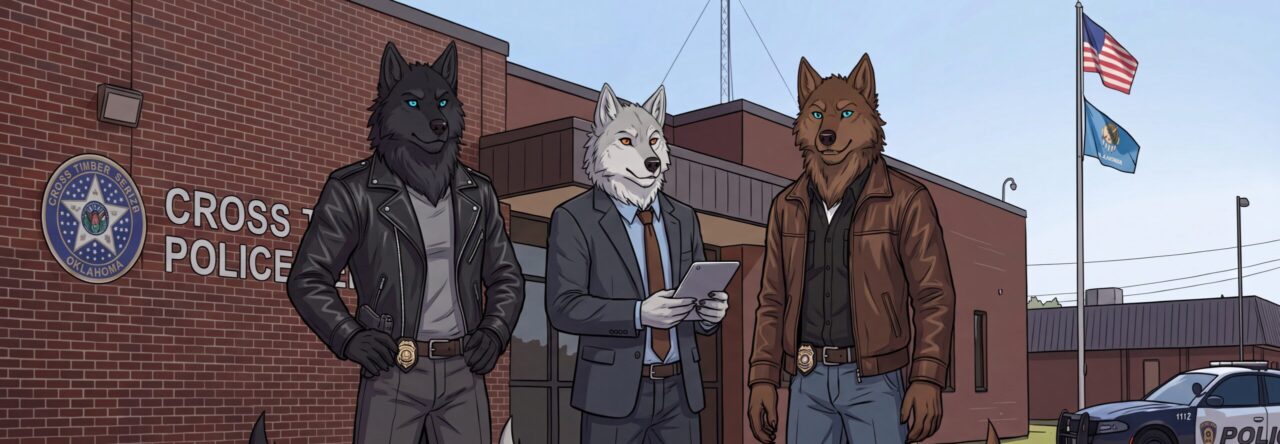
Monday night began the way most Monday nights did.
The Humvee rolled into the Cross Timber Police Department lot at 17:48 with its familiar low growl, passed the patrol units, and settled into its usual unofficial arrangement across two-and-a-half parking spaces.
Thane shut off the engine.
Gabriel looked out at the building.
“Do you think anyone missed us?”
Mark climbed out of the back seat with his duty bag over one shoulder.
“We were gone two days.”
“Exactly. Long enough for people to realize the workplace is less fun without us.”
Thane opened his door.
“People have jobs.”
Gabriel got out and shut the passenger door.
“Cruel.”
The three of them crossed the parking lot together.
Nothing looked different at first.
The same front windows glowed against the early evening dark. The same dispatch lights shone through the glass. A patrol officer came through the side entrance carrying coffee and a report folder. Somewhere behind the building, an engine started.
Then they stepped inside.
And everyone stopped.
Not gradually.
Not subtly.
The front-desk officer paused with her hand halfway toward a telephone. A records clerk froze beside the copier. Two patrol officers standing near the lockers stopped speaking in the middle of a sentence.
The lobby was full of people performing the same strange, silent action at once.
Staring at them.
Thane stopped walking.
Gabriel stopped beside him.
Mark’s ears lifted.
For one long second, nobody spoke.
It felt less like walking into a police department and more like walking into the first ten minutes of a deeply unsettling science-fiction movie, where the entire town had been replaced by something that looked human but had forgotten how to blink.
Gabriel looked around the lobby.
“Uh-oh,” he said quietly. “This cannot be good.”
A dispatcher leaned out from the communications-room doorway, saw them, and immediately disappeared again.
Thane’s ears angled back.
“Why is everyone looking at us?”
“No idea,” Mark said. “But they are not looking like we are about to be congratulated.”
Gabriel glanced toward the hallway.
“Maybe the Humvee finally got caught parking illegally.”
“It was within the lines.”
“It has never once been within the lines.”
“Mostly within.”
The records clerk looked like she was trying not to laugh.
Then, from the hallway leading toward Investigations, Officer Patel appeared.
She saw them standing there.
Her expression did something complicated.
Not fear.
Not amusement.
Not quite sympathy.
“Your office,” she said.
Gabriel looked at her.
“That does not sound reassuring.”
Patel’s mouth twitched.
“Your office.”
Thane, Gabriel, and Mark exchanged a look.
Then they moved.
The silence followed them down the hall.
People looked up from desks as they passed. A patrol officer near the break-room doorway visibly bit the inside of his cheek. Someone at the far end of the bullpen whispered, “They are here,” in a tone normally reserved for incoming tornadoes or celebrity sightings.
Gabriel leaned closer to Thane as they walked.
“Did we accidentally commit a felony?”
“No.”
“Are you sure?”
“Yes.”
“Because the vibe says felony.”
Mark looked toward the open door of their office.
“Whatever this is, it is in there.”
Thane’s stomach tightened.
Their office door stood open.
And inside were Voss, Rusk, Deputy Chief Mercer, the Chief of Police—
And the mayor of Cross Timber.
Gabriel stopped so abruptly that Mark nearly walked into him.
His voice dropped to a whisper.
“Is that the mayor?”
Thane did not answer.
Because it was.
The mayor stood near the center of the room in a tailored navy suit, smiling broadly as though she had been waiting all day for exactly this moment. The Chief stood beside her, hands clasped behind his back, with the expression of someone attempting very hard to maintain a command presence while suppressing amusement.
Voss stood near the case board with a coffee in one hand.
Rusk leaned against the filing cabinet, looking tired enough to have spiritually retired from the department three times already.
Mercer stood slightly behind the mayor.
He did not look happy.
He did not look furious, either.
He looked like a man who had spent the entire afternoon being reminded that public goodwill was technically a good thing, while privately wondering whether the city might survive one week without the three wolves becoming the center of another impossible administrative event.
Thane entered first.
Gabriel came in at his right.
Mark took position at his left.
The three of them stopped shoulder to shoulder in front of the desks, standing with the quiet, uneasy formality of people who had no idea whether they were about to be praised, assigned a disaster, or told to turn in their badges because someone had finally reviewed the Humvee parking footage.
Gabriel opened his mouth.
“Should we—”
Without looking at him, Thane reached his right paw across and gently closed it over Gabriel’s muzzle.
“No.”
Gabriel’s eyes widened.
Mark looked down at the floor.
The Chief’s mouth twitched.
Rusk made a sound into his coffee cup that might have been a cough.
Thane lowered his hand.
Gabriel blinked once.
Then gave the smallest possible nod.
The mayor looked delighted.
“Oh, please,” she said. “Do not let me make anyone nervous.”
Gabriel looked toward Mercer.
“That seems optimistic.”
Mercer gave him a warning look.
Gabriel immediately became very interested in the wall behind the mayor.
The mayor stepped forward.
“Detectives,” she said warmly. “I wanted to meet you in person.”
Thane found his voice.
“Mayor.”
“Please, call me Sheila,” she said. “Tonight is not a formal council meeting. It is a thank-you.”
The room stayed quiet.
Thane looked from her to Mercer.
Mercer’s expression told him absolutely nothing useful.
The mayor continued.
“I assume all three of you know why I am here.”
Gabriel glanced at Mark.
Mark gave him a nearly invisible shake of the head.
Thane said, “No, ma’am.”
The mayor smiled.
“The diner video.”
All three wolves went still.
Gabriel’s ears lowered.
Mark’s eyes closed for half a second.
Thane felt the beginning of a headache form behind his eyes.
The video.
Of course.
The video of Ray at the diner had continued spreading all weekend. It had made the local news. Then statewide social-media pages. Then a handful of national accounts that specialized in “good news” clips and animal-adjacent content.
It had been edited into short videos with sentimental music.
It had been clipped into reaction compilations.
It had been discussed by people who had never been within a thousand miles of Cross Timber and nevertheless had strong opinions about pie, homelessness, community policing, and whether Thane’s stare at the phones had been “intimidating” or “hot.”
Gabriel had kept that last category to himself.
Mostly.
The mayor looked at them with genuine warmth.
“I have received more than a thousand emails since Friday morning.”
Gabriel’s eyes widened.
“A thousand?”
“One thousand, two hundred and seventeen,” the mayor said. “As of this afternoon.”
Rusk’s eyebrows rose slightly.
The mayor continued.
“Some are from Cross Timber residents. Some are from people in other Oklahoma cities. Some are from people who say they have not trusted police in years and were moved by what they saw. Some are from people who have experienced homelessness themselves. Some are from business owners who told me they have watched that video with their employees.”
Thane did not know where to look.
So he looked at the mayor.
“We didn’t do it for attention.”
“I know,” she said.
That was the thing about her answer.
She did not say it like a politician delivering a line.
She said it like she understood.
“And that,” she added, “is exactly why it mattered.”
Mercer shifted slightly behind her.
The mayor turned toward him for just a second.
“Deputy Chief Mercer was kind enough to arrange this meeting.”
Mercer’s mouth tightened.
Kind enough was not the phrase his face suggested.
The mayor looked back at the three wolves.
“Cross Timber has spent the past few years learning what it means to have three extraordinary officers in its police department. People notice your work. They notice the difficult cases. They notice the rescues. They notice the things that make the news.”
Gabriel looked very carefully at the floor.
The mayor’s smile softened.
“But this was different.”
She glanced toward the office door, toward the city beyond the station, toward the invisible screen of a thousand phones and a thousand people who had watched Ray sit in a diner booth with a menu in his hands.
“You saw a man having one of the worst nights of his life. You made sure he stopped frightening other people. You made sure everyone was safe. And then you made sure he was fed.”
Mark’s ears shifted back.
The mayor looked at him.
“You gave him a practical path forward.”
Then she looked at Gabriel.
“You gave him room to keep his dignity.”
Then she looked at Thane.
“And you reminded everyone watching that kindness does not need an audience to be real.”
Thane swallowed.
The room had gone very quiet.
Even Mercer had stopped looking like he wanted to file a complaint against the entire concept of public gratitude.
The mayor turned toward the Chief.
The Chief stepped aside.
And Thane finally saw what had been sitting on the conference table behind him.
A wooden plaque.
Dark polished wood.
A large ceremonial golden key mounted across its center.
The engraved plate beneath it read:
CITY OF CROSS TIMBER
Presented to the Night Shift Detail
For Service, Compassion, and Community
Gabriel stared at it.
Mark stared at it.
Thane stared at it.
The mayor picked up the plaque.
Then walked toward them.
“On behalf of the City of Cross Timber,” she said, “I would like to present the three of you with the Key to the City.”
For a second, nobody moved.
Gabriel’s jaw actually dropped.
Mark’s eyes widened in a way Thane had almost never seen.
Thane stood there with his ears lifted and his mind entirely blank.
The mayor held the plaque out to him.
“Detective Thane,” she said, “please accept this on behalf of the Night Shift Detail.”
Thane recovered just enough to take it carefully in both hands.
It was heavier than it looked.
Warm from the mayor’s hands.
Real.
Not a joke.
Not a warning.
Not a disciplinary meeting.
A key.
To the city.
He looked down at the plaque.
Then back at the mayor.
“Thank you,” he said.
It came out quieter than he expected.
The mayor smiled.
Then, before Thane had any idea what was happening, she stepped forward and hugged him.
Thane froze.
Not because he disliked the gesture.
Because he had not expected a mayor to hug him in the middle of the police department while he held a giant ceremonial key and half the building probably watched through the open office door.
His arms came up a second later.
Careful.
Gentle.
He hugged her back.
The mayor stepped away with a warm smile.
Then she looked toward Gabriel and Mark.
“And thank you both,” she said. “The city is lucky to have you.”
Gabriel cleared his throat.
“Thank you, Mayor.”
Mark nodded.
“Thank you.”
The mayor turned toward Mercer.
“Deputy Chief, thank you for allowing us the time and for coordinating this.”
Mercer managed a professional smile.
“Of course, Mayor.”
“And take good care of them,” she said.
Mercer blinked.
The Chief’s expression changed very slightly.
Rusk looked down into his empty coffee cup.
Voss looked at the ceiling.
The mayor continued, apparently unaware of the administrative grenade she had just tossed into the room.
“They are a tremendous credit to the city.”
Mercer looked at Thane, Gabriel, and Mark.
Then back at the mayor.
“We are fortunate to have them.”
It was a perfectly polite sentence.
It was also the closest Mercer could come to publicly admitting that the three wolves had become one of the city’s most effective—and most complicated—assets.
The mayor beamed.
“Wonderful.”
Then she shook the Chief’s hand, nodded once to Voss and Rusk, and walked past the three wolves toward the office door.
“Good night, detectives.”
“Good night, Mayor,” Mark said.
Gabriel managed, “Good night.”
Thane stood there holding the plaque.
The mayor disappeared into the hallway.
The Chief followed after a moment, pausing only long enough to look back at the key.
“Congratulations,” he said. “Please do not mount that on the hood of the Humvee.”
Thane looked at him.
“I was not going to.”
Gabriel made a small sound.
The Chief’s eyes shifted toward him.
Gabriel immediately looked innocent.
The Chief smiled faintly.
“Good night.”
Then he left too.
The door closed.
The office went silent.
For several seconds, nobody moved.
Thane stood in the center of the room holding a golden key attached to a piece of polished wood.
Gabriel stared at him.
Mark stared at the plaque.
Voss leaned against the case board with both hands around her coffee.
Rusk looked like he had seen every possible version of police work during his career and had not been prepared for this one.
Mercer stood perfectly still.
Thane looked at him.
Then looked down at the plaque.
Then looked back.
The only thing he could think to say was:
“I am so sorry, Deputy Chief.”
Mercer closed his eyes.
“Do not.”
Thane’s ears lowered.
“I did not know she was coming.”
“I know.”
“We did not ask for this.”
“I know.”
Gabriel raised one hand slightly.
“Technically, nobody asks for a key to a city.”
Mercer opened his eyes.
“Gabriel.”
“Right. Sorry.”
Mercer rubbed a hand over his face.
“You three bought dinner for a hungry man.”
“Yes,” Thane said.
“You did not make a public-relations announcement.”
“No.”
“You did not call the mayor.”
“No.”
“You did not stage the video.”
“No.”
“You actively told people to stop filming.”
“Yes.”
Mercer let out a slow breath.
“Then I cannot be angry with you.”
Gabriel tilted his head.
“You sound like that is difficult.”
“It is not difficult,” Mercer said. “It is administratively exhausting.”
Rusk finally spoke.
“That is the closest thing he has to a compliment.”
“I did not compliment them.”
Voss looked at him.
“You absolutely did.”
Mercer pointed at the plaque.
“I have received hundreds of messages about this. Other departments. Former colleagues. My cousin in Tulsa. My sister-in-law in Denver. A sheriff I worked with fifteen years ago who apparently saw the video on a national page and felt compelled to email me three paragraphs about dignity.”
Gabriel’s ears lifted.
“Three paragraphs?”
Mercer looked at Thane.
“The video has been overwhelmingly positive. The mayor is thrilled. The city is thrilled. The Chief is pleased. The public-relations office has been answering messages all day.”
Thane shifted the plaque in his hands.
“I still do not like people watching.”
“I know,” Mercer said.
For once, his voice was not irritated.
Just direct.
“But they watched you do something good. And it mattered to people.”
Thane looked down.
Mercer continued.
“Do not make a habit of turning every patrol contact into a charity event.”
“We will not,” Mark said.
“Do not accept free meals because people recognize you.”
“We will not,” Thane said.
“Do not assume public approval changes policy, jurisdiction, evidence rules, or the fact that you are police officers before you are internet folklore.”
Gabriel raised a finger.
“Internet folklore is a strong phrase.”
Mercer’s expression sharpened.
Gabriel lowered his hand.
“Noted.”
Mercer looked at all three of them.
“But I am not going to punish three detectives for treating a human being like a human being.”
The words settled into the room.
Voss nodded once.
Rusk reached for the plaque.
“Can I see it?”
Thane handed it over.
Rusk turned it slightly under the office lights.
“It is a very large key.”
Gabriel leaned closer.
“Do you think it opens anything?”
“No,” Mark said.
“Maybe city hall.”
“No.”
“Maybe the city vault.”
“There is no city vault.”
“There should be.”
Rusk looked at the engraving.
“This may be the first key to the city ever awarded for buying somebody pie.”
Gabriel looked pleased.
“Historical achievement.”
Thane looked at him.
“Do not.”
Voss set down her coffee.
“All right. Congratulations. You can put the key somewhere secure, make whatever jokes you need to make about it, and then we have work.”
Mark took the plaque from Rusk.
“Secure evidence cabinet?”
Voss looked at him.
“It is not evidence.”
“It is a physical municipal asset.”
“It is a ceremonial award.”
Mark considered that.
“Secure storage cabinet?”
“Fine,” Voss said. “Secure storage cabinet.”
Gabriel smiled.
“Can we hang it in the office?”
Mercer looked at him.
“Not until Facilities confirms whether the wall can hold the symbolic weight of your growing legend.”
Gabriel went quiet.
Then looked at Thane.
“I think he just made a joke.”
Mercer pointed toward the conference table.
“Briefing.”
The celebration lasted exactly as long as it took to move the plaque into the locked storage cabinet in the back of their office.
Mark wrapped it in a clean evidence blanket first.
Gabriel said that was excessive.
Mark said the key had a polished finish and would collect fingerprints.
Gabriel asked who would be stealing it.
Mark said that was not the point.
Thane watched them argue for a minute.
Then closed the cabinet door.
“Done.”
Gabriel looked at him.
“You have a key to the city.”
“We have a key to the city.”
“You accepted it.”
“Because the mayor handed it to me.”
“I am going to tell people you asked for it.”
“No, you are not.”
Mark took his notebook to the conference table.
“You are both going to be impossible about this.”
“Correct,” Gabriel said.
The case board was still waiting.
At its center, Leah Moreno’s name remained in dark blue marker.
LEAH MORENO — SEXUAL ASSAULT — PRIORITY
The key had not changed that.
The mayor had not changed that.
The city could thank them, praise them, hand them a golden plaque, and fill their inboxes with messages about pie and compassion.
But the board still held the real work.
Voss tapped Leah’s case file.
“Day shift made progress.”
The tone of the room changed.
Mark opened his notebook.
Gabriel’s humor faded.
Thane leaned forward.
Voss looked at the updated timeline screen.
“Kessler and Detective Hsu completed the first clock-alignment pass. The dark SUV from the restaurant camera is likely leaving the garage at approximately fifteen-twenty-three actual time, not fifteen-twenty-seven.”
Mark’s pen paused.
“Four minutes earlier.”
“Yes.”
Rusk stepped beside the board.
“That places it closer to the reported elevator malfunction and before the service camera comes back online.”
Gabriel looked at the timeline.
“Still not enough to place it with Leah.”
“No,” Voss said. “But it narrows the question.”
She added a new line to the board:
15:23 — DARK SUV EXITS GARAGE / DAMAGED LEFT TAILLIGHT
“Garage entrance footage is incomplete,” Voss continued. “One camera did not retain high-resolution video. The remaining footage shows seven dark SUVs entering during the relevant period. We have narrowed that to five with the apparent vehicle shape and taillight configuration.”
“Five is better than seven,” Mark said.
“It is,” Voss agreed. “But it is not a suspect list.”
Rusk flipped open a report.
“A restaurant employee gave a supplemental statement. She was taking out trash around fifteen-twenty. She heard a man’s voice in the service alley. She could not make out words. She thought it was an argument between employees.”
Gabriel looked up.
“Tone?”
“Angry,” Rusk said. “Not shouting. Controlled. She said she heard one sharp sound against metal. Then nothing.”
Thane looked toward the garage map.
“The service door?”
“Maybe,” Voss said. “The witness cannot place the sound exactly.”
Mark made a note.
“Any mention of citrus cleaner?”
“Property manager confirmed it is used by the contracted cleaning company,” Voss said. “It is also used in the maintenance closet by garage staff. It is common enough that we cannot treat it as an identifier.”
“Not yet,” Thane said.
Voss met his eyes.
“Not yet.”
Rusk slid another folder across the table.
“Leah’s phone remains missing. Her carrier records show it powered down at fifteen-thirty-nine, roughly eight minutes after the service camera came back online. It has not reconnected.”
Gabriel looked toward the case card.
“Someone took it.”
“Likely,” Voss said. “But likelihood is not proof.”
Mark wrote it down anyway.
“Potential device disposal route.”
“Exactly.”
Voss looked at Night Shift.
“Tonight, you keep learning Hawthorne after dark. You check the garage. You build the late-hour witness list. You talk to people who work around the district after the day shift goes home: restaurant closers, delivery drivers, sanitation crews, overnight security, rideshare drivers. You do not suggest answers. You ask what they saw, heard, smelled, or noticed.”
“Understood,” Gabriel said.
“Also,” Voss added, “the city wants you at no public events, no press appearances, no interviews, and no spontaneous civic ceremonies without approval.”
Gabriel blinked.
“Do we get spontaneous civic ceremonies often?”
Mercer gave him a long look.
“Apparently.”
Rusk looked at the plaque cabinet.
“I am putting in for a ceremonial-key policy.”
“No,” Mercer said.
“Just saying.”
“No.”
Voss gathered the case folder.
“Night Shift has the board.”
The Humvee pulled out of the station lot at 18:31.
For the first few minutes, nobody said much.
The key to the city sat locked in their office.
The case board sat in all three of their minds.
Downtown moved around them in the way it always did at the beginning of a Monday night: restaurants filling, traffic slowing near the theater, people heading home from work, delivery drivers trying to beat the dinner rush.
Gabriel leaned back in the passenger seat.
“So.”
Thane kept his eyes on the road.
“No.”
“I did not say anything.”
“You were about to.”
“I was going to say that we now own Cross Timber.”
“We do not own Cross Timber.”
“Ceremonially.”
“Still no.”
Mark spoke from the back seat.
“The key does not convey ownership, administrative authority, property rights, voting rights, zoning authority, or access credentials.”
Gabriel turned around.
“You researched this?”
“I read the plaque.”
“That is not research.”
“I also looked up ceremonial keys while you were arguing with Mercer.”
Thane glanced in the mirror.
“You did what?”
Mark looked entirely unapologetic.
“It is a symbolic honor.”
Gabriel smiled.
“So we symbolically own the city.”
“No.”
Thane shook his head.
“I am driving into traffic.”
Gabriel looked out the window.
“Fine. I will stop talking about it.”
He lasted twelve seconds.
“Do you think the key opens the Mayor’s bathroom?”
“Gabriel.”
“Right.”
They headed toward Hawthorne.
The garage looked different after dark.
Not because the crime scene had changed.
Because the people around it had.
The art center was closed. The restaurants were still busy, but their crowds moved in smaller waves. The upper levels of the garage had emptied, leaving long rows of concrete and parked cars beneath fluorescent lights.
Thane parked on the first level.
Mark opened the late-hour canvass list.
“We have three restaurants closing between twenty-one hundred and twenty-three hundred. Two delivery services with drivers using the alley. One sanitation contractor. One security company. A rideshare staging area near the theater.”
Gabriel looked at the service corridor.
“Let’s start with people who have reason to be in the alley.”
They did.
Not aggressively.
Not with a theory already in their hands.
They talked to a dishwasher carrying out bins from the bistro next door. He remembered nothing from Thursday afternoon but said the garage’s service lights had flickered around three that day. He assumed it was normal.
They spoke to a rideshare driver who worked the downtown area every afternoon. She had not seen Leah. She did remember a dark SUV speeding out of the garage, though she could not give a plate. She remembered it because the driver had taken the turn too fast and nearly clipped a cyclist.
“What kind of SUV?” Mark asked.
“Dark. Maybe blue. Maybe black. Older, I think. The back light on one side was busted or dim.”
“Which side?” Gabriel asked gently.
The driver thought for a moment.
“Driver’s side. Left.”
Mark wrote it down.
“Time?”
“After three. Before school pickup traffic. I remember because I was heading to get my daughter from daycare.”
“Did you see the driver?”
“No. Sun glare. I only saw the car.”
“Thank you,” Gabriel said. “That still helps.”
They spoke to a sanitation worker who had been in the alley near the garage on Thursday afternoon. He had heard a metal door shut hard. He had not seen anyone.
They spoke to an overnight security guard who had worked Cedar Plaza for six years. He knew the garage’s normal sounds well enough to list them without thinking: elevator motors, ventilation fans, delivery carts, dumpsters, restaurant staff, drunk theater patrons, cars scraping wheel rims against the turn ramps.
“Anything unusual Thursday?” Thane asked.
The guard frowned.
“Not that I noticed. But there was a guy around the service door.”
Mark looked up.
“Describe him.”
“Did not get close. Dark jacket. Ball cap. Thought he was maintenance or maybe one of the restaurant guys.”
“Did you see his face?”
“No.”
“Vehicle?”
“No.”
“Time?”
The guard thought.
“Afternoon. Around three, maybe. I was doing the west stairwell check.”
“Did he have a badge?” Gabriel asked.
“Could not tell.”
Thane smelled the man’s uncertainty.
Not deception.
Just a person trying to pull an ordinary image out of a day that had become important after the fact.
“Thank you,” Thane said. “If you remember anything else, even something small, call us.”
The guard nodded.
“Will do.”
By 22:10, Night Shift had added two possible witnesses, confirmed the damaged left taillight from a second source, and collected more reminders that the service door had been an ordinary part of the building until it became the center of someone’s worst day.
No name.
No plate.
No clean answer.
But more structure.
More road.
Thane stood near the garage exit while Mark logged the canvass notes.
Gabriel watched cars leave the restaurant district.
“You know what I hate about cases like this?”
Thane looked at him.
“Everything?”
Gabriel nodded.
“Fair. But specifically, that the person who did this probably thinks all these little things do not matter.”
Mark closed the notebook.
“They matter.”
“Yeah,” Gabriel said. “They do.”
They made one more pass through the service alley.
Nothing fresh.
Nothing wrong.
Nothing simple.
At 23:32, Dispatch called them to a minor disturbance at a convenience store two blocks away.
A man had been loudly accusing the clerk of shorting him on lottery tickets. By the time Night Shift arrived, patrol had him standing outside with his hands in his pockets and the clerk safely behind the counter.
The tickets had been printed correctly.
The man had simply misunderstood how the game worked.
Gabriel explained it to him with the patient tone of someone talking a tired, frustrated adult back from the edge of an argument nobody needed.
Mark confirmed the transaction timestamps.
Thane stood between the man and the store door without needing to say much.
The man apologized.
The clerk accepted it.
The city moved on.
By 01:00, they were back in the Humvee.
Gabriel looked over at Thane.
“Normal police work.”
Thane nodded.
“Mostly.”
“Do you think the mayor knows we just resolved a lottery-ticket dispute?”
“No.”
“Should we tell her?”
“No.”
“Could be another key.”
Thane looked at him.
“No.”
Mark spoke from the back.
“One key is sufficient.”
Gabriel sighed.
“Fine.”
They returned to the station early enough to organize reports, upload canvass notes, and place the new witness statements into Leah Moreno’s case folder before morning handoff.
The office felt unusually full with the plaque cabinet closed behind them.
Gabriel glanced at it several times.
Finally, Mark said, “You can stop looking at it.”
“I am not looking at it.”
“You have looked at it eight times.”
“I am admiring our municipal authority.”
“We have none.”
“Symbolic authority.”
“Still none.”
Thane sat at his desk and began writing the canvass summary.
The words came slowly at first.
Then cleanly.
Who had been contacted.
What each person knew.
What they did not know.
The damaged left taillight corroborated by a rideshare driver.
The dark-jacketed male near the service door.
The hard metal-door sound.
The alley traffic pattern.
No conclusions beyond the facts.
At 05:58, Gabriel leaned back in his chair.
“You know what is weird?”
Thane did not look up.
“Everything.”
“No. More specifically.”
Mark glanced toward him.
Gabriel pointed at the plaque cabinet.
“Friday, we were three wolves in a diner telling people to let a hungry man eat.”
Thane nodded.
“Yeah.”
“Today, the mayor hugged you and gave us a key to the city.”
Mark looked at the cabinet.
“The sequence is statistically unusual.”
Gabriel smiled.
“Thank you, Mark.”
Thane kept typing.
“It does not change anything.”
Gabriel’s expression softened.
“No,” he said. “It does not.”
The key did not solve Leah Moreno’s case.
It did not make the work easier.
It did not erase the things that had happened before they became detectives, or the things that would happen after.
It did not make Thane less afraid of being watched.
It did not make Mark less precise.
It did not make Gabriel less likely to make a joke at exactly the wrong time.
But it meant something.
Not because of the gold paint.
Not because of the mayor.
Because the city had seen three wolves make a small choice without expecting applause.
And somehow, that choice had reached farther than any of them knew.
At 06:30, Voss, Rusk, and Kessler came in for the morning handoff.
Kessler stopped just inside the office door.
His eyes went immediately to the locked plaque cabinet.
Then to the three wolves.
Then back to the cabinet.
“There is a key in there,” he said.
Gabriel smiled.
“We own the city now.”
Kessler looked at him.
“That is not how property works.”
Mark nodded.
“Correct.”
Gabriel looked offended.
“You are all terrible at joy.”
Voss set down her coffee.
“Morning handoff.”
The jokes ended.
Mark gave the evidence status first.
“Leah Moreno case. Night Shift completed late-hour canvass around Hawthorne and Cedar Plaza. We identified a rideshare driver who independently recalls a dark, older SUV leaving the garage after fifteen hundred Thursday afternoon. She remembers a damaged driver-side taillight.”
Kessler’s attention sharpened.
“That is our second corroboration.”
“Yes,” Mark said. “Still no plate, no driver description.”
“Good,” Kessler said. “Good.”
Gabriel took the witness portion.
“Security guard recalls a male near the service door around the relevant period. Dark jacket, ball cap, possibly posing as maintenance or restaurant staff. No face. No badge confirmation. Sanitation worker heard a metal door shut hard. Nothing conclusive, but it supports the service-alley timeline.”
Rusk nodded.
“We can work with that.”
Thane finished.
“Scene actions and active leads. The garage is quieter after dark. Late-hour traffic is limited and predictable. We documented normal service-alley activity and camera gaps. The damaged left taillight remains our best vehicle feature. We need garage entry footage, city traffic camera pulls, and a canvass of vehicle-repair shops if the plate does not break.”
Voss looked at the board.
“Good work.”
She meant it.
The kind of praise that did not need to be louder.
Kessler picked up the witness notes.
“I will start on the traffic-camera requests. And I will see whether any local body shops have a dark SUV with recent left-rear taillight work.”
Mark nodded.
“Be careful with that search. We do not have enough to make it broad.”
“I know,” Kessler said. “I will keep it narrow.”
Rusk looked around the office.
Then at the cabinet.
“So. Key to the city.”
Gabriel leaned back.
“Ceremonial authority.”
“No,” Voss said.
“Symbolic authority.”
“No.”
Kessler looked at Thane.
“Congratulations.”
Thane’s ears shifted.
“Thank you.”
Kessler nodded once.
Then he looked at the active case board.
“Now let’s solve something that matters.”
The words were not harsh.
They were right.
Voss gathered the case files.
“Go home, Night Shift.”
Gabriel stood and stretched.
“Breakfast?”
Mark closed his notebook.
“Breakfast.”
Thane picked up his badge wallet.
“No pancakes.”
Gabriel looked genuinely hurt.
“The city gave us a key.”
“That is not a pancake exemption.”
“It should be.”
“It is not.”
Mark slung his bag over one shoulder.
“One key is sufficient. One pancake is also sufficient.”
Gabriel stared at him.
“You have become cruel.”
Thane headed toward the door.
“Come on.”
They walked out together.
The plaque remained locked safely in their office.
The case board remained behind them.
The city outside was waking up.
And somewhere out there, a damaged taillight was moving through morning traffic, attached to a vehicle whose driver still believed the city had not noticed.
Night Shift knew better.
The city was always watching.
Sometimes, it just needed help knowing what to look for.