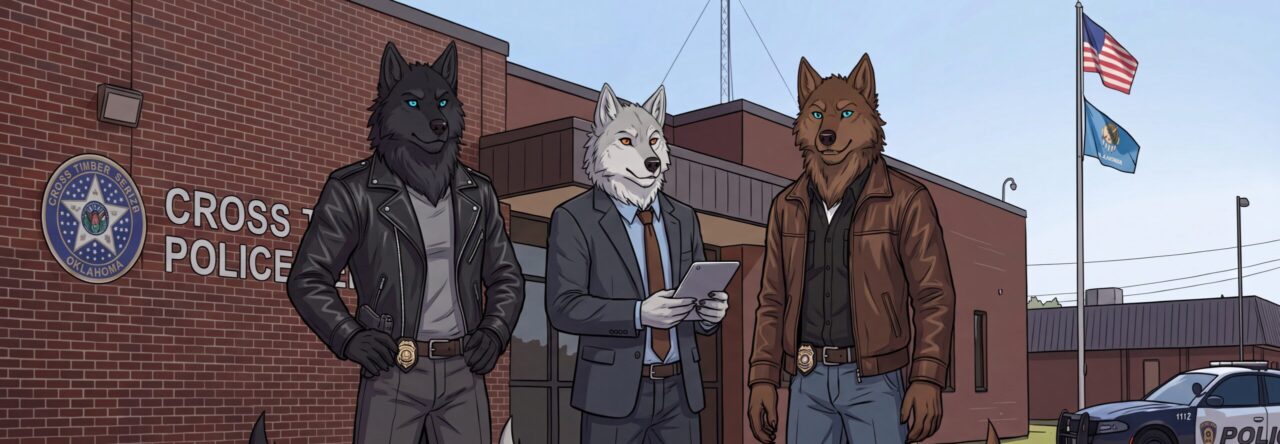
The back door behind Cross Timber Police Department had never officially been designated as the smoking area.
Nobody had ever needed to.
The narrow strip of pavement behind the building sat between the evidence-bay wall and a chain-link fence, out of sight from the front lot and far enough from the loading entrance that nobody important had to acknowledge it existed. A rusted metal ash can stood beside the door. There was a bench with one cracked slat. The concrete smelled faintly of rainwater, old coffee, and tobacco no matter how often Facilities washed it down.
It was where officers went when they needed five minutes.
Sometimes for a cigarette.
Sometimes for air.
Sometimes because the building had become too full of people, radios, paperwork, and things they could not say at their desks.
Thane heard the crying before he reached the door.
He stopped so abruptly that Gabriel nearly walked into him.
“What?” Gabriel asked.
Thane lifted one paw.
Beyond the heavy steel door, someone was speaking into a phone.
The voice was low.
Female.
Trying very hard not to break.
“I understand that,” she said.
A pause.
“No, I understand that I am behind. I know I am behind.”
Another pause.
Her voice shook.
“I am not asking you to forgive it. I am asking for more time.”
Gabriel’s expression changed.
Mark stood still beside them, ears tipped toward the door.
The woman swallowed hard.
“I can make a partial payment Friday. I can make another one next week. I just need—”
The silence on the other end lasted long enough that Thane could hear rain dripping from the building’s gutter outside.
Then the woman made a small, strangled sound.
“No,” she said. “No, please do not send that. I said I can pay. I am four months behind because my transmission went out and the repair was over four thousand dollars, and I know that is not your problem, but it is mine and I am trying.”
Gabriel’s ears lowered.
The voice on the phone was too quiet for the wolves to make out clearly. Calm. Patient. Unyielding.
A person reading policy.
A person who might even have felt bad.
A person who still could not change what the system allowed.
The woman tried one more time.
“I have worked there fifteen years.”
She stopped.
Breathed in.
Then, very softly:
“Okay.”
The phone clicked off.
For a moment, there was nothing outside except rainwater and traffic from the road beyond the fence.
Then Thane opened the door.
A woman stood near the ash can with her back half turned toward them.
She was in uniform.
Veteran patrol officer, based on the sleeve patch, the worn leather of her duty belt, and the way she carried herself even while trying to make herself smaller.
Her shoulders tightened the second the door opened.
She turned quickly.
Her eyes were wet.
She swiped at her face with the heel of one hand, fast and angry, like the tears had betrayed her by existing.
“Sorry,” she said.
She did not sound sorry.
She sounded mortified.
Thane saw the name badge before she could turn away.
SERRANO
Gabriel opened his mouth.
Thane did not stop him this time.
But Gabriel took one look at the officer’s face and simply said, “You are fine.”
Officer Serrano shook her head.
“No. I am not.”
The words came out before she could catch them.
Her face changed immediately.
She looked down at the phone in her hand.
Then she squared her shoulders.
“I am sorry,” she said again. “I just needed a minute.”
“You do not owe us an explanation,” Thane said.
She looked up.
For a second, her expression softened.
Then the wall came back.
The practiced one.
The officer wall.
“I have a shift,” she said.
“So do we,” Gabriel said quietly.
Serrano nodded once.
Then she slipped past them through the door.
She did not run.
She did not look back.
But she moved with the careful speed of somebody trying to get out of reach before anyone could see how close she had come to falling apart.
The door shut behind her.
Thane stood there for another moment.
Gabriel looked at him.
“That was bad.”
“Yes,” Thane said.
Mark glanced at the door.
“Her name is Serrano.”
“I saw.”
“Do we know her?”
“No.”
Gabriel’s eyes stayed on the closed door.
“She has worked here fifteen years.”
Thane nodded.
“Yeah.”
They went inside.
The Investigations Bureau was already in motion.
The day shift had not quite left. The night shift had not fully arrived. Phones rang from different parts of the floor. The copier spat out pages in the records alcove. Somebody near the break room was arguing with a vending machine in a tone that suggested the machine had committed a personal betrayal.
Normal.
Almost.
The three wolves passed through the bullpen and headed toward their office.
Voss stood at the case board.
Rusk sat at the conference table with a paper cup of coffee and the exhausted posture of a man who had been awake too long but refused to admit it. Kessler stood beside a rolling whiteboard, jacket still on, a laptop open in front of him.
Leah Moreno’s name remained at the center of the board.
The case had changed shape since the last shift.
New lines connected old notes.
DARK SUV — LEFT REAR TAILLIGHT DAMAGE
SERVICE-ALLEY WITNESSES
CAMERA TIME OFFSETS
MISSING PHONE — POWERED OFF 15:39
WESTLINE PROPERTY SERVICES
DEREK MAYS — FIELD TECHNICIAN
Thane stopped near the board.
Gabriel saw the new name and went quiet.
Mark pulled out his notebook.
Voss looked up.
“Evening.”
“Evening,” Thane said.
Kessler nodded at them.
“Evening.”
Gabriel looked at the board.
“Looks like we had a day.”
“We did,” Rusk said.
Voss closed the file in her hands.
“Before we get to Mays, one other thing.”
Gabriel’s ears lifted.
“Please tell me it is not another key.”
Rusk looked into his coffee.
“Do not tempt the universe.”
Voss ignored both of them.
“I checked the fund.”
Thane kept his expression still.
Mark did not pause over his notebook.
Gabriel leaned against the edge of his desk.
“Safe Steps?”
“Yes.”
Voss tapped the printed program materials clipped to Leah’s case folder.
“Red River Community Foundation is real. It has an established board. Independent governance. Audited funds. Their emergency-assistance policies are legitimate. Their partner organizations are legitimate.”
“That is good,” Mark said.
“It is,” Voss replied.
Her eyes moved over the three wolves.
Not accusing.
Not casual, either.
“The Cross Timber Community Fund was created inside Red River under a confidential donor agreement. Safe Steps is its first restricted program.”
Gabriel tilted his head.
“And?”
“And I wanted to know who funded it.”
Rusk glanced over his coffee.
“Voss wanted to know who funded it.”
“I am allowed to be curious,” Voss said.
“You are allowed to be curious. You are just not allowed to subpoena philanthropy because it makes you itch.”
Voss gave him a look.
Rusk took another drink.
“Continue.”
Voss rested one hand on the folder.
“The foundation referred me to its legal contact. Elias Carroway.”
For the smallest fraction of a second, Gabriel’s ears twitched.
Thane saw it.
So did Mark.
Voss saw that too.
Her gaze sharpened.
But she continued.
“Carroway & Wexler.”
Kessler looked at the name on the folder.
“The firm downtown?”
“The firm downtown,” Rusk said.
“The one with half the state’s corporate attorneys scared of them?”
“The one,” Voss said.
Thane did not move.
Eli was not a man people forgot after meeting him.
Voss had probably walked into his office expecting information and discovered, within the first thirty seconds, that he had been waiting for exactly the kind of conversation she wanted to have.
She said, “I asked Mr. Carroway who created the fund.”
Gabriel folded his arms.
“And?”
“He told me the donors were confidential.”
“That sounds like him,” Thane said before he could stop himself.
The room went still.
Voss looked directly at him.
Rusk lowered his coffee cup.
Kessler’s expression did not change, but his eyes shifted once toward Thane.
Thane felt Gabriel glance at him.
Mark did not look up from his notes.
Voss said nothing for a moment.
Then she asked, “You know him?”
Thane considered the safest answer.
Not a lie.
Not an explanation.
“He is a good attorney.”
Rusk’s eyebrows went up.
“That is an unusually warm endorsement from you.”
“He is,” Thane said.
Voss watched him.
Then she looked back at the Safe Steps folder.
“Mr. Carroway was professional. Annoyingly professional.”
Gabriel’s mouth twitched.
“What did he say?”
Voss looked at the paper as if she could still see Eli sitting across from her.
“He said, ‘Detective, I am happy to answer every question necessary for you to determine whether this program is legitimate, ethical, independently administered, and useful to the people you serve.’”
Rusk leaned back.
“That is lawyer for ‘ask me the wrong question and I will charge you by the syllable.’”
Voss ignored him.
“I asked whether the donors had any control over individual recipients.”
“He said no?”
“He said the donors can identify community needs and recommend areas of support, but the fund’s independent partners determine eligibility and approve assistance. He said no detective, donor, officer, or elected official decides which victim gets help.”
Mark nodded.
“That is appropriate.”
Voss looked at him.
“You have thought about this.”
Mark’s face stayed neutral.
“I have thought about victim-assistance structures generally.”
Gabriel looked toward the ceiling.
“Very generally.”
Voss continued.
“I asked whether the fund was connected to the police department.”
“And?” Thane asked.
“He said the program is independent of the department. No agency funds. No donor access to case files. No backchannel decisions. No public-relations role.”
Rusk gave a tired nod.
“Good answer.”
“It was,” Voss said. “I asked whether the donor had any personal connection to Cross Timber Police Department.”
Gabriel went very still.
Voss met his eyes.
“And he said he was not authorized to discuss donor identities, business relationships, or private clients.”
Rusk looked at the three wolves.
“Also a good answer.”
Voss leaned one hip against the conference table.
“I do not like not knowing where large amounts of money come from.”
No one answered.
“That does not make the fund illegitimate. It makes me a detective.”
Thane nodded once.
“Fair.”
“I verified the things I could verify,” Voss continued. “The policies are clean. The board is independent. The emergency-assistance partners are real. The program can actually move money within hours for lodging, transportation, locks, phones, food, and other immediate needs.”
Gabriel’s face softened.
“That could help people.”
“Yes,” Voss said.
The word came out quiet.
More personal than the rest.
Thane caught the faint shift in her scent again.
Old fear.
Old memory.
Gone quickly.
Voss folded the flyer and placed it back in Leah’s file.
“So I will use it if it is appropriate. Not as a substitute for the department doing its job. Not as a favor. As a resource.”
“Good,” Mark said.
Voss looked at the three of them.
“I am still curious.”
Gabriel smiled faintly.
“Curiosity is healthy.”
“Do not push it.”
“Not pushing it.”
“I am not asking you to compromise anyone’s legal confidentiality,” Voss said. “I am not accusing you of anything. I am simply noting that a confidential fund appeared at the exact moment this department discovered it had a serious gap in victim assistance.”
Thane held her gaze.
“That sounds like good timing.”
Voss’s mouth almost moved.
Almost.
Then she picked up the case file.
“Now. Derek Mays.”
The room changed.
The Safe Steps flyer disappeared beneath the work.
Kessler turned the laptop toward them.
“Derek Mays, thirty-seven. Senior field technician for Westline Property Services. Westline does building systems, maintenance support, access control, camera work, electrical troubleshooting, and small commercial repairs.”
“Not a garage employee,” Gabriel said.
“No,” Kessler replied. “But he worked at Cedar Plaza two years ago during the camera-system upgrade.”
Mark looked at the board.
“Which means access knowledge.”
“Exactly,” Kessler said.
Voss stepped beside the monitor.
“Cedar Plaza retired several contractor credentials after the upgrade. One was not properly deactivated.”
Mark’s eyes narrowed.
“Mays’s?”
“Mays’s,” Voss said.
Rusk slid a printed log across the table.
“At fifteen-oh-five Thursday, Mays’s old contractor credential accessed the service corridor door. At fifteen-oh-seven, the service-camera feed went into diagnostic maintenance mode.”
“Not a failure,” Mark said.
“No,” Kessler replied. “Not a random outage.”
The laptop screen showed a series of time-stamped entries.
15:05:42 — SERVICE DOOR ACCESS
15:07:11 — CAMERA 4B / DIAGNOSTIC MODE ENABLED
15:22:36 — ELEVATOR SERVICE STATUS REQUESTED
15:30:54 — CAMERA 4B / DIAGNOSTIC MODE DISABLED
Mark leaned closer.
“The elevator malfunction.”
“Likely false,” Kessler said. “There was no mechanical fault. The service request was sent from an access panel inside the corridor. Security received the alert, checked the elevator, and was pulled away from the lower stairwell during the critical window.”
Gabriel’s ears lowered.
“So he made the camera disappear and created a reason for security to look somewhere else.”
“That is the theory,” Voss said. “Not the conclusion yet.”
Thane looked at the time entries.
“Can we tie it to Mays?”
Kessler clicked into another file.
“The system recorded a device certificate during the access sequence. It belongs to a Westline-issued service tablet.”
“Assigned to Mays,” Mark said.
“Yes.”
“Could someone else have used it?”
“They could have,” Kessler said. “But the device connected to the Cedar Plaza service network at fifteen-oh-four. Westline’s asset logs show that tablet was signed out to Mays Wednesday evening and was not returned until Friday.”
Rusk tapped another document.
“And Mays’s work SUV GPS was parked two blocks from Cedar Plaza from fourteen-fifty-eight until fifteen-thirty-six.”
Gabriel stared at the timestamps.
“What did he say when you asked where he was?”
Kessler’s expression went flatter.
“He said he was servicing an air-conditioning complaint at Ridgeview Court.”
“Was he?”
“No,” Voss said. “Ridgeview has no work order for him. No access log. No resident complaint. No camera footage of his SUV. Nothing.”
Mark made a note.
“Lie.”
“Likely,” Voss said. “But we do not write likely. We write what we can prove.”
Rusk pushed another thin folder toward them.
“Body shop in Eastgate. Mays brought his assigned Explorer in Friday morning to get an estimate on a damaged rear-left taillight.”
Gabriel looked up.
“The damaged taillight.”
“The owner photographed the vehicle for the insurance estimate,” Rusk said. “Dark blue 2018 Explorer. Rear-left lens cracked. Fresh scrape along the quarter panel. Mays said he backed into a loading bollard.”
“Was the Explorer repaired?” Thane asked.
“Not yet,” Kessler said. “Parts were ordered. Vehicle was released back to him.”
“Where is it now?”
“Unknown.”
Voss looked at Night Shift.
“Day shift has enough to seek search warrants for the vehicle, Mays’s work tablet, his personal phone, his residence, and his Westline work locker. We do not have enough to arrest him yet.”
Gabriel looked at the board.
“What do you need from us?”
“Late-hour work,” Voss said. “You will go to Carter’s Collision and collect the owner’s statement and original photographs under the preservation order. Then you will continue the Hawthorne canvass. We need to identify whether Mays was seen anywhere else that afternoon, whether he had a reason to be around the garage, and whether anyone noticed him after the incident.”
Thane nodded.
“Understood.”
Voss added, “You do not contact Mays.”
“We will not.”
“Do not let the fact that the case is narrowing make you impatient.”
Thane’s eyes moved to Leah Moreno’s name.
“We will not.”
Rusk stood and gathered his files.
“Good. Because impatient cases become bad cases.”
Kessler closed his laptop.
“I will finish the warrant drafts before I leave. Voss will review them. If the judge signs overnight, you will be notified.”
“Understood,” Mark said.
The handoff dissolved into movement.
Rusk took his coffee and headed toward the door. Kessler picked up his laptop case. Voss stayed at the board for another moment, reading the line with Derek Mays’s name.
Thane waited until Rusk and Kessler had moved out of the office.
Then he said, “Voss?”
She looked at him.
“We saw Officer Serrano outside.”
Voss’s posture changed.
Not sharply.
Just enough.
“Marisol Serrano?”
“Yes,” Thane said. “She was upset. On the phone with her bank.”
Voss looked toward the hallway.
For a moment, Thane thought she might tell them it was none of their business.
Instead, she exhaled.
“Marisol Serrano,” Voss said. “Fifteen years with Cross Timber. Patrol. Good officer. Better person.”
Gabriel’s expression softened.
“She sounded like she was in trouble.”
“She is.”
Voss looked down at the folder in her hands.
“Her transmission went out three months ago. It was a bad repair. Then a second problem came up after the first shop did not fix it correctly. She paid more than four thousand dollars to keep a car running because she needs it to get to work and because she does not have anyone else’s vehicle to borrow.”
Mark listened without writing.
“Four months behind,” Thane said quietly.
Voss’s eyes lifted.
“She told the bank that?”
“Yes.”
Voss nodded once.
“She is proud. She has been picking up extra shifts. Selling some things. Trying to catch up before anyone notices.”
“She should have asked for help,” Gabriel said.
“She should not have had to ask for help,” Voss replied.
The room went quiet.
Voss looked at all three of them.
“Do not make her a project.”
Thane nodded.
“We will not.”
“She is not irresponsible,” Voss said. “She is not weak. She had a hard month turn into a hard season, and now the math is beating her.”
“I know,” Thane said.
Voss studied him for a moment.
Then she softened.
“If you know of a resource, give her the information. Quietly. That is all.”
Thane nodded again.
“Okay.”
Voss picked up Leah’s file.
“Good night, Night Shift.”
“Good night,” Gabriel said.
She left.
The office door closed.
For several seconds, nobody spoke.
Thane stood near the board with his eyes on Officer Serrano’s name as it existed only in his memory.
Gabriel looked at Mark.
Mark looked at Thane.
Nobody needed to say what they were thinking.
Mark closed his notebook.
“Do it.”
Gabriel nodded once.
“Do it.”
Thane took out his phone.
Eli answered on the first ring.
“Thane.”
“Eli.”
“You are calling at eighteen-thirty-eight,” Eli said. “That means one of three things has happened. Someone needs help. Someone has made a legal mistake. Or Gabriel has decided a city ordinance is a personal challenge.”
Gabriel leaned toward the speakerphone.
“I have not decided that today.”
“Comforting,” Eli said.
Thane sat at his desk.
“We found someone who needs help.”
The humor left Eli’s voice immediately.
“Tell me.”
Thane gave him the name.
“Officer Marisol Serrano. Cross Timber Police Department. She is four months behind on her mortgage. Her car repairs put her under. We heard her trying to get more time from the bank.”
Eli was quiet.
Then he said, “Do you have her permission to discuss her finances?”
“No.”
“Good answer.”
Gabriel leaned back in his chair.
“We do not want to embarrass her.”
“Also good.”
Mark spoke calmly.
“We want to know whether you can identify the mortgage servicer through public property records and make an anonymous payment directly to the lender.”
Eli did not answer right away.
Thane knew that silence.
Eli was doing the work in his head.
Conflict screens.
Ethics.
Privacy.
How to help without turning a good deed into something that could harm the person receiving it.
Finally, he said, “This does not go through Safe Steps.”
“I know,” Thane said.
“Nor should it. She is a department employee. The fund’s structure is not for direct assistance to people connected to your workplace, especially when you know her through law enforcement.”
“Then the Quiet Response account,” Thane said.
“Yes.”
Eli’s voice stayed precise.
“I can identify the recorded mortgage lien and locate the current servicer without touching any department system or asking anyone at Cross Timber to disclose private information. I will have my office confirm the lender’s third-party payment procedure, arrange an anonymous cure payment for the past-due balance, and cover two additional monthly payments.”
Gabriel looked toward Thane.
Thane nodded once.
“That is what we want.”
“I need to be clear about something,” Eli continued. “You do not contact her about this. You do not imply that she owes you anything. You do not ask for gratitude. You do not use it as a reason to involve yourselves in her personal life.”
“We will not,” Thane said.
“I know you will not,” Eli replied.
Mark asked, “Will she know who did it?”
“Not from the payment,” Eli said. “The lender will know a lawful third-party payment was made. She will receive notice that her account is current. There may be questions. But the public will not know, the department will not know, and she will not be given your names.”
“Good,” Thane said.
Eli let out a slow breath.
“You three are too nice.”
Gabriel’s ears lifted.
Eli continued, “I wish more of my clients were like you.”
Gabriel leaned closer to the phone.
“You wish more of your clients were werewolves?”
There was a brief pause.
Then Eli said, “Some days, Gabriel, I wish more of my clients were werewolves.”
Mark’s mouth twitched.
Thane looked down at the desk to hide his smile.
Eli went on.
“I will get it done tonight. I will send you one message when the payment is accepted. Nothing else. No details you do not need.”
“Thank you,” Thane said.
“Do not thank me yet. I have to call a mortgage servicer after business hours.”
Gabriel winced.
“Oh.”
“Yes,” Eli said. “Exactly.”
The call ended.
For a moment, the three wolves sat quietly in their office.
The new key to the city remained locked in the storage cabinet behind them.
Leah Moreno’s case filled the board in front of them.
Somewhere else in the building, Officer Marisol Serrano was probably putting on the face she wore every day and heading out to do her job.
Thane looked at Gabriel.
“Ready?”
Gabriel stood.
“Ready.”
Mark picked up the Carter’s Collision preservation packet.
“Ready.”
They went to work.
Carter’s Collision sat on the eastern edge of Cross Timber in a low metal building behind a tire shop and a discount furniture warehouse.
The official business hours had ended at six.
The paint booth was dark.
The service bays were closed.
But one office light still burned behind the front glass.
Thane parked the Humvee at the curb.
Gabriel looked at the building.
“You ever notice that every place holding important evidence has terrible lighting?”
Mark checked the preservation order.
“Evidence is not selecting the lighting.”
“It should.”
Thane opened the door.
“Come on.”
The owner met them inside.
Bo Carter was a thickset man in his late fifties with gray hair, a work shirt stained across the front, and the permanent half-squint of someone who had spent most of his life looking at metal under bad fluorescent lights.
He shook hands carefully, then looked at the three wolves.
“I know who you are,” he said.
Gabriel sighed.
“Please do not ask about the key.”
Bo blinked.
“The what?”
Gabriel looked relieved.
“Nothing.”
Carter led them into the office.
“Kessler said you would be coming. I pulled the estimate file, the photos, and the camera footage from Friday morning.”
Mark set the preservation order on the desk.
“Thank you for keeping everything.”
Carter shrugged.
“Police ask me to preserve something, I preserve it.”
He opened a folder.
The first photograph showed the rear-left corner of a dark blue Ford Explorer.
The taillight lens was cracked through the center.
A red-white fracture line ran across the plastic housing. Scrapes marked the metal quarter panel beneath it.
Thane looked at the image.
It matched the witness descriptions.
Not enough by itself.
But no longer hypothetical.
Carter tapped the image.
“Guy said he backed into a bollard.”
“Did that fit the damage?” Thane asked.
Carter shook his head.
“Maybe. Could have been a pole. Could have been a concrete wall. Could have been a shopping cart if the shopping cart had a grudge.”
Gabriel looked at him.
“Very hostile shopping cart.”
“Those things have corners.”
Mark turned to the next image.
“Was there damage inside the housing?”
“Yeah. Mounting clips broke. Lens shifted. Nothing that told me where it happened. I am a body-shop owner, not a crime-scene unit.”
“Understood,” Mark said.
Carter pulled up the video on his computer.
The footage showed the Explorer pulling into the lot at 08:43 Friday morning.
Mays stepped out.
He wore a dark baseball cap and a navy Westline work jacket.
He looked ordinary.
Annoyingly ordinary.
Not panicked.
Not hurried.
Just a man with a damaged taillight who wanted an estimate.
Gabriel watched him walk across the lot.
“He knew he was on camera.”
“Probably,” Thane said.
“Or he did not care.”
“Both are possible,” Mark said.
Carter paused the footage.
“One thing,” he said. “He asked whether I could replace the light same day.”
“Could you?” Thane asked.
“No. Had to order the assembly. Told him Monday or Tuesday.”
“What did he say?”
“He said he could not leave the truck. Needed it for work.”
Mark wrote it down.
“Did he say why he needed it fixed quickly?”
Carter shrugged.
“Just said it was embarrassing.”
Thane looked at the cracked lens.
“Did he pay for the estimate?”
“Cash.”
“Unusual?”
“For a small estimate? Not really.”
Gabriel studied Mays’s face on the paused video.
“He seems calm.”
Carter glanced at him.
“You can tell that from a recording?”
Gabriel’s expression stayed neutral.
“I can see it.”
Carter looked back at the screen.
“Yeah. Calm.”
Mark asked, “Do you still have the estimate paperwork with his signature?”
“Right here.”
“Any vehicle inspection notes?”
“Attached.”
“Thank you.”
Carter placed the folder back on the desk.
“Is this guy dangerous?”
Thane considered the question.
“We do not know yet.”
Carter nodded slowly.
“That usually means yes.”
“No,” Thane said. “It means we do not know.”
Carter looked at him.
Then nodded again.
“Fair enough.”
They photographed the documents, collected the preserved copies, and left Carter’s Collision with more evidence but no answer that could stand alone.
The Explorer had a broken taillight.
Mays had lied about where he was.
His old credential had opened the service door.
His assigned tablet had placed the camera into maintenance mode.
He had sought a repair the next morning.
Everything pointed in the same direction.
And still, Leah deserved more than a direction.
She deserved proof.
At 21:13, Night Shift was sent to an apartment complex on the south side for a suspicious-person call.
A property manager had seen someone trying door handles in the parking lot.
By the time Thane, Gabriel, and Mark arrived, Patrol had already located the man sitting in the passenger seat of his own car with a dead battery and a look of exhausted embarrassment.
He had not been trying doors.
He had been trying to find a jump.
His phone had died.
His jumper cables were missing.
And after the third person ignored him, he had started checking whether any nearby cars had jumper cables visible through the windows.
Officer Bell stood beside the patrol unit with his arms folded.
He saw the three wolves step out of the Humvee and gave Thane a tired nod.
“Detectives.”
“Bell.”
The man looked at Thane as if he expected the worst.
“I was not stealing anything,” he said. “I swear.”
“I know,” Thane said.
“You know?”
“I can see your car battery is dead.”
The man blinked.
Then looked toward his car.
The interior light was dim and flickering.
“Oh.”
Gabriel crouched slightly beside the passenger window.
“Do you have jumper cables?”
“No.”
“Do you have roadside assistance?”
“My phone died.”
Mark stepped over to the car and glanced at the battery terminals through the hood gap.
“Corrosion. Probably a weak connection.”
Bell looked at him.
“Can you fix that?”
“No,” Mark said. “But I can tell you it is real.”
The property manager stood nearby looking apologetic.
“I thought he was breaking into cars.”
“He was worried,” Gabriel said. “That is reasonable.”
The man looked down.
“I just needed to get home.”
Bell opened the trunk of his patrol unit and pulled out a set of jumper cables.
“Then let’s get you home.”
Thane helped connect the cables.
Mark explained to the man that he should have the battery tested in the morning.
Gabriel talked the property manager down from the embarrassment of having called police on someone who needed help.
Ten minutes later, the car started.
The man looked at all of them.
“I am sorry.”
“You are fine,” Thane said.
The man drove away.
Bell watched the taillights disappear.
Then looked at Thane.
“You three have a strange way of doing detective work.”
Thane glanced at him.
“It was a call.”
“Yeah,” Bell said. “It was.”
He leaned against the patrol unit.
“Everything good?”
Thane looked toward the apartment building.
“Mostly.”
Bell nodded.
“That sounds like a lie detectives tell when something is not good but has not become a disaster yet.”
Thane did not answer.
Bell looked at him for a second.
Then nodded again.
“Good luck.”
“Thanks.”
They headed back toward downtown.
At 22:04, Mark’s phone vibrated.
He looked at the secure message, then opened his laptop in the rear seat.
“New file from Kessler,” he said.
Gabriel turned around.
“Day shift is supposed to be sleeping.”
“Kessler is probably trying.”
“That is not the same thing.”
Mark read the message.
“Camera vendor completed the device analysis.”
Thane pulled into a legal parking space beside a closed florist shop.
“What did they find?”
Mark’s eyes moved across the screen.
“The Cedar Plaza camera system did not merely go into diagnostic mode.”
Gabriel looked over the seat.
“What does that mean?”
“It means someone manually disabled the live feed, looped the last twelve seconds of recorded hallway footage, and set a delayed restoration command.”
Thane’s hands tightened around the wheel.
“Can they prove it?”
“The vendor says the command sequence requires administrative service access. The device certificate belongs to Mays’s assigned Westline tablet.”
“Could somebody copy the certificate?” Gabriel asked.
“In theory,” Mark said. “But the tablet also connected to the garage’s internal service network. Its hardware identifier matches the device registered to Mays.”
Gabriel leaned back.
“So he knew exactly how long the camera would be blind.”
“Yes,” Mark said.
Thane looked through the windshield at the empty street.
“What else?”
Mark scrolled.
“The elevator malfunction was a false service request generated from the same tablet, two minutes before the dark SUV exited the garage.”
The air inside the Humvee changed.
Gabriel’s voice went low.
“He created a distraction.”
“Likely,” Mark said.
“Not likely,” Thane said.
Mark looked at him.
Thane corrected himself.
“Supported by the evidence.”
Mark nodded once.
“Supported by the evidence.”
A second message arrived.
This one from Voss.
Do not contact Mays. Warrant affidavit is being revised. Keep working. Call if you locate the vehicle.
Gabriel looked at the dashboard clock.
“Does Voss ever sleep?”
“No,” Thane said.
Mark checked the attached update.
“Mays did not report for his evening on-call shift.”
“Maybe he called out,” Gabriel said.
“He did not,” Mark replied. “Westline says he simply did not show.”
Thane started the engine.
“Home address?”
Mark pulled it up.
“Northwest Cross Timber. Single-story rental. One vehicle registered to him: the Explorer.”
“Any license plate reader hits?”
“Not yet.”
Gabriel looked at Thane.
“Are we driving by?”
Thane hesitated.
They had no warrant yet.
No authority to enter.
No reason to turn surveillance into pressure that could send a possible suspect running.
Then he keyed the radio.
“Night Shift to Dispatch. Can you confirm whether any patrol unit is near northwest Cross Timber?”
Dispatch answered after a moment.
“Patrol Five is two blocks from the Mays address.”
Thane looked at Mark.
“Ask for a drive-by only. No contact. No lights.”
Mark relayed the information through Dispatch.
A minute later, the response came back.
“Patrol Five reports dark blue Ford Explorer in driveway. Rear-left taillight appears taped over. Residence dark. No visible movement.”
Gabriel exhaled slowly.
“He is home.”
“Maybe,” Mark said. “Vehicle is home.”
Thane looked at the street ahead.
“Good enough for now.”
They did not go to the house.
They did not sit outside it.
They did not turn the night into a challenge.
They had a vehicle.
A location.
A set of digital records.
A false statement.
A service-door entry.
A camera loop.
A staged elevator call.
A witness who heard a woman say no.
They needed warrants.
They needed the phone.
They needed physical evidence.
They needed the case to survive every question a defense attorney would ask.
At 23:11, Dispatch sent them to a robbery alarm at a pharmacy on the west side.
It turned out to be a malfunctioning back door.
At 00:37, they assisted patrol with a fender-bender near the theater district, keeping traffic from backing into an intersection while Mark documented the camera locations for the responding officer.
At 01:56, Gabriel spent twenty minutes helping a panicked college student find her parked car after a concert.
At 02:30, Thane took a report from a restaurant owner whose delivery driver had been threatened by an angry customer over a missing order.
The city did not pause because Leah Moreno’s case was moving toward something.
People still lost cars.
Argued over food.
Forgot where they parked.
Hit each other at intersections.
Needed help when their night went wrong.
Night Shift did the work in front of them.
Then, whenever there was space between calls, they returned to Leah’s case.
Mark organized the body-shop records.
Gabriel rebuilt the service-alley witness timeline.
Thane read Mays’s work history and access logs until the pattern stopped being abstract.
Mays had worked around buildings for years.
He knew doors.
Cameras.
Blind spots.
Which repair calls made people stop asking questions.
Which uniforms made people look away.
That was what made the case so ugly.
Not that he had used a mask.
That he had used normalcy.
At 04:12, Voss called.
Thane answered on speaker.
“Voss.”
“Judge signed the warrants,” she said.
Gabriel sat up.
Mark stopped typing.
Voss continued.
“Search warrant for Mays’s residence. Explorer. Work tablet. Personal electronics. Westline locker. Digital account data. The judge also approved seizure of the vehicle and preservation of its onboard navigation records.”
“Good,” Thane said.
“Not good yet,” Voss replied. “Useful.”
Rusk’s voice came faintly from somewhere near her.
“Tell them to stay away from the house.”
Voss ignored him.
“Day shift will execute at zero-seven-hundred. I want Night Shift there.”
Thane looked at the clock.
“You want us to stay?”
“I want the detectives who built the overnight branch of this case present when we test it.”
Gabriel glanced at Mark.
Mark nodded.
“Understood,” Thane said.
“Do not make this a victory lap,” Voss said. “We may find nothing. We may find something that changes the whole case. We go in professional, calm, and prepared to follow evidence wherever it goes.”
“We will,” Thane said.
The call ended.
For a while, nobody spoke.
Then Gabriel leaned back in his chair.
“You know what I hate?”
Thane looked at him.
“Everything?”
“Still true. But specifically, I hate the part before the door opens.”
Mark saved the final report.
“That is because uncertainty is unpleasant.”
“No, it is because uncertainty is rude.”
Thane looked down at Leah’s file.
“What if he did it?”
Gabriel’s expression went still.
“What if he did?”
“We get it right,” Thane said.
Mark looked at him.
“And if he did not?”
Thane met his eyes.
“We get it right.”
Mark nodded.
“Good.”
At 05:18, Thane’s phone buzzed.
One new message from Eli.
Anonymous mortgage cure payment accepted by servicer. Arrears paid. Two additional monthly payments applied. No department involvement. No action required from you.
Thane read it once.
Then again.
He did not show the screen to Gabriel or Mark immediately.
He just sat there with the phone in his hand.
A veteran officer who had spent the evening trying to hide tears behind a police building would wake up to a mortgage account that was current.
She might wonder how.
She might be suspicious.
She might think the bank had made a mistake.
She might cry again.
But she would have time.
Not forever.
Not all problems solved.
Just time.
Thane handed the phone to Mark.
Mark read it.
Then passed it to Gabriel.
Gabriel looked down at the message for a long moment.
“That was fast.”
“Eli said he would do it,” Thane replied.
Gabriel nodded.
“Yeah.”
Mark returned the phone.
“We do not tell her.”
“No,” Thane said.
“Not unless she finds out,” Gabriel added.
“Even then,” Thane said, “we do not make it about us.”
Mark nodded.
“Good.”
Outside the station windows, dawn began to thin the darkness.
At 06:31, Voss, Rusk, Kessler, and a small warrant team came through the bureau doors.
Kessler looked like he had not slept.
Rusk looked like he had slept exactly as much as Kessler.
Voss looked awake in the way she always did before something mattered.
She placed the warrant packet on the conference table.
“Morning handoff,” she said.
Mark began with the evidence summary.
The service-door access.
The camera loop.
The false elevator request.
The vehicle GPS.
The body-shop photographs.
The witness statement.
The incomplete but tightening timeline.
Gabriel followed with the people.
The restaurant employee who heard the voice.
The security guard who saw a dark-jacketed man near the service door.
The rideshare driver who remembered the damaged left taillight.
The ordinary people who had not understood, at the time, that they had seen pieces of something terrible.
Thane finished with the scene.
“The evidence points toward Mays having access, opportunity, and a reason to conceal his presence. It does not yet prove Leah’s phone was in his possession. It does not yet place him physically with her through direct forensic evidence. We need the warrants to tell us whether the pieces hold.”
Voss looked at him.
“Good.”
Kessler tapped the warrant packet.
“Explorer is still in the driveway. Patrol has kept a low-profile watch. No movement from inside since the first drive-by.”
Rusk looked around the room.
“Everybody understand the plan?”
They did.
Voss picked up Leah Moreno’s file.
Then she looked toward the Safe Steps flyer tucked inside it.
For a second, her eyes stayed there.
Not on the name of the fund.
Not on the confidential donor line.
Just on the idea of immediate help.
Then she looked back at Night Shift.
“You three ready?”
Thane stood.
Gabriel stood at his right.
Mark stood at his left.
The same way they had stood in front of a mayor.
The same way they had stood in a dozen rooms since becoming detectives.
Not because they were the strongest people in the room.
Because they were a pack.
“Ready,” Thane said.
Outside, the city was waking.
Somewhere behind a closed door in northwest Cross Timber, Derek Mays was either asleep, afraid, or already working out which lie he would tell first.
And somewhere else, Officer Marisol Serrano had one more morning before the bank could take her home.
The quiet work had begun.
Now came the part that had to be proven.