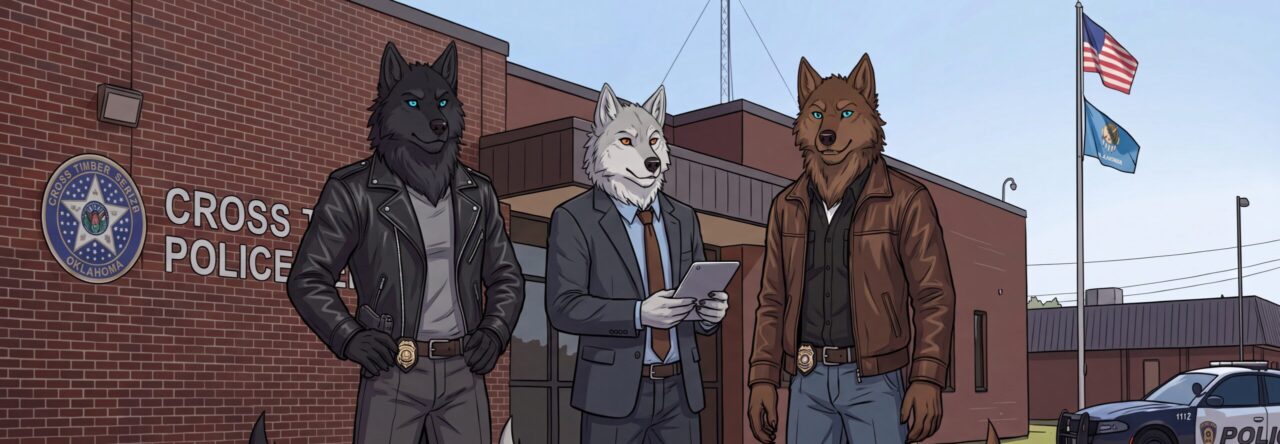
A week later, Officer Serrano laughed in the bullpen.
It was not a loud laugh.
Not one that stopped conversations or made people turn around.
Just a quick, unguarded sound at something Officer Patel had said while they stood beside the report printer with paper cups of coffee in their hands.
But Thane heard it from halfway down the hall.
He stopped without meaning to.
Gabriel, walking beside him, took one more step before he noticed.
“What?”
Thane did not answer right away.
He looked toward the bullpen.
Serrano stood with Patel near the printer, one hip against the counter, hair pulled back neatly, uniform pressed, duty belt sitting straight at her waist. She looked rested.
Not completely untouched by the last few weeks.
Nobody looked untouched after a hard stretch.
But the tightness that had lived in her shoulders was gone. The careful way she had held herself, like one wrong word might make everything come apart, had gone with it.
She was talking with both hands.
She was smiling.
She looked like herself.
Patel said something else, and Serrano laughed again.
Gabriel followed Thane’s gaze.
Then his expression softened.
“Oh.”
Mark joined them from the other side of the hallway, carrying his laptop case and a fresh evidence folder.
“What?”
Gabriel tipped his head toward Serrano.
Mark looked.
For a few seconds, none of them spoke.
Then Serrano noticed them.
She looked over, saw the three wolves standing in the hallway, and lifted one hand.
“Evening, detectives.”
“Evening,” Thane said.
Her smile stayed.
Not strained.
Not grateful in a way that made anybody uncomfortable.
Just normal.
“Big night,” she said.
Gabriel’s ears lifted.
“Is it?”
Serrano looked toward the front windows.
“You have not seen the lot yet?”
Thane glanced at Gabriel.
Gabriel looked at Mark.
Mark’s ears tipped forward.
“Apparently not.”
Serrano’s smile widened.
“You should go look.”
Then she turned back toward Patel, still carrying her coffee, still laughing at something small and ordinary.
The three wolves continued down the hall.
Gabriel waited until they were out of earshot.
“She looks good.”
“Yeah,” Thane said.
Mark nodded.
“Stabilized.”
Gabriel looked at him.
“You make that sound like a patient chart.”
“It is a positive assessment.”
“It is.”
Thane looked back once toward the bullpen.
Serrano had picked up a report folder. Patel was explaining something with exaggerated hand motions. Serrano shook her head, smiling.
No one knew who had made the mortgage payment.
No one had told her.
No one had asked her for anything.
But she had breathing room now.
A chance to stand upright again.
And that was enough.
More than enough.
Thane felt something warm settle low in his chest.
Not pride.
Not exactly.
Something quieter.
The feeling of seeing a good thing land where it belonged.
“Come on,” he said.
They headed for the front entrance.
The parking lot had changed.
For a second, Thane stopped beneath the awning and simply looked.
Eighteen new Ford Police Interceptor Utilities filled the far half of the lot in neat rows.
Fresh white paint.
Dark Cross Timber graphics along the doors.
New emergency-light bars gleaming under the late-afternoon sky.
Push bumpers.
Rear prisoner partitions.
Mounted radios.
Mobile data terminals lit inside the cabins.
Fresh tires.
Fresh plates.
Not a loose panel.
Not a cracked console screen.
Not a strip of peeling door trim held in place by the optimism of Fleet and two rolls of black tape.
They looked sharp.
They looked capable.
They looked like vehicles that would start at the beginning of a shift and still run at the end of it.
The newest patrol units sat in three clean rows beneath the fading sun.
A few officers were already moving around them, opening doors, checking rear compartments, running hands over the new equipment mounts, adjusting seats, and looking at the interiors with the quiet reverence people usually reserved for new houses.
Officer Grant stood near one of the units with both hands resting on the hood.
He was grinning.
Not trying to hide it.
Darnell had opened the rear door of another unit and was examining the new partition system like he had been given access to a spacecraft.
Patel sat in the driver’s seat of a third vehicle, checking the radio controls while Bell leaned against the passenger-side door and explained something to a younger patrol officer.
Serrano stood near the first row with a clipboard in hand.
She was looking over a vehicle-assignment sheet.
And she was smiling too.
Gabriel let out a slow breath.
“Well.”
Mark looked across the rows.
“The upfit work is better than I expected.”
Gabriel turned toward him.
“Of course that is your first thought.”
“The mounting layout is efficient. The rear equipment storage is modular. The radio placement does not obstruct the front-console controls.”
Gabriel blinked.
“You are impressed.”
“I am objectively impressed.”
Thane looked across the lot.
The city had moved quickly once the grant was accepted.
The department had already had a fleet-replacement specification ready because Mercer had spent years trying to get the city to approve one. The state contract dealer had located a released allocation of Police Interceptor Utilities built close enough to Cross Timber’s requirements that the regional upfitter could finish the radios, lights, cameras, graphics, partitions, and equipment mounts without waiting for a new factory run.
It had still taken work.
Fleet staff.
Procurement.
City Legal.
The upfitter.
The communications unit.
People in offices who did not get much attention unless something failed.
But now the vehicles were here.
Ready to work.
Deputy Chief Mercer stood near the first row in a clean uniform shirt, talking with the fleet supervisor and a city representative. He had the look of a man trying very hard to remain professional while standing in front of a problem he had spent years carrying.
Officer Bell spotted the three wolves first.
He lifted a hand.
“Night Shift.”
Thane, Gabriel, and Mark crossed the lot.
Bell nodded toward the rows of Interceptors.
“Pretty, huh?”
Gabriel looked down the line.
“They smell new.”
Bell gave him a look.
“Everything smells new to you.”
“Not everything smells this new.”
“Plastic, upholstery, wiring, adhesive, fresh rubber,” Mark said. “And the equipment compartments are clean.”
Gabriel pointed at him.
“See? He gets it.”
Mark stared at him.
“I did not say I was enjoying it.”
“You did not have to.”
Mercer turned as they approached.
For a moment, his expression stayed neutral.
Then it shifted.
Not much.
Just enough.
“Evening.”
“Evening,” Thane said.
Mercer looked back at the vehicles.
“All eighteen cleared final inspection this afternoon.”
Gabriel glanced toward the city representative.
“That is fast.”
Mercer’s mouth moved faintly.
“Fleet found an available allocation. Procurement moved with impressive speed once it had funding. The upfitter worked overtime.”
Mark looked at the nearest vehicle.
“Were the radio systems integrated already?”
“Every unit has current radios, camera systems, front and rear recording, modern mobile terminals, medical-kit mounts, evidence-storage compartments, partitions, rifle-locker mounting points, and the department’s standard patrol equipment setup.”
Gabriel tilted his head.
“Rifle-locker mounting points.”
Mercer looked at him.
“You are not getting one.”
“I was not asking.”
“You were thinking about asking.”
Gabriel looked at Thane.
“He can read minds now.”
“No,” Thane said. “You are just obvious.”
The fleet supervisor laughed.
Mercer looked at the three wolves again.
Then glanced toward the city representative, who had moved to talk with Crowe near the far line of cars.
His voice lowered.
“They are good vehicles.”
Thane nodded.
“Yeah.”
“They will save people time.”
“Yeah.”
“They will save officers from getting stranded, overheating, losing a radio, dealing with dead terminals, or taking a unit out of service for something that should have been fixed ten years ago.”
Thane looked at him.
Mercer’s face stayed composed.
But his eyes had changed.
“You got what you needed,” Thane said quietly.
Mercer looked at the nearest patrol unit.
Then back at him.
“We did.”
Gabriel and Mark stood silently beside Thane.
Mercer did not say thank you.
Not here.
Not in the lot.
Not with people around.
He did not need to.
Instead, he turned toward a small gathering forming near the first row of vehicles.
“Come on,” he said. “I need to make sure nobody decides the push bumpers are decorative.”
The department did not hold a ceremony.
That had been one of the conditions.
No giant check.
No cameras.
No donor name.
No local-news live shot of officers standing in front of the fleet.
Just a short briefing in the parking lot before shift.
Crowe stood near the first vehicle while patrol gathered in a loose semicircle.
The sun sat low behind the building, catching the new light bars and making them flash bright against the dark glass.
Mercer stood beside her.
The city representative stayed off to one side.
Not invisible.
Just not making the moment about City Hall.
Mercer cleared his throat.
“These units are ready for service tonight.”
A murmur moved through the group.
“Eighteen units,” he continued. “Patrol vehicle replacement. Full upfit. Current equipment. Current radios. Current cameras. Current terminals. The oldest marked units in the fleet are being retired out of front-line rotation beginning now.”
Somebody behind Thane let out a quiet, disbelieving laugh.
Darnell looked down at the keys in his hand.
Grant stared at the dashboard of the vehicle beside him.
Serrano stood with Patel, both listening.
Mercer continued.
“The funding came through a confidential restricted public-safety grant accepted through the City of Cross Timber under normal procurement procedures. The donor has asked to remain anonymous.”
No one complained.
No one asked who.
Most people just looked at the cars.
Mercer’s voice hardened slightly.
“They are here because this department needs reliable equipment. You will inspect them. You will maintain them. You will report problems early. You will not treat a new patrol unit like it is indestructible because nothing is.”
Gabriel leaned toward Mark.
“I think he is looking at Darnell.”
Mark looked at Darnell.
“He is definitely looking at Darnell.”
Darnell heard them.
“I have never damaged a patrol vehicle.”
Patel gave him a look.
“You backed into a shopping-cart corral last month.”
“It came out of nowhere.”
“It was bolted to the ground.”
“It was dark.”
Mercer continued as if nothing had happened.
“Assignments are posted. Fleet will be available through the first week for setup questions and equipment adjustments. Anyone with a recurring assigned unit will receive a familiarization checklist before the end of shift.”
He looked across the group.
“Use them well. Bring them home.”
That was it.
No applause was requested.
But it came anyway.
Not thunderous.
Not dramatic.
Just a real ripple of hands coming together from people who understood what the vehicles meant.
Thane stood at the back with Gabriel and Mark.
They did not clap immediately.
Not because they were above it.
Because for a second, all three of them simply watched.
Bell stood beside the unit he had been assigned, one hand on the open driver’s door.
Grant sat behind the wheel of another, adjusting the seat with the pleased concentration of someone who had spent too many shifts driving something with a broken lumbar-support lever.
Patel ran her fingers over the clean edge of a new center console.
Darnell opened the rear hatch and found the medical bag properly secured in a dedicated compartment.
Serrano stepped up to one of the vehicles at the end of the second row.
A new unit.
Her name was not on it.
No officer’s name was.
It belonged to the department.
To the shift.
To whoever needed it.
But she ran one hand over the driver-side door graphic anyway.
Then she opened the door and sat inside.
Her shoulders lowered.
She closed her eyes for half a second.
Then opened them again.
Thane saw it.
Gabriel saw it.
Mark saw it.
And none of them said a word.
The feeling in Thane’s chest spread warmer.
This.
This was the payoff.
Not the grant agreement.
Not the legal structure.
Not the quiet signatures and confidential phone calls.
This was the point.
Watching people they worked beside every night stand in front of tools that would make their lives safer.
Watching Serrano smile without knowing why the world had suddenly given her enough room to breathe.
Watching Bell inspect a radio that would not cut out halfway through a call.
Watching Grant sit in a vehicle that did not smell faintly of coolant and electrical failure.
Watching Darnell look delighted over a properly secured trauma kit.
The three wolves stood a little apart from it all.
Not looking important.
Not needing to.
Just happy.
Gabriel leaned close enough that only Thane and Mark could hear him.
“That feels good.”
Thane nodded.
“Yeah.”
Mark looked at the row of vehicles.
“Very good.”
Gabriel glanced at him.
“You can say it like a person.”
Mark considered.
“I am extremely pleased.”
Gabriel smiled.
“Better.”
Thane watched Serrano step out of the new Interceptor.
She saw the three of them standing together and lifted one hand in a small wave.
Thane waved back.
Then Crowe called for evening briefing.
The city still had work to do.
The new patrol units were not an excuse to ignore the old cases.
They made the night feel lighter.
That was all.
In the briefing room, the case board still carried evidence lists, victim names, property-recovery charts, lab requests, and the slow, necessary work that followed arrests.
Voss stood at the head of the table.
Rusk sat near the coffee pot with a paper cup and a look that said he had already heard at least three people complain about needing to learn new vehicle controls.
Kessler had stayed late again, laptop open beside him.
The access-burglary case was no longer an emergency.
It had become a recovery operation.
Latham and Cross remained in custody.
Their attorneys had arrived.
The evidence team had recovered property tied to ten confirmed victims and five more potential victims from the storage unit, garage, van, and electronic files.
But the case had opened more questions than it had closed.
Voss tapped the first folder.
“Access burglaries.”
Mark opened his notes.
“Victim-notification team has identified eleven confirmed victim households. Seven have recovered property. Four are awaiting digital-evidence review because the devices recovered may contain sensitive personal information.”
Gabriel looked toward the evidence chart.
“Any scheduled second visits?”
“Three,” Kessler said. “All prevented. Patrol contacted each household before the relevant date. Two families stayed elsewhere voluntarily. One had already changed every lock and garage control after the first burglary.”
Thane nodded.
“Good.”
“Latham and Cross had lists for more addresses,” Voss said. “Some may be targets that were never entered. Some may be people whose information was acquired from mail or online records but not yet acted on.”
“Do we know where the address lists came from?” Gabriel asked.
“Partly,” Kessler said. “Cross used the old HomeLink access account to identify systems and camera configurations. Latham appeared to collect physical documents and access items. But one of the spreadsheets includes data that would not have been available through either source.”
Mark’s ears tipped forward.
“What kind of data?”
“Insurance claim numbers. vehicle finance information. account-recovery questions. Some medical-provider references.”
Gabriel’s expression changed.
“Data broker?”
“Possibly,” Kessler said. “Or someone with access to records. We are still tracing it.”
Voss looked at Night Shift.
“You are not chasing that tonight. The digital-crimes unit and prosecutor have taken the broader identity-theft branch. Your task is victim follow-up.”
Gabriel nodded.
“Making sure people know what was recovered?”
“Yes. Explaining what may have been compromised. Helping them understand the difference between recovered property and restored security.”
“That is a hard conversation,” Gabriel said.
“I know.”
Voss tapped the second folder.
“Prairie Ridge.”
The mood shifted again.
“Mason Vail remains in custody,” she said. “His attorney has advised him not to speak further.”
Rusk leaned back.
“Smart attorney.”
“His phone extraction is ongoing,” Kessler said. “The prepaid number he texted has been used by at least one additional device, but we do not yet have subscriber information. It may identify an accomplice. It may identify a buyer. It may identify nothing useful. We do not force it.”
Mark nodded.
“Materials inventory?”
“Prairie Ridge has confirmed approximately two hundred thousand dollars in missing materials and equipment at the Redline yard,” Voss said. “Likely more once the audit finishes. Harold Brice has obtained counsel and is cooperating through his attorney.”
“Luis?” Thane asked.
“Home from the hospital,” Voss said. “Recovering. He has a follow-up appointment tomorrow. His company has placed him on paid leave until he is medically cleared.”
Gabriel’s ears lowered.
“Is that good?”
“His wife says he needs it,” Voss replied. “He is frustrated. But he is alive.”
Thane nodded.
“Good.”
Voss looked at the room.
“Night Shift will follow up with Luis and Marina after their appointment. Do not push for a statement. Do not ask him to perform gratitude because we made an arrest. Check on their safety. Clarify what happens next. Make sure they know the case does not disappear because the immediate scene is over.”
Gabriel nodded.
“Understood.”
Rusk took a drink of coffee.
“Then you get whatever patrol needs. New cars do not stop people from losing keys, fighting with cousins, or calling police because a raccoon stared at them funny.”
Gabriel looked at him.
“That happened once.”
“Once was enough.”
Crowe stood near the door.
“Get to work.”
Their first stop was not a crime scene.
It was the Whitcomb house.
Darren Whitcomb opened the front door with a new deadbolt installed above the old one and a small metal camera cover clipped over the doorbell lens.
He looked tired.
But not afraid in the same raw way he had been the first night.
Nora stood behind him with a tray of iced tea glasses balanced in both hands.
They had not expected company.
They had just wanted to sit in their own house without wondering whether someone knew the code to their garage.
“Detectives,” Darren said.
“Evening,” Thane said.
“We wanted to update you in person,” Gabriel added.
Darren stepped aside.
The kitchen still held the family command center.
But the old papers were gone.
The board had been redone with clean magnets and a fresh calendar.
No gate codes.
No address list.
No emergency-contact sheet pinned in public view.
Just the family schedule they needed and nothing more.
Mark noticed it immediately.
He did not comment until they were seated around the kitchen table.
“The home-security reset was completed?”
Darren nodded.
“New router. New passwords. New doorbell account. New garage controls. Every lock changed.”
“Good,” Mark said.
Nora set iced tea in front of them.
“You found them?”
Gabriel looked at her.
“We found the people we believe were responsible for the burglaries.”
Darren’s face tightened.
“Were our things there?”
“Some,” Gabriel said carefully. “Your garage remote. Your spare key. The home-office folder. Some vehicle documents.”
Nora closed her eyes.
Darren leaned back in his chair.
“Why?”
Thane answered.
“They were collecting access. Information. Things that could help them come back later, or impersonate the people they stole from.”
Darren’s jaw tightened.
“They were going to come back.”
“We found target lists,” Gabriel said. “There was evidence they intended follow-up entries at some homes. We cannot say with certainty that yours was scheduled, but you did the right things. You secured the house. You changed the access points. You made it harder for them to use what they had.”
Nora looked at the new door lock.
“We were lucky.”
“No,” Thane said. “You reported it. That helped us connect the pattern.”
Darren looked at him.
“Is there anything else we need to do?”
Mark opened a folder.
“We brought a list. Credit monitoring. account-password changes. replacement of vehicle registration records. recovery-account updates. a safe-device review for old phones and tablets. The digital-crimes unit will contact you if any of your information appears in recovered account files.”
Nora accepted the folder.
Her hands were steady now.
“Thank you.”
Gabriel looked at her.
“You do not have to thank us for doing the job.”
“I know,” she said. “But I want to.”
For a moment, Gabriel did not answer.
Then he smiled.
“Okay.”
They left the Whitcomb home with one less family living inside the shadow of someone else’s plan.
Not completely healed.
Not instantly safe in every way.
But informed.
Prepared.
Seen.
That mattered.
Luis Ortega’s house stood on a quiet block south of the older commercial district.
A small single-story home with a narrow porch, a neat row of potted plants, and a blue pickup parked carefully beneath a carport.
Luis sat in a reclining chair in the living room with his injured leg elevated and wrapped in a hard cast.
He looked irritated by the chair.
Irritated by the crutches leaning against the wall.
Irritated by the fact that his wife, Marina, had clearly decided he would not be carrying anything heavier than a water glass for the foreseeable future.
Which, Gabriel thought, was probably a good sign.
Marina opened the door with a tired smile.
“Come in.”
Luis looked up from the chair as the three wolves entered.
“Detectives.”
“Luis,” Thane said.
“You look better.”
“I look trapped in furniture.”
Gabriel nodded.
“That is a fair assessment.”
Luis glanced toward his cast.
“They say six to eight weeks.”
Mark looked at the crutches.
“That will depend on healing and physical therapy.”
Luis looked at him.
“You are the optimistic one?”
“No,” Gabriel said. “He is the organized one.”
Mark ignored him.
Marina brought everyone coffee before sitting on the edge of the couch.
The living room had the comfortable clutter of a real home.
Family pictures.
A folded blanket.
A basket of children’s toys near the television.
A framed photograph of Luis and Marina with two young girls standing between them at a lake.
Thane noticed the girls were not home.
Maybe at school.
Maybe with relatives.
Maybe somewhere they did not have to hear the details of why their father had been missing.
Voss had said not to make Luis perform gratitude.
So Thane did not start there.
He sat across from Luis.
“We wanted to let you know where the case stands.”
Luis’s expression hardened slightly.
“Mason.”
“Mason is in custody,” Thane said. “The search warrants recovered materials from the Redline yard, your insulin kit from his work truck, records that support the inventory changes you found, and evidence that puts his truck near the culvert after you were attacked.”
Luis closed his eyes.
For a few seconds, he did not move.
Then he opened them again.
“He had my insulin.”
“Yes.”
“He left me down there.”
“Yes.”
Marina reached for Luis’s hand.
He held it.
Gabriel spoke gently.
“The evidence is being processed. The prosecutor’s office will decide final charges as the case develops. Mason has an attorney. There may be hearings. There may be delays. We do not want you to think the arrest means you will never have to hear about this again.”
Luis nodded slowly.
“I know.”
“But we also do not want you to think you are carrying it alone,” Gabriel said.
Luis looked at him.
“I was trying to do the right thing.”
“We know,” Thane said.
“I thought if I just documented it, if I did not accuse anybody until I had proof, it would be safe.”
Mark’s ears lowered.
“That was reasonable.”
Luis gave a small, bitter laugh.
“Did not feel reasonable in the culvert.”
“No,” Mark said quietly. “It would not.”
Marina looked toward the floor.
“They offered him paid leave,” she said. “Prairie Ridge did.”
Luis’s jaw tightened.
“I do not want paid leave.”
“You need to heal,” Marina said.
“I need to work.”
“You need to heal,” she repeated.
Gabriel watched them.
Not judging.
Just hearing the strain beneath the argument.
The fear of bills.
The fear of being pushed aside.
The fear that getting hurt while doing the right thing would cost Luis the job he had tried to protect.
Thane looked at Luis.
“Do you have an attorney?”
Luis blinked.
“What?”
“For work. For the company. For anything connected to the theft investigation.”
“No.”
“Okay,” Thane said. “You may want one before you sign anything you do not understand. That is not a recommendation about a specific lawyer. It is just a recommendation to make sure someone explains your options.”
Luis nodded.
“Okay.”
Mark added, “Victim Services will also contact you. They can explain the case process, medical-cost questions, and available support without you having to figure all of it out yourself.”
Marina’s eyes softened.
“Thank you.”
Thane nodded.
“Your job right now is to recover.”
Luis looked at his cast.
“That is not much of a job.”
“It is for now,” Thane said.
Luis studied him.
Then, finally, some of the anger left his face.
“Okay.”
It was not a victory speech.
It was not a perfect answer.
But it was a place to start.
Before they left, Luis called after them from the living room.
“Detectives.”
They turned.
“I heard you found the material yard.”
“We did.”
Luis looked at Marina.
Then back at them.
“Do not let him say it was just paperwork.”
Thane held his gaze.
“We will not.”
At 21:46, Night Shift responded to a patrol-assist call near the western greenbelt.
No major crime.
No urgent threat.
Just a teenage boy who had climbed into a storm-drain access channel after losing a bet and then discovered that getting out was harder than getting in.
Officer Grant stood near the opening with one hand on his duty belt and the expression of someone trying very hard not to laugh in front of the boy’s friends.
The boy sat on a concrete ledge six feet below the access opening.
He was muddy.
Embarrassed.
And trapped between a steep slick slope and a narrow grate that had become much less funny after the sun went down.
Gabriel looked at him.
“You lost a bet?”
The boy looked at the ground.
“Yes.”
“What was the bet?”
“That I could get down there and back out.”
Gabriel nodded.
“Okay. So you lost twice.”
The boy’s friends made strangled sounds trying not to laugh.
The trapped boy glared at them.
Thane crouched at the edge and looked down.
“No injuries?”
“No.”
“Can you stand?”
“Yes.”
“Good.”
Mark examined the access ladder bolted to the far wall.
“It is intact. He likely slid past the lower rungs.”
Grant glanced at it.
“Can you get to it?”
The boy nodded.
“I think.”
“Do not ‘think,’” Mark said. “Move slowly. Face the ladder. Keep both hands on it.”
The boy looked at Thane.
“Can you just pull me out?”
Thane looked down at him.
“I can. But you need to climb the first part. You have to help.”
The boy’s face fell.
Gabriel leaned near the opening.
“He is being nice. He thinks the mud is funny.”
“I do not.”
“You do a little.”
Thane looked at him.
Gabriel smiled.
The boy took a breath.
Then moved carefully toward the ladder.
He slipped once.
Thane’s hand shot down immediately, caught the back of his shirt, and held him steady without lifting him.
The boy froze.
“You are okay,” Thane said. “Find the rung.”
The boy did.
One step.
Then another.
Then three more.
When he reached the opening, Thane reached down and lifted him the rest of the way onto solid ground.
The boy stood there dripping mud and staring at the concrete channel like it had personally betrayed him.
Grant handed him a bottle of water.
“Next time, lose a bet involving video games.”
The boy nodded.
“Yes, sir.”
One of his friends raised a phone.
“Can we get a picture with the wolves?”
The trapped boy looked horrified.
“No.”
Gabriel looked at the group.
“Absolutely not.”
The phone went down.
Thane looked at the boy.
“You are not in trouble. Go home. Shower. Do not climb into storm drains.”
“Yes, sir.”
As the teenagers walked away, Grant looked at Thane.
“Normal evening?”
Thane glanced at the drain.
“Pretty normal.”
Grant smiled.
“I am driving one of the new units tonight.”
“Yeah?”
“Yeah.” He looked back toward his patrol SUV parked by the curb. “It starts.”
Gabriel nodded solemnly.
“Important feature.”
Grant smiled wider.
“Turns out.”
At 23:18, they stopped at a gas station near the interstate because Mark needed coffee, Gabriel needed something salty, and Thane needed five minutes without a radio talking at him.
The new patrol fleet had become the city’s main topic of conversation.
Two officers stood at the pumps in separate new Interceptors, comparing center-console layouts while pretending they were not.
A passing driver rolled down his window and asked one of them if the department had won the lottery.
Officer Darnell, leaning against the pump beside his assigned unit, answered without hesitation.
“Nope. Somebody did something nice.”
The driver nodded, satisfied with that.
Thane stood near the convenience-store window holding a bottle of water.
Gabriel looked through the glass toward the patrol vehicles.
“Do you think anybody will ever figure it out?”
“Some people already have,” Mark said.
“Not publicly.”
“No.”
Gabriel looked at Thane.
“Does it bother you?”
Thane considered the question.
He thought of Voss in the interview room.
Mercer in the parking lot.
Rusk’s small knowing smile.
Eli’s zero-dollar invoice.
Serrano laughing by the printer.
The fleet vehicles in neat rows beneath the sun.
“No,” Thane said. “Not if they keep it quiet.”
Mark nodded.
“Then it is functioning as intended.”
Gabriel smiled.
“You make everything sound like a server deployment.”
“It is a system.”
“It is people.”
“It is both.”
Thane took a drink of water.
“Come on. We have reports.”
The rest of the shift was ordinary in the way ordinary was supposed to be.
A noise complaint where the problem turned out to be an exercise bike assembled at midnight in an upstairs apartment.
A welfare check on a man whose daughter had not heard from him all day; he was fine, asleep in a recliner with his phone on silent and deeply embarrassed by the number of police officers who had come to check on him.
A traffic assist after a delivery van shed part of its load across a service road.
No crises.
No new bodies.
No new missing people.
No fresh catastrophe waiting to become a case board.
Just work.
Good work.
At 03:52, Mark received a message from the digital-crimes liaison handling the wider identity-theft branch of the Latham and Cross case.
The preliminary review of their stolen data showed no new unauthorized credit accounts or major financial transactions tied to the victim list.
Not yet.
The suspects had been arrested before they could move beyond collection and planning.
Gabriel read the message twice.
“So we got there in time.”
Mark nodded.
“Likely.”
Gabriel gave him a look.
Mark corrected himself.
“Yes. We got there in time.”
Thane looked out the office window toward the parking lot.
A row of new patrol units sat under the lot lights.
Some were already out on the streets.
Some were waiting for the next shift.
All of them clean.
All of them ready.
At 04:17, a message came from Voss.
Luis Ortega’s case file has been formally assigned for prosecution review. Vail’s counsel has requested discovery preservation. Good. Let them see what we have.
Thane read it.
Then showed it to Gabriel and Mark.
Gabriel nodded slowly.
“Good.”
Mark looked at the fleet schedule posted in the system.
“Vehicle transition is going smoothly. Only one radio-mount adjustment request so far.”
Gabriel stared at him.
“Do you have a secret fleet dashboard?”
“Yes.”
“Why?”
“Because I asked Fleet for one.”
“Why?”
“To see whether the transition was functioning correctly.”
Gabriel looked at Thane.
“He is a very strange wolf.”
Thane’s mouth moved faintly.
“Yeah.”
Mark looked at both of them.
“You are welcome.”
At 06:30, Voss and Rusk arrived for handoff.
Voss took the victim-follow-up notes.
Rusk listened to the storm-drain report with one eyebrow raised.
“A storm drain.”
“Teenager,” Gabriel said.
“Of course.”
“Lost a bet,” Mark added.
Rusk looked at Thane.
“Did you rescue him?”
“Assisted.”
“Did he learn anything?”
“Maybe.”
“Then the city moves forward.”
Voss glanced through the final case notes.
“Good work tonight.”
Thane nodded.
“Thanks.”
Her eyes moved toward the lot through the front windows.
One of the new Interceptors pulled in, lights off, clean white paint reflecting the first edge of dawn.
Voss watched it for a moment.
Then she looked back at the three wolves.
“Looks like patrol is happy.”
Gabriel smiled.
“Seems like it.”
Voss’s mouth almost moved.
Then she returned to the files.
Outside, the sky was beginning to brighten over Cross Timber.
The city would wake up soon.
People would go to work.
Kids would ride buses.
Families would lock their doors and assume their houses belonged only to them.
Luis Ortega would wake in his own bed with his family nearby.
Officer Serrano would report for shift with her bills paid, her head up, and one less impossible thing pressing on her chest.
Patrol officers would turn keys in reliable vehicles and trust the engines to start.
And three wolves would go home knowing they had helped make some of that possible.
Not because anyone had thanked them.
Not because anyone knew.
Just because they had seen a need.
And they had done what they could.
That was enough.
It was more than enough.