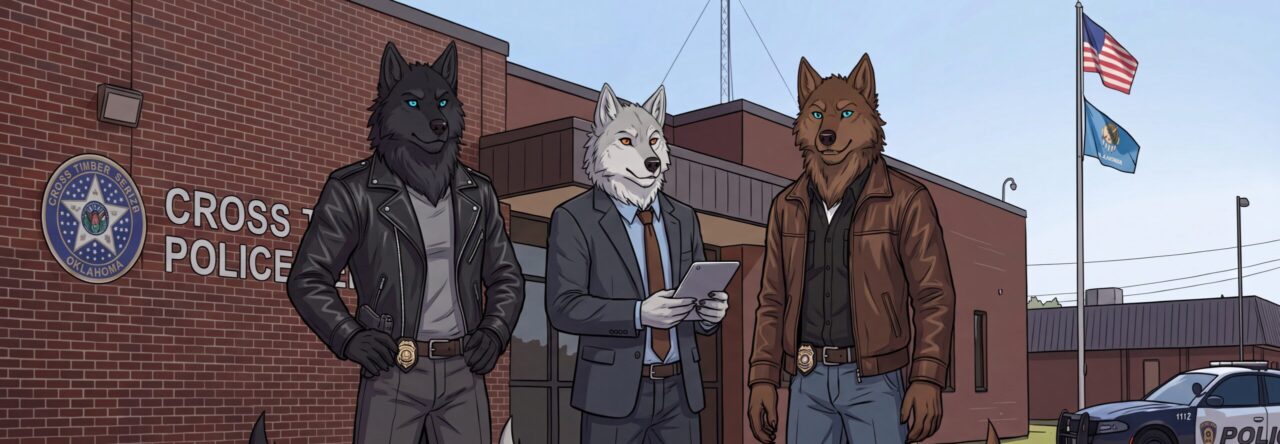
The new patrol vehicles had already begun to disappear into the rhythm of the department.
A week ago, they had stood in shining rows beneath the evening sun, all clean white paint and fresh graphics and factory-new interiors.
Now they sat in the lot with mud on their tires.
Coffee cups in their consoles.
Report folders tucked behind seats.
A faint dusting of Oklahoma road grit along the lower doors.
They looked better that way.
Not less impressive.
More real.
They were not display pieces anymore.
They were police cars.
Thane noticed that as the Humvee rolled through the lot just before seventeen-thirty.
Officer Grant climbed out of a new Interceptor near the service bay, talking into his shoulder mic while carrying a stack of traffic-warning cones. Officer Patel was loading a medical bag into the rear compartment of another unit. Darnell stood beside a third vehicle, arguing with Fleet about whether the new radio mount was two inches too close to his knee.
“It is two inches too close,” Darnell insisted.
The fleet technician looked at him.
“You are six-foot-four.”
“And my knees are six-foot-four knees.”
“That is not how knees work.”
“It is how mine work.”
Gabriel watched through the passenger-side window.
“He is going to lose that argument.”
Mark leaned forward from the back seat.
“The mount is adjustable.”
Darnell heard him through the open window.
“It is not adjustable enough.”
Mark considered the distance between the radio console and Darnell’s knee.
“It may be adjustable enough for a person with normal proportions.”
Darnell turned slowly toward the Humvee.
Gabriel covered his mouth.
Thane shut off the engine.
“Do not start.”
“I did not say anything,” Gabriel said.
“You were thinking it.”
“I was thinking Darnell is emotionally six-foot-four knees.”
Mark opened his door.
“That does not make sense.”
“It does in my heart.”
Thane climbed out.
“Come on.”
They crossed the lot together.
The evening had settled warm and hazy over Cross Timber. The sky was pale blue near the horizon, turning gold behind the municipal-service buildings. Somewhere beyond the station, a lawn mower droned through its final pass of the day.
Inside, the department was busy in the ordinary way.
Not tense.
Not quiet.
Just moving.
Dispatch chatter came in bursts from the communications wing. Patrol officers moved between the locker rooms and briefing area. The front desk clerk was explaining the difference between a police report and a civil dispute to someone who did not appear happy about it.
Officer Serrano stood near the bullpen copier with a report folder in one hand and a bottle of water in the other.
She looked up as the three wolves entered.
“Evening.”
“Evening,” Thane said.
She smiled.
Still normal.
Still steady.
She had been moving differently since the mortgage crisis—not like someone who had been rescued, because nobody had rescued her. She had kept working. She had made the calls. She had accepted the breathing room when it appeared.
But she was not carrying that tight, exhausted look anymore.
She looked rested.
Present.
Like she had enough room in her life to be a person again instead of a problem waiting to get worse.
Gabriel noticed it too.
His expression softened just slightly.
Serrano glanced between them.
“What?”
“Nothing,” Gabriel said.
Serrano narrowed her eyes.
“That is never true.”
“You look good,” Thane said.
For a second, she seemed caught off guard.
Then she nodded once.
“Thanks.”
Patel appeared beside her with two printed incident sheets.
“We have a briefing in five,” she said. Then, to Serrano, “You still owe me the report correction from last night.”
“I do not.”
“You wrote ‘the suspect exited the residence in an aggressive manner.’”
“He did.”
“He tripped over a recycling bin.”
“He exited aggressively.”
Patel looked at the three wolves.
“See what I deal with?”
Serrano shook her head, smiling, and headed toward the briefing room.
Thane watched her go.
Then he looked at Gabriel and Mark.
Gabriel already knew.
Mark did too.
No meeting was necessary.
No silent vote.
Just the shared understanding that had become one of the pack’s quietest languages.
Serrano had been one officer.
One hard month.
One surprise expense.
One person who had needed help before the edge became a fall.
There would be others.
Thane turned toward Mercer’s office.
“I need to talk to him.”
Gabriel’s ears lifted.
“About what?”
“You know.”
Mark looked from Thane to the office door.
“The officer-support idea.”
Thane nodded.
Gabriel looked toward Serrano’s retreating back.
Then back at Thane.
“Yeah.”
Mercer’s door was open.
He sat behind his desk with a stack of fleet-transition reports spread in front of him, glasses low on his nose, one hand resting on a page labeled WEEK ONE MAINTENANCE REVIEW.
He looked up when the three wolves appeared in the doorway.
“No.”
Gabriel blinked.
“We have not asked anything.”
“You are all standing there together,” Mercer said. “That means you either want something or someone has done something.”
“Both can be true,” Gabriel said.
Mercer looked at Thane.
“Do you want a helicopter?”
“No.”
“Good. Because I already told you no.”
“I never asked for a helicopter.”
“You have thought about it.”
Gabriel looked at Mark.
“He has.”
“I have not,” Thane said.
Mark adjusted the strap on his laptop case.
“You have looked at the department parking lot twice this week and evaluated the open area near the service bay.”
Thane stared at him.
“That was not why.”
Gabriel smiled.
“Sure.”
Mercer set down his pen.
“What do you need?”
Thane stepped into the office.
Gabriel and Mark followed.
The door stayed open.
No secrecy.
No dramatic closing of blinds.
Just four people standing in a work office with a problem that needed to be named properly before it could be solved.
Thane looked at the fleet reports.
Then at Mercer.
“The cars fixed a department problem.”
Mercer’s expression changed slightly.
“And?”
“Serrano showed us a people problem.”
Mercer sat back in his chair.
For a moment, he did not speak.
Then he nodded toward the guest chairs.
“Sit.”
The three wolves sat.
Mercer remained behind the desk.
“What are you proposing?”
Thane’s ears lowered slightly.
“A way for officers to ask for help before a bad month becomes a disaster.”
Mercer did not answer immediately.
Gabriel leaned forward.
“Not from the department.”
Mark added, “Not through supervisors. Not through Internal Affairs. Not through a discretionary command fund. Not through anything that would make an officer feel like they had to explain private hardship to the people evaluating them.”
Mercer’s gaze shifted from one to the next.
“And what does that look like?”
Thane spoke carefully.
“A separate restricted program through Red River. Independent review. Confidential application. Direct vendor payments whenever possible.”
“For what?”
“Emergency needs,” Thane said. “Car repairs that keep someone from getting to work. Housing arrears. Utility shutoff. Emergency child care. Medical travel. Storm damage. A hotel after a fire. A locksmith after a domestic situation. Things that turn into bigger problems when people have no cushion.”
Mercer’s face had gone serious.
“Do you know how complicated that is?”
“We know it needs to be,” Mark said.
“What happens when someone applies because they are behind on rent every month?”
“Then the program does not become a permanent substitute for income,” Mark said. “The foundation can set criteria for short-term crisis stabilization, vendor verification, limited grants, and referrals for longer-term support.”
“What happens when an officer is under discipline?”
Gabriel looked at him.
“The fund does not buy them immunity.”
“What happens when an officer is not liked?”
“The fund does not become a popularity contest,” Thane said.
Mercer’s eyes stayed on him.
“What happens when someone asks for money because they made bad choices?”
Thane held his gaze.
“Then the foundation decides whether there is an eligible emergency need. Not us. Not you. Not anybody’s shift supervisor.”
Mercer leaned back.
The office stayed quiet.
Outside, somebody laughed in the bullpen. A printer ran. A chair scraped against tile.
Mercer looked down at the fleet report again.
Then up.
“You are talking about a confidential officer-assistance program.”
“Yes,” Thane said.
“That could become very personal, very fast.”
“That is why it cannot be run by the department,” Gabriel said. “Nobody should have to stand in front of a lieutenant and explain that their water is getting shut off, or their car needs a transmission, or their kid is sick.”
Mercer’s eyes moved toward the bullpen.
Toward the officers who worked for him.
Toward Serrano’s desk, though he could not see it from here.
Then he sighed.
“I am not saying no.”
Gabriel’s ears lifted.
“But I am not saying yes until I understand every boundary.”
“That is fair,” Thane said.
Mercer pointed toward Thane’s phone.
“Call Carroway.”
Eli answered on the first ring.
“Thane.”
“Eli. You have me, Gabriel, Mark, and Deputy Chief Mercer on speaker.”
There was a pause.
Then Eli said, “Should I be concerned?”
Mercer leaned toward the phone.
“We are discussing a potential officer-support program through Red River.”
“Oh,” Eli said. “Then I am concerned in the administrative sense.”
Gabriel smiled.
“That is still concern.”
“It is the most useful kind.”
Thane explained the idea.
Not as a pitch.
Not as something already decided.
Just the need they had seen and the guardrails they wanted around it.
When he finished, Eli was quiet for a moment.
Then he said, “The broad concept is workable. The details are where it either becomes a dignified emergency-support program or a well-intentioned disaster.”
Mercer nodded slowly.
“That is my concern.”
“Good,” Eli said. “It should be.”
Mark opened his laptop.
“What would you require?”
Eli answered without hesitation.
“First: the department does not decide eligibility. Not Mercer, not Crowe, not Human Resources, not any supervisor. They can tell officers the resource exists. They can make a referral only with the officer’s consent. But they do not receive names, case notes, payment amounts, or applicant information.”
Mercer nodded again.
“Agreed.”
“Second: the program needs objective criteria. Sudden hardship. Immediate risk. Documented need. Short-term stabilization. It is not a salary supplement. It is not a debt-consolidation program. It is not a way to reimburse poor choices indefinitely.”
Gabriel looked at Thane.
“That sounds like a lawyer.”
“It should,” Eli said.
“Third,” Eli continued, “direct vendor payment whenever possible. Mechanic. landlord. mortgage servicer. utility company. hotel. pharmacy. child-care provider. locksmith. travel provider. Not cash handed over in a hallway. Not a check from a detective. Not anything that lets the recipient feel personally indebted to a donor.”
Thane nodded.
“That is what we want.”
“Fourth: the program must be kept entirely separate from law-enforcement decisions. It cannot be discussed in disciplinary proceedings, performance evaluations, promotions, investigations, witness matters, criminal cases, or internal politics.”
Mercer’s expression hardened.
“Yes.”
“Fifth: the donor identity stays confidential. The foundation, its legal and audit personnel, and only those who legally need to know will have that information. Applicants do not. Supervisors do not. Other officers do not.”
Gabriel looked toward Mercer.
“That is important.”
“I know,” Mercer said.
“Sixth,” Eli said, “we need a clear appeal and exception process. Not because every request will be approved, but because people deserve to know that an initial denial is not the end of the world if new documentation or a serious emergency changes the picture.”
Mark typed quickly.
“Independent review panel?”
“Foundation staff plus a vetted social-service partner,” Eli said. “No police command representation. No donor representation.”
Mercer leaned back.
“What would you call it?”
Gabriel answered immediately.
“The Cross Timber Officer Support Fund.”
Mark looked at him.
“That is sensible.”
Gabriel stared.
“Did you just compliment me?”
“It was an accurate observation.”
Thane looked at Mercer.
“Officer Support Fund.”
Mercer repeated it quietly.
“Cross Timber Officer Support Fund.”
Eli said, “Plain is good. Dignified is good. Do not make it sound like a memorial or a marketing campaign.”
Gabriel looked at the phone.
Eli continued.
“I suggest an initial pilot period,” Eli said. “A defined reserve. Annual outside review. A simple confidential application path. Clear emergency categories. A partner organization capable of responding quickly enough that the assistance is meaningful.”
Mercer nodded slowly. “And what kind of reserve are we talking about?”
Thane looked at Gabriel.
Then Mark.
Neither hesitated.
“Two million,” Thane said.
The office went quiet.
Mercer stared at him.
“Two million dollars.”
“Yes.”
“For emergency support.”
“Yes,” Thane said. “Not all at once. Not handed out because somebody asks. It stays with Red River. It gets reviewed. It gets used when somebody has a real problem and needs a place to land.”
Gabriel leaned back in his chair.
“Enough that it is real. Enough that it lasts.”
Mark added, “And enough that the foundation can structure it responsibly, with annual reporting, reserve management, and independent review rather than treating it as an informal spending account.”
Mercer looked from one of them to the next.
“That is not a pilot.”
“It is a starting point,” Thane said.
Mercer sat with that for a moment.
Then he looked down at the fleet reports on his desk.
“Do it.”
“Could it include civilian staff?” Mercer asked.
Thane glanced at Gabriel and Mark.
Gabriel nodded.
Mark did too.
“It should,” Thane said. “Dispatch. Records. detention. anyone who keeps the department functioning.”
Mercer looked at him.
“That changes the name.”
“Cross Timber Public Safety Support Fund?” Mark suggested.
Gabriel wrinkled his nose.
“That sounds like a line item.”
“It is a line item.”
“Officer Support Fund is better.”
Mercer thought about it.
“Keep the name. Include eligible essential civilian department employees in the criteria.”
Eli said, “That is workable. The written program can define eligible personnel without making the public name cumbersome.”
Thane leaned toward the phone.
“How soon?”
Eli answered, “Not tomorrow. Properly, not tomorrow. I can have a framework to Red River by the end of the week. They will need to review their charitable-purpose requirements, draft the application process, identify the independent social-service partner, and establish confidentiality protocols.”
Gabriel’s ears tipped back.
“So weeks.”
“Several,” Eli said. “Possibly a month before launch. But I can make sure the concept is real before it becomes a public conversation.”
Thane nodded.
“Okay.”
“When it does exist,” Mercer said, “the department gets a simple announcement. No donor name. No speech. No officer has to raise their hand in a room and admit they need it.”
“Exactly,” Gabriel said.
Mercer sat quietly for another moment.
Then he nodded once.
“Do it.”
The three wolves looked at him.
Mercer held up one hand.
“Do it right. Do it clean. Do it once. And do not make me regret trusting you.”
Thane’s voice softened.
“You will not.”
Eli said, “Deputy Chief Mercer, I will send a concept memo tomorrow. You will hate at least half the language.”
Mercer sighed.
“Good. Then it will feel official.”
The call ended.
For a moment, no one moved.
Then Gabriel looked at Mercer.
“You know what the weird part is?”
Mercer looked tired already.
“What?”
“You said yes to a fund, but still no to a helicopter.”
Mercer pointed at the door.
“Go to briefing.”
Gabriel stood.
“Worth asking.”
“It was not.”
The evening moved slowly after that.
Not empty.
Just normal.
The kind of night where the city kept presenting small problems and trusting someone to take them seriously enough that they did not become bigger ones.
At 19:11, Dispatch sent Night Shift to an apartment complex on the south side for a noise complaint.
The initial call sounded familiar enough to make everyone tired before they arrived.
LOUD MUSIC. POSSIBLE ARGUMENT. CALLER UNSURE IF VIOLENCE INVOLVED.
The apartment building was older, two stories of pale brick with narrow exterior walkways and balcony railings that had been painted too many times.
Officer Patel was already outside Unit 214 when the Humvee arrived.
She looked toward the three wolves.
“Music is loud. Neighbor says it has been loud for an hour. No signs of fighting.”
Gabriel tilted his head.
The bass came through the wall in a steady thump.
Not violent.
Not angry.
Just loud enough that the floorboards probably had opinions.
Thane looked at the apartment door.
“Who called?”
“Woman next door. Works nights. Has a toddler asleep.”
Mark looked toward the balcony window.
“Any children inside this unit?”
“Unknown.”
Gabriel listened again.
Then nodded slightly.
“Two adults. Maybe one teenager. No screaming.”
Patel knocked.
The music did not stop.
She knocked harder.
“Police department.”
The bass cut off.
A few seconds later, the door opened.
A young man stood there wearing a half-buttoned shirt and holding a guitar pick in one hand. Behind him, a teenage girl sat on the couch beside an electric keyboard. Another young man stood near a small drum pad setup, looking as if he had been caught committing a serious crime against silence.
The apartment smelled like pizza rolls, laundry detergent, cheap cologne, and the faint hot-plastic scent of audio equipment working too hard.
Gabriel looked past the first young man.
“Band practice?”
The young man blinked.
“Uh. Yeah.”
Patel crossed her arms.
“Your neighbor has a sleeping toddler.”
The young man’s face fell.
“Oh.”
The teenager stood from the couch.
“We did not know.”
“She knocked on the wall,” Patel said.
“We thought that was part of the beat,” the drummer said.
Nobody moved for a second.
Then Gabriel closed his eyes.
“Of course you did.”
Thane looked at the instruments.
“You live here?”
The young man nodded.
“Yeah. I am Theo. That is my sister, Lacey. And that is Brandon.”
“Are you practicing for something?” Gabriel asked.
Lacey nodded.
“Open-mic night. Friday. We have one song.”
“Do you need the music at this volume to practice it?”
The three of them looked at each other.
“No,” Theo admitted.
Patel pointed toward the wall separating the apartments.
“Then keep it down.”
“Yes, ma’am,” Theo said quickly.
The toddler began crying in the neighboring apartment.
The three musicians froze.
Gabriel looked at them.
“That is your cue.”
Theo looked miserable.
“We are sorry.”
“Go apologize,” Thane said.
They did.
Not because a report required it.
Not because they were ordered to grovel.
Just because a young man with a guitar pick in his hand looked across the hall, realized he had been selfish, and decided to fix the smallest part of the problem.
The neighbor opened the door with the toddler on her hip.
Theo apologized.
Lacey apologized.
Brandon apologized, then offered to carry the woman’s trash down later if she needed help.
The woman looked surprised.
Then tired.
Then less angry.
“Just keep it down,” she said.
“We will,” Theo promised.
Patel watched the exchange.
Then looked at Gabriel.
“You did not even have to say much.”
Gabriel shrugged.
“They were not trying to be jerks.”
Thane looked at the apartment door.
“Sometimes people just need to know they are being loud.”
Mark added, “And that wall-knocking is not generally percussion.”
The teenager, Lacey, heard him.
“I will remember that.”
“Good,” Mark said.
The report took six minutes.
The apology took another two.
Nobody went to jail.
The toddler went back to sleep.
And somewhere, later that week, three young musicians would probably play their one song at an open-mic night without waking half the building first.
At 21:04, the call was a disabled vehicle on East Memorial.
A silver sedan had stalled in the right lane just after the driver had turned onto the access road. Traffic was moving around it, impatient but not dangerous yet.
Officer Grant had arrived first in one of the new Interceptors.
His emergency lights flashed blue and red against the warm dark.
The sedan’s driver stood on the shoulder holding her phone and looking near tears.
Her daughter, maybe ten years old, sat in the passenger seat with a backpack in her lap.
Grant waved Night Shift over.
“Car died. No restart. They are trying to get to the hospital.”
Gabriel’s ears tipped forward.
“Who is in the hospital?”
The driver looked at him.
“My mother. She had surgery this morning. My daughter and I were going to see her, but then this happened.”
Thane looked at the sedan.
No smoke.
No crash damage.
No immediate hazard except the traffic.
Mark checked the dashboard indicators through the driver-side window.
“Battery light. Temperature is normal. Could be electrical. Could be alternator.”
The woman swallowed.
“I do not know what to do.”
Grant had already called a tow.
But the nearest unit was thirty-five minutes out.
The woman looked at her daughter.
Then at the hospital bag in the back seat.
Gabriel crouched beside the passenger door.
“Hey,” he said to the girl. “What is your grandmother’s name?”
“Grandma Rosa.”
“Is she okay?”
“She had a hip thing.”
“Then she is probably going to be very happy to see you.”
The girl nodded, trying hard not to cry.
Thane looked at Grant.
“Can you get them there?”
Grant looked toward his new patrol unit.
Then back at the sedan.
“I can transport them if the tow company can secure the car.”
Mark checked the tow update.
“Twenty-nine minutes now.”
Thane looked at the woman.
“Do you have someone who can meet the tow company?”
“My brother,” she said. “He lives nearby. I can call him.”
“Do that.”
Grant opened the rear door of his Interceptor.
The new partition had a civilian transport side configured for exactly that kind of thing—clean, safe, easy to use, not the old cramped rear seat of a car that smelled like broken air-conditioning and years of exhausted shifts.
The little girl climbed in first.
Then looked around.
“This is a new police car.”
Grant smiled.
“It is.”
“Is it yours?”
“It belongs to the department.”
“It is nice.”
Grant glanced at Thane.
Then back at the girl.
“Yeah,” he said. “It is.”
The woman got into the rear seat beside her daughter.
Before Grant shut the door, she looked at the three wolves.
“Thank you.”
Thane shook his head slightly.
“Grant is getting you there.”
She looked at Grant.
“Thank you.”
Grant nodded.
“Of course.”
The new Interceptor pulled into traffic with its emergency lights on—not racing, not turning the moment into a crisis, just making sure a mother and daughter reached the hospital safely after their car had chosen the worst possible time to quit.
Thane watched it go.
Gabriel stood beside him.
“Cars are more than cars.”
“Yeah,” Thane said.
Mark looked at the stalled sedan.
“Still an alternator problem.”
Gabriel looked at him.
“You are right, but read the room.”
“I was not denying the emotional significance.”
“You were thinking it very loudly.”
At 23:37, Night Shift responded to a welfare check at a small duplex near the old fairgrounds.
The caller was a neighbor who had not seen eighty-one-year-old Harold Finch in two days.
His mail was still in the box.
His porch light had been on since the previous night.
And his television was loud enough that the neighbor could hear game-show applause through the wall.
The house was locked.
The lights were on.
No answer at the door.
Thane stood on the porch and breathed in.
Old paper.
Coffee.
Laundry soap.
The faint medicinal scent of a home where someone kept organized pill bottles near the kitchen sink.
And Harold.
Alive.
Asleep.
No blood.
No panic.
No obvious injury.
Gabriel tilted his head.
“I can hear him.”
Mark looked toward the interior wall.
“Snoring?”
“Very loudly.”
Officer Darnell, standing at the edge of the porch, looked relieved.
“Can we wake him without breaking a door?”
Thane knocked again.
“Mr. Finch. Police department.”
No response.
Gabriel stepped closer to the living-room window.
The blinds were partly open.
Inside, Harold Finch slept deeply in a recliner with a blanket over his knees, one hearing aid resting on the side table beside him.
The television flashed bright colors across the room.
A game-show host shouted something about a vacation package.
Gabriel looked at the hearing aid.
Then at Darnell.
“That explains the television.”
Mark checked the address records.
“Emergency contact is listed as a daughter, Evelyn Finch. Local address.”
Darnell called.
Five minutes later, Evelyn arrived in a sedan, frantic and apologetic.
“He does this sometimes,” she said. “Not the two days part. But he falls asleep in that chair and takes out his hearing aid because it whistles.”
“Why did you not check sooner?” Darnell asked gently.
“I work in Tulsa,” she said. “I called him yesterday. He did not answer. I thought he was mad because I forgot to come over Sunday.”
Gabriel’s ears lowered.
“Do you have a key?”
“Yes.”
She opened the door.
The three officers entered with her.
Harold woke slowly, blinking at the bright television.
Then saw three large wolves, his daughter, and two police officers standing in his living room.
He looked at them for a long second.
Then said, “Did I win?”
Gabriel covered his mouth.
Darnell looked toward the ceiling.
Evelyn laughed through the tears already gathering in her eyes.
“No, Dad. You fell asleep.”
Harold looked at the television.
Then at the blanket over his knees.
“Oh.”
Thane crouched near the recliner.
“Are you hurt?”
“No.”
“Have you eaten today?”
Harold thought about it.
“I had cereal.”
“That was yesterday,” Evelyn said.
Harold frowned.
“Was it?”
The mood shifted.
Not into panic.
Into attention.
Mark quietly asked Evelyn about medications, recent changes, and whether Harold had been more confused than usual.
Darnell called EMS—not because Harold had done anything wrong, not because they needed an emergency, but because two days of missed meals and medication questions deserved a medical check.
Harold protested mildly.
“I am fine.”
Gabriel sat on the edge of the coffee table, keeping his voice gentle.
“Maybe. But let somebody make sure.”
Harold looked at him.
“You are very large.”
“Accurate.”
“You are also polite.”
“Also accurate.”
Harold considered that.
Then nodded.
“Fine. But I am not going to the hospital unless I have to.”
“Fair,” Gabriel said.
EMS arrived.
Harold’s blood sugar was low, but not dangerously so. His blood pressure needed follow-up. He had missed medication doses. The paramedic recommended evaluation, and Evelyn agreed.
Harold sighed deeply.
“Can I take my blanket?”
Evelyn smiled.
“Yes, Dad.”
As they rolled him toward the ambulance, Harold looked back at Gabriel.
“You tell that game-show fellow I was winning.”
Gabriel nodded solemnly.
“I will make sure he knows.”
Outside, Darnell watched the ambulance pull away.
Then looked at Night Shift.
“Good catch.”
Thane glanced at the now-dark television through the window.
“Neighbor did the catching.”
“Yeah,” Darnell said. “But you all listened.”
Thane nodded.
“Sometimes that is the job.”
The rest of the night slowed even further.
A false burglar alarm at a florist’s shop, triggered by a faulty motion sensor and an aggressively drifting helium balloon.
A dispute over a parking space at a late-night diner that turned out to be two exhausted cousins arguing over who had borrowed whose truck.
A report of “someone screaming in the park” that turned out to be a youth soccer coach attempting motivational exercises with a group of teenage players who had clearly decided embarrassment was part of athletic development.
Gabriel watched the coach from the Humvee.
The man stood in the middle of the grass, shouting encouragement while a dozen teenagers ran laps around the field.
“Louder!” the coach called. “You do not quit because you are tired!”
One teenager shouted back, “I am not quitting! I am just emotionally done!”
Gabriel smiled.
“I respect that kid.”
Mark checked the call notes.
“No complaint from the park.”
“Then why are we here?”
“Caller reported screaming.”
Thane watched the teenagers.
They were fine.
Tired.
Loud.
Fine.
He keyed the radio.
“Night Shift to Dispatch. No emergency. Youth practice activity. All parties okay.”
Dispatch acknowledged.
Gabriel looked at Thane.
“You could have said ‘emotionally done.’”
“No.”
“Missed opportunity.”
“Good.”
At 03:18, Night Shift returned to the station.
The place had settled into its overnight hush.
Dispatch still worked behind the glass. A detention officer walked down the hall carrying a clipboard. One patrol officer slept in the break-room chair with his radio turned low and a report folder open across his chest.
The new Interceptors sat in the lot outside, some occupied, some empty, all quietly waiting for their next call.
Mark opened his laptop at the conference table.
An email from Eli waited in his inbox.
Subject: Officer Support Fund — Initial Framework
Mark opened it.
Gabriel leaned over one shoulder.
Thane stood behind them.
The document was only three pages.
Plain.
No grand language.
No donor recognition.
At the top:
Cross Timber Officer Support Fund
A Restricted Program of the Cross Timber Community Fund
Administered Through Red River Community Foundation
Mark read the core sections aloud.
“Purpose: to provide confidential, short-term emergency assistance to eligible sworn officers and essential civilian department employees facing verified sudden hardship that materially threatens housing, transportation, health, safety, caregiving, or continued work stability.”
Gabriel nodded.
“Good.”
“Administration: applications reviewed by qualified Red River staff and an independent social-service partner. Department supervisors may provide program information or make a referral only with applicant consent. No department employee receives applicant names, case information, grant amounts, or decision records.”
Thane looked at the page.
“Good.”
“Payments: direct-to-vendor whenever feasible. Emergency grants are not wages, performance incentives, rewards, loans, disciplinary mitigation, or substitutes for ongoing income.”
Mark read more slowly.
“Program boundaries: assistance is separate from criminal investigations, internal investigations, promotion, discipline, performance evaluation, case assignment, public recognition, and donor contact.”
Gabriel leaned back.
“That is exactly what it needs to be.”
Mark reached the final section.
“Confidentiality: applicant identities are protected to the fullest extent permitted by law. Donor identity remains confidential. Recipients are not told who funded the program. No recipient is expected to provide thanks, loyalty, access, or any form of consideration.”
The three of them went quiet.
Thane looked at the words.
No recipient is expected to provide thanks.
That was it.
The whole point.
Help that did not come with a hook hidden in it.
Help that did not turn a hard moment into a debt.
Gabriel looked at the bottom of the page.
“What does Eli need from us?”
Mark scrolled.
“Approval of the framework. Red River’s final review. A funding commitment once the legal structure is complete. Mercer’s signature on a department-awareness memorandum stating that command will not access applicant information.”
Thane nodded.
“Send our approval.”
Mark looked at him.
“All three?”
Thane glanced at Gabriel.
Gabriel nodded.
Then at Mark.
Mark nodded too.
“Send it,” Thane said.
Mark typed the reply.
The framework is approved. Please proceed with Red River’s review and the confidential program setup. — Thane, Gabriel, and Mark
He sent it.
The email disappeared into the quiet machinery of the world.
One more good thing beginning in a room where nobody would ever know who had pushed the first piece into place.
Gabriel looked at Thane.
“You okay?”
Thane looked through the conference-room window toward the lot.
At the new patrol cars.
At the rows of old streetlights beyond the building.
At a city full of people who would have problems tomorrow.
Some small.
Some terrible.
Some solvable if the right help arrived before the worst moment became permanent.
“Yeah,” Thane said.
Mark closed the laptop.
“Good shift.”
Gabriel looked at the empty report queue.
“Very slow shift.”
“Same thing,” Mark said.
“No,” Gabriel replied. “A good shift can be busy. A slow shift is slow.”
Thane picked up his duty bag.
“Both can be good.”
Gabriel looked at him.
“Was that wisdom?”
“Go write your reports.”
Gabriel smiled.
“Yes, Detective.”
At 06:30, Voss and Rusk arrived for handoff.
The reports were routine.
Noise complaint resolved without enforcement action.
Disabled vehicle safely handled.
Welfare check transferred to EMS and family care.
False alarm.
Parking dispute.
Park activity confirmed safe.
No major cases.
No fresh disaster.
Rusk listened to the summary with a paper cup of coffee in hand.
Then looked at the three wolves.
“Nothing caught fire, bled, disappeared, or tried to sue the city?”
Gabriel considered.
“Not technically.”
Rusk nodded.
“Excellent.”
Voss gathered the reports.
Her eyes moved briefly to the new Interceptors outside.
Then to the three wolves.
“Quiet night?”
Thane nodded.
“Yeah.”
Voss looked at him for a moment.
She knew enough now.
Not everything.
Not the balance sheets or the phone calls or the names on confidential foundation paperwork.
But enough.
She did not ask.
She simply nodded once.
“Good.”
Night Shift left the station as dawn began to lighten the eastern sky.
The city was waking.
Coffee shops would open soon.
Buses would begin their routes.
Kids would complain about summer chores.
People would get in their cars, turn keys, and expect engines to start.
And somewhere, soon, an officer or dispatcher or records clerk would have one less impossible choice to make when life decided to break at the wrong time.
The pack walked to the Humvee together.
No applause.
No plaque.
No name on a door.
Just a place to land.