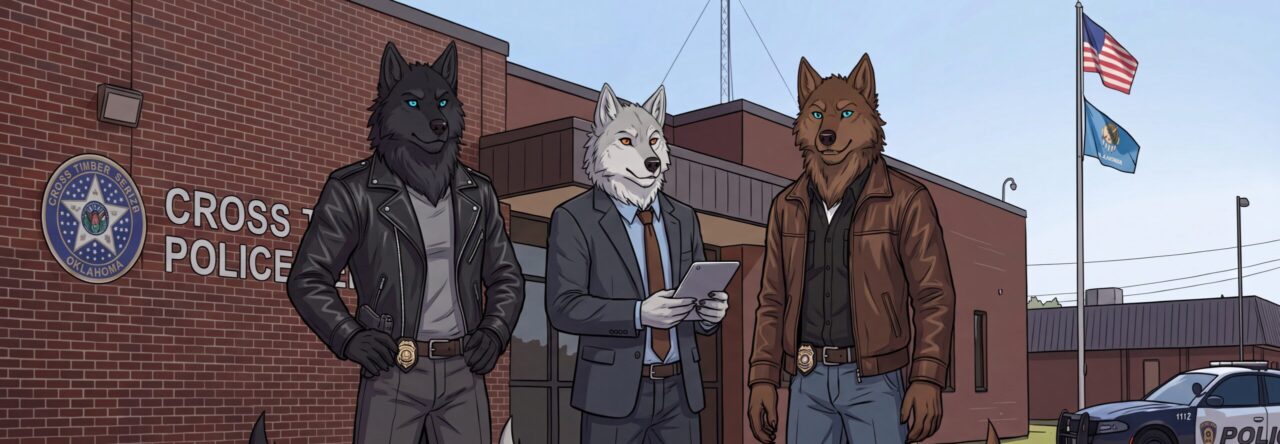
Friday arrived warm and clear, with the kind of early-summer evening that made half of Cross Timber want to be outside and the other half want to complain about the people who were.
The Humvee rolled into the police-department lot at 17:18.
Thane parked in its usual place along the far edge, where nobody had to wonder whether it would fit between two standard patrol units. The new Interceptors had already stopped looking new in the way that mattered.
They had dust on the tires.
Coffee cups in the consoles.
A little road grit around the wheel wells.
One had a faint smudge near the rear hatch where somebody had apparently leaned against it while eating something greasy.
They looked better that way.
Less like a delivery.
More like they belonged.
Officer Grant stood beside one of the new units near the service bay, arguing with a Fleet technician about a radio mount.
“It is too close to my knee,” Grant said.
The technician looked at the mount.
“It is adjustable.”
“It adjusts approximately half an inch.”
“That is still adjustable.”
Grant looked through the open driver’s door.
“My knee is not adjustable.”
Gabriel climbed out of the passenger seat.
“Maybe it is emotionally adjustable.”
Grant looked at him.
“No.”
Mark stepped down from the rear seat, glanced once at the console, and said, “The mount can probably move another inch if Fleet reverses the lower bracket.”
The technician looked at him.
Grant looked at him.
The technician sighed.
“I will check.”
Grant pointed at Mark.
“See?”
Mark adjusted the strap on his laptop case.
“I did not say you were correct.”
“You said I might be correct.”
“I said the equipment may permit a revision.”
Gabriel nodded thoughtfully.
“That is Mark for ‘good job.’”
Thane shut the Humvee door.
“Come on.”
They crossed the lot together.
The station was already active in the way it always was during the overlap between day shift and nights. The front desk had a small line. Dispatch chatter came in brief bursts from behind the glass. A patrol officer walked by carrying a bag of ice and a report folder, which suggested either an injury or a very poor dinner decision.
Serrano stood near the copier in the bullpen, speaking with Patel over a stack of traffic-report forms.
She looked up when the three wolves entered.
“Evening.”
“Evening,” Thane said.
Serrano smiled.
Not the brittle smile she had worn during the worst of the spring.
Not the careful one that seemed to ask people not to look too closely.
Just a normal smile.
Patel held up one of the forms.
“She wrote ‘the vehicle departed the scene at a reckless rate of speed.’”
Serrano folded her arms.
“It did.”
“It was a Honda Odyssey.”
“It accelerated recklessly.”
“It made a right turn through a yellow light.”
Gabriel looked at the report.
“Was it transporting children?”
Patel looked at him.
“Yes.”
Gabriel nodded.
“Then it may have been emotionally reckless.”
Serrano’s smile widened.
Patel looked at all four of them.
“You are all terrible.”
“We are consistent,” Mark said.
Serrano gathered her reports.
“Good luck tonight.”
“You too,” Thane said.
She headed toward the patrol hallway with Patel.
Thane watched her go for half a second.
Then Mercer’s voice came from the office corridor.
“Thane.”
He turned.
Mercer stood in the doorway of his office with a thin blue folder in one hand.
He looked at all three wolves.
“Got a minute?”
Gabriel’s ears tipped forward.
Mark’s gaze settled on the folder.
Thane nodded.
“Yeah.”
Mercer stepped aside.
“All of you.”
He closed the door after they entered.
Not with the heavy finality of a disciplinary meeting.
Just enough to make the conversation private.
The office was as familiar as ever: case of old commendation plaques on the wall, patrol-zone map by the filing cabinet, fleet-transition reports stacked across one corner of the desk. Mercer had a photograph near the window of himself years younger, standing with a class of academy graduates. He looked almost unrecognizable without gray at his temples.
The blue folder sat in front of him.
He rested both hands on it.
“It is finalized,” he said.
Gabriel stopped smiling.
“The Officer Support Fund?”
Mercer nodded.
“Red River completed the program structure this morning. Their board approved the restricted-fund framework under the Cross Timber Community Fund. The independent social-service partner signed on. City Legal approved the department-awareness agreement. Human Resources signed off on the privacy language.”
Mark’s ears angled forward.
“That was substantially faster than expected.”
“Much faster,” Mercer said.
“Eli?” Gabriel asked.
Mercer gave him a look.
“Eli.”
Gabriel nodded.
“Of course.”
Mercer opened the folder and slid the first page toward them.
The top was simple.
CROSS TIMBER OFFICER SUPPORT FUND
A Restricted Program of the Cross Timber Community Fund
Administered Through Red River Community Foundation
Below that, in clean black type:
Initial Funding Commitment: $2,000,000
The three wolves looked at it.
They had known the amount.
They had agreed to it.
They had watched Eli turn an idea into rules and legal language and independent administration.
But seeing it there made it feel different.
Not like money.
Like a door.
Mercer watched their faces.
“The application portal goes live Monday,” he said. “The department gets a plain internal notice. No donor name. No ceremony. No mandatory meeting. Officers and eligible civilian staff can apply directly through Red River or ask the employee-assistance liaison for information.”
Mark read the one-page summary.
“Supervisors do not receive names.”
“No names,” Mercer said.
“No decisions.”
“No decisions.”
“No amounts.”
“No amounts.”
“Direct-to-vendor payment whenever feasible.”
“Yes.”
“Independent review and appeal process.”
“Yes.”
“Separate from discipline, performance evaluation, investigations, promotion, and assignment.”
Mercer nodded.
“Yes.”
Gabriel looked at the bottom of the page.
“No donor acknowledgment.”
“None,” Mercer said. “No donor name in the staff notice. No donor name in the application material. No donor name in any department communication.”
Thane felt some of the tension leave his chest.
“Good.”
Mercer closed the folder.
Then he looked at them.
Not at Night Shift.
Not at the wolf detectives people talked about in the hallways or recognized around town.
At Thane, Gabriel, and Mark.
“I need to say something,” he said.
Gabriel’s expression changed.
Mark stopped reading.
Thane stayed quiet.
Mercer’s voice lowered.
“I have been a police officer for a long time. I have been a supervisor long enough to understand that people bring their entire lives to work with them whether they want to or not.”
He looked down at the folder.
“Cars break down. Roofs leak. Parents get sick. Kids need things at the wrong time. Someone gets behind on a bill because one surprise hits them, then another, and suddenly they are trying to take a domestic-violence call while wondering whether their power will still be on when they get home.”
Nobody interrupted.
“Most officers do not say anything,” Mercer continued. “They do not want a lieutenant to know. They do not want the department thinking they cannot handle their lives. They do not want a coworker whispering that they needed help.”
His hand rested on the folder.
“They would rather drown quietly than admit they need somewhere to stand.”
Gabriel’s ears lowered.
Thane thought of Serrano outside the station weeks earlier.
Phone pressed to her ear.
Trying to breathe quietly enough that nobody would notice she was crying.
Mercer lifted his eyes.
“This gives them a place to land before a hard month becomes a disaster.”
The office stayed quiet.
Then Mercer said, “Thank you.”
Not as a formal courtesy.
Not as a commander thanking people at a staff meeting.
He said it with a rawness Thane had never heard from him before.
“Thank you,” Mercer repeated. “For the fleet. For this. For seeing something I should have seen sooner. For giving my people help without making them beg for it.”
Thane’s ears lowered.
“We are lucky,” he said.
Mercer frowned slightly.
“What?”
“We are lucky to be able to help.”
Mercer studied him.
Thane looked at the folder.
“We have had good fortune,” he said. “More than a lot of people get. We know that.”
Gabriel leaned lightly against the desk.
“And we know a lot of good officers do not have a cushion when something goes wrong.”
Mark nodded toward the program summary.
“A stable department should not depend on whether an individual employee can survive an emergency alone.”
Mercer watched them.
Thane found the words carefully.
“The money does not mean anything if it just sits in a bank account. It is a number. It is an account statement. It does not do anything for anybody.”
Mercer’s eyes shifted.
Thane continued.
“But if we can use it to help people we care about—people who work hard, people who try to do the right thing, people who get hit by something they did not see coming—then its value is a hundred times what the bank statements say.”
Mercer sat down slowly behind his desk.
For a moment, he just looked at the blue folder.
“I knew the number,” he said. “I understood it on paper. But seeing what two million dollars can become—what it can mean to someone who thinks their life is falling apart over one unexpected bill—it is different.”
Gabriel’s voice softened.
“That is the point.”
Mercer nodded once.
Then he looked at them again.
“You know most people with your kind of money would buy something stupid.”
Gabriel’s ears lifted.
“Thane owns a Humvee.”
Thane looked at him.
“That is not stupid.”
Mercer’s mouth twitched.
“I did not say it was.”
“Good.”
Mercer looked between the three wolves.
“You are all very strange.”
“We know,” Mark said.
“And I have enjoyed working with you.”
Gabriel blinked.
Mercer noticed.
“Do not make a thing out of it.”
“We are absolutely making a thing out of it,” Gabriel said.
Mercer ignored him.
“You have brought chaos into this department.”
“Good chaos,” Gabriel said.
Mercer pointed at him.
“Sometimes good chaos.”
Gabriel smiled.
“Progress.”
Mercer leaned back in his chair.
“It has been entertaining.”
Gabriel stared at him.
“Entertaining?”
“Stressful,” Mercer corrected.
Thane’s mouth moved faintly.
“Often very stressful.”
“But entertaining,” Mercer finished.
Gabriel looked at Mark.
“Write it down.”
“I am not writing that down.”
“Write it down emotionally.”
“That is not a thing.”
Thane looked at Mercer.
“We appreciate that this department gave us a chance to do this job.”
Mercer’s expression changed.
“We did not give you charity,” he said. “You earned the badge. You earned the cases you work. You earned the trust you have.”
Thane held his gaze.
“We still appreciate it.”
Mercer nodded once.
Then Thane said, “If there is ever anything this department needs, come talk to us.”
Mercer’s eyes lifted.
“Thane.”
“No. I mean it.”
Gabriel nodded.
“Through the right channels.”
“Through Eli,” Mark added. “Through Red River. Through City Legal. Whatever keeps it lawful and independent.”
Thane continued.
“If there is a real need, and there is a clean way to help, tell us. We will see what we can do.”
Mercer looked at them for a long moment.
“You cannot quietly fund every problem in Cross Timber.”
“No,” Thane said. “But we can help with some.”
“And the department cannot become dependent on anonymous money.”
“We know.”
“And I cannot start seeing the three of you as a private emergency budget.”
Thane nodded.
“We know that too.”
Mercer exhaled through his nose.
“Good. Because I would hate to have to tell you no after you gave me two million dollars to help my people.”
Gabriel smiled.
“You can still tell us no.”
Mercer looked at him.
“I have. Repeatedly.”
“Not enough.”
“Do not ask about a helicopter.”
“I was not going to.”
Mark looked at Gabriel.
“You were.”
Gabriel looked offended.
“I was thinking about a small helicopter.”
Mercer pointed toward the door.
“Go see Voss and Rusk before I reconsider everything.”
Gabriel stood.
“Worth asking.”
“It was not.”
Thane reached toward the folder.
Mercer put one hand over it.
“This stays with me,” he said.
Thane nodded.
“Okay.”
Mercer looked at all three of them one more time.
“Thank you.”
Nobody joked this time.
“You are welcome,” Thane said.
Then they left.
Voss and Rusk were waiting in the small case room off Investigations.
Not a department briefing.
Not a patrol roll call.
Just the five of them around a scarred conference table that had seen too many cold coffees, too many case files, and too many nights where somebody had said, This should be simple, right before it stopped being simple.
Voss had a thin stack of handoff folders in front of her.
Rusk had a sandwich wrapped in paper and a cup of coffee that looked like it had been reheated at least once.
He looked up as the wolves entered.
“Mercer tell you no on the helicopter again?”
Gabriel paused.
“He did.”
Rusk nodded as if that confirmed something.
“Good. My soul retired years ago. I do not need to watch three werewolves learn aviation.”
Mark set his laptop case on the table.
“Thane did not ask for a helicopter.”
Rusk took a drink of coffee.
“Then he is thinking about it.”
Thane sat down.
“We are not getting a helicopter.”
Rusk looked at him.
“Good. That is exactly what a person who wants a helicopter says.”
Voss let them have three seconds of it.
Then she slid the first folder toward Thane.
“Latham and Cross.”
Thane opened it.
The access-burglary case had moved into the slow part now.
Victim notification.
Property recovery.
Digital review.
The work that came after the flashing lights and the search warrants and the arrests.
“Seven additional items were matched to confirmed victims today,” Voss said. “Digital Crimes has the larger identity-theft branch. They have not found evidence that the suspects opened fraudulent accounts before we arrested them, but they are still tracing the information source.”
Mark scanned the list.
“Any new risk to the victim households?”
“Not at the moment,” Voss said. “Patrol has made the needed security-contact follow-ups. The victim-assistance coordinator is handling credit-monitoring resources and password-reset guidance.”
Gabriel looked toward the notes.
“So they are okay?”
“They are safer than they were,” Voss said. “That is the honest answer.”
Thane nodded.
Voss shifted the second folder toward Mark.
“Prairie Ridge.”
Mark opened it.
“Mason Vail remains in custody. His attorney has requested discovery preservation. Harold Brice is cooperating through counsel, which means we will get information slowly and expensively.”
Rusk opened his sandwich.
“Lawyers remain undefeated.”
Voss continued.
“The prepaid number on Vail’s phone has been linked to Darren Pike. Pike is a former subcontractor with a history of hauling construction materials. State investigators and the county task force are handling the potential distribution chain.”
“Do we need to do anything?” Thane asked.
“Not tonight,” Voss said. “If they need you, they will ask.”
Gabriel leaned back.
“That is unfamiliar.”
“That is healthy,” Voss said.
Rusk nodded.
“Try it.”
Voss looked at the three wolves.
“Tonight is patrol support. No active major case. No task force waiting for you to solve something before dawn. The city will still produce ordinary trouble, and patrol may still need detectives. That is enough.”
Thane nodded.
“Okay.”
Rusk folded his sandwich wrapper.
“Friday in Cross Timber has a predictable shape. Somebody will lose something. Somebody will accuse someone else of stealing it. Somebody will get drunk enough to call nine-one-one because a neighbor looked at them wrong.”
Gabriel’s ears lifted.
“That is very specific.”
“It is experience.”
Voss glanced toward the hall.
“One more thing.”
The wolves looked at her.
“The Officer Support Fund is finalized.”
Thane held still.
Voss’s voice stayed practical.
“Red River is handling it correctly. Mercer has the department-facing agreement. No donor identity. No supervisor access. No shortcuts.”
Mark nodded once.
“We know.”
Voss looked at each of them.
“You built the structure. Now leave it alone.”
Gabriel’s expression softened.
“We will.”
“You do not ask who uses it,” she said. “You do not try to solve individual applications. You do not turn it into a private ledger of people who owe you.”
Thane held her gaze.
“We will not.”
Voss nodded.
“That is why I am willing to trust it.”
Rusk stood, gathering his folders.
“Good. Now go have a boring Friday.”
Gabriel looked at him.
“You know saying that makes it dangerous.”
Rusk picked up his coffee.
“That is why I said it.”
At 19:07, the first call sent them downtown.
The dispatcher’s voice came through clear and controlled.
“Night Shift, respond to Heritage Square. Parent reports missing six-year-old male near the First Friday concert area. Last seen approximately five minutes ago near the fountain. Child wearing blue T-shirt with a yellow opossum, gray shorts, red sneakers.”
The warmth went out of Thane’s chest.
Gabriel sat forward in the passenger seat.
“Any description beyond that?”
Dispatch answered, “Name is Milo. Parent says he may be carrying a small orange stuffed fox.”
Thane turned the Humvee toward downtown.
“Night Shift en route.”
The First Friday crowd filled Heritage Square when they arrived.
Food trucks lined the west curb. A local band played from a small outdoor stage. Children ran between parents and folding chairs, their laughter mixing with music and the smell of fried food, kettle corn, barbecue smoke, and warm pavement.
Officer Bell was already at the fountain, speaking with a woman whose face had gone pale.
Two patrol officers were moving toward opposite ends of the square.
Bell saw the Humvee and lifted one hand.
“Mother says he turned toward the food trucks. She looked down to answer a call and he was gone.”
Thane approached the woman carefully.
She clutched an orange stuffed fox in one hand.
Not Milo’s.
A matching one.
“He had the other one,” she said. “He always takes it everywhere. I only looked down for a second.”
Gabriel crouched in front of her.
“You did the right thing calling. We have people at the exits. We are going to find him.”
Her eyes locked on his.
“You promise?”
Gabriel did not promise what nobody could guarantee.
“We are going to work every direction he could have gone.”
Mark was already opening a map on his phone.
“Four exit routes from the central area,” he said. “Two are vehicle-accessible. Bell’s officers have both. I will coordinate vendor checks and the stage side.”
Thane inhaled through his nose.
The square was crowded.
Too many scents.
Food, sweat, dogs, smoke, spilled soda, children, hot plastic from a bounce house, damp grass from the sprinkler line near the fountain.
He focused on the stuffed fox.
Orange fabric.
Soap.
A little strawberry scent from whatever Milo had eaten earlier.
Then the boy himself.
Small.
Fresh.
Moving fast.
“Bell,” Thane said. “I have a likely direction. Toward the garden walkway east of the stage. Mark, keep the exits covered. Gabriel, with me.”
Bell did not ask how Thane knew.
He did not need to.
“Patel, Darnell,” Bell said into his radio. “Shift east to the garden walkway. Watch the parking cut-through.”
Thane did not run.
Not yet.
He moved quickly through the crowd, Gabriel beside him, both badges visible, both heads turning in the direction of the scent.
“Police,” Gabriel called calmly as they passed vendors. “Looking for a six-year-old boy in a blue opossum shirt. Have you seen him?”
A lemonade seller pointed east.
“Little kid with a fox? He went that way. Toward the garden.”
Thane picked up the pace.
The walkway led behind the community center, where a small volunteer garden sat behind a low iron fence.
Milo was inside.
He had crouched beside a raised bed full of tomatoes and basil, orange fox tucked beneath one arm.
An older volunteer stood several feet away, talking gently to him.
The boy looked up when Thane and Gabriel approached.
His eyes were wet.
“I wanted to see the butterflies.”
Thane stopped at the gate.
“You found any?”
Milo sniffed.
“One.”
Gabriel crouched near the entrance.
“Your mom is scared.”
Milo looked down.
“I did not mean to go far.”
“I know,” Gabriel said. “But when you move away without telling her, she cannot find you.”
The volunteer looked at Thane.
“He came in about three minutes ago. I asked if he knew where his parent was. He said no.”
“Thank you,” Thane said.
Milo held the fox closer.
“Am I in trouble?”
Thane looked at him.
“You are going to have a conversation with your mom. But right now, you are safe.”
Milo nodded.
Thane keyed his radio.
“Night Shift to Bell. Child located. Safe. Community garden east of Heritage Square.”
The response came almost immediately.
“Copy. Mother notified.”
When Milo saw his mother, he started crying before she reached him.
She dropped to her knees and pulled him close, one hand cradling the back of his head, the other holding the stuffed fox trapped between them.
“I am sorry,” Milo said into her shoulder.
His mother made a sound that was half laugh and half sob.
“I love you,” she said. “Just stay where I can see you.”
Bell stood near Thane.
“Good work.”
Thane watched mother and son hold each other.
“Good teamwork.”
Bell nodded.
Then he looked toward the crowd.
“Friday is starting early.”
Gabriel came up beside them.
“Could have been worse.”
Bell looked at him.
“Do not say that either.”
The next two hours stayed blessedly ordinary.
A caller reported a suspicious person trying car doors outside a strip mall.
The suspicious person turned out to be an exhausted rideshare driver attempting to find the correct silver Hyundai in a lot containing eleven nearly identical silver Hyundais.
Officer Grant had already stopped him.
The driver had his app open, a passenger’s name visible on the screen, and the deeply tired expression of a man who had spent nine hours navigating strangers and parking lots.
Grant looked at Thane when Night Shift arrived.
“I thought it was him at first.”
“He is checking door handles,” Thane said.
“He is checking the wrong door handles.”
The driver lifted both hands.
“They all look the same.”
Gabriel looked around the lot.
He had a point.
The strip mall was full of identical compact SUVs in three shades of silver, gray, and nearly-silver.
Mark stepped beside the driver and checked the license plate on the app.
“The correct vehicle is three rows east.”
The driver looked.
Then closed his eyes.
“Oh.”
Grant looked at him.
“You cannot open random cars.”
“I know. I thought it was mine.”
“That sentence does not improve it.”
“It is a long night.”
Gabriel watched the driver walk toward the actual vehicle.
Then glanced at Grant.
“Did you give him a warning?”
“Yeah.”
“Good.”
Grant looked at him.
“You wanted me to arrest a rideshare driver for being tired?”
“No. I wanted to see if you would say yes.”
Grant shook his head.
“You are a terrible influence.”
“Mercer says I bring good chaos.”
Grant blinked.
“He said that?”
Gabriel smiled.
“Privately.”
“I do not believe you.”
“Wise.”
At 22:41, Dispatch sent Night Shift to a neighborhood south of the high school for a reported disturbance.
The caller had heard yelling, a woman crying, and something breaking in a driveway.
The radio traffic tightened the moment the call came through.
Thane drove without talking.
Gabriel read the update from Dispatch.
“Caller says the parties may be related. No weapons seen. No prior calls at the address in the last twelve months.”
They arrived to find Officer Serrano standing beside a pickup truck with its driver-side door open.
A young woman sat on the curb in front of the house, crying into both hands.
A young man stood near the garage, pale and shaking.
A plastic laundry basket lay overturned in the driveway.
That was the thing the caller had heard break.
The basket had hit the concrete hard enough to crack.
Serrano looked at Thane.
“Brother and sister. Their father had a heart attack tonight.”
The whole shape of the scene changed.
Gabriel’s ears lowered.
The young woman looked up when he approached.
“He is in the hospital,” she said. “They do not know if he is going to make it.”
The young man was breathing too fast.
“I should have been there,” he said. “I told him I would come by last week. I did not. I had work, and then I forgot.”
“John,” the young woman said, anger rising through the tears, “this is not about you.”
“It is about me,” he snapped. “Everything is always about me.”
Serrano stepped closer but did not interrupt.
Gabriel sat down on the curb a few feet away from the woman.
“Do you have someone at the hospital with him?”
“Our aunt,” she said.
“Okay.”
Thane looked at John.
“Do you know which hospital?”
“Mercy North.”
“Do you have a way there?”
John looked toward the pickup.
“I can drive.”
Gabriel glanced at him.
“You are shaking.”
“I can drive.”
The young woman wiped at her face.
“I cannot drive.”
Thane looked toward Serrano.
“Could one of you transport them?”
Serrano nodded immediately.
“I can.”
John looked at Thane.
“We are not under arrest?”
“No.”
“Then why are you helping?”
Thane held his gaze.
“Because your dad is in the hospital and you need to get there safely.”
Johni looked down at the broken laundry basket.
The anger seemed to leave him all at once.
“I am sorry,” he said to his sister.
She did not answer immediately.
Then she reached for his hand.
“Get in the car,” she said.
Serrano opened the rear door of her Interceptor.
The two siblings climbed in.
Before she shut the door, Serrano looked at Thane.
“I will update Dispatch when I have them at the hospital.”
Thane nodded.
“Drive safe.”
The new patrol vehicle pulled away from the curb.
Thane watched its lights disappear down the street.
Gabriel stood beside him.
“Cars are more than cars.”
“Yeah,” Thane said.
The broken laundry basket still lay in the driveway.
Mark crouched beside it.
“Plastic fatigue,” he said.
Gabriel looked at him.
“Read the room.”
“I was not suggesting it belonged in the report.”
“Your face was.”
At 00:18, the city had entered its late-Friday phase.
The concert crowd was gone.
The restaurants were thinning.
The bars were getting louder in direct proportion to the quality of the decisions being made inside them.
Night Shift stopped at a twenty-four-hour diner near the highway after a patrol officer requested assistance with what Dispatch had initially called a “large disorderly group.”
The group consisted of four college-age men, one exhausted waitress, and a single birthday cake that had been dropped face-first onto a booth seat.
Officer Darnell stood near the register with his arms folded.
One of the young men was attempting to explain the situation while wearing a paper birthday crown that said FORTY IS FANTASTIC.
He was nowhere close to forty.
Gabriel took in the cake, the crown, the icing smeared across the booth, and the waitress holding a damp towel.
“What happened?”
The young man pointed at another man.
“He pushed me.”
The other man pointed back.
“He tripped over the cake.”
“The cake was on the table.”
“It is not on the table now.”
Mark looked at the booth.
The cake was very clearly not on the table now.
Thane turned toward Darnell.
“Anybody hurt?”
“No.”
“Any threats?”
“No.”
“Any damage beyond cake?”
“Booth upholstery, possibly.”
The waitress spoke from behind the counter.
“I just need them to leave.”
Gabriel looked at the four young men.
“Who is driving?”
Silence.
Gabriel’s ears lowered.
“That is not the answer I was hoping for.”
The man with the birthday crown held up his phone.
“I can call my sister.”
“Good,” Gabriel said. “Call her.”
The sister arrived twenty minutes later in sweatpants and a faded university T-shirt.
She took one look at the birthday crown, the ruined cake, and the icing-covered booth.
Then she looked at her brother.
“You are twenty-one.”
He nodded weakly.
“Yes.”
“And this is what you did with it?”
He looked at the floor.
“Yes.”
She looked at the officers.
“I am sorry.”
Darnell nodded toward the men.
“They need rides. The diner does not want charges if they cover cleanup and leave.”
The sister pointed toward the booth.
“You are cleaning that before you get in my car.”
The birthday boy nodded.
“Yes, ma’am.”
Gabriel watched them gather paper towels and cleaning spray under the waitress’s furious supervision.
Then he leaned toward Thane.
“Normal Friday.”
Thane looked at the birthday cake sliding slowly off the booth cushion.
“Pretty normal.”
Mark looked at the crown.
“It says forty.”
Gabriel nodded.
“Maybe that is why he was so upset.”
At 02:31, they received a welfare check from a small apartment complex on the north side.
A resident had not seen her neighbor, Mrs. Alma Ruiz, all day. Her lights had been on since morning. Her dog had been barking off and on from inside.
The call had enough familiar pieces to make all three wolves quiet.
No rushing in.
No assumption.
They arrived with Officer Patel, who had a spare key holder listed in the apartment’s emergency-contact file.
The neighbor, an older woman named Clara, met them on the walkway.
“She has never missed taking that little dog out,” Clara said. “Not in three years. And she did not answer me.”
Thane listened.
The dog was inside.
Alive.
Agitated.
There was a slow, uneven breathing sound from somewhere beyond the door.
Thane looked at Patel.
“She needs medical.”
Patel nodded and called for EMS as the key holder arrived.
Mrs. Ruiz had fallen in the bathroom.
Not badly enough to lose consciousness.
Badly enough that she could not reach her phone.
Her little terrier had stayed beside her all day, barking whenever anyone passed the apartment.
When the door opened, the dog raced into the hall, spun once in frantic circles, then ran back toward the bathroom.
Gabriel followed.
Mrs. Ruiz lay against the tub with a towel under her head, tired and frightened but awake.
“I kept telling him to stop barking,” she said weakly.
Gabriel crouched near her.
“He did good.”
The little terrier pressed against her leg.
Mrs. Ruiz put one trembling hand on the dog’s head.
“He always thinks he is bigger than he is.”
Gabriel looked at the dog.
“Most good ones do.”
EMS arrived quickly.
No obvious fracture, though the paramedic suspected dehydration and a possible hip injury. They lifted Mrs. Ruiz carefully onto the stretcher.
Before she was taken out, she looked at Thane.
“Did Clara call?”
“She did.”
Mrs. Ruiz’s eyes filled.
“I am going to have to bring her something.”
Thane shook his head.
“Just get better.”
The dog was secured with Clara, who promised to take him home and make sure he had food and water until Mrs. Ruiz returned.
As the ambulance pulled away, Patel stood beside Night Shift in the quiet parking lot.
“That dog probably saved her.”
“Clara did too,” Mark said.
Patel nodded.
“Yeah.”
The night had gone soft again after that.
Not empty.
Not easy.
But ordinary in the way ordinary mattered.
People saw something wrong.
They called.
Someone answered.
At 04:46, Night Shift returned to the station.
The day-shift offices were still dark.
The hallways were quieter now, the building settling into that strange hour before dawn when the overnight crew began writing reports and the morning crew had not yet arrived to inherit them.
Gabriel opened the break-room refrigerator and found a single container marked PATEL — DO NOT TOUCH.
He closed it again.
“Nothing.”
Mark looked over.
“Good decision.”
“Do not make it sound like I considered stealing Patel’s food.”
“You did.”
“I considered it respectfully.”
Thane sat at the conference table with the reports.
The missing-child call.
The family emergency.
The diner disturbance.
Mrs. Ruiz’s fall.
No new case board.
No warrants.
No dramatic arrest.
Just paper that made the night real.
Mark’s laptop chimed.
He looked at the screen.
Then at Thane and Gabriel.
“The Officer Support Fund launch notice is ready.”
Gabriel stepped closer.
The email was plain.
No donor name.
No special graphics.
No language designed to make anyone feel grateful.
Just a department resource notice scheduled to go out Monday morning.
The Cross Timber Officer Support Fund is available to eligible sworn officers and essential civilian department employees facing verified sudden hardship affecting housing, transportation, health, safety, caregiving, or work stability.
Below it:
Applications are confidential and independently reviewed. Department supervisors do not receive applicant names, reasons, grant amounts, or approval decisions.
And below that:
For information or to apply, contact Red River Community Foundation through the secure portal or the listed confidential assistance line.
Gabriel read it twice.
“It is exactly right.”
Mark nodded.
“It tells people what they need to know and nothing they do not.”
Thane looked at the quiet hallway beyond the conference room.
At the desks where officers would sit Monday morning.
At the people who would open the email and perhaps ignore it.
At the people who would read it, close it, and feel something loosen in their chest because now they knew there was somewhere to turn.
No one would know where it came from.
That was the point.
“Send approval,” Thane said.
Mark did.
The message disappeared into the same quiet system that would carry it to people who might need it one day.
Gabriel sat on the edge of the table.
“You know what I like?”
Thane looked at him.
“What?”
“That it does not make anybody prove they are a good person before they get help.”
Mark glanced at the program summary.
“It requires verified hardship and eligibility.”
Gabriel gave him a look.
“You know what I mean.”
Mark considered.
“Yes. I do.”
Thane closed the final report.
“People do not have to deserve a bad thing before it happens.”
Gabriel’s ears lowered.
“No.”
“They just need somewhere to stand after.”
At 06:24, Voss and Rusk arrived for handoff.
Voss carried a travel mug and a fresh case folder. Rusk had a breakfast sandwich in one hand and looked personally offended by the sunrise.
“Anything on fire?” he asked.
“No,” Thane said.
“Any major crime?”
“No.”
Rusk nodded.
“Then I am already having a better morning than expected.”
Voss sat at the table and listened while they walked through the night.
Milo found safe at Heritage Square.
Family emergency safely transported to the hospital.
Diner dispute resolved without arrest.
Mrs. Ruiz transported for medical care after neighbor welfare check.
No new developments on Latham, Cross, Vail, or the Prairie Ridge investigation.
When they finished, Voss looked over the reports.
“Good work.”
Thane nodded.
“Thanks.”
Rusk opened his breakfast sandwich.
“Birthday cake?”
Gabriel pointed at the report.
“Face-down booth impact.”
Rusk stopped.
“No.”
“It was a rough night for cake.”
“No.”
“It was forty-themed.”
Rusk closed his eyes.
“I need you to stop helping the city.”
Gabriel smiled.
“I am sorry.”
“You are not.”
“No.”
Voss’s eyes moved to the Officer Support Fund notice still open on Mark’s screen.
She did not ask about it.
She did not need to.
She looked at the three wolves.
Then nodded once.
“Good.”
Outside, dawn was beginning to lift over Cross Timber.
The new patrol units sat quietly in the lot, waiting for the next shift.
The old units waited too, faded and stubborn, not yet gone.
Inside the station, a fund existed now.
No donor name.
No expectation of thanks.
Just a private door for people who had spent too much of their lives being the person everyone else called when things went wrong.
Thane, Gabriel, and Mark walked out to the Humvee together.
Friday had become Saturday.
Gabriel stretched as he walked.
“Weekend.”
Mark looked at him.
“You will sleep for six hours, wake up, and decide we should do something.”
“Probably.”
Thane opened the driver-side door.
“Sleep first.”
Gabriel smiled.
“Fine. But after that, maybe breakfast.”
Mark climbed into the back seat.
“Breakfast is acceptable.”
Thane started the engine.
The three of them drove home beneath a brightening sky, carrying nothing more urgent than the knowledge that somewhere in the city, people had a little more room to breathe.
And that was what it was for.