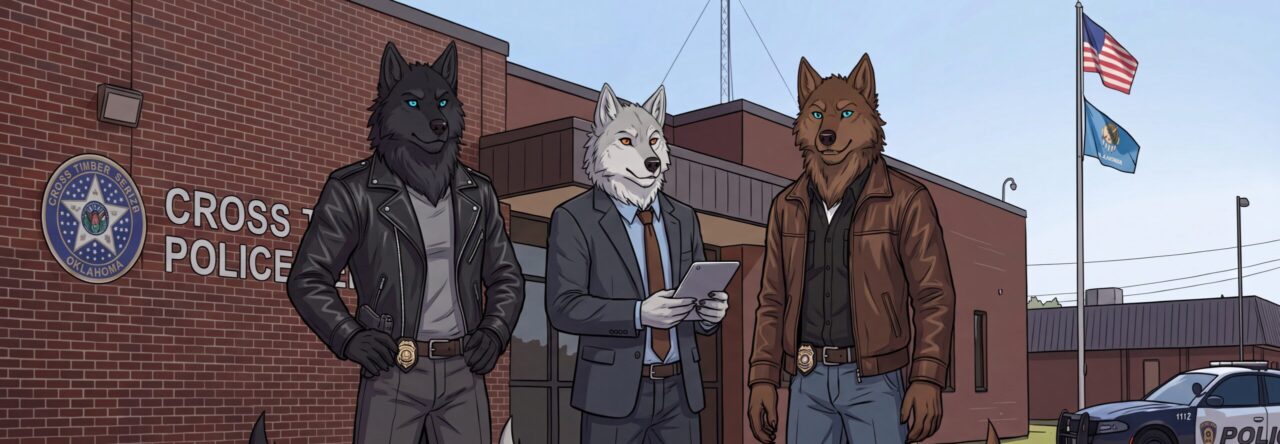
Saturday began with Gabriel shouting from the pantry, “Who moved the coffee filters?”
Mark answered from the kitchen table without looking up from his mug.
“No one moved the coffee filters.”
“They are not where they were.”
“They are exactly where they were.”
Gabriel appeared in the pantry doorway holding a box of tea bags as though it had personally betrayed him.
“This is tea.”
“Yes,” Mark said.
“Tea is not coffee.”
“Correct.”
“Then why is it where coffee should be?”
Mark finally looked up.
“Because you are looking on the tea shelf.”
Gabriel stared at him.
The house was quiet for exactly three seconds.
Then Thane walked through the kitchen, barefoot paws silent on the wood floor, wearing loose gray sweatpants and a dark shirt, scratching one ear with the distracted expression of someone who had slept less than he wanted and woken up with a purpose.
He reached past Gabriel, opened the next pantry cabinet, and took out the coffee filters.
Gabriel looked at the cabinet.
Then at Thane.
Then at Mark.
“There are too many cabinets.”
Mark took a drink of coffee.
“There are the correct number of cabinets.”
“There is never a correct number of cabinets.”
Thane set the filters on the counter.
“Coffee first. Philosophy later.”
Gabriel pointed at him.
“Thank you. Leadership.”
Mark’s ears shifted.
“That was not leadership. That was object permanence.”
Gabriel opened his mouth.
Thane held up one paw.
“Coffee first.”
Gabriel closed his mouth.
That was how Saturday morning went.
Normal pack chaos.
The first pot of coffee brewed while Mark made eggs, Gabriel found the bacon but lost the spatula, and Thane discovered that the spatula had somehow ended up in the drawer with the can opener because Gabriel had “temporarily reclassified it.”
Mark rejected the classification.
Gabriel appealed.
Thane overruled both of them by taking the spatula, using it, and putting it in the correct drawer.
By 10:34, breakfast had happened.
The kitchen had mostly survived.
Gabriel sat sideways in one of the oversized chairs near the windows with a second cup of coffee balanced carefully between both hands. Mark stood at the counter cleaning a skillet with the intense focus of a man who believed hot water and timing could solve most domestic problems. Thane leaned against the island with his phone in one paw.
Bridge House.
The words had stayed with him through the short sleep after shift.
The line around the building.
The yellow light spilling onto the sidewalk.
The sign saying overnight check-in full.
The faces.
He had thought sleep might put distance between him and the image.
It had not.
He searched the city resource directory and found the number for Cross Timber Bridge House near the bottom of a page listing meal services, warming and cooling centers, crisis contacts, and emergency shelter programs.
He looked at Gabriel.
Then at Mark.
“Calling.”
Gabriel straightened slightly.
Mark dried his hands and turned.
Thane tapped the number.
The phone rang four times.
Then five.
On the sixth, someone answered with the tired voice of a person who had already been interrupted twenty times before noon.
“Bridge House, this is Talia.”
Thane kept his voice low and calm.
“Good morning. I was wondering if you could use some help with shelter work today.”
There was a pause.
Not suspicion.
Not exactly.
More like the administrator on the other end had expected a complaint, a question about donations, a request for services, or someone demanding an answer she did not have.
Instead, she had been offered hands.
When she answered, the exhale came first.
“Yes,” she said. “Definitely.”
The relief in those two words made Gabriel’s ears lower from across the room.
Thane looked toward the window.
“What do you need?”
Another short pause.
Then a faint, exhausted laugh.
“What do we not need?”
“We can bring a couple friends. We are good with heavy lifting, cleaning, serving food, organizing supplies. Whatever is useful.”
“Are you with a church group?”
“No, ma’am.”
“A company?”
“No.”
“Students?”
“No.”
This time the pause held a different quality.
Thane could almost hear her trying to decide whether to ask more.
He did not give her the chance.
“We will come down in a bit and check in at the front desk. If you can use us, we will work. If you cannot, we will get out of your way.”
“No,” Talia said quickly. “Please come. We are short today. Two volunteers called out, the pantry delivery is late, and dinner prep is already behind.”
“We will be there.”
“Thank you,” she said.
Not polished.
Not formal.
Just relieved.
Thane ended the call.
Gabriel set his coffee down carefully.
“She sounded tired.”
“She sounded beyond tired,” Thane said.
Mark folded the dish towel and set it beside the sink.
“What did she ask?”
“If we were with a church, company, or students.”
Gabriel looked down at himself.
“Clearly students.”
Mark looked at him.
“Of what?”
“Life.”
“No.”
Thane slipped the phone into his pocket.
“She said they are short. Pantry delivery late. Dinner prep behind.”
Mark nodded.
“We should wear plain clothes. No department anything.”
“Agreed.”
Gabriel stood.
“No badges.”
“No badges,” Thane said.
“No guns?”
Thane considered that.
They were off duty, and they normally carried.
But Bridge House was not a patrol call. It was a shelter. People there might have complicated histories with police, systems, authority, and survival. The last thing he wanted was for someone waiting in line for food to feel watched.
“Secured at home,” he said.
Mark nodded.
“That seems appropriate.”
Gabriel looked at him.
“You agree quickly when it is important.”
“Yes.”
Thane pushed away from the island.
“I need five minutes.”
Gabriel narrowed his eyes.
“For what?”
“To get ready.”
“That was vague.”
Thane was already walking toward the hall.
Mark watched him go.
“He is getting something.”
Gabriel looked at Mark.
“What?”
“I do not know.”
“That is troubling.”
“It may be private.”
“That is more troubling.”
Thane entered his office, closed the door halfway, and opened the lower drawer of the heavy desk near the window.
He kept personal checks there.
Not many.
Most things in their lives were handled electronically, through accounts, legal structures, transfers, and people whose job it was to make sure generosity did not become a mess.
But some things were simple.
He took one check from the folder.
Then hesitated.
One hundred thousand dollars wasn’t really enough.
Not for homelessness.
Not for shelter capacity.
Not for the line around the block.
Not for the exhaustion in Talia’s voice or the sign that said overnight check-in full.
But it was not nothing.
It was beds repaired.
Food bought.
A cooler replaced.
A payroll gap eased.
A utility bill covered.
A broken van fixed.
Some number of bad nights made less bad.
Thane wrote carefully.
Pay to the order of Cross Timber Bridge House.
Then the amount.
He folded it once, placed it in a plain envelope, sealed it, and put it in his back pocket.
When he returned to the kitchen, Gabriel looked at him immediately.
“You got something.”
“Keys.”
Gabriel looked at Thane’s empty hands.
“Keys are already by the door.”
“I got different keys.”
Mark’s eyes narrowed slightly.
But he said nothing.
Thane appreciated that.
Mostly.
They changed into plain work clothes.
Thane wore an old dark T-shirt, heavy canvas pants, and no department markings.
Gabriel chose jeans and a soft black shirt that, somehow, still made him look like he had dressed for an audience.
Mark wore a gray shirt, dark pants, and the expression of a person who had decided not to bring a notebook but deeply regretted the limitation.
Gabriel noticed.
“You can bring your phone.”
Mark looked at him.
“I was not going to bring a notebook.”
“I did not say notebook.”
“You implied notebook.”
“You inferred notebook.”
“I inferred accurately.”
Thane opened the front door.
“Come on.”
They parked four blocks away from Bridge House.
Not because the Humvee could hide.
It could not.
But because Thane did not want the first thing people noticed to be a military vehicle rolling up to the shelter entrance on a Saturday.
The street where he parked was quiet, lined with older brick buildings, a closed insurance office, a small church with a faded sign, and a fenced lot where two delivery vans sat under the sun.
Gabriel looked toward downtown as he climbed out.
“Good call.”
Mark shut the rear door.
“The Humvee would draw unnecessary attention.”
Thane started walking.
The heat had already settled into the sidewalks.
Not the brutal high summer heat that would arrive later, but enough that the brick walls held warmth and the air smelled of pavement, exhaust, dust, and distant food.
Bridge House came into view around the corner.
In daylight, the building looked more tired than it had under the yellow shelter lights.
Long brick face.
Painted trim chipped in places.
A ramp leading to the front entrance.
A side door propped open near the service alley.
Two volunteers moved along the sidewalk with clipboards, speaking to people waiting near the wall.
The line was already there.
Not as long as it had been near dawn.
But long enough.
People sat on the curb, stood in patches of shade, leaned against backpacks, kept hands around plastic bags, watched the door, watched each other, watched the street.
Some looked up as the wolves approached.
Some recognized them immediately.
A man with a gray beard and a sun-faded ball cap straightened slightly.
A younger woman with a duffel bag stared for a second, then looked away as though she did not want to be caught looking.
Two teenagers near the corner whispered to each other.
An older woman sitting on a milk crate looked Thane up and down.
“Well,” she said, “that is new.”
Gabriel smiled gently.
“Good morning.”
“Is it?”
“Trying to be.”
She considered that.
“Fair.”
Thane kept his hands visible and relaxed.
No badge.
No weapon.
No authority.
Just three very large wolves walking toward a shelter.
The difference mattered.
At the front entrance, a volunteer in a yellow Bridge House vest turned to greet them, then froze.
His mouth opened.
Closed.
Opened again.
Gabriel leaned slightly toward Thane.
“We may need to identify as life forms.”
The volunteer found his voice.
“Uh. Can I help you?”
Thane nodded.
“I called earlier. Asked if you needed help.”
The volunteer’s eyes widened.
“You called?”
“Yes.”
A woman appeared behind him in the doorway, holding a clipboard, a radio clipped to one pocket, and a half-eaten granola bar in the other hand.
She was maybe in her late forties, with dark hair pulled back tightly, tired eyes, and the controlled alertness of someone whose day had been running faster than she had since sunrise.
She looked at Thane.
Then Gabriel.
Then Mark.
Then back at Thane.
“Oh,” she said.
Gabriel lifted one hand.
“We are the unannounced large mammal volunteer group.”
For half a second, nobody moved.
Then the volunteer laughed.
The woman did too.
Not much.
Just enough to break the shock.
Thane offered his hand.
“Thane.”
She shook it.
“Talia Warren. Administrator.”
“Gabriel,” Gabriel said, offering his hand next. “Mostly useful. Occasionally supervised.”
Mark shook her hand last.
“Mark. I follow instructions well.”
Talia looked at him.
“That may make you my favorite.”
Gabriel put one paw over his chest.
“Wounded immediately.”
The volunteer laughed again.
Several people in the line had begun watching with open curiosity now.
Talia looked toward them, then lowered her voice.
“Are you here as police?”
“No,” Thane said. “Private citizens. We can leave if our being here makes things harder.”
She studied him.
That was the right question.
He could see her weighing it.
Recognition could help.
Recognition could hurt.
A shelter was not a stage.
Finally, she said, “Some people may be nervous.”
“I understand.”
“Some may ask for pictures.”
“We can say yes or no depending on whether it is appropriate.”
“Some may ask for help you cannot give.”
“We will refer them to staff.”
Talia’s shoulders eased by a fraction.
“You have done this before?”
“Not exactly,” Thane said.
Mark added, “We understand boundaries.”
Gabriel smiled.
“And boxes.”
Talia looked at him.
“Boxes?”
“We were promised heavy lifting.”
That got a real laugh from the volunteer.
Talia turned and pointed through the front room.
“Then come inside. We have boxes.”
Inside, Bridge House was controlled chaos.
Not disaster.
Not neglect.
Controlled chaos.
The front room had rows of folding chairs against one wall, a check-in desk near the entrance, a bulletin board covered in notices, and a table stacked with hygiene kits, socks, and bottled water.
A hallway led toward offices, showers, restrooms, and a small clinic room.
Beyond that, the building opened into a cafeteria space with long tables, plastic chairs, and a serving line connected to the kitchen.
People moved everywhere.
Staff.
Volunteers.
Guests.
Some slowly.
Some quickly.
Some with purpose.
Some with the exhausted drift of people who had no place to be until the next line formed.
The kitchen smelled like onions, beans, coffee, and industrial dish soap.
The pantry smelled like cardboard, canned goods, rice, and old shelving.
A young volunteer carrying a crate of apples turned a corner, saw the wolves, and almost dropped the crate.
Mark stepped forward and caught one edge before it tilted.
“Careful.”
The volunteer stared at him.
“Thank you.”
“You are welcome.”
Gabriel leaned toward the volunteer.
“We are here to help, not steal your produce.”
The volunteer blinked.
Then laughed.
“Okay. Good.”
Talia led them to the kitchen entrance, where a broad-shouldered woman in a red apron stood over a prep table with a chef’s knife, three hotel pans, and the expression of someone who had not sat down since Wednesday.
“Mary,” Talia said.
The woman looked up.
Then froze.
“This is Thane, Gabriel, and Mark,” Talia said. “They called to volunteer.”
Mary looked at the three wolves.
Then at Talia.
Then at the pile of unopened boxes near the rear hallway.
“Can they lift?”
Gabriel grinned.
“We have been known to inconvenience gravity.”
Mary pointed with the knife.
“Pantry delivery came in wrong, late, and somehow all at once. Dry storage is a wreck. Walk-in needs rearranged. Dinner service starts at five-thirty. Lunch line opens in forty minutes. If you can move, sort, chop, carry, clean, serve, or not get in my way, I love you already.”
Mark nodded once.
“Prioritize dry storage first?”
Mary looked at him.
“Yes.”
“Do you have categories?”
Mary stared.
Then pointed to a laminated sheet taped to the pantry door.
Mark’s ears tipped forward.
“Good.”
Gabriel whispered, “She has categories. He is in love.”
“I heard that,” Mary said.
Gabriel smiled.
“With respect.”
Mary pointed the knife at him again.
“You. Black wolf. Wash hands. Hairnet.”
Gabriel looked wounded.
“My fur is part of my charm.”
“Hairnet.”
“Yes, ma’am.”
Thane looked at the boxes.
“Where do you want these?”
Mary walked to the pantry door and opened it.
Dry goods filled metal shelves in uneven stacks.
Some neat.
Some not.
Several boxes sat on the floor, blocking access to the lower shelves.
“Rice there. Beans there. Cans by type if anyone has the will to live. Paper goods in the back. Do not put heavy boxes on the top shelf or I will personally haunt you.”
Mark nodded.
“Understood.”
Thane picked up the first fifty-pound bag of rice.
Mary blinked.
He picked up the second.
Then the third.
She lowered the knife slightly.
“Okay.”
Gabriel returned wearing a hairnet stretched around his ears in a way that made two volunteers in the kitchen immediately lose composure.
He looked at Thane.
“Do not say anything.”
Thane looked at the hairnet.
Then at Gabriel.
“I was not going to.”
“You were.”
“I was thinking it.”
“Worse.”
Mark entered the pantry and began reorganizing shelves with the focused calm of a man discovering that chaos had dared to exist within reach of his hands.
For the next hour, they worked.
No ceremony.
No speech.
No group photo.
Just work.
Thane carried rice, flour, beans, canned vegetables, cases of peanut butter, flats of bottled water, and one box labeled MIXED DONATION — MAYBE USEFUL that proved to contain mismatched napkins, instant oatmeal, expired marshmallows, and thirty-seven plastic forks.
Mark created a clean system in dry storage without making anyone feel scolded for the previous lack of one.
Gabriel washed produce, chopped vegetables under Mara’s supervision, and somehow managed to turn hairnet complaints into morale.
A volunteer named Dennis, thin and gray-haired, looked at Gabriel’s uneven stack of diced onions.
“Those are not uniform.”
Gabriel looked down.
“They are emotionally varied.”
Mary did not look up from the stove.
“They are going in soup. I do not care if they have personalities.”
Dennis laughed hard enough to need the edge of the counter.
By noon, the pantry floor was clear.
Lunch service had begun.
Talia found Thane near the walk-in cooler, carrying two cases of milk.
“You were not kidding about useful.”
Thane set the cases where Mary pointed.
“We are trying.”
“You are succeeding.”
A shout came from the cafeteria.
Not fear.
Not anger.
Excitement.
Someone had recognized Gabriel at the serving line.
“Are you the wolf from the park movie night?”
Gabriel held a ladle over a pan of stew.
“I have been accused.”
A little girl standing beside a woman with tired eyes bounced once on her toes.
“You did the quiet scary face.”
Gabriel looked toward Thane.
“Oh, no.”
Thane was carrying a tub of clean trays.
He stopped.
The girl’s eyes widened.
“That is him.”
The cafeteria shifted.
Not everyone.
But enough.
Faces turned.
Some curious.
Some amused.
Some guarded.
A man near the back looked away immediately, shoulders tightening.
Thane noticed and kept his body relaxed.
Mara stepped near him.
“You do not have to do photos.”
“I know.”
Talia appeared beside the serving line.
“Only if staff says it is okay. No blocking service. No pictures of anyone who has not agreed.”
The little girl looked up at her mother.
“Please?”
Her mother hesitated.
Thane waited.
No pressure.
No performance.
Then the woman gave a tired smile.
“If he does not mind.”
Thane set the tub down.
“One quick one.”
Gabriel immediately brightened.
“Quiet Kaden Face or regular?”
The girl whispered, “Quiet.”
Thane crouched beside her, leaving space. He lowered his head, showed a careful line of teeth, and gave the smallest silent growl shape without sound.
The girl made the same face with far less teeth and much more enthusiasm.
Her mother took the picture.
For the first time since Thane had entered the cafeteria, the woman’s face looked less tired.
Just for a second.
But a second counted.
“Thank you,” she said.
Thane nodded.
“You are welcome.”
Gabriel looked at the girl.
“Excellent face. Strong form.”
The girl beamed.
Mark passed behind them carrying a crate of clean cups.
“The composition was acceptable.”
Gabriel pointed at him.
“That is high praise.”
The girl whispered to her mother, “The gray one liked it.”
Her mother laughed softly.
After that, pictures happened.
Not constantly.
Not with everyone.
Talia controlled it with the same firm kindness she seemed to apply to everything.
No photos in the line.
No photos of other guests in the background without permission.
No phones during service rush.
Volunteers first, later, after tasks were covered.
Guests only if they asked.
Thane respected every boundary.
So did Gabriel.
So did Mark, though Mark became the unofficial photographer within twenty minutes because everyone discovered he framed pictures with nearly clinical precision.
A volunteer in her seventies took a photo with all three wolves and announced that her grandson would “lose his entire mind.”
A kitchen worker asked Gabriel for a picture in the hairnet because “nobody at home will believe this.”
Gabriel posed with tragic dignity.
Thane did one Kaden Face with three teenage volunteers and refused a second because the serving line was backing up.
Mark took a photo with Dennis in front of the newly organized pantry because Dennis said, “My wife will not believe the beans have labels.”
Mark looked genuinely pleased.
“The beans should have had labels.”
Dennis nodded solemnly.
“I see that now.”
The shelter did not become easy.
No number of jokes could make it easy.
A man snapped at a volunteer over a missing hygiene kit, then apologized five minutes later with his eyes on the floor.
A woman cried quietly near the intake desk because the overnight list was full again.
A young man refused lunch twice, then came back near the end of service and asked if there was anything left.
There was.
Mary made sure there was.
Thane served him without comment.
Gabriel joked with a table of older men about the tragic limitations of institutional coffee.
One of them said, “You drink this long enough, your tongue gives up.”
Gabriel looked into his cup.
“My tongue is considering legal action.”
That got a laugh from the whole table.
Mark spent forty minutes sorting donated socks by size after Talia explained that mismatched bins slowed everything down during evening distribution.
He did not say the system was bad.
He simply asked, “What would make this easier for staff?”
Talia looked at him for a second.
Then handed him six empty bins and a marker.
“Bless you.”
Mark accepted the marker.
“I will use clear labels.”
Talia looked toward the ceiling.
“Double bless you.”
By midafternoon, Thane had moved shelving units, unloaded a truck, mopped part of the hallway after a cooler leaked, carried broken chairs to a storage room, replaced a warped table in the cafeteria, and lifted a freezer enough for Dennis to retrieve a lost caster wheel from beneath it.
Dennis stared at him.
“How are your knees?”
“Fine.”
“My knees hurt watching that.”
Gabriel passed behind them with a stack of trays.
“His knees are arrogant.”
Thane looked at him.
“My knees are not arrogant.”
“They know what they did.”
Mary called from the kitchen.
“Black wolf, stop discussing knees and bring me carrots.”
Gabriel saluted with a tray.
“Yes, Chef.”
Mary looked at Talia.
“I am keeping him.”
“No,” Thane and Mark said at the same time.
Gabriel looked delighted.
“I am in demand.”
“You are in the way,” Mark said.
“I contain multitudes.”
“You contain carrots,” Mary said. “Move.”
He moved.
The day kept going.
Lunch became cleanup.
Cleanup became prep.
Prep became restocking.
Restocking became a short lull where the volunteers stood in the hallway drinking water from paper cups while Talia answered three calls in a row and somehow sounded patient on each one.
At 16:12, Thane stepped outside for a moment.
Not because he needed air.
Because he needed to see the line again.
It had grown.
People waited along the sidewalk beneath the angled shade of the building.
Some sat on bags.
Some stood with arms folded.
Some stared at the door.
Some talked quietly.
A few recognized him from earlier and lifted hands.
He returned the gesture.
Near the end of the line, a man in a faded jacket watched him with wary eyes.
Thane did not approach.
He simply stood near the doorway, not blocking it, not looming over anyone, letting people decide whether to acknowledge him.
An older woman on the curb looked up.
“You working here now?”
“For today.”
“Volunteering?”
“Yes, ma’am.”
She nodded.
“Good. They need tall people.”
Thane looked at the stack of boxes near the service entrance.
“Yes, ma’am.”
She studied him.
“You eat regular food?”
“Yes.”
“Huh.”
Thane waited.
She nodded again.
“That is all I wondered.”
“Okay.”
He went back inside smiling faintly.
Gabriel saw it.
“What?”
“Someone asked if I eat regular food.”
“And?”
“I said yes.”
Gabriel looked thoughtful.
“A fair question, honestly.”
Mark walked past them carrying a bin of socks.
“No, it is not.”
“Mark, people are allowed to be curious.”
“Curiosity should be specific and useful.”
Gabriel smiled.
“Have you met humans?”
“Yes. They are rarely either.”
Thane laughed before he could stop himself.
The sound carried into the kitchen.
Mary looked over.
“Good. You are all still alive. Dinner service starts in forty-five.”
Dinner service was heavier than lunch.
Talia had warned them it would be.
Still, warning was not the same as seeing the line move slowly through the cafeteria while the late-day heat clung to people’s clothes and exhaustion settled into every chair.
The meal was simple.
Bean stew.
Rice.
Cornbread.
Apples.
Coffee.
Water.
A small dessert table with cookies donated by a bakery that had sent them in large plastic tubs.
Thane served rice.
Gabriel served stew.
Mark kept trays, cups, and utensils moving with quiet efficiency.
Mary controlled the line like a general.
“Rice first. Stew next. Cornbread. Apples. Keep it moving. Smile if you can do it without looking deranged.”
Gabriel looked at Thane.
“Was that directed at me?”
“Yes,” Mary said.
“I am excellent at smiling.”
“Then prove it quietly.”
A man in line looked from Gabriel to Mary.
“Does she talk to everybody like that?”
Gabriel ladled stew into the man’s bowl.
“Only people she likes.”
Mary snorted.
The man smiled.
A woman with a little boy asked if the stew had meat.
Mary answered before anyone else could.
“No meat today. Beans, vegetables, broth. No pork.”
The woman looked relieved.
“Thank you.”
Mark quietly made a note on a small pad Talia had given him.
“Dietary question frequency,” he said when Gabriel looked at him.
Gabriel stared.
“You found a way to make soup statistical.”
“It may help signage.”
The next person in line asked the same question.
Gabriel glanced at Mark.
“Fine.”
Mark looked satisfied.
As the room filled, the mood changed.
Not happy.
Not exactly.
But warmer.
People talked more.
A volunteer put on music low enough not to overwhelm the room.
Gabriel carried coffee refills table to table and somehow ended up in a debate about whether the best gas-station burrito in Cross Timber came from the place on Meridian or the place near the bypass.
Thane cleared trays, refilled water, and answered small questions without letting any one interaction become too large.
Yes, he was the one from the news.
Yes, he was okay.
No, he was not there as a police officer.
Yes, he was really that tall.
No, he did not mind helping move the broken table.
Yes, Gabriel was always like that.
No, Mark was not angry.
“He just looks precise,” Thane explained.
At the far table, Mark was explaining the sock bin system to a volunteer with serious enthusiasm.
Gabriel passed behind Thane.
“He does look precise.”
“He is precise.”
“It is his natural state.”
A teenage boy with a tray looked at Gabriel.
“Can he hear you?”
Mark said from across the room, “Yes.”
The boy laughed.
For a while, that was the day.
Food.
Water.
Questions.
Trays.
Small jokes.
Heavy boxes.
Quiet thanks.
People allowed to be people, not problems.
As dusk settled outside, the line finally shortened.
The last trays went out.
The last coffee was poured.
The last cookies were divided carefully enough that no one at the final table felt like they had received scraps.
Talia stood near the cafeteria entrance with one hand against the wall, watching the room.
Her face looked older than it had on the phone.
But lighter.
A little.
Mary came out of the kitchen wiping her hands on a towel.
“We survived.”
Gabriel leaned against the serving counter.
“That sounded uncertain for a while.”
“It is always uncertain.”
Mark looked toward the pantry.
“Dry storage is usable.”
Mary pointed at him.
“Usable? That pantry is the cleanest it has been since I started here.”
Mark’s ears tipped forward.
“Good.”
Dennis came up beside them.
“And the beans have labels.”
“As beans should,” Mark said.
Talia laughed softly.
Then turned to Thane.
“I do not know how to thank you.”
Thane shook his head.
“You do not have to.”
“Yes,” she said. “I do.”
Gabriel looked around the cafeteria.
“Today was good.”
“It was more than good,” Talia said. “You lifted the mood. Staff needed that as much as guests did.”
Mary crossed her arms.
“And you worked.”
Thane nodded.
“That is what we came for.”
“You can come back anytime,” Talia said.
A few volunteers nearby nodded immediately.
Dennis said, “Especially if there are more boxes.”
Gabriel put one paw over his heart.
“We are always emotionally available for boxes.”
Mark looked at him.
“That is not what emotionally available means.”
“It is now.”
Talia smiled.
“You are always welcome.”
Thane looked toward the front room.
Some guests remained at the tables.
Some had gone back outside.
Some waited near intake for answers Talia might or might not be able to give.
The day had been good.
The problem remained.
He nodded.
“We will come back.”
Gabriel’s expression softened.
“Absolutely.”
Mark nodded once.
“Yes.”
They shook hands with staff.
With volunteers.
With Mary, who gripped Gabriel’s hand and said, “Next time, I am teaching you proper onion size.”
Gabriel looked solemn.
“I will prepare emotionally.”
“With a knife,” she said.
“With a knife,” he agreed.
Talia walked them toward the front entrance.
The evening air met them at the door, warm and heavy.
The line outside had thinned, but not disappeared.
It probably never fully disappeared.
Thane stepped onto the sidewalk, then stopped.
He reached into his back pocket.
The envelope had bent slightly during the day.
He had carried it through pantry work, lunch service, mopping, dinner, and every moment he had reminded himself that today was supposed to be about showing up, not buying absolution.
He turned back to Talia.
“Here.”
He handed her the folded envelope.
She took it automatically.
“What is it?”
“For the shelter.”
Talia looked down.
Then back up.
“Thane—”
“No strings,” he said. “No announcement. Use it where it helps.”
She started to open it.
Thane stepped backward.
“Not while we are standing here.”
Her fingers stopped.
Gabriel looked at him.
Mark did too.
Thane gave Talia a small nod.
“Thank you for letting us work.”
Then he turned and walked down the sidewalk before she could answer.
Gabriel followed.
Mark followed.
Behind them, Talia stood in the shelter doorway with the envelope in both hands.
Thane did not look back.
The walk to the Humvee was quiet.
The evening had cooled only slightly.
Streetlights had come on along the blocks between Bridge House and the lot where they had parked.
A few cars moved through downtown.
Somewhere behind them, the shelter doors opened and closed again.
People still needed food.
Beds.
Showers.
Documents.
Jobs.
Treatment.
Safety.
Time.
The day had not fixed that.
But it had not been nothing.
When they reached the Humvee, Gabriel paused beside the passenger door.
“What did you give her?”
Thane unlocked the doors.
“An envelope.”
Gabriel stared.
“I am aware of the shape.”
Mark stood by the rear door.
“What was in it?”
Thane opened the driver’s door.
“Not much.”
Mark’s ears tipped forward.
“That answer is statistically suspicious.”
Gabriel leaned on the passenger door.
“Thane.”
Thane climbed in.
Gabriel got in after him, turning in the seat before the door was fully shut.
Mark settled into the back, eyes on Thane in the rearview mirror.
Thane started the engine.
For a few seconds, he did not answer.
Then Mark said, “I thought we were not going to donate money.”
“Yeah,” Thane said.
Gabriel waited.
Thane looked toward the shelter lights in the distance.
“I changed my mind.”
Mark was quiet.
Gabriel was not.
“How much?”
Thane adjusted his grip on the wheel.
“A hundred thousand.”
Both of them went still.
Not angry.
Not shocked in the ordinary way.
Just widened eyes.
A recalculation of scale.
Gabriel looked out the windshield.
Then back at Thane.
“A hundred grand.”
“Yeah.”
Mark’s expression settled first.
He looked toward the shelter, then at Thane in the mirror.
“Good.”
Thane glanced back.
“Good?”
“Yes.”
Gabriel let out a slow breath.
Then nodded.
“Yeah.”
His voice was quieter.
“Good.”
Thane put the Humvee in gear.
They pulled out of the lot and turned toward home.
Behind them, Bridge House remained lit against the evening.
A tired brick building full of people doing too much with too little.
A line that would form again.
A kitchen that would need cleaning again.
A pantry that would empty again.
A shelter that could not become enough just because three wolves wanted it to.
But tomorrow, someone might order food without worrying about the invoice.
A broken cooler might be replaced.
A utility bill might stop threatening the lights.
A staff shift might be covered.
A bad week might become less impossible.
Money was useful.
Hands were useful.
Laughter was useful.
Dignity was useful.
None of it was enough by itself.
But enough things, given the right way, might hold someone for one more night.
Thane drove through Cross Timber with Gabriel beside him and Mark behind him, all three quiet in the warm dark.
After a while, Gabriel said, “We are going back.”
Thane nodded.
“Yeah.”
Mark looked out the side window.
“We should ask what day is hardest.”
“Yeah,” Thane said.
“And whether they need regular help with pantry organization.”
Gabriel smiled faintly.
“There it is.”
Mark ignored him.
Thane looked ahead at the road home.
Saturday had started with coffee filters and cabinet arguments.
It ended with soup on Gabriel’s shirt, pantry labels in Mark’s handwriting, a hundred thousand dollars in Talia’s hands, and the certainty that Bridge House would not be a place they only drove past anymore.
For one day, they had asked where they were needed.
The answer had been everywhere.
So they would come back.