Author: Thane Page 10 of 17

Chapter 73 — Still Hurts

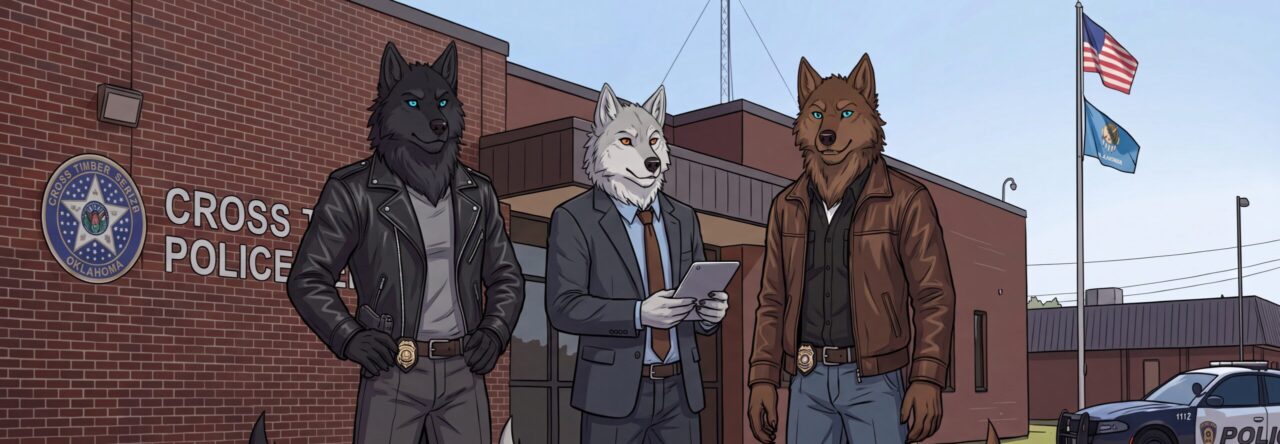
By the time Thane returned to the Cross Timber Police Department, the front lobby had acquired a second folding table.

The first held cards.

The second held flowers.

A third had been placed near the break-room door for food deliveries, where someone had taped up a handwritten sign in thick black marker:

NOT EVIDENCE. PLEASE LABEL ALLERGENS.

Thane stopped just inside the front doors.

Gabriel came in behind him, looked over the tables, and exhaled through his nose.

Carla at the reception desk looked tired, pleased, and one minor delivery away from declaring herself the commander of a small floral nation.

“Someone sent a get-well card covered in loose silver glitter. It shed all over the counter. Dispatch found it in the radio-room carpet.”

Thane stood there for a moment, taking it in.

The flowers were not as overwhelming as they had been the previous day. Most had already been redirected to hospital staff, dispatch, Heritage Liquor, Victim Services, and the officers working overnight patrol.

But there were still enough to make the station smell faintly like a greenhouse.

Sunflowers.

Carnations.

Roses.

A vase of wildflowers in a mason jar with a card that read:

FOR DETECTIVE THANE AND THE PEOPLE WHO KEPT ROSA SAFE.

The card table was worse.

There were stacks of envelopes from local schools, church groups, senior centers, businesses, and people who had apparently decided that mailing a police detective a handwritten note was the most useful thing they could do after watching a frightening video online.

A small stuffed wolf wearing a yellow construction vest sat beside a handmade sign.

GET WELL, BIG WOLF.

Thane looked at it.

Gabriel looked at him.

“Do not.”

“I did not say anything.”

“You were going to.”

“I was going to say the vest is adorable.”

Thane gave him a flat look.

Mark glanced at the toy.

“It is not regulation.”

Gabriel put one hand over his chest.

“Mark. It is a child’s gift.”

“It can be both adorable and noncompliant.”

Carla cleared her throat.

“The stuffed animals are being routed through Victim Services after the tags are recorded. That one is currently waiting for Sergeant Hale’s niece, who has been in the children’s hospital wing for a week.”

Thane nodded.

“Good.”

Carla smiled.

“And before you ask, no, you are not taking it home.”

Thane blinked.

“I was not going to.”

Gabriel looked at her.

“He was absolutely not going to.”

Carla pointed at the three of them.

“You have no idea how many people have asked whether he needs a special recovery den.”

Thane closed his eyes.

“Please tell me none of them brought one.”

“Not yet.”

“Carla.”

“One person offered to donate a custom recliner.”

Gabriel’s ears lifted.

“Was it nice?”

“Gabriel.”

“What? He got shot seven times. A good recliner is not an unreasonable public-health intervention.”

Mark adjusted the folder beneath one arm.

“Department policy does not permit acceptance of a custom recovery recliner.”

Gabriel looked at him.

“Your fun-to-information ratio is devastating.”

Thane shook his head and walked past the tables.

He was fully healed.

That was what the doctor had called it when the final examination ended earlier that afternoon.

No open wounds.

No retained rounds.

No internal injury.

No limitations beyond the soreness that remained in strange, stubborn places.

His chest felt tight if he stretched too far.

His thigh complained when he climbed stairs.

There was a faint ache beneath his ribs, as if his body had remembered the shape of the impacts even after it had repaired the damage.

He knew it would fade.

Probably soon.

That did not make it nothing.

Mark fell into step beside him.

“You are compensating slightly on the right side.”

Thane looked at him.

“I am walking.”

“Yes.”

“Normally.”

“Mostly.”

Gabriel came around the other side.

“Congratulations. You are now medically healthy enough to be criticized by both of us.”

Thane pointed toward the Investigations hallway.

“Statement first.”

Gabriel’s expression sobered.

“Statement first.”


The formal interview took place in a small conference room beside the Chief’s office.

Not an interrogation room.

Not a place designed to make someone uncomfortable.

A table.

Six chairs.

A carafe of coffee no one had touched.

A city-seal plaque on the wall.

Two unopened boxes of tissues sitting in the center of the table, as if somebody had decided the room itself would make people cry.

Leila Ochoa waited at one end with a recorder, a notebook, and a thick folder marked HERITAGE LIQUOR — CRITICAL INCIDENT REVIEW.

A representative from the police association sat quietly beside Thane. The department had made the option available. Thane had taken it, not because he expected wrongdoing, but because every officer who gave a full statement after a critical incident deserved the same process.

Mark and Gabriel had completed their own statements separately.

No coordinated language.

No shared drafts.

No comparing who remembered which second.

Just what each of them had seen.

Mercer stood outside the room with Voss.

Neither would be part of the statement.

Neither wanted to be.

Ochoa clicked on the recorder.

“Today is Monday, eighteen thirty-two hours. Detective Thane is present voluntarily for his full statement regarding the armed robbery and shooting at Heritage Liquor on Thursday night. Detective, are you medically cleared to participate?”

“Yes.”

“Are you taking any medication that affects your ability to understand or answer questions?”

“No.”

“Have you reviewed any evidence from the scene since your initial public-safety interview?”

“No.”

“Have you discussed the substance of your statement with Detectives Gabriel and Mark?”

“No.”

“Are you prepared to proceed?”

“Yes.”

Ochoa nodded.

“Start with your arrival.”

Thane did.

He told it cleanly.

The dispatch call.

The reported armed robbery.

The shots fired.

Grant and Serrano already positioned outside the store.

The clerk behind the counter.

The young employee near the boxed-wine display.

The gunman’s position.

The shattered front window.

The absence of a clean shot.

He did not make himself larger.

He did not make the suspect smaller.

He did not call the gunman evil.

He did not say he had known exactly how everything would end.

He described what he had seen.

What he had heard.

What he had assessed.

Ochoa asked questions when she needed more detail.

“Why did you enter the doorway?”

“The gunman had turned the weapon toward Rosa Martinez. She was injured and crawling toward the counter opening. Grant and I did not have a clean angle from outside without risking her.”

“Did you believe the suspect remained an immediate threat?”

“Yes.”

“Why?”

“The handgun was still in his hand. He had fired multiple rounds. Rosa was exposed. He moved the gun toward her.”

“Describe what happened after you entered.”

Thane took a breath.

“He fired.”

“How many times?”

“Seven.”

“Did you remain standing?”

“Yes.”

“Did that affect your decision to continue?”

“It affected what I knew I might survive.”

Ochoa looked up.

“Explain that.”

Thane considered the words before he used them.

“I am a werewolf. My healing is faster. My chances of permanent injury are different than they would be for a human officer in the same position.” He paused. “That did not make the situation safe. It did not mean the shots did not hurt.”

The room remained quiet.

Ochoa wrote.

Thane continued.

“It meant I knew I would be able to take a risk that Rosa could not take. The gun was still pointed at her. There was no clean shot. There was no time to wait for a better position.”

“Were you attempting to demonstrate that you could survive gunfire?”

“No.”

“Were you angry because the suspect shot you?”

“No.”

“Why did you move toward him?”

“Because he raised the gun again.”

Ochoa nodded once.

“Describe the disarm.”

“I caught his gun wrist and redirected the muzzle away from the clerk. He resisted. His trigger finger stayed inside the guard. I turned the pistol until it came free.”

“Did you intend to break his finger?”

“No.”

“What was your intent?”

“To keep him from firing again.”

“Did you use force after the weapon was secured?”

“No.”

“Did you strike him?”

“No.”

“Did you use force after he was in handcuffs?”

“No.”

“Did you make any threats?”

“No.”

“Did you give commands?”

“Yes.”

“What commands?”

“Drop it. Then hands open.”

Ochoa looked down at the report summary.

“You told the initial investigator that the suspect said, ‘They leave stuff. They move out and leave everything. Nobody wants it.’ Was that connected to the Heritage Liquor robbery?”

“No. That was Cole Varela in the earlier case.”

Ochoa paused.

Then closed her eyes briefly.

“Different critical incident. Long week.”

Thane’s ears tipped forward.

“You okay?”

She looked at him.

“I am fine.”

Gabriel’s voice, from somewhere in the hallway beyond the door, carried faintly through the wall.

“No.”

Ochoa stared at the door.

Then, despite herself, smiled once.

“Thank you, Detective Gabriel.”

Thane’s mouth twitched.

Ochoa returned to the record.

“Detective, is there anything else about your decision-making that you believe the review team needs to understand?”

Thane looked at the table.

At his hands.

At the claws that had stayed visible beneath the conference-room lighting through every sentence.

“Yes,” he said finally.

Ochoa waited.

“Being able to heal does not mean I get to be careless. We still use cover. We still wait when waiting is safe. We still use verbal commands. We still take the least dangerous option we have.”

He looked up.

“There was no safe option left for Rosa. That is why I moved.”

Ochoa held his gaze for a moment.

Then nodded.

“Thank you.”

The recorder clicked off.

The statement was complete.

Not the whole investigation.

Not the final review.

Not the reports, forensic findings, video analysis, witness interviews, or supervisor findings still to come.

But his part of the truth was in the room now.

Placed where it could be seen.


Voss was waiting in the hallway when Thane stepped out.

Mercer stood beside the window with his hands in the pockets of his suit trousers, staring down at the patrol lot below.

Neither spoke immediately.

That was not their style.

Thane looked between them.

“Was it okay?”

Voss answered first.

“It was complete.”

He nodded.

“That is what I wanted.”

“You did not make it about being hard to hurt,” she said. “You made it about why Rosa could not be the one left in that line of fire.”

“She could not.”

“No,” Voss said. “She could not.”

Mercer turned from the window.

He looked at Thane for a long second.

There was no dramatic expression on his face.

No swelling speech.

Just something honest and difficult to hide.

“You took seven handgun rounds,” he said. “Several of them through your core. No body armor. No retreat path. And you remained functional enough to see the threat, protect a civilian, disarm the shooter, stop using force when the threat stopped, and give a clear statement afterward.”

Thane’s ears lowered slightly.

“Okay.”

Mercer’s mouth moved toward a humorless smile.

“You are very bad at accepting the point of a compliment.”

“I do not want people to think I am invincible.”

“They should not,” Mercer said. “You are not.”

“I know.”

“But I am still impressed,” he said. “I would be lying if I said otherwise.”

Thane did not know what to say to that.

So Voss did.

“Being impressed is not the same as turning you into a symbol.”

Mercer nodded.

“No. It is not.”

Voss looked at Thane.

“You made a terrible situation smaller. That is what I want remembered.”

Thane looked down the hallway toward the lobby.

The flowers.

The cards.

The stuffed wolf in a construction vest.

The whole city trying to tell him that standing through gunfire had meant something.

“Rosa went home yesterday,” he said.

“Yes,” Voss said.

“Evan too.”

“Yes.”

“Then that is enough.”

Mercer’s expression softened.

“For the case, maybe. Not for the people who care about you.”

Thane glanced at him.

Mercer continued before he could object.

“You do not have to perform gratitude. You do not have to become a hero poster. But let people be glad you are alive.”

Thane was quiet for a moment.

Then nodded once.

“Okay.”

Rusk appeared at the end of the hallway carrying two coffees and a department-issued travel mug that read:

CROSS TIMBER PD — HANDLE WITH CARE

He looked at Thane.

“Apparently somebody thought this was funny.”

Gabriel emerged from the break room behind him.

“It is funny.”

“It is a mug,” Thane said.

“It is a mug with a warning label.”

Mark appeared last, looking at the mug.

“Technically, it is prudent.”

Rusk handed it to Thane.

“Carla said it was from a local print shop. Policy says it stays in the communal gift stack.”

Thane turned it over in his hands.

“Good.”

Rusk took a sip of coffee.

“Also, do not get shot tonight.”

Thane looked at him.

“I was not planning to.”

“Excellent. We have exceeded our flower-storage capacity.”

Gabriel nodded seriously.

“Dispatch is near revolt.”

“Dispatch has created a flower-inventory system,” Rusk said.

Mark’s ears tipped forward.

“May I see it?”

“No,” Thane said.

Mark looked offended.

“I only want to review the structure.”

“That is exactly why no.”

Voss gathered the remaining handoff folders.

“Enough. Night Shift, you have an actual shift.”


The first patrol assist came at 20:11.

Officer Grant had a disabled hatchback stalled halfway into the eastbound lane on Chandler, just beyond the grocery store.

No injuries.

No collision.

No crime.

Just a tired mother, two restless children in the backseat, and a car that had decided its transmission was done with the entire concept of forward movement.

The woman stood beside the open driver’s door with one hand pressed against her forehead.

A toddler in a dolphin shirt leaned against the rear window and cried with the quiet determination of someone who had been promised dinner twenty minutes ago.

Grant stood near the front bumper, directing traffic around the car.

When the Humvee pulled up behind his unit, he looked toward Thane.

“Glad you are back.”

“Glad it is a car,” Thane said.

Grant smiled faintly.

“Same.”

Mark stepped out first and assessed the lane.

“Traffic is light enough to move it to the grocery lot. We need one officer at the west approach and one at the intersection.”

Gabriel looked at the woman.

“Hi. We are going to get you out of the road.”

She looked at him, then at Thane.

Her face changed.

Not fear.

Recognition.

“Oh,” she said. “You are—”

Thane held up one hand gently.

“Tonight, I am helping move your car.”

The woman blinked.

Then nodded.

“Okay.”

It was exactly what she needed to hear.

Not a story.

Not a photograph.

Not a question about how many bullets could hit a werewolf before he stopped walking.

Just a plan.

Grant took the west approach.

Serrano arrived from the intersection and blocked traffic briefly.

Mark directed the angles.

Gabriel got the woman and children safely into the grocery-store lot.

Thane put both hands against the rear of the hatchback.

The soreness in his ribs tugged when he leaned into it.

Not sharply.

Not enough to stop him.

Enough that he noticed.

The car rolled.

Slowly at first.

Then more easily.

Mark moved with him, guiding the front wheel while Grant kept the lane clear.

Thirty seconds later, the hatchback sat safely in a parking space beneath a grocery-store light.

The toddler had stopped crying.

The older child, maybe six, pressed both hands against the back window and stared at Thane.

The mother came over once traffic began moving again.

“Thank you,” she said.

“You are welcome.”

She hesitated.

Then looked at his chest.

Not at the wounds, which were hidden beneath his uniform shirt.

At him.

“I saw the video.”

Thane nodded.

“I am sorry you had to see it.”

Her eyes widened slightly.

“No. I just…” She looked toward her kids. “I am glad you are okay.”

Thane looked at the two children in the car.

Then back at her.

“Me too.”

Gabriel appeared beside him with the woman’s roadside-assistance number written on a small card.

“Tow truck is on the way. The grocery manager said you can wait inside with the kids if you want.”

The woman took the card.

“Thank you.”

As Night Shift walked back toward the Humvee, Grant fell into step beside Thane.

For half a block, she said nothing.

Then she cleared her throat.

“Can I ask you something?”

Thane looked at her.

“Yes.”

“I keep replaying it.”

“The store?”

Grant nodded.

“I saw the first shot hit you. Then the second. I knew Rosa was in the line. I knew I did not have the angle.” She looked down at the pavement. “I keep thinking I should have done more.”

Thane stopped.

Grant stopped too.

“You did do more,” Thane said.

Grant looked at him.

“You got there first. You set the position. You called the threat. You kept the front covered. You got Evan out. You backed me when I moved.”

“But you got shot.”

“Yes.”

Grant’s jaw tightened.

“Seven times.”

“Yes.”

Thane let the words sit.

Then said, “That does not make it your fault.”

Grant looked away.

“It feels like it should.”

“I know.” Thane’s voice stayed low. “But you did not put the gun in his hand. You did not make him fire. You did not fail because I had a different body than you do.”

Grant looked back at him.

Thane continued.

“You were where you needed to be. Rosa is alive. Evan is alive. You got the scene stable after the threat ended. That matters.”

Grant nodded slowly.

“Okay.”

“Do not carry the parts that belong to the gunman.”

For a moment, Grant did not answer.

Then he said, “You have been talking to Dr. Price again.”

Thane’s mouth moved faintly.

“Maybe.”

Grant looked relieved enough to laugh once.

“Good.”


At 22:36, Night Shift assisted Patel at an apartment complex off North Cedar.

The call had come in as a possible domestic disturbance.

Raised voices.

Something crashing.

A neighbor worried that someone was being hurt.

By the time they arrived, it was three adults in a cramped apartment, two open moving boxes, an overturned laundry basket, and a disagreement about whether a ninety-two-year-old grandmother’s old sewing machine belonged to the eldest daughter or the grandson who had promised to repair it.

No one had been struck.

No one had threatened anyone.

Everyone was exhausted.

The grandmother had died two weeks earlier.

Her family had been trying to clear the apartment before the end of the month.

The sewing machine was the last thing anybody had expected to become a fight.

Gabriel sat at the small kitchen table with the eldest daughter, Nadia.

Mark spoke quietly with the grandson, who was nineteen, angry, embarrassed, and very close to crying about a machine he had not actually known how to repair.

Thane stood in the doorway between the living room and kitchen, giving the room enough space to breathe.

Patel leaned against the wall beside him.

“Quiet night,” she murmured.

Thane glanced toward the sewing machine.

“Very.”

Patel looked at him.

“How are you?”

“Fine.”

She gave him a look.

He corrected himself.

“Healing.”

“Better.”

After a minute, she said, “Does it still hurt?”

Thane looked toward the kitchen.

Gabriel had made Nadia laugh softly at something. Mark was showing the grandson how the machine’s serial plate could help identify the model and perhaps find an original manual online.

“It did,” Thane said. “A lot.”

Patel was quiet.

“I have been shot at,” she said. “Never hit. I have thought about it since Thursday.”

Thane nodded.

“Most officers have.”

“Does it feel different because you heal?”

“Yes.”

“How?”

He thought about the answer.

“The first part does not feel different.”

Patel waited.

“It is force. Heat. Pressure. It feels like your body being told something is very wrong all at once.” Thane looked down at his hands. “You do not stop feeling pain because you are a werewolf. You do not get used to it. The pain is real.”

Patel’s expression stayed serious.

“Then the healing starts.”

“Fast,” Thane said. “The worst of it fades fast. The pressure goes. The damage closes. Your body starts catching up to what happened.”

“And the memory?”

Thane looked at her.

“The memory takes longer.”

Patel nodded once.

That was enough.

Across the room, the grandson said, “I do not want to sell it.”

Nadia wiped at her face.

“I do not either.”

Gabriel looked between them.

“Then do not make the decision tonight.”

The young man looked toward the sewing machine.

“But the apartment has to be empty by Friday.”

Mark spoke without looking up from his tablet.

“You can move the machine to storage for thirty days. That gives you time to decide without making the decision while everyone is upset.”

Nadia looked at him.

“Can we do that?”

Patel stepped forward.

“I can call a storage place near here. See who has a small unit available.”

The whole apartment seemed to unclench.

Not solve.

Not heal.

Just breathe.

Thane watched the sewing machine get moved carefully into a corner away from the boxes.

A small practical delay.

A little more time.

Sometimes that was all police could give people.

Sometimes it was enough.

As they walked back toward the Humvee, Patel fell into step beside Thane again.

“You know what people are saying?”

Thane looked at her.

“That I am invincible?”

“Some of them.”

“I am not.”

“I know.”

“They should know.”

“They will,” Patel said. “But they also saw you keep going.”

Thane was quiet.

Patel continued.

“You did not make it look easy.”

He looked at her.

“No.”

“Good.”

Then she went back to her unit.


At 00:18, the station break room had become a problem.

Not a serious problem.

A food problem.

Someone had delivered two trays of breakfast burritos for night shift, even though it was midnight and no one could explain why breakfast food had become the city’s chosen language of concern.

Another donor had sent cookies.

Dispatch had received sandwiches.

The fire department had sent a note saying they were not accepting any more donuts because Cross Timber apparently wanted every public-safety worker to gain ten pounds by the end of the month.

Rusk had written GOOD LUCK beneath the note.

Gabriel stood near the counter, holding a burrito in one hand.

“This is a tremendous public service.”

Mark looked at the handwritten labels on the trays.

“It is an unstructured resource-distribution issue.”

Gabriel stared at him.

“You have a burrito. Be happy.”

“I am happy.”

“You look like you are planning an audit.”

“I am planning a rotation.”

Thane sat at one of the small break-room tables with a bottle of water and half a burrito.

His ribs still felt mildly sore when he laughed.

He had discovered that twice already.

He was now trying not to give Gabriel the satisfaction.

Grant came in first.

Then Darnell.

Serrano came in after clearing a report.

Patel arrived a minute later.

None of them sat immediately.

They hovered the way people did when they had a question but had not decided whether they were allowed to ask it.

Gabriel saw it.

“Oh, no,” he said cheerfully. “This is an intervention.”

“It is not,” Darnell said.

“It is absolutely an intervention.”

Grant looked at Thane.

“Can we ask you something?”

Thane put down his water.

“Yes.”

Darnell grabbed a burrito and sat across from him.

“Does being a werewolf make you more willing to take chances?”

The room went quieter.

Not awkward.

Just attentive.

Thane looked at the patrol officers.

Then at Gabriel.

Then at Mark.

He knew what they were really asking.

Not whether bullets hurt.

Whether a body that healed could make an officer careless.

Whether his kind of strength changed the rules.

“No,” Thane said.

Darnell waited.

Thane continued.

“Being a werewolf does not make us more willing to take chances. It gives us a different calculation when there is no clean safe answer.”

Grant leaned forward slightly.

“What does that mean?”

“It means we can sometimes put ourselves into danger that would create a higher risk of permanent injury for someone else.” Thane looked down at the water bottle. “We may be able to take the hit instead of a civilian. Or take an angle another officer cannot safely take. Or close distance when waiting would let someone get hurt.”

He looked back up.

“But that only changes the risk to us. It does not remove the risk. It does not make force easier to justify. It does not mean we get to be reckless because we heal.”

Mark nodded once.

“‘We could survive it’ is never enough.”

Darnell looked at him.

“Then what is enough?”

Mark folded his hands on the table.

“An immediate threat. A lawful purpose. No safer workable alternative. A clear reason the action reduces overall harm.”

Gabriel took another bite of burrito.

“And even then, we have to live with it afterward.”

The room stayed quiet.

Grant looked at Thane.

“Were you scared?”

Thane did not hesitate.

“Yes.”

That answer seemed to surprise them more than anything else.

Serrano’s expression shifted.

“Really?”

“Yes.”

“Even after the first shot?”

“Especially after the first shot.”

Darnell stared at the table.

“So how did you keep moving?”

Thane thought about the liquor store.

The shattered window.

Rosa crawling.

The gunman looking at him with the pistol rising again.

“I did not keep moving because I was fearless,” he said. “I kept moving because Rosa was still there.”

Grant nodded slowly.

Gabriel looked at him.

“That is the part people miss when they watch the video.”

“They see the bullets,” Patel said.

“Yeah,” Gabriel said. “They do not see the decision before them.”

Serrano sat across from Thane.

“What is it like to heal that fast?”

The question landed softer than the others.

More curious than afraid.

Thane leaned back carefully in his chair.

“It is strange,” he said.

Darnell smiled faintly.

“That is not a very technical answer.”

“I am not Mark.”

Mark looked mildly offended.

“You can be technical without being me.”

Gabriel made a thoughtful sound.

“I disagree.”

Thane continued before either could argue.

“It hurts first. It all hurts. You feel where the damage is. You know what happened.” He glanced down at his chest. “Then it starts to fade. The heat goes away. The pressure goes away. The body starts putting itself back together faster than your mind catches up.”

“Like pain running backward?” Grant asked.

Thane considered it.

“Maybe. Not exactly. More like your body is working very hard to convince you that you are not dying.”

No one laughed.

Thane went on.

“The soreness stays longer. Not always. But sometimes. My body heals the wound before my mind has finished understanding it.”

Serrano nodded.

“That makes sense.”

“It also means we have to be careful,” Thane said. “We can look fine before we are ready. We can move before we should. We can convince ourselves the damage does not count because it does not last.”

Gabriel looked at him.

“Do we?”

Thane looked back.

“Yes.”

Gabriel nodded once.

“Fair.”

Patel rested her hands around her coffee cup.

“So you do not think of yourselves as safer?”

Mark answered this time.

“We are safer from some kinds of lasting injury. We are not safer from bad decisions.”

Darnell gave a low whistle.

“That should be on a poster.”

Gabriel pointed at him.

“No more posters.”

“Seriously,” Thane said.

Darnell held up both hands.

“No posters.”

There was a beat.

Then he added, “Maybe a mug.”

Thane stared at him.

The whole table laughed.

Even Thane, though he stopped quickly and pressed one hand to his ribs.

Gabriel’s expression changed immediately.

“You okay?”

Thane looked at him.

“Healing.”

Mark nodded.

“Accurate.”


The final patrol assist came at 03:47.

A caller at the northside gas station had reported a man “passed out” near the air pump.

The call sounded worse than it was.

The man was awake when Patel arrived.

He was seventy-four, stubborn, mildly dehydrated, and deeply offended that his old pickup had chosen the gas-station lot to suffer a dead battery.

His name was Walter Briggs.

He had been driving home from visiting his brother in the hospital.

He had sat down on the curb after his truck would not start and fallen asleep because he had not slept much in two days.

The station clerk had seen him and called.

By the time Night Shift arrived, Walter had been given water, checked by EMS, and was arguing that he did not need anyone fussing over him.

“I have had worse nights,” he said.

Patel looked at him.

“Your truck is dead, your phone battery is at three percent, and you fell asleep beside an air pump.”

Walter pointed a finger at her.

“Still had worse.”

Thane crouched beside the truck’s open hood.

“Battery terminal is loose.”

Walter looked over.

“You know cars?”

“No,” Thane said. “But Mark does.”

Mark inspected the cable connection.

“Corrosion buildup. Loose clamp. Likely recoverable temporarily.”

Walter narrowed his eyes at him.

“You are a detective.”

“Yes.”

“And you are fixing my truck.”

“No,” Mark said. “I am identifying why it does not work.”

He checked the battery terminal again.

“Corrosion buildup. Loose clamp. I can clean the connection enough to get you safely home, but the battery and terminal need proper service tomorrow.”

Walter narrowed his eyes.

“You can do that?”

“Yes.”

Patel stepped back toward her unit, keeping an eye on the lot.

“Road is clear,” she said. “Take the time you need.”

Mark nodded once.

Then he cleaned the terminal and tightened the clamp.

Walter looked between them.

“I did not ask for all this.”

Gabriel leaned against the pump.

“You did not ask for a dead battery either. Yet here we are.”

The old man grumbled, but not seriously.

A few minutes later, Mark had the clamp cleaned enough to reconnect.

Thane held the hood steady while Walter turned the key.

The engine coughed.

Failed.

Then caught.

Walter stared at the dashboard.

“Well,” he said.

Mark stepped back.

“Drive directly home. Replace the battery and terminal connection tomorrow.”

Walter looked at Thane.

Then looked again.

Recognition reached his face slowly.

“You are that wolf.”

Gabriel closed his eyes.

Thane waited.

Walter pointed toward Thane’s chest.

“You got shot.”

“Yes.”

“Seven times?”

“Yes.”

Walter shook his head.

“That seems excessive.”

“It was.”

Walter was quiet for a moment.

Then he looked at Patel.

“Does it still hurt?”

Patel glanced at Thane.

Thane answered for himself.

“A little.”

Walter nodded.

“Good.”

Gabriel blinked.

“Good?”

Walter leaned on the open truck door.

“If it did not hurt, you might think you could do it again.” He looked at Thane. “Pain has a job.”

The words settled into the cold early-morning air.

Thane looked at him.

“Yes,” he said. “It does.”

Walter nodded once, apparently satisfied.

Then he got into his truck.

Before pulling away, he rolled down the window.

“Do not let them make you a fool because you heal fast.”

Thane’s ears tipped forward.

Walter tapped the steering wheel.

“People see a strong thing and assume it does not need protecting. That is how strong things get broken.”

Then he drove away slowly toward the north road.

No one spoke for a few seconds.

Gabriel watched the taillights disappear.

“Well,” he said. “That man just emotionally corrected all of us.”

Mark looked at Thane.

“He was not wrong.”

“No,” Thane said. “He was not.”


At 05:51, the Humvee rolled back into the station lot.

The sky was beginning to turn pale above Cross Timber.

The flower tables in the lobby remained.

The cards remained.

The sign about glitter remained.

But the building had settled into the ordinary quiet of the hour before day shift.

Carla had gone home.

Dispatch had changed over.

The donated breakfast burritos were gone.

Rusk’s travel mug sat abandoned in the break room beside a stack of reports.

Thane stood for a moment in the lobby before heading out.

A new card rested on top of the morning stack.

The handwriting was large and careful.

Probably a child.

DEAR DETECTIVE THANE,

I SAW YOU GET HURT ON THE PHONE.

I AM GLAD YOU GOT BETTER.

MY MOM SAYS YOU ARE NOT BULLETPROOF.

I THINK YOU SHOULD STILL BE CAREFUL.

LOVE, JASMINE

Thane read it twice.

Gabriel came up beside him.

“Good advice.”

“Yeah.”

Mark looked over his shoulder.

“Clear, concise, and medically appropriate.”

Thane held the card gently between both hands.

Then put it back on the table.

He looked at Gabriel and Mark.

“Being a werewolf does not make us better police.”

Gabriel looked at him.

“No?”

“It gives us advantages,” Thane said. “It changes what we can survive. It changes what we can do when someone is in danger.”

Mark waited.

Thane looked toward the quiet lobby.

At the cards.

The flowers.

The city’s fear turned into handwriting, sunflowers, burritos, and small reminders to be careful.

“But the badge is the part that tells us what we owe people.”

Mark nodded.

Gabriel was quiet for a moment.

Then he smiled slightly.

“That is pretty good.”

Thane looked at him.

“Do not put it on a mug.”

Gabriel lifted both hands.

“No mugs.”

Mark glanced toward the break room.

“Reasonable policy.”

The three of them walked out together.

Behind them, the cards waited for someone to read them.

Ahead, morning came slowly over the city.

And for one quiet night, nothing had needed saving by force.

Chapter 72 — The Mail

By 09:18 the next morning, Thane had received three bouquets, nineteen cards, two stuffed wolves, a handwritten get-well note from a six-year-old named Mason, and one cardboard box containing a pair of child-sized hiking boots.

He had been shot seven times less than twelve hours earlier.

He was still in the hospital.

And he had absolutely no idea what to do with the boots.

The box sat on the windowsill beside a vase of sunflowers and a small balloon shaped like a silver star.

The note taped to the top read:

FOR THE WOLF DETECTIVE WHO STOOD UP.

Underneath, in different handwriting:

THESE ARE NOT FOR YOU. WE KNOW YOU HAVE PAWS. PLEASE GIVE THEM TO A KID WHO NEEDS THEM.

Thane stared at the box.

Gabriel sat in the chair nearest the window with a cup of hospital coffee and an expression that suggested he had been awake long enough to dislike everything about the world.

Mark stood near the foot of the bed with his tablet open.

“I have logged the sender information,” Mark said.

Thane looked at him.

“You logged the boots?”

“The boots are a physical item delivered to a police detective through a hospital.”

“They are child-sized.”

“Yes.”

“They clearly are not a bribe.”

“No.”

“Then why are you logging them?”

“Because Chief Whitaker instructed us not to accept gifts without processing them through the department.”

Gabriel took a careful sip of coffee.

“Thank God. For a second, I thought we might have to make ethical decisions without a spreadsheet.”

Mark did not look up from the tablet.

“The spreadsheet is helping.”

Thane glanced again at the cardboard box.

“It says to give them to a kid.”

“We can ask the Chief whether they can be routed through an existing youth-outreach partner,” Mark said. “Or returned with a thank-you note explaining the policy.”

“They are boots,” Thane said.

“They are still boots.”

Gabriel looked at the box.

“They are kind of good-looking boots.”

Thane gave him a flat look.

“You are not trying them on.”

“I did not say I was.”

“You looked at the size.”

“I was estimating.”

“Gabriel.”

“Fine.”

Mark looked at the card again.

“The sender included a child’s name but no return address. That makes a direct return difficult.”

Gabriel smiled faintly.

“Then they become powerful paws for somebody else.”

Thane looked at him.

Gabriel held up both hands.

“I am not making fun of it.”

“No,” Thane said quietly. “You are not.”

That was true.

The room was full of cards.

Not just cards addressed to Thane.

Some were for Rosa Martinez, the clerk from Heritage Liquor.

Some were for Evan, the teenage stocker who had spent the night with his mother after he crawled out from behind the boxed-wine display.

Some were for Grant and Serrano.

One was for “THE OFFICERS WHO DID NOT LET HIM COME BACK.”

The hospital mail desk had stopped bringing deliveries one at a time.

At 08:40, a nurse named Melissa had arrived with a rolling linen cart full of flowers, envelopes, small bags of candy, and one extremely large stuffed gray wolf wearing a tiny police hat.

The wolf’s name tag read:

CAPTAIN PAWS.

Thane had looked at it for a long time.

Then at Gabriel.

Then at Mark.

Gabriel had covered his muzzle with one hand.

Mark had said, “The hat is not regulation.”

Thane had answered, “It is not staying.”

The stuffed wolf was now sitting in the corner near the visitor chair.

No one had moved it.

Thane suspected Gabriel had done that on purpose.

The television mounted high on the wall had been muted since before sunrise.

It still showed a local news channel.

The lower-third banner changed every few minutes.

CROSS TIMBER DETECTIVE RECOVERING AFTER LIQUOR-STORE SHOOTING

Then:

VIDEO OF WEREWOLF OFFICER HEALING SPREADS ONLINE

Then:

POLICE ASK PUBLIC NOT TO SHARE GRAPHIC FOOTAGE

Thane did not look at it.

He had looked once at 06:12.

That had been enough.

The store-security footage had been released only in a limited, edited form through official channels after investigators preserved the original. The department had not released the worst of it. No close shots of Rosa on the floor. No extended view of Thane being hit. No footage that turned human fear into something people could replay for entertainment.

But there had been other video.

There was always other video.

A customer had filmed from behind a parked SUV across the lot.

Someone in the next storefront had caught part of the front windows shattering.

A person driving past had recorded the aftermath from too close before patrol pushed everyone back.

The clips had spread faster than anyone could stop them.

People had seen the shots.

They had seen Thane stagger into the liquor-store display.

They had seen the gunman stop firing.

Then they had seen Thane still standing.

The internet had done what it always did with a thing it did not understand.

It had made him larger than he was.

Gabriel had read a few headlines before Mark took his phone away.

THE WOLF WHO WOULD NOT FALL.

BULLETS COULD NOT STOP HIM.

IS CROSS TIMBER’S MOST FAMOUS DETECTIVE INVINCIBLE?

Mark had looked up from the phone and said, “That last one is inaccurate.”

Gabriel had stared at him.

“Thank you, Mark. I had no idea.”

Thane had closed his eyes.

“I am not bulletproof.”

“No,” Gabriel had said. “You are not.”

“That needs to be the statement.”

Mark had already been typing.

The final version had gone through Chief Whitaker, City Legal, Critical Incident, and Voss before anyone allowed it to leave the department’s official account.

It was short.

It was not dramatic.

It did not mention hiking boots, powerful paws, supernatural heroism, or the number of rounds.

It read:

Detective Thane is recovering following last night’s armed robbery at Heritage Liquor. He remains under medical observation and is expected to recover.

The Detective was injured during an active threat. He is not invulnerable, and the public should not mistake werewolf healing for an absence of injury or risk.

The clerk injured in the robbery is also expected to recover. The incident remains under investigation. We ask the public to respect the privacy of those affected and avoid sharing graphic footage.

Beneath the department statement, Thane had been permitted one sentence.

Nothing more.

Nothing that touched the investigation.

Nothing that made the shooting about him.

Rosa is recovering. Evan is safe. That is what matters. Please let the investigators do their work.

The response had been immediate.

Thousands of comments.

Tens of thousands.

Some kind.

Some strange.

Some so furious at the gunman that the department moderators had to remove them.

Some from people who had been helped by Night Shift before.

The woman from the pharmacy whose prescription bag had been under her mobility scooter.

The delivery driver who had backed into the dumpster.

A volunteer from Hollow Creek Community Center.

Someone from Cedar Ridge Senior Living.

One of the Heritage Square families had posted a photo of little Milo holding a handwritten sign that said:

GET WELL, WOLF POLICE.

Kaden’s father had posted nothing at first.

Then, around 07:30, he had shared a photograph of a piece of notebook paper.

Kaden had drawn Thane lying in a hospital bed.

The drawing showed seven large red circles over Thane’s brown chest and stomach.

Each had a tiny black X through it.

Above the bed, in huge blue crayon letters, Kaden had written:

POWERFUL PAWS HEAL FAST

Then, beneath it in smaller green letters:

BUT PLEASE DO NOT GET SHOT ANY MORE

Gabriel had shown Thane the image.

Thane had stared at it for a long time.

Then said, “That is fair.”

Mark had nodded.

“It is clear advice.”

Gabriel had looked at them both.

“You are taking this incredibly seriously.”

“It is from Kaden,” Thane said.

“Exactly.”

A knock sounded at the door.

Dr. Hayes entered with a nurse behind her.

The nurse held a clipboard.

Dr. Hayes held the expression of a person who had spent the last four hours trying to reconcile medical reality with the body sitting upright in front of her.

“How are we feeling?” she asked.

Gabriel looked at Thane.

“Terrible.”

Thane looked back at him.

“I am okay.”

Dr. Hayes pointed toward him.

“That answer is banned.”

Thane blinked.

“What?”

“You were shot seven times. You have no retained rounds, no current internal bleeding, and no fractures. Your wounds are closing at a rate that is not medically reasonable for a human patient.” She paused. “You are not a human patient. That does not mean I am suddenly comfortable calling any of this normal.”

Mark looked at the clipboard.

“What are his current restrictions?”

Dr. Hayes looked at him.

“No work. No driving. No lifting. No chasing armed suspects through convenience stores.”

Gabriel nodded.

“Strong list.”

Thane sat up a little straighter.

“I was not in a convenience store.”

Dr. Hayes stared at him.

“Do not correct me on venue type.”

Thane settled back.

“Okay.”

The nurse tried not to smile.

Dr. Hayes continued.

“Your blood pressure is stable. Your imaging is clear. The wounds are healing cleanly. You have been monitored long enough that I am comfortable releasing you later this afternoon if your condition remains stable.”

Gabriel looked at the clock.

“Later this afternoon?”

“It is 09:22,” Dr. Hayes said.

“He was shot last night.”

“Yes.”

Dr. Hayes looked at Thane.

“You are not supposed to be eligible for discharge this afternoon.”

Thane considered that.

“I am sorry?”

“Stop apologizing to doctors for surviving in ways that annoy us.”

Mark’s ears tipped forward.

“That is concise.”

“It is medically accurate,” Dr. Hayes said.

She looked at Thane.

“You are going to rest. You are going to follow the wound-care instructions even though your body is going to make you think they are unnecessary. And you are not returning to work because you feel guilty about being absent.”

“I do not feel guilty.”

Gabriel turned toward her.

“He feels guilty.”

Thane looked at him.

“I do not.”

Gabriel looked back at Dr. Hayes.

“He absolutely does.”

Dr. Hayes nodded.

“I have met people like you before.”

Thane stared at the ceiling.

“You have met werewolves before?”

“I have met police officers before.”

That shut him up.

Dr. Hayes checked his chart once more.

Then nodded to the nurse.

“Leave the paperwork. I will be back at thirteen hundred.”

She moved toward the door.

Then paused beside the box of hiking boots.

“What is that?”

“A gift,” Gabriel said.

“Do not accept gifts,” Mark said at the same time.

Dr. Hayes looked at the note.

Then at Thane.

“Child-size?”

“Yes,” Thane said.

“Good. I was worried you had somehow developed a shoe problem.”

Gabriel made a sound into his coffee.

Thane looked at him.

“Do not.”

Dr. Hayes left before either of them could explain.


At 10:06, Chief Whitaker called.

Mark put the phone on speaker.

The Chief’s voice came through clear and calm.

“Detective.”

“Chief.”

“How are you?”

Thane looked at Gabriel.

Gabriel looked back at him.

Thane chose his answer carefully.

“I am healing. Dr. Hayes expects to discharge me this afternoon.”

“Good.”

“She also says I cannot work.”

“She is correct.”

“I know.”

“You are on paid administrative leave pending the initial shooting and use-of-force review.”

Thane’s ears tipped back.

“I did not fire my weapon.”

“I know.”

“I did not—”

“Thane.”

He stopped.

The Chief’s voice softened slightly.

“You were shot seven times during an armed robbery. You used force to disarm and restrain an armed suspect. The review is required because the public deserves a complete account, the department deserves a complete account, and you deserve a complete account.”

Thane looked at the cards near the windowsill.

“I understand.”

“This is not discipline.”

“I know.”

“Good.”

The Chief paused.

“Your formal interview will happen after you have rested and after counsel or union representation has been offered. You will not coordinate language with Gabriel or Mark. You will not read comments online. You will not answer messages from reporters, friends, relatives, brand representatives, podcast hosts, documentary producers, or people who think a bulletproof wolf detective is an appropriate subject for a children’s cartoon.”

Gabriel looked at Mark.

Mark looked at the phone.

Thane blinked.

“Children’s cartoon?”

Mercer’s voice came faintly in the background.

“Tell him about the lunch boxes.”

Chief Whitaker exhaled.

“Deputy Chief Mercer is currently standing in my office holding a mock-up of a lunch box someone emailed to the department.”

Thane closed his eyes.

“No.”

“Yes.”

“What is on it?”

Mercer’s voice came closer.

“A wolf in a police vest standing on a mountain with laser eyes.”

Gabriel sat upright.

“Laser eyes?”

“Laser eyes,” Mercer confirmed.

Thane looked at Mark.

“Why?”

Mark considered it.

“Visual shorthand for exaggerated capability?”

“That is not an answer.”

“It is the likely answer.”

Chief Whitaker returned to the phone.

“City Legal has already sent takedown notices where appropriate. No one is using your likeness, name, badge, or department affiliation for a product without authorization.”

“Good,” Thane said.

“And KEEN contacted Eli this morning.”

Gabriel’s eyes widened.

“Oh, no.”

Thane sat forward.

“What did they want?”

“They wanted to send flowers and a note. Eli informed them that a note was fine and any gift would be processed under department and hospital policy.”

Mark looked at the growing collection near the window.

“Reasonable.”

Chief Whitaker continued.

“They also asked whether the hiking film should be paused.”

Thane was quiet for a moment.

The video had come out days before the shooting.

It had been warm.

Simple.

A trail.

Paws on stone.

Human boots on ground.

A sentence about people building their own power.

Now the same feeds that had shown him standing on a limestone ridge were showing him walking through a shattered liquor-store doorway with blood across his shirt.

The connection made his stomach tighten.

“What did Eli say?” he asked.

“Eli said the existing film may remain posted because it is truthful, private-citizen work with no department use. He advised them not to reference the shooting, not to alter the campaign, and not to use it as a resilience or ‘unstoppable’ message.”

Thane let out a breath.

“Good.”

Mercer came back on the line.

“For the record, they appear to be behaving responsibly.”

“That is good,” Gabriel said.

“And,” Mercer continued, “they sent a card. No product. No promotional language. Just a card.”

Thane nodded.

“Okay.”

Chief Whitaker’s voice shifted again.

“Now for the less strange part. The department has received two hundred and eighty-seven cards, thirty-four floral deliveries, eleven food deliveries, four stuffed animals, nine dog treats, six wolf treats, and one crate of what appears to be artisanal beef jerky.”

Gabriel looked delighted.

“Wolf treats?”

“Do not,” Thane said.

“I did not say anything.”

“You were about to.”

Chief Whitaker continued as though neither had spoken.

“Nothing expensive is being accepted personally. Cards are being cataloged. Flowers are going to the hospital nurses and the Heritage Liquor staff once Rosa approves. Food will be distributed to the station, dispatch, fire, and the hospital break rooms. The stuffed animals will go through Victim Services after the tags are recorded.”

Mark nodded slowly.

“That is appropriate.”

Mercer’s voice carried a hint of amusement.

“The wolf treats are under review.”

Gabriel put one hand over his muzzle.

Thane stared at the phone.

“Do not feed me anything people mail to the police station.”

“No one is feeding you anything people mail to the police station,” Chief Whitaker said.

“Good.”

“But Rusk did ask whether the jerky could be field-tested.”

“Of course he did.”

“Voss said no.”

“Good.”

Chief Whitaker paused.

“There is one more thing.”

Thane waited.

“The lobby is full.”

“What?”

“Full.”

“Of what?”

“Mail.”

Gabriel looked at Mark.

Mark looked at the pile of cards on the windowsill.

Mercer answered before the Chief could.

“Not people. Mostly. A few people came by, but we redirected them. The lobby is full of cards, flowers, school projects, and bags of things people thought you might need.”

“What things?”

“Blankets. Coffee. A case of bottled water. A box of protein bars. Three different first-aid kits. A child’s firefighter helmet. A paperback novel titled The Alpha Who Could Not Die.

Gabriel made a sound that was halfway between a laugh and a cough.

Thane sat very still.

“No.”

“Yes.”

“Is that a real book?”

Mercer paused.

“It is now.”

Mark looked at the phone.

“Please tell me nobody bought it.”

“Someone mailed it to the station,” Mercer said. “Rusk opened the box before we could stop him.”

“Is it good?” Gabriel asked.

Chief Whitaker said, “Gabriel.”

“What? I am curious.”

“You are not reading it.”

“I was not going to.”

“You were.”

He smiled.

“Maybe.”

Thane leaned back against the bed.

The room had become unreal.

Seven bullet wounds.

A hospital discharge later that afternoon.

A national video cycle.

Flowers.

Cards.

Wolf treats.

A fictional novel about an immortal alpha apparently now resting in the Cross Timber Police Department lobby.

He rubbed one hand across his face.

“I only wanted Rosa to get out.”

The room went quiet.

Not heavy.

Not sad exactly.

Just honest.

Chief Whitaker’s voice softened.

“I know.”

Thane looked at the box of child-sized hiking boots.

Then at the giant stuffed wolf wearing a police hat.

Then at the cards.

“I do not know what to do with all of it.”

“You do not need to do anything with it today,” the Chief said. “You need to rest. We will make sure the department handles the rest cleanly.”

Mercer added, “And for the record, ordinary old you has become something of a civic event.”

Thane looked at the phone.

“I hate that sentence.”

“I know,” Mercer said.

Then he sounded quieter.

“But you should know people are not only reacting because you survived.”

Thane waited.

“They are reacting because they saw what you did before you survived. You moved for somebody else.”

Thane did not answer.

He did not need to.

The Chief spoke again.

“We will see you when you are cleared. Do not come to the station early.”

“Yes, Chief.”

“Do not drive.”

“Yes, Chief.”

“Do not read the comments.”

Gabriel looked at Thane.

“No promises,” Thane said.

Chief Whitaker paused.

“That was not for you. That was for Gabriel.”

Gabriel looked offended.

“I have excellent impulse control.”

Mark said, “No.”

Mercer laughed.

The call ended.

For a few seconds, nobody spoke.

Then Gabriel looked at the hospital television.

The muted local-news anchor was now standing in front of Heritage Liquor.

Behind her, the front windows had been boarded temporarily.

A banner beneath the image read:

STORE CLERK EXPECTED TO RECOVER AFTER ARMED ROBBERY

Gabriel pointed at the screen.

“That is the headline that matters.”

Thane looked at it.

“Yes.”


Dr. Hayes released Thane at 13:47.

She did not look happy about it.

She looked medically satisfied and personally irritated.

Those were apparently different things.

“You have healing wounds,” she said, reading the final discharge instructions aloud. “Not imaginary wounds. Not symbolic wounds. Healing wounds.”

“Yes, doctor.”

“You will keep them clean.”

“Yes, doctor.”

“You will not drive.”

“Yes, doctor.”

“You will not return to work until cleared by the department and until you can move without compensating for the thigh wound.”

Thane looked down at his leg.

It still hurt.

Not enough to stop him from walking.

Enough to remind him that the body did not erase the price of what it had done.

“Yes, doctor.”

“And you will contact us immediately if you experience difficulty breathing, chest pain, fever, worsening pain, dizziness, or any new symptoms.”

Gabriel leaned against the wall.

“What if he experiences an urge to fight crime?”

Dr. Hayes looked at him.

“Call Chief Whitaker.”

Mark nodded.

“Reasonable escalation path.”

Thane looked at both of them.

“I am standing right here.”

Dr. Hayes handed him the folded discharge packet.

“Good. Stand carefully.”

The nurse returned his personal effects.

Badge in a sealed department envelope.

Wallet.

Phone.

Keys.

A plain dark T-shirt from Gabriel’s emergency clothing bag.

Gabriel had brought it from the cabin that morning.

The shirt fit loosely enough over Thane’s healing torso.

Mark carried the giant stuffed wolf.

Thane had tried to leave it.

Gabriel had picked it up first.

“It is a hospital gift.”

“It is not coming home.”

“It is for a kid.”

“Then it can go to a kid.”

“Fine,” Gabriel said. “But I am carrying it to the car.”

“You look happy about that.”

“I look like a responsible person transporting a victim-services item.”

Mark looked at the toy wolf’s tiny police hat.

“Questionable chain of custody.”

Gabriel smiled.

“Objectively adorable chain of custody.”

They left through a staff exit.

Not because the hospital had told them to hide.

Because the front entrance had become too busy.

A few local camera crews stood near the public doors.

A cluster of people waited across the sidewalk with signs.

Not a crowd.

Not a mob.

Just maybe twelve people.

A woman held a handmade poster that read:

GET WELL, DETECTIVE THANE

A little boy beside her held another:

ROSA TOO

Thane stopped when he saw it.

Gabriel watched his face.

“You want to go over there?”

Thane looked at his discharge instructions.

Then at the people.

Then at the small child gripping the sign.

“No,” he said quietly. “Not today.”

Gabriel nodded immediately.

“Okay.”

Nobody pushed him.

Nobody argued.

They walked toward the Humvee parked in the employee lot.

Thane slowed beside the rear door.

The hospital security officer standing nearby nodded to him.

“Hey, Detective.”

“Hey.”

The officer hesitated.

Then held out a folded piece of paper.

“My daughter made this. I figured you might want it.”

Thane took it.

The drawing showed a brown wolf, a black wolf, and a gray-and-white wolf standing in front of a hospital.

The brown wolf had bandages wrapped around his chest.

Above all three, written in purple marker, were the words:

WE ARE GLAD YOU ARE OKAY

Thane looked at it for a moment.

Then at the security officer.

“Tell her thank you.”

The man smiled.

“I will.”

Thane folded the picture carefully and handed it to Mark.

“Can you keep that safe?”

Mark opened his notebook folder.

“Yes.”

Gabriel watched Thane get into the passenger seat.

Then looked at the staff exit behind them.

At the signs in the distance.

At the hospital windows.

At the whole city doing what cities did when something frightened them.

They turned fear into gifts.

Letters.

Flowers.

Food.

Pictures.

Messages sent into the dark because people needed the person who had scared them to still be there in the morning.

Gabriel shut the door gently.

Then climbed into the back.

Mark took the driver’s seat.

Thane looked at him.

“You are driving?”

“Yes.”

“Why?”

“Because Dr. Hayes told you not to.”

“That does not mean you have to drive.”

“Gabriel is carrying a giant stuffed wolf. I am the only practical option.”

Gabriel looked down at Captain Paws beside him.

“He is not giant. He is emotionally substantial.”

Thane closed his eyes.

“I am tired.”

Mark started the Humvee.

“That is medically appropriate.”


The station had become worse.

Thane knew that before Mark even parked.

The front lobby windows were visible from the lot.

Behind the glass, flowers had taken over the reception desk.

Not a few.

Not tasteful arrangements.

Flowers.

Buckets of them.

Bright sunflowers. Roses. Carnations. Wildflowers in mason jars. A tall arrangement of white lilies that looked expensive enough to cause Mark actual discomfort.

Cards filled a folding table beneath the windows.

A second table held stuffed animals.

A third table had been set aside for food deliveries, most of which now had handwritten labels attached.

TO DISPATCH

FOR NIGHTS

FOR ROSA AND HER FAMILY

PLEASE GIVE THESE TO THE NURSES

NOT A BRIBE. JUST COOKIES.

Gabriel looked through the windshield.

“Oh.”

Mark parked slowly.

Thane stared at the lobby.

“That is a lot.”

“Yes,” Mark said.

The front doors opened before any of them reached them.

Rusk stepped out carrying a cardboard tray of coffee cups in one hand and a bouquet of yellow flowers in the other.

He stopped when he saw Thane.

For once, he did not make a joke immediately.

“You are supposed to be home.”

“I am going home.”

“Then why are you here?”

“Because I wanted to see this.”

Rusk looked back through the lobby doors.

“That was a mistake.”

Thane’s ears tipped forward.

“Why?”

Rusk held up the bouquet.

“Because this is delivery number thirty-seven today.”

Gabriel looked at the flowers.

“Those are nice.”

“They are addressed to ‘The Big Brown One.’”

Thane stared at him.

Rusk looked at the card.

“Not actually. That one is from a child who thought your name was ‘Detective Thane Wolf.’”

Gabriel leaned closer.

“What does it say?”

Rusk read.

“‘Dear Detective Thane Wolf, I hope you get better. My dad says you got shot a lot but you are still okay because wolves are tough. Please do not get shot a lot again because that seems bad. From Olivia.’”

For a second, nobody spoke.

Then Thane said, “Olivia is correct.”

Rusk nodded.

“Very wise kid.”

The group went inside.

Every conversation in the lobby stopped.

Not sharply.

Not dramatically.

Just enough that Thane felt the entire room notice him.

Dispatch staff stood near the break-room door.

A patrol officer he barely knew was arranging cards on a table.

The front-desk civilian, Carla, held a stack of envelopes and looked like she had spent all morning trying to prevent the police station from becoming a floral warehouse.

Then everyone started talking at once.

“Detective!”

“Good to see you standing.”

“How are you feeling?”

“Do you need anything?”

“Those flowers are from a school in Enid.”

“Someone sent jerky.”

“Do not eat the jerky,” Mark said.

Carla looked relieved.

“Thank you.”

Thane raised both hands.

The room quieted.

Not because he did anything intimidating.

Because they cared enough to listen.

“I am okay,” he started.

Gabriel made a small sound.

Thane corrected himself.

“I am healing. I am under doctor’s orders to go home and rest.”

That got a few laughs.

He looked around the lobby.

At the flowers.

The cards.

The food.

The paper drawings taped to the wall.

One of them showed Thane with a bandage across his chest and a giant word bubble reading:

HANDS OPEN!

Another showed a brown wolf with a cape, seven red Xs on his shirt, and the caption:

NOT BULLETPROOF BUT STILL AWESOME

Thane stared at that one.

Gabriel leaned close.

“Accurate, technically.”

“Do not.”

“It is not wrong.”

Thane looked back at the room.

“I do not know what to say.”

Carla held up one envelope.

“You do not have to say anything. People just wanted you to know.”

Thane nodded slowly.

“Okay.”

Rusk moved past him toward the reception desk.

“You should see the cards.”

“I am not reading all of them.”

“No. You are reading some of them.”

“Rusk.”

“Voss already sorted the ones with actual threats, weirdness, or commercial requests. Mark is sorting anything that may create a policy issue. The rest are nice.”

Mark nodded.

“Mostly nice.”

Gabriel looked at him.

“Mostly?”

Mark pointed toward a small stack on the end of the table.

“Those are the people who sent drawings of bulletproof vests.”

Thane looked over.

There were four.

One had a child’s crayon drawing of a vest with enormous shoulder pads.

Another had a printout from a tactical-equipment company with handwritten notes all over it.

A third was a homemade sketch labeled:

WOLF ARMOR — NO WEAK SPOTS

Gabriel picked it up.

“Oh, this kid gave you cannons.”

Thane looked at the drawing.

The armor had what appeared to be two small missile launchers mounted over the shoulders.

“Put that in the weird stack,” he said.

Mark checked his tablet.

“It is already in the youth-art stack.”

“That is not better.”

“It is more accurate.”

Rusk set the coffee tray down.

“Chief made rules.”

“Of course she did,” Gabriel said.

Rusk held up a page from the desk.

“Cards get displayed or archived. Food goes to shared department spaces, dispatch, nurses, Heritage Liquor staff, and patrol shifts. Flowers go to hospital units, victim-services offices, and the clerk’s family if they accept them. Stuffed animals go to Victim Services. Cash, gift cards, expensive items, and products get documented and returned or routed through an approved charity partner.”

Mark nodded.

“Exactly right.”

Rusk looked at the child-sized hiking boots.

“What are those?”

Thane looked at the box.

“A kid sent them to be given to another kid.”

Rusk read the note.

Then his face changed.

Not much.

But enough.

“That can go through Victim Services,” he said.

Mark looked at Carla.

“Can you make a separate intake record? Anonymous child donor. Intended for youth distribution. No department endorsement.”

Carla nodded.

“Already made one.”

Mark looked impressed.

“Thank you.”

Carla smiled.

“Some of us are good at paperwork too.”

Gabriel pointed at her.

“Powerful paperwork, powerful you.”

Thane turned toward him.

“Gabriel.”

Carla laughed.

Rusk smiled into his coffee.

Mark looked at the ceiling.

“This phrase is becoming difficult to contain.”

“Good,” Gabriel said.

“No,” Thane said.

Then someone near the break-room door called, “Detective Thane?”

He turned.

Officer Bell stood there.

Bell had not been on duty at Heritage Liquor.

He had been at the North Birch warrant service when the initial radio traffic came through, then had spent half the night helping manage the outer scene once additional units arrived.

Now he held a plain white envelope in one hand.

“You look like hell,” Bell said.

Thane nodded.

“Thank you.”

“You are welcome.”

Bell handed over the envelope.

“This came to the station from Rosa.”

Thane looked at the name.

“Rosa?”

“She asked the hospital social worker to bring it over once she heard you were getting discharged.”

Thane opened it carefully.

Inside was a simple folded card.

No flowers.

No glitter.

No elaborate message.

Just neat handwriting.

Detective Thane,

I do not know how to thank you.

I remember seeing you at the door. I remember thinking you should not come in. I remember you telling him to drop the gun.

Please do not tell me it was nothing.

I am going to be okay. Evan is going to be okay. My daughter got to hug me this morning.

So are you.

Thank you for coming in.

— Rosa

Thane read it once.

Then again.

The lobby had gone quiet without anyone meaning it to.

Gabriel stood beside him.

Mark looked down at the card, but not closely enough to intrude.

Bell waited.

Thane folded the card carefully.

“Is she okay?”

Bell nodded.

“Pain medication. Stitches. Angry at being told to rest. Her sister says that is a good sign.”

Thane let out a breath.

“Good.”

Bell looked at him.

“She asked me to tell you she is not calling you a hero because she knows you hate that.”

Gabriel’s ears lifted.

“Rosa is already smarter than most people.”

Bell continued.

“She said you are the person who came in when she could not get out.”

Thane looked at the folded card in his hand.

There were no good answers to that.

No jokes.

No modesty that did not sound like denial.

So he nodded.

“Tell her I am glad she is going to hug her daughter again.”

Bell’s expression softened.

“I will.”

Rusk cleared his throat.

Then pointed at the card table.

“Okay. Enough sincere feelings. There is a crocheted wolf with a tiny bandage that needs a home.”

Gabriel looked toward the table.

“Does it have a police hat?”

“It has a tiny silver badge.”

Gabriel put a hand over his heart.

“Heroic.”

Thane looked at him.

“Do not say that word.”

“Sorry.”

He was not sorry.


They made it home just after sixteen hundred.

Thane did not drive.

Mark did.

Gabriel sat in the passenger seat with Captain Paws in the back beside him because the giant stuffed wolf had apparently become a temporary Victim Services passenger and could not be left in the heat.

The cabin was quiet when they arrived.

No radios.

No flowers.

No television banners.

No cards stacked across a station lobby.

Just the long slope of the lawn, pine shadows across the drive, and the familiar heavy warmth of the house waiting behind them.

Thane got out slowly.

His leg no longer buckled.

But it reminded him of itself with every step.

Gabriel came around the front of the Humvee.

“You need help?”

“No.”

Gabriel raised an eyebrow.

“That was a question.”

Thane looked at him.

Then at the porch.

Then back.

“Yes.”

Gabriel’s expression changed immediately.

No joke.

No teasing.

He moved to Thane’s side.

Not holding him up.

Just close enough that Thane could lean if he needed to.

Captain Paws remained in the Humvee.

“Why is the wolf staying in the car?” Thane asked.

Gabriel looked at the stuffed animal.

“Because I have not decided whether he belongs in the den or in Victim Services.”

“Victim Services,” Thane said.

“Probably.”

Mark unlocked the front door.

Inside, the cabin smelled like wood, coffee, clean laundry, and the tomato soup Gabriel had apparently started before they left for the hospital the night before.

Gabriel looked toward the kitchen.

“Oh.”

Thane looked at him.

“What?”

“I made soup and forgot we were not coming home.”

Mark set the discharge folder on the counter.

“Soup remains edible.”

Gabriel looked relieved.

“Good.”

Thane sat on the edge of the couch.

Not the sofa where the infamous sleeping photograph had been taken.

That couch had become a tactical hazard.

He chose the large upholstered chair near the fireplace instead.

Gabriel disappeared into the kitchen.

Mark opened the tote of cards.

“You do not need to read these today.”

Thane looked at the stack.

“I know.”

“But?”

“But I want to read a few.”

Mark nodded.

He sorted through them with careful hands.

One from Kaden.

One from Rosa.

One from a group of children at Hollow Creek.

One from an older couple at Cedar Ridge.

One from a woman who signed only her first name and wrote that Night Shift had helped her daughter after a dangerous night months earlier.

Thane opened the Hollow Creek card first.

It was huge.

Purple poster board folded in half.

Inside were dozens of names in different handwriting.

Some were printed.

Some cursive.

Some were only letters shaped approximately like names.

At the top, in thick orange paint, it read:

GOOD HANDS GET BETTER SOON

Thane stared at it.

Gabriel came back with three bowls of soup and stopped behind him.

“Oh.”

Mark looked over Thane’s shoulder.

“Renee must have organized it.”

Thane touched one claw lightly to the words.

Good hands.

The phrase from the community center.

The phrase that had made sense before he knew how many different ways hands could matter.

Hands to carry cedar frames.

Hands to sort food pantry shelves.

Hands to return a grocery bag.

Hands to hold someone still without hurting them.

Hands to push a gun away from a clerk on a tile floor.

He set the card carefully beside Rosa’s.

Gabriel handed him a bowl.

“Eat.”

Thane looked at the soup.

“You are very bossy today.”

“You got shot seven times.”

“That is not a permanent personality change.”

“It is a temporary authority grant.”

Mark sat in the chair across from him.

“I support the grant.”

Thane looked between them.

“You are both impossible.”

Gabriel smiled.

“Still standing, though.”

The phrase could have been wrong.

Could have sounded too much like the headlines.

Too much like the videos.

Too much like the whole city trying to turn blood and fear into a slogan.

But Gabriel said it quietly.

Not for anyone else.

Not for the public.

Just because he was there.

Thane looked down at the bowl in his hands.

Then nodded once.

“Yeah.”

He took a bite.

For a while, the three of them sat without talking.

The soup was good.

The cabin was quiet.

The world outside was still turning Thane into something larger than he wanted to be.

Somewhere, people were mailing cards.

Somewhere, a department staff member was sorting flowers.

Somewhere, Kaden was probably reminding everyone in his house that powerful paws healed fast but should not get shot anymore.

And somewhere, Rosa Martinez was recovering with her daughter beside her.

That was enough.

More than enough.

Thane looked toward the small pile of cards.

Then at Mark.

“Tomorrow, can we find a kid for the boots?”

Mark nodded.

“Through the proper process.”

Gabriel lifted his spoon.

“Powerful paws.”

Thane looked at him.

Gabriel smiled.

“Powerful you.”

Thane gave him a long, tired stare.

Then, despite everything, he laughed.

Not hard.

Not loudly.

But enough that it hurt a little.

Enough that Gabriel stopped smiling for half a second.

Enough that Mark looked up.

Thane held one hand against his side.

“I am fine.”

Gabriel pointed his spoon at him.

“No.”

Thane corrected himself.

“I am healing.”

Mark nodded.

“Accurate.”

Outside, the late afternoon sun moved slowly across the pines.

Inside, the cards waited.

The soup cooled.

And Thane, still sore, still angry at the fear he had seen in Gabriel’s eyes, still unsure what to do with the whole city’s love, sat in his own chair with his pack beside him.

Not invulnerable.

Not bulletproof.

Not a legend.

Just here.

For today, that was enough.

Chapter 71 — Still Standing

Three nights after Cole Varela was taken into custody, Night Shift came in expecting a quiet Thursday.

That was the first mistake.

Not theirs.

Not anyone’s, exactly.

It was simply the sort of thing police officers said when the city had been calm for several hours, the weather was warm without being brutal, and the handoff folder waiting in the small case room contained more loose ends than emergencies.

Voss and Rusk stood at the end of the table when the three wolves entered.

Rusk had coffee.

Voss had two slim case files, a tablet, and the expression she wore when she had already organized a problem into the things that mattered and the things that could wait until morning.

Thane sat down.

Gabriel took the chair beside him.

Mark opened his laptop and set his small notebook within reach.

Rusk glanced at Thane.

“No footwear questions tonight.”

Thane looked at him.

“Why would there be footwear questions?”

“Because, apparently, there are no limits to what people will ask a wolf detective after he appears in a national hiking video.”

Gabriel sat back.

“That is not even a joke anymore. It is public-service forecasting.”

Voss gave Rusk a look.

He lifted his coffee.

“I said nothing about boots.”

“You were about to.”

“I was not.”

“You were.”

Rusk smiled.

“Maybe.”

Thane looked at Voss.

“Can we work?”

“Yes,” she said.

She slid the first file across the table.

“Varela is in custody. Property Crimes, Digital Forensics, and the county fraud unit have the larger investigation. They have identified sixteen probable victims across the four apartment properties. More may follow once the laptop and recovered records are processed.”

Mark nodded.

“Jessa?”

“Her attorney is talking with the prosecutor’s office,” Voss said. “The company is conducting an internal review of the fee waivers, access failures, and key controls. She has not been charged with the burglary pattern or the identity theft activity. At this point, the evidence does not place her in those crimes.”

Gabriel leaned forward.

“Good.”

“Do not confuse that with the matter being over,” Voss said. “It is not. But she gave us information that mattered when it counted.”

Thane looked at the file.

“Maya and Alana?”

“Both are home. Both units have new locks, new access protocols, and patrol checks for now. Victim Services is helping them decide what they need next.”

“Good,” Thane said.

Voss nodded once.

The second file held little that required Night Shift.

A recovered stolen vehicle needed follow-up in the morning. A suspected retail-fraud ring had been handed to Financial Crimes. A small evidence discrepancy from a weekend call had already been corrected.

Normal work.

Necessary work.

Nothing that made the room feel dangerous.

Rusk tapped the folder with one finger.

“So, barring catastrophe, you have a mostly ordinary Thursday.”

Gabriel looked at Thane.

“We should not say it out loud.”

“I did not say it,” Rusk said. “I implied it.”

“That is worse,” Mark said.

Rusk stared at him.

“You are becoming a problem.”

Mark considered that.

“I think I have been one for some time.”

Voss closed the folders.

“Crowe has a patrol support request near the east commercial strip, but it is a property-dispute follow-up. No active risk. Take it if you are clear.”

Thane nodded.

“Okay.”

Voss looked at all three of them.

“Go have a boring night.”

Rusk lifted his coffee.

“And do not become any additional cultural phenomena.”

Gabriel stood.

“No promises.”

Thane pointed at him.

“Do not.”

Gabriel smiled.

“Sorry.”

He was not sorry.


The first two hours were exactly as unremarkable as Cross Timber had promised them.

At 19:26, they helped Officer Serrano untangle a dispute outside a small strip-mall restaurant where a delivery driver had backed into a dumpster, then convinced himself someone had hit his van and fled.

Mark found the security footage.

Gabriel talked the driver down from calling three different insurance companies before anyone had even identified damage.

Thane crouched beside the van’s rear bumper and found the scrape line matched the chipped edge of the dumpster exactly.

No hit-and-run.

No mystery.

No crime.

Just a tired man at the end of a long shift who had panicked because he was already late on rent and could not afford another problem.

When Mark showed him the footage, the driver sat on the curb beside his van and laughed until he had to wipe at his eyes.

“I am sorry,” he said. “I thought somebody did this to me.”

Gabriel crouched beside him.

“You had a bad night.”

“I have had a bad month.”

Gabriel nodded.

“That tracks.”

The driver looked at the scrape.

“Can I still drive it?”

“Yes,” Thane said. “But maybe do not reverse into dumpsters again.”

The man gave him a weak smile.

“Fair.”

At 20:41, they answered a call at a neighborhood pharmacy where an older customer believed somebody had stolen her prescription bag.

The bag had been tucked beneath the seat of her mobility scooter.

She cried when Mark found it.

Not because the bag had been expensive.

Because her medication was inside, and she had spent twenty panicked minutes thinking she had lost the one thing she needed to feel steady.

Thane helped her settle the bag back into the scooter basket.

Gabriel checked that she had the right pharmacy number saved in her phone.

Mark wrote down the time of the call, the medication name as the customer had spelled it, and the fact that no theft had occurred.

Then they left her with a cold bottle of water from the pharmacy cooler and a promise from the manager that someone would walk her to her car.

By 21:37, the Humvee rolled through the east side of Cross Timber beneath a sky still holding the last dull purple light of evening.

Thane drove.

Gabriel had one elbow against the passenger door, phone facedown in his lap.

Mark sat in the rear seat with his laptop closed for once, looking out the window as the commercial strip passed by.

A tire shop.

A laundromat.

A dollar store.

A small taqueria with bright red lettering above its windows.

An auto-parts store.

A standalone liquor store at the edge of a larger parking lot.

“Normal,” Gabriel said.

Thane glanced at him.

“Do not.”

“I am observing.”

“You are tempting fate.”

Mark looked out the rear window.

“Statistically, fate does not respond to verbal provocation.”

Gabriel turned around.

“You say that now.”

The radio cracked.

Dispatch’s voice cut cleanly through the Humvee.

“Units, priority traffic. Multiple callers reporting shots fired at Heritage Liquor, 4817 East Chandler. Possible armed robbery in progress. Male with handgun reported inside. One employee down behind the counter. Suspect believed still inside.”

The city changed shape instantly.

Thane’s hand tightened on the wheel.

Gabriel’s phone disappeared into his pocket.

Mark was already reaching for his notebook and radio.

Dispatch continued.

“Additional callers report shots from the front entrance. Units respond emergency. Use caution.”

Thane keyed the radio.

“Night Shift is two minutes out.”

Crowe’s voice answered from the channel.

“Copy, Night Shift. Grant and Serrano are closest. Do not enter blind. Confirm threat, establish positions, and report.”

“Understood,” Thane said.

The Humvee accelerated.

No one spoke for the next block.

Not because they had nothing to say.

Because there was nothing useful to say yet.

Lights blurred across the windshield.

Traffic moved aside as they came through the next intersection.

Ahead, a burst of gunfire cracked across the radio feed.

Not close enough to hear through the windshield.

Close enough to make the dispatcher’s voice sharpen.

“Additional shots fired. Heritage Liquor. All responding units, suspect still active.”

Gabriel looked at Thane.

“Still two minutes?”

“One.”

Mark keyed the radio.

“Dispatch, any description?”

“Male, gray hooded sweatshirt, dark ball cap, handgun. Caller cannot confirm number of people inside. Employee down behind counter may still be moving.”

Thane took the last turn hard but controlled.

The store came into view.

Heritage Liquor sat alone at the corner of a tired shopping center, its bright blue sign glowing over wide front windows. A large ice chest stood outside beneath the awning. A delivery van sat crooked near the curb. One set of headlights shone from a car abandoned at an angle in the parking lot.

Officer Grant’s patrol unit was already positioned near the front corner of the building.

Officer Serrano crouched behind the engine block of a second unit, radio in hand, eyes fixed on the store entrance.

A round struck the glass front door from inside.

The glass starred but held.

Grant shouted something into his shoulder mic.

Thane parked the Humvee behind a row of concrete planters, angled enough to provide cover without blocking Grant’s exit route.

The three wolves were out before the engine fully settled.

“Grant,” Thane called.

Grant looked over.

“Suspect is inside front aisle. Handgun. He fired at the clerk, then at us when we arrived. I have one employee behind the counter. She is alive. I cannot see whether she is hit.”

“Serrano?” Gabriel asked.

“Rear door covered,” Grant said. “No clear exit yet. We have a customer or second employee somewhere near the back. I heard somebody crying.”

Another gunshot cracked from inside.

Grant flinched behind the patrol unit.

The round hit the metal edge of the hood and snapped away into the parking lot.

“Still shooting,” he said unnecessarily.

Crowe’s voice came through the radio.

“Status.”

Thane keyed his mic.

“Active threat inside Heritage Liquor. Male with handgun in front aisle or near counter. One clerk down but moving. At least one additional civilian unaccounted for. Grant and Serrano have exterior positions. No clear shot from outside.”

“Do not rush the doorway,” Crowe said. “More units are coming.”

A scream cut through the front glass.

Not loud.

Not long.

But unmistakably terrified.

Thane moved closer to the front corner, using the brick wall for cover.

The store’s front windows were plastered with beer advertisements, lottery signs, neon brand logos, and rows of bottles behind the counter. The interior was bright enough that the shapes inside moved behind the glare.

A man in a gray hoodie stood near the front aisle.

His back was partly turned.

One hand held a black handgun.

The other gripped a canvas bag.

Behind the counter, a woman in a red work shirt lay low on the floor. One arm was wrapped around her upper body. Blood darkened the sleeve near her shoulder, though Thane could not tell whether it was a direct wound or shattered-glass injury.

Near the end of the counter, another person crouched behind a display of boxed wine.

A young man.

Maybe nineteen.

Frozen.

The gunman shouted something Thane could not fully hear through the glass.

Then he fired once into the ceiling.

Bottles rattled.

The clerk screamed.

Grant lifted his radio.

“Suspect is agitated. No clear angle. Clerk has possible gunshot injury.”

Thane watched the gunman’s stance.

Not steady.

Not trained.

But dangerous enough.

The pistol came up and down with every breath.

The bag hung loose from his other hand.

His attention kept moving between the front doors, the counter, and the rear of the store.

A robbery that had gone wrong.

A man with a gun who had discovered that panic could make the world feel smaller until all he saw were threats.

Gabriel eased up beside Thane, keeping to cover.

“Second employee is by the back display,” he said.

“I see him.”

“Can we get him out?”

“Not from here.”

A shot exploded through the front window.

Glass burst outward in a glittering wave.

Thane pulled Gabriel back behind the brick corner.

The bullet struck somewhere behind them and vanished into the parking lot.

Grant swore.

Serrano’s voice came across the radio.

“Rear door remains closed. I have no movement.”

Inside, the clerk behind the counter shifted.

She was trying to crawl.

Slowly.

One hand dragging her toward the narrow opening at the end of the counter.

The gunman saw her.

His head snapped toward the movement.

The pistol began to turn.

Thane saw the line before anyone else spoke.

The clerk.

The gun.

The open floor between them.

No officer outside had a clean angle.

Grant could not fire through the glass without risking the woman.

Serrano was at the rear.

Gabriel’s eyes followed the same motion.

“Thane.”

Thane keyed his radio.

“Clerk is moving. Gun is coming toward her. No clear outside shot.”

Crowe answered immediately.

“Hold your position. Additional units are thirty seconds—”

The gunman raised the pistol.

Thane stepped out from cover.

“Police!” he shouted. “Drop the gun!”

The man turned.

For an instant, his face showed only confusion.

He saw the largest wolf in the city standing in the shattered doorway, claws visible, badge catching the store lights.

Then he fired.

The first round struck Thane high in the chest.

It felt like being hit by a sledgehammer swung at full speed.

His shoulder snapped back.

The second caught his side.

The third hit low enough to fold his right leg beneath him.

He stumbled into the endcap beside the front door, knocking bottles loose from a display.

The gunman kept firing.

Four.

Five.

Six.

Seven.

Each impact was its own flash of heat and force.

One tore through his upper arm.

One slammed into his abdomen.

One struck his thigh and turned his balance sideways again.

The seventh hit somewhere near his ribs and drove him hard enough into the metal shelf that glass clinked and rattled around him.

Pain did not disappear because he healed.

It never did.

It arrived bright and immediate and total.

Then the body did what it had always done.

It fought.

Blood spread across the front of Thane’s shirt.

Ran dark through fur.

Dripped onto the tile.

His knees almost gave.

The gunman stopped firing.

Not because he was done.

Because Thane was still standing.

For one impossible second, the man simply stared.

The handgun hung low in his grip.

The clerk behind the counter was still moving.

Still trying to crawl.

Still alive.

Thane drew one breath.

Then another.

“Drop it,” he said.

His voice was rougher than he intended.

The gunman’s face had gone pale.

“You were—”

The pistol started to rise again.

Not toward Thane.

Toward the clerk.

Thane moved.

Not fast because he was angry.

Not because he wanted revenge for seven rounds of handgun fire.

Because the gun was moving toward someone who could not get away.

He crossed the distance before the man understood he had made the wrong choice.

Thane’s left hand caught the gunman’s wrist.

His right hand drove the pistol away from the counter, up and outward toward the empty ceiling.

The gunman fought him.

Hard.

His trigger finger stayed hooked inside the guard.

The pistol twisted between them.

There was a sharp, ugly snap.

The gunman screamed.

The weapon came free.

Thane threw it across the tile and out of reach.

Then he turned the man into the aisle wall, controlled both arms, and put him down hard enough that the struggle stopped.

“Hands open,” Thane said.

The man gasped through the pain.

“Get off me!”

“Hands open.”

The gunman’s clenched fist trembled beneath Thane’s grip.

His breathing came too fast.

His face was white with shock.

Thane did not tighten further.

Did not threaten.

Did not growl.

He held the man exactly where he needed to be.

Nothing more.

The fist opened.

Thane secured one wrist.

Then the other.

The cuffs closed with two hard clicks.

He checked them once.

Firm.

Controlled.

Done.

Grant was through the shattered front doorway seconds later, weapon drawn, covering the suspect until Thane moved back.

Serrano came around the counter toward the injured clerk.

“Suspect in custody!” Grant shouted into his radio. “Gun secure. Shots fired suspect in custody. EMS expedite.”

The young employee behind the boxed-wine display began sobbing.

Not loudly.

Not dramatically.

Just the sound of someone whose body had waited until the danger stopped before it remembered fear.

Gabriel reached him first.

“Hey,” he said, dropping into a crouch a few feet away. “You are okay. You are safe right now.”

The young man stared at him.

“I thought he killed him.”

Gabriel looked toward Thane.

So did everyone else.

The gunman lay cuffed on the tile, staring up at the blood across Thane’s shirt.

Thane swayed once.

Caught himself on the edge of the counter.

The gunman’s eyes went wide.

“I shot you,” he said.

Thane looked down at him.

Then at the gun lying several feet away.

Then at the clerk Serrano was helping behind the counter.

“Hands open,” Thane said again.

The gunman stared at him.

His broken trigger finger curled against his palm.

For once, he had nothing left to say.


The first ambulance arrived less than two minutes later.

By then, additional patrol units had sealed the parking lot, moved witnesses behind cover, and established the outer perimeter.

The store manager had arrived from somewhere nearby and stood outside with both hands pressed over his mouth.

A customer who had hidden in the rear stockroom was brought out by officers and wrapped in a blanket.

The clerk behind the counter—Rosa Martinez, thirty-one—was conscious and furious at anyone who asked whether she could breathe.

The wound in her upper arm was a graze, shallow but bloody. A paramedic wrapped it while Rosa kept asking about the teenage stocker, whose name turned out to be Evan.

Evan sat on the curb with Gabriel beside him, holding a cup of water in both shaking hands.

“I did not do anything,” Evan kept saying.

“You did not need to do anything,” Gabriel told him. “You stayed down. You survived. That was enough.”

Inside the store, Mark moved with the careful efficiency that always appeared when other people’s panic needed structure.

He documented where the handgun landed.

The shattered front glass.

The blood patterns.

The torn canvas bag.

The fired casings.

The clerk’s location.

The gunman’s discarded maintenance of the robbery scene.

He did not say anything about body-camera footage.

The detectives did not wear cameras.

But the store had interior security video. Grant and Serrano’s patrol systems had recorded the exterior response. Witnesses had phones. Dispatch had radio traffic.

There would be more evidence than anyone could sort before morning.

Mark knew that.

So he started with the things that could not be moved twice.

He stood near the door and looked at Thane.

“Do not walk through the casing field.”

Thane looked down.

His shirt hung in ribbons across his chest and side.

Blood darkened his fur in wide, uneven patches.

The holes in the cloth told their own ugly story.

Thane’s wounds were already closing.

Not all at once.

Not cleanly.

But fast enough that the paramedic approaching him stopped short.

“Oh, hell,” she said.

Thane looked at her.

“I am healing.”

“That was not a question.”

He blinked.

The paramedic—Nora Ellis, according to the patch on her sleeve—pointed toward the front of the store.

“You were hit.”

“Yes.”

“How many times?”

“I do not know.”

Grant, standing near the evidence line, looked at the floor.

“Seven. I think.”

Mark glanced up from his notes.

“Seven rounds fired directly at Thane after he entered.”

The sentence was flat.

Professional.

But Mark’s ears had gone low against his head.

Nora stared at Thane’s torn shirt.

“You are coming with us.”

“I need to—”

“You need to sit down before you fall down.”

“I am not going to fall.”

Gabriel appeared beside him.

Blood had soaked into the front of Thane’s shirt and along one arm. Gabriel looked at it for half a second too long.

Then he looked at Thane’s face.

“That was not a plan, was it?”

Thane swallowed.

“The clerk was in the line.”

“I know.”

“That was the shot line.”

“I know.”

Gabriel’s voice tightened.

“That was not what I asked.”

For a moment, the store filled with sound.

Radios.

Ambulance equipment.

The buzz of broken neon.

The faint scrape of someone sweeping glass into a pan outside the evidence boundary.

Thane looked past Gabriel to Rosa, now being loaded into the ambulance.

Then to Evan on the curb.

Then to the suspect, who sat on another stretcher with one hand restrained and his injured finger being splinted.

“Nobody else got hit,” Thane said.

Gabriel’s expression did not soften.

Not yet.

“I know,” he said.

Mark came closer, notebook still in hand.

“The scene will show the angle,” he said. “The patrol-car video will show Grant’s position. The store cameras will show Rosa crawling. It will show you stopped once the weapon was controlled.”

Thane looked at him.

“That matters.”

“It matters,” Mark said.

Nora stepped between them.

“Great. Love the documentation. Hate the amount of blood. Sit.”

Thane looked at the ambulance.

Then at Crowe arriving at a fast walk from her unmarked SUV.

The lieutenant had not been on the scene when the first calls went out. She had been two miles away at another patrol matter when the radio traffic changed.

Now she crossed the parking lot with a look Thane had only seen a few times.

Not anger.

Not fear exactly.

The kind of focused control that came when the person in charge knew something had gone very wrong and everybody around her needed to remain useful anyway.

She stopped in front of Thane.

Her eyes went to his shirt.

Then to his face.

Then to the suspect on the stretcher.

“Medical?” she asked.

Nora answered before Thane could.

“Transporting. He took multiple gunshot wounds.”

“Seven,” Mark said quietly.

Crowe looked at Thane.

“You are going.”

“Yes, Lieutenant.”

Her gaze held his for a second.

“Do not minimize this.”

“I am not.”

“Good.”

She turned to Mark.

“Initial public-safety statement only. Preserve every camera system, every witness name, every officer position. Nobody gives media a story. Nobody gives anyone a dramatic version because they think it will be helpful.”

Mark nodded.

“Understood.”

She looked at Gabriel.

“Ride with him.”

Gabriel’s ears tipped back.

“I can—”

“That was not a question.”

Gabriel nodded.

“Yes, Lieutenant.”

Crowe turned back to Thane.

“The shooting will be investigated. Your force response will be reviewed. The gunman’s actions will be investigated. That is how this works.”

Thane nodded.

“I know.”

“Good.” Her expression shifted by the smallest amount. “You protected the clerk. Now let someone take care of you.”

Thane looked as though he wanted to argue.

Then he looked at the blood on the floor.

At the shells near the endcap.

At the clerk’s ambulance pulling away.

And he nodded once.

“Okay.”


The hospital emergency department had a private room ready by the time the ambulance arrived.

Not because Thane received special treatment.

Not exactly.

But because the uniformed officers outside the door, the torn bloodied shirt, and the fact that a suspect had fired seven rounds into a Cross Timber detective made privacy necessary before the waiting room turned into a problem.

The first physician through the door was Dr. Hayes, a human emergency physician who had seen werewolves before but never seemed entirely prepared for the reality of their healing.

She stood at the foot of the bed, reviewing the paramedic notes.

“Seven?” she asked.

Thane sat upright against the raised backrest.

“Yes.”

“Do you know where?”

“Chest. Side. arm. abdomen. thigh.”

Dr. Hayes looked at the ruined shirt in the evidence bag on the counter.

“That is not an answer I enjoy hearing.”

“Sorry.”

“Do not apologize to me. Just answer questions.”

Gabriel sat in a chair near the wall.

Mark stood beside the door with his notebook closed now, hands resting together in front of him.

Neither had left.

Neither looked inclined to.

Dr. Hayes examined the wounds.

Some had already sealed to narrow red lines.

Others remained open enough to require cleaning and observation, though the edges were closing even as she watched.

She called for imaging anyway.

Thane did not object.

No one had to tell him twice.

The pain had faded from blinding to deep and ugly.

His leg still ached whenever he shifted.

His ribs felt tight.

His body was healing.

That was not the same as being untouched.

After the scan, Dr. Hayes returned with her arms folded.

“No retained rounds,” she said.

Mark’s ears tipped forward.

“None?”

“None.” Dr. Hayes looked at Thane. “Your body did what it does. Two projectiles were recovered at the scene, and the rest either passed through or lodged in store fixtures. You have no pneumothorax, no active internal bleeding, no fracture visible at this time.”

Gabriel looked at Thane.

“Seven rounds.”

Thane looked away.

Dr. Hayes pulled the curtain farther closed.

“You will remain under observation for a few hours. I do not care that you are healing. I do not care that you are stubborn. I do not care that you have work to do.”

Thane looked back at her.

“I do have work to do.”

“I know. You can do it after I clear you.”

She pointed at him.

“No walking out. No disappearing. No arguing with nurses.”

Thane blinked.

“Okay.”

Dr. Hayes looked at Gabriel.

“If he tries to leave?”

Gabriel’s expression did not change.

“I will sit on him.”

Thane stared at him.

“You will not.”

Gabriel looked at Dr. Hayes.

“He will not get far.”

For the first time since the shooting, Thane’s mouth moved toward something almost like a smile.

Dr. Hayes nodded.

“Good. I like this plan.”

Then she left them alone.

The room quieted.

Outside, someone rolled a cart down the hallway.

A monitor beeped softly from another room.

The city had kept going.

It always did.

Gabriel looked at the evidence bag containing Thane’s shirt.

The fabric was shredded at the chest, side, arm, and thigh.

The blood had dried dark along the edges.

He looked away first.

Thane watched him.

“I am sorry.”

Gabriel’s head came up.

“For what?”

“For making you watch that.”

Gabriel let out a breath.

“You did not make me watch it.”

“I moved.”

“You moved because she was in the line of fire.”

“I know.”

“Then do not make this into some kind of apology where I tell you it was fine.”

Thane’s ears tipped back.

“I was not.”

Gabriel leaned forward, elbows on his knees.

“I know why you did it. I know you were trying to get to Rosa. I know you did not lose control. You did not punish him. You did not keep hitting him once he was down.”

Thane looked toward the floor.

Gabriel’s voice dropped.

“But I watched seven rounds hit you.”

The words sat heavily in the small room.

Thane swallowed.

“I was afraid.”

Gabriel looked at him.

“Yeah?”

“Yeah.”

“You were?”

“Yes.”

Gabriel leaned back.

For a second, his eyes closed.

Then he opened them again.

“Okay.”

It was not forgiveness.

Not needed.

Not even really about forgiveness.

It was an acknowledgment.

A truth placed in the room where it could be seen.

Mark came in.

“The clerk is stable.”

Thane looked at him.

“Rosa?”

“Stable. Surgery is not expected. The round grazed her upper arm. She has glass cuts, but nothing life-threatening.”

“Evan?”

“Physical injuries none. He is with his mother.”

Thane exhaled.

“The suspect?”

“His finger is fractured. EMS transported him under guard. No other significant injury reported.”

Thane nodded.

“No one else got hit.”

Gabriel looked at him.

“No.”

Mark’s voice stayed calm.

“Not after you moved.”

A knock came at the door.

Chief Whitaker entered first.

Mercer followed behind her.

Neither wore uniforms.

The Chief had thrown a dark blazer over what looked like ordinary clothes. Mercer’s tie was crooked, and his hair had clearly not been combed since somebody called him out of bed.

They both looked at Thane.

For a moment, nobody said anything.

Chief Whitaker crossed to the foot of the bed.

“You look terrible.”

Thane glanced at the bloodied shirt bag.

“Thank you, Chief.”

“That was not a compliment.”

“I know.”

Mercer stopped beside Gabriel’s chair.

His eyes moved over Thane’s healed and healing wounds.

Then to the X-ray report clipped at the end of the bed.

“Seven rounds,” he said quietly.

“Yes.”

The Chief looked at Thane.

“Do you have a formal statement pending?”

“Initial public-safety questions only. Critical Incident will take the detailed statement after medical clearance.”

“Good.”

She nodded once.

“No press statement from you. No phone calls to reporters. No social-media response. No family member, friend, officer, or well-meaning stranger tells the story before the evidence does.”

“Yes, Chief.”

“The store video, patrol-car systems, dispatch recordings, witness accounts, physical evidence, and your statements will all be reviewed. That is not punishment. It is process.”

“I understand.”

Chief Whitaker’s expression held.

Then she said, “You were shot seven times.”

Thane looked at her.

“Yes, Chief.”

“You do not get to call that fine just because you are healing.”

Thane’s ears lowered.

“Okay.”

Mercer looked toward the window.

Outside, the first thin blue edge of morning had begun to touch the hospital parking lot.

“I have already had three calls from people who saw police lights,” he said. “One from a local reporter. Two from city staff who heard rumors. None of them are getting anything from us tonight.”

“Good,” Gabriel said.

Mercer looked at him.

“You all right?”

Gabriel hesitated.

Then nodded once.

“I am here.”

Mercer accepted that.

He turned to Mark.

“Scene secure?”

“Yes,” Mark said. “Critical Incident has the store cameras. Grant and Serrano’s patrol systems are preserved. The physical evidence is photographed. The weapon, casings, clothing, and witness positions are documented. The detectives’ notes are in progress.”

Mercer nodded.

“Good.”

Chief Whitaker looked back at Thane.

“Do you need anything?”

The question caught him off guard.

Not because it was unusual for the Chief to ask.

Because it had been a long time since anyone had asked him that in a room where he did not need to be the strongest person in it.

Thane thought about Rosa.

Evan.

The gunman’s face when he realized the bullets had not stopped him.

Gabriel’s voice saying he had watched seven rounds hit him.

Mark’s calm inventory of what the review would show.

“I need to give my statement,” Thane said finally.

The Chief nodded.

“Then give it clearly. Give it completely. Let the evidence carry what it can carry.”

“Yes, Chief.”

She looked at him for a moment longer.

Then her expression softened in a way most officers in Cross Timber probably never saw.

“Rest when they let you.”

Thane nodded.

“I will.”

Chief Whitaker looked at Gabriel.

“Make sure he does.”

Gabriel nodded once.

“With enthusiasm.”

Thane stared at him.

“Do not sit on me.”

Gabriel looked at the Chief.

“No promises.”

For the first time, Mercer smiled.

Only a little.

But enough.


The initial statement room was not an interrogation room.

It was a small hospital conference room with beige walls, one table, six chairs, a box of tissues no one had touched, and a window looking out over the far side of the parking lot.

Thane wore a plain dark hospital shirt.

His torn duty shirt had been taken for evidence.

His badge and sidearm had been secured under department procedure, then returned to the appropriate evidence chain until the review team cleared the scene portion of the event.

He sat at the end of the table with a bottle of water in front of him.

Mark sat beside him.

Gabriel sat on the other side.

Crowe stood near the wall.

Across from them, a Critical Incident investigator named Leila Ochoa opened a notebook.

She was not there to accuse.

She was not there to praise.

She was there to record what had happened before memory and exhaustion began sanding the edges off it.

“Detective,” she said, “I need only the public-safety information right now. We will schedule the full formal interview after you have rested and medical clears you.”

Thane nodded.

“Okay.”

“Was anyone else injured by the suspect?”

“Rosa Martinez. Clerk. Upper-arm graze and glass injuries. Evan Cole, stocker, no visible physical injuries. Suspect, fractured finger during disarm. No other injuries I know of.”

“Any outstanding suspects?”

“No.”

“Any additional weapons?”

“Not that I know. One handgun recovered near front aisle.”

“Any evidence requiring immediate preservation?”

“Store video. Exterior camera systems. Grant and Serrano’s patrol recordings. Firearm. casings. bag. suspect clothing. my clothing. clerk location. bullet damage in front entry and shelves.”

Ochoa wrote.

“Any immediate threat to the public?”

“No.”

“Describe your decision to move from cover.”

Thane took a breath.

He looked at the water bottle.

Then at Ochoa.

“The clerk was on the floor behind the counter. She started crawling toward the opening. The suspect saw her and raised the handgun toward her. Grant and I had no clear outside angle without risking her. I reported the line of fire. The gun was moving toward her.”

“Did you fire your weapon?”

“No.”

“Why not?”

“No clean shot. The clerk was behind him or near his line.”

“What happened after you moved?”

“He fired multiple times. I remained upright. I ordered him to drop the weapon. He raised it again toward the clerk. I closed distance, controlled the gun hand, redirected the muzzle away from people, took the weapon, and restrained him.”

“Did you strike him after the weapon was secured?”

“No.”

“Did you use force after he was cuffed?”

“No.”

“Did he say anything after arrest?”

“No.”

“Anything else that you believe we need to know immediately?”

Thane thought of the moment after the seventh shot.

The store lights.

The gunman staring at him.

The clerk still moving.

The choice that had not felt like a choice.

“No,” he said.

Ochoa closed her notebook.

“Thank you. We will speak again after you have rested.”

Thane nodded.

The interview was over.

The room stayed quiet.

Crowe remained by the wall until Ochoa left.

Then she looked at the three wolves.

“Formal review tomorrow evening. You will all have union or counsel options if you want them. You will have time to review your reports. You will not coordinate language. You will tell the truth individually.”

Mark nodded.

“Understood.”

Gabriel nodded too.

Thane looked at the table.

“Okay.”

Crowe’s face softened by a fraction.

“You did not become the wall tonight.”

Thane looked up.

She continued.

“You saw the threat. You named it. You moved because someone was in danger. And you stopped when the danger stopped.”

The words landed differently than praise.

They were not applause.

They were a reminder.

A measurement against the person he had once been afraid of becoming.

Thane nodded once.

“Thank you.”

Crowe opened the door.

“Go home when medical releases you.”

Then she left them alone.

Gabriel stared at the closed door for a few seconds.

Then looked at Thane.

“I hate that she is good at this.”

Thane’s mouth moved faintly.

“She is.”

Mark picked up the bottle of water and handed it to Thane.

“You should drink.”

Thane took it.

“Yes, Mark.”

Gabriel leaned back in his chair.

“You know you can just say you are scared sometimes.”

Thane looked at him.

“I did.”

“Tonight.”

Gabriel nodded.

“Good.”

Mark stood.

“I will get the discharge instructions when Dr. Hayes returns.”

Thane looked at him.

“You do not have to do that.”

“I know.”

Mark left the room.

Gabriel stayed.

For once, he did not make a joke.

Not about the hiking video.

Not about powerful paws.

Not about Thane looking like a mythical trail guardian who had wandered into a liquor store robbery.

He simply sat there.

Thane looked at the empty chair across the table.

At the seat where he had just described the gunfire in careful, clean sentences.

At the chair where he had not allowed himself to sit when the shots hit.

Because standing had felt necessary.

Standing had felt like the only thing between Rosa and the pistol.

Now the store was secure.

Rosa was alive.

Evan was with his mother.

The gun was in evidence.

The man who fired it was in custody.

The story would be told by footage, casings, notes, wounds, radio traffic, and the truth.

Thane let out a breath.

Then, for the first time that night, he let himself sit all the way back in the chair.

The bullets had not stopped him.

But they had mattered.

And he was still here.

Chapter 70 — The Door Holds

At 23:24, the case room had stopped being a room and become a map of every way a system could fail someone.

The whiteboard held two apartment complexes now.

MARLOWE COURT on the left.

JUNIPER TRACE on the right.

Between them ran lines in Mark’s careful block printing.

Former employee account.
Turnover lists.
Old physical keys.
Blue grease-pencil marks.
Vacant units.
Families in transition.
Children.
Night shifts.
Forwarding addresses.
Documents.
Doors.

At the center of the board, circled twice in dark marker, was one name.

COLE VARELA

Crowe stood at the head of the table with her phone against one ear and a yellow legal pad in front of her.

Mark sat beside the preserved tenant-system audit package Kessler had assembled during day shift, comparing the activity records with the service-road footage from Crosstown Auto Parts.

Gabriel stood near the whiteboard, arms folded tightly over his chest.

Thane watched the map.

Not because the words would change if he stared at them long enough.

Because every word was attached to a person.

Maya Barlow, working nights while her daughter stayed at daycare.

Tara Mendez, trying to get through her mother’s medical emergency without losing the paperwork that kept her son safe.

Alana Reeves, at Juniper Trace, hearing someone outside her apartment door say he was maintenance when he had no business being there.

A man had looked at their move-out dates and their family notes and their work schedules and seen opportunity.

He had not seen people.

He had seen openings.

Crowe ended the call.

“Patrol has Alana and her daughter with the Juniper Trace manager in the leasing office,” she said. “They are safe. Alana did not open the door. Her daughter was in the bedroom and did not see the man.”

Gabriel let out a breath.

“Good.”

“Her apartment is being rekeyed now,” Crowe continued. “The manager is sending their actual maintenance lead with Patel present. No emergency access keys are leaving that office without a written log and an officer watching the handoff.”

Mark nodded.

“Good.”

Crowe looked at Mark.

“What do we have?”

Mark turned his laptop so everyone could see.

The footage from the auto-parts camera filled the screen.

Cole Varela emerging from the fence gap behind Marlowe Court.

The ball cap coming off.

The narrow beard.

The scar near his jaw.

The dark gray Silverado parked along the service road.

The plate visible as he drove away.

Next to it sat his current driver’s-license photograph.

Same face.

Same truck.

No guesswork left in it.

“Identity is confirmed by the vehicle registration and the video comparison,” Mark said. “The truck is registered to Cole Varela. The tenant-management platform shows the same device profile from Jessa Walden’s former laptop accessing both Marlowe Court and Juniper Trace records. That device accessed Alana Reeves’s tenant profile two hours before the suspicious maintenance knock.”

“What did it view?” Crowe asked.

“Her notice-to-vacate entry. Her work order history. Maintenance scheduling notes. Emergency-contact fields. Deposit-refund information. Her forwarding-address field was empty.”

Gabriel’s ears lowered.

“He was checking whether she had someplace else to go.”

“Likely,” Mark said. “Or whether he could get there before she did.”

Thane looked at the Juniper side of the board.

“Does she have a child listed?”

“Yes,” Mark said. “One daughter. Paige Reeves. Seven years old.”

Gabriel stared at the name.

“That should never be useful information to a stranger.”

“No,” Mark said.

Crowe looked toward the three wolves.

“We have enough for the prosecutor to evaluate an arrest request and search warrants for Cole’s truck, residence, electronic devices, and any storage location tied to his name. We have evidence of unauthorized system access, likely unlawful entry, theft of documents, surveillance of tenants, identity-related material, threats through Jessa, and an active suspicious-entry report at Juniper Trace.”

Thane nodded.

“What do you need?”

“Facts,” Crowe said. “Not anger. Not certainty you cannot support. Facts.”

Mark was already moving.

He pulled the Marlowe Court evidence matrix onto the large screen.

The blue grease-pencil marks.

The notebook from Four-B.

The old contractor key ring found in the turnover tote.

The active account logs.

Jessa’s consented message thread.

The photograph of Cole’s screen showing the turnover folder.

The video still of Cole fleeing behind Building Four.

The partial fabric recovered from the fence line.

The Juniper Trace account access.

The suspicious maintenance knock at Seven-D.

The list was not flashy.

That was what made it strong.

Each item did one small piece of work.

Together, they showed the shape of the case.

“Mark,” Crowe said.

He looked up.

“Draft the affidavit sequence. Keep Juniper separate enough that the judge can see the escalation. Start with the access and physical evidence at Marlowe. Then Jessa’s information. Then Cole’s confirmed presence at the site. Then the current Juniper conduct.”

“Understood.”

“Thane,” Crowe said. “You have the scene narrative. Make clear what you observed at Four-B, Three-C, and the fence line. Do not turn the blue marks into a code until you explain where Jessa got that knowledge.”

“Okay.”

“Gabriel. You have Jessa, Tara, Maya, and the Juniper call. Keep the language exact. Especially where people were afraid, pressured, or contacted under false pretenses.”

Gabriel nodded.

“Got it.”

Crowe picked up her phone again.

“Mark, call the on-call assistant district attorney. Tell her the packet is coming in pieces because we are working an active threat at a second property.”

Mark nodded.

The room broke into motion.

No shouting.

No dramatic music.

No rush for the sake of rushing.

Just a group of people doing the part that came before the warrant.

The part that made the warrant real.


At 23:41, Gabriel called Alana Reeves.

She answered from the Juniper Trace leasing office.

Her voice was tight but controlled.

“I am here,” she said. “My daughter is with the manager. Is he gone?”

“We do not know where he is right now,” Gabriel said. “But there are officers at the complex, your apartment is being secured, and you are not going back alone tonight.”

There was a pause.

Then Alana said, “I knew he was not maintenance.”

“What made you sure?”

“He did not know the name of the company.”

Gabriel leaned back in his chair.

“What did he say?”

“He said he was there for a water-line inspection.”

“Did you have a water issue?”

“No.”

“Did he have a work-order number?”

“I asked. He said it was on his phone.”

“Did he show it to you?”

“No. I told him I was calling the office. Then he got quiet.”

“What happened next?”

“I heard him standing outside the door.”

Gabriel’s ears lowered.

“For how long?”

“I do not know. Maybe a minute. Maybe longer.” Her breath shook. “I could see his shadow under the door. My daughter was in the living room. I told her to go into my bedroom and lock the door. Then I called nine-one-one.”

“You did exactly right,” Gabriel said.

“I felt stupid,” Alana said.

“No. You felt scared.”

“That is not the same thing.”

“No,” Gabriel said. “It is not.”

She was quiet for a second.

Then asked, “Why me?”

Gabriel looked toward the board.

At the notes beside her name.

Move-out next week.

Evening job.

One child.

He did not want to tell her she had been selected because someone had looked at her life and decided it was unstable enough to exploit.

Not yet.

Not over the phone.

Not while her daughter sat somewhere nearby with a leasing-office receptionist and a coloring book.

“We are still learning that,” he said honestly. “But it has to do with apartments where people were moving, or dealing with difficult things, or trying to get somewhere safer.”

Alana made a small sound.

“My rent went up. I cannot afford it anymore.”

“I know.”

“I gave notice because I was trying to do the right thing.”

“You did.”

“And someone got that from my file?”

Gabriel kept his voice calm.

“We believe someone got information they should not have had.”

Alana took a slow breath.

“Okay.”

“The most important thing right now is you and Paige. You stay with the manager or family tonight. Do not return to the apartment alone. Do not respond to anyone claiming they are maintenance unless you call the leasing office through a number you already know.”

“I will not.”

“Good.”

“Is my apartment okay?”

“We are checking it now.”

“Do not let them throw out Paige’s stuff.”

Gabriel looked at Mark.

Then at the window.

“No one is throwing anything out.”

“Okay.”

“You are doing good, Alana.”

“I do not feel like it.”

“You do not have to feel brave to make the right call.”

For a few seconds, Alana did not say anything.

Then she said, “Okay.”

When the call ended, Gabriel wrote down the exact language.

No embellishment.

No inference.

Just a frightened woman behind a locked door, a stranger without a work-order number, and the shadow of someone who had waited too long after being told no.


At 00:17, the on-call assistant district attorney joined the case room by secure video.

Her name was Alicia Tran. She had worked with Night Shift during the Secondhand warrants, and she looked exactly as focused now as she had at two in the morning a week earlier.

Her hair was pulled back. Her reading glasses sat low on her nose. A legal pad filled half the space beside her keyboard.

“Talk to me,” she said.

Crowe did.

Not all at once.

Not emotionally.

She started with Marlowe Court.

The reports of unauthorized entry into vacant and transition units.

The selective theft of documents and personal information.

The blue grease-pencil marks.

The notebook documenting unit numbers, move-out schedules, child routines, and the phrase last door.

Then the active former-employee account.

Then Jessa’s statement.

Then Cole’s text messages.

Then the footage showing Cole fleeing the scene after police arrived.

Then Juniper Trace.

The active access from the same device profile.

The accessed tenant records.

The suspicious maintenance knock.

The corroborating dark gray truck.

By the time Crowe finished, the assistant district attorney had stopped writing.

Not because she had no questions.

Because she was deciding which questions mattered first.

“Do you have evidence Cole possessed Jessa’s laptop?” she asked.

Mark answered.

“Jessa states she gave it to Cole for repair after her termination. He never returned it. The tenant-platform access comes from the device fingerprint tied to that laptop. Cole sent Jessa a screenshot of the turnover folder from the laptop twelve days ago.”

“Was that message preserved?”

“Yes.”

“Did Jessa consent to the review?”

“Yes. Documented consent, limited to Marlowe-related messages.”

“Good.” Alicia looked at Thane. “Do you have direct evidence that Cole entered the apartments?”

“Not direct video of him inside,” Thane said. “But we have him fleeing from the rear service road after police locate the notebook in a vacant unit he had used as an observation point. He appears on camera exiting the fence gap behind that building and entering his truck. We have blue grease-pencil marks on the units corresponding to the categories described by Jessa. We have contractor-key access vulnerabilities and a discarded old contractor key ring. We have his prior work at the complex and his familiarity with the buildings.”

Alicia nodded.

“Careful phrasing. Strong circumstantial connection, but do not write ‘he entered all units’ unless you recover evidence that puts him in those units.”

“Understood,” Thane said.

She looked at Gabriel.

“The Juniper Trace caller. Did she see his face?”

“No. She saw his boots under the door and his shadow. She heard him claim to be maintenance. He had no verified work order and left after she said she would call the office.”

“Any witness to his truck?”

“Management and patrol are checking cameras now. A resident saw a dark gray pickup near the service entrance, but has not identified a plate.”

“Okay.”

Alicia looked at Crowe.

“On the totality, I am comfortable seeking search warrants for Cole’s residence, truck, devices, and any storage unit or garage access tied to him. I am also comfortable seeking an arrest warrant based on the combined evidence and the present escalation. I want the Juniper event clearly separated as an immediate safety concern, not presented as a completed burglary.”

Crowe nodded.

“That is exactly how we have it.”

“Then send the affidavits.”

Mark did.

The packet went out in four sections.

Cole’s residence.

Cole’s truck.

Digital devices and account records.

Storage locations and physical access items.

The arrest affidavit went with them.

Then they waited.

Not passively.

Never passively.

While the judge read, Patrol kept Juniper Trace stable.

The actual maintenance lead rekeyed Alana’s apartment with Patel watching every movement. The old lock cylinder went into an evidence bag. A temporary hallway camera went up outside Seven-D, aimed only at the walkway and the exterior approach.

The complex manager locked the master-key cabinet and called the ownership company’s emergency contact.

Grant checked the service road behind the complex.

Darnell sat in an unmarked unit near the entrance, lights off, eyes on the street.

Nobody made an announcement.

Nobody panicked the residents.

The goal was not to make every person at Juniper Trace feel like they lived inside a police operation.

The goal was to make sure Cole did not get another opening.

At 00:54, Mark’s phone buzzed.

He looked down.

Then straightened.

“Warrant signed.”

Crowe did not smile.

“Which?”

“All of them.”

The room went quiet.

Thane looked at the authorization pages as they printed.

A warrant was not victory.

It was permission.

Permission to look where the facts had led.

Permission to take the next step without becoming what they were trying to stop.

Crowe picked up the arrest warrant.

“Cole’s residence is on North Birch. His truck is not there.”

“Could be at Juniper,” Gabriel said.

“Maybe,” Crowe said. “We do not guess. We verify.”

She checked her radio.

“Grant.”

“Go ahead.”

“Any visual on the Silverado?”

“Negative at the main lot and south service road. I am moving to the rear access now.”

“Do it quietly.”

“Copy.”

Crowe looked at the detectives.

“We are splitting. Bell is meeting the residence team at North Birch. Patel and Darnell remain with Juniper. Grant stays eyes-on at the service road.”

She looked at Thane.

“Night Shift takes the Humvee. Thane, you drive. I will meet you in the unmarked at the rear service lane.”

Thane nodded.

“Okay.”

“Remember,” Crowe said, “our subject is now wanted. That does not give us permission to act careless.”

Gabriel looked toward the printed warrant.

“Understood.”

Crowe gathered the folders.

Then looked at Thane.

“Report before motion.”

Thane met her eyes.

“Name it first. Move second.”

“Good.”


Juniper Trace was quieter than Marlowe Court.

Newer buildings.

Better lights.

Fresh mulch around the small landscaping beds.

A leasing office with clean glass doors and a cheerful painted sign by the entrance.

But the same pressure lived beneath it.

Rent notices.

Move-out dates.

Work orders.

Families whose lives could fit inside a tenant file if someone forgot they were people.

The Humvee eased into the rear service lane with its headlights dimmed. Thane parked behind the maintenance shed, where Crowe’s unmarked SUV waited farther back in shadow.

Thane got out first.

The air smelled of wet grass, hot asphalt, trash bins, and the sharp edge of recently cut cedar mulch.

Underneath it, faint but there, came the stale tobacco and industrial citrus hand cleaner he had smelled at Marlowe.

He did not say Cole’s name.

Not yet.

He listened.

A distant highway.

A sprinkler ticking somewhere beyond the fence.

An air-conditioning compressor cycling on.

The soft hum of a utility transformer.

Then, farther down the service lane, the low idle of an engine.

Thane lifted one hand.

Crowe saw it.

“Where?”

“Rear lot. South end.”

Grant’s voice came through Crowe’s radio at the same moment.

“Crowe, visual on dark gray Silverado. Rear access near Building Seven. Plate matches Varela. Subject vehicle occupied. One person inside.”

Crowe’s face hardened.

“Does he see you?”

“Negative.”

“Hold. Do not engage.”

“Copy.”

The three wolves and Crowe moved along the shadowed side of the maintenance shed.

Not running.

Not crowding one another.

Not talking unless they had to.

The Silverado sat in a narrow service space behind Building Seven.

Its lights were off.

The engine idled quietly.

Cole sat behind the wheel.

He wore a dark ball cap and a gray work shirt. A clipboard rested in the passenger seat. Something pale lay over the backseat—possibly a maintenance vest.

He was looking toward the building.

Not at his phone.

Not at the road.

At the rear walkway leading to Seven-D.

Crowe looked at Thane.

“Does he have a weapon visible?”

“No.”

“Can you see his hands?”

“On the wheel.”

Crowe keyed her radio.

“Patel. Status on Seven-D?”

“New lock installed. Resident and child remain off-site. Exterior hallway camera active. No one inside the unit.”

“Good. Do not move unless ordered.”

Crowe looked at the truck.

Cole sat there for another minute.

Then another.

He checked his phone.

Looked toward Building Seven.

Then opened the truck door.

The clipboard came with him.

So did a small black tool bag.

He shut the door quietly.

Looked both directions down the service lane.

And walked toward the building.

Gabriel’s ears lowered.

“He is going in.”

Crowe raised one hand.

“Hold.”

Cole moved through the rear stairwell entrance.

The light above the metal door flickered once as it swung shut behind him.

Crowe spoke into the radio.

“Darnell, he is inside Building Seven from the rear stairwell. Keep the front approach. Grant, hold rear vehicle. Patel, do not let him reach Seven-D.”

“Copy,” Patel said.

Thane looked toward the stairwell.

“Why not take him now?”

“Seven-D is empty, Alana and Paige are off-site, and we have both hallway approaches covered,” Crowe said. “If he attempts that lock, we catch him in the act without putting a resident at risk. Hold until he does.”

Gabriel looked at her.

“Alana and Paige are safe.”

“Yes.”

“Okay.”

They entered the rear stairwell.

The building smelled of old paint, carpet cleaner, fried food from someone’s apartment, and the humid warmth of a closed hallway.

Cole was one level above them.

Thane could hear his boots on the stairs.

Slow.

Not hurried.

The deliberate pace of somebody playing a role.

Crowe motioned them to stop on the landing.

They listened.

A door opened somewhere above.

Then shut.

Cole’s footsteps moved down the second-floor corridor.

Patel’s voice came quietly through the radio.

“Subject approaching Seven-D. I have visual from the far stairwell.”

Crowe pressed the radio button.

“Do not challenge until he touches the door or attempts entry.”

“Copy.”

Thane’s heart beat once, hard.

Not fear.

Not exactly.

The controlled anger that always came when somebody mistook another person’s vulnerability for a chance to take something.

He kept it where it belonged.

Inside.

Cole reached Seven-D.

The temporary hallway camera caught him from the side.

He looked at the door.

Looked down the hall.

Then clipped a laminated badge to his shirt.

MAINTENANCE

It was generic. Cheap. No company name.

He pulled a key ring from the tool bag.

Selected one key.

Inserted it into Alana’s new lock.

Turned it.

Nothing.

Cole’s posture changed.

Not much.

But enough.

He tried again.

Harder.

The key did not move.

The door held.

Cole looked down at the lock.

Then raised one hand toward the frame.

His thumb brushed the little blue crescent that had been copied from the old mark on Maya’s door.

He had marked it.

He knew exactly what it meant.

Crowe stepped into the hall.

“Cole Varela.”

Cole froze.

“Police. Step away from the door. Hands where I can see them.”

For half a second, he did not move.

Then he turned.

Saw Crowe.

Saw Thane behind her.

Saw Gabriel at the far end of the hall.

Saw Patel coming up from the stairwell.

The clipboard slipped from his hand.

He ran.

Not toward Seven-D.

Not toward the front stairwell where Darnell waited.

He cut back toward the rear stairs.

Thane moved.

“Cole Varela fleeing rear stairwell, Building Seven.”

He named it.

Then moved.

Cole took the stairs two at a time.

The clipboard bounced against the wall behind him. The tool bag snagged briefly on the railing, slipped from his grip, and thudded onto the landing.

Thane followed.

Not reckless.

Not blind.

Cole hit the first-floor landing, turned hard, and shoved through the rear exit.

The door slammed open into the service lane.

Grant had already moved his unit into position near the Silverado, blocking the truck’s path.

Cole saw it.

Changed direction.

Cut toward the narrow strip between the maintenance shed and the fence.

Thane came through the doorway behind him.

Cole made it three strides.

Then Thane caught him.

Not with claws.

Not with anger.

One hand closed around Cole’s upper arm. The other caught the back of his work shirt.

Thane turned with his momentum, guided him into the side wall of the shed, and held him there with firm, controlled pressure.

Cole hit the wall hard enough to lose his breath but not hard enough to be hurt.

“Hands open,” Thane said.

Cole struggled once.

“Get off me!”

“Hands open.”

“You do not understand—”

“Hands open.”

Cole’s fist stayed clenched.

Thane did not increase force.

Did not threaten.

Did not growl.

He held the man exactly where he was and waited.

Cole looked past him.

At Grant.

At Crowe coming through the rear door.

At Patel beside the building.

At the blocked Silverado.

At the dark fence line where he had probably expected to disappear.

Then his hand opened.

Thane guided both hands behind his back.

Patel stepped in with cuffs.

Cole twisted his head toward Thane.

“They leave stuff. They move out and leave everything. Nobody wants it.”

Crowe’s voice cut through the lane.

“Cole, do not say anything else.”

He looked at her.

Then at the blue grease-pencil mark on the doorframe in the distance.

The mark he had thought no one would see.

Gabriel came out of the building behind Patel. At the base of the stairwell, Grant had marked the dropped clipboard and tool bag in place and was keeping the area clear for the evidence technician.

He looked at Cole.

“People leaving does not make their lives available to you.”

Cole stared at him.

Then looked away.

Patel secured the cuffs.

Thane stepped back.

Cole stood breathing hard against the wall.

No weapon.

No injured officers.

No door opened.

No child inside a bedroom listening to a stranger try a copied key.

Crowe told Cole he was under arrest on the signed warrant and stated the listed offenses in a calm, even voice.

Cole said nothing after that.

Not because he had suddenly understood the harm.

Maybe not.

But because the door he expected to open had held.

And the people who had been watching him were no longer willing to look away.


The clipboard contained a printed maintenance sheet with no actual work order attached.

The tool bag held copied keys, a small bottle of blue grease pencil, a generic maintenance badge, a portable flashlight, a slim folder of addresses, and a stack of blank notices designed to look like apartment-management paperwork.

Nothing dramatic.

Nothing that would make a television show.

But everything had a purpose.

The keys were labeled by building number.

The folder contained unit lists.

Some marked with the same box, slash, crescent, and dot-and-line system Jessa had described.

Mark documented every item at the rear of Grant’s unit while the evidence technician from Property Crimes photographed the truck.

Cole’s Silverado contained more.

A laptop bag on the passenger floor.

A small portable scanner.

A box of unopened mail.

Two folders of copied tenant documents.

Replacement-identification applications.

Deposit-refund notices.

Photographs of doorframes.

Lists of parking patterns.

A printed page from Juniper Trace showing tenant names and move-out dates.

Alana Reeves’s name was circled.

Paige’s name appeared beneath it in the household field.

Gabriel stared at the page for a second.

Then folded it shut.

“Bag it.”

Mark did.

The rear seat held a stack of child-sized school papers, some loose family photographs, and several envelopes that appeared to have been taken from units at Marlowe Court.

Not all belonged to known victims.

Which meant the investigation was going to become bigger.

More calls.

More people who had left something behind because their lives had changed too fast.

More victims who had probably blamed themselves when paperwork vanished from a box they had forgotten was still in a closet.

Crowe looked at the evidence table growing under the service-lane lights.

“Finish the truck inventory,” she said. “Bell, begin signed search-warrant service at North Birch.”

“Copy,” Bell said over the radio.

The residence search team had already staged nearby. Bell had two patrol officers and a Property Crimes evidence technician with him outside Cole’s small rental house on North Birch.

By the time Crowe confirmed Cole was in custody and the Silverado was secure, Bell was at the front door.

The door opened without force.

Cole’s roommate—an exhausted-looking man named Dustin—stepped outside with both hands visible and said he had no idea why police were there.

Bell identified himself, explained that officers were serving a signed search warrant, and directed Dustin to remain outside while the residence was cleared.

The team kept the scene calm.

Then Bell called Crowe.

“Residence is secure. No other people. You are going to want to see the office.”


Cole’s office was a converted back bedroom.

There was a folding desk beneath a cheap lamp. A printer. A scanner. A second monitor. Stacks of folders. A box of replacement labels. A small shredder beside a trash bag full of paper strips.

Nothing looked like a criminal mastermind’s hideout.

It looked like a person who had made a system out of other people’s emergencies.

On the wall above the desk, taped in rows, were printed maps of Marlowe Court and Juniper Trace.

Colored circles marked vacant units.

Yellow highlighter marked expected move-out dates.

Blue pen marked units where the tenant had children, unusual work hours, hospital notes, or forwarding information.

A handwritten key sat in the corner.

BOX — empty
SLASH — partial
CRESCENT — watched
DOT LINE — mail / docs

Mark stood in front of it for a long moment.

Then photographed every inch.

Thane looked at the maps.

At the circles.

At the notes.

At the way real names had been reduced to routes, timing, and access.

Gabriel’s voice was low.

“He made a schedule out of people’s worst weeks.”

“Yes,” Thane said.

On the desk lay Jessa’s old laptop in a cracked black case.

Its screen was still awake. An open browser window showed tabs for the Marlowe turnover dashboard, tenant-profile search, the Juniper Trace work-order system, and a free email account. At the edge of the display, a file window was open to a folder labeled TRACKING.

Mark stopped just outside the evidence technician’s working space.

“Photograph the display exactly as it sits. No clicking. No scrolling. Digital Forensics gets it intact.”

The technician nodded.

“We document first.”

The laptop would go to digital forensics.

The files would be extracted properly.

The access history preserved.

The evidence kept clean.

But even without opening it, the room already told a story.

The folders on the desk held copies of documents from Marlowe tenants.

School forms.

Benefits letters.

Insurance cards.

Photo IDs.

Change-of-address confirmations.

Documents that had been taken because someone thought people in transition would not know what was missing until the thief had already used it.

In the closet, Bell found a plastic storage bin filled with old brass keys.

Marlowe Court.

Juniper Trace.

Two other properties owned by the same parent company.

Some keys were labeled.

Others were not.

A second bin held property.

Photographs.

Letters.

A toddler’s bracelet.

An older man’s military-service record.

A stack of family albums.

A small black lockbox.

A set of keys on a wooden keychain shaped like a house.

Everything would need to be documented.

Matched.

Returned through the right channels.

Not tonight.

Not immediately.

But found.

No longer hidden in a room where somebody had treated it like inventory.

Crowe stood in the doorway.

Her face had gone still.

“Call the ownership company,” she said. “All properties. Every key system. Every former-employee account. Every turnover file. Freeze access until it is reviewed.”

Bell nodded.

“Already started.”

“Good.”

Crowe looked at the wall maps again.

Then at the blue grease pencil in the evidence bag.

“People always think safety is one big thing,” she said quietly. “A lock. A camera. A patrol car.”

Gabriel looked at the maps.

“It is a lot of little things.”

“Yes,” Crowe said. “And one person deciding they are allowed to use the gaps.”

Thane stood near the folding desk.

“You can fix the gaps.”

Crowe looked at him.

“We will.”

Her eyes moved to the laptop.

“To the extent we can.”


By 04:38, the maps, laptop, and first bins of recovered property had been photographed and logged. Bell’s team remained inside with the evidence technician, continuing the warranted inventory, while Night Shift stepped back to the Humvee to finish reports, coordinate victim contact, and leave room for the evidence work.

At 04:38, Gabriel called Alana Reeves again.

This time she answered from her sister’s living room.

He could hear a child’s cartoon quietly playing in the background.

“Is it over?” Alana asked before he could introduce himself.

Gabriel sat in the front seat of the Humvee outside Cole’s house.

The warrant team still moved inside under low voices and evidence lights.

“It is not over for the investigators,” he said. “There will be reports and evidence and people we need to talk to.”

Alana was quiet.

Then said, “But?”

“But Cole Varela is in custody.”

The silence that followed was not empty.

It was the sound of somebody trying to understand that the person outside her door was no longer outside any door.

“You got him?”

“Yes.”

“Was he the one?”

“Yes.”

Gabriel looked through the windshield toward the narrow rental house.

“He had information about your apartment. He had a list. He had tools and keys he should not have had.”

Alana let out a shaky breath.

“My daughter is asleep on my sister’s couch.”

“That is good.”

“She asked if we could go home tomorrow.”

“You can,” Gabriel said. “But only when you feel ready. Your lock has been changed. The complex is changing its access procedures. Patrol will make extra checks overnight and tomorrow.”

“Okay.”

“And Alana?”

“Yes?”

“You did exactly what you were supposed to do. You did not open the door. You called for help. You protected Paige.”

Her voice broke.

“I was so scared.”

“I know.”

“I kept thinking if I had just opened it and asked him what he wanted, maybe it would have been nothing.”

Gabriel looked toward the evidence team.

Toward the maps.

Toward the folders.

“No,” he said. “You made the right choice.”

Alana was quiet for a long moment.

Then she said, “Thank you.”

“You do not owe us that.”

“I know,” she said. “I am still saying it.”

Gabriel smiled faintly.

“Okay.”

When the call ended, Thane looked across from the driver’s seat.

“She okay?”

“She will be,” Gabriel said.

Mark sat in the back with his laptop open, entering evidence references into the case file.

“Her unit is no longer identified as vulnerable in the active system,” he said.

Gabriel looked at him.

“That sounded almost comforting.”

“It is comforting,” Mark said. “It is also true.”

Thane looked at the quiet street beyond the windshield.

The sky had begun to lighten at the edges.

Not sunrise yet.

Just the first pale promise of morning.

“One door,” he said.

Gabriel looked at him.

“What?”

“One door held.”

Mark closed the laptop for a second.

Then nodded.

“One door held.”


At 06:27, Voss and Rusk arrived at the station for handoff.

The case room smelled like stale coffee, printer heat, and the cold air from the vent Mark had turned too low at some point after four in the morning.

The whiteboard had changed again.

Cole Varela’s name was no longer a possible link.

It sat in the center of the case with a line through it.

Below it:

IN CUSTODY

The two complex names remained.

Marlowe Court.

Juniper Trace.

But now a third section had been added.

RECOVERED / PENDING IDENTIFICATION

Documents.
Keys.
Laptop.
Maps.
Tenant files.
Personal property.
Mail.
Photographs.
Access records.

Voss entered first.

She took one look at the board.

Then at the evidence list on the table.

Then at the three wolves.

“You got him.”

Thane nodded.

“He came back to Juniper.”

Rusk set down his coffee.

“He tried the door?”

“Yes.”

“Did it hold?”

“It held.”

Rusk’s face shifted.

The usual dry amusement did not disappear completely.

But it moved aside.

“Good,” he said.

Crowe gave the handoff.

Not rushed.

Not celebratory.

Cole had been arrested on the warrant after attempting to use a copied key at Alana Reeves’s apartment door. His truck and residence had been searched under signed warrants. The team had recovered the laptop tied to Jessa’s old account, copied keys, tenant records, maps, document folders, personal property, and evidence of surveillance activity across multiple apartment properties.

The investigation had expanded.

The parent company had been notified.

Emergency account shutdowns and key-control reviews were in progress.

Victim-services staff and Property Crimes would begin the slow work of identifying property and contacting affected tenants.

Voss listened without interrupting.

When Crowe finished, she looked at Thane.

“What did he say?”

“Nothing useful,” Thane said. “He said people leave things when they move.”

Voss’s expression went hard.

“People leave their lives in boxes when they have no choice but to move fast.”

Gabriel looked at her.

“Yes.”

Rusk stood near the whiteboard.

“He thought empty meant available.”

“Exactly,” Voss said.

Mark looked down at the evidence inventory.

“The system failures made access easier. They did not create his intent.”

Voss looked at him.

“Good distinction.”

Crowe gathered her folders.

“Jessa will need counsel. She may face consequences for the late-fee manipulation and her access failures. But she has provided substantial information, and she did not participate in the entries or thefts based on current evidence.”

Rusk nodded once.

“She left a door unlocked.”

“She did,” Voss said.

“And he walked through it.”

“Yes.”

The room fell quiet.

Then Rusk looked toward the evidence board.

“Are we going to be returning things?”

“Eventually,” Mark said. “After processing and identification.”

Rusk nodded.

“Good.”

Voss looked at the three wolves.

“You did not solve this because you were wolves.”

Thane glanced at her.

She continued.

“You solved it because you saw a pattern, protected the people in immediate danger, and did not let a bad system turn into an excuse to stop looking for the person choosing to exploit it.”

Gabriel leaned back in his chair.

“That is about as close to a speech as you get.”

Voss looked at him.

“Do not tell anyone.”

Gabriel smiled.

“Would not dream of it.”

Rusk picked up his coffee.

Then glanced at Thane.

“No hiking jokes today.”

Thane raised an eyebrow.

“Really?”

“Really.”

Rusk paused.

“Also, for the record, this is a much better use of the phrase ‘all terrain.’”

Thane stared at him.

Rusk lifted one hand.

“Sorry.”

He was, a little.

Not completely.

But enough.

Outside, day shift arrived in the growing light.

Cars pulled into the lot.

The city woke up.

At Marlowe Court, a locksmith crew was changing cores and reviewing key rings with Janelle and Luis.

At Juniper Trace, a mother and her daughter would return when they were ready to a door with a new lock and a manager who had finally understood what access meant.

At Cole Varela’s rental house, Property Crimes would keep sorting through bins of documents and photographs until every piece of property had a name attached to it again.

The work was not finished.

It would not be finished for weeks.

Maybe months.

But the door had held.

And the person who believed he could wait for everyone else to leave was no longer standing outside it.

Chapter 69 — Borrowed Keys

By the time Night Shift reached the Investigations hallway on Tuesday evening, the laminated hiking photograph had migrated.

It was no longer on the bulletin board.

That would have been too easy.

Instead, Rusk had tucked it into the clear plastic sleeve on the outside of his locker, directly below his nameplate, where Thane’s paw rested on limestone beside the Targhee II boot beneath the caption:

NO BOOTS. NO BADGE. ALL TERRAIN.

Thane stopped in the hallway.

Rusk, standing in the case-room doorway with a coffee in one hand, looked innocent.

“You said it could not stay on the bulletin board.”

“I said it should not be in the building.”

“That was not the exact wording.”

“It was the meaning.”

Mark leaned closer to inspect the photo.

“The lamination survived the move.”

Rusk nodded.

“Quality work.”

Gabriel looked between them.

“I am genuinely impressed that you found a way to make a hiking-film still look like a warning label.”

“It is a tribute,” Rusk said.

“It is a picture of my paw.”

“Your paw,” Rusk said, “has become culturally significant.”

Thane reached toward the locker.

Rusk closed it.

“Second copy.”

Thane stared at him.

“You made a second copy?”

“Of course.”

Voss’s voice came from inside the case room.

“Rusk.”

He looked toward her.

“What?”

“Take it down.”

Rusk sighed with theatrical suffering.

“Fine.”

He removed the photograph, slid it into a folder beneath his arm, and looked at Thane.

“It will live somewhere private.”

“You do not have a private office.”

“I have a locker.”

“That is not private if everyone knows you keep it there,” Mark said.

Rusk pointed at him.

“You have become unreasonably difficult.”

Mark considered that.

“I think the conditions were present earlier.”

Gabriel smiled.

“Good start to the night.”

Thane walked into the case room.

“Can we work?”

Voss looked up from the table.

“Yes.”

The shift changed shape immediately.

The folder in front of Voss was thicker than the one from the previous night. Crowe stood near the whiteboard, arms folded, watching the three wolves take their places.

Mark opened his laptop beside the folder. A secure evidence packet, prepared by Kessler during day shift, waited on the screen.

On the board, beneath the still-fresh heading THE LAST DOOR, Mark had written the known facts from Marlowe Court.

Vacant and transition units entered.
Personal documents targeted.
Physical-key controls weak.
Former employee account active.
Tenant routines documented.
Unknown male fled Building Four.

Under that, in a separate column:

JESSA WALDEN
COLE VARELA — possible link

Voss tapped the folder.

“Day shift made progress.”

Gabriel sat forward.

“Good progress?”

“Useful progress,” Voss said. “Which is better than exciting progress.”

Rusk leaned against the coffee maker.

“I disagree, but continue.”

Voss slid a printed audit summary across the table.

“Kessler spent the day preserving records from Marlowe’s tenant-management platform. The ownership company gave us a voluntary preservation package through counsel: login history, account activity, device information, and access logs. Mark has the complete secured packet on his drive.”

Mark turned the laptop so the others could see the summarized activity report.

Voss added, “Before he left, Kessler also asked corporate IT to flag any matching device activity across the parent company’s other properties for verification. Any confirmed match will be sent directly to Mark.”

Mark’s ears tipped forward.

“Jessa’s account?”

“Active after termination,” Mark said. “Kessler’s preservation package lets us narrow the pattern.”

He opened the activity summary.

A list of timestamps appeared.

Late-night logins.

Turnover-list access.

Tenant-profile views.

Work-order schedules.

Forwarding-address fields.

Emergency-contact fields.

Deposit-refund information.

“Over the past two weeks,” Mark said, “Jessa Walden’s account accessed records for thirty-seven units. Not all were vacant. Most were in some form of transition: notice given, eviction pending, emergency move-out, deceased tenant, family hardship relocation, lease break, or transfer to another complex.”

Gabriel’s expression hardened.

“They were sorting for instability.”

“Likely,” Mark said. “The account opened documents and tenant pages associated with all six known-entry units. It also accessed Maya Barlow’s profile twice before the person at her door identified himself as maintenance.”

Thane looked at the board.

“Could Jessa have done that?”

Voss shook her head.

“Not from the evidence we have. The account activity came from a persistent device profile tied to her old laptop. Same browser configuration. Same software version. Same hardware-signature fields the platform had retained since her employment.”

“Her laptop?” Mark asked.

Voss nodded.

“The leasing-office asset inventory identifies the serial number. Jessa confirmed yesterday that it was her personal laptop, not company equipment.”

Voss looked at the three wolves.

“Jessa is downstairs.”

“Voluntarily?” Gabriel asked.

“Yes.”

“Lawyer?”

“No. She was advised she could consult one. She said she wants to talk.”

Crowe spoke from the whiteboard.

“Be clear with her. This is not a free pass. She had access she should have lost, and whoever used her account had it because the system failed in more than one direction.”

Thane nodded.

“Okay.”

“But,” Crowe continued, “we also do not make her carry somebody else’s crimes because she is already ashamed of her own mistakes.”

Gabriel looked at Voss.

“Cole Varela?”

Voss slid another page across the table.

“Thirty-two. Former flooring subcontractor. Worked through Rockledge Flooring at Marlowe Court for six months last year. Contract ended after billing disputes and repeated complaints about incomplete work.”

“Criminal history?” Mark asked.

“Nothing violent. A misdemeanor theft charge at twenty-one, dismissed after diversion. Two citations for driving without insurance. One small-claims judgment from a former landlord. No current active warrants.”

“Vehicle?” Thane asked.

“Dark gray Chevrolet Silverado. Registered in his name. Older model. Extended cab. County plate.”

Gabriel looked at the page.

“That match the runner?”

“Not yet,” Voss said. “Do not fill in blanks.”

Mark opened the next page of the preserved packet.

“The personnel and contractor records show that Cole and Jessa were in a relationship for approximately a year. They broke up shortly after she was fired. He was not a Marlowe employee when she lost her job, but he knew the complex, knew the service-road access, and knew how turnover work was handled.”

Thane looked at the account logs again.

“Do we know how he got the laptop?”

“Not yet,” Voss said. “That is why you are talking to Jessa.”

Rusk took a drink of coffee.

“Try not to scare her.”

Gabriel looked at him.

“That is your contribution?”

“Tonight, yes.”

Voss ignored him.

“Speak with her. Then recheck the unit marks and the access pattern at Marlowe. Kessler identified a likely exterior camera at Crosstown Auto Parts behind Building Four and asked the manager to retain the relevant footage. Mark, see what it gives you beyond Grant’s partial view from the chase.”

Mark closed his laptop.

“Good.”

“After that,” Crowe said, “we decide whether the evidence supports moving on Cole’s residence, vehicle, devices, or all three. We do not write a warrant because we want one. We write it because the facts earn it.”

Thane nodded.

“Understood.”

Voss looked toward the interview hallway.

“Go see what Jessa can tell you.”


Jessa Walden sat in Interview Two with both hands wrapped around a paper cup of water.

She had changed clothes since the previous night. Her navy blouse had been replaced by a soft gray sweater and dark jeans. Her hair was pulled back in a loose knot that looked as though she had done it without a mirror.

She looked exhausted.

Not from lack of sleep alone.

From the kind of fear that had been building for too long and had finally run out of places to hide.

When Thane, Gabriel, and Mark entered, she looked up immediately.

“Am I under arrest?”

“No,” Gabriel said.

Jessa’s shoulders dropped a fraction.

“That does not mean this is not serious,” Mark added.

She nodded quickly.

“I know.”

Thane pulled out a chair across from her.

“We need the truth, Jessa.”

“I know.”

“Not the version that makes you look best,” Thane said. “Not the version that makes somebody else look worst. Just what happened.”

Jessa’s fingers tightened around the cup.

“I am trying.”

Gabriel sat beside Thane instead of directly opposite her.

“Start with the laptop.”

Jessa looked down.

“It was mine. Personal laptop. I used it for work sometimes because the office computers were terrible.”

“Did you use it to access the tenant system?” Mark asked.

“Yes.”

“Did you save passwords?”

Jessa hesitated.

Then nodded.

“Not written down. But it stayed logged in.”

“Was that allowed?”

“No.”

The word came out quietly.

Flatly.

Not defensive.

Not trying to soften itself.

Mark made a note.

“Why did you keep it logged in?”

“Because I was always being called after hours. Someone locked out. Somebody needed an emergency work order. Somebody’s payment got posted wrong. A resident saying a pipe burst or a child got sick and they did not know what to do.” Jessa swallowed. “The office system was awful. If I logged out, I had to do multiple-factor verification every time. It was easier to leave it.”

Gabriel held her gaze.

“And after you were fired?”

“I thought I signed out.” She looked up at him. “I really did.”

“Did you?”

“I do not know. I thought I did.”

Mark glanced at the device activity summary on his tablet.

“The account remained active.”

Jessa nodded.

“I know that now.”

Thane leaned forward slightly.

“Tell us about Cole.”

For a moment, she did not answer.

Then she let out a breath that seemed to have been trapped inside her since the previous night.

“He was good at first.”

Gabriel did not interrupt.

“He worked long hours. He could fix things. He knew how to talk to people when they were mad. He made me feel like I was not carrying the whole building by myself.”

Jessa looked down at the water cup.

“And then he started asking questions like they were nothing.”

“What kind of questions?” Thane asked.

“Which units were empty. Which tenants were behind. Who was moving. Whether people were really leaving or just threatening to leave.” Her voice tightened. “I thought he was curious because he had worked there. He knew the buildings. He knew which units had bad flooring, which ones had leaks, which apartments were hard to turn over.”

“Did you tell him?” Mark asked.

“Not lists. Not files.” Jessa looked up quickly. “I did not give him lists.”

“Did you tell him names?” Gabriel asked.

Jessa’s face folded.

“Sometimes.”

The room went quiet.

She looked down again.

“Not because I thought he would do anything. I would come home furious about somebody getting an eviction notice after their kid got sick. Or a woman trying to move because her ex kept showing up. Or a family who had three days to clear an apartment because the owner wanted the unit renovated.”

Her eyes filled.

“I talked too much.”

Gabriel’s voice stayed gentle.

“About people who were having a hard time.”

“Yes.”

“You were trying to make sense of it.”

“I was trying to be angry at somebody who would listen.”

Mark wrote that down.

Not because it excused anything.

Because it mattered.

Thane looked at her.

“What happened after you were fired?”

Jessa’s jaw tightened.

“I had the laptop at home. I was upset. I was scared. I knew I had made mistakes with the late fees.”

Gabriel’s ears lowered.

“Tell us about that.”

She laughed once, without humor.

“I waived them.”

“Late fees?” Mark asked.

“Yes.”

“Why?”

“Because people were drowning.”

The words came out sharper than anything she had said so far.

Then she looked embarrassed by them.

“I know that is not a policy.”

“No,” Thane said. “It is not.”

“A woman’s paycheck came late because her employer changed payroll systems. A man missed work because his wife was in surgery. A tenant had a domestic-violence relocation order and was trying to get into another unit. I waived fees. I moved dates. I changed charges I should not have changed.”

“Did you take money?” Mark asked.

“No.”

“Did you benefit financially?”

“No.”

“Did you make false entries to cover for yourself?”

“No. I just—” She rubbed both hands over her face. “I thought I was giving people one more day. Then one more week. Then I was scared to admit how much I had done.”

Gabriel looked at her.

“And Cole knew.”

Jessa nodded.

“He knew I was fired. He knew why. He told me if I ever made trouble for him, he could make sure Marlowe’s owners knew every name I helped. He said they would say I was stealing from them.”

“Did he threaten you directly?” Thane asked.

“He did not say he would hurt me.”

“That is not what I asked.”

Jessa swallowed.

“He said he could ruin me.”

“Did he have access to the laptop then?”

“Yes.”

“How?”

Jessa looked toward the mirror on the wall, as if she could see through it to the hallway beyond.

“My computer was running slow. He said he knew somebody who could clean it up, back things up, wipe anything that could get me in trouble. I gave it to him because I was scared of what might still be on it.”

“Did he return it?” Mark asked.

“No.”

“Did you ask?”

“Yes.”

“What did he say?”

“That he was still working on it.” Her voice went thin. “Then that he had thrown it away because it was dead. Then he told me I should stop asking questions if I wanted him to keep quiet.”

Gabriel’s expression hardened.

“Did you believe he had thrown it away?”

“No.”

“What did you think he had?”

“My emails. Notes. Tenant messages. Passwords. I thought he had copied everything.”

“Did he ever say he was using Marlowe’s system?” Thane asked.

Jessa shook her head.

“No. But he sent me a picture once.”

“What picture?”

“A screenshot. It showed an apartment list. Unit numbers. Names. I knew it was from the turnover folder.”

“Do you still have it?” Mark asked.

Jessa reached for her purse.

“I did not delete it.”

She handed over her phone.

“I want to show you.”

Mark looked at her.

“Are you giving us permission to view the messages from Cole related to Marlowe Court?”

“Yes.”

“Only those messages?”

“Yes.”

Mark documented her consent and began scrolling while she unlocked the phone.

The messages were not dramatic.

That made them worse.

They were ordinary text bubbles.

Arguments.

Apologies.

Missed calls.

Then, farther down, the shape changed.

COLE: you still got the list?
JESSA: There is no list. Leave me alone.
COLE: Don’t play dumb. You know who is leaving.
JESSA: I do not work there anymore.
COLE: You always know. That is your thing.
JESSA: Stop.
COLE: You want them to find out about your little favors? Keep acting clean.

Mark scrolled farther.

A photo appeared.

A screenshot from the Marlowe system.

The TURNOVER / PRIORITY UNITS folder open on a laptop screen.

The date was twelve days earlier.

Below it, a message from Cole:

COLE: People who get out fast always leave the useful stuff.
JESSA: You are sick.
COLE: You are the one who showed me where the doors are.

Jessa covered her mouth.

“I did not show him anything.”

Gabriel looked at her.

“You may have left a door unlocked, Jessa. That does not make you the person choosing to walk through it.”

Her eyes filled.

He continued, calm but firm.

“But you do have to tell us every way he could have gotten in.”

Jessa nodded hard.

“I will.”

Mark scrolled again.

There were messages from the previous weekend.

COLE: 3C still there?
JESSA: I do not know what that means.
COLE: Yellow car. Daycare. She is leaving.
JESSA: Leave those people alone.
COLE: You should worry about yourself.

Gabriel’s ears flattened.

“Maya.”

Jessa looked sick.

“I did not know her. I knew the unit was moving because I saw it in the old system before I got fired. I did not tell him about her child. I swear.”

“We know,” Gabriel said.

“Do you?” she asked, sudden and raw. “Because I do not know where the line is anymore. I was trying to help people. Then I got scared. Then I did nothing while he—”

“You are here now,” Thane said.

Jessa looked at him.

“That does not fix it.”

“No,” Thane said. “It does not.”

The truth landed without cruelty.

Then he added, “But it can help stop it.”

Jessa looked down at the phone.

“I saw blue marks once.”

Mark looked up.

“Where?”

“On the door frames.” She wiped at her face. “Cole used a blue grease pencil when he did flooring estimates. He would make little marks on trim, baseboards, subflooring. He said nobody ever noticed blue because everybody thought it was construction.”

“Did he explain the marks?” Mark asked.

“No. But one time he pointed at a door and said, ‘Empty ones get a box. Half-gone ones get a slash. You watch the last ones.’”

Thane’s eyes shifted to Gabriel.

The notebook from Four-B.

The curved mark near Maya’s door.

last door

“What did he mean by ‘last ones’?” Gabriel asked.

Jessa shook her head.

“I do not know.”

“Yes, you do,” Mark said quietly. Not accusing. Just precise. “What did you think he meant?”

Jessa closed her eyes.

“People who had not moved yet. People who were still there, but would be leaving soon.”

The room went silent.

Then Jessa looked at the three wolves.

“He thinks nobody will notice if they disappear from a place they were already leaving.”

Gabriel nodded once.

“That is what we think too.”


With Jessa’s written consent and a patrol officer holding the courtyard, the detectives returned to Marlowe Court so she could identify the marks she had described.

Once someone knew what they were looking for, the blue marks became visible.

Not obvious.

Not at first.

That was their purpose.

A small blue box in the corner of Four-A’s closet jamb, partly obscured by paint.

A thin slash under the latch plate in Two-B, no larger than a fingernail.

A curved crescent near the lower corner of Three-C’s exterior frame.

A faint dot-and-line mark on the inside of Five-C’s laundry closet.

Marks that could have been ignored as contractor notation, paint transfer, a child’s crayon, or nothing at all.

But Jessa stood in the courtyard with the detectives and looked at each one with a face that seemed to lose more color every time another appeared.

“Empty,” she said, pointing toward Four-A’s box mark.

“Partly moved,” she said at Two-B’s slash.

Then she stopped at Three-C.

The new deadbolt had been installed that morning. Patel had checked the hallway camera twice before sunrise. Luis had changed the key log and secured the old rings inside a locked cabinet under Crowe’s direction.

The little blue crescent remained on the lower frame, just above the threshold.

Jessa looked at it.

“That is watched,” she said.

Mark took photographs from three angles.

“Watched?”

Jessa nodded.

“Still there. Still moving. Worth returning to.”

Gabriel’s face tightened.

“Not a maintenance mark.”

“No,” Jessa said.

“Not a turnover code.”

“No.”

“His code,” Thane said.

Jessa nodded.

The apartment was empty now. Maya and Nora were staying with her sister until the complex could complete the lock changes and safety plan. The front door was closed. The small chalk drawing from Nora still sat on the walkway nearby: a bright yellow sun, a pink house, and three uneven stick figures holding hands.

Thane looked at the mark.

A crescent in faded blue grease pencil.

A little line that told someone exactly what he needed to know.

Not that a person lived there.

That a person might be vulnerable.

That a door might become empty soon.

That there could be papers, keys, mail, refunds, benefit records, passwords, family photographs, identity documents, and all the small fragile pieces people did not have time to protect while trying to survive a move.

Mark stood beside Thane.

“The code aligns with the recovered notebook,” he said. “Four-A was marked vacant. Two-B was marked partial. Three-C was marked occupied but transitioning.”

“Say it another way,” Gabriel said.

Mark looked at the quiet apartment door.

“He marked people according to how easily he believed he could take from them.”

Thane nodded.

“Put that in the report.”

Mark looked at him.

“That is inference.”

“Then write the facts that support it.”

Mark nodded once.

“Understood.”

Luis joined them near the walkway.

He carried a printed sheet of physical-key access and a small locked metal key box.

“I found something,” he said.

Crowe had instructed him to make the list complete.

Not approximate.

Not “probably.”

Complete.

He held up a ring with three old brass keys attached.

“These were supposed to be returned by the previous flooring contractor when Rockledge left. I thought they had been. Their old supervisor signed the return sheet.”

“Are these the keys?” Mark asked.

“No,” Luis said. “These are the keys I found in an old turnover supply tote after we started checking everything. They were taped beneath a shelf.”

Thane looked at the ring.

“Do they open units?”

Luis nodded.

“Old building keys. Buildings One through Four. Same pattern as the older locks.”

“Could Cole have copied them?” Gabriel asked.

Luis closed his eyes briefly.

“Probably.”

“Could he have kept copies after his contract ended?” Mark asked.

Luis did not answer.

Nobody needed him to.

The system had been full of gaps.

A fired employee’s access account still active.

Old physical keys never fully reconciled.

Contractors moving through empty apartments.

Turnover lists that told someone where pressure had broken a family’s routine.

It was not one failure.

It was a collection of ordinary failures that a person like Cole Varela had learned to use.

Thane looked across the courtyard.

“You did not build this alone,” he told Janelle quietly.

She stood near the leasing-office steps with her arms wrapped around herself.

“I should have caught it.”

“Maybe,” Thane said. “But somebody made a choice to exploit it. That choice is his.”

Janelle looked at the marks on the doors.

Then nodded.

Not because she believed she was blameless.

But because she understood the difference.


Tara Mendez was staying with her sister on the north side of Cross Timber.

The apartment was small but orderly, with a bright throw blanket over the couch, a line of plastic dinosaurs on the coffee table, and a laundry basket full of folded clothes waiting to be put away.

Mateo sat on the living-room floor building a puzzle of a triceratops skeleton.

He wore pajamas despite the early evening hour, because apparently he had decided pajamas were appropriate for any situation involving dinosaurs.

When Gabriel, Thane, and Mark arrived, Tara’s sister took Mateo into the bedroom with the puzzle box and closed the door most of the way.

Tara sat at the kitchen table with a mug of tea cooling between her hands.

She looked tired in a familiar way.

Not the kind of tired that sleep fixed.

The kind that came from trying to be a daughter, a mother, an employee, a tenant, and a person with a phone that would not stop ringing.

Gabriel placed the evidence-release receipt on the table.

“We recovered the documents you hid in the wall.”

Tara’s eyes filled instantly.

“They were still there?”

“Yes,” Mark said. “The person who entered Two-B appears not to have found them.”

Tara put both hands over her mouth.

“Oh.”

“They are in evidence temporarily,” Mark continued. “We will return them as soon as they are processed and cleared for release.”

She nodded quickly.

“Okay. That is okay. I just—” She looked toward the bedroom. “I thought I had lost everything important.”

Thane sat across from her.

“What else was missing from the box labeled Mateo?”

Tara looked down at the table.

“School paperwork. Copies of his insurance card. Old vaccination records. A copy of his Social Security card. The list of medications my mom takes. A folder from when I applied for emergency leave at work.”

“Why were those in the Mateo box?” Mark asked.

“Because I was moving too fast.” Her voice broke. “I had one box for the things I needed to keep close. Then my mom got sick. Then I had to get Mateo to school. Then I had to call the hospital. I just put everything in whatever box was open.”

Gabriel leaned forward slightly.

“Did anyone know you had those papers?”

“No.”

“Did anyone help you pack?”

“My sister, for an hour. Then she had to pick up her kids. I had a moving company take furniture. Janelle gave me permission to come back for the rest. That was it.”

“Did you notice anyone watching the unit?” Thane asked.

Tara thought.

“There was a guy outside once. Maybe maintenance. Dark shirt. I thought he was checking the building because there had been a leak in the stairwell.”

“Did you talk to him?”

“No.”

“Did he see you carry the Mateo box?” Gabriel asked.

Tara’s eyes moved toward the bedroom.

Then back.

“Yes.”

The word was barely audible.

“I took it out to my car once. Then realized I forgot my keys. I set it down in the hall. He was at the other end near the stairs. He looked at the label.”

Gabriel nodded slowly.

“Did he say anything?”

“He said, ‘Kids have a lot of paperwork.’”

Tara’s fingers tightened around the mug.

“I thought it was just a weird thing to say.”

“What did you say?” Mark asked.

“I said, ‘Yeah.’ Then I picked it up and went back inside.”

The room stayed quiet.

Tara looked at the evidence receipt again.

“I should have put it somewhere better.”

Gabriel shook his head.

“No.”

“I should have made a list.”

“No.”

“I should have—”

“You hid them because you were trying to protect your son,” Gabriel said. “He is the one who made that feel unsafe. Not you.”

Tara looked at him.

The tears in her eyes finally fell.

Not loudly.

Not dramatically.

Just the exhaustion of somebody who had been carrying blame for a thing that had never belonged to her.

Thane looked down at the evidence receipt.

“We are finding out who he is.”

Tara wiped her face.

“Do you know?”

“We have a name we are working,” Mark said carefully. “We are not done yet.”

Tara nodded.

“I do not want him near my kid.”

“He will not get near Mateo through that apartment again,” Thane said.

It was not a promise that the world could never hurt her.

It was not a claim that detectives could make every danger disappear.

But it was true.

The unit had been secured.

The system was being locked down.

The person who had used the gaps was being identified.

Tara looked toward the bedroom.

A small plastic dinosaur crashed to the floor.

Mateo laughed.

The sound made Tara smile through the tears.

“His paws are powerful too,” she said softly.

Thane looked at her.

“Yeah.”

Gabriel smiled.

“Very powerful.”

From the bedroom, Mateo called, “I heard that!”

Tara laughed once.

The sound was tired.

But real.


Crosstown Auto Parts closed at nine, but the manager had agreed to meet Night Shift after Mark called and explained that their exterior camera might have captured a person fleeing a police scene.

The manager, a wiry man named Darin who wore a grease-stained store polo and carried a ring of keys large enough to be considered a defensive tool, led them into the small office behind the parts counter.

“This camera is mostly for people stealing batteries,” he said. “It points toward the back lot and service road because folks dump trash behind the fence.”

“Tonight, that may help with something else,” Mark said.

Darin brought up the camera system.

The monitor showed a grainy view of the rear parking area, the fence line behind Marlowe Court, and a stretch of service road running behind both properties.

The timestamp was two minutes and forty-one seconds slow.

Mark had already accounted for that.

He had taken the radio log from Crowe’s response, Grant’s report, and the dispatch record of the unknown male entering Building Four.

He entered the corrected time range.

The footage rolled.

At first, nothing.

A stray cat crossed the back lot.

A delivery truck passed down the service road.

A shopping cart tipped slowly in the wind near the dumpster enclosure.

Then, at the corrected equivalent of 01:26, a man emerged from the gap behind Marlowe Court’s fence.

He ran hard for six steps.

Stopped beside the dark gray Silverado parked along the service road.

Looked back toward the apartment complex.

Then removed his ball cap.

The camera caught his face.

Not perfectly.

But clearly enough.

Narrow beard.

Sharp nose.

Dark hair flattened with sweat.

A small pale scar along his right jaw.

The man opened the driver’s door.

The rear plate came into full view as he pulled away.

Mark froze the image.

Cole Varela.

His driver’s-license photo appeared beside the footage.

Same jawline.

Same scar.

Same beard.

Same eyes.

Thane looked at the still.

“That is him.”

They had all learned not to say more than the evidence could support.

But this was enough to identify the runner.

Not because Thane recognized a shape in the dark.

Not because a scent had pointed in a direction.

Because a camera showed Cole Varela emerging from the fence gap behind the building where he had been seen running.

Because he got into the truck registered to his own name.

Because Jessa’s active tenant-system account had been used from the device profile tied to her missing laptop.

Because Jessa said Cole possessed that laptop and had sent her a screenshot of the turnover folder from it.

Because Jessa’s messages showed he knew about Maya, the yellow car, the daycare schedule, and the fact that she was moving.

Because blue grease-pencil marks appeared on doors that matched the private code she described.

Because he had worked the buildings.

Because he had access to the weakness.

Because he had come back once police began looking.

Gabriel looked at the screen.

“He knew we were there.”

“Probably saw the patrol units,” Thane said.

“Or got a message from somebody,” Mark said.

“Maybe,” Thane agreed.

Darin looked at the photo.

“That guy come into the store?”

“Not that we know,” Gabriel said.

Darin frowned.

“He has been parked back there before.”

Mark looked at him.

“When?”

“Couple times this month. I thought he was waiting on somebody. Dark truck. Same one. Usually early morning.”

“Did you see where he came from?”

Darin pointed toward the fence.

“Apartment side.”

“Did he ever enter the store?” Mark asked.

“No.”

“Did he leave anything behind?”

“No.”

“Did he talk to anyone?”

“No.”

Darin leaned closer to the screen.

“Why?”

Gabriel looked at the footage.

“Because he was watching people.”

The manager stared at him.

Then looked toward the fence.

“You mean tenants?”

“Possibly.”

Darin’s face tightened.

“My daughter lives in an apartment.”

Gabriel nodded.

“Then tell her the same thing we are telling everyone else. If someone comes to her door claiming maintenance, she can call the office through a number she already knows. She does not have to open the door because somebody says they belong there.”

Darin nodded slowly.

“Yeah.”

Mark copied the relevant footage with Darin’s consent and documented the chain of custody.

Thane stood beside the monitor for another moment.

Cole’s face remained frozen on screen.

Not a shadow now.

Not a smell.

Not a runner disappearing behind a dumpster.

A name.

A truck.

A direction.

A person.

The case had moved past the point where somebody could say there was no pattern.

Now they had to prove where he kept the information.

Where he stored the documents.

Who else he had targeted.

Whether he had used the stolen papers already.

And whether Maya was the only occupied tenant he had marked as worth watching.

Thane looked at the copied footage in Mark’s hand.

“Call Crowe.”

Mark did.


By 23:18, the Marlowe Court case board had changed again.

Voss and Rusk were gone, their day-shift handoff long completed. Crowe remained in the case room with the three wolves, while Mark organized the preserved records, video stills, and evidence summaries Kessler had assembled before leaving.

On the board, Cole Varela’s name now sat in dark marker beneath the heading.

COLE VARELA
Former flooring subcontractor
Former partner of Jessa Walden
Tenant-system activity via device profile tied to Jessa’s laptop
Observed fleeing Marlowe Court
Vehicle confirmed: dark gray Silverado
Physical-key vulnerability / blue grease-pencil code

Mark had added a separate column titled:

LIKELY OBJECTIVES

Documents.
Identity information.
Forwarding addresses.
Deposit-refund timing.
Account-recovery information.
Benefit paperwork.
Mail.
Replacement IDs.
Keys.

Gabriel stood near the board, reading the list.

“He is not taking things because he likes things.”

“No,” Mark said.

“He is taking the paperwork people leave behind because he knows they will be too busy or embarrassed to realize what it gives him.”

Mark nodded.

“Some of the accessed tenant pages included partial account information, emergency contacts, forwarding addresses, and deposit status. The system also stored uploaded identification documents in certain cases.”

Thane looked at him.

“Can he see all of that?”

“He could if the account permissions were unchanged,” Mark said.

“Were they?”

Mark checked the preserved permission record on his screen.

“Yes.”

The answer landed heavily.

Crowe folded her arms.

“What has he done with the documents?”

“We do not know yet,” Mark said. “But the likely exposure includes identity theft, fraudulent credit applications, account-recovery attempts, benefit fraud, interception of deposit-refund checks, misuse of forwarded mail, and access to people whose addresses have changed quickly.”

Gabriel stared at the page.

“So Maya was not just a house with a lock.”

“No,” Mark said. “She was a tenant file. A move-out date. A child. A night shift. A forwarding address he might obtain later. A person he believed would be too exhausted to fight him.”

Thane looked at the board.

“He expected her to leave.”

“Yes,” Mark said.

“And he expected the apartment to become another empty place.”

“Yes.”

“Then why keep watching her after she refused to open the door?”

Mark looked at the notebook photograph.

“Because she knew something was wrong.”

Crowe nodded.

“And because people like this do not like unfinished access.”

The room went quiet.

Mark’s laptop chimed.

He looked down at a secure message from corporate IT. The subject line read: MATCH CONFIRMED.

His expression changed.

“Corporate IT has confirmed the same device profile accessed another property two hours ago.”

Crowe looked at him.

“Which one?”

“Juniper Trace Apartments. West side. Same ownership parent. Different local management company.”

“Names?” Crowe asked.

“Two vacant units. One occupied.”

“Which occupied unit?”

Mark read.

“Building Seven, Unit D. Tenant: Alana Reeves. Notice given. Move-out scheduled next week. Works evenings at a hospital laundry service. One child listed in household.”

Gabriel looked at Thane.

“Another last door.”

Crowe reached for her phone.

Before she could dial, her radio on the table crackled.

Dispatch.

“Lieutenant Crowe, Juniper Trace Apartments reports suspicious person at Building Seven. Resident in Seven-D says a man claiming to be maintenance knocked twice and asked her to open the door for a ‘water-line inspection.’ Resident refused. Subject left before patrol arrival. Caller reports a dark gray pickup was seen near the service entrance.”

Nobody moved for half a second.

Then Crowe stood.

“Send the plate and still to every responding unit. Do not let anybody make contact alone. Notify Juniper Trace management that no employee or contractor is to enter a resident unit without verified work order and manager confirmation.”

Dispatch acknowledged.

Crowe looked at the three wolves.

“This is active now.”

Thane nodded.

“Juniper Trace.”

“Not yet,” Crowe said. “We build the warrant package for Cole’s residence and truck while patrol stabilizes the scene. We do not chase a shadow through another apartment complex without a plan.”

Gabriel’s voice was quiet.

“But he is there.”

“Maybe,” Crowe said. “Or he was. Either way, we will not make the next tenant pay for our impatience.”

Mark was already pulling the relevant records into a new case packet.

Cole’s vehicle.

The service-road footage.

The tenant-system logins.

The messages from Jessa.

The grease-pencil code.

The physical-key vulnerability.

The notebook.

The first complex.

The second complex.

The suspicious maintenance knock at Seven-D.

The pattern did not need more drama.

It needed to be written clearly enough that a judge could see it.

Thane looked at the board one last time.

At the vacant apartments.

At the stolen documents.

At Maya’s marked door.

At a new name in a new complex.

Alana Reeves.

One child.

Evening job.

Move-out next week.

Another person caught in the narrow space between where she lived and where she was trying to go.

Gabriel stood beside him.

“He thinks he can wait people out.”

Thane looked at the address on the screen.

“Then we get there first.”

Outside, the city moved through its late hours.

People slept behind locked doors.

People packed boxes.

People filled out change-of-address forms, signed lease notices, worried about hospital bills, called family, worked night shifts, and tried to make it through the next week.

And somewhere across Cross Timber, a man who had borrowed keys, borrowed access, borrowed names, and treated other people’s upheaval like opportunity had found another building full of doors.

This time, Night Shift knew his name.

And this time, he would not be the only one watching.

Chapter 68 — The Last Door

The photograph had been laminated.

Thane knew that before he even reached the Investigations hallway.

The glossy rectangle caught the overhead lights from halfway down the corridor. It had been taped neatly to the bulletin board outside the case room, directly beneath a department notice about evidence-submission deadlines and beside a faded flyer reminding employees not to microwave fish in the break room.

The picture itself was from the KEEN shoot.

Thane’s broad brown paw rested on pale limestone, claws visible against the rough rock. Beside it, one of the Targhee II boots stood on the same ridge.

Someone had written across the bottom in thick black marker:

NO BOOTS. NO BADGE. ALL TERRAIN.

Gabriel stopped beside him.

“Oh, that is excellent.”

“No, it is not.”

Mark leaned closer.

“The alignment is better than Rusk’s usual work.”

Thane turned toward him.

“You think Rusk made this?”

Mark looked at the caption.

“No one else would write ‘All Terrain’ with that much satisfaction.”

From inside the case room, Rusk called, “I heard that.”

Thane reached for the laminated print.

Rusk appeared in the doorway with a coffee in one hand and the expression of a man who had been waiting for exactly this reaction.

“Do not take it down.”

“I am taking it down.”

“It is public morale.”

“It is not.”

“It is art.”

“It is a picture of my foot.”

“Paw,” Rusk corrected. “That distinction is central to the piece.”

Gabriel folded his arms.

“You laminated it.”

“I protect important documents.”

Thane peeled one corner of the tape free.

Rusk did not move.

“You know I made a second copy.”

Thane stopped.

Rusk smiled.

“I know you too well.”

Voss looked up from the table inside the case room.

“Rusk.”

“What?”

“It does not stay on a department bulletin board.”

Rusk looked wounded.

“Chief Whitaker said nothing about bulletin boards.”

“Chief Whitaker said no one was permitted to turn a private-citizen appearance into department promotion.”

“I did not promote anything. I added a caption.”

Voss held his gaze.

Rusk sighed.

“Fine.”

He took the laminated picture from Thane with exaggerated care.

“It will go in my office.”

“You do not have an office,” Gabriel said.

“Then it will go somewhere private and meaningful.”

“Your locker,” Mark said.

Rusk pointed at him.

“Exactly.”

Thane stared at all of them.

“You are all terrible.”

Gabriel patted him once between the shoulders.

“And yet, powerful.”

Thane gave him a flat look.

“Do not.”

Gabriel lifted both hands.

“Sorry.”

He was not sorry.

Voss slid a thin folder across the case-room table.

“Sit down. You have a real case to look at.”

The humor shifted aside.

Not gone. It never entirely vanished when Rusk had coffee and Gabriel had an audience.

But moved into the background.

Thane sat nearest the whiteboard. Gabriel took the chair to his right. Mark opened his laptop beside the folder.

Voss tapped the cover.

MARLOWE COURT APARTMENTS — POSSIBLE UNLAWFUL ENTRY / PROPERTY THEFT

“Property manager called Patrol yesterday afternoon,” Voss said. “She reported two vacant apartments entered without authorization. No forced doors. No obvious property missing. She assumed at first it was either a maintenance mistake or a contractor who had gone into the wrong units.”

“Reasonable first assumption,” Mark said.

“It was,” Voss agreed. “Then a former tenant came back for a box she had left behind. She found it opened, personal documents missing, and fresh dust around a utility panel in the closet.”

Gabriel’s ears lowered.

“Who was the former tenant?”

“Tara Mendez. Thirty-four. She moved out quickly last week to care for her mother after a medical emergency. She thought she had cleared everything important.”

“What was taken?” Thane asked.

“Her son’s school records, photocopies of identification documents, an old checkbook, letters from her father, a small envelope of family photographs, and a folder containing paperwork related to her mother’s medical care.”

Gabriel looked at the file.

“Not televisions. Not appliances.”

“No,” Voss said.

Mark turned the first page.

“Any signs the person knew what they were looking for?”

“Possibly. The property manager says the unit was otherwise mostly untouched. A few boxes had been opened. The closet panel had been removed. A cabinet beneath the bathroom sink had been searched. Nothing was scattered. Nothing looked like a smash-and-grab.”

Rusk leaned against the coffee maker.

“Somebody went through a vacant apartment like they had time.”

“Exactly,” Voss said.

Thane looked through the report.

There were four units listed.

Two fully vacant.

One pending turnover.

One where a tenant had technically moved out but still had property inside.

Each had been entered in the past ten days.

Each tenant had left under some kind of pressure.

Medical emergency.

Family death.

Eviction.

Emergency relocation after a burst pipe damaged an apartment.

None had filed a full theft report immediately.

Two had not realized anything was missing until the property manager called them.

Gabriel rested both forearms on the table.

“They are choosing people who do not have time to inventory what they leave behind.”

“Maybe,” Voss said.

Mark looked at the dates.

“Do the unit entries line up with formal vacancy notices?”

“Mostly,” Voss said. “That is the part I want you to examine. Marlowe Court is old. The ownership group changed last year. Their key controls are a mess, their contractor access is too broad, and their maintenance records are mostly paper with a newer digital system layered on top.”

Rusk took a drink of coffee.

“Which means everybody is going to blame the property manager before anyone proves who did what.”

“Probably,” Voss said.

“Who is she?” Gabriel asked.

“Janelle Mora. Thirty-eight. Lives on site. Has been there five years. The new ownership group has been pressuring her over occupancy numbers and maintenance delays. She is scared they will decide this is her fault.”

Thane looked at the folder.

“Any current threat to a resident?”

“Not that we can prove,” Voss said. “But a patrol officer spoke with a woman in Unit Three-C last night. She said someone knocked around midnight two days ago, identified himself as maintenance, then left when she told him through the door she had not called for maintenance.”

Mark’s ears tipped forward.

“Three-C is occupied?”

“Yes.”

“Why is it in the file?”

Voss turned to another page.

“Because Three-C appears in the complex turnover system as ‘pending vacancy.’ The tenant gave notice last month. Her move-out date is still two weeks away.”

Gabriel looked at Thane.

“They have the list.”

“Maybe,” Voss said. “Do not write that down yet.”

Thane nodded.

“What do you want from us?”

“Go look,” Voss said. “Talk to Janelle. Walk the units. Figure out whether this is sloppy management, a bad contractor, a local thief taking advantage of chaos, or something more organized.”

Rusk pushed off the coffee maker.

“And try not to make a hiking commercial in the process.”

Thane looked at him.

“Go home.”

Rusk smiled.

“Gladly.”

Voss stood, gathering the folders.

“Normal Monday night otherwise. Crowe has patrol calls covered. You are not taking over Marlowe Court unless the evidence earns it.”

“It will,” Gabriel said quietly.

Voss looked at him.

“Then show me.”


Marlowe Court sat on the southeastern edge of Cross Timber, where older apartment buildings gave way to repair shops, discount stores, a small industrial park, and the long flat line of the old rail corridor.

The complex had been built in the late nineteen-seventies and had never been designed to look like much.

Six two-story brick buildings formed a loose horseshoe around a cracked central parking lot. A narrow playground sat near the leasing office, its faded metal slide still warm from the day’s sun. A half-dead ornamental pear tree leaned over one section of sidewalk. The landscaping had been trimmed recently but not carefully, as if someone had been told to make the place look occupied and had done the minimum required to satisfy the instruction.

Children rode bikes between parked cars.

Someone grilled on a second-floor balcony.

A television murmured behind an open window.

The place was not empty.

It was not hopeless either.

It was simply tired.

The kind of complex where people arrived because the rent was manageable, stayed because moving cost money they did not have, and learned to keep their expectations practical.

Thane parked the Humvee at the far edge of the lot.

Gabriel looked across the buildings.

“Cheerful.”

“Functional,” Mark said.

Gabriel turned toward him.

“Do not.”

Mark looked at the cracked sidewalks, the mismatched exterior lights, the mailboxes with peeling unit labels, and the dumpster enclosure whose gate had one hinge held together by wire.

“Potentially functional.”

“That is worse.”

Janelle Mora waited outside the leasing office.

She was small, dark-haired, and sharply dressed in a navy blouse and black slacks despite the heat. A ring of keys hung from one hand. A tablet rested under the other arm.

She looked at the three wolves, then at the Humvee, then back at them.

“Detectives?”

Gabriel smiled.

“Janelle?”

“Yes.”

“I’m Gabriel. This is Thane and Mark.”

She nodded quickly.

“Thank you for coming.”

“Tell us where you want to start,” Thane said.

Janelle looked toward Building Two.

“Unit Two-B. That is Tara Mendez’s old apartment.”

“Was it vacant when someone entered?” Mark asked.

“Mostly.” Janelle gave a tired laugh without humor. “That is the problem. She had turned in keys, but she had a signed agreement to return for some things because her mother went into the hospital so fast. The unit was scheduled for turnover, but not cleared.”

“Who knew that?” Gabriel asked.

“Me. The maintenance lead. The cleaning vendor. The ownership office, technically. Maybe the leasing coordinator before she quit.” Janelle looked at the keys in her hand. “And apparently whoever got inside.”

Thane watched her face.

Not the details of it.

The way she held the key ring too tightly.

The way she kept glancing toward Building Two.

“This is not your first problem with the units,” he said.

Janelle looked at him.

“No.”

“Tell us the whole thing.”

She nodded.

“The first one was Four-A. Old tenant died in hospice. His daughter cleared most of it but left a few boxes in the closet because she had to fly back to Denver. The apartment was technically vacant. The daughter came back two weeks later for a family photo album and found the closet opened.”

“Anything missing?” Mark asked.

“She thought a small lockbox was missing. Then she was not sure if she had already taken it. She felt awful. She kept saying she should have made a list.”

Gabriel’s ears lowered.

“Did she?”

“No. She did not call us until Tara found her things missing. Then I started looking at all the turnover units.”

“What did you find?” Thane asked.

“Four-A. Two-B. One-D. Five-C. All entered. All after the tenant had left, or mostly left. All with a mess that did not look like a normal break-in.”

“Keys missing?” Mark asked.

“Not from the cabinet.”

“Master key?”

“Still secured.”

“Who has access?”

Janelle hesitated.

“Me. Luis, our maintenance lead. Two daytime maintenance techs. The cleaning vendor’s supervisor. The ownership company’s regional inspector when he is in town. Emergency access codes are in the digital log, but the old brass keys are still used for several buildings because the lock upgrades were never finished.”

Mark’s expression shifted.

“Who has access to the digital log?”

“Me. Luis. Corporate. The old leasing coordinator had access before she left. Our cleaning vendor can see work orders but not the master list.”

“Can former employees still access it?” Mark asked.

Janelle looked away.

“I do not know.”

The answer sat between them.

Gabriel’s voice stayed gentle.

“That is something we can check.”

Janelle nodded.

“Okay.”

She led them toward Building Two.

The sidewalk was uneven beneath their feet. Thane could smell sun-warmed brick, lawn chemicals, laundry detergent drifting from open windows, frying onions from a nearby apartment, old motor oil from the parking lot, and something sharper beneath it.

Industrial citrus cleaner.

Faint.

Not strong enough to mean anything alone.

But familiar.

He had smelled it in Lydia Harlan’s garage during the Secondhand case.

He did not say that.

One cleaner was not one crew.

One scent was not evidence.

But he remembered it.

Before Janelle touched the lock, Mark held up one hand.

“Tara still has property in there and an active agreement to return. We need her consent before we go inside.”

Janelle gave him Tara’s number. Mark called, identified himself, and explained that detectives needed to enter with Janelle to document the apparent unauthorized entry and determine whether any property had been disturbed.

Tara’s answer came tired but clear through the speaker. “Yes. Please. Go in. Just tell me if someone took anything else.”

Mark documented the time and her consent.

Only then did Janelle unlock Unit Two-B.

The apartment was small.

One bedroom, one bathroom, kitchen open to a narrow living room. The carpet had been pulled from the bedroom but not yet replaced. Half-empty boxes sat stacked against the living-room wall. A child’s plastic dinosaur cup rested on the kitchen counter beside two unopened rolls of packing tape.

The place smelled stale.

Drywall dust.

Old carpet glue.

Dusty cardboard.

The remains of somebody’s life paused in the middle of being moved.

Tara Mendez had not been gone long.

Her presence still held the apartment together.

A school calendar taped to the refrigerator.

A small drawing of a family beneath a rainbow.

A grocery list written in blue marker on a paper plate.

Two child-sized shoes in the closet by the front door, one turned on its side.

Gabriel looked at them.

“Her son?”

“Mateo,” Janelle said. “Eight.”

Thane stood near the bedroom doorway.

“Where was the panel?”

“Closet.”

Janelle led them down the short hall.

The bedroom closet stood open.

A rectangular utility access panel had been removed from the lower wall and leaned against the opposite side. Its screws sat in a neat line on the floor.

Mark crouched near the panel but did not touch it.

“Who opened this?”

“Not us,” Janelle said. “Luis said he does not need access there for turnover.”

“What is behind it?” Mark asked.

“Water lines. Some electrical. Nothing useful.”

“Nothing useful to maintenance,” Thane said.

Janelle looked at him.

“No.”

Thane crouched beside the opening.

The darkness beyond smelled of dust, dry insulation, old wood, and something faintly metallic.

The drywall edge had been scored cleanly in one place where someone had widened the opening by less than an inch.

Not an accidental maintenance access.

Not a rushed search either.

Careful.

Purposeful.

He looked closer without reaching inside.

There were shallow scrape marks along the bottom interior stud.

Fresh.

And one small square of pale cardboard had been pushed deeper into the wall cavity.

“Mark.”

Mark came over with gloves and evidence bags.

“Possible hidden item?” he asked.

“Maybe.”

Property Crimes had not been called yet. Until the removed panel and the hidden materials, they had not established a clear crime scene.

But Mark carried basic collection supplies for exactly the kind of moment when something stopped being merely suspicious.

Janelle stepped back.

“What is that?”

“We do not know yet,” Mark said.

Thane looked toward the closet doorway.

“Who was in here before Tara returned?”

“Cleaning vendor went through Saturday morning. Luis checked the water heater Sunday. I showed a prospective tenant the apartment Monday afternoon. Tara came back Tuesday.”

“What day did she notice the missing things?”

“Tuesday.”

“Did she find this panel open?”

“Yes.”

“Did anyone report it before she did?”

“No.”

Mark photographed the panel, the screw placement, the opening, and the dust patterns around it.

Then he reached carefully through the access space and retrieved the cardboard.

It was a torn piece of a moving box.

Nothing written on it.

Nothing folded around anything.

But the dust beneath it had been disturbed.

The cavity had been searched.

Thane looked farther in.

At the very back, tucked behind a vertical pipe, sat a small beige envelope.

Mark saw it too.

“Do not touch it,” he said.

“I am not.”

“I know.”

Janelle looked from one wolf to the other.

“What is that?”

“Possibly something left by the tenant,” Gabriel said. “Or something placed there later. We do not know which yet.”

Mark took more photographs.

Then, after documenting the interior position as best he could from the small opening, he retrieved the envelope with gloved fingers.

It had no name on the outside.

The flap had come loose enough that Mark could see copied identity and benefits documents inside without removing individual pages. Near the top sat a handwritten note in blue ink.

MATEO — KEEP SAFE

Janelle covered her mouth.

Gabriel’s expression changed.

Not dramatically.

Just enough that Thane knew he was thinking about the small dinosaur cup on the counter, the two shoes by the door, and the mother who had left in a hurry because her own mother had gone into the hospital.

“She hid them,” Gabriel said quietly.

Thane nodded.

“Maybe.”

The papers were still there.

Not stolen.

Not yet.

Which meant whoever searched the wall had either missed them or decided they were not what they wanted.

Mark photographed the envelope and the visible contents in place. Then he sealed it exactly as found.

“Tara can identify the contents after it is logged,” he said.

Janelle looked at the open wall.

“Why would she hide them there?”

Gabriel turned toward her.

“Because people who have had to move fast learn to put important things where they think nobody will look.”

Janelle’s eyes moved to the papers.

Then to the boxes.

Then to the scattered pieces of a life that had been interrupted before it could be packed neatly.

“She told me she did not know where anything was anymore,” Janelle said.

Thane stood.

“People are allowed to be overwhelmed.”

Janelle nodded.

Her jaw tightened.

“Corporate is going to say I should have had a better inventory process.”

“Corporate can say a lot of things,” Gabriel said. “Right now, we are finding out who entered the apartment.”

For the first time since they arrived, Janelle looked less afraid.

Not calm.

Not yet.

But less alone.


Luis Calder found them outside Building Two.

He was in his fifties, broad-shouldered, gray-haired, and wore a faded maintenance shirt with the Marlowe Court logo stitched over one breast. A radio clipped to his belt crackled every few minutes with work orders.

He looked at the wolves, then at Janelle, then toward Unit Two-B.

“I heard detectives were here.”

“You are Luis?” Thane asked.

“Yes.”

“Maintenance lead?”

“Been here eleven years.”

Mark introduced himself and opened his notebook.

“We need to talk about keys, work orders, and who goes into turnover units.”

Luis gave a tired nod.

“Okay.”

“Did you enter Two-B after Tara Mendez moved out?”

“Sunday. Water heater check.”

“Did you open the closet panel?”

“No.”

“Do you ever need to?”

“Not for a water heater.”

“Who else would?”

Luis looked toward the unit.

“Electrician, maybe. Plumber if there was a wall leak. Nobody has a work order for that one.”

“Do contractors have physical keys?” Mark asked.

“Cleaning company has two unit keys for whichever apartments they are assigned that day. They sign them out. They are supposed to return them by five. Maintenance keys stay in the office.”

“Supposed to?” Gabriel asked.

Luis sighed.

“They usually do.”

“What happens if they do not?”

“Janelle calls. I call. Then we make a problem until they bring them back.”

“Any keys missing?” Mark asked.

“No.”

“Any keys copied?” Thane asked.

Luis looked at him.

“I do not know.”

“Have locks been changed between tenants?” Mark asked.

“Not always. Corporate policy says rekey after each move-out. Corporate also says a lot of things they do not approve labor hours for.”

Janelle’s shoulders stiffened.

Luis looked at her.

“I am not saying you did not try.”

“I know,” she said quietly.

He looked back at Mark.

“Some locks get changed. Some get serviced. Some get new cores. Some get the old key until we catch up. We are behind.”

“How far behind?” Mark asked.

Luis hesitated.

“Maybe thirty units.”

Gabriel looked at Thane.

Thirty apartments where an old tenant key might still work.

Thirty doors where a person who knew the complex had time.

Luis continued before anyone could ask.

“But that does not mean anybody can just walk in. We still have maintenance logs. We still know who has keys.”

“Do you?” Thane asked.

Luis looked at the buildings around them.

The cracked sidewalks.

The old key cabinet in the leasing office.

The overworked property manager.

The thin line between getting something fixed and making a paper trail about it.

“No,” he admitted. “Not the way we should.”

Nobody said anything for a moment.

Then Mark asked, “Who had access to the key log before the leasing coordinator left?”

Luis rubbed one hand across his jaw.

“Jessa.”

“Last name?”

“Walden.”

“When did she leave?”

“About six weeks ago.”

“Why?”

“Got fired. Not for keys. For changing rent records. Something about waived fees.”

Janelle looked away.

“Corporate said she was accessing resident accounts without approval.”

Gabriel’s ears tipped forward.

“Where is she now?”

“I do not know,” Janelle said. “She left fast.”

Mark wrote the name down.

“Any vendors who stopped working here recently?”

“Cleaning company changed in April,” Luis said. “A flooring contractor got dropped two months ago after an argument over billing. Pest-control people come and go.”

“Names,” Mark said.

Luis gave them.

Not as answers.

Not yet.

Just as roads.

That was enough for the moment.

Thane looked at the upper-floor walkways.

At windows with curtains open and closed.

At families trying to make the complex feel like home despite the fact that home was always one rent increase, one health emergency, or one broken car away from changing.

“Show us Four-A,” he said.


Four-A had belonged to Harold Venn.

He had died three weeks earlier after several months in hospice care.

His daughter had flown in from Denver, cleared what she could, taken the important things, and left behind boxes of old papers, clothing, and garage items because she had to return to her job.

The apartment was now empty.

Not mostly empty.

Empty in the way a place looked after someone had been taken out of it piece by piece.

No furniture.

No dishes.

No shoes by the door.

No grocery list on the refrigerator.

Only dust on the baseboards, a faint rectangle on the living-room wall where something had hung, and a smell of old carpet that had absorbed decades of dinners, winters, visitors, and ordinary days.

Earlier that evening, Janelle had reached Harold Venn’s daughter in Denver. She had agreed that detectives could inspect the vacant unit and observe the remaining boxes, provided they contacted her before moving or collecting anything.

Janelle unlocked the door.

The air inside felt heavier.

Gabriel did not speak at first.

Neither did Thane.

Some rooms made people quiet.

This was one of them.

Mark walked through with his notebook open.

The daughter had reported a missing lockbox, a photo album, and a set of military service papers.

No one had found signs of forced entry.

The closet where the boxes had been kept was open.

The shelves had been wiped clean except for one line of pale dust where something rectangular had rested.

Thane stood near the bedroom window.

The blinds were half bent.

Not damaged.

Just moved.

He looked across the courtyard.

Unit Four-B faced the same stretch of grass.

Its window was dark.

“Who lives there?” he asked.

Janelle checked her tablet.

“Four-B is vacant too. It is waiting on a refrigerator part.”

“Show me.”

The second unit had been left unlocked by maintenance during the day, but Luis used his key anyway.

“Habit,” he said.

“Good habit,” Mark replied.

Four-B was nearly identical to Four-A.

Same narrow bedroom windows.

Same view across the courtyard.

But this apartment had been cleaned recently. The floors were bare. The cabinets were empty. A ladder leaned against the far wall beneath a smoke detector that had been removed for replacement.

At first, nothing looked wrong.

Then Thane stopped near the bedroom window.

The air smelled of dust, old paint, faint stale tobacco, and citrus cleaner.

Again.

Not strong.

Not exclusive.

But there.

He looked toward the window.

The blinds were pulled halfway down.

A cheap folding chair sat in the corner, facing the glass.

Not folded.

Open.

Positioned directly toward Four-A.

Gabriel came to stand beside him.

“That is not maintenance.”

“No,” Thane said.

On the windowsill lay a fast-food receipt, three days old.

A coffee cup with dried residue in the bottom.

And a small black notebook.

Mark put on gloves.

“Photographs first.”

He documented the chair.

The window.

The receipt.

The notebook.

The coffee cup.

The blinds.

The faint scuff marks where someone had moved the chair closer to the glass and back again.

Then he opened the notebook.

The first page held dates.

No names.

Just unit numbers.

4A — daughter Tues / leaves 14:10
2B — son school 7:35 / mom hospital
1D — carpet crew 9:00
5C — lock change?

Gabriel went still.

Mark turned another page.

More notes.

Times.

Vehicle descriptions.

A few rough initials.

Then, near the middle, a newer page.

3C — still there
yellow car / daycare 7:20
works nights?
last door

Thane looked at the page.

Janelle’s face drained.

“Three-C.”

Gabriel turned toward her.

“Who lives in Three-C?”

Janelle stared at the notebook.

“Maya Barlow. Her daughter is Nora. She gave notice because she is moving in with her sister after her rent went up.”

“Move-out date?” Mark asked.

“Two weeks from Friday.”

“Does she work nights?” Thane asked.

“She works at a distribution center in Oklahoma City. Evening shift.”

“Yellow car?” Gabriel asked.

Janelle nodded.

“She has a yellow Honda. Old one.”

Thane looked at the final words again.

last door

The room seemed to narrow around them.

Not because a weapon had appeared.

Not because someone had broken a door down.

Because the case had changed shape.

The intruder was not only searching vacant apartments.

He was watching the people who would become vacant next.

Mark photographed the notebook page.

“Has Maya reported anyone knocking at her door?”

Janelle nodded slowly.

“Two nights ago. She called the office the next morning. Said a man told her he was maintenance. She did not open the door.”

“Did she describe him?” Gabriel asked.

“She said she only saw boots through the peephole.”

Thane looked at the chair.

At the window.

At the courtyard where the person who sat here could watch Four-A, Two-B, the walkway to Three-C, the parking lot, and the playground.

A person did not need to break into the occupied apartment yet.

They could wait.

Watch.

Learn the schedule.

Know when the child left for daycare.

Know when the mother drove to work.

Know when the apartment would be empty.

“Crowe,” Thane said.

Mark already had his phone out.


Lieutenant Crowe arrived eleven minutes later.

She did not come with sirens or a full tactical response.

She came in an unmarked SUV, stepped into Four-B, read the notebook without touching it, and looked through the partially closed blinds toward Building Three.

“Do we know whether anyone is in Three-C right now?” she asked.

Janelle checked the system.

“Maya should be at work. Nora is usually with her sister after daycare.”

“Should be?” Crowe asked.

Janelle swallowed.

“I do not know for sure.”

Crowe looked at Thane.

“Can you tell?”

Thane stood near the window, listening.

The courtyard carried dozens of layered sounds.

A child laughing near the playground.

A television through an open second-floor window.

A dog barking from somewhere behind Building Five.

A car door shutting.

He listened for movement from Three-C.

Nothing obvious.

But that did not mean the unit was empty.

“We do not know,” he said.

Crowe nodded.

“Good answer.”

She took out her radio.

“Patel, take the north side of Building Three. Grant, west walkway. No lights, no noise. We are checking on a resident who may have been surveilled. This is not an emergency entry unless we have reason for one.”

The response came back clean and calm.

Crowe turned to the three wolves.

“We notify her. We do not walk up to an apartment with a full group and make the entire complex think something happened. Gabriel, call the number on file. Mark, get every fact we can from the system. Thane, stay with me.”

Gabriel stepped into the hall and dialed.

The phone rang.

Once.

Twice.

Three times.

Then a woman answered, breathless.

“Hello?”

“Maya? My name is Detective Gabriel with Cross Timber Police Department. You are not in trouble. Are you somewhere safe right now?”

There was a pause.

Then a careful voice.

“Yes. I am at work.”

“Is your daughter with you?”

“She is with my sister. Why?”

Gabriel looked through the window at the notebook on the sill.

“We have some information that makes us concerned someone may have been watching your apartment. Did someone knock on your door two nights ago and claim to be maintenance?”

Maya went quiet.

Then said, “Yes.”

“Did you open the door?”

“No. I asked for a work-order number. He left.”

“Good. Did you see him?”

“Just his boots. Brown work boots. He stood too close to the door.”

Gabriel’s expression changed.

“What do you mean?”

“I could see the shadow under the door. He stayed there after I told him I was not opening it. I thought maybe he was waiting for me to change my mind.”

“Did he say anything else?”

“He said he would come back when I was not so busy.”

Gabriel’s ears lowered.

“Okay. You did the right thing by not opening the door. We are at Marlowe Court now. Your apartment is secure at this moment, but we need you not to return alone tonight.”

Maya took a breath.

“Is someone in my apartment?”

“We do not have evidence of that,” Gabriel said. “We do have evidence that someone has been entering vacant units and may have been watching yours. We are going to make sure you have a safe plan before you come back.”

Maya’s voice shook.

“My kid’s things are there.”

“I know,” Gabriel said. “We will deal with that. Right now, you and Nora stay where you are.”

Maya was quiet for a long second.

Then she said, “Okay.”

“Can you give me your sister’s address?”

“Yes.”

“Good. We will have an officer meet you both there shortly. We will also make sure your apartment lock is rekeyed before you return.”

“Okay.”

“You are doing great,” Gabriel said.

Maya gave a small broken laugh.

“I do not feel like I am.”

“That is okay,” he said. “You do not have to feel brave to make a smart choice.”

When the call ended, Gabriel looked at Crowe.

“She is with her sister. Daughter is safe. She did not open the door. The man said he would come back when she was not busy.”

Crowe’s face hardened.

“Patel, call Maya’s sister and make sure Maya and Nora stay there. As soon as we have another unit in place, meet them in person and stay with them until they are settled. Grant, hold the main walkway. Darnell, take the far stairwell. Janelle, nobody enters Three-C until we establish the lock condition and document it.”

Janelle nodded quickly.

“I can have Luis rekey it.”

“Not yet,” Crowe said. “We need to see whether it was compromised.”

Luis had gone pale.

“I did not—”

“Nobody said you did,” Crowe told him. “Right now, I need you to tell me every person who had keys, codes, contractor access, or knowledge of turnover units. We are not guessing. We are building a list.”

Luis nodded.

“Okay.”

Mark closed the notebook evidence bag.

“This is no longer just unlawful entry into vacant units.”

Crowe looked at the bag.

“No.”

Thane stood beside the window.

Across the courtyard, Three-C’s curtains were closed.

The apartment looked ordinary.

A potted plant in the window.

A child’s chalk drawing on the concrete near the front steps.

A small plastic tricycle leaning against the wall.

The kind of place someone might look at and see only a tired mother trying to make it to the end of a lease.

But someone had been writing down her routines.

Someone had been waiting across the courtyard.

Someone had called her apartment pretending to be maintenance and stayed near the door after she refused to let him in.

The last door on the page.

Not vacant.

Not empty.

Not yet.

Thane looked at Crowe.

“We need to find out why her.”

Crowe nodded.

“Yes.”

Then she looked at the notebook.

“And before he comes back.”


They checked Three-C without rushing it.

Janelle opened the door only after Crowe confirmed Maya had given permission for a welfare and security check. Grant held the main walkway while Darnell covered the far stairwell. Luis stood near the leasing office with a printed list of keys and access codes, his hands shaking every time his radio crackled.

Inside, Maya’s apartment looked lived in.

Not messy.

Not careless.

Just full.

A child’s backpack hung from a kitchen chair. A stack of folded laundry rested on the couch. A toy horse stood beside the television. A calendar on the refrigerator had Nora’s daycare schedule written in pink marker beneath Maya’s work shifts.

The details from the notebook were not hard to obtain.

That was what made them worse.

Daycare pickup.

Yellow car.

Night work.

Move-out date.

The things anyone could learn by watching for long enough.

Mark examined the lock without touching it.

No visible damage.

No scratches suggesting a forced entry.

No signs the deadbolt had been drilled or bypassed.

Thane checked the hallway-side door frame.

Nothing obvious.

Gabriel walked slowly through the apartment, careful not to disturb anything.

On the counter sat a small stack of mail.

One envelope lay open.

Not torn.

Opened cleanly.

Maya’s name on the front.

A credit-card preapproval.

A utility notice.

Nothing dramatic.

Nothing that would prove someone had entered.

But the apartment smelled faintly of the same citrus cleaner as the other units.

And beneath it, the dry stale scent of tobacco.

Thane stood near the front door.

He looked down at the threshold.

There, near the edge of the molding, was a tiny mark in blue grease pencil.

Almost invisible.

A small curved line, no larger than the tip of one claw.

He pointed.

“Mark.”

Mark crouched beside it.

“Photographing.”

“What is it?” Crowe asked.

“Unknown,” Mark said. “Could be a contractor mark. Could be a unit identifier. Could be nothing.”

Thane looked toward the calendar on the refrigerator.

Then toward the child’s backpack.

“Could be a way to tell someone the door is worth returning to.”

No one disagreed.

Crowe looked at the apartment again.

Then at Janelle.

“Rekey this unit tonight. New deadbolt. New privacy bar if you can get one installed. I want a temporary camera in the hallway, pointed at the exterior approach, not inside the residence.”

Janelle nodded.

“I can do that.”

“Do it with an officer present,” Crowe said. “And no one shares the new key code outside the people who absolutely need it.”

Luis swallowed.

“I understand.”

Crowe looked at him.

“Do you?”

Luis nodded.

“Yes.”

“Good. Then start making your list.”


By 01:07, the leasing office had become a temporary command space.

Not a major operation.

No detectives were spreading maps across the walls. No one had brought in a dozen officers or rolled up with a tactical truck.

Just a property manager, a maintenance lead, two patrol officers, three detectives, and a night commander trying to understand how someone had found the weak places in an already strained system.

Mark sat at the small leasing-office desk with Janelle’s laptop connected to the complex access database.

The system was not elegant.

It had tenant profiles, maintenance work orders, vacancy statuses, electronic lock entries for the newer buildings, and a shared folder called TURNOVER / PRIORITY UNITS that made Mark’s ears lower the second he saw it.

“Who has access to this folder?” he asked.

Janelle stood beside him.

“Me. Luis. Corporate. Maybe the old leasing coordinator. The regional inspector.”

“Any vendors?”

“Not directly.”

“Any former vendors?”

“Not supposed to.”

Mark clicked through the permissions.

There were several active accounts.

Janelle.

Luis.

Corporate users.

The regional inspector.

A former cleaning-company supervisor whose contract had ended two months earlier.

And one account belonging to Jessa Walden, the terminated leasing coordinator.

Mark looked at the last login.

His expression changed.

“Janelle.”

She leaned over.

“What?”

“Jessa’s account logged in last night.”

Janelle stared at the screen.

“That cannot be right.”

“It is.”

“She was fired.”

“Her account was never disabled.”

Janelle’s face went pale.

Mark checked the activity history.

The account had accessed the turnover folder three times over the last two weeks.

It had viewed vacancy lists.

Move-out dates.

Work-order schedules.

Tenant contact notes.

Forwarding addresses when they existed.

And, two nights earlier, the profile for Maya Barlow in Three-C.

Gabriel, standing near the office door, looked at Thane.

“She had the list.”

“Maybe,” Thane said.

Mark clicked deeper.

The system showed the access came from a local IP address.

Not enough to place a person.

Not enough to say Jessa herself had done it.

But enough to know the account was active.

Enough to know the information had been available.

Enough to move from a vague fear to a directed investigation.

Crowe stepped into the office.

“Patel has Maya and Nora settled at the sister’s house. New lock is going in now. Grant has the hallway camera positioned. Luis is compiling physical-key access. What do you have?”

Mark turned the laptop toward her.

“Former leasing coordinator’s account remained active after termination. It accessed turnover records repeatedly, including Maya Barlow’s profile.”

Crowe looked at the screen.

“Name?”

“Jessa Walden.”

“Address?”

Mark pulled up the personnel file.

“Last known address is a duplex on North Birch. Listed phone disconnected. No current employer in the quick search.”

“Prior history?” Crowe asked.

“Termination for improper access to tenant accounts and unauthorized fee changes. No known criminal charges.”

Gabriel looked at the paper list Luis had given them.

“Could she have copied keys?”

Luis shook his head.

“I do not know. She had keys when she worked here. She returned a ring when she left. But if somebody wanted copies made, they could have done it.”

Crowe looked at him.

“Were the locks changed after she left?”

Luis did not answer.

That was answer enough.

Thane stood near the office window.

The courtyard beyond it had gone quiet now.

Most lights were off.

The playground stood empty.

The central parking lot held a few scattered cars beneath yellow lamps.

The place looked like it was sleeping.

But somewhere in those buildings, a person had sat in a folding chair and written down a mother’s work schedule.

Somebody had walked through abandoned rooms and decided that the lives left in boxes were easy to take.

Somebody had used a system nobody had bothered to lock down.

“Jessa may be a lead,” Gabriel said. “She may also be somebody else’s access point.”

Mark nodded.

“She had information. That does not establish she entered units.”

“No,” Thane said. “But it gives us the road.”

Crowe looked at the three wolves.

“Good. Do not turn this into an arrest based on a login. We will verify the account activity, preserve the records, locate Jessa, and find out who had physical access.”

Thane nodded.

“Okay.”

Crowe’s radio crackled.

Grant’s voice came through.

“Crowe, someone just entered Building Four from the south walkway. Male, dark shirt, ball cap. I lost visual behind the stairwell.”

Everyone in the office went still.

Crowe lifted the radio.

“Is he a resident?”

“Unknown. He did not park in the lot. Came in from the service road behind the dumpsters.”

Thane was already moving.

Crowe held up one hand.

“Report before motion.”

Thane stopped.

“Male entered Building Four from south service road. Unknown identity. Dark shirt, ball cap. Possible connection to vacant-unit entries.”

Crowe nodded.

“Good. Patel, hold Building Three. Darnell, cover the north exit. Grant, keep eyes on the stairwell. Detectives with me.”

They moved.

Not running blind.

Not crashing through the lot.

The three wolves crossed the courtyard with Crowe, keeping spaces between them, watching the windows and walkways.

Building Four stood dark ahead.

The vacant units.

The folding chair.

The notebook.

The place where someone had watched another person’s life through half-closed blinds.

Thane caught the scent first.

Stale tobacco.

Industrial citrus.

Fresh sweat.

Close.

He raised one hand.

Crowe saw it.

“Where?”

“South stairwell.”

They rounded the corner.

A man in a dark T-shirt and ball cap stood halfway up the stairs.

He froze when he saw them.

For one second, nobody moved.

Then he turned and ran.

“North exit!” Crowe called.

The man vaulted the last three steps, hit the lower walkway, and cut toward the service lane.

Thane moved after him.

Not with the blind fury of a chase.

Not with a roar.

He named it first.

“Male fleeing south through Building Four service lane. Dark shirt, ball cap, approximately medium build.”

Then he ran.

The man was fast.

Faster than Thane expected.

He knew the complex.

He cut between the dumpster enclosure and a maintenance shed, knocked over a loose plastic bin, and slipped through a narrow gap between the rear fence and an old utility box.

Thane followed as far as the gap allowed.

The fence scraped against his shoulder.

The man had already reached the service road.

Grant’s unit came around the corner at the far end, lights still off, trying to close the distance.

The runner looked back once.

Thane saw only part of his face beneath the cap.

Light skin.

Maybe late twenties or thirties.

A narrow beard.

A frightened expression.

Not the look of someone casually walking through a complex.

The man cut behind an auto-parts store and disappeared into the darkness beyond the service road.

Grant stopped at the fence line.

“Gone.”

Thane stood still for a moment, breathing hard.

The scent trail broke into exhaust, dumpster rot, hot pavement, and the lingering chemical smell from a nearby repair shop.

Too many directions.

Too many places to vanish.

Crowe came up beside him.

“Anything?”

“Not enough.”

“Did you see him clearly?”

“Not clearly.”

“Did he enter a unit?”

“I do not know.”

Crowe nodded once.

“Then that is what we write.”

Thane looked back toward Building Four.

Toward the dark windows.

Toward the place where someone had been watching.

“I think he came for the notebook.”

Crowe looked at him.

“Maybe.”

“He knew we were here.”

“Maybe.”

“He did not come through the lot.”

“No,” Crowe said. “He came through the service road because he did not want to be seen.”

Thane looked toward the fence gap.

A strip of dark fabric had snagged on the bent wire.

Crowe saw it too.

“Mark,” she said.

Mark arrived with gloves and an evidence bag.

He photographed the fabric where it hung.

Then collected it carefully.

A small piece.

Not much.

But it was something.

Behind them, the dark buildings of Marlowe Court stood silent.

The people inside slept, watched television, washed dishes, worried about rent, packed boxes, called family, or tried not to think about tomorrow.

They did not know a man had come back through the service road.

They did not know he had run when police arrived.

They did not know one of their neighbors had been listed in a notebook under the words last door.

Not yet.

Thane looked across the courtyard toward Three-C.

A new hallway camera sat above the entrance now.

Luis was inside changing the lock.

Patel stood nearby, making sure the work happened exactly as ordered.

For tonight, Maya and Nora were safe with family.

For tonight, the door would be stronger than it had been.

But the case had only begun.

By morning, Voss and Rusk would have a full handoff waiting.

A former employee whose account remained active after termination.

Turnover lists and tenant records accessed through that account after midnight.

Vacant units searched for documents and hidden property.

A notebook full of routines.

A resident watched from across a courtyard.

And an unknown man who had come back in the dark, then run the second he realized somebody was looking back.

Thane stood beside the fence, the torn scrap of fabric now sealed in Mark’s evidence bag.

Gabriel came up beside him.

“He did not get into Three-C.”

“No,” Thane said.

“Not tonight.”

“No.”

Mark looked toward the complex.

“The point of entry is still unclear.”

Thane watched the new lock go into Maya’s door.

“No,” he said. “But the point of attention is not.”

Gabriel looked at him.

“What do you mean?”

Thane looked at the apartment across the courtyard.

At the quiet window.

At the door someone had marked as worth returning to.

“He is not looking for empty apartments,” Thane said.

The air moved softly through the complex.

A train sounded somewhere beyond the rail corridor.

Then Mark looked at the notebook sealed in his evidence bag.

And finished the thought.

“He is looking for the last door before someone disappears.”

Chapter 67 — Next Best Thing

By 11:42 the next morning, Thane had received forty-three emails about shoes.

He was sitting at the long kitchen table in the cabin with a mug of coffee between both hands, his phone facedown beside it like it had personally offended him.

Gabriel stood at the counter assembling breakfast sandwiches with the concentration of someone performing surgery on bacon, eggs, cheese, and toasted bread.

Mark sat at the other end of the table with a laptop open, a second mug of coffee at his elbow, and the quiet look he got whenever a messy thing had become organized enough to be interesting.

Thane turned his phone over.

It buzzed again.

He stared at it.

Gabriel glanced over.

“Another one?”

“Yes.”

“Free boots?”

“No.”

“Free sandals?”

“No.”

“An offer of tremendous wealth and a lifetime supply of rugged outdoor footwear?”

Thane looked at the screen.

“Actually.”

Gabriel stopped buttering a piece of toast.

“Oh.”

Mark looked up.

“Which company?”

“I do not know. Something called Alpine Forge.”

Mark held out one hand.

Thane passed him the phone.

Mark read in silence for several seconds.

Then his ears tipped forward.

“This one is legitimate.”

Gabriel set down the butter knife.

“How legitimate?”

Mark read from the screen.

“‘We would be prepared to discuss a three-year national ambassador agreement, content licensing, outdoor-family campaign usage, and a compensation package beginning at two-point-five million dollars annually.’”

Gabriel stared at Thane.

Thane stared at Mark.

Then he looked down at his own feet.

At his broad brown paws.

At his visible claws.

At the thick pads that had carried him through woods, rain, snow, gravel lots, broken glass, training courses, crime scenes, wet lawns, grocery-store parking lots, and one deeply regrettable attempt to walk across a frozen pond when he was seventeen.

“We do not wear shoes,” Thane said.

Gabriel slowly lowered himself into a chair.

“That is your response?”

“That is the whole situation.”

Mark continued reading.

“They also offer an equity incentive.”

Thane took his phone back.

“Why?”

“Because you accidentally became a footwear movement.”

“I complimented Kaden’s sandals.”

“You created a phrase.”

“I said four words.”

“You created four marketable words.”

Thane looked at the phone again.

The email had a polished logo at the top. There was a signature from a vice president. A direct phone number. A calendar link. Language about authenticity, confidence, outdoor access, family adventure, and the extraordinary response to the Powerful Paws, Powerful You trend.

Gabriel leaned over the table.

“What is the offer after two-point-five million?”

“I do not know.”

“Read it.”

“I am not reading the rest.”

“Thane.”

“No.”

Mark had already opened a spreadsheet.

Thane stared at him.

“Why do you have a spreadsheet?”

“Because there are forty-three emails.”

“You made a spreadsheet about shoe offers?”

“I made a spreadsheet about distinguishing credible commercial inquiries from phishing attempts, novelty solicitations, and people attempting to obtain your personal contact information.”

Gabriel looked at the screen.

“How many are real?”

Mark scrolled.

“Twenty-eight appear credible. Nine are probably real but not worth responding to. Four are obvious scams. One is a comedian asking whether you would appear in a livestream called Barefoot Alpha Takes on the Outdoors.

Thane closed his eyes.

“Delete that one.”

“Already did.”

Gabriel reached for the phone.

“Any others in the seven figures?”

Mark looked down.

“Six.”

Gabriel put a hand over his heart.

“Six companies want to give you millions of dollars because you said a child had good sandals.”

Thane pushed his phone toward the center of the table.

“Because people are ridiculous.”

Gabriel picked it up.

“No. People are predictable. Outdoor brands see a wolf detective, a wholesome kid, hiking sandals, a slogan, a viral video, and the phrase ‘powerful paws.’ They see a campaign they could not have built in ten years.”

Thane looked at him.

“I do not want a campaign.”

“I know.”

“I do not want money.”

“I know.”

“I do not want people thinking they can buy my badge.”

Gabriel’s teasing expression softened.

“I know that too.”

Mark closed the spreadsheet halfway.

“And you should not accept any offer before Eli reviews it.”

“I am not accepting any offer.”

“Correct,” Mark said. “But the declines should still be consistent.”

Thane stared at the row of email previews.

One from a trail-running company.

One from a work-boot manufacturer.

One from an outdoor chain promising a “historic partnership.”

One from a luxury shoe brand that had apparently decided nothing said rugged authenticity like a permanent full-time werewolf with no shoes at all.

Then he saw one near the bottom.

The subject line was simple.

No pitch. Just a thank-you.

The sender was from KEEN.

Thane paused.

Gabriel saw it.

“Oh.”

Mark reopened the laptop.

“That one is from a Portland address.”

Thane clicked it.

The email was shorter than the others.

No giant figures.

No contract language.

No mention of ambassador programs, equity, ad campaigns, or six-figure appearance fees.

It was from a woman named Rhea Imai, listed as Director of Brand Story.

She wrote that she had seen the original Kaden post, then the follow-up video from the station lobby.

She wrote that the company understood the attention had begun with an honest conversation between an adult and a child, not with a brand campaign.

She wrote that they were grateful Thane had described Kaden’s sandals as “wolf worthy,” but that the line which stayed with them was not even about the product.

Powerful paws, powerful you.

At the bottom, Rhea had added:

We are not interested in making you say something you do not mean. We only wanted to say thank you for making a kid feel strong in something as ordinary as his own two feet.

Thane read it twice.

Gabriel watched his face.

“That one got you.”

“It is not an offer.”

“No,” Mark said. “Not yet.”

Thane looked at the kitchen window.

Sunlight touched the pines beyond the cabin lawn. Somewhere farther down the hill, a squirrel was doing something extremely important and extremely loud in the leaves.

The house felt quiet.

Safe.

Normal.

His phone buzzed again.

Another commercial inquiry.

Thane ignored it.

Then he opened a reply window to Rhea Imai.

Gabriel stopped chewing.

“Oh, you are answering.”

“I am saying thank you.”

“Right,” Gabriel said. “That is how it starts.”

Mark reached for his coffee.

“Keep it concise.”

Thane looked at the blank screen for a moment.

Then typed.

Thank you for writing. I appreciate it.

I should be clear that I do not need an endorsement, free equipment, a spokesperson arrangement, or money. The things I said to Kaden were not a campaign. They were honest.

Wolves do not wear shoes. We have claws, pads, and feet made for rough ground. That is the ultimate power. But people need good footwear, and your sandals and Targhee II boots are rugged, practical, and worth feeling confident in. For humans who do not have awesome clawed feet like we do, KEEN is the next best thing.

That is all I meant.

Thane

Gabriel read over his shoulder.

Then sat back slowly.

“That is going to make them lose their minds.”

“It is a decline.”

“It is an incredibly flattering decline.”

“It is the truth.”

Mark leaned forward.

“You should add that no use of your department position, badge, likeness, name, or image is authorized.”

Thane nodded.

He added a final paragraph.

Also, I am a police detective. Nothing about my work, department, badge, uniform, or city is available for commercial use. I do not want a paid relationship with any company.

He read it once.

Then pressed send.

The email disappeared.

Gabriel looked at the clock.

“How long do you think?”

“For what?”

“The reply.”

“They may not reply.”

Mark glanced at the screen.

“They will.”

Thane looked at him.

“You are both impossible.”

The reply arrived ninety-four seconds later.

Gabriel checked the time.

Then laughed.

“They did lose their minds.”

Thane opened it.

Rhea had responded from her phone.

This is more honest and more powerful than anything a paid spokesperson could give us. May we have a short call? No money. No badge. No department. No pressure. Just a conversation about whether there is a way to film the truth you just wrote.

Gabriel put both hands on the table.

“Oh, no.”

Mark’s expression went thoughtful.

“They are proposing content production.”

Thane looked at the message.

“They want to make a commercial.”

“They want to make a film,” Gabriel said.

“It says content.”

“That is marketing language for ‘we want to make you look cool in slow motion.’”

Thane looked down at his paws again.

“We do not wear shoes.”

Gabriel pointed at him.

“That is the thing they want to film.”


Eli called them thirty minutes later.

Thane had not called him yet.

He had not forwarded the emails.

He had not even decided whether he would answer Rhea again.

But apparently the phrase Powerful Paws, Powerful You had moved fast enough through the world that Eli Carroway had received a message from someone at Red River Community Foundation asking whether the wolves were “considering an apparel partnership.”

He had called Thane immediately.

The attorney appeared on the cabin’s large kitchen display in a crisp charcoal suit, seated in an office that looked as immaculate as everything else about him.

He did not look amused.

Which, in Eli’s case, did not mean he was angry.

It meant he had already identified fourteen ways the situation could become complicated.

“Good morning,” Eli said.

Gabriel waved from the counter.

“Hi, Eli.”

“Gabriel.”

Mark had opened his laptop again.

Thane sat at the table with the KEEN email thread on his phone.

Eli looked at all three of them.

“Would one of you like to explain why three outdoor-equipment companies have contacted my office in the last hour asking for access to a werewolf detective who does not wear shoes?”

Gabriel raised one hand.

“Thane complimented a child’s sandals.”

Eli looked at Thane.

Thane sighed.

“I complimented a child’s sandals.”

Eli took off his glasses.

“Of course you did.”

Thane held up the phone.

“I declined the offers. I told them I do not need money or endorsement deals.”

“Good.”

“One company replied.”

“Which company?”

“KEEN.”

Eli paused.

“KEEN Footwear?”

“Yes.”

“They want to pay you?”

“No. I said no money.”

“They want to use your likeness?”

“Maybe.”

Eli put his glasses back on.

“Then we are not discussing an email anymore. We are discussing a likeness agreement, commercial usage rights, a private-citizen appearance, possible consumer-protection concerns, public-employment ethics, intellectual-property terms, image approvals, location permissions, insurance, release language, and whether anyone involved is about to say the word ‘spokesperson.’”

Gabriel slowly raised one finger.

“Spokeswolf?”

Eli closed his eyes.

“No.”

Gabriel smiled.

“It was worth asking.”

“No, it was not.”

Mark turned his laptop so Eli could see the email thread.

“They explicitly offered no compensation and said they do not want department imagery.”

Eli read the screen.

For once, his expression softened by a fraction.

“They are being smarter than the other companies.”

Thane looked at him.

“So?”

“So,” Eli said, “you do not agree to anything by text. You do not let them use the phrase ‘spokesperson.’ You do not accept money, equipment, royalties, stock, equity, travel reimbursement above actual logistics, gifts, or a continuing relationship. You do not wear a badge. You do not wear a uniform. You do not appear at a police facility. You do not use your official title in any commercial material.”

“Okay,” Thane said.

“And if this proceeds, the agreement will say exactly what they may use, for how long, in which formats, and for what purpose. They do not own your face because you stood near a pair of boots.”

Gabriel looked at the display.

“That seems fair.”

“It is more than fair. It is necessary.”

Thane looked toward the trees outside.

“I do not want to sell anything.”

Eli studied him.

“Then do not.”

“They want a commercial.”

“They want authenticity,” Eli said. “You have already given them something better than a commercial: an actual opinion that you did not manufacture for money.”

Thane looked back at the screen.

“I said their boots were good.”

“You told a child he could feel capable in something he was wearing,” Eli said. “That is not the same as selling him shoes.”

For a second, the kitchen stayed quiet.

Then Eli continued.

“If you decide to do this, it must remain exactly that. One short private-citizen appearance. No payment. No department connection. No children. No product-safety claims. No claim that police endorse footwear. No use of Kaden’s name or image. No perpetual rights. No artificial-intelligence use. No digital replica. No broad ‘all media forever’ clause.”

Gabriel blinked.

“They would ask for that?”

“They would ask for less if they are responsible. But I draft against the sentence somebody might try to add later.”

Mark nodded approvingly.

“That is sound practice.”

Eli looked at him.

“Thank you, Mark.”

Thane considered the phone in his hand.

“What do I tell them?”

Eli’s expression became almost kind.

“Tell them they can call me.”


Chief Adrienne Whitaker had been Chief of Police for six years.

She was not easily surprised.

Cross Timber had surprised her plenty of times, of course. Any city did. Weather, budget cuts, unexpected personnel problems, public meetings, criminal cases, equipment failures, a municipal goat that had once made it into the station lobby and somehow gotten up one flight of stairs.

But she had learned to separate surprise from panic.

The Chief’s office was clean without being sterile. Dark wood shelves. Framed city photographs. A wall map of Cross Timber. A small collection of service pins arranged in a shadow box behind her desk.

Thane, Gabriel, and Mark sat in the chairs across from her the next afternoon.

Deputy Chief Mercer sat to the Chief’s right with a yellow legal pad open in front of him.

Voss and Rusk stood near the wall beside the windows.

Rusk had coffee.

Voss had her arms folded.

Neither looked particularly impressed at first.

Then Chief Whitaker set a printed email packet on her desk.

“Is this accurate?”

Thane looked at the pages.

The subject lines alone were absurd.

National Outdoor Campaign Proposal
A Once-in-a-Generation Brand Partnership
Powerful Paws: Premium Ambassadorship Opportunity
Seven-Figure Creator Offer — Confidential
Let’s Build Something Wild

He looked back at the Chief.

“Unfortunately.”

Mercer leaned over the stack.

“One company offered you six million dollars a year to wear shoes.”

“I would not wear the shoes.”

Mercer nodded slowly.

“That is what makes this difficult to explain to Procurement.”

Gabriel covered his muzzle with one hand.

Chief Whitaker looked at him.

“Do not encourage this.”

“I am trying very hard not to.”

Rusk took a drink of coffee.

“I am not.”

Voss gave him a look.

Rusk ignored it.

Chief Whitaker turned back to Thane.

“You declined every paid offer?”

“Yes.”

“Why?”

Thane looked down at his paws.

Then back up.

“Because I do not need their money. And because I do not want anyone to think they can turn the badge into an advertisement.”

The Chief held his gaze.

“Good answer.”

Mercer nodded.

“It is also the right answer.”

Rusk lifted the email packet.

“One company offered him an equity position.”

Thane looked at him.

“Why are you helping?”

“I am not helping. I am documenting the scale of the absurdity.”

Voss glanced at the packet.

“I read the KEEN exchange.”

Thane’s ears tipped back slightly.

“You did?”

“The Chief asked City Legal to make sure the department had no conflict. I was copied because you are assigned to my investigative section.”

Thane nodded.

Voss’s expression softened.

“You handled it well.”

Gabriel looked at her.

“That is high praise from Voss.”

“It is accurate praise,” Voss said.

Mark’s ears tipped forward.

“That is higher praise.”

Rusk looked at the ceiling.

“Everybody is being unbearable.”

Chief Whitaker opened another folder.

“This is the agreement Eli sent over for preliminary review. I am not here to approve your private life. You are not asking permission to be a private citizen.”

She tapped the document.

“I am here because a national company wants to use the face of a Cross Timber detective in a commercial campaign, and the public will connect those things whether we like it or not.”

Thane nodded.

“Understood.”

“The limits are good,” Mercer said. “No badge. No uniform. No departmental references. No squad vehicles. No city property. No paid relationship. No use of the department name. No suggestion that this office endorses KEEN.”

“Correct,” Mark said.

Mercer looked at him.

“You helped draft this?”

“Eli drafted it.”

“Mark organized the concerns,” Thane said.

Gabriel grinned.

“He made a spreadsheet.”

Chief Whitaker looked at Mark.

“Of course he did.”

Mark accepted that without comment.

The Chief turned to Thane again.

“What exactly do they want to film?”

Thane hesitated.

Then said, “They want to compare my paws to their Targhee II boots on a trail.”

For one second, there was silence.

Rusk lowered his coffee.

Mercer blinked.

Voss looked at Thane.

Chief Whitaker leaned back in her chair.

“They want to compare your clawed feet to hiking boots.”

“Not in a safety-rating way,” Thane said quickly. “No claims. Just visual. Their boots on rough ground. Me on rough ground. The idea is that humans make their own powerful paws.”

Rusk spoke first.

“I hate how much I want to see that.”

Gabriel pointed at him.

“Right?”

Voss gave them both a look.

Then looked back at Thane.

“Did you agree?”

“Not yet.”

Chief Whitaker read the one-page creative summary.

It had been sent by KEEN after Eli’s office began reviewing the agreement.

No child actors.

No Kaden.

No police imagery.

No uniforms.

No tactical setting.

No fake emergency.

No claim that a boot made someone a better officer, better parent, better hiker, or better human.

Just a short outdoor film.

A brown wolf walking a rocky trail.

Human hikers in boots and sandals.

The phrase Powerful Paws, Powerful You.

Chief Whitaker set the page down.

“They came from Portland for this?”

“Small production team,” Thane said. “Five people.”

Mercer stared at him.

“Thane.”

“What?”

“A national footwear company is flying a crew from Oregon to Oklahoma because you told a kid his sandals were wolf worthy.”

Thane shifted in his chair.

“I said they were good sandals.”

Mercer smiled.

“That is not ordinary old you, and you know it.”

Thane looked away.

Voss watched him for a moment.

Then said, “You did not chase attention. You did not turn Kaden into a prop. You declined money. You put boundaries around it. And the only reason they noticed you in the first place is because you made a kid feel good about himself.”

Rusk nodded.

“Also because your paws look objectively dramatic on camera.”

“Rusk,” Voss said.

“What? They do.”

Chief Whitaker reached for a pen.

“Here is the department position. You may proceed as a private citizen if City Legal signs off on the final agreement and Eli remains involved. You do not discuss any active case. You do not reference the department. You do not allow them to use your official identity. You do not wear anything resembling a uniform.”

“Okay,” Thane said.

“And no Kaden Face.”

Thane looked at her.

“I was not going to do the Kaden Face in a hiking-boot commercial.”

Rusk made a small sound.

“Missed opportunity.”

Chief Whitaker looked at him.

“Rusk.”

“Sorry.”

He was not sorry.

Mercer picked up the creative summary again.

“I am impressed.”

Thane looked at him.

“Why?”

“Because companies usually come to a department with an agenda,” Mercer said. “They want access. They want a badge in the background. They want the appearance of public-service approval. These people came to you because you were kind to a kid.”

Gabriel’s expression softened.

Voss nodded once.

Chief Whitaker looked at Thane.

“Do not undersell that.”

Thane did not know what to say.

So he nodded.

That was enough.


Redbud Ridge Outdoor Preserve was twenty minutes northeast of Cross Timber.

It was not a famous place.

That was part of the appeal.

A small stretch of protected woodland and limestone ridges, maintained by a regional land trust and open to hikers, runners, school groups, birdwatchers, and anyone who wanted a quiet place to walk beneath cedar trees without driving three hours into the mountains.

The trail system had rocky rises, hard-packed dirt, exposed roots, shallow creek crossings, patches of wet grass near the low ground, and enough open overlooks to make the horizon look larger than it was.

It was also neutral ground.

No cabin.

No police station.

No city seal.

No department vehicles in frame.

No place that belonged to the wolves or their work.

Just Oklahoma sky, stone, trees, and trail.

The KEEN crew arrived just after sunrise.

They came in two dark production vans with Oregon plates and enough cases, lighting stands, camera gear, batteries, cables, microphones, and neatly packed coffee to make Gabriel decide they were either making a shoe video or invading a small country.

A woman with close-cropped black hair and a green field jacket walked toward the trailhead first.

“Thane?”

He nodded.

“I’m Kendra.” She offered a hand. “Director. This is Luis, camera. Priya, producer. Hannah, sound. Mateo, second camera.”

Thane shook each hand.

Gabriel and Mark stood a little behind him, both dressed casually in outdoor clothes.

Gabriel wore a dark T-shirt, utility pants, and the expression of someone prepared to enjoy every second of this.

Mark wore a gray outdoor shirt, dark cargo pants, and a small cross-body bag containing water, a notebook, first-aid supplies, and what Thane suspected was at least one spare phone battery.

Kendra looked at the three wolves.

“Thank you for coming.”

Thane glanced around.

“You flew all the way from Portland for this?”

Kendra smiled.

“We flew from Portland because the team wanted to meet the person who sent the most honest email we received all year.”

Gabriel put a hand to his chest.

“Oh, he is going to hate that.”

Thane gave him a look.

Kendra laughed.

Then she turned more serious.

“Before we start, I want to say this clearly. We are not here to make you pretend to be somebody. You are not our spokesperson. You are not taking money. You are not endorsing us as a police officer. We have the agreement, the approved language, the usage limits, and Eli’s office has been extremely clear.”

Gabriel looked toward the production vans.

“Eli has a way.”

Kendra’s smile widened.

“He does.”

Mark nodded.

“That is accurate.”

Kendra continued.

“You tell the truth. We film it. We do not use Kaden. We do not use the police department. We do not say anything that makes a product claim we cannot support. We do not ask you to act like hiking boots are magic.”

“Good,” Thane said.

Kendra looked down at his paws.

“Your feet are magic enough.”

Thane stared at her.

Gabriel turned away, laughing into one hand.

Kendra lifted both hands.

“Sorry. That sounded less strange in my head.”

“It is okay,” Thane said.

“It is not,” Gabriel said. “But please continue.”

The crew had brought several pairs of boots and sandals for the human hikers who would appear in the film.

Two adult models waited nearby with a production assistant, both dressed like ordinary people going out for a morning trail walk. One wore a pair of brown Targhee II mid boots. The other wore dark hiking sandals with broad protective toes and sturdy straps.

No one was pretending the hikers were police officers.

No one was pretending Thane had taught them how to hike.

They were simply people on a trail.

The same kind of people Kaden had been imagining when he looked down at his own Keen sandals and decided he could climb rocks.

Kendra led Thane to a flat stretch of limestone near the trailhead.

Luis adjusted a camera mounted low to the ground.

Mateo set another farther up the ridge.

Hannah clipped a small microphone to Thane’s shirt collar.

Kendra crouched beside the monitor.

“First we get the visual sequence. No dialogue. Your paws on the rock. The boots on the rock. The sandals in the grass. Trail movement. Nothing unsafe, nothing fast enough that anyone watching thinks they should try to outrun a wolf in hiking shoes.”

Gabriel raised a hand.

“Important disclaimer.”

Kendra nodded.

“Very important.”

Thane looked down the trail.

The morning light was still soft. Gold through the cedar branches. Cool shadows over the limestone. A thin line of mist hung low near the creek crossing.

He could smell wet stone.

Clay.

Bark.

A rabbit somewhere too far off to matter.

A hawk circling high enough that it was more shape than scent.

It felt good to be outside before the heat built.

Kendra pointed to a mark on the trail.

“Walk from there to the ridge. Natural pace. Do not look at the camera.”

Thane nodded.

“Okay.”

“Rolling.”

The first take was simple.

Thane stepped onto the limestone.

One broad paw at a time.

Claws clicking softly over stone.

Pads gripping rough surface.

The camera stayed low.

Not making him look monstrous.

Not making him look like a superhero.

Just showing what he was.

A wolf moving over ground built for paws.

Then Luis cut to the hiker in the Targhee II boots.

The same line over the rock.

Boot soles gripping the uneven surface.

Then the woman in the sandals crossing wet grass beside the creek.

Then Thane stepping through the same grass, water catching briefly at the edges of his pads.

Kendra watched the monitor.

“Again,” she said. “That was good. I want one slower.”

Thane did it again.

Then again from another angle.

Then a close shot of his claws settling into a shallow crack in the stone.

Then a close shot of the Targhee II boot stepping onto a similar ridge.

No claims.

No artificial race.

No fake comparison.

Just an image.

Paws.

Boots.

Ground.

The way different bodies met the same trail.

Gabriel watched from beside Mark.

“I hate to say it,” he murmured, “but this is actually cool.”

Mark kept his eyes on the monitor.

“Objectively.”

“You are both going to make him impossible.”

“He is already impossible,” Mark said.

Thane heard them anyway.

“I can hear you.”

Gabriel smiled.

“Good. Be more cinematic.”


The dialogue came after the trail shots.

Kendra had written a loose structure.

Not a script.

A set of ideas.

Power did not have to look the same on everyone.

Good equipment was about confidence, not pretending to be something else.

The outdoors belonged to people who were prepared for it.

Thane read the page once.

Then handed it back.

“I cannot say this.”

Kendra looked at it.

“What part?”

“‘Every trail becomes possible.’”

She nodded immediately.

“Fair. Too broad.”

“And this one says ‘unstoppable.’ Nobody is unstoppable.”

Kendra crossed it out.

“Good catch.”

Mark looked at her.

“Thank you.”

Kendra smiled.

“Your lawyer sent notes. Your detective sent more notes.”

Mark did not deny it.

Thane looked toward the trail.

“I can say what I said in the email.”

“Then say that,” Kendra replied.

Luis moved the camera to a small rise overlooking the creek.

The trail curved behind Thane. Trees framed the background. Farther off, the human hikers waited with their boots and sandals, soft-focus enough that they looked like people simply heading somewhere.

Kendra stood beside the monitor.

“Take your time.”

Thane looked at the camera.

He had been in front of cameras before.

News cameras after the shooting.

Department press events.

A hundred cell phones at community festivals.

Kaden’s father filming him in the lobby.

But this was different.

No one was asking him to be a detective.

No one wanted a statement after a crisis.

No one wanted him to make a scary face.

They wanted him to say one true thing.

Kendra lifted a hand.

“Whenever you are ready.”

Thane took a breath.

Then spoke.

“We are wolves. We do not wear shoes.”

Gabriel made a small sound behind the camera.

Thane continued.

“We have claws. We have pads. We have feet made for rough ground. That is our power.”

He looked down at the limestone beneath his paws.

Then back at the lens.

“But people build their own power. Good boots. Good sandals. Something that lets you climb the rocks, cross the creek, get muddy, and keep going.”

The morning breeze shifted through the trees.

Thane looked toward the human hikers on the trail.

“For people who do not have awesome clawed feet like we do, KEEN is the next best thing.”

Kendra did not cut.

Thane kept going.

“Powerful paws, powerful you.”

For a moment, no one spoke.

Then Kendra lowered her hand.

“That was it.”

Thane blinked.

“That was one take.”

“That was the take.”

Luis looked up from the camera.

“Really clean.”

Hannah touched one hand to the headphones over her ears.

“Natural. No wind problem. No traffic.”

Gabriel walked forward slowly.

“You did not sound like you were selling anything.”

“I was not.”

“No,” Gabriel said. “That is why it worked.”

Mark came up beside him.

“The wording is grounded. It avoids unsupported claims. It communicates the concept clearly.”

Thane looked at him.

“Thank you?”

“That was praise.”

Gabriel leaned toward Kendra.

“Write it down. Mark complimented him.”

Kendra laughed.

Then looked at Thane.

“We have one more option. It is not a spoken line. Just a final visual. You stand at the overlook. We shoot from behind. The hikers pass below. Then we cut to the boots. No growling. No police imagery. No logo visible until the final card.”

Thane nodded.

“Okay.”

They filmed it.

The ridge.

The trail.

The boot prints in damp dirt.

Thane’s paws on stone.

A human hand tightening a sandal strap.

A hiker stepping over a root.

A child-sized backpack resting beside a trail marker—not a child in frame, just the suggestion that someone small might be learning to go somewhere new.

Then Thane standing against the wide Oklahoma sky.

Just a wolf who had said a kind thing to a kid and somehow ended up in a national outdoor film.

When Kendra finally called wrap, Gabriel walked up beside him holding a bottle of water.

“You know,” he said, “you looked pretty damn cool.”

Thane took the bottle.

“I was standing on a rock.”

“You were standing on a rock like it had personally wronged you.”

Mark joined them.

“The framing was strong.”

Thane looked at both of them.

“You are not helping.”

Gabriel smiled.

“We are helping your image.”

“I do not have an image.”

Mark looked back at the camera crew breaking down equipment.

“You have a national campaign in production.”

Thane groaned.

Gabriel patted his shoulder.

“Powerful paws, buddy.”

Thane looked at him.

“Do not.”

Gabriel’s smile widened.

“Powerful you.”


The rough cut arrived at 17:18.

The three wolves were already back at the department, dressed for shift in their regular duty clothes. They had barely made it through the front entrance before the desk officer waved them toward the Chief’s conference room.

“Chief wants you upstairs,” she said.

Gabriel looked at Thane.

“Maybe they found out you did the face.”

“I did not do the face.”

“Maybe the boots did it.”

“Gabriel.”

Chief Whitaker, Mercer, Voss, and Rusk were already in the conference room.

The large screen on the wall showed a paused frame from the film.

Thane’s paw on limestone.

Claws visible.

A dark brown boot just beyond it.

The image looked less like a product shot and more like a magazine cover from a world where hiking trails had wolves who carried badges and made children feel brave.

Rusk looked at the screen.

Then at Thane.

“I have a complaint.”

Thane sat down slowly.

“What?”

“This is annoyingly good.”

Gabriel put a hand to his chest.

“I knew it.”

Mercer leaned back in his chair.

“I watched it twice.”

Thane looked at him.

“Why?”

“Because the first time I was trying to decide whether this would turn into an ethics issue. The second time, I was watching it as a human being.”

“And?”

Mercer smiled.

“It is very good.”

Voss sat near the far end of the table with a laptop open in front of her.

She looked at Thane.

“You did exactly what you said you would do.”

“No badge,” Mark said.

“No department reference,” Voss added.

“No payment,” Mercer said.

“No inflated claims,” Mark said.

Rusk folded his arms.

“And somehow, despite all that restraint, they made you look like a mythical wilderness guardian who might appear at sunrise to judge your trail shoes.”

Thane stared at him.

“Rusk.”

“What? That is the feeling.”

Chief Whitaker picked up the remote.

“Watch it.”

The room went quiet.

The video began.

No dramatic opening slogan.

No booming narrator.

Just wind moving through cedar branches.

A close shot of rough limestone.

Then Thane’s paw stepped into frame.

Claws clicking gently over stone.

Cut to a Targhee II boot stepping onto the same ridge.

Cut to a sandal crossing wet grass beside the creek.

Cut to a hand brushing water from a pant leg.

Cut to Thane moving through the trees, broad shoulders low and steady, not posing, not rushing, simply at home on uneven ground.

Then his voice.

We are wolves. We do not wear shoes.

A cut to paws on rock.

We have claws. We have pads. We have feet made for rough ground. That is our power.

A hiker lacing a boot.

A trail sign.

A pair of sandals beside a creek bank.

But people build their own power. Good boots. Good sandals. Something that lets you climb the rocks, cross the creek, get muddy, and keep going.

The shot widened.

Thane stood on the ridge, the Oklahoma woods behind him.

For people who do not have awesome clawed feet like we do, KEEN is the next best thing.

Then the last line.

Powerful paws, powerful you.

The screen went black.

A simple logo appeared.

Then the film ended.

No department name.

No inflated claims.

No attempt to turn a child’s moment into a sales pitch.

Just the phrase.

The trail.

The boots.

The paws.

For a few seconds, nobody spoke.

Then Chief Whitaker leaned back in her chair.

“Well.”

Gabriel grinned.

“Well?”

The Chief looked at Thane.

“That is a national outdoor brand campaign.”

Thane shifted in his chair.

“I was standing on a rock.”

Mercer looked at him.

“You were standing on a rock while a film crew from Portland made you look like an outdoor legend.”

Rusk nodded.

“I have seen every detective in this department try to look cool in a photograph. None of them have ever achieved ‘mythic trail guardian.’”

Voss looked at the paused black screen.

Then at Thane.

“What I like is that it does not make you special because you are a wolf.”

Thane looked at her.

Voss continued.

“It makes the people watching feel like they can be capable too.”

The room quieted again.

Gabriel’s expression softened.

Mark looked down at the table.

Chief Whitaker nodded once.

“That is why it works.”

Thane did not know what to say to that.

So he looked at the screen.

At the place where the video had ended.

At the idea that a few words said to Kaden in a lobby could travel all the way to Portland, then back to a limestone ridge outside Cross Timber, and somehow still remain about the same simple thing.

A kid feeling strong in his own shoes.

Rusk broke the silence.

“I still think they should have used the Kaden Face.”

Voss looked at him.

“No.”

“Just once.”

“No.”

“Very faintly in the background.”

“Rusk.”

He took a drink of coffee.

“Fine.”

The Chief stood.

“You have shift briefing in five minutes. Good work, detectives. And Thane?”

He looked at her.

“Yes, Chief?”

She smiled faintly.

“Do not let anyone convince you that ordinary kindness is ordinary.”


Voss and Rusk’s handoff that evening was mercifully free of footwear.

Mostly.

Rusk had printed a still image from the video and placed it face down on the case-room table before the three wolves arrived.

Thane saw the paper immediately.

“No.”

Rusk looked innocent.

“It is not what you think.”

“It is exactly what I think.”

Rusk turned it over.

The image showed Thane’s paw on limestone beside the Targhee II boot. Someone—almost certainly Rusk—had written beneath it in black marker:

NO BOOTS. NO BADGE. ALL TERRAIN.

Gabriel bent over laughing.

Mark studied the printout. “The claim is broadly defensible.”

Thane picked it up. “I am throwing this away.”

Rusk took it back. “No. It is evidence of cultural history.”

“Rusk.”

Voss slid a thin folder toward them.

“Normal night.”

Thane sat down.

“Good.”

“First call is a property follow-up at a grocery store,” Voss said. “No crime confirmed. A woman left a navy canvas tote in her cart. It contains medication and personal items. Store security shows an older man picked it up by mistake, apparently believing it was his wife’s identical bag.”

Mark opened the folder.

“Victim name?”

“Lila Quinn. She is waiting at the store with her daughter. The tote is time-sensitive because of medication, but no emergency has been reported.”

Gabriel nodded.

“Any identifying information on the man?”

“The manager knows him as a regular customer. Name is Harold Sutter. He paid with his store membership account. The store contacted him once but received no answer.”

“Address?” Thane asked.

“Likely in the system. If he did take it by mistake, we want the bag back without making him feel like a criminal.”

Thane nodded.

“Okay.”

Voss opened the next folder.

“Second call is more routine. A neighborhood association is arguing about a utility trailer that has been parked in a shared alley for three days. The registered owner says it is not abandoned. One neighbor says it is blocking access. You are not being asked to solve municipal parking policy. You are being asked to prevent adults from turning it into a midnight shouting match.”

Gabriel leaned back.

“Classic.”

Rusk looked at Thane.

“Try not to make a commercial about it.”

Thane stared at him.

“Go home.”

Rusk smiled.

“Gladly.”


The grocery store was quiet when Night Shift arrived.

It was after nineteen hundred, the rush long gone. Only a handful of customers moved through the aisles with baskets and small carts, picking up milk, dinner ingredients, pet food, or the things people remembered they needed only after the day had already worn them out.

Lila Quinn waited near the customer-service desk with her daughter.

Lila looked to be in her late sixties. She wore a pale yellow blouse, dark slacks, and the strained expression of someone trying very hard not to panic because panic would not help her find a missing bag.

Her daughter, Nicole, stood close beside her.

“I am sorry to bother you,” Lila said as the wolves approached.

Gabriel shook his head.

“You are not bothering us.”

“I left it in the cart,” Lila said. “I had two bags. I set one in the child seat while I was checking a price, then I went to get the other one. I came back and it was gone.”

“Tell us about the tote,” Mark said.

“Navy blue canvas. White handles. My initials are inside the zipper pocket, but not outside. It has my medication pouch, reading glasses, a notebook, and some groceries.”

The store manager, a tired-looking man named Desmond, stood nearby with a tablet.

“Video shows another customer picking it up,” he said. “He had a bag that looked almost exactly the same.”

Mark watched the footage.

A gray-haired man in a plaid shirt had stopped beside Lila’s abandoned cart, looked down, then picked up the tote and walked toward the exit.

He had not looked around.

He had not hidden it beneath a jacket.

He had not moved with the quick, tight movements of someone trying not to be seen.

He had simply picked it up as if it belonged to him.

“Could be a mistake,” Gabriel said.

“Looks like one,” Thane agreed.

Desmond tapped another screen.

“His name is Harold Sutter. He shops here every Tuesday. Membership account, debit card transaction. We tried the phone number attached to the account. No answer.”

“Did he buy anything unusual?” Mark asked.

“Bread, soup, coffee, cat food.”

“Did he have his own navy tote?” Gabriel asked.

Desmond paused the video.

In the man’s cart sat a second navy bag with white handles.

Nearly identical.

“Looks like it,” Desmond said.

Mark nodded.

“Okay.”

Lila’s daughter looked at her mother.

“So he probably has it?”

“Probably,” Thane said. “We will check.”

They found Harold Sutter at a small duplex near the northern edge of Cross Timber.

A porch light glowed above the front door. A wind chime ticked softly beside a pot of petunias.

Thane knocked.

The door opened after a few seconds.

Harold stood there in slippers, sweatpants, and a faded college sweatshirt. He had a cup of tea in one hand and a puzzled expression on his face.

“Yes?”

“Mr. Sutter?” Gabriel asked.

“Yes.”

“I’m Detective Gabriel. This is Detective Thane and Detective Mark. We are following up on a grocery-store mix-up.”

Harold looked from one wolf to another.

Then at the marked patrol unit parked down the street.

“I did not do anything.”

“We do not think you did,” Gabriel said. “Did you shop at Carter’s Market this evening?”

“Yes.”

“Did you take home a navy canvas tote bag?”

Harold looked down at the floor.

Then back at them.

“I have a navy canvas tote bag.”

“May we ask you to look at it?”

His expression changed.

Not guilty.

Concerned.

“Oh.”

He stepped back inside.

“Wait.”

They heard him moving through the small living room.

A television murmured from the other side of the house.

Then Harold returned carrying the tote.

Navy blue.

White handles.

Exactly as described.

“I thought it was Ruth’s,” he said.

“Who is Ruth?” Thane asked.

“My wife.” Harold looked down at the bag. “She died last year. She had one just like this. I carry it to the store now because I got used to seeing it with me.”

His thumb brushed one of the white handles.

“I did not even check.”

Gabriel’s voice softened.

“It happens.”

Harold opened the bag.

Inside were a pouch of medication, reading glasses, a notebook, and a box of tea.

He looked at the contents.

Then his face folded.

“Oh, no.”

“It belongs to a woman named Lila Quinn,” Mark said. “She is safe. She is waiting at the store with her daughter.”

Harold looked stricken.

“I need to take it back.”

“We can bring it,” Gabriel said. “You do not need to drive at night if you have been drinking tea and settling in.”

Harold gave a small, embarrassed laugh.

“I have not been drinking anything stronger than chamomile.”

“Then you are probably okay,” Gabriel said.

Harold looked at the bag again.

“Will she be angry?”

Thane shook his head.

“She knows it may have been a mistake.”

Harold nodded.

“I am sorry.”

“You can tell her that,” Thane said.

They drove him back to the store.

Lila waited near the service desk with her daughter.

When Harold walked in carrying the tote, she stood immediately.

“Oh.”

“I am so sorry,” he said. “I thought it was my wife’s. Same bag. Same handles. I should have checked.”

Lila looked at the tote.

Then at him.

“My husband had a blue one too,” she said.

Harold looked up.

For a second, both of them understood something nobody else in the store needed explained.

Lila took the bag.

Checked the pouch.

The glasses.

The notebook.

Everything was there.

“Thank you for bringing it back,” she said.

Harold nodded.

“I am sorry.”

“I know,” Lila said.

Nicole put an arm around her mother.

The store manager looked relieved.

Gabriel watched Harold and Lila for a moment.

Then glanced at Thane.

No crime.

No arrest.

No mystery that needed a whiteboard.

Just two people who had each carried something forward because it had belonged to someone they missed.

The bag went home to the right person.

That was enough.


The trailer dispute was exactly as irritating as promised.

The shared alley behind a row of townhomes was too narrow for three adults, one utility trailer, two trash bins, and the amount of emotional history apparently involved.

A middle-aged man named Chris stood beside the trailer with his arms folded.

A woman named Teri stood near her fence with an expression that made it clear she had been waiting all day for someone official to tell Chris he was wrong.

The trailer was parked partly in the alley, partly beside a detached garage.

It had a flat tire.

A stack of lumber sat strapped to the bed.

Nothing about it suggested a crime.

Everything about it suggested a neighborhood group chat that had become hostile around lunchtime.

Officer Grant stood near the alley entrance with a patient expression.

“Glad you are here,” he said as Night Shift approached. “Trailer owner says he is waiting on a tire repair. Neighbor says she cannot get her trash cart through.”

Teri pointed at the trailer.

“It has been there since Saturday.”

“It is Tuesday,” Chris said.

“Exactly.”

“My tire blew.”

“You have a truck.”

“I have a job.”

“So do I.”

Gabriel held up a hand.

“Okay. Nobody gets points for having a job.”

Both adults stopped.

Thane looked at the alley.

The trailer did block one side of the access lane. But there was enough room for a trash cart to pass if it was angled carefully.

The real issue was not the garbage.

The real issue was that Chris had promised to move the trailer Sunday, then Monday, then that morning, and had not.

Mark checked the municipal code Grant had pulled up.

“Trailer may be temporarily parked for loading, unloading, maintenance, or repair,” he said. “But it cannot block access or remain abandoned.”

“It is not abandoned,” Chris said.

“No,” Mark replied. “But it is inconvenient.”

Teri looked at him.

“Thank you.”

Mark continued.

“The tire is visibly flat. The trailer is registered to Mr. Chrisley. There is lumber secured on the bed. That supports temporary repair use.”

Chris nodded.

“Exactly.”

Mark looked at him.

“You still need to move it.”

Chris’s mouth closed.

Gabriel leaned against the fence.

“What happened with the tire shop?”

Chris rubbed his face.

“They said tomorrow morning. I was going to borrow a jack after work.”

“You have one?” Thane asked.

“My brother has one.”

“Where is your brother?”

“Woodward.”

Gabriel looked at the trailer.

Then at Thane.

Thane looked back.

“No.”

Gabriel lifted both hands.

“I did not say anything.”

“You were about to.”

“I was about to ask whether we can help move it ten feet.”

Thane looked at the trailer.

At the flat tire.

At the stack of lumber.

At Teri’s trash cart.

At Chris, who looked embarrassed now that the argument had become something smaller and more solvable than he had expected.

“Can you unhitch it?” Thane asked.

Chris blinked.

“Yeah.”

“Do it.”

Five minutes later, with Grant directing from the alley entrance and Mark checking clearance, Thane lifted one side of the trailer just enough for Chris to guide the tongue and Gabriel to steady the rear corner.

They moved it eleven feet.

No heroics.

No dramatic strength.

Just enough to pull the trailer flush against Chris’s garage wall and open the lane again.

Teri rolled her trash cart through once.

Then twice.

“It fits,” she said.

Chris looked at her.

“I will get the tire fixed tomorrow.”

“Thank you,” Teri said.

Then, after a moment, “I am sorry I yelled.”

Chris nodded.

“I should have moved it sooner.”

Gabriel looked at Grant.

“That was almost peaceful.”

Grant sighed.

“Do not jinx it.”

Teri looked at Thane.

Then down at his paws.

Then back up.

“My grandson says you are the shoe wolf.”

Thane closed his eyes.

Grant made a choking sound.

Teri smiled.

“I did not say it was bad.”

Thane opened one eye.

“Good.”

She rolled the trash cart toward the street.

Behind her, Chris started unstrapping the lumber.

The alley was clear.

Nobody had been arrested.

Nobody had been right enough to need the last word.

For a Tuesday night, that counted as progress.


The rest of the shift stayed light.

A closed restaurant alarm turned out to be a loose exhaust vent rattling against its sensor.

A teenager reported a suspicious person “walking around the park after dark,” who turned out to be a city maintenance worker collecting lanterns from the Summer Movie Night event.

A taxi driver needed help locating the owner of a forgotten backpack, which belonged to a college student who had spent forty minutes convinced he had lost his entire life because it contained a laptop, his student ID, and a very expensive pair of headphones.

At 02:18, Gabriel discovered that Rusk had sent the rough cut of the KEEN film to Bell.

At 02:21, Bell replied with a single message.

THAT IS EXTREMELY COOL.

At 02:23, Bell’s next message arrived.

MY GRANDDAUGHTER SAYS YOU NEED TO DO THE KADEN FACE ON A MOUNTAIN.

Thane stared at the phone.

Gabriel leaned over.

“See? Public demand.”

“No.”

Mark looked at the message.

“Not a formal request.”

“It is not happening.”

Gabriel typed a response before Thane could stop him.

Tell her the mountain is safe. The Kaden Face remains a ground-level community service.

Thane looked at him.

“Delete that.”

Gabriel looked at the screen.

“Too late.”

Mark leaned forward.

“‘Community service’ may create an expectation.”

Gabriel blinked.

“Do not tell Voss I wrote that.”

Mark looked at him.

“I was not going to.”

Gabriel relaxed.

Then Mark added, “Unless she asks.”

Gabriel stared at him.

“You are a menace.”

“I am accurate.”

At 04:46, the final approved KEEN video went live.

Thane knew because all three of their phones buzzed at once.

He looked down at the screen.

A message from Kendra.

It is out. Thank you for trusting us with the truth.

Below it was a link.

Gabriel opened it first.

Of course he did.

The video had been posted to the company’s national account.

Within minutes, the comments began stacking beneath it.

Some were exactly what Thane expected.

That wolf is cooler than I will ever be.

I need those boots now.

The powerful-paws thing got me. Great message for kids.

My daughter has been wearing her sandals around the house all week.

I came for the claws. I stayed because the message is actually good.

Then there were the photos.

Parents posting children in worn sneakers, sandals, hiking shoes, rain boots, soccer cleats, and muddy summer shoes.

A little girl standing on a trail with one boot held in the air.

A boy in a creek wearing blue Keen sandals.

A grandmother posing beside a walker in sturdy walking shoes.

A family at a state park, all holding up their feet beneath the caption:

POWERFUL PAWS, POWERFUL US.

Thane scrolled for a while without saying anything.

Gabriel watched him.

“You okay?”

Thane looked out the windshield.

The city was still dark.

Streetlights reflected faintly on the pavement.

A delivery truck moved through an intersection ahead.

Somewhere, a dog barked once behind a fence.

“Yeah,” he said.

“Too much?”

“A little.”

Gabriel nodded.

“That is fair.”

Mark looked at his own screen.

“KEEN has posted a comment clarifying that the video is a private-citizen collaboration and not a law-enforcement endorsement.”

Thane nodded once.

“Good.”

“And they did not use Kaden’s name.”

“Good.”

Gabriel looked at him.

“You are checking all the things.”

“I want to make sure they did what they said.”

Mark’s voice was calm.

“That is why Eli made the agreement.”

Thane looked at the video one more time.

At the shot of his paw beside the boot.

At the rocky trail.

At the line he had said because it was true.

Then he put the phone away.

“Okay.”

Gabriel smiled.

“You admit it was cool?”

Thane stared out the windshield.

“It was pretty damn cool.”

Gabriel slapped one hand against the dashboard.

“Yes.”

Mark looked at him.

“Objectively.”

Thane sighed.

“You two are never letting that go.”

“No,” Gabriel said happily. “Absolutely not.”


At 06:25, Voss and Rusk arrived for handoff.

Rusk came through the case-room door carrying coffee, a breakfast sandwich, and an expression that made Thane immediately suspicious.

“No,” Thane said.

Rusk stopped.

“I have not said anything.”

“You are smiling.”

“I smile sometimes.”

“You do not smile like that unless something terrible has happened.”

Rusk held up his phone.

“Nothing terrible. Congratulations. You are trending nationally.”

Thane looked at Voss.

Voss set her coffee down.

“Before you say anything, the Chief has already reviewed the final post. City Legal confirms the boundaries are intact.”

“Good,” Thane said.

Rusk turned the phone so they could see.

The video had crossed several million views overnight.

A national outdoor account had reposted it.

A local television station had run the clip under the headline:

CROSS TIMBER DETECTIVE’S ‘POWERFUL PAWS’ MESSAGE REACHES NATIONAL AUDIENCE

Mercer had texted the group at 05:58.

Good work last night. Also, I have now seen three separate adults wearing hiking boots in the administration hallway. I blame all of you.

Gabriel read it aloud.

Then looked at Thane.

“You inspired workplace safety.”

“I did not.”

Rusk took a bite of his sandwich.

“Trailhead Outfitters sold out of the children’s Newport H2 sizes again.”

Thane closed his eyes.

“Why do you know that?”

“Because the manager sent me a picture of the empty shelf.”

Voss looked at Rusk.

“Why does the manager have your number?”

Rusk paused.

“That is a separate conversation.”

“It is not,” Voss said.

Gabriel tried not to laugh.

Rusk looked at Thane.

“Anyway. You have caused another sandal shortage.”

Thane stood.

“I am going home.”

“You still have five minutes on shift,” Mark said.

“I am going home in five minutes.”

Rusk held up his phone again.

“One more thing.”

Thane pointed at him.

“Do not.”

Rusk ignored him.

A message from Chief Whitaker sat at the top of the group thread.

For the record: the KEEN video is excellent. Also, no one is permitted to ask Detective Thane to autograph footwear while he is on duty. This includes department command staff.

Below it, Mercer had replied:

Cowardice.

Rusk had replied:

What about off duty?

The Chief had replied:

Especially you.

Gabriel leaned against the table, laughing helplessly.

Mark read the exchange twice.

Then nodded.

“That is clear policy language.”

Thane stared at all of them.

“You are all terrible.”

Voss looked at him.

“No, we are impressed.”

The room quieted a little.

Rusk lowered his phone.

Mercer’s text was still visible.

The Chief’s message.

The video on a national account.

The ridiculousness of a footwear company flying from Portland to film a wolf detective walking through Oklahoma woods.

And beneath all of it, something simpler.

One child in blue sandals.

One sentence said honestly.

One idea that had found its way into the hands of people who needed to hear it.

Voss looked at Thane.

“You did good.”

Thane nodded once.

“Thanks.”

Rusk picked up his coffee.

Then smiled.

“Powerful paws, Detective.”

Thane pointed toward the door.

“Go home, Rusk.”

Rusk laughed.

“Gladly.”

Outside, dawn rose over Cross Timber.

The parking lot filled slowly with day-shift cars.

A patrol officer crossed the lot wearing dark hiking boots beneath his uniform pants.

Another walked in wearing ordinary running shoes.

A records clerk carried a pair of small children’s sandals in a shopping bag, probably for a grandchild, probably not thinking anyone had noticed.

Thane saw them through the window.

Then looked down at his own paws.

Claws.

Pads.

The feet he had always had.

The power he had never needed to earn.

For humans, maybe it was different.

Maybe a pair of shoes did not make someone strong.

Maybe it only reminded them they were allowed to go somewhere.

Thane picked up his report folder.

Gabriel fell into step beside him.

“You know,” Gabriel said, “for somebody who does not wear shoes, you are very good at footwear.”

Thane looked at him.

“You are lucky I am tired.”

Gabriel smiled.

“Powerful tired.”

Mark joined them on the other side.

“Still powerful.”

Thane sighed.

Then the three of them walked out into the early morning.

No camera crew.

No movie lights.

No trail ridge.

Just the city waking up around them.

And somewhere, probably, a kid was putting on a pair of sandals before breakfast and standing a little straighter in them.

Chapter 66 — Powerful Paws

Kaden arrived at the Cross Timber Police Department walking like a boy who had recently been informed his footwear possessed official wolf credentials.

His dark blue Keen Newport H2 sandals slapped confidently against the lobby tile as he crossed from the front doors to the desk. He had on cargo shorts, a green T-shirt with a cartoon mountain on the front, and the unmistakable swagger of someone who knew exactly how good his shoes were.

His father followed a few steps behind, carrying a folded piece of construction paper and looking like he had already heard about the sandals at least twenty times that day.

Thane stopped just inside the entrance.

Gabriel, behind him, took one look at Kaden’s deliberate stride and smiled.

“Oh, he has been practicing.”

Kaden reached them and planted both feet wide apart.

He looked down at his Keens.

Then back up at Thane.

“Look.”

Thane’s ears tipped forward.

“I see.”

Kaden lifted one foot, displaying the sandal’s sturdy straps and closed toe with the pride of somebody showing off a new patrol vehicle.

“Wolf worthy,” he said.

Thane crouched a little.

“Very wolf worthy.”

Kaden nodded, pleased but not surprised.

His father laughed.

“You have told me since breakfast.”

Kaden lowered his foot, then stood a little straighter.

“Dad says I can climb rocks in them.”

“Good shoes for climbing rocks,” Thane said. “Good shoes for running through grass. Good shoes for getting muddy without losing them.”

Kaden nodded along with each point, already convinced.

“I can run really fast in them.”

“I believe it.”

Thane looked down at the blue sandals again.

Then at Kaden’s bright, confident face.

“Powerful paws,” he said.

Kaden blinked.

“Mine?”

“Yours.”

Thane nodded toward the Keens.

“Powerful paws, powerful you.”

For half a second, Kaden went completely still.

Then his entire face lit up.

“Powerful paws,” he repeated.

“Powerful you,” Thane said.

Kaden looked down at his sandals again, but this time he did not merely admire them.

He looked like he had been handed a title.

Then he took three slow, exaggeratedly confident steps across the lobby.

His father laughed so suddenly he had to turn away.

Gabriel put one hand over his mouth.

Mark’s ears tipped forward.

“Memorable,” he said.

Thane glanced at him.

“What?”

Kaden turned back around.

“Did you see?”

“I did,” Thane said.

“I have powerful paws now.”

“You do.”

Kaden grinned.

Then lifted both hands like claws and raised one sandal at the same time.

Gabriel made a choking sound.

Mark said, “That will photograph well.”

Kaden’s father had already pulled out his phone.

He had not meant to record anything. That much was clear from the way he fumbled the unlock screen and nearly dropped it once before he got the camera open.

“Would you mind saying that one more time?” he asked, smiling apologetically. “My parents are going to love this.”

Thane looked at Kaden.

Kaden stood perfectly still now.

Not because he was shy.

Because he was taking the moment with the seriousness of a knight about to be sworn in.

Thane sighed.

“Okay.”

Kaden stood beside him, one blue sandal planted firmly on the floor.

His father held up the phone.

“Ready?”

Kaden nodded.

Thane crouched again.

He looked down at Kaden’s sandals.

Then at the boy.

“Powerful paws,” Thane said.

Kaden’s grin spread wider.

“Powerful you.”

Thane nodded.

“Exactly.”

Then he and his father headed toward the front doors.

Kaden walked with a new, deliberate stomp to every step.

Not loud.

Not obnoxious.

Just enough to make it clear that he was now very aware of the quality of his footwear.

Gabriel watched him go.

Then turned slowly toward Thane.

“You gave him a creed.”

“I complimented his sandals.”

“You gave him a creed about powerful paws.”

“They are good sandals.”

Mark tucked the drawing into his notebook folder so it would not bend before he could make a copy for the case-room bulletin board.

“They are.”

Thane looked at him.

“Do not start.”

Mark blinked.

“I was agreeing.”

Gabriel followed them toward Investigations.

“You have no idea what you just did.”

Thane made a low sound in his throat.

“Neither do you.”


Voss and Rusk were waiting in the small case room.

Voss had a clean stack of folders in front of her and a travel mug near her right hand. Rusk leaned against the whiteboard beneath the fading outline of the Secondhand case map, holding coffee and looking far too pleased with himself for someone who had not even spoken yet.

The three wolves entered.

Rusk looked at Thane.

Then at Gabriel.

Then at Mark.

“Powerful paws.”

Thane stopped.

Gabriel made a delighted sound.

Mark sat down and opened his laptop.

Voss looked at Rusk.

“What did I tell you?”

“That it was inevitable.”

“I told you not to say it.”

“And yet.”

Thane stared at him.

“How do you know about that?”

Rusk held up his phone.

Kaden’s father had already posted the video.

It had been less than fifteen minutes.

The clip was simple.

Kaden in the police-station lobby, holding up one blue-sandaled foot.

Thane crouched beside him.

The words, quiet and earnest.

Powerful paws, powerful you.

Then Kaden’s grin.

The caption read:

Kaden got official confirmation that his Keen sandals are wolf worthy. Apparently, powerful paws make a powerful you. He has not stopped saying it.

The post had already been shared by the Hollow Creek Community Center page.

Then by the Cross Timber parents group.

Then by the local outdoor-recreation page.

Gabriel leaned over Rusk’s shoulder.

“Oh, that is adorable.”

Thane looked at the number beneath the post.

“Why does it have six thousand views?”

Rusk checked.

“Seven thousand now.”

Thane looked at Voss.

“You let him show me this?”

“I did not know he had it until he said your new footwear campaign had launched.”

“It is not a campaign,” Thane said.

“Correct,” Voss said. “It is not.”

Gabriel sat down beside Thane.

“Maybe it is a movement.”

“No.”

Mark looked at his laptop.

“The city public-information office has already received two messages asking whether the department has partnered with Keen.”

Thane stared at him.

“What?”

Voss picked up a folder.

“The answer is no. The department has not partnered with anyone. Nobody is being paid. Nobody is endorsing a product in uniform. Nobody is doing commercial appearances.”

Gabriel raised one hand.

“What about if they offer us free funnel cake?”

“No.”

“Free hiking boots?”

“No.”

“Free—”

“No.”

Gabriel lowered his hand.

“Your policy work has really taken the joy out of modern life.”

Voss looked at him.

“My policy work has kept you out of three separate disciplinary meetings this year.”

“Only three?”

“Gabriel.”

“Sorry.”

Rusk took a drink of coffee.

“On the bright side, Thane, you have not merely gone viral for snarling at children. You have now expanded into motivational outdoor footwear.”

Thane looked at him.

“I hate you.”

“No, you do not.”

“Sometimes I do.”

Rusk smiled.

“Fair.”

Voss slid the first folder across the table.

“Now that we have established there will be no official wolf-shoe initiative, we have actual work.”

The humor settled.

Not entirely.

Gabriel still had the video open on his phone, and Rusk was still smiling into his coffee.

But the shift began.

“Secondhand update,” Voss said. “Mason and Raines are both in custody. Nathan Vale has counsel. His attorney notified the prosecutor’s office that he may be willing to make a proffer through counsel, but nothing is scheduled yet.”

Mark nodded.

“Property inventory?”

“Still underway,” Voss said. “Property Crimes confirmed twelve identified victims so far, with another nine potential households from the unit records and digital material. No need for you to take that tonight unless something breaks.”

Thane looked toward the still-faint names on the whiteboard.

“Any new victim contact?”

“Not tonight. You did enough on the operational side. Property Crimes and victim-services personnel are handling the notifications in daylight.”

“Good.”

Voss opened the next folder.

“This is your likely work tonight. Three reports from the Cedar Ridge senior-living complex. Same scam pattern: caller claims to be a relative, says there has been an accident or arrest, asks the victim to buy gift cards or transfer money before ‘law enforcement gets involved.’”

Gabriel’s face shifted.

“Anyone lose money?”

“One resident bought four hundred dollars in cards before her daughter caught it. Another nearly sent twelve hundred. The third called the front desk first and stopped before making a purchase.”

“Same caller?” Mark asked.

“Possibly. The victims were called from different spoofed local numbers, but the scripts are nearly identical.”

Rusk set his coffee down.

“Patrol asked if Night Shift could look at the call information, help the complex make a useful alert, and speak with one resident who is still convinced her grandson is in jail.”

“Name?” Thane asked.

“Samuel Bowen. Seventy-six. His actual grandson is in college in Stillwater and, according to the grandson’s mother, has not been arrested in any jurisdiction tonight.”

Gabriel nodded.

“Good start.”

Voss continued.

“After that, normal Monday. Patrol will call if something needs detective follow-up. The night is allowed to be quiet.”

Rusk looked at Thane.

“Though I cannot promise your phone will be.”

Thane ignored him.

Voss closed the folders.

“One rule: do not let the social-media nonsense distract you from people who actually need help.”

“It will not,” Thane said.

“I know.”

She stood.

Rusk picked up his coffee.

Then paused at the door.

“Powerful paws, Detective.”

Thane pointed at him.

“Go home.”

Rusk grinned.

“Gladly.”


Cedar Ridge sat in a neat brick complex just off the eastern loop, with landscaped walkways, a dining hall, independent-living apartments, and a low brick sign out front that read:

CEDAR RIDGE SENIOR LIVING
Independent Living • Assisted Living • Community Care

The community director, a compact woman named Sonia Ellis, met the three wolves in the front lobby.

She had a name badge clipped to her cardigan, a tablet in one hand, and the restless look of someone who had spent the last hour reassuring residents that nobody needed to feel embarrassed for being targeted.

“Thank you for coming,” she said.

Gabriel nodded.

“Tell us what happened.”

Sonia led them into a small activity room lined with puzzle tables, paperback novels, and framed photographs of resident gardening projects.

“Three calls within two days,” she said. “The first was Mrs. Bledsoe. She got a call from someone claiming to be her grandson. He said he had caused a crash, had been arrested, and needed gift cards for bail because he did not want his parents to know.”

Gabriel’s ears lowered.

“Did she send them?”

“Her daughter stopped her after she bought four cards. The cards had not been read to the scammer yet, so the store manager was able to freeze them.”

“Good,” Mark said.

“The second was Mr. Bowen. He got the same story tonight. A young man crying, calling him Grandpa, saying he was in jail. Then another man came on the line claiming to be a public defender. Mr. Bowen was told he needed to buy gift cards to keep his grandson from being transferred somewhere dangerous.”

Thane’s face tightened.

“That is not how any of that works.”

“No,” Sonia said. “But Mr. Bowen is scared. His grandson is named Eric. The caller knew that.”

Mark looked up.

“Where could they have gotten the name?”

“Family Facebook pages. graduation announcements. public posts. The grandson played baseball in high school. There are pictures everywhere.”

Gabriel nodded slowly.

“Same as the estate thieves. Different crime. Same basic principle.”

“They find the emotional hinge,” Thane said.

Sonia looked at him.

“Yes.”

She led them into a small sitting room near the back of the building.

Samuel Bowen sat in a recliner with both hands wrapped around a mug of tea.

He wore tan slacks, a pale button-down shirt, and hearing aids in both ears. His phone sat on the side table beside him.

He looked up as the three detectives entered.

“Are you the ones who said my grandson is not in jail?”

Gabriel pulled a chair closer and sat down.

“I am Gabriel. This is Thane and Mark.”

Samuel looked at Thane.

Then at Gabriel.

Then at Mark.

His eyes narrowed slightly.

“You are the wolves from the picture.”

Gabriel smiled.

“Unfortunately, yes.”

Samuel looked at Thane.

“My daughter sent me that sandal video.”

Thane closed his eyes for a moment.

Samuel’s mouth twitched.

“My granddaughter says you are ‘the powerful-paws police.’”

Gabriel looked at Mark.

“We have been given a title.”

Mark was already writing notes.

“It is not an official title.”

Samuel waved that off.

“Anyway. Are you telling me Eric is fine?”

“We have contacted his mother,” Gabriel said. “She confirmed Eric is in Stillwater, safe, and probably asleep.”

Samuel let out a breath.

The tension did not leave him all at once.

It never did with people who had spent an hour imagining the worst thing they could imagine.

But some of it eased.

“He sounded scared,” Samuel said quietly.

“They are good at that,” Gabriel said. “They use fear because fear makes people move before they have time to check.”

Samuel looked at his phone.

“I knew something was wrong. I did. Eric would not ask me for gift cards.”

“But the caller sounded like him?” Gabriel asked.

Samuel nodded.

“Close enough. They said he had been hurt. They said he was ashamed.” He swallowed. “You hear a young person crying and saying he needs you, and you do not want to be the old man who refuses to help because he was too suspicious.”

Thane sat across from him.

“You are not the problem here.”

Samuel looked at him.

“They called me because they thought I would care.”

“Exactly,” Thane said. “They used something good about you.”

Samuel looked down at the tea in his hands.

For a moment, nobody spoke.

Then Mark picked up the phone from the side table.

“May I?”

Samuel nodded.

Mark examined the call log.

The spoofed number appeared local.

The call had lasted nine minutes.

A second number had called twice afterward.

He documented both numbers and the exact times.

“Do you remember what the second man said?” Mark asked.

“Public defender,” Samuel replied. “He said his name was Mr. Coleman. Said Eric had made a mistake but things could be fixed quickly if I helped.”

“Did he ask you not to tell anyone?”

Samuel looked at him.

“Yes.”

“Did he tell you the police would make it worse?”

“Yes.”

Mark nodded.

“That is important.”

Samuel looked embarrassed again.

“Why?”

“Because it tells us their script,” Mark said. “They are trying to isolate you. They want you to think that asking for help will hurt your grandson.”

Gabriel leaned forward slightly.

“Real police do not ask for gift cards. Real lawyers do not ask for gift cards. Nobody who is trying to help you should tell you to keep it secret from your family.”

Samuel nodded slowly.

“I know that now.”

“You knew enough to call the front desk,” Gabriel said. “That was the right move.”

Samuel looked at him.

“It was?”

“Yes.”

The old man sat quietly for a second.

Then he looked at Thane.

“So what do I tell my granddaughter?”

Thane blinked.

“What?”

Samuel smiled faintly.

“She thinks you are the powerful-paws police. She is nine. She will want to know what you say when somebody tries to trick you.”

Gabriel leaned back in his chair.

“Oh, this is dangerous.”

Thane looked at Samuel’s phone.

Then at the old man.

“Tell her to stop first,” he said. “Take a breath. Call somebody she knows from a number she already has. And do not let somebody else’s panic become her emergency.”

Samuel thought about it.

Then nodded.

“That is good.”

Mark added it to the written safety handout Sonia had prepared.

Gabriel looked at him.

“You are putting it in the handout?”

“It is accurate.”

“Powerful-paws police safety guidance.”

“No.”

Sonia smiled despite herself.

“I think our residents will remember it.”

Thane looked at her.

“Sonia.”

She lifted both hands.

“I did not say I would put the phrase on anything.”

Gabriel looked at her.

“You should absolutely not put the phrase on anything.”

Thane gave him a look.

Gabriel corrected himself.

“Unless it is legally reviewed.”

Voss would have hated that sentence.


They spent the next hour in the Cedar Ridge activity room.

Not giving a speech.

Not turning the residents into an audience.

Just talking.

Sonia gathered a small group of people who wanted to hear the practical version.

Mrs. Bledsoe sat near the front with her daughter, still holding the unused gift cards in an envelope. A retired teacher named Dennis asked whether scammers could fake familiar voices. Another resident wanted to know whether a legitimate hospital might ever ask a family member to pay something over the phone.

Mark answered carefully.

“Medical providers may contact family about billing, but they will not demand gift cards, cryptocurrency, wire transfers to an unknown account, or secrecy.”

Gabriel added, “And even when a call sounds urgent, you are allowed to hang up and call back through a number you already trust.”

Thane stood near the window, listening to the questions.

Not because he needed to be the one speaking.

Because people needed to see that the room was safe enough to ask.

Mrs. Bledsoe looked at him.

“My daughter says you are famous now.”

Thane made a sound under his breath.

Gabriel immediately looked interested.

“Did she?”

“She said the sandal thing is everywhere.”

Thane looked at Mark.

Mark checked his phone.

Then paused.

Gabriel noticed.

“Oh no.”

Mark turned the screen so they could see.

The Hollow Creek Community Center page had reposted Kaden’s video with a small caption about summer outdoor safety.

A Cross Timber parent had posted a picture of her daughter in mud-streaked sandals beside a creek.

A youth soccer coach had posted a team picture with the words POWERFUL PAWS, POWERFUL YOU — HYDRATE AND WEAR GOOD SHOES.

A local hiking group had shared a photograph of a family on a trail, every child holding up one boot or sandal.

The hashtag had become visible beneath every other post.

#PowerfulPawsPowerfulYou

Gabriel stared at the screen.

“It is a movement.”

“It is not,” Thane said.

Mark scrolled once more.

“A regional outdoor store has posted a display.”

Thane looked at him.

“No.”

Mark showed him anyway.

The display was in a small shop called Trailhead Outfitters in Edmond.

A handwritten chalkboard sign stood in front of a row of Keen sandals and hiking boots.

WOLF-WORTHY SUMMER FOOTWEAR
Powerful paws, powerful you.
Not affiliated with Cross Timber PD. Please do not call the police station for shoe advice.

Gabriel made a strangled laugh.

Mrs. Bledsoe leaned over to see.

“Oh, that is funny.”

Thane stared at the screen.

“Why would they write that?”

Mark looked at the post.

“Because, apparently, they received fourteen calls asking whether they carried ‘the wolf sandals.’”

Gabriel sat back.

“Fourteen?”

“Within twenty minutes.”

Thane looked at Sonia.

“This is not part of the safety talk.”

Sonia tried to look serious.

“It is not.”

A resident near the window raised one hand.

“Which sandals are the wolf sandals?”

Thane closed his eyes.

Gabriel pointed at him.

“Ask the powerful-paws police.”

“Gabriel.”

“Sorry.”

He was not sorry.


At 21:43, dispatch called Night Shift to a small grocery store near the northern edge of Cross Timber.

A cashier had stopped a customer from purchasing more gift cards after recognizing the same scam pattern they had just discussed at Cedar Ridge.

The caller had not been a Cedar Ridge resident.

This time, it was a fifty-eight-year-old man named Paul Avery, standing beside a grocery-store gift-card rack with three hundred-dollar prepaid cards in his hands and a phone pressed hard against one ear.

The cashier, a young woman named Keisha, had stepped away from her register and called the non-emergency line after hearing him say, “No, I will not tell my wife. I understand.”

When the three wolves entered, Paul was pacing near the store’s front windows.

His face was red.

His phone was still at his ear.

Thane heard the tinny sound of a man’s voice coming through the speaker.

Urgent.

Authoritative.

Fast.

The familiar shape of pressure.

Gabriel approached first.

“Sir?”

Paul held up one hand.

“I am handling something.”

Gabriel stopped a few feet away.

“Okay. Who are you talking to?”

Paul looked at him, annoyed.

“My son.”

The voice on the phone said something sharper.

Paul’s face tightened.

Gabriel kept his tone gentle.

“Can you put it on speaker?”

“No.”

“That is okay. Can you ask your son a question only he would know?”

Paul frowned.

“What?”

“Something the person on the phone could not find online.”

The man’s voice came through again.

Louder now.

Paul looked at the phone.

Then at Gabriel.

“Why?”

“Because I think somebody may be trying to scare you into giving them money.”

The voice on the phone changed.

“Dad, do not listen to him. I do not have time.”

Paul’s face went pale.

Gabriel’s ears lowered.

“Ask him what he called his first dog.”

Paul hesitated.

Then said into the phone, “What did you call your first dog?”

There was a pause.

Not long.

But too long.

The man on the line said, “Dad, come on. You know I do not have time for this.”

Paul’s hand began to shake.

“What did you call him?”

The voice hardened.

“Are you going to help me or not?”

Paul stared at the phone.

Then looked at Gabriel.

Gabriel held his gaze.

“Hang up.”

Paul did.

The store suddenly felt quieter.

The fluorescent lights buzzed overhead.

A cart wheel squeaked somewhere in the produce aisle.

Keisha stood near her register with her hands clasped in front of her, trying not to look like she was watching too closely.

Paul stared at the dark phone screen.

“My son’s first dog was named Pickles,” he said.

Gabriel nodded.

“Okay.”

Paul swallowed.

“He said he was in jail.”

“We will call your real son through the number already in your contacts,” Mark said.

Paul looked at him.

“I do not want him to think I thought he was—”

“He will understand,” Gabriel said. “And he will be glad you called.”

Paul’s fingers shook as he opened his contacts.

He pressed his son’s name.

The phone rang twice.

A sleepy voice answered.

“Dad?”

Paul’s eyes filled immediately.

“Hey, buddy.”

“Are you okay?”

Paul turned away slightly.

“No. I mean—yes. I got a call.”

His son listened.

Then said, louder, “Dad, that was not me. I am home. I am fine.”

Paul closed his eyes.

“I know.”

“You should tell Mom too.”

“I will.”

“You okay?”

Paul looked at Gabriel.

Then at Thane.

Then at Mark.

“Yeah,” he said. “I am now.”

When the call ended, he set the gift cards back in the rack.

Keisha stepped forward.

“I am sorry,” she said. “I did not mean to embarrass you.”

Paul looked at her.

Then shook his head.

“You did not.”

He picked up one of the cards again.

For a second, Gabriel tensed.

Then Paul handed it to Keisha.

“Can you put these back somewhere nobody can see them?”

Keisha smiled.

“Absolutely.”

Mark documented the spoofed number and the call time.

The scammer had used another local-looking number. Same pattern. Different script details. Same demand for secrecy.

Not a new case for Night Shift.

Not a lead that would become an overnight arrest.

But enough for the department to add to the regional fraud advisory.

Enough to help the next person recognize the call before fear did the work for the scammer.

Outside the store, Paul stood near his truck for a moment before leaving.

He looked at Thane.

“Your friend said you were famous.”

Thane looked at Gabriel.

Gabriel immediately looked innocent.

Paul smiled a little.

“My daughter showed me a picture. The hiking thing.”

Thane made a quiet groan.

Paul nodded toward his own shoes.

He wore old running sneakers with one lace replaced by a piece of paracord.

“Not really powerful paws,” he said.

Thane looked down.

Then back at him.

“They got you here tonight. That counts.”

Paul looked at the shoes.

Then laughed once.

“Fair.”

He got in his truck and drove away.

Gabriel watched him go.

“See?”

Thane looked at him.

“What?”

“Sometimes you accidentally say something good.”

“I said his shoes got him to the grocery store.”

“You said it like it mattered.”

“It did matter.”

Gabriel smiled.

“Exactly.”


By midnight, the phrase had escaped Cross Timber.

That was the only way Thane could describe it.

He had not seen it leave.

Had not watched somebody open a gate and let it run.

But it had.

It had moved through parent groups and hiking groups and neighborhood pages. It had appeared beneath photographs of kids wearing sandals at splash pads, boots on summer trails, sneakers at playgrounds, and muddy shoes beside fishing ponds.

A small group of Oklahoma teachers had posted pictures of summer-school students holding up their shoes beneath hand-lettered signs.

POWERFUL PAWS, POWERFUL YOU

A youth baseball coach had used it under a team photo.

A scout troop had used it beside a picture of children standing in hiking boots at a trailhead.

Someone at an elementary school had apparently created a one-page “summer confidence” worksheet featuring blank outlines of shoes and the sentence:

My powerful paws help me go…

Thane found that one at 00:17 because Darnell sent it to the Night Shift group chat with no message beneath it.

Gabriel read it aloud from the passenger seat.

“‘My powerful paws help me go…’ Oh, Thane. You are teaching literacy now.”

“I am not.”

Mark sat in the back, looking at a message on his phone.

“The department public-information office has issued a clarification.”

Thane glanced in the rearview mirror.

“What clarification?”

Mark read.

“‘The Cross Timber Police Department does not endorse or promote any commercial footwear brand. Detective Thane’s comments to a child were personal, unscripted, and not part of an official campaign.’”

Gabriel nodded.

“That is reasonable.”

Mark continued.

“‘The department does, however, support children wearing safe, appropriate footwear for outdoor activity.’”

Gabriel stared at him.

“Did they put that in writing?”

“Yes.”

“That is basically an endorsement.”

“It is a safety statement.”

“Powerful-paws safety statement.”

Thane gripped the steering wheel.

“Stop.”

Mark looked down again.

“There is an addendum.”

Gabriel leaned back.

“Oh, no.”

“‘The department asks residents not to bring footwear to the police station for autograph requests.’”

There was a moment of silence in the Humvee.

Then Gabriel began laughing.

Not loudly at first.

Then helplessly.

Thane stared at the road.

“What happened?”

Mark turned the phone toward him.

A front-desk message.

At 23:51, a sixteen-year-old had arrived at the station carrying a new hiking boot and asking whether Detective Thane was available to sign it.

The desk officer had politely told him no.

The teenager had left without issue.

Rusk, apparently still awake for reasons nobody could explain, had added a comment beneath the message:

The first of many.

Thane made a sound that was not quite a growl and not quite a groan.

Gabriel wiped at one eye.

“Sixteen?”

“Do not.”

“He brought a boot to the station.”

“Do not.”

“He had probably practiced what he was going to say.”

“Gabriel.”

Mark looked out the window.

“He did leave a note.”

Thane’s ears tipped back.

“No.”

Mark read it.

Dear Detective Thane, I have Targhee IIs. My mom says I cannot get them signed because that would be weird. Respectfully, I disagree. — Mason P.

Gabriel lost whatever was left of his composure.

Thane drove in silence for almost a full block.

Then said, “His mom is correct.”

Mark nodded.

“Objectively.”

Gabriel pointed toward him.

“You are both crushing a young man’s dream.”

“He wants somebody to sign a boot,” Thane said.

“He wants the powerful-paws police to sign his boot.”

“That is not better.”

“It is much better.”


At 01:36, Patrol asked Night Shift to assist with a call at a small apartment complex near the old rail line.

The dispatch notes were brief.

DISTURBANCE / POSSIBLE FAMILY DISPUTE. CALLER REPORTS YELLING, OBJECTS THROWN. NO WEAPONS REPORTED. CHILD PRESENT.

The social-media nonsense stopped mattering before Thane turned into the lot.

It always did.

There were times for jokes.

Times for fried sugar.

Times for ridiculous phone videos and local footwear movements.

Then there were times when a child might be inside a home listening to adults lose control.

Thane parked beside Patel’s unit.

Patel met them near the bottom of the stairs.

“Third-floor apartment. Neighbor heard yelling, then something break. The caller says a woman and her brother are arguing about their mother’s house.”

Gabriel’s expression changed.

“Any history?”

“Nothing at this address. Both names came back clean. The woman’s kid is six.”

Mark looked toward the stairwell.

“Who is inside?”

“Woman, brother, child. No answer yet.”

Thane nodded.

“Okay.”

They climbed the stairs.

The apartment door stood closed at the end of the walkway.

A cracked ceramic planter lay near the wall, soil spilled across the concrete.

Behind the door, someone was crying.

Not a child.

An adult.

Patel knocked.

“Cross Timber Police Department. Please come to the door.”

The crying stopped.

Then a woman’s voice came through the door.

“I do not want him here.”

A man’s voice answered from farther inside.

“You cannot just sell everything!”

Gabriel stepped closer, but kept his voice low.

“Ma’am, my name is Gabriel. We are here to make sure everybody is safe. Can you come to the door?”

The lock turned.

The door opened several inches.

A woman in her early thirties stood there with red eyes and a shaking hand on the knob. Behind her, a little boy sat on the living-room floor beside a tipped-over basket of plastic toys.

A man stood near the kitchen, equally upset, fists clenched at his sides but not raised.

The woman looked at the detectives.

“He will not leave.”

Her brother spoke immediately.

“She is trying to throw away Mom’s whole life.”

Gabriel’s ears lowered.

The shape of the argument was familiar.

Not the same as Secondhand.

Not a theft.

Not a scam.

But grief again.

Boxes.

Things.

The impossible work of deciding what stayed and what went.

Mark saw it too.

His gaze moved to the living room, where half-filled moving boxes stood against the wall. One had MOM’S PHOTOS written across it in black marker. Another read KITCHEN / DONATE?

Thane kept his voice even.

“Everybody take one step back from each other.”

The brother looked at him.

“I am not doing anything.”

“Take one step back anyway.”

The man held Thane’s gaze.

Then stepped back.

The woman did too.

Good.

“Who is the child?” Thane asked.

“My son,” the woman said. “Evan.”

“Is there another adult who can sit with him in another room?”

The woman looked toward the boy.

Then toward the brother.

“No.”

Mark crouched a few feet from Evan.

“Evan, would you like to sit in your room for a few minutes while we talk?”

The boy looked uncertain.

“Am I in trouble?”

“No,” Mark said. “Nobody is in trouble for having big feelings.”

The woman’s face broke slightly at that.

Evan nodded and picked up a stuffed dinosaur from the floor.

Mark walked with him toward the bedroom, leaving the door open enough that the child could see the adults but not hear every word.

Gabriel looked at the woman.

“What is your name?”

“Julia.”

“And you?”

“Ben,” the brother said.

“Okay, Julia. Ben. We are not here to decide what happens to your mother’s belongings. We are here because the yelling got loud enough that your neighbor was worried and your child was scared.”

Julia wiped at her face.

“Our mom died in May.”

Ben looked away.

“She left us the house. Our old house. And Julia wants to sell it.”

“I cannot keep it,” Julia said. “I live here. I work here. The house needs repairs. I have a kid. I cannot spend every weekend driving over there and sorting through everything.”

Ben’s voice rose again.

“You did not even ask me before calling the estate company.”

“I did ask you. You did not answer.”

“I was working.”

“You have been working for six weeks.”

“Because somebody has to.”

Thane lifted one hand.

“Stop.”

The word was not loud.

It did not need to be.

Both adults looked at him.

“You are both hurting,” Thane said. “That does not make it okay to hurt each other in front of a six-year-old.”

Ben’s shoulders dropped.

Julia covered her mouth.

Gabriel spoke more softly.

“You do not have to solve the house tonight.”

Julia looked at him.

“I know.”

“No,” Gabriel said. “You know it in your head. You are both acting like it has to be solved tonight or you lose her again.”

Neither answered.

The apartment was quiet except for the soft murmur of a children’s cartoon from Evan’s bedroom.

Mark came back into the living room.

He had not taken notes.

This was not a criminal investigation.

It was a family in pain, a child who needed the adults to lower their voices, and a call that had not become something worse because somebody nearby had cared enough to pick up the phone.

“Do you have somewhere else to stay tonight?” Patel asked Ben.

Ben looked at his sister.

Then at the boxes.

“I can go to my friend’s.”

“Good,” Patel said. “Do that.”

Julia looked at her brother.

“I am sorry.”

Ben swallowed.

“I am sorry too.”

Gabriel nodded toward the boxes.

“Tomorrow, you can call somebody neutral. Estate mediator. probate attorney. family friend. Whoever can help you make a plan that is not being made at one in the morning while everybody is exhausted.”

Julia nodded.

Ben nodded too.

Thane looked at both of them.

“You do not have to keep every object to keep your mom.”

Julia’s eyes filled.

Ben looked at the floor.

“You also do not have to get rid of everything to move forward,” Thane continued. “But neither of you decides that by shouting.”

The brother gave a short, unsteady laugh.

“Okay.”

Julia nodded.

“Okay.”

Ben picked up his keys.

Before he left, he walked toward Evan’s bedroom.

The boy stood in the doorway holding the stuffed dinosaur.

“Bye, Uncle Ben,” he said.

Ben crouched.

“Bye, buddy.”

“Are you mad?”

Ben’s face changed.

“No.”

“You sounded mad.”

“I was sad,” Ben said. “And I sounded mad. That was not fair.”

Evan thought about it.

Then held out the stuffed dinosaur.

Ben hugged it awkwardly.

“Okay,” Evan said.

The man stood.

He looked at the detectives.

“Thanks.”

Gabriel shook his head.

“Go get some sleep.”

Ben left.

The apartment door closed.

Julia leaned against it for a moment.

Then looked at Thane.

“Did you really say that thing about powerful paws?”

Thane stared at her.

Gabriel looked delighted.

Julia managed a small laugh.

“My sister sent it to me. Her kids are wearing hiking boots in the kitchen now.”

Thane looked toward the ceiling.

“I am sorry.”

Julia laughed again.

This time, it was real.

“Do not be. Evan liked it.”

From the bedroom, Evan called, “Powerful paws!”

Mark’s ears tipped forward.

Thane looked at him.

Mark said nothing.

Not because he did not have something dry and precise to say.

Because there was no need.

Thane looked toward Evan’s room.

“Powerful you,” he called back.

The little boy smiled.

Then Julia wiped her face again and went to sit with him.

Outside, Patel looked at the three wolves.

“That was good.”

“It was quiet,” Gabriel said.

“Quiet is good,” Patel replied.

Thane looked back at the apartment door.

“Yeah.”


At 04:47, the night finally became boring.

Not empty.

Not effortless.

But boring in the useful way.

The kind of boring where no one else was hurt, no one called screaming, no victim sat in an interview room wondering whether the worst thing that had happened was somehow their own fault.

Night Shift finished reports.

Mark documented the Cedar Ridge scam numbers, the call details, the utility of the staff response, and the outreach recommendations.

Gabriel wrote the narrative for the Avery incident, careful to include what the scammer had said and the question that had exposed the lie.

Thane wrote the family-disturbance supplement with the same care he brought to everything else.

Not that Julia and Ben had been “uncooperative.”

Not that their voices had been “excessive.”

Not that the call had been “resolved.”

He wrote what had happened.

A mother’s death.

A house no one knew how to handle.

A six-year-old frightened by the sound of adults yelling.

A brother leaving voluntarily for the night.

A sister remaining safely with her child.

No arrests.

No threats.

No weapons.

No one injured.

A next step suggested.

A calmer morning made possible.

At 05:31, Gabriel looked up from his report.

“My phone is buzzing again.”

Thane did not look away from his screen.

“Do not tell me.”

“I think you want to know.”

“I do not.”

Mark checked his own phone.

Then paused.

Thane looked up.

“No.”

Mark turned the screen around.

A local morning-news account had posted a segment teaser.

The image showed Kaden’s blue Newport H2 sandals, his grin, and Thane crouched beside him in the station lobby.

The headline read:

“POWERFUL PAWS” GOES VIRAL: OKLAHOMA OUTDOOR RETAILERS SEE SURPRISE RUSH ON KIDS’ SANDALS AND HIKING BOOTS

Beneath the teaser was a second line:

Several stores report sharp demand for Keen Newport H2 sandals and Targhee II hiking boots after Cross Timber video trend.

Gabriel stared.

Then leaned back in his chair.

“Oh my God.”

Thane looked from the screen to Mark.

“They put the shoe names in a news segment?”

“Yes.”

“They are saying people bought them because of me?”

“The article says the phrase was a contributing cultural factor,” Mark replied.

Gabriel put both hands on his head.

“Contributing cultural factor.”

Thane stood.

“I am going home.”

“It is not six-thirty yet,” Mark said.

“I am leaving anyway.”

“You are still on duty,” Mark said.

Thane sat back down.

Gabriel smiled helplessly.

“Powerful paws, powerful you.”

Thane pointed at him.

“Not another word.”

Gabriel lowered his hands.

“Understood.”

He waited three seconds.

“Do you think there will be a footwear analytics report?”

Thane stared at him.

Gabriel smiled.

“I am sorry.”

He was not sorry.


At 06:24, Voss and Rusk arrived for handoff.

Voss carried coffee.

Rusk carried coffee, a breakfast sandwich, and a folded copy of the local morning paper.

Thane saw the paper and immediately held up one hand.

“No.”

Rusk stopped.

“I have not said anything.”

“You brought a newspaper.”

“I bring newspapers sometimes.”

“You brought it folded.”

Rusk smiled.

“Fine.”

He unfolded it.

The front page of the local section carried a photograph of Kaden standing in his blue sandals, hands raised like claws.

The headline was impossible to miss.

POWERFUL PAWS, POWERFUL YOU
Cross Timber Moment Sends Oklahoma Shoppers Looking for “Wolf-Worthy” Footwear

Gabriel made a sound that was not language.

Mark leaned over despite himself.

Voss put her coffee down.

“Rusk.”

“What? It is news.”

“It is not department news.”

“It is local culture news.”

Thane looked at the photograph.

Then at the smaller box beneath it.

A reporter had quoted a manager from Trailhead Outfitters:

“We had families come in asking for the sandals from the wolf video. We sold through several Newport H2 sizes before lunch and had people asking about Targhee II boots for kids and adults. We had to make a sign telling people it was not an official endorsement.”

Rusk looked at Thane.

“You have caused a statewide run on sandals and hiking boots.”

“I have not.”

Mark looked at the paper.

“The article says several Oklahoma retailers reported unusual demand.”

Thane turned toward him.

“Whose side are you on?”

“The side of documented retail movement.”

Gabriel pointed at the article.

“Documented retail movement.”

Voss picked up the newspaper and folded it shut.

“This does not become a thing at work.”

Rusk looked at her.

“It is already a thing.”

“It does not become a department thing.”

“Fine,” Rusk said. “It becomes a cultural phenomenon entirely separate from the department.”

Voss looked at him.

“Rusk.”

He took a bite of his sandwich.

“Sorry.”

The morning handoff began.

Cedar Ridge scam information passed to day shift and the regional fraud unit.

The grocery-store call was added to the pattern.

The family-disturbance report was summarized.

No major overnight crime.

No fires.

No hospital transports.

No one hurt.

A normal Monday night, by the only definition that mattered.

Voss listened, asked the questions she needed to ask, and nodded when the answers were clear.

Then she looked at the three wolves.

“Good work.”

Thane nodded.

“Thanks.”

Rusk stood near the door.

He had almost made it out when the front lobby desk officer called down the hall.

“Detective Thane?”

Everyone turned.

The desk officer stood beside a man in his thirties and a little girl who could not have been older than eight.

The girl wore a pink rain jacket despite the warm morning, denim shorts, and one brand-new brown hiking boot on her left foot.

The right foot was still in a sneaker.

She held the matching boot in both hands.

Thane went still.

Gabriel’s eyes widened.

Rusk looked delighted.

Voss closed her eyes.

The father looked apologetic.

“I am sorry. My wife works overnight dispatch. We are here to pick her up, and my daughter got these for our family trip this weekend.”

The little girl held up the boot.

“They are Targhees,” she said.

Mark’s ears tipped forward.

“New boots?”

She nodded.

“My dad says they are for hiking.”

“They are,” her father said.

The girl looked at Thane.

“Can you sign it?”

Thane stared at the boot.

Then at the girl.

Then at Voss.

Voss looked back at him.

“No speeches. No pictures. One boot.”

Rusk made a pleased sound around his sandwich.

Gabriel turned away because he was visibly trying not to laugh.

Thane crouched.

“What is your name?”

“Ellie.”

“Where are you hiking, Ellie?”

“Beavers Bend.”

“That is a good place for hiking boots.”

Ellie nodded seriously.

“Dad says I have to stay on the trail.”

“Your dad is right.”

She held out the boot.

Thane took it carefully.

It was small in his hands.

Clean leather.

New laces.

A boot that had not yet gone anywhere.

The desk officer found a marker.

Thane uncapped it.

For a second, he considered writing only his name.

That would be normal.

That would be safe.

Then Ellie looked at him with the solemn concentration of a child waiting for something important.

He wrote beneath the tongue of the boot:

Powerful paws, powerful you. — Thane

Ellie read it slowly.

Then smiled so hard her cheeks lifted.

“Dad!”

Her father looked over her shoulder.

Then laughed.

“Oh, she is going to wear those everywhere.”

“She should,” Gabriel said before he could stop himself.

The father looked at him.

“Even to bed?”

Gabriel considered it.

“Maybe not to bed.”

Mark nodded.

“Good footwear still requires appropriate use.”

Ellie hugged the boot to her chest.

“Thank you.”

Thane stood.

“Have fun on your hike.”

“I will.”

She took her father’s hand.

Then turned back at the lobby doors.

“Powerful paws!”

Thane lifted one claw.

“Powerful you.”

She laughed.

Then disappeared into the morning with her boot and her father and a brand-new phrase tucked under the tongue of something made to carry her farther than she had gone before.

For a moment, nobody spoke.

Then Rusk looked at Thane.

“I give it six hours before somebody tries to put that on a billboard.”

Thane stared at him.

“Go home, Rusk.”

Rusk grinned.

“Gladly.”

Gabriel gathered his report folder.

Mark closed his laptop.

Voss picked up her coffee.

And outside the station, Cross Timber was waking up.

Parents were getting children ready for summer school.

People were walking dogs.

Stores were opening.

Somewhere, a parent was probably buying a pair of sandals because a kid had asked for “the wolf ones.”

Somewhere else, a child was trying on hiking boots in a living room and standing a little straighter in them.

Thane did not understand it.

Not really.

He had said one thing to one kid in a police-station lobby.

A simple thing.

A good thing.

Maybe that was all it took sometimes.

Not a slogan.

Not a campaign.

Not a promise of anything impossible.

Just a reminder that the things carrying you forward mattered.

Thane headed toward the front doors.

Gabriel fell into step beside him.

“You know,” he said, “you are kind of good at this.”

“At what?”

“Accidentally making people feel brave.”

Thane looked out at the morning.

Then shook his head.

“I complimented a pair of sandals.”

Gabriel smiled.

“Powerful sandals.”

Thane gave him a look.

Gabriel held up both hands.

“Sorry.”

Mark came up on Thane’s other side.

“The phrase has practical applications.”

Thane looked at him.

“Do not.”

Mark nodded once.

“I will not develop them.”

“Good.”

They walked out into the warm early-summer morning.

No one asked for a photo.

No one asked Thane to snarl.

No one had called about a crime.

For the moment, the city was simply waking up.

And somewhere behind them, on a little girl’s hiking boot, the marker ink was still fresh.

Powerful paws, powerful you.

Chapter 65 — Under the Stars

Gabriel began objecting to Summer Movie Night before they had even left the cabin.

“This was supposed to be relaxing.”

Thane stood in the kitchen, loading a cooler with bottled water, canned sparkling drinks, and a container of cut fruit that Mark had apparently decided was necessary for an outdoor movie.

“It is relaxing.”

“It is a public event.”

“People relax at public events.”

“People who enjoy being observed relax at public events.”

Mark came in from the hall carrying three oversized camp chairs folded beneath one arm and a rolled blanket beneath the other.

“They are not observing us in a hostile manner.”

Gabriel looked at him.

“That is a very Mark sentence.”

“It is accurate.”

“You keep saying that like accuracy protects you from being annoying.”

“It frequently does.”

Thane shut the cooler.

“Bring the chairs.”

Gabriel followed him toward the door.

“I just want it noted that I was promised a quiet Saturday night.”

“You were promised food trucks and a movie.”

“I was promised funnel cake.”

“You promised yourself funnel cake.”

“Which is the strongest kind of promise.”

Outside, the late-June evening had softened the heat just enough to be pleasant.

The cabin grounds were still warm beneath their pads, and the trees around the property carried the layered scent of sun-baked pine, damp earth near the creek, and the last bright green push of early summer. Somewhere behind the house, a bird made one final, insistent argument against nightfall.

The Humvee waited in the drive.

Thane got behind the wheel.

Gabriel took the passenger seat with the cooler between his feet. Mark climbed into the back with the chairs, blanket, a small first-aid pouch, his notebook, and a folded park map he had printed from the city event page.

Gabriel looked over his shoulder.

“You printed a map.”

“It shows the food-truck layout, accessible seating, restrooms, first-aid location, event-information tent, and designated family-reunification point.”

Thane started the engine.

“Family-reunification point?”

Mark looked up from the map.

“Large public gathering. Children. Darkness after the movie begins. It is sensible.”

Gabriel turned toward the windshield.

“You know what? I respect the preparedness.”

“Thank you.”

“I am still judging the printed map.”

“That is fine.”

The Humvee rolled down the long drive and turned toward town.

For the first few minutes, the three of them let the road carry the conversation.

Cross Timber passed in warm evening pieces: small brick homes with porch lights already on, kids chasing one another through sprinklers, a man grilling in a driveway while somebody else carried folding chairs toward the backyard, a dog standing with both front paws on a fence rail to supervise the street.

The city looked almost sleepy.

Not empty.

Just comfortable.

The kind of evening that made people want to sit outside until someone remembered it was a school night.

Gabriel watched the passing lights.

“You think we are going to get recognized?”

Thane kept his eyes on the road.

“Probably.”

“Are you prepared?”

“For what?”

Gabriel smiled.

“The Kaden Face.”

Thane’s ears tipped back.

“No.”

Mark looked at his map.

“It is statistically likely.”

Thane glanced in the rearview mirror.

“You are both awful.”

Gabriel folded his arms.

“People love you.”

“People like a stupid picture.”

“People like the stupid picture because they like you.”

Thane looked back at the road.

“That does not make it less stupid.”

“No,” Gabriel said. “It makes it sweet.”

Thane made a low sound in his throat.

Gabriel looked delighted.

“Do not growl at me. Save it for the fans.”

“Gabriel.”

“Sorry.”

He was not sorry.


Hearthstone Park had been turned into a small, cheerful city.

The main lawn stretched broad and green beneath string lights hung from temporary poles. A huge inflatable movie screen stood at the far end, still blank except for a city logo and a countdown timer ticking toward sunset. Families claimed spaces with blankets and folding chairs. Kids ran between adults carrying glow sticks, light-up wands, and cups of shaved ice bright enough to be seen from orbit.

Food trucks lined the paved loop beside the playground.

Tacos.

Barbecue.

Kettle corn.

Pizza.

A local coffee trailer serving iced drinks and lemonade.

And, near the end of the line, a funnel-cake stand with a banner large enough that Gabriel spotted it from the Humvee before Thane had found a parking place.

“There.”

Thane had not even finished turning into the lot.

“Gabriel.”

“There is a funnel-cake truck.”

“I see it.”

“You need to park closer.”

“I am parking where there is space.”

“Funnel cake waits for no wolf.”

Mark leaned forward from the back seat.

“Park closer to the family entrance. It will be easier to leave later.”

Gabriel looked back at him.

“Whose side are you on?”

“The side that does not make Thane circle the lot twice.”

Thane found a spot along the outer edge of the lot and shut down the engine.

The second the three of them stepped out, a little boy’s voice cut through the crowd.

“THANE!”

Thane stopped.

Gabriel’s entire face brightened.

“Oh no.”

Kaden came running across the grass with the reckless speed of a child who had been given permission to run but had not been given any practical limits on how fast.

His father followed several steps behind, calling, “Kaden, slow down!”

Kaden did not slow down.

He reached Thane and stopped so abruptly his sandals skidded in the grass.

Thane looked down at Kaden’s feet.

“Those sandals are awesome,” he said. “Very wolf worthy.”

Kaden’s whole face lit up.

“They are Keens,” he said proudly. “Dad says I can climb rocks in them.”

Thane nodded solemnly.

“Good shoes for climbing rocks. Good shoes for running through grass. Definitely wolf worthy.”

Kaden looked down at them like they had just been officially promoted.

His father laughed behind him.

“Oh, you have no idea what you just did.”

Gabriel leaned toward Mark.

“He is going to wear those to bed.”

Mark watched Kaden admire his sandals.

“Statistically likely.”

“I knew you would come!”

Thane looked at him.

“How did you know?”

Kaden pointed broadly at the movie screen.

“Everybody said maybe.”

Gabriel crouched beside him.

“Everybody is a very unreliable source.”

Kaden looked at Gabriel.

“You are here too!”

“I am devastated to report that I am.”

Kaden looked at Mark.

“You brought your notebook?”

Mark held up the small black notebook.

“Yes.”

Kaden nodded, apparently satisfied.

Then he turned back to Thane.

“My dad said I could ask.”

Thane closed his eyes.

Kaden’s father reached them and looked embarrassed.

“You absolutely do not have to—”

“It is okay,” Thane said.

Kaden grinned.

“The Kaden Face!”

Gabriel made a sound that came dangerously close to a cheer.

Thane looked at him.

“Do not.”

“I said nothing.”

“You made a noise.”

“It was a supportive noise.”

Kaden’s father pulled out his phone.

“Only if you are sure.”

Thane looked at Kaden and at his wolf-worthy footwear.

The kid had already raised both hands into small claws.

He had practiced.

There was no question.

Thane sighed.

“Okay. One. Because your Keens rock!”

Kaden bounced on the balls of his feet.

Gabriel took the phone from Kaden’s father.

“Everybody knows the format. Kaden, claws up. Thane, down a little. The park lights are behind you, so we are going to use the trees as background.”

Mark looked toward the line of mature maples beyond the lawn.

“Two steps left would reduce glare.”

Gabriel stared at him.

“You are helping.”

“The lighting is poor from this angle.”

Thane moved two steps left.

Kaden positioned himself beside him, shoulders squared with the exaggerated seriousness of a child preparing for a duel.

“Ready?” Gabriel asked.

Kaden nodded.

Thane lowered himself beside him.

His expression shifted.

Shoulders forward.

Blue eyes narrowed.

Fangs bared just enough.

Then the low, controlled growl rolled through his chest.

Kaden gave the fiercest growl a ten-year-old could manage.

Gabriel took three photographs.

The first caught Kaden laughing.

The second caught Thane looking appropriately terrifying and Kaden looking like a tiny wolf prince beside him.

The third was perfect.

Kaden’s father looked at the screen and laughed.

“Oh, man.”

Kaden grabbed the phone with both hands.

“Dad. Dad, look!”

“I am looking.”

“It is so good!”

“It is extremely good.”

Kaden looked at Thane.

“Can I show everybody?”

Thane hesitated for half a second.

Then nodded.

“Sure.”

Kaden took off toward the lawn, carefully this time because his father caught the back of his shirt before he could reach full speed.

Gabriel watched him go.

“You just fed it.”

“I took one picture.”

“You fed it.”

Mark checked the event map.

“Technically, Kaden began it.”

Thane looked at both of them.

“You are impossible.”

From nearby, a familiar voice said, “That is not a denial.”

Walt stood beside the kettle-corn truck with two small granddaughters and a paper bag of popcorn large enough to feed a baseball team.

He wore a Cross Timber Fire Department shirt, jeans, and the pleased expression of a man who had just watched something he intended to bring up for the rest of the evening.

Thane stared at him.

“Walt.”

Walt lifted both hands.

“I am not asking.”

“Good.”

“My granddaughters are.”

The two girls stood side by side, both smiling shyly.

The older one, maybe nine, had the same steady eyes as Walt.

The younger one held a light-up wand and looked like she was considering whether Thane’s claws were real enough to touch.

Gabriel leaned down toward them.

“Would you like a picture with the scary wolf?”

The younger girl nodded quickly.

The older one gave a more measured nod.

Walt looked at Thane.

“They have been asking since I showed them mine.”

Thane sighed.

Gabriel looked at Walt.

“Your photograph has caused a public disturbance.”

Walt’s smile widened.

“Worth it.”

Thane crouched again.

“Two pictures.”

The girls stepped beside him.

The younger one raised tiny claws immediately.

The older one tried to look serious.

Gabriel got the first picture.

Then the younger girl looked up at Thane.

“Can you do it quieter?”

Everyone paused.

Her grandfather looked down at her.

“Honey?”

She looked at Thane.

“I like the face. I do not like loud growls.”

Thane’s expression softened.

“Yeah. I can do quiet.”

The girl nodded.

“Okay.”

Gabriel lowered the phone slightly.

“Quiet Kaden Face,” he announced.

“It does not have a second name,” Thane said.

“It does now.”

Mark stepped closer.

“Do not make it louder than she requested.”

Thane looked at the little girl.

Then lowered himself beside both of them again.

This time he gave the expression—the narrowed eyes, the fangs, the lowered shoulders—but no sound at all.

Just a silent, dramatic snarl.

The younger girl laughed.

The older one raised her claws.

Gabriel took the photograph.

When he showed them, both girls leaned close to the phone.

“That one is better,” the younger girl declared.

Walt looked at Thane.

“Quiet version is a hit.”

Thane stood.

“There is no quiet version.”

Gabriel’s smile turned wicked.

“Forest Boss Monster: Whisper Mode.”

Thane stared at him.

Walt laughed so hard he nearly dropped the kettle corn.


They had not made it ten feet toward the food trucks before the first adult asked.

It was a woman in her early forties carrying two lemonades and wearing a shirt from the local hospital. She approached with the careful, hopeful expression of someone who knew she was about to ask something ridiculous and had decided to ask anyway.

“Excuse me?”

Thane stopped.

Gabriel immediately turned toward her.

“Yes?”

The woman laughed nervously.

“This is going to sound stupid.”

“No,” Gabriel said. “It is not.”

Thane looked at him.

Gabriel ignored him.

The woman glanced at Thane.

“My niece sent me the picture of you and Kaden. She said I had to get one with you if I saw you.”

Thane looked around.

“Where is your niece?”

The woman smiled.

“She is in Wichita.”

Gabriel folded his arms.

“So this is really for you.”

The woman pointed at him.

“Do not make it weird.”

“I am not making it weird. I am clarifying the audience.”

Thane sighed.

“One.”

The woman’s face lit up.

“Really?”

“One.”

“Thank you.”

Gabriel took her phone.

“Hands up. Commitment. You are not escaping this with half-hearted claws.”

The woman lifted both hands and immediately burst into laughter.

“I feel ridiculous.”

“Good,” Gabriel said. “That means you are doing it right.”

Thane lowered himself beside her.

She tried to be serious.

She failed.

The photograph caught her laughing so hard her eyes were nearly closed while Thane gave the full, theatrical Kaden Face beside her.

When she saw it, she covered her mouth.

“Oh my God. My niece is going to scream.”

Thane stood.

“Good.”

The woman looked at him.

“You really do this for anybody?”

“No,” Thane said immediately.

Gabriel looked at the line beginning to form five feet away.

Thane looked past her.

Then groaned.

There were six people.

A couple with a teenage daughter.

A man in a Hawaiian shirt holding a shaved ice.

A woman with two boys.

And, somehow, a pair of college students who looked as though they had wandered over simply because they had heard the words Kaden Face and wanted to know what that meant.

Gabriel turned toward the line.

“Oh, this is bad.”

Mark looked at the growing group.

“Operationally, we should create order.”

Thane stared at him.

“Mark.”

“What? They are blocking the main walkway.”

“You are not organizing a line.”

“I am preventing congestion.”

Gabriel pointed at him.

“You have become the event coordinator for Thane’s face.”

“That is not what is happening.”

The man in the Hawaiian shirt raised his hand.

“Can I get one for my grandkids?”

Gabriel looked around him.

“Where are they?”

“Florida.”

“Sir.”

“They will love it.”

Thane looked at the man.

Then at the small line.

Then at Kaden, who had returned from the lawn and was now watching the whole thing with the delighted expression of someone who had accidentally invented a cultural phenomenon.

Thane rubbed a hand over his muzzle.

“Five minutes.”

Gabriel’s ears perked.

“Five minutes?”

“Five minutes.”

Mark checked the time.

“Six minutes will be more practical.”

Thane pointed at him.

“Do not.”

Mark closed his mouth.

Gabriel turned toward the loose crowd.

“Okay. Quick pictures. No pushing. Kids first. Adults, you have to make the claws. That is non-negotiable.”

Thane looked at him.

“Gabriel.”

“The people deserve standards.”

They did five minutes.

Then eight.

Then twelve.

Kaden helped direct traffic for approximately three minutes before his father gently moved him out of the way of the funnel-cake line.

Walt’s granddaughters held up glow sticks behind Gabriel like tiny stage assistants.

Mark, despite his protestations, became the official photographer because he was objectively the best at framing the shots.

“Two steps to the left.”

“Do not stand directly beneath the overhead light.”

“Keep the screen behind you, not the portable restroom.”

“No, sir, the claw hands should be visible.”

The college students requested what they called “the serious detective version.”

Thane looked at them.

“There is no serious detective version.”

Gabriel leaned around him.

“There is only the Kaden Face.”

The teenage daughter of the couple in line asked whether Mark and Gabriel could do it too.

Thane turned immediately.

“Yes.”

Gabriel blinked.

“What?”

“You heard her.”

Mark looked at the girl.

“Do you mean all three of us?”

“Yes.”

Thane stepped aside.

Gabriel looked deeply offended.

“You are abandoning your post?”

“I am expanding the format.”

Mark sighed.

“This will not look dignified.”

Gabriel stared at him.

“We are three seven-foot wolves standing in a city park making claw hands for a picture. Dignity left ten minutes ago.”

The girl’s mother laughed.

“Please.”

So the three of them stood together.

Thane in the center, big and dramatic, fangs bared.

Gabriel beside him with one hand lifted like a claw and the other pointing toward the camera as if he had just been caught in a crime he did not regret.

Mark on the other side, claws raised properly but with a completely neutral expression that made him look less like a forest monster and more like someone calmly evaluating whether the forest monster’s paperwork was in order.

The teenager looked at the photo and nearly dropped her phone laughing.

“This is perfect.”

Gabriel leaned close.

“Send it to everyone you know.”

Thane turned toward him.

“No.”

Gabriel smiled.

“Send it only to responsible parties.”

The line finally broke when the movie-night announcer tested the sound system.

A burst of music rolled across the lawn, followed by a cheerful voice asking everyone to find their seats because the movie would begin in fifteen minutes.

Thane stepped away from the impromptu photo area and pointed at the funnel-cake truck.

“Food.”

Gabriel looked delighted.

“Yes.”

Mark folded the event map and put it in his pocket.

“The line is shorter now.”

“Because we were the line,” Gabriel said.

Thane began walking.

“Funnel cake. Now.”


The funnel-cake truck was called Sugar Drift, and Gabriel loved it immediately.

“I respect a business that knows exactly what it is.”

The vendor was a young woman with purple hair pulled into a high bun and powdered sugar dusting the front of her black apron.

She looked at the three wolves, then at the line of people still occasionally glancing their direction.

“You are the face guys.”

Thane shut his eyes.

Gabriel put a hand on the service counter.

“We prefer community-engagement ambassadors.”

“You do not,” Thane said.

The vendor smiled.

“My little brother showed me the video.”

“Video?” Thane asked.

Mark looked at Gabriel.

Gabriel looked innocent.

“I did not take a video.”

Kaden’s father, passing nearby with Kaden and a paper tray of curly fries, lifted his phone in apology.

“Sorry! I only posted the quiet one.”

Thane looked at the screen.

The video showed the silent Kaden Face with Walt’s youngest granddaughter.

No growl.

Just Thane lowering himself beside the girl, raising his claws, giving the expression, and then holding perfectly still while she made the same face beside him.

It was maybe twelve seconds long.

The caption read:

Quiet version for kids who want the picture but not the noise.

The comments had started immediately.

This is adorable.
He listened to her.
Cross Timber’s gentlest scary wolf.
I am going to cry in the kettle-corn line.

Thane stared at the phone.

Kaden’s father looked worried.

“I can take it down.”

Thane looked at the video again.

At the little girl laughing after the picture.

Then shook his head.

“No. It is okay.”

Kaden’s father relaxed.

“Thanks.”

Gabriel’s expression softened.

Then he leaned toward Thane.

“Gentlest scary wolf.”

Thane pointed at the menu.

“Order.”

Gabriel grinned.

“Yes, sir.”

They ordered one funnel cake with powdered sugar and strawberries, one with cinnamon sugar and caramel, a basket of fries because Gabriel claimed “sweet needs salty balance,” and three lemonades.

Mark looked at the two huge paper trays when the vendor set them down.

“This is excessive.”

Gabriel took the caramel one.

“It is a community event. We are supporting local business.”

Thane picked up the strawberry funnel cake.

“You said you wanted this.”

“I do.”

“Then eat it.”

Gabriel looked at him.

“You know, your tone makes it sound like I have been ordered to consume fried sugar.”

“You have.”

Mark accepted a lemonade.

“Operationally, it appears he has.”

Gabriel looked between them.

“You are both monsters.”

The vendor laughed.

Then, cautiously, she held up her own phone.

“Can I get one later?”

Thane stared at her.

She smiled.

“After you eat.”

Thane considered it.

Then nodded.

“After.”

Gabriel looked triumphant.

“You see? Even food-service professionals recognize the value of the Kaden Face.”

“She gave us food.”

“She understands leverage.”


They found a space near the middle of the lawn, far enough from the screen that the sound would not be overwhelming and close enough that they could see it without straining.

Mark approved the location after a careful visual check.

“Good sightline. Accessible route behind us. No foot traffic immediately in front.”

Gabriel set down the cooler.

“You could review an eclipse.”

“I would identify the safe viewing location.”

“That is not an answer.”

Thane unfolded one of the oversized chairs and lowered himself into it.

The chair creaked but held.

Gabriel settled onto the blanket with the funnel cake between them.

Mark sat in his chair with the lemonade in one hand and a small bag of kettle corn in the other.

Thane looked at him.

“You bought kettle corn?”

Mark looked down at the bag.

“Yes.”

Gabriel stared.

“You bought kettle corn.”

“It was available.”

“You said it was nutritionally indefensible.”

“It is still food.”

Gabriel leaned closer to Thane.

“Mark is letting joy happen in public.”

Mark did not look up.

“I am eating popcorn.”

“It is a gateway.”

The movie began with a bright burst of music.

The crowd cheered.

The film was an old family adventure called The Lantern Fox, about three siblings who discovered a hidden valley full of strange creatures and spent two hours trying to return a glowing fox to the stars before an extremely dramatic local mayor could capture it for tourism.

Gabriel lasted seven minutes before whispering, “That mayor is absolutely going to betray them.”

Mark looked at the screen.

“He has been introduced beside a wall of taxidermy. The narrative signals are clear.”

Thane took a bite of funnel cake.

“Can we watch the movie?”

Gabriel pointed at the screen.

“The fox knows something.”

“It is a fox.”

“Exactly.”

The movie continued.

Kids whispered and laughed around them. Somewhere behind their blanket, a toddler announced at full volume that she had to use the bathroom. Parents shifted lawn chairs. Someone opened a bag of chips with the determined stealth of a person who believed plastic could be quiet if handled carefully enough.

Thane found himself relaxing despite the noise.

The estate-theft case had ended only days ago.

Not finished, not entirely.

The inventory would take time. The digital evidence would take time. Prosecutors would have questions. Other victims would need to be found, contacted, given back what could be returned.

But the crew was stopped.

Tonight, nobody was asking him to look at a photograph of an empty garage floor.

Nobody was explaining why they had thought they should have known better.

Tonight, a ridiculous glowing fox was trying to escape a man in a mayoral sash.

Gabriel reached for another piece of the strawberry funnel cake.

Thane moved the tray away.

“That is mine.”

“You have the caramel one.”

“I have both now.”

“That is greed.”

“That is boundaries.”

Mark, without looking away from the screen, reached into the kettle-corn bag.

“You are both behaving as though food scarcity is imminent.”

Gabriel looked at him.

“You brought one bag of kettle corn to three wolves.”

“It was a large bag.”

“It was a medium bag.”

“Then you should have purchased more.”

Gabriel looked toward the food trucks.

“Do you want me to go?”

“No,” Thane and Mark said together.

Gabriel smiled.

“See? You love me.”

The crowd laughed at something on screen.

Then the sound changed.

Not the movie.

Not the music.

A child crying.

It came from behind them.

Not loud at first.

Not dramatic.

Just the thin, scared sound of a child trying not to cry in a crowd and failing.

Thane’s ears tipped back.

Gabriel heard it too.

Mark set down his kettle corn.

The crying came again.

A little closer.

Thane looked over his shoulder.

A boy stood near the edge of the paved walkway behind their seating area.

He was maybe six.

Small for his age, dark curls, green T-shirt with a dinosaur on the front. He held a paper cup of lemonade in one hand, though most of it had sloshed down the side and darkened the front of his shirt.

He was looking around wildly.

His lower lip trembled.

No adult stood immediately beside him.

Gabriel was already rising.

“Hey, buddy.”

The boy looked at him.

His eyes widened.

Not because Gabriel was a wolf.

Because a big black wolf had spoken directly to him while he was already scared.

Gabriel stopped a few feet away and lowered himself slowly to a crouch.

“You are okay,” he said. “You are not in trouble.”

The boy’s face folded.

“I cannot find my mom.”

Thane stood, but stayed back.

Mark looked toward the family-reunification tent on the other side of the lawn.

A small white canopy with a blue sign beside the first-aid station.

“There,” he said quietly.

Gabriel kept his attention on the child.

“What is your name?”

“Leo.”

“Hi, Leo. I am Gabriel.”

Leo sniffed hard.

“I was with Mom and Eli.”

“Okay. Who is Eli?”

“My brother.”

“How old is he?”

“Ten.”

“Okay.” Gabriel’s voice remained calm. “Did you leave them, or did they leave you?”

Leo looked down at his spilled lemonade.

“I had to go potty.”

“That happens.”

“I went with Eli. Then he said he saw Kaden.”

Gabriel glanced at Thane.

Thane’s ears tilted back.

Of course he did.

Leo continued.

“And then I looked at the light toys and then I could not see Eli anymore.”

“Okay,” Gabriel said. “You did the right thing stopping where people could see you. We are going to help you find them.”

Leo looked at Thane.

“You are the scary wolf.”

Thane crouched a few feet away.

“Sometimes.”

Leo blinked.

“Are you doing the face?”

“Not right now.”

Leo nodded as if that made perfect sense.

Mark had already moved toward the event-information tent.

A volunteer in a bright orange vest noticed him approaching and stepped out to meet him.

Mark showed his badge and identified the situation without raising his voice.

“Off duty. We have a separated child near the central lawn. Name is Leo, approximately six, green dinosaur shirt, dark curly hair. He was last with his mother and older brother near the restroom and the light-toy stand. We need your family-reunification process.”

The volunteer, a college-aged woman with a radio clipped to her vest, nodded immediately.

“I am Maya. We have a lost-child protocol. I will call the event lead and send staff to the restrooms and vendor lane.”

“Do not announce his name over the loudspeaker,” Mark said.

Maya nodded.

“We do not. We announce that an adult should report to the family tent and verify details privately.”

“Good.”

She spoke quietly into her radio.

Mark looked toward the paved walkway.

“Leo is with Gabriel. We will bring him to the tent.”

Maya’s eyes moved to Thane and Gabriel.

Then back to Mark.

“Okay.”

Gabriel had not moved from his crouch.

Leo’s crying had softened, but he still held the lemonade cup so tightly it was beginning to collapse.

Gabriel held out one hand.

“Do you want to walk with me to the family tent? It is right there.”

Leo looked toward the white canopy.

Then back at Gabriel.

“Will you stay?”

“Yep.”

“Will he stay?” Leo asked, pointing at Thane.

Thane nodded.

“Yeah.”

“Will the gray one stay?”

Mark came back toward them.

“I will.”

Leo considered the three of them.

Then held out his free hand.

Gabriel took it gently.

The boy’s hand disappeared inside his.

They walked toward the family tent.

The movie continued behind them.

On screen, the glowing fox was now apparently trapped in a cave beneath an old clock tower.

The crowd laughed at a joke.

The ordinary life of the park went on.

But the small space around Leo had narrowed to three wolves, one orange-vested volunteer, and the simple work of getting him back to his family.

At the tent, Maya offered Leo a chair, a fresh cup of water, and a stack of crayons.

Leo did not want the crayons.

He wanted to watch the lawn.

Gabriel stayed crouched beside him.

“Can you tell us what your mom is wearing?”

Leo wiped his face with the back of his wrist.

“Yellow.”

“Yellow shirt?”

“No. Yellow thing.”

“Like a jacket?”

Leo nodded.

“She has a yellow jacket.”

“Okay. What about Eli?”

“Blue shirt. It says Thunder.”

Mark typed the description into the event form.

Maya relayed it over the radio.

No names.

No details anyone could misuse.

Just a request for a woman in a yellow jacket and a boy in a blue Thunder shirt to check in at the family-reunification tent.

Thane stood near the edge of the canopy, watching the crowd move.

Not searching by scent.

Not pretending he could magically pull one family from hundreds of people.

He looked.

He listened.

He watched for the shape of panic.

A woman near the light-toy stand had begun moving too quickly through the crowd. Her eyes swept from one child to another. A boy in a blue basketball shirt followed beside her, crying openly now.

The woman wore a yellow cardigan tied around her waist.

Thane turned to Maya.

“Possible match. Near the toy stand.”

Maya followed his gaze.

Her radio was already in her hand.

“I see her.”

The woman saw the tent at almost the same time.

She started toward it.

Then broke into a run.

The boy beside her kept pace.

“Leo!” she cried.

Leo jolted upright.

“Mom!”

Gabriel stood but did not let Leo sprint forward until Maya had stepped into the space between them.

The woman reached the tent breathless, eyes wide, one hand still clamped around the older boy’s wrist.

“I am Rachel Boone,” she said. “My son is Leo. He is six. He has a green dinosaur shirt and a scar on his knee from falling off a scooter last summer.”

Maya nodded once.

“Leo?”

The boy’s face crumpled.

“Mom!”

Maya stepped aside.

Rachel dropped to her knees and gathered him against her.

Leo buried his face in her shoulder.

“I am sorry,” he sobbed.

“No,” Rachel said immediately. “No, baby. You are okay. You are okay.”

The older brother, Eli, stood beside them with tears streaking down his face.

“I only looked at the toys for one second.”

Rachel reached for him too, pulling him in with her free arm.

“Nobody is in trouble. We found him. That is what matters.”

Gabriel stepped back.

Thane looked away for a moment, giving them the privacy of not having three enormous wolves standing over the reunion.

Mark closed the event form.

Maya spoke quietly into her radio to clear the alert.

The boy held his mother so tightly the yellow cardigan slipped from her waist and fell to the grass.

Rachel picked it up with one hand.

Then looked at Gabriel.

At Mark.

At Thane.

Her face was wet with tears.

“Thank you.”

Gabriel shook his head gently.

“You got to him. We just helped keep him safe until you did.”

Rachel looked at Leo.

Then back at them.

“I turned around and he was gone.”

“It happens fast in a crowd,” Mark said. “The important thing is that you came straight to event staff.”

Eli looked at Thane.

“I saw Kaden.”

Thane’s ears tipped back.

“Did he show you the picture?”

Eli nodded miserably.

“I wanted to see if you were really here.”

Leo looked up from his mother’s shoulder.

“Are you really scary?”

Thane crouched a little.

“No.”

Leo thought about that.

“You have scary teeth.”

“Sometimes I make a scary face.”

“Are you going to do it?”

Rachel made a small, exhausted laugh through the tears.

“Leo.”

Thane looked at the boy.

Then at the yellow cardigan, the blue Thunder shirt, the fresh water cup, the event tent, the mother who was still shaking from fear.

“Not tonight,” he said gently. “Tonight you stay with your mom.”

Leo nodded.

That seemed right to him.

Rachel pressed one hand over her mouth.

“Thank you,” she said again.

Gabriel smiled.

“You are welcome.”

She led both boys away slowly.

Eli kept one hand locked around Leo’s.

Leo looked back once at Thane.

Then lifted a small claw hand.

Thane lifted his own in return.

No growl.

No picture.

Just a wave shaped like a claw.


The three wolves stood quietly beneath the tent for a few seconds after the family disappeared into the crowd.

Maya looked at them.

“You handled that really well.”

Gabriel looked toward the lawn.

“So did you.”

Maya shook her head.

“I mostly called people.”

“You called the right people,” Mark said. “And you did not put Leo’s name on the loudspeaker.”

Maya’s face softened.

“We train for it.”

“Good training,” Mark said.

She looked down at the now-closed family-reunification form.

Then at Thane.

“Do you want to put anything in the report?”

Thane glanced at Gabriel and Mark.

They were off duty.

No police action had been necessary.

No formal report was required from them.

But the event staff had their own record.

“Just make sure you note he was reunited with his mother,” Thane said. “And that the family went home together.”

Maya nodded.

“I will.”

Gabriel looked across the lawn toward their blanket.

The movie was still playing.

On screen, the glowing fox had apparently escaped the cave and was now running through some kind of moonlit orchard.

“Our funnel cake is cold,” he said.

Thane looked at him.

“Leo is okay.”

“I know.” Gabriel’s voice softened. “I am glad he is okay.”

Then he looked at the movie.

“And our funnel cake is cold.”

Mark checked the time.

“Leo was separated for approximately nine minutes.”

Gabriel looked at him.

“Nine minutes?”

“From first contact to reunification.”

“That is impressive.”

“It is adequate,” Mark said.

Thane started walking back toward their blanket.

“It is good.”

Mark looked at him.

“Good.”

Gabriel fell into step between them.

“You know what the best part is?”

Thane glanced at him.

“What?”

“Leo did not ask for the Kaden Face.”

Thane made a low, tired sound.

Gabriel smiled.

“I am just saying. The kid has priorities.”


Their blanket was exactly where they had left it.

The chairs were untouched.

The cooler was still cold.

The movie had progressed to its final act.

The mayor had captured the lantern fox in a glass contraption made of brass gears and entirely too much dramatic blue light.

Gabriel sat down beside the funnel-cake trays.

He picked up the strawberry one.

Then froze.

Thane looked at him.

“What?”

Gabriel held up a piece of funnel cake.

“It is soggy.”

“Eat it.”

“I cannot believe you said that to me.”

“Eat it.”

Mark sat in his chair and picked up the kettle-corn bag.

“It remains structurally edible.”

Gabriel looked at him.

“Mark, you are a menace in a completely different way than Thane.”

“I am aware.”

Thane reached for the caramel funnel cake.

Gabriel slapped one hand over the tray.

“That is mine.”

“You said mine was soggy.”

“It is still mine.”

“You cannot have both.”

“I can emotionally have both.”

“That is not how food works.”

Gabriel looked at Mark.

“Back me up.”

Mark considered the two paper trays.

“Thane purchased both.”

Gabriel’s jaw dropped.

“Betrayal.”

“Objectively.”

Gabriel leaned back onto the blanket.

“You know, I was almost killed by a glass fox machine tonight.”

Thane looked at the screen.

“That is not what happened.”

“It almost happened.”

“You are not in the movie.”

“Spiritually, I am.”

The crowd around them cheered as the three children on screen broke the glass contraption and released the glowing fox into a sky full of impossible stars.

For a few minutes, the three wolves watched without talking.

The fox rose over the park on the giant inflatable screen.

The music swelled.

Kids pointed upward.

Parents pulled blankets higher around tired shoulders.

Thane took another bite of funnel cake.

It was cold.

It was still good.

The final scene ended with the fox disappearing into the night sky, leaving a trail of gold light over the valley.

The screen went dark.

Then the park erupted in applause.

The credits began.

People started gathering their chairs and blankets, calling children back from the playground and trying to collect all the glow sticks that had somehow become essential property in the last two hours.

Gabriel stood and stretched.

“Okay. I liked that more than I expected.”

Thane looked at him.

“You spent half the movie talking.”

“I can do both.”

Mark began folding the chairs.

“The mayor’s redemption was not narratively earned.”

Gabriel stared at him.

“He gave up the fox.”

“After attempting to monetize it.”

“Growth.”

“Minimal growth.”

Thane picked up the cooler.

“Come on.”

They had made it halfway toward the exit when the woman from Sugar Drift stepped out from beside the funnel-cake truck.

She had finished closing one side of the service window and held her phone in one hand.

Thane saw her.

Stopped.

Gabriel looked at him.

“Oh.”

The vendor smiled apologetically.

“You said after.”

Thane looked toward the darkened lawn.

The event was ending.

The picture line had dispersed.

The food trucks were packing down.

The air smelled like sugar, grass, warm plastic from the inflatable screen, and the faint smoke of somebody’s barbecue trailer cooling off after a long night.

He looked at the woman.

Then at her phone.

“Quick.”

Her smile widened.

“Thank you.”

Gabriel took the phone.

“Okay. Last one of the night. The closing ceremony.”

The vendor stepped beside Thane.

She raised both hands.

“Like this?”

“More claws,” Gabriel said.

“I am holding the funnel-cake tongs all night. My claw muscles are tired.”

“Excuses.”

Mark looked at the light from the truck’s service window.

“Stand one step right. The sign will frame you better.”

The vendor looked at him.

“Are you all this intense?”

Gabriel pointed at Mark.

“Mostly him.”

Thane crouched.

The woman raised her hands.

Gabriel counted down.

“Three. Two. One.”

Thane gave the Kaden Face.

The vendor gave it back with surprising commitment.

Gabriel took the picture.

Then handed the phone over.

The woman looked at it and burst out laughing.

“That is going on the truck’s employee board.”

Thane stood.

“Please do not.”

She smiled.

“No promises.”

Gabriel leaned toward Thane as they started walking again.

“You are absolutely going to be on a mural.”

“I am not.”

“Food truck employee board is basically a mural.”

“It is not.”

Mark carried two folded chairs beneath one arm.

“It is a limited, mobile display surface.”

Thane looked over his shoulder.

“Mark.”

“What?”

“Stop helping.”

“I am trying.”

“You are not.”

The Humvee waited at the edge of the lot beneath a row of parking-lot lights.

Around them, the park slowly emptied.

Families went home carrying tired children and folding chairs.

Volunteers picked up cups and glow-stick wrappers from the grass.

The inflatable screen began to deflate with a long, soft sigh.

Somewhere behind them, a kid yelled, “Bye, scary wolf!”

Thane turned.

A small hand waved from the backseat of a departing SUV.

He lifted one claw in return.

Gabriel climbed into the passenger seat.

“Gentlest scary wolf.”

Thane started the engine.

“Do not.”

Mark settled into the back with the chairs.

“The public response was largely positive.”

Gabriel looked back at him.

“Largely?”

“One toddler appeared uncertain.”

“He was two.”

“He was evaluating risk.”

Thane pulled out of the lot.

The road home was darker now.

The city quieting around them.

Gabriel held the last piece of caramel funnel cake in one hand.

Thane glanced at it.

“You took that.”

Gabriel looked down.

“I did.”

“That was mine.”

“It is cold.”

“It is still mine.”

Gabriel took a bite.

Then smiled around the powdered sugar.

“Report before motion.”

Thane looked at him.

“That rule does not apply to funnel cake.”

“It absolutely applies to funnel cake.”

Mark looked out the window.

“It should.”

Gabriel leaned back in his seat.

“You both know you love me.”

Thane drove through the warm summer night toward the cabin.

Behind them, the movie screen would come down.

The food trucks would leave.

The park would be empty by midnight.

Leo would be asleep somewhere safe beside his brother.

Kaden would probably show someone the new picture first thing in the morning.

And somewhere in Cross Timber, at least one grown adult was already texting a friend that the city’s wolf detectives had been at Movie Night and yes, the big brown one had done the face.

Thane groaned quietly behind the wheel.

Gabriel heard him.

“Save it,” he said. “You are off duty.”

Thane kept his eyes on the road.

“I am.”

And for once, nobody asked him to growl.

Chapter 64 — What Comes Back

At 03:28, the Sunset View Motor Lodge looked exactly like it had an hour earlier.

The same weak yellow lights over the exterior walkway.

The same rows of doors with peeling paint around the locks.

The same faded sign by the office advertising weekly rates and free cable.

The same thin curtains in Room 214, drawn shut against a night that had begun hot and had only barely cooled.

But the parking lot had changed.

Officer Bell’s new Interceptor sat near the motel entrance, lights off.

Patel’s unit waited along the far side of the second building, positioned where she could see the exterior stairwell and the row of rooms without blocking traffic.

Grant stood near the white cargo van three spaces down from Room 214, talking quietly with a property-crimes technician beside the passenger-side rear bumper.

Lieutenant Crowe had arrived in an unmarked department SUV and was standing at the edge of the lot with a warrant folder open in one hand.

Thane, Gabriel, and Mark approached her from the Humvee.

No one was speaking loudly.

No one needed to.

The warrants had changed the shape of the night.

Not because they made the case solved.

Because now the facts had been tested, written down, reviewed by an attorney, questioned by a judge, and found sufficient to let the department look where the evidence pointed.

Crowe looked up as they reached her.

“Room 214 and the Transit are both covered,” she said. “No unexpected movement. Nathan has not left the room. No one has approached the van.”

Mark glanced toward the white Ford Transit.

The dent near the passenger-side rear bumper caught the parking-lot light.

The blank side panels still carried faint rectangular shadow marks where magnetic signs had been removed.

“Rental vehicle remains active,” he said. “Records-preservation request was confirmed by MetroWorks. They will provide the rental agreement, payment records, GPS data, and pickup-return logs when legal process reaches them.”

Crowe nodded.

“Good.”

Bell came over from the motel entrance.

He wore his patrol armor, radio, and standard duty gear. Patel and Darnell, stationed farther down the walkway, were dressed the same.

The three wolves wore their normal duty gear, visible badges, sidearms secured, radios checked.

Crowe looked at all of them.

“This is a search-warrant service. Not a raid. Nathan Vale has not been charged yet. He is the occupant of the room and a person named in the warrant materials. We identify ourselves, announce the warrant, secure the room, and search within scope.”

She looked at Thane.

“No improvised conversations.”

Thane nodded.

“He requested counsel.”

“Exactly,” Crowe said. “No questions about the case. No ‘just one thing.’ No good-cop conversation on the way to the car. If he chooses to say something without being prompted, document it. But nobody pulls information out of him.”

Gabriel nodded.

“Understood.”

Crowe turned to Bell.

“You and Patel are at the door. Darnell holds the exterior walkway. Grant stays on the van until we clear the room, then joins the vehicle search with the tech.”

Bell nodded.

“Got it.”

Crowe looked at Mark.

“You handle the warrant inventory and keep everyone inside scope.”

Mark’s ears tipped forward.

“Yes.”

“Thane, Gabriel, you are with Bell and Patel. Keep the room secure. We are not looking for a fight, but we are not assuming there will not be one.”

Thane looked toward Room 214.

“Okay.”

Crowe closed the folder.

“One more thing. This crew has been comfortable walking into homes because they know what fear does to people. We do not bring that into this room. We do this by the book.”

The statement settled over the group.

Then Crowe looked at Bell.

“Go.”


Bell climbed the exterior stairs first.

Patel followed on the other side of the narrow walkway, while Thane, Gabriel, and Mark moved behind them.

The motel corridor was quiet.

A television murmured somewhere behind a closed door.

An air-conditioning unit rattled in the wall near Room 210.

A child coughed once from the far end of the building.

Room 214 sat beneath a flickering overhead light.

Bell knocked.

“Police department. Nathan Vale, come to the door.”

No answer.

He knocked again, harder.

“Mr. Vale. Police department. We have a search warrant. Come to the door.”

For a few seconds, the only sound was the weak buzz of the overhead light.

Then movement.

A scrape across the floor.

The chain slid.

The door opened three inches.

Nathan Vale looked out.

He had not slept.

His eyes were red. His hair was flattened on one side, as though he had lain down and then given up on the idea. He wore the same gray T-shirt from the night before, now wrinkled and darkened with sweat near the collar.

He looked at Bell first.

Then Patel.

Then the three wolves behind them.

Then past them, toward the parking lot.

He saw the patrol units.

He saw Crowe.

He saw the cargo van.

His face drained.

Bell held the warrant folder where Nathan could see it.

“Mr. Vale, we have a signed search warrant for this room. Step outside, please.”

Nathan swallowed.

“Am I under arrest?”

“Not at this moment,” Bell said. “You are being temporarily detained while we execute the warrant. We will tell you if your status changes.”

Nathan looked down the hallway.

Then back at Bell.

“My lawyer—”

Bell nodded immediately.

“You asked for one last night. We are not here to question you.”

Nathan’s eyes moved to Gabriel.

Gabriel kept his voice calm.

“You do not have to say anything.”

For a moment, Nathan looked almost confused by that.

Then he stepped back.

The chain came off.

Bell opened the door fully.

Patel moved in first, checking the narrow room with a practiced glance.

One bed.

A small table.

A bathroom door standing open.

A microwave on top of a mini refrigerator.

A cheap dresser.

A duffel bag near the wall.

No one else inside.

“No other occupants,” Patel said.

Bell guided Nathan into the exterior walkway, where Darnell waited beside a metal chair.

“Sit here,” Bell said. “Keep your hands where we can see them.”

Nathan sat.

His knees bounced immediately.

Darnell stood a few feet away, not looming over him, not trying to talk.

Just there.

The warrant team entered.

Mark opened the folder and read the scope one more time under his breath.

Business documents.

Customer lists.

Pickup sheets.

Electronic devices and storage media associated with Clearview Estate Solutions or related aliases.

Property believed to be stolen from identified victims.

Moving supplies, clothing, signage, tools, packaging material, and evidence of the fraudulent estate-transition operation.

Thane stood near the door, eyes moving across the room.

The place smelled like stale air, cheap detergent, cold fast food, and Nathan’s fear.

Under it was the same faint citrus cleaner he had smelled in Lydia Harlan’s garage.

The same sharp artificial scent.

Not enough to prove anything.

But enough to place the room in the same story.

Mark set an evidence log on the small motel table.

“Search begins at zero-three thirty-six,” he said.

The property-crimes technician, a quiet woman named Kim Alvarez, began photographing the room exactly as it stood.

The bed.

The duffel bag.

The dresser drawers.

The table.

The shoe rack beside the door.

The motel key card on the nightstand.

No one touched anything before it was documented.

Then the search began.

Gabriel opened the dresser slowly.

Shirts.

Two pairs of jeans.

A stack of socks.

A flashlight.

Nothing else in the top drawer.

The second held receipts, a gas-station loyalty card, loose change, and a folded tourist map of Oklahoma City.

The third held a small notebook.

Gabriel stopped.

“Mark.”

Mark came over.

The notebook was black, spiral-bound, its cover bent from being shoved into a drawer too many times.

Mark photographed it where it lay.

Then lifted it with gloved hands.

Inside were pages of dates, addresses, initials, and short notes.

Not polished bookkeeping.

Not a master plan.

Just the rough, cramped handwriting of someone trying to keep track of a job that had started becoming something he did not fully understand.

Harlan — Sat / garage + box / C says keep papers
Dempsey — blue case / pic boxes / 2 trips
Brice — old tools / medals? C handles
Bell — shadow / safe / files
Porter — no good? too much watching

Gabriel read the last line over Mark’s shoulder.

“Porter.”

Evelyn Porter.

The sixth report.

The one from the neighboring jurisdiction.

The crew had tried her house.

Maybe failed.

Maybe backed off because she had too many people around.

Maybe because she had asked too many questions.

Thane looked toward the exterior walkway where Nathan sat silent beneath the buzzing light.

“He was keeping track.”

Mark’s expression stayed measured.

“He was documenting activity. We cannot infer motive from the notebook alone.”

“No,” Thane said. “But it matters.”

Mark turned another page.

There were amounts beside some addresses.

Not enough to indicate what property had sold for.

More like payment splits.

N — 250
D — 400
C — cash later

Gabriel’s ears lowered.

“Two hundred and fifty dollars.”

Mark nodded once.

“For carrying things out of a grieving person’s garage.”

No one said anything.

Kim continued photographing.

Thane moved to the duffel bag.

Inside were work clothes.

Two navy polos with no logo.

A pair of khaki pants.

Gray work gloves.

A roll of packing tape.

A bundle of zip ties.

Blue moving blankets folded carefully beneath a worn hoodie.

He found a rectangular cardboard sleeve at the bottom.

Inside were three flexible magnetic signs.

The same navy house outline.

The same neat white box beneath it.

CLEARVIEW ESTATE SOLUTIONS
Estate Clear-Outs • Donation Coordination • Home Transition Support

Gabriel looked at the signs.

“They came off the van.”

“Likely,” Mark said.

“They knew when to look official and when to disappear.”

Mark photographed the signs.

Then placed them in separate evidence bags.

Behind the duffel, tucked between the bed frame and the wall, Thane noticed a narrow zippered document case.

He pointed.

“Mark.”

Mark crouched beside the bed.

Kim photographed the case in place.

Then Mark opened it.

Inside were photocopies.

Work orders.

Blank acknowledgment forms.

Receipts.

A small stack of business cards.

A color printout of the Clearview website homepage.

And, beneath those, a set of handwritten pickup sheets.

Not all of them matched names on the board.

Some were addresses.

Some were partial initials.

Some had handwritten notes.

Widow — son in Dallas.
Probate sale? church memorial Sat.
Call before 9.
Garage first.
Ask about papers.
“Donation” if they hesitate.

Gabriel went very still.

Mark did not say anything for a moment.

Then he turned another page.

A small storage-rental receipt was clipped behind the pickup sheets.

Northgate Storage
Unit C-184
Renter: Claire Morgan
Monthly autopay active

A brass key tag hung from a thin metal ring behind it.

C-184

Thane felt the room change.

Not in the way rooms changed when someone drew a weapon or tried to run.

In the quieter way a case moved when a fact stopped being theory and became direction.

Mark looked at Crowe, who had entered the room after receiving Bell’s clear signal.

“Storage unit,” he said.

Crowe stepped closer.

“Document it.”

Kim took photographs.

Mark read the receipt again.

“Northgate is open twenty-four hours through gate access, but the office does not open until eight. We have renter information, unit number, and a key recovered from a room occupied by a documented participant in the fraudulent operation.”

Crowe’s eyes moved to the pickup sheets.

Then to the name.

Claire Morgan.

The stolen identity used for the private mailbox.

The woman in the dark polo.

The woman carrying the black tote.

The woman who had called James Harlan “Jim” like she had learned it from a page.

“Call the ADA,” Crowe said.

Mark nodded.

“I will prepare the supplement.”

Crowe looked at Thane.

“Anything else here?”

Thane scanned the room again.

The small refrigerator.

The bathroom.

The microwave.

The cheap table.

Then he spotted a torn envelope beneath the motel-room trash liner.

Not hidden.

Not even fully discarded.

He pointed it out to Kim.

The envelope bore the faded letterhead of a local bank.

Inside was a printed transfer confirmation.

Sender: Carissa Mason
Recipient: Nathan Vale
Memo: labor / cleanout
Amount: $250.00

The date was Saturday.

The day Lydia Harlan’s garage had been cleared.

Gabriel looked at the name.

“Carissa Mason.”

Mark’s ears tipped forward.

“Not Claire Morgan.”

“Real payment account,” Crowe said.

“Potential real identity,” Mark replied. “We still verify.”

Crowe nodded.

“Do it.”

Outside, Nathan shifted in his chair.

He had heard nothing specific.

No one had spoken loudly enough for that.

But he had watched the detectives carry evidence bags from the room.

He had seen the document case.

And the way his face changed told Thane he knew exactly what they had found.

Nathan looked at him.

Thane did not approach.

Did not ask a question.

Did not make a promise.

He simply held Nathan’s gaze for a moment.

Then turned back inside.


The cargo van was searched under the hard white light of the motel lot.

Grant had already positioned the evidence technician’s rolling cart beside the passenger-side door.

The van’s sliding door opened with a reluctant metal scrape.

Exactly as Mr. Salazar had described.

Inside, the cargo area was mostly empty.

That was almost worse.

The blue moving blankets had been folded into a stack near the front bulkhead. A hand truck stood strapped to one wall. A dolly rested beside it. There were two small furniture pads, a box of blank labels, a roll of clear plastic wrap, and a black tote bag shoved beneath the passenger seat.

Nothing looked immediately valuable.

Nothing looked immediately criminal.

That had been the design.

The van could pass for any moving vehicle in the city.

But the search was not about what it looked like at first glance.

Kim photographed the interior.

Mark checked the warrant scope.

Grant stood at the rear door, keeping the lot clear and watching the motel walkway.

Thane stepped into the cargo area.

The floor smelled of rubber, dust, old cardboard, citrus cleaner, and the faint metallic scent of tools.

Near the left wall, he saw a small red streak caught beneath a tie-down rail.

Not blood.

Paint.

The same muted red as the tall metal toolbox in Lydia’s garage photograph.

He pointed it out.

“Possible transfer.”

Kim crouched near it.

“Photographing.”

Thane moved farther inside.

A clear plastic storage tote sat beneath the folded blankets.

The lid was secured with two plastic latches.

Mark checked the warrant.

“Stolen property and business records. Open it.”

Kim photographed the tote.

Then released the latches.

Inside were folders.

Not victim property.

Paperwork.

Multiple copies of the vague Clearview acknowledgment form.

Blank work orders.

A small portable label printer.

An envelope of magnetic business-card stock.

A stack of navy polo shirts still folded in plastic.

And a cheap handheld card reader.

Gabriel picked up one of the blank forms with gloved hands.

The language was broad enough to sound harmless.

General household goods. Donation materials. Estate transition items.

At the bottom, in smaller print:

Customer acknowledges removal of listed materials and waives claim to donated items.

“Everything they needed to make a tired person sign something without reading it,” Gabriel said.

Mark examined the forms.

“The signature line is deliberately separated from the waiver language.”

Crowe looked at him.

“Meaning?”

“Meaning they wanted the person focused on acknowledging pickup, not on what they were giving away.”

Gabriel stared at the paper.

“They built a trap out of typography.”

“Document it,” Crowe said.

Mark did.

The black tote beneath the passenger seat held more.

A prepaid phone.

A tablet.

A portable receipt printer.

A small stack of fake employee badges with first names only.

CARISSA
NATE
DEREK
LENA

And a sealed evidence envelope marked in black marker:

H — not sold

Thane looked at it.

Mark photographed the envelope before opening it.

Inside lay a velvet medal box.

The wood was dark blue. The lid bore a small brass plate with an engraved name.

JAMES T. HARLAN

Lydia’s husband.

The box contained Army National Guard medals, a service ribbon bar, a folded flag presentation pin, and a small black-and-white photograph of a younger James Harlan in uniform.

Gabriel’s breath caught.

“They kept it.”

“Maybe they were waiting to sell it,” Mark said.

“Maybe,” Thane said.

But the box had been marked.

Not by a victim.

By someone in the crew.

H — not sold.

A piece of a man’s life treated like inventory.

Crowe looked at the medal box.

Then at the blank forms.

Her voice stayed even.

“Bag it.”

Kim did.

The next tote held a mix of smaller objects.

A blue leather suitcase with an airline tag bearing Carol Dempsey’s name.

A framed fire-service plaque.

A stack of family albums wrapped in a moving blanket.

A coin binder.

A box of letters tied with faded ribbon.

A small metal lockbox.

Each item was photographed.

Each was documented.

Each one shifted from anonymous property into a line of evidence that could be returned to someone who had thought it was gone.

Mark opened the storage box enough to read the name label on the front.

Dempsey — papers / do not mix

Gabriel looked at him.

“She has her things.”

“Some of them,” Mark said.

“Enough to start.”

Thane stood in the open van, looking at the evidence cart filling with the pieces of six different lives.

A tool chest.

A pocket watch.

A medal box.

Photographs.

Letters.

A blue suitcase.

There would be more.

He knew that already.

The storage receipt in Nathan’s room meant the van had been only the moving part.

The place where things passed through before they were sold, stripped, boxed, or hidden.

Crowe stepped closer.

“Mark.”

Mark already had his phone out.

“I am contacting the ADA.”

“Do it.”


The supplemental warrant took forty-seven minutes.

Not because anyone was slow.

Because the right thing had to be written the right way.

Mark sat in the back of the Humvee with his laptop open across his knees, the warrant folder balanced beside him. Crowe stood outside the passenger door, listening as he read the new facts into the secure call with the on-call assistant district attorney.

Nathan Vale’s signed consignment connection.

The documented pickup sheets.

The storage receipt.

The recovered key.

The evidence from the van.

The transfer payment from Carissa Mason.

The fake business materials.

The property of identified victims.

The specific reason to believe additional stolen property, business records, victim information, and evidence of the fraudulent operation would be stored in Unit C-184 at Northgate Storage.

The attorney asked the same kind of questions she had asked earlier.

Precise.

Careful.

Annoying only if someone did not understand that she was trying to make the case survive.

“Can you establish that the storage receipt is current?”

“Yes,” Mark said. “The receipt shows monthly autopay active. The key was recovered from Nathan Vale’s motel room alongside current pickup records. The unit is listed under the Claire Morgan identity already tied to Clearview’s mailbox rental and the unidentified female participant.”

“Do you know whether the unit has been accessed recently?”

“Not yet. We are preserving facility records and will request gate logs. The unit key is in evidence. We have not opened the unit.”

“Does the warrant request identify what may be searched for?”

“Yes. Specific categories: stolen property identifiable to known victims; business records; customer lists; fraudulent work orders; identification documents; digital storage media and devices used to facilitate the operation; packaging, labels, and resale documentation; physical evidence tying individuals to the unit and the stolen property.”

The attorney paused.

Then said, “Send the supplement.”

Mark did.

The on-call judge received it twelve minutes later.

By 04:58, the supplemental warrant had been signed.

And by then, the rental company had responded to the original records request.

The white Transit had been rented online using a debit card in the name of Carissa Mason.

The card belonged to a woman with an Oklahoma address in northwest Oklahoma City.

The driver’s-license photograph matched the woman from the Cedar & Brass surveillance still.

Same dark hair.

Same cheekbones.

Same small scar near the left jawline.

Same narrow shoulders beneath the navy polo.

Kessler, awake now because Mark had called him at four-thirty, confirmed the comparison through the department system and sent the identification result back with a concise note.

Carissa Mason, 34. Prior employment: administrative assistant, residential moving company; terminated fourteen months ago after internal complaint involving customer-document access. No prior felony convictions. Two misdemeanor fraud-related charges dismissed after restitution in 2018.

Thane read the message twice.

“She used to work for a moving company.”

Gabriel’s expression went cold.

“She learned the vocabulary somewhere.”

“Maybe the customer records too,” Mark said.

Crowe looked at the screen.

“Do not write that until we can prove it.”

“No,” Mark said. “But it gives us a direction.”

Another message came through from Kessler.

Derek Raines, 39. Prior convictions: receiving stolen property, possession of stolen credit cards, misdemeanor assault. Current address: 7400 block of North Mercer. Vehicle: dark gray Chevrolet Silverado, plate confirmed.

Crowe looked toward Bell.

“Get a unit on that address. Quietly. I want to know if the truck is there.”

Bell nodded and stepped away to make the call.

Nathan Vale remained seated outside Room 214.

The room search had ended.

The evidence had been logged.

The warrant scope had been completed.

Crowe approached him with a second folder.

“Nathan Vale.”

He looked up.

The exhaustion had settled into him now.

Not panic.

Something duller.

The look of someone who had spent a long night realizing the truth had kept moving after he stopped looking at it.

Crowe held the folder where he could see it.

“You are under arrest for your role in the theft operation under investigation. You will be transported, booked, and advised of your rights. You requested an attorney earlier. That request remains in effect.”

Nathan closed his eyes.

“Okay.”

Bell stepped forward and placed him in handcuffs.

No struggle.

No speech.

Nathan looked once toward Room 214.

Then toward the white van.

Then down at the pavement.

As Bell guided him toward the patrol unit, Nathan said quietly—not to any particular person, not as an answer to a question—

“I did not know how bad it was at first.”

Gabriel heard him.

So did Thane.

Neither responded.

There was nothing to say that would make it less true or less his responsibility.

Nathan sat in the rear of Bell’s Interceptor.

The door closed.

Bell drove away toward booking.

Crowe watched the vehicle leave.

Then looked at the time.

“Northgate,” she said.


The first gray edge of dawn had begun to show by the time they reached Northgate Storage.

The facility sat behind a row of light-industrial buildings south of the old rail line.

Long rows of metal storage doors stretched beneath security lights. A keypad gate stood at the entrance. Security cameras watched the drive lanes from high poles.

The office was still closed.

The gate logs had been preserved electronically through an emergency request from the facility manager, who had been reached at home and was now on his way.

But the warrant did not require the office to be open.

It required the unit.

C-184.

Crowe parked the unmarked SUV near the outer fence, where the team could see the main lane without blocking the entrance.

Bell had transported Nathan to booking. Patel and Darnell had arrived from the motel operation, both carrying fresh coffee and the look of officers who had not expected their shift to turn into an estate-theft case at three in the morning.

Grant sat in his Interceptor near the far row, keeping eyes on the gate.

Thane, Gabriel, and Mark stood beside Crowe near the rear of the Humvee.

The warrant folder rested on the hood between them.

Crowe looked at the team.

“We have the unit. We have the key. We have cause to search. We also have a strong possibility that Carissa Mason or Derek Raines may come here once they realize something has gone wrong.”

Gabriel looked toward the rows of doors.

“You think they know?”

Crowe nodded toward the time.

“Nathan did not return to work. The van is gone. The motel room is being searched. They may know by now.”

Mark looked at the gate logs on his tablet.

“Facility manager provided the last six hours remotely. Unit C-184 was accessed at 22:17 last night. The entry code was used again at 04:11, but no gate exit followed.”

Thane looked at him.

“Someone is inside?”

“Possibly,” Mark said. “Or someone entered and left through an open gate behind another vehicle. The log does not tell us.”

Crowe’s face hardened.

“Then we do not casually walk up and lift a door.”

She looked at Patel.

“Can you get eyes on the unit from the side lane?”

Patel nodded.

“From the drainage access, probably.”

“Do it. Darnell with you. No contact unless there is an immediate threat.”

Patel and Darnell moved off.

Grant stayed near his unit, watching the gate and the lane.

Crowe looked at the wolves.

“Stay with me until we know whether someone is inside.”

Thane nodded.

The morning air smelled like hot metal, old concrete, damp grass beyond the fence, and oil from the rail line.

The storage facility itself smelled of dust and sealed spaces.

Too many locked doors.

Too many things people had put away because they did not know what else to do with them.

Thane listened.

Nothing obvious.

No voices.

No footsteps.

No van engine.

But the facility carried noise strangely.

A distant rattling door could be the wind.

A small scrape could be a pigeon in the rafters.

He did not pretend certainty where there was none.

“We do not know,” he said quietly.

Crowe nodded.

“Good.”

Her radio clicked.

Patel’s voice came through.

“Crowe, Unit C-184 door is down approximately two feet. Interior lights on. I can see shelving and boxes. No visible person from this angle.”

Crowe looked at the team.

“Down two feet?”

“Affirmative.”

Mark glanced toward the warrant.

“Potential active access.”

Thane’s ears tipped forward.

The metal roll-up door was not fully closed.

Someone had been inside recently.

Maybe still was.

Crowe raised a hand.

“Move.”

They went in carefully.

Not running.

Not crashing through the facility.

A controlled line down the side lane, keeping distance from the partially raised door.

Grant moved to cover the rear lane. Patel and Darnell came around from the drainage side. The three wolves followed Crowe and stayed where she could see them.

The door to C-184 stood two feet above the concrete.

Enough to show a strip of shadow beneath it.

Enough for Mark to see the lower edge of a cardboard box inside.

Enough for Thane to smell dust, old wood, paper, moving blankets—

And fresh coffee.

Someone had been here recently.

“Crowe,” he said quietly. “Fresh coffee. Could be someone inside.”

Crowe nodded once.

Then raised her voice.

“Police department. Anyone inside Unit C-184, announce yourself.”

No answer.

“Police department. We have a signed search warrant. If you are inside, come out with your hands visible.”

Still nothing.

Darnell moved toward the side of the door mechanism.

“Could be empty.”

“Could be,” Crowe said.

She looked at Thane.

“Can you lift it?”

Thane looked at the roll-up door.

Then at the team.

“Yes.”

“Do it slowly. Everyone stays clear.”

Thane crouched beside the bottom edge.

The metal was cold beneath his claws.

He got a careful grip and lifted.

The door rolled upward with a harsh metallic rattle.

Three feet.

Four.

Five.

Enough to reveal the unit.

No one inside.

Not at the moment.

But someone had been.

A paper coffee cup sat on a folding table near the back wall, steam no longer rising but the lid still warm enough for Thane to smell the fresh dark-roast coffee beneath the dust.

The storage unit was larger than it had looked from outside.

Ten by twenty.

Shelves lined the walls.

Plastic bins stacked in rows.

Antique furniture wrapped in moving blankets.

Boxes labeled with street names, initials, and vague phrases like OFFICE, TOOLS, KEEP, PHOTO, SELL, DONATE.

A long folding table stood in the center with a laptop, receipt printer, blank forms, and a small portable scanner.

On the wall above it hung a whiteboard.

It held addresses.

Names.

Dates.

Short notes.

And on the far side of the unit, beside a stack of boxes, stood a dark gray Chevrolet Silverado.

Derek Raines’ truck.

The driver-side door was open.

Crowe looked at Grant.

“Where is he?”

Grant’s radio clicked.

“Vehicle entered through south gate thirty seconds ago. Silver SUV. One driver, one passenger.”

Crowe’s eyes went hard.

“Positions.”

The team moved.

Not into the unit.

Not yet.

They took cover along the row, leaving the unit door open enough that it looked undisturbed from the main lane.

Thane moved behind a concrete support column beside Gabriel. Mark stayed near Crowe and the warrant folder, where he could document but not be exposed.

The silver SUV appeared at the end of the lane.

It rolled slowly toward C-184.

Carissa Mason drove.

Derek Raines sat in the passenger seat.

The surveillance stills had not lied.

Carissa’s dark hair was pulled back. She wore a dark polo shirt beneath a light jacket. Her face looked tight and pale.

Derek was broader than Nathan, light-haired, thick through the shoulders, wearing a gray T-shirt and work jeans.

The SUV stopped outside the open storage unit.

Neither noticed the patrol units positioned farther back.

Neither noticed Grant’s vehicle in the side lane.

They saw only the open door.

The dark inside.

The truck parked where Derek had left it.

Carissa got out first.

She looked around once.

Then walked toward the unit.

Derek followed.

“What happened to the door?” he asked.

“Maybe Nate came by,” Carissa said.

“He did not answer.”

“Then he is scared.”

Derek looked toward the folding table.

“You think he talked?”

Carissa stopped.

For one second, she did not answer.

Then she said, “He does not know enough to talk.”

Thane felt Gabriel shift beside him.

Not forward.

Not yet.

Crowe waited until both suspects were within the unit doorway.

Then stepped out.

“Police. Hands where we can see them.”

Carissa spun.

Derek froze.

For half a second, nobody moved.

Then Derek took one hard step backward toward the Silverado.

Bell was not there.

He was still at booking.

But Grant came around the rear lane at the same moment, blocking the truck side.

“Hands up,” Grant ordered.

Derek looked toward the truck.

Then toward the storage-unit shelves.

Then toward Thane.

Thane stepped into view.

Not fast.

Not threatening.

Just placing himself between Derek and the only open direction.

“Hands open,” Thane said.

Derek’s hands clenched.

“Move.”

“No.”

“Get out of my way.”

“Hands open.”

Derek’s eyes flicked toward Thane’s claws.

Then to the patrol officers.

Then back to the open unit.

He took another step.

Thane did not move.

“You are not getting past me,” he said.

Derek’s shoulders tensed.

Crowe’s voice cut through the space.

“Derek Raines, you are under arrest. Do not make this harder.”

Carissa lifted her hands first.

Her face had gone blank.

Controlled.

The kind of blankness that came from somebody realizing every exit had disappeared.

Derek stared at Thane for another second.

Then, slowly, his hands opened.

Thane nodded once.

“Good.”

Patel stepped in and secured Derek in handcuffs.

Grant moved to Carissa.

Carissa looked toward the shelves.

Toward the bins.

Toward the whiteboard on the wall.

Then she looked at Thane.

“You have no idea what people throw away.”

Gabriel stepped closer.

“You do not get to decide what is trash in somebody else’s grief.”

Carissa’s eyes flashed.

“They leave it sitting in garages. They call it junk. They tell us to take it.”

“No,” Gabriel said. “They tell you they are overwhelmed. You hear what you want.”

Carissa’s mouth tightened.

Derek looked at the floor.

Crowe stepped between the detectives and the suspects.

“Do not say anything else,” she told both of them. “You will be advised of your rights.”

Carissa laughed once.

It was sharp.

Humorless.

“You think Nate did this?”

Crowe looked at her.

“You should stop talking.”

Carissa’s jaw set.

She did.

Grant guided her toward the SUV.

Patel led Derek the other way.

The storage unit stayed open behind them.

A whole room full of proof.

Not a theory.

Not a pattern on a whiteboard.

Proof.


The first thing Mark found was Lydia Harlan’s name.

It was written on the side of a plastic storage bin in black marker.

HARLAN — HOLD

The lid was taped shut.

Kim photographed it.

Mark read the warrant scope one more time.

Then cut the tape.

Inside lay a careful stack of objects wrapped in old moving blankets.

A framed photograph of James Harlan beside his vintage pickup truck.

A leather roll of hand tools.

A brace drill.

A small set of carving chisels.

A file box full of documents.

The original title to the old truck.

A bundle of letters tied with a faded green ribbon.

And beneath all of that, wrapped in soft blue cloth, the rest of the medal box’s contents.

Not the box from the van.

Additional items.

Service papers.

Unit photographs.

A folded program from a retirement ceremony.

A yellowed newspaper clipping about James’s National Guard service.

Gabriel stood beside the tote, quiet.

“They separated it.”

“High-value items in the van,” Mark said. “Other property here.”

“Not just value,” Thane said. “They knew what was personal.”

Mark looked at the wrapped letters.

“Some of them may have been selected by accident.”

Thane shook his head.

“Maybe. But they held on to them.”

No one argued.

Across the unit, another bin held Carol Dempsey’s blue suitcase.

Her fire-service plaque lay beside it, wrapped in a towel.

A second photo album rested beneath the plaque.

The pages had been left intact.

No one had taken them apart.

No one had thrown them away.

They had simply been waiting.

Like stock.

Like inventory.

Like the people who owned them did not exist.

The deeper the team searched, the more names appeared.

Albert Brice’s antique woodworking tools.

Marta Bell’s military shadow box.

The locked safe from her father’s home.

A jewelry box from Gerald Pruitt’s house.

A stack of files from Evelyn Porter.

Photographs.

Letters.

Medals.

Wedding albums.

Military records.

Birth certificates.

Vehicle titles.

Old watches.

Furniture hardware.

Small boxes full of things nobody would recognize as valuable until they belonged to someone who had lost the person connected to them.

The unit held property tied to the known victims.

And more.

A second whiteboard on the back wall listed addresses in three neighboring jurisdictions.

Some had dates beside them.

Some had simple check marks.

Some had notes.

Obit posted.
Daughter out of state.
Church memorial.
Ask for donation contact.
Garage access.
Old man alone.
Call after funeral.

Gabriel read the last line.

Then stepped away from the board.

His ears had gone flat.

“They built a list.”

Mark photographed every inch of it.

“They were planning targets.”

Thane looked at the addresses.

“Get patrol notifications out now.”

Crowe nodded.

“Already happening.”

She had stepped aside to call Dispatch. The addresses would be checked. Families would be contacted carefully. Not with panic. Not with a dramatic warning that made them feel hunted.

With information.

With a chance to secure their homes and know what to look for.

The kind of warning Lydia Harlan had never gotten.

Near the folding table, Kim found a portable card scanner linked to a laptop.

Mark began the process of documenting the devices without opening or browsing through them beyond what the warrant allowed.

Business emails.

Customer spreadsheets.

Templates.

Photographs.

Storage inventory lists.

Potentially a record of every person they had targeted.

Potentially names of buyers.

Potentially evidence of the moving-company records Carissa had accessed before she was fired.

The case was not finished.

Not close.

There would be forensic downloads.

Account returns.

Victim identification.

Prosecutor review.

Additional search warrants.

More reports.

More names.

But the crew’s working center had been found.

And the people running it were in custody.

At 07:14, the sun rose fully over the storage-facility roofs.

The light came in hard and gold through the open door of Unit C-184.

It fell across boxes of photographs.

Across furniture wrapped in blue blankets.

Across the whiteboard full of people’s vulnerable moments.

Across the evidence cart filling with the things that had been stolen from homes where someone had trusted the wrong voice.

Thane stood near Lydia’s bin.

He found the framed photograph of James Harlan by the pickup.

The same picture from the obituary.

James smiling in the sun, one hand resting on the hood, looking like a man who had probably spent decades making things work.

Thane looked at the photograph.

Then at the evidence label Mark was preparing.

Item: framed family photograph, identified victim Lydia Harlan.

A sterile line.

A necessary line.

But not the whole truth.

Not even close.


At 08:02, Voss walked into Unit C-184 carrying coffee and looking like someone who had been told the overnight team had cracked open a major property-theft operation before breakfast.

Rusk followed her.

He had a breakfast sandwich in one hand and stopped just inside the open storage door.

For the first time in a long while, he did not make a joke immediately.

He looked at the shelves.

At the bins.

At the photographs.

At the whiteboard.

Then at the evidence cart.

“Jesus,” he said quietly.

Voss stood beside him.

Her face had gone still.

Crowe met them near the folding table.

“Three in custody. Nathan Vale, Derek Raines, Carissa Mason. We have the rental van, Nathan’s motel room, the storage unit, the fake business materials, victim property, target lists, and digital devices.”

Voss looked at the whiteboard.

“They were using obituaries.”

“Obituaries, probate notices, community posts, property-transition signals,” Mark said. “Anything that suggested a home was in change.”

Rusk looked at a bin of family albums.

“They thought grief was a business model.”

Gabriel folded his arms.

“Yeah.”

Voss walked slowly through the unit.

She did not touch anything.

She looked at the items.

The military shadow box.

The blue suitcase.

The tool rolls.

The stacks of letters.

The boxes marked with addresses.

Then she stopped beside Lydia Harlan’s bin.

The framed photograph of James Harlan rested near the top.

Voss looked at Thane.

“You found more than the chest.”

“We found enough to start giving people pieces back,” Thane said.

Voss’s eyes shifted to the evidence labels.

“After the right documentation.”

“Of course,” Mark said.

Rusk finally took a bite of his sandwich.

Then looked at Thane.

“You know,” he said, “this is an exceptionally poor place for the Kaden Face.”

Thane stared at him.

“Rusk.”

Rusk nodded.

“I know. Too soon.”

Gabriel made a small noise that was almost a laugh.

It did not erase the room.

Nothing could.

But it put one small thread of normal life back into the morning.

Voss looked at Crowe.

“Property Crimes has the lead on the extended inventory?”

“Yes,” Crowe said. “They will need days. Maybe longer.”

“And the target list?”

“Patrol notifications already started. We will coordinate victim-contact teams, county agencies, and the neighboring jurisdictions.”

Voss nodded.

Then she looked at the three wolves.

“Good work.”

Thane looked around the unit.

At the evidence.

At the people’s lives stacked in plastic bins.

“It is not done.”

“No,” Voss said. “But it is stopped.”

For now.

That mattered.


By Thursday afternoon, the storage unit had become a controlled maze of evidence tables, inventory sheets, photographs, and case numbers.

Property Crimes had documented every item from the van, motel room, and storage unit.

The prosecutor’s office had approved the release of several large, clearly identified items once forensic photography, trace examination, and chain-of-custody documentation were complete.

Some things would have to remain.

Digital devices.

Certain documents.

The blank forms.

The fake badges.

The business cards.

Items needing fingerprint or trace processing.

But not everything had to stay behind a locked evidence-room door.

Lydia Harlan’s walnut tool chest had been fully documented at Cedar & Brass.

The pocket watch had been photographed, identified through the pawn-shop record, and processed.

The framed photograph of James by the pickup had been documented and cleared.

The medal box and service papers needed a little longer.

Not because anyone wanted to keep them.

Because the case needed them.

Voss called Lydia late that afternoon.

She did not say much over the phone.

Only that detectives had recovered several items and wanted to return what they could.

Lydia had gone quiet.

Then asked, “Did you find Jim’s chest?”

Voss looked across the property room toward Thane, Gabriel, and Mark.

“Yes,” she said. “We did.”


The Harlan garage looked different in daylight.

The open space beneath the workbench still remained.

The pale rectangle in the dust had been cleaned now.

Dana had swept the floor, perhaps because staring at the empty outline had been too much.

But the empty hooks on the wall were still there.

The cabinet where the lockbox had been stored remained open.

The garage still smelled of cedar, metal, and old motor oil.

Still felt like a place waiting for its owner to come back and finish something.

Lydia stood near the workbench with Dana beside her when the department SUV pulled into the driveway.

Voss drove.

Rusk rode in the passenger seat, looking out the window with the expression of a man who knew he had been invited because someone needed to keep the moment from becoming too solemn.

Behind them, the Humvee rolled in.

Thane parked at the curb.

Gabriel and Mark climbed out.

Property Crimes had brought the tool chest in the SUV’s rear cargo area.

It took two evidence technicians and a rolling cart to move it to the garage.

Thane could have carried it himself.

He did not.

This was not a moment for making anything about his strength.

The chest had been documented, sealed, transported, and released through the right process.

It would be returned the same way.

Lydia stood completely still as the chest came through the side door.

Dana’s hand found hers.

The evidence technician rolled it carefully across the concrete and stopped it in front of the pale space beneath the workbench.

For a second, nobody spoke.

Then Lydia stepped forward.

Her fingers hovered over the carved lid before she touched it.

She traced the oak-leaf pattern.

The brass corner.

The engraved plate.

JAMES HARLAN

Her breath caught.

“Oh.”

Dana covered her mouth.

Lydia’s fingers moved to the lower right foot of the chest.

To the small dark burn mark.

“He set a soldering iron down there,” she said softly. “Twenty years ago. I told him he was going to ruin it.”

Her voice broke.

“He said it would give it character.”

Thane stood a few feet away.

He did not move.

Lydia looked at him.

At Gabriel.

At Mark.

At Voss.

At the chest.

Then she touched the brass nameplate again.

“I thought it was gone.”

Voss’s voice was quiet.

“We found it at a consignment shop. The owner held it for us.”

Lydia looked down.

“You found it.”

“We found more,” Voss said carefully. “Some of it needs to remain in evidence for now. But we recovered your pocket watch too.”

Mark held out a small evidence-release box.

Inside, wrapped in protective cloth, lay the silver watch.

Lydia made a small sound.

Not a sob.

Not quite.

She took the box with both hands.

The watch had been cleaned and documented, but it still carried the same small monogram on the back.

JH

She opened it.

The face ticked.

Quietly.

Steadily.

As though it had been doing that all along.

Dana put an arm around her mother.

Lydia looked at the watch.

Then at the chest.

Then at the framed photograph the evidence technician handed her next.

James by the truck.

Smiling.

Alive.

She pressed the picture to her chest.

“I know these are things,” she said.

Thane shook his head.

“They are not just things.”

Lydia looked at him.

“No,” she said. “They are not.”

For a moment, the garage held only the quiet sound of the watch ticking.

Rusk stood near the door with both hands in his pockets.

His eyes had gone suspiciously focused on the floor.

Gabriel noticed.

He did not say anything.

Voss stepped closer to Lydia.

“The people responsible are in custody. The investigation is still active. There may be more property to identify, and we will keep you informed through the case process.”

Lydia nodded.

“Okay.”

“We cannot promise every item will come back,” Voss said. “But we are working through the inventory.”

Lydia took a breath.

Then looked at the tool chest.

“You told me you would work it.”

Thane remembered the driveway.

Mr. Salazar asking them to get the things back.

Lydia standing in the interview room, convinced the whole thing had happened because she had been foolish.

He had not promised.

He had said they would work it.

“We did,” he said.

Lydia looked at him for a long moment.

Then she smiled.

Small.

Tired.

Real.

“Yes,” she said. “You did.”

Dana wiped at her eyes.

Then looked at the three wolves.

“Thank you.”

Gabriel shook his head gently.

“You do not owe us thanks.”

“I know,” Dana said. “But I am giving it anyway.”

Gabriel smiled.

“Okay.”

Lydia looked down at the watch again.

Then at the chest.

“I do not know what to do with all of this now.”

Thane glanced toward the workbench.

“The chest goes back where it belongs.”

Lydia looked at the pale rectangle on the garage floor.

Then she nodded.

Thane stepped forward only after the evidence technician had cleared the process.

He crouched beside the chest, got both hands beneath the lower frame, and lifted it carefully.

Not like a show.

Not like the garden bench.

Just enough strength used gently.

He carried it the few feet to the workbench.

Mark stood beside the old floor marks.

“Two inches left,” he said.

Thane shifted.

“Back half an inch.”

Thane adjusted.

“Good.”

He lowered the chest into the space where it had rested before.

The wood touched concrete.

The pale empty rectangle disappeared beneath it.

Lydia let out a breath.

The garage changed.

Not completely.

James was still gone.

The house was still full of decisions and grief and the strange work of learning how to live after someone had left.

But the chest was back.

The watch was ticking.

The photograph was in Lydia’s hands.

A few pieces of a life had come home.

Rusk looked at the chest.

Then at Thane.

“Do not growl at it.”

Thane turned his head slowly.

Rusk held up both hands.

“Too soon?”

Gabriel made a tired laugh.

Lydia looked between them.

Then, unexpectedly, she laughed too.

Softly at first.

Then enough that Dana laughed with her.

The sound did not undo anything.

It did not erase what had been taken.

But it belonged in the garage.

It belonged beside the watch and the chest and the man in the photograph.

Voss looked at the group.

Then at Lydia.

“We will be in touch.”

Lydia nodded.

“Okay.”

As the detectives stepped outside, Thane looked back once through the open garage door.

Lydia stood beside the chest.

One hand resting on the carved lid.

Dana beside her.

The watch still open in her other hand.

The late-afternoon sun came in through the garage opening and touched the brass corners of the chest.

For the first time since they had arrived at her house, the space beneath the workbench was not empty.


The Humvee pulled away from the curb as the day began to soften toward evening.

Gabriel sat in the passenger seat, quieter than usual.

Mark sat in the back with his notebook closed on his knee.

For several blocks, nobody spoke.

Then Gabriel looked out the window.

“People think arrests are the ending.”

Thane kept his eyes on the road.

“Sometimes they are.”

“Not this time.”

“No.”

Mark looked down at the closed notebook.

“The arrests stopped the operation. The property return is separate.”

Gabriel nodded.

“But it matters.”

“Yes,” Mark said.

Thane drove through Cross Timber as the city moved around them.

People walked dogs.

Kids rode bikes.

Someone carried groceries across a parking lot.

A man stood beside an old truck in a driveway, talking on his phone.

Ordinary life.

Messy life.

The kind that kept going even when something terrible happened inside it.

Thane thought of the storage unit.

The bins.

The labels.

The whiteboard of targets.

The way Carissa Mason had said people threw things away.

She had been wrong.

People did not throw away the parts of a life that mattered.

Sometimes they got tired.

Sometimes grief made the house feel too big and the garage too full and every box impossible to open.

Sometimes they trusted someone who sounded kind.

That was not the same as giving things away.

Gabriel looked toward Thane.

“You okay?”

Thane nodded.

“Yeah.”

Mark glanced out the window.

“The chest is where it belongs.”

Thane’s mouth moved faintly.

“Yeah.”

Behind them, the case would continue.

There would be reports.

Interviews.

Digital evidence.

Victim notifications.

More property to identify.

More people to contact.

The work would not be finished for a long time.

But tonight, a tool chest sat beneath a workbench in the garage where James Harlan had built it.

A pocket watch ticked in Lydia’s hand.

A photograph had come home.

And for one family, at least, the empty place was no longer empty.

Page 10 of 17

COPYRIGHT © 2026 · THREE WEREWOLVES LLC