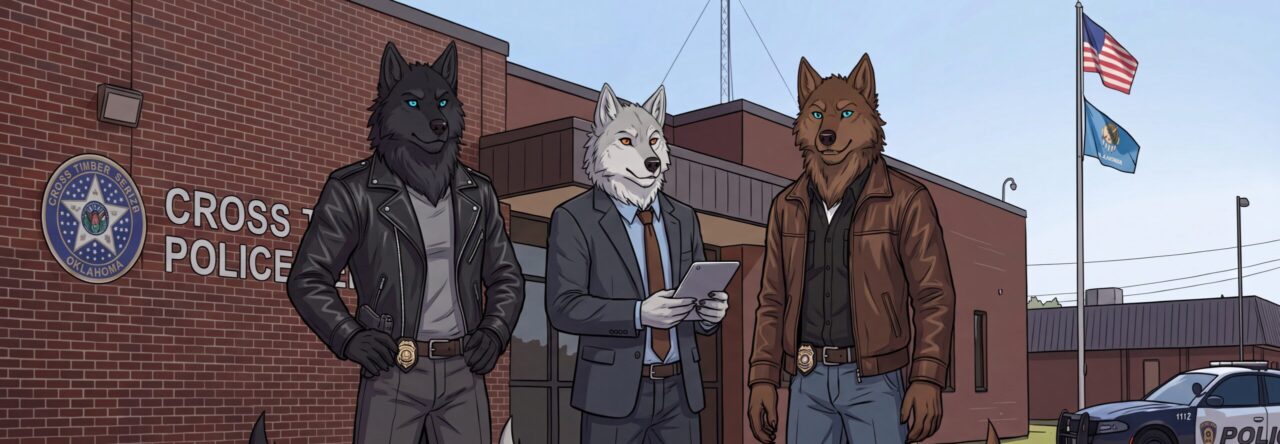
Category: Wolf Detectives

Chapter 39 — Give Me the Night

The rest of the shift did not ask much of them.

That was not the same thing as being quiet.

Night Shift still took a noise complaint that turned out to be two roommates arguing over a broken air conditioner. They reviewed a minor hit-and-run report from patrol, helped Dispatch narrow the location of a stranded motorist whose phone battery was nearly dead, and spent twenty minutes confirming that a warehouse alarm had been caused by a loose loading-bay door in the wind.

Nothing bled.

Nothing ran.

Nothing caught fire.

By four in the morning, Gabriel had declared the night “suspiciously cooperative.”

By four-thirty, Mark had corrected the phrasing.

“A cooperative night is not suspicious.”

“It is if we are working it,” Gabriel said.

Thane looked up from his report.

“Do not say that like the city hates us.”

“The city loves us,” Gabriel said. “The city also keeps handing us people with knives.”

Mark did not look away from his laptop.

“One person with a knife.”

“Tonight.”

“One person tonight.”

“That is still too many.”

Thane went back to typing.

On the whiteboard behind them, two active case cards had changed.

WESTFIELD PHARMACY BURGLARY now carried the black Subaru’s plate number, two suspects’ names, a note for the recovered medication, and an evidence-request line that stretched halfway across the board.

Beside it, INDUSTRIAL CORRIDOR CONVERTER THEFTS had new markings: the three recovered converters, the likely vehicle, the tools, and a pending inventory comparison from the tire shop and landscaping company.

Neither case was finished.

Not legally.

Not yet.

The pharmacy medications still needed to be verified by inventory. The cash had to be counted and sourced. The firearm needed a serial-number return, a trace request, and ballistic review. The false identification card needed to be matched to its owner and connected to the driver.

The converters needed lab confirmation and victim identification.

The suspects needed to be interviewed.

Search warrants might still be necessary.

But the road existed now.

And the road was solid.

At five-thirty, Mark finished the evidence-status sheet for the third time.

Gabriel watched him from across the desk.

“You know it is not going to get more correct because you stare at it.”

Mark did not look up.

“It may become more readable.”

“It is a table.”

“It has six evidence categories.”

“It has color coding.”

“The color coding is useful.”

Gabriel looked at Thane.

“Is it?”

Thane read the page over Mark’s shoulder.

“Yes.”

Gabriel leaned back in his chair.

“You are both terrible.”

Mark clicked the final file into the shared case folder.

“Westfield summary is complete. Converter-theft summary is complete. Dana Keeler’s welfare-pass notation is complete. Evidence status is current as of zero-five-thirty-eight.”

Thane glanced at the clock.

“Day shift gets here in less than an hour.”

Gabriel stood and stretched until his back gave a soft series of pops.

“Good. I am ready to hand somebody else the paperwork.”

“You are still doing your supplemental narrative,” Mark said.

Gabriel froze halfway through the stretch.

“I thought I was done.”

“You have not completed your statement regarding the knife.”

Gabriel looked at his palm.

The wound had closed completely now. Only a faint dark line remained beneath the fur where the blade had entered.

“I caught the knife.”

“You did.”

“Then Officer Darnell cuffed the driver.”

“Yes.”

Gabriel sat down again.

“That is the whole narrative.”

Mark pushed a blank report form toward him.

“Write it down.”

Gabriel stared at the form.

“You have become the enemy.”

“I have always been the enemy.”

Thane’s mouth shifted.

“That is not a healthy self-description.”

Mark looked at him.

“It is accurate in this context.”

Outside, the first hint of daylight began to soften the eastern windows.

Cross Timber looked different before sunrise.

The streets quieted. The last overnight traffic thinned. Porch lights clicked off one at a time. Bakeries and coffee shops began warming their ovens. Delivery trucks moved through the industrial district while most of the city still slept.

At six-twenty, Voss came through the Investigations Bureau door with coffee in one hand and a legal pad tucked beneath her arm.

Rusk followed her, carrying two coffees, a breakfast sandwich, and the expression of a man who had not yet decided whether the day was worth participating in.

He stopped in the doorway.

Looked at the whiteboard.

Looked at the evidence-status sheet on Mark’s desk.

Looked at the stack of reports.

Then looked at the three wolves.

“What did you do?” he asked.

Gabriel leaned back in his chair.

“We had a productive night.”

Rusk stared at the board.

“You were supposed to be doing a quiet patrol-support shift.”

“We did patrol support,” Gabriel said. “Very successfully.”

Voss set her coffee down near the conference table.

“Morning handoff.”

The room changed.

Gabriel straightened.

Mark opened his notebook.

Thane stood and carried the main case file to the table.

It was not a performance.

That mattered.

No one had to impress anyone.

The work spoke for itself.

Voss took the chair at the end of the table. Rusk dropped into the one beside her, took a bite of his sandwich, and held out a hand.

“Give me the night.”

Mark began.

“First item: Dana Keeler protective-order watch.”

He slid a printed map across the table.

“Night Shift conducted public-roadway welfare passes at Dana’s residence and her aunt’s residence between nineteen-fifteen and nineteen-thirty. No observed contact. No suspicious vehicles. No fresh indicators of the respondent near either location. Patrol completed two additional checks after midnight. Same result.”

Voss nodded.

“Dana?”

“No direct contact from us,” Mark said. “No reason to disturb her. Her family was present. Patrol has the active location and knows the history.”

“Good,” Voss said. “It stays active. Day shift can make a non-emergency follow-up later.”

Rusk pointed with his sandwich.

“Anything from the masked numbers?”

“Nothing overnight,” Mark said.

“Fine. Next.”

Mark turned the page.

“Catalytic-converter theft corridor. We conducted a baseline sweep across the theft locations and probable access routes. We identified likely staging areas, blind camera zones, rear service lanes, lighting gaps, and normal overnight noise patterns.”

Rusk looked at Thane.

“You drove three miles of industrial road to learn what a loose HVAC panel sounds like?”

Gabriel raised one finger.

“It is a very specific loose HVAC panel.”

Mark ignored him.

“The sweep established the probable offender approach routes. That became relevant later.”

Voss’s eyes moved to the black Subaru photos clipped behind the pharmacy paperwork.

“Later,” she said.

Thane took over.

“After the corridor sweep, we moved toward Westfield Pharmacy. Mark observed a black Subaru with a partial plate consistent with the burglary bulletin. Two occupants. Vehicle was circling closed commercial lots near the pharmacy, then moved north through the area.”

Rusk stopped chewing.

“Did you initiate?”

“No,” Thane said. “We followed at distance and notified patrol on tactical. Unit Two-Fourteen initiated the stop.”

“Good.”

“During the stop, the driver provided identification that did not match his appearance. Officer Darnell asked him to step out. Passenger exited against commands.”

Voss looked at Thane.

“And?”

Thane’s expression stayed matter-of-fact.

“I observed a concealed handgun at the passenger’s waistband. I removed the firearm and secured the passenger before he could access it.”

Rusk looked at the arrest report.

“Then the driver produced a knife.”

“Correct,” Gabriel said.

Voss turned toward him.

“Your hand.”

Gabriel held it up.

“It is fine.”

“I know it is fine now.”

“He lunged at Officer Darnell,” Gabriel said. “I caught the blade before it got to him. Darnell took the driver into custody.”

Rusk stared at Gabriel for a second.

Then took another bite of his sandwich.

“You are all a paperwork nightmare.”

Gabriel smiled.

“Thank you.”

“That was not praise.”

“It had praise-adjacent energy.”

Mark continued before the exchange could grow.

“Two suspects were separated and transported. Patrol sergeant supervised the vehicle search after we established the visible medication, the false identification, the firearm, and the burglary-vehicle match.”

He laid out the evidence photos in a clean row.

“Twenty suspected controlled-medication bottles. Nine hundred sixty-eight dollars in cash. One compact floor jack. One battery-powered cutting tool. Spare blades. Gloves. Three recovered catalytic converters.”

Voss picked up the photo of the cargo well.

“Three.”

“Three,” Mark said. “One has a visible asset mark consistent with the tire shop’s fleet coding. I notified the property-crimes detective. Confirmation is pending, but the vehicle was operating in the active theft corridor and the tools are consistent with the method.”

Rusk looked from the evidence photos to the board.

“So you found the pharmacy burglary suspects while they were carrying probable evidence from the converter series.”

Gabriel leaned back.

“When you say it like that, it sounds like we planned it.”

“You did not?” Rusk asked.

“No,” Gabriel said. “We mostly drove around and offended the laws of probability.”

Mark looked at him.

“We performed a targeted patrol sweep of active areas, identified a vehicle matching an active bulletin, maintained observation, and coordinated with patrol for a lawful stop.”

Gabriel considered that.

“Your version is less fun.”

“It is more accurate.”

Thane looked at Voss.

“The cases did not fall into our laps. We knew the areas first. The Subaru was out of place because we had just spent hours learning what belonged there.”

Voss watched him for a moment.

Then nodded.

“Good answer.”

The words were quiet.

They landed anyway.

Rusk picked up the photo of the three converters again.

“Day shift will take the follow-up interviews once the suspects have counsel or waive. We will get property crimes on the converter identifications and pharmacy inventory confirmation. Mark, send the baseline map and your access-route notes to Detective Hsu. He will want them.”

“Already uploaded,” Mark said.

Rusk stared at him.

“Of course they are.”

Mark’s ears shifted.

“I anticipated the request.”

Gabriel looked at Thane.

“He is going to be unbearable about this.”

Mark glanced at him.

“I have not said anything.”

“That is how I know.”

Voss flipped through the report packet.

“Officer Darnell’s body camera?”

“Requested and cross-referenced,” Mark said. “Gabriel’s supplemental statement includes the knife intervention. Thane’s firearm-recovery statement is complete. Patrol sergeant has the chain-of-custody documentation.”

“Good.”

Voss set the packet down.

The room went quiet for a second.

Then she looked at the three of them.

“You had a quiet protective-order check, a theft-corridor sweep, and a potential pharmacy-burglary vehicle. You did not rush the stop. You brought patrol in. You identified the firearm before it became a problem. You preserved the scene. You documented the evidence.”

Gabriel tilted his head.

“Are we being complimented?”

Rusk gave him a tired look.

“Do not ruin it.”

Voss’s mouth twitched.

“You had a good night.”

Thane nodded once.

“So did the city.”

Rusk pointed at him with the last corner of his breakfast sandwich.

“That is a much better answer than ‘we got lucky.’”

Gabriel looked offended.

“But we did get lucky.”

“No,” Voss said. “You were prepared when an opportunity appeared. That is not luck.”

Mark looked at the board.

“It is also partly luck.”

Voss looked at him.

Mark considered his wording.

“Preparation created the conditions for recognition. The Subaru’s presence was not random, but encountering it during our patrol interval was not entirely controllable.”

Rusk held up both hands.

“Fine. You were professionally lucky.”

Gabriel brightened.

“I will take that.”

Voss stood.

“Property crimes and the pharmacy case detective have the day. You three go home.”

Gabriel looked around the conference table.

“That is it?”

“That is it.”

“You are not assigning us another case?”

“You are off in ten minutes.”

Gabriel sighed dramatically.

“Cruel leadership.”

Voss picked up her coffee.

“Go sleep before you become a liability.”

Mark closed his notebook.

“Already in progress.”

Rusk rose from his chair and gathered the case packet.

As he passed Thane, he stopped.

“You know what the dangerous part is?”

Thane looked at him.

“What?”

“You are going to start thinking this is normal.”

Gabriel answered before Thane could.

“It is normal.”

Rusk looked at him.

“For you three, maybe.”

Thane smiled faintly.

“Hopefully not every night.”

Rusk nodded.

“That is the correct answer.”

They left the conference room together.

Day shift spread into the bureau behind them, gathering files, opening cases, making phone calls, turning the three wolves’ overnight work into subpoenas, inventory requests, witness follow-ups, and charging packets.

Night Shift had handed off the road.

Now someone else would walk the next part of it.

Outside, the sun had fully cleared the horizon.

Cross Timber looked pale and ordinary in the morning light.

The three wolves crossed the parking lot toward the Humvee, slower now than they had moved all night.

Gabriel climbed into the passenger seat and let his head fall back against the rest.

“Breakfast.”

Mark got into the rear.

“Breakfast.”

Thane settled behind the wheel.

“Where?”

Gabriel opened one eye.

“Somewhere with pancakes.”

Thane looked at him.

“Not IHOP.”

“Why not?”

“You had pancakes yesterday.”

“I had pancakes yesterday afternoon. This is morning.”

Mark buckled in.

“That is not a meaningful distinction.”

“It is a deeply meaningful distinction.”

Thane started the Humvee.

“No cinnamon.”

Gabriel turned toward him.

“Cruel.”

“No cinnamon.”

“You are still holding that against me?”

“I will hold it against you until the end of time.”

Mark looked out the window.

“That seems disproportionate.”

Thane pulled out of the lot.

“You ate them too.”

“I ate one.”

“You ate three.”

“I was gathering evidence.”

Gabriel smiled.

“See? We are detectives. Everything is evidence.”

They found a small diner just off the highway, one of those places that had been open long enough for the booths to remember generations of elbows and coffee mugs.

The waitress took one look at the three exhausted wolves in plain clothes, badges still clipped at their belts, and brought coffee before anyone ordered it.

“Long night?” she asked.

Gabriel looked at the mug like it had personally saved his life.

“Unreasonably productive.”

Thane ordered pancakes.

Soft ones.

Mark ordered eggs, toast, and something with enough protein to qualify as a strategy.

Gabriel ordered pancakes too, then looked at Thane.

“Do you think these bend?”

Thane looked at the menu.

“They better.”

When the food came, they ate without talking for the first few minutes.

Not because anything was wrong.

Because exhaustion had finally settled over them.

The kind that came after adrenaline had been replaced by paperwork, then paperwork by daylight.

Gabriel cut into his pancakes.

The fork sank through easily.

He looked at Thane.

“Soft.”

Thane nodded.

“Acceptable.”

Mark drank his coffee.

“High praise.”

Gabriel leaned back in the booth.

“You know, for a night where we allegedly only drove around and looked at things, we did a lot.”

Thane looked out the window at the morning traffic beginning to build.

“Yeah.”

Mark folded his napkin carefully beside his plate.

“Preparation mattered.”

Gabriel looked at him.

“You are going to put that on a mug.”

“No.”

“You should.”

“No.”

Thane smiled.

“Maybe a shirt.”

Mark looked at both of them.

“Absolutely not.”

Gabriel grinned.

“Night Shift: Preparation Matters.”

Thane added, “And pancakes should bend.”

Mark closed his eyes.

“I need sleep.”

“Agreed,” Thane said.

They paid, left a generous tip, and climbed back into the Humvee.

The city was fully awake now.

School buses moved through intersections. Delivery trucks backed into restaurants. People hurried into offices carrying coffee and phones and all the small concerns of daylight.

Thane drove them home through it all.

The cabin waited beyond the city, quiet beneath the trees.

By the time they turned into the gravel drive, Gabriel had fallen asleep in the passenger seat with his head tilted toward the window. Mark was not asleep, exactly, but his eyes had closed somewhere between the highway and the woods.

Thane parked the Humvee.

For a moment, he sat with both hands resting on the wheel.

The weekend had been loud.

Pancakes. Park videos. An officer in trouble. A morning handoff. A black Subaru full of evidence. The strange, almost dizzying realization that they had spent so much time trying to prove they belonged here—and now the work was simply theirs to do.

Gabriel stirred beside him.

“Home?”

“Home,” Thane said.

Mark opened one eye from the back seat.

“Bed.”

“Bed,” Thane agreed.

They went inside together.

The cabin was quiet.

The daylight stayed outside.

And for a few hours, Night Shift belonged only to sleep.

Chapter 38 — Out of Place

By nineteen hundred, Cross Timber had gone fully dark.

The last light had faded behind low western clouds, leaving the city washed in streetlamp glow, brake lights, and the cold blue rectangles of televisions behind living-room windows. The station had changed with the shift. Day-shift conversations were gone. The front lobby was quiet. Dispatch had settled into its overnight rhythm—fewer voices, sharper tones, every call carrying a little more weight because there were fewer units free to answer.

Night Shift had the board.

Thane stood in their office with one hand braced against the wall map while Mark pulled active locations onto the large monitor at his desk.

“Dana Keeler’s house first,” Mark said. “Then her aunt’s address.”

Gabriel leaned back in his chair with one ankle resting across the opposite knee.

“Romantic.”

“It is a protective-order welfare check.”

“I know what it is.”

“Then stop calling it romantic.”

Gabriel turned toward Thane.

“He gets bossy when he has maps.”

“He gets bossy when he has air,” Thane said.

Mark did not look up.

“I heard that.”

“Good.”

The protective order involving Dana Keeler had not produced a fresh call that evening. That was good. It was also the sort of good that could become dangerous if it made people careless.

Dana’s former boyfriend had not come to her door. Had not sent another message. Had not tried to reach her through a friend or a new number.

Not yet.

But the report carried two prior domestic calls. It carried escalating threats. It carried the particular shape of fear that made a person leave her own home because silence no longer felt safe.

Thane looked at the screen.

“Then industrial district?”

“Catalytic-converter corridor,” Mark said. “We know where the thefts happened. We need to know the area before we come back in a hurry.”

Gabriel stood and clipped his badge wallet into place beside his holster.

“An educational drive.”

“A baseline sweep.”

“Same thing, but less boring.”

Mark gave him a look.

“Facts are not boring.”

“Facts are sometimes very boring.”

Thane looked between them.

“Facts are useful.”

Mark’s mouth shifted almost imperceptibly.

Gabriel pointed at Thane.

“See? He is getting better at detective talk.”

“I have always had detective talk.”

“You once described a suspect as having ‘the smell of bad intentions.’”

“He did.”

“That is not the point.”

The three of them headed out.

The Humvee waited beneath the lot lights, too large and too square and too familiar to look anything but at home among the patrol cars. Thane took the driver’s seat. Gabriel settled into the passenger side. Mark climbed into the rear with his laptop bag, field notebook, and compact evidence kit at his feet.

The engine started with its familiar heavy growl.

Thane pulled out of the lot.

For several minutes, the city passed in quiet layers: late dinner traffic, a couple walking a dog under a porch light, a convenience-store window glaring white into the dark, a teenager on a bicycle cutting through a parking lot with earbuds in.

Gabriel watched the city through his window.

“Do you think anyone will ask you to jump a fence tonight?”

Thane kept his eyes on the road.

“No.”

Mark spoke from the back seat.

“Please do not encourage him.”

“I am not encouraging him. I am asking a question.”

“You ask dangerous questions.”

Gabriel looked at Thane.

“Would you jump a fence if someone asked?”

“No.”

Mark made a quiet sound that was not quite a laugh.

Gabriel turned.

“See? Even Mark does not believe you.”

“I would evaluate the fence,” Thane said.

“That is not a no.”

Thane’s ears angled back.

“You two are exhausting.”

“Night Shift is officially underway,” Gabriel said. “We need to establish a tone.”

“That tone is apparently harassment.”

“Affectionate harassment.”

“Still harassment.”

Mark looked out the side window.

“Dana’s street is next right.”

The joking stopped without anyone announcing it.

The neighborhood sat in a quiet pocket of Cross Timber where modest brick homes lined narrow streets beneath older oaks. Porch lights glowed over trimmed lawns. A pickup sat in one driveway. A minivan in another. Television light flickered blue against curtains.

Dana Keeler’s house stood halfway down the block.

The porch light was on.

A lamp burned in the front room.

Nothing moved near the curb.

No unfamiliar vehicle idled at the corner. No shadow waited between houses. No one stood beneath the streetlamp trying too hard not to look like they belonged there.

Thane slowed the Humvee to a crawl.

The scent of the neighborhood moved through the cracked windows in soft layers—wet grass, laundry soap, old leaves, dog fur, gasoline from a mower stored in a nearby shed.

Dana’s scent lingered around the front walk and driveway.

So did the older, steadier scent of the aunt who owned the house.

Nothing fresh suggested the ex had been close.

Nothing sharp.

Nothing wrong.

Thane drove past without stopping.

Gabriel watched the house disappear behind them.

“Quiet,” he said.

“Quiet is good,” Mark said.

“Quiet can be good,” Thane corrected.

Neither argued.

Dana’s family address was four minutes away in a cul-de-sac near a small church and a fenced playground. A different kind of quiet lived there.

More cars in driveways. More porch decorations. A bright kitchen window. A television on behind the front curtains. A child laughing somewhere inside.

Dana’s gray sedan was there this time, parked beside an older SUV.

The house smelled lived-in. Warm food. Laundry. Multiple adults. A child. No fresh unfamiliar scent near the driveway. No male scent lingering close to the porch that did not belong to the household. No vehicle waiting at the end of the street.

Mark logged the pass-by.

“Both locations clear from public roadway. No observed contact. No suspicious vehicles. No immediate action.”

Gabriel glanced over his shoulder.

“Do we call her?”

“Not unless we have a reason,” Thane said. “She knows patrol is aware. A quiet night is not a reason to make her relive it.”

Mark nodded.

“Agreed.”

Thane turned the Humvee toward the industrial district.

The city changed block by block.

Neighborhood streets widened into four-lane roads. Houses became self-storage facilities, tire shops, fleet yards, industrial warehouses, plumbing suppliers, truck-repair bays, and long stretches of chain-link fence.

The catalytic-converter thefts had occurred across a three-mile corridor over the previous week.

A small commercial fleet company.

A landscaping business.

A municipal utility yard.

Two independent mechanics.

The common thread was not the victims.

It was the access.

Vehicles parked outside.

Cameras with blind spots.

Night shifts ending before dawn.

Lanes wide enough for a thief to work unseen for a few minutes, then disappear before anyone realized what was gone.

Thane drove slowly.

Not suspiciously slowly.

Just slowly enough to look.

Mark had the map open beside him now, theft locations and time windows marked in different colors.

“First hit was here,” he said, pointing toward a tire shop with a bright security light over the front drive and darkness pooled along the rear fence. “Two fleet vans. Time window between 01:10 and 02:00.”

Gabriel looked out.

“Rear access?”

“Unpaved service lane behind the building. No fence on the south side.”

Thane took the next turn and drove the service lane.

The Humvee rolled through old gravel and shallow puddles. The lane ran behind the tire shop, then past a storage yard with stacked pallets, a metal supply warehouse, and a closed loading dock.

Thane’s senses filled in what the map could not.

Old oil.

Warm rubber from trucks that had been parked hours ago.

Diesel.

Cooling metal.

The stale scent of exhaust trapped beneath awnings.

A recent welding smell near one shop.

A stray cat somewhere beneath a dumpster.

Nothing that did not belong.

That was the point.

“Normal?” Gabriel asked.

“Mostly,” Thane said.

“Mostly is not normal.”

“No. Mostly means there is nothing I would write down yet.”

Mark added a note.

“South lane has no lighting past the pallet yard. Utility-access gate is secured, but lower hinge is rusted. Good camera coverage on front lot. Poor coverage from rear service lane.”

Gabriel looked at the hinge.

“You think they are using the same route?”

“I think we do not know yet,” Mark said.

Thane drove on.

They covered the entire corridor that way.

Not hunting.

Learning.

The dark places.

The open places.

The businesses with motion lights.

The businesses with cameras pointed too high.

The spots where a vehicle could wait without looking abandoned.

The places where fresh-cut metal, unfamiliar footwear, odd shadows, a running engine, or a light in the wrong window would stand out.

At the landscaping yard, Thane caught the lingering scent of hot metal from legitimate maintenance work earlier that day and committed it to memory.

At the utility lot, Mark counted camera housings and traced their coverage angles from the road.

At a warehouse with three box trucks backed against a loading dock, Gabriel heard a loose HVAC panel tapping in the wind and made a face.

“That noise could hide someone moving.”

Mark looked up.

“Good point.”

Gabriel looked pleased.

“See? I do detective work too.”

“You do,” Thane said.

Gabriel blinked at him.

“Was that praise?”

“Do not make it weird.”

By the time they cleared the industrial district, Thane could picture the roads with his eyes closed.

He knew where standing water collected.

He knew which lights flickered.

He knew where the rear fences narrowed.

He knew which scent belonged to the tire shop’s service lane and which belonged to the loading dock behind the supply warehouse.

Anything new would stand out.

Mark closed the map.

“Baseline complete.”

Gabriel looked at him.

“You make that sound like we just mapped the moon.”

“We mapped three miles of active theft corridor.”

“The moon would have been easier.”

Thane turned toward Westfield Pharmacy.

The burglary had happened two nights earlier.

The store had been closed. A rear door had been forced. The cash drawer had been emptied, and controlled medication had been taken from a secured cabinet.

Rusk’s handoff had included a few solid details.

Black Subaru.

Partial plate.

Possibly two offenders.

A receipt left at the counter.

No confirmed identity.

No confirmed weapons.

Nothing that justified an immediate stop by itself.

But enough to keep eyes open.

They had just passed the third turnoff toward the pharmacy when Mark leaned forward.

“Thane.”

Thane had already seen it.

A black Subaru sat at the curb across from a closed strip center.

Its headlights were off.

Two people were inside.

The car began moving as the Humvee came into view, easing away from the curb and rolling through the empty lot without turning into any storefront.

It passed the pharmacy.

Then doubled back.

Slowly.

Gabriel leaned toward the windshield.

“That feels wrong.”

Mark had his tablet up.

“Plate is partially obscured by dirt.”

Thane adjusted his speed, staying two vehicles behind.

The Subaru turned onto the access road behind the strip center.

It passed a closed pet-grooming business, a dry cleaner, and a small clinic with dark windows.

Then it turned around again.

Mark narrowed his eyes at the rear plate.

“Black Subaru. Partial plate is consistent with the Westfield Pharmacy burglary bulletin. Same three visible characters, same placement. Two occupants. Vehicle is circling commercial lots near the burglary location.”

Gabriel looked at Thane.

“They are looking for another hit.”

“Maybe.”

“Maybe is enough.”

Thane keyed the encrypted tactical channel.

“Night Shift to patrol. Possible match on the Westfield Pharmacy burglary vehicle. Black Subaru, two occupants, partial plate consistent with bulletin. Currently eastbound behind the Westfield strip center, moving slow and circling lots. We are following at distance.”

Dispatch answered immediately.

“Copy, Night Shift. Units are moving.”

Thane continued behind the Subaru.

Not close enough to crowd it.

Not so far that he lost it.

The city lights moved across the black paint in brief blue-white flashes. The Subaru rolled through one more parking lot, then turned onto a wider road leading north.

“Eastbound on Mayfair,” Thane said into the radio. “Passing the old theater lot. No evasive driving. No visible weapons.”

Gabriel watched the car.

“Driver keeps checking mirrors.”

“Passenger?” Thane asked.

“Head down. Maybe looking at a phone.”

Mark leaned forward between the seats.

“Unit Two-Fourteen is coming from the north. They will have visual in thirty seconds.”

Thane kept pace.

The marked patrol unit appeared ahead at the next intersection.

It turned smoothly behind the Subaru.

Its emergency lights came on.

For one second, Thane thought the driver might run.

The engine revved.

Then the Subaru moved to the shoulder.

“Traffic stop,” Mark said.

Thane pulled the Humvee in behind the patrol unit, leaving enough room for the officer’s rear approach and any additional backup.

“Quiet exit,” Thane said. “Stand by the vehicle until we know what we have.”

Gabriel nodded.

The three of them stepped out into the warm night.

The patrol officer—Officer Darnell—approached the Subaru on the driver’s side.

Traffic hissed past in the nearest lane, headlights sweeping across the scene. A second patrol unit had been called, but was still a few minutes out.

Thane stood near the rear quarter of the Humvee with Gabriel and Mark, quiet and still.

They could hear nearly everything.

The driver rolled down his window.

Officer Darnell spoke in the calm, practiced tone of someone beginning an ordinary traffic stop.

“Evening. I need your driver’s license, registration, and proof of insurance.”

The driver handed over a card.

Darnell looked at it.

Then looked at the driver.

Then at the card again.

The photograph did not match.

Not close.

The man in the photo had a narrow face and a shaved head.

The driver had a heavy beard and a jagged scar along one cheek.

Officer Darnell kept his voice even.

“Step out of the vehicle for me.”

The driver opened his door.

“Why?”

“We will talk about it outside.”

The driver stepped out.

The passenger door opened almost immediately.

A second man climbed out.

Large enough to make Officer Darnell adjust his stance.

“Passenger, stay in the vehicle,” Darnell said.

The passenger kept moving.

“I did not do anything.”

“Get back in the vehicle.”

The passenger did not.

He stood beside the Subaru with his hands low.

Too low.

His shirt had ridden up at the back when he stepped out.

Thane saw the grip of a handgun tucked at the small of his back.

Black polymer.

No holster.

No room for mistakes.

Thane moved.

Not fast enough to make noise.

Just fast enough that the passenger never had time to understand the distance closing behind him.

He came around the rear of the Subaru and reached in one motion.

One hand controlled the passenger’s shoulder.

The other stripped the handgun cleanly from the waistband before the man could turn.

Thane shoved him chest-first against the Subaru.

The metal door boomed under the impact.

The passenger gasped.

Thane held him there with his weight and one broad hand between the shoulder blades.

“Do not move,” he said.

The passenger froze.

Thane secured the handgun in his back pocket, out of the man’s reach.

“Gun on passenger,” he announced. “Passenger secure.”

Officer Darnell’s head snapped toward them.

The driver saw his chance.

His hand came out of his pocket with a folding knife already open.

He lunged toward Darnell.

Gabriel moved before the officer could.

The blade drove into the thick web of Gabriel’s palm as he closed his hand over it.

Blood surfaced bright against black fur.

Gabriel did not even blink.

The driver’s eyes went wide.

Gabriel looked at him with a small, almost amused smile.

“No.”

He locked his other hand around the knife handle, twisted the blade free from the driver’s grip, and stepped backward with it.

Officer Darnell recovered instantly.

“Hands behind your back!”

The driver hesitated.

Then saw Gabriel’s bleeding hand, Thane pinning his armed passenger against the Subaru, and Mark standing steady behind them with camera running and radio in hand.

His hands went up.

Darnell cuffed him.

Gabriel handed the knife over hilt-first.

“Careful,” he said. “It is sharp.”

Darnell looked at Gabriel’s palm.

“You okay?”

Gabriel glanced down.

The wound was already closing.

“Occupational hazard.”

Mark had not moved from his position near the Humvee.

He had documented the entire sequence from a safe angle, then keyed his radio.

“Second unit, expedite. Firearm recovered from passenger. Driver secured. One knife recovered. Officer is okay. Two suspects detained.”

Thane brought the passenger around from the Subaru, keeping him controlled but upright.

The man had gone pale.

Not from pain.

From fear.

Thane had not hurt him beyond what was necessary to stop him.

But the passenger had seen enough.

He did not fight.

“Hands behind your back,” Thane said.

The man obeyed.

Thane cuffed him, checked the restraints, then held him beside the rear bumper while they waited for backup.

Gabriel pressed his palm against his shirt. The blood had already slowed.

Officer Darnell looked from the hand to Gabriel’s face.

“That knife went through your hand.”

Gabriel looked at him.

“It was rude.”

Darnell blinked.

Then looked at Thane.

“You all always show up like this?”

Thane glanced at the Subaru.

“Not usually.”

Mark looked up from his notes.

“Statistically, we are having an unusual weekend.”

Gabriel turned toward him.

“That is the closest thing to a joke you have made all night.”

“I am adapting.”

The second patrol unit arrived with a third close behind it.

The scene expanded quickly.

Extra lights.

More uniforms.

The roadway secured.

The suspects separated.

The driver placed in one unit.

The passenger placed in another.

Thane handed the recovered handgun to a patrol sergeant, giving the location and condition exactly as he had found it.

“Passenger’s waistband, small of back. I removed it after visual confirmation. No discharge. Secured in my back pocket until transfer.”

The sergeant nodded.

“Good.”

Mark provided the camera and location notes.

“Black Subaru. Partial plate consistent with the Westfield burglary bulletin. Officer Darnell initiated the stop after the vehicle was observed circling commercial lots near the pharmacy. Driver presented identification not matching his appearance. Passenger exited against commands. Detective Thane observed a concealed firearm. Driver then produced a knife during detention.”

The sergeant looked at the Subaru.

“That vehicle is going nowhere tonight.”

“No,” Thane said. “It is not.”

The burglary link had become much stronger.

A black Subaru matching the partial plate.

Two men circling the area around the pharmacy.

A false ID.

A concealed gun.

A knife.

Then Mark looked through the rear passenger window.

His ears lifted.

“Thane.”

Thane moved beside him.

A pharmacy stock bottle was visible beneath the front passenger seat.

White plastic.

Orange label.

Westfield Pharmacy inventory sticker.

Another sat in the center console.

A third was shoved into the driver-side door pocket.

None of them were hidden well.

Not really.

The patrol sergeant followed their gaze.

“Probable cause is getting prettier by the second.”

“Photograph everything in place,” Thane said. “Then we process under vehicle-search authority.”

The sergeant nodded and started issuing assignments.

Once the scene was stable and the vehicle search was approved, Night Shift went to work.

Mark documented first.

Always first.

Wide photographs of the Subaru.

The plate.

The exterior.

The windows.

The visible medication bottles.

The positions of the seats.

The scattered wrappers and receipts.

The false identification card lying on the driver-side floor mat.

Gabriel stood beside him, gloves on now, his palm nearly healed.

“Twenty bucks says there is something dumb in the glove box,” he said.

Mark did not look up from the camera.

“Do not gamble at a crime scene.”

“Not gambling. Estimating.”

“Still no.”

Thane opened the rear hatch after Mark finished documenting it.

The Subaru smelled like old fast food, sweat, gun oil, stale cigarette smoke, and the sharp chemical bite of recently handled medication.

Then he caught something else beneath it.

Fresh-cut metal.

Hot exhaust residue.

Oil and road grit worked into the rear cargo carpet.

He looked toward Mark.

“Cargo area.”

Mark moved around with the camera first, documenting the rear hatch, the spare-tire compartment, and the nylon grocery bags before touching anything.

Beneath an old blanket in the cargo well, they found a compact floor jack, a battery-powered cutting tool, spare blades, heavy gloves, and three freshly removed catalytic converters wrapped in contractor bags.

Gabriel stared into the back of the Subaru.

“Well,” he said. “That answers one question.”

Mark photographed the recovered parts from every angle, then leaned close without touching.

One of the converter housings carried a faint etched inventory code.

His eyes narrowed.

“This may be one of the fleet vans from the tire shop.”

“May?” Gabriel asked.

“It needs confirmation. But the code format matches their equipment records.”

Thane looked into the cargo area.

“So these were not only pharmacy burglars.”

Mark glanced from the converters to the medication bottles waiting to be cataloged.

“Likely pharmacy burglars and catalytic-converter thieves.”

Gabriel leaned against the rear bumper.

“They really committed to being bad at crime in several categories.”

“Do not put that in the report,” Mark said.

“I was not going to.”

“You were absolutely going to.”

The first bottle came from the center console.

Then three more from the driver-side door pocket.

Two from a compartment beneath the rear passenger floor mat.

Four more inside a nylon grocery bag shoved beneath the spare-tire cover.

Cash appeared in the center-console compartment, folded in rubber-banded stacks.

More cash in the glove box.

When Mark finished counting, he looked up.

“Nine hundred and sixty-eight dollars in cash.”

Gabriel peered into the cargo area.

“And twenty suspected controlled-medication bottles.”

“Twenty bottles requiring pharmacy verification,” Mark corrected. “Several are marked as Westfield stock. Some may be patient-dispensing bottles.”

Thane looked at the evidence bags forming beside the vehicle.

“Make sure both suspects are advised of their charges. Separate transports. No custodial questioning about the burglary or the thefts until they have been Mirandized.”

The sergeant nodded.

“Understood.”

Officer Darnell stood near the front of his patrol unit, watching evidence bags begin to stack.

“You three were supposed to be doing a burglary follow-up?”

“We were,” Gabriel said.

Darnell looked at the cash, the medication, the gun case, the knife bag, and the contractor bags holding catalytic converters.

“Seems like you found both cases.”

Thane looked at the Subaru.

“We found what did not belong.”

Mark glanced at him.

Then wrote the phrase into his notes.

Gabriel noticed.

“Oh, that is going in the report?”

“No,” Mark said.

“It should.”

“No.”

“It is a good line.”

“It is not evidence.”

“That has never stopped Thane from saying something dramatic.”

Thane looked at Gabriel.

“I am holding a crime scene together.”

“You are standing near a car.”

“Same thing.”

Gabriel smiled.

The suspects were transported one at a time.

The evidence was tagged.

The Subaru was sealed and prepared for tow.

The pharmacy burglary detective on the case was notified, then given the clean version: vehicle match, observed behavior, false identification, firearm, knife, suspected stolen medication, cash, and all scene documentation preserved.

The property-crimes detective handling the converter theft series got the second call.

Three recovered converters.

Cutting equipment.

Floor jack.

A vehicle operating inside the theft corridor.

A likely fleet inventory mark.

By the time the final patrol unit cleared, the roadway had gone quiet again.

The traffic stop had become a tow truck, a few lingering tire marks, and the smell of warm asphalt beneath streetlights.

Thane stood beside the Humvee with Gabriel and Mark.

Gabriel flexed his healed hand.

“How many incidents was that tonight?”

Mark checked his notes.

“Dana Keeler’s protective-order welfare passes. Catalytic-theft corridor baseline. Pharmacy burglary vehicle. Armed stop. Two felony arrests. Suspected controlled-medication recovery. Possible clearance of three converter thefts.”

Gabriel looked at Thane.

“We have been on shift for, what, three hours?”

“About that.”

Gabriel leaned against the passenger door.

“I would like less convenient criminals.”

Mark looked at him.

“You just complained that they were not smarter.”

“I did not say I wanted them smarter. I said I wanted them less conveniently stupid.”

Thane opened the driver’s door.

“I want them to stop robbing pharmacies.”

“That too,” Gabriel said.

Mark climbed into the back seat.

“Dana’s locations remain quiet.”

Thane paused.

“How do you know?”

“Patrol units did two additional checks while we were on the Subaru. No contact. No suspicious vehicle. No violation.”

Thane nodded.

“Good.”

Gabriel settled into the passenger seat.

“See? A productive evening.”

Thane started the engine.

“A weird evening.”

“Normal for us.”

“That is not comforting.”

“It is not supposed to be comforting.”

The Humvee rolled back toward the station.

By the time they reached their office, the evidence notifications had already begun arriving.

The property log.

The vehicle tow confirmation.

The medication count pending pharmacy verification.

The firearm serial check.

The arrest reports.

The burglary detective’s request for supplemental narratives.

The converter-theft detective’s request for images of the etched inventory mark.

Mark claimed the main desk immediately.

Gabriel took the chair beside him and began dictating the sequence of the stop in clipped, clean language while Thane worked through the initial investigative narrative.

No one wrote anything they could not defend.

No one made the story sound cleaner than it had been.

The driver had lunged with a knife.

Gabriel had intervened.

Thane had recovered a concealed firearm from the passenger.

The evidence had been secured.

The suspects had been transported.

The vehicle had been searched lawfully and documented completely.

At 01:43, Gabriel leaned back in his chair and rubbed at his eyes.

“That was too easy.”

Mark did not look up.

“It was not easy.”

“It was easier than it could have been.”

“That is different.”

Thane finished typing a sentence and glanced at both of them.

“I hope the next one is smarter.”

Gabriel looked at him.

“Do not say that out loud.”

“I mean it.”

“No. You do not. You want criminals who are less careless, not smarter.”

Thane considered that.

“Fine. Less careless.”

Mark looked up from the evidence log.

“That is still not a good wish.”

Gabriel grinned.

“You know what he means.”

Thane leaned back in his chair.

“I mean I want a case that makes us work.”

Mark’s expression shifted.

Not disagreement.

Understanding.

“You will get one,” he said.

Outside the windows, Cross Timber held its night.

Patrol cars moved through dark streets.

Porch lights burned.

People slept behind locked doors.

Somewhere, someone made a bad decision.

Somewhere else, someone needed help.

Night Shift had learned the city’s shadows.

Now it had started learning what stood out inside them.

And the shift was not over yet.

Chapter 37 — Back on the Clock

At 17:50, the Humvee rolled into the Cross Timber Police Department lot with the heavy, familiar growl of something that had no business fitting between ordinary parking lines.

Thane eased it into the far end of the employee row, where it took up most of two spaces and a piece of a third.

Gabriel looked out the passenger window.

“You parked almost responsibly.”

“I parked responsibly.”

“You occupied multiple spaces.”

“It is a large vehicle.”

Mark leaned forward from the back seat, looking through the windshield.

“Technically, it occupies portions of three.”

Thane shut off the engine.

“It fits.”

“It does not fit,” Mark said.

“It fits enough.”

Gabriel smiled.

“Back on duty for six seconds and we are already litigating the Humvee.”

Thane opened his door.

“Oh, so you’re riding in back tonight?”

Gabriel’s grin faded.

“Cruel.”

Mark stepped down from the rear seat, adjusting the strap of his duty bag over one shoulder.

“I call window.”

Gabriel looked at him.

“That is worse.”

Thane’s mouth shifted.

“Thought so.”

They crossed the lot together, badges visible, sidearms secure at their belts, the late-day sunlight catching on the glass doors ahead of them.

The station was louder than usual.

Not busy exactly.

But there was a current moving through it.

People looked up as the three wolves entered.

A dispatcher near the front desk stopped mid-sentence and smiled.

A patrol officer coming out of briefing raised both hands in a mock surrender.

“Here come the celebrities.”

Gabriel bowed slightly as he walked.

“Please. We prefer ‘beloved public servants.’”

Mark did not break stride.

“We prefer ‘detectives.’”

Thane looked at the patrol officer.

“What happened?”

The officer laughed.

“You happened.”

He held up his phone.

On the screen, Thane stood frozen in a perfect midair frame over the soccer fence from the day before. The video had paused at the exact moment his arms spread for balance, tail extended, claws out.

Someone had added dramatic music.

Across the top, in bright yellow letters, read:

CROSS TIMBER’S WOLF DETECTIVE HAS NO CHILL

Gabriel leaned over to inspect it.

“That is an excellent angle.”

Mark looked at the phone, then at Thane.

“You did not need to clear the entire fence.”

“It was a safe landing.”

The patrol officer laughed harder.

“That is what the comments say. ‘Safe landing. Ten out of ten. Would let him vault my fence.’”

Thane’s ears angled back.

“I did not ask anyone to post that.”

“No,” Gabriel said. “You just gave them material.”

A records clerk leaned out from behind her cubicle wall.

“My cousin’s kid was there. She has watched the video seventeen times.”

“Seventeen?” Gabriel asked.

“Since lunch.”

Mark muttered, “That explains the view count.”

The clerk pointed at another open video on her monitor. This one showed Gabriel crouched beside the storm-drain grate at the park, listening with theatrical concentration before locating the lost quarter.

The caption read:

WOLF DETECTIVE SOLVES THE CASE OF THE MISSING TWENTY-FIVE CENTS

Gabriel nodded gravely.

“It was a difficult investigation.”

Thane looked at him.

“It rolled into a drain.”

“There were environmental factors.”

Mark passed them.

“The suspect was gravity.”

Gabriel pointed after him.

“See? That is why he is the paperwork wolf. No imagination.”

From farther down the bullpen, a burst of laughter rose.

Someone’s phone played the sound of children cheering.

Then the sharp, wily snarl from the fence video.

Thane stopped.

Gabriel stopped beside him.

Mark, already three steps ahead, closed his eyes.

The phone’s owner—a young evidence technician named Lacey—looked up from her desk and immediately tried to hide the screen.

Too late.

Gabriel walked over.

“Play it again.”

Lacey looked horrified.

“Detective—”

“Please. We are professionals. We need to review the footage for safety concerns.”

Mark turned around.

“No, we do not.”

Thane looked at the phone.

Lacey cautiously hit replay.

The video showed him taking three steps, launching over the fence, and landing in the deep crouch on the far side. The children shrieked. The camera shook with laughter.

Then came Gabriel’s voice, unmistakable from behind the person filming.

“That was entirely unnecessary.”

The bullpen laughed again.

Thane looked at Gabriel.

“They liked it.”

“They did,” Gabriel said. “That has never been the issue.”

Lacey lowered the phone.

“My neighbor was there. She said all the kids spent the rest of the afternoon pretending to be wolves.”

Thane’s expression softened despite himself.

“Did anyone get hurt?”

“No,” Lacey said quickly. “They were just running around and growling at each other.”

Mark nodded once.

“Acceptable.”

Gabriel looked at him.

“You have standards for children pretending to be wolves?”

“Yes.”

“What are they?”

“No climbing anything taller than an adult. No chasing people who do not want to be chased. No jumping near parking lots.”

Gabriel looked at Thane.

“You hear that? You are now subject to Mark’s playground policy.”

Thane moved on before either of them could make the joke worse.

The smiles followed them all the way toward Investigations.

So did the videos.

At one desk, an analyst had the park clip paused beside a spreadsheet. At another, a patrol sergeant was watching the public video from Edmond—a shaky cellphone clip from a passing motorist that began after Thane had already pulled the suspect away from Officer Perez.

It did not show the punches.

It showed the aftermath.

A large man sitting rigidly at the curb.

Thane standing behind him with both hands locked on the man’s shoulders.

Gabriel and Mark kneeling beside the injured Edmond officer.

The video had no audio for the first few seconds.

Then the person filming whispered, “Oh my God, that’s those wolf detectives.”

A different patrol officer looked up from the screen.

“Edmond Watch Commander sent our captain a courtesy memo around noon. Said your statements were clean, your scene handoff was clean, and you saved one of their officers from a bad beating.”

Mark nodded.

“Officer Perez had minor injuries. He was transported for evaluation.”

“Yeah,” the officer said. “I heard.”

Gabriel’s expression lost some of its brightness.

“Good. He deserved a quiet day after that.”

The patrol officer looked at Thane.

“Your timing was good.”

Thane shrugged once.

“We were there.”

“You were there and you did something.”

Thane did not have an answer to that.

Gabriel did.

“He is bad at accepting compliments. You may need to write it down and submit it in triplicate.”

The patrol officer laughed.

Thane gave Gabriel a look.

Gabriel smiled sweetly.

“Off duty behavior is not covered by the same professional standards.”

“It absolutely is,” Mark said.

“Then I am in trouble.”

“You are always in trouble.”

“That is what makes life interesting.”

They reached the Investigations Bureau door.

Inside, the day shift was still present.

Detective Voss stood near the central case board with a coffee in one hand and a file in the other. Detective Rusk sat behind a borrowed desk, reading something on his tablet with the exhausted expression of a man who had already spent nine hours regretting everyone else’s choices.

Deputy Chief Mercer stood near the conference table.

He had both hands in the pockets of his suit pants.

His expression was one of profound, carefully rehearsed disappointment.

Thane stopped.

Gabriel leaned toward Mark.

“Oh, good. We have been summoned before the council.”

Mark looked at Mercer.

“Technically, he is one person.”

Gabriel lowered his voice.

“Then it is a very judgmental council.”

Mercer looked up.

“I can hear you.”

“Of course you can,” Gabriel said. “You are a Deputy Chief.”

Rusk glanced over his tablet.

“Congratulations. You found the secret to management.”

Voss’s mouth shifted.

Barely.

Mercer looked at the three wolves.

“Detectives.”

“Deputy Chief,” Thane said.

Mercer took a slow breath.

“Before you say anything, I want it clearly understood that I am aware of the following facts.”

Gabriel settled one hip against the conference table.

“This sounds promising.”

“I am aware that you were off duty.”

“Yes, sir,” Mark said.

“I am aware that you were traveling through another agency’s jurisdiction.”

“Yes, sir.”

“I am aware that you encountered an Edmond officer under immediate physical assault.”

Thane nodded.

“Yes, sir.”

“I am aware that you stopped, rendered aid, notified the proper agency, did not search the suspect’s vehicle, did not interfere with the jurisdiction’s investigation, remained long enough to provide statements, and left only after Edmond officers assumed control.”

Gabriel looked thoughtful.

“When you say it that way, we sound almost responsible.”

Mercer gave him a look.

“I hate that you are this popular.”

Gabriel’s ears lifted.

“Thank you?”

“I hate that you apparently cannot go to breakfast without becoming a department outreach campaign.”

“That is not our fault,” Thane said.

Mercer pointed at him.

“You jumped a fence in a public park.”

“It was a safe fence.”

“It was a soccer fence.”

“It was clear.”

“It was unnecessary.”

The room fell quiet for half a second.

Gabriel opened his mouth.

Thane spoke first.

“They asked.”

Mercer stared at him.

Rusk made a sound that might have been a laugh disguised as a cough.

Voss lowered her coffee.

Mercer shut his eyes briefly.

“Of course they asked.”

Gabriel leaned forward, smooth as ever.

“For the record, Deputy Chief, we did not post anything. We did not ask anyone to post anything. We were off duty, being kind to people, and apparently the city enjoys watching Thane behave like an overgrown comic-book mascot.”

Thane looked at him.

“Gabriel.”

“What? It is affectionate.”

Mercer held up one hand.

“I am not disciplining you for being kind to the public. I am not disciplining you for lawfully intervening when an officer was in danger.”

His tone sharpened just enough to quiet the room.

“But I am reminding you that popularity is not policy. Viral videos do not change jurisdiction. They do not change use-of-force standards. They do not change the duty to preserve scenes, protect evidence, or hand cases to the agency responsible for them.”

Mark nodded immediately.

“Understood.”

Thane did too.

“Yes, sir.”

Gabriel placed one hand over his chest.

“We will endeavor to remain wildly competent and only accidentally adorable.”

Mercer looked at him.

“Do not say that in any official setting.”

“I will put it in the unofficial notes.”

“Do not create unofficial notes.”

Gabriel smiled.

“Then it will live in my heart.”

Mercer threw both hands up.

“See? This. This is why I hate that you keep ending up on top.”

Voss turned away and took a drink of coffee to hide her smile.

Rusk did not bother.

He laughed quietly into his tablet.

Mercer looked toward them.

“You two are no help.”

Rusk shrugged.

“They are not wrong.”

“They are a policy memo wearing fur.”

Voss said, “A very visible policy memo.”

Mercer gave the three wolves one last long look.

Then his expression eased.

Not much.

But enough.

“Edmond PD sent thanks. I forwarded the memo to your personnel files. Do not make me regret being able to do that.”

Thane nodded.

“We will not.”

Gabriel added, “We will try our best not to.”

Mercer pointed at him again.

“That phrase has never reassured anyone.”

“It reassures me.”

“I am going upstairs.”

As he walked away, Gabriel watched him go.

“He loves us.”

Mark looked at him.

“That is not what that was.”

“He loves us in a complicated, policy-driven way.”

Thane picked up the nearest case file from the table.

“Can we do our job now?”

Rusk leaned back in his chair.

“Please. Before another child asks you to vault city hall.”

Gabriel looked at Thane.

“Would you?”

“No.”

Mark glanced at him.

“Immediately?”

Thane thought for one second too long.

Gabriel grinned.

“Oh, he would.”

Voss set her coffee down and tapped the case board.

“Night Shift handoff.”

The room changed.

Not dramatically.

Just enough.

The jokes remained in the air, but the work stepped forward.

Mark moved to the board with his notebook. Gabriel took the chair closest to Voss. Thane stood near the end of the conference table, arms folded.

Voss pointed to the first card.

“Marin Cole remains in county custody. Priya has the preliminary charging packet. The digital extraction from Alicia Monroe’s phone is in progress. Nothing tonight requires your involvement unless Marin’s attorney makes an unexpected move or the company produces additional evidence.”

“Understood,” Mark said.

Rusk picked up the next folder.

“Westfield Pharmacy burglary. Black Subaru, possibly two suspects. No confirmed identity yet. Patrol has the vehicle description and plate fragment. Do not chase it if it pops up. Call it, contain it, let patrol units set the stop.”

Gabriel nodded.

“Any sign they are armed?”

“Not yet.”

“Any sign they are smart?”

Rusk looked at the report.

“They left a receipt at the counter.”

Gabriel sat back.

“So, no.”

“Correct.”

Voss moved to another card.

“Three catalytic-converter thefts around the industrial district over the last week. Same probable vehicle, same tool marks. Day shift has canvass requests out. If you get an alarm, suspicious vehicle, or patrol call tied to those businesses, treat it as active.”

Mark made a note.

“Likely two offenders?”

“Probably,” Voss said. “Do not assume.”

Thane nodded.

“Got it.”

Rusk slid one final file across the table.

“Protection-order violation. Woman named Dana Keeler. Ex-boyfriend has been sending messages from masked numbers, no direct contact yet. She is staying with family tonight. Patrol knows the address. She knows to call. Nothing says this turns into your case, but I do not want it lost in shift change.”

Gabriel read the first page.

“Any history of violence?”

“Two prior domestic calls. No felony record. That does not mean much.”

“It means enough to stay awake,” Gabriel said.

Voss looked at the three of them.

“That is the night. Routine calls, active patrol support, the open cases you just received. You have the board.”

Thane looked around the office.

The day-shift files.

The empty chairs Voss and Rusk would leave behind.

Their own desks beyond the glass.

Their own phones.

Their own radio traffic.

It felt different this time.

Not because they had been told they were detectives.

Because the room was actually becoming theirs.

Rusk stood and gathered his tablet, jacket, and empty coffee cup.

“If nothing catches fire, bleeds, disappears, or runs from patrol, try to keep it that way.”

Gabriel looked at him.

“That is an aggressively low bar.”

“It is a bar.”

Voss picked up her coffee and case files.

At the door, she paused.

“Morning handoff at zero-six-thirty. Mark, timeline and evidence status. Gabriel, witness and interview issues. Thane, scene actions, active leads, and anything that still does not fit.”

Mark nodded.

“Understood.”

Gabriel gave a lazy salute.

“Bright and early. Or at least technically morning.”

Thane said, “We will have it ready.”

Rusk opened the door.

“Good. Because I like sleep.”

Voss followed him toward the hall.

Then stopped beside Thane.

“Walk with me a second.”

He did.

They moved a few steps away from the others, near the narrow window that looked over the employee lot. The last of the daylight was fading now. The lot lights had clicked on, pale pools against the pavement.

Voss looked at him.

Not stern.

Not loud enough to embarrass him.

Just honest.

“I took a chance on you three,” she said quietly.

Thane’s ears lifted.

Voss glanced toward Gabriel and Mark.

“I’m glad I did.”

For a moment, Thane did not know what to say.

Then he nodded.

“Thank you.”

Voss gave him the smallest hint of a smile.

“Do good work tonight, Detective.”

She turned and left.

Thane stood by the window for another second.

Across the office, Gabriel had heard every word.

Of course he had.

He was leaning against his desk with a quiet smile on his face.

Mark stood beside the case board, one paw resting on the open notebook in front of him.

His expression was calmer.

But proud.

Thane walked back toward them.

Gabriel raised his eyebrows.

“Glad she took a chance on us?”

Thane looked at him.

“Do not make it weird.”

“I would never.”

Mark looked at Gabriel.

“You absolutely would.”

Gabriel smiled.

“Probably.”

The radios woke across the station.

Phones rang.

A patrol unit called out a traffic stop.

Somewhere in Dispatch, a chair rolled back and someone laughed at a video for the last time before getting back to work.

The city outside darkened.

Cross Timber’s day shift went home.

Night Shift took the board.

And the night began.

Chapter 34 — The Missing Hour

By twelve-oh-six, the rain had turned Cross Timber into a city of blurred headlights and shining streets.

Water ran in hard sheets down the station windows. Lightning flashed behind the detective bullpen, turning the glass white for an instant before leaving the room in monitor glow again.

The Night Shift office no longer looked new.

It looked occupied.

Case files covered two desks. Alicia Monroe’s photograph rested beside Mark’s open notebook. A printout of Cedarline’s badge-access log sat under Gabriel’s elbow. Thane stood at the wall map with one claw resting against the eastern edge of town, where red marker lines traced the route from Cedarline Contracting to the trailhead.

Cedarline.

Trailhead.

East Ridge.

Three places. One missing hour.

Mark sat at his desk with a department IT technician on speakerphone and three windows open across his monitor.

“Say that again,” Voss said.

Mark did not look up.

“Marin’s company laptop is not connecting from her home network.”

“Where is it connecting from?” Rusk asked.

Mark’s claws moved precisely over the keyboard.

“Vehicle hotspot.” He clicked through another screen. “The white crossover assigned to her has an active mobile connection. IT can identify the vehicle account, but the telematics feed is delayed.”

“How delayed?” Voss asked.

“Six minutes.”

Gabriel looked at the weather radar on the side monitor.

“Six minutes feels generous tonight.”

Mark’s eyes narrowed at a string of numbers.

“Last ping was east of town. Near East Ridge.”

Rusk swore under his breath.

The East Ridge project had been stalled twice that year—first by financing, then by weather. Half-built model homes sat along muddy graded roads, surrounded by stacks of lumber, wrapped insulation, portable work lights, generators, and unfinished utility trenches. Beyond the development, the ground dropped toward an old low-water crossing and a county road that became unreliable whenever the creek rose.

Thane studied the map.

“If she gets across the crossing before it floods, she has the old equipment yard and the county road.”

Gabriel turned toward him.

“If she does not?”

“She is trapped on the site.”

Voss took the warrant packet from the printer tray and skimmed the first page.

“Patrol gets both exits. Thane, take western containment. Bell and the west-side units are yours. Rusk, you and Gabriel approach the site office and trailer row. Mark, you stay mobile with me until we have a confirmed structure, then you move where the evidence needs you.”

Mark looked up.

“I can work the telematics from the command unit.”

“And when we have a scene?” Voss asked.

“I work the scene.”

“Good.”

Rusk grabbed his keys.

“No one enters alone. No one chases her into an unstable structure without confirming what we have.”

Thane looked at Voss.

“She has Alicia’s phone.”

“She may,” Voss said.

“She is deleting the records.”

“She is.”

“She may destroy both.”

Voss met his eyes.

For one second, the rain seemed to get louder against the windows.

Then Voss said, “You are detectives now. Use what you are.”

Gabriel went still.

Mark’s ears lifted slightly.

Voss continued.

“Find her. Preserve the evidence. Bring her in alive.”

Rusk opened the office door.

“Move.”

The Humvee fought through the storm like a stubborn green animal.

Thane drove with both hands planted on the wheel, windshield wipers slamming back and forth across the glass. Water pooled in the ruts of the access road. Mud sprayed high behind the tires. The headlights cut only a few yards into the rain before the darkness swallowed them.

Gabriel sat in the passenger seat, case bag at his feet, listening to dispatch traffic through one ear.

Mark rode in back with his laptop tethered to a portable hotspot and a charger plugged into the rear power port. The screen reflected pale light across his gray-white muzzle.

“Telematics updated,” he said.

Thane glanced at him through the rearview mirror.

“Where?”

“East Ridge main gate. Eleven fifty-nine.”

“Any movement after?”

“Not yet.”

“Could be delayed,” Gabriel said.

“It is delayed,” Mark answered. “That does not mean it is wrong.”

Thane turned onto the unfinished development’s access road.

The site gate stood open.

Patrol units had already set up at the north exit and the old creek crossing. Red-and-blue light pulsed across rows of unfinished homes. White rain jackets moved between portable floodlights.

The white crossover waited beside the site office trailer.

Empty.

Its engine ticked softly beneath the rain.

A reflective safety vest hung in the rear window.

Gabriel looked at it.

“That’s Eli’s vest.”

“Not his,” Mark said. “The type he saw.”

“Right. That sounded better in my head.”

Thane shut off the Humvee.

The night rushed in around them: rain, wet construction wood, diesel from a portable generator somewhere deeper in the site, soaked earth, fresh-cut lumber, cold metal, and the muddy river smell rising from the creek bed.

Bell was waiting beneath the trailer awning with two patrol officers, rain darkening his uniform shoulders. He saw Thane step out of the Humvee and gave him a short nod.

“Perimeter is locked, Detective. North gate and creek crossing are covered. West team is standing by. What do you need?”

Thane looked toward the white crossover.

“Keep the western access closed. Put one unit at the road cutoff and one on the rear footpath. Nobody approaches the east structure until I know where Marin is.”

“Copy.”

Thane stepped toward the crossover.

The smell hit him before he reached it.

Bleach.

Lavender.

Wet fabric.

Alicia’s blood—not fresh enough to overwhelm the rain, but there, trapped beneath the rear hatch seam and soaked into the cargo mat.

He crouched beside the rear tire.

The red clay in the treads matched the service road behind the trailhead. There was wild mint caught in the narrow grooves of the rubber, green leaves flattened hard against the mud.

Thane looked toward the unfinished homes.

The scent trail left the crossover and cut east.

Not toward the office trailer.

Not toward the north gate.

Toward the lowest row of model homes near the creek.

He followed it only as far as the marked western perimeter, then stopped.

The trail was not clean. Rain fought it. Construction dust, wet drywall, old smoke from a generator, and raw lumber layered over each other.

But Marin’s scent remained beneath the noise.

Lavender detergent.

Floral sanitizer.

The sharp copper edge of panic.

And Alicia’s phone.

Not the device itself, exactly. Electronics had their own smell when warmed by a hand and enclosed in plastic. Oil from fingers. Screen-cleaner residue. The faint warmed-metal scent that lingered in a pocket or bag.

Thane looked at Bell.

“Marin left the crossover on foot,” he said. “She is carrying something handled at the trailhead. Likely Alicia’s phone or evidence from the vehicle.”

Bell looked toward the unfinished homes.

“Direction?”

“East. Toward the model home nearest the creek.”

Bell studied the rain and the narrow route between the structures.

“You want the west side held?”

Thane nodded.

“Hold the west side. Nobody comes out through that rear line.”

“Done.”

Bell turned to the patrol officers.

“You heard Detective Thane. West line. No gaps.”

Mark came around the front of the crossover with an evidence light and a camera hanging from his neck.

“I have a match,” he said.

Voss joined them.

“Talk.”

Mark held up a photo on his phone.

“The reflective safety clip recovered at the trailhead has a torn plastic attachment point. This vest has the matching torn loop on the lower rear strap.”

Gabriel leaned closer.

“So the vest was in both places.”

“Likely,” Mark said. “It still needs lab comparison, but the damage pattern aligns.”

He moved the light toward the rear cargo area without opening it.

“Also, the industrial dust from the service road contains gypsum, red clay, and a fine aggregate consistent with the East Ridge site material. We collected trace transfer from Alicia’s crossover at the trailhead. The same blend is on Marin’s cargo mat.”

Voss looked between Mark and Thane.

“Can we say she transported Alicia?”

“Not yet,” Mark said. “We can say the vehicle likely traveled between the trailhead and this site. We can say the trace material is consistent. We still need to establish timing, content, and contact.”

“Good,” Voss said. “Keep every word of that.”

A gust hit the site hard enough to rattle loose plastic sheeting against the nearest frame.

Thane’s head turned.

There.

Faint beneath the generator hum.

A lighter wheel clicking.

Once.

Twice.

Then the soft crackle of paper catching fire.

Gabriel’s ears rose.

“You hear that?”

Thane nodded.

“Rear room.”

Gabriel tilted his head, listening through rain and the constant fluttering slap of plastic tarps.

“One person,” he said. “Moving slow. Something metal in one hand. Phone in the other, maybe. I hear the screen tapping against something when she shifts.”

Rusk looked toward the nearest unfinished model.

“Which room?”

“Back side,” Gabriel said. “Laundry or utility room. Generator is close.”

Mark glanced at the construction plan taped to the trailer wall.

He traced a finger across it.

“Model Four. Rear utility room opens onto an unfinished mudroom. The generator is outside the back wall. Permanent power is not connected.”

Voss lifted her radio.

“Units hold perimeter. No one approaches the east structure without direction. We have a suspect inside with a possible ignition source and evidence. Fire-rescue stage at the nearest safe point.”

She looked at the trio.

“Night Shift. Show me the room.”

The unfinished model home had no front door.

Just a rough opening beneath a temporary plastic flap that snapped wildly in the wind.

Inside, the structure smelled of wet wood, drywall dust, exposed insulation, and generator fumes. Rain hammered the roof sheathing overhead. Water blew through gaps around the windows, running down bare studs and pooling in pale streaks across the unfinished floor.

Rusk and Gabriel took the front opening.

Thane pointed Bell toward the narrow overhang along the west side.

“Stay with me. Watch the rear opening and keep Gabriel’s exit clear.”

Bell nodded once.

“With you, Detective.”

They moved along the side under the narrow overhang, careful of exposed nails and uneven ground.

Voss and Mark stayed outside the immediate entry path, protected behind a stack of wrapped lumber with a clear view through the open wall framing.

The portable generator chugged near the rear of the house.

Its exhaust mixed with the storm air.

The room beyond it glowed orange.

A metal trash can burned low beside a plastic folding table.

Marin Cole stood near it.

She had shed her rain jacket. Her lavender sweater clung damply to her arms. Her hair had come loose from its careful work knot. Alicia’s phone shone in one hand.

In the other, a cheap silver lighter trembled.

She looked smaller than Thane expected.

That did not make her less dangerous.

The phone was evidence.

The lighter was fire.

The house was unfinished.

The generator was running.

The rain had not made the structure safe. It had made it worse.

Gabriel stepped into the open front room but stopped well short of the rear utility area.

“Marin.”

She turned sharply.

The lighter came up.

Rusk’s hand hovered near his weapon but did not draw.

“My name is Detective Gabriel,” Gabriel said. “I need you to put down the lighter and the phone.”

Marin laughed once.

It was a broken sound.

“You don’t understand.”

Gabriel’s voice stayed low.

“Then help me understand. But do not burn the evidence while you do it.”

“You don’t know what she was doing.”

“We know Alicia found irregular payroll records.”

Marin’s face changed.

The lighter clicked again.

Every part of him wanted to close the distance.

The woman was cornered. The room was unstable. The fire was growing. One movement could turn the entire structure into a trap.

Thane stayed where he was, listening for the next thing that changed.

Marin looked through the half-built room toward the sound of the storm.

“She was going to destroy the company.”

Gabriel did not nod.

He did not soften the words for her.

“She was going to report what she found.”

“She didn’t understand.” Marin’s voice rose. “You think those numbers mean theft? You have no idea what it takes to keep a company afloat.”

“Then tell me,” Gabriel said. “Tell me what happened.”

Marin stared at the phone in her hand.

“She came in with that stupid report.” Her breath shook. “She had screenshots. Notes. She said she was going to take it to the owner on Monday.”

“Did you meet her at Cedarline?”

“Yes.”

“Did you argue?”

“Yes.”

“Did you hurt her?”

Marin’s face crumpled.

“She fell.”

Gabriel did not rush to fill in the space.

Rain slammed against the half-finished roof.

The generator sputtered.

The paper in the trash can crackled louder.

“Tell me what happened,” Gabriel said again.

“She was going to ruin everything.”

“Alicia was going to report theft.”

“It was not theft.” Marin’s eyes flashed. “I was keeping things moving. The projects were bleeding. Vendors wanted money. People needed jobs. I moved funds where they had to go.”

“You used inactive employee accounts.”

“I borrowed from them.”

“You created a vendor that did not exist.”

“I made it work.”

“You took money that was not yours.”

Marin looked at him like he had struck her.

Then she looked toward the rear door.

Thane saw it.

The thought of running.

The ground beyond the door sloped toward the creek. Rainwater was already pouring through the back opening in a widening stream.

The drop beyond the threshold was hidden in darkness.

A person could take three steps and disappear into the drainage cut.

Voss spoke over the radio from outside.

“Thane. Report rear terrain.”

He answered without taking his eyes off Marin.

“Water rising behind the structure. Ground drops past the rear door. Mud is unstable. She cannot see where she would step.”

Voss’s voice came back calm.

“Use it.”

Thane spoke then.

Not loud.

Not threatening.

“Marin.”

She looked at him.

“You are not going to hurt me?” she asked.

The question hung in the unfinished room.

Thane could hear Gabriel breathe.

Could smell Bell’s attention sharpen beside him.

He looked at Marin’s shaking hand around the lighter.

At the phone.

At the fire.

At the water moving behind her.

“No,” he said.

Marin stared.

Thane kept his voice low.

“But you need to put the lighter down and come out. The water is rising behind you. The ground drops past that door. You cannot see where you are stepping.”

“I can get out.”

“Not that way.”

“You don’t know that.”

“I know enough.”

Her eyes flicked toward the rear door again.

The lighter trembled harder.

A gust tore through the exposed framing.

The plastic covering one wall ripped free with a violent crack.

A section of temporary exterior bracing shuddered.

Thane heard the change before anyone else.

Wood under strain.

A long, splitting groan from the side wall nearest the utility room.

“East wall is going,” he said.

Mark’s voice snapped through the radio.

“I see it. The temporary brace is pulling loose from the sill.”

Voss answered at once.

“Thane, you have scene safety. Can you stabilize it without crossing the fire line?”

“Yes.”

“Do it.”

Thane keyed his radio.

“Bell, take the rear exit with Rusk. Keep Gabriel’s path clear. Fire-rescue Lieutenant, I need a shore brace on the east wall now.”

Bell did not hesitate.

“On it, Detective.”

The fire-rescue lieutenant answered through the noise.

“Moving.”

Thane moved.

Not toward Marin.

Toward the wall.

The unfinished exterior frame leaned inward as the wind pressed hard against loose plastic and wet sheathing. One of the diagonal temporary braces had come free at the top. The wall was not about to collapse like a building in a movie, but it was shifting enough to turn the narrow room into a crush point if it gave way.

Thane planted both feet in the mud just outside the open framing.

His claws dug deep.

He put one shoulder beneath the sagging beam and both hands against the wet stud wall.

The wood groaned again.

Then stopped moving.

The force of it drove through his arms and spine, heavy but manageable.

Rain ran down his muzzle.

Mud sucked at his feet.

Behind the wall, Marin stared at him.

The lighter remained in her hand.

Gabriel took one careful step forward.

“Marin,” he said. “Look at him.”

She did.

Thane held the wall in place.

Not looking at her like prey.

Not growling.

Not demanding anything.

Just holding the danger away from everyone in the room.

“You have choices,” Gabriel said. “But burning the phone is not one of them.”

Marin shook her head.

“You don’t understand.”

“Then explain it later,” Gabriel said. “You can tell us what happened. You do not get to decide what it means alone.”

Her eyes filled.

“I did not mean to kill her.”

The room went still.

Even the generator seemed quieter.

Gabriel’s voice softened, but did not forgive.

“Then do not make us guess what happened. Put it down.”

The fire in the trash can flared.

Rusk moved closer with the extinguisher he had taken from the entry station.

Marin looked at the burning papers.

Then at Alicia’s phone.

Then at Thane holding the wall against the storm.

She dropped the lighter.

It struck the wet floor with a small metallic clink.

Gabriel did not move.

“The phone too.”

Marin held it for another second.

Then let it fall.

The phone hit the floor beside the lighter.

Rusk moved first.

He crossed quickly, kicked the trash can away from the wall, and discharged the extinguisher in a short burst. White foam swallowed the fire. He recovered the lighter and phone with evidence gloves from a pouch at his belt.

“Evidence secure,” he said.

“Marin,” Gabriel said. “Walk toward my voice.”

She took one step.

Then another.

Her knees gave out before she reached him.

Bell and Rusk had already cleared the side exit. The fire-rescue lieutenant and another firefighter forced a temporary shore brace into position beneath the shifting frame.

Thane kept the wall steady until the lieutenant looked toward him and raised a hand.

“Brace is holding.”

Thane tested the pressure once, felt the load transfer into the new support, and stepped clear.

Bell called from the side exit, soaked through and breathing hard.

“Clear route, Detective.”

Thane nodded.

“Keep it clear until we have her out.”

The wall held.

He moved into the room only after the path had been cleared.

Marin was on her knees in the wet floor dust, sobbing into both hands.

Thane approached.

“Marin Cole,” he said. “You are under arrest for the murder of Alicia Monroe.”

She looked up at him.

“You said you wouldn’t hurt me.”

“I won’t.”

He guided her hands behind her back.

No pressure beyond what was needed.

No anger.

No performance.

The cuffs clicked.

Thane secured the cuffs, checked their placement, and released Marin’s arm the instant the restraint was complete.

No extra pressure.

No warning squeeze.

No need to prove anything.

Bell remained at the clear exit, directing the transport officer toward the safest route through the mud.

Marin folded forward, crying.

Gabriel crouched several feet away—not touching her, not comforting her, just keeping his voice steady.

“Medical is going to check you,” he said. “Then we are going to talk.”

Marin did not answer.

The storm moved through the open walls around them.

And for the first time that night, the case stopped running.

The first scene at Cedarline told the story better than Marin ever could.

By two in the morning, Voss had a search warrant team at the company office. The building’s security footage was recovered before the storm could knock out the external backup connection.

Mark stood beside Voss in the mobile command SUV as the video played.

The footage was grainy.

Enough.

Alicia entered the office at 7:41 p.m.

Marin met her near the finance wing.

They spoke in the hall.

Neither looked calm.

At 8:03, the two women entered the loading corridor near the rear exit.

The camera angle caught only part of the space. Stacks of wrapped materials blocked the far end.

Alicia raised a hand.

Marin moved closer.

The audio was poor, but the argument was unmistakable.

At 8:10, Alicia turned toward the exit.

Marin stepped in front of her.

Alicia shoved past.

Marin grabbed her arm.

The video shook once as a forklift passed outside.

Then came a hard sound.

Metal against something solid.

When the camera cleared, Alicia was down behind the stack of materials.

Marin stood frozen for two seconds.

Then she looked toward the camera.

Looked at Alicia.

And ran.

She returned six minutes later with a rolling equipment cart.

At 8:24, the cart moved toward the rear exit beneath a tarp.

Alicia’s badge never registered out.

Marin’s did.

Mark watched the timestamp.

Then pulled up the vehicle telematics beside it.

White crossover leaving Cedarline.

White crossover at the trailhead service road.

White crossover at East Ridge.

The path existed now.

Not as a wolf’s certainty.

Not as a hunch.

As facts.

Mark opened the phone recovery report from the digital-forensics technician working across the lot.

“Voss.”

She looked at him.

“The phone log confirms a remote lock at 9:31.”

“From Alicia’s phone?”

“Yes.”

“Meaning?”

Mark looked at the vehicle record.

“Marin left Alicia’s key fob inside the crossover. Then used the companion app on Alicia’s phone to lock the vehicle from outside after she staged the body.”

The locked car had been deliberate.

The phone had not been missing property.

It had been the tool.

And the evidence.

Mark stared at the recovered activity log.

“Marin did not take the phone because it mattered to Alicia,” he said. “She took it because it could lock the car, erase the files, and show where she had been.”

Voss nodded.

“Put that in the warrant supplement.”

Mark’s claws clicked softly against the keyboard.

“It also contains the login record for Alicia’s payroll folder. There is an audio file from the meeting.”

“Can we recover it?”

“Probably.”

“Probably?”

Mark looked up.

“It is enough to work.”

Voss’s mouth shifted.

“Good.”

In the interview room before dawn, Marin gave them pieces.

Not a confession anyone would call clean.

Not a story that spared her.

Just pieces.

Gabriel sat across from her. Priya joined by secure video from home, hair pulled back and expression already alert despite the hour. Rusk stood near the observation window with his arms folded.

Marin looked exhausted now.

Her lavender sweater had been bagged as evidence. She wore a department-issued gray shirt. Her hands rested on the table, cuffed in front.

Gabriel placed a printed still from the Cedarline footage between them.

Alicia in the loading corridor.

Marin facing her.

“You argued,” he said.

Marin stared at the image.

“She was going to ruin everything.”

“Alicia was going to report fraud.”

“It was not fraud.”

Gabriel waited.

Marin’s mouth tightened.

“I took money. I moved money. I paid things that needed to be paid.”

“You used inactive employee accounts.”

“I was going to put it back.”

“You created a vendor that did not exist.”

“I was keeping the projects alive.”

“You were stealing.”

Marin looked at him with something like hatred.

“She did not understand.”

Gabriel’s voice stayed level.

“She understood enough to save the records.”

Marin looked away.

“What happened in the loading corridor?”

“She shoved me.”

“Then what?”

“She fell.”

“Into what?”

“I don’t know.”

“The steel cabinet?”

Silence.

Gabriel did not push the answer into her mouth.

He let it stay there.

Finally, Marin whispered, “She hit her head.”

“Was she alive?”

Marin’s eyes filled again.

“Yes.”

“Did you call for help?”

“No.”

“Why not?”

“She was going to report me.”

“So you put her on a cart.”

Marin covered her face with both hands.

“You drove her to the trailhead.”

No answer.

“You put her in her car.”

No answer.

“You locked the car from outside.”

Marin’s shoulders shook.

“You took her phone.”

No answer.

Gabriel leaned back.

“You can explain your choices later. But every time Alicia needed help, you made another choice.”

Marin lowered her hands.

For the first time, she looked at him.

Not through him.

Not at the room around him.

At him.

“I panicked.”

Gabriel nodded once.

“Panic is not the same thing as an accident.”

No one spoke after that.

There was nothing left to improve by making her cry harder.

The evidence already held.

Mara Monroe came to the station after sunrise.

The rain had passed, leaving Cross Timber washed cold and silver beneath the morning light. Water dripped from every tree along the station lot. The air smelled clean in the way it did only after a hard storm had beaten everything down.

Mara sat in the family interview room with a paper cup of coffee she had not touched.

Voss sat across from her.

Gabriel stood near the window. Mark had a thin folder in his hands. Thane remained by the door, not looming, not distant—just there.

Voss spoke first.

“We have someone in custody for Alicia’s death.”

Mara closed her eyes.

Her breath caught.

“Who?”

“Marin Cole. Finance director at Cedarline.”

Mara stared at her.

“Marin?”

“She and Alicia met at Cedarline last night,” Voss said. “Alicia had uncovered financial fraud involving company payroll records. During the confrontation, Alicia was seriously injured.”

Mara pressed one hand over her mouth.

“Marin did this?”

“Yes.”

“What about Nate?”

Gabriel stepped forward slightly.

“Nate was investigated,” he said. “He had sent threatening messages. He had reason to be angry. But the evidence confirms he was at the sports bar during the time Alicia was transported to the trailhead.”

Mara looked down.

“I thought it was him.”

“A lot of people did,” Gabriel said gently.

“He was awful to her.”

“He may have been,” Gabriel said. “But he did not kill her.”

Mara’s eyes filled again.

Mark opened the folder in his hands.

“Your sister saved records,” he said.

Mara looked at him.

“She documented the irregular payroll payments. She kept notes. She created a file with the information Marin was trying to erase.”

“Did that get her killed?”

The question sat in the room.

Mark did not answer quickly.

“No,” he said. “Marin’s choices got her killed.”

Mara looked down at the untouched coffee.

Thane spoke then.

“She made it hard for someone to erase what they did.”

Mara’s shoulders shook.

This time, when she cried, no one tried to make it better.

There was no better.

Gabriel handed her a tissue box.

Mark set Alicia’s recovered notes folder on the table but did not push it toward her.

Voss explained what came next.

The medical examiner.

The prosecutor.

The evidence process.

The long road through court.

It was not comfort.

But it was truth.

And sometimes that was the only thing detectives could offer.

By sunrise, the Night Shift office looked like it had survived a small war.

Three empty coffee cups sat on Mark’s desk.

Gabriel’s chair was turned sideways, one foot hooked beneath the edge of the evidence cabinet. A half-eaten protein bar had disappeared somewhere under a stack of reports.

Thane stood before the wall map.

A new case card had been pinned beneath a red line running from Cedarline to the trailhead, then east to East Ridge.

ALICIA MONROE
HOMICIDE / FINANCIAL FRAUD
MARIN COLE — IN CUSTODY

Below it, Mark had added another card.

NATE WILCOX — CLEARED / NOT RESPONSIBLE

Gabriel came up beside him, holding a fresh cup of coffee.

“First night as detectives,” he said. “We got a murder, fraud, a rainstorm, and a woman trying to set paperwork on fire.”

Mark looked up from his report.

“Technically, she tried to set paper on fire.”

Gabriel turned toward him.

“You are going to be exhausting in this office.”

“The office is already exhausted.”

Thane looked at the board.

Alicia’s photograph.

Nate’s name moved out of the suspect column.

Marin’s arrest card.

The route between scenes.

The facts that had refused to line up until the team gave them room to be wrong first.

“We almost had the wrong answer,” Thane said.

Mark joined him at the board.

“We had the first answer.”

Gabriel leaned against the desk.

“Then we did the work.”

Voss appeared in the doorway with a fresh stack of overnight reports tucked beneath one arm.

“Good,” she said. “Learn from this one.”

Rusk followed behind her, coat still damp at the shoulders.

“And do not get attached to sleep.”

Gabriel accepted the coffee Voss handed him.

“Detective work is glamorous.”

Rusk looked at the case board.

“It is paperwork with consequences.”

Thane looked at Alicia’s photograph one last time.

He did not feel triumphant.

He felt responsible.

That was better.

Outside, the storm had passed.

The evidence had not.

And Night Shift had its first case.

Chapter 33 — Before the Rain

The west trailhead sat beyond the developed edge of Cross Timber, where the city gave way to creek beds, low woods, and service roads that had once belonged to ranch land before trails, picnic tables, and weathered information signs had tried to civilize them.

At night, it was mostly dark.

The trail kiosk stood beneath a single yellow security lamp. The lot was gravel and packed dirt, bordered by scrub oak and cedar. Beyond that, the tree line folded into blackness.

Storm clouds had swallowed the moon.

Thane drove the Humvee through the trailhead entrance and slowed as patrol tape appeared in the headlights.

The gray crossover sat at the far end of the lot, near the service-road gate.

Its headlights were off.

Its interior dome light glowed dimly through rain-speckled glass.

Two patrol cars blocked the entrance. A fire-rescue unit sat near the crossover with its emergency lights dark but ready. A maintenance truck stood beneath the kiosk awning, its driver beside an officer, both of them looking toward the vehicle as though staring hard enough might change what was inside it.

Thane parked where Bell had directed over the radio.

Gabriel was out before the Humvee’s engine had fully settled.

Mark followed with his case bag and notebook tucked beneath one arm. He had not yet customized the notebook cover with anything other than his name and a tiny gold-star sticker that still clung near the bottom corner.

Voss and Rusk arrived seconds later in an unmarked SUV.

Bell met them at the edge of the taped perimeter.

He wore a patrol jacket over his uniform, rain darkening the shoulders. His eyes went first to Voss, then to the trio.

“Victim is female,” he said. “Early thirties, maybe. Maintenance worker found her about ten minutes ago. He says the vehicle was not here when he made his sunset check.”

“Doors?” Voss asked.

“Locked when he found it. Patrol documented that through body cam. Fire used a lockout tool on the passenger side because they had a possible medical emergency. EMS confirmed death once they got access. Driver-side door, trunk, and hood have not been touched beyond visual observation.”

“Any obvious trauma?” Rusk asked.

“Nothing obvious through the glass. Seatbelt was fastened. Purse is on the passenger floorboard. Keys are visible in the center console. No phone that we can see.”

Voss looked toward the sky.

The clouds were moving low and fast over the tree line.

“And the rain?”

Bell glanced up.

“Forecast said twenty minutes.”

Gabriel looked at the black horizon.

“Forecast has never once been right when we need it to be.”

Bell’s mouth almost moved.

Almost.

Voss turned to the trio.

“Night Shift. This is yours.”

Mark straightened slightly.

Gabriel’s humor went quiet.

Thane looked through the rain-speckled glass at the woman in the driver’s seat.

“Do not hurry,” Voss said. “Do not freeze. Work.”

Thane nodded once.

“Yes.”


The woman sat reclined slightly behind the wheel.

Her head rested against the headrest at an angle that looked almost peaceful until a person looked long enough to understand it was not. Her seatbelt crossed her chest. One hand lay near her lap. The other rested loosely against the center console.

Her face was pale.

No obvious blood marked the glass or upholstery.

The purse on the passenger-side floor had tipped open just enough to show a wallet, a compact, a packet of tissues, and a set of keys on a ring separate from the vehicle key fob.

No phone.

No weapon.

No visible signs of a struggle.

A person could look at the scene and see a woman who had driven to a quiet trailhead, locked herself in her car, and died alone.

Thane did not look at it that way.

Not yet.

He stayed outside the vehicle, moving slowly around the perimeter without touching the doors or stepping too close to the tire impressions in the wet gravel.

Bell followed at a respectful distance, scene notebook open.

“What do you have?” Bell asked.

Thane lowered his head slightly near the rear driver-side door.

Rain was coming. He could smell it in the wind now—wet stone, cold soil, ozone, the heavy green smell of leaves about to be beaten down.

Under that, closer to the vehicle, something else lingered.

Bleach.

Not fresh enough to burn his nose. Not old enough to be irrelevant.

Floral hand sanitizer.

Artificial lavender, sweet and sharp, caught in the seam around the rear door and low along the rocker panel.

Another scent too.

Adult woman.

Recent.

Not the victim’s.

Thane moved toward the rear hatch, then paused.

The trunk seam carried a thin metallic note.

Possible blood.

Possible rust, old tools, contaminated fabric, anything.

Not enough to call it blood.

Not from outside.

Not yet.

He looked down.

The trailhead lot was mostly compacted gravel and pine needles, darkened by the first misting rain. Beneath the rear tire area, however, he caught damp clay and crushed wild mint.

That ground did not match the lot.

It smelled like the service road beyond the gate, where the terrain dropped toward a creek bed and the dirt stayed red longer after rain.

A second set of tire impressions sat near the rear passenger side of the crossover. Not clean enough to identify a make. Not yet. But something had backed close to the victim’s vehicle, then turned away toward the service road.

Thane stepped back.

“I have observations consistent with another person being near the vehicle recently,” he said.

Bell wrote.

“Go on.”

“Recent adult female scent around the driver-side exterior and rear hatch. Bleach, floral hand sanitizer, artificial lavender laundry scent near the rear door and office-side cabin area.” Thane paused. “I also detect a metallic odor around the trunk seam. It may be blood. It may not. I cannot identify source or age from exterior position.”

Bell nodded.

“Anything with the ground?”

“Red clay and crushed wild mint beneath the rear tire area. That does not match the lot. There are tire impressions consistent with a second vehicle backing near the crossover before leaving.”

“Can you place the second driver inside the car?”

“No.”

“Can you say why they were here?”

“No.”

Thane looked through the driver-side glass again.

“I can say the scene needs more than one explanation.”

Bell looked at him.

For a moment, the rain and lights seemed to fall away.

“Good,” Bell said quietly.

Not praise for Thane’s senses.

Praise for the sentence.

Thane felt it.

Then nodded.

“Mark needs the vehicle time data.”

Bell glanced toward the crossover.

“Go.”

Mark stood near the passenger side with an officer’s report in one hand and his notebook in the other. He had already written three short columns on the page.

Observed
Reported
Unverified

Thane stopped beside him.

“Anything?”

“The dash display reads 9:18,” Mark said. “The first patrol officer noted it because the center console was illuminated when they made emergency entry.”

“Time now is?”

“Ten-oh-seven.”

“Maybe it stopped.”

“Maybe.” Mark looked at the dark screen through the glass. “Or it was set wrong. The maintenance worker says he passed through at nine-thirty and the lot was empty. The trailhead camera shows a vehicle entering at nine-forty-two.”

Thane glanced toward the kiosk.

“That makes the worker wrong.”

Mark’s ears shifted once.

“Not necessarily.”

“Why?”

“Because the camera clock may be wrong. The dash clock may be wrong. The worker may be estimating. Three bad clocks do not make one liar.”

Thane looked at him.

Mark tapped the page.

“I asked dispatch for a comparison against the camera feed from an earlier patrol call. The trailhead camera captured a public-works truck at eight-thirty-six. Dispatch logged the truck’s radio contact at eight-twenty-four.”

“Twelve minutes fast,” Thane said.

“Probably.” Mark’s eyes brightened slightly. “If the camera is twelve minutes fast, it places the crossover entering at nine-thirty.”

“Exactly when the worker said he passed.”

“Yes.”

Thane looked toward the awning.

“So he was not wrong.”

Mark gave him a small look.

“The scene has an inaccurate clock. That does not make the witness inaccurate.”

Voss, approaching from the perimeter, heard it.

“Good,” she said. “Keep the difference.”

Mark nodded.

Thane looked toward Gabriel.

Gabriel had moved beneath the kiosk awning with the maintenance worker.

The man was maybe fifty-five, rain jacket zipped too high, baseball cap clenched in both hands. He looked wet, tired, and terrified that everyone at the scene was about to decide he had done something wrong.

Gabriel sat on the bench across from him rather than standing over him.

He kept his hands visible.

“You are Eli Booker?” Gabriel asked.

The man nodded.

“Yeah.”

“I’m Detective Gabriel. You found the vehicle?”

“Yeah.”

“Tell me what happened.”

Eli looked toward the crossover.

“I was checking the gate. Saw the car. Tried the door. Saw her inside. Called.”

Gabriel nodded.

“You are not in trouble for finding her when you found her.”

Eli’s mouth tightened.

“I should’ve been here earlier.”

Gabriel waited.

The rain began ticking harder against the kiosk roof.

“I do a pass at sunset,” Eli said. “Usually. I check the gate, make sure nobody’s parked back here after dark, see if the trail signs are still standing.” His eyes flicked toward the service-road gate. “I had to leave early.”

“For what?”

“My wife’s medicine. Pharmacy closes at seven. She’s got heart trouble, and I forgot to pick it up yesterday.” He swallowed. “So I left around six-fifteen. Came back a little after nine.”

“You think you should have found her sooner.”

“I should’ve been here.”

Gabriel’s expression stayed calm.

“Maybe. But right now I need the last time you were here before you found her.”

Eli rubbed both hands over his cap.

“Sunset. I don’t know. Nine-thirty, maybe. I drove through. Lot was empty.”

“You are sure?”

“Sure enough. I’d remember that car. It was right there, plain as day.”

Gabriel nodded.

“What else did you see?”

Eli frowned.

“Nothing.”

“Take your time.”

The man looked out toward the service road.

Then back.

“There was a white crossover by the gate.”

Gabriel waited.

“Before or after your pass through the lot?”

“Before. Maybe ten minutes before. I was coming in from the east road. It was just sitting there, engine on.”

“Did you see who was driving?”

“No.”

“Anyone else inside?”

“No.”

“Was it the same vehicle as the one at the trailhead?”

“No. Different shape. Taller. White.”

“Anything else?”

Eli closed his eyes.

“There was something in the back window. Bright.”

“Like what?”

“Safety vest, maybe. Reflective stripes. I thought it was a contractor. We get them sometimes.”

“Which way did it go?”

“Service road.”

“Toward the main exit?”

“No. The old road. Toward the creek.”

Gabriel wrote it down.

He did not say, That’s our suspect.

He did not say, That white crossover staged the scene.

He asked for the next fact.

“Could you identify the driver if you saw them again?”

Eli shook his head.

“Not really.”

“Could you identify the vehicle?”

“Maybe.”

“Okay.” Gabriel closed the notebook. “That is useful.”

Eli looked at him.

“Am I going to get fired?”

Gabriel’s face softened.

“I do not know your employer’s rules. But you did the right thing when you found her. You called. You stayed. You told us what you remembered.”

Eli nodded, breathing shakily.

Gabriel stood.

“An officer will stay with you until we are done here.”

As he walked back toward the vehicle, Rusk met him under the edge of the awning.

“Anything?”

“White crossover. Reflective vest in the rear window. Service-road direction around nine-twenty.”

Rusk looked toward the gate.

“Could be connected.”

“Could be a contractor.”

“Could be both.”

Gabriel nodded.

“Exactly.”

Rusk gave him a sideways glance.

“You are learning.”

“Try not to sound surprised.”

“My soul retired years ago. Surprise is all I have left.”


The victim’s name came from her wallet.

Alicia Monroe. Thirty-five.

Her sister was listed as emergency contact.

By the time Alicia’s identity had been confirmed through her driver’s license and the first records check, the rain had become a steady curtain beyond the trailhead lights.

Mara Monroe arrived in a raincoat over pajamas, hair pulled back badly, eyes wide enough to show she had driven too fast and would not remember doing it.

Voss met her near the patrol tape.

“Ms. Monroe?”

Mara nodded.

“My sister? Is she—”

Voss did not make her say it.

“I am sorry,” she said. “Your sister is dead.”

Mara’s face folded.

Not theatrically.

Not loudly.

She simply seemed to lose the shape of herself for a second.

Gabriel stepped close enough to support if she fell, but not close enough to touch without permission.

Mara turned toward the crossover.

“Can I see her?”

“Not yet,” Voss said gently. “We need to preserve the scene. I promise someone will talk you through what happens next.”

Mara pressed both hands over her mouth.

Gabriel stayed beside her.

After a moment, he said, “Could we sit somewhere dry?”

She looked at him.

Then nodded.

They moved to the back seat of a patrol SUV, warm air running low through the vents.

Gabriel sat across from her.

“Before we talk about anyone who may have hurt Alicia,” he said, “tell me about her.”

Mara blinked at him.

“What?”

“Tell me who she was.”

For a moment, the grief in her face changed.

Alicia became more than a body in a locked car.

“She was… organized,” Mara said, voice trembling. “Painfully organized. She made lists for vacations. She bought birthday gifts in July. She was always the one who remembered Mom’s prescriptions and Dad’s doctor appointments after he got sick.”

Gabriel nodded.

“What did she do for work?”

“Payroll compliance. Cedarline Contracting.”

“Did she like it?”

“She liked catching people being sloppy.” Mara almost smiled, then the expression broke. “She said payroll was numbers, but numbers told on people.”

Gabriel wrote that down.

“Did she have problems recently? Anyone she was afraid of?”

Mara looked out at the rain.

“Her ex-fiancé.”

“Nate Wilcox?”

“Yes.”

“What happened?”

“They broke up three weeks ago. He was angry. He kept saying she had ruined his life.”

“Did he threaten her?”

“He sent messages.”

“Do you still have them?”

“Some. She sent me screenshots.”

“Can we see them?”

Mara unlocked her phone with shaking fingers and pulled up the thread.

One message appeared in a screenshot.

YOU DO NOT GET TO WALK AWAY WITH WHAT IS MINE.

Another:

YOU THINK YOU CAN MAKE ME THE BAD GUY AND TAKE EVERYTHING.

A third, sent two days earlier:

I KNOW WHERE YOU GO WHEN YOU WANT TO FEEL IMPORTANT.

Gabriel stared at the words.

Mara’s voice became smaller.

“He has gambling debts. Alicia told me. He borrowed money from her. He wanted more.”

“Did he know her routine?”

“Yes.”

“Did he know she came out here?”

“Maybe.”

Gabriel nodded.

“Did Alicia mention anyone else?”

Mara shook her head.

“Work? Friends? A disagreement?”

“She was stressed.” Mara wiped at her face. “But I thought it was Nate.”

“Why?”

“Because that was what she talked about.”

Gabriel let the sentence sit.

Then asked, “Did she say anything about work?”

Mara frowned.

“Not exactly.”

“Anything you remember.”

“She said someone there was making her feel watched.” Mara looked down at her hands. “I thought she meant Nate. I kept telling her to block him.”

Gabriel wrote it down.

“What did she say?”

Mara closed her eyes, trying to hear her sister.

“‘Someone at work knows I found it.’”

Gabriel’s pen stopped.

“What did she find?”

“I don’t know.” Mara shook her head. “She wouldn’t tell me. Said she had to make sure before Monday.”

“Did she name anyone?”

“No.”

“Did she mention a meeting tonight?”

Mara’s expression changed.

“She said she had to stop by Cedarline. Something about a report. She was supposed to meet someone.”

“Who?”

“I don’t know.”

Gabriel looked through Alicia’s schedule notes in the case file.

No name yet.

But the shape of the case had shifted.

Not away from Nate.

Not entirely.

But wider.

When Gabriel stepped out of the SUV, Rusk waited beneath the open hatch of the crime-scene unit.

“Former fiancé?” Rusk asked.

“Strong lead,” Gabriel said. “Threats, debt, dark blue truck, knows her habits.”

Rusk waited.

Gabriel looked back toward Mara.

“Not a conclusion.”

Rusk’s tired face softened slightly.

“Good.”


The medical examiner arrived just as the rain became hard enough to turn the lot into a shining blur.

Dr. Ellen Ward was a compact woman in a dark waterproof shell, gray hair tied back under a hood. She moved with the calm of someone who had spent decades entering rooms after the worst part had already happened.

The evidence technicians had completed the first exterior documentation. Ward examined Alicia through the opened passenger side before allowing the body to be removed.

Voss, Rusk, Mark, Gabriel, and Thane stood beneath the crime-scene tent as Ward spoke.

“Preliminary only,” Ward said. “Do not write a cause of death into a report based on what I am about to say.”

“No one will,” Voss said.

Ward nodded.

“There is a small but serious impact injury concealed behind the victim’s left hairline. I have not completed an internal examination. I cannot tell you the exact mechanism or timing yet.”

“Could it be from a fall?” Rusk asked.

“Could be. Could be a strike. Could be contact with a hard surface. At this point, I am not going to guess.”

She looked toward the driver’s seat.

“But there is very little blood in the cabin. There is transfer in the hair, but not enough visible blood in the vehicle to support this being the primary injury location.”

“Meaning?” Mark asked.

Ward looked at him.

“Meaning the locked car may not be where she was injured.”

Thane looked toward the dark service road.

The white crossover.

The red clay.

The mint.

The second vehicle close behind Alicia’s.

Gabriel looked at the body being prepared for transport.

“So this is a staging scene.”

Ward gave him the careful answer.

“It is consistent with a staging scene.”

Voss nodded once.

“Good enough for now.”

The scene changed after that.

Not in volume.

In purpose.

The vehicle was no longer simply a locked car with a dead woman inside.

It was a question someone had arranged to make look simple.

Mark moved beneath the tent with his notebook already open.

“Scene log needs a secondary location for the service road,” he said. “We should lock down the gate and preserve both approaches before the rain destroys the track pattern.”

Voss looked at Bell.

“Get patrol on the service road. Nobody enters without logging.”

Bell nodded and keyed his radio.

“Three-oh-four, set a hard perimeter from the old gate to the creek crossing. No civilian traffic. Preserve tire and foot impressions as best you can.”

Thane looked at Voss.

“Authorization to work the road edge?”

Voss held his gaze.

“Special Capabilities Support. Exterior only. You point. Evidence collects.”

“Yes, Detective.”

Thane moved into the rain.

Bell went with him.

The service road ran behind the trailhead lot, narrow and uneven, with red clay exposed between patches of wet grass. In the dark, it looked like a black ribbon disappearing into trees.

Thane stayed at the edge until a crime-scene technician marked his route.

Then he worked slowly.

He found the second vehicle’s tire pattern where it had turned in from the old gate.

He found crushed wild mint along the shoulder.

He found fine industrial dust—pale gray, almost chalky—caught in the wet tread imprint near the place where the vehicle had backed close to Alicia’s crossover.

And three feet away, half pressed into mud, he found a small reflective safety clip.

Not a full vest.

A clip-on strip, the kind workers fastened to jackets or bags.

The technician photographed it before lifting it.

Thane stood back.

“Same material?” Bell asked.

“Reflective strip. Could be related to what Eli saw. Could be unrelated.”

“Anything else?”

Thane closed his eyes for one second, drawing in the rain-heavy air.

The scents were washing out already.

But the path remained.

White crossover at the service road.

Close to Alicia’s vehicle.

Something transferred from the service road to the rear of the crossover.

No clear sign of Nate’s truck.

No sharp gasoline-and-cigarette trace from his vehicle.

No familiar dark pickup tire pattern.

Thane opened his eyes.

“I cannot place the white-crossover driver in Alicia’s vehicle,” he said. “I can place a second vehicle near this location after Alicia’s arrival, with trace material linking the service road to the rear of the victim vehicle.”

Bell looked at him.

“That is the sentence.”

Thane nodded.

“Put it in the report.”


Nate Wilcox was located at a sports bar on the south edge of Cross Timber just after eleven.

Patrol found his dark blue pickup in the lot.

The truck had rain beading across the hood and a cracked tail light on the passenger side. It looked bad for him. Everything about Nate Wilcox looked bad for him.

He was at the bar.

He was angry.

He had been drinking.

He had sent messages that read like threats.

He was exactly the sort of man an entire city could decide had killed someone before he ever sat across from a detective.

Rusk and Gabriel met him in an interview room at the station.

Nate had sobered enough to be loud rather than incoherent.

He sat in a plastic chair with his arms crossed, face red, eyes hard.

“You people already decided,” he said.

Gabriel took the chair across from him.

“You are a strong lead.”

Nate laughed without humor.

“Same thing.”

“No,” Gabriel said. “It is not.”

Nate looked at him.

Gabriel’s voice stayed quiet.

“Being a strong lead means we have reasons to ask questions. It does not mean you are guilty. Tell me what you know.”

Nate looked at Rusk.

Rusk leaned against the wall near the door, arms folded.

“You can talk to the black wolf,” he said. “He is irritatingly competent.”

Gabriel glanced back at him.

“Thank you.”

“That was not praise.”

Nate rubbed both hands over his face.

“I yelled at her.”

“What about?”

“Money.”

“Whose money?”

“Mine. Hers. I don’t know.” He stared at the table. “She kept saying I had to get help. Like I didn’t know that.”

“Did you ask her for money?”

“Yes.”

“Did she give you any?”

“Before. Not lately.”

“Did she tell you why?”

“She said she had things going on. Work things.”

“Did you threaten her?”

“I sent messages.”

“Did you mean them?”

Nate’s jaw tightened.

“I was mad.”

“That is not what I asked.”

Nate looked at him.

Then away.

“I wanted her to answer.”

“Did you intend to hurt her?”

“No.”

“Did you hurt her?”

“No.”

“Were you at the trailhead tonight?”

“No.”

“Your truck was seen in the area?”

“I drove past her apartment around eight. Then I went to the bar.”

“What time?”

“Eight-thirty. Maybe eight-forty-five.”

“Can anyone confirm that?”

“The bartender. People there.”

“Did you leave after you got there?”

“No.”

“Not once?”

“No.”

Gabriel watched him.

Not for a tremor. Not for the kind of theatrical lie detectives saw on television.

For what could be checked.

“Why did you drive by her apartment?”

“I wanted to apologize.”

“Did you?”

“No.”

“Why not?”

Nate’s face twisted.

“Because I saw a light on. I figured she was ignoring me. So I went to the bar.”

Rusk left the room briefly.

When he returned, he had a phone in his hand.

“Bartender says he remembers him,” Rusk said. “Nate complained about the Thunder game before nine. Security footage has him entering at eight-forty-eight. He does not leave until after ten-fifteen.”

Nate looked at Gabriel.

“So?”

Gabriel held his gaze.

“So you did not put Alicia at the trailhead.”

Nate’s face changed.

Not relief.

Not completely.

Something like grief trying to find a place to go.

“You think somebody did?”

Gabriel looked down at the file.

“I think somebody did.”

Nate swallowed.

“You think I helped?”

“I do not know.”

“I didn’t.”

“Then keep telling us what you know.”

Nate’s shoulders lowered a fraction.

“She said somebody at work was stealing,” he said. “She told me that once. I thought she was making excuses.”

“Who?”

“She didn’t say.” He looked at the table. “She was always talking about this finance lady, though. Marin. Said she was too polished. Too nice.”

Gabriel looked up.

“Marin who?”

“Cole. Finance director, I think.”

“Did Alicia meet her tonight?”

“I don’t know.”

“Did you ever see Marin’s vehicle?”

Nate frowned.

“White crossover. Like a Buick. She had one of those little reflective vest things in the back because she went out to job sites.”

Gabriel and Rusk looked at each other.

Nate saw it.

“What?”

Gabriel stood.

“Thank you, Nate.”

“That’s it?”

“For now.”

“You believe me?”

Gabriel paused at the door.

“I believe the facts that support you.”

Then he left.

In the hallway, Rusk looked at him.

“How do you feel about clearing the guy everyone hated?”

Gabriel leaned against the wall.

“Like that is why we have to do it.”

Rusk nodded.

“Welcome to detectives.”


By midnight, Cedarline Contracting had become the center of the case.

Mark sat in the Night Shift office with a laptop, three printed spreadsheets, Alicia Monroe’s calendar metadata, and a legal pad covered in dates.

Voss stood behind him.

Rusk had returned with Gabriel. Thane and Bell came in from the trailhead with rain darkening their jackets and a fresh evidence supplement already submitted to the case file.

The office no longer felt new.

It felt used.

Files spread across the desks. Evidence requests printing from the small machine by the wall. A map of Cross Timber filling with circles and arrows. Coffee cooling untouched beside a stack of property logs.

Mark had been working through Cedarline’s payroll records obtained under the emergency preservation request and the warrant Voss had secured while the crime scene was still active.

Alicia Monroe’s job title had sounded boring until the numbers began to line up.

Payroll compliance analyst.

She checked duplicate payments.

Inactive employee IDs.

Vendor reimbursements.

Project labor allocations.

The small errors that did not matter until someone added them together.

Mark tapped one line on the screen.

“This account should have been closed eleven months ago.”

Voss leaned closer.

“Why was it not?”

“It belongs to an employee who left Cedarline last year. His ID remained active in the reimbursement system.” Mark clicked again. “Small payments continued after his departure.”

“How small?” Gabriel asked.

“Two hundred forty dollars. Three hundred eighty. Five hundred. Different descriptions. Fuel. site cleanup. specialty tools.”

“Total?”

“Over thirty thousand dollars in seven months.”

Rusk whistled softly.

Mark pulled up a second spreadsheet.

“Several reimbursements route through a vendor called Redline Project Services. There is no physical office listed. The business registration address is a mailbox store in Norman.”

“Who approved them?” Voss asked.

Mark looked at the authorization records.

“Finance director.”

The room quieted.

“Marin Cole,” Mark said.

Thane stood near the whiteboard, rainwater dripping slowly from the edge of his jacket onto the floor mat.

“What did Alicia find?”

Mark opened a recovered draft folder from Alicia’s corporate account.

A single file sat under a personal directory.

CHECK BEFORE MONDAY

He clicked.

The document contained screenshots of inactive employee IDs, vendor payment patterns, and a note Alicia had started but not finished.

Reimbursement pattern is not accidental. MC is approving payee records after employee separation. Need confirm whether she knows company vehicle logs—

The note ended there.

Mark looked up.

“Alicia was not just finding a payroll error,” he said. “She was building a fraud report.”

Voss looked at the screen.

“And Marin knew.”

“Probably,” Mark said. “Alicia had a calendar event at seven-forty-five tonight. Meeting title: ‘Records Review.’ Attendee: Marin Cole.”

Gabriel leaned forward.

“Where?”

“Cedarline office.”

“Was the building open?”

“Not officially. Most staff leave by six.”

Thane looked toward the whiteboard.

The locked car.

The white crossover.

The safety clip.

The blood scent at the trunk.

The washed-out service road.

“Alicia met Marin,” he said.

“Likely,” Voss said.

“Then something happened at Cedarline,” Thane continued.

“Likely,” Voss repeated.

“And the trailhead was where Marin left her.”

Rusk looked at him.

“Strong theory.”

Thane nodded.

“Not a conclusion.”

Gabriel’s mouth moved at one corner.

Mark did not look away from the screen.

But his ears lifted.

Voss pointed at the employee-access report.

“Keep going.”

Mark brought up badge data.

“Alicia entered Cedarline at seven-forty-one. Marin’s badge registered at seven-thirty-eight.”

“Anyone else?” Voss asked.

“Not according to the main entrance log.”

“What about rear access?”

Mark scrolled.

“At eight-sixteen, the rear loading entrance opened.”

“By whom?”

“Badge log does not identify the person. It was a request-to-exit sensor.”

“Camera?”

“Preserved but not yet downloaded.”

“What else?”

“Marin’s badge registers near the loading corridor at eight-nineteen. Alicia’s badge never registers leaving.”

The room went still.

“Marin’s vehicle?” Rusk asked.

“White crossover exits the rear gate at eight-thirty-one.”

Thane’s eyes went to the clock on the wall.

“Trailhead car arrives at nine-thirty,” he said.

“Approximately,” Mark said. “Once the camera clock is corrected.”

“An hour,” Gabriel said.

“The missing hour,” Mark said quietly.

The phrase settled over the office.

Alicia entered Cedarline alive.

Marin entered Cedarline alive.

An hour later, Marin’s white crossover left through the rear gate.

Another hour later, Alicia’s vehicle appeared at the trailhead with Alicia dead inside it.

The first theory had been Nate.

A clean story of rage and an ex-fiancé who looked terrible.

But the facts had done something harder.

They had opened another door.

Gabriel looked down at Alicia’s case photo on the file.

“Mara thought Alicia was scared of Nate.”

“She may have been,” Rusk said.

“Yeah,” Gabriel said. “But she was also scared of work.”

Thane looked at the board.

“Phone.”

Voss looked at him.

“Alicia’s phone is gone,” he said. “If Marin knew Alicia had records, she may have taken the phone to destroy the rest.”

Mark’s eyes sharpened.

“Her sister said Alicia changed the phone password because she thought someone at work tried to look through it.”

Rusk picked up his keys.

“Get a warrant for Marin’s vehicle, home, office, work devices, and account records.”

“I am already drafting it,” Voss said.

Gabriel looked at the laptop.

“Can we see whether Marin accessed Alicia’s files after Alicia died?”

Mark’s paws moved across the keyboard.

“Maybe.”

He opened the company remote-access logs.

The page loaded slowly.

Rain battered the windows.

For a few seconds, only the old coffee maker gurgled in the corner.

Then Mark stopped moving.

“What?” Voss asked.

Mark leaned closer to the screen.

“Marin’s work laptop connected remotely at ten-oh-two.”

“From where?” Rusk asked.

“Unknown network at the moment.”

“What did it access?”

Mark’s face changed.

“Alicia’s payroll folder.”

Voss stepped behind him.

“Is it still active?”

Mark clicked again.

A red progress line appeared across the screen.

The folder list was shrinking.

One file vanished.

Then another.

Then another.

“She is deleting it now,” Mark said.

The room snapped into motion.

“Lock the account,” Voss said.

“I am requesting it.”

“Call IT.”

“Already calling.”

Rusk grabbed the warrant packet from the printer tray.

“Where is Marin?”

Mark pulled up the employee file.

“Cross Timber home address. But she has a company vehicle and access to three active Cedarline project sites.”

Gabriel stepped toward the map.

“Can we track the company vehicle?”

“Maybe, if the telematics account is active.”

“Maybe?” Gabriel asked.

Mark’s ears shifted.

“Do you want me to make it work faster by being insulted?”

Gabriel lifted both hands.

“No. Please continue being terrifyingly competent.”

Thane looked through the rain-smeared office window.

The storm had moved east, hard and low, swallowing the far streetlights in gray water.

“She has an hour,” he said.

Gabriel looked at him.

“Why an hour?”

Thane turned toward the wall map.

“Because once the storm reaches the eastern roads, every service route gets worse. Low-water crossings. gravel access. Construction sites. She knows where the cameras are and where they are not.”

Rusk looked at the map too.

“You think she is running.”

“I think she knows the files are gone if she stays.”

Voss took the warrant packet.

“Then we find her before the rain hides the rest.”

The new office disappeared behind movement.

Mark had IT on speaker, preserving what it could from Marin’s remote session.

Gabriel called Mara Monroe again, asking whether Alicia had ever mentioned Marin’s address, family, habits, or favorite places.

Rusk called patrol units toward the company sites.

Voss reviewed the warrant language one last time.

Thane stood at the map, eyes on the eastern edge of Cross Timber.

Three project sites.

A home address.

A white crossover.

A missing phone.

An hour that did not fit.

The city outside had gone dark under the storm.

Their first night as detectives had begun with a locked car at the edge of the woods.

By midnight, they had a murdered woman, a false answer, a disappearing trail—

—and one hour to catch the truth before the rain carried it away.

Chapter 32 — Night Shift

Before dawn, the cabin smelled like coffee, rain, and nerves.

Thane came down the hall to the sound of Gabriel and Mark already arguing in the kitchen.

Gabriel leaned against the counter beside the coffee maker, black fur still sleep-ruffled around his ears. Mark sat at the dining table with a slim binder open in front of him.

It was so much smaller than the first detective-study binder that Thane stopped in the doorway for a second.

Mark noticed.

“It is not comprehensive,” he said.

Gabriel looked over at him.

“You made a two-page binder.”

“It is an outline.”

“You made a two-page outline.”

“It contains the relevant points.”

Gabriel stared at him.

“Mark. You have grown.”

Mark’s ears shifted back.

“I am capable of concise preparation.”

“Somewhere, three filing cabinets just burst into flames.”

Thane crossed into the kitchen and reached for the coffee pot.

Three months ago, he might have taken it without thinking, stepped between them, and made some comment about Mark treating an exam like a military campaign.

Now he paused just long enough to look at the binder first.

“That all you got?” he asked.

Mark slid it toward him.

“Four reminders.”

Gabriel poured coffee into a dark travel mug and set it beside Thane’s hand.

“No motivational speech,” he said. “You hate those.”

“Correct.”

“You are going to do fine.”

Thane looked at him.

Gabriel’s mouth shifted.

Then he corrected himself.

“You are going to do the work. That is better.”

Something tightened in Thane’s chest.

Not panic.

Not shame.

Something steadier.

“Yeah,” he said. “I am.”

Thane opened the binder.

Four lines filled the first page.

State the strongest theory.
State what could prove it wrong.
Preserve evidence that supports and contradicts both.
Do not confuse urgency with certainty.

Thane read them twice.

Then he looked at Mark.

“You made this for me?”

Mark looked down at the binder.

“You do not have to use it.”

“I am using it.”

Mark closed the binder.

“Your retest is not asking whether you can find a suspect.”

“I know.”

“It is asking whether you can keep looking after you find one.”

“I know.”

Gabriel picked up his own coffee.

“Also, if the panel asks anything ridiculous, remember that you are allowed to take a breath before you answer.”

Thane looked at him.

“I know how to take a breath.”

Gabriel smiled.

“You did not always.”

That could have hurt once.

Instead, Thane nodded.

“No,” he said. “I didn’t.”

The rain had stopped by the time they reached the Humvee.

The matte green truck sat under the carport with water beading across the hood, broad and stubborn and entirely Thane’s. He climbed into the driver’s seat. Gabriel settled into the passenger side. Mark took the rear bench with his small binder tucked carefully beside him.

For a few minutes, nobody spoke.

The Humvee rolled down the long gravel drive and through the trees. Early light spread pale across Cross Timber. Houses appeared through the mist. A school bus passed in the opposite direction, yellow against the wet road.

Thane drove steadily.

Not like he was proving he could.

Not like he was holding the wheel together through force.

Just steady.

Gabriel rested one arm on the door.

“You know,” he said, “for a detective exam, you are surprisingly calm.”

Thane glanced at him.

“I am not calm.”

“You smell calmer than last time.”

“That is a low standard.”

Gabriel nodded.

“Fair.”

From the back, Mark said, “It is also measurable.”

Gabriel turned halfway around.

“You are not allowed to make emotional stability into a spreadsheet.”

“I have not.”

“Yet.”

Mark did not answer.

Which was answer enough.

Thane let out a short breath through his nose.

Not quite a laugh.

But close.

The station appeared at the end of the next block.

The same building. Same windows. Same flag moving lightly in the damp morning air.

Thane parked the Humvee in its usual place.

For one second, he sat with both hands on the steering wheel.

Gabriel did not rush him.

Mark did not say anything.

Then Thane opened the door.

“Let’s go.”


Sergeant Hale waited in the briefing room with coffee in one hand and a sealed packet in the other.

The room was smaller than the one used for the original eligibility exam. No line of candidates. No stack of score envelopes. No separate stations with laminated signs.

Just one table.

One chair.

One packet.

And five people who knew exactly why Thane was there.

Mercer stood near the window, silver hair neat, expression unreadable. Priya Shah sat at the table with her aligned pens and a legal pad. Melissa Carver from the district attorney’s office stood beside the file cabinet, arms folded. Lieutenant Fields leaned against the wall with the tired patience of a man who had spent thirty years watching people decide whether they wanted the truth or a victory.

Voss and Rusk stood behind the glass wall separating the room from the adjacent observation area.

Not scoring.

Not intervening.

Watching.

Hale looked at Thane.

“This is not the friendly version.”

Thane nodded.

“I know.”

“Good.” Hale held out the packet. “Then do not come in here trying to prove you deserve it.”

Thane took the envelope.

“Show us how you think.”

He sat.

The chair felt too small beneath him, though everything in the department had long ago been reinforced or widened for the trio. He set the unopened packet on the table and looked at the seal for one breath.

Priya spoke first.

“Officer Thane, your original score established strengths in ethics, testimony, sensory documentation, witness handling, and evidence preservation.”

He nodded.

“Your deficit was not intelligence,” she continued. “It was investigative narrowing. You identified a strong lead and treated it as a conclusion before competing theories received equal consideration.”

“Yes, ma’am.”

“Today, we are evaluating whether you can recognize a strong lead without turning it into a conclusion.”

Thane looked at the sealed packet.

“Yes, ma’am.”

“Begin.”

He opened it.

The fictional case involved a contractor named Ramon Silva.

Ramon had been found unconscious behind the office of his small construction company. The rear door had been locked. A safe had been opened. Cash was missing. His wallet remained in his pocket. His phone had been wiped of several recent messages.

The obvious suspect was Mason Crowley, Ramon’s business partner.

Mason had threatened Ramon over unpaid invoices. He knew the alarm code. His truck had been captured near the office at approximately the right time. He had gambling debts. A witness had heard a man say, You stole from me.

Thane felt the answer arrive.

Mason.

Mason had motive. Access. Opportunity. Anger. Debt.

The old part of him wanted to circle the name.

He could almost feel the pen press down.

Then he looked again.

The safe had been opened with a code, not forced.

The missing cash totaled less than Mason claimed Ramon owed him.

A bookkeeping discrepancy showed Ramon may have been hiding money from the business.

An employee had access to the alarm system and had recently changed shifts.

The witness had heard two voices, but described the second voice as female.

The office camera timeline might have been offset by twelve minutes.

Deleted messages had come from an unknown number.

Thane picked up his pen.

At the top of the page, he wrote:

Primary lead: Mason Crowley.

Then he stopped.

Below it, he wrote:

Required competing theories:

1. Financial fraud or concealed theft by Ramon Silva.
2. Employee-facilitated robbery or access-code misuse.
3. Third-party coercion connected to deleted communications.

He looked at the list.

His chest tightened once.

Not with fear.

With recognition.

The old Thane would have written the other theories below Mason’s name, like footnotes. Things to check after he had squeezed the obvious answer hard enough to make it confess.

This time, he gave each one the same question.

What would prove this wrong?

He began building the plan.

Preserve Ramon’s medical statement if he regained consciousness.

Secure alarm and access-code logs before they could be overwritten.

Preserve the camera system and independently establish whether the clock was wrong.

Request recovery of deleted communications.

Separate Mason, the employee, and Ramon’s financial records.

Protect the safe and office scene for evidence of lawful access, code entry, and handling.

Interview the witness without giving them Mason’s name.

He did not write interview Mason first.

He wrote:

Separate all involved parties before disclosure of competing facts.

Fields watched him from the wall.

Thane could feel the eyes in the room, but he did not look up.

He worked the packet.

Not fast.

Not slow.

Carefully enough that every lead had somewhere to go besides the conclusion he wanted.

When the written portion ended, Mercer stood.

“Walk us through it.”

Thane sat back.

“Mason Crowley is the strongest current lead,” he said.

Mercer nodded.

“Why?”

“Documented conflict over unpaid invoices. Familiarity with the alarm code. Vehicle proximity. Gambling debt. A possible threat statement overheard by a witness.”

“Are you building the case around him?”

“No.”

“Why not?”

“Because the case is not about whether Mason looks guilty. It is about what happened to Ramon Silva.”

Mercer watched him.

“Mason may be part of that answer,” Thane continued. “He may not be.”

Priya opened the file.

“Why preserve financial records before you have ruled out Mason?”

“Because financial records can disappear. Because they may explain the amount missing from the safe. Because they may establish motive for Ramon, Mason, an employee, or a third party.”

“And if Mason is guilty?”

“Then the records still matter.”

“Why?”

“Because evidence that complicates my first theory matters as much as evidence that supports it. If I wait until Mason is cleared to investigate another path, I may lose the truth that clears him. Or the truth that proves him.”

Carver looked at the case packet.

“What is your first investigative action?”

“Preserve Ramon’s initial medical statement if he can provide one.”

“Why not seize Mason’s truck?”

“Because the truck can be secured by patrol while I preserve information more likely to disappear immediately. Ramon’s memory may change. The alarm logs may overwrite. The camera time offset needs independent verification before we assign meaning to the vehicle sighting.”

Fields pushed away from the wall.

“What do you do when your first theory feels obvious?”

The room went quiet.

Thane looked at the case file.

Then at the phrase Mark had written that morning.

Do not confuse urgency with certainty.

He looked back at Fields.

“I write it down,” he said. “Then I work the facts that could prove me wrong.”

No one moved.

“If it survives that, I keep it,” Thane continued. “If it doesn’t, I do not get to want it harder.”

Fields held his gaze.

Then nodded once.

Priya turned a page.

The next questions came harder.

Would he seek an emergency warrant for the deleted-message account?

Yes, if the facts established probable cause and the risk of destruction.

Would he interview Mason before or after reviewing the alarm logs?

After preserving the logs, unless an immediate safety threat required contact sooner.

Would he tell the witness Mason’s name?

No.

Would he treat the female voice as proof of an accomplice?

No. It was an observation requiring corroboration.

Would he treat Mason’s gambling debt as motive?

Possible motive. Not proof.

Would he seek a warrant for the employee’s home?

Not until access records, financial links, or other independent facts created probable cause.

The questions pressed him from every side.

But Thane did not feel trapped.

He felt tested.

There was a difference.

He could say what he knew.

He could say what he did not.

He could name what would change his mind.

For once, being asked to consider another answer did not feel like someone taking strength away from him.

It felt like being trusted with more of the truth.

Then Priya closed the case file.

Her hands rested beside her pen.

“Officer Thane,” she said, “why should this department trust your judgment after your off-duty conduct six months ago?”

The question landed cleanly.

No one looked away.

Not Mercer.

Not Hale.

Not Voss behind the glass.

Not Rusk.

Thane felt the old urge to brace.

To explain the pain first.

The score. The shame. The feeling of being left behind.

But that was not the question.

And it was not the answer.

“It should not trust me because I want it to,” he said.

Priya’s expression did not change.

Thane continued.

“It should trust the record of what I did after.”

He held still in the chair.

“I reported what I did. I accepted the consequences. I got help. I changed how I respond before anger becomes someone else’s danger.”

Behind the glass, Voss did not move.

Rusk’s eyes lowered briefly.

“I cannot erase what I did to Mark and Gabriel,” Thane said. “I cannot make them feel safe because I say I am sorry. I cannot ask them to make it smaller because I am ashamed.”

His throat tightened.

He kept going.

“I can refuse to hide from it. I can refuse to minimize it. I can show, over time, that I do not let pride decide what facts mean. Or what people mean.”

Priya leaned back.

“And if you feel that old anger again?”

“I leave before it becomes someone else’s problem. I name it. I call someone. I do not decide what another person means without asking.”

Mercer spoke from the end of the table.

“What does Alpha mean to you now?”

Thane looked at him.

The answer did not arrive quickly.

That was all right.

“Making sure the people around me feel safe enough to tell me no.”

No one spoke.

Hale’s coffee cup stopped halfway to his mouth.

Then Mercer nodded once.

“Thank you, Officer.”

The retest was over.


Gabriel waited outside the evaluation room with two coffees.

He sat in one of the hard hallway chairs, long legs stretched out, ears angled toward the door. Mark sat beside him with his gold-star notebook open on his knee, though he had not turned a page in several minutes.

When Thane stepped out, Gabriel stood.

He handed him a coffee without asking.

“You look like you argued with a courthouse.”

Thane took the cup.

“Close.”

Mark looked up.

“Did you answer the alternate-theory question?”

Thane looked at him.

“Yes.”

Mark nodded once.

“Good.”

Gabriel watched Thane’s face.

“Did they ask the other question?”

Thane knew what he meant.

“Yes.”

Gabriel’s expression changed.

Not fear.

Not guilt.

Not the old uncertainty.

Just attention.

“What did you say?”

Thane held the coffee in both hands.

“The truth.”

Gabriel nodded.

“Good.”

No one asked for more.

Not there.

Not in the hallway.

They walked out together.

The three of them returned to the Humvee.

Thane drove.

Gabriel sat passenger.

Mark took the back.

The ride home was not quiet because anyone was afraid to speak. It was quiet because nobody knew what came next.

At a stoplight, Gabriel looked over.

“You hungry?”

“Yes.”

Mark glanced up from the notebook.

“You said that too quickly.”

“I have not eaten since before dawn.”

“That is fair.”

Gabriel pointed toward a diner on the corner.

“Breakfast?”

Thane looked at the sign.

Then at the two of them.

“Breakfast.”

They ate in a booth near the back, where the server knew them well enough not to stare and not well enough to stop being faintly impressed every time three full-grown wolves ordered pancakes.

Gabriel ordered eggs, bacon, hash browns, and coffee.

Mark ordered oatmeal, fruit, toast, and coffee.

Thane ordered the breakfast plate that came with enough food to make the server pause.

Gabriel looked at the order ticket.

“Trying to eat your feelings?”

Thane looked at him.

“No.”

Gabriel lifted both hands.

“Good. Because I am not equipped to fight a pancake.”

Mark drank coffee.

“That is not how pancakes work.”

“You have no imagination.”

The server returned with food.

For ten minutes, they talked about nothing important.

A weird call Gabriel had handled the previous week involving a man who believed his neighbor’s leaf blower was broadcasting messages from the federal government.

Mark corrected three details in Gabriel’s retelling.

Gabriel accused him of keeping a secret timeline of all fun.

Thane listened.

And for the first time since the retest began, he did not feel like he was waiting for something to be decided about him.

He was just with them.

That mattered more than he expected.


The result arrived the next afternoon.

Mercer called Thane to the conference room.

No explanation.

No tone in the message.

Just:

Conference room B. 1400 hours.

Mark and Gabriel were already there when Thane arrived.

Voss and Rusk stood near the windows. Hale leaned against the wall with his coffee. Priya sat at the table beside a single envelope.

The room smelled like paper, coffee, nerves, and all the careful things nobody was saying.

Thane took the chair in the middle.

The envelope waited in front of him.

Mercer stood at the head of the table.

“Open it.”

Thane did.

The page inside was simple.

SCORE: 90.0
RESULT: ELIGIBLE

For a second, the words would not settle.

Then they did.

Eligible.

The room remained quiet.

Gabriel’s mouth opened in a smile so bright he had to look away for a second.

Mark’s ears lifted.

Thane read the score again.

Ninety.

Not ninety-six.

Not the top.

Not perfect.

It did not need to be.

His feedback read:

Strengths: Proper weighting of competing theories. Clear investigative priorities. Improved articulation of uncertainty. Strong evidence discipline. Mature judgment and accountability.

Then the final note:

Continue practicing this discipline under live-case pressure.

Thane looked at the sentence.

Then he smiled.

Small.

Real.

Of course there was still an improvement note.

There should be.

Mercer watched him.

“You did not score highest.”

Thane looked up.

“No, sir.”

“You did something more important.”

Thane waited.

“You showed that when an answer feels obvious, you now know to ask what it costs to be wrong.”

The words settled deeper than the score.

“Thank you, sir.”

Mercer nodded once.

Then closed the folder in front of him.

“Eligibility is not an assignment.”

Gabriel’s smile dimmed.

Mark’s posture sharpened.

Thane folded the score paper carefully and set it on the table.

“Yes, sir.”

Mercer looked toward Voss and Rusk.

Voss stepped forward.

“Cross Timber has enough cases that develop after normal business hours to justify an expanded after-hours investigative detail,” she said. “Violent assaults. Missing persons. Suspicious deaths. Major scenes where the first hours matter more than anyone likes to admit.”

Rusk added, “We also have enough detectives who would prefer not to receive calls after ten at night.”

Gabriel nodded solemnly.

“A tragic but understandable problem.”

Rusk looked at him.

“Do not make me regret this in the first ten seconds.”

Gabriel’s ears tilted back.

“Noted.”

Voss ignored both of them.

“We need investigators who understand patrol. Who know what it is to arrive before a scene has become a file. Who can preserve facts, work with responding officers, and think before the trail gets cold.”

She looked at Mark.

“You build cases that hold together.”

Mark did not move.

But his tail shifted once beneath his chair.

Voss looked at Gabriel.

“You get people to tell the truth without giving them the ending.”

Gabriel’s expression went serious.

Then Voss looked at Thane.

“You know what it means to have a strong answer and still keep looking.”

Thane held her gaze.

“Effective at eighteen hundred hours,” Mercer said, “all three of you are assigned to the Investigations Bureau, Night Shift Detail.”

The words seemed to change the air.

Mercer placed three folders on the table.

One in front of Mark.

One in front of Gabriel.

One in front of Thane.

Each folder contained the same assignment memorandum.

CROSS TIMBER POLICE DEPARTMENT
INVESTIGATIONS BUREAU
DETECTIVE I — NIGHT SHIFT DETAIL
SUPERVISION: DETECTIVES VOSS AND RUSK

Thane looked at the page.

His hand did not shake.

But it wanted to.

Mercer continued.

“You are not being assigned because you are a pack.”

Gabriel glanced at Mark.

Mark looked at the memorandum.

“You are being assigned because each of you brings something the other two do not.”

Mercer’s eyes moved between them.

“Thane gets results. Gabriel gets answers. Mark gets cases that hold together.”

Rusk raised one finger.

“And together, apparently, you will be useful.”

Mercer nodded.

“Individually, you will remain accountable.”

That mattered too.

Not a wolf team that could hide inside its own legend.

Not three friends given special treatment because the city liked them.

Three detectives.

Each responsible.

Each necessary.

Each still answerable.

Hale pushed off the wall.

“Congratulations.”

The word sounded strange from him.

Gabriel looked at him.

“Was that pride?”

“No.”

“Was it almost pride?”

“Also no.”

Mark looked down at the folder.

“Thank you, Sergeant.”

Hale’s expression softened by one impossible degree.

“You earned it.”

Thane looked at the assignment memorandum again.

Then at Mark.

Gabriel.

Voss.

Rusk.

The people who had seen him at his worst.

The people who had not let him hide from it.

The people who had not made him stay there either.

“Thank you,” he said.

He meant it.


At seventeen fifty-eight, the Humvee rolled into the station lot.

Thane drove.

Gabriel sat passenger with a detective case bag at his feet.

Mark rode in the back with a second bag, his notebook, and a stack of blank evidence forms that he had somehow acquired before officially reporting for the shift.

Thane parked in the space closest to the side entrance.

Gabriel looked at the clock on the dash.

“You know, as detectives, we should probably start parking less like a military convoy.”

Thane looked at him.

“It fits.”

“Two spaces.”

“It fits in two spaces.”

Mark leaned forward from the back.

“Technically, it occupies portions of three.”

Gabriel turned.

“Do not encourage him.”

Thane shut off the engine.

For a moment, none of them moved.

The station lights shone through the damp evening. The city beyond it was settling into night: restaurants filling, streetlights blinking on, people going home, people leaving home, people beginning the kinds of nights that turned into calls.

Thane looked at his new badge wallet.

The word DETECTIVE had been stamped beneath his name.

It was not heavier than his patrol badge.

It just carried a different kind of responsibility.

They entered together.

Nina Alvarez saw them through the dispatch glass.

Her eyes went first to the badge wallets, then to the folders in their hands.

“About time,” she said.

Gabriel leaned toward the window.

“Were you rooting for us?”

Nina looked at Mark.

“I was rooting for the paperwork.”

Mark nodded.

“That is fair.”

Their new office was down a short hallway behind the detective bullpen.

It had once been an interview room.

Now it contained three desks, a battered metal evidence cabinet, a corkboard, a large wall map of Cross Timber, and a coffee maker that looked as though it had survived at least one homicide.

Gabriel stood in the doorway.

“We have an office.”

Mark walked directly to the storage cabinet.

“We have insufficient storage.”

“We have desks.”

“We have one shared supply drawer.”

Gabriel crossed to the desk closest to the window.

“This one is mine.”

Mark looked at it.

“It receives glare after nineteen hundred.”

“Then it is mine and tragic.”

Thane stepped inside last.

The room smelled like dust, stale coffee, old carpet, and possibility.

Three desks.

Three chairs.

Three names waiting to be added to the small whiteboard by the door.

He looked at the empty map wall.

Soon there would be strings.

Photographs.

Reports.

Victims.

Questions.

The things people did in darkness and the slow work of proving what had happened.

Voss entered carrying a thin case file.

“You have desks for six minutes.”

Gabriel blinked.

Voss handed him the file.

Rusk followed behind her, already holding his keys.

“A woman was found in a locked vehicle at the west trailhead. No obvious cause of death. No phone. Rain due before midnight.”

Mark took the file from Gabriel and opened it.

“Who found her?”

“Trail maintenance worker,” Voss said. “He says the car was not there at sunset.”

“Medical examiner?” Mark asked.

“En route.”

Gabriel looked up.

“Any sign of forced entry?”

“Not yet.”

Thane looked toward the wall map.

“Who is on scene?”

“Patrol has the perimeter,” Voss said. “Bell is holding the first responding unit. He asked for you specifically.”

Thane’s ears shifted.

Not pride.

Something warmer.

Something earned.

Voss looked at all three of them.

“Night Shift,” she said. “You are with me.”

The office vanished behind motion.

Mark grabbed his case bag, notebook, and an evidence kit without needing to be told. Gabriel clipped his badge wallet into place and checked the batteries in his recorder. Thane picked up his own bag, then paused long enough to look back at the three desks.

At Mark’s notebook.

At Gabriel’s grin.

At the badge wallet in his hand.

The city had spent two years teaching them how to survive the night.

Now it was time to find out what the night had been hiding.

Chapter 31 — Second Look

Three months after the night Thane put his hands on Gabriel’s throat, he stopped entering rooms without asking.

It was not dramatic.

No one announced it. No one kept a chart on the refrigerator. Mark did not make a color-coded household protocol, though Gabriel had suggested one in a tone that was joking only halfway.

It was simply what Thane did now.

He stopped at doorways.

He asked.

And he waited for the answer.

That morning, rain tapped softly against the high windows of the cabin kitchen. Gabriel stood at the counter in an old black T-shirt, making coffee with the careful concentration of someone who had not yet decided whether he was awake enough to speak to another living creature.

Thane came down the hall and stopped at the threshold.

Gabriel heard him.

He always heard him.

For a second, neither moved.

Then Thane said, “Can I come in?”

Gabriel’s shoulders shifted.

Not fear.

Not exactly.

A memory of it.

He looked over his shoulder.

“Yes.”

Thane entered.

Slowly.

Not because he thought the kitchen would break if he moved too fast. Because three months ago, he would have walked in and taken up the room without noticing. He would have assumed there was space for him because there had always been space for him.

Now he noticed.

Gabriel had one hand around a mug. The other rested on the counter near the coffee grinder. His throat no longer showed bruising beneath the dark fur, but Thane still saw the place anyway.

He saw it every time.

Thane crossed to the cabinet, stopped two feet away from Gabriel, and took down another mug.

“Do you want yours here,” he asked, “or should I leave it on the table?”

Gabriel looked at him.

The question was small.

That was why it hurt.

“Here is fine,” he said.

Thane filled the mug and set it down beside Gabriel’s hand without touching him.

“Thanks,” Gabriel said.

Thane nodded.

No joke followed.

That had been another change.

Gabriel still joked. Of course he did. The cabin would have felt haunted without him doing it. But he no longer used humor to force a room back into normal. And Thane no longer expected humor to pull him out of whatever he refused to name.

Mark came in from the garage carrying a cardboard box against his chest.

Thane saw it immediately.

His body moved before his mind did.

Then he stopped.

Mark noticed.

The box was not heavy. It contained printer paper, folders, and a stack of old case binders Mark had brought home from the detective rotation because he distrusted leaving anything “temporarily unsorted” at the station.

Thane looked at the box.

“Do you want help?”

Mark looked back at him.

The pause was not long.

It still mattered.

“Yes.”

Thane stepped forward, took the box only after Mark shifted it toward him, and carried it to the dining table.

He did not make a joke about it being light.

He did not say he could have carried ten more.

He set it down carefully.

Mark nodded once.

“Thank you.”

Thane nodded back.

That was all.

It was not enough to repair what he had done.

Nothing that small could be.

But it was one more thing he did not take.

The department review had not been quick.

The formal finding had stayed in his personnel file. The administrative leave had become a conditional return plan. He had met with Dr. Price twice a week at first, then once a week, then whenever the work became harder than he could name alone.

He had surrendered his duty weapon for a time.

He had completed a fitness-for-duty evaluation.

He had written the accountability statement and given it to Mark and Gabriel in sealed envelopes because Dr. Price had told him not to stand over them while they read it.

He had not asked whether they had.

He had not asked whether they forgave him.

He had not asked whether they still loved him.

He already knew the answer to that one was complicated.

That was the point.

The first time Dr. Price had asked how he was doing after his return-to-work review, Thane had said, “Better.”

She had stared at him over the top of her glasses.

“Better than what?”

Thane had hated the question.

He hated it because it worked.

“I was angry yesterday,” he told her eventually. “A driver cut me off outside the grocery store. I wanted to follow him.”

“What did you do?”

“I pulled into the next lot. Sat there. Called Bell.”

“Did you tell Bell you wanted to follow him?”

“Yes.”

“Did you leave before you made it someone else’s problem?”

“Yes.”

Dr. Price nodded.

“That is an answer.”

Thane had learned to give answers now.

Not conclusions.

Answers.

There was a difference.

That evening, Bell arrived at the cabin in an unmarked department SUV.

Thane saw him through the front window and felt the old reflex to go out first, get in the driver’s seat, turn a routine ride into proof that he had control of something.

He did not.

Bell knocked once, then let himself in after Thane opened the door.

“You ready?” Bell asked.

“Yes.”

Bell looked past him toward the kitchen, where Mark and Gabriel sat at opposite ends of the table reviewing separate case files.

Thane’s work return had come with conditions.

He could patrol.

He could carry a weapon again.

He could respond to calls.

But for the first several shifts, Bell would ride with him.

“This is not a demotion,” Bell had said the first night back.

Thane had buckled into the driver’s seat of his patrol unit and stared through the windshield.

“It is a safeguard.”

“For everyone,” Bell said.

“Yes.”

Bell looked at him.

“You understand that I am not here because I think you are a monster.”

Thane kept his eyes forward.

“I know.”

“I am here because you proved you can become unsafe. So did everyone else. You do not get to be offended by the caution you earned.”

Thane nodded.

“I am not offended.”

Bell watched him for a moment.

“Good.”

Tonight, Bell took the passenger seat again.

Thane drove.

The roads were dry. The sky over Cross Timber had turned deep blue above the trees, the last light caught behind low clouds. Dispatch was already busy with the ordinary machinery of the city: a minor crash, a loose dog, a noise complaint, an alarm at a pharmacy, a welfare check.

Nothing heroic.

Nothing dramatic.

Just people needing police officers.

For the first hour, Thane handled ordinary calls.

A man yelling at a tow-truck driver because his car had been impounded.

A neighbor dispute about a backyard fire pit.

A woman who had called three times because her ex-boyfriend had driven past her apartment slowly, twice, and then once more.

Thane took each call carefully.

He gave people space.

He did not crowd doors.

He did not let his voice become larger than the room needed.

At the third call, Bell watched him stand outside an apartment threshold while the frightened woman explained the slow passes.

Two years ago, Thane might have gone looking for the ex-boyfriend before he had all the facts.

Tonight, he took down the plate number.

Asked whether she had saved any messages.

Asked whether there were prior reports.

Asked whether there was a protective order.

Asked whether she had somewhere she felt safe tonight.

Then he called another unit to check the ex-boyfriend’s listed address while he stayed with her.

When they cleared, Bell said nothing for a block.

Then, “Good work.”

Thane kept driving.

“Thank you.”

Bell looked out the passenger window.

“You did not decide what the car passes meant.”

“No.”

“You let the facts tell you whether they meant something.”

“Yes.”

Bell nodded.

“Keep doing that.”

The violent home invasion came in at 10:43 p.m.

“Three-oh-one, Three-oh-four, respond priority to 1800 block of Hawthorne. Adult female assaulted during possible burglary. Victim conscious, EMS en route. Caller reports forced entry, possible suspect fled in a dark pickup.”

Bell looked at Thane.

Thane had already turned toward the call.

“Go.”

The house sat near the old part of Cross Timber where mature oaks hung over narrow streets and brick homes carried the quiet weight of people who had lived in them for decades.

Patrol units were already arriving.

An ambulance waited at the curb, lights washing red across wet pavement. A neighbor stood under a blanket on the porch next door, crying into both hands.

The front door of Evelyn Hart’s house hung open.

The lock had been pried loose.

Thane parked behind a unit, stepped out, and stopped.

The air carried blood.

Fear.

Rain dampness.

A woman’s expensive perfume, faded beneath the copper sharpness of injury.

Bell was beside him.

“Scene safety first.”

“Yes.”

They entered after the first officers confirmed the suspect was gone.

Evelyn Hart lay on the living-room floor with a paramedic beside her. She was in her seventies, white hair loose around her face, one side of her forehead dark with blood. Her breathing was shallow but steady.

Her safe stood open behind a framed landscape painting.

Drawers had been pulled from a desk in the adjoining office.

Papers covered the floor.

One of the patrol officers looked toward Bell.

“Grandson did it.”

Bell did not answer.

The officer continued.

“Neighbor saw his truck earlier. He has a theft conviction. He had a screaming match with her last week. She told people she was cutting him off.”

Thane felt the answer form.

It was immediate.

Angry grandson. Money. Safe. Forced door. Old woman injured.

Rory Hart.

The name was already in the air.

A neighbor had found Evelyn. The neighbor stood near the ambulance now, speaking fast to another officer.

“He was here,” she said. “I saw that truck. Dark blue pickup. It was outside around eight-thirty.”

The paramedic lifted a broken prescription bottle from the floor near the office desk.

“Belonged to the grandson?” someone asked.

“Maybe,” the neighbor said. “He’s had trouble with pills.”

Everything wanted to point one way.

Thane caught a familiar male scent in the house.

Old.

Woven into the rug by the front door and the hallway where family photographs stood on a table.

Rory visited.

That much was clear.

He had been here.

But when?

Thane stood near the office doorway.

Bell watched him.

“What do we know?”

“Evelyn Hart was assaulted during a forced-entry burglary,” Thane said. “Safe and office drawers were accessed. Neighbor reports seeing a dark pickup earlier. The victim’s grandson, Rory Hart, has a recent conflict with her and may have a history involving theft or controlled medication.”

Bell nodded.

“What else?”

“Rory’s scent is present in the residence.”

“Does that put him here tonight?”

“No.”

“What would prove you wrong?”

The question went through Thane like cold water.

He looked around the office again.

The open safe.

The prescription bottle.

The family photographs.

The desk.

The forced front door.

“Rory’s scent could be old,” he said. “The bottle may not be connected. The truck sighting could have been earlier. The voicemail or argument proves anger, not entry.”

Bell waited.

“Keep going.”

Thane moved slowly through the room.

Not touching.

Not deciding.

Looking.

The pry damage at the front door was narrow and clean. A thin tool had been used, not a broad crowbar. The splinter pattern was shallow, near the latch. Someone knew how to force the lock without destroying the frame.

He smelled something in the office.

Not Evelyn’s perfume.

Not the wet blood near the living room.

Bleach.

Floral hand sanitizer.

Artificial lavender from detergent or fabric spray.

Fresh enough to sit above the older household scents.

It lingered near the desk drawers and the open safe.

There was another trail too.

A woman’s scent.

Not strong.

Not from a stranger who had stood in one place briefly.

It moved from the office to the bedroom and back.

It belonged in the house often enough to overlap with everything else.

But it had been here recently.

Thane stepped back.

“Bell.”

Bell joined him at the office doorway.

“There is a recent adult female scent in the office and bedroom,” Thane said. “I detect bleach, floral hand sanitizer, and an artificial-lavender laundry product. The scent trail is fresh enough to be relevant. I cannot identify the person.”

Bell looked at the open safe.

“Could it be medical?”

“Possibly. Could be a family member, caregiver, cleaner, or someone else with access.”

“Report it.”

Thane keyed his radio.

“Three-oh-one, interior observation. Rory Hart remains a strong lead based on reported conflict and possible prior presence. However, I have identified additional facts requiring separate examination before narrowing focus: narrow forced-entry damage inconsistent with a broad tool, recent adult female scent in office and bedroom areas, and fresh odors consistent with bleach and floral laundry products near financial records and safe area. Request detectives and evidence.”

He released the button.

No one spoke for a moment.

The first officer who had said Rory did it looked toward him.

“You think it was a woman?”

Thane looked at the scene.

“I think we need to find out.”

Bell’s mouth shifted slightly.

Not a smile.

Close.

“That,” he said quietly, “is a detective sentence.”

Thane looked at him.

“It is a patrol report.”

“Exactly.”

Evelyn Hart was transported alive.

The house became a controlled scene.

Evidence technicians arrived with cameras and bags. Patrol held the perimeter. Bell and Thane kept the neighbor separated from the growing cluster of curious people who had begun appearing behind porch curtains.

The name of Evelyn’s home-health aide surfaced within twenty minutes.

Darla Wynn.

She had visited Evelyn three times a week for meal preparation, medication reminders, transportation, and “light financial organization,” according to the neighbor.

Darla had been at the house that afternoon.

She had keys.

She had access to Evelyn’s office.

She had reportedly helped sort bills and banking paperwork.

And, the neighbor added, she wore lavender sweaters all the time.

Thane did not react.

He documented it.

That was all.

Voss arrived with Rusk forty minutes later.

Mark and Gabriel came with them.

They were in plain clothes now more often than uniforms, though neither had yet settled into the look of it. Mark wore a dark button-down with the sleeves rolled neatly above his wrists. Gabriel had on a charcoal jacket over an open-collar shirt, badge clipped at his belt.

For a second, seeing them together made Thane’s chest tighten.

The old feeling tried to rise.

They were moving forward.

They were detectives.

He was patrol.

Then he stopped.

That was not the whole truth.

Mark and Gabriel had earned this.

And he was still here.

He was still useful.

He waited where he was until Voss addressed him.

“Officer Thane.”

“Yes, Detective.”

“Brief us.”

Thane stood near the front walk with Bell beside him.

He gave the facts.

Not the story he wanted.

Not the story the neighborhood wanted.

The facts.

“Evelyn Hart was found assaulted in her residence after forced entry. Safe and office drawers were accessed. Neighbor reports seeing a dark blue pickup in the area around eight-thirty. Adult grandson Rory Hart has recent documented conflict with Evelyn and may have financial pressure. His scent is present in the residence, but I cannot place him here tonight.”

Mark’s ears shifted slightly.

Thane continued.

“Front-door pry damage is narrow and controlled. It does not appear consistent with the broad crowbar described in Rory’s prior arrest report. I observed recent adult female scent in the bedroom and office areas, with odors consistent with bleach, floral hand sanitizer, and artificial lavender laundry product. I also observed the scent near the safe and financial-record area.”

Voss looked at him.

“Primary suspect?”

Thane held her gaze.

“Rory Hart is a strong lead.”

A pause.

“Not a conclusion.”

Mark looked at him.

Gabriel did too.

Neither said anything.

But something in Gabriel’s posture eased.

Small.

Real.

Voss nodded.

“Good. Mark, financials and access. Gabriel, Rory. Rusk and I will handle warrants and scene coordination. Bell, keep patrol support on the exterior. Thane, you stay on the scene perimeter until we know whether the aide is located.”

“Yes, Detective.”

No frustration rose in him.

No need to argue that he could do more.

He had been given a role.

He did it.

Mark took over the dining-room table with a stack of bank statements, a laptop, and the careful expression he wore when facts began trying to hide from one another.

Evelyn’s niece had provided account access information. The bank had flagged several small transfers over the last two months, all beneath the threshold that triggered immediate fraud review.

Three hundred dollars.

Four hundred fifty.

Two hundred.

Different dates.

Different descriptions.

Each transfer had gone to a prepaid debit account.

Mark followed the paper trail without rushing.

The home-health aide had helped Evelyn organize bills.

But she had not been authorized to access investment accounts.

The bank records showed a recent attempt to update a beneficiary designation.

It had failed because the signature did not match an older file.

Then Mark found the assisted-signature form.

Darla Wynn’s handwriting appeared in the notes section.

Not as a signature.

As a witness.

Mark stared at it.

Then built the timeline.

The small transfers began after Darla started making extra visits.

The beneficiary-change attempt came one week before the home invasion.

The safe had contained hard-copy investment papers.

The office drawers had been searched not for cash alone, but for documents.

He looked up from the screen.

“The missing records are not random,” he said.

Voss stepped beside him.

“They are the reason for the scene.”

Mark nodded.

“The robbery was probably meant to look like Rory’s relapse. Darla needed the paperwork gone before Evelyn or the bank noticed the transfers.”

Voss looked at the account history.

“Get the warrant packet ready.”

Mark’s ears lifted.

“Yes.”

Across town, Gabriel sat across from Rory Hart in an interview room.

Rory was exactly the kind of person everyone wanted to blame.

He was thirty-two. Broad-shouldered. Unshaven. Tired around the eyes. He wore a stained work shirt and had the defensive posture of someone who had spent enough time being judged that he had learned to prepare for it before anyone spoke.

His dark blue truck was parked outside.

It had been in the neighborhood earlier.

He had left angry messages for Evelyn.

He had a prior theft conviction.

He smelled of cigarettes, old engine oil, and the kind of exhaustion that came from too many bad choices.

Gabriel sat across from him.

Rory stared at the table.

“You people already decided.”

Gabriel did not answer too quickly.

“You are a strong lead.”

Rory laughed without humor.

“Same thing.”

“No,” Gabriel said. “It is not.”

Rory looked at him.

Gabriel’s voice stayed even.

“Being a strong lead means we have reasons to ask questions. It does not mean you are guilty. Tell me what you know.”

Rory’s jaw worked.

“I yelled at her.”

“What about?”

“Money.”

“Whose money?”

“Mine. Hers. I don’t know.” He rubbed both hands over his face. “She was giving money to that woman.”

“Darla?”

“Yeah. Darla.” Rory leaned forward. “That woman was always there. Telling Grandma what pills to take. What bills to pay. Who was bad for her heart.”

“What did you mean by that?”

“She kept telling her I was bad for her. That I made her stressed. Like I was some monster.”

Gabriel let the words rest.

“Did you see Darla today?”

“Yesterday. She had on that stupid lavender sweater. Sat in the kitchen for an hour with Grandma’s papers spread out.”

“Did she say what she was doing?”

“Said she was helping her organize.”

“Did you go back tonight?”

“No.”

“Your truck was seen in the neighborhood.”

“I went by at eight-thirty. I was going to apologize.” Rory looked away. “I saw Darla’s car. So I left.”

“Why?”

“Because I didn’t want to fight with her there.”

“Did you enter the house?”

“No.”

“Did you take anything?”

“No.”

“Did you hurt Evelyn?”

Rory’s eyes came up hard.

“No.”

Gabriel watched him.

Not for whether he sounded like a person he wanted to believe.

For whether the facts could be checked.

“What kind of vehicle does Darla drive?”

“White crossover. Old Buick thing.”

“Where was it parked?”

“By the back gate.”

“Did you see anyone else?”

“No.”

“Did you see a dark pickup?”

Rory frowned.

“My truck.”

“Anyone else’s?”

“No.”

Gabriel nodded.

“Okay.”

Rory looked at him.

“That’s it?”

“That is what you know?”

“Yes.”

“For now.”

Gabriel stood.

Rory watched him go.

At the door, Gabriel paused.

“Rory.”

“What?”

“You were right about one thing.”

Rory’s face tightened.

“Which thing?”

“A strong lead is not the same as guilty.”

He left before Rory could decide what to do with that.

The warrant for Darla’s apartment and vehicle came through before dawn.

She was not home.

Her phone went unanswered.

Her employer said she had called in sick.

Her bank account showed a recent transfer from the prepaid debit card to a cash-app account, then an attempt to withdraw money at a bus-station ATM outside Cross Timber.

Mark found the purchase next.

A one-way bus ticket.

Southbound.

Departure in forty-eight minutes.

Voss gave the instruction over the radio.

“Patrol containment at Cross Timber Transit. Do not initiate contact unless necessary. We have probable cause, but keep it controlled until units are set.”

Bell and Thane were closest.

They took the rear service entrance.

Not the lead.

Not the entry team.

Containment.

Thane knew the difference now.

The bus depot sat beneath hard white lights, half empty at that hour. A row of long-distance buses idled along the far curb. People waited beneath the covered platform with backpacks, paper tickets, worn suitcases, sleeping children, and the blank expressions of people who had decided leaving was easier than explaining.

Darla Wynn stood near the rear service gate.

She wore a pale lavender sweater beneath a rain jacket.

Her white crossover was parked crookedly near the employee lot.

One hand held a small overnight bag.

The other held a utility knife.

Not raised.

Not hidden.

Visible enough.

Bell and Thane held position behind a parked shuttle van.

“Knife,” Bell said.

“Yes.”

“Distance.”

“Yes.”

“Hold.”

Thane held.

Darla looked toward the service gate.

Saw the patrol units shift into position.

Saw the plainclothes detectives arriving from the front.

Her face broke.

“You don’t understand,” she called.

Thane did not move.

A department negotiator had already begun speaking from the front side, calm and measured.

“Darla, put the knife down. We can talk.”

Darla shook her head hard.

“He would have taken everything.”

“Who would?”

“Rory.” Her voice cracked. “He was going to drain her dry. He was always asking for money. She was scared of him.”

Gabriel stood near Voss by the front entrance.

He did not speak yet.

This was not his interview room.

This was not his conversation to own.

Thane could smell Darla’s fear.

Sharp.

Bitter.

Desperate.

He could also smell old blood in the rear cargo space of her crossover. Bleach. Lavender detergent. Paper. Evelyn’s home.

He did not say it.

Not yet.

The warrant team would search the vehicle.

It would be found or it would not.

Darla’s grip tightened on the knife.

Bell’s voice stayed low.

“Hold.”

Thane held.

Every muscle in him wanted to end it.

One fast move.

One disarm.

One clean conclusion.

He could do it.

That was never the question.

The question was whether he should.

Darla looked toward him.

Recognition came slowly.

Everyone in Cross Timber knew his face.

The woman who had tried to frame an angry grandson looked at the wolf who had become famous for taking a bullet and putting down an armed suspect.

Her hand shook.

“You’re not going to hurt me.”

It was not a question.

Thane looked at her.

“No.”

She stared.

His voice stayed low.

“Put the knife down. No one is taking anything from you right now.”

“I did what I had to.”

“Maybe,” Thane said. “But you do not have to make this worse.”

Darla’s eyes filled.

The negotiator kept talking.

Voss waited.

Gabriel remained still.

Mark stood near the command vehicle, tracking the perimeter and the timing and every available exit.

No one rushed her.

No one treated her fear as an excuse.

No one treated her fear as a reason to prove they were stronger.

After nearly two minutes, Darla’s shoulders collapsed.

The knife fell to the pavement.

Thane stepped forward only after command directed it.

He approached with his hands visible.

Darla dropped to her knees.

Thane cuffed her carefully.

No extra pressure.

No angry grip.

No performance for the officers watching.

When the cuffs clicked, he released her arm immediately.

The evidence technicians found Evelyn’s paperwork in the rear cargo area of Darla’s crossover.

A blood-stained throw blanket.

Two pieces of stolen jewelry.

The prepaid debit card.

The forged assisted-signature form.

The search of Darla’s apartment found the remaining investment documents hidden in a laundry hamper beneath bags of lavender-scented dryer sheets.

By noon, the case had its shape.

Darla Wynn had taken small amounts from Evelyn’s accounts for months. When the bank began questioning the beneficiary change and Evelyn’s niece planned to review the paperwork, Darla panicked. She staged the robbery to look like Rory’s relapse, attacked Evelyn when she came home too early, and took the documents that could expose the theft.

Rory had been angry.

Rory had been close.

Rory had been easy to blame.

But he had not done it.

At the evidence van, Voss stood with Mark, Gabriel, Thane, and Bell.

The bags were sealed now.

The paperwork would become exhibits.

The statements would become reports.

The case would move through court, through prosecutors, through all the slow machinery that made truth more than a story people believed for one night.

Voss looked at Thane.

“Officer Thane, your initial report kept the second theory alive long enough for us to find the truth.”

Thane looked at the evidence bags.

“I almost made Rory the answer.”

Voss nodded.

“But you did not.”

Mark stood beside him, hands tucked into the pockets of his jacket.

“You tested it.”

Gabriel looked at Thane.

His expression was tired.

Open.

“You looked again.”

The words did not erase anything.

They were not supposed to.

They did not say we forgot.

They did not say you are fixed.

They said only what was true.

They had seen him choose differently.

For now, that was enough.

At the cabin that evening, the great room waited.

The same great room.

The same stone fireplace.

The same wall where Gabriel had hit hard enough to leave a faint mark that Mark had quietly had repaired without mentioning it.

Thane stood at the entryway with his keys in one hand.

Mark and Gabriel had arrived in the Xterra ahead of him.

They were already inside.

For a moment, Thane could not cross the room.

Gabriel noticed.

“You can come in,” he said.

Thane entered slowly.

Mark sat on the couch. Gabriel sat beside him, one leg tucked beneath him, a case file closed on his lap.

Thane stayed standing near the end of the coffee table.

“I do not expect today to erase anything,” he said.

Mark looked at him.

“It does not.”

“I know.”

Gabriel looked toward the fireplace wall.

Then back at Thane.

“I do not forgive you because you got a case right.”

Thane nodded.

“I know.”

“I forgive you because you have spent months proving you understand what you did.” Gabriel’s voice was steady, but softer than usual. “And because when you had a chance to make someone afraid today, you chose not to.”

Thane’s eyes closed briefly.

The room blurred for one second.

He opened them again.

“Thank you.”

Mark’s ears shifted.

“I am still angry sometimes.”

Mark looked at him.

“But I am not afraid of you every day anymore.”

That was the sentence that broke something open in Thane.

Not loudly.

Not dramatically.

He just had to sit down.

He lowered himself onto the far end of the couch, hands open on his knees, and stared at the floor.

Gabriel stood.

Thane looked up.

Gabriel took one step toward him, then stopped.

“Can I hug you?”

The question was everything.

Thane swallowed.

“Yes.”

Gabriel crossed the remaining distance and wrapped his arms around him.

Not cautiously.

Not as a test.

With intention.

Thane held him gently.

So gently that every muscle in his arms seemed to speak.

You can leave.

I will let you.

I am choosing this.

Gabriel leaned into him for one second longer.

Then Mark stood too.

He looked at them both.

“If you squeeze either of us,” Mark said, “I am filing a report.”

Gabriel, muffled against Thane’s shoulder, said, “I am the report.”

A sound came out of Thane before he could stop it.

Not a growl.

Not a sigh.

A laugh.

Small.

Real.

The first one in months.

Mark joined them.

The pack closed around itself again.

Everyone inside it knew they were allowed to be safe.

Later that night, after Mark had fallen asleep on the couch beneath a blanket and Gabriel had drifted off with one foot hanging over the armrest, Thane sat at the kitchen table with his laptop open.

A new email waited in his department inbox.

DETECTIVE ELIGIBILITY RETEST SCHEDULED
Monday, 0800 Hours

Six months had passed.

The words did not feel like a verdict this time.

They felt like a door.

Thane looked across the great room.

Gabriel slept with his face turned toward the fireplace, one hand loose against the cushion.

Mark’s notebook rested open on his chest. The gold-star sticker still clung to the cover.

Thane closed the laptop.

For the first time since the first detective exam, he did not think:

I have to prove I belong with them.

He thought:

I have to show what I learned.

The pack was whole again.

Not because nothing had broken.

Because they had learned how to build safety from the pieces.

Chapter 30 — Not Yet

Thane woke with his uniform still on.

For several seconds, he did not know why.

The room was gray with early morning. Rain pressed softly against the bedroom windows. His duty shirt was wrinkled beneath him. His score packet rested on the floor beside the bed.

Then memory returned.

Not all at once.

Gabriel’s voice.

Emotional-support patrol wolf.

The hot, immediate certainty that they were laughing at him.

The wall.

Gabriel’s hands at his wrist.

Mark saying his name.

Mark flying backward.

The sound of him hitting the couch.

And then—

Gabriel’s fear.

Mark’s fear.

The smell of both of them, sharp in the great room, cutting through everything else.

Thane sat upright too quickly.

The cabin was quiet.

Not normal quiet.

There was no music low in the kitchen. No irritated clicking from Mark’s keyboard. No coffee grinder. No Gabriel singing badly to himself while he looked for something to eat.

There was sound, but it was careful sound.

A cabinet closing softly.

A mug set down with too much control.

Someone moving down the hall, stopping, then moving again.

They were awake.

They knew he was awake.

And they were measuring where he was.

Thane sat on the edge of the bed, both hands hanging between his knees.

He could smell the distance.

Gabriel’s scent was subdued beneath coffee and soap, but the fear was still there. Not panic. Not fresh terror. Something worse in a way—controlled fear. The kind a person held onto because they did not know whether they needed it.

Mark’s was tighter.

Pain. Caution. Anger pressed flat beneath the careful order of his morning routine.

Thane closed his eyes.

The detective score had hurt.

That much had been true.

It had hurt because Mark had passed. Because Gabriel had passed. Because they had stepped through a door he had wanted so badly, and he had been left standing on the other side of it with seventy-eight point five points and six months of waiting.

But that was not what he had done.

Gabriel had made a joke.

Mark had tried to stop him.

Thane had chosen to hurt them.

The thought did not soften because he said it honestly.

It only became clearer.

He stood.

For a moment, he reached automatically toward his duty belt.

Then stopped.

The belt sat on the dresser where he had dropped it the night before. Badge. radio. holster. Everything that had meant he was allowed to carry power into other people’s worst moments.

He left it there.

When he opened his bedroom door, he did it slowly.

The great room was washed in cold morning light.

Gabriel sat at the far end of the couch with a mug held in both hands. He wore a loose dark shirt and sweatpants. There was faint discoloration beneath the fur at his throat, visible only because Thane knew where to look. His voice would probably be rough today.

Mark stood at the kitchen counter rather than sitting at the table. He held one arm closer to his side than usual. His face was composed in the way it became when composition was the only thing he trusted.

Both looked up.

Neither moved toward him.

Neither smiled.

Thane stopped several feet from the end of the couch.

He did not come closer.

For a few seconds, he could not make words happen.

Then he did.

“I put my hands on you.”

Gabriel’s fingers tightened around the mug.

Thane looked at Mark.

“I threw you.”

Mark did not nod.

Did not need to.

“You made a joke,” Thane said, his voice low. “I chose to hurt you. That was mine. Not yours.”

Gabriel looked down into his coffee.

Thane continued.

“I made both of you afraid.”

His throat tightened around the next words.

“I will not say I was upset like that explains it. I will not say you pushed me. I will not say I did not mean it. I did it.”

The rain ticked quietly against the glass.

“You do not have to forgive me today,” Thane said. “You do not have to be near me today. You do not have to pretend it did not happen.”

Gabriel finally looked at him.

His voice was rough.

“I was scared of you.”

Thane held still.

Gabriel’s blue eyes did not leave his.

“Not for one second. Not because you yelled.” He swallowed. “I was scared you were going to keep going.”

The words struck harder than Mercer’s score sheet.

Harder than not eligible.

Harder than six months.

Thane’s ears lowered.

“I know.”

Gabriel shook his head once.

“No. You do not get to say that like it makes it finished.”

Thane nodded.

“You’re right.”

Mark spoke from the counter.

His voice was quiet.

Thane looked at him.

Mark’s brown eyes were steady and furious.

“The Alpha is supposed to make the pack safer,” he said. “You did the opposite.”

The cabin seemed to narrow around the sentence.

Thane did not defend himself.

“Yes.”

Mark set his untouched coffee down.

“Here is what happens today.”

Thane waited.

“You do not patrol. You report what happened to Crowe. You tell her the truth.”

“We take the Xterra to our detective rotation.”

Thane felt something twist beneath his ribs.

The Xterra was what Mark and Gabriel took when Thane was not with them.

“You do not follow us to the station,” Mark continued. “You do not wait in the lot. You do not treat us taking distance as rejection.”

“Yes.”

“You do not come into a room after either of us tells you to leave.”

“Yes.”

“You do not touch either of us unless we ask you to.”

“Yes.”

Mark’s expression did not soften.

Gabriel watched him for a long moment.

Then said, “I should have stopped when Mark told me to stop.”

Thane looked at him.

Gabriel’s mouth twisted.

“I heard him. I knew you were upset. I thought I could fix it by being funny.” He looked down. “I was wrong.”

“You did not make me do that,” Thane said.

Gabriel’s eyes lifted.

“No,” he said. “I didn’t.”

Thane nodded.

“No.”

The word sat there.

Clear.

Unshared.

No place to hide.

Mark picked up his keys from the counter.

Gabriel rose slowly from the couch.

The movement made Thane tense in a way he hated. He forced himself not to step forward. Not to offer help. Not to ask whether Gabriel’s throat hurt.

That was not his right this morning.

Gabriel noticed the effort.

His expression changed by a fraction.

Not forgiveness.

Not yet.

But he noticed.

Mark passed Thane without brushing against him.

Gabriel followed.

At the front door, Gabriel paused.

Thane stood in the middle of the great room with his hands open at his sides.

“I’ll call Crowe,” he said.

Mark nodded once.

“Do that.”

Then they left.

The Xterra started in the garage.

Thane stood near the front windows, watching through the rain-streaked glass as Mark backed it carefully down the drive.

Gabriel sat in the passenger seat.

No music.

No argument.

No laughing about the detective score.

No Thane behind the wheel of the Humvee, pretending he hated how Mark navigated when they both knew Mark had memorized every road in Cross Timber.

The Xterra rolled through the trees and disappeared.

Gabriel looked back once through the passenger window.

Not angry.

Not warm.

Uncertain.

That uncertainty hurt more than anything.

Thane stayed at the window until the sound of the engine was gone.

Then he turned back to the empty cabin.

The great room looked wrong without them.

The couch where Mark had landed still held a crooked throw pillow. Gabriel’s mug sat on the coffee table, half full. A faint impression marked the wall beside the fireplace where Gabriel’s shoulders had hit.

Thane stared at it.

Then picked up his phone.

Crowe answered on the second ring.

“Thane.”

“I need to report something.”

Her voice changed immediately.

“Tell me.”

He stood at the kitchen counter, looking at the wood grain beneath his claws.

“I had an off-duty domestic incident at home. I put my hands on Gabriel’s throat. I threw Mark when he tried to intervene.”

Silence.

Not long.

One breath.

But long enough for Thane to understand that the words had become real outside the cabin.

“Are either of them in immediate danger?” Crowe asked.

“No.”

“Are you?”

“No.”

“Are you alone?”

“Yes.”

“Do you have your department weapon?”

“It is in my duty belt. It is secured in my bedroom.”

“Do not touch it.”

“Yes, ma’am.”

“Do not report for patrol. Do not drive yourself to the station. I am documenting this and initiating an administrative review. You will provide a full statement later today. You will also be placed on immediate administrative leave pending clinical review.”

“Yes, ma’am.”

Crowe paused.

“You did the right thing by calling.”

Thane shut his eyes.

“That does not make what happened smaller,” she continued.

“No, ma’am.”

“I am sending Bell to pick you up. He will secure your duty equipment and bring you in. Contact Dr. Price as soon as we disconnect.”

“Yes.”

“Thane.”

He waited.

“Today is not about whether you can drive safely. It is about whether you need to.”

The words found the same raw place Mark’s boundaries had found.

“Yes, ma’am.”

Crowe hung up.

Thane looked toward the hallway.

The Humvee keys sat in their bowl near the garage door.

For the first time in months, he did not reach for them.

Bell arrived twenty minutes later in an unmarked department SUV.

He did not knock loudly.

He stood at the front door when Thane opened it, rain on his shoulders, a sealed equipment bag tucked beneath one arm.

Neither of them spoke for a moment.

Then Bell said, “Show me the duty belt.”

Thane led him to the bedroom.

Bell did not look around. Did not ask questions. Did not make the room into a scene.

He checked the service weapon according to procedure, logged the radio, badge, spare magazines, and duty equipment, then sealed them into the bag.

The absence of the belt from the dresser felt enormous.

Bell picked up the bag.

“You called.”

“After.”

“Yes,” Bell said. “After.”

Thane looked at the floor.

Bell’s voice softened without becoming gentle.

“Now you keep calling. Every time you need to.”

They rode to the station in silence.

Bell drove.

Thane sat in the passenger seat of the unmarked SUV and watched Cross Timber pass under low clouds.

A bakery opening for the morning. A kid waiting at a bus stop under a red umbrella. An old woman walking a yellow dog in a raincoat.

Ordinary life.

Everyone moving through their day without knowing the person who had stood in front of a bullet, carried someone out of floodwater, and spoken carefully at a press conference had nearly strangled the person he loved because he could not bear being left behind.

The station felt different without his gear.

Crowe met him in a small conference room.

No uniformed officers waiting. No audience. No drama.

Just Crowe, an internal-affairs lieutenant Thane knew only slightly, and a recorder on the table.

Crowe sat across from him.

“Start from the beginning.”

Thane did.

The exam.

The results.

The score.

Gabriel’s first joke in the Humvee.

Mark’s warning.

The second joke.

The silence.

The cabin.

He did not call it a fight.

He did not call it a pack conflict.

He did not say he “lost control” as though control had wandered off by itself.

“I assaulted Gabriel,” he said. “I used force against Mark. I stopped only after I recognized they were afraid of me.”

The internal-affairs lieutenant looked down at his notes.

Crowe did not look away.

“Did Gabriel strike you?”

“No.”

“Did Mark strike you?”

“No.”

“Did either of them present an immediate physical threat?”

“No.”

“Did you believe either had committed a crime?”

“No.”

“Did you believe they needed to be restrained?”

“No.”

“Then why did you use force?”

Thane’s throat tightened.

“Because I was angry.”

Crowe waited.

That was not enough.

“Because I was ashamed,” he said. “And I wanted them to stop being ahead of me.”

The room stayed quiet.

Crowe looked toward the recorder for a moment, then back at him.

“You are being placed on administrative leave pending the department’s review and your clinical fitness-for-duty assessment.”

“Yes, ma’am.”

“You will have no armed-duty responsibilities. No patrol duties. No independent use of department equipment. Do you understand?”

“Yes.”

“You may be directed not to return to the station except for required appointments.”

“Yes.”

Crowe’s face changed slightly.

Disappointment showed through.

Not anger.

That would have been easier.

“You have worked very hard to become someone this department can trust,” she said. “Today, you are telling me you broke trust with the people closest to you.”

Thane looked down.

“Yes.”

“Your reporting this does not erase it.”

“I know.”

“It does mean we can begin deciding what safe looks like.”

He nodded.

Crowe stood.

“Call Dr. Price.”

Dr. Price saw him that afternoon.

Her office had not changed.

The same low bookshelves. The same muted lamp in the corner. The same chair that had once seemed too soft for the kind of questions she asked.

Thane sat in it now and hated that his body remembered how to be comfortable there.

Dr. Price listened while he explained.

Not every detail.

She had enough from Crowe’s preliminary contact to know the shape of it.

But she made him say the parts that mattered.

“I missed the exam by one and a half points,” he said.

Dr. Price waited.

Thane looked at the carpet.

“Mark scored ninety-six. Gabriel got eighty-seven point five.”

She waited.

“I have to wait six months.”

She waited.

Thane looked up, frustrated.

“That matters.”

“It matters,” Dr. Price said. “It is not why you put your hands on Gabriel.”

He looked away.

“You were angry because they passed.”

“Yes.”

“Were you angry because they passed, or because you believed their passing meant something about you?”

Thane’s ears shifted back.

“They moved forward.”

“And?”

“I stayed behind.”

“And?”

He did not answer.

Price let the silence do its work.

Finally, Thane said, “I thought they would not need me.”

Her expression softened only slightly.

“Is that what you believed?”

“Yes.”

“What did the score say about you?”

“That I was not good enough.”

“For what?”

“For them.”

The answer surprised him as soon as he said it.

Price watched him.

“You have spent a long time believing your job in the pack is to stand in front,” she said.

“Yes.”

“To be strongest.”

“Yes.”

“To take the hit. Carry the weight. Break down the thing that threatens them.”

“Yes.”

“And when Mark and Gabriel passed something you did not?”

Thane’s claws pressed slowly into the chair arms.

“I felt small.”

Price nodded.

“And what did you do with that feeling?”

“I got angry.”

“What did you want them to feel?”

Thane did not want to answer.

Price waited.

He hated her for how well she could wait.

“I wanted them to stop being ahead of me.”

“That is not a feeling.”

“No.”

“What did you want them to feel?”

He swallowed.

“Small.”

The word sat between them.

Ugly.

True.

Price did not flinch.

“You wanted the room to remember you were stronger.”

“Yes.”

“You wanted them to need you.”

“Yes.”

She leaned back.

“You confused being needed with being owed.”

Thane’s ears lowered.

“You confused fear with respect.”

He looked at the floor.

“I know.”

“No,” Price said quietly. “You are beginning to know.”

Her voice was not cruel.

That made it worse.

“Your strength did not fail you last night,” she said. “Your values did.”

Thane shut his eyes.

The words struck cleanly.

No defense against them.

No report language.

No legal distinction.

Nothing but the truth.

When he opened his eyes again, Price had a legal pad in front of her.

“You are going to do several things,” she said.

He nodded.

“First: continued counseling. Not because I am deciding whether you are a monster. Because you have demonstrated that shame can become entitlement before you notice it. That is dangerous.”

“Yes.”

“Second: no physical contact during conflict. Ever. Not to calm someone. Not to stop them leaving. Not to make a point. If conflict becomes physically charged, you leave the room.”

“Yes.”

“Third: you create a leave-before-escalation protocol. You identify the first signs—physical and emotional—that tell you you are no longer thinking clearly. You call a designated person. Me, Bell, Crowe if necessary. Someone who does not need to be standing in front of you to matter.”

“Yes.”

“Fourth: you write an accountability statement. Not an apology they are required to read. Not something designed to make you feel clean. A statement of what you did, what it cost them, and what you will do differently. Mark and Gabriel decide whether they want it.”

Thane nodded.

“Fifth,” Price said, “you identify the first thought that turns pain into entitlement.”

He looked at her.

She held his eyes.

“What did you think when Gabriel made the joke?”

Thane’s throat tightened.

“They think they are better than me.”

“And when Mark reached for your shoulder?”

“He was stopping me.”

“Was he?”

“Yes.”

“Was he challenging you?”

Thane thought of Mark’s hand on his shoulder.

The grounding touch.

The fear already in his scent.

“No.”

“What did you decide it meant?”

“That he thought I was weak.”

Price nodded.

“There it is.”

Thane sat very still.

His first answer had been himself.

Every time.

They are leaving me.

They think they are better.

He is challenging me.

He had not asked.

He had not looked.

He had decided.

Price wrote something down.

Then asked, “What do you do when your first answer is yourself?”

Thane stared at the rain against the window.

The detective exam surfaced in his mind.

Mercer’s voice.

You found a suspect. We asked you to build a case.

He looked back at her.

“I test it.”

Price nodded.

“Good.”

She closed the legal pad.

“Now prove it.”

Across town, Mark drove the Xterra into the detective lot.

Gabriel sat beside him, one hand near his throat whenever he forgot not to.

Neither spoke for the first several minutes.

The detective bureau occupied a quieter part of the station complex, separated from patrol by a glass corridor and an abundance of locked doors. The change felt more formal than either of them expected.

No night-shift briefing board.

No radio crackle from a dozen units.

No immediate call waiting to be answered.

Instead: case files. Evidence boxes. whiteboards covered in names and arrows. Phones ringing behind half-closed office doors.

Voss met them near the entrance.

“Congratulations,” she said.

The word caught both of them off guard.

Mark looked at her.

Gabriel looked away.

Voss noticed.

“I know today is complicated,” she said. “You are allowed to be proud of your scores and hurt by what happened. Those are not competing emotions.”

Mark’s ears lowered.

Gabriel swallowed.

Voss did not press.

“Mark, you are with me. Fatal hit-and-run. Conflicting vehicle descriptions, a delayed report, and a street camera that may or may not have the time wrong.”

Mark looked up despite himself.

Voss’s mouth shifted.

“Yes. You may be useful.”

“Thank you.”

“Gabriel, Rusk has a burglary-assault case. Victim is overwhelmed, distrustful, and has already told responding officers she does not want to talk to ‘another person with a clipboard.’”

Gabriel looked toward Rusk’s desk.

Rusk lifted a file without looking up.

“Try not to become a clipboard.”

Gabriel managed a faint smile.

“I will work on it.”

Mark sat with Voss at a side table, a collision diagram spread between them.

A woman had been killed two nights earlier after a dark pickup ran a stop sign and struck her car. The original report had come in late because witnesses thought the truck had fled into another jurisdiction. One witness described a black truck. Another said blue. A third said the truck had chrome running boards. Street camera footage showed a vehicle shape but no readable plate.

Mark began building the timeline.

Call times.

Witness locations.

Traffic-light sequence.

Road conditions.

Camera timestamps.

He checked the street camera against the dispatch log.

Then checked it again.

Voss watched him.

“You are trying to control something.”

Mark did not look up.

“The timeline has inconsistencies.”

“It does.”

“The witness sequence is not stable.”

“It is not.”

Mark placed one hand flat against the edge of the diagram.

Voss waited.

Finally, he said, “And something else is not stable.”

Voss nodded.

“You are allowed to be angry with him.”

Mark’s eyes stayed on the report.

“I am.”

“You are allowed to be hurt.”

“I am.”

“You are allowed to be proud that you passed.”

Mark went quiet.

That one seemed hardest.

Voss leaned forward slightly.

“Those feelings do not cancel each other out.”

Mark looked at his score packet, still folded in the side pocket of his case folder.

“I do not want to be happy while he is—”

“You are not responsible for making your achievement smaller because someone else is hurting,” Voss said. “Especially when that person hurt you.”

Mark’s claws rested against the table edge.

Then he nodded.

“Okay.”

Voss tapped the camera log.

“Now. What is the first fact we can trust?”

Mark looked at the timestamps.

The question steadied him.

“The dispatch time,” he said. “It is generated independently.”

“Good. Build from there.”

Across the hall, Gabriel sat across from a woman named Sienna Morales.

She had a split lip, bruising near one eye, and both arms folded close to her chest. Her apartment had been broken into three nights earlier. She had tried to stop the intruder. The intruder had pushed her into a cabinet, taken a small lockbox, and left before patrol arrived.

Sienna had given responding officers a minimal statement.

Now Rusk needed more.

Gabriel sat at the table with his hands visible.

Sienna watched him carefully.

“I already told them everything.”

“I read what you told them,” Gabriel said. “You do not have to start over from the beginning if that feels like too much.”

“Then why am I here?”

“Because some of the things that seem small at first become important later. But I do not want you to guess, and I do not want you to give me answers you think I want.”

Sienna looked toward the door.

“I should have known better.”

Gabriel opened his mouth.

Normally, he would have said something quick. Warm. Reassuring.

You did nothing wrong.

The sentence sat there.

True, perhaps.

But not the part she needed first.

He paused.

“You do not have to earn help by blaming yourself first,” he said.

Sienna looked at him.

Something in her face loosened.

Then she began to talk.

Not quickly.

Not cleanly.

But honestly.

About the lockbox.

About a former roommate who knew where it was kept.

About a strange text message she had ignored that morning.

About the sound of someone in the hall before the door opened.

Gabriel listened.

He did not pull her toward a story.

He made room for the one she had.

Afterward, Rusk found him standing near the vending machines with a bottle of water he had not opened.

“You okay?” Rusk asked.

Gabriel gave a small laugh.

“No.”

Rusk nodded.

“Good. At least you know.”

Gabriel looked at him.

Rusk leaned against the wall.

“You do not have to decide what forgiveness looks like before you decide what safety does.”

Gabriel stared at the bottle in his hand.

“I know he is hurting.”

“Yes.”

“I know what that feels like.”

“Also yes.”

Gabriel looked down the hallway toward the interview room.

“And I am still scared.”

Rusk nodded once.

“Then listen to that too.”

By the time Mark and Gabriel returned to the cabin, evening had settled over the trees.

The Xterra rolled up the drive beneath a bruised purple sky.

Neither spoke as Mark parked.

The Humvee sat in its usual place beneath the carport.

Still.

Too large.

Too familiar.

Mark turned off the engine.

Gabriel looked toward the cabin.

“Do you think he is here?”

“Yes.”

“How do you know?”

“His bedroom light is on.”

Gabriel nodded.

Neither moved for several seconds.

Then Mark opened the door.

Inside, the cabin smelled different.

Not because Thane was gone.

Because he had made himself smaller.

No duty gear.

No weapon oil.

No sharp edge of adrenaline.

Just cedar, coffee, paper, and the faint exhausted scent of someone who had spent the day looking directly at himself and not liking what he found.

Thane sat at the kitchen table.

He wore a plain dark shirt and loose pants. No badge. No holster. No radio. His department equipment was gone.

A legal pad sat in front of him.

Only three lines had been written.

I hurt you.
I am responsible.
I will not ask you to make me feel better.

When Mark and Gabriel entered, Thane stood.

Then stopped himself from taking even one step toward them.

“I called Crowe,” he said. “I gave a full statement. I saw Dr. Price.”

Mark set his keys on the counter.

“What did she say?”

Thane looked at the legal pad.

“That being ashamed does not make me safe.”

Gabriel went quiet.

Thane continued.

“I am off duty. I am not carrying a weapon. I am on administrative leave pending review.”

He said it plainly.

Not waiting for sympathy.

Mark looked at him for a long moment.

“Do you understand that this could affect more than the detective exam?”

“Yes.”

“The department could decide you are not fit for armed duty.”

“Yes.”

“Do you understand why?”

“Yes.”

Thane’s voice caught only slightly.

“Because I was not safe.”

Gabriel looked toward the fireplace wall.

The place where his shoulders had hit.

Thane followed his gaze and looked away.

“I will not touch either of you unless you ask me to. I will leave a room when either of you tells me to.”

He looked at them.

“I am not asking you to forgive me.”

Gabriel’s throat worked once before he answered.

“I do not forgive you yet.”

Thane nodded.

“I know.”

Mark’s eyes stayed fixed on him.

“I do not know how safe I feel with you yet.”

“I know.”

Gabriel looked down at his hands.

For a moment, Thane thought he might say nothing else.

Then Gabriel spoke.

“I still love you.”

Thane’s eyes closed.

Only for a second.

Gabriel continued before he could answer.

“That does not make this okay. It does not make it gone. It does not mean I am ready to joke with you like nothing happened.” His voice roughened. “It just means I do not want to lie about that too.”

Thane opened his eyes.

“I love you too.”

Gabriel nodded once.

The words did not repair anything.

They were not supposed to.

Mark looked between them.

Then pulled out one of the chairs at the far end of the kitchen table.

“We are still a pack,” he said. “But you do not get to decide what that means alone anymore.”

Thane looked at him.

The sentence was not soft.

It was not cruel.

It was true.

“You’re right,” Thane said.

Mark sat down.

Gabriel took the chair beside him.

Not close to Thane.

Not yet.

But in the same room.

Thane remained standing for a moment, then sat at the opposite end of the table.

The three of them occupied the cabin together in a new shape.

No one turned on music.

No one made dinner right away.

No one pretended they were fine.

Rain began again beyond the windows.

Thane picked up his score packet from beside the legal pad.

He had read the feedback so many times the fold lines were beginning to wear soft.

Broaden investigative theories earlier.
Give contradictory evidence equal weight.
Distinguish a strong lead from a sufficiently tested conclusion.

He looked at the words.

Then at Gabriel’s throat.

Then at Mark’s guarded posture.

His first explanation had been I was left behind.

His second had been they think they are better than me.

His third had been Mark is challenging me.

Every conclusion had come fast.

Every one had centered himself.

Every one had become dangerous because he had not stopped to ask what else might be true.

Thane picked up the pen.

On the legal pad, beneath the three unfinished lines, he wrote:

When I hurt, I will not decide what anyone else means before I ask.

He set the pen down.

No one said anything.

They did not need to.

He was not ready to be a detective.

More frighteningly, he had learned he was not yet ready to call himself the pack’s safest place.

Not yet.

Chapter 29 — One Answer at a Time

The detective exam’s practical portion began in a hallway with too many closed doors.

Thane stood between Gabriel and Mark beneath a row of laminated signs taped neatly to the walls.

ORAL BOARD
MOCK WITNESS INTERVIEW
TESTIMONY EVALUATION
JUDGMENT SCENARIO
CANDIDATE WAITING AREA

The signs made the police department feel less like a station and more like a courthouse that had decided nobody in it deserved peace.

Gabriel looked down the corridor.

“This feels less like an exam and more like a building that wants to deny us insurance.”

Mark studied the printed schedule in his hand.

“Thirty minutes per section is objectively insufficient.”

Gabriel glanced at him.

“That sentence visibly hurts you.”

“It is a fact.”

Thane said nothing.

He had been quiet since they left the cabin.

Not tense in the way he was before a difficult patrol call. Not alert. Not waiting.

Just contained.

The Humvee sat outside in the lot, locked beneath the gray morning sky. Thane had driven them, of course. It was his vehicle. His hands had stayed steady on the steering wheel. His turns had been smooth. His lane changes clean.

But Gabriel had noticed the silence.

Mark had noticed the silence.

Neither had said anything.

The detective process had started a week earlier with pencils, case files, and enough paper to make Thane suspicious of civilization. Today would be different.

No written answers to revise.

No page to cross out.

No time to sit with a question until it stopped feeling like a trap.

Today they would have to answer in the room.

Sergeant Hale appeared at the end of the corridor with a coffee cup in one hand and a thin stack of folders in the other.

“No discussing answers.”

Gabriel looked at him.

“We were discussing emotional preparation.”

“Prepare emotionally in silence.”

Gabriel nodded.

“Understood.”

Hale handed each of them a small white card.

Different station orders.

Different reporting times.

Different rooms.

No pack support.

No glances across the table.

No quiet corrections under the breath.

Thane looked down at his card.

TESTIMONY EVALUATION — 0900
MOCK WITNESS INTERVIEW — 0945
CASE DEFENSE — 1030
JUDGMENT SCENARIO — 1115

Gabriel read his own.

“Witness interview first,” he murmured. “That seems unfairly on-brand.”

Mark looked at the schedule on his card.

“Oral board.”

Gabriel smiled.

“You have fun.”

“I will not.”

“You will have the best time anyone has ever had being interrogated by municipal leadership.”

Mark’s ears went flat.

“Please stop.”

Hale looked between them.

“Separate doors. Now.”

The three of them stood there one moment longer.

Thane looked at Gabriel.

Gabriel’s blue eyes were bright, but not carefree. The humor was there because Gabriel always found a place to put it. But beneath it was nerves. Real ones.

Mark’s posture was exact. His uniform was spotless. His folder was held too carefully.

They were ready.

They were frightened.

They were each pretending the other two could not tell.

Then Hale said, “Move.”

And the pack separated.


Priya Shah had arranged the testimony room like a courtroom because she enjoyed making things difficult.

At least, that was what Gabriel had once said.

Thane had not believed it until now.

A table stood at the front of the room. A chair faced it alone. Priya sat behind the table with a file open in front of her. Beside her sat an outside evaluator from the county district attorney’s office, a broad-shouldered woman with silver hair and a nameplate that read MELISSA CARVER.

Hale stood at the back wall.

Not helping.

Not judging visibly.

Just there.

Thane entered, closed the door behind him, and sat in the chair.

Priya looked up.

“Officer Thane.”

“Ma’am.”

“This is a fictional scenario. You are not being evaluated on whether you know the anticipated answer. You are being evaluated on whether you can explain what you know, what you do not know, and why that difference matters.”

“Yes, ma’am.”

Priya slid a report toward him.

The scenario was familiar in structure.

A patrol officer had responded to a suspicious vehicle parked near a closed construction site. The officer had detected an unfamiliar chemical odor and a scent consistent with fresh gun oil near a drainage channel behind the site. The officer documented the observation, notified a supervisor, and an evidence technician later recovered a firearm from a shallow depression within the lawfully searched area.

Carver folded her hands.

“Officer, are you asking a jury to trust your nose?”

Thane met her eyes.

“No.”

Carver waited.

Thane continued.

“I am asking them to evaluate evidence recovered through lawful investigation. The officer’s observation was documented as an observation. It helped identify an area that required attention. It did not prove what was there.”

Priya leaned forward slightly.

“So your senses do not replace evidence?”

“No.”

“They do not create probable cause by themselves?”

“Not by themselves.”

“They do not make you more credible than any other witness?”

Thane considered the question.

“No,” he said. “They make me responsible for being more precise.”

Carver’s expression did not change.

But Priya’s pen paused.

“Explain.”

“I can notice something other officers might not. That does not mean I get to claim more than I know. If I smell gun oil, I say I detected an odor consistent with gun oil. I do not say there was definitely a firearm. If an evidence technician finds a firearm after that, then the firearm is evidence. My observation is part of how we got there. It is not the conclusion.”

Priya turned a page.

“What if defense counsel says your unusual senses make your testimony unfairly persuasive?”

“Then I explain exactly what I perceived and exactly what I did not know at the time. The evidence still has to stand on its own.”

“And if it does not?”

“Then it does not matter how certain I felt.”

The room stayed quiet.

Hale took a sip of coffee.

Priya asked questions about warrants. Scene boundaries. Documentation. Body-camera footage. The line between sensory observation and unsupported inference.

Thane answered each one cleanly.

Not quickly.

Not slowly.

He had learned that a pause did not always mean weakness.

Sometimes it meant he was choosing the truth before the answer.

At one point, Carver asked, “Would you ever omit a sensory observation because you were afraid a jury might misunderstand it?”

“No.”

“Why not?”

“Because it happened.”

“And if it creates confusion?”

“Then I explain it clearly. I do not hide facts to make a report easier.”

Priya closed the file.

“Thank you, Officer.”

Thane stood.

“Thank you.”

He did not know whether he had done well.

But he knew he had not lied.

For that part, he was proud.


Mark’s oral board began with a question designed to make him want to answer six questions at once.

The panel sat behind a conference table.

Mercer in the center.

Priya to one side.

Carver to the other.

A fourth evaluator sat at the far end, an investigator from the Oklahoma County Sheriff’s Office named Lieutenant Fields. He was older, quiet, and wore the expression of someone who had heard every answer people rehearsed in mirrors.

Mark sat alone across from them.

Mercer opened a folder.

“Officer Mark. You are assigned a burglary case. A witness identifies a suspect after viewing a social-media post that names that person. Stolen property is later recovered from a shared apartment. One roommate has an alibi. The other refuses to speak. What is your first priority?”

Mark began to answer.

“The first priority is to preserve the recovered property, identify the chain of possession, clarify the social-media exposure, separate the witnesses, determine whether the witness—”

Priya lifted one finger.

“One answer, Officer.”

Mark stopped.

His ears shifted back.

He looked down at the table for a fraction of a second.

Then up.

“Preserve the identification circumstances and separate the witnesses,” he said. “The social-media exposure may affect the statement, and I need to know what was independently observed before I treat the identification as reliable.”

Fields nodded once.

“What would make you abandon your suspect theory?”

Mark’s answer came more easily.

“Evidence that the identification, possession timeline, plate information, or access to the recovered property cannot be independently connected to that person. The identification is a lead, not a conclusion.”

Mercer looked at him.

“Why does that distinction matter?”

“Because a conclusion narrows the investigation. A lead directs it. If I treat an untested lead as a conclusion, I can miss the evidence that proves the lead is wrong.”

Carver turned a page.

“The witness is overwhelmed. They jump around in time, mention an employee they dislike, tell you about a divorce from fifteen years ago, and refuse to answer direct questions. What do you do?”

Mark had a complete answer.

He had a system.

He had a list of steps.

He could feel all of it rise at once.

Then he remembered the morning in the hospital entrance, the blocked ambulance lane, the impatient drivers, the need to choose the next correct thing before the whole scene became a knot.

He answered simply.

“I let them tell me what happened from the moment they first noticed something was wrong. I will ask about details after.”

Fields leaned forward.

“You let them ramble?”

“I let them establish a narrative. Then I clarify sequence, identify what is directly observed, and separate facts from interpretation.”

“And if they keep blaming the employee they dislike?”

“I document the allegation. I do not adopt it.”

Mercer’s expression gave nothing away.

Priya opened another file.

“Officer, you created a timeline chart for a complicated investigation. Defense counsel asks whether you are asking the court to accept your conclusion because you made a chart.”

Mark’s ears shifted.

“No,” he said. “The chart proves nothing. It organizes independently documented facts so the sequence can be evaluated clearly.”

“And if the chart is wrong?” Priya asked.

“Then the underlying records should show it. The chart is not evidence. It is a tool.”

“Why make one at all?”

“Because investigators and jurors are people. Complex facts are easier to evaluate when they are organized honestly.”

Carver watched him for a long moment.

Then said, “Thank you, Officer.”

Mark left the room with his heart beating too fast and the conviction that he had said at least three things badly.

He found the waiting area, sat in an empty chair, and stared at the carpet.

Cass came out of another room a minute later.

She glanced at him.

“You look like you are calculating the percentage chance you said something wrong.”

Mark blinked.

“I am not calculating a percentage.”

Cass sat two chairs away.

“That was not a denial.”

Mark looked at the closed oral-board door.

“Thirty minutes is insufficient for accurate self-assessment.”

Cass’s mouth shifted.

“Probably.”


Gabriel’s mock witness interview took place in a small training room with a camera mounted in one corner and an evaluator seated behind a glass panel.

The role player sat across from him at a plain table.

A woman in her late twenties, hair tied back, hands clenched around a paper cup. She looked exhausted in a way that had been carefully practiced.

The scenario file said she was an employee at a small retail store. She had seen an assault and robbery. The suspected offender had been in the store for less than a minute. She was afraid he would find out she had talked to police.

Gabriel sat down across from her.

He did not smile too brightly.

He did not lean in.

He gave her space.

“My name is Gabriel. You are not in trouble.”

The woman looked at him.

“Do I have to do this?”

“I cannot tell you what happens later,” Gabriel said. “But I can tell you what happens right now. I want to understand what you saw in your own words.”

Her shoulders tightened.

“He is going to know I told you.”

“I cannot promise what he will or will not learn through a case,” Gabriel said. “But I can make sure I write down what you tell me accurately. I can also make sure you know who to contact if you are worried about safety.”

The woman looked at the paper cup.

“I just saw him come in.”

“What was the first thing you noticed?”

“He was angry.”

Gabriel waited.

“What did you see that made you think he was angry?”

She looked up at him.

“He was moving fast. His shoulders were up. He kept looking at the counter.”

“What happened after that?”

“He yelled at Malik. The cashier.”

“What did you hear?”

“He said, ‘Give me the money.’ Then he hit him.”

“With what?”

“A knife.”

Gabriel held still.

“When you say knife, what did you actually see?”

The woman frowned.

“Something shiny.”

“Did you see a blade?”

“No. I saw metal. It was quick.”

“Okay. So you saw a metallic object. You are not sure whether it was a knife.”

She nodded slowly.

“No. I guess I am not sure.”

“That is okay. I would rather know what you are sure of.”

The woman’s shoulders dropped by a fraction.

Gabriel continued.

“What made you look toward him?”

“The yelling.”

“What did he look like?”

She gave a description.

Height, maybe.

Build, maybe.

Jacket color.

Dark hair.

No, perhaps a hat.

Yes, maybe a hood.

Everything uncertain.

Everything still useful if it stayed honest.

When she asked whether she would have to testify, Gabriel did not tell her no.

He did not tell her she would be safe.

He told her the truth.

“I cannot promise what will happen. I can tell you that prosecutors and victim advocates can explain your options. Right now, you are helping us understand what happened.”

The interview ended.

The role player left through a side door.

Gabriel stayed seated for one extra breath.

Then stood.

The evaluator’s door opened.

Carver entered with a clipboard.

“You did not reinforce her certainty about the weapon.”

“No.”

“Why?”

“Because she did not have certainty. She had fear.”

Carver nodded.

“And fear is?”

“Important. But not the same thing as a fact.”

Carver made a note.

Gabriel tried not to look pleased.

He failed a little.


Thane’s mock witness interview was harder in a different way.

The role player was a man in his fifties, broad-shouldered, red-eyed, and visibly furious before Thane sat down.

The scenario: the man’s adult daughter had disappeared after an argument with her boyfriend. The father believed the boyfriend had hurt her and wanted him arrested immediately.

The father slammed both hands onto the table.

“You need to get him.”

Thane sat across from him.

“I need to understand what happened.”

“He did something.”

“What do you know?”

“I know he hurt her.”

“What did you see?”

The man glared at him.

“You people always do this.”

“Do what?”

“Make me prove it before you care.”

Thane felt the instinct in the man.

The raw need for a target.

The fury that came from being powerless while someone you loved might be in danger.

He knew that instinct.

Too well.

“I care,” Thane said. “That is why I need facts. Tell me the last time you spoke to her.”

The man looked away.

“Yesterday morning.”

“What did she say?”

“She said they had a fight.”

“Exact words.”

The man’s face twisted.

“She said he was ‘being impossible.’ That he kept asking where she was. Who she was with.”

“Did she say he threatened her?”

“No.”

“Did she say he hit her?”

“No.”

“Did she tell you she was afraid?”

The man was silent.

“Did she have a vehicle?”

“Yes.”

“What kind?”

“White Kia. Older one. She has a crack in the windshield.”

“Phone?”

“iPhone.”

“Location sharing?”

“I do not know.”

“Friends? Coworkers? Places she goes when she is upset?”

The father rubbed both hands over his face.

“Her friend Tessa. She goes to a lake road sometimes. The old boat ramp.”

“Did she tell anyone she was going there?”

“I do not know.”

“Who saw her last?”

The man looked up at Thane.

“You are not going to arrest him.”

“Not until I know what I can prove.”

“He did this.”

“Maybe,” Thane said. “But I need to know before I build everything around him.”

The sentence came out before Thane understood why it mattered.

The father stared at him.

Then nodded once.

Not agreement.

Not peace.

Just the beginning of giving him what he needed.

The interview continued.

Locations.

Texts.

Friends.

Phone carriers.

Previous reports.

A small piece of information at a time.

When it ended, Thane stood and felt the room remain inside him.

The father’s anger had been easy to understand.

The harder thing had been refusing to let it decide the case.


The case defense came last.

Thane knew it as soon as he entered the room.

The Kestrel Motors fire packet sat in front of Mercer, Priya, Carver, and Fields.

His written plan rested beside it.

The one he had gone over in his head every night since the exam.

The one where Damon Pike sat at the top.

Mercer looked at him.

“Officer Thane. Who is your primary investigative focus?”

Thane sat.

“Damon Pike.”

“Why?”

“Pike sent threatening messages to the owner. He knew the building layout and alarm system. His vehicle was captured near the relevant time. He had a recent employment conflict and possible motive.”

“Reasonable,” Mercer said. “What facts complicate that theory?”

Thane answered.

“The traffic footage may show Pike traveling away from the dealership. The internal camera system was disabled from inside the office. The owner had recently increased insurance. There were missing title files that may indicate a financial motive. The security guard heard two voices arguing before he was struck.”

Fields leaned forward.

“Why is Pike still your primary focus?”

“Because the available facts put him closest to direct involvement.”

Priya turned a page in his report.

“Your action plan prioritizes Pike’s phone, Pike’s vehicle, Pike’s clothing, Pike’s messages, and Pike’s alibi. Why are the owner’s insurance records and alarm-system logs lower?”

Thane looked at the page.

“Because Pike is the most immediate lead.”

Mercer’s voice stayed calm.

“Most immediate, or most persuasive?”

The words landed harder than they should have.

Thane’s ears shifted back.

“Both.”

Fields looked at him.

“Those are not necessarily the same thing.”

Thane held still.

Priya tapped the report.

“You note that the owner increased the policy six weeks before the fire. You note the camera disablement came from inside. You note the title-file discrepancy. Why are those not equal first-day priorities?”

“The financial records and alarm logs should be preserved immediately,” Thane said.

“But you did not prioritize them equally,” Priya said.

“No.”

“Why?”

Thane looked at the reports.

At Pike’s threats.

At the traffic camera.

At the building familiarity.

At the answer he had reached quickly and held onto because it made sense.

“Because Pike looked like the person who did it.”

Mercer nodded once.

“Maybe he was.”

The room waited.

Mercer continued.

“The security guard is now more alert. He remembers one of the voices saying, ‘You said no one would get hurt.’ The voice may have belonged to the owner.”

Thane felt the scenario shift.

“You have Pike’s vehicle secured,” Mercer said. “The owner is available for interview. The guard’s statement may change. What do you do first?”

The answer rose in him.

Pike.

Secure Pike’s phone. Check Pike’s car. Verify Pike’s route. Lock down the lead before it changed.

He heard himself almost say it.

Then stopped.

“I preserve the guard’s statement,” he said. “I preserve the alarm logs. I interview Pike and the owner separately.”

Priya nodded.

“In what order?”

Thane’s mind moved too fast.

The guard could lose memory. The logs could be overwritten. Pike could destroy evidence. The owner could shape a story. The fire scene could change. The insurance records could move.

Every fact mattered.

Every path mattered.

And suddenly he could see that his written plan had treated some of them as roads leading toward Pike, not roads that might lead somewhere else.

“In—” Thane began.

He paused.

Too long.

Fields watched him.

Mercer did not rescue him.

Finally Thane said, “I preserve the guard’s statement first. Then the alarm logs. Then I separate and interview Pike and the owner.”

“Why the guard first?”

“Because memory can change.”

“And the alarm logs?”

“Because they may be overwritten.”

“And Pike?”

“Because he is still a possible suspect.”

“Possible,” Mercer said.

Thane nodded.

“Possible.”

It was a better answer.

But he knew it had come after the panel had forced him to the edge of it.

He left the room feeling neither failed nor successful.

He had been seen.

Not as the wolf who took a bullet.

Not as the officer who found a woman in floodwater.

Not as the person who criminals recognized and feared.

As a candidate with an answer that arrived too early.


The judgment scenario was worse because it did not give anyone enough time to be certain.

A violent-felony suspect might be leaving town.

A witness was unstable.

A warrant application was incomplete.

A digital account could delete itself remotely.

The victim’s family was demanding immediate answers.

Every candidate received the same prompt.

Every candidate had ten minutes.

Mark went first.

He assigned parallel tasks through command.

Preserve the digital account through an emergency request.

Protect the witness’s spontaneous statement.

Complete the warrant application with the facts already available.

Send patrol to watch—not stop—the possible fleeing suspect until legal authority was clear.

Contact the family with an honest update and a named point of contact.

Fields asked him, “What do you let wait?”

Mark answered, “Anything that does not disappear before the next unit arrives.”

Gabriel’s scenario was next.

He prioritized victim safety, the unstable witness’s first statement, and a clear boundary with the family.

“I do not give them an answer I do not have just because silence feels cruel,” he said.

Priya’s pen paused again.

Thane’s scenario came last.

He identified the digital evidence risk.

The potential flight risk.

The need to protect the witness.

But he spoke about the likely suspect first.

Fields asked him, “What if the suspect is not the person who harmed the victim?”

Thane answered, “Then we need to know before we build the rest of the case around him.”

It was true.

It was good.

But it came after the question.

After the prompt.

After someone else had made him say what should have been at the center of his answer.

When Hale dismissed him, Thane walked out into the hallway and found Gabriel waiting near the water cooler.

Gabriel looked him over.

“You look like you fought a filing cabinet.”

Thane looked at him.

“Did you do well?”

Gabriel’s expression shifted.

“Not discussing answers.”

“Right.”

Gabriel tilted his head.

“You?”

“Not discussing answers.”

“Fair.”

Mark came out of the oral-board room a few minutes later.

He looked pale.

Gabriel immediately said, “You look like you calculated your own death.”

Mark blinked.

“I did not.”

“That was not a no.”

Hale appeared down the hall.

“All candidates are dismissed. Results will be delivered Tuesday. Go home. Do not find each other in the parking lot and compare answers.”

Gabriel raised one hand.

Hale closed his eyes.

Gabriel lowered it again.

“Nothing.”


Tuesday came too quickly.

The score packets waited face down in the conference room.

No public ranking board. No names projected on a wall. No dramatic row of chairs.

Just a long table.

Ten sealed envelopes.

Mercer stood at the head of the room. Crowe leaned against the far wall. Priya sat nearby with her aligned pens. Hale stood beside the door. Voss and Rusk watched from the side, neither of them smiling.

The candidates sat.

Thane sat between Gabriel and Mark.

He could smell them both.

Gabriel’s nerves were sharp and bright.

Mark’s anxiety was quieter, contained beneath paper, coffee, and the faint electrical smell of the phone charger in his pocket.

Thane’s own scent was flat.

He hated that.

Mercer spoke.

“The eligibility cutoff is eighty. Candidates who meet or exceed it will be placed on the detective eligibility list. Candidates who do not may retest after six months, provided they remain in good standing.”

No one moved.

Mercer looked around the table.

“This process is not a judgment of your worth as officers. It is an evaluation of readiness for a specific kind of work. Read your packet. Individual feedback will follow.”

The envelopes opened.

Paper tore softly.

Mark looked down first.

His eyes moved once.

Then stopped.

Gabriel leaned toward him.

“Top of the class?”

Mark did not look up.

“I do not know everyone else’s score.”

Gabriel leaned closer.

“That was not a no.”

Mark’s score sheet read:

SCORE: 96.0
RESULT: ELIGIBLE

For a second, Mark did not breathe.

Then he looked at the feedback.

Evidence discipline.

Legal reasoning.

Organization.

Clear investigative priorities.

Strong recognition of unknowns and contradictions.

Concise, usable written work.

One improvement note waited at the bottom.

Continue practicing concise verbal presentation under time constraints.

Mark looked personally offended.

Gabriel saw it.

“They said you talk too much.”

“They did not.”

“They said it in administrative language.”

Mark looked at him.

“You are not allowed to be mean today.”

Gabriel put a hand over his chest.

“I have not even opened mine.”

Then he did.

His smile appeared immediately.

He tried to hide it.

Failed.

SCORE: 87.5
RESULT: ELIGIBLE

The feedback praised his interview discipline, witness-centered judgment, rapport without improper influence, and honest self-awareness.

The improvement note read:

Avoid over-investing in relational sequencing when rapid operational decisions are required.

Gabriel stared at it.

“They are saying I talk too much.”

Mark looked at him.

“In administrative language.”

Gabriel pointed at him.

“You got ninety-six. You have surrendered your right to sarcasm for twenty-four hours.”

Mark folded his packet.

“I do not believe that is enforceable.”

Thane had not opened his envelope yet.

He could hear Gabriel’s breath shift.

Could smell Mark’s pleased disbelief.

Could see their packets on the table, both marked with the same word.

ELIGIBLE.

He was proud of them.

He was.

The feeling existed.

Small.

True.

Buried beneath something hotter.

He opened his envelope.

The number sat at the top of the page.

SCORE: 78.5
RESULT: NOT ELIGIBLE — RETEST AVAILABLE IN SIX MONTHS

For one second, the words did not mean anything.

Then they did.

Thane read them again.

The number did not move.

Seventy-eight point five.

One and a half points beneath the line.

His eyes moved down the page.

Strengths: Calm under pressure. Strong ethics and use-of-force reasoning. Precise sensory documentation. Effective witness handling. Sound evidence-preservation instincts.

Then the part that mattered.

Development required: Broaden investigative theories earlier. Give contradictory evidence equal weight. Distinguish a strong lead from a sufficiently tested conclusion. Articulate why alternate paths must be preserved before narrowing focus.

The room had changed.

He could smell it.

Gabriel’s happiness had stopped.

Mark’s satisfaction had folded into concern.

The other candidates kept reading their own results, but the sound of paper seemed too loud.

Mercer approached Thane’s place at the table.

Not making a spectacle.

Not lowering his voice so much that it became pity.

Just speaking directly.

“You found a suspect,” Mercer said. “We asked you to build a case.”

Thane’s ears lowered.

“I know.”

“You were not wrong because Pike was a bad lead. You were incomplete because every road in your plan led back to proving Pike right.”

“He was the likely suspect.”

Mercer nodded.

“Probably.”

Thane looked up.

Mercer’s expression stayed steady.

“But detectives do not get to want the likely answer harder than the facts support it.”

The words landed somewhere raw.

Mercer continued.

“You did not fall short because you were wrong. You fell short because you stopped testing whether you were right.”

Thane looked at the packet.

His hands were steady.

Too steady.

“Yes, sir.”

Mercer rested one hand on the table edge.

“Six months is not forever.”

Thane did not answer.

Mercer nodded once and moved away.

The meeting ended without celebration.

Candidates who qualified were told where to report for eligibility-list paperwork. Candidates who had not were offered supervisor follow-up and retest guidance.

Mark kept looking at Thane.

Gabriel did too.

Thane could smell the concern beginning before either of them said anything.

And beneath his own fur, beneath the clean uniform fabric and the paper in his hands, something else was rising.

Hot.

Bitter.

Shame, first.

Then anger.

Then something sharp enough to make the air around him feel wrong.

Mark noticed it first.

His ears shifted backward.

He did not look at Thane directly. He just folded his score packet once and held it in both hands.

Gabriel noticed a moment later.

He saw Thane’s jaw set.

Saw the way his claws pressed lightly against the table edge.

Gabriel did not understand what he was smelling.

Not fully.

He thought Thane needed air.

Normal words.

A way out of the awful silence.

Thane stood.

“Let’s go.”

His voice was flat.

Mark rose quietly.

Gabriel folded his packet.

“Yeah.”

No one said congratulations.

Not yet.

Maybe not ever.

Outside, the Humvee waited in the parking lot.

Thane drove.

Of course he drove.

Gabriel sat in the passenger seat. Mark climbed into the rear with the score packets folded in his lap.

The first few minutes passed in silence.

The Humvee moved through Cross Timber with its usual heavy, steady growl.

Thane did not drive fast.

He did not drive recklessly.

He drove too carefully.

Every stop exact.

Every turn clean.

Both hands fixed on the wheel.

No music.

No radio.

No comments about traffic.

No argument when Mark checked the route even though there was only one route home.

Mark watched Thane’s shoulders.

Gabriel watched the side of Thane’s face.

The anger in the cab grew heavier.

Gabriel finally tried to make the air move.

“Well,” he said lightly, “Detective Mark, try not to make us call you sir.”

Mark looked at him.

“Do not.”

Gabriel glanced at Thane.

“We will still let you sit with us at lunch, Officer.”

Thane said nothing.

Mark’s ears lowered.

“Gabriel.”

Gabriel heard the warning.

But he misread it.

He thought Mark was trying to protect Thane’s pride.

He thought Thane needed the normal pack rhythm. A little teasing. A little proof that nothing had changed between them.

So he kept going.

“It is fine,” Gabriel said. “Every detective team needs someone who can carry evidence boxes and intimidate the copier.”

Mark’s voice sharpened.

“Gabriel. Stop.”

Thane did not turn his head.

Did not glare.

Did not growl.

That was worse.

His scent was changing now.

Not disappointment.

Not sadness.

Anger sat under it.

Resentment.

A hot, sour edge that made Mark’s fur rise along his shoulders.

Gabriel finally stopped smiling.

The rest of the ride passed without another word.

When they reached the cabin, Thane parked the Humvee perfectly.

Not half over a line.

Not angled across the gravel.

Perfectly centered beneath the carport.

Mark noticed.

It was the kind of control that meant the rest of him was barely holding together.

Thane got out before either of them spoke.

He went inside without waiting.

The great room was warm and familiar.

Heavy timber beams.

The long couch.

The stone fireplace dark for the afternoon.

A half-finished puzzle on the wide coffee table because Gabriel had insisted it was “a low-pressure pack activity” and Mark had then organized the edge pieces by color.

Thane walked through the room without taking off his duty belt.

Without setting down the score packet still clenched in one hand.

He headed toward the hall.

Gabriel followed.

“Thane.”

No answer.

Mark stayed near the door, one hand still on the strap of his patrol bag.

Watching.

Gabriel took another step.

“Hey.”

Thane stopped at the mouth of the hall.

His back stayed turned.

Gabriel looked at Mark.

Mark’s eyes had gone wide.

A silent warning.

Do not.

Gabriel saw it.

And still thought silence was more dangerous.

Still thought a joke could pull Thane back.

“Look at it this way,” Gabriel said, trying to smile. “When Mark and I make detective, we can always request you as our emotional-support patrol wolf.”

Thane turned.

There was no warning.

No sarcastic reply.

No growl first.

One moment Gabriel stood in the center of the great room.

The next, Thane was on him.

Gabriel barely had time to step backward before his shoulders struck the wall beside the fireplace.

Thane’s hand closed around his throat.

Not claws.

Not piercing.

But enormous and absolute.

Gabriel’s feet barely found the floor.

The score packet fell from Thane’s other hand and fluttered onto the hardwood.

Gabriel’s hands went to Thane’s wrist.

Not fighting.

Not trying to make it worse.

Just trying to breathe.

For the first time in all the years they had known each other, Gabriel was not impressed by Thane’s strength.

He was afraid of it.

Thane’s eyes were wide.

Blue gone dark.

His fur stood along his shoulders.

His voice came out low and rough.

“You think you are better than me because you got a number on a piece of paper?”

Gabriel tried to answer.

No sound came.

Mark moved.

“Thane. Stop.”

He crossed the room fast and reached for Thane’s shoulder.

The touch barely landed.

Thane reacted without thinking.

A violent turn.

A sharp movement of shoulder and hip.

Mark was suddenly airborne.

He hit the couch hard enough to knock the breath from him, one arm catching the edge as he landed twisted against the cushions.

The impact made the whole room go silent.

Gabriel’s eyes widened.

Mark lay there for one stunned second, staring at Thane as if he did not recognize him.

Thane turned back.

The anger broke open.

Not the anger he had learned to control.

Not the fierce, focused thing that came during a call and sharpened into action.

This was older.

Ugly.

Fear dressed in teeth.

“I am stronger than both of you combined,” Thane shouted.

Gabriel’s claws scraped against Thane’s wrist.

Thane did not seem to notice.

“I am the one who stands in front when things go bad.”

His voice shook the timber walls.

“I am the reason people stop pulling guns.”

Mark pushed himself upright on the couch, one hand pressed against his ribs.

“Thane—”

“I deserve to be a detective!”

The words came louder.

Rawer.

“I deserve more than you.”

Gabriel stared at him.

Not angry.

Just scared.

That was what finally reached Thane.

Gabriel’s fear.

Mark’s fear.

The smell of it, sharp and undeniable in the room.

Not from suspects.

Not from strangers.

From his pack.

From the two people who had trusted him more than anyone.

Thane’s grip loosened.

Gabriel dropped to the floor against the wall, coughing hard, one hand pressed to his throat.

Thane stepped backward.

His chest heaved.

His claws flexed once.

Then went still.

The anger folded inward so quickly it almost looked like pain.

He looked at Gabriel.

At Mark.

At the score packet on the floor between them.

Then he looked away.

“Forget it,” he said.

The words came out broken.

He backed toward the hallway.

Mark did not move.

Gabriel did not speak.

Thane turned, went down the hall, entered his bedroom, and slammed the door hard enough to shake the cabin.

The silence afterward was worse than the shout.

Gabriel stayed on the floor with his back against the wall.

His breathing was uneven.

Mark sat half-upright on the couch, one hand still braced against his side.

Neither of them looked toward the hallway at first.

Neither spoke.

The fireplace stones seemed too close.

The cabin felt too large.

Too empty.

Finally, Gabriel swallowed hard and whispered, “That was not him.”

Mark looked toward the closed bedroom door.

His eyes were wide.

His voice was quiet.

“It was.”

The room went still again.

And for the first time, neither of them knew whether they were safe walking past Thane’s door.

Chapter 28 — The Dreaded Detective Exam

The detective exam began with silence.

Not the comfortable silence of the cabin at dawn, when rain tapped the windows and Gabriel slept too late and Mark pretended he had not been awake for an hour already.

Not the familiar silence of a patrol car before a call, when everyone knew the radio could break it at any second.

This was formal silence.

Measured silence.

The kind created by individual desks spaced evenly across a briefing room, water bottles placed beside sharpened pencils, and sealed packets thick enough to make Thane suspicious before he had even opened one.

He stood in the doorway with Gabriel and Mark on a Saturday morning, all three in clean uniforms, all three without their patrol bags, radios, or normal shift gear.

The room looked wrong without clutter.

No maps on the walls.

No officers coming and going.

No open laptops or coffee cups near keyboards.

Just ten desks.

Ten packets.

Ten candidates.

And a large clock mounted above the whiteboard, its second hand moving with the steady indifference of something that had never been asked to pass an oral board.

Gabriel looked at the room.

“Well,” he said quietly, “this feels inviting.”

Mark looked at the cover page of the nearest packet without touching it.

“There is a word limit.”

Gabriel turned toward him.

“We have been inside for three seconds.”

“It is listed on the cover sheet.”

Thane stared at the packet.

It was thick.

Thicker than it needed to be.

“This has too many pages.”

From the back wall, Sergeant Hale took a sip of coffee.

“Crime has paperwork.”

Gabriel’s ears lifted.

“He waited years to say that.”

Hale did not look at him.

“I can make you leave before you begin.”

Gabriel lowered his head.

“Understood.”

The other candidates were already finding their seats.

Cass Morgan sat near the front row, shoulders squared, dark hair pulled back, expression calm enough to make everyone else feel louder by comparison. She gave the trio a small nod when she noticed them.

A few other patrol officers filled the room: a traffic officer with six years on, a senior night-shift patrolwoman Thane knew only as Rodriguez, two officers from days, and a detective-assignment hopeful from the county task-force rotation.

No one was there to make the wolves comfortable.

No one was there to celebrate what they had done.

They were candidates now.

That was all.

Deputy Chief Mercer entered at exactly eight.

He wore the same gray suit he wore during press conferences, command meetings, disciplinary reviews, and any other event that required a person to look calm while everyone else became nervous around him.

Assistant City Attorney Priya Shah entered behind him, carrying a thin binder and three aligned pens. Voss and Rusk took seats against the side wall. Crowe stood near the door. Hale remained at the rear with his coffee.

Mercer waited until everyone had found a seat.

“This examination creates an eligibility list,” he said. “It does not guarantee an assignment, a title, an office, a badge change, or a desk with a window.”

Gabriel glanced toward Mark.

Mark did not look back.

Mercer continued.

“It establishes who is qualified to compete when a detective opening exists. The people who pass will not all become detectives immediately. Some may never be assigned. That is not failure. This is a standard, not a promise.”

He looked across the room.

“The standard exists because detectives do not simply respond to facts. They organize them. They preserve them. They question them. They decide what can be proved, what cannot yet be proved, and what must be done next before the truth disappears.”

Priya Shah stepped forward.

“The job is not to identify a person you think did it.”

Her eyes moved across the candidates.

“The job is to build a case that can survive everyone who wants to prove you wrong.”

Thane sat a little straighter.

That sentence did not feel like a legal lecture.

It felt aimed.

Priya continued.

“You will be evaluated on law, evidence, ethics, procedure, investigative planning, report quality, witness handling, and judgment. You will not be evaluated on confidence, reputation, physical ability, popularity, or how many people recognize you from the news.”

Gabriel’s ears lowered slightly.

Priya looked at him.

“Especially not that.”

Gabriel nodded once.

“Fair.”

Hale cleared his throat.

“Phones in the lockers. Watches off. No talking. No signaling. No helping each other. You are not a pack for the next four hours.”

The room got quieter.

Thane glanced at Gabriel.

Gabriel was looking at the sealed packet.

Mark was already sitting with both hands flat beside his pencil, as if physically holding himself away from opening it early.

Hale looked at the clock.

“You may begin.”

The packets opened with a low rustle.

Thane turned the first page.

DETECTIVE ELIGIBILITY WRITTEN EXAMINATION
SECTION ONE: INVESTIGATIVE LAW, EVIDENCE, ETHICS, AND REPORT STANDARDS

He read the first question.

A witness had been shown a social-media photograph by an officer before giving a formal identification statement. The witness then claimed the pictured person was the suspect.

Which step was required?

Document the officer’s action.

Preserve the original social-media source.

Avoid treating the identification as independent.

Conduct an appropriate follow-up procedure.

The answer was not hard.

The answer was just longer than Thane liked.

He selected the most complete choice and moved on.

The next question involved a patrol officer who smelled a chemical odor near a vehicle but could not identify the substance.

What could be written?

What required corroboration?

What could not be claimed?

Thane’s pencil moved more easily.

He knew this one.

Officer may document detected odor, describe it without unsupported identification, and note its relevance to scene assessment. Officer may not state the odor proves criminal intent or chemical identity without corroboration.

He paused.

Read it again.

Then moved to the next.

A suspect made an ambiguous request for counsel.

A victim recanted after an assault.

A body-camera video appeared to show an incident but had missing metadata.

A welfare check revealed evidence in plain view.

Every question came down to the same thing.

What did you know?

What could you say?

What could you do next?

And what did you have to leave alone until you had the right authority?

Mark wrote with relentless steadiness.

Not fast.

Not slow.

His pencil moved, stopped, circled a phrase, moved again.

On a question involving a confused witness and a partially suggested identification, he frowned at two answers that were both incomplete in different ways.

He looked at the clock.

Then at the options.

Then back at the clock.

Complete was not always useful.

Correct enough to act was better than perfect too late.

He chose the answer that preserved the witness statement, documented the contamination, and created a path for a clean follow-up.

Then he kept moving.

Gabriel reached a question about an injured witness who had asked whether the suspect would be told they had spoken with police.

His first instinct was toward the answer that emphasized reassurance and support.

He almost selected it.

Then he reread.

The question was not asking how to make the witness feel safe.

It was asking how to preserve a voluntary statement without making promises an officer could not keep.

Ortiz’s voice came back to him, dry and exact.

You are here to hear the part they can tell.

Gabriel chose the answer that protected the witness without directing them.

Then he let out a slow breath and moved on.

Thane reached Question Twenty-Seven.

A likely suspect had motive, opportunity, prior threats, and proximity to the scene. There was no direct physical evidence.

Which investigative step was most appropriate?

He read the answers.

Interview the suspect immediately.

Seek a warrant for the suspect’s residence.

Preserve the suspect’s known communications and verify the suspect’s movements through independent evidence.

Contact the victim’s family and advise them the suspect had been identified.

The third one was obvious.

He marked it.

Then a follow-up asked which evidence should be prioritized first and why.

Thane wrote in the margin before he could stop himself.

Find evidence.

He stared at the words.

That was not an answer.

Not really.

Not enough.

What evidence?

Whose evidence?

What disappeared first?

What could prove him wrong?

The question had too many roads.

He selected the best option, but the unsettled feeling remained.

By the time Hale called the first break, Thane’s neck ached.

The candidates stood quietly, stretched, drank water, and avoided looking at one another as if eye contact might accidentally exchange an answer.

Gabriel went to the water dispenser.

Mark stood beside the window with both hands clasped behind his back.

Thane leaned against the far wall.

Cass crossed the room to refill her bottle. She passed them without speaking, then paused just long enough to say, “No one looks comfortable.”

Gabriel gave her a thin smile.

“That is because this is a welcoming environment.”

Cass glanced toward Hale.

“He looks thrilled.”

Hale did not look up from his coffee.

“I can hear you.”

Cass nodded.

“Then it is working.”

The second packet arrived after the break.

Thane saw the title and felt the room shift.

CASE FILE EXERCISE: KESTREL MOTORS FIRE

Mercer stood at the front again.

“You are not being asked to solve the case,” he said. “You are being asked to build the first forty-eight hours of the investigation.”

Priya added, “A strong case file does not reward the person who falls in love with the first suspect. It rewards the person who protects enough paths to discover what is actually true.”

Thane’s ears shifted.

She did not look at him.

That did not help.

The file was thick.

Of course it was.

A used-car dealership called Kestrel Motors had burned at 2:13 a.m. The office was heavily damaged. The night security guard had been struck while attempting to leave. The guard was alive but hospitalized.

The obvious suspect was Damon Pike, a recently fired employee.

Pike had sent angry texts to the owner two days earlier.

A witness had seen a man in a dark hoodie near the lot around midnight.

Pike knew the alarm system and rear access layout.

A traffic camera had captured his vehicle two miles away near the relevant time.

The owner claimed Pike had threatened to burn the place down.

Thane read those facts once.

Then again.

Damon Pike.

The answer assembled itself quickly.

Anger. Access. Opportunity. Threats. Vehicle near the scene.

He could see the road already.

Then the file complicated it.

The business owner had increased the fire-insurance policy six weeks before the blaze.

The internal camera system had been disabled from inside the office.

The owner was behind on inventory payments.

The security guard reported hearing two voices arguing before he was struck.

The eyewitness could not identify the hoodie wearer’s face, height, or build.

The traffic camera might show Pike traveling in the opposite direction from the dealership.

An accounting discrepancy suggested someone had been removing vehicle-title files from the office.

The instructions followed.

Submit:

  1. Ranked investigative priorities.
  2. At least three plausible theories.
  3. Facts supporting and contradicting each theory.
  4. Warrant or consent issues.
  5. Witness-interview plan.
  6. Evidence-preservation steps.
  7. Concise probable-cause summary for the next action.

Mark’s first page became an investigation matrix.

Not a giant flowchart.

Not the kind of sprawling, immaculate document Gabriel made fun of at home.

A working order.

Fire-origin scene preservation first.

Security guard’s initial spontaneous statement and medical status.

Exterior and interior video recovery.

Alarm-system access logs.

Insurance policy and claims history.

Financial records.

Title-file discrepancies.

Pike’s work schedule, phone data, vehicle movements, and communications.

Owner’s timeline.

Identification of the second voice.

He wrote the list.

Then ranked it.

Then crossed out three words.

Then rewrote a sentence.

The word limit sat at the top of the page like a threat.

Mark hated it.

Gabriel saw the people first.

The owner’s allegation against Pike sounded persuasive.

Too persuasive.

A recently fired employee. Angry text messages. A supposedly direct threat. A fire.

That kind of story came ready-made.

Gabriel wrote down the owner’s statement, then added a note beneath it:

Obtain exact language of alleged threat; distinguish direct quotation from owner interpretation.

He flagged the security guard as urgent but not uncomplicated.

Injured.

Possibly medicated.

Possibly frightened.

Possibly carrying the only unshaped memory of the argument.

He wrote:

Preserve first spontaneous account before interview contamination; coordinate medically appropriate follow-up.

He added the witness in the hoodie.

Establish observation conditions before treating description as identification.

Lighting.

Distance.

Duration.

Prior familiarity.

Whether anyone had mentioned Pike’s name before the witness gave a description.

Gabriel’s instinct was to build a path through people.

That was useful.

It could also become too much.

He caught himself writing a full paragraph about building trust with the security guard.

Then looked at the instruction.

Operational plan.

Not therapy plan.

He cut it down.

Thane wrote Damon Pike at the top of his page.

Not in large letters.

Not dramatically.

Just as a working lead.

Then he built around it.

Locate Pike.

Preserve his vehicle.

Seek legally appropriate phone-location data.

Verify his route and alibi.

Preserve the threat messages.

Compare his familiarity with alarm systems and rear access.

Locate clothing and footwear.

Check for injuries consistent with a struggle.

It was clean.

Useful.

Strong.

Then he reached the instruction:

What facts would most seriously undermine your primary theory?

Thane stopped.

The traffic camera might show Pike traveling away from the scene.

The camera system had been disabled from inside.

The owner had increased insurance.

The title files were missing.

Two voices had argued before the guard was struck.

He wrote them down.

But he wrote them as complications.

Questions around Pike.

Not alternate roads.

The file asked for three plausible theories.

He gave them.

Pike acting alone.

Owner-or-insider financial motive.

Third-party theft or title-fraud scheme involving internal access.

But when he ranked priorities, Pike came first.

Pike’s phone.

Pike’s route.

Pike’s clothing.

Pike’s messages.

The owner’s financial records appeared lower.

The security guard’s second voice appeared lower.

He was not ignoring them.

He was just moving toward the suspect who made sense first.

His pencil paused above the page.

He thought of Bell.

What would prove you wrong?

Thane wrote down the traffic camera contradiction.

Then moved on.

The final written exercise came after lunch.

By then, the room smelled faintly of pencils, bottled water, anxiety, and the sandwiches people had eaten in near silence.

Hale distributed a stack of disorganized supplemental reports.

Conflicting witness accounts.

Partial CCTV timestamps.

A vague social-media post.

An anonymous tip that might be nothing.

A patrol officer’s scent observation.

An incomplete property inventory.

A pending digital-evidence request.

The instruction was one sentence.

Write the report an incoming detective needs at 3:00 a.m. to understand what is known, what is uncertain, and what must happen next.

Mark made five pages of notes.

He knew they had two pages.

He hated that.

He organized the reports into categories:

Known facts.

Unverified claims.

Evidence at risk.

Contradictions.

Next steps.

Then he began cutting.

A sentence became a phrase.

A phrase became a precise bullet.

He removed a useful detail because it did not change the next decision.

It hurt.

But when he reached the end, he had a report that could be read quickly by a tired detective and used immediately.

No unnecessary language.

No loose claims.

No missing steps.

Gabriel’s report was readable in the way a good conversation was readable.

He wrote people clearly without turning them into characters.

He almost wrote that a witness was clearly terrified.

Then he stopped.

He crossed it out.

Instead, he wrote:

Witness spoke quietly, cried intermittently, and repeatedly asked whether the suspect would be told she had called police.

That was better.

Thane wrote a direct summary.

Clear.

Structured.

No overstatement.

No unsupported scent claims.

He identified the key evidence.

He listed uncertainties.

He made sure the incoming detective would know what needed immediate preservation.

But his first paragraph named a primary suspect.

Based on the victim’s prior conflict with Pike, Pike’s knowledge of the facility, and traffic-camera capture near the relevant time frame, Pike should be considered the primary investigative focus pending corroboration.

It was not wrong.

The owner’s insurance increase appeared later.

The internal camera access appeared later.

The second voice appeared later.

All present.

All noted.

But the report had already leaned.

The angle was there.

The written portion ended at 2:45.

Hale collected the packets one desk at a time.

No one spoke.

No one compared answers.

No one asked whether anyone else had noticed the owner’s insurance policy or the camera timing or the witness who could not identify a face.

When Hale reached Thane’s desk, he took the packet, looked at the cover page, and nodded once.

“Done.”

Thane watched it disappear into the stack.

For the first time in years, he wished he could rewrite something after submitting it.

Hale faced the room.

“You have completed the written portion. Congratulations. You are now forbidden from replaying every answer in your head for the rest of the weekend.”

Gabriel raised a hand.

Hale stared at him.

Gabriel lowered it.

“Nothing.”

“Good.”

Hale’s gaze moved across the room.

“Oral boards and practical interview evaluations begin next week. Do not come in thinking charm will replace preparation. Do not come in thinking a good written score will replace judgment. And do not come in thinking strength is relevant.”

His eyes landed on Thane for half a second.

Thane did not look away.

The candidates were dismissed.

Outside the station, the afternoon had gone soft and gray. Spring clouds stretched over Cross Timber, and a light rain had started somewhere beyond the parking lot.

The three wolves walked to the Humvee in silence.

Gabriel opened the passenger door, sat down, and stared through the windshield.

Mark climbed into the back with the grim posture of someone who had just survived a difficult system audit.

Thane got behind the wheel but did not start the engine.

For a while, no one said anything.

Then Gabriel exhaled.

“I think I did well.”

Mark looked up from the back seat.

“You cannot know that.”

“I know I did not humiliate myself.”

“That is not the same as doing well.”

Gabriel considered that.

“Still progress.”

Thane kept both hands on the steering wheel.

Gabriel turned toward him.

“What?”

Thane looked through the windshield at the station doors.

“The fire case.”

Mark went quiet.

“We cannot discuss answers,” he said.

“I know.”

Gabriel’s voice lowered.

“You think you missed something?”

Thane’s ears shifted back.

“I think I found the answer fast.”

Mark watched him carefully.

“That is not always bad.”

“No.”

Gabriel waited.

Thane looked down at his hands.

“But I do not know if I looked hard enough at the other answers.”

The Humvee held the silence.

Mark did not offer false reassurance.

Gabriel did not make a joke.

Finally, Mark said, “Then the oral board is where you show them you know the difference.”

Thane looked at him.

Gabriel nodded.

“And if you do not,” he said, “you learn it before someone’s real case depends on it.”

That was how they loved each other.

Not by saying the hard part was easy.

By refusing to pretend it was not hard.

Thane started the engine.

The Humvee rumbled awake beneath them.

At home that night, Mark built an oral-board study schedule.

Of course he did.

He spread printed policies, old case summaries, evidence references, and a notebook across the long kitchen table. The schedule had columns. Categories. Time blocks. Color coding.

Gabriel stood over his shoulder with a mug of tea.

“This is color-coded.”

“The colors represent topic categories.”

“You made interrogation theory green.”

“It is a calming color.”

Thane sat at the far end of the table, reading the oral-board preparation sheet for the third time.

“There are too many sections.”

Mark looked up.

“There are six.”

“Too many.”

Gabriel leaned back against the counter.

“I think we should practice.”

Mark looked suspicious.

“Practice what?”

“Answers. Questions. Being emotionally harassed by a panel of people who enjoy making us uncomfortable.”

“That is not a formal testing category.”

“It should be.”

Thane looked at the schedule.

“Who is on the panel?”

“Not listed,” Mark said.

Gabriel smiled.

“Then we assume everyone.”

Mark went back to the papers.

“Panel interview. Mock witness interview. Case-presentation defense. Testimony under adversarial questioning. Judgment scenario.”

He paused.

“They only gave us thirty minutes per section.”

Gabriel looked at him.

“That is because God loves us and wants you to suffer.”

Mark stared at the page.

“This is not a theological conclusion.”

Thane looked at the date.

One week.

One week before they sat in front of people who would not care how fast he could run, how much he could lift, how much fear he could smell in a room, or whether a criminal dropped a gun when he arrived.

They would care how he thought.

How he chose.

How he explained what he knew and what he did not.

Monday morning, each candidate received an email.

DETECTIVE ELIGIBILITY PROCESS — ORAL BOARD ASSIGNMENT

The message was brief.

Panel interview. Mock witness interview. Case-presentation defense. Testimony under adversarial questioning. Judgment scenario.

Gabriel read the words panel interview and smiled.

Mark read the schedule and looked personally betrayed by the time limits.

Thane read the email twice.

Then a third time.

The written test had asked them to find the road.

The oral board would ask whether they could defend every step they took upon it.

Page 6 of 6

COPYRIGHT © 2026 · THREE WEREWOLVES LLC