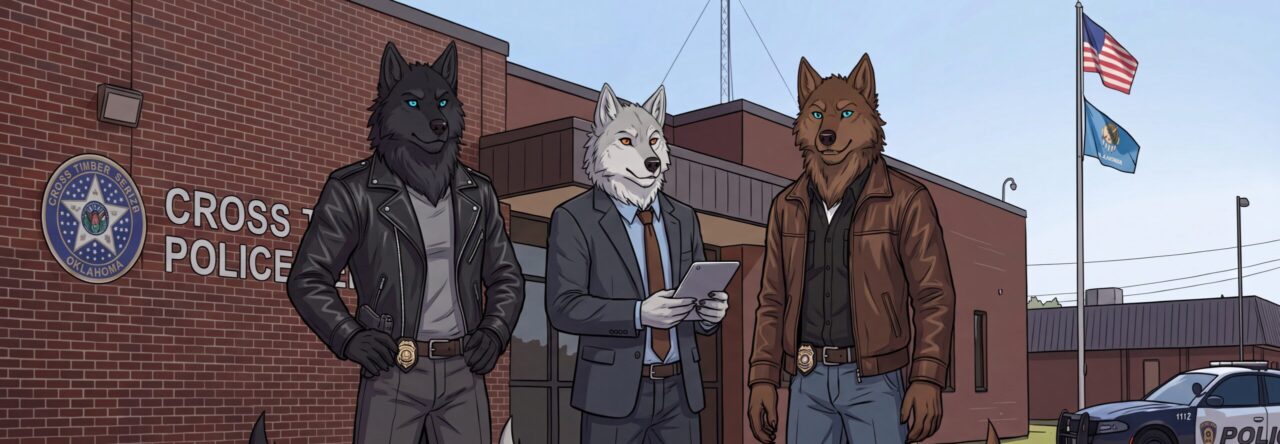
Month: July 2026

Chapter 75 — A Bone to Pick

Friday arrived without a press conference.

No cameras waited in the lobby.

No one had asked Thane to stand beneath a department seal and explain gunfire, healing, risk, or why the people who worked beside him deserved more attention than he did.

The flower table in the lobby had shrunk to one small arrangement near reception.

The cards had been moved into neat archival boxes, except for the handful Carla still kept out for officers coming off difficult shifts.

The department had begun to look like itself again.

That was good.

Thane walked into the Night Shift office at 18:03, expecting the familiar beginning-of-evening handoff.

Voss stood at the far end of the table with a folder open in front of her.

Rusk leaned against the counter with coffee in one hand.

Gabriel entered behind Thane, already looking suspiciously pleased with the fact that the night did not appear to contain any microphones.

Mark followed with his notebook, tablet, and the small expression of satisfaction he got whenever a room contained the correct number of chairs and none of them were occupied by reporters.

Thane crossed to his desk.

Then stopped.

A box sat in the center of it.

It was square.

Plain brown cardboard.

Large enough to hold a small appliance, a stack of files, or a deeply impractical gift.

A red bow had been taped across the top.

No card.

No return label.

No explanation.

Thane looked at the box.

Then at the bow.

Then at Gabriel.

Gabriel’s expression remained almost impressively neutral.

Almost.

“Do not,” Thane said.

Gabriel blinked.

“I have not done anything.”

“You are enjoying something.”

“I enjoy many things.”

Mark set his tablet on the table.

“The bow is suspicious.”

Rusk took a slow drink of coffee.

“Everything is suspicious to you.”

“No,” Mark said. “Only things that present themselves without identifying information.”

Voss looked at the box.

“Do not open it if you think it is a threat.”

Thane studied the cardboard.

It smelled like cardboard.

Packing tape.

A faint trace of store shelf dust.

Nothing chemical.

Nothing sharp.

Nothing concerning.

Underneath it all, something dry and animal.

He looked at Voss.

“It is not a threat.”

“Then open it carefully,” she said.

Thane set one claw beneath the edge of the tape.

Gabriel had taken one step closer.

Mark had shifted just enough that he could see inside without leaning over Thane’s shoulder.

Rusk remained against the counter.

Perfectly still.

Perfectly straight-faced.

The tape tore.

Thane lifted the top flaps.

Looked inside.

Then went very quiet.

For a second, no one moved.

He reached down into the box.

Slowly withdrew the contents.

It was a large rawhide dog-bone chew toy.

Ridiculously large.

Nearly the length of Thane’s forearm.

White at the center, knotted at both ends, and wrapped in a clear plastic sleeve bearing a cheerful label that read:

NATURAL BEEF-FLAVOR CHEW

Thane stared at it.

His ears tipped back.

A low growl began somewhere deep in his chest.

Gabriel made one strangled sound.

Then doubled over against the edge of the table, one hand pressed to his muzzle as laughter shook him.

Mark looked at the rawhide.

Looked at Thane.

Then looked away.

His shoulders moved once.

Twice.

He was chuckling.

Actually chuckling.

Voss closed her eyes briefly.

Rusk remained still.

Thane turned slowly.

The rawhide bone hung from one paw.

His gaze traveled around the room.

To Gabriel, who had lost any remaining ability to pretend.

To Mark, who was attempting to rearrange a stack of folders without looking amused.

To Voss, whose expression had the exhausted patience of someone who knew better than to ask how much worse this was about to become.

Then to Rusk.

“Okay,” Thane said.

His voice was calm.

That was worse than the growl.

“Which one of you did this?”

Gabriel managed to straighten halfway.

“It could have been anyone.”

“No,” Thane said, still looking at Rusk. “It could not.”

Rusk lifted one eyebrow.

“Strong accusation.”

“You are the only person in this room old enough to think rawhide is still funny.”

Voss made a quiet sound into one hand.

Gabriel folded over again.

Mark’s ears flattened against his head as he fought another laugh.

Rusk’s mouth twitched.

Only slightly.

“I will have you know,” he said, “the gift was selected with great care.”

“Was it?” Thane asked.

“I considered a squeaky toy.”

Gabriel made a noise so abrupt he had to sit down.

Thane looked at the bone again.

Then at the box.

Then back at Rusk.

The growl deepened.

Rusk’s expression finally cracked.

A smile began at the corner of his mouth.

That was enough.

Thane moved.

One instant he stood beside his desk.

The next, he planted one paw on the desk edge, vaulted cleanly over the two empty guest chairs, and landed directly in front of Rusk and Voss in one fluid motion.

The chairs did not move.

The coffee on the counter did not spill.

But the sound of Thane’s landing carried through the office hard enough that the officers passing in the Investigations hallway stopped.

Darnell appeared in the doorway first.

Patel behind her.

Then Grant.

Then two patrol officers Thane did not know well enough to name without checking their badges.

Every face went still.

Thane held the rawhide bone loosely at his side.

His shoulders squared.

His blue eyes narrowed.

The expression he wore was not the Kaden Face.

The Kaden Face was theatrical. Controlled. Something a child could laugh at once the growl ended.

This was quieter.

Sharper.

His lips lifted just enough to show his teeth.

A warning without sound.

Rusk stopped smiling.

For perhaps the first time in several years, Detective Owen Rusk looked genuinely unsure whether he had made an error in judgment.

Voss did not move.

But her eyes tracked Thane’s hands, his stance, the distance between him and Rusk.

She knew him too well.

She knew the difference between anger and control.

Outside the office, nobody breathed.

Thane took one step toward Rusk.

Rusk’s coffee lowered slowly.

“Thane,” he said.

Thane stared at him.

Then the snarl vanished.

His expression broke into a wide, bright, entirely toothy grin.

He set one large paw on Rusk’s shoulder.

“You need new material, Rusk,” he said. “This joke is so old it qualifies for a pension.”

For a second, Rusk only blinked.

Then he laughed.

Not his usual dry little laugh.

Not the faint breath through his nose he used when Gabriel said something stupid.

A full, startled, helpless laugh that bent him forward and made him set his coffee down before he spilled it.

The office exploded with laughter around him.

Gabriel had both hands braced on the table now, laughing so hard his ears had nearly disappeared into his fur.

Mark had given up entirely. He stood beside the table, shoulders shaking, one hand pressed against the edge of his tablet as though he needed it for balance.

Even Voss smiled.

Not widely.

Never widely.

But enough.

Darnell leaned against the doorway.

“I need that written down somewhere.”

“No,” Thane said.

Patel pointed toward the rawhide bone.

“Is that evidence?”

“Unfortunately, no.”

Grant looked at Rusk.

“You really bought him a dog chew?”

Rusk wiped at one eye.

“I had it gift-wrapped.”

Thane looked at him.

“That made it worse.”

“It had a bow.”

“That did not improve it.”

“It showed commitment.”

“It showed premeditation,” Mark said.

Rusk looked at him.

“You are supposed to be the reasonable one.”

“I am being reasonable. You planned a prank, acquired materials, packaged them, transported them into a police facility, and placed them on a detective’s desk.”

Gabriel lifted one hand.

“Mark has entered the prosecution phase.”

Rusk pointed at him.

“You are not helping.”

“No,” Gabriel said cheerfully. “I am enjoying the consequences.”

Voss looked toward the officers gathered at the doorway.

“Back to work.”

Nobody moved.

Voss raised one eyebrow.

The hallway cleared immediately, though Darnell’s laugh followed him around the corner.

Thane stepped back from Rusk.

The rawhide still hung from one paw.

Rusk looked at it.

Then at Thane.

“Are you going to keep that?”

Thane looked down at the bone.

“No.”

“Good.”

“I am putting it in your desk drawer.”

Rusk stopped smiling.

Thane’s grin sharpened.

“Unless you want it framed.”

“That would be cruel.”

“You bought it.”

“Fair.”

Voss took the rawhide from Thane with two fingers, as though it might somehow spread bad judgment.

“This is going in the property-disposition bin,” she said.

Gabriel looked wounded.

“You are throwing it away?”

“I am protecting all of you from becoming worse.”

“That ship sailed when Rusk found the bow.”

Rusk leaned back against the counter, still smiling despite himself.

“I regret nothing.”

Thane looked at him.

“Good. It will make the next part more satisfying.”

Rusk’s smile faded by a fraction.

Voss pointed at both of them.

“No escalation.”

Thane’s expression became innocent.

“I said nothing about escalation.”

“That is why I am concerned.”

“Reasonable,” Mark said.

Voss returned to the handoff folder.

“Can we work now?”

Gabriel straightened his shirt.

“Honestly, I am emotionally ready for a boring Friday.”

“That is the correct attitude,” Voss said.

Rusk picked up his coffee again.

“And, for the record, there are no active major cases requiring Night Shift action.”

“Good,” Thane said.

“The Varela investigation remains with Property Crimes, Digital Forensics, and the county fraud unit. Marlowe Court and Juniper Trace have begun the access-control overhaul. The ownership company has issued notices to all residents. No new related incidents overnight.”

Mark nodded.

“Any return-property identifications?”

“Several,” Voss said. “Day shift handled two. More will be scheduled next week. Nothing needs you tonight.”

“Heritage Liquor?” Gabriel asked.

“Rosa has been cleared for limited follow-up contact through Victim Services. Evan is with family and declined further media attention. The critical-incident review is still moving normally. No new action for you tonight.”

Thane nodded.

“Okay.”

Rusk opened the next folder.

“Patrol has three low-level assist requests that may develop into something more complicated, but probably will not. A civil standby at a grocery-store parking lot. A recurring false-alarm problem in North Cedar. A late-night noise complaint near the recreation center.”

Gabriel leaned back in his chair.

“Nothing says Friday like someone else’s avoidable situation.”

“Your empathy remains inspiring,” Voss said.

“It is accurate empathy.”

Crowe stepped into the doorway at that moment, already in uniform and looking like she had heard exactly enough of the rawhide conversation to regret entering.

“Tell me nobody is hurt.”

“No one is hurt,” Voss said.

Crowe looked at the empty box on Thane’s desk.

Then at Rusk.

Then at the rawhide bone still sitting in Voss’s hand.

“Do I want to know?”

“No,” six people said at once.

Crowe considered that.

“Good. Night Shift, take the grocery-store standby first. Then keep your radio on.”

Thane stood.

Gabriel grabbed his jacket.

Mark collected his tablet.

Rusk called after them, “Try not to get any more gifts.”

Thane looked back.

“I will do my best.”

Rusk smiled.

“Excellent.”

Thane gave him one last look.

Rusk’s smile became less certain.

Then Night Shift left the office.


The civil standby unfolded in the far corner of a grocery-store parking lot beneath a buzzing light pole and a sky still holding the last orange edge of Friday evening.

Officer Grant had arrived first.

She stood beside her unit with a tablet in one hand and a patient expression on her face.

Across from her, a woman in a green sweatshirt stood with her arms folded.

A man in a blue work shirt stood ten feet away, hands in his pockets.

Between them sat a golden retriever with one ear folded backward and a red leash looped around its collar.

The dog wagged so hard his entire rear half moved.

Grant looked toward the Humvee.

“Glad you are here.”

Thane stepped out.

“What is it?”

Grant glanced at the dog.

“Breakup disagreement. They share the dog. They disagree about who keeps him this weekend. Both claim the other is violating an arrangement that exists mostly in text messages and bad assumptions.”

Gabriel looked at the golden retriever.

“Who is the dog?”

“Biscuit,” the woman said.

The dog heard his name and began wagging harder.

Thane looked at Biscuit.

Then at the rawhide-bone memory still much too fresh in his mind.

Gabriel noticed.

His eyes brightened.

Thane gave him a warning glance.

Gabriel looked away immediately.

Not convincingly.

Mark opened his notebook.

“Any threats? Physical contact? Property damage?”

“No,” Grant said. “Raised voices. A shopping-cart incident. No assault. Store security called because they were arguing near the entrance.”

The woman sighed.

“I did not hit him with the cart.”

“You pushed it at me,” the man said.

“I pushed it past you.”

“It hit my knee.”

“It brushed your knee.”

Biscuit barked once.

Gabriel crouched a few feet away from the dog.

“Your witness has strong feelings.”

The woman looked at the dog.

“He has dinner in fifteen minutes.”

The man looked at her.

“You always say that like dinner matters more to him than I do.”

Biscuit sat.

Then looked directly at the man.

Then at the woman.

Then at the grocery bag resting between them.

Gabriel glanced at the bag.

“What is in there?”

“Chicken treats,” the woman said.

Biscuit’s tail became dangerous.

Thane folded his arms.

“The dog does not appear to have selected a side.”

The man stared at him.

“What?”

“He appears to have selected dinner.”

Grant smiled into her tablet.

The woman’s mouth twitched despite herself.

The man tried not to smile.

Failed.

The tension in the parking lot loosened by half an inch.

Mark spoke before it could tighten again.

“We cannot decide ownership of Biscuit. That is a civil matter. But we can help you separate the immediate problem from the larger one.”

The woman looked at him.

“What does that mean?”

“It means neither of you is deciding permanent custody in a grocery-store parking lot at nineteen thirty-seven on a Friday.”

The man nodded slowly.

“That seems fair.”

Mark continued.

“You need a temporary plan for the weekend. Then you need to put the agreement in writing somewhere clearer than text messages.”

Gabriel looked at Biscuit.

“Preferably before he starts requiring legal counsel.”

The dog barked again.

Thane pointed gently toward the leash.

“Who had him last weekend?”

The woman raised her hand.

“Me.”

“Who has him this weekend?”

The man said, “Me.”

The woman immediately said, “But he has a vet appointment Saturday.”

The man looked at her.

“You did not tell me that.”

“I told you he had an appointment.”

“You said ‘something Saturday.’”

“I said it was important.”

Mark held up one hand.

“Stop.”

Both of them did.

He looked at the woman.

“Vet appointment time?”

“Eleven.”

“Can he take Biscuit?”

She looked at the man.

The man looked at Biscuit.

Biscuit looked at the grocery bag.

“Yeah,” the man said. “I can take him.”

“Then he takes Biscuit tonight. You meet at the vet tomorrow at ten forty-five. After the appointment, you decide the remaining weekend schedule in writing.”

The woman frowned.

“And if we cannot agree?”

“Then you use a mediator, attorney, or civil process,” Mark said. “Not a shopping cart.”

Grant added, “And definitely not the grocery-store entrance.”

The woman nodded.

The man nodded.

Biscuit barked again.

Gabriel smiled.

“Unanimous.”

The exchange took another ten minutes.

No one hugged.

No one declared peace forever.

But the man took the leash.

The woman handed over Biscuit’s small food bag and the vet paperwork.

Biscuit accepted both outcomes with equal enthusiasm.

As Night Shift returned to the Humvee, Gabriel waited until the dog was safely in the other car before he spoke.

“Interesting.”

Thane looked at him.

“No.”

“You did not say anything about the bone.”

“I know.”

“You were thinking about it.”

“I was not.”

Mark got into the rear seat.

“You paused for 1.6 seconds after hearing the dog’s name.”

Thane looked at him through the open driver’s door.

“Why do you know that?”

“I noticed.”

“That is worse.”

Gabriel climbed into the passenger seat.

“Rawhide has become emotionally significant.”

Thane started the Humvee.

“Do not make me put you in Rusk’s desk drawer.”

Gabriel smiled.

“Worth it.”


At 22:41, Officer Patel requested assistance at a small townhouse complex off North Cedar.

The emergency call had come from a woman named Linda Turner, seventy-two, who reported that her home speaker had called emergency services twice in one evening.

The first time, she had assumed it was a malfunction.

The second time, the speaker had announced, in a cheerful automated voice, that it was contacting emergency assistance.

Linda had panicked and unplugged it.

Then called the police because she was worried the device had been hacked.

When Night Shift arrived, Patel stood in the living room with a notebook open while Linda and her husband Gus sat on the couch beneath a framed wedding photograph.

The speaker sat unplugged on the coffee table.

A television show played silently across the room.

Thane recognized the shape of the problem before anyone said anything.

On the television, a detective reenactment paused beneath large white letters:

CALL 911 BEFORE IT IS TOO LATE

Gabriel stared at the screen.

Then at the speaker.

Then at Linda.

“Were you watching this when it called?”

Linda looked embarrassed.

“Yes.”

Gus pointed at the television remote.

“It said the number. Twice.”

Patel looked at the speaker.

“So did the speaker.”

Mark examined the settings screen through the phone app Linda had reluctantly opened for him.

“It appears the emergency voice feature is active,” he said. “The television dialogue may have triggered it.”

Gus looked at him.

“The television called the police.”

“The device misheard the television,” Mark said.

“That is worse.”

“It is inconvenient,” Mark corrected.

Gabriel sat on the edge of the armchair across from Linda.

“Nothing suggests someone hacked it. The device heard a command it should not have acted on.”

Linda looked toward the speaker.

“Can it do that again?”

Mark adjusted the settings.

“I am disabling emergency voice activation. You can still place emergency calls manually through the phone or by using the speaker’s standard contact prompt, but it will not interpret the television as a request for help.”

Gus looked relieved.

“Good.”

Thane nodded toward the television.

“Maybe turn the show down too.”

Linda sighed.

“It is my favorite.”

Gus looked at her.

“It is always somebody getting murdered.”

“It is a mystery program.”

“It is a very loud mystery program.”

Gabriel smiled.

“Both can be true.”

The speaker rebooted.

A calm synthetic voice announced that emergency voice activation had been disabled.

Gus pointed at it.

“Good. Stay that way.”

Patel closed her notebook.

“Call us if it happens again. But I think we have the explanation.”

Linda looked at Thane.

“You are the one from television too.”

Thane paused.

Not because he was uncomfortable with the recognition.

Not exactly.

Because he was learning how much better it felt when people looked at him and did not immediately ask about blood.

“Yes, ma’am.”

“My niece sent me that video. I did not watch the whole thing.”

“That was probably wise.”

Linda nodded.

“But I saw enough.” She looked at him carefully. “I am glad you are all right.”

Thane inclined his head.

“Thank you.”

Gus looked from Thane to the speaker.

“Honestly, I am more afraid of that thing now.”

Gabriel stood.

“That is also probably wise.”


At 00:36, the noise complaint near the recreation center arrived exactly as Rusk had predicted.

A caller reported yelling, music, and “possibly a large fight” at the outdoor basketball court behind Cross Timber Community Recreation.

By the time Night Shift arrived, Officer Darnell had already determined that there was no fight.

There were eight teenagers playing three-on-three under court lights that should have been off thirty minutes earlier.

There was one portable speaker.

There was a small crowd of friends on the bleachers.

And there was a neighbor in a duplex across the lot who had a newborn daughter and had reached the point where another bass line might have counted as an act of war.

Darnell stood near the sideline with her arms folded.

A teenager in a faded Thunder shirt held a basketball at his hip.

“We are not doing anything wrong,” he said.

“You are playing basketball after the park closes,” Darnell said.

“We are not breaking anything.”

“You are keeping a baby awake.”

The teenager looked toward the duplex.

Then back at Darnell.

He did not have a response ready.

Thane stepped onto the edge of the court.

The teenagers recognized him quickly.

Not with the wide-eyed shock people had shown during the week after the shooting.

More with the uncertain curiosity of people who had seen someone online and did not know whether that person was still ordinary once they stepped into the same light.

The boy in the Thunder shirt looked at Thane’s chest.

Then quickly looked away.

Thane noticed.

He did not mention it.

“What time is it?” he asked.

The boy checked his phone.

“Twelve thirty-seven.”

“What time does the court close?”

“Midnight.”

“Then you know why we are here.”

The boy shifted the ball.

“Yeah.”

Thane looked toward the duplex.

A narrow upstairs window glowed faintly.

The curtains were drawn.

Somewhere inside, a baby cried once.

Not loudly.

Not for long.

But enough.

Thane looked back at the group.

“No one is in trouble tonight. But the person who called has a newborn. Her day does not stop because yours feels like it just started.”

A girl in a red hoodie looked toward the building.

“We did not know.”

“I know,” Thane said. “Now you do.”

The boy with the basketball looked at the speaker.

Then at his friends.

“We can go.”

Darnell’s posture eased.

“Good choice.”

Gabriel pointed toward the edge of the court.

“Take the speaker with you before somebody decides to leave it in a bush.”

The girl in the red hoodie picked it up.

“I was not going to leave it in a bush.”

Gabriel smiled.

“Then you have already exceeded expectations.”

A few of the teens laughed.

The ball bounced once as the boy tucked it under his arm.

Then he hesitated.

“Detective?”

Thane looked at him.

“Yeah?”

“I saw what happened at the store.”

Thane waited.

The boy looked at the court.

Then at the duplex.

Then back at Thane.

“My mom made me watch the press conference after. She said I should hear the whole thing.”

Thane nodded.

“Did you?”

“Yeah.”

“What did you think?”

The boy shrugged.

“I guess I thought you were, like… not scared of anything.”

Thane looked at him for a second.

Then said, “I know what I can do. That does not mean I get to ignore what can go wrong.”

The boy nodded slowly.

Thane added, “You have people who depend on you?”

The boy looked toward his friends.

Then toward the duplex.

“Yeah.”

“Then be the kind of person who makes it easier for them to get home safe.”

The boy looked down at the basketball.

“Okay.”

The group left without argument.

The portable speaker stayed off.

The court lights clicked dark behind them.

As Night Shift returned toward the Humvee, Darnell looked at Thane.

“You keep accidentally giving speeches.”

Thane looked at her.

“I did not.”

“You did.”

Gabriel opened the passenger door.

“He cannot help it. He was made in a lab to deliver emotionally reasonable statements.”

Thane stared at him.

“That is not how werewolves work.”

Mark got into the rear seat.

“Also, not how labs work.”

Gabriel looked between them.

“You are both exhausting.”


At 03:18, the final patrol assist came from a quiet neighborhood south of the old rail corridor.

A resident had called about a suspicious vehicle parked near the entrance to a closed elementary school.

No lights.

No obvious driver.

No movement.

The kind of call that could be nothing or something.

Patel arrived first.

Grant came from the north side.

Night Shift rolled in behind them.

The vehicle was an older silver sedan parked beneath a streetlamp beside the school fence.

A man stood near the driver’s side, one hand resting on the roof.

At first glance, he looked nervous enough to make the call reasonable.

At second glance, the reason became clear.

A teenage girl sat behind the wheel.

Both hands clenched around the steering wheel.

Her father stood outside the car with an expression of exhausted patience.

Patel approached the passenger window.

“Evening,” she said.

The father looked relieved.

“Officer. I am sorry. We are not doing anything.”

“Why are you parked at a closed school at three in the morning?”

The girl’s face disappeared behind her hands.

The father sighed.

“Parallel parking.”

Grant looked at the empty curb.

“Parallel parking.”

“She has her driving test tomorrow.”

“Today,” the girl mumbled.

The father looked at his watch.

“Yes. Today.”

Thane stepped closer, staying far enough back not to crowd the girl.

“Why here?”

The father gestured helplessly at the empty lot.

“No traffic. No parked cars to hit. No people to scare.”

The girl lowered her hands.

“I am terrible at it.”

“You are learning,” the father said.

“I almost hit the dumpster.”

“The dumpster is fine.”

“It made a noise.”

“The dumpster has had worse.”

Gabriel looked toward the school’s large metal trash enclosure.

“That dumpster has definitely had worse.”

The girl looked at Thane.

Recognition came slowly.

Then all at once.

“You are Detective Thane.”

“Yeah.”

She looked embarrassed.

“I am sorry you got shot.”

“Thank you.”

“I saw the video.”

“Okay.”

“I did not watch all of it.”

“That was smart.”

She looked down at the wheel.

“Do you ever get nervous?”

Her father gave her a tired look.

“Hannah.”

“It is a question.”

Thane considered it.

The quiet street.

The school fence.

The girl holding the steering wheel like it had personally betrayed her.

“Sometimes,” he said. “But usually the question is what you do with it.”

She looked at him.

“What do you do?”

“I use what I know. I slow down. I ask for help when I need it. I do not pretend I can do something before I am ready.”

The father glanced at his daughter.

Hannah looked toward the empty curb.

“Can I try again?”

Patel stepped back.

“You have ten minutes. Then everybody goes home.”

The father nodded quickly.

“Yes, ma’am.”

Grant smiled.

“Good luck.”

Night Shift watched from beside the Humvee as Hannah pulled forward, checked her mirrors, and attempted the maneuver again.

The first try was crooked.

The second was worse.

The third placed the sedan within a respectable distance of the curb without touching the cone her father had set out in place of another car.

Hannah looked over her shoulder.

Then stared at the result.

“I did it.”

Her father beamed.

“You did it.”

Gabriel applauded once.

Quietly.

So did Patel.

The girl laughed.

Not because the parking job was perfect.

Because it was hers.

As they drove away, Mark looked back at the silver sedan.

“She will likely pass.”

Gabriel looked at him.

“Based on what?”

“Improvement across three trials. Appropriate correction. Reduced steering overcompensation.”

Gabriel nodded solemnly.

“Very romantic.”

“It is objectively encouraging.”

Thane drove through the quiet streets toward the station.

For once, none of them argued.


At 05:54, the Investigations hallway was quiet when Night Shift returned.

The day-shift lights had not fully come on yet.

The coffee machine had started its first unhappy gurgle.

A few officers moved through the corridor with the slow purpose of people who had arrived early enough to resent the sun.

Thane entered the Night Shift office.

His desk was clear.

No box.

No bow.

No rawhide.

He looked at Rusk’s desk.

Rusk was not there yet.

Gabriel leaned against the doorframe.

“Disappointed?”

“No.”

“Relieved?”

“No.”

“Planning?”

Thane looked at him.

“Maybe.”

Mark set his tablet on the table.

“Voss explicitly prohibited escalation.”

“Voss prohibited immediate escalation.”

Mark stared at him.

“That is not materially different.”

“It is temporally different.”

Gabriel smiled.

“Oh, this is going to be good.”

“It is not,” Thane said.

The office door opened.

Rusk stepped in with coffee in one hand and a folder in the other.

He looked at Thane’s desk first.

Then at Thane.

Then at Gabriel’s grin.

His eyes narrowed.

“No.”

Thane smiled.

“What?”

“I know that look.”

“You do?”

“Yes. It is the same look you had before you tried to scare me into an early cardiac event.”

“I did not try to scare you.”

“You leapt over furniture.”

“Carefully.”

“Into my personal space.”

“Also carefully.”

Rusk set his coffee down.

“I want it noted that I was the victim of an overreaction.”

Voss entered behind him.

“You purchased a rawhide bone.”

“It had a bow.”

“That is not a defense.”

“It was a very good bow.”

Thane looked at Rusk.

“I told you. New material.”

Rusk nodded once.

“Fine. No more dog jokes.”

“Good.”

“Unless they are exceptionally good.”

“Rusk.”

“Fine.”

Voss opened the handoff folder.

“Normal Friday?”

“Normal Friday,” Thane said.

“Any arrests?”

“No.”

“Any injured parties?”

“No.”

“Any active cases?”

“No.”

“Any reports that will surprise me?”

Gabriel looked toward Thane.

“The parallel-parking suspect was released with a warning.”

Voss looked at him.

“Was she?”

“Absolutely,” Gabriel said. “She had a cone.”

Rusk took a drink of coffee.

“I leave you alone for one shift.”

Mark handed Voss the reports.

“Civil standby resolved without incident. False emergency-device activation resolved. Noise complaint resolved voluntarily. Suspicious vehicle unfounded. All patrol-support documentation is complete.”

Voss reviewed the stack.

Then looked at the three wolves.

“Good work.”

Thane nodded.

“Thank you.”

Rusk picked up the empty rawhide box from the recycling bin.

He examined the torn bow still stuck to one flap.

Then looked at Thane.

“For the record, this was funny.”

Thane smiled.

“It was.”

Rusk blinked.

“It was?”

“No,” Thane said. “But I respect the commitment.”

Rusk looked briefly pleased.

Then Thane added, “That does not mean you are safe.”

Rusk’s expression changed.

Gabriel started laughing before he could stop himself.

Mark sighed.

Voss closed the handoff folder.

“Go home.”

They did.

Outside, the first pale edge of morning spread over Cross Timber.

A city waking up.

A police department returning to its ordinary rhythms.

No gunfire.

No press conference.

No flowers arriving by the crate.

Just reports, patrol assists, bad jokes, a dog named Biscuit, a television that had tried to call emergency services, a girl learning to parallel park, and three werewolves walking toward their Humvee together.

For one quiet Friday night, that was more than enough.

Chapter 74 — The Room

At 18:07, Thane expected to walk into the Cross Timber Police Department, collect the night handoff, and begin a normal shift.

He got as far as the Investigations hallway before Deputy Chief Mercer stepped out of the Chief’s office and said, “Good. You are all here.”

That alone was enough to make Gabriel slow down.

Mark looked up from the folder tucked beneath one arm.

Thane stopped.

Mercer wore a dark suit instead of his usual department polo. His tie was straight. His expression was controlled in the particular way it became when he had spent too long thinking about something unpleasant and had arrived at the conclusion that he still had to do it.

Behind him, Chief Whitaker stood in the doorway with Voss and Rusk.

Crowe was there too.

That was not a normal shift handoff.

Gabriel looked down the hallway.

Then back at Mercer.

“Oh, no.”

Mercer folded his hands.

“At eighteen-thirty, we are holding a press conference in the Community Room.”

All three wolves went still.

Mercer looked directly at Thane.

“You will be speaking.”

For one full second, no one answered.

Thane’s eyes widened.

Gabriel’s eyes widened.

Mark’s eyes widened.

Rusk looked at all three of them and took a slow drink of coffee.

“I have never seen that happen at the same time.”

Gabriel pointed at Mercer.

“You cannot just say that like it is a normal sentence.”

“I am aware,” Mercer said.

Thane found his voice first.

“I have a shift.”

“You do,” Mercer said. “It will begin after the press conference.”

“I thought the department had already released a statement.”

“We did.”

“And Chief Whitaker spoke yesterday.”

“She did.”

“Then why am I speaking?”

Mercer glanced toward the closed doors of the Community Room.

“Because the city has spent four days trying to understand what it saw through incomplete, frightening video. Because the public knows you were shot. Because people know you healed faster than they thought was possible. Because people are filling the lobby with cards, flowers, food, stuffed animals, deeply questionable wolf-themed gifts, and notes asking whether you are all right.”

Gabriel’s ears lifted.

“Questionable gifts?”

“Not relevant,” Mercer said.

“It is relevant to me.”

Mercer ignored him.

“More importantly,” he continued, looking at Thane, “there are already too many people online calling you invincible. There are people turning a violent robbery into a superhero story. We need the facts to be louder than that.”

Thane’s ears lowered slightly.

“I do not want a press conference about me.”

“I know.”

“I do not want anyone thinking getting shot was impressive.”

“I know.”

“I do not want to become—”

“A slogan?” Mercer asked.

Thane looked at him.

Mercer nodded once.

“Neither do I.”

The hallway quieted.

Chief Whitaker stepped forward.

“You are not being asked to perform,” she said. “You are being asked to tell the truth. You will speak only to what you know. You will not speculate. You will not answer questions about evidence that remains under review. You can say ‘I do not know’ whenever you need to.”

Thane glanced at Voss.

“Do I have to answer questions?”

“No,” Voss said. “You can decline any question. Mercer or I will step in if it goes somewhere it should not.”

Rusk lifted his coffee.

“And I have been instructed to remain silent.”

Gabriel looked at him.

“That is the smartest decision anyone has made all day.”

Rusk smiled.

“I do not disagree.”

Mark looked toward the Community Room doors.

“How many people are out there?”

Mercer’s mouth tightened.

“More than I expected.”

“That is not an answer,” Mark said.

“There are local, regional, and national media outlets. There are citizens. Some of the Heritage Liquor staff are here. Rosa’s sister is here. Evan’s mother is here. Officers from every shift are here. Dispatch sent two representatives. Fire and EMS have people in the room.”

Gabriel looked at Thane.

“That is a lot.”

“It is,” Thane said.

Mercer studied him.

“You do not have to give a speech. But the city needs to hear something from you that is not a viral clip of a gunman firing at you.”

Thane looked down at his hands.

The old ache had mostly faded.

His chest no longer pulled when he breathed deeply. His thigh no longer made him favor one side. The wounds had closed. His body had repaired itself.

But that did not mean the memory had become small.

He still remembered the glass breaking.

The feeling of the rounds hitting him.

Rosa crawling behind the counter.

The gun rising toward her again.

He looked up.

“What do you want me to say?”

Mercer answered quietly.

“The truth.”

Gabriel stepped closer to Thane.

“You are good at that.”

Thane looked at him.

“I am not good at microphones.”

“You are good at telling people what matters,” Gabriel said.

Mark nodded.

“And at correcting inaccurate assumptions.”

Thane glanced toward the Community Room.

“That is not the same thing.”

“No,” Mark said. “But it is adjacent.”

For the first time since Mercer had spoken, Thane’s mouth twitched.

Rusk noticed.

“There. He is emotionally prepared.”

“Rusk,” Voss said.

“I am being supportive.”

“No,” Gabriel said. “You are being Rusk.”

Chief Whitaker checked the time.

“Twenty minutes.”

Mercer looked at Thane.

“You do not need to be perfect. You need to be honest.”

Thane nodded once.

“Okay.”


The Community Room had been used for retirement receptions, citizen-academy nights, training sessions, school presentations, and once, according to Gabriel, a disastrous chili cook-off that had required three fire extinguishers and a plumbing contractor.

Tonight, it looked like a different room.

Rows of folding chairs filled the center.

Television cameras stood along the back wall beneath the department seal.

Reporters clustered near the aisle with notebooks, microphones, and phones already recording.

The side walls held city staff, officers, dispatchers, firefighters, paramedics, and citizens who had run out of room in the chairs.

The front row was not media.

Rosa Martinez sat there with her sister.

Her upper arm was wrapped beneath a loose cardigan. She looked tired. Pale, maybe. But upright.

Beside her sat Evan and his mother.

Evan looked as though he wanted to disappear into his chair.

When he saw Thane enter through the side door, though, his eyes widened.

Then he stood.

Rosa stood too.

The room noticed.

The applause began quietly.

Not a roar.

Not at first.

Just hands coming together from the front row.

Then the people behind them joined.

Then the officers near the walls.

Then the reporters stopped moving long enough to clap too.

Thane froze near the side of the room.

Gabriel stood beside him.

Mark was on his other side.

For one second, Thane looked as though he might turn around and walk straight back into the hallway.

Gabriel leaned close enough that only Thane could hear him.

“You do not have to do anything except stand there.”

Thane looked at Rosa.

At Evan.

At the people holding cards in their laps.

At the woman from the pharmacy whose medication bag they had found under her mobility scooter.

At the exhausted delivery driver from the dumpster call.

At volunteers from Hollow Creek.

At patrol officers who had taken calls with them, trained with them, argued with them, and worked beside them while the city tried to turn one frightening night into a legend.

He stayed.

The applause faded slowly.

Mercer stood at the podium beneath the department seal.

Chief Whitaker stood a few steps behind him.

Voss, Rusk, Crowe, Bell, Grant, Serrano, Patel, Darnell, and several other officers lined the wall to one side.

Thane noticed Grant first.

She gave him a small nod.

Nothing big.

Nothing public.

Just a quiet reminder.

You are here.

The room settled.

Mercer looked out at the crowd.

He had given public statements before.

Budget statements.

Policy statements.

Statements after difficult calls when the city needed facts more than reassurance.

But he did not look comfortable.

That was how Thane knew this mattered.

“Thank you for being here,” Mercer began.

His voice carried cleanly through the room.

“On Thursday night, Cross Timber Police officers responded to an armed robbery at Heritage Liquor on East Chandler. The suspect fired multiple rounds inside the business, injured an employee, and continued to present an immediate threat to the people inside the store and responding officers.”

The room was quiet enough that Thane could hear the soft mechanical hum of the camera lights.

“Officer Grant and Officer Serrano arrived first and established exterior positions. Detective Thane, Detective Gabriel, and Detective Mark arrived shortly afterward. Officers identified an injured clerk behind the counter, an additional employee trapped inside the store, and an armed suspect who remained active.”

Mercer paused.

“The suspect fired at Detective Thane. Detective Thane was struck seven times. He was injured. He was not invulnerable.”

Several people in the room shifted.

Some looked toward Thane.

Others looked down.

Mercer continued.

“Werewolf healing is extraordinary. It is also not an absence of pain, risk, trauma, or consequence. Detective Thane remained functional long enough to protect an injured clerk from an immediate threat, disarm the suspect, and secure him in custody. Once the threat ended, the force ended.”

The words landed heavily.

Not applause words.

Not hero words.

Facts.

“The suspect received medical treatment and remains in custody. His injuries are not life-threatening. Rosa Martinez, the clerk injured during the robbery, is recovering. Evan, the employee trapped inside the store, was physically unharmed and has access to support services.”

Rosa’s sister reached for her hand.

Mercer looked toward her briefly.

Then back to the room.

“The criminal investigation remains active. The department’s use-of-force review remains active. That is standard process. The review exists to protect the public, protect the officers, and establish a complete record based on physical evidence, video, witness statements, radio traffic, and sworn reports.”

He adjusted one page on the podium.

“We have heard the public concern. We have received cards, flowers, food, messages, drawings, and gifts. We have also seen online speculation that is inaccurate, unsafe, or disrespectful to the people who were harmed.”

His eyes moved across the rows of cameras.

“We are asking everyone not to share graphic footage from the scene. Do not turn Rosa’s worst night into content. Do not turn Evan’s fear into content. Do not turn gunfire into entertainment because a wolf healed faster than you expected.”

No one moved.

Mercer’s voice softened.

“People are alive because officers, dispatchers, paramedics, firefighters, hospital staff, and civilians did their jobs under extraordinary pressure. That is the story.”

Then he stepped slightly aside.

“Detective Thane has agreed to say a few words.”

The room turned.

Thane looked at Gabriel.

Gabriel gave him the smallest nod.

Mark said quietly, “You know what matters.”

Thane walked to the podium.

The path felt longer than it should have.

The bright lights made the room warm. The microphone sat low from Mercer’s remarks, so Thane adjusted it upward with one careful claw.

Thane looked at the room.

At the cameras.

At Rosa.

At Evan.

At the reporters waiting with their questions already built.

For one strange second, all he could think was that there were too many people.

Too many eyes.

Too much silence.

Then he looked at Mercer.

Mercer was trying very hard not to look anxious.

Thane leaned toward the microphone.

“We’ve really got to stop meeting like this.”

For half a heartbeat, the room stayed still.

Then people laughed.

Not because the shooting had been funny.

Because it was a release.

A roomful of people had been carrying fear for days, and Thane had handed them one breath of air.

The laughter became applause.

Gabriel covered his muzzle with one hand.

Mark looked down, though the faint movement of his ears gave him away.

Rusk, against explicit instruction, murmured, “Good opening.”

Voss elbowed him without looking.

Thane waited for the applause to settle.

Then his expression changed.

Not harder.

Just more serious.

“I am okay,” he said. “I am fully healed.”

“But I am not the person who needs the most attention tonight. Rosa is recovering. Evan is safe. The suspect is in custody and receiving medical care. That matters.”

Rosa looked down.

Her sister squeezed her hand again.

Thane continued.

“I know a lot of people have been worried. I know people have seen the video. I know it looked frightening.”

His voice lowered.

“It was frightening.”

The room quieted again.

“I was hurt. It hurt. Healing quickly does not mean bullets are harmless. It does not mean I want anyone to think that walking into gunfire is something a person should do because they believe they can survive it.”

He paused.

“I moved because someone was still in danger. That was it.”

No one clapped.

That was right.

Thane looked toward Grant and Serrano along the wall.

“Officer Grant and Officer Serrano were there first. They established the scene. They protected people outside the store. They kept the response organized while the threat was still active.”

Grant looked like she wished she could become part of the wall.

Serrano looked at the floor.

Thane kept going.

“Officer Bell, patrol officers, dispatchers, paramedics, firefighters, hospital staff, evidence technicians, investigators—there were a lot of people doing exactly what they had trained to do.”

He looked back at the audience.

“Gabriel, Mark, and I never wanted to be the center of attention. None of us did. We came here to be useful. That is all.”

Gabriel’s ears lowered.

Mark stood a little straighter.

Thane’s gaze moved over the officers near the side wall.

“The talented law-enforcement people in this building deserve every bit as much attention as we do. They work every day. They answer calls nobody records. They sit with people when their lives are falling apart. They carry bad news. They find lost children. They help somebody get home. They take reports that matter even when nobody is watching.”

His voice roughened slightly.

“They are heroes every day. They keep this city safe. Please do not forget them.”

For a moment, no one moved.

Then Rosa stood.

Slowly, carefully.

She began clapping.

Evan stood beside her.

Then the room rose with them.

The applause came back louder this time.

Not for the gunfire.

Not for the healing.

For the people along the wall who had spent years doing ordinary, difficult work without a camera pointed at them.

Grant covered her face for a second.

Serrano laughed softly, embarrassed.

Bell folded his arms and looked down, as though he had suddenly found the floor fascinating.

Mercer stood near the podium with his jaw set tight.

Chief Whitaker did not look away from Thane.

When the room finally quieted, Mercer stepped forward.

“We will take a limited number of questions,” he said. “Questions must remain within the boundaries of the active investigation. We will not discuss specific forensic findings, witness statements, protected medical details, or operational tactics beyond what has already been publicly stated.”

Hands rose immediately.

A reporter from one of the Oklahoma City stations stood first.

“Deputy Chief, the public has seen Detective Thane take what appears to be seven rounds and remain standing. Is he bulletproof?”

“No,” Mercer said.

Then he nodded to Thane.

Thane stepped closer to the microphone.

“No,” he repeated. “Not remotely. I was hurt. I could have been hurt worse. I am lucky to heal the way I do, but that does not make gunfire safe. It does not make me bulletproof.”

The reporter nodded.

A woman near the center aisle stood next.

“Detective, why did you keep moving after you were shot?”

Thane took a breath.

“The clerk was still in the line of fire. The gun came up again, and I could not leave her there.”

A man from a national cable outlet raised his hand.

“Does your physiology give you an advantage that other officers do not have? Does that mean werewolf officers can take risks others should not?”

Chief Whitaker stepped forward first.

“Detectives Thane, Gabriel, and Mark are held to the same legal and policy standards as every Cross Timber officer. Their physiology does not change the law. It does not lower the threshold for force. It does not excuse recklessness.”

Thane nodded.

“It changes what damage I might survive,” he added. “That can matter if somebody else is in danger and there is no safer choice. But it does not mean I get to take risks because I want to look brave. It does not mean I get to ignore cover, commands, backup, de-escalation, or procedure.”

Mark’s ears tipped forward.

Gabriel looked like he wanted to say something but wisely did not.

Thane continued.

“Being able to heal does not give us permission to be careless.”

The reporter lowered his hand.

Another question came from the back.

“Did you intend to break the suspect’s finger?”

Mercer raised one hand.

“The precise mechanics of the disarm are part of the active review.”

Thane looked at the reporter.

“My intent was to stop him from firing again.”

“Was the injury necessary?”

“The review will determine all of the facts,” Mercer said. “The suspect resisted control of a firearm during an active threat. He received treatment. He is in custody. We will not litigate that event through a press conference.”

The reporter nodded and sat.

A younger journalist from a local paper stood next.

“Detective, you said you never wanted attention. How does it feel to receive hundreds of cards and gifts from people who are grateful you survived?”

Thane looked toward the lobby doors.

Through the narrow glass window beside them, he could see the bright blur of flowers.

The stacks of cards.

A small paper banner someone had taped near reception.

He did not know who had made it.

He had not asked what it said.

“I am flattered,” he said carefully. “I am grateful. I do not know how to say thank you well enough for all of it.”

A few people smiled.

Thane looked toward Rosa again.

“But I hope people remember why they are sending those things. A clerk went home to her daughter. A young employee went home to his mother. Officers and dispatchers and medics went home too. That is the part I care about.”

The journalist nodded.

“Thank you.”

A final hand rose near the front.

The speaker was not press.

She was an older woman Thane recognized from the pharmacy call days earlier—the one who had believed her prescription bag had been stolen.

Her hands shook slightly as she stood.

“May I ask something?”

Mercer looked at Chief Whitaker.

The Chief nodded.

“You may,” Mercer said.

The woman looked at Thane.

“My grandson watched the video before I could stop him. He is eight. He keeps asking me whether wolves can die.”

A murmur moved through the room.

Thane did not answer immediately.

He thought about Kaden’s drawing.

The red circles and black Xs.

The words in blue crayon telling him not to get shot anymore.

He thought about the lunchbox with laser eyes.

The strangers online calling him unstoppable.

Then he looked at the woman.

“Yes,” he said.

The room went still.

“Werewolves can die. We can be hurt. We can make mistakes. We heal fast, but that is not the same thing as being invincible. It does however take a great deal more damage to kill us.”

The woman nodded slowly.

“What should I tell him?”

Thane’s expression softened.

“Tell him strong people still need to be careful. Tell him guns are dangerous. Tell him when he sees something frightening, he should talk to someone he trusts instead of carrying it alone.”

The woman’s eyes filled.

“I will.”

Thane nodded.

“Thank you.”

Mercer stepped back to the podium.

“That will be all for today.”

The questions stopped.

The room did not rise into applause this time.

It did not need to.

People stood anyway.

Not all at once.

Not in a wave.

Just individuals coming to their feet.

Rosa first.

Then Evan.

Then Grant.

Then Serrano.

Then the people along the walls.

Thane looked at the room one more time.

At the faces.

At the cameras.

At the officers who would leave this room and go right back to working calls before sunrise.

He lifted one hand.

“Thank you,” he said. “All of you.”

Then he stepped away from the microphone.

Gabriel met him before he reached the side door.

“That was good,” he said quietly.

Thane looked at him.

“I said too much.”

“No.”

“I probably said too much.”

“No,” Gabriel repeated.

Mark joined them.

“The public-safety message was direct, accurate, and proportionate.”

Thane looked at him.

“That is your version of ‘good.’”

“Yes.”

Rusk appeared behind them.

“I have an alternate version.”

“No,” Voss said from somewhere nearby.

Rusk sighed.

“It involved the phrase ‘you made the room cry, big guy.’”

Thane stared at him.

Rusk held up both hands.

“Fine. It was good.”

Mercer walked over last.

For a second, he looked at Thane without saying anything.

Then he exhaled.

“I have scheduled press conferences before,” he said. “I have never been happier to be able to stop talking.”

Thane’s mouth twitched.

“You did okay.”

Mercer looked offended.

“I did more than okay.”

Gabriel smiled.

“Powerful press conference, powerful you.”

Mercer looked at him.

“Do not start that.”

Gabriel’s smile widened.

Too late.

Chief Whitaker approached from the podium.

“Night Shift,” she said. “You have a normal shift to work.”

Thane nodded.

“Okay.”

She looked at him.

“Are you ready?”

Thane glanced back toward the Community Room.

The audience was already beginning to disperse. Reporters gathered their equipment. Rosa hugged her sister. Evan’s mother had one hand on his shoulder.

Outside, the station lobby waited with flowers, cards, and the city’s accumulated concern.

Inside, there would be reports.

Calls.

People who needed help.

The work.

“Yes,” he said.


Once the Community Room had cleared, Voss and Rusk gave Night Shift the actual handoff in the small case room. There were no active detective cases requiring overnight action—only a few patrol-support requests, routine follow-up notes, and instructions to remain available if the liquor-store investigation developed anything urgent.

Their first call came at 20:14.

Officer Darnell had stopped to help a driver whose small utility trailer had blown a tire on the service road behind a hardware store.

The trailer had drifted partly into a shallow ditch.

The driver was not injured.

His cargo consisted of two ladders, a cooler, several bags of mulch, and what looked like the world’s least cooperative riding lawn mower.

When the Humvee pulled in behind Darnell’s unit, the driver looked from Thane to the trailer.

Then back to Thane.

“You are the one from the news.”

Thane looked at the trailer.

“Tonight, I am the one helping get this out of the ditch.”

The man blinked.

Then nodded.

“Fair.”

Darnell directed traffic while Mark checked the trailer hitch and wheel position.

Gabriel climbed carefully onto the rear bumper and began moving loose bags of mulch away from the damaged tire.

Thane stood beside the tongue of the trailer, assessing the angle.

His body felt normal.

No sharp pain.

No soreness.

No bruised memory in his muscles.

But he still moved carefully.

Not because he needed to.

Because he had promised people he would.

“Can we shift it without pulling the hitch loose?” Thane asked.

Mark examined the attachment.

“Yes. Lift at the rear. Darnell will guide the driver’s steering. We need the wheel clear of the ditch before we rotate.”

Darnell looked at Thane.

“You good?”

Thane nodded.

“Yes.”

She looked at him for a second longer.

Then nodded back.

“Okay. On your call.”

Thane placed both hands beneath the trailer’s rear frame.

Gabriel took the opposite side.

Together they lifted.

Not dramatically.

Not like a feat for a camera.

Just enough to take weight off the damaged wheel.

Darnell guided the driver.

Mark called the angle.

Thirty seconds later, the trailer rolled back onto level ground.

The driver stared at it.

Then at the two wolves.

Then at the news alert still glowing on his phone screen.

“You all really did come straight from that press conference to pull a trailer out of a ditch?”

Gabriel brushed mulch from his shirt.

“Police work is glamorous.”

Darnell snorted.

Thane looked at the driver.

“Get the tire replaced before you haul it again.”

“Yes, sir.”

“Good.”

They drove away before he could ask for a photograph.

That felt like progress.

At 22:02, they assisted Grant with a welfare check at a small duplex near the north edge of town.

An older man had not answered his sister’s calls since the afternoon.

His car was in the drive.

The porch light was on.

The television could be heard through the front window.

Grant had already spoken to a neighbor, who said the man had been working outside all day and had seemed tired but normal.

The door opened on the third knock.

The man stood there in a bathrobe, holding a television remote in one hand and looking deeply offended.

“What?” he demanded.

Grant lowered her notebook.

“Mr. Wilcox?”

“Yes.”

“Your sister asked us to check on you. She said you have not answered your phone.”

Mr. Wilcox looked toward the coffee table.

A phone lay beneath a folded newspaper.

He stared at it.

Then looked back at Grant.

“It is on silent.”

“Yes, sir.”

“That is ridiculous.”

“It happens.”

He looked past Grant and saw Thane.

Recognition spread across his face.

“Oh.”

Thane gave him a small nod.

“Evening.”

Mr. Wilcox looked at his chest.

Then at Grant.

“Is he supposed to be out?”

Grant did not miss a beat.

“He is medically cleared and currently helping me check on you.”

Mr. Wilcox seemed to consider whether that was a sufficient answer.

Then he pointed toward the phone.

“Tell my sister I am alive.”

Grant’s mouth moved toward a smile.

“I will.”

“Tell her I was watching television.”

“I will.”

“Tell her to stop calling every hour.”

Grant looked at him.

“I will not tell her that.”

Mr. Wilcox grumbled.

Then he saw Gabriel and Mark beside the walkway.

“You got the whole wolf department out here?”

Gabriel smiled.

“Just the night shift.”

Mr. Wilcox nodded as if that explained everything.

Then he looked at Thane again.

“My wife saw the video.”

Thane waited.

“She cried.”

Thane’s ears lowered slightly.

“I am sorry.”

Mr. Wilcox shook his head.

“She cried because you came back up.”

The old man stood in the open doorway for a moment.

Then he said, “Tell your people I said thank you.”

Thane looked at Grant.

Then at the other officers on the street.

“I will.”

They left Mr. Wilcox safe, irritated, and newly aware that his phone had a volume setting.

At 00:36, Night Shift assisted Patel at a grocery-store parking lot where a teenager had locked his keys, his wallet, and his younger sister’s inhaler inside a car.

The inhaler was not urgently needed.

The sister was breathing fine.

But the teenager had become frantic enough that the store manager called police before he tried to smash a window.

Mark talked him through roadside assistance.

Gabriel sat on the curb with the younger sister, who was mostly upset because she had been promised ice cream.

Thane found a spare key taped beneath the teenager’s rear bumper in one of those magnetic boxes every parent hoped no one else would discover.

The teen stared at it.

“I forgot that was there.”

“Your mother did not,” Thane said.

The teenager got the inhaler, the wallet, and eventually the ice cream.

Patel watched Thane close the car door again.

“You doing okay?” she asked quietly.

“Yes.”

She raised an eyebrow.

Thane corrected himself.

“I am fully healed.”

He looked at her.

“You do not have to keep checking.”

“I know.”

“Then why do you?”

Patel looked at the young girl eating ice cream in the passenger seat.

“Because you got shot seven times.”

Thane let out a breath.

“That is fair.”

At 02:18, the quiet finally settled in.

They sat in the break room with two patrol officers, a half-empty coffee pot, and a box of donated cookies that Mark had approved after confirming the sender was a local bakery with a receipt and no request for special treatment.

Darnell had one cookie in each hand.

Grant had coffee.

Patel sat across from Thane, elbows resting on the table.

No one was in a hurry to speak.

The night had been ordinary.

A trailer.

A welfare check.

A locked car.

The kind of calls that mattered without becoming stories.

Eventually, Darnell looked at Thane.

“Can I ask something?”

Thane leaned back.

“Yes.”

“Does getting shot hurt?”

Grant closed her eyes briefly.

“Darnell.”

“What? Everybody is thinking it.”

Gabriel lifted one hand.

“I was not thinking it because I already know.”

Darnell looked at him.

“Okay, then everybody else is thinking it.”

Thane considered the question.

“It hurts.”

Darnell waited.

“It hurts a lot.”

The room quieted.

Thane continued.

“The first part is force. Heat. Pressure. Your body knows something is wrong before your mind catches up. Then you feel where it hit. You feel what it changed.”

Grant looked down at her coffee.

“And then you heal.”

“Yes.”

“How fast?”

“Fast enough that the worst of it starts fading before you have fully processed what happened.”

Patel looked at him.

“Like pain running backward?”

“Not exactly,” Thane said. “More like the body catches up and starts telling you that you are still alive.”

Darnell turned the cookie in his fingers.

“Does it still hurt after?”

“Sometimes. The damage closes faster than the memory does.”

Grant looked at him.

Thane shrugged slightly.

“It is the true one.”

Patel sat forward.

“Does healing make you more willing to take risks?”

Thane looked around the table.

He had answered versions of that question before.

At the press conference.

In his formal statement.

But here, at two in the morning, with patrol officers who had seen too much and asked too little of each other, the answer felt different.

“It lets us take different risks sometimes,” he said. “Not more risks.”

Darnell frowned.

“What is the difference?”

Thane took a breath.

“If someone is in danger and there is no safe, workable alternative, I am able to put myself in a position another officer cannot. I am able to take the harm instead of a civilian. I may be able to close distance when waiting would make things worse.”

Mark nodded.

“But that changes only the risk to us,” he said. “It does not change the legal threshold. It does not make the action automatically wise. It does not make us immune to bad decisions.”

Gabriel rested his forearms on the table.

“We still use cover. We still give commands. We still wait when waiting is safe. We still need backup.”

Grant looked at Thane.

“You were scared?”

“No,” Thane said.

The answer landed quietly.

“I have been a werewolf my entire life. I know my body. I knew the shots would hurt, and I knew they were unlikely to stop me.”

Darnell’s expression shifted.

“Then what made you move?”

“Rosa was still there.”

The room stayed quiet.

Thane continued.

“Knowing I could take the rounds did not make the gun less dangerous. It meant I had a chance to get between it and her before he fired again.”

Patel looked down at her coffee.

Grant let out a slow breath.

Darnell set one cookie down untouched.

Then Gabriel broke the silence.

“Also, for the record, he has been insufferably stubborn since he healed.”

Thane looked at him.

“You were supposed to rest.”

“I rested.”

“You sat down for seven minutes and then reorganized the pantry.”

Mark nodded.

“Accurate.”

Thane looked at Mark.

“You are not helping.”

“I am providing corroboration.”

Darnell smiled.

“So werewolf healing does not fix personality?”

“No,” Mark said.

Gabriel leaned back.

“Tragically, it does not.”

The room laughed.

Even Grant.

Even Patel.

Thane shook his head.

Then he looked at the patrol officers again.

“I mean what I said earlier. Being a werewolf does not make us better police.”

Grant looked at him.

“It gives us abilities. It changes what our bodies can survive. But the badge is what tells us what we owe people.”

Mark’s ears tipped forward.

Gabriel was quiet.

Thane looked at the room.

“We do not get to be careless because we heal. We do not get to turn pain into a reason to hurt somebody back. We do not get to use strength just because we have it.”

Darnell nodded.

“Hands open.”

“Hands open,” Thane said.

Grant lifted her coffee cup.

“To ordinary nights.”

Patel raised hers.

“To ordinary nights.”

Gabriel lifted a cookie.

“To no more press conferences.”

Mark considered that.

“Temporarily reasonable.”

Thane looked at him.

“Mark.”

“What?”

“Just say it.”

Mark looked around the room.

Then lifted his coffee.

“To ordinary nights.”

They drank to that.

Outside, Cross Timber moved quietly beneath the late-summer dark.

No gunfire.

No flashing lights.

No packed rooms.

No cameras pointed at a wolf detective trying to explain why he had moved.

Just patrol cars moving through familiar streets.

Dispatchers answering phones.

Nurses working late.

Parents driving home.

People locking doors behind them and trusting that someone would come if they needed help.

At 06:15, Night Shift walked out into the beginning of morning.

Behind them, the station waited.

Ahead of them, the city did too.

And for one more quiet night, the people of Cross Timber had made it safely to dawn.

Chapter 73 — Still Hurts

By the time Thane returned to the Cross Timber Police Department, the front lobby had acquired a second folding table.

The first held cards.

The second held flowers.

A third had been placed near the break-room door for food deliveries, where someone had taped up a handwritten sign in thick black marker:

NOT EVIDENCE. PLEASE LABEL ALLERGENS.

Thane stopped just inside the front doors.

Gabriel came in behind him, looked over the tables, and exhaled through his nose.

Carla at the reception desk looked tired, pleased, and one minor delivery away from declaring herself the commander of a small floral nation.

“Someone sent a get-well card covered in loose silver glitter. It shed all over the counter. Dispatch found it in the radio-room carpet.”

Thane stood there for a moment, taking it in.

The flowers were not as overwhelming as they had been the previous day. Most had already been redirected to hospital staff, dispatch, Heritage Liquor, Victim Services, and the officers working overnight patrol.

But there were still enough to make the station smell faintly like a greenhouse.

Sunflowers.

Carnations.

Roses.

A vase of wildflowers in a mason jar with a card that read:

FOR DETECTIVE THANE AND THE PEOPLE WHO KEPT ROSA SAFE.

The card table was worse.

There were stacks of envelopes from local schools, church groups, senior centers, businesses, and people who had apparently decided that mailing a police detective a handwritten note was the most useful thing they could do after watching a frightening video online.

A small stuffed wolf wearing a yellow construction vest sat beside a handmade sign.

GET WELL, BIG WOLF.

Thane looked at it.

Gabriel looked at him.

“Do not.”

“I did not say anything.”

“You were going to.”

“I was going to say the vest is adorable.”

Thane gave him a flat look.

Mark glanced at the toy.

“It is not regulation.”

Gabriel put one hand over his chest.

“Mark. It is a child’s gift.”

“It can be both adorable and noncompliant.”

Carla cleared her throat.

“The stuffed animals are being routed through Victim Services after the tags are recorded. That one is currently waiting for Sergeant Hale’s niece, who has been in the children’s hospital wing for a week.”

Thane nodded.

“Good.”

Carla smiled.

“And before you ask, no, you are not taking it home.”

Thane blinked.

“I was not going to.”

Gabriel looked at her.

“He was absolutely not going to.”

Carla pointed at the three of them.

“You have no idea how many people have asked whether he needs a special recovery den.”

Thane closed his eyes.

“Please tell me none of them brought one.”

“Not yet.”

“Carla.”

“One person offered to donate a custom recliner.”

Gabriel’s ears lifted.

“Was it nice?”

“Gabriel.”

“What? He got shot seven times. A good recliner is not an unreasonable public-health intervention.”

Mark adjusted the folder beneath one arm.

“Department policy does not permit acceptance of a custom recovery recliner.”

Gabriel looked at him.

“Your fun-to-information ratio is devastating.”

Thane shook his head and walked past the tables.

He was fully healed.

That was what the doctor had called it when the final examination ended earlier that afternoon.

No open wounds.

No retained rounds.

No internal injury.

No limitations beyond the soreness that remained in strange, stubborn places.

His chest felt tight if he stretched too far.

His thigh complained when he climbed stairs.

There was a faint ache beneath his ribs, as if his body had remembered the shape of the impacts even after it had repaired the damage.

He knew it would fade.

Probably soon.

That did not make it nothing.

Mark fell into step beside him.

“You are compensating slightly on the right side.”

Thane looked at him.

“I am walking.”

“Yes.”

“Normally.”

“Mostly.”

Gabriel came around the other side.

“Congratulations. You are now medically healthy enough to be criticized by both of us.”

Thane pointed toward the Investigations hallway.

“Statement first.”

Gabriel’s expression sobered.

“Statement first.”


The formal interview took place in a small conference room beside the Chief’s office.

Not an interrogation room.

Not a place designed to make someone uncomfortable.

A table.

Six chairs.

A carafe of coffee no one had touched.

A city-seal plaque on the wall.

Two unopened boxes of tissues sitting in the center of the table, as if somebody had decided the room itself would make people cry.

Leila Ochoa waited at one end with a recorder, a notebook, and a thick folder marked HERITAGE LIQUOR — CRITICAL INCIDENT REVIEW.

A representative from the police association sat quietly beside Thane. The department had made the option available. Thane had taken it, not because he expected wrongdoing, but because every officer who gave a full statement after a critical incident deserved the same process.

Mark and Gabriel had completed their own statements separately.

No coordinated language.

No shared drafts.

No comparing who remembered which second.

Just what each of them had seen.

Mercer stood outside the room with Voss.

Neither would be part of the statement.

Neither wanted to be.

Ochoa clicked on the recorder.

“Today is Monday, eighteen thirty-two hours. Detective Thane is present voluntarily for his full statement regarding the armed robbery and shooting at Heritage Liquor on Thursday night. Detective, are you medically cleared to participate?”

“Yes.”

“Are you taking any medication that affects your ability to understand or answer questions?”

“No.”

“Have you reviewed any evidence from the scene since your initial public-safety interview?”

“No.”

“Have you discussed the substance of your statement with Detectives Gabriel and Mark?”

“No.”

“Are you prepared to proceed?”

“Yes.”

Ochoa nodded.

“Start with your arrival.”

Thane did.

He told it cleanly.

The dispatch call.

The reported armed robbery.

The shots fired.

Grant and Serrano already positioned outside the store.

The clerk behind the counter.

The young employee near the boxed-wine display.

The gunman’s position.

The shattered front window.

The absence of a clean shot.

He did not make himself larger.

He did not make the suspect smaller.

He did not call the gunman evil.

He did not say he had known exactly how everything would end.

He described what he had seen.

What he had heard.

What he had assessed.

Ochoa asked questions when she needed more detail.

“Why did you enter the doorway?”

“The gunman had turned the weapon toward Rosa Martinez. She was injured and crawling toward the counter opening. Grant and I did not have a clean angle from outside without risking her.”

“Did you believe the suspect remained an immediate threat?”

“Yes.”

“Why?”

“The handgun was still in his hand. He had fired multiple rounds. Rosa was exposed. He moved the gun toward her.”

“Describe what happened after you entered.”

Thane took a breath.

“He fired.”

“How many times?”

“Seven.”

“Did you remain standing?”

“Yes.”

“Did that affect your decision to continue?”

“It affected what I knew I might survive.”

Ochoa looked up.

“Explain that.”

Thane considered the words before he used them.

“I am a werewolf. My healing is faster. My chances of permanent injury are different than they would be for a human officer in the same position.” He paused. “That did not make the situation safe. It did not mean the shots did not hurt.”

The room remained quiet.

Ochoa wrote.

Thane continued.

“It meant I knew I would be able to take a risk that Rosa could not take. The gun was still pointed at her. There was no clean shot. There was no time to wait for a better position.”

“Were you attempting to demonstrate that you could survive gunfire?”

“No.”

“Were you angry because the suspect shot you?”

“No.”

“Why did you move toward him?”

“Because he raised the gun again.”

Ochoa nodded once.

“Describe the disarm.”

“I caught his gun wrist and redirected the muzzle away from the clerk. He resisted. His trigger finger stayed inside the guard. I turned the pistol until it came free.”

“Did you intend to break his finger?”

“No.”

“What was your intent?”

“To keep him from firing again.”

“Did you use force after the weapon was secured?”

“No.”

“Did you strike him?”

“No.”

“Did you use force after he was in handcuffs?”

“No.”

“Did you make any threats?”

“No.”

“Did you give commands?”

“Yes.”

“What commands?”

“Drop it. Then hands open.”

Ochoa looked down at the report summary.

“You told the initial investigator that the suspect said, ‘They leave stuff. They move out and leave everything. Nobody wants it.’ Was that connected to the Heritage Liquor robbery?”

“No. That was Cole Varela in the earlier case.”

Ochoa paused.

Then closed her eyes briefly.

“Different critical incident. Long week.”

Thane’s ears tipped forward.

“You okay?”

She looked at him.

“I am fine.”

Gabriel’s voice, from somewhere in the hallway beyond the door, carried faintly through the wall.

“No.”

Ochoa stared at the door.

Then, despite herself, smiled once.

“Thank you, Detective Gabriel.”

Thane’s mouth twitched.

Ochoa returned to the record.

“Detective, is there anything else about your decision-making that you believe the review team needs to understand?”

Thane looked at the table.

At his hands.

At the claws that had stayed visible beneath the conference-room lighting through every sentence.

“Yes,” he said finally.

Ochoa waited.

“Being able to heal does not mean I get to be careless. We still use cover. We still wait when waiting is safe. We still use verbal commands. We still take the least dangerous option we have.”

He looked up.

“There was no safe option left for Rosa. That is why I moved.”

Ochoa held his gaze for a moment.

Then nodded.

“Thank you.”

The recorder clicked off.

The statement was complete.

Not the whole investigation.

Not the final review.

Not the reports, forensic findings, video analysis, witness interviews, or supervisor findings still to come.

But his part of the truth was in the room now.

Placed where it could be seen.


Voss was waiting in the hallway when Thane stepped out.

Mercer stood beside the window with his hands in the pockets of his suit trousers, staring down at the patrol lot below.

Neither spoke immediately.

That was not their style.

Thane looked between them.

“Was it okay?”

Voss answered first.

“It was complete.”

He nodded.

“That is what I wanted.”

“You did not make it about being hard to hurt,” she said. “You made it about why Rosa could not be the one left in that line of fire.”

“She could not.”

“No,” Voss said. “She could not.”

Mercer turned from the window.

He looked at Thane for a long second.

There was no dramatic expression on his face.

No swelling speech.

Just something honest and difficult to hide.

“You took seven handgun rounds,” he said. “Several of them through your core. No body armor. No retreat path. And you remained functional enough to see the threat, protect a civilian, disarm the shooter, stop using force when the threat stopped, and give a clear statement afterward.”

Thane’s ears lowered slightly.

“Okay.”

Mercer’s mouth moved toward a humorless smile.

“You are very bad at accepting the point of a compliment.”

“I do not want people to think I am invincible.”

“They should not,” Mercer said. “You are not.”

“I know.”

“But I am still impressed,” he said. “I would be lying if I said otherwise.”

Thane did not know what to say to that.

So Voss did.

“Being impressed is not the same as turning you into a symbol.”

Mercer nodded.

“No. It is not.”

Voss looked at Thane.

“You made a terrible situation smaller. That is what I want remembered.”

Thane looked down the hallway toward the lobby.

The flowers.

The cards.

The stuffed wolf in a construction vest.

The whole city trying to tell him that standing through gunfire had meant something.

“Rosa went home yesterday,” he said.

“Yes,” Voss said.

“Evan too.”

“Yes.”

“Then that is enough.”

Mercer’s expression softened.

“For the case, maybe. Not for the people who care about you.”

Thane glanced at him.

Mercer continued before he could object.

“You do not have to perform gratitude. You do not have to become a hero poster. But let people be glad you are alive.”

Thane was quiet for a moment.

Then nodded once.

“Okay.”

Rusk appeared at the end of the hallway carrying two coffees and a department-issued travel mug that read:

CROSS TIMBER PD — HANDLE WITH CARE

He looked at Thane.

“Apparently somebody thought this was funny.”

Gabriel emerged from the break room behind him.

“It is funny.”

“It is a mug,” Thane said.

“It is a mug with a warning label.”

Mark appeared last, looking at the mug.

“Technically, it is prudent.”

Rusk handed it to Thane.

“Carla said it was from a local print shop. Policy says it stays in the communal gift stack.”

Thane turned it over in his hands.

“Good.”

Rusk took a sip of coffee.

“Also, do not get shot tonight.”

Thane looked at him.

“I was not planning to.”

“Excellent. We have exceeded our flower-storage capacity.”

Gabriel nodded seriously.

“Dispatch is near revolt.”

“Dispatch has created a flower-inventory system,” Rusk said.

Mark’s ears tipped forward.

“May I see it?”

“No,” Thane said.

Mark looked offended.

“I only want to review the structure.”

“That is exactly why no.”

Voss gathered the remaining handoff folders.

“Enough. Night Shift, you have an actual shift.”


The first patrol assist came at 20:11.

Officer Grant had a disabled hatchback stalled halfway into the eastbound lane on Chandler, just beyond the grocery store.

No injuries.

No collision.

No crime.

Just a tired mother, two restless children in the backseat, and a car that had decided its transmission was done with the entire concept of forward movement.

The woman stood beside the open driver’s door with one hand pressed against her forehead.

A toddler in a dolphin shirt leaned against the rear window and cried with the quiet determination of someone who had been promised dinner twenty minutes ago.

Grant stood near the front bumper, directing traffic around the car.

When the Humvee pulled up behind his unit, he looked toward Thane.

“Glad you are back.”

“Glad it is a car,” Thane said.

Grant smiled faintly.

“Same.”

Mark stepped out first and assessed the lane.

“Traffic is light enough to move it to the grocery lot. We need one officer at the west approach and one at the intersection.”

Gabriel looked at the woman.

“Hi. We are going to get you out of the road.”

She looked at him, then at Thane.

Her face changed.

Not fear.

Recognition.

“Oh,” she said. “You are—”

Thane held up one hand gently.

“Tonight, I am helping move your car.”

The woman blinked.

Then nodded.

“Okay.”

It was exactly what she needed to hear.

Not a story.

Not a photograph.

Not a question about how many bullets could hit a werewolf before he stopped walking.

Just a plan.

Grant took the west approach.

Serrano arrived from the intersection and blocked traffic briefly.

Mark directed the angles.

Gabriel got the woman and children safely into the grocery-store lot.

Thane put both hands against the rear of the hatchback.

The soreness in his ribs tugged when he leaned into it.

Not sharply.

Not enough to stop him.

Enough that he noticed.

The car rolled.

Slowly at first.

Then more easily.

Mark moved with him, guiding the front wheel while Grant kept the lane clear.

Thirty seconds later, the hatchback sat safely in a parking space beneath a grocery-store light.

The toddler had stopped crying.

The older child, maybe six, pressed both hands against the back window and stared at Thane.

The mother came over once traffic began moving again.

“Thank you,” she said.

“You are welcome.”

She hesitated.

Then looked at his chest.

Not at the wounds, which were hidden beneath his uniform shirt.

At him.

“I saw the video.”

Thane nodded.

“I am sorry you had to see it.”

Her eyes widened slightly.

“No. I just…” She looked toward her kids. “I am glad you are okay.”

Thane looked at the two children in the car.

Then back at her.

“Me too.”

Gabriel appeared beside him with the woman’s roadside-assistance number written on a small card.

“Tow truck is on the way. The grocery manager said you can wait inside with the kids if you want.”

The woman took the card.

“Thank you.”

As Night Shift walked back toward the Humvee, Grant fell into step beside Thane.

For half a block, she said nothing.

Then she cleared her throat.

“Can I ask you something?”

Thane looked at her.

“Yes.”

“I keep replaying it.”

“The store?”

Grant nodded.

“I saw the first shot hit you. Then the second. I knew Rosa was in the line. I knew I did not have the angle.” She looked down at the pavement. “I keep thinking I should have done more.”

Thane stopped.

Grant stopped too.

“You did do more,” Thane said.

Grant looked at him.

“You got there first. You set the position. You called the threat. You kept the front covered. You got Evan out. You backed me when I moved.”

“But you got shot.”

“Yes.”

Grant’s jaw tightened.

“Seven times.”

“Yes.”

Thane let the words sit.

Then said, “That does not make it your fault.”

Grant looked away.

“It feels like it should.”

“I know.” Thane’s voice stayed low. “But you did not put the gun in his hand. You did not make him fire. You did not fail because I had a different body than you do.”

Grant looked back at him.

Thane continued.

“You were where you needed to be. Rosa is alive. Evan is alive. You got the scene stable after the threat ended. That matters.”

Grant nodded slowly.

“Okay.”

“Do not carry the parts that belong to the gunman.”

For a moment, Grant did not answer.

Then he said, “You have been talking to Dr. Price again.”

Thane’s mouth moved faintly.

“Maybe.”

Grant looked relieved enough to laugh once.

“Good.”


At 22:36, Night Shift assisted Patel at an apartment complex off North Cedar.

The call had come in as a possible domestic disturbance.

Raised voices.

Something crashing.

A neighbor worried that someone was being hurt.

By the time they arrived, it was three adults in a cramped apartment, two open moving boxes, an overturned laundry basket, and a disagreement about whether a ninety-two-year-old grandmother’s old sewing machine belonged to the eldest daughter or the grandson who had promised to repair it.

No one had been struck.

No one had threatened anyone.

Everyone was exhausted.

The grandmother had died two weeks earlier.

Her family had been trying to clear the apartment before the end of the month.

The sewing machine was the last thing anybody had expected to become a fight.

Gabriel sat at the small kitchen table with the eldest daughter, Nadia.

Mark spoke quietly with the grandson, who was nineteen, angry, embarrassed, and very close to crying about a machine he had not actually known how to repair.

Thane stood in the doorway between the living room and kitchen, giving the room enough space to breathe.

Patel leaned against the wall beside him.

“Quiet night,” she murmured.

Thane glanced toward the sewing machine.

“Very.”

Patel looked at him.

“How are you?”

“Fine.”

She gave him a look.

He corrected himself.

“Healing.”

“Better.”

After a minute, she said, “Does it still hurt?”

Thane looked toward the kitchen.

Gabriel had made Nadia laugh softly at something. Mark was showing the grandson how the machine’s serial plate could help identify the model and perhaps find an original manual online.

“It did,” Thane said. “A lot.”

Patel was quiet.

“I have been shot at,” she said. “Never hit. I have thought about it since Thursday.”

Thane nodded.

“Most officers have.”

“Does it feel different because you heal?”

“Yes.”

“How?”

He thought about the answer.

“The first part does not feel different.”

Patel waited.

“It is force. Heat. Pressure. It feels like your body being told something is very wrong all at once.” Thane looked down at his hands. “You do not stop feeling pain because you are a werewolf. You do not get used to it. The pain is real.”

Patel’s expression stayed serious.

“Then the healing starts.”

“Fast,” Thane said. “The worst of it fades fast. The pressure goes. The damage closes. Your body starts catching up to what happened.”

“And the memory?”

Thane looked at her.

“The memory takes longer.”

Patel nodded once.

That was enough.

Across the room, the grandson said, “I do not want to sell it.”

Nadia wiped at her face.

“I do not either.”

Gabriel looked between them.

“Then do not make the decision tonight.”

The young man looked toward the sewing machine.

“But the apartment has to be empty by Friday.”

Mark spoke without looking up from his tablet.

“You can move the machine to storage for thirty days. That gives you time to decide without making the decision while everyone is upset.”

Nadia looked at him.

“Can we do that?”

Patel stepped forward.

“I can call a storage place near here. See who has a small unit available.”

The whole apartment seemed to unclench.

Not solve.

Not heal.

Just breathe.

Thane watched the sewing machine get moved carefully into a corner away from the boxes.

A small practical delay.

A little more time.

Sometimes that was all police could give people.

Sometimes it was enough.

As they walked back toward the Humvee, Patel fell into step beside Thane again.

“You know what people are saying?”

Thane looked at her.

“That I am invincible?”

“Some of them.”

“I am not.”

“I know.”

“They should know.”

“They will,” Patel said. “But they also saw you keep going.”

Thane was quiet.

Patel continued.

“You did not make it look easy.”

He looked at her.

“No.”

“Good.”

Then she went back to her unit.


At 00:18, the station break room had become a problem.

Not a serious problem.

A food problem.

Someone had delivered two trays of breakfast burritos for night shift, even though it was midnight and no one could explain why breakfast food had become the city’s chosen language of concern.

Another donor had sent cookies.

Dispatch had received sandwiches.

The fire department had sent a note saying they were not accepting any more donuts because Cross Timber apparently wanted every public-safety worker to gain ten pounds by the end of the month.

Rusk had written GOOD LUCK beneath the note.

Gabriel stood near the counter, holding a burrito in one hand.

“This is a tremendous public service.”

Mark looked at the handwritten labels on the trays.

“It is an unstructured resource-distribution issue.”

Gabriel stared at him.

“You have a burrito. Be happy.”

“I am happy.”

“You look like you are planning an audit.”

“I am planning a rotation.”

Thane sat at one of the small break-room tables with a bottle of water and half a burrito.

His ribs still felt mildly sore when he laughed.

He had discovered that twice already.

He was now trying not to give Gabriel the satisfaction.

Grant came in first.

Then Darnell.

Serrano came in after clearing a report.

Patel arrived a minute later.

None of them sat immediately.

They hovered the way people did when they had a question but had not decided whether they were allowed to ask it.

Gabriel saw it.

“Oh, no,” he said cheerfully. “This is an intervention.”

“It is not,” Darnell said.

“It is absolutely an intervention.”

Grant looked at Thane.

“Can we ask you something?”

Thane put down his water.

“Yes.”

Darnell grabbed a burrito and sat across from him.

“Does being a werewolf make you more willing to take chances?”

The room went quieter.

Not awkward.

Just attentive.

Thane looked at the patrol officers.

Then at Gabriel.

Then at Mark.

He knew what they were really asking.

Not whether bullets hurt.

Whether a body that healed could make an officer careless.

Whether his kind of strength changed the rules.

“No,” Thane said.

Darnell waited.

Thane continued.

“Being a werewolf does not make us more willing to take chances. It gives us a different calculation when there is no clean safe answer.”

Grant leaned forward slightly.

“What does that mean?”

“It means we can sometimes put ourselves into danger that would create a higher risk of permanent injury for someone else.” Thane looked down at the water bottle. “We may be able to take the hit instead of a civilian. Or take an angle another officer cannot safely take. Or close distance when waiting would let someone get hurt.”

He looked back up.

“But that only changes the risk to us. It does not remove the risk. It does not make force easier to justify. It does not mean we get to be reckless because we heal.”

Mark nodded once.

“‘We could survive it’ is never enough.”

Darnell looked at him.

“Then what is enough?”

Mark folded his hands on the table.

“An immediate threat. A lawful purpose. No safer workable alternative. A clear reason the action reduces overall harm.”

Gabriel took another bite of burrito.

“And even then, we have to live with it afterward.”

The room stayed quiet.

Grant looked at Thane.

“Were you scared?”

Thane did not hesitate.

“Yes.”

That answer seemed to surprise them more than anything else.

Serrano’s expression shifted.

“Really?”

“Yes.”

“Even after the first shot?”

“Especially after the first shot.”

Darnell stared at the table.

“So how did you keep moving?”

Thane thought about the liquor store.

The shattered window.

Rosa crawling.

The gunman looking at him with the pistol rising again.

“I did not keep moving because I was fearless,” he said. “I kept moving because Rosa was still there.”

Grant nodded slowly.

Gabriel looked at him.

“That is the part people miss when they watch the video.”

“They see the bullets,” Patel said.

“Yeah,” Gabriel said. “They do not see the decision before them.”

Serrano sat across from Thane.

“What is it like to heal that fast?”

The question landed softer than the others.

More curious than afraid.

Thane leaned back carefully in his chair.

“It is strange,” he said.

Darnell smiled faintly.

“That is not a very technical answer.”

“I am not Mark.”

Mark looked mildly offended.

“You can be technical without being me.”

Gabriel made a thoughtful sound.

“I disagree.”

Thane continued before either could argue.

“It hurts first. It all hurts. You feel where the damage is. You know what happened.” He glanced down at his chest. “Then it starts to fade. The heat goes away. The pressure goes away. The body starts putting itself back together faster than your mind catches up.”

“Like pain running backward?” Grant asked.

Thane considered it.

“Maybe. Not exactly. More like your body is working very hard to convince you that you are not dying.”

No one laughed.

Thane went on.

“The soreness stays longer. Not always. But sometimes. My body heals the wound before my mind has finished understanding it.”

Serrano nodded.

“That makes sense.”

“It also means we have to be careful,” Thane said. “We can look fine before we are ready. We can move before we should. We can convince ourselves the damage does not count because it does not last.”

Gabriel looked at him.

“Do we?”

Thane looked back.

“Yes.”

Gabriel nodded once.

“Fair.”

Patel rested her hands around her coffee cup.

“So you do not think of yourselves as safer?”

Mark answered this time.

“We are safer from some kinds of lasting injury. We are not safer from bad decisions.”

Darnell gave a low whistle.

“That should be on a poster.”

Gabriel pointed at him.

“No more posters.”

“Seriously,” Thane said.

Darnell held up both hands.

“No posters.”

There was a beat.

Then he added, “Maybe a mug.”

Thane stared at him.

The whole table laughed.

Even Thane, though he stopped quickly and pressed one hand to his ribs.

Gabriel’s expression changed immediately.

“You okay?”

Thane looked at him.

“Healing.”

Mark nodded.

“Accurate.”


The final patrol assist came at 03:47.

A caller at the northside gas station had reported a man “passed out” near the air pump.

The call sounded worse than it was.

The man was awake when Patel arrived.

He was seventy-four, stubborn, mildly dehydrated, and deeply offended that his old pickup had chosen the gas-station lot to suffer a dead battery.

His name was Walter Briggs.

He had been driving home from visiting his brother in the hospital.

He had sat down on the curb after his truck would not start and fallen asleep because he had not slept much in two days.

The station clerk had seen him and called.

By the time Night Shift arrived, Walter had been given water, checked by EMS, and was arguing that he did not need anyone fussing over him.

“I have had worse nights,” he said.

Patel looked at him.

“Your truck is dead, your phone battery is at three percent, and you fell asleep beside an air pump.”

Walter pointed a finger at her.

“Still had worse.”

Thane crouched beside the truck’s open hood.

“Battery terminal is loose.”

Walter looked over.

“You know cars?”

“No,” Thane said. “But Mark does.”

Mark inspected the cable connection.

“Corrosion buildup. Loose clamp. Likely recoverable temporarily.”

Walter narrowed his eyes at him.

“You are a detective.”

“Yes.”

“And you are fixing my truck.”

“No,” Mark said. “I am identifying why it does not work.”

He checked the battery terminal again.

“Corrosion buildup. Loose clamp. I can clean the connection enough to get you safely home, but the battery and terminal need proper service tomorrow.”

Walter narrowed his eyes.

“You can do that?”

“Yes.”

Patel stepped back toward her unit, keeping an eye on the lot.

“Road is clear,” she said. “Take the time you need.”

Mark nodded once.

Then he cleaned the terminal and tightened the clamp.

Walter looked between them.

“I did not ask for all this.”

Gabriel leaned against the pump.

“You did not ask for a dead battery either. Yet here we are.”

The old man grumbled, but not seriously.

A few minutes later, Mark had the clamp cleaned enough to reconnect.

Thane held the hood steady while Walter turned the key.

The engine coughed.

Failed.

Then caught.

Walter stared at the dashboard.

“Well,” he said.

Mark stepped back.

“Drive directly home. Replace the battery and terminal connection tomorrow.”

Walter looked at Thane.

Then looked again.

Recognition reached his face slowly.

“You are that wolf.”

Gabriel closed his eyes.

Thane waited.

Walter pointed toward Thane’s chest.

“You got shot.”

“Yes.”

“Seven times?”

“Yes.”

Walter shook his head.

“That seems excessive.”

“It was.”

Walter was quiet for a moment.

Then he looked at Patel.

“Does it still hurt?”

Patel glanced at Thane.

Thane answered for himself.

“A little.”

Walter nodded.

“Good.”

Gabriel blinked.

“Good?”

Walter leaned on the open truck door.

“If it did not hurt, you might think you could do it again.” He looked at Thane. “Pain has a job.”

The words settled into the cold early-morning air.

Thane looked at him.

“Yes,” he said. “It does.”

Walter nodded once, apparently satisfied.

Then he got into his truck.

Before pulling away, he rolled down the window.

“Do not let them make you a fool because you heal fast.”

Thane’s ears tipped forward.

Walter tapped the steering wheel.

“People see a strong thing and assume it does not need protecting. That is how strong things get broken.”

Then he drove away slowly toward the north road.

No one spoke for a few seconds.

Gabriel watched the taillights disappear.

“Well,” he said. “That man just emotionally corrected all of us.”

Mark looked at Thane.

“He was not wrong.”

“No,” Thane said. “He was not.”


At 05:51, the Humvee rolled back into the station lot.

The sky was beginning to turn pale above Cross Timber.

The flower tables in the lobby remained.

The cards remained.

The sign about glitter remained.

But the building had settled into the ordinary quiet of the hour before day shift.

Carla had gone home.

Dispatch had changed over.

The donated breakfast burritos were gone.

Rusk’s travel mug sat abandoned in the break room beside a stack of reports.

Thane stood for a moment in the lobby before heading out.

A new card rested on top of the morning stack.

The handwriting was large and careful.

Probably a child.

DEAR DETECTIVE THANE,

I SAW YOU GET HURT ON THE PHONE.

I AM GLAD YOU GOT BETTER.

MY MOM SAYS YOU ARE NOT BULLETPROOF.

I THINK YOU SHOULD STILL BE CAREFUL.

LOVE, JASMINE

Thane read it twice.

Gabriel came up beside him.

“Good advice.”

“Yeah.”

Mark looked over his shoulder.

“Clear, concise, and medically appropriate.”

Thane held the card gently between both hands.

Then put it back on the table.

He looked at Gabriel and Mark.

“Being a werewolf does not make us better police.”

Gabriel looked at him.

“No?”

“It gives us advantages,” Thane said. “It changes what we can survive. It changes what we can do when someone is in danger.”

Mark waited.

Thane looked toward the quiet lobby.

At the cards.

The flowers.

The city’s fear turned into handwriting, sunflowers, burritos, and small reminders to be careful.

“But the badge is the part that tells us what we owe people.”

Mark nodded.

Gabriel was quiet for a moment.

Then he smiled slightly.

“That is pretty good.”

Thane looked at him.

“Do not put it on a mug.”

Gabriel lifted both hands.

“No mugs.”

Mark glanced toward the break room.

“Reasonable policy.”

The three of them walked out together.

Behind them, the cards waited for someone to read them.

Ahead, morning came slowly over the city.

And for one quiet night, nothing had needed saving by force.

Page 3 of 3

COPYRIGHT © 2026 · THREE WEREWOLVES LLC