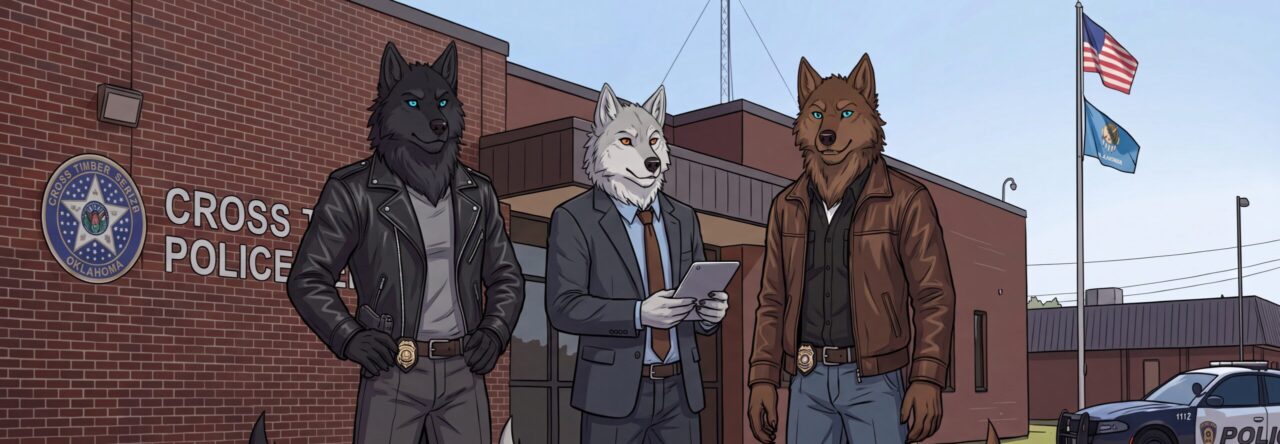
Month: July 2026 Page 2 of 3

Chapter 85 — No Wolf Belongs in a Cage

By Saturday evening, the cabin had gone quiet in a way that usually meant everyone was thinking too loudly.

Gabriel sat on the great-room sofa with one leg stretched out and the other folded beneath him, pretending to watch a movie neither Thane nor Mark had agreed to. The volume was low enough that the dialogue blurred into noise.

Mark sat at the dining table with his laptop open, a legal pad beside it, and three pens arranged parallel to the edge of the paper. He had not written anything for several minutes.

Thane stood near the windows, looking out into the trees.

The secure medical unit had stayed with him.

Not the building.

Not the deputies.

Not Laird’s dry voice or the absurd safe door with its bolts and locking wheel.

The chain.

The huge steel chain running from Silas’s collar to the wall anchor.

It had been necessary.

Thane knew that.

Silas had broken standard cuffs. He had ripped an interview-room door out of its frame. He had tried to run through a police station. He had hurt people with fear, violation, theft, and the deliberate use of his strength to make other people’s walls meaningless.

The chain had been necessary.

That did not make it bearable.

Gabriel paused the movie.

The screen froze on a man holding a flashlight in what appeared to be a basement no reasonable person should have entered.

“Thane.”

Thane did not turn.

“Yeah?”

“You have been staring at the trees for twenty-two minutes.”

Mark looked up.

“Twenty-four.”

Gabriel glanced at him.

“I was giving him emotional privacy.”

“You were giving him inaccurate privacy.”

Thane’s mouth moved slightly.

Not quite a smile.

Gabriel set the remote down.

“Say it.”

Thane turned from the window.

“I want him out of that room.”

The words landed.

Neither Gabriel nor Mark looked surprised.

That almost made it harder.

Mark closed the laptop.

Gabriel leaned forward, elbows on his knees.

“The secure room.”

“Yes.”

“The concrete room with the giant chain.”

“Yes.”

Gabriel’s ears lowered.

“Me too.”

Mark did not answer quickly.

Thane looked at him.

Mark’s face was calm, but the calm had weight behind it.

“He cannot simply be released.”

“I know.”

“He committed planned burglaries.”

“I know.”

“He violated homes.”

“I know.”

“He used private information against people who trusted him professionally.”

“I know.”

“He escaped custody.”

“Attempted.”

“After breaking restraints and a police interview-room door.”

Thane’s ears tipped back.

“Yes.”

Mark’s voice stayed level.

“He terrified victims. He endangered officers. He is dangerous.”

Thane looked down.

“Yes.”

Gabriel stood and crossed the room slowly.

His expression was different now.

Less humor.

More pack.

“I want him out of that room too,” Gabriel said. “But I do not want Elise Redding or Priya Harlan hearing that our money matters more than their fear.”

Thane closed his eyes for half a second.

That struck where it was supposed to.

“I do not want that either.”

Mark stood from the table.

“You participated in the investigation. You physically subdued him. You are a witness. Any attempt by you to pay restitution, court costs, attorney fees, housing, or supervision creates conflicts.”

“I know.”

“Do you?”

Thane looked at him.

Mark’s voice sharpened.

“Because wanting something good does not make the route good. Paying his restitution directly could look like buying leniency. Asking the district attorney for release into your custody could look like an arresting detective influencing prosecution. Offering him pack, housing, money, and work could look like reward after harm.”

Gabriel said quietly, “Mark.”

“No.” Thane lifted one paw. “He is right.”

Mark’s expression shifted, but he did not soften the next words.

“And ‘no wolf belongs in a cage’ cannot become ‘victims matter less when the defendant is like us.’”

Silence filled the room.

The words were brutal.

They were also true.

Thane looked back toward the trees.

“I know.”

Gabriel walked closer.

“But.”

Thane turned back.

Gabriel’s voice softened.

“But no wolf belongs in a cage.”

Mark looked away first.

That said enough.

Thane stepped toward them.

“He did wrong. I know that. He made choices. Criminal choices. Cruel choices. He has to answer for them.”

His voice stayed even, but the heat beneath it rose.

“But I saw that chain. I saw him sitting there with a collar around his neck like something out of a monster movie. I saw the first honest relief on his face when we walked in because we were the only people in the building who knew what he was without needing a containment briefing.”

Gabriel’s eyes lowered.

Thane continued.

“He is not innocent. I am not saying that. I am saying the room will not make him better. The chain will not make him safer. Not inside. It will teach him that every bad thing he believed about humans was true.”

Mark’s jaw tightened.

Thane looked at him.

“Tell me the clean way.”

Mark looked back.

“What?”

“Tell me the clean way,” Thane said. “I do not want to buy him out. I do not want to erase what he did. I do not want to hurt the victims twice. I want a way to get him out of the cage without pretending he does not belong in court.”

Gabriel nodded slowly.

“That is the right question.”

Mark was quiet.

Then he looked toward the dining table.

“We call Eli.”

Thane nodded.

“Yes.”

“And we accept whatever ethical limits he gives us.”

“Yes.”

“And if the clean answer is no?”

Thane did not answer immediately.

That was the problem.

Gabriel watched him.

Mark did too.

Finally Thane said, “Then we keep looking for a clean answer that is not no.”

Mark sighed.

“That is not reassuring.”

“It is honest.”

Gabriel nodded.

“Also very Thane.”

Mark looked at him.

Gabriel shrugged.

“He asked for the clean way. Not the easy way.”

Mark picked up his phone from the table and slid it toward Thane.

“Call Eli.”


Elias Carroway answered on the third ring.

“Thane.”

“Eli.”

“It is Saturday evening. That means one of three things. You are in trouble, you have found trouble, or you are attempting to solve trouble in a way that will create a new legal category.”

Gabriel murmured, “He knows us too well.”

Thane put the call on speaker.

“It is Silas Creed.”

Eli was quiet for half a second.

Then his voice changed.

The amusement drained away, replaced by the precise calm of a lawyer sitting forward in his chair.

“Start at the beginning you are allowed to tell me.”

Thane did.

Not the evidence.

Not privileged case details beyond what was already in public filings or what Eli would learn soon enough through formal channels.

He described the medical lockup.

The room.

The chain.

The visit.

Silas’s history in broad terms as Silas had shared it.

The conversation about better choices.

The fact that Silas remained dangerous.

The fact that Thane could not stop seeing the collar.

When he finished, Eli did not speak for several seconds.

Then he said, “You want him released.”

“I want him out of a cage.”

“That is not the same legal sentence, but it is close enough to be dangerous.”

“I know.”

“Do you?”

Mark’s eyes flicked toward Thane.

Gabriel’s ears lowered.

Thane said, “Mark already said that.”

“Good. Then I can say it again with billable punctuation.”

“Eli.”

“You are an arresting officer, a detective involved in the investigation, a use-of-force witness, a wealthy potential benefactor, and someone with personal species-related identification with the defendant.”

Thane’s ears tipped back.

Eli continued.

“That combination is a conflict bonfire.”

“I know.”

“You cannot buy a sentence.”

“I do not want to.”

“You cannot buy forgiveness.”

“I know.”

“You cannot make victims whole by making them feel purchased.”

“I know.”

“You cannot offer Silas a soft landing so attractive that it appears crime led him to a better life than accountability would have.”

Thane closed his eyes.

“I know.”

“Good,” Eli said. “Now tell me what you actually want.”

Thane opened his eyes.

“I want a deferred sentence or structured probation if the DA will consider it. Long term. Strict. Ankle monitor. Home and work confinement. Therapy. Control training. No security work. No access to alarms, safes, estates, art handling, high-value clients. Full restitution. Full allocution. Court reviews. Prison time hanging over him if he violates.”

Mark looked faintly surprised.

Gabriel did too.

Thane continued.

“I want all stolen property returned. I want any damages not covered by recovered property or insurance paid. Repair costs, deductibles, uncovered loss, counseling if victims need it, court costs. I want to cover it, but cleanly. Through the court, or victim compensation, or whatever structure does not make it look like I am handing people money to feel better.”

Eli’s voice was quieter when he answered.

“That is better than I expected.”

Gabriel whispered, “That is Eli praise.”

Mark nodded once.

Thane said, “I want you to be his attorney.”

“No.”

The answer came instantly.

Thane went still.

Eli continued before he could respond.

“I cannot represent Silas as his criminal attorney.”

“Why?”

“Because I represent you. I represent Gabriel and Mark. I represent your financial structures, your philanthropic structures, and your interests. You are witnesses. You are involved in his arrest. You used force against him. Your interests and his interests may diverge sharply.”

Thane looked down.

“Okay.”

“What I can do,” Eli said, “is arrange independent criminal counsel for him. Someone excellent. Someone who answers to Silas, not to you. I can pay that attorney through a clean structure you fund, provided Silas consents and the court is aware. I can represent you in making a lawful support offer. I can negotiate with the DA on your behalf regarding restitution funding, housing support, supervision resources, and expert assistance.”

Thane absorbed that.

“Who?”

“Nora Wexler.”

Gabriel’s eyebrows lifted.

Mark’s did too.

Thane knew the name.

Carroway & Wexler.

Eli’s partner.

Former federal public defender, according to the brief biography Eli had once grudgingly allowed them to read when Gabriel accused him of being “suspiciously lawyer-shaped.”

Eli said, “Nora handles criminal defense and complex sentencing. If she agrees and if conflict review clears, she represents Silas. I do not. And if she represents Silas, she represents Silas. Not you. Not your guilt. Not your hope. Him.”

Thane nodded slowly.

“Good.”

“You do not get privileged updates.”

“I understand.”

“You do not steer the defense.”

“I understand.”

“You do not tell her what Silas should accept.”

“I understand.”

“You do not ask Silas to accept a deal because you want him out of that room.”

Thane’s jaw tightened.

“I understand.”

Eli’s voice softened by one degree.

“And, Thane, if Silas wants to plead guilty and accept prison rather than live under supervision connected to you, that is his choice.”

Thane had not expected that to hurt.

It did.

“Yes.”

Gabriel looked at him.

Mark looked down at the legal pad.

Eli continued.

“Now, as for restitution. We can offer a court-administered restitution fund. Not direct payments from you to victims. We can cover repair costs, insurance deductibles, uncovered losses, security repairs, appraisal gaps, and documented emotional-harm services if the court allows. The offer cannot be contingent on victims supporting the plea.”

“Good.”

“It must be available whether they support it or not.”

“Yes.”

“It cannot buy their silence.”

“No.”

“It cannot buy their forgiveness.”

“No.”

“It cannot buy Silas a door.”

Thane’s ears shifted.

Eli let that sit.

Then said, “It can help build one if the court decides a door is lawful.”

Gabriel exhaled softly.

Thane looked toward the dark windows.

“Can you talk to Silas?”

“I can ask Nora to meet him tonight. I can join for the portion involving your proposed support only if Nora approves and Silas consents. But he needs his own lawyer before anyone discusses plea possibilities.”

“I want to see him too.”

“No.”

“Eli.”

“No. Not until counsel is assigned and present. You have already had one welfare visit. Anything from here forward touches legal strategy, sentencing, restitution, supervision, and custody. You do not walk into that room again because your heart is loud.”

Gabriel looked at Thane.

Mark’s mouth tightened, approving despite himself.

Thane said, “Fine.”

“Say that like it is true.”

“It is true.”

“No, it is not. But you will obey it.”

Thane’s mouth twitched despite everything.

“Yes.”

Eli sighed.

“I will make calls. Do not contact the DA directly. Do not contact victims. Do not contact Silas. Do not write checks. Do not lease apartments. Do not set up employment. Do not solve anything until I tell you what shape the solution can legally have.”

Gabriel whispered, “He is taking away all your hobbies.”

Thane ignored him.

“Thank you, Eli.”

“Do not thank me yet. This is going to be ugly.”

“I know.”

“No,” Eli said. “You do not. But you will.”

The call ended.

For a moment, the cabin remained silent.

Then Gabriel said, “Well.”

Mark looked at the phone.

“That was the correct answer.”

“It was a lot of no.”

“Yes.”

Thane sat down slowly in the nearest chair.

Gabriel sat across from him.

Mark stayed standing.

Thane looked at both of them.

“He was right.”

“Yes,” Mark said.

Gabriel nodded.

“Annoyingly.”

Thane leaned forward, elbows on his knees.

“I still want to help.”

Gabriel’s expression softened.

“We know.”

Mark sat at last.

“We do too.”

Thane looked up.

Mark held his gaze.

“I do not want him in that room either.”

Gabriel’s voice went quieter.

“No wolf belongs in a cage.”

Mark nodded once.

“No.”

Thane closed his eyes.

For the first time all day, the words did not feel like a reason to run.

They felt like a reason to build carefully.


Nora Wexler met Silas Creed at 20:18.

Thane did not go.

Gabriel did not go.

Mark did not go.

That was the first hard part.

The second hard part was waiting.

Eli called at 22:06.

“Nora has agreed to represent him, pending written conflict disclosures, which she believes are manageable because her representation is independent and adverse where necessary. Silas accepted.”

Thane stood so quickly Gabriel looked up from the sofa.

“He accepted?”

“Yes.”

“How is he?”

“I am not his attorney.”

Thane stopped.

Eli continued.

“But Nora authorized me to tell you one thing because Silas asked her to communicate it.”

Thane’s throat tightened.

“What?”

“He said, ‘Tell him I will not test the chain.’”

Gabriel’s ears lowered.

Mark looked away.

Thane sat back down.

“Okay.”

Eli’s voice softened.

“That matters.”

“Yes.”

“Nora also says Silas is willing to consider a plea if it gets him out of secure medical custody and into a lawful supervised structure. She has not advised him to accept anything yet. She needs discovery. She needs charging decisions. She needs to evaluate exposure. But he is willing to listen.”

Thane let out a slow breath.

“Good.”

“Tomorrow morning, Nora and I will request a meeting with District Attorney Kincaid. Not an ambush. Formal. Clean. The DA will know Nora represents Silas, and I represent your support proposal.”

“Okay.”

“You will not attend.”

Thane’s ears flattened.

Eli continued, “Not the first negotiation. You are a witness. Your presence would distort the room.”

“I understand.”

“Eventually, the DA may want to hear from you. That will be controlled.”

“Yes.”

“And Thane?”

“Yeah?”

“This may fail.”

Thane closed his eyes.

“I know.”

“Do not promise Silas anything.”

“I will not.”

“Good.”


District Attorney Rachel Kincaid agreed to meet at 09:30 Sunday morning because the case had already become impossible enough to ignore normal hours.

She was waiting in the conference room at the DA’s office when Eli arrived with Nora Wexler.

Kincaid was in her early fifties, with silver-streaked black hair pulled into a low knot and the kind of calm that did not invite people to mistake it for softness. She had prosecuted murders, public corruption, child abuse, violent assaults, and enough wealthy defendants to know that money usually entered a criminal case wearing good shoes and a wounded expression.

She did not rise when Eli entered.

“Nora,” she said.

“Rachel.”

“Eli.”

“District Attorney.”

Kincaid looked at the folders in their hands.

“I assume this is not a social call.”

“No,” Nora said.

“You represent Silas Creed.”

“I do.”

Kincaid looked at Eli.

“And you?”

“I represent Thane, Gabriel, and Mark regarding a proposed support and restitution structure. I do not represent Silas.”

“Good,” Kincaid said. “Because for half a second I thought this was going to become professionally absurd before I had coffee.”

Eli sat.

“It may still become professionally absurd, but not for that reason.”

Kincaid did not smile.

Nora opened her folder.

“My client is prepared to discuss a global plea resolution after discovery review. This meeting is preliminary.”

“Your client committed multiple planned residential burglaries, used professional security access to target victims, stole high-value property, attempted another burglary, broke police restraints, transformed into a werewolf in an interview room, and attempted to escape custody.”

Nora nodded.

“Correct.”

Kincaid looked at Eli.

“And your clients would like to spend their way around prison.”

“No,” Eli said.

Kincaid’s eyes sharpened.

“Convince me.”

Eli did not rush.

“Thane, Gabriel, and Mark are not asking that the charges be dismissed, reduced beyond legal justification, or minimized. They are not asking you to ignore the victims. They are not offering money in exchange for victim support. They are not asking for control over prosecution.”

Kincaid leaned back.

“What are they asking?”

“A sentence with a door.”

Kincaid stared at him.

“That sounds like Thane.”

“It is.”

“I do not sentence metaphors.”

“No. But judges sometimes do.”

Nora glanced at him.

Eli took the warning and continued more plainly.

“We are asking you to consider a deferred sentence or structured probationary resolution with a long suspended prison term, strict supervision, GPS monitoring, home and work restrictions, no-contact orders, employment restrictions, mandatory treatment, transformation-control compliance, court reviews, and immediate revocation exposure.”

Kincaid’s face did not change.

“That is a large ask.”

“Yes.”

“Why should I even consider this?”

“Because long-term incarceration of a shifter is not a normal correctional problem,” Eli said. “County cannot hold him in a regular cell. The state currently has no werewolf-rated detention infrastructure. Secure medical custody is expensive, ethically fragile, and not designed as punishment. Sedating him indefinitely is not lawful punishment. Chaining him indefinitely is not rehabilitation. Building a custom prison solution may cost enormous public resources and still produce a worse version of the same man.”

Kincaid folded her hands.

“That sounds like a public-budget argument.”

“It is partly one.”

“I do not decide justice by spreadsheet.”

“No,” Eli said. “But you do decide whether a proposed sentence protects the public. A structure designed around what he is may protect the public better than a cage designed around what he is not.”

Kincaid looked at Nora.

“Your client’s history?”

Nora opened a second folder.

“Abandonment after first manifestation at thirteen. Multiple foster placements. Documented behavioral reports involving property damage, fear responses from caregivers, and placement disruption. Juvenile property offenses. No documented assaults causing serious injury. Adult record is limited and scattered across jurisdictions, mostly suspected but uncharged property crimes. We are still verifying.”

Kincaid’s expression hardened.

“Tragic past does not excuse present harm.”

“No,” Nora said. “But it may inform supervision, treatment, and sentencing.”

Kincaid looked at Eli again.

“And the wolves?”

Eli knew which wolves she meant.

“Thane’s position is emotional but not irrational.”

“That is generous.”

“It is also true,” Eli said. “He knows Silas caused harm. He knows Silas must plead, allocute, return property, pay restitution, and submit to supervision. But he saw the chain.”

Kincaid looked down briefly.

She had seen the photographs.

Everyone necessary had.

The steel collar.

The absurd chain.

The concrete room.

The secure door.

She said nothing.

Eli continued.

“Thane’s exact words to me were that no wolf belongs in a cage. That does not mean no wolf belongs under law. It means the structure should not become cruelty simply because the system was surprised by biology.”

Kincaid’s eyes lifted.

“That is also Thane.”

“Yes.”

“And the money?”

“Court-administered restitution fund. No direct victim contact from Thane. No requirement that victims support the plea. Full coverage of repair costs, uncovered losses, deductibles, appraisal gaps where property cannot be returned, and court-approved services related to the crime impact. Funds available regardless of victim position. My clients will also offer to cover extraordinary public costs related to safe supervised placement if the court and county accept through a transparent agreement.”

Kincaid tapped one finger on the table.

“So they pay for the damage, pay for the supervision, pay for the problem, and the defendant avoids prison.”

Nora answered this time.

“He avoids a cage that may make him more dangerous. He does not avoid conviction if he pleads. He does not avoid a suspended sentence. He does not avoid supervision. He does not avoid conditions. He does not avoid public accountability.”

Kincaid’s eyes narrowed slightly.

“And if he violates?”

“Revocation,” Nora said. “Full exposure.”

“Full?”

Nora did not hesitate.

“Full.”

Eli added, “Thane will not shield him.”

Kincaid looked at him.

“Can you promise that?”

“No. Thane can.”

“He is not here.”

“Because I thought you would appreciate the room being less emotionally large.”

For the first time, Kincaid almost smiled.

Almost.

Then she looked back at the file.

“Victims.”

“Yes,” Eli said.

“The Reddings, Harlans, and Albrechts get a voice.”

“Absolutely.”

“They may hate this.”

“Yes.”

“They may see it as the werewolf detectives protecting one of their own.”

“Yes.”

“They may go to the press.”

“Yes.”

Kincaid leaned forward.

“And they may be right.”

Eli’s expression did not move.

“No,” he said. “They may reasonably fear that. They may reasonably resent the proposal. They may reasonably reject forgiveness. But if the structure is transparent, court-approved, victim-centered, and available without buying support, then they are not right that the process was corrupt.”

Kincaid watched him.

Nora said, “My client would be required to stand in court and say what he did. Not generally. Specifically. He would have to acknowledge that he studied homes, used trust, violated private spaces, damaged property, stole items, and caused fear. If he cannot do that, there is no deal.”

Kincaid looked at Nora.

“Can he?”

Nora paused.

“I believe he can.”

“You believe.”

“I have been his attorney for thirteen hours.”

“Fair.”

Eli slid a proposed framework across the table.

Kincaid did not pick it up immediately.

“What does Thane want personally?”

Eli took a breath.

“Silas out of the concrete room.”

“That is it?”

“No,” Eli said. “He wants him given a chance to become something other than a monster in a story people tell themselves later.”

Kincaid’s face shifted.

Small.

Enough.

Eli continued.

“He also wants to help pay for an apartment, employment placement, therapy, monitoring, restitution, and safe supervision. I have already told him all of that must be structured through court and counsel, not personal rescue.”

“Will he listen?”

“Yes.”

Kincaid looked skeptical.

Eli said, “Eventually.”

Nora’s mouth twitched.

Kincaid picked up the framework at last.

She read for several minutes.

Neither lawyer interrupted.

When she reached the proposed conditions, she slowed.

Long deferred sentence.

GPS ankle monitor.

Home, work, court, medical, therapy, legal appointments only.

No contact with victims.

No access to alarm systems, security consulting, safes, locksmithing, estate services, art handling, private acquisitions, high-value residential clients, or related technology.

Mandatory employment approved by probation.

Mandatory therapy.

Mandatory transformation-control training with approved specialists.

Regular court reviews.

No shifting except in approved medical, training, or emergency circumstances.

Immediate reporting of any involuntary shift.

No possession of burglary tools, security bypass devices, or unauthorized access equipment.

Full restitution.

Full allocution.

Search conditions for devices and residence.

Travel restriction.

Revocation for violation.

Kincaid set the pages down.

“This is not nothing.”

“No,” Eli said.

“It is also not prison.”

“No.”

She looked at Nora.

“Would your client accept a long deferred term?”

“Subject to review, yes.”

“How long?”

Nora said, “We would discuss ten.”

Kincaid said, “Fifteen.”

Nora did not react.

“We would discuss fifteen.”

“Full restitution before release.”

Eli said, “Funds can be placed with the court in advance.”

“Recovered property returned first.”

“Yes.”

“Victim statements before final agreement.”

“Of course.”

“No direct contact between Thane and victims.”

“Agreed.”

“No press.”

“Agreed.”

“No hero narrative.”

Eli nodded.

“Agreed.”

Kincaid looked at him.

“And Thane understands this is not adoption.”

Eli’s face stayed calm.

“Yes.”

Nora added, “Silas understands that too.”

Kincaid looked at her.

“Does he?”

“He asked whether this meant pack.”

Eli looked at Nora.

He had not known that.

Nora continued.

“I told him no. Not legally. Not socially. Not now. He understood.”

Kincaid’s expression softened and hardened at the same time.

“Good.”

The room went quiet.

Finally Kincaid closed the folder.

“I am not agreeing today.”

Eli nodded.

“I did not expect you to.”

“I need victim consultation. I need to speak with the judge’s clerk about whether the court will even entertain this structure. I need county, probation, medical, and state input. I need cost estimates. I need risk assessment. I need to know whether your clients’ money can be accepted without poisoning the case.”

“Yes.”

“And I want to hear from Thane.”

Eli nodded slowly.

“Controlled setting.”

“Yes. Not as detective. Not as donor. As the person asking me to consider a door.”

Nora looked at Eli.

Kincaid stood.

“Bring me proof this protects the public, respects the victims, and does not let money touch the scale. Then I will decide whether to take it to the court.”

Eli stood.

“Thank you for considering it.”

Kincaid looked at him.

“I have not considered it kindly yet.”

“No.”

“But I am considering it.”

“That is enough for today.”

Kincaid’s expression turned dry.

“For you, maybe.”


Eli called the cabin at 11:14.

Thane answered before the first ring finished.

Gabriel looked up from the kitchen island.

Mark turned from the stove, where he had been making lunch because waiting apparently required sandwiches.

Eli did not bother with greeting.

“She did not say yes.”

Thane’s shoulders lowered slightly.

“But?”

“She did not say no.”

Gabriel closed his eyes.

Mark exhaled.

Thane gripped the phone.

“What does she want?”

“Everything.”

“That sounds fair.”

“It is,” Eli said. “Victim consultation. Court input. Probation and medical plans. County detention analysis. Cost estimates. A clean restitution mechanism. Risk assessment. Proof that money does not buy the outcome. Proof that public safety is better served by structure than by improvising a werewolf cage.”

Thane nodded even though Eli could not see him.

“Okay.”

“She also wants to hear from you.”

Gabriel looked at Thane.

Mark went still.

Eli continued.

“Not today. Not casually. I will prepare you, and you will not improvise in a way that makes me consider early retirement.”

Thane’s mouth moved faintly.

“I will try.”

“That was not the sentence I requested.”

“I will not improvise.”

“Better.”

Thane looked toward the window.

“How is Silas?”

“I am not his attorney.”

Thane closed his eyes.

“Eli.”

“Nora says he remains compliant. He ate breakfast. He has not tested the restraints. He asked whether the court would require him to speak to the victims.”

Gabriel’s ears lowered.

“What did Nora say?”

Eli answered, “She said court may require allocution and victim impact, but no private contact. He said good.”

Thane looked down.

“Good.”

“Do not read too much into one word.”

“I know.”

“You do not.”

“No,” Thane admitted. “I do.”

Eli was quiet for a moment.

Then said, “Thane.”

“Yeah?”

“You are doing the right thing by trying to do this cleanly.”

Thane swallowed.

“Thank you.”

“But clean does not mean painless.”

“I know.”

“Good. Because the victims may hate you for this.”

Thane’s ears lowered.

“I know.”

“They may see your compassion for Silas as betrayal.”

“I know.”

“The DA may still say no.”

“I know.”

“The judge may say no.”

“I know.”

“Silas may fail.”

Thane closed his eyes.

The kitchen was silent.

Gabriel’s face had gone tight.

Mark looked down at the counter.

Thane said, “I know.”

Eli’s voice softened.

“Then we keep going.”

Thane opened his eyes.

“Yes.”

The call ended.

For a while, none of them spoke.

Then Gabriel said, “Sandwiches?”

Thane looked at him.

Gabriel’s smile was small and tired.

“We still have to eat.”

Mark turned back to the stove.

“He is correct.”

Thane sat at the island.

The chair creaked under him.

Gabriel slid a plate toward him a few minutes later.

Turkey sandwich.

Chips.

Pickle.

Ordinary food on an ordinary Saturday while somewhere across town a werewolf sat in a concrete room waiting to find out whether the world had any answer for him except steel.

Thane picked up the sandwich.

His appetite was not there.

He ate anyway.

Because Gabriel was watching.

Because Mark had made it.

Because trying to build a door required staying steady long enough to lift the frame.

Gabriel sat beside him.

“You know Mark was right.”

Thane nodded.

“Yes.”

“You know Eli was right.”

“Yes.”

“You know the DA is right to be hard.”

“Yes.”

Gabriel bumped his shoulder lightly against Thane’s arm.

“And you are still right to ask.”

Thane looked at him.

Gabriel’s eyes were bright.

“No wolf belongs in a cage,” he said.

Mark placed his own plate on the island and sat across from them.

“No,” he said. “But if we build a door, it has to lock from the outside until he earns it.”

Thane nodded slowly.

“That is fair.”

“And victims get to say what the lock costs,” Mark added.

“Yes.”

Gabriel picked up a chip.

“And Silas has to stop trying to rip doors off hinges.”

Thane’s mouth curved faintly.

“Yes.”

The three of them sat together in the kitchen, eating lunch they barely tasted, while the house settled around them.

No victory.

No promise.

No easy mercy.

Only the shape of a possible path, narrow and difficult and clean enough that it might hold.

Thane looked toward the trees beyond the window.

He could still see the chain.

He suspected he always would.

But for the first time since he had stood in that concrete corridor, he could see something else too.

Not freedom.

Not forgiveness.

Not pack.

A door.

And that was enough to keep fighting.

Chapter 84 — The Chain

Saturday morning at the cabin began with Gabriel accusing the refrigerator of hiding the orange juice.

The refrigerator did not defend itself.

Mark did.

“The orange juice is on the second shelf.”

Gabriel stood in front of the open refrigerator door, staring into it with the grim focus of a detective facing a hostile witness.

“It is not.”

“It is behind the milk.”

“That is an unreasonable location.”

“It is a refrigerated beverage behind another refrigerated beverage.”

“Obstruction.”

Thane walked into the kitchen wearing loose dark pants, no shirt, and the expression of someone who had slept hard and still woken up thinking.

He reached over Gabriel’s shoulder, moved the milk, and took out the orange juice.

Gabriel looked at it.

Then at Thane.

Then at Mark.

“The refrigerator cooperated because it fears him.”

Mark took a drink of coffee.

“The refrigerator is not sentient.”

“That is what it wants you to think.”

Thane set the orange juice on the counter.

“Close the door.”

Gabriel closed the refrigerator.

Mark looked toward Thane.

“You are quiet.”

Thane opened a cabinet.

“I just woke up.”

“You have been awake for twelve minutes.”

“That is still just.”

Gabriel narrowed his eyes.

“No. He has a thing.”

Thane took down a glass.

Mark turned slightly in his chair.

“What thing?”

Thane poured orange juice.

The kitchen went still in the way it did when both of them realized he was deciding whether to say something.

That was always worse than when he simply said it.

He took a drink.

Then set the glass down.

“I want to go talk to Silas.”

Gabriel’s ears lifted.

Mark’s hand stopped halfway to his mug.

For a moment, the only sound in the kitchen was the low hum of the refrigerator Gabriel had just accused of strategy.

Then Gabriel said, “In medical lockup.”

“Yes.”

“The werewolf burglar who broke cuffs, ripped out an interview-room door, and tried to run through the station.”

“Yes.”

“The same one you pinned to the floor.”

“Yes.”

Gabriel looked at Mark.

“He is using very few words. That means this is serious.”

Mark looked at Thane.

“Purpose?”

Thane leaned back against the counter.

“I want to know why.”

Gabriel’s expression shifted.

“Why he did it?”

“Why he chose that.”

Mark set his mug down carefully.

“He may not answer honestly.”

“I know.”

“He may attempt manipulation.”

“I know.”

“He may see the visit as weakness.”

“I know.”

Gabriel studied Thane for several seconds.

Then his voice softened.

“You also want to see him because he is the first one like us.”

Thane looked toward the window over the sink.

Morning light came through the trees beyond the cabin, green and gold and ordinary.

“No,” he said.

Gabriel waited.

Thane looked back.

“He is not like us.”

Mark’s ears tipped forward slightly.

Thane continued.

“But he is close enough that I do not think we should pretend he is only a burglary suspect who got weird.”

Gabriel nodded once.

Quiet.

Mark’s face remained serious.

“We need authorization.”

“Yes.”

“Chief.”

“Yes.”

“Crowe.”

“Yes.”

“Medical supervisor.”

“Yes.”

“Probably legal.”

Thane looked at him.

“I know.”

Gabriel leaned one hip against the counter.

“And we do not ask case questions.”

Thane nodded.

“Not evidence. Not property. Not who else. Not anything that belongs in the case file unless he brings it up and the rules allow it.”

Mark looked faintly relieved.

“A custodial conversation with a represented or potentially represented suspect is complicated.”

Gabriel looked at him.

“There he is.”

“It is true.”

Thane picked up his phone.

“I am calling Chief.”

Gabriel held up the orange juice.

“Breakfast first?”

Thane looked at him.

Gabriel gave a small smile.

“Medical lockup conversations go better when no one is hungry.”

Mark nodded.

“That is probably accurate.”

Thane looked at the phone.

Then set it on the counter.

“Breakfast first.”

Gabriel lifted the orange juice in victory.

“The refrigerator case is solved.”

Mark looked at him.

“There was no case.”

Gabriel smiled.

“That is what a solved case looks like.”


Chief Whitaker did not say no.

That worried Gabriel more than if she had.

She listened to Thane’s request over speakerphone while Mark sat at the kitchen table with a legal pad, because apparently Saturday breakfast could become a planning conference in under four minutes.

When Thane finished, Whitaker was quiet for long enough that Gabriel leaned slightly toward the phone to make sure the call had not dropped.

Then she said, “This is not an interrogation.”

“I know,” Thane said.

“You do not ask about the burglaries, stolen property, accomplices, access logs, security bypasses, or anything that belongs to the criminal case.”

“I know.”

“You do not promise him anything.”

“I will not.”

“You do not suggest cooperation will improve his situation.”

“No.”

“You do not go in because you feel sorry for him.”

Thane did not answer immediately.

Gabriel watched him.

Mark did too.

Finally Thane said, “I feel something. I do not think sorry is the right word.”

Whitaker’s voice softened by a fraction.

“Good. Because pity makes bad decisions.”

“I know.”

“I will speak with Crowe and the medical supervisor. If they agree, this is a welfare and containment conversation. You may ask about his current condition, his understanding of what he is, and any safety issues related to holding him. If he wants to talk about his life, he can. If he talks about the case, you stop him.”

“Yes.”

“Gabriel and Mark go with you.”

“Yes.”

“No one goes alone.”

“I was not going to.”

“And, Thane?”

“Chief?”

“You being the one who subdued him does not mean there is no risk.”

Thane glanced at Gabriel.

Gabriel lifted his eyebrows.

Thane said, “I know.”

“Say it like you know.”

Thane’s ears tipped back slightly.

“There is risk.”

“Good. I am tired of impossible things this month.”

Gabriel whispered, “Same.”

Whitaker continued, “I will call you back.”

The call ended.

Thane set the phone down.

Gabriel pointed at him.

“She said the thing I was going to say.”

“You were going to say several things.”

“Yes, but one of them was that.”

Mark wrote something on the legal pad.

Gabriel leaned over.

“What are you writing?”

“Topics to avoid.”

“That is terrifyingly useful.”

“Yes.”

Thane looked at the list.

It already had headings.

No burglary questions.
No evidence discussion.
No promises.
No implied benefit.
No pack invitation.
No unplanned physical contact.
Exit route clear.
Medical staff aware.
Restraint status confirmed.

Gabriel read the fifth line.

“No pack invitation?”

Mark looked at him.

“It should be explicit.”

Thane said nothing.

Gabriel’s expression softened.

“Yeah.”

Mark looked at Thane.

“If that subject comes up, we can say there are better choices. We cannot make belonging sound like an immediate option. Not after what he did.”

Thane nodded slowly.

“I know.”

But the words landed.

Because some part of him had thought it.

Not as forgiveness.

Not as rescue.

Not as stupidity.

Just the old instinct that saw a lone wolf in a concrete room and wondered what might have happened if someone had found him earlier.

That instinct was not wrong.

But it was dangerous if it forgot the victims.

Redding.

Harlan.

Albrecht.

The people whose homes had been violated.

The people whose private lives had become lists.

The people whose doors had been ripped open by someone who believed power made permission.

Thane looked at Mark’s list again.

“No pack invitation,” he said.

Mark nodded.

“Not today.”

Gabriel’s voice was quiet.

“Maybe not ever.”

Thane accepted that.

Whitaker called back twenty-three minutes later.

“Approved with conditions,” she said.

Mark picked up his pen.

Gabriel mouthed, of course.

Whitaker continued.

“Secure medical supervisor agrees to a controlled visit. Crowe will meet you there. Medical staff remains outside the room. The room stays monitored. Door team present. You three enter only after restraints are checked. Conversation is recorded by the facility system for safety and legal clarity. Silas has been advised this is not a criminal interview and that he does not have to speak with you. He agreed to the visit.”

Thane’s ears shifted.

“He agreed?”

“Yes.”

Gabriel looked at Mark.

Mark wrote that down.

Whitaker added, “Do not make me regret this.”

“No, Chief,” Thane said.


The secure medical unit was not in the main hospital building.

That was the first thing Thane noticed.

It sat behind Cross Timber Regional, connected by a service corridor and surrounded by more cameras than windows. The building had originally been designed for high-risk medical custody: combative detainees, psychiatric emergencies requiring medical monitoring, inmates needing care under guard.

It had not been designed for Silas Creed.

That was obvious before they reached the door.

A county transport van sat near the entrance.

Two deputies stood by the access point.

A Cross Timber patrol unit idled in the shade.

Crowe stood near the secured door speaking with a woman in a navy uniform whose badge identified her as Laird — County Detention Supervisor.

The supervisor was in her fifties, broad-shouldered, short-haired, and visibly unimpressed by the world in general.

She looked at the three wolves as they approached.

Her eyes did not widen.

That impressed Gabriel.

“Detectives,” Crowe said.

Thane nodded.

“Lieutenant.”

Supervisor Laird looked them over once.

“So this is the part where everyone tells me this is a good idea.”

Gabriel said, “I was hoping someone else had already done that.”

Laird did not smile.

Mark said, “We understand your concern.”

“I doubt that.”

“We understand some of it,” Mark amended.

Laird looked at him for a second.

Then at Thane.

“You want to go into a reinforced medical holding room with a detainee who already broke police restraints, destroyed an interview door, and required emergency sedation.”

“Yes,” Thane said.

“Unarmed.”

“Yes.”

“Voluntarily.”

“Yes.”

Laird stared at him.

“You see my issue.”

“Yes.”

Crowe folded her arms.

“Chief approved a controlled visit. Medical approved. I approved. Laird has final say on entry.”

Laird pointed toward the building.

“Let me describe the room before anyone gets heroic. Concrete walls. Reinforced ceiling. Floor drain. Steel fixtures. One bed. One toilet. One camera. One speaker. Door came from an old bank vault retrofit and weighs more than my first car. We added a secondary bar system after Thursday because apparently reality needed help.”

Gabriel glanced at Mark.

Mark’s ears tipped forward despite himself.

Laird continued.

“He is restrained with a steel collar and chain anchored to the wall. Before anyone gets sentimental, the collar is padded and medically checked every four hours. The chain gives him room to sit, stand, use the toilet with privacy screening, and reach the sink. It does not give him room to reach the door.”

Thane’s expression tightened slightly.

Laird saw it.

“You do not like the collar.”

“No.”

“Neither do I. I like dead staff less.”

Thane accepted that.

Laird’s voice hardened.

“He has been out of sedation since yesterday afternoon. He is medically stable. Angry, mostly quiet, and too polite when asking questions about door construction. He has not shifted again. He has not eaten much. He watches the camera like it owes him money.”

Gabriel looked toward the building.

“That sounds like him.”

Laird looked at Crowe.

“I still say this is a bad idea.”

Thane stepped closer, not looming, but close enough that the supervisor had to look up.

“If he changes, who in this building stops him?”

Laird’s mouth tightened.

“That is exactly my point.”

“No,” Thane said. “Your point is risk. Mine is response.”

Crowe watched him carefully.

Thane continued.

“I was the one who put him on the floor the first time. Gabriel and Mark helped control him. We know how he moves. We know what he can break. If something goes wrong while we are inside, we are the safest people for him to be near.”

Laird’s eyes narrowed.

“That sounds like overconfidence.”

“It is not,” Thane said. “It is containment.”

Mark added, “If Silas becomes violent, delaying response until personnel outside enter through the vault door increases risk to staff. With us inside, immediate control is possible.”

Gabriel lifted one hand.

“And for the record, we do not want him loose either.”

Laird looked at Gabriel.

“You are the funny one.”

“So I am told.”

“Be less funny inside.”

“Understood.”

Laird looked back at Thane.

“You said you have nothing to worry about?”

Thane shook his head.

“I said I can handle him.”

“That is not the same thing.”

“No,” Thane said. “It is more accurate.”

Crowe’s expression shifted faintly.

Laird studied him for another long second.

Then she turned toward the secured entrance.

“Fine. But my rules. You enter together. You stay between him and the door. You do not touch the collar, chain, anchor, bed, toilet, camera, speaker, or anything else in that room unless medical or I tell you to. If he changes, we open nothing until you have him controlled. If you say get out, my people get out. If I say get out, you get out. If Crowe says get out, everyone gets out. Clear?”

Thane nodded.

“Clear.”

Gabriel said, “Clear.”

Mark said, “Clear.”

Laird looked at Crowe.

“If this becomes paperwork, I am blaming all of you alphabetically.”

Crowe said, “Fair.”


The room looked worse than Laird had described.

Not because she had understated it.

Because words could not make concrete feel less like a tomb.

The secure holding door stood at the end of a short corridor behind two controlled access points. It was absurd. There was no other word for it.

A thick circular locking wheel sat in the center. Steel bolts ran into the frame on three sides. A modern keypad and card reader had been mounted beside it, but the old mechanical hardware remained, huge and blunt and theatrical.

Gabriel stopped in front of it.

“That door has opinions.”

Mark leaned slightly closer.

“Bank-vault origin seems plausible.”

Laird looked at him.

“You want a tour or a visit?”

“Visit,” Mark said.

“But the hinges are interesting.”

Laird stared.

Gabriel whispered, “Not now.”

The observation window beside the door was narrow, reinforced, and set behind wire glass.

Thane looked through it.

Silas sat on the bed.

Human.

Barefoot.

Wearing gray medical custody pants and a sleeveless gray shirt, both designed to tear away rather than become ligatures. His wrists were unrestrained, but the collar around his neck was wide, dark metal padded at the inside and connected to a chain thick enough that it looked less manufactured than forged for a movie about ancient monsters.

The chain ran from the collar to a wall anchor the size of a dinner plate.

There was a standard prison bed bolted to the floor.

A stainless-steel toilet.

A sink.

A mattress.

A blanket folded at the foot of the bed.

Nothing else.

Silas sat with his elbows on his knees, hands hanging between them, head lowered.

He did not look powerful.

That was the dangerous part.

He looked tired.

Small, almost.

Not physically.

Human Silas was still tall and lean, with a body built by discipline and secrecy.

But the room reduced him.

Concrete did that.

Chains did that.

Being unable to choose when a door opened did that.

Thane felt Gabriel shift beside him.

Mark’s face had gone very still.

Crowe spoke quietly.

“Remember the rules.”

“I know,” Thane said.

Laird keyed the intercom.

“Creed. Visitors.”

Silas did not move.

Laird continued.

“Detectives Thane, Gabriel, and Mark. You agreed to this conversation. You may decline now.”

Silas’s head lifted.

For the first time since arriving, Thane saw his face clearly.

Silas looked surprised.

Then something else moved across his expression so quickly Thane almost missed it.

Relief.

Not joy.

Not gratitude.

Relief so raw it had no defense ready.

Silas stood.

The chain shifted with a heavy scrape against the floor.

“Let them in,” he said.

Laird looked at Thane.

“Last chance.”

Thane looked through the glass at Silas.

“No.”

The door opened slowly.

Mechanical bolts withdrew with deep, ugly sounds.

The safe door swung outward.

Cool air, concrete dust, antiseptic, metal, and Silas’s scent came through.

Human.

Contained.

Wolf buried under skin.

The hot-earth note still there.

Muted.

Waiting.

Thane entered first.

Gabriel followed.

Mark entered last and positioned himself near the wall to Thane’s left, exactly where he could see Silas, the chain, the anchor, and the door.

The door closed behind them.

The bolts slid home.

Gabriel glanced back.

“Well,” he said softly. “That is dramatic.”

Silas stared at the three of them.

He did not sit.

Neither did they.

For several seconds, no one spoke.

Then Silas said, “You came.”

Thane nodded.

“Yes.”

Silas looked at Gabriel.

Then Mark.

Then back at Thane.

“Why?”

Thane glanced once at the camera in the corner.

“This is not an interview about the case.”

Silas’s mouth twitched.

“How careful.”

“It matters.”

“To them?”

“To everyone.”

Silas looked at the door.

“The room is listening.”

“Yes.”

“Good.”

Gabriel’s ears shifted.

“You like that?”

Silas looked at him.

“If I am going to be seen, I prefer accuracy.”

Mark said, “That would have been useful earlier in your life.”

Silas’s eyes moved to him.

For one second, the old sharpness returned.

Then it faded.

He sat back on the bed.

The chain settled heavily across the floor.

“You are direct.”

“Yes,” Mark said.

Silas looked at Thane.

“And you?”

“I wanted to talk.”

“About what?”

“What you are.”

Silas gave a low laugh.

“You know what I am.”

“No,” Thane said. “I know what you can become.”

The laugh stopped.

Gabriel leaned back against the concrete wall, arms loose, posture casual on purpose.

“Those are not the same.”

Silas looked at him for a long moment.

Then said, “You three rehearsed that?”

“No,” Gabriel said. “We are naturally irritating.”

Silas almost smiled.

Almost.

Thane saw it.

Then the room swallowed it.

Silas looked down at his hands.

Human hands.

Long fingers.

Clean nails.

No claws.

“Why did you come?” he asked again.

Thane answered differently this time.

“Because you are the first shifter we have met.”

Silas’s head lifted.

That landed.

Mark said, “We know shifters exist. Rarely. But knowledge is not the same as contact.”

Gabriel added, “And your contact method was extremely illegal.”

Silas looked at him.

“Still funny.”

“Usually.”

“Even here?”

“Especially here,” Gabriel said. “Concrete rooms need better material.”

Silas looked around.

“This one has material.”

Gabriel’s expression softened.

“Yeah.”

The room quieted again.

Thane took one step closer, still well outside the chain’s reach.

“Why?”

Silas’s face closed.

Thane said, “Not the case. Not what you took. Not how. Why use what you are that way?”

Silas stared at him.

“Because it works.”

“That is not why.”

“It is enough.”

“No,” Thane said. “It is the answer you give when you do not want to say the real one.”

Silas’s jaw tightened.

The chain moved once as his shoulders shifted.

Mark watched it.

Gabriel watched Silas’s face.

Thane waited.

Silas looked toward the door.

“You stand there with badges and friends and a house big enough that it probably has rooms you forget exist, and you ask me why.”

Thane did not react to the hit.

It was close enough to truth to sting.

“Yes.”

Silas looked back at him.

“Because nobody gave me anything else.”

Gabriel’s humor vanished.

Mark’s expression did not change, but his ears lowered slightly.

Silas leaned forward, forearms on his knees.

“My mother knew before I did. I think she hoped it would skip me. My father said it was sickness. Sin. Blood rot. Whatever word made him feel less afraid.”

He looked at his hands.

“I changed the first time at thirteen. Not fully. Enough. Nails. Teeth. Fur along my arms. Broke a bathroom door because I could not get out and thought I was dying.”

No one spoke.

Silas continued.

“My mother cried. My father left for two days. When he came back, he would not look at me. Three weeks later I was at my aunt’s house. Then a cousin’s. Then a placement. Then another.”

“Foster care,” Gabriel said quietly.

Silas nodded once.

“People like fostering sad children. They do not like fostering teenagers who break doorframes in their sleep.”

Thane’s chest tightened.

“Did they know?”

“Some knew something. Most knew enough to be afraid. I learned quickly that if I wanted to stay somewhere, I had to be small.”

He smiled without warmth.

“I am not good at small.”

Mark’s voice was softer than usual.

“What happened?”

“What always happens to boys who are too strange for sympathy and too useful to ignore.” Silas looked at him. “Older kids figured out I could open things. Doors. cabinets. locked sheds. A social worker’s desk once, though that was by accident.”

Gabriel said nothing.

Silas leaned back.

“By sixteen, I could get into houses. By seventeen, I could get into safes if they were cheap. By twenty, I knew rich people hide things because they believe hiding is the same as deserving.”

Thane’s eyes narrowed slightly.

Silas saw it.

“There it is.”

“What?”

“Judgment.”

“Yes,” Thane said.

Silas’s eyebrows lifted.

Thane continued.

“What happened to you was wrong. What you did to other people was also wrong.”

Silas stared at him.

For once, he had no quick answer.

Gabriel pushed gently.

“You scared them.”

Silas looked away.

“They were not home.”

“You made sure they were not home,” Mark said. “That means you understood they would be afraid if they were.”

Silas’s mouth tightened.

Mark continued.

“You selected items with financial and sentimental value. You studied private spaces. You made people feel unsafe in their own homes.”

Silas’s eyes flashed.

“They have other homes.”

“That does not matter,” Thane said.

“It mattered when I had none.”

“It explains why you are angry. It does not make burglary moral.”

Silas stood suddenly.

The chain snapped tight before he got closer.

Metal hit the floor hard.

Gabriel did not move.

Mark did not move.

Thane did not move.

Silas breathed through his nose, eyes bright.

“You think I do not know what moral sounds like? Every foster parent had a sermon. Every judge had a lecture. Every rich client had a charitable foundation and a locked room full of things they liked more than people.”

Thane’s voice stayed level.

“And you became the thing that proved them right to be afraid.”

Silas froze.

The words landed harder than force would have.

Gabriel looked at Thane.

Mark did too.

Silas’s face changed.

Anger first.

Then hurt.

Then something much older than both.

He sat down slowly.

The chain slackened.

“Careful, Detective,” he said, but the old edge was gone. “That almost sounded like truth.”

“It was.”

Silas stared at the floor.

For a while, the room was only breathing and the faint hum of ventilation.

Then Silas said, “I watched you.”

Gabriel’s ears shifted.

“On the news?”

“Yes.”

Thane waited.

Silas did not look up.

“The shooting. The press conference. The children. The shelter. The commercial with the shoes you do not wear.”

Gabriel glanced at Thane.

Thane closed his eyes briefly.

Mark said, “Sandals and boots.”

Silas looked at him.

“What?”

“The campaign included sandals and boots.”

Gabriel whispered, “Mark.”

“It is accurate.”

For the first time, Silas actually smiled.

Small.

Tired.

Real enough to hurt.

“You are exactly like television made you seem.”

Gabriel put a paw to his chest.

“Devastatingly charming?”

“Exhausting.”

“Also accurate.”

Silas looked at Thane.

“I thought it was fake.”

“What?”

“All of it. The badge. The rules. The kindness. The way people looked at you. I thought you were pets for a city that wanted a miracle with claws.”

Thane did not flinch.

Silas continued.

“Then I saw the liquor store video.”

Gabriel’s expression darkened.

Silas saw it.

“I am not praising it.”

“Good,” Gabriel said.

Silas looked back at Thane.

“You took bullets and did not kill him.”

“No.”

“You could have.”

“Yes.”

“You did not.”

“No.”

Silas’s voice dropped.

“I did not understand that.”

Thane said, “You understood it enough to notice.”

Silas looked down.

“Maybe.”

Gabriel stepped away from the wall, still outside the chain line.

“If you knew about us, why did you not reach out?”

Silas laughed once.

Bitter.

“To the three famous police wolves?”

“Yes.”

“You would have helped me?”

Thane did not answer quickly.

That mattered.

Silas noticed.

Finally Thane said, “If you had come before the burglaries, yes.”

Silas’s mouth tightened.

“Before.”

“Yes. Before.”

“And after?”

“We can still tell the truth to you,” Thane said. “We can still make sure you are treated humanely. We can still help the department understand what is needed to hold you safely. We can still tell you there are better choices.”

Silas looked at him.

“But I do not get to be rescued.”

“No.”

The room went quiet again.

Gabriel’s voice softened.

“You did real harm.”

Silas closed his eyes.

“I know.”

It was the first time he had said it without turning the words into a weapon.

Mark stepped slightly forward.

“There are other ways to use what you are.”

Silas opened his eyes.

“Like police?”

“Not necessarily.”

Gabriel shrugged.

“Search and rescue. Disaster work. Security done legally. Heavy rescue. Wilderness tracking. Emergency response. Hell, honest consulting if you could stop turning client floor plans into shopping lists.”

Mark added, “Structural assessment, access planning, protective design, threat testing with consent. Your skills had legitimate applications.”

Silas looked at him.

“You sound like a brochure.”

“I am correct.”

“He is,” Gabriel said. “Annoyingly.”

Silas looked at Thane.

“And you? What would you have said if I came to you?”

Thane thought of the cabin.

The kitchen.

Gabriel fighting the refrigerator.

Mark labeling pantry shelves.

The Humvee.

Night shift.

Bridge House.

The badge.

The pack.

He chose carefully.

“I would have said you needed rules before belonging.”

Silas’s eyes narrowed.

“Rules.”

“Yes.”

“I have had enough rules.”

“No,” Thane said. “You have had enough control. That is different.”

Silas did not answer.

Thane continued.

“Rules can protect you from yourself. Control just teaches you where to hide.”

Something in Silas’s face shifted.

Small.

Dangerous.

Honest.

Thane went on.

“You should have reached out.”

Silas’s jaw worked once.

“You think I do not know that now?”

Gabriel’s expression softened.

Silas looked away.

“I saw you three and hated you.”

“Yeah,” Gabriel said quietly.

“Not because you had anything. Because you made it look possible.”

Thane’s ears lowered slightly.

Silas stared at the wall.

“I spent my whole life believing this thing in me only had two uses. Survive or take. Hide or break. Then there you were, standing in uniforms, letting humans clap for you like they would not panic if they saw what you really are.”

“They do see what we are,” Mark said.

“No,” Silas said. “They have seen what you let them survive seeing.”

That made Mark stop.

Silas looked at the camera.

“They did not see you alone at thirteen.”

Thane said, “No.”

“They did not see you hungry.”

“No.”

“They did not see you in places where being strong meant someone older decided you were useful.”

“No.”

Silas turned back.

“So do not tell me it was easy.”

“I was not going to.”

“Good.”

Thane held his gaze.

“I was going to tell you it was still a choice.”

Silas looked away first.

That was new.

The conversation changed after that.

Not lighter.

But less like two doors trying to break each other.

Silas asked about being full-time wolf.

Not the way reporters did.

Not curious in the polished way rich clients had probably asked him about security systems.

He asked like someone trying to understand a road he had never known existed.

“You never change back?”

“No,” Thane said.

“Ever?”

“No.”

“Does it hurt?”

“No. This is what we are.”

Silas looked at Gabriel.

“And you?”

“Same.”

“Mark?”

“Yes,” Mark said.

Silas’s mouth tightened.

“I thought that part was publicity.”

Gabriel laughed softly.

“What, the claws?”

“The permanence.”

Thane looked at him.

“You can shift at will?”

“Mostly.”

“Mostly?”

Silas looked down at his hands.

“Strong emotions make it harder to stop. Pain can force it one way or another. Fear used to trigger it. Anger still does if I let it.”

Mark’s ears tipped forward.

“Can you prevent it voluntarily?”

“Yes.”

“Reliably?”

Silas looked at him.

“In a normal room? Yes.”

“This is not a normal room.”

“No.”

Mark nodded.

“That matters.”

Silas looked toward the chain.

“I hate this.”

“I know,” Thane said.

“I hate that it works.”

Thane did not answer.

Silas swallowed.

“When they put it on, I thought I would change just to prove they could not hold me.”

Gabriel watched him carefully.

“Why didn’t you?”

Silas looked at Thane.

“Because I remembered the floor.”

There was no humor in it.

Thane’s expression did not change.

Silas leaned back against the wall behind the bed.

“I have never been put down like that.”

Gabriel lifted one eyebrow.

“You had a very confident hallway entrance.”

Silas looked at him.

“I thought I could take him.”

“And?”

Silas’s eyes moved to Thane.

“I was wrong.”

The words were simple.

No performance.

No challenge hidden inside them.

Thane nodded once.

“Yes.”

Silas looked almost offended by the lack of gloating.

“You could enjoy that more.”

“I do not need to.”

That made Gabriel smile faintly.

Silas stared at Thane for a second.

Then laughed.

Quiet.

Disbelieving.

“You really are like that.”

“No,” Gabriel said. “He is much more annoying at home.”

Thane looked at him.

Gabriel held up both paws.

“What? He should know.”

Silas’s eyes narrowed with something dangerously close to interest.

“What is home like?”

Mark said immediately, “Not relevant.”

Gabriel looked at him.

“He asked a normal question.”

“He is in custody.”

“I am aware.”

Thane said, “Loud.”

Silas looked back at him.

Thane continued.

“Coffee arguments. Too many cabinets according to Gabriel. Mark reorganizes things that were already fine. Gabriel moves things and denies it. I drive.”

Gabriel pointed at him.

“You always driving is not home. That is tyranny.”

“It is safety.”

“It is alpha vehicular oppression.”

Mark looked at Silas.

“This is typical.”

Silas stared at them.

Not smiling now.

Not exactly.

Watching.

Like someone looking through a window into a place he had never believed existed.

The chain lay across the floor between them.

For the first time, it looked less like theater and more like tragedy.

Silas’s voice was quiet.

“If I had reached out…”

He stopped.

Thane let him.

Silas tried again.

“If I had reached out before.”

Gabriel’s face softened.

“Before matters.”

Silas nodded once.

Pain moved across his face quickly and was gone.

“I know.”

Thane said, “There is always a better choice than crime.”

Silas looked at him with tired eyes.

“That sounds like something on a school poster.”

“Still true.”

“Truth can be corny?”

Gabriel said, “Constantly.”

Mark nodded.

“Frequently.”

Silas looked down and laughed once.

Not much.

Enough.

Then he said, “What happens to me now?”

Thane did not answer.

Mark did.

“Court. Custody. Medical and security planning. Charges. Counsel. Likely state involvement because of the transformation and restraint issues.”

Silas looked at him.

“Prison?”

“Likely if convicted,” Mark said.

“Werewolf-rated prison?”

“That system may not exist yet.”

Silas looked toward the vault door.

“They will build one for me.”

Thane said, “Probably.”

Silas closed his eyes.

The room felt smaller.

Gabriel said, “You can still decide who you are inside whatever comes next.”

Silas opened his eyes.

“That sounds like another poster.”

Gabriel shrugged.

“I am emotionally laminated.”

Silas actually smiled again.

Then the smile faded.

“I do not know how.”

Thane looked at him.

“No one does at first.”

Silas studied him.

“You would help me learn?”

Mark’s posture tightened.

Gabriel’s ears lowered.

The dangerous question had arrived.

Thane answered slowly.

“We can help the people responsible for holding you understand what you are. We can tell the truth about what is safe and what is not. We can speak to you if it is allowed and if it does not harm the case or the victims.”

Silas heard the boundaries.

All of them.

“And pack?”

The word landed hard.

Not because Silas deserved it.

Because he knew what it meant.

Thane’s voice stayed gentle and firm.

“Not now.”

Silas looked away.

For a second, he was thirteen in a bathroom again.

Then forty-two in a concrete room.

“Because of what I did.”

“Yes.”

“Because you do not trust me.”

“Yes.”

“Because I might use it.”

“Yes.”

Silas nodded slowly.

“Good.”

Gabriel blinked.

Silas looked back at them.

“That is the first honest no I have heard in a long time.”

Thane’s chest hurt.

He did not let it show.

Silas took a breath.

“I do not know if I can become what you think I should have been.”

Thane said, “You do not have to become us.”

Mark added, “That would be impractical.”

Gabriel glanced at him.

Mark continued, “There are already three.”

Silas stared.

Then laughed again.

A real laugh this time, short and cracked.

Gabriel grinned.

“Mark made a joke. You should feel honored.”

“I did not make a joke,” Mark said.

“That is how we know.”

Silas shook his head.

The chain moved softly.

After a moment, he looked at Thane.

“You were very strong.”

Gabriel immediately brightened.

“Oh, here we go.”

Silas ignored him.

“I have been stronger than every room I ever entered since I was seventeen. Stronger than locks. Stronger than men with guns if I moved first. Stronger than doors, walls, safes, whatever rich people thought would protect them.”

His eyes stayed on Thane.

“I never thought someone could beat me. Not like that. Not that easily.”

Thane’s mouth moved slightly.

“It was not easy.”

Silas tilted his head.

“You are being polite.”

“No. You are dangerous.”

“But you were stronger.”

“Yes.”

Silas smiled faintly.

“There it is.”

Gabriel looked at Thane.

“You admitted it. Mark, record the date.”

Mark said, “The room is already recording.”

“Convenient.”

Silas looked at Gabriel, then back at Thane.

“You could have broken me.”

“Yes,” Thane said.

“You did not.”

“No.”

“Why?”

Thane answered without hesitation.

“Because I did not need to.”

Silas sat with that.

For a long moment, he did not look like a criminal mastermind, a private security consultant, a burglar, or a werewolf who had ripped steel apart with his hands.

He looked like a man hearing a language he should have learned years ago.

Then Thane added, “Your reveal was pretty cool, though.”

Gabriel’s head snapped toward him.

Mark stared.

Silas blinked.

“What?”

Thane shrugged.

“It was interesting to meet a werewolf who shifts. And the reveal was dramatic.”

Gabriel slowly turned fully toward Thane.

“Are we reviewing his escape attempt?”

“No.”

“You just said his reveal was cool.”

“It was.”

Mark said, “The transformation was visually and biologically significant. The timing was criminally poor.”

Silas stared at them.

Then he laughed.

Harder this time.

Not long.

Not free.

But real.

The sound bounced strangely off the concrete walls.

Gabriel smiled despite himself.

“Eight out of ten reveal,” he said. “Zero out of ten exit plan.”

Silas laughed again, then looked down as if the sound had surprised him.

When he looked up, his eyes were wet.

He did not wipe them.

He did not mention them.

Neither did they.

The speaker above the door clicked.

Laird’s voice came through.

“Detectives. Time.”

Thane looked at the camera.

“Understood.”

Silas stood.

The chain shifted.

Not a lunge.

Not a threat.

Just a man standing because the only people close enough to understand were leaving.

Thane looked at him.

“We will not lie to you.”

Silas nodded once.

“Good.”

“We will not excuse what you did.”

“I know.”

“We will tell them what is true about holding you safely.”

Silas looked toward the door.

“Tell them the collar works.”

Thane’s ears lowered.

Silas saw it.

“I hate it,” he said. “But tell them it works.”

Mark nodded.

“I will.”

Gabriel stepped toward the door, then paused.

“You should eat.”

Silas looked at him.

“What?”

“You have not eaten much. Laird said.”

Silas’s mouth twitched.

“Is that an order?”

“No,” Gabriel said. “Annoying advice.”

Silas looked at Thane.

“Is he always like that?”

“Yes.”

“Good.”

The door bolts began to unlock from outside.

Thane held Silas’s gaze.

“You had a bad beginning.”

Silas’s face closed slightly.

Thane continued.

“That was not your fault.”

The door started to open.

“What you chose later was.”

Silas swallowed.

“Yeah.”

The door opened wide enough for Gabriel and Mark to step through.

Thane remained one second longer.

“There is still later,” he said.

Then he walked out.

The safe door closed between them.

Bolts slid into place.

The corridor felt brighter than it had before, though nothing had changed.

Laird stood with Crowe near the control panel.

She looked at all three wolves.

“Well?”

Gabriel let out a breath.

“He talked.”

Laird looked through the observation glass.

Silas had sat back down on the bed.

His head was lowered again.

But not the same way.

Mark said, “He remains dangerous.”

Laird nodded.

“Obviously.”

“But he is not unreachable.”

Crowe looked at Thane.

Thane kept his eyes on the window.

“No,” he said. “Not unreachable.”

Laird crossed her arms.

“I will put that in the category of useful but not comforting.”

“That is accurate,” Mark said.

Gabriel looked at the ridiculous vault door.

“For what it is worth, the door is excellent.”

Laird stared at him.

Then, despite herself, gave a short laugh.

“I hate that you are all like this.”

Crowe said, “You get used to it.”

“No, I do not think I will.”

Thane turned away from the window.

They walked back through the secured corridor, past the deputies, past the medical station, past the doors that locked behind them one at a time.

Outside, the afternoon sun was bright and hot over the hospital lot.

For a moment, none of them moved toward the Humvee.

Gabriel looked at Thane.

“You okay?”

Thane looked toward the secure medical building.

“Yes.”

Mark studied him.

“That sounded more true than usual.”

“It is.”

Gabriel leaned against the passenger door.

“Do you think we got through?”

Thane thought about Silas laughing in the concrete room.

Silas saying before matters.

Silas asking about pack.

Silas admitting the collar worked.

Silas not hiding the tears.

“A little,” Thane said.

Mark nodded.

“A little is not nothing.”

“No,” Gabriel said softly. “It is not.”

Thane unlocked the Humvee.

As they climbed in, Gabriel looked back at the secure unit.

“He was right about one thing.”

Thane started the engine.

“What?”

Gabriel’s ears lowered slightly.

“If he had reached out before…”

He did not finish.

He did not need to.

Mark looked out the side window.

“Before matters.”

Thane put the Humvee in gear.

“Yes.”

They drove away from the secure medical unit and back toward Cross Timber, leaving Silas behind the absurd safe door, the concrete walls, the chain, and the first honest no he had maybe ever believed.

It did not fix what he had done.

It did not give back the stolen fear.

It did not erase the homes he had violated or the people he had made unsafe.

But somewhere inside that locked room, a man who had believed his only choices were hide, take, or break had been forced to consider a fourth.

Later.

That was not freedom.

It was not forgiveness.

It was not pack.

But it was a door.

And for once, Silas Creed had not tried to rip it off the hinges.

Chapter 83 — The Other Wolf

Silas Creed entered Interview Two like a man arriving for an appointment he had chosen to keep.

That was the first thing Thane did not like.

Most people brought into the Cross Timber Police Department at 04:22 in the morning after being arrested outside a house they were not authorized to enter carried something with them.

Fear.

Anger.

Shame.

Panic.

Denial.

A desperate need to talk.

A desperate need not to talk.

Creed carried none of those things.

He walked between Darnell and Patel with his hands cuffed behind him, his dark hair still neat, his black shirt unwrinkled except where Mark had searched him, and his mouth set in a faint line that might have been amusement if amusement had forgotten how to be warm.

He looked at the walls.

The door hinges.

The camera dome in the corner of the interview room.

The table.

The chairs.

The ceiling tile.

The corners.

Routes.

Weak points.

Materials.

Not like a nervous suspect.

Like a contractor.

Thane stood in the hallway outside the room with Gabriel on his right and Mark on his left.

Crowe stood beside the door, arms folded, watching Creed step inside.

Voss and Rusk were already in the interview suite. Voss would lead. Rusk would sit second. Crowe had decided Night Shift would observe from outside and remain close.

Not because Creed had earned special treatment.

Because the scenes had earned caution.

Three homes connected.

Two completed burglaries.

One interrupted attempt.

A suspect with security credentials, a list of future targets, a vehicle tied to the scenes, stolen property located at the attempted burglary, and physical damage no one in the building liked saying out loud.

Creed paused just inside the room and looked back at Thane.

“You are staying close.”

Thane said nothing.

Creed smiled.

“Prudent.”

Crowe looked at Darnell.

“Seat him.”

Darnell guided Creed to the chair at the table.

Patel stood near the door while Darnell secured Creed’s cuffs to the table ring with a short chain.

Mark watched the process.

Standard cuffs.

Standard interview restraint.

Properly double-locked.

Properly seated.

Sufficient for humans.

He had said that earlier.

He did not say it again.

Creed sat comfortably.

That was the second thing Thane did not like.

Most suspects resisted the table restraint if only by shifting their shoulders or testing the chain with some small resentful movement.

Creed did not test it.

He simply rested his cuffed hands against the table as though the restraint were decorative.

Voss stepped in.

Darnell and Patel exited.

Crowe remained in the hall.

The interview room door closed.

The recording system began.

Just the fixed room system, Voss, Rusk, a suspect, and a case that had gone from strange to dangerous in less than one night.

Voss sat across from Creed.

“Silas Creed, I am Detective Voss. This is Detective Rusk. You are in custody. Before we ask questions, I am going to advise you of your rights.”

Creed leaned back slightly.

“Of course.”

Voss read the advisement cleanly.

No drama.

No shortcuts.

Creed listened with the patient expression of a man hearing a familiar disclaimer before signing a contract.

When she finished, she asked, “Do you understand each of those rights as I have explained them?”

“Yes.”

“Having those rights in mind, are you willing to speak with us?”

Creed’s eyes moved briefly toward the observation window.

He could not see through it.

He looked anyway.

“Yes.”

Voss placed the rights form on the table.

“Read and sign if that is accurate.”

Creed did.

His handwriting was controlled.

Sharp.

Almost elegant.

Rusk took the form back.

Voss began with simple things.

Name.

Date of birth.

Address.

Work.

Creed answered.

No hesitation.

No unnecessary detail.

Private security consultant.

Residential risk assessments.

High-value property protection.

Specialized client advisory.

“Do you work with Sterling Shield?” Voss asked.

“Sometimes.”

“Iron Gate Residential Security?”

“Sometimes.”

“Fortress & Hale?”

“Not directly.”

“Art handlers?”

“When clients require coordination.”

“Private acquisitions?”

Creed smiled slightly.

“That phrase covers many sins.”

Rusk looked at him.

“That sounded like practice.”

“It is a professional field with imprecise language.”

Voss opened the first folder.

“Arthur and Elise Redding. 1908 Glass House Lane.”

Creed did not react.

“Do you know them?”

“I know of them.”

“Did you attend a donor reception at their residence ten days ago?”

“Yes.”

“In what capacity?”

“As a guest.”

“Whose guest?”

“Thomas Vale.”

“Were you working?”

“No.”

“Did you inspect their gallery?”

“I looked at art.”

“Did you inspect their security layout?”

“No.”

Voss set a photograph on the table.

The rear door from Glass House Lane.

Torn off its hinges.

“Were you at the Redding residence Tuesday night?”

“No.”

She set down the vault photograph.

Bent steel.

Warped frame.

Open safe.

“Did you enter the hidden vault?”

“No.”

Another photograph.

The maintenance log from Sterling Shield.

Contractor token.

Silas Creed.

Authenticated 23:12.

Voss placed it beside the vault photo.

Creed looked down.

His expression did not change.

“That appears to be a credential issue.”

Mark stood on the other side of the observation glass with his arms folded.

Gabriel leaned closer to Thane.

“He is calm.”

Thane kept his eyes on Creed.

“He knows something he thinks we do not.”

Crowe, beside them, did not look away from the room.

“Then let him keep thinking it.”

Inside, Voss moved to Harlan.

Rear door.

Closet safe.

Study safe.

Gallery alcove.

Silas Creed named by Priya Harlan as the consultant who had reviewed their system.

Creed denied being there Tuesday night.

Then Albrecht.

Security maintenance scheduled from his contractor token.

Homeowners out of state.

Creed found on the rear patio.

Painting dropped at his feet.

Black Yukon confirmed on property.

Remote device in his pocket.

Target list in his pocket.

Creed’s answers grew shorter.

Not panicked.

Sharper.

“Yes, I was there.”

“For what purpose?”

“Consultation.”

“At 03:45 in the morning?”

“Clients with wealth value discretion.”

“Magnus Albrecht says he did not authorize you to be there.”

“Then perhaps Mr. Albrecht forgot.”

Rusk leaned back.

“Convenient.”

Creed looked at him.

“Memory often is.”

Voss set the folded list on the table, sealed in an evidence sleeve.

“Redding. Harlan. Albrecht. Six other addresses.”

Creed glanced at it.

“Professional notes.”

“Notes for what?”

“Potential clients.”

“Several of whom had hidden safes, private collections, and security systems you could access.”

“I am good at my work.”

Voss did not blink.

“You are also under arrest for doing it illegally.”

Creed’s eyes returned to the observation window.

This time, the smile faded.

Just a little.

Voss noticed.

“Are you worried about them?”

Creed looked back at her.

“Who?”

“You know who.”

Creed’s mouth curved again.

“No.”

Rusk said, “You keep looking.”

“I am curious.”

“About?”

Creed leaned forward as far as the chain allowed.

“How long it took them to understand.”

Thane’s ears lowered.

Gabriel went still.

Mark’s expression tightened.

Crowe said quietly, “There it is.”

Voss did not turn.

“Understand what?”

Creed looked at her as if she had asked a child’s question.

“That your case stopped being about burglary the moment they smelled the door.”

The air outside the room changed.

No one moved.

Inside, Rusk’s eyes sharpened.

Voss’s voice stayed even.

“What do you believe they smelled?”

Creed’s smile became real for the first time.

Not warm.

Not happy.

Predatory.

“Me.”

Voss let the silence stretch.

Creed enjoyed it.

“You have no idea how rare that is,” he said. “To be recognized by something close enough to matter.”

Thane’s chest tightened.

Close enough.

Gabriel whispered, “No.”

Mark did not answer.

Voss said, “Recognized as what?”

Creed’s gaze lifted again toward the dark glass.

“They know.”

Rusk looked toward the observation window for half a second.

Then back.

“Say it.”

Creed’s smile widened.

“Why? So it sounds insane on your recording?”

Voss folded her hands.

“You signed the waiver. You chose to talk.”

“I chose to see how much you had.”

“And?”

Creed looked down at the cuffs.

“You have enough for human court.”

The chain moved.

Not far.

Just a small sound of metal shifting.

Thane heard it.

So did Gabriel.

So did Mark.

Crowe keyed her radio softly.

“Interview hall, hold positions. No one enters without command.”

Inside, Voss heard the chain too.

Her posture changed by almost nothing.

But it changed.

Rusk’s hand lowered near his side.

Not to draw.

Not yet.

Ready.

Voss said, “Silas.”

Creed looked at her.

“You need to remain seated.”

He laughed once.

Soft.

Almost disappointed.

“You still think seated matters.”

The change began in his hands.

Not like the trio.

They had no change to begin.

They were what they were.

Creed’s fingers lengthened first, skin drawing tight over knuckles that shifted with a wet, grinding sound. Nails darkened and pushed into claws. The cuffs bit into expanding wrists.

Voss stood.

“Silas, stop.”

Rusk moved with her, backing toward the door without turning his back.

Creed’s shoulders hunched.

His spine bowed.

The table jerked as his arms thickened against the restraint.

The first cuff snapped.

Not opened.

Snapped.

Metal split at the hinge with a sharp crack.

Gabriel breathed, “Move.”

Crowe hit the door release.

“Voss, Rusk, out.”

The second cuff failed.

Creed surged upward, the chair skidding back and slamming the wall.

His face changed as he rose—jaw lengthening, teeth pushing forward, dark hair spreading into darker fur along his neck and arms. His shirt tore at the seams. His body expanded, not to Thane’s size, but far beyond human, dense and powerful and wrong in the confined room.

Voss and Rusk got through the door as Creed slammed one hand into the table.

The bolted ring tore free.

The table lurched sideways.

Patel shouted from the hall.

Darnell pulled the outer door open.

Crowe stepped back, weapon up, but Thane was already moving.

“Hold fire,” he said.

Not an order over Crowe.

A fact.

Too many people.

Too close.

Too much unknown about what would stop Creed and what would only make him worse.

Creed hit the interview room door from inside before it fully closed again.

The frame cracked.

The second hit tore the latch plate loose.

The door slammed outward.

Silas Creed stepped into the hall as a werewolf.

Not like them.

That was the first thing Thane understood.

Creed was tall, maybe six and a half feet in that shape, leaner than Thane, darker fur streaked with gray along the spine, eyes amber and too bright under the fluorescent lights. His muzzle was narrower. His ears pinned back hard. His claws flexed open and closed as though he were discovering his own hands again after too long without them.

He was powerful.

Fast.

Dangerous.

But he was not pack.

He smelled like hidden rooms and expensive cologne burned away by heat.

He smelled like rage wearing freedom as an excuse.

The hallway froze for one heartbeat.

Creed looked left.

Voss and Rusk were there, behind Crowe and moving back.

Darnell and Patel stood near the secured door.

Officers beyond them.

Glass.

Desks.

Civilians somewhere farther in the building.

Then Creed looked right.

Thane stood in the center of the hall.

Gabriel stood to his right.

Mark to his left.

Three wolves blocking the way out.

Creed’s mouth opened into something almost like a grin.

“There you are.”

Thane did not move.

“Down.”

Creed laughed.

It came out rough now, lower, layered with a growl he had not earned enough control to hide.

“You wear their badge and give me commands?”

“Yes.”

Creed’s shoulders rolled.

“You think wearing a badge makes you alpha?”

Gabriel’s eyes flashed.

Mark shifted his weight.

Thane’s voice stayed calm.

“No. Restraint does.”

Creed’s grin vanished.

Then he charged.

He went for Thane.

Of course he did.

Fast enough that a human officer might have seen only a dark blur crossing the interview hall.

Thane saw the shoulder drop.

The left hand open.

The right hand drawn back to strike.

He let Creed come the last half step.

Then he moved.

Not back.

In.

Thane caught the striking wrist with his left paw, turned his body, and drove his right forearm across Creed’s chest before the blow could land.

The impact shook the hallway wall.

Creed snarled and twisted, trying to rip free.

Thane did not hold where a human joint would have failed.

He held where a werewolf joint could take pressure without breaking immediately.

Creed’s other hand came up for Thane’s face.

Gabriel intercepted it with both paws, redirecting claws away from Thane’s eyes and down toward the wall.

Mark struck low—not a kick, not a blow for pain, but a precise drive into Creed’s knee line to break balance.

Creed hit the wall hard enough to crack drywall.

He roared.

Officers behind Crowe flinched.

Crowe did not.

“Clear the hall,” she snapped. “Now.”

Darnell and Patel moved everyone back.

Voss pulled Rusk farther toward the side corridor.

Creed shoved off the wall and surged again, dragging Gabriel half a step with him.

Gabriel released before Creed could use his grip against him.

Mark shifted to the rear angle.

Thane took the center.

Creed lunged low this time, trying to get inside Thane’s reach and drive him back.

That was his mistake.

Thane was stronger.

Not a little.

Not almost.

Stronger in the way a storm door was stronger than paper.

He caught Creed under the shoulder and across the back of the neck, turned with the motion, and put him down.

The floor shook when Creed hit.

Creed tried to roll.

Mark was already on one leg, controlling the ankle and knee.

Gabriel caught the free wrist again and forced it wide, away from his own body, away from everyone else.

Thane dropped one knee across Creed’s upper back, not on the spine, not crushing the ribs, but heavy enough that Creed’s chest met the floor and stayed there.

Creed bucked.

The hallway tile cracked under one clawed hand.

Thane adjusted, seized the wrist Gabriel had controlled, and folded it upward behind Creed’s shoulder.

Creed snarled.

Thane increased pressure.

Not rage.

Not punishment.

Control.

Control calibrated for a body that had just torn through steel cuffs, an interview-room door, and half the hallway.

“Human form,” Thane said.

Creed spat something that was not a word.

Thane bent the wrist another inch and shifted his weight through Creed’s shoulder.

Creed’s snarl became a sound with pain in it.

Gabriel’s voice was tight.

“Thane.”

“I have him.”

Creed twisted his head enough to bare his teeth.

“You think this hurts?”

Thane leaned closer.

“Yes.”

Then he changed the angle.

Not more force.

Better force.

A pressure line through wrist, elbow, shoulder, and the heavy pin across Creed’s back that made every attempt to rise feed pain back into the joint.

Creed’s breath hitched.

Thane’s voice dropped.

“Human form. Now.”

Creed clawed at the floor with his free hand.

Mark moved with him, controlling the leg before he could get leverage.

Gabriel held the far arm wide.

Thane increased pressure again.

Creed shouted.

Not a roar.

A shout.

Human enough to know it was working.

Thane’s eyes stayed clear.

“You are not leaving this building through anyone.”

Creed panted against the floor.

His fur bristled.

His claws dug grooves into the tile.

For one terrible second, Thane thought he would force them to break something.

Then Creed’s body shuddered.

The change reversed in harsh, uneven waves.

Fur receded.

Muscle contracted.

The muzzle shortened.

Claws pulled back into human nails.

The body under Thane’s knee became smaller, softer, human-shaped again, shaking with breath and fury.

Thane did not release immediately.

“Hands visible,” Crowe said from behind him.

Creed lay facedown on the floor, naked where the change had destroyed most of his clothes, one cheek pressed to the tile, eyes open and burning.

He laughed once.

It sounded thin now.

“Still think you can hold me?”

Thane kept the wrist controlled.

“Yes.”

Creed’s eyes cut toward him.

For the first time, there was fear under the anger.

Not much.

Enough.

Crowe stepped closer.

“Medical restraint. Now.”

Rusk was already on the radio.

“Dispatch, send EMS to the secured garage entrance. Combative detainee, extraordinary restraint issue, medical evaluation and chemical restraint assessment needed. Notify Chief Whitaker and Deputy Chief Mercer. County holding supervisor. State liaison.”

Voss stood at the side corridor, breathing hard but steady.

She looked at Thane.

Thane looked back.

She nodded once.

Not praise.

Not relief.

Acknowledgment.

He had stopped when the danger stopped.

Even though the danger had not felt fully stopped.

That mattered.


The next thirty minutes became the strangest kind of order.

Crowe kept command in the hallway.

No one crowded.

No one filmed.

No one joked.

No one said monster.

Creed remained pinned until additional restraints arrived.

Not standard cuffs alone.

Flex restraints rated for large animals from Animal Control’s emergency kit, soft medical restraints from EMS, and a restraint board used under paramedic direction because the problem was no longer only custody.

It was medical safety.

Officer safety.

Public safety.

A living impossibility in a police hallway.

Chief Whitaker arrived twelve minutes after the call, hair pulled back, face calm in the way that made everyone else calmer by force of example.

Mercer arrived three minutes later and stopped at the edge of the damaged hallway.

He looked at the broken interview door.

The cracked tile.

The torn cuff still attached to the chain.

The deep claw marks in the floor.

Then at naked, furious, human Silas Creed restrained beneath Thane’s control.

Mercer inhaled.

“I am adding werewolf-rated detention to the list of things I did not expect to need this fiscal year.”

Gabriel, still holding Creed’s far wrist, closed his eyes.

“Not now.”

Mercer looked at him.

“I know.”

But his voice had shaken slightly.

Not fear.

Not only fear.

Recognition of scale.

Chief Whitaker stepped beside Crowe.

“Status.”

Crowe answered.

“Creed shifted in Interview Two after waiving rights and during questioning. Broke cuffs and interview-room door. Attempted escape. Night Shift stopped him. He reverted under controlled pain compliance. EMS en route for medical evaluation and emergency chemical restraint assessment. No officer injuries reported yet beyond possible strains. Voss and Rusk clear.”

Whitaker looked at Voss.

Voss nodded.

“We are clear.”

“Rusk?”

Rusk flexed one hand.

“Clear. Angry at architecture.”

Whitaker looked at Thane.

“Thane?”

“Clear.”

“Gabriel?”

“Clear.”

“Mark?”

“Clear.”

Creed laughed against the floor.

“Clear,” he repeated. “Listen to you.”

Thane shifted pressure slightly.

Creed stopped laughing.

Whitaker looked down at him.

“Silas Creed, you are in custody. You will receive medical evaluation. You will not be questioned further right now.”

Creed turned his head as much as Thane’s hold allowed.

“Afraid?”

Whitaker’s face did not change.

“Responsible.”

That seemed to irritate him more than fear would have.

EMS arrived through the secured garage entrance with two paramedics and an EMT escorted by Patel.

The lead paramedic, Alvarez, took one look at the hallway and said, “I was not briefed for this.”

Crowe said, “Neither were we.”

Alvarez looked at Thane.

“Is he stable?”

“Physically, yes. Combative if released.”

Creed snarled.

Human throat.

Still convincing.

Alvarez crouched at a safe angle.

“I need to assess breathing and circulation.”

Thane looked to Crowe.

Crowe nodded.

“Maintain control.”

They did.

Alvarez worked carefully, professionally, and with visible effort not to stare too long at the claw marks.

He checked Creed’s breathing, pulse, pupils, responsiveness, and restraints. Then he stood and spoke quietly with Crowe, Whitaker, and the second paramedic.

“Given demonstrated strength, escape attempt, and risk to himself and others, we can administer emergency sedation under medical protocol for safe transport and evaluation. He needs a monitored setting. Not a jail cell.”

Mark said from his position near Creed’s legs, “A normal jail cell will not hold him if he changes again.”

Alvarez looked at him.

“I believe you.”

Mercer said, “County does not have anything rated for this.”

Whitaker said, “Then he goes to secure medical under guard until we have a lawful holding plan.”

Crowe nodded.

“I will coordinate with county, state, legal, and the hospital administrator.”

Creed’s eyes moved from face to face.

For the first time, he seemed to understand that being impossible had not made him untouchable.

It had made every serious person in the building become more careful.

Alvarez prepared the sedative.

Creed looked at Thane.

“You are wasting yourself.”

Thane looked down at him.

“No.”

“You could have taken anything.”

“I know.”

“You could have owned rooms like theirs.”

“I know.”

Creed’s lip curled.

“And instead you serve them.”

Gabriel’s voice went cold.

“We serve the law.”

Creed looked at him.

“You serve humans.”

Mark’s grip tightened, controlled but firm.

Thane said, “We help people.”

Creed’s eyes burned.

“They would cage you if they could.”

Thane leaned closer.

“They are trying to figure out how to cage you because you ripped doors off houses, stole from people, broke cuffs, and tried to run through a police station.”

Creed’s jaw tightened.

“That is not the same thing.”

“No,” Thane said. “It is not.”

The paramedic administered the medication.

Creed’s eyes stayed on Thane as the sedative began to take hold.

“You think restraint makes you better.”

Thane’s voice was quiet.

“No. It makes me safe enough to stand near.”

Creed tried to answer.

The words blurred.

His body fought the medication for several seconds longer than a human body should have.

Then his muscles softened.

His breathing steadied.

His eyes closed.

Thane did not release until Alvarez confirmed sedation was sufficient and the restraints were secured for transport.

Only then did Thane stand.

His knees did not shake.

His hands did not shake.

But he felt the weight of the hallway all at once.

The broken door.

The cracked tile.

The smell of Creed’s change.

The sound of metal snapping.

Gabriel stepped close to his right.

Mark to his left.

For a moment, the three of them stood together without speaking.

Pack.

Not because they were strongest.

Because they had stopped together.


Creed was transported under EMS monitoring to the secure medical wing at Cross Timber Regional, escorted by Crowe, Patel, Darnell, and two county deputies who had arrived looking skeptical and left looking pale.

Chief Whitaker stayed at the station.

So did Mercer, Voss, Rusk, and Night Shift.

No one pretended the rest of the morning was normal.

The conference room became command again.

Only this time, the board had changed.

Burglary suspect.

Werewolf shifter.

Escaped standard restraints.

Emergency medical hold.

Secure transport.

Additional warrants.

State notification.

Containment planning.

Media risk.

Legal risk.

Evidence preservation.

Use-of-force review.

The words looked ridiculous together.

They were still true.

Mark stood at the whiteboard, writing with careful block letters despite the fact that the cuff fragments from Interview Two sat in evidence packaging on the table behind him.

“Creed’s townhome search warrant is being served now,” he said. “Storage facility warrant pending. Yukon held. Remote device and phone in evidence. Target list photographed and bagged. Interview recording preserved through rights waiver and shift event.”

Voss added, “Questioning stops at shift. Anything after that is custody and emergency response. No further interrogation until counsel issue is reviewed and medical status resolved.”

Rusk looked at the broken cuff in its evidence bag.

“He shifted because the evidence boxed him in.”

Gabriel stood near the window.

“Or because he wanted us to see.”

Thane looked at him.

Gabriel’s face was serious.

“He kept looking at us. He wanted the reveal to matter.”

Mark nodded.

“He believed it changed the power structure.”

Mercer sat heavily in a chair.

“It did.”

Whitaker looked at him.

Mercer gestured toward the hallway.

“Not in the way he wanted. But it did.”

No one argued.

Because it had.

Until that morning, the department had known three permanent werewolves.

Their werewolves.

Their detectives.

Their policy memos wearing fur, as Mercer had once said.

Now they knew there were others.

Others who could look human.

Others who could change.

Others who could break normal restraints.

Others who might hide in professional clothes, polite credentials, expensive rooms, and smooth voices.

Whitaker folded her hands on the table.

“We handle one case first.”

Voss nodded.

“Creed.”

“One suspect,” Whitaker continued. “One set of crimes. One use-of-force review. One emergency detention problem. We do not turn this into panic about every rare bloodline in Oklahoma.”

Rusk said, “That would be helpful.”

Mercer looked at Night Shift.

“You three knew this was possible?”

Thane answered honestly.

“We knew shifters existed. Rarely. Most bloodlines lost it. Some can change. Some cannot. Some stay one way.”

Gabriel said, “We had not met one using it to rip vault doors open.”

Mark added, “There are likely very few.”

Mercer leaned back.

“Likely.”

“I cannot quantify it.”

“That was not comforting.”

“No.”

Whitaker looked at Thane.

“What did you know in the hallway?”

Thane thought about that.

Then said, “He was strong. Fast. Not used to restraint in that shape. He wanted to run through whoever was in front of him.”

“And you?”

“I was in front of him.”

“That is not an answer.”

Thane met her eyes.

“I knew I could stop him.”

The room went quiet.

Whitaker waited.

Thane continued.

“I did not know how much force it would take. I knew regular cuffs were gone. I knew there were officers behind us. Voss and Rusk were still close. If he reached the garage or public area, someone would get hurt.”

Gabriel said, “He went for Thane first.”

Mark nodded.

“Dominance challenge. Tactical error.”

Rusk looked at him.

“Your calm is unsettling.”

“It was both.”

Voss studied Thane.

“You used pain compliance.”

“Yes.”

“Why?”

“To force reversion without breaking a limb or escalating to deadly force.”

Voss nodded once.

“Say that in the statement.”

“I will.”

Crowe’s voice came through the phone on the conference table. She had called in from the hospital.

“Medical update. Creed is sedated, monitored, and restrained in secure treatment under guard. He has not shifted again. Hospital legal is involved. County is sending a supervisor. State is sending someone who sounds extremely awake now.”

Mercer muttered, “Good for them.”

Crowe continued, “We need a plan before sedation wears off.”

Whitaker looked at Mercer.

“We are working on it.”

Mark said, “A standard holding cell is inadequate. A reinforced medical room with controlled access may be adequate temporarily if sedation, monitoring, and multiple guards are maintained. Long-term, he requires a detention environment that accounts for transformation, strength, claw damage, and restraint failure.”

Gabriel looked at him.

“You have been waiting your whole life to say ‘werewolf detention environment.’”

“No,” Mark said. “I would have preferred not to need the phrase.”

Rusk nodded.

“That makes all of us.”

Voss’s phone buzzed.

She checked it.

“Storage warrant approved.”

Mark looked up.

“Creed’s storage facility may contain Redding and Harlan property.”

Whitaker nodded.

“Then finish the burglary case.”

Mercer looked at the broken cuff.

“And then figure out the rest of reality.”


They found the stolen property at 09:12.

Not all of it.

Enough.

Creed’s rented storage unit on South Larkspur held a black rolling crate, two climate-controlled art cases, a reinforced trunk, and shelves organized with the same clean precision he had used in other people’s homes.

The LeClerc sketches were there.

The Turner study, wrapped properly.

The Madsen bronze.

The Harlan bronze bird.

The abstract painting.

Watches.

Coin cases.

Jewelry.

Cash bundles.

A ledger.

Photographs of vault panels, hidden doors, safe locations, camera angles, alarm pads, service entrances, and ridge routes.

No crew.

No accomplice visible in the planning.

No division of labor.

No split shares.

No communications discussing partners.

Just Creed.

Selecting.

Studying.

Entering.

Taking.

Leaving.

Rusk stood in the storage unit doorway after crime scene opened the first case.

“Well,” he said quietly. “That is a confession with shelving.”

Voss looked at the art cases.

“Careful.”

Mark photographed the visible labels before anyone moved them.

Gabriel stood beside Thane, staring at the recovered pieces.

“He could have kept going.”

“Yes,” Thane said.

“Redding. Harlan. Albrecht. Then the rest of the list.”

“Yes.”

Gabriel’s ears lowered.

“He liked it.”

Thane thought of the scent in the vault.

Excitement.

Heat.

Not desperation.

Not survival.

“Yes.”

Mark stepped back from the ledger.

“Insurance values, sentimental notes, security features, owner travel patterns, public social media posts, event schedules, staff routes.”

Voss’s jaw tightened.

“He turned their lives into shopping lists.”

Rusk looked toward the storage facility drive, where morning heat had begun rising off the pavement.

“And thought being stronger meant no one could tell him no.”

Thane said nothing.

Gabriel looked at him.

Thane finally said, “He was wrong.”


By late afternoon, Creed remained in secure medical custody.

The burglary case had become strong enough that even Arthur Redding stopped demanding reassurance and started asking when his property could be photographed for insurance.

Priya Harlan cried when told the bronze bird had been recovered.

Not loudly.

Not for long.

Enough that Gabriel had to step outside after the call and pretend to study a vending machine for two minutes.

Mark completed the first evidence summary.

Crowe completed the preliminary command report.

Voss drafted the interview timeline.

Rusk wrote the phrase suspect transformed into non-human werewolf form in an official report, stared at it for thirty seconds, then said, “I hate paperwork.”

Gabriel looked over his shoulder.

“That sentence is historic.”

“I hate historic paperwork.”

Mercer spent most of the day on calls with county, state, hospital legal, city legal, and people who did not believe the first version of anything he said.

Chief Whitaker held the department steady with one simple instruction:

No rumors.

No hallway mythology.

No jokes where the public could hear them.

No speculation about other werewolves, shifters, bloodlines, or monsters.

The case was a case.

The suspect was a suspect.

The law still applied.

The building took longer to believe that emotionally than procedurally.

At 17:46, after nearly thirty hours awake, Thane, Gabriel, and Mark stood in the damaged interview hallway while facilities placed temporary plywood over the broken frame.

The claw marks remained in the tile.

For now.

Gabriel looked down at them.

“Those are going to be hard to buff out.”

Mark said, “They will need tile replacement.”

“I know.”

“You said buff out.”

“I was being emotionally hopeful.”

Thane crouched near one of the marks.

The grooves were deep.

Creed had tried to climb out through the floor because he could not get out through them.

Mark stood beside him.

“You okay?”

Thane looked at the claw marks.

“Yes.”

Gabriel leaned against the wall.

“That sounded mostly true.”

Thane smiled faintly.

“Everyone keeps saying that.”

“Because you keep saying yes like it has paperwork attached.”

Thane stood.

“I am okay.”

Mark studied him.

“He was not like us.”

“No,” Thane said.

Gabriel’s voice softened.

“But he was close enough.”

Thane looked toward Interview Two.

The room beyond the damaged door was empty now.

Table shifted.

Chair overturned.

Metal ring torn loose.

A place built for human truth had briefly held something else.

“Yes,” Thane said. “Close enough.”

Mark’s expression stayed serious.

“He used what he was as permission.”

Gabriel nodded.

“To take.”

Rusk appeared at the end of the hall with coffee and the expression of a man who had survived the kind of day that aged municipal carpet.

“I am told facilities can repair the door by Friday.”

Gabriel looked at the frame.

“Can they make it werewolf-rated?”

Rusk stared at him.

Gabriel lifted one hand.

“Too soon.”

“Yes.”

Rusk walked closer.

Then looked at the three of them.

“Voss wants your statements before you go home. Crowe wants them too. Chief wants you to eat something first. Mercer wants someone to explain the phrase ‘transformation risk profile’ in a way that will not make him retire.”

Mark nodded.

“I can do that.”

Rusk looked at him.

“I was afraid of that.”

Thane looked down the hall toward the garage.

“Where is Creed?”

“Still sedated. Stable. Guarded. Legal circus assembling.”

Gabriel sighed.

“Good.”

Rusk took a drink of coffee.

“For what it is worth, you stopped him before he got past the interview hall.”

Thane nodded.

“He was not leaving through anyone.”

Rusk’s expression shifted.

He had heard the line in the reports already.

Maybe from Voss.

Maybe from Crowe.

Maybe from the recording.

“Good,” Rusk said.

Not lightly.

Thane accepted it.

A few minutes later, they sat in the conference room with food none of them had ordered but all of them needed.

Sandwiches.

Chips.

Water.

A banana Gabriel claimed had “witnessed too much.”

Mark opened his statement form.

Gabriel opened his.

Thane looked at the blank page.

For a moment, he saw Creed on the floor again.

Amber eyes.

Bared teeth.

Human form returning under pressure.

Fear arriving late.

He wrote carefully.

Observed suspect exit Interview Two in non-human werewolf form after breaking standard restraints and door hardware. Suspect attempted to flee toward occupied police facility hallway. I positioned myself between suspect and other persons. Suspect charged me. I used physical control techniques with assistance from Detectives Gabriel and Mark to stop forward movement, place suspect prone, and prevent further escape. Suspect continued resisting. Due to demonstrated strength and failure of standard restraints, I applied joint pressure/pain compliance to compel suspect to cease resistance and return to human form. Force ended once suspect was controlled and medical restraints were available.

He paused.

Then added:

Objective was containment and protection of persons in the building.

He looked at the sentence.

It was not everything.

Reports never were.

But it showed the road.

Gabriel leaned over slightly.

“Good?”

Thane looked at him.

“Good.”

Mark read the line from his seat.

“Accurate.”

Gabriel nodded.

“Then we keep going.”

Thane looked across the conference room.

Voss stood near the door, speaking quietly with Crowe.

Rusk argued with the coffee machine.

Mercer paced near the far wall with his phone pressed to his ear.

Chief Whitaker listened to someone on speaker and somehow made silence feel like command.

The department was still standing.

The case was still moving.

The law was still there.

Bent, maybe.

Stressed.

Forced to hold something no one had planned for.

But not broken.

Creed had thought being stronger made him free.

He had thought hidden doors, steel safes, human cuffs, police hallways, and ordinary rules existed only until someone powerful enough decided they did not.

He had been wrong.

Thane looked back down at his statement.

Strength opened doors.

Restraint decided which ones should stay closed.

Chapter 82 — No Crew

Hawthorn Ridge Drive sat two miles east of Glass House Lane, higher on the same line of wooded ridges where the city’s money looked out over everyone else’s lights.

The houses were not close together.

That was the point.

Long drives. Deep lots. Stone walls. Mature trees planted years before the homes existed so nothing looked new enough to admit it had been purchased all at once.

By the time Thane followed Crowe’s unmarked unit through the gate at 2240 Hawthorn Ridge, two patrol cars were already in the circular drive.

Their red and blue lights rolled across pale stone, dark windows, and a front lawn cut so evenly it looked less grown than installed.

Patel stood near the front entrance speaking with a woman in a long cardigan and bare feet.

Darnell was at the side of the house with a flashlight, keeping a man in dress slacks from walking toward the back.

The man did not like that.

His voice carried even through the Humvee’s windshield.

“This is my house.”

Darnell’s answer was calm.

“And it is our scene.”

Gabriel looked toward Thane.

“I like Darnell.”

Mark leaned forward from the backseat, scanning the property.

“Rear of house faces tree line. Fewer neighboring sightlines than the Redding residence.”

Thane parked behind the patrol units.

Crowe was out before he shut off the engine.

“Patel,” she called.

Patel turned.

“Lieutenant.”

“Status.”

Patel walked toward them, notebook in hand.

“Homeowners are Daniel and Priya Harlan. They returned from Tulsa at 20:55. Found rear mudroom door off the frame. Daniel checked the master closet safe before calling. I had him stop after that. Initial sweep clear. No one inside. No injuries.”

“Loss?”

“Jewelry, cash, watches, two pieces from a small private collection, and contents of a secondary safe in the study. They are still making the list.”

Mark’s ears tipped forward.

“Secondary safe located how?”

“Hidden behind built-in shelving.”

Gabriel looked at Thane.

Thane looked toward the rear of the house.

The same feeling from Glass House Lane had followed them.

Not a conclusion.

A pressure.

Crowe’s expression remained flat.

“Damage?”

Patel looked toward the side yard.

“You should see it.”

They did.

The rear mudroom door lay across the stone walkway outside, twisted in its frame like something had grabbed it and decided hinges were a suggestion.

The door was reinforced steel wrapped in decorative wood.

Its lock had not been picked.

Its glass had not been broken.

The hinges had torn free from the wall. The frame around them had split outward, and the deadbolt plate was bent but still engaged in what remained of the jamb.

Gabriel stopped beside the walkway.

“Same song.”

Mark crouched near the torn hinge side.

“Different verse.”

Darnell came over from the side yard.

“Homeowner says that door was new. Installed last year after a neighbor had a break-in.”

Mark examined the hinge plate.

“Who installed it?”

Darnell checked his notes.

“Harlan said Iron Gate Residential Security.”

Gabriel’s eyes moved to Mark.

Mark looked at Crowe.

“Same company as Redding?”

“No,” Crowe said. “Redding used Sterling Shield. But Iron Gate may have used contractors.”

Mark nodded.

“That is where the overlap may be.”

Thane stepped closer to the door.

He did not touch it.

He breathed.

Homeowner.

Patel.

Darnell.

Cleaning products.

Damp earth.

Mulch.

A trace of dog from somewhere on the property.

Then, near the hinge side, beneath the torn wood and exposed metal, the same cologne.

Clean rain.

Sharp.

Expensive.

Too controlled.

Under it, sweat.

Stone dust.

Metal dust.

Human male.

And the faint hot-earth note that did not belong.

Thane’s ears lowered slightly.

Gabriel saw it.

“Same?”

Thane kept his voice quiet.

“Close.”

Mark looked up.

“Close or same?”

“Same family of scent. I need more before I say same person.”

Crowe nodded once.

“Good answer.”

Darnell looked at the door.

“Still not a crew?”

Mark stood.

“Not at the entry. At least not obviously.”

“Doors like that do not come off alone.”

“No,” Thane said. “They do not.”

The mudroom inside was clean.

Too clean.

A line of shoes stood beside a bench. A row of hooks held jackets. A shelf had baskets labeled with names.

Nothing overturned.

Nothing disturbed.

The intruder had come through the back like a storm and then moved through the house like a list.

Primary closet.

Study.

Gallery alcove.

No kitchen drawers opened.

No televisions missing.

No laptops taken from the family room.

No random electronics.

No petty searching.

The master closet safe was built into a wall behind a sliding panel in a cabinet that looked like ordinary shoe storage.

The panel had been opened correctly.

The safe had not.

Its front was bowed outward at the seam, the locking bolts bent inside the frame. One hinge had snapped free. The handle was crushed flat against the door.

Mark stood in front of it for several seconds without speaking.

That alone made Gabriel glance at him.

“What?”

Mark said, “This should not be possible with hands.”

Darnell muttered, “There are a lot of things tonight that should not be possible with hands.”

Mark pointed to the door seam.

“There are no pry insertion marks at the initial separation point. No cuts. No spreader marks. Deformation suggests force applied directly to the door after the cabinet panel was opened.”

Gabriel leaned carefully without crossing too far into the closet.

“So he found the hidden panel, opened it like a person who knew how, then wrecked the safe like a person who did not need tools.”

“Yes,” Mark said.

Thane looked at the safe.

The same scent was strongest at the handle.

No gloves smell here.

Not leather.

Not on the metal.

He frowned.

Gabriel noticed.

“No gloves?”

“Not on the safe.”

Mark’s head lifted.

“Elise said the possible Silas wore gloves at the reception.”

“He may not have worn them here.”

“Or he used something else.”

Thane leaned closer.

The safe handle smelled of metal deformation, skin oil, and the intruder’s scent.

No obvious cloth.

No latex.

No nitrile.

Skin.

“Bare hand,” Thane said.

Crowe, standing in the closet doorway, looked at him.

“Say that carefully in the report.”

“I will.”

In the study, the concealed safe behind the built-ins had been found the same way.

A shelf had been removed without damage.

Placed gently on the floor.

The safe behind it had been ripped open.

Inside, the Harlans said, had been cash, family jewelry, two passports kept in a travel envelope, and a small case of old coins inherited from Priya’s father.

The passports were on the desk.

Untaken.

So were several documents.

Gabriel looked at them.

“He is not taking identity documents.”

Mark nodded.

“At Redding, there were documents missing according to Arthur, but Elise was uncertain whether he had moved them previously. Here, passports were exposed and left.”

Thane looked at the desk.

“So he is not trying to build identity packages.”

“Likely not,” Mark said. “Property, currency, portable valuables, art.”

“Specific,” Gabriel said.

“Yes.”

They moved to the gallery alcove.

Smaller than Redding’s, but still enough to hold four sculptures, six paintings, and a lighting system more elaborate than most restaurants.

Two pieces were gone.

A bronze bird.

A small abstract painting in a thick black frame.

Priya Harlan stood at the doorway with Patel beside her. She had changed into shoes but still wore the cardigan over what looked like travel clothes. Her face was pale, but her voice was steady.

“The bird was my father’s,” she said. “It is not the most expensive piece.”

Gabriel looked at her.

“Why would someone take it?”

“I do not know.”

“Who knew it mattered?”

Priya looked down.

“My sister. Daniel. The appraiser. The installer. Maybe our insurance broker.”

Daniel Harlan, standing behind her, said, “It was still valuable.”

Priya did not look at him.

“Yes. But that is not why I want it back.”

Gabriel nodded.

“Understood.”

Mark looked at the empty plinth.

“Was it attached?”

“Yes,” Daniel said. “Museum gel and a concealed bracket. Earthquake-safe.”

Gabriel glanced at him.

“In Oklahoma?”

Daniel flushed.

“It came with the mounting system.”

Mark examined the plinth.

“The bracket was removed correctly.”

Thane looked at him.

“Not broken?”

“No. Released.”

“That requires knowledge?”

“Yes.”

Priya said quietly, “The installer knew. The appraiser watched him do it.”

Daniel looked toward the study.

“The security consultant may have too.”

Crowe turned her head.

“Security consultant?”

Daniel rubbed one hand across his forehead.

“We had an assessment after the neighbor’s break-in last year. Iron Gate sent a man. He looked at doors, windows, cameras, the safe locations.”

“What was his name?” Mark asked.

Daniel hesitated.

“I do not remember.”

Priya closed her eyes.

“Silas.”

The name tightened the room.

Gabriel looked at Thane.

Mark looked at Crowe.

Crowe’s face did not change.

“Last name?”

Priya opened her eyes.

“Creed. Silas Creed.”


At 00:18, they had the Harlans seated in the front room, the major scene areas taped off, crime scene requested, and a second property list started.

Crowe stood in the foyer with Thane, Gabriel, Mark, Patel, and Darnell.

The house around them was too quiet.

Expensive houses did that after police arrived.

They absorbed sound.

“They both had contact with Silas Creed,” Gabriel said.

Mark looked at his tablet.

“Redding through the donor reception and security logs. Harlan through Iron Gate assessment and possibly the art installation. Need confirmation from company records.”

Patel said, “One contractor working for two different security companies?”

“Possible,” Mark said. “High-end residential consultants often subcontract. Security, art protection, vault planning, event assessment. The overlap may be through him, not through a single firm.”

Darnell looked toward the back of the house.

“And he has access to hidden safe information.”

Gabriel added, “Or he learns it fast.”

Crowe looked at Thane.

“Scent?”

“Same profile. I will say consistent with the first scene, not identical yet.”

“Good.”

Mark scrolled through the Harlans’ exterior camera records.

“System outage here at 22:48 Tuesday. Restored 23:09.”

Gabriel frowned.

“Redding was 23:14 to 23:42 Tuesday.”

“Same night,” Mark said.

Darnell folded his arms.

“He hit both the same night?”

“Possibly,” Mark said. “Or the outage was staged one night and entry happened later. Need internal logs, alarm status, and neighborhood cameras.”

Thane looked toward the rear windows.

“He could do both.”

Everyone looked at him.

Thane did not elaborate.

He did not need to.

Redding to Harlan was two miles by road.

Less by ridge and drainage easement.

A person strong enough to carry stolen property over an eight-foot wall might not need roads.

Crowe’s eyes narrowed.

“Do not build a theory around what he could do. Build it around what he did.”

“Yes,” Thane said.

But Crowe looked at the map on Mark’s tablet.

Then at the house.

Then at the rear wall.

She understood the problem.

Gabriel’s phone buzzed.

He checked it.

“Voss.”

Crowe nodded.

“Put her on.”

Gabriel answered and switched to speaker.

“Tell me this is not a second impossible door,” Voss said.

Gabriel looked at the twisted mudroom door visible through the hall.

“I would love to.”

Rusk’s voice came faintly in the background.

“That means yes.”

Crowe said, “We have a second burglary. Same general victim profile. Similar entry damage. Hidden safe found. Silas Creed named again by homeowner.”

Voss was quiet for one beat.

“Creed is real?”

“Very,” Mark said. “Contractor credential touched Redding’s security system before outage. Harlan names him as security consultant. Need warrants for Sterling Shield, Iron Gate, Creed devices, employment records, work orders, and account access logs.”

Rusk said, “We will start with day shift.”

Crowe looked at the time.

“Do that. I am calling ADA Tran now for preservation and emergency warrant language.”

Voss said, “We are on our way in.”

“You are day shift,” Crowe said.

“Not today.”

Rusk muttered, “I was afraid she would say that.”

Voss continued, “Keep the scenes clean. Do not let the homeowners talk to each other. Do not let private security clean up logs before we lock them.”

“Already in motion,” Crowe said.

The call ended.

Gabriel put his phone away.

Darnell looked toward the rear of the house.

“This is going to get loud.”

Thane nodded.

“Yes.”


By 02:07, the case had become a room full of boards, maps, printouts, coffee, and people who had not planned to be awake.

Crowe moved the active coordination to the Cross Timber PD conference room because two burglary scenes, two victim families, two security firms, and one emerging suspect required more wall space than the Night Shift office could offer.

Voss and Rusk arrived at 01:12.

Voss had her hair pulled back and a jacket thrown over a plain shirt. Rusk looked like a man who had dressed in the dark and resented the concept of clothing.

Neither wasted time.

The board went up.

Redding — 1908 Glass House Lane

Tuesday outage: 23:14–23:42
Rear door removed
Vault panel destroyed
Fortress & Hale door forced
Interior safe opened
High-value art, watches, cash, rare coins
Silas Creed credential token authenticated 23:12
Reception ten days earlier — possible guest-of-guest / private acquisitions

Harlan — 2240 Hawthorn Ridge

Tuesday outage: 22:48–23:09
Rear mudroom door removed
Closet safe forced
Study safe forced
Art and jewelry stolen
Passports left
Silas Creed named as security consultant
Installed bracket released correctly

Mark added a third column.

Contradictions to Crew Theory

He wrote carefully.

One dominant scent profile at major force points.
Selective movement through homes.
No broad search pattern.
Hidden storage located efficiently.
Security access timed.
No tool marks consistent with heavy equipment.
Carrying/exfiltration inconsistent but not impossible for one unusually strong person.
No camera evidence of multiple actors yet.

Gabriel stood beside the board.

“That column is going to make people unhappy.”

Mark capped the marker.

“The facts are already doing that.”

Voss studied it.

“Do not overstate the scent.”

“I did not.”

“No. You did not.”

Rusk leaned against the table.

“If this is one person, we are dealing with someone who knows high-end security, knows valuables, knows hidden storage, moves fast, and can apply enough force to defeat reinforced doors and safes without tools.”

Gabriel nodded.

“Other than that, normal burglary.”

Rusk gave him a look.

“Thank you.”

“You sounded bleak. I added perspective.”

Crowe entered with a fresh set of notes.

“ADA Tran is reviewing warrant drafts. Preservation letters are going out to Sterling Shield and Iron Gate. We are requesting Creed contractor records, access logs, work orders, client lists, GPS if company devices exist, credential history, and any internal communication about Redding or Harlan.”

Voss looked at the board.

“What do we have on Creed personally?”

Mark pulled up a preliminary search on the conference room screen.

“Silas Creed. Forty-two. Private security consultant. Formerly licensed as a contractor under Creed Strategic Residential. No local criminal history. Prior addresses in Colorado, Texas, Kansas. Current listed address is a leased townhome in northwest Cross Timber. Vehicle registered: black GMC Yukon. Business filings inactive, but he appears to operate as an independent consultant under several firms.”

Gabriel frowned.

“No criminal history?”

“No local,” Mark said. “National check pending.”

Rusk looked at the screen.

“Social media?”

“Minimal. Professional profile. Security, asset protection, estate risk assessments, private acquisitions logistics.”

Voss looked at Gabriel.

“Private acquisitions.”

“That phrase again.”

Mark opened Creed’s professional photo.

A man appeared on the screen in a gray suit against a neutral background.

Dark hair.

Clean-shaven.

Handsome in a controlled, forgettable way.

A face built to be trusted by rich people because it showed just enough confidence to suggest competence and not enough emotion to suggest appetite.

Thane stared at the image.

Something in his chest tightened.

Not recognition.

Response.

Gabriel noticed.

“What?”

Thane looked at the eyes in the photograph.

“Nothing.”

Voss heard the lie.

“Thane.”

He looked at her.

“The cologne fits the man.”

Rusk tilted his head.

“You can smell a picture now?”

“No,” Thane said. “He looks like someone who would buy that cologne.”

Gabriel stared at him.

Mark stared at him.

Rusk slowly smiled.

“That is terrible evidence.”

“I know.”

Voss looked down at her notes.

“It is also probably true.”

Crowe pointed at the screen.

“Find him.”


They found his townhome at 03:18.

Not him.

The townhome.

The black Yukon was gone.

A patrol unit sat two blocks away without lighting the street. Another covered the rear access road.

No one approached the front door.

No knock.

No conversation.

Not yet.

Mark worked from the conference room, moving through databases with the grim precision of someone building a bridge one bolt at a time.

“Yukon passed an eastbound license-plate reader on Memorial at 22:31 Tuesday,” he said. “Then northbound on Ridgecut at 22:39.”

“Toward Harlan,” Voss said.

“Yes.”

“After Harlan outage began,” Gabriel said.

Mark nodded.

“Then no plate hits until 00:12, westbound on County Line near the drainage easement access road below Cedar Crown.”

Rusk stood straighter.

“After Redding outage.”

“Yes.”

Crowe looked at the map.

“That puts him between both scenes during the right window.”

“Not at the scenes,” Voss said.

“No,” Mark agreed. “Between.”

Gabriel looked at Thane.

Thane studied the map.

Harlan.

Redding.

Drainage easement.

Roads.

Ridgelines.

Places where cameras watched cars.

Places where cameras did not watch someone moving through dark tree lines with stolen property.

He did not say it yet.

Mark changed the display.

“Yukon also appears near a storage facility on South Larkspur at 00:41. Plate reader at entrance. Need facility records and cameras.”

Crowe grabbed the warrant draft packet.

“Add storage facility.”

Voss looked at Mark.

“Any known clients that match future targets?”

Mark pulled the contractor files from Sterling Shield and Iron Gate as preservation responses began arriving.

He created a list of wealthy residential clients where Creed’s name appeared in any consultant, assessment, installation, event-security, or art-protection role.

Redding.

Harlan.

Eight others in Cross Timber.

Four in nearby Edmond.

Two in Arcadia.

One in Nichols Hills.

One name made him stop.

“Albrecht residence.”

Gabriel looked over.

“Who?”

“Magnus and Caroline Albrecht. 3110 Briar Court. High-value residence west ridge. Private collection. Hidden safe room noted in insurance assessment. Creed performed a security review through Sterling Shield eleven months ago.”

Voss looked at the map.

“Any travel?”

Rusk was already searching.

“Caroline Albrecht posted publicly yesterday from Santa Fe.”

Gabriel closed his eyes.

“People keep doing that.”

Mark added, “Magnus Albrecht is tagged in the same post. ‘Back next week.’”

Crowe’s face went still.

“Vacant house.”

“Likely,” Mark said.

“Security system?”

Mark opened the preliminary Sterling Shield account data.

“Active. No outage reported.”

Rusk looked at the clock.

“It is 03:31.”

Gabriel looked at the map.

“If Creed works nights, he has time.”

Thane stood.

“He may already be there.”

Crowe pointed at him.

“Not yet.”

Thane stopped.

Crowe continued.

“We do not race to a rich house because a suspect had prior access and the owners posted vacation photos. We need articulable facts.”

Mark said, “There is more.”

Everyone looked at him.

He tapped the screen.

“Sterling Shield account logs show an administrative maintenance window scheduled for Albrecht at 03:45.”

Voss leaned forward.

“Scheduled by whom?”

Mark read the line.

“Contractor token. Silas Creed.”

The room changed.

Crowe was already moving.

“Now we have articulable facts.”

Voss grabbed her jacket.

“Patrol perimeter. Quiet approach. No sirens. No lights until needed.”

Crowe looked at Thane.

“You do not go running into that house because your instincts are loud.”

Thane met her eyes.

“I know.”

“Report before motion.”

“Name it first. Move second.”

“Good. Move.”


Briar Court was a private road off the west ridge, narrower than Glass House Lane and darker than Hawthorn Ridge.

The Albrecht residence sat behind a wrought-iron gate and a row of tall cypress trees that had no business thriving in Oklahoma but seemed to have survived through money and stubbornness.

Patrol units staged two streets out.

Crowe took command from her unmarked car.

Voss and Rusk arrived in a second unmarked.

Darnell, Grant, and Patel covered approaches.

No one approached the front gate until Mark confirmed the security maintenance window had begun.

At 03:45, the system status changed.

Camera heartbeat interrupted.

Remote maintenance active.

Thane stood beside the Humvee, looking toward the dark line of the property.

Gabriel was beside him.

Mark had the tablet braced against the hood.

Crowe looked at him.

“Status.”

“Account shows maintenance mode. External cameras suppressed. Internal alarm armed but reporting service bypass.”

“Can the homeowners confirm they did not authorize that?”

“Reached by phone,” Rusk said from Crowe’s car. “Magnus Albrecht says no maintenance scheduled, no one authorized on property, they are in Santa Fe.”

Crowe nodded.

“Probable cause for attempted burglary and unauthorized system access. We secure the perimeter and intercept if he is present. No entry without exigency or warrant unless we confirm active burglary.”

Gabriel looked toward the gate.

“What if we hear it?”

Crowe looked at him.

“Then you report what you hear.”

Thane’s ears lifted.

The night beyond the cypress trees seemed still at first.

Crickets.

Distant traffic.

A sprinkler ticking somewhere two properties over.

Then a faint sound.

Metal under stress.

Not loud.

Not dramatic.

A groan from the rear side of the Albrecht property.

Thane looked at Crowe.

“Rear structure. Metal strain. Possible door force.”

Gabriel’s head turned.

“I hear it too.”

Mark closed the tablet.

“Maintenance mode active. Homeowner confirmed no authorization. Rear sound consistent with forced entry.”

Crowe keyed her radio.

“All units, we have probable active entry. Move to containment. No lights until positions reached. Darnell, Grant, cover east approach. Patel, north service road. Voss and Rusk with me at front. Night Shift, rear with me. Report before motion.”

They moved.

Not running.

Not yet.

Fast and controlled through the side access easement where the landscaping thinned near a drainage swale.

Thane could smell the house before he saw the rear door.

Stone.

Water.

Fresh mulch.

Security-system plastic warmed by electronics.

And him.

The same cologne.

The same sweat.

The same hot-earth undercurrent.

Stronger now.

Fresh.

Very fresh.

Thane held up one paw.

Crowe stopped behind him.

Gabriel and Mark stopped too.

“What?” Crowe whispered.

“Same scent. Fresh. Rear side.”

A second sound came.

Wood cracking.

Then a thud inside the house.

Crowe keyed the radio.

“Active forced entry confirmed. We are making contact.”

They rounded the rear corner.

The back of the Albrecht house rose ahead, dark and angular, with a pool reflecting no lights because the system was still in maintenance suppression.

A service door near the rear kitchen hung half-open.

Not fully removed.

Bent outward at the frame.

A black vehicle sat beyond the pool house in the shadow of the service drive.

Large.

SUV.

No lights.

Gabriel whispered, “Yukon.”

Mark’s eyes flicked to the rear door.

“Entry ongoing.”

Crowe spoke into the radio.

“Black Yukon on rear service drive. Need plate confirmation. Maintain perimeter.”

Then she looked at Thane.

“Contact.”

Thane raised his voice, clear and controlled.

“Cross Timber Police. Whoever is inside, stop where you are and come out with your hands visible.”

For one second, nothing happened.

Then something moved inside the dark house.

Fast.

Not toward them.

Away.

Gabriel’s ears snapped toward the sound.

“Interior movement. West hall.”

Mark said, “Toward garage side.”

Crowe keyed the radio.

“Possible suspect moving west interior. All units hold containment. Do not enter alone.”

Thane smelled adrenaline spike.

Not panic.

Anger.

The rear door opened wider.

A man stepped into view.

Human.

Dark hair.

Black clothes.

No mask.

No gloves.

Silas Creed stood in the doorway with one hand on the bent frame and one hand holding a canvas-wrapped rectangle under his arm.

He looked at Thane.

Then Gabriel.

Then Mark.

Then Crowe.

His face did not show surprise.

It showed irritation.

Like they had arrived early.

Thane’s body went still.

Creed’s scent hit him fully now.

Human on top.

Something else under it.

Buried.

Controlled.

Wrong in the way a covered flame was wrong.

Crowe raised her weapon.

“Silas Creed. Put the item down and show me your hands.”

Creed looked at the wrapped painting under his arm.

Then back at her.

“That is unfortunate.”

“Now.”

Creed smiled slightly.

It was a small expression.

Polite.

Cold.

Then he dropped the painting.

Not gently.

It hit the stone patio with a flat, expensive sound.

Gabriel’s eyes flicked to it.

Mark’s did not.

Thane watched Creed’s hands.

Creed lifted them slowly.

Palms out.

Human hands.

No claws.

No visible weapon.

Crowe kept her stance.

“Step out and turn around.”

Creed looked at Thane again.

“You are a long way from traffic duty.”

Gabriel’s ears lowered.

Crowe said, “Turn around.”

Creed complied.

Slowly.

Darnell’s voice came over the radio.

“Rear vehicle confirmed. Black GMC Yukon. Plate matches Creed.”

Patel: “North service road covered.”

Grant: “East approach covered.”

Crowe moved in.

“Hands behind your back.”

Creed placed his hands behind him.

Mark stepped forward with cuffs.

Thane stayed close.

Not touching.

Not crowding.

But close.

Creed glanced over his shoulder at him.

“Careful, Detective.”

Thane said nothing.

Mark cuffed him.

Double-locked.

Checked fit.

Creed watched the process with faint amusement.

“You know those are not very impressive.”

Mark looked at him.

“They are sufficient for humans.”

Creed’s smile did not change.

Crowe’s eyes sharpened.

“Silas Creed, you are under arrest for burglary, attempted burglary, unauthorized access to a protected computer system, theft, and related offenses pending further investigation.”

Creed looked toward the dark house.

Then at Thane.

“Related offenses,” he repeated.

Gabriel stepped to the side and collected the wrapped painting with care.

“Suspected stolen property secured.”

Crowe nodded.

“Search incident, then transport.”

Creed’s gaze moved across the three wolves.

For the first time, his expression shifted.

Not fear.

Calculation.

“You have no idea what you are doing,” he said.

Thane met his eyes.

“We are learning.”

Creed laughed once.

Softly.

“Clearly.”

Mark began the search.

No weapons.

No tools.

No lock picks.

No pry bars.

No drill.

No hydraulic spreader.

A phone.

A key fob.

A slim wallet.

A small remote device with no markings.

A folded list.

Mark held the list open under his flashlight.

Names.

Addresses.

Dates.

Redding.

Harlan.

Albrecht.

Others.

Gabriel looked over his shoulder.

“That is not good.”

Crowe took one look and keyed the radio.

“Evidence located indicating additional planned targets. Notify station. We are transporting Creed. Preserve Albrecht scene and get crime scene en route.”

Creed’s smile faded.

Just a little.

Thane noticed.

The list mattered to him.

Good.


Silas Creed did not speak during the ride to the station.

He sat in the rear of Patel’s patrol unit because Unit Twelve was available and because no one was putting him in the Humvee.

Patel drove.

Darnell followed.

Night Shift followed behind them with Crowe.

The Albrecht house stayed secured behind Grant, crime scene, and Voss, who remained on-site to control the warrant transition.

Rusk went back to the station ahead of them to prepare the interview room and evidence intake.

Gabriel sat in the passenger seat of the Humvee with one paw against his knee.

“You smelled it.”

Thane kept his eyes on the patrol unit ahead.

“Yes.”

Mark leaned forward from the back.

“What did you smell?”

Thane took a breath.

“Human.”

Gabriel waited.

“And something under it.”

Mark’s ears tipped forward.

“Animal?”

“No.”

“Wolf?”

Thane did not answer immediately.

The patrol unit’s taillights turned red at the next intersection.

Creed sat behind the cage, head angled toward the side window.

Human profile.

Human hands cuffed behind him.

Human mouth curved in the faintest possible smile.

Thane’s paws tightened around the steering wheel.

“I do not know,” he said.

Gabriel did not challenge him.

Mark did not either.

Crowe’s voice came over the phone in the cup holder, still connected from command coordination.

“We are not naming what we do not know.”

Thane glanced at it.

“I know.”

“Good.”

A pause.

Then Crowe added, “But we plan for what the scene already told us.”

Mark said, “Regular restraints may be insufficient.”

Gabriel looked back.

“You are saying that now?”

“I said sufficient for humans.”

“Mark.”

“It was accurate.”

Thane looked at the patrol unit ahead.

“We keep him controlled. We keep the room clear. We do not underestimate him.”

Gabriel’s voice went quieter.

“No.”

The station came into view.

Lights on.

Garage open.

Rusk waiting near the secured entrance with two officers and an evidence cart.

Creed was removed from the patrol unit without incident.

He looked around the garage as if assessing construction.

Walls.

Doors.

Officers.

Routes.

Thane saw him do it.

So did Mark.

So did Gabriel.

Crowe stepped close enough that Creed could not pretend she was not speaking to him.

“You are going to an interview room. You are going to be searched again. You are going to sit down. You are going to speak only if you choose to speak after advisement. If you attempt to flee, you will be stopped.”

Creed looked at her.

Then at Thane.

“You think so?”

Thane’s voice stayed calm.

“Yes.”

Creed’s smile returned.

The secured door opened.

They walked him inside.

And for the first time since the case began, Thane knew with certainty that the strange part had not ended at the burglary scene.

It had only followed them home.

Chapter 81 — The Glass House

By Wednesday night, Gabriel had decided the city was trying to lull them into a false sense of security.

He said it at 18:06 from the Night Shift office while Mark reviewed the handoff notes and Thane adjusted the chair at his desk because someone from day shift had used it and set it to a height intended for a much smaller species.

Voss did not look impressed.

“The city is not lulling you.”

“It has been too quiet.”

Rusk leaned against the file cabinet with coffee in one hand and the expression of a man who had never once been fooled by silence.

“You complained about the city being too loud.”

“I contain range.”

“You contain caffeine and suspicion.”

Gabriel nodded once.

“Both survival traits.”

Mark looked up from the handoff sheet.

“Monday was not quiet. We conducted traffic enforcement.”

“You sat sideways in an Interceptor and suffered.”

“That was part of the enforcement.”

Thane looked at Mark.

“It was not.”

“It affected morale.”

Gabriel pointed at him.

“See? He gets it.”

Voss slid a folder across the table toward Thane.

“Actual handoff.”

Thane took it.

The folder was thin.

That had become unusual enough to feel almost suspicious.

Voss summarized before he opened it.

“No major active cases requiring overnight investigative work. Property Crimes is working a series of detached-garage thefts on the west side, but so far those are unlocked doors, tools, and two bicycles. Not yours unless something changes.”

Rusk added, “One victim insists his missing ladder was stolen by a rival contractor.”

Gabriel blinked.

“Was it?”

“No. It was in his neighbor’s shed.”

“Rival neighbor?”

“No.”

“Disappointing.”

Mark skimmed the first page.

“Patrol support requests?”

“Standard,” Voss said. “Grant may need assistance with a repeated trespass complaint near the closed nursery. Patel has a welfare check that may be medical. Darnell is tied up with a collision report near the bypass.”

Thane nodded.

“Okay.”

Voss watched him for half a second.

“What?”

“Nothing,” he said.

“That sounded like something.”

“It is not.”

Rusk lifted his coffee.

“He is bracing for the other shoe.”

Thane glanced at him.

Rusk smiled faintly.

“I was a detective before you had a badge.”

“You keep saying things like that,” Gabriel said.

“Because they remain true.”

Voss closed her notebook.

“If something drops, it drops. Until then, go be useful and do not invent a case because you are bored.”

Gabriel looked offended.

“I would never.”

Mark looked at him.

“You would absolutely.”

“I would investigate mysteries.”

“Such as suspicious tarps.”

“It moved with intent.”

Voss pointed toward the door.

“Out.”

They went.

For two hours, nothing dropped.

The first assist was a welfare check on a man who had not answered his daughter’s calls because his phone had fallen behind the couch and he had decided, after searching for three minutes, that peace was a reasonable substitute.

Patel disagreed.

So did the daughter, loudly, over speakerphone.

The second assist involved a closed nursery, a back fence, two teenagers, and the discovery that the “trespassers” were actually looking for a lost cat named Lasagna.

The cat had not been found.

Gabriel took that harder than the teenagers did.

“We should have stayed.”

Thane drove north toward the station.

“We were not dispatched to a missing cat.”

“His name is Lasagna.”

“That does not change jurisdiction.”

“It changes moral weight.”

Mark looked up from the tablet in the backseat.

“I sent the teenagers the animal-control lost-pet form and the neighborhood group contact.”

Gabriel turned.

“You did?”

“Yes.”

“You do have a heart.”

“I have a process.”

“Same thing, emotionally.”

At 20:31, the radio changed.

“Night Shift, Crowe.”

Thane keyed the mic.

“Night Shift.”

“Respond to Cedar Crown Estates, 1908 Glass House Lane. Residential burglary. Patrol on scene. Homeowners present. High-value property loss. Property Crimes requested detectives due to forced entry and unusual damage.”

Gabriel’s expression sharpened.

Mark closed his tablet.

Thane turned the Humvee toward the east ridge.

“Night Shift responding.”

The light at the next intersection turned green.

Gabriel looked out the windshield.

“There it is.”

Mark said, “Other shoe.”

Thane accelerated carefully.

“Let us see what kind.”


Cedar Crown Estates occupied a ridge east of town where Cross Timber became less neighborhood and more statement.

Long drives.

Stone entrances.

Gated clusters.

Homes built with glass walls, steel beams, imported tile, oversized garages, and landscaping that required its own small economy to maintain.

The streetlights were subtle.

The security cameras were not.

House numbers appeared on polished stone markers near the drives.

1908 Glass House Lane sat at the curve of a cul-de-sac behind a line of ornamental trees and a low limestone wall.

The house itself was large, angular, and pale, with floor-to-ceiling windows facing the view west over the city.

At night, with interior lights on and patrol units outside, it looked less like a home and more like an exhibit about expensive anxiety.

Two patrol cars sat in the drive.

Grant stood near the front walk speaking with a man in linen pants and a button-down shirt who had the stunned, furious expression of someone whose money had failed to prevent something.

Darnell stood near the open garage bay, keeping a second man away from the side yard.

A woman in a white blouse sat on a stone bench near the entry with a blanket around her shoulders despite the warm night.

Thane parked the Humvee well behind the patrol units.

Gabriel looked at the house.

“Subtle.”

Mark scanned the exterior.

“Extensive glass. Multiple access points. Cameras at the drive, entry, garage, and rear corners.”

Thane stepped out.

The air smelled of cut grass, warm stone, chlorine from a pool somewhere behind the house, expensive cleaning products drifting through open doors, and fear.

Not the sharp fear of immediate danger.

The sour, delayed fear of violation.

Someone had come home and discovered the walls did not mean what they had believed.

Grant saw them and came over.

“Owners are Arthur and Elise Redding. They returned from Dallas about twenty minutes before the call. They were gone since Sunday morning. Cleaning service came Monday. Landscape crew Tuesday morning. Pool company Tuesday afternoon. No one else authorized.”

“Who found the burglary?” Thane asked.

“Mrs. Redding saw the rear hall door damaged from inside. Mr. Redding checked the gallery room and vault, then called 911.”

“Vault?” Gabriel asked.

Grant’s face said exactly.

“Hidden room off the gallery. Apparently not obvious unless you know where the panel is.”

Mark looked toward the house.

“Was it entered?”

“Destroyed,” Grant said. “Mr. Redding says several high-value pieces are gone. Watches, cash, jewelry, rare coins, two small paintings, and some documents he has not fully inventoried.”

Thane glanced at the front door.

“Anyone hurt?”

“No. No one home.”

“Scene secured?”

“As much as possible. I kept the owners out after initial safety sweep. Darnell cleared the residence with Mr. Redding at the beginning because he was already inside and insisted his wife’s medication might have been taken. It was not. After that, we froze movement.”

Mark nodded.

“Good.”

Grant lowered her voice slightly.

“Damage is strange.”

“Strange how?” Gabriel asked.

Grant looked toward the side yard.

“Like someone forgot doors are supposed to open.”


Arthur Redding did not want to be told where to stand.

That became clear within thirty seconds.

He was in his late fifties, trim, tan, and expensive in a way that looked rehearsed. His hair was silver at the temples. His watch was missing, based on the paler band of skin at one wrist and the way he kept glancing down at it.

“This is unacceptable,” he said as Thane approached.

Thane nodded.

“Yes, sir.”

“I need to know who did this.”

“That is what we are here to find out.”

“I have private security. Cameras. Alarms. Reinforced doors.”

Gabriel looked toward the side of the house.

“Apparently not reinforced enough.”

Arthur’s eyes snapped to him.

Gabriel lifted one hand.

“That was not helpful. I apologize.”

Mark glanced at him.

Gabriel mouthed, I know.

Elise Redding stood from the bench before Arthur could respond. She was calmer than her husband, but not less affected. Her hands were steady. Her scent was not.

“I am Elise,” she said.

“Thane. Gabriel. Mark.”

She looked at each of them in turn.

Recognition registered.

Not celebrity recognition.

Functional recognition.

She knew who they were, and tonight she cared only whether they could help.

“Please find whoever did this,” she said.

“We will work the facts as far as they go,” Thane said.

Arthur frowned.

“That is not a promise.”

“No,” Thane said. “It is the truth.”

Elise’s shoulders eased by a fraction.

Arthur did not like it.

But he stopped talking.

For the moment.

Mark asked, “Do you have a current inventory of the missing property?”

Arthur looked toward the house.

“Some of it.”

“We need what you know now and a full written inventory later. Item descriptions, photographs, appraisals, serial numbers where applicable, insurance records, and any prior documentation.”

Arthur nodded impatiently.

“Yes. Fine.”

Gabriel asked, “Who knew about the vault?”

Arthur looked at him sharply.

“No one.”

Elise gave a small, humorless laugh.

Arthur looked at her.

She said, “Arthur.”

He tightened his jaw.

“Elise and I. Our architect when the house was built. The contractor. My security consultant. Our insurance appraiser. Possibly the art handler who installed the hanging system.”

“That is more than no one,” Gabriel said gently.

Arthur looked away.

Elise said, “The cleaning service does not know. Staff does not go into the gallery unless we are home.”

“Any recent visitors?” Mark asked.

Arthur started to answer.

Elise beat him to it.

“Yes.”

Arthur looked at her again.

She ignored him.

“We hosted a donor reception ten days ago. About sixty people. Mostly on the main floor and terrace. Caterers, valet service, bar staff. Private security. One art consultant.”

Gabriel’s ears shifted.

“Art consultant?”

“For one of the guests,” Arthur said. “He was looking at a piece in the gallery. He did not know about the vault.”

Mark made a note.

“We will need the guest list, staff list, vendor list, and security company contact.”

Arthur frowned.

“That is a lot of people.”

“Yes,” Mark said.

“It was not a random break-in.”

“No,” Thane said.

That landed.

Arthur looked at him.

“You know that already?”

Thane looked toward the house.

“I know this was not someone looking for a television.”


The side entrance had once been a door.

Now it lay on the stone patio eight feet from its frame.

Not open.

Not kicked in.

Removed.

The hinges had torn out of the reinforced jamb, leaving splintered wood, bent metal, and long gouges in the surrounding frame. The latch plate had not failed first. The deadbolt had held long enough for the door itself to lose the argument.

Gabriel stood beside the patio edge.

“Well.”

Mark crouched near the frame without touching it.

“Not a pry bar.”

Darnell, standing a few feet back, nodded toward the door.

“That was my first thought too.”

Mark looked at the hinge damage.

“Force was applied outward and rotationally. The door was pulled, not pushed.”

Gabriel looked at the door on the patio.

“Someone pulled the door off?”

“Likely.”

Darnell folded his arms.

“Several someones.”

Mark did not answer immediately.

Thane moved closer.

The scent around the door was crowded.

Reddings.

Patrol.

Darnell.

Grant.

Landscaping crew residue from the yard.

Pool chemicals.

A faint trace of cleaning solution.

But beneath all of it, near the hinge side of the frame, there was a scent that did not belong.

Human.

Male.

Sweat.

Leather.

Metal dust.

Stone dust.

Something expensive and sharp under it, like cologne built to suggest clean rain but failing to hide body heat.

One person.

Maybe.

The patio had been crossed by patrol during the safety sweep.

The owners had walked near it.

The scene was not pristine.

But Thane did not smell the layered confusion of a crew.

Not at the entry.

He looked down.

The stone patio held no clear shoe print. Too clean. Too dry.

A smear near the edge of the fallen door showed a partial scuff, broad and indistinct.

Not enough.

“Photograph this whole area before anything moves,” Thane said.

Darnell nodded.

“Crime scene tech is on the way.”

Mark pointed to the hinge screws.

“The screws did not shear cleanly. They pulled through under lateral force.”

Gabriel looked at him.

“For the non-hinge scholars?”

Mark glanced up.

“The door was not defeated. It was overpowered.”

Darnell muttered, “Great.”

They moved inside.

The rear hall opened into a long corridor of polished concrete floors, white walls, and recessed lighting. Nothing else appeared disturbed at first.

That almost made it worse.

A house this expensive should have looked chaotic after a burglary.

Broken glass.

Ransacked drawers.

Torn cushions.

Instead, the intruder seemed to have known exactly where to go.

Gallery.

Vault.

Primary bedroom.

Office.

Not random.

The gallery occupied the back corner of the house, where large windows looked over the city lights and two walls held art under carefully angled illumination.

Several spaces were empty.

Not obviously empty to someone who did not know the room.

But the clean rectangles on the wall and the exposed hanging hardware told the truth.

Mark stood in the doorway and scanned without entering.

“Which pieces are missing?”

Arthur answered from behind Grant, who kept him at the threshold.

“Two LeClerc sketches. One small Turner study. A bronze by Madsen from the plinth near the south wall.”

Elise said quietly, “The Turner is a study attributed to Turner, not confirmed.”

Arthur turned.

“Elise.”

“It matters for insurance.”

Mark nodded once.

“It does.”

Gabriel looked at the empty wall.

“The thief knew which ones to take.”

Arthur’s mouth tightened.

“They took the smallest pieces with the highest value.”

“Or the easiest to transport,” Mark said.

“Both,” Gabriel replied.

Thane looked toward the far wall.

The vault entrance had been hidden behind a panel designed to match the wall.

The panel was gone.

Not opened.

Gone.

It had been ripped free and left leaning against the wall in three cracked pieces.

Behind it, a steel door stood open.

Bent.

The locking mechanism had been crushed inward. The handle twisted. The frame warped at two points.

Mark approached slowly.

His expression changed.

Not shocked.

Not exactly.

Focused.

“This is a serious door.”

Arthur gave a sharp laugh.

“It was supposed to be.”

“Manufacturer?”

“Fortress & Hale. Custom.”

Mark examined the bent frame.

“No torch marks. No drill pattern. No hydraulic spreader marks that I can see.”

Gabriel leaned near the threshold.

“Could someone use a portable ram?”

“Maybe on the panel,” Mark said. “Not like this.”

Thane stood just outside the vault.

The smell was stronger here.

Same male scent.

Sweat.

Cologne.

Metal.

Stone dust.

And something else.

Excitement.

Not fear.

Not panic.

A body working hard and enjoying it.

His ears lowered slightly.

Gabriel noticed.

“What?”

Thane looked at the vault door.

“One scent is strongest.”

Mark’s eyes flicked to him.

“One?”

“At the door.”

Darnell shifted.

“One person did this?”

“I am not saying that yet.”

“Good,” Mark said. “Because one person did not bend a Fortress & Hale vault door by hand.”

Thane looked at him.

“No normal person.”

The room went quiet.

Gabriel looked at the door again.

Then at Thane.

No one said the word.

Not yet.

Inside the vault, shelves had been stripped selectively.

Watch boxes lay open.

A drawer had been pulled out and set neatly on the floor.

Another safe, smaller and freestanding inside the larger vault, had been torn open at the hinge side. Not cut. Torn.

The cash drawer was empty.

Coin cases gone.

Several jewelry trays left behind.

Mark stood inside the vault with his hands behind his back, careful not to touch anything.

“He did not take everything.”

Arthur snapped, “He took enough.”

Mark looked at him.

“He selected.”

Arthur stopped.

Mark continued.

“A burglar under time pressure takes what is obvious, portable, and valuable. This person ignored obvious pieces and opened concealed storage. Either he had prior knowledge or exceptional guidance.”

Elise stood very still at the threshold.

“Exceptional guidance?”

“Information,” Mark said. “Plans. Photos. Inventory. Prior access. Someone who knew what mattered.”

Gabriel looked around the vault.

“Or someone who knew what to smell for.”

Arthur frowned.

“What does that mean?”

Gabriel did not answer immediately.

Thane said, “Some materials hold scent differently. Paper. leather. oil. metal handled often.”

Arthur’s face went uncertain.

“You can smell valuables?”

“No,” Thane said. “We can smell use. People. spaces. sometimes patterns.”

Elise looked at the open shelves.

“Could someone smell the vault from outside the room?”

Thane looked at the hidden panel.

“Not through that door.”

Mark turned toward him.

“But once inside the gallery?”

“Maybe. If they knew what to pay attention to.”

Gabriel walked slowly along the gallery wall.

“Which means either someone knew the panel was here, or someone noticed something most people would miss.”

Arthur looked between them.

“Like you would.”

Thane met his eyes.

“Yes.”

That was not comforting.

Arthur seemed to realize it.

Crime scene techs arrived at 21:04.

So did Crowe.

She entered through the rear hall, took one look at the detached door, and said, “That is not subtle.”

“No,” Gabriel said.

Crowe looked at Thane.

“Initial read?”

“Targeted. High value. Unusual force. Scene suggests knowledge of the vault and selected property.”

“Crew?”

Mark answered.

“Possibly. But physical evidence at the major force points does not yet support multiple actors.”

Crowe looked at him.

“One person?”

“Not a conclusion. But the scene is not behaving like a typical crew burglary.”

Crowe’s gaze moved to the vault door.

“Wonderful.”

Thane said, “There is one scent strongest at entry and vault. Contamination prevents certainty.”

Crowe absorbed that.

Then nodded.

“Do not overstate it in reports.”

“I will not.”

“Good.”

Gabriel looked toward the gallery windows.

“Cameras?”

Grant stepped forward.

“Security company says the system went offline Tuesday at 23:14. Reconnected at 23:42. Homeowners did not get an alert because the outage registered as maintenance packet loss.”

Mark’s ears tipped forward.

“Maintenance packet loss.”

“That is what they told Mr. Redding.”

Mark’s expression flattened.

“I need logs.”

Crowe nodded.

“Get them.”

Arthur stepped forward.

“My security company is cooperating.”

Mark looked at him.

“They may also be embarrassed. Those are different things.”

Gabriel turned his head slightly.

“Mark.”

“It is true.”

Arthur did not argue.

That was new.


By 22:18, the house had settled into a strange division.

Crime scene worked the vault, gallery, rear hall, and side patio.

Grant kept the homeowners in the front sitting room while they began writing an initial missing-property list.

Darnell maintained the exterior perimeter.

Crowe coordinated with dispatch, property crimes, and the on-call prosecutor in case warrants became necessary for security records before morning.

Night Shift worked the house.

Not searching as thieves had searched.

Reading.

Mark began with physical sequence.

Rear side door removed.

Straight path through rear hall.

Gallery panel destroyed.

Vault door forced.

Interior safe opened.

Selected property removed.

Primary bedroom entered second.

Office entered third.

Exit through rear.

No messy searching in kitchen, guest rooms, media room, laundry, or garage.

Gabriel worked people.

He took the vendor list from Elise, then sat with her long enough to ask questions without letting Arthur answer them all.

Caterers.

Valet company.

Security firm.

Architect.

Contractor.

Art installer.

Insurance appraiser.

Private event staff.

Guests at the donor reception.

“Did anyone linger in the gallery?” Gabriel asked.

Elise held a mug of tea she had not touched.

“People always linger in the gallery.”

“Anyone make you uncomfortable?”

She looked toward the hall, where Arthur spoke with Grant.

Then back at Gabriel.

“One man.”

Gabriel waited.

“I do not know his name. He came with Thomas Vale. Not as a date. Not exactly. An advisor, maybe. Thomas collects modern sculpture. This man said he worked in private acquisitions.”

“Art acquisitions?”

“That was the implication.”

“What did he do?”

“He asked too many questions without asking them directly.”

Gabriel’s ears shifted.

“How?”

“He looked at sight lines. Cameras. Lighting. He asked who designed the hanging system. He noticed the wall paneling. He said the house had ‘good bones,’ which is something people say when they are trying not to say they are studying construction.”

Gabriel wrote that down.

“Description?”

“Forties maybe. Tall. Not as tall as you. Dark hair. Very clean. Expensive suit. He wore gloves.”

“Gloves?”

“Thin leather. Driving gloves maybe. I remember because it was warm.”

Gabriel looked at her.

“Did he touch anything?”

“I do not know.”

“Name from Mr. Vale?”

“Maybe. I can look at the guest list.”

“Please.”

Thane worked the route.

The rear hall.

The gallery.

The bedroom.

The office.

A high-value watch safe in the bedroom closet had been ripped out from behind a concealed cabinet.

The cabinet door was not destroyed.

It had been opened correctly.

The safe had not.

In the office, a locked file cabinet had been pulled open with enough force that the drawer rails twisted outward.

But the desk drawers were untouched.

A thief who knew value.

A thief who knew hiding places.

A thief who did not waste motion.

At the rear exit, the trail became harder.

Stone patio.

Landscaped gravel.

A line of ornamental grasses.

A maintenance path behind the pool equipment.

Thane crouched near the path.

One scent.

Strongest here.

Same cologne.

Same sweat.

Underneath it, something earthy and hot.

A body running harder than a normal human should while carrying weight.

He followed to the back wall.

Not over the gate.

Not through the side drive.

Over the wall.

The limestone wall stood eight feet high and lined with decorative capstones.

On top of one capstone, almost invisible beneath dust, was a smear.

Not blood.

Skin oil.

A faint pressure mark.

On the far side, grass sloped down toward a drainage easement.

Thane looked over.

No vehicle.

No obvious track.

But the scent went that way.

He did not climb over.

Not without documenting.

He called Mark.

Mark arrived with a camera from the tech kit and photographed the capstone from three angles before Thane pointed out the faint smear.

Mark looked over the wall.

“Eight feet.”

“Yes.”

“Carrying stolen property.”

“Yes.”

“Likely multiple trips?”

Thane inhaled slowly.

“Maybe not.”

Mark looked at him.

Thane met his eyes.

“Some of it was bulky but not heavy for someone strong enough.”

Mark’s expression tightened.

“Still too much for a normal single person.”

“Yes.”

Gabriel joined them from the house.

“I have a possible guest-of-guest. No name yet. Private acquisitions. Tall. Dark hair. Gloves at the reception. Asked about construction without asking about construction.”

Mark looked toward the house.

“Someone with art knowledge and structural interest.”

“And maybe enough strength to make a vault door reconsider its career,” Gabriel said.

Thane looked back over the wall.

Crowe approached from the patio.

“What do you have?”

“Exit over the rear wall,” Mark said. “Likely into drainage easement. Need perimeter photos and possible canvas beyond wall.”

Crowe looked at the eight-foot wall.

“Over?”

“Yes.”

“Carrying stolen property?”

“Likely.”

Crowe stared at the wall.

Then at Thane.

“I am not asking what I want to ask.”

“Good,” Thane said.

“Because if I ask it, you will tell me not to jump ahead.”

“Yes.”

Gabriel looked at the wall.

“I also do not like the question.”

Mark said, “The question is premature.”

Crowe nodded.

“Then do the work that makes it less premature.”


At 23:36, the security company logs arrived.

Mark stood in the Reddings’ office with Crowe, Grant, and the security manager on speakerphone.

The manager, a man named Bryce, sounded defensive before anyone accused him of anything.

“The system logged an intermittent network interruption. It was not a full alarm event.”

Mark looked at the exported file.

“It coincides with camera loss.”

“Temporarily.”

“Twenty-eight minutes.”

“That is temporary.”

“It is also enough.”

Bryce went silent.

Mark continued.

“The maintenance packet designation appears manually assigned after reconnection.”

“That is a system process.”

“No,” Mark said. “The original event was camera outage and local network interruption. The maintenance classification was applied after the fact.”

Bryce’s voice changed.

“I need to review that.”

“Yes,” Mark said.

Crowe leaned toward the phone.

“Do that quickly.”

Mark scrolled.

“Who had remote administrative access?”

“Company supervisors, the account manager, and approved technicians.”

“List.”

“I will have to—”

“Now,” Crowe said.

Bryce gave them three names.

One senior account manager.

Two technicians.

And a contractor used for high-value residential installs.

Mark looked at the last name.

“Silas Creed.”

Gabriel, standing near the office door, heard it and turned.

Crowe saw the movement.

“What?”

Gabriel looked at Elise, who stood in the hallway with Grant.

“Elise said the reception guest-of-guest might have been introduced as Silas.”

Elise’s face went pale.

“I think so.”

Arthur stepped forward.

“Silas Creed?”

Bryce’s voice crackled through the speaker.

“He has done consulting work for us. High-end residential. System hardening. Vault integration. He is not an employee.”

Mark’s eyes stayed on the log.

“He had admin access.”

“For assigned projects.”

“Was Redding assigned?”

A pause.

“No.”

“Did he access the Redding account this week?”

“I need to check.”

Mark looked at Crowe.

Crowe said, “Check.”

The line went quiet except for typing.

Thane stood near the office doorway.

Silas Creed.

The name did not mean anything to him.

Not yet.

But names had weight once they entered a case.

Bryce came back on the line.

“There is a credential token associated with Creed’s contractor profile that touched the Redding system Tuesday night.”

Crowe’s voice flattened.

“Touched.”

“Authenticated.”

“At what time?” Mark asked.

Another pause.

“Twenty-three twelve.”

The cameras went down at 23:14.

Mark looked at Crowe.

Crowe’s eyes hardened.

“Preserve everything,” she said into the phone. “Logs, access records, contractor profiles, internal messages, help desk notes, remote sessions, credential history. Do not alter, delete, or attempt to clean anything up. We will be seeking a warrant.”

Bryce swallowed audibly.

“Understood.”

Crowe ended the call.

For a moment, the office was silent.

Gabriel looked at Elise.

“Do you have a guest list from the reception?”

She nodded.

“In my email.”

“Forward it to us.”

Arthur’s voice had gone tight.

“Silas Creed had access to my security system?”

Mark said, “His credentials authenticated near the outage.”

“That is yes.”

“That is a specific kind of yes.”

Arthur looked like he wanted to argue and could not find a useful target.

Thane looked at Crowe.

“Enough for follow-up. Not enough for conclusion.”

Crowe nodded.

“Correct.”

Gabriel looked toward the gallery.

“But enough to stop calling this random.”

“Very much enough,” Crowe said.

Then dispatch called.

“Crowe, dispatch.”

Crowe keyed her radio.

“Crowe.”

“Second residential burglary just reported. 2240 Hawthorn Ridge Drive. Homeowner returned home, reports safe forced open, art and jewelry missing. Patrol en route. Caller states rear door is completely off the frame.”

No one moved.

The words hung in the Reddings’ office with the weight of a door torn from hinges.

Gabriel’s ears lowered.

Mark closed his tablet halfway.

Thane looked toward the dark windows facing the city.

Crowe’s voice stayed calm.

“Dispatch, assign Grant to remain at Glass House with crime scene. Send Darnell and Patel to Hawthorn Ridge. Night Shift and I are en route.”

“Copy.”

Arthur stepped forward.

“There is another one?”

Thane turned toward him.

“Yes.”

Elise sat down slowly in the nearest chair.

Gabriel looked at Thane.

The quiet week was over.

Mark put his tablet under one arm.

Crowe started for the hall.

“Move.”

They moved.

Outside, the night air had cooled over the ridge.

Crime scene lights washed the Reddings’ torn doorway in white.

Behind the house, the rear wall waited with its faint smear and impossible angle.

Ahead, across Cross Timber’s expensive hills, another family had come home to find that walls, locks, doors, safes, secrets, and money had not been enough.

Thane climbed into the Humvee.

Gabriel shut the passenger door.

Mark got in behind them.

Crowe’s unmarked unit pulled out first.

Thane followed.

No one spoke for the first mile.

Then Gabriel said quietly, “Two houses.”

Mark’s voice came from the back.

“Same method, if the door report is accurate.”

Thane looked at the road ahead.

“One person’s scent at the first major points.”

Gabriel turned slightly.

“You still think one?”

“I think we do not have enough to say.”

“That is not what I asked.”

Thane’s paws tightened on the wheel.

“I know.”

The road curved toward Hawthorn Ridge.

The city lights dropped away behind them.

For a moment, the Humvee’s headlights caught the reflective edge of a speed-limit sign, then the dark trees beyond it.

Thane could still smell the Redding vault in his memory.

Metal.

Stone dust.

Cologne.

Sweat.

And something beneath it that did not belong in a normal burglary report.

He did not say the word.

Not yet.

But somewhere inside him, an old instinct had lifted its head.

The case was no longer strange.

It was familiar in a way he did not like at all.

Chapter 80 — Comfortable

Monday evening began like a normal shift.

That was the first warning sign.

Thane parked the Humvee in its usual place at 17:58. Gabriel climbed out with a coffee in one hand and the skeptical expression of someone who no longer trusted Mondays on principle. Mark stepped down from the back seat with his tablet tucked under one arm and his shirt already neat despite the ride.

The air was warm.

The station looked ordinary.

No media trucks.

No flowers piled near reception.

No unusual calls rolling across the radio.

No one waiting outside the employee entrance with a clipboard, a crisis, a casserole, or an animal in a box.

Gabriel looked toward the building.

“I do not like it.”

Thane shut the driver’s door.

“What?”

“The calm.”

Mark glanced toward the station.

“The absence of visible crisis is not evidence of hidden crisis.”

Gabriel pointed at him.

“That is exactly what hidden crisis wants us to think.”

Thane started toward the door.

“We are going to handoff.”

“That is where they get you,” Gabriel said.

Mark followed.

“They?”

“Monday.”

“Monday is not sentient.”

“It has patterns.”

Thane badged them through the employee entrance.

Inside, the hallway smelled like coffee, paper, floor cleaner, and the faint metallic warmth of a building that had been running its air conditioning hard all day.

The radio room hummed.

Someone laughed near records.

A patrol officer they did not know well passed them carrying a stack of citation books and gave a quick nod.

Normal.

Gabriel narrowed his eyes.

“Too normal.”

Thane did not answer.

They reached the Investigations hallway and turned toward the Night Shift office.

Then all three stopped.

Voss was inside.

Rusk was inside.

Mercer was inside.

Deputy Chief Mercer stood near Thane’s desk with both hands on his hips, wearing the expression of a man who had opened a door expecting a closet and found a live orchestra.

Voss sat at the table with a folder closed in front of her.

Rusk leaned against the file cabinet with coffee in hand.

None of them spoke.

Gabriel looked at Mercer.

Then at Voss.

Then at Rusk.

Then slowly turned toward Thane.

“Oh, hell.”

Thane’s ears tipped back.

Mark looked at the room.

Then at the hallway behind them, as if briefly calculating the odds of leaving before anyone acknowledged their arrival.

Too late.

Mercer pointed at Thane.

“A hundred grand?”

Thane blinked.

Gabriel’s mouth opened.

Mark became very still.

Mercer’s voice rose.

“You gave a homeless shelter a hundred grand?”

Thane looked at Voss.

Voss’s face remained composed.

Too composed.

Rusk took a slow drink of coffee.

Thane looked back at Mercer.

“I thought they could use the cash.”

Gabriel made a small sound.

Not a laugh.

Not quite.

More like the sound of a man realizing this conversation had begun halfway down a hill and was still gaining speed.

Mercer stared at Thane.

“You thought they could use the cash.”

“Yes.”

“So you handed the administrator of Bridge House a folded envelope at the end of a full volunteer day and walked out before she could open it.”

Thane paused.

“That is accurate.”

Voss closed her eyes briefly.

Rusk looked at the ceiling.

Gabriel whispered, “Strong exit.”

Mark said nothing.

Mercer turned slightly, then turned back, as if his first response had physically failed to locate the correct place to go.

“Talia Warren called my office this afternoon.”

Thane’s expression changed.

“Is something wrong?”

“No,” Mercer said. “Nothing is wrong. That is the problem. Nothing is wrong. She called to tell me that three of my detectives spent sixteen hours at Bridge House on Saturday moving boxes, serving meals, organizing storage, cleaning, taking photos, making staff laugh, and apparently causing a pantry volunteer named Dennis to develop strong opinions about bean labels.”

Mark’s ears tipped forward.

“The labels were necessary.”

“I am sure they were,” Mercer said.

Gabriel raised one hand slightly.

“For the record, Mary invited me back.”

“She said you had poor knife discipline but strong morale value.”

Gabriel lowered his hand.

“That is fair.”

Mercer looked at Thane again.

“She was crying, Thane.”

The room quieted.

Mercer’s voice dropped.

“She tried not to. Administrator voice. Professional voice. All of that. But I could hear it. She said the money will keep their food purchasing stable through the hottest part of the summer, cover a cooler replacement, help with emergency overflow supplies, and give them breathing room on staffing.”

Thane did not know what to do with that.

So he nodded.

“Good.”

Mercer stared at him.

“Good.”

“Yes.”

“A hundred thousand dollars.”

“They needed it.”

“I understand that part.”

Thane waited.

Mercer spread both hands.

“What I do not understand is how that number came out of your back pocket like a grocery receipt.”

Gabriel looked down.

Mark looked at the table.

Voss’s mouth moved slightly, but she did not interrupt.

Mercer’s eyes moved across all three wolves.

“How much money do you three actually have?”

Thane’s ears lowered.

“I do not think that is relevant.”

“It became relevant when one of my detectives started quietly dropping six-figure checks into social-service agencies.”

“That was one check.”

Mercer pointed at him again.

“That is not the defense you think it is.”

Rusk murmured, “It was a very Thane defense.”

Voss said, “Rusk.”

“What? It was.”

Thane folded his arms.

“We have enough money to be comfortable.”

Mercer stared.

“Comfortable.”

“Yes.”

“I would say way more than comfortable.”

“That depends on your definition.”

“Thane.”

The name landed with administrative weight.

Thane looked at Gabriel.

Gabriel immediately looked away.

“No.”

“I did not ask anything.”

“You were going to.”

Thane looked at Mark.

Mark looked back at him calmly.

That was worse.

Mercer saw the look.

“Oh, he knows.”

Mark said, “Yes.”

Thane narrowed his eyes.

“Mark.”

Mercer turned fully toward Mark.

“How much?”

Mark did not hesitate.

“All in, sixty-seven million, three hundred forty-nine thousand, forty-one dollars and twenty-two cents.”

The room went silent.

Not quiet.

Silent.

Gabriel stared at Mark.

Thane stared at Mark.

Voss stared at Mark.

Rusk stopped with his coffee halfway to his mouth.

Mercer’s hand dropped slowly to his side.

Thane was the first to recover.

“How in the hell do you know that off the top of your head?”

Mark’s mouth moved into the smallest possible smile.

“As of Friday close of business.”

Gabriel turned in his chair.

“You have that number memorized?”

“I know the current total.”

“Why?”

“It is useful.”

“For what?”

“Knowing.”

Thane stared at him.

Mark took the expression as a request for more information.

“That figure includes liquid accounts, investment accounts under our direct personal control, and funds not already restricted or legally committed elsewhere. It excludes the cabin, vehicles, certain trust structures, and funds already committed to charitable programs.”

Mercer sat down.

Not dramatically.

Just straight down into the nearest chair.

Rusk finally lowered his coffee.

“Sixty-seven million.”

“And change,” Gabriel said faintly.

Voss looked at him.

“Do not help.”

Gabriel nodded.

“Not helping.”

Mercer rubbed one hand over his face.

“I need a minute.”

Thane looked uncomfortable enough that Rusk’s expression softened by a fraction.

Voss folded her hands on the table.

None of them spoke for several seconds.

Then Rusk said, very quietly, “You have sixty-seven million dollars and you still come here for night shift?”

Thane looked at him.

“Yes.”

“Why?”

It was the same question Darnell had asked.

Different room.

Different weight.

Same answer.

Thane did not look at Gabriel or Mark first.

He did not need to.

“Because we like to help people,” he said. “And we need to feel useful.”

Gabriel’s expression changed.

He nodded.

Mark nodded too.

“That is accurate,” Mark said.

Mercer looked at all three of them.

“You could do anything.”

“We know,” Gabriel said.

“And this is what you choose?”

“Yes,” Thane said.

Mercer leaned back slowly.

Voss watched him.

Rusk looked down at his coffee like it had become less interesting than the room.

Thane continued, quieter now.

“Money helps. Saturday proved that. The fund proved that. The fleet proved that. But money does not sit with someone after bad news. Money does not find a lost wedding ring. Money does not calm a parking-lot argument before it becomes worse. Money does not serve dinner unless someone shows up to serve it.”

He glanced at Gabriel and Mark.

“We can do both. So we try to do both.”

Mercer was silent.

Voss’s expression had softened, though she kept it contained.

Rusk cleared his throat.

“Damn.”

Gabriel looked at him.

“That is the whole comment?”

“For now.”

Mercer stood.

His face had changed.

Not fully.

He still looked stunned.

But the sharp administrative edge had eased into something heavier and quieter.

He walked to Thane first.

Held out his hand.

Thane looked at it.

Then took it carefully.

Mercer’s grip was firm.

“That was an incredibly generous thing you did for Bridge House,” Mercer said.

Thane’s ears shifted.

“They needed it.”

“I know. And you gave it.”

Thane did not answer.

Mercer released his hand, then turned to Gabriel.

Gabriel accepted the handshake with unusual seriousness.

“You too,” Mercer said.

Gabriel’s smile was small.

“I mostly chopped uneven onions.”

“You showed up.”

Gabriel nodded.

“Yeah.”

Mercer turned to Mark.

Mark took the handshake.

“Talia said the pantry was a miracle.”

“The prior organization was inefficient.”

Mercer looked at him.

Then, despite himself, smiled.

“Of course it was.”

Mark nodded.

“Yes.”

Mercer looked at all three again.

“I am not telling you to stop helping. I am not sure I could if I tried.”

“You could try,” Gabriel said.

Mercer gave him a look.

Gabriel raised both hands.

“Not a suggestion.”

“But,” Mercer continued, “remember what you already know. No leverage. No influence. No expectations. No personal decision-making on services tied to department work. Keep legal structures clean when they need to be clean. Keep yourselves out of recipient decisions.”

Mark nodded immediately.

“Agreed.”

Thane nodded too.

“Agreed.”

Gabriel said, “Agreed.”

Mercer looked toward the hallway.

“And if you are going to hand someone a hundred-thousand-dollar check in an envelope, understand that at some point someone is going to call me while crying.”

Thane winced slightly.

“I did not think about that part.”

“I noticed.”

Voss looked down.

Rusk smiled into his coffee.

Mercer moved toward the door.

“Carry on.”

Then he stopped.

Looked back.

“Sixty-seven million.”

Thane sighed.

Mark said, “And twenty-two cents.”

Mercer stared at him.

Gabriel covered his muzzle.

Rusk lost the first small laugh.

Mercer shook his head and left.

The hallway swallowed his footsteps.

For a moment, nobody moved.

Then Rusk looked at Mark.

“Twenty-two cents.”

“Correct.”

“You could have rounded.”

“I was asked how much.”

Voss looked at Thane.

“You alright?”

Thane looked toward the doorway Mercer had left through.

“Yes.”

“That sounded mostly true.”

“It is.”

Gabriel leaned back in his chair.

“I feel financially exposed.”

Mark looked at him.

“You did not know the number either.”

“I knew the vibe.”

“That is not accounting.”

“It is emotional accounting.”

Voss held up one hand.

“No.”

Gabriel closed his mouth.

Rusk opened the handoff folder.

“Now that we have established that Night Shift is apparently better capitalized than several city departments—”

“Rusk,” Voss said.

“I am moving on.”

“You are not moving on well.”

“I rarely do.”

Thane sat.

“Actual handoff?”

“Actual handoff,” Voss said.

She opened the folder.

“Nothing major from the weekend. Bridge House already sent Talia’s official thank-you email to the department, which we will file and not turn into a press release.”

“Thank you,” Thane said.

“Saturday volunteer work is not department activity,” Voss continued. “No report. No public statement. No further discussion unless someone raises a conflict issue.”

Mark nodded.

“Darnell’s truck is back. He is annoyingly pleased about it.”

Gabriel smiled.

“Good.”

“Patrol is short tonight,” Rusk said. “Two sick calls and one training absence. Crowe asked if you three can cover traffic enforcement on the east highway approach for the first half of the shift.”

Gabriel blinked.

“Traffic?”

“Yes.”

“As in traffic stops?”

“Yes.”

“As in patrol?”

Rusk’s smile grew faintly.

“As in the thing you used to do before you became detectives and started hiding in plain clothes.”

Thane looked toward Voss.

“Traffic enforcement?”

Voss nodded.

“Problem area. Vehicles coming off Highway 62 into town are carrying highway speeds too far past the limit change. Patrol has had complaints from businesses near the east edge and two near-misses this week.”

Mark opened his tablet.

“Speed transition from sixty-five to forty-five to thirty-five?”

“Yes,” Voss said. “Posted clearly. Enforcement requested.”

Gabriel looked at Thane.

“We get to be patrol again.”

“For half a shift,” Thane said.

Rusk added, “Crowe said if you complain, she will assign you the skateboard complaint behind the old post office for three consecutive evenings.”

Gabriel straightened.

“I love traffic.”

Voss smiled faintly.

“You will need uniforms.”

Thane’s ears moved.

“Our old patrol uniforms?”

Mark’s expression became thoughtful.

“Will they still fit?”

Gabriel looked at him.

“That is the most dangerous question anyone has asked today.”

Thane stood.

“We’ll find out.”


The locker room had not changed much since their patrol days.

Same benches.

Same dented lockers.

Same smell of gear, detergent, rubber mats, and institutional soap.

Thane opened his old locker and stared at the uniform hanging inside.

It looked smaller than he remembered.

Gabriel opened his.

“Oh, no.”

Mark examined his uniform with concern.

“It should fit.”

Gabriel held his shirt against his chest.

“Clothes shrink when abandoned.”

“They do not.”

“They develop resentment.”

Thane took his uniform down.

Dark department shirt.

Modified seams.

Tail clearance.

Pants built for werewolf legs and movement but still recognizably patrol uniform pants.

Badge.

Name strip.

The uniform felt strange in his paws.

Familiar, but not current.

Like picking up an older version of himself.

Gabriel looked over.

“You okay?”

“Yeah.”

“Thinking about patrol?”

“A little.”

Mark began changing with practical efficiency.

“We were patrol officers for longer than we have been detectives.”

“True,” Gabriel said.

“We should remain proficient.”

Gabriel looked at him.

“You are excited.”

“I am not excited.”

“You are patrol-excited.”

“That is not a category.”

“It absolutely is.”

Thane pulled the uniform shirt on.

The shoulders fit.

Barely.

Gabriel watched.

“That shirt is doing its best.”

Thane looked at him.

“Yours is next.”

“I am emotionally smaller.”

“You are not physically smaller enough.”

Gabriel’s shirt fit after a short struggle and one alarming sound from a seam that did not actually tear.

Mark’s fit cleanly, which made Gabriel personally offended.

“Of course yours fits.”

“It was stored correctly.”

“So was mine.”

“Your locker contained an empty snack bag.”

Gabriel paused.

“That was emergency morale.”

Thane fastened his duty belt.

The weight settled against him in a way that belonged to old muscle memory.

Not uncomfortable.

Not preferred.

Just known.

Mark checked his own belt, then looked at Thane.

Gabriel adjusted his badge.

“Still weird to see us like this.”

Mark looked at him.

“We wore uniforms for months.”

“I know. But now it feels like a costume.”

Thane looked at himself in the mirror.

Large brown wolf.

Blue eyes.

Black patrol uniform.

Badge visible.

Claws bare.

No attempt to pretend the uniform made him ordinary.

“It is not a costume,” he said.

Gabriel’s expression softened.

“No.”

Mark nodded once.

“It is a role.”

Thane looked at him.

“One we know how to do.”

They left the locker room together.

Patel saw them first in the hallway and stopped dead.

Then smiled.

“Well, look at that.”

Gabriel spread his arms.

“Retro night.”

Darnell leaned out of the report room.

“Oh, hell yes.”

Thane looked at him.

“Do not make it weird.”

“You are in uniform in daylight.”

“It is evening.”

“Still weird.”

Grant walked by with a folder, saw them, and grinned despite herself.

“Traffic wolves.”

Gabriel pointed at her.

“Trademark that.”

“No.”

“Coward.”

Crowe appeared at the far end of the hallway.

She looked them up and down once.

“Uniforms fit?”

Gabriel lifted both arms slightly.

“Define fit.”

Crowe’s expression did not change.

“Can you move, breathe, and not split a seam on camera?”

“Yes.”

“Then they fit.”

Mark nodded.

“Acceptable standard.”

Crowe handed Thane a key fob.

“Unit Twelve. New Interceptor. Radar calibrated last month. In-car system works. Use standard traffic-stop protocol, cite or warn as appropriate, and do not turn the east approach into a circus.”

Gabriel accepted the assignment with a solemn nod.

“No circus.”

Crowe looked directly at him.

“I mean you.”

“I sensed that.”

Thane looked at the key fob.

“Unit Twelve?”

“It has the most legroom.”

Gabriel smiled.

“That is a beautiful sentence.”

Crowe added, “Still not enough.”


Unit Twelve was a new Ford Police Interceptor Utility.

One of the city’s new vehicles.

Clean.

Well-equipped.

Fresh graphics.

Modern lightbar.

In-car camera system.

Computer mount.

Cage behind the front seats.

Built, in theory, to carry officers, gear, and the occasional prisoner.

Not built, in any meaningful sense, for three full-time werewolves.

Thane opened the driver’s door.

Looked at the seat.

Looked at the steering wheel.

Looked at Gabriel.

Gabriel looked at the passenger seat.

“This vehicle is optimistic.”

Mark opened the rear door.

Then stared at the cage partition.

“No.”

Gabriel leaned over.

“You fit?”

“No.”

“You have not tried.”

“I have assessed.”

Thane looked into the rear area.

Mark’s ears had lowered.

His tail flicked once.

The rear seat had enough room for a normal human officer transporting a normal human prisoner.

It did not have enough room for Mark’s legs, tail, shoulders, and dignity.

Gabriel looked at Crowe, who had followed them into the garage for reasons Thane now understood were probably entertainment.

“Lieutenant.”

Crowe folded her arms.

“You asked for the most legroom. That is the most legroom.”

Mark looked at the rear seat again.

“I could sit sideways.”

“No,” Thane said.

“I could.”

“No.”

Gabriel walked around the vehicle.

“What if Mark sits front passenger and I ride in back?”

Mark and Thane both looked at him.

Gabriel looked into the rear seat.

He paused.

“No.”

Crowe’s mouth twitched.

Thane adjusted the driver’s seat as far back as it would go.

It moved.

Not far enough.

He got in anyway.

His knees fit.

Technically.

His ears brushed the roof.

His tail required negotiation.

Gabriel climbed into the front passenger seat and immediately moved it back.

It hit the cage.

“Ah.”

Mark stood outside the rear door.

Expression calm.

Eyes bleak.

Thane looked at Crowe.

“Humvee?”

“No.”

“Lieutenant.”

“Marked unit for traffic enforcement.”

“It is marked when we put a light on it.”

“No.”

Gabriel was trying not to laugh.

Mark finally climbed into the rear seat sideways, one leg angled, tail carefully tucked, shoulders turned enough to avoid the cage partition.

He shut the door.

His face appeared behind the cage.

Gabriel turned and looked at him.

“You look like a disappointed museum exhibit.”

Mark stared through the partition.

“I dislike this.”

Crowe nodded.

“Documented.”

Thane looked over his shoulder.

“You okay?”

“No.”

“Can you tolerate it for traffic duty?”

“Yes.”

Gabriel smiled.

“Brave.”

Mark looked at him through the cage.

“I will remember this.”

Gabriel faced forward.

“Traffic duty is already exciting.”

Crowe stepped back.

“East approach. First half of shift. Be visible, be professional, and do not let the first driver you stop record you arguing about legroom.”

Thane started the Interceptor.

“Yes, Lieutenant.”

They rolled out of the garage.

The vehicle felt strange.

Smooth.

Quiet.

Too low.

Too enclosed.

The computer screen glowed beside him.

The radar unit sat mounted near the dash.

The camera system blinked ready.

Gabriel shifted carefully.

“This seat was designed by someone who hates tails.”

Mark’s voice came from behind the cage.

“All rear compartments were designed by someone who hates tails.”

Thane turned onto the street.

“It is temporary.”

Mark said, “Time is subjective when seated improperly.”

Gabriel looked back.

“I am using that later.”


The east highway approach ran past the edge of town where Highway 62 narrowed, slowed, and became Cross Timber instead of open road.

The speed dropped in stages.

Sixty-five.

Forty-five.

Thirty-five.

The signs were large.

Reflective.

Obvious.

And, judging by the first ten minutes of radar returns, aspirational.

Thane parked Unit Twelve in a visible spot near a closed feed store where the road widened enough for safe stops.

The first few drivers saw the marked unit and slowed hard.

Gabriel watched one pickup nose-dive.

“That man just discovered brakes.”

Mark, still angled uncomfortably in the back, said, “Forty-seven in a thirty-five.”

“Warning?” Gabriel asked.

Thane watched the pickup continue at a corrected speed.

“Not stopping him for correcting before the zone.”

Mark nodded.

“Reasonable.”

At 20:03, the radar chirped.

Fifty-six in a thirty-five.

A black sedan entered the reduced zone without slowing.

Thane pulled out smoothly.

Gabriel straightened.

“Oh, here we go.”

Mark activated the stop entry on the computer from his rear position with visible annoyance at the angle.

Thane lit the sedan.

It took the driver an extra half block to pull over, then stopped safely on the shoulder beneath a streetlight.

Thane parked behind it.

“Same protocol,” he said.

Gabriel nodded.

“Contact and cover?”

“I will contact. You cover passenger side.”

Mark said from the back, “I will remain wedged and monitor.”

Gabriel looked back.

“Your sacrifice is noted.”

Thane stepped out.

The evening air felt enormous after the Interceptor.

He approached the driver’s side with his hands visible.

The driver, a man in his thirties wearing a polo shirt and the expression of someone already preparing an argument, had his window down before Thane reached him.

“Officer, I was just coming off the highway.”

“Detective,” Thane said. “You were traveling fifty-six in a posted thirty-five.”

The man blinked.

His eyes moved up.

And up.

And up.

Whatever argument he had prepared did not survive contact with a seven-foot werewolf in uniform standing beside his sedan.

“Uh.”

Gabriel stood near the passenger side, perfectly polite, perfectly still.

The driver swallowed.

“I did not realize it dropped that fast.”

Thane pointed back toward the road.

“There are two signs before this point. Forty-five, then thirty-five.”

“Yes, sir.”

“License and proof of insurance.”

The man handed them over quickly.

Back at the Interceptor, Gabriel leaned toward Thane.

“He had a whole speech ready.”

“Yes.”

“It died young.”

Gabriel checked the driver through dispatch.

“No wants. Valid license. Insurance current. Local address.”

Thane looked at the speed.

Fifty-six.

Twenty-one over.

First stop of the night.

Clear zone.

No aggressive driving beyond speed.

He returned to the sedan.

“I am issuing a citation for speed. The reduced zone begins before the businesses and side streets. People are turning in and out of those lots. Slow down before the sign, not after it.”

The driver nodded.

“Yes, sir.”

He signed.

No argument.

As Thane walked back, Gabriel watched the sedan pull away carefully at exactly thirty-five.

“That man will observe the speed limit until his grandchildren are old.”

“Good.”

Mark’s voice came through the open rear window.

“Citation was appropriate.”

Gabriel looked back.

“Thank you, cage oracle.”

“I dislike you.”


The second stop was a warning.

A college student in a small hatchback doing forty-seven in the thirty-five zone, visibly embarrassed, with a trunk full of laundry and a passenger holding a half-eaten burrito.

She apologized before Thane reached the window.

“I know, I know. I saw the sign too late.”

Thane looked at her license.

“You live in town?”

“Yes.”

“Then you know the road changes.”

“I do. I just zoned out.”

Gabriel looked at the passenger’s burrito.

The passenger held it lower.

Gabriel said, “That burrito is not evidence.”

The passenger said, “Okay.”

Thane gave the driver a written warning.

“Slow down before the first sign. Not at the second.”

“Yes, sir.”

As they returned to Unit Twelve, Gabriel said, “The burrito feared me.”

“The burrito did not.”

“The passenger did.”

“Because you commented on his burrito.”

“It looked nervous.”

Mark entered the warning.

“You are why traffic stops become strange.”

Gabriel opened the passenger door.

“I am why traffic stops become memorable.”

“That is worse,” Mark said.

At 21:12, they stopped a landscaping truck whose trailer lights were out.

The driver had no idea.

Mark, despite still being confined to the rear seat, identified the likely issue before Thane finished the stop.

“Loose connector at the hitch.”

The driver checked it.

The lights came on.

Thane issued a warning and told him to replace the worn connector.

The driver stared at Mark through the rear window.

“Is he okay back there?”

Gabriel smiled.

“He is thriving.”

Mark’s voice came flatly from inside the cage.

“I am not.”

The driver wisely did not ask more.

At 21:54, a red sports car came through at sixty-two in the thirty-five.

Thane stopped it.

The driver was seventeen.

New license.

Borrowed car.

Too much confidence.

Not enough road.

The boy’s hands shook when he handed over his license.

His father arrived fifteen minutes later after Thane called the registered owner.

The father did not yell.

That was worse.

He stood beside the sports car, looked at the citation, looked at his son, and said, “We will discuss this at home.”

The boy looked like he would have preferred yelling.

Thane handed the father the paperwork.

“This road has businesses, side streets, and pedestrians near the turnoff. Sixty-two is not a mistake. It is a decision.”

The boy stared at the ground.

“Yes, sir.”

Gabriel stood quietly on the passenger side.

No jokes.

Mark, from the rear seat, documented the stop.

When they returned to Unit Twelve, Gabriel exhaled.

“Good dad.”

“Yeah,” Thane said.

Mark added, “The silence was effective.”

Gabriel nodded.

“I feared it from here.”

At 22:31, a motorcycle approached fast enough that the radar chirped before the rider saw the marked unit.

The bike slowed immediately.

Thane watched it pass at thirty-eight.

Gabriel looked at him.

“Stopped himself.”

“Yes.”

“Do we count that as a win?”

“Yes.”

Mark shifted behind the cage.

“I would like to count returning this vehicle as a win.”

Thane looked back.

“One more hour.”

Mark closed his eyes briefly.

“I will survive.”

Gabriel turned around.

“That sounded dramatic.”

“It was precise.”

“You are emotionally compressed.”

“I am physically compressed.”

“Both can be true.”

At 23:04, Crowe called them over the radio.

“Unit Twelve, status?”

Thane answered.

“Unit Twelve, east approach. Five stops. Two citations, three warnings. Traffic speeds reduced.”

A pause.

“Any problems?”

Thane looked at Gabriel.

Gabriel looked at Mark.

Mark said from the back, “The rear compartment is a problem.”

Thane keyed the mic.

“No operational problems.”

Crowe’s voice remained dry.

“Copy. Return after midnight. Patrol can resume coverage.”

Gabriel looked back at Mark.

“You have been spared.”

Mark said, “Eventually.”


At 00:12, they returned Unit Twelve to the station.

Mark exited the rear compartment with the careful dignity of a man determined not to let a vehicle know it had won.

Gabriel stepped out and stretched.

“That was educational.”

Thane climbed out.

“About traffic?”

“About Mark’s tolerance for confinement.”

Mark looked at him.

“It has decreased.”

Crowe was waiting near the garage entrance.

“Vehicle intact?”

“Yes,” Thane said.

“Any complaints?”

“Not from citizens,” Gabriel said.

Crowe looked at Mark.

Mark said, “I have several.”

“File them with the seat manufacturer.”

“I may.”

Crowe’s mouth twitched.

“Go change. Patrol assist for the rest of the shift. Nothing active right now.”

They returned to the locker room and changed back into plain clothes.

Gabriel peeled off the uniform shirt with visible relief.

“I respect patrol, but I do not miss uniform seams.”

Mark hung his carefully.

“The uniform was functional.”

“You rode sideways in a cage.”

“That was the vehicle, not the uniform.”

Thane looked at his old patrol shirt before hanging it back in the locker.

It had felt strange at first.

Then familiar.

Then strange again.

He closed the locker.

Gabriel noticed.

“Good strange or bad strange?”

“Both.”

Mark shut his locker.

“We did the work.”

“Yeah,” Thane said.

Gabriel smiled.

“And we survived the Interceptor.”

Mark said, “Barely.”


The second half of shift returned to the ordinary rhythm they knew better now.

At 01:03, they assisted Patel with a convenience-store disturbance that turned out to be two customers arguing over whether one had cut in line for the microwave.

Gabriel handled it by asking both men what they had purchased.

One had a frozen burrito.

The other had instant noodles.

Gabriel looked deeply solemn.

“Gentlemen, no meal here is worth jail.”

Patel closed her notebook.

“That is the most accurate de-escalation statement I have heard all week.”

The men separated.

The microwave survived.

At 02:18, Grant called for help moving a fallen branch out of a residential street after a light storm passed north of town and sent a gust through an older neighborhood.

The branch was large enough that public works had been notified.

Not large enough to keep Thane, Gabriel, and Mark from moving it to the curb in one coordinated lift.

A woman in a robe watched from her porch.

“You boys are handy.”

Gabriel smiled.

“We are available for municipal lumber relocation.”

Mark looked at him.

“No, we are not.”

“Emotionally.”

“No.”

At 03:41, Darnell requested backup on a report of someone sleeping behind a closed auto parts store.

The man was not intoxicated.

Not aggressive.

Just exhausted and trying to stay out of view.

He had been turned away from Bridge House because overnight beds were full.

That made the three wolves quiet.

Darnell handled the contact gently.

No citation.

No threat.

He connected the man with the overnight outreach number Bridge House had provided, then gave him information about the morning intake window and a place he could wait without blocking the business entrance.

Thane stood nearby, hands relaxed.

Not crowding.

Not looming.

The man looked at him once.

Then away.

Before they left, he said, “You were at Bridge House.”

Thane nodded.

“Saturday.”

The man’s eyes narrowed slightly.

“People said the pantry looked different.”

Mark, beside the Humvee, straightened by a fraction.

Gabriel smiled softly.

“Beans had a big day.”

The man huffed.

Almost a laugh.

Almost.

Then he nodded and turned back toward Darnell.

On the drive back, none of them spoke for several minutes.

Finally, Gabriel said, “We are going back.”

Thane nodded.

“Yeah.”

Mark looked out the window.

“We should ask about overnight overflow needs.”

“Yeah,” Thane said.

No one mentioned the check.

No one needed to.


Morning handoff came at 06:29.

Voss and Rusk were in the case room again.

Mercer was not.

That made Gabriel visibly relax.

Rusk noticed immediately.

“Disappointed?”

“No.”

“Were you hoping for another financial audit?”

“Absolutely not.”

Mark set the traffic-enforcement summary on the table.

“East approach coverage: eight stops, three citations, five warnings. Average observed speed decreased after visible enforcement. No arrests. No vehicle searches. No pursuits.”

Voss reviewed the sheet.

“Good.”

Rusk looked at Thane.

“How was the Interceptor?”

Mark answered before Thane could.

“Inadequate.”

Rusk looked delighted.

“For all of you?”

“Yes.”

“Good to know.”

Gabriel pointed at him.

“You are enjoying that too much.”

“I enjoy precise discomfort when it is harmless.”

Mark stared.

“That sentence is concerning.”

Voss took the rest of the reports.

“Convenience-store disturbance resolved. Branch assist. Contact behind auto parts store handled with outreach referral.”

Her eyes moved briefly to Thane.

“Good.”

Thane nodded.

“Darnell did it right.”

“I know.”

Rusk set his coffee down.

“Any other surprises?”

Gabriel looked at Thane.

Thane looked at Mark.

Mark looked at Gabriel.

“No,” Thane said.

Rusk studied them.

“That pause was suspicious.”

“It was fatigue,” Mark said.

“Also suspicious.”

Voss closed the folder.

“Go home.”

They stood.

Gabriel stretched his shoulders.

“I never thought I would miss the Humvee.”

Thane looked at him.

“You complain about the Humvee constantly.”

“I complain with affection.”

Mark gathered his tablet.

“The Humvee is objectively better suited to our dimensions.”

Gabriel smiled.

“See? He loves it too.”

“I did not say love.”

“You meant love.”

“I meant suited.”

Thane walked toward the door.

Behind them, Rusk said, “Sixty-seven million dollars and they still argue about legroom.”

Voss said, “Let them.”

Thane smiled despite himself.

In the garage, the Humvee waited exactly where they had left it.

Huge.

Impractical.

Comfortable in the way few things built for humans ever were.

Gabriel climbed into the passenger seat with a sigh of relief.

Mark settled into the back like a man returning from exile.

Thane started the engine.

Morning light spilled across the open garage door.

The city waited beyond it.

A little safer on the east approach.

A little quieter after a slow night.

Still full of people who needed things money could help and things money could not touch.

Gabriel looked out the windshield.

“Comfortable.”

Thane glanced at him.

“What?”

“You said you had enough money to be comfortable.”

Mark’s ears tipped forward.

Gabriel smiled.

“I think this is comfortable.”

The Humvee rumbled softly beneath them.

Thane looked ahead.

“Yeah,” he said.

Then he drove them home.

Chapter 79 — Where Needed

Saturday began with Gabriel shouting from the pantry, “Who moved the coffee filters?”

Mark answered from the kitchen table without looking up from his mug.

“No one moved the coffee filters.”

“They are not where they were.”

“They are exactly where they were.”

Gabriel appeared in the pantry doorway holding a box of tea bags as though it had personally betrayed him.

“This is tea.”

“Yes,” Mark said.

“Tea is not coffee.”

“Correct.”

“Then why is it where coffee should be?”

Mark finally looked up.

“Because you are looking on the tea shelf.”

Gabriel stared at him.

The house was quiet for exactly three seconds.

Then Thane walked through the kitchen, barefoot paws silent on the wood floor, wearing loose gray sweatpants and a dark shirt, scratching one ear with the distracted expression of someone who had slept less than he wanted and woken up with a purpose.

He reached past Gabriel, opened the next pantry cabinet, and took out the coffee filters.

Gabriel looked at the cabinet.

Then at Thane.

Then at Mark.

“There are too many cabinets.”

Mark took a drink of coffee.

“There are the correct number of cabinets.”

“There is never a correct number of cabinets.”

Thane set the filters on the counter.

“Coffee first. Philosophy later.”

Gabriel pointed at him.

“Thank you. Leadership.”

Mark’s ears shifted.

“That was not leadership. That was object permanence.”

Gabriel opened his mouth.

Thane held up one paw.

“Coffee first.”

Gabriel closed his mouth.

That was how Saturday morning went.

Normal pack chaos.

The first pot of coffee brewed while Mark made eggs, Gabriel found the bacon but lost the spatula, and Thane discovered that the spatula had somehow ended up in the drawer with the can opener because Gabriel had “temporarily reclassified it.”

Mark rejected the classification.

Gabriel appealed.

Thane overruled both of them by taking the spatula, using it, and putting it in the correct drawer.

By 10:34, breakfast had happened.

The kitchen had mostly survived.

Gabriel sat sideways in one of the oversized chairs near the windows with a second cup of coffee balanced carefully between both hands. Mark stood at the counter cleaning a skillet with the intense focus of a man who believed hot water and timing could solve most domestic problems. Thane leaned against the island with his phone in one paw.

Bridge House.

The words had stayed with him through the short sleep after shift.

The line around the building.

The yellow light spilling onto the sidewalk.

The sign saying overnight check-in full.

The faces.

He had thought sleep might put distance between him and the image.

It had not.

He searched the city resource directory and found the number for Cross Timber Bridge House near the bottom of a page listing meal services, warming and cooling centers, crisis contacts, and emergency shelter programs.

He looked at Gabriel.

Then at Mark.

“Calling.”

Gabriel straightened slightly.

Mark dried his hands and turned.

Thane tapped the number.

The phone rang four times.

Then five.

On the sixth, someone answered with the tired voice of a person who had already been interrupted twenty times before noon.

“Bridge House, this is Talia.”

Thane kept his voice low and calm.

“Good morning. I was wondering if you could use some help with shelter work today.”

There was a pause.

Not suspicion.

Not exactly.

More like the administrator on the other end had expected a complaint, a question about donations, a request for services, or someone demanding an answer she did not have.

Instead, she had been offered hands.

When she answered, the exhale came first.

“Yes,” she said. “Definitely.”

The relief in those two words made Gabriel’s ears lower from across the room.

Thane looked toward the window.

“What do you need?”

Another short pause.

Then a faint, exhausted laugh.

“What do we not need?”

“We can bring a couple friends. We are good with heavy lifting, cleaning, serving food, organizing supplies. Whatever is useful.”

“Are you with a church group?”

“No, ma’am.”

“A company?”

“No.”

“Students?”

“No.”

This time the pause held a different quality.

Thane could almost hear her trying to decide whether to ask more.

He did not give her the chance.

“We will come down in a bit and check in at the front desk. If you can use us, we will work. If you cannot, we will get out of your way.”

“No,” Talia said quickly. “Please come. We are short today. Two volunteers called out, the pantry delivery is late, and dinner prep is already behind.”

“We will be there.”

“Thank you,” she said.

Not polished.

Not formal.

Just relieved.

Thane ended the call.

Gabriel set his coffee down carefully.

“She sounded tired.”

“She sounded beyond tired,” Thane said.

Mark folded the dish towel and set it beside the sink.

“What did she ask?”

“If we were with a church, company, or students.”

Gabriel looked down at himself.

“Clearly students.”

Mark looked at him.

“Of what?”

“Life.”

“No.”

Thane slipped the phone into his pocket.

“She said they are short. Pantry delivery late. Dinner prep behind.”

Mark nodded.

“We should wear plain clothes. No department anything.”

“Agreed.”

Gabriel stood.

“No badges.”

“No badges,” Thane said.

“No guns?”

Thane considered that.

They were off duty, and they normally carried.

But Bridge House was not a patrol call. It was a shelter. People there might have complicated histories with police, systems, authority, and survival. The last thing he wanted was for someone waiting in line for food to feel watched.

“Secured at home,” he said.

Mark nodded.

“That seems appropriate.”

Gabriel looked at him.

“You agree quickly when it is important.”

“Yes.”

Thane pushed away from the island.

“I need five minutes.”

Gabriel narrowed his eyes.

“For what?”

“To get ready.”

“That was vague.”

Thane was already walking toward the hall.

Mark watched him go.

“He is getting something.”

Gabriel looked at Mark.

“What?”

“I do not know.”

“That is troubling.”

“It may be private.”

“That is more troubling.”

Thane entered his office, closed the door halfway, and opened the lower drawer of the heavy desk near the window.

He kept personal checks there.

Not many.

Most things in their lives were handled electronically, through accounts, legal structures, transfers, and people whose job it was to make sure generosity did not become a mess.

But some things were simple.

He took one check from the folder.

Then hesitated.

One hundred thousand dollars wasn’t really enough.

Not for homelessness.

Not for shelter capacity.

Not for the line around the block.

Not for the exhaustion in Talia’s voice or the sign that said overnight check-in full.

But it was not nothing.

It was beds repaired.

Food bought.

A cooler replaced.

A payroll gap eased.

A utility bill covered.

A broken van fixed.

Some number of bad nights made less bad.

Thane wrote carefully.

Pay to the order of Cross Timber Bridge House.

Then the amount.

He folded it once, placed it in a plain envelope, sealed it, and put it in his back pocket.

When he returned to the kitchen, Gabriel looked at him immediately.

“You got something.”

“Keys.”

Gabriel looked at Thane’s empty hands.

“Keys are already by the door.”

“I got different keys.”

Mark’s eyes narrowed slightly.

But he said nothing.

Thane appreciated that.

Mostly.

They changed into plain work clothes.

Thane wore an old dark T-shirt, heavy canvas pants, and no department markings.

Gabriel chose jeans and a soft black shirt that, somehow, still made him look like he had dressed for an audience.

Mark wore a gray shirt, dark pants, and the expression of a person who had decided not to bring a notebook but deeply regretted the limitation.

Gabriel noticed.

“You can bring your phone.”

Mark looked at him.

“I was not going to bring a notebook.”

“I did not say notebook.”

“You implied notebook.”

“You inferred notebook.”

“I inferred accurately.”

Thane opened the front door.

“Come on.”


They parked four blocks away from Bridge House.

Not because the Humvee could hide.

It could not.

But because Thane did not want the first thing people noticed to be a military vehicle rolling up to the shelter entrance on a Saturday.

The street where he parked was quiet, lined with older brick buildings, a closed insurance office, a small church with a faded sign, and a fenced lot where two delivery vans sat under the sun.

Gabriel looked toward downtown as he climbed out.

“Good call.”

Mark shut the rear door.

“The Humvee would draw unnecessary attention.”

Thane started walking.

The heat had already settled into the sidewalks.

Not the brutal high summer heat that would arrive later, but enough that the brick walls held warmth and the air smelled of pavement, exhaust, dust, and distant food.

Bridge House came into view around the corner.

In daylight, the building looked more tired than it had under the yellow shelter lights.

Long brick face.

Painted trim chipped in places.

A ramp leading to the front entrance.

A side door propped open near the service alley.

Two volunteers moved along the sidewalk with clipboards, speaking to people waiting near the wall.

The line was already there.

Not as long as it had been near dawn.

But long enough.

People sat on the curb, stood in patches of shade, leaned against backpacks, kept hands around plastic bags, watched the door, watched each other, watched the street.

Some looked up as the wolves approached.

Some recognized them immediately.

A man with a gray beard and a sun-faded ball cap straightened slightly.

A younger woman with a duffel bag stared for a second, then looked away as though she did not want to be caught looking.

Two teenagers near the corner whispered to each other.

An older woman sitting on a milk crate looked Thane up and down.

“Well,” she said, “that is new.”

Gabriel smiled gently.

“Good morning.”

“Is it?”

“Trying to be.”

She considered that.

“Fair.”

Thane kept his hands visible and relaxed.

No badge.

No weapon.

No authority.

Just three very large wolves walking toward a shelter.

The difference mattered.

At the front entrance, a volunteer in a yellow Bridge House vest turned to greet them, then froze.

His mouth opened.

Closed.

Opened again.

Gabriel leaned slightly toward Thane.

“We may need to identify as life forms.”

The volunteer found his voice.

“Uh. Can I help you?”

Thane nodded.

“I called earlier. Asked if you needed help.”

The volunteer’s eyes widened.

“You called?”

“Yes.”

A woman appeared behind him in the doorway, holding a clipboard, a radio clipped to one pocket, and a half-eaten granola bar in the other hand.

She was maybe in her late forties, with dark hair pulled back tightly, tired eyes, and the controlled alertness of someone whose day had been running faster than she had since sunrise.

She looked at Thane.

Then Gabriel.

Then Mark.

Then back at Thane.

“Oh,” she said.

Gabriel lifted one hand.

“We are the unannounced large mammal volunteer group.”

For half a second, nobody moved.

Then the volunteer laughed.

The woman did too.

Not much.

Just enough to break the shock.

Thane offered his hand.

“Thane.”

She shook it.

“Talia Warren. Administrator.”

“Gabriel,” Gabriel said, offering his hand next. “Mostly useful. Occasionally supervised.”

Mark shook her hand last.

“Mark. I follow instructions well.”

Talia looked at him.

“That may make you my favorite.”

Gabriel put one paw over his chest.

“Wounded immediately.”

The volunteer laughed again.

Several people in the line had begun watching with open curiosity now.

Talia looked toward them, then lowered her voice.

“Are you here as police?”

“No,” Thane said. “Private citizens. We can leave if our being here makes things harder.”

She studied him.

That was the right question.

He could see her weighing it.

Recognition could help.

Recognition could hurt.

A shelter was not a stage.

Finally, she said, “Some people may be nervous.”

“I understand.”

“Some may ask for pictures.”

“We can say yes or no depending on whether it is appropriate.”

“Some may ask for help you cannot give.”

“We will refer them to staff.”

Talia’s shoulders eased by a fraction.

“You have done this before?”

“Not exactly,” Thane said.

Mark added, “We understand boundaries.”

Gabriel smiled.

“And boxes.”

Talia looked at him.

“Boxes?”

“We were promised heavy lifting.”

That got a real laugh from the volunteer.

Talia turned and pointed through the front room.

“Then come inside. We have boxes.”


Inside, Bridge House was controlled chaos.

Not disaster.

Not neglect.

Controlled chaos.

The front room had rows of folding chairs against one wall, a check-in desk near the entrance, a bulletin board covered in notices, and a table stacked with hygiene kits, socks, and bottled water.

A hallway led toward offices, showers, restrooms, and a small clinic room.

Beyond that, the building opened into a cafeteria space with long tables, plastic chairs, and a serving line connected to the kitchen.

People moved everywhere.

Staff.

Volunteers.

Guests.

Some slowly.

Some quickly.

Some with purpose.

Some with the exhausted drift of people who had no place to be until the next line formed.

The kitchen smelled like onions, beans, coffee, and industrial dish soap.

The pantry smelled like cardboard, canned goods, rice, and old shelving.

A young volunteer carrying a crate of apples turned a corner, saw the wolves, and almost dropped the crate.

Mark stepped forward and caught one edge before it tilted.

“Careful.”

The volunteer stared at him.

“Thank you.”

“You are welcome.”

Gabriel leaned toward the volunteer.

“We are here to help, not steal your produce.”

The volunteer blinked.

Then laughed.

“Okay. Good.”

Talia led them to the kitchen entrance, where a broad-shouldered woman in a red apron stood over a prep table with a chef’s knife, three hotel pans, and the expression of someone who had not sat down since Wednesday.

“Mary,” Talia said.

The woman looked up.

Then froze.

“This is Thane, Gabriel, and Mark,” Talia said. “They called to volunteer.”

Mary looked at the three wolves.

Then at Talia.

Then at the pile of unopened boxes near the rear hallway.

“Can they lift?”

Gabriel grinned.

“We have been known to inconvenience gravity.”

Mary pointed with the knife.

“Pantry delivery came in wrong, late, and somehow all at once. Dry storage is a wreck. Walk-in needs rearranged. Dinner service starts at five-thirty. Lunch line opens in forty minutes. If you can move, sort, chop, carry, clean, serve, or not get in my way, I love you already.”

Mark nodded once.

“Prioritize dry storage first?”

Mary looked at him.

“Yes.”

“Do you have categories?”

Mary stared.

Then pointed to a laminated sheet taped to the pantry door.

Mark’s ears tipped forward.

“Good.”

Gabriel whispered, “She has categories. He is in love.”

“I heard that,” Mary said.

Gabriel smiled.

“With respect.”

Mary pointed the knife at him again.

“You. Black wolf. Wash hands. Hairnet.”

Gabriel looked wounded.

“My fur is part of my charm.”

“Hairnet.”

“Yes, ma’am.”

Thane looked at the boxes.

“Where do you want these?”

Mary walked to the pantry door and opened it.

Dry goods filled metal shelves in uneven stacks.

Some neat.

Some not.

Several boxes sat on the floor, blocking access to the lower shelves.

“Rice there. Beans there. Cans by type if anyone has the will to live. Paper goods in the back. Do not put heavy boxes on the top shelf or I will personally haunt you.”

Mark nodded.

“Understood.”

Thane picked up the first fifty-pound bag of rice.

Mary blinked.

He picked up the second.

Then the third.

She lowered the knife slightly.

“Okay.”

Gabriel returned wearing a hairnet stretched around his ears in a way that made two volunteers in the kitchen immediately lose composure.

He looked at Thane.

“Do not say anything.”

Thane looked at the hairnet.

Then at Gabriel.

“I was not going to.”

“You were.”

“I was thinking it.”

“Worse.”

Mark entered the pantry and began reorganizing shelves with the focused calm of a man discovering that chaos had dared to exist within reach of his hands.

For the next hour, they worked.

No ceremony.

No speech.

No group photo.

Just work.

Thane carried rice, flour, beans, canned vegetables, cases of peanut butter, flats of bottled water, and one box labeled MIXED DONATION — MAYBE USEFUL that proved to contain mismatched napkins, instant oatmeal, expired marshmallows, and thirty-seven plastic forks.

Mark created a clean system in dry storage without making anyone feel scolded for the previous lack of one.

Gabriel washed produce, chopped vegetables under Mara’s supervision, and somehow managed to turn hairnet complaints into morale.

A volunteer named Dennis, thin and gray-haired, looked at Gabriel’s uneven stack of diced onions.

“Those are not uniform.”

Gabriel looked down.

“They are emotionally varied.”

Mary did not look up from the stove.

“They are going in soup. I do not care if they have personalities.”

Dennis laughed hard enough to need the edge of the counter.

By noon, the pantry floor was clear.

Lunch service had begun.

Talia found Thane near the walk-in cooler, carrying two cases of milk.

“You were not kidding about useful.”

Thane set the cases where Mary pointed.

“We are trying.”

“You are succeeding.”

A shout came from the cafeteria.

Not fear.

Not anger.

Excitement.

Someone had recognized Gabriel at the serving line.

“Are you the wolf from the park movie night?”

Gabriel held a ladle over a pan of stew.

“I have been accused.”

A little girl standing beside a woman with tired eyes bounced once on her toes.

“You did the quiet scary face.”

Gabriel looked toward Thane.

“Oh, no.”

Thane was carrying a tub of clean trays.

He stopped.

The girl’s eyes widened.

“That is him.”

The cafeteria shifted.

Not everyone.

But enough.

Faces turned.

Some curious.

Some amused.

Some guarded.

A man near the back looked away immediately, shoulders tightening.

Thane noticed and kept his body relaxed.

Mara stepped near him.

“You do not have to do photos.”

“I know.”

Talia appeared beside the serving line.

“Only if staff says it is okay. No blocking service. No pictures of anyone who has not agreed.”

The little girl looked up at her mother.

“Please?”

Her mother hesitated.

Thane waited.

No pressure.

No performance.

Then the woman gave a tired smile.

“If he does not mind.”

Thane set the tub down.

“One quick one.”

Gabriel immediately brightened.

“Quiet Kaden Face or regular?”

The girl whispered, “Quiet.”

Thane crouched beside her, leaving space. He lowered his head, showed a careful line of teeth, and gave the smallest silent growl shape without sound.

The girl made the same face with far less teeth and much more enthusiasm.

Her mother took the picture.

For the first time since Thane had entered the cafeteria, the woman’s face looked less tired.

Just for a second.

But a second counted.

“Thank you,” she said.

Thane nodded.

“You are welcome.”

Gabriel looked at the girl.

“Excellent face. Strong form.”

The girl beamed.

Mark passed behind them carrying a crate of clean cups.

“The composition was acceptable.”

Gabriel pointed at him.

“That is high praise.”

The girl whispered to her mother, “The gray one liked it.”

Her mother laughed softly.

After that, pictures happened.

Not constantly.

Not with everyone.

Talia controlled it with the same firm kindness she seemed to apply to everything.

No photos in the line.

No photos of other guests in the background without permission.

No phones during service rush.

Volunteers first, later, after tasks were covered.

Guests only if they asked.

Thane respected every boundary.

So did Gabriel.

So did Mark, though Mark became the unofficial photographer within twenty minutes because everyone discovered he framed pictures with nearly clinical precision.

A volunteer in her seventies took a photo with all three wolves and announced that her grandson would “lose his entire mind.”

A kitchen worker asked Gabriel for a picture in the hairnet because “nobody at home will believe this.”

Gabriel posed with tragic dignity.

Thane did one Kaden Face with three teenage volunteers and refused a second because the serving line was backing up.

Mark took a photo with Dennis in front of the newly organized pantry because Dennis said, “My wife will not believe the beans have labels.”

Mark looked genuinely pleased.

“The beans should have had labels.”

Dennis nodded solemnly.

“I see that now.”

The shelter did not become easy.

No number of jokes could make it easy.

A man snapped at a volunteer over a missing hygiene kit, then apologized five minutes later with his eyes on the floor.

A woman cried quietly near the intake desk because the overnight list was full again.

A young man refused lunch twice, then came back near the end of service and asked if there was anything left.

There was.

Mary made sure there was.

Thane served him without comment.

Gabriel joked with a table of older men about the tragic limitations of institutional coffee.

One of them said, “You drink this long enough, your tongue gives up.”

Gabriel looked into his cup.

“My tongue is considering legal action.”

That got a laugh from the whole table.

Mark spent forty minutes sorting donated socks by size after Talia explained that mismatched bins slowed everything down during evening distribution.

He did not say the system was bad.

He simply asked, “What would make this easier for staff?”

Talia looked at him for a second.

Then handed him six empty bins and a marker.

“Bless you.”

Mark accepted the marker.

“I will use clear labels.”

Talia looked toward the ceiling.

“Double bless you.”

By midafternoon, Thane had moved shelving units, unloaded a truck, mopped part of the hallway after a cooler leaked, carried broken chairs to a storage room, replaced a warped table in the cafeteria, and lifted a freezer enough for Dennis to retrieve a lost caster wheel from beneath it.

Dennis stared at him.

“How are your knees?”

“Fine.”

“My knees hurt watching that.”

Gabriel passed behind them with a stack of trays.

“His knees are arrogant.”

Thane looked at him.

“My knees are not arrogant.”

“They know what they did.”

Mary called from the kitchen.

“Black wolf, stop discussing knees and bring me carrots.”

Gabriel saluted with a tray.

“Yes, Chef.”

Mary looked at Talia.

“I am keeping him.”

“No,” Thane and Mark said at the same time.

Gabriel looked delighted.

“I am in demand.”

“You are in the way,” Mark said.

“I contain multitudes.”

“You contain carrots,” Mary said. “Move.”

He moved.

The day kept going.

Lunch became cleanup.

Cleanup became prep.

Prep became restocking.

Restocking became a short lull where the volunteers stood in the hallway drinking water from paper cups while Talia answered three calls in a row and somehow sounded patient on each one.

At 16:12, Thane stepped outside for a moment.

Not because he needed air.

Because he needed to see the line again.

It had grown.

People waited along the sidewalk beneath the angled shade of the building.

Some sat on bags.

Some stood with arms folded.

Some stared at the door.

Some talked quietly.

A few recognized him from earlier and lifted hands.

He returned the gesture.

Near the end of the line, a man in a faded jacket watched him with wary eyes.

Thane did not approach.

He simply stood near the doorway, not blocking it, not looming over anyone, letting people decide whether to acknowledge him.

An older woman on the curb looked up.

“You working here now?”

“For today.”

“Volunteering?”

“Yes, ma’am.”

She nodded.

“Good. They need tall people.”

Thane looked at the stack of boxes near the service entrance.

“Yes, ma’am.”

She studied him.

“You eat regular food?”

“Yes.”

“Huh.”

Thane waited.

She nodded again.

“That is all I wondered.”

“Okay.”

He went back inside smiling faintly.

Gabriel saw it.

“What?”

“Someone asked if I eat regular food.”

“And?”

“I said yes.”

Gabriel looked thoughtful.

“A fair question, honestly.”

Mark walked past them carrying a bin of socks.

“No, it is not.”

“Mark, people are allowed to be curious.”

“Curiosity should be specific and useful.”

Gabriel smiled.

“Have you met humans?”

“Yes. They are rarely either.”

Thane laughed before he could stop himself.

The sound carried into the kitchen.

Mary looked over.

“Good. You are all still alive. Dinner service starts in forty-five.”


Dinner service was heavier than lunch.

Talia had warned them it would be.

Still, warning was not the same as seeing the line move slowly through the cafeteria while the late-day heat clung to people’s clothes and exhaustion settled into every chair.

The meal was simple.

Bean stew.

Rice.

Cornbread.

Apples.

Coffee.

Water.

A small dessert table with cookies donated by a bakery that had sent them in large plastic tubs.

Thane served rice.

Gabriel served stew.

Mark kept trays, cups, and utensils moving with quiet efficiency.

Mary controlled the line like a general.

“Rice first. Stew next. Cornbread. Apples. Keep it moving. Smile if you can do it without looking deranged.”

Gabriel looked at Thane.

“Was that directed at me?”

“Yes,” Mary said.

“I am excellent at smiling.”

“Then prove it quietly.”

A man in line looked from Gabriel to Mary.

“Does she talk to everybody like that?”

Gabriel ladled stew into the man’s bowl.

“Only people she likes.”

Mary snorted.

The man smiled.

A woman with a little boy asked if the stew had meat.

Mary answered before anyone else could.

“No meat today. Beans, vegetables, broth. No pork.”

The woman looked relieved.

“Thank you.”

Mark quietly made a note on a small pad Talia had given him.

“Dietary question frequency,” he said when Gabriel looked at him.

Gabriel stared.

“You found a way to make soup statistical.”

“It may help signage.”

The next person in line asked the same question.

Gabriel glanced at Mark.

“Fine.”

Mark looked satisfied.

As the room filled, the mood changed.

Not happy.

Not exactly.

But warmer.

People talked more.

A volunteer put on music low enough not to overwhelm the room.

Gabriel carried coffee refills table to table and somehow ended up in a debate about whether the best gas-station burrito in Cross Timber came from the place on Meridian or the place near the bypass.

Thane cleared trays, refilled water, and answered small questions without letting any one interaction become too large.

Yes, he was the one from the news.

Yes, he was okay.

No, he was not there as a police officer.

Yes, he was really that tall.

No, he did not mind helping move the broken table.

Yes, Gabriel was always like that.

No, Mark was not angry.

“He just looks precise,” Thane explained.

At the far table, Mark was explaining the sock bin system to a volunteer with serious enthusiasm.

Gabriel passed behind Thane.

“He does look precise.”

“He is precise.”

“It is his natural state.”

A teenage boy with a tray looked at Gabriel.

“Can he hear you?”

Mark said from across the room, “Yes.”

The boy laughed.

For a while, that was the day.

Food.

Water.

Questions.

Trays.

Small jokes.

Heavy boxes.

Quiet thanks.

People allowed to be people, not problems.

As dusk settled outside, the line finally shortened.

The last trays went out.

The last coffee was poured.

The last cookies were divided carefully enough that no one at the final table felt like they had received scraps.

Talia stood near the cafeteria entrance with one hand against the wall, watching the room.

Her face looked older than it had on the phone.

But lighter.

A little.

Mary came out of the kitchen wiping her hands on a towel.

“We survived.”

Gabriel leaned against the serving counter.

“That sounded uncertain for a while.”

“It is always uncertain.”

Mark looked toward the pantry.

“Dry storage is usable.”

Mary pointed at him.

“Usable? That pantry is the cleanest it has been since I started here.”

Mark’s ears tipped forward.

“Good.”

Dennis came up beside them.

“And the beans have labels.”

“As beans should,” Mark said.

Talia laughed softly.

Then turned to Thane.

“I do not know how to thank you.”

Thane shook his head.

“You do not have to.”

“Yes,” she said. “I do.”

Gabriel looked around the cafeteria.

“Today was good.”

“It was more than good,” Talia said. “You lifted the mood. Staff needed that as much as guests did.”

Mary crossed her arms.

“And you worked.”

Thane nodded.

“That is what we came for.”

“You can come back anytime,” Talia said.

A few volunteers nearby nodded immediately.

Dennis said, “Especially if there are more boxes.”

Gabriel put one paw over his heart.

“We are always emotionally available for boxes.”

Mark looked at him.

“That is not what emotionally available means.”

“It is now.”

Talia smiled.

“You are always welcome.”

Thane looked toward the front room.

Some guests remained at the tables.

Some had gone back outside.

Some waited near intake for answers Talia might or might not be able to give.

The day had been good.

The problem remained.

He nodded.

“We will come back.”

Gabriel’s expression softened.

“Absolutely.”

Mark nodded once.

“Yes.”

They shook hands with staff.

With volunteers.

With Mary, who gripped Gabriel’s hand and said, “Next time, I am teaching you proper onion size.”

Gabriel looked solemn.

“I will prepare emotionally.”

“With a knife,” she said.

“With a knife,” he agreed.

Talia walked them toward the front entrance.

The evening air met them at the door, warm and heavy.

The line outside had thinned, but not disappeared.

It probably never fully disappeared.

Thane stepped onto the sidewalk, then stopped.

He reached into his back pocket.

The envelope had bent slightly during the day.

He had carried it through pantry work, lunch service, mopping, dinner, and every moment he had reminded himself that today was supposed to be about showing up, not buying absolution.

He turned back to Talia.

“Here.”

He handed her the folded envelope.

She took it automatically.

“What is it?”

“For the shelter.”

Talia looked down.

Then back up.

“Thane—”

“No strings,” he said. “No announcement. Use it where it helps.”

She started to open it.

Thane stepped backward.

“Not while we are standing here.”

Her fingers stopped.

Gabriel looked at him.

Mark did too.

Thane gave Talia a small nod.

“Thank you for letting us work.”

Then he turned and walked down the sidewalk before she could answer.

Gabriel followed.

Mark followed.

Behind them, Talia stood in the shelter doorway with the envelope in both hands.

Thane did not look back.


The walk to the Humvee was quiet.

The evening had cooled only slightly.

Streetlights had come on along the blocks between Bridge House and the lot where they had parked.

A few cars moved through downtown.

Somewhere behind them, the shelter doors opened and closed again.

People still needed food.

Beds.

Showers.

Documents.

Jobs.

Treatment.

Safety.

Time.

The day had not fixed that.

But it had not been nothing.

When they reached the Humvee, Gabriel paused beside the passenger door.

“What did you give her?”

Thane unlocked the doors.

“An envelope.”

Gabriel stared.

“I am aware of the shape.”

Mark stood by the rear door.

“What was in it?”

Thane opened the driver’s door.

“Not much.”

Mark’s ears tipped forward.

“That answer is statistically suspicious.”

Gabriel leaned on the passenger door.

“Thane.”

Thane climbed in.

Gabriel got in after him, turning in the seat before the door was fully shut.

Mark settled into the back, eyes on Thane in the rearview mirror.

Thane started the engine.

For a few seconds, he did not answer.

Then Mark said, “I thought we were not going to donate money.”

“Yeah,” Thane said.

Gabriel waited.

Thane looked toward the shelter lights in the distance.

“I changed my mind.”

Mark was quiet.

Gabriel was not.

“How much?”

Thane adjusted his grip on the wheel.

“A hundred thousand.”

Both of them went still.

Not angry.

Not shocked in the ordinary way.

Just widened eyes.

A recalculation of scale.

Gabriel looked out the windshield.

Then back at Thane.

“A hundred grand.”

“Yeah.”

Mark’s expression settled first.

He looked toward the shelter, then at Thane in the mirror.

“Good.”

Thane glanced back.

“Good?”

“Yes.”

Gabriel let out a slow breath.

Then nodded.

“Yeah.”

His voice was quieter.

“Good.”

Thane put the Humvee in gear.

They pulled out of the lot and turned toward home.

Behind them, Bridge House remained lit against the evening.

A tired brick building full of people doing too much with too little.

A line that would form again.

A kitchen that would need cleaning again.

A pantry that would empty again.

A shelter that could not become enough just because three wolves wanted it to.

But tomorrow, someone might order food without worrying about the invoice.

A broken cooler might be replaced.

A utility bill might stop threatening the lights.

A staff shift might be covered.

A bad week might become less impossible.

Money was useful.

Hands were useful.

Laughter was useful.

Dignity was useful.

None of it was enough by itself.

But enough things, given the right way, might hold someone for one more night.

Thane drove through Cross Timber with Gabriel beside him and Mark behind him, all three quiet in the warm dark.

After a while, Gabriel said, “We are going back.”

Thane nodded.

“Yeah.”

Mark looked out the side window.

“We should ask what day is hardest.”

“Yeah,” Thane said.

“And whether they need regular help with pantry organization.”

Gabriel smiled faintly.

“There it is.”

Mark ignored him.

Thane looked ahead at the road home.

Saturday had started with coffee filters and cabinet arguments.

It ended with soup on Gabriel’s shirt, pantry labels in Mark’s handwriting, a hundred thousand dollars in Talia’s hands, and the certainty that Bridge House would not be a place they only drove past anymore.

For one day, they had asked where they were needed.

The answer had been everywhere.

So they would come back.

Chapter 78 — Around the Block

By Friday evening, Cross Timber had managed an entire week without asking Night Shift to stand in front of cameras, chase a suspect through an apartment complex, disarm a gunman, or explain werewolf physiology to anyone holding a microphone.

Gabriel considered that a civic achievement.

He said so at 18:04, standing in the small case room with one shoulder against the wall and a fresh coffee in one hand.

“I think we should commemorate it.”

Voss did not look up from the folder in front of her.

“With silence?”

“That was not where I was going.”

“It is where I am going.”

Rusk sat beside her, reviewing the short handoff sheet with the same solemn attention he might have given a homicide packet.

“Monday was quiet,” he said. “Tuesday was quieter. Wednesday somehow contained three lost-wallet reports, none of which belonged to the same person. Thursday involved a possum in a pharmacy stockroom.”

Gabriel lifted one finger.

“That possum was innocent.”

“It was in the antihistamines,” Mark said.

“It had seasonal needs.”

Thane leaned back in his chair.

“The pharmacist disagreed.”

“The pharmacist screamed,” Gabriel said. “That is not the same as disagreement.”

Voss finally looked up.

“The possum was removed without injury. The pharmacy resumed normal operation. No one filed a complaint.”

“Because we are excellent,” Gabriel said.

“Because Animal Control arrived before you named it.”

Gabriel paused.

“I had not named it.”

Mark looked at him.

“You were considering it.”

“I was considering options.”

Rusk turned a page.

“Other than the possum, the week has been mostly patrol assists, follow-up calls, and people discovering that summer creates noise complaints.”

Thane nodded.

“No major cases.”

“No major cases,” Voss confirmed.

There was relief in that.

Not because major cases were avoidable forever.

They were not.

The city would hurt again. Someone would go missing. Someone would lie. Someone would need the kind of help that came with reports, warrants, interviews, and hard answers.

But for one week, Cross Timber had mostly required officers to move traffic cones, calm arguments, recover property, check on people, and help ordinary problems remain ordinary.

That mattered too.

Mark opened his tablet.

“The Darnell vehicle issue is resolved?”

Voss glanced at him.

“Not a case.”

“I know. I am asking because we worked with him twice this week, and he was using a temporary ride arrangement.”

Rusk took a drink of coffee.

“His truck was returned Thursday afternoon. Northline replaced the transmission assembly and documented the work. Darnell has been instructed by several people, including Patel, not to personally inspect the repair while off duty and annoyed.”

Gabriel smiled.

“How did he take that?”

“Poorly,” Rusk said. “But silently.”

“Growth.”

Thane said nothing.

He had seen Darnell Thursday night in the parking lot.

No big conversation.

No renewed thanks.

Just Darnell leaning beside his repaired truck, one hand on the door, looking across the lot at Thane for a moment before giving a small nod.

Thane had nodded back.

No debt.

No favors.

No special loyalty.

Just a truck running again and a father able to get his daughter where she needed to go.

That was enough.

Voss slid the handoff folder toward Thane.

“Tonight should be the same kind of shift. Patrol is short two people because of training and one sick call. Crowe asked that you remain available for assists.”

“What kind?” Thane asked.

“Nothing complicated yet. Grant has a traffic complaint near the youth sports fields. Patel has a possible disabled vehicle near the west access road. Darnell is handling a welfare check that may only be a neighbor overreacting to unopened mail.”

Rusk added, “There is also a recurring complaint about teenagers skateboarding behind the old post office.”

Gabriel’s ears lifted.

“Are they damaging property?”

“No.”

“Threatening anyone?”

“No.”

“Leaving trash?”

“Apparently one energy-drink can.”

Gabriel looked offended.

“So the complaint is that teenagers are outside?”

Rusk nodded.

“An ancient crime.”

Mark made a note.

“If there is no property damage or trespass after posted hours, the appropriate response is likely advisory.”

Gabriel looked at him.

“You were born to make skateboarding less cool.”

“I have no opinion on skateboarding.”

“That is exactly what I mean.”

Voss closed her notebook.

“Go have another boring Friday.”

Thane stood.

“We will try.”

Rusk looked at him.

“Try harder than usual.”

Gabriel pointed at Rusk as they headed for the door.

“That sounded supportive.”

“It was not.”

“Still heard it that way.”

Rusk sighed.


Their first call came at 19:12 near the youth sports fields, where a line of cars had turned a narrow access road into a slow-moving knot of headlights, brake lights, and parental impatience.

Friday evening baseball.

Two fields active.

One concession stand running out of nacho cheese.

One parking lot designed by a person who had apparently believed families arrived by parachute.

Officer Grant stood near the entrance lane with a reflective vest over her uniform and a look of grim patience.

A man in a minivan had attempted to create his own parking spot beside a drainage ditch.

A woman in an SUV had blocked half the exit while waiting for someone to leave.

A pickup truck with a trailer full of folding chairs had stopped in the center lane because the driver was trying to call his wife and ask which field their grandson was on.

No one was injured.

Everyone was irritated.

That was sometimes worse.

Thane parked the Humvee near the far edge of the lot, where its size would not add to the problem.

Gabriel stepped out and surveyed the scene.

“Parent traffic,” he said quietly. “The purest form of civic collapse.”

Grant pointed at him.

“Do not start.”

“I had one sentence.”

“You always have one sentence. Then seven more show up.”

Mark was already studying the lot.

“The exit is blocked because vehicles entering the gravel overflow area are cutting across the flow instead of circling.”

Grant looked at him.

“Can you fix that without using the word flow?”

“Yes.”

“Good.”

Mark walked toward the overflow entrance and began directing vehicles into a single loop with short, precise gestures.

Gabriel took the minivan.

Thane took the pickup.

The driver of the pickup rolled down his window as Thane approached.

“I am just trying to find Field Two.”

“You are currently blocking both fields.”

The man looked around as though noticing the line behind him for the first time.

“Oh.”

“Pull forward to the gravel. Park along the fence. Then walk.”

“My wife said to call when I got here.”

“Call after you park.”

The man nodded quickly.

“Yes, sir.”

He moved.

The entire lane exhaled.

Gabriel convinced the minivan driver that the drainage ditch was not a parking space, even if “everybody else was making up rules.”

Grant got the SUV moving.

Mark turned the gravel overflow into something that almost resembled an intentional system.

Within fifteen minutes, the knot had loosened.

Parents still grumbled.

Children still ran across the grass with gloves and bats and snow cones.

The concession stand still ran out of nacho cheese, which caused one small boy to declare the evening ruined.

But no vehicles were trapped anymore.

Grant took off the reflective vest and looked at the three wolves.

“Thank you.”

Gabriel looked across the field.

“Do we get baseball?”

“No.”

“Not even one inning?”

“You are working.”

“I could emotionally support the community.”

“From your patrol-assist vehicle.”

Thane looked toward the concession stand.

A little girl with a batting helmet too large for her head stared at him from near the fence.

He lifted one hand.

She smiled, then hid behind her father’s leg.

Thane smiled faintly.

“Come on,” he said.

Gabriel sighed.

“Fine. But if the nacho-cheese situation becomes a riot, remember I warned you.”


At 21:03, Patel’s disabled-vehicle call turned out to be an overheated sedan, a grandmother named Mrs. Naylor, and two bags of frozen groceries that were losing their fight against the June evening.

The sedan sat on the shoulder near the west access road, hood raised, hazard lights blinking weakly.

Patel stood beside the driver’s door speaking with Mrs. Naylor, who was short, silver-haired, and furious at the engine.

“I told my son that car was making a noise.”

Patel nodded.

“What kind of noise?”

“A bad one.”

Gabriel stopped beside Thane.

“That is mechanically specific.”

Mark moved toward the open hood.

Mrs. Naylor pointed at him.

“Does he know cars?”

“Yes,” Thane said.

Mark glanced once into the engine compartment.

“Coolant leak.”

Mrs. Naylor looked at Patel.

“That sounds expensive.”

“It may not be catastrophic,” Mark said. “But it should not be driven tonight.”

Mrs. Naylor’s expression hardened.

“I have chicken in the trunk.”

That, apparently, was the emergency.

Thane looked at Patel.

“Tow?”

“Already called. Thirty minutes.”

Mrs. Naylor made a sound of deep betrayal.

“My chicken does not have thirty minutes.”

Gabriel leaned slightly toward Thane.

“This is our moment.”

Thane looked at him.

“Our moment?”

“To save the chicken.”

Mrs. Naylor pointed at Gabriel.

“He understands.”

Patel closed her eyes.

Mark checked the coolant reservoir, then stepped back.

“The vehicle needs to remain off. If she has a cooler, the groceries can be moved into it.”

Mrs. Naylor looked offended.

“If I had a cooler, I would not be discussing chicken with the police.”

Thane thought for a moment.

“There is an insulated evidence transport bag in the Humvee.”

Mark turned toward him.

“It is clean.”

“I know.”

“It has never been used for biological evidence.”

“I know.”

Gabriel looked delighted.

“We are saving chicken with police-adjacent logistics.”

“It is not police-adjacent,” Mark said. “It is a clean insulated bag.”

“It has department energy.”

Mrs. Naylor looked between them.

“Is it clean?”

“Yes, ma’am,” Thane said.

“Then I do not care what energy it has.”

They moved the frozen groceries into the insulated bag and placed it in the shade of the Humvee. Mrs. Naylor called her son, told him the police were saving her chicken, and then spent the next twenty minutes describing the sedan’s long history of disrespect.

When the tow truck arrived, her son arrived with it.

A tired man in work boots and a city utilities shirt climbed out of his pickup, took one look at the Humvee, the wolves, Patel, his mother, and the insulated grocery rescue operation, and said, “I am not asking.”

“Smart,” Gabriel said.

Mrs. Naylor took the grocery bag from Thane.

“You are very polite for something so large.”

Thane paused.

“Thank you.”

“I mean that as a compliment.”

“I accepted it as one.”

She patted his arm.

“You tell your mother you were raised right.”

Gabriel made a strangled sound.

Mark looked away.

Thane looked at Mrs. Naylor.

“I will.”

They waited until she and her son left safely with the groceries.

Patel watched the tow truck pull away.

“I am writing this as motorist assist.”

Gabriel leaned against the Humvee.

“Not poultry preservation?”

“No.”

“Missed opportunity.”


At 23:46, Darnell’s welfare check turned out to be unopened mail, an unplugged phone charger, and a retired teacher named Mr. Abbott who had become so engrossed in organizing his late wife’s recipe cards that he had forgotten to call his sister for two days.

He was not hurt.

He was not confused.

He was, however, surrounded by index cards, shoeboxes, and three open binders on the dining-room table.

Darnell stood in the doorway with one hand resting against the frame.

“Mr. Abbott, your sister was worried.”

Mr. Abbott, eighty-one and wearing a cardigan despite the warm night, adjusted his glasses.

“My sister worries professionally.”

“She said you call every evening.”

“I was busy.”

Gabriel looked at the table.

“With pie?”

“With history,” Mr. Abbott said.

That made Mark step closer.

“What kind of history?”

“My wife kept every family recipe she ever liked. Some are from her mother. Some from mine. Some from church friends who have been gone thirty years.” He picked up a card with careful fingers. “If I do not put them in order, half of this disappears when I do.”

The room changed slightly.

Darnell’s posture softened.

Thane looked at the table.

The cards were stained with vanilla, oil, coffee, and time.

Names were written in corners.

Dates.

Notes.

Too much salt.

Good for Christmas.

Marla liked this one.

Mr. Abbott saw Thane looking.

“She wrote comments on everything.”

Thane nodded.

“That seems useful.”

“It was annoying when she was alive,” Mr. Abbott said. “Now it is useful.”

No one answered quickly.

Finally, Gabriel said, “You should call your sister.”

Mr. Abbott sighed.

“Yes. I suppose I should.”

“Before she calls us again.”

“She would.”

“She did.”

Mr. Abbott looked at Darnell.

“Tell her I am alive.”

Darnell smiled.

“You can tell her yourself.”

Mr. Abbott reached for his phone.

It did not turn on.

Mark looked at the charger lying disconnected behind a side table.

“I found the issue.”

Mr. Abbott watched Mark plug it in.

Then the phone lit up.

“Well,” he said. “That is embarrassing.”

“Less embarrassing than a search party,” Gabriel said.

Mr. Abbott considered that.

“True.”

They stayed long enough for Mr. Abbott to call his sister, endure her scolding, and promise to call again the next evening.

As they left, he stopped Thane near the porch.

“You are the wolf from the news.”

Thane did not tense.

Not anymore.

“Yes.”

Mr. Abbott studied him for a moment.

“My wife would have liked you.”

Thane looked at him.

“Why?”

“She liked people who showed up.”

Then he stepped back inside and closed the door.

The porch light remained on behind them.

Darnell walked beside Thane down the path.

“Good check.”

“Yeah.”

“Better than some.”

Thane nodded.

“Much better.”


The next two hours passed in the kind of small work that filled a night without changing its shape.

A store alarm tripped because a helium balloon had drifted in front of a motion sensor.

Two teenagers behind the old post office were not damaging anything, though one did reluctantly pick up the energy-drink can after Mark looked at it for longer than was comfortable.

A delivery driver called for help after his van’s rear door jammed shut with half a restaurant order inside. Gabriel held the flashlight, Mark identified the latch problem, and Thane freed the door without bending it.

The driver stared at the rescued stack of food containers like they had pulled a child from a well.

“You saved twelve orders of wings.”

Gabriel placed one hand over his heart.

“Finally, someone understands the stakes.”

At 01:38, they sat in the Humvee in a mostly empty parking lot while Mark finished the brief notes on the delivery assist.

Gabriel had found a paper bag of fries in the order the restaurant had remade after the delay, and the owner had insisted they take them.

Mark had checked the bag.

Receipt.

No request.

No special treatment.

Acceptable.

Gabriel held a fry up between two claws.

“To slow weeks.”

Thane took one.

“To slow weeks.”

Mark took one after a moment.

“To properly documented slow weeks.”

Gabriel smiled.

“There he is.”

The radio carried routine traffic.

A parking complaint.

A medical call for Fire and EMS.

A noise complaint that resolved before anyone arrived because the caller’s neighbor turned the music down after receiving a text.

Normal.

Useful.

Manageable.

At 02:26, they helped Grant and Patel search a convenience-store parking lot for a lost set of keys that turned out to be inside the caller’s other pocket.

At 03:14, they stood by while a tow driver changed a tire for a college student whose spare had less air than the flat.

At 04:02, they checked a construction fence after a caller reported “a suspicious shadow,” which proved to be a loose tarp moving in the wind.

Gabriel looked at the tarp.

“Arrest it.”

Patel shook her head.

“No.”

“It was suspicious.”

“It was fabric.”

“Suspicious fabric.”

Mark looked at the fence tie.

“It does need to be secured.”

Gabriel pointed at him.

“See?”

“That is not probable cause.”

“You are ruining my case.”

Thane tied the tarp down.

Case closed.


At 04:47, they were on their way back from the construction site, heading east along Meridian toward the center of town.

The city had grown quiet in the way it did before dawn.

Not asleep.

Never fully asleep.

But lower.

Softer.

The traffic lights changed for almost no one. Gas-station signs glowed over empty pumps. A bakery truck turned slowly onto a side street. The first thin edge of gray waited somewhere beyond the rooftops.

Gabriel sat in the passenger seat, one elbow against the door, watching the dark storefronts pass.

Mark had finished the last patrol-assist note and closed his tablet.

Thane drove with the windows cracked enough to bring in the night air.

They passed the old library.

The closed hardware store.

The mural near the community clinic.

Then the city’s main shelter came into view.

Cross Timber Bridge House occupied a long brick building near the edge of downtown, where the old warehouse district had become a mix of social-service offices, storage lots, small churches, and businesses that opened early or not at all.

The shelter lights were on.

Not just the front light.

All of them.

The entrance doors stood open, and warm yellow light spilled onto the sidewalk.

A sign near the door read:

EVENING MEAL — 5:30–7:00

Another beneath it:

OVERNIGHT CHECK-IN FULL

The line was still there.

At nearly five in the morning, the dinner line should have been gone.

But people remained along the wall and around the corner, some sitting on the curb, some standing with bags at their feet, some wrapped in jackets despite the warm June night because exhaustion made everyone look cold.

No one was yelling.

No obvious fight.

No medical emergency.

No call for service.

Just a line of people waiting near a building that did not have enough of something.

Enough beds.

Enough food.

Enough staff.

Enough room.

Enough time.

Thane slowed without meaning to.

Gabriel’s expression changed.

Mark leaned slightly forward from the backseat.

For a few seconds, none of them spoke.

A man near the wall sat with his elbows on his knees and his head down.

A woman held a plastic grocery sack against her chest like it contained everything she owned.

An older man stood near the curb with a cane in one hand, staring at the open door with no expression at all.

A young person in a hoodie kept one hand on a backpack strap and the other around a paper cup.

Faces turned briefly toward the Humvee.

Not with excitement.

Not recognition first.

Just the wary instinct of people who had learned to notice vehicles, uniforms, power, attention.

Then most of them looked away.

Thane kept the Humvee moving slowly.

The line continued around the corner.

Farther than he expected.

Farther than it should have.

Gabriel’s voice was quiet when he finally spoke.

“Jesus.”

Mark did not correct him.

Thane looked through the windshield.

The shelter entrance passed beside them.

A volunteer in a yellow vest stepped outside carrying an empty plastic bin. He looked exhausted. Another person just inside the doorway held a clipboard and spoke gently to someone Thane could not see.

Thane’s chest tightened.

Not fear.

Not pain.

Something older.

Something sharper.

The feeling of seeing a problem big enough that strength alone looked useless against it.

“How awful must it be,” he said quietly, “to be homeless and broke?”

Neither Gabriel nor Mark answered quickly.

The Humvee rolled past the corner.

More people waited along the side street.

Some had blankets.

Some had bags.

Some had nothing visible at all.

Gabriel swallowed.

“I cannot imagine sleeping outside because every safe place is already full.”

Mark looked through the side window.

“Or having to decide whether to stand in line for food, shelter, paperwork, medical help, or a bathroom because each one requires time and energy you may not have.”

Thane’s paws tightened slightly on the wheel.

They had seen hardship before.

Victims who left homes with nothing but a phone and a child.

Officers one broken transmission away from crisis.

Families deciding which bill could wait.

People whose grief made them vulnerable to thieves.

But this was different in scale.

Not a single emergency.

A whole line of them.

A block-long reminder that being safe was not a default state.

The light changed ahead.

Thane stopped at the intersection.

No cars crossed.

No one honked.

For one suspended moment, the three of them sat in the Humvee while the shelter line stretched behind them in the mirrors.

Gabriel looked at Thane.

“We cannot fix all of that tonight.”

“I know.”

Mark’s voice was quiet.

“And not by showing up with money in our paws.”

Thane nodded.

“I know that too.”

The light turned green.

He did not move for half a second.

Then he drove.

The shelter disappeared behind them, but the image did not.

People along the wall.

The open door.

The sign that said overnight check-in full.

The faces.

Not all despair.

That would have been too simple.

Some were tired.

Some guarded.

Some blank.

Some embarrassed.

Some angry.

Some trying not to look like they were hoping too hard.

But the weight on the sidewalk was unmistakable.

By the time they reached the next block, Thane said, “We should stop by tomorrow.”

Gabriel turned toward him.

“Saturday?”

“Yeah.”

Mark asked, “In what capacity?”

“Not police,” Thane said. “Not donors. Not some big thing.”

Gabriel nodded slowly.

“Just us.”

“Just us,” Thane said. “Ask if they need hands. Serving food. Moving boxes. Cleaning. Whatever. Maybe we can cheer some folks up a little.”

Mark looked toward the rear window, though the shelter was gone from view.

“We should call first.”

“Yeah.”

“And ask what they actually need.”

“Yeah.”

“And not assume our presence helps.”

Thane nodded.

“Agreed.”

Gabriel’s ears lowered slightly.

“If they say no?”

“Then we respect that.”

“And if they say yes?”

Thane looked at the road ahead.

“Then we show up.”

Gabriel was quiet.

Then he said, “I want to.”

Mark nodded once.

“So do I.”

The words settled inside the Humvee.

Not a plan yet.

Not a solution.

Just the first honest response to seeing a line of people outside a shelter at the edge of morning and realizing that looking away would be easier.

Thane turned toward the station.

“Tomorrow,” he said.

Gabriel looked out the side window.

“Tomorrow.”


The rest of the shift stayed uneventful.

They returned to the station at 05:58.

Mark filed the final notes.

Gabriel refilled his coffee and did not drink it.

Thane stood for a moment in the garage beside the Humvee, looking toward the eastern edge of the sky as morning gathered itself over Cross Timber.

By 06:27, Voss and Rusk were back in the case room.

Voss looked at the stack of reports.

“Slow night?”

“Slow night,” Thane said.

Rusk took the top page.

“Traffic assist. Disabled vehicle. Welfare check. Store alarm. Delivery van. Lost keys. Tire assist. Suspicious tarp.”

Gabriel nodded.

“The tarp was suspicious.”

“No, it was not,” Mark said.

“It moved with intent.”

“It moved with wind.”

Rusk looked at Voss.

“Do we have a form for fabric-based criminal intent?”

“No.”

“We should.”

Voss ignored him and reviewed the summary.

“No arrests. No injuries. No pending detective follow-up.”

“No,” Mark said.

“Good.”

Thane stood beside the table.

He was listening.

He was answering.

But part of him was still at Bridge House.

At the line around the corner.

At the man with his head down.

At the woman holding the grocery sack like letting go of it might mean losing the last piece of a life.

Voss noticed.

She always did.

“You alright?”

Thane looked up.

“Yes.”

Rusk lowered his coffee slightly.

“That sounded mostly true.”

Gabriel glanced at Thane.

Then said, “We drove past Bridge House on the way back.”

The room changed quietly.

Voss’s expression settled.

Rusk looked down at the folder.

“They have been full most nights this month.”

Mark’s ears tipped forward.

“Social Services sent out a general notice last week. Meal demand is up. Overnight beds are full. Cooling-center planning is starting early because July is coming.”

Thane looked at her.

“Do they need volunteers?”

“Probably,” Voss said. “But ask them, not me. Shelter work has its own rules. People need dignity more than they need spectacle.”

Thane nodded.

“That is what we thought.”

Rusk looked between the three of them.

“Going tomorrow?”

“Maybe,” Gabriel said. “If they want us.”

Mark said, “The problem is systemic, resource-intensive, and affected by housing cost, mental health access, employment instability, addiction services, medical debt, domestic violence—”

Rusk held up one hand.

“I believe you.”

Mark stopped.

Gabriel looked at him.

“You were ready.”

“I was accurate.”

Thane’s mouth moved slightly.

Voss saw it and let the moment breathe.

Then she said, “Go home. Sleep. Call Bridge House when normal people are awake.”

Gabriel nodded.

“Define normal.”

“Not you.”

“Fair.”

They left the case room.

The station was waking around them.

Day shift moving in.

Night shift thinning out.

The old rhythm continuing because it had to.

In the garage, Thane unlocked the Humvee.

Gabriel climbed into the passenger seat.

Mark got into the back.

No one spoke until Thane started the engine.

Mark looked out toward the garage exit as morning light spilled in.

Thane backed the Humvee out into the pale morning.

The city waited beyond the lot.

Safe for some.

Hard for others.

Too hard for too many.

For one more night, Cross Timber had made it to dawn.

But not everyone in it had made it there easily.

Chapter 77 — No Debt

At 17:55 on Monday evening, Thane pulled the Humvee into the Cross Timber Police Department lot and saw Officer Patel drop Darnell near the employee entrance.

Not in a patrol unit.

In Patel’s personal crossover.

Darnell climbed out with a paper coffee cup in one hand and his duty bag over one shoulder. He leaned back toward the open passenger window.

“I owe you gas money.”

Patel looked at him through the window.

“You owe me one quiet ride home when this is over.”

“That is not a real thing.”

“It is now.”

She pulled into a parking space beside the row of employee vehicles.

Gabriel watched through the passenger-side window of the Humvee.

“Darnell has a chauffeur.”

Darnell glanced over.

“My truck is at Northline.”

Gabriel’s ears tipped forward.

“Bad?”

“Depends how much you enjoy transmissions.”

“I enjoy them best when they remain inside vehicles.”

“Then it is bad.”

That was all Darnell said.

He headed for the employee entrance with Patel beside him.

Thane parked the Humvee in its normal space.

Mark climbed out of the backseat.

“Transmission?”

“Apparently,” Thane said.

Gabriel shut his door.

“Are we asking?”

“No.”

Gabriel nodded once.

“Correct answer.”

They entered the station together.

The Investigations hallway was quiet for the beginning of shift.

No raised voices near the vending machines.

No reporters in the lobby.

No department-wide emergency moving through the radio room.

Just the familiar smell of coffee, printer toner, wet pavement tracked in from the parking lot, and the faint tiredness of a building changing shifts.

Voss stood in the case room doorway when they arrived.

Rusk was at the table behind her, holding coffee in one hand and two thin folders in the other.

“Night Shift,” Voss said.

Gabriel looked around.

“No press conference?”

“Not tonight.”

“No rawhide?”

Rusk looked at Thane.

“Not from me.”

Thane gave him a long look.

Rusk lifted his coffee.

“I learned something from Friday.”

Gabriel leaned toward Mark.

“He absolutely did not.”

“I heard that,” Rusk said.

“That was intentional.”

Voss set the folders on the table.

“Nothing active requiring overnight detective work. One stolen vehicle recovered at a tow yard, but the owner has been notified and day shift will handle the follow-up. A burglary report from Cedar Ridge may become something more, but at the moment it is a broken rear window, an unlocked garage, and a homeowner who may have misplaced his own power tools.”

Mark opened the first folder.

“Any evidence indicating entry?”

“Nothing obvious.”

“Any camera footage?”

“A doorbell camera facing the wrong direction.”

Gabriel sighed.

“Of course it does.”

“The owner said he bought it on sale,” Rusk said.

“That makes it less useful but somehow more understandable.”

Voss continued.

“Crowe wants you available for general patrol support. Darnell and Grant are handling a disturbance call near Willow Creek if it develops.”

“No cases,” Gabriel said.

“No cases,” Voss confirmed.

Thane nodded.

“Good.”

Rusk looked at the three of them.

“Try to keep the city standing until morning.”

Gabriel smiled.

“That is a very broad assignment.”

“It is the best kind.”

Voss gathered her notebook.

“Have a boring Monday.”

Gabriel stood.

“Finally, an achievable goal.”


At 20:21, boring Monday took the form of a cable barrier, two blocked lanes, and a utility contractor who had misunderstood the difference between secured and tied down.

A flatbed trailer carrying bundled orange construction barrier had hit a pothole on East Hunter as the driver turned toward the industrial park.

One roll came loose.

Then another.

By the time Grant arrived, bright orange mesh had blown across both lanes and wrapped itself around a road sign, a traffic barrel, and one extremely unhappy sedan that had stopped halfway through the mess.

The contractor stood beside his truck with both hands on his hips.

“I had ratchet straps on it.”

Grant looked at the torn strap hanging from the trailer rail.

“You had one ratchet strap on it.”

“I had two.”

“One is in the road.”

He looked at the barrier fluttering under the streetlights.

“Right.”

The Humvee pulled in behind Grant’s unit.

Thane parked at an angle to protect the nearest lane, set the hazard lights, and stepped out.

Gabriel stared at the orange mesh.

Then at the contractor.

Then at the roadway.

“Congratulations,” he said. “You have invented industrial spaghetti.”

The contractor blinked.

“What?”

“Nothing. We will get it cleared.”

Mark walked the edge of the trailer, studying the remaining load.

“The weight distribution is uneven. Do not move the vehicle until the loose materials are resecured.”

The contractor nodded.

“Okay.”

Grant looked toward Thane.

“Can you and Gabriel pull the barrier clear while we keep traffic stopped?”

“Yes.”

She was not asking his permission.

She was coordinating a scene where everyone had a job.

Thane and Gabriel took opposite ends of the tangled mesh, working along the shoulder to gather it into manageable sections. The barrier caught against boots, road seams, and the underside of the stopped sedan, but between them they freed it without dragging it across traffic.

Mark worked with the contractor to redistribute the remaining bundles.

Grant directed cars through the single open lane.

Darnell arrived in his patrol unit just as they cleared the first section of road.

He stepped out, checked the traffic pattern, and moved to help Grant keep drivers from trying to make their own lanes through the work zone.

His phone rang.

He glanced at the screen.

Something in his face changed.

Not dramatically.

Just enough.

He walked a few steps away from the roadway before answering.

“Yeah. This is Darnell.”

He listened.

His shoulders settled lower.

“No, I understand what a transmission does.”

A pause.

“No. I am asking whether there is any version of that sentence that costs less than thirty-eight hundred dollars.”

Grant glanced in his direction.

Patel, who had arrived to help with traffic, did not.

Darnell listened again.

“Okay. Run it by me one more time.”

He rubbed one hand over the side of his face.

“Monday morning diagnosis. Replacement assembly. Labor. Fluids. Tax. I understand.”

Another pause.

“Call me when you know how quickly you can get the part.”

He ended the call.

For a few seconds, he stood beside his patrol unit looking down at his phone.

Then he put it away.

Patel walked over first.

“Northline?”

Darnell nodded.

“Transmission’s gone.”

Grant looked toward the trailer.

“Thirty-eight?”

“Thirty-eight hundred.”

Gabriel had stopped pulling orange mesh long enough to hear that.

His expression softened.

“That is brutal.”

Darnell gave him a small shrug.

“Could be worse.”

“It could,” Gabriel said. “It is still brutal.”

Patel’s voice stayed low.

“You put in the application?”

Darnell looked at her.

For a moment, Thane thought he might refuse the question.

Then he nodded once.

“This afternoon.”

“Good.”

Darnell’s jaw tightened.

“I do not love it.”

“You do not have to love it,” Patel said. “You just have to use the option that exists.”

Darnell looked down at his phone again.

Then nodded.

“Okay.”

Thane did not say anything.

He did not ask what application.

He did not need to.

The contractor tightened the final replacement strap.

Then tested it twice.

Grant watched him.

“Better?”

“Much better.”

“Good. You are going directly back to your yard and replacing every damaged strap before you haul anything else.”

“Yes, ma’am.”

Gabriel stood beside Thane, orange mesh draped over one shoulder.

“You know what I like about this?”

Thane looked at him.

“I am not sure I want to know.”

“No one is shooting anyone.”

“That is a good thing to like.”

“And we are helping with traffic cones.”

“That is also fine.”

Gabriel smiled.

“We are living the dream.”

Grant walked past them toward her unit.

“You are both putting that barrier in the truck bed, right?”

Gabriel looked at the huge tangled bundle.

“I was hoping it would become a community art installation.”

“No.”

“Worth asking.”


At 23:17, Patel’s laundromat alarm turned out to be neither a burglary nor an equipment fire.

It was a wedding ring.

Or, more accurately, the absence of one.

Rita’s Wash & Fold sat at the edge of a small shopping center beside a closed pharmacy and a discount furniture store. Its windows glowed under fluorescent lights, and the air inside smelled like detergent, warm fabric, and the metallic heat of overworked dryers.

A woman in a gray sweatshirt stood near a row of front-loading washers with both hands pressed against her mouth.

Her husband stood beside her, trying very hard to look calm.

He was not succeeding.

Patel met Night Shift near the entrance.

“Her ring was in the left pocket of a pair of jeans,” she said quietly. “She checked before loading them. Now it is gone. She thinks it came out during the cycle.”

Gabriel looked at the washers.

“Could it have?”

“Yes,” Patel said. “Possibly into a seal, drain catch, or beneath the machine. The manager has not arrived yet.”

The woman saw Thane and Mark approach.

Her eyes widened slightly.

Then her attention snapped back to the washer.

“I know it is stupid,” she said. “It is just a ring.”

“It is not stupid,” Thane said.

Her husband put one hand against her back.

“It was her grandmother’s.”

The woman swallowed.

“She gave it to me when I got married. She said she wore it through forty-seven years with my grandfather, and I was supposed to keep it safe.”

Mark crouched beside the washer.

“Which pocket?”

“Left front.”

“Did you check the drum?”

“Yes. Twice.”

“Did you check the door seal?”

“I do not know where—”

“I will.”

Mark carefully ran one claw along the thick rubber gasket around the washer door.

Nothing.

He checked the lower edge.

Still nothing.

Then he leaned closer.

“The ring may have moved behind the internal seal. I need the machine unplugged before we do anything further.”

Patel looked toward the manager’s office.

“Lockbox?”

The husband pointed.

“Behind the counter. The employee said the manager gave her a key.”

The employee hurried over with a ring of keys and a worried expression.

“I am so sorry. I did not know what else to do.”

“You called,” Patel said. “That was the right thing.”

Mark waited until the washer was unplugged.

Then, using the small emergency-release access panel beneath the door, he checked the narrow space around the lower filter housing.

His claws were precise.

Slow.

A few seconds passed.

Then Mark stopped.

The woman held her breath.

Mark reached farther into the opening.

When he withdrew his paw, a thin gold band rested against one dark claw.

The woman made a sound that was half laugh and half sob.

Her husband sat down abruptly in one of the plastic chairs.

Gabriel smiled.

“Found it.”

The woman took the ring from Mark with both hands.

She pressed it to her lips.

Then looked up at all of them.

“Thank you.”

Mark nodded.

“You should have the washer inspected before using it again. The seal has a gap large enough for small objects to move behind it.”

The employee looked horrified.

“I will call the manager.”

“Good.”

The woman slipped the ring back onto her finger.

Then clasped her hand tightly around it.

Thane watched her do that.

For a moment, he thought about the cards that had filled the station lobby after Heritage Liquor.

The drawings.

The flowers.

The way people sometimes believed helping had to be large to count.

But a ring found in a washer at midnight could be enormous to the person who had lost it.

Patel walked the couple toward the door.

The husband paused beside Thane.

“That was a good thing you did.”

Thane shook his head slightly.

“Mark found it.”

The husband looked at Mark.

Mark looked briefly uncomfortable with the direct attention.

Then the man smiled.

“Still. Good thing.”

Mark nodded once.

“Yes.”

Gabriel waited until they were back outside.

“That was nice.”

Mark glanced at him.

“The ring was not damaged.”

“I know. That is why it was nice.”

“It was also statistically fortunate.”

Gabriel looked at Thane.

“See? He is almost sentimental now.”

Mark got into the backseat.

“I am not.”

Thane started the Humvee.

“You were.”

“I was accurate.”

Gabriel smiled.

“Close enough.”


At 01:46, Night Shift assisted Darnell at a small apartment complex off Willow Creek.

The call had come in as a possible disturbance.

A resident reported shouting, a slammed door, and someone crying on the stairs.

By the time Thane, Gabriel, and Mark arrived, the immediate tension had already settled into something smaller and more complicated.

A young couple stood near the stairwell.

A toddler slept on the shoulder of a woman in a faded blue hoodie.

The man stood ten feet away, hands visible, eyes red, looking like he regretted every word he had said in the past hour.

Darnell had positioned himself between them without making it obvious.

Patel spoke quietly with the woman.

Grant talked to the man near the parking lot.

Nobody had been hit.

No property had been damaged.

No one wanted an arrest.

But both people needed the night to end without becoming worse.

Darnell looked at Thane as he approached.

“Can you take the guy for a walk around the building?” he asked. “Just enough distance that he stops trying to apologize directly at her.”

Thane nodded.

“Yeah.”

The man looked at him.

Then at the sleeping child.

Then back at Thane.

“I did not touch her.”

“I know,” Thane said. “Come walk.”

They went around the side of the building where the air smelled of damp grass, warm concrete, and someone’s late-night barbecue grill.

The man scrubbed both hands over his face.

“I keep trying to fix it while she is still mad.”

“That usually does not work,” Thane said.

“I know that. I just—”

“You want it over.”

The man looked at him.

“Yes.”

Thane nodded.

“Then stop trying to make her make you feel better about it.”

The man went quiet.

They walked a few more steps.

“I said things I should not have said.”

“Then tomorrow, you can apologize when she is ready to hear it.”

“What do I do tonight?”

“Give her room. Make sure the kid has what she needs. Sleep somewhere else if she asks you to. Do not turn one bad argument into five more because you cannot stand silence.”

The man looked down.

“Okay.”

When they returned to the stairwell, Patel had helped the woman arrange for her sister to pick her up.

Grant had the man’s keys in hand only long enough to make sure he was not driving angry.

Darnell stood by the patrol unit, taking the final notes.

The woman carried the sleeping toddler carefully to her sister’s car.

The man watched her leave.

Then turned to Darnell.

“I will stay at my brother’s.”

Darnell nodded.

“Good. Text him before you leave. Let him know you are coming.”

The man did.

No arrest.

No report that would make the morning news.

No miracle reconciliation.

Just two people separated for the night before a hard conversation became something unforgivable.

As Night Shift walked back toward the Humvee, Darnell fell into step beside Thane.

“Thanks,” he said.

“Of course.”

Darnell nodded.

His phone buzzed.

He glanced down automatically.

Then stopped.

The screen reflected pale light across his face.

Patel noticed first.

“Everything okay?”

Darnell did not answer for a second.

He read the message again.

Then let out a breath that seemed to come from somewhere deeper than his lungs.

“Yeah,” he said.

Patel’s expression changed.

“Yeah?”

Darnell looked at the phone.

“It went through.”

For a moment, nobody said anything.

Then Patel smiled.

“Good.”

Grant’s face softened.

“Good.”

Darnell read another line.

“Red River will pay Northline directly. The shop gets confirmation in the morning. They can order the part as soon as it clears.”

Gabriel looked at him.

“That is good news.”

Darnell nodded, still staring at the screen.

“Yeah.”

He sounded like he did not completely trust his voice.

Thane did not ask what had been submitted.

He did not ask who had reviewed it.

He only said, “Good.”

Darnell looked up.

Their eyes met.

Something passed across Darnell’s face.

Not certainty.

Not yet.

Just the recognition that Thane had heard enough to understand something mattered—and had not taken another inch.

Darnell put his phone away.

“Yeah,” he said again. “Good.”


The remainder of the shift passed in the quiet, useful pieces that rarely made anyone’s memory of a week.

They helped Grant keep a lane clear while a tow truck removed a stalled delivery van from an underpass.

They stood with Patel outside a convenience store while a locksmith replaced the damaged front lock after a delivery driver snapped a key in the cylinder.

They checked on an older man whose personal emergency alarm activated because he had leaned too heavily against the pendant while reaching for a can of soup.

He was fine.

Embarrassed.

And deeply offended that the responding officers insisted on making sure he actually had enough soup before leaving.

By 05:58, the sky over Cross Timber had begun turning from black to the soft, uncertain gray that came before sunrise.

The city was not awake yet.

But it was getting there.

Bakery lights came on.

A school bus moved empty through a quiet intersection.

A woman in running clothes crossed the street with a reflective leash in one hand and a sleepy beagle at the other end.

Thane drove the Humvee back toward the station.

Gabriel had gone quiet in the passenger seat.

Not asleep.

Gabriel did not usually sleep in moving vehicles.

He just looked tired in the good way—the way people did after a shift that had not demanded more than they could give.

Mark sat behind Thane with his tablet open, finishing the last patrol-assist notes.

“No unresolved follow-up,” Mark said.

“Good,” Thane replied.

Gabriel looked out the windshield.

“Boring Monday.”

“Very boring Monday,” Thane said.

Gabriel smiled faintly.

“I am starting to understand the appeal.”


Voss and Rusk were already in the case room at 06:27.

Voss had fresh coffee.

Rusk had a different fresh coffee.

Neither looked fully awake, but both had been detectives long enough to make exhaustion look like a scheduling preference.

“Anything burning?” Rusk asked.

“No,” Gabriel said.

“Any major crime?”

“No.”

“Any rawhide?”

Thane looked at him.

Rusk held up one hand.

“Professional curiosity.”

“Nothing,” Mark said.

Rusk sighed.

“Fine.”

The morning handoff was short.

No new investigative calls.

No violent incidents.

No warrants requiring follow-up.

Just patrol-assist reports, notes from the apartment disturbance, and a brief mention of the recovered wedding ring in case the laundromat manager called about the damaged machine.

Voss read through the summary.

“Good work.”

“Thank you,” Thane said.

Rusk looked at the stack of reports.

“You found a wedding ring in a washer.”

“Mark did,” Gabriel said.

“Technically,” Mark said, “the ring was lodged in an internal access gap.”

Rusk considered that.

“Romantic.”

Mark stared at him.

“That word does not apply.”

“It applied to somebody.”

Voss closed the folder.

“Go home.”

They did not need to be told twice.

Gabriel stood first.

“Cabin. Coffee. No alarms.”

Mark gathered his tablet.

“And breakfast.”

“Yes,” Gabriel said. “Breakfast first. Then no alarms.”

Thane rose from the table.

They walked together through the Investigations hallway toward the garage access door.

Darnell stood near the end of the corridor.

He had changed out of his duty gear.

His phone rested in one hand.

He looked up as they approached.

“Thane.”

The tone in his voice made Gabriel and Mark slow down.

Thane stopped.

“Yeah?”

Darnell glanced toward Gabriel and Mark.

Then back to Thane.

“Can I talk to you for a minute?”

Gabriel looked at Thane.

Thane gave the smallest nod.

“We’ll be by the Humvee,” Gabriel said.

Mark followed him through the garage door without comment.

They stepped into the garage, leaving Thane and Darnell in the quiet stretch of hallway beside the secured exit.

For several seconds, Darnell only looked at the phone in his hand.

Then he said, “You saw that earlier.”

Thane nodded once.

“I saw you got good news.”

“You did not ask what it was.”

“It was not mine to ask.”

Darnell looked down at the screen.

“My truck died Saturday.”

Thane waited.

“Transmission started slipping near the old rail bridge. I got it to the shoulder, barely. Had it towed to Northline. They were closed Sunday. Monday morning they gave me the estimate.”

He gave a short, humorless laugh.

“Thirty-eight hundred dollars.”

Thane’s ears shifted slightly.

Darnell continued.

“I had some savings. Not enough. Rent had cleared. My daughter’s summer program was due this week. Her mom has night shifts most of the month, so I have been doing more morning drop-offs.”

He looked at Thane.

“I can get myself to work. I have a unit. Patel has been good enough to give me a lift to the station. But I cannot get my kid where she needs to go. Cannot get groceries. Cannot get through a normal week without making it someone else’s problem.”

Thane nodded slowly.

“Patel told me to apply.”

“She was right.”

“I know.”

Darnell looked at his phone again.

“I hated doing it.”

“That does not mean it was wrong.”

“No.” Darnell shook his head. “It did not feel wrong. It just felt like admitting I had run out of options.”

Thane’s expression softened.

“You did not run out of options. You used one.”

Darnell looked at him.

For a second, he seemed like he might argue.

Then he looked back down.

“The approval says Red River will pay Northline directly. The truck should be ready in a few days, assuming they can get the part.”

“Good.”

“Good,” Darnell echoed.

The hallway stayed quiet.

Then Darnell looked up again.

“I need to ask something.”

Thane sighed softly.

“That phrase has never led anywhere good.”

Darnell’s mouth twitched.

“I know you did not know I applied.”

“I did not.”

“I know you did not know I was approved.”

“I did not.”

“I believe you.”

Thane waited.

Darnell leaned one shoulder against the wall.

“There have been stories for a while.”

“What kind of stories?”

“Not specific ones. Just patterns.” Darnell shrugged. “The fleet grant. Safe Steps. The Community Fund. Things get built or funded, and nobody ever wants credit for them. Most of what people say is probably garbage.”

Thane did not move.

Darnell continued.

“But I have worked scenes with you three. I have watched you take time for people when you did not have to. I have seen how serious you get when someone might feel obligated, embarrassed, or exposed.”

He looked down at his phone.

“Then I got that email, and you heard enough to know it mattered. You did not get curious. You looked relieved that whatever had happened helped.”

Thane’s ears tipped back slightly.

Darnell held his gaze.

“That did not feel like someone hearing routine good news.”

Thane said nothing.

“You three helped make this fund happen, didn’t you?”

The cleanest answer would have been no answer.

The safest answer would have been no answer.

The fund did not belong to them anymore. That had been the point. Red River held it. Independent reviewers made decisions. Direct vendors were paid. The department did not decide. The pack did not decide.

But Darnell stood in front of him with a truck that would be repaired, a daughter who would not lose her routine, and gratitude he had not asked for.

Thane did not want to lie.

So he chose the smallest truth he could.

“Yes,” he said quietly. “We helped establish it.”

Darnell went still.

Thane held up one paw before he could speak.

“But we do not decide who receives help. We do not review applications. We do not get names. I did not know your truck was in the shop. I did not know you applied. I did not know you were approved until you said it outside that apartment.”

“You are serious.”

“Yes.”

“So you put money into a fund and just let strangers decide?”

“Independent people with rules decide,” Thane said. “That matters.”

“Why?”

“Because otherwise it becomes a favor.”

Darnell looked down.

Thane continued.

“If we pick who gets help, people start wondering what they owe us. If we know who applies, people start wondering whether we will treat them differently on a scene or in a report. If they know we helped them, they may feel like they have to agree with us, protect us, laugh at our bad jokes, or look the other way when we are wrong.”

Darnell’s mouth pulled faintly to one side.

“Rusk bought you a rawhide bone.”

“That is exactly the kind of corruption I am trying to prevent.”

Darnell laughed once.

It was quiet.

Then it faded.

“I do not feel like I owe you,” he said.

“Good.”

“I feel grateful.”

“You are allowed to be grateful.”

Darnell looked at the phone in his hand.

“Then what do you want from me?”

“Use the help,” Thane said. “Take care of your daughter. Get your truck fixed. Keep doing your job the way you would have done it if the fund never existed.”

Darnell nodded slowly.

“And keep it quiet.”

“Yes.”

“Because the fund stays cleaner that way.”

“Yes.”

Darnell was quiet for a long moment.

Then he said, “You three really are rich, aren’t you?”

Thane’s ears tipped back.

“I would rather not talk about our money.”

“That is not a no.”

“No.”

Darnell’s expression became almost apologetic.

“I am not trying to be rude. I just do not understand how somebody becomes rich enough to help start something like this and still comes to work night shift in a Humvee.”

Thane looked through the garage-door window.

Gabriel leaned against the passenger side of the Humvee, talking with his hands about something Mark clearly had no interest in discussing.

Mark stood beside him, patient and quiet.

Thane looked back at Darnell.

“We have more than we need.”

Darnell blinked.

“That is a very calm way to say you are millionaires.”

Thane did not answer.

Darnell’s eyes widened a fraction.

“Oh.”

“Yes,” Thane said at last. “We are.”

Darnell was quiet for a moment.

Then he asked, “Why are you police officers?”

The question was not accusing.

It was honest.

Like Darnell had spent the entire night thinking about a broken truck, his daughter’s program, the fund that kept one bad week from becoming six worse ones, and the three wolves who could apparently afford to never work again but still answered calls about cable barriers, lost wedding rings, and arguments in apartment parking lots.

Thane considered him.

Then said, “Because money is useful, but it is not enough.”

Darnell waited.

“We have abilities that can help people,” Thane continued. “We have strength. We heal fast. We can hear things other people cannot. We can track. We can get somewhere quickly. We can take risks sometimes that other people should not have to take.”

He glanced toward the station around them.

“But none of that means much if we are not using it for something.”

Darnell’s expression changed.

Thane went on.

“The fund can help someone keep a vehicle running. Stay in an apartment. Cover emergency childcare. Get through one bad month before it becomes six worse ones.”

He looked at Darnell’s phone.

“And this job lets us help in other ways. We can show up. We can listen. We can look for people. We can stand between someone and a bad night. We can do it inside a system with rules, reports, oversight, and people who will tell us when we are wrong.”

Darnell was quiet.

“We do not need the paycheck,” Thane said. “But we want to use what we are to help folks. In as many ways as we can.”

For a moment, Darnell only looked at him.

Then he nodded.

“That makes more sense than I expected.”

Thane’s mouth twitched.

“It is not always a high bar.”

“No.” Darnell smiled. “But it is a hell of a reason.”

He held out his hand.

Thane took it carefully.

Darnell’s grip was firm.

Not worshipful.

Not indebted.

Just grateful.

“Thank you,” Darnell said.

“You do not owe us anything.”

“I know.”

“No special loyalty.”

Darnell’s smile widened slightly.

“I was already loyal to the department. I do not need a transmission to change that.”

“Good.”

“And I will not tell anyone.”

Thane nodded.

“Thank you.”

Darnell looked at his phone one more time.

“Anybody asks where the help came from, I have the right answer.”

Thane waited.

“Red River Community Foundation.”

“That is the right answer,” Thane said.

Darnell stepped back toward the garage door.

Then paused.

“And, for what it is worth, Detective?”

“Yeah?”

“My daughter gets to stay in her program.”

Thane’s ears lowered slightly.

“Good.”

Darnell nodded.

Then he walked away.

Thane watched him go for a moment before stepping through the garage door.

Gabriel looked up immediately.

“Everything okay?”

“Yeah.”

Mark studied his expression.

“Did he ask?”

“Yes.”

“Did you answer?”

“Some of it.”

Gabriel leaned against the Humvee.

“You are terrible at evasive answers.”

“I know.”

Mark nodded once.

“Did he agree to maintain confidentiality?”

“Yes.”

“Good.”

Thane opened the driver’s door.

Morning light reached across the garage entrance beyond them.

Somewhere across town, a transmission would be ordered, a repair would be completed, and a father would keep getting his daughter where she needed to go.

Thane did not know the details Red River had reviewed.

He did not know what the panel had considered.

He did not know whether there had been other applicants that day.

That was right.

The fund had done what it was built to do.

And Darnell did not owe him for it.

That was enough.

Chapter 76 — Sixty Minutes, No Warrants

Gabriel announced the escape room at 16:18 on Saturday afternoon.

He did it from the kitchen island while Mark was making coffee and Thane was trying to decide whether the new cedar shelf in the den was level enough to stop thinking about.

It was level.

Mark had measured it twice.

Thane was still looking at it.

Gabriel leaned against the counter, phone in hand, wearing the expression that meant he had already made a decision for everyone and was now waiting for the argument.

“We have plans tonight.”

Thane looked over.

“We do?”

“Yes.”

Mark poured coffee into three mugs.

“No, we do not.”

Gabriel pointed at him.

“Wrong. We do now.”

Thane turned from the shelf.

“What plans?”

Gabriel held up his phone.

“Escape room.”

There was a moment of silence.

Then Mark said, “Why?”

Gabriel blinked.

“Because it is a normal-person activity.”

Mark considered that.

“Many normal people do not participate in escape rooms.”

“Many normal people do,” Gabriel said. “That is why they exist.”

Thane looked at the phone.

“Is this because you lost an argument online?”

Gabriel’s ears tipped back.

“No.”

“It is,” Mark said.

“It is not.”

“You are defensive.”

“I am not defensive. I am cultured.”

Thane leaned against the counter.

“What argument?”

Gabriel sighed as though the question had been forced from him unfairly.

“A guy said that detective work must make escape rooms boring.”

Mark looked at him.

“And you disagreed.”

“Obviously.”

“By booking one?”

“By proving him wrong.”

Thane looked at Mark.

Mark looked at Thane.

Gabriel pointed at both of them.

“You are coming.”

Thane glanced toward the den shelf.

“I have things to do.”

“The shelf is level,” Mark said.

“I know.”

“You have checked it three times.”

“Four.”

Mark looked at the coffee mug in his hand.

“Three.”

Gabriel smiled.

“Excellent. That means he is free.”

Thane stared at him.

“What kind of escape room?”

Gabriel looked down at the reservation.

The Clockmaker’s Last Secret.

Mark’s expression changed slightly.

Not excitement.

Mark did not generally become visibly excited.

But his ears tipped forward.

“What is the premise?”

Gabriel read from the screen.

“‘Elias Vale, eccentric clockmaker and collector of mechanical curiosities, has vanished on the eve of unveiling his final invention. His workshop is locked. His secrets are hidden. You have sixty minutes to uncover the truth before the clock strikes midnight.’”

Mark nodded once.

“Mechanically coherent theme.”

Gabriel smiled.

“I knew you would like it.”

“I said it was coherent.”

“That is Mark enthusiasm.”

Thane looked between them.

“Where is it?”

“Cipher House Escape Rooms,” Gabriel said. “Old strip center off West Memorial. They have a seven-thirty slot. I booked the whole room.”

“You booked the whole room?” Thane asked.

“Yes.”

“Why?”

Gabriel glanced toward the windows.

“Because I would like to spend one hour doing something stupid with my pack without a stranger filming you, asking whether you are bulletproof, or handing you a rawhide bone.”

Thane was quiet for a second.

Mark set his mug down.

Then Gabriel added, “Also, I want to win.”

Thane looked at him.

“That is more honest.”

“I contain multitudes.”

Mark opened the reservation page on Gabriel’s phone.

“You prepaid.”

“Yes.”

“You selected the advanced difficulty.”

“Yes.”

“You booked under the name Gabriel Blackwood.”

Gabriel looked offended.

“It is my name.”

“You used your actual name?”

“What was I supposed to use?”

Mark thought for a moment.

“Possibly not a name attached to a detective known locally.”

Gabriel waved one hand.

“It is an escape room, Mark. Not witness protection.”

Thane finally smiled.

“Fine.”

Gabriel straightened.

“Fine?”

“Fine.”

Mark picked up his coffee again.

“I will attend.”

Gabriel pointed at both of them.

“Excellent. No warrants. No reports. No work language unless the room is actually on fire.”

Thane looked at him.

“What if the room is on fire?”

“Then we leave.”

“Reasonable,” Mark said.

Gabriel grinned.

“See? Already a team.”


At 19:11, Thane drove the Humvee west through Cross Timber with Gabriel in the passenger seat and Mark in the back.

They were off duty.

No badges.

No radios.

No weapons.

Just ordinary clothes altered for broad shoulders, tails, claws, and the practical realities of three full-time wolves who had never been able to slip into a crowd unnoticed even on their best day.

Thane wore a dark green long-sleeved shirt and black cargo pants.

Gabriel had chosen a charcoal henley and jeans, somehow managing to look like he was attending a private opening rather than a puzzle game in a strip mall.

Mark wore a plain blue button-down with the sleeves rolled neatly above his wrists and dark pants with enough room to move comfortably.

He had brought no tablet.

No notebook.

No first-aid pouch.

Gabriel had checked twice.

The second time, Mark had said, “It is an escape room, not a wilderness expedition.”

Gabriel had looked at him.

“Who are you and what did you do with Mark?”

Now Gabriel glanced toward the backseat.

“You are taking this very seriously.”

“I am participating in the activity as requested.”

“That is not the same thing.”

“It is adjacent.”

Thane looked at the road.

“I am beginning to understand why you two are friends.”

Gabriel grinned.

“You are welcome.”

Cipher House Escape Rooms occupied the end unit of a faded commercial building between a martial-arts studio and a store that sold custom balloons, party arches, and what appeared to be inflatable castles.

The sign above the door was black with white lettering.

A brass clock face sat in the center, hands frozen at eleven fifty-nine.

Gabriel looked pleased.

“That is good branding.”

Mark looked at the sign.

“The hour hand is too close to twelve.”

Gabriel turned toward him.

“It is a logo.”

“It is inaccurate.”

“It is evocative.”

“It is inaccurate evocative branding.”

Thane parked the Humvee at the far end of the lot, away from the front windows.

Not hiding it.

The vehicle was not capable of hiding.

Just giving the place a chance to look normal before three seven-foot wolves climbed out and drew every eye in the parking area.

A teenage boy carrying two bags of takeout stopped near the martial-arts studio door.

He looked at the Humvee.

Then at Thane.

Then at Gabriel and Mark.

His eyes widened.

Gabriel gave him a small wave.

The boy nearly dropped one of the bags.

Then he hurried inside.

Thane watched him go.

“We should probably be quick.”

Gabriel nodded.

“That is why I booked the room.”

The front door chimed when they entered.

The lobby was small but carefully designed.

Black-painted walls. Brass light fixtures. Old clock faces mounted in uneven rows. A bookshelf filled with fake leather-bound volumes. Framed black-and-white photographs of people in old-fashioned coats standing beside strange machinery.

A young woman behind the counter looked up from a tablet.

She was maybe twenty-five, with dark curly hair pinned up in a loose bun, a Cipher House T-shirt, and the practiced smile of someone prepared to welcome birthday parties, anxious couples, corporate teams, and groups who had clearly watched too many heist movies.

The smile froze for half a second.

Then recovered.

“Hi,” she said. “Welcome to Cipher House.”

Gabriel stepped forward.

“Reservation for Gabriel Blackwood.”

The woman checked her tablet.

Then looked up again.

“Three players?”

“Yes.”

Her eyes moved across them.

“Just the three of you?”

Mark nodded.

“Yes.”

She looked like she wanted to ask something.

Then decided against it.

Good instincts.

“I am Sasha,” she said. “I will be your game master tonight. You are playing The Clockmaker’s Last Secret. It is rated advanced, but it is absolutely solvable without prior escape-room experience.”

Gabriel leaned toward Thane.

“Did you hear that?”

Thane looked at him.

“I heard the part where she said it is solvable.”

“That was aimed at you.”

“It was not.”

Sasha smiled despite herself.

“Before we start, I need to go over a few rules.”

Mark’s ears tipped forward.

Gabriel sighed.

“Oh, no.”

Sasha pointed to a framed sign behind the counter.

“Nothing in the room requires force. If something does not open, it is not supposed to open yet.”

Thane nodded.

“Okay.”

“No climbing on furniture.”

Gabriel looked toward Thane.

Thane looked back.

“I was not going to climb furniture.”

“No breaking locks, panels, props, or décor.”

Mark raised one finger.

“What qualifies as a panel?”

Sasha glanced at him.

“Anything attached to a wall, floor, ceiling, or piece of furniture.”

“Useful clarification.”

Gabriel closed his eyes.

“Sasha, I am sorry in advance.”

Sasha kept going.

“No using tools other than the ones provided in the game.”

“Fair,” Thane said.

“And no treating the room like a real investigation.”

Gabriel looked delighted.

“Define that.”

Sasha folded her arms.

“No searching every inch of the place for latent fingerprints. No interrogating the clockmaker’s portrait. No trying to reconstruct a fictional suspect’s movement based on dust patterns.”

Mark looked mildly disappointed.

“I was not going to do that.”

Gabriel turned to him.

“You were absolutely going to do that.”

“I would have observed the dust patterns.”

“That is the same thing with more syllables.”

Sasha’s smile widened.

“Also, I need to say this specifically: no claws on locks.”

Thane looked down at his paws.

Then back at her.

“I do not use my claws on locks.”

“I figured,” Sasha said quickly. “That one is on the standard rules list now.”

Gabriel looked around the lobby.

“For all wolves?”

“For all guests.”

“Cowardly,” Gabriel said.

Sasha laughed.

Then glanced toward the rear hallway.

“Your room is ready. You will have sixty minutes. You receive three hints. The hints are not a failure. They are there so you can keep moving.”

Mark nodded.

“Understood.”

Sasha gestured toward a small cubby wall.

“Phones stay here unless you need them for an emergency. No photos inside the room until the game is over.”

Gabriel placed his phone in a cubby.

“Can I request a warning before any fake spiders?”

“There are no fake spiders.”

“Excellent.”

“Any sudden loud noises?” Thane asked.

Sasha considered that.

“Clock chimes. Mechanical effects. One thunder sound near the end, but it is not especially loud.”

Thane nodded.

“Okay.”

Gabriel glanced at him.

“You good?”

Thane looked at the hallway door.

“I am good.”

Sasha led them past a second game room whose door was painted like a submarine hatch.

Then down a narrow corridor lined with portraits.

At the end waited a heavy wooden door with a brass plaque.

THE CLOCKMAKER’S LAST SECRET

Sasha stood beside it.

“When I close this door, the clock starts. Remember: look everywhere, communicate, and do not overthink the obvious.”

Gabriel smiled.

“Too late.”

Sasha looked at him.

“That is usually the problem.”

She opened the door.

The room beyond was a clockmaker’s workshop.

Dark wood walls.

A large workbench cluttered with brass gears, tools, and wooden clock pieces.

Tall shelves filled with books, jars, tiny drawers, and half-finished mechanisms.

A grandfather clock stood against the far wall, its pendulum moving with an oddly slow swing.

Three smaller clocks hung above the workbench.

A writing desk sat near a narrow window with heavy curtains.

A portrait of an older man stared down from above a fireplace that was clearly not real.

On the opposite wall, an iron door bore a large circular lock with no keyhole.

Sasha stepped backward into the hallway.

“Good luck.”

The door closed.

A speaker somewhere above them clicked.

Then a deep clock chime sounded once.

The digital display beside the door lit up.

60:00

Then began counting down.

Gabriel looked around.

“Okay.”

Mark immediately turned to the door.

“No force,” he said.

Thane folded his arms.

“No force.”

Gabriel walked to the center of the room.

“Team meeting.”

Mark looked at him.

“We have been in here seven seconds.”

“Exactly. Prime planning time.”

Thane leaned against the workbench.

“Fine.”

Gabriel pointed toward the room.

“Mark, you take books, papers, numbers, anything that looks like it hates joy.”

Mark nodded.

“Reasonable.”

“Thane, physical mechanisms. Clocks, furniture, anything that moves.”

Thane looked at the grandfather clock.

“Okay.”

“And I will handle atmosphere, hidden meaning, dramatic correspondence, and anything that requires charm.”

Mark stared at him.

“What does charm solve?”

Gabriel gestured toward the room.

“Everything eventually.”

“Not mechanically.”

“Spiritually.”

Thane glanced at the display.

“Fifty-nine minutes.”

Gabriel pointed at him.

“Go.”

They moved.

Mark started at the writing desk.

He did not touch anything immediately. He looked first.

A stack of letters tied with blue ribbon.

A ledger book.

A fountain pen.

Three ink bottles.

A framed photograph of the clockmaker standing beside a younger woman in a workshop.

The top letter was addressed to E. Vale.

Mark untied the ribbon carefully.

Gabriel wandered toward the portrait above the false fireplace.

“Elias Vale,” he said in a low theatrical voice. “Clockmaker. Inventor. Probably terrible father.”

“There is no indication he had children,” Mark said.

Thane crouched beside the grandfather clock.

The pendulum swung left.

Then right.

Then left again.

But the hands did not move forward.

They moved backward.

He watched for three cycles.

The minute hand shifted one mark counterclockwise.

Then another.

“Mark.”

Mark looked over.

“The grandfather clock is running backward.”

Gabriel stopped examining the portrait.

“That feels important.”

Mark crossed the room.

He watched the hands.

“Correct.”

“Do not say ‘correct’ like I just completed a basic task.”

“You observed a relevant inconsistency.”

“That is almost a compliment.”

“It is a compliment.”

Gabriel leaned close to the clock face.

“The hands are at eleven fifty-five.”

“Moving backward,” Thane said.

“Why would a clockmaker make a clock run backward?”

Mark looked toward the bookshelves.

“Possibly to indicate reverse order.”

Gabriel snapped his fingers.

“Or regret.”

Mark stared at him.

“Those are not mutually exclusive.”

Gabriel looked delighted.

“Mark, you are getting better at this.”

“I am adapting to poor conditions.”

At the writing desk, Mark opened the first letter.

The handwriting was elegant and slanted.

He read silently for a moment.

Then aloud.

My dear Eliza,

If I have taught you anything, it is this: time is not what the clocks say it is. It is what we choose to keep.

Begin where we began.

— E.

Gabriel looked around.

“Where did they begin?”

Mark lifted the framed photograph.

“Possibly here.”

He turned it over.

On the back, written in pencil, were three words.

FIRST LESSON — 1894

Thane looked toward the bookshelves.

“Books arranged by year?”

Mark crossed to inspect them.

The shelves held rows of false-looking leather volumes.

Some had titles.

On the Measurement of Hours.

The Astronomer’s Almanac.

Mechanical Wonders of the New Century.

The Silent Bell.

Most had small brass numbers stamped at the base of their spines.

Gabriel read the titles.

“First lesson. Eighteen. Ninety-four.”

Mark scanned the shelf.

“There are four books with one, eight, nine, and four.”

Gabriel looked at him.

“Maybe it is a code.”

“Likely.”

Thane watched the clock hands continue backward.

Eleven fifty-four.

Eleven fifty-three.

“Could be a book order,” he said.

Mark pulled the books in sequence.

One.

Eight.

Nine.

Four.

Nothing happened.

Gabriel looked over his shoulder.

“Try the order from the clock.”

Mark paused.

“What?”

“Backward.”

The clockmaker’s clock ran backward.

The note said begin where we began.

The photograph said first lesson, eighteen ninety-four.

Gabriel pointed to the books.

“Four. Nine. Eight. One.”

Mark put the books back.

Then pulled them in reverse.

Four.

Nine.

Eight.

One.

A soft click sounded from somewhere behind the shelf.

The books swung inward on a hidden hinge.

Gabriel threw both hands up.

“Yes!”

Behind the shelf sat a narrow compartment containing a small brass key and a card printed with a single sentence.

THE HANDS AGREE ONLY TWICE A DAY.

Mark took the card.

“The key likely opens a desk drawer.”

Thane looked at the grandfather clock.

“The hands agree at twelve.”

“Twice a day,” Mark said. “Twelve noon and midnight.”

Gabriel pointed at the clock face.

“It is nearly twelve.”

“It is moving backward,” Thane said.

“Still nearly twelve.”

Mark examined the brass key.

“It has a circular bow with a small number twelve stamped into it.”

“Desk drawer,” Thane said.

Mark tried the key in the center drawer.

It opened.

Inside lay a small velvet-lined box containing three clock hands: one short, one long, one thin and straight. Beneath them sat a sheet of paper printed with a diagram of three empty circles.

Gabriel stared at it.

“That is not immediately helpful.”

Mark unfolded the paper.

The circles were labeled:

HOUR
MINUTE
SECOND

At the bottom, another instruction:

WHEN THE HANDS AGREE, THE HEART WILL SPEAK.

Thane looked at the three hanging clocks over the workbench.

Each had hands frozen at different times.

One at three fifteen.

One at six thirty.

One at nine forty-five.

Gabriel walked over.

“Maybe we put the hands on those.”

Mark looked at the three loose clock hands.

“Possibly.”

Each hanging clock had a small central peg where an additional hand could fit.

The hour hand fit the first clock.

The minute hand fit the second.

The thin second hand fit the third.

But when Mark tried them in those positions, nothing happened.

Gabriel crossed his arms.

“Maybe the labels are lying.”

“They are not lying,” Mark said. “They may be incomplete.”

Thane looked at the display.

48:11

“We have time.”

Gabriel stared at him.

“That is easy for you to say. You are not being personally judged by a wall clock.”

Thane looked at the grandfather clock.

“It is judging all of us.”

Gabriel narrowed his eyes at it.

“Do not take its side.”

They tried different combinations.

Hour hand on the clock at three fifteen.

Minute hand on the clock at six thirty.

Second hand on the clock at nine forty-five.

Nothing.

Minute on the first.

Hour on the second.

Second on the third.

Nothing.

Mark began making a list aloud.

“Three clocks. Three hands. Six permutations.”

Gabriel groaned.

“Please do not say permutations in a haunted workshop.”

“It is not haunted.”

“Atmospherically haunted.”

Mark continued.

“Four possibilities tested. Two remain.”

Thane looked at the wall above the clocks.

The clockmaker’s initials had been carved into the wood.

E.V.

Below them, almost invisible beneath a layer of dark stain, were three small symbols.

A sun.

A moon.

A star.

He looked at the letter on the desk.

The hands agree only twice a day.

Noon.

Midnight.

The final thing?

A star.

“Mark.”

Mark turned.

“The symbols above the clocks. Sun, moon, star.”

Gabriel looked up.

“Oh.”

Mark compared the symbols to the three letter pages.

The first letter had a tiny sun pressed into the wax seal.

The second, which Mark had not yet read, had a crescent moon.

The third had a star.

“Order of correspondence,” Mark said.

He handed the first letter to Gabriel.

“Read.”

Gabriel did.

Eliza,

The noon bell is loud enough for everyone to hear. Do not confuse noise with truth.

— E.

Second letter.

Eliza,

At midnight, the house is quiet enough for the smallest mechanism to be heard. Listen for it.

— E.

Third letter.

Eliza,

The stars keep time without hands. When all else fails, look above.

— E.

Gabriel looked toward the ceiling.

“Look above.”

The room had no obvious ceiling features except a brass chandelier with six small lamps.

Thane stood beneath it.

One lamp flickered.

Then another.

The metal frame had small rotating rings at its base.

Each ring bore tiny symbols.

Sun.

Moon.

Star.

And a dozen others.

“Mechanism,” Thane said.

Mark joined him.

The rings had three empty slots, each the width of a loose clock hand.

The clock hands had not belonged on the wall clocks at all.

Gabriel looked offended.

“Then why did the clocks have pegs?”

“To misdirect,” Mark said.

“That is rude.”

“That is the genre.”

Thane carefully inserted the hour hand into the ring marked with the sun.

The minute hand into the moon.

The second hand into the star.

The chandelier clicked.

One of the lamps brightened.

A narrow beam of light pointed toward the false fireplace.

Gabriel walked over.

“Heart will speak.”

The fireplace held a brick panel at its center.

A brass heart shape sat in the mortar.

He pressed it.

Nothing.

Thane looked at the grandfather clock.

Eleven fifty-one.

Moving backward.

Mark reread the card.

“When the hands agree, the heart will speak.”

Gabriel looked from the clock to the fireplace.

“The hands agree at twelve.”

“Yes,” Mark said.

“But the clock is moving backward.”

“Yes.”

“So it will get there.”

“Eventually.”

Gabriel looked at the display.

41:24

“We are waiting?”

Mark frowned.

“We should not need to wait ten minutes.”

Thane watched the grandfather clock.

Its minute hand moved backward, yes.

But the hour hand did not move at all.

It remained fixed near twelve.

The hands would agree when the minute hand reached twelve.

That would take about ten minutes.

The room gave them sixty.

Escape rooms did not generally require ten minutes of passive waiting.

“Something changes the clock speed,” Thane said.

Gabriel looked around.

“Maybe the pendulum.”

The pendulum swung slowly behind its glass panel.

At the bottom, a small brass plate read:

TIME KEEPS WHAT YOU GIVE IT.

Mark crouched beside it.

The pendulum bob was shaped like a small metal disk.

A narrow slot cut through the middle.

No obvious key.

No obvious lever.

Gabriel held the velvet box up.

“Anything else in here?”

Only a small strip of paper, folded twice.

He opened it.

A WEIGHT IS NOT A BURDEN IF IT HELPS YOU MOVE.

Mark looked at the pendulum.

“A weight.”

The workbench held several brass gears and small tools.

One object stood out: a heavy round brass gear with no teeth.

It had a slot cut through its center.

Thane picked it up.

It was heavier than it looked.

“Does this fit?”

Mark nodded toward the pendulum.

“Likely.”

Thane opened the glass panel carefully.

No force.

No claws.

The gear slid onto the pendulum rod beneath the existing bob.

The clock shuddered.

Then the pendulum began swinging faster.

The minute hand moved backward with new speed.

Gabriel pointed at the display.

“Okay. That is satisfying.”

The clock hands crept.

Eleven forty.

Eleven forty-five.

Eleven fifty.

The room remained still.

The three wolves watched.

Gabriel paced.

Mark read every letter again as though a missed comma might hold the answer.

Thane stared at the brass heart in the fireplace.

Eleven fifty-five.

Eleven fifty-eight.

Eleven fifty-nine.

Then the hands aligned at twelve.

The grandfather clock gave a deep, resonant chime.

Once.

The brass heart in the fireplace clicked inward.

A hidden panel slid open beside it.

Inside sat a small wooden box with a circular combination lock.

On top was another note.

Gabriel picked it up.

“‘The last secret is not kept by time. It is kept by the one who refuses to leave.’”

Mark looked at the portrait.

“Eliza.”

“Or the clockmaker,” Gabriel said.

“Could be either,” Thane said.

The wooden box bore four rotating dials marked with letters.

Mark looked at the letters in the note.

“Last secret. Refuses to leave.”

Gabriel turned toward the room.

“Maybe the answer is ‘love.’”

Mark looked at him.

“That is not evidence.”

“It is a clockmaker writing letters to someone named Eliza in a workshop full of secrets. It is extremely evidence.”

Thane studied the portrait.

The older clockmaker stood beside the young woman.

His hand rested on a small object on the workbench.

The photograph on the desk had shown the same two people years earlier.

Begin where we began.

The first lesson.

The portrait frame had a tiny brass plaque at the bottom.

Elias and Eliza Vale — 1894

Mark looked at it.

Then at the note.

“The one who refuses to leave may be Eliza.”

“Why?” Gabriel asked.

“She is in every letter. The clockmaker is missing. She remains.”

Thane looked at the wooden box.

Four letters.

ELIZ.

Gabriel looked at him.

“It is probably E-L-I-Z-A.”

“Five letters,” Mark said.

Gabriel frowned.

“Then it is a bad lock.”

Thane watched the dials.

Each one had an additional symbol between certain letters.

A small arrow.

A star.

A circle.

A line.

Mark turned the box.

On the underside was a tiny engraved phrase.

THE NAME IS NOT THE ANSWER.

Gabriel groaned.

“Of course it is not.”

Mark looked at the framed photograph again.

Then at the original letter.

“Time is what we choose to keep.”

He read the sentence aloud.

“Not the clocks. The memory.”

Thane looked toward the bookshelf.

“First lesson.”

“1894,” Mark said.

“Not the year,” Thane said. “The photograph.”

Gabriel walked to the desk and picked it up.

The younger Eliza held something in one hand.

At first it looked like a small book.

But when he tilted the frame toward the chandelier light, he saw it was a brass pocket watch.

Its cover bore an engraving.

Four letters.

HOME

Gabriel looked at the box.

“H-O-M-E.”

Mark frowned.

“Why?”

Gabriel held up the photograph.

“Because that is what they chose to keep.”

Thane looked at the note.

The last secret is not kept by time. It is kept by the one who refuses to leave.

The workshop.

The letters.

The portrait.

The pocket watch.

Home.

Mark watched the four dials.

Then slowly nodded.

“It fits the theme.”

Gabriel smiled.

“Thank you.”

“That is not an endorsement of your process.”

“It is the closest I will get.”

They set the dials.

H.

O.

M.

E.

The lock clicked.

The wooden box opened.

Inside lay a small brass key attached to a blue ribbon.

And one final note.

Eliza,

The invention was never the clock.

It was the hour we kept for one another.

— E.

For a moment, none of them spoke.

The room felt different.

Not haunted.

Not sad.

Just gentle.

Gabriel looked at the note.

“That is actually kind of nice.”

Mark nodded.

“Emotionally coherent.”

Gabriel glanced at him.

“You are learning.”

The brass key fit the circular lock on the iron door.

Thane inserted it.

Turned it.

The door opened inward.

Beyond it lay a narrow final room.

A simple parlor with one upholstered chair, a small table, and a large clock face painted on the back wall.

At the center of the room stood a pedestal with a single brass button.

Above it, painted in faded gold:

ONLY THE HEIR MAY STOP THE CLOCK.

The digital display outside the room read:

06:18

Gabriel stepped in first.

“Okay. This is the end.”

Mark examined the pedestal.

“No apparent mechanism.”

Thane looked at the chair.

It was old-fashioned, upholstered in dark green velvet, with carved wooden arms.

On the wall behind it, a framed silhouette portrait of Eliza Vale looked out toward the room.

Gabriel walked around the chair.

“Only the heir may stop the clock.”

Mark looked at the portrait.

“Eliza is the heir.”

“There is no person in the room,” Gabriel said.

“Possibly an object representing her.”

The chair sat beneath the portrait.

Thane looked at the floor.

The rug beneath it had a circular pattern.

One point of the design was slightly raised.

“Pressure plate,” he said.

Mark crouched.

“Possibly.”

Gabriel looked at the chair.

“So someone needs to sit.”

Mark looked at him.

“Why you?”

Gabriel put one hand on his chest.

“Because I have carried the emotional burden of this narrative.”

Thane stared at him.

“You read three letters dramatically.”

“I read them beautifully.”

Mark looked at the display.

05:41

“We should test the pressure plate.”

Gabriel walked to the chair and lowered himself into it with an exaggerated sigh.

“This furniture is deeply uncomfortable.”

The room went dark.

Not completely.

Just enough that the gold-painted clock face on the back wall began to glow.

The hands spun.

The brass button on the pedestal lit up.

Gabriel froze.

Then slowly smiled.

“Oh.”

Mark looked at the floor beneath the chair.

“Pressure plate confirmed.”

Thane stepped toward the pedestal.

The button was set beneath a small engraved plaque.

WHEN THE HOUR IS YOURS, LET IT GO.

Mark read it once.

Then again.

Gabriel remained in the chair.

“I am the heir.”

“No,” Mark said. “You are the weight.”

Gabriel looked offended.

“That is rude.”

“It is mechanically descriptive.”

Thane looked at the spinning clock hands.

They stopped at twelve.

The button glowed brighter.

“Let it go,” he said.

Gabriel pointed toward it from the chair.

“Press it.”

Thane pressed the button.

For one second, nothing happened.

Then the walls shuddered softly.

Every clock in the workshop began to chime.

The grandfather clock.

The wall clocks.

Some hidden mechanism inside the shelves.

The sound rolled through the rooms in a warm, layered chorus.

The iron door behind them opened fully.

A speaker crackled overhead.

Then Sasha’s voice came through.

“Congratulations. You have escaped The Clockmaker’s Last Secret.

The digital display outside the room flashed.

00:11

Gabriel shot out of the chair so fast it nearly tipped backward.

“We had eleven seconds.”

Mark checked the screen.

“Eleven point four.”

Gabriel pointed at him.

“Do not make it less dramatic.”

“It remains dramatic.”

Thane looked at the open door.

Then at the workshop behind them.

“We almost lost to a grandfather clock.”

Gabriel stared at him.

“We defeated a grandfather clock.”

“By sitting down,” Mark said.

Gabriel turned to him.

“Strategically.”

Sasha opened the outer door.

Her eyes were wide.

“You escaped.”

Gabriel spread both hands.

“Of course we escaped.”

Sasha looked at the timer.

“By eleven seconds.”

“Yes.”

“You used all three hints?”

Mark answered immediately.

“We did not use any.”

Sasha looked at the hint monitor mounted near the door.

Then at the room.

Then back at them.

“No hints.”

“No hints,” Mark confirmed.

Sasha stared.

“I was getting ready to send you one at twelve minutes.”

Gabriel looked pleased.

“You doubted us.”

“I did not doubt you. I had concerns.”

“Same thing.”

Sasha gestured toward the workshop.

“How did you get the final answer?”

Gabriel pointed at the chair.

“I was the heir.”

Mark said, “You triggered a pressure plate.”

Gabriel pointed at him.

“Do not erase my contribution.”

Thane looked at Sasha.

“He sat down.”

Sasha covered her mouth to keep from laughing.

Then failed.

“That is one of the better endings I have seen.”

Gabriel looked at the clockmaker’s room.

“See? Charisma under pressure.”

Mark turned toward Thane.

“The phrase is not supported by the evidence.”

Thane nodded.

“Agreed.”

Gabriel looked betrayed.

“You are both terrible winners.”

Sasha led them back to the lobby, where a small monitor displayed their team name.

Gabriel had entered it during check-in.

PACK OF THREE

Underneath:

ESCAPED — 00:11 REMAINING

A small digital badge appeared beside it.

TOP TEN TIME THIS MONTH

Gabriel stared at the screen.

Then looked at Mark.

“Top ten.”

Mark nodded.

“Technically ninth.”

Gabriel looked at Thane.

“Ninth.”

Thane smiled.

“Good work.”

Gabriel’s ears lifted.

“That is all I needed.”

Sasha stood behind the counter with a small photo sign shaped like a clock.

“Would you be willing to take a team photo?”

Thane glanced at Gabriel.

Gabriel looked at him hopefully.

Not theatrically.

Not trying to turn it into a thing.

Just hopeful.

Thane looked at Mark.

Mark said, “She asked politely.”

Sasha’s face went red.

“You absolutely do not have to. I can also just take a photo of the room board.”

Thane looked at the sign.

At the monitor.

At the young woman who had kept the room private, treated them like ordinary customers, and had not asked a single question about bullets, healing, or viral clips.

“Okay,” he said.

Sasha blinked.

“Really?”

“Yeah.”

Gabriel clapped once.

“Excellent.”

They stood in front of the Cipher House sign.

Mark took the center because he was tallest after Thane and because Gabriel claimed he had “the most trustworthy puzzle-face.”

Gabriel stood on Thane’s left, one hand raised in a dramatic claw.

Mark stood on Thane’s right, holding the little clock-shaped photo sign with the calm expression of someone who had just submitted a successful report.

Sasha lifted her phone.

“Ready?”

Gabriel leaned close.

“Do the Kaden Face.”

Thane gave him a look.

“This is not a Kaden Face situation.”

“It is absolutely a Kaden Face situation.”

“It is an escape room.”

“Exactly. Escape. Face.”

“That does not mean anything.”

“It means everything.”

Mark looked at Thane.

“His reasoning is poor. The photo would benefit from expression.”

Gabriel turned toward him.

“You agree?”

“I said benefit. Not require.”

Thane looked at Sasha.

She was trying very hard not to laugh.

“Fine,” he said.

He lowered his head slightly.

Let his lips pull back.

Showed enough teeth to be impressive without being frightening.

Then gave a low, controlled growl.

Not loud.

Not long.

Just enough.

Sasha took the picture.

Her phone flashed.

Then she lowered it with the kind of smile people got when something ordinary had become unexpectedly memorable.

“Thank you,” she said.

Gabriel looked at the image.

“Perfect. No notes.”

Mark glanced at it.

“The composition is strong.”

Thane looked at both of them.

“You are impossible.”

Sasha smiled.

“You all were really fun.”

Gabriel looked wounded.

“Only really fun?”

She laughed again.

“Very fun.”

“That is better.”

They left before the next group arrived.

No crowd.

No video.

No questions waiting outside.

Just a young couple heading toward the front door, who looked startled at the sight of three huge wolves exiting the lobby but then saw the photo sign in Gabriel’s hand and smiled.

The woman held the door open for them.

“How did you do?” she asked.

Gabriel grinned.

“Eleven seconds.”

The man looked impressed.

“Nice.”

Mark nodded politely.

“Thank you.”

Thane walked out into the warm night air feeling lighter than he had expected.

The whole thing had been false.

The clockmaker.

The letters.

The missing inventor.

The locked door.

The pressure plate.

No one needed saving.

No report needed writing.

No camera needed preserving.

They had just spent an hour in a room with a puzzle and each other.

That was enough.


Gabriel chose the diner.

Of course he did.

It was a small twenty-four-hour place called Penny’s, tucked beside a tire shop and a closed florist on the old highway frontage road.

The sign outside promised:

BREAKFAST ALL NIGHT

PIE UNTIL GONE

Gabriel stared at the second line.

“That is a threat.”

“It is a business policy,” Mark said.

“It is a pie scarcity policy.”

Thane parked the Humvee beneath a streetlamp.

The diner was mostly empty.

A truck driver in a ball cap sat at the counter reading something on his phone.

An older couple shared coffee in a booth near the front.

Two college students argued quietly over a basket of fries.

The waitress looked up as the wolves entered.

She took in Thane, Gabriel, and Mark.

Then the size of the empty booth nearest the back.

“Big booth?” she asked.

“Yes, ma’am,” Gabriel said.

“Coming right up.”

No recognition.

No questions.

No concern.

Just a booth.

Thane liked her immediately.

They settled in.

Gabriel took the inside seat first, then changed his mind because he wanted access to the aisle, then changed back when Mark pointed out he was making the arrangement worse.

Thane sat opposite them.

The laminated menu had pictures of pancakes, burgers, chicken-fried steak, and four slices of pie displayed beneath the words ASK ABOUT TODAY’S SELECTIONS.

The waitress returned with water glasses.

“What can I get you?”

Gabriel looked up.

“What pie is left?”

“Cherry. Pecan. Chocolate cream. One slice of apple.”

Gabriel put one hand over his heart.

“Apple for me.”

Mark looked at him.

“You did not ask what the main meal is.”

“I know what it is.”

Thane glanced at the menu.

“Do you?”

“Pie is the main meal.”

The waitress looked at Mark.

“And you?”

“Coffee. Turkey sandwich. Pecan pie.”

“Thane?”

Thane looked at the menu.

“Burger. Fries. Chocolate cream pie.”

Gabriel nodded approvingly.

“Correct choice.”

The waitress walked away.

For a few minutes, they sat with the kind of quiet that belonged only to people who did not need to fill every space.

Then Gabriel put both hands on the table.

“I would like it officially recorded that we won because I understood the emotional core of the narrative.”

Mark looked at him.

“We won because Thane observed the clock direction, I identified the symbolic sequence, and you sat on a pressure plate.”

Gabriel leaned back.

“That is a cruel simplification.”

“It is a concise summary.”

Thane looked at Mark.

“You did get stuck on the hands.”

Mark frowned slightly.

“The clue was improperly phrased.”

“It said the hands agree twice a day,” Gabriel said.

“Yes.”

“And the clock hands were almost at twelve.”

“Yes.”

“And the clock ran backward.”

“Yes.”

Gabriel waited.

Mark folded his hands.

“The clock’s movement pattern introduced ambiguity.”

Thane smiled.

“You overthought it.”

Mark looked at him.

“I did not overthink it.”

“You made a list of permutations.”

“There were six possible hand placements.”

“You said the word permutations.”

“It was the correct word.”

Gabriel pointed at him.

“That is exactly what an overthinker says.”

Mark looked toward Thane.

“I would like it recorded that I reject this characterization.”

Thane nodded gravely.

“Rejected.”

Gabriel’s ears lifted.

“See? Democracy.”

“That is not democracy,” Mark said.

“Then it is justice.”

Their food arrived.

The waitress set down the plates without comment.

The burger was large enough that Thane had to angle it carefully around his claws.

Gabriel took one bite of apple pie and looked immediately vindicated.

Mark ate his sandwich in neat, efficient pieces.

For a while, the conversation shifted to ordinary things.

The shelf in the den.

Whether the garage needed more overhead storage.

The fact that Gabriel had apparently ordered a new blanket because the old one “did not have enough emotional presence.”

Mark said blankets did not have emotional presence.

Gabriel said that was because Mark did not understand textiles.

Then, after the plates had mostly cleared and the pie was down to forks and crumbs, Gabriel looked at Thane.

“You had fun.”

Thane looked up.

“I did.”

Gabriel smiled.

“You did.”

“I said I did.”

“I know. I just enjoy hearing it.”

Mark took a sip of coffee.

“It was a satisfactory activity.”

Gabriel turned to him.

“That is the most joy you have expressed all evening.”

Mark considered it.

“I would participate again.”

Gabriel put both hands on the table.

“Okay. That is enormous.”

Thane looked at Mark.

“Another escape room?”

“Possibly.”

“What kind?”

Mark thought about it.

“Not one with a poorly labeled clock mechanism.”

Gabriel laughed.

“Haunted mansion next time.”

“It was not haunted.”

“Submarine.”

“Too enclosed.”

“Prison break.”

Thane looked at him.

“No.”

Gabriel paused.

“Fair.”

The waitress came by with the check.

Gabriel reached for it.

Mark reached too.

Thane got there first.

Gabriel looked offended.

“You did not book it.”

“I know.”

“You did not get to pay.”

“I am paying.”

“You paid for pie?”

“I paid for dinner.”

“You had pie.”

“That is irrelevant.”

Mark looked at the check.

“Split evenly?”

Thane shook his head.

“No. I have it.”

Gabriel narrowed his eyes.

“You are buying our affection.”

“I am buying dinner.”

“Same thing, emotionally.”

Thane handed the waitress his card.

Mark looked at Gabriel.

“Let him.”

Gabriel’s expression softened.

Then he nodded.

“Fine.”

The waitress returned a few minutes later.

As Thane signed the receipt, she glanced toward the table.

“You all celebrating something?”

Gabriel opened his mouth.

Thane spoke first.

“We got out.”

The waitress smiled.

“Congratulations.”

That was all.

No questions.

No explanation.

No story larger than the truth.

They got out.

When they stepped back into the parking lot, the air had cooled enough to make the pavement smell clean.

The Humvee waited beneath the streetlamp.

The city stretched around them in quiet blocks of dark storefronts, distant traffic signals, and porch lights.

Gabriel climbed into the passenger seat.

Mark took the back.

Thane started the engine.

For a few minutes, nobody said anything.

Then Gabriel looked out the window.

“Eleven seconds.”

Mark answered from the backseat.

“Eleven point four.”

Gabriel turned around.

“You are banned from decimals.”

“No,” Mark said.

Thane smiled as he pulled onto the road.

They had escaped.

Barely.

Not from danger.

Not from gunfire.

Not from a case that would follow them for weeks.

Just from a clockmaker’s workshop that never existed.

A locked room.

A false mystery.

A puzzle that asked them to notice, think, argue, laugh, and trust one another.

For one Saturday night, they had done exactly that.

And when the lights of the cabin appeared through the trees, Thane realized he was already looking forward to the next one.

Page 2 of 3

COPYRIGHT © 2026 · THREE WEREWOLVES LLC