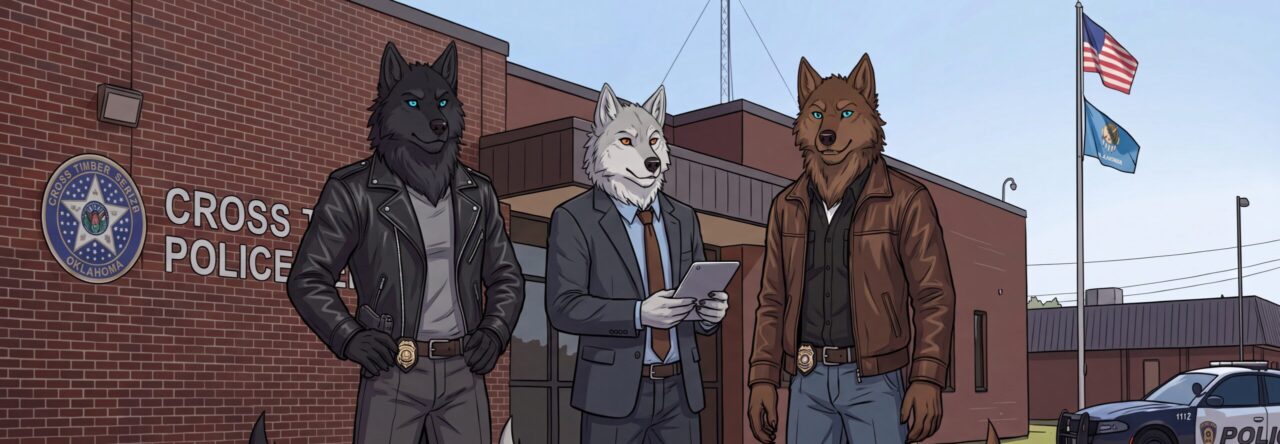
The detective exam’s practical portion began in a hallway with too many closed doors.
Thane stood between Gabriel and Mark beneath a row of laminated signs taped neatly to the walls.
ORAL BOARD
MOCK WITNESS INTERVIEW
TESTIMONY EVALUATION
JUDGMENT SCENARIO
CANDIDATE WAITING AREA
The signs made the police department feel less like a station and more like a courthouse that had decided nobody in it deserved peace.
Gabriel looked down the corridor.
“This feels less like an exam and more like a building that wants to deny us insurance.”
Mark studied the printed schedule in his hand.
“Thirty minutes per section is objectively insufficient.”
Gabriel glanced at him.
“That sentence visibly hurts you.”
“It is a fact.”
Thane said nothing.
He had been quiet since they left the cabin.
Not tense in the way he was before a difficult patrol call. Not alert. Not waiting.
Just contained.
The Humvee sat outside in the lot, locked beneath the gray morning sky. Thane had driven them, of course. It was his vehicle. His hands had stayed steady on the steering wheel. His turns had been smooth. His lane changes clean.
But Gabriel had noticed the silence.
Mark had noticed the silence.
Neither had said anything.
The detective process had started a week earlier with pencils, case files, and enough paper to make Thane suspicious of civilization. Today would be different.
No written answers to revise.
No page to cross out.
No time to sit with a question until it stopped feeling like a trap.
Today they would have to answer in the room.
Sergeant Hale appeared at the end of the corridor with a coffee cup in one hand and a thin stack of folders in the other.
“No discussing answers.”
Gabriel looked at him.
“We were discussing emotional preparation.”
“Prepare emotionally in silence.”
Gabriel nodded.
“Understood.”
Hale handed each of them a small white card.
Different station orders.
Different reporting times.
Different rooms.
No pack support.
No glances across the table.
No quiet corrections under the breath.
Thane looked down at his card.
TESTIMONY EVALUATION — 0900
MOCK WITNESS INTERVIEW — 0945
CASE DEFENSE — 1030
JUDGMENT SCENARIO — 1115
Gabriel read his own.
“Witness interview first,” he murmured. “That seems unfairly on-brand.”
Mark looked at the schedule on his card.
“Oral board.”
Gabriel smiled.
“You have fun.”
“I will not.”
“You will have the best time anyone has ever had being interrogated by municipal leadership.”
Mark’s ears went flat.
“Please stop.”
Hale looked between them.
“Separate doors. Now.”
The three of them stood there one moment longer.
Thane looked at Gabriel.
Gabriel’s blue eyes were bright, but not carefree. The humor was there because Gabriel always found a place to put it. But beneath it was nerves. Real ones.
Mark’s posture was exact. His uniform was spotless. His folder was held too carefully.
They were ready.
They were frightened.
They were each pretending the other two could not tell.
Then Hale said, “Move.”
And the pack separated.
Priya Shah had arranged the testimony room like a courtroom because she enjoyed making things difficult.
At least, that was what Gabriel had once said.
Thane had not believed it until now.
A table stood at the front of the room. A chair faced it alone. Priya sat behind the table with a file open in front of her. Beside her sat an outside evaluator from the county district attorney’s office, a broad-shouldered woman with silver hair and a nameplate that read MELISSA CARVER.
Hale stood at the back wall.
Not helping.
Not judging visibly.
Just there.
Thane entered, closed the door behind him, and sat in the chair.
Priya looked up.
“Officer Thane.”
“Ma’am.”
“This is a fictional scenario. You are not being evaluated on whether you know the anticipated answer. You are being evaluated on whether you can explain what you know, what you do not know, and why that difference matters.”
“Yes, ma’am.”
Priya slid a report toward him.
The scenario was familiar in structure.
A patrol officer had responded to a suspicious vehicle parked near a closed construction site. The officer had detected an unfamiliar chemical odor and a scent consistent with fresh gun oil near a drainage channel behind the site. The officer documented the observation, notified a supervisor, and an evidence technician later recovered a firearm from a shallow depression within the lawfully searched area.
Carver folded her hands.
“Officer, are you asking a jury to trust your nose?”
Thane met her eyes.
“No.”
Carver waited.
Thane continued.
“I am asking them to evaluate evidence recovered through lawful investigation. The officer’s observation was documented as an observation. It helped identify an area that required attention. It did not prove what was there.”
Priya leaned forward slightly.
“So your senses do not replace evidence?”
“No.”
“They do not create probable cause by themselves?”
“Not by themselves.”
“They do not make you more credible than any other witness?”
Thane considered the question.
“No,” he said. “They make me responsible for being more precise.”
Carver’s expression did not change.
But Priya’s pen paused.
“Explain.”
“I can notice something other officers might not. That does not mean I get to claim more than I know. If I smell gun oil, I say I detected an odor consistent with gun oil. I do not say there was definitely a firearm. If an evidence technician finds a firearm after that, then the firearm is evidence. My observation is part of how we got there. It is not the conclusion.”
Priya turned a page.
“What if defense counsel says your unusual senses make your testimony unfairly persuasive?”
“Then I explain exactly what I perceived and exactly what I did not know at the time. The evidence still has to stand on its own.”
“And if it does not?”
“Then it does not matter how certain I felt.”
The room stayed quiet.
Hale took a sip of coffee.
Priya asked questions about warrants. Scene boundaries. Documentation. Body-camera footage. The line between sensory observation and unsupported inference.
Thane answered each one cleanly.
Not quickly.
Not slowly.
He had learned that a pause did not always mean weakness.
Sometimes it meant he was choosing the truth before the answer.
At one point, Carver asked, “Would you ever omit a sensory observation because you were afraid a jury might misunderstand it?”
“No.”
“Why not?”
“Because it happened.”
“And if it creates confusion?”
“Then I explain it clearly. I do not hide facts to make a report easier.”
Priya closed the file.
“Thank you, Officer.”
Thane stood.
“Thank you.”
He did not know whether he had done well.
But he knew he had not lied.
For that part, he was proud.
Mark’s oral board began with a question designed to make him want to answer six questions at once.
The panel sat behind a conference table.
Mercer in the center.
Priya to one side.
Carver to the other.
A fourth evaluator sat at the far end, an investigator from the Oklahoma County Sheriff’s Office named Lieutenant Fields. He was older, quiet, and wore the expression of someone who had heard every answer people rehearsed in mirrors.
Mark sat alone across from them.
Mercer opened a folder.
“Officer Mark. You are assigned a burglary case. A witness identifies a suspect after viewing a social-media post that names that person. Stolen property is later recovered from a shared apartment. One roommate has an alibi. The other refuses to speak. What is your first priority?”
Mark began to answer.
“The first priority is to preserve the recovered property, identify the chain of possession, clarify the social-media exposure, separate the witnesses, determine whether the witness—”
Priya lifted one finger.
“One answer, Officer.”
Mark stopped.
His ears shifted back.
He looked down at the table for a fraction of a second.
Then up.
“Preserve the identification circumstances and separate the witnesses,” he said. “The social-media exposure may affect the statement, and I need to know what was independently observed before I treat the identification as reliable.”
Fields nodded once.
“What would make you abandon your suspect theory?”
Mark’s answer came more easily.
“Evidence that the identification, possession timeline, plate information, or access to the recovered property cannot be independently connected to that person. The identification is a lead, not a conclusion.”
Mercer looked at him.
“Why does that distinction matter?”
“Because a conclusion narrows the investigation. A lead directs it. If I treat an untested lead as a conclusion, I can miss the evidence that proves the lead is wrong.”
Carver turned a page.
“The witness is overwhelmed. They jump around in time, mention an employee they dislike, tell you about a divorce from fifteen years ago, and refuse to answer direct questions. What do you do?”
Mark had a complete answer.
He had a system.
He had a list of steps.
He could feel all of it rise at once.
Then he remembered the morning in the hospital entrance, the blocked ambulance lane, the impatient drivers, the need to choose the next correct thing before the whole scene became a knot.
He answered simply.
“I let them tell me what happened from the moment they first noticed something was wrong. I will ask about details after.”
Fields leaned forward.
“You let them ramble?”
“I let them establish a narrative. Then I clarify sequence, identify what is directly observed, and separate facts from interpretation.”
“And if they keep blaming the employee they dislike?”
“I document the allegation. I do not adopt it.”
Mercer’s expression gave nothing away.
Priya opened another file.
“Officer, you created a timeline chart for a complicated investigation. Defense counsel asks whether you are asking the court to accept your conclusion because you made a chart.”
Mark’s ears shifted.
“No,” he said. “The chart proves nothing. It organizes independently documented facts so the sequence can be evaluated clearly.”
“And if the chart is wrong?” Priya asked.
“Then the underlying records should show it. The chart is not evidence. It is a tool.”
“Why make one at all?”
“Because investigators and jurors are people. Complex facts are easier to evaluate when they are organized honestly.”
Carver watched him for a long moment.
Then said, “Thank you, Officer.”
Mark left the room with his heart beating too fast and the conviction that he had said at least three things badly.
He found the waiting area, sat in an empty chair, and stared at the carpet.
Cass came out of another room a minute later.
She glanced at him.
“You look like you are calculating the percentage chance you said something wrong.”
Mark blinked.
“I am not calculating a percentage.”
Cass sat two chairs away.
“That was not a denial.”
Mark looked at the closed oral-board door.
“Thirty minutes is insufficient for accurate self-assessment.”
Cass’s mouth shifted.
“Probably.”
Gabriel’s mock witness interview took place in a small training room with a camera mounted in one corner and an evaluator seated behind a glass panel.
The role player sat across from him at a plain table.
A woman in her late twenties, hair tied back, hands clenched around a paper cup. She looked exhausted in a way that had been carefully practiced.
The scenario file said she was an employee at a small retail store. She had seen an assault and robbery. The suspected offender had been in the store for less than a minute. She was afraid he would find out she had talked to police.
Gabriel sat down across from her.
He did not smile too brightly.
He did not lean in.
He gave her space.
“My name is Gabriel. You are not in trouble.”
The woman looked at him.
“Do I have to do this?”
“I cannot tell you what happens later,” Gabriel said. “But I can tell you what happens right now. I want to understand what you saw in your own words.”
Her shoulders tightened.
“He is going to know I told you.”
“I cannot promise what he will or will not learn through a case,” Gabriel said. “But I can make sure I write down what you tell me accurately. I can also make sure you know who to contact if you are worried about safety.”
The woman looked at the paper cup.
“I just saw him come in.”
“What was the first thing you noticed?”
“He was angry.”
Gabriel waited.
“What did you see that made you think he was angry?”
She looked up at him.
“He was moving fast. His shoulders were up. He kept looking at the counter.”
“What happened after that?”
“He yelled at Malik. The cashier.”
“What did you hear?”
“He said, ‘Give me the money.’ Then he hit him.”
“With what?”
“A knife.”
Gabriel held still.
“When you say knife, what did you actually see?”
The woman frowned.
“Something shiny.”
“Did you see a blade?”
“No. I saw metal. It was quick.”
“Okay. So you saw a metallic object. You are not sure whether it was a knife.”
She nodded slowly.
“No. I guess I am not sure.”
“That is okay. I would rather know what you are sure of.”
The woman’s shoulders dropped by a fraction.
Gabriel continued.
“What made you look toward him?”
“The yelling.”
“What did he look like?”
She gave a description.
Height, maybe.
Build, maybe.
Jacket color.
Dark hair.
No, perhaps a hat.
Yes, maybe a hood.
Everything uncertain.
Everything still useful if it stayed honest.
When she asked whether she would have to testify, Gabriel did not tell her no.
He did not tell her she would be safe.
He told her the truth.
“I cannot promise what will happen. I can tell you that prosecutors and victim advocates can explain your options. Right now, you are helping us understand what happened.”
The interview ended.
The role player left through a side door.
Gabriel stayed seated for one extra breath.
Then stood.
The evaluator’s door opened.
Carver entered with a clipboard.
“You did not reinforce her certainty about the weapon.”
“No.”
“Why?”
“Because she did not have certainty. She had fear.”
Carver nodded.
“And fear is?”
“Important. But not the same thing as a fact.”
Carver made a note.
Gabriel tried not to look pleased.
He failed a little.
Thane’s mock witness interview was harder in a different way.
The role player was a man in his fifties, broad-shouldered, red-eyed, and visibly furious before Thane sat down.
The scenario: the man’s adult daughter had disappeared after an argument with her boyfriend. The father believed the boyfriend had hurt her and wanted him arrested immediately.
The father slammed both hands onto the table.
“You need to get him.”
Thane sat across from him.
“I need to understand what happened.”
“He did something.”
“What do you know?”
“I know he hurt her.”
“What did you see?”
The man glared at him.
“You people always do this.”
“Do what?”
“Make me prove it before you care.”
Thane felt the instinct in the man.
The raw need for a target.
The fury that came from being powerless while someone you loved might be in danger.
He knew that instinct.
Too well.
“I care,” Thane said. “That is why I need facts. Tell me the last time you spoke to her.”
The man looked away.
“Yesterday morning.”
“What did she say?”
“She said they had a fight.”
“Exact words.”
The man’s face twisted.
“She said he was ‘being impossible.’ That he kept asking where she was. Who she was with.”
“Did she say he threatened her?”
“No.”
“Did she say he hit her?”
“No.”
“Did she tell you she was afraid?”
The man was silent.
“Did she have a vehicle?”
“Yes.”
“What kind?”
“White Kia. Older one. She has a crack in the windshield.”
“Phone?”
“iPhone.”
“Location sharing?”
“I do not know.”
“Friends? Coworkers? Places she goes when she is upset?”
The father rubbed both hands over his face.
“Her friend Tessa. She goes to a lake road sometimes. The old boat ramp.”
“Did she tell anyone she was going there?”
“I do not know.”
“Who saw her last?”
The man looked up at Thane.
“You are not going to arrest him.”
“Not until I know what I can prove.”
“He did this.”
“Maybe,” Thane said. “But I need to know before I build everything around him.”
The sentence came out before Thane understood why it mattered.
The father stared at him.
Then nodded once.
Not agreement.
Not peace.
Just the beginning of giving him what he needed.
The interview continued.
Locations.
Texts.
Friends.
Phone carriers.
Previous reports.
A small piece of information at a time.
When it ended, Thane stood and felt the room remain inside him.
The father’s anger had been easy to understand.
The harder thing had been refusing to let it decide the case.
The case defense came last.
Thane knew it as soon as he entered the room.
The Kestrel Motors fire packet sat in front of Mercer, Priya, Carver, and Fields.
His written plan rested beside it.
The one he had gone over in his head every night since the exam.
The one where Damon Pike sat at the top.
Mercer looked at him.
“Officer Thane. Who is your primary investigative focus?”
Thane sat.
“Damon Pike.”
“Why?”
“Pike sent threatening messages to the owner. He knew the building layout and alarm system. His vehicle was captured near the relevant time. He had a recent employment conflict and possible motive.”
“Reasonable,” Mercer said. “What facts complicate that theory?”
Thane answered.
“The traffic footage may show Pike traveling away from the dealership. The internal camera system was disabled from inside the office. The owner had recently increased insurance. There were missing title files that may indicate a financial motive. The security guard heard two voices arguing before he was struck.”
Fields leaned forward.
“Why is Pike still your primary focus?”
“Because the available facts put him closest to direct involvement.”
Priya turned a page in his report.
“Your action plan prioritizes Pike’s phone, Pike’s vehicle, Pike’s clothing, Pike’s messages, and Pike’s alibi. Why are the owner’s insurance records and alarm-system logs lower?”
Thane looked at the page.
“Because Pike is the most immediate lead.”
Mercer’s voice stayed calm.
“Most immediate, or most persuasive?”
The words landed harder than they should have.
Thane’s ears shifted back.
“Both.”
Fields looked at him.
“Those are not necessarily the same thing.”
Thane held still.
Priya tapped the report.
“You note that the owner increased the policy six weeks before the fire. You note the camera disablement came from inside. You note the title-file discrepancy. Why are those not equal first-day priorities?”
“The financial records and alarm logs should be preserved immediately,” Thane said.
“But you did not prioritize them equally,” Priya said.
“No.”
“Why?”
Thane looked at the reports.
At Pike’s threats.
At the traffic camera.
At the building familiarity.
At the answer he had reached quickly and held onto because it made sense.
“Because Pike looked like the person who did it.”
Mercer nodded once.
“Maybe he was.”
The room waited.
Mercer continued.
“The security guard is now more alert. He remembers one of the voices saying, ‘You said no one would get hurt.’ The voice may have belonged to the owner.”
Thane felt the scenario shift.
“You have Pike’s vehicle secured,” Mercer said. “The owner is available for interview. The guard’s statement may change. What do you do first?”
The answer rose in him.
Pike.
Secure Pike’s phone. Check Pike’s car. Verify Pike’s route. Lock down the lead before it changed.
He heard himself almost say it.
Then stopped.
“I preserve the guard’s statement,” he said. “I preserve the alarm logs. I interview Pike and the owner separately.”
Priya nodded.
“In what order?”
Thane’s mind moved too fast.
The guard could lose memory. The logs could be overwritten. Pike could destroy evidence. The owner could shape a story. The fire scene could change. The insurance records could move.
Every fact mattered.
Every path mattered.
And suddenly he could see that his written plan had treated some of them as roads leading toward Pike, not roads that might lead somewhere else.
“In—” Thane began.
He paused.
Too long.
Fields watched him.
Mercer did not rescue him.
Finally Thane said, “I preserve the guard’s statement first. Then the alarm logs. Then I separate and interview Pike and the owner.”
“Why the guard first?”
“Because memory can change.”
“And the alarm logs?”
“Because they may be overwritten.”
“And Pike?”
“Because he is still a possible suspect.”
“Possible,” Mercer said.
Thane nodded.
“Possible.”
It was a better answer.
But he knew it had come after the panel had forced him to the edge of it.
He left the room feeling neither failed nor successful.
He had been seen.
Not as the wolf who took a bullet.
Not as the officer who found a woman in floodwater.
Not as the person who criminals recognized and feared.
As a candidate with an answer that arrived too early.
The judgment scenario was worse because it did not give anyone enough time to be certain.
A violent-felony suspect might be leaving town.
A witness was unstable.
A warrant application was incomplete.
A digital account could delete itself remotely.
The victim’s family was demanding immediate answers.
Every candidate received the same prompt.
Every candidate had ten minutes.
Mark went first.
He assigned parallel tasks through command.
Preserve the digital account through an emergency request.
Protect the witness’s spontaneous statement.
Complete the warrant application with the facts already available.
Send patrol to watch—not stop—the possible fleeing suspect until legal authority was clear.
Contact the family with an honest update and a named point of contact.
Fields asked him, “What do you let wait?”
Mark answered, “Anything that does not disappear before the next unit arrives.”
Gabriel’s scenario was next.
He prioritized victim safety, the unstable witness’s first statement, and a clear boundary with the family.
“I do not give them an answer I do not have just because silence feels cruel,” he said.
Priya’s pen paused again.
Thane’s scenario came last.
He identified the digital evidence risk.
The potential flight risk.
The need to protect the witness.
But he spoke about the likely suspect first.
Fields asked him, “What if the suspect is not the person who harmed the victim?”
Thane answered, “Then we need to know before we build the rest of the case around him.”
It was true.
It was good.
But it came after the question.
After the prompt.
After someone else had made him say what should have been at the center of his answer.
When Hale dismissed him, Thane walked out into the hallway and found Gabriel waiting near the water cooler.
Gabriel looked him over.
“You look like you fought a filing cabinet.”
Thane looked at him.
“Did you do well?”
Gabriel’s expression shifted.
“Not discussing answers.”
“Right.”
Gabriel tilted his head.
“You?”
“Not discussing answers.”
“Fair.”
Mark came out of the oral-board room a few minutes later.
He looked pale.
Gabriel immediately said, “You look like you calculated your own death.”
Mark blinked.
“I did not.”
“That was not a no.”
Hale appeared down the hall.
“All candidates are dismissed. Results will be delivered Tuesday. Go home. Do not find each other in the parking lot and compare answers.”
Gabriel raised one hand.
Hale closed his eyes.
Gabriel lowered it again.
“Nothing.”
Tuesday came too quickly.
The score packets waited face down in the conference room.
No public ranking board. No names projected on a wall. No dramatic row of chairs.
Just a long table.
Ten sealed envelopes.
Mercer stood at the head of the room. Crowe leaned against the far wall. Priya sat nearby with her aligned pens. Hale stood beside the door. Voss and Rusk watched from the side, neither of them smiling.
The candidates sat.
Thane sat between Gabriel and Mark.
He could smell them both.
Gabriel’s nerves were sharp and bright.
Mark’s anxiety was quieter, contained beneath paper, coffee, and the faint electrical smell of the phone charger in his pocket.
Thane’s own scent was flat.
He hated that.
Mercer spoke.
“The eligibility cutoff is eighty. Candidates who meet or exceed it will be placed on the detective eligibility list. Candidates who do not may retest after six months, provided they remain in good standing.”
No one moved.
Mercer looked around the table.
“This process is not a judgment of your worth as officers. It is an evaluation of readiness for a specific kind of work. Read your packet. Individual feedback will follow.”
The envelopes opened.
Paper tore softly.
Mark looked down first.
His eyes moved once.
Then stopped.
Gabriel leaned toward him.
“Top of the class?”
Mark did not look up.
“I do not know everyone else’s score.”
Gabriel leaned closer.
“That was not a no.”
Mark’s score sheet read:
SCORE: 96.0
RESULT: ELIGIBLE
For a second, Mark did not breathe.
Then he looked at the feedback.
Evidence discipline.
Legal reasoning.
Organization.
Clear investigative priorities.
Strong recognition of unknowns and contradictions.
Concise, usable written work.
One improvement note waited at the bottom.
Continue practicing concise verbal presentation under time constraints.
Mark looked personally offended.
Gabriel saw it.
“They said you talk too much.”
“They did not.”
“They said it in administrative language.”
Mark looked at him.
“You are not allowed to be mean today.”
Gabriel put a hand over his chest.
“I have not even opened mine.”
Then he did.
His smile appeared immediately.
He tried to hide it.
Failed.
SCORE: 87.5
RESULT: ELIGIBLE
The feedback praised his interview discipline, witness-centered judgment, rapport without improper influence, and honest self-awareness.
The improvement note read:
Avoid over-investing in relational sequencing when rapid operational decisions are required.
Gabriel stared at it.
“They are saying I talk too much.”
Mark looked at him.
“In administrative language.”
Gabriel pointed at him.
“You got ninety-six. You have surrendered your right to sarcasm for twenty-four hours.”
Mark folded his packet.
“I do not believe that is enforceable.”
Thane had not opened his envelope yet.
He could hear Gabriel’s breath shift.
Could smell Mark’s pleased disbelief.
Could see their packets on the table, both marked with the same word.
ELIGIBLE.
He was proud of them.
He was.
The feeling existed.
Small.
True.
Buried beneath something hotter.
He opened his envelope.
The number sat at the top of the page.
SCORE: 78.5
RESULT: NOT ELIGIBLE — RETEST AVAILABLE IN SIX MONTHS
For one second, the words did not mean anything.
Then they did.
Thane read them again.
The number did not move.
Seventy-eight point five.
One and a half points beneath the line.
His eyes moved down the page.
Strengths: Calm under pressure. Strong ethics and use-of-force reasoning. Precise sensory documentation. Effective witness handling. Sound evidence-preservation instincts.
Then the part that mattered.
Development required: Broaden investigative theories earlier. Give contradictory evidence equal weight. Distinguish a strong lead from a sufficiently tested conclusion. Articulate why alternate paths must be preserved before narrowing focus.
The room had changed.
He could smell it.
Gabriel’s happiness had stopped.
Mark’s satisfaction had folded into concern.
The other candidates kept reading their own results, but the sound of paper seemed too loud.
Mercer approached Thane’s place at the table.
Not making a spectacle.
Not lowering his voice so much that it became pity.
Just speaking directly.
“You found a suspect,” Mercer said. “We asked you to build a case.”
Thane’s ears lowered.
“I know.”
“You were not wrong because Pike was a bad lead. You were incomplete because every road in your plan led back to proving Pike right.”
“He was the likely suspect.”
Mercer nodded.
“Probably.”
Thane looked up.
Mercer’s expression stayed steady.
“But detectives do not get to want the likely answer harder than the facts support it.”
The words landed somewhere raw.
Mercer continued.
“You did not fall short because you were wrong. You fell short because you stopped testing whether you were right.”
Thane looked at the packet.
His hands were steady.
Too steady.
“Yes, sir.”
Mercer rested one hand on the table edge.
“Six months is not forever.”
Thane did not answer.
Mercer nodded once and moved away.
The meeting ended without celebration.
Candidates who qualified were told where to report for eligibility-list paperwork. Candidates who had not were offered supervisor follow-up and retest guidance.
Mark kept looking at Thane.
Gabriel did too.
Thane could smell the concern beginning before either of them said anything.
And beneath his own fur, beneath the clean uniform fabric and the paper in his hands, something else was rising.
Hot.
Bitter.
Shame, first.
Then anger.
Then something sharp enough to make the air around him feel wrong.
Mark noticed it first.
His ears shifted backward.
He did not look at Thane directly. He just folded his score packet once and held it in both hands.
Gabriel noticed a moment later.
He saw Thane’s jaw set.
Saw the way his claws pressed lightly against the table edge.
Gabriel did not understand what he was smelling.
Not fully.
He thought Thane needed air.
Normal words.
A way out of the awful silence.
Thane stood.
“Let’s go.”
His voice was flat.
Mark rose quietly.
Gabriel folded his packet.
“Yeah.”
No one said congratulations.
Not yet.
Maybe not ever.
Outside, the Humvee waited in the parking lot.
Thane drove.
Of course he drove.
Gabriel sat in the passenger seat. Mark climbed into the rear with the score packets folded in his lap.
The first few minutes passed in silence.
The Humvee moved through Cross Timber with its usual heavy, steady growl.
Thane did not drive fast.
He did not drive recklessly.
He drove too carefully.
Every stop exact.
Every turn clean.
Both hands fixed on the wheel.
No music.
No radio.
No comments about traffic.
No argument when Mark checked the route even though there was only one route home.
Mark watched Thane’s shoulders.
Gabriel watched the side of Thane’s face.
The anger in the cab grew heavier.
Gabriel finally tried to make the air move.
“Well,” he said lightly, “Detective Mark, try not to make us call you sir.”
Mark looked at him.
“Do not.”
Gabriel glanced at Thane.
“We will still let you sit with us at lunch, Officer.”
Thane said nothing.
Mark’s ears lowered.
“Gabriel.”
Gabriel heard the warning.
But he misread it.
He thought Mark was trying to protect Thane’s pride.
He thought Thane needed the normal pack rhythm. A little teasing. A little proof that nothing had changed between them.
So he kept going.
“It is fine,” Gabriel said. “Every detective team needs someone who can carry evidence boxes and intimidate the copier.”
Mark’s voice sharpened.
“Gabriel. Stop.”
Thane did not turn his head.
Did not glare.
Did not growl.
That was worse.
His scent was changing now.
Not disappointment.
Not sadness.
Anger sat under it.
Resentment.
A hot, sour edge that made Mark’s fur rise along his shoulders.
Gabriel finally stopped smiling.
The rest of the ride passed without another word.
When they reached the cabin, Thane parked the Humvee perfectly.
Not half over a line.
Not angled across the gravel.
Perfectly centered beneath the carport.
Mark noticed.
It was the kind of control that meant the rest of him was barely holding together.
Thane got out before either of them spoke.
He went inside without waiting.
The great room was warm and familiar.
Heavy timber beams.
The long couch.
The stone fireplace dark for the afternoon.
A half-finished puzzle on the wide coffee table because Gabriel had insisted it was “a low-pressure pack activity” and Mark had then organized the edge pieces by color.
Thane walked through the room without taking off his duty belt.
Without setting down the score packet still clenched in one hand.
He headed toward the hall.
Gabriel followed.
“Thane.”
No answer.
Mark stayed near the door, one hand still on the strap of his patrol bag.
Watching.
Gabriel took another step.
“Hey.”
Thane stopped at the mouth of the hall.
His back stayed turned.
Gabriel looked at Mark.
Mark’s eyes had gone wide.
A silent warning.
Do not.
Gabriel saw it.
And still thought silence was more dangerous.
Still thought a joke could pull Thane back.
“Look at it this way,” Gabriel said, trying to smile. “When Mark and I make detective, we can always request you as our emotional-support patrol wolf.”
Thane turned.
There was no warning.
No sarcastic reply.
No growl first.
One moment Gabriel stood in the center of the great room.
The next, Thane was on him.
Gabriel barely had time to step backward before his shoulders struck the wall beside the fireplace.
Thane’s hand closed around his throat.
Not claws.
Not piercing.
But enormous and absolute.
Gabriel’s feet barely found the floor.
The score packet fell from Thane’s other hand and fluttered onto the hardwood.
Gabriel’s hands went to Thane’s wrist.
Not fighting.
Not trying to make it worse.
Just trying to breathe.
For the first time in all the years they had known each other, Gabriel was not impressed by Thane’s strength.
He was afraid of it.
Thane’s eyes were wide.
Blue gone dark.
His fur stood along his shoulders.
His voice came out low and rough.
“You think you are better than me because you got a number on a piece of paper?”
Gabriel tried to answer.
No sound came.
Mark moved.
“Thane. Stop.”
He crossed the room fast and reached for Thane’s shoulder.
The touch barely landed.
Thane reacted without thinking.
A violent turn.
A sharp movement of shoulder and hip.
Mark was suddenly airborne.
He hit the couch hard enough to knock the breath from him, one arm catching the edge as he landed twisted against the cushions.
The impact made the whole room go silent.
Gabriel’s eyes widened.
Mark lay there for one stunned second, staring at Thane as if he did not recognize him.
Thane turned back.
The anger broke open.
Not the anger he had learned to control.
Not the fierce, focused thing that came during a call and sharpened into action.
This was older.
Ugly.
Fear dressed in teeth.
“I am stronger than both of you combined,” Thane shouted.
Gabriel’s claws scraped against Thane’s wrist.
Thane did not seem to notice.
“I am the one who stands in front when things go bad.”
His voice shook the timber walls.
“I am the reason people stop pulling guns.”
Mark pushed himself upright on the couch, one hand pressed against his ribs.
“Thane—”
“I deserve to be a detective!”
The words came louder.
Rawer.
“I deserve more than you.”
Gabriel stared at him.
Not angry.
Just scared.
That was what finally reached Thane.
Gabriel’s fear.
Mark’s fear.
The smell of it, sharp and undeniable in the room.
Not from suspects.
Not from strangers.
From his pack.
From the two people who had trusted him more than anyone.
Thane’s grip loosened.
Gabriel dropped to the floor against the wall, coughing hard, one hand pressed to his throat.
Thane stepped backward.
His chest heaved.
His claws flexed once.
Then went still.
The anger folded inward so quickly it almost looked like pain.
He looked at Gabriel.
At Mark.
At the score packet on the floor between them.
Then he looked away.
“Forget it,” he said.
The words came out broken.
He backed toward the hallway.
Mark did not move.
Gabriel did not speak.
Thane turned, went down the hall, entered his bedroom, and slammed the door hard enough to shake the cabin.
The silence afterward was worse than the shout.
Gabriel stayed on the floor with his back against the wall.
His breathing was uneven.
Mark sat half-upright on the couch, one hand still braced against his side.
Neither of them looked toward the hallway at first.
Neither spoke.
The fireplace stones seemed too close.
The cabin felt too large.
Too empty.
Finally, Gabriel swallowed hard and whispered, “That was not him.”
Mark looked toward the closed bedroom door.
His eyes were wide.
His voice was quiet.
“It was.”
The room went still again.
And for the first time, neither of them knew whether they were safe walking past Thane’s door.