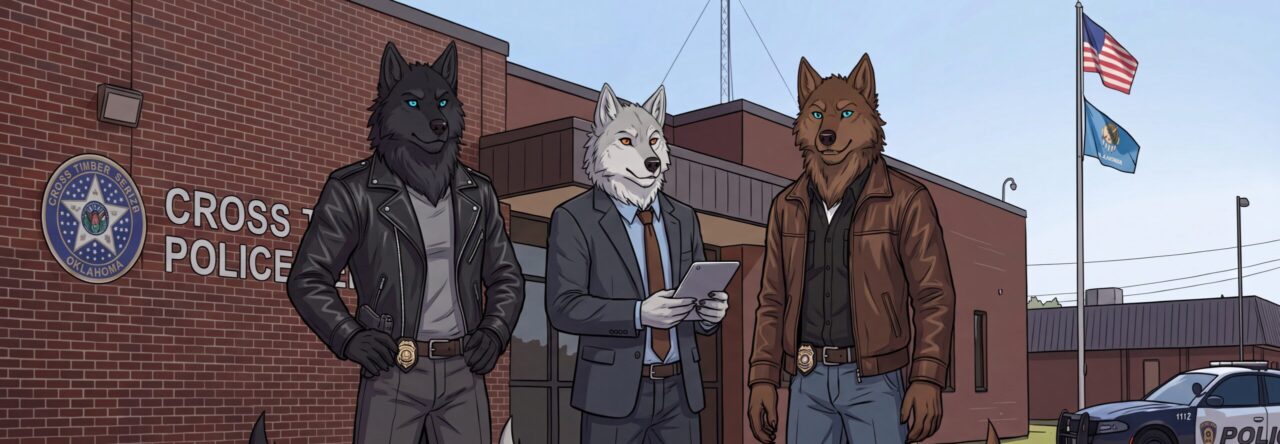
Thane woke with his uniform still on.
For several seconds, he did not know why.
The room was gray with early morning. Rain pressed softly against the bedroom windows. His duty shirt was wrinkled beneath him. His score packet rested on the floor beside the bed.
Then memory returned.
Not all at once.
Gabriel’s voice.
Emotional-support patrol wolf.
The hot, immediate certainty that they were laughing at him.
The wall.
Gabriel’s hands at his wrist.
Mark saying his name.
Mark flying backward.
The sound of him hitting the couch.
And then—
Gabriel’s fear.
Mark’s fear.
The smell of both of them, sharp in the great room, cutting through everything else.
Thane sat upright too quickly.
The cabin was quiet.
Not normal quiet.
There was no music low in the kitchen. No irritated clicking from Mark’s keyboard. No coffee grinder. No Gabriel singing badly to himself while he looked for something to eat.
There was sound, but it was careful sound.
A cabinet closing softly.
A mug set down with too much control.
Someone moving down the hall, stopping, then moving again.
They were awake.
They knew he was awake.
And they were measuring where he was.
Thane sat on the edge of the bed, both hands hanging between his knees.
He could smell the distance.
Gabriel’s scent was subdued beneath coffee and soap, but the fear was still there. Not panic. Not fresh terror. Something worse in a way—controlled fear. The kind a person held onto because they did not know whether they needed it.
Mark’s was tighter.
Pain. Caution. Anger pressed flat beneath the careful order of his morning routine.
Thane closed his eyes.
The detective score had hurt.
That much had been true.
It had hurt because Mark had passed. Because Gabriel had passed. Because they had stepped through a door he had wanted so badly, and he had been left standing on the other side of it with seventy-eight point five points and six months of waiting.
But that was not what he had done.
Gabriel had made a joke.
Mark had tried to stop him.
Thane had chosen to hurt them.
The thought did not soften because he said it honestly.
It only became clearer.
He stood.
For a moment, he reached automatically toward his duty belt.
Then stopped.
The belt sat on the dresser where he had dropped it the night before. Badge. radio. holster. Everything that had meant he was allowed to carry power into other people’s worst moments.
He left it there.
When he opened his bedroom door, he did it slowly.
The great room was washed in cold morning light.
Gabriel sat at the far end of the couch with a mug held in both hands. He wore a loose dark shirt and sweatpants. There was faint discoloration beneath the fur at his throat, visible only because Thane knew where to look. His voice would probably be rough today.
Mark stood at the kitchen counter rather than sitting at the table. He held one arm closer to his side than usual. His face was composed in the way it became when composition was the only thing he trusted.
Both looked up.
Neither moved toward him.
Neither smiled.
Thane stopped several feet from the end of the couch.
He did not come closer.
For a few seconds, he could not make words happen.
Then he did.
“I put my hands on you.”
Gabriel’s fingers tightened around the mug.
Thane looked at Mark.
“I threw you.”
Mark did not nod.
Did not need to.
“You made a joke,” Thane said, his voice low. “I chose to hurt you. That was mine. Not yours.”
Gabriel looked down into his coffee.
Thane continued.
“I made both of you afraid.”
His throat tightened around the next words.
“I will not say I was upset like that explains it. I will not say you pushed me. I will not say I did not mean it. I did it.”
The rain ticked quietly against the glass.
“You do not have to forgive me today,” Thane said. “You do not have to be near me today. You do not have to pretend it did not happen.”
Gabriel finally looked at him.
His voice was rough.
“I was scared of you.”
Thane held still.
Gabriel’s blue eyes did not leave his.
“Not for one second. Not because you yelled.” He swallowed. “I was scared you were going to keep going.”
The words struck harder than Mercer’s score sheet.
Harder than not eligible.
Harder than six months.
Thane’s ears lowered.
“I know.”
Gabriel shook his head once.
“No. You do not get to say that like it makes it finished.”
Thane nodded.
“You’re right.”
Mark spoke from the counter.
His voice was quiet.
Thane looked at him.
Mark’s brown eyes were steady and furious.
“The Alpha is supposed to make the pack safer,” he said. “You did the opposite.”
The cabin seemed to narrow around the sentence.
Thane did not defend himself.
“Yes.”
Mark set his untouched coffee down.
“Here is what happens today.”
Thane waited.
“You do not patrol. You report what happened to Crowe. You tell her the truth.”
“We take the Xterra to our detective rotation.”
Thane felt something twist beneath his ribs.
The Xterra was what Mark and Gabriel took when Thane was not with them.
“You do not follow us to the station,” Mark continued. “You do not wait in the lot. You do not treat us taking distance as rejection.”
“Yes.”
“You do not come into a room after either of us tells you to leave.”
“Yes.”
“You do not touch either of us unless we ask you to.”
“Yes.”
Mark’s expression did not soften.
Gabriel watched him for a long moment.
Then said, “I should have stopped when Mark told me to stop.”
Thane looked at him.
Gabriel’s mouth twisted.
“I heard him. I knew you were upset. I thought I could fix it by being funny.” He looked down. “I was wrong.”
“You did not make me do that,” Thane said.
Gabriel’s eyes lifted.
“No,” he said. “I didn’t.”
Thane nodded.
“No.”
The word sat there.
Clear.
Unshared.
No place to hide.
Mark picked up his keys from the counter.
Gabriel rose slowly from the couch.
The movement made Thane tense in a way he hated. He forced himself not to step forward. Not to offer help. Not to ask whether Gabriel’s throat hurt.
That was not his right this morning.
Gabriel noticed the effort.
His expression changed by a fraction.
Not forgiveness.
Not yet.
But he noticed.
Mark passed Thane without brushing against him.
Gabriel followed.
At the front door, Gabriel paused.
Thane stood in the middle of the great room with his hands open at his sides.
“I’ll call Crowe,” he said.
Mark nodded once.
“Do that.”
Then they left.
The Xterra started in the garage.
Thane stood near the front windows, watching through the rain-streaked glass as Mark backed it carefully down the drive.
Gabriel sat in the passenger seat.
No music.
No argument.
No laughing about the detective score.
No Thane behind the wheel of the Humvee, pretending he hated how Mark navigated when they both knew Mark had memorized every road in Cross Timber.
The Xterra rolled through the trees and disappeared.
Gabriel looked back once through the passenger window.
Not angry.
Not warm.
Uncertain.
That uncertainty hurt more than anything.
Thane stayed at the window until the sound of the engine was gone.
Then he turned back to the empty cabin.
The great room looked wrong without them.
The couch where Mark had landed still held a crooked throw pillow. Gabriel’s mug sat on the coffee table, half full. A faint impression marked the wall beside the fireplace where Gabriel’s shoulders had hit.
Thane stared at it.
Then picked up his phone.
Crowe answered on the second ring.
“Thane.”
“I need to report something.”
Her voice changed immediately.
“Tell me.”
He stood at the kitchen counter, looking at the wood grain beneath his claws.
“I had an off-duty domestic incident at home. I put my hands on Gabriel’s throat. I threw Mark when he tried to intervene.”
Silence.
Not long.
One breath.
But long enough for Thane to understand that the words had become real outside the cabin.
“Are either of them in immediate danger?” Crowe asked.
“No.”
“Are you?”
“No.”
“Are you alone?”
“Yes.”
“Do you have your department weapon?”
“It is in my duty belt. It is secured in my bedroom.”
“Do not touch it.”
“Yes, ma’am.”
“Do not report for patrol. Do not drive yourself to the station. I am documenting this and initiating an administrative review. You will provide a full statement later today. You will also be placed on immediate administrative leave pending clinical review.”
“Yes, ma’am.”
Crowe paused.
“You did the right thing by calling.”
Thane shut his eyes.
“That does not make what happened smaller,” she continued.
“No, ma’am.”
“I am sending Bell to pick you up. He will secure your duty equipment and bring you in. Contact Dr. Price as soon as we disconnect.”
“Yes.”
“Thane.”
He waited.
“Today is not about whether you can drive safely. It is about whether you need to.”
The words found the same raw place Mark’s boundaries had found.
“Yes, ma’am.”
Crowe hung up.
Thane looked toward the hallway.
The Humvee keys sat in their bowl near the garage door.
For the first time in months, he did not reach for them.
Bell arrived twenty minutes later in an unmarked department SUV.
He did not knock loudly.
He stood at the front door when Thane opened it, rain on his shoulders, a sealed equipment bag tucked beneath one arm.
Neither of them spoke for a moment.
Then Bell said, “Show me the duty belt.”
Thane led him to the bedroom.
Bell did not look around. Did not ask questions. Did not make the room into a scene.
He checked the service weapon according to procedure, logged the radio, badge, spare magazines, and duty equipment, then sealed them into the bag.
The absence of the belt from the dresser felt enormous.
Bell picked up the bag.
“You called.”
“After.”
“Yes,” Bell said. “After.”
Thane looked at the floor.
Bell’s voice softened without becoming gentle.
“Now you keep calling. Every time you need to.”
They rode to the station in silence.
Bell drove.
Thane sat in the passenger seat of the unmarked SUV and watched Cross Timber pass under low clouds.
A bakery opening for the morning. A kid waiting at a bus stop under a red umbrella. An old woman walking a yellow dog in a raincoat.
Ordinary life.
Everyone moving through their day without knowing the person who had stood in front of a bullet, carried someone out of floodwater, and spoken carefully at a press conference had nearly strangled the person he loved because he could not bear being left behind.
The station felt different without his gear.
Crowe met him in a small conference room.
No uniformed officers waiting. No audience. No drama.
Just Crowe, an internal-affairs lieutenant Thane knew only slightly, and a recorder on the table.
Crowe sat across from him.
“Start from the beginning.”
Thane did.
The exam.
The results.
The score.
Gabriel’s first joke in the Humvee.
Mark’s warning.
The second joke.
The silence.
The cabin.
He did not call it a fight.
He did not call it a pack conflict.
He did not say he “lost control” as though control had wandered off by itself.
“I assaulted Gabriel,” he said. “I used force against Mark. I stopped only after I recognized they were afraid of me.”
The internal-affairs lieutenant looked down at his notes.
Crowe did not look away.
“Did Gabriel strike you?”
“No.”
“Did Mark strike you?”
“No.”
“Did either of them present an immediate physical threat?”
“No.”
“Did you believe either had committed a crime?”
“No.”
“Did you believe they needed to be restrained?”
“No.”
“Then why did you use force?”
Thane’s throat tightened.
“Because I was angry.”
Crowe waited.
That was not enough.
“Because I was ashamed,” he said. “And I wanted them to stop being ahead of me.”
The room stayed quiet.
Crowe looked toward the recorder for a moment, then back at him.
“You are being placed on administrative leave pending the department’s review and your clinical fitness-for-duty assessment.”
“Yes, ma’am.”
“You will have no armed-duty responsibilities. No patrol duties. No independent use of department equipment. Do you understand?”
“Yes.”
“You may be directed not to return to the station except for required appointments.”
“Yes.”
Crowe’s face changed slightly.
Disappointment showed through.
Not anger.
That would have been easier.
“You have worked very hard to become someone this department can trust,” she said. “Today, you are telling me you broke trust with the people closest to you.”
Thane looked down.
“Yes.”
“Your reporting this does not erase it.”
“I know.”
“It does mean we can begin deciding what safe looks like.”
He nodded.
Crowe stood.
“Call Dr. Price.”
Dr. Price saw him that afternoon.
Her office had not changed.
The same low bookshelves. The same muted lamp in the corner. The same chair that had once seemed too soft for the kind of questions she asked.
Thane sat in it now and hated that his body remembered how to be comfortable there.
Dr. Price listened while he explained.
Not every detail.
She had enough from Crowe’s preliminary contact to know the shape of it.
But she made him say the parts that mattered.
“I missed the exam by one and a half points,” he said.
Dr. Price waited.
Thane looked at the carpet.
“Mark scored ninety-six. Gabriel got eighty-seven point five.”
She waited.
“I have to wait six months.”
She waited.
Thane looked up, frustrated.
“That matters.”
“It matters,” Dr. Price said. “It is not why you put your hands on Gabriel.”
He looked away.
“You were angry because they passed.”
“Yes.”
“Were you angry because they passed, or because you believed their passing meant something about you?”
Thane’s ears shifted back.
“They moved forward.”
“And?”
“I stayed behind.”
“And?”
He did not answer.
Price let the silence do its work.
Finally, Thane said, “I thought they would not need me.”
Her expression softened only slightly.
“Is that what you believed?”
“Yes.”
“What did the score say about you?”
“That I was not good enough.”
“For what?”
“For them.”
The answer surprised him as soon as he said it.
Price watched him.
“You have spent a long time believing your job in the pack is to stand in front,” she said.
“Yes.”
“To be strongest.”
“Yes.”
“To take the hit. Carry the weight. Break down the thing that threatens them.”
“Yes.”
“And when Mark and Gabriel passed something you did not?”
Thane’s claws pressed slowly into the chair arms.
“I felt small.”
Price nodded.
“And what did you do with that feeling?”
“I got angry.”
“What did you want them to feel?”
Thane did not want to answer.
Price waited.
He hated her for how well she could wait.
“I wanted them to stop being ahead of me.”
“That is not a feeling.”
“No.”
“What did you want them to feel?”
He swallowed.
“Small.”
The word sat between them.
Ugly.
True.
Price did not flinch.
“You wanted the room to remember you were stronger.”
“Yes.”
“You wanted them to need you.”
“Yes.”
She leaned back.
“You confused being needed with being owed.”
Thane’s ears lowered.
“You confused fear with respect.”
He looked at the floor.
“I know.”
“No,” Price said quietly. “You are beginning to know.”
Her voice was not cruel.
That made it worse.
“Your strength did not fail you last night,” she said. “Your values did.”
Thane shut his eyes.
The words struck cleanly.
No defense against them.
No report language.
No legal distinction.
Nothing but the truth.
When he opened his eyes again, Price had a legal pad in front of her.
“You are going to do several things,” she said.
He nodded.
“First: continued counseling. Not because I am deciding whether you are a monster. Because you have demonstrated that shame can become entitlement before you notice it. That is dangerous.”
“Yes.”
“Second: no physical contact during conflict. Ever. Not to calm someone. Not to stop them leaving. Not to make a point. If conflict becomes physically charged, you leave the room.”
“Yes.”
“Third: you create a leave-before-escalation protocol. You identify the first signs—physical and emotional—that tell you you are no longer thinking clearly. You call a designated person. Me, Bell, Crowe if necessary. Someone who does not need to be standing in front of you to matter.”
“Yes.”
“Fourth: you write an accountability statement. Not an apology they are required to read. Not something designed to make you feel clean. A statement of what you did, what it cost them, and what you will do differently. Mark and Gabriel decide whether they want it.”
Thane nodded.
“Fifth,” Price said, “you identify the first thought that turns pain into entitlement.”
He looked at her.
She held his eyes.
“What did you think when Gabriel made the joke?”
Thane’s throat tightened.
“They think they are better than me.”
“And when Mark reached for your shoulder?”
“He was stopping me.”
“Was he?”
“Yes.”
“Was he challenging you?”
Thane thought of Mark’s hand on his shoulder.
The grounding touch.
The fear already in his scent.
“No.”
“What did you decide it meant?”
“That he thought I was weak.”
Price nodded.
“There it is.”
Thane sat very still.
His first answer had been himself.
Every time.
They are leaving me.
They think they are better.
He is challenging me.
He had not asked.
He had not looked.
He had decided.
Price wrote something down.
Then asked, “What do you do when your first answer is yourself?”
Thane stared at the rain against the window.
The detective exam surfaced in his mind.
Mercer’s voice.
You found a suspect. We asked you to build a case.
He looked back at her.
“I test it.”
Price nodded.
“Good.”
She closed the legal pad.
“Now prove it.”
Across town, Mark drove the Xterra into the detective lot.
Gabriel sat beside him, one hand near his throat whenever he forgot not to.
Neither spoke for the first several minutes.
The detective bureau occupied a quieter part of the station complex, separated from patrol by a glass corridor and an abundance of locked doors. The change felt more formal than either of them expected.
No night-shift briefing board.
No radio crackle from a dozen units.
No immediate call waiting to be answered.
Instead: case files. Evidence boxes. whiteboards covered in names and arrows. Phones ringing behind half-closed office doors.
Voss met them near the entrance.
“Congratulations,” she said.
The word caught both of them off guard.
Mark looked at her.
Gabriel looked away.
Voss noticed.
“I know today is complicated,” she said. “You are allowed to be proud of your scores and hurt by what happened. Those are not competing emotions.”
Mark’s ears lowered.
Gabriel swallowed.
Voss did not press.
“Mark, you are with me. Fatal hit-and-run. Conflicting vehicle descriptions, a delayed report, and a street camera that may or may not have the time wrong.”
Mark looked up despite himself.
Voss’s mouth shifted.
“Yes. You may be useful.”
“Thank you.”
“Gabriel, Rusk has a burglary-assault case. Victim is overwhelmed, distrustful, and has already told responding officers she does not want to talk to ‘another person with a clipboard.’”
Gabriel looked toward Rusk’s desk.
Rusk lifted a file without looking up.
“Try not to become a clipboard.”
Gabriel managed a faint smile.
“I will work on it.”
Mark sat with Voss at a side table, a collision diagram spread between them.
A woman had been killed two nights earlier after a dark pickup ran a stop sign and struck her car. The original report had come in late because witnesses thought the truck had fled into another jurisdiction. One witness described a black truck. Another said blue. A third said the truck had chrome running boards. Street camera footage showed a vehicle shape but no readable plate.
Mark began building the timeline.
Call times.
Witness locations.
Traffic-light sequence.
Road conditions.
Camera timestamps.
He checked the street camera against the dispatch log.
Then checked it again.
Voss watched him.
“You are trying to control something.”
Mark did not look up.
“The timeline has inconsistencies.”
“It does.”
“The witness sequence is not stable.”
“It is not.”
Mark placed one hand flat against the edge of the diagram.
Voss waited.
Finally, he said, “And something else is not stable.”
Voss nodded.
“You are allowed to be angry with him.”
Mark’s eyes stayed on the report.
“I am.”
“You are allowed to be hurt.”
“I am.”
“You are allowed to be proud that you passed.”
Mark went quiet.
That one seemed hardest.
Voss leaned forward slightly.
“Those feelings do not cancel each other out.”
Mark looked at his score packet, still folded in the side pocket of his case folder.
“I do not want to be happy while he is—”
“You are not responsible for making your achievement smaller because someone else is hurting,” Voss said. “Especially when that person hurt you.”
Mark’s claws rested against the table edge.
Then he nodded.
“Okay.”
Voss tapped the camera log.
“Now. What is the first fact we can trust?”
Mark looked at the timestamps.
The question steadied him.
“The dispatch time,” he said. “It is generated independently.”
“Good. Build from there.”
Across the hall, Gabriel sat across from a woman named Sienna Morales.
She had a split lip, bruising near one eye, and both arms folded close to her chest. Her apartment had been broken into three nights earlier. She had tried to stop the intruder. The intruder had pushed her into a cabinet, taken a small lockbox, and left before patrol arrived.
Sienna had given responding officers a minimal statement.
Now Rusk needed more.
Gabriel sat at the table with his hands visible.
Sienna watched him carefully.
“I already told them everything.”
“I read what you told them,” Gabriel said. “You do not have to start over from the beginning if that feels like too much.”
“Then why am I here?”
“Because some of the things that seem small at first become important later. But I do not want you to guess, and I do not want you to give me answers you think I want.”
Sienna looked toward the door.
“I should have known better.”
Gabriel opened his mouth.
Normally, he would have said something quick. Warm. Reassuring.
You did nothing wrong.
The sentence sat there.
True, perhaps.
But not the part she needed first.
He paused.
“You do not have to earn help by blaming yourself first,” he said.
Sienna looked at him.
Something in her face loosened.
Then she began to talk.
Not quickly.
Not cleanly.
But honestly.
About the lockbox.
About a former roommate who knew where it was kept.
About a strange text message she had ignored that morning.
About the sound of someone in the hall before the door opened.
Gabriel listened.
He did not pull her toward a story.
He made room for the one she had.
Afterward, Rusk found him standing near the vending machines with a bottle of water he had not opened.
“You okay?” Rusk asked.
Gabriel gave a small laugh.
“No.”
Rusk nodded.
“Good. At least you know.”
Gabriel looked at him.
Rusk leaned against the wall.
“You do not have to decide what forgiveness looks like before you decide what safety does.”
Gabriel stared at the bottle in his hand.
“I know he is hurting.”
“Yes.”
“I know what that feels like.”
“Also yes.”
Gabriel looked down the hallway toward the interview room.
“And I am still scared.”
Rusk nodded once.
“Then listen to that too.”
By the time Mark and Gabriel returned to the cabin, evening had settled over the trees.
The Xterra rolled up the drive beneath a bruised purple sky.
Neither spoke as Mark parked.
The Humvee sat in its usual place beneath the carport.
Still.
Too large.
Too familiar.
Mark turned off the engine.
Gabriel looked toward the cabin.
“Do you think he is here?”
“Yes.”
“How do you know?”
“His bedroom light is on.”
Gabriel nodded.
Neither moved for several seconds.
Then Mark opened the door.
Inside, the cabin smelled different.
Not because Thane was gone.
Because he had made himself smaller.
No duty gear.
No weapon oil.
No sharp edge of adrenaline.
Just cedar, coffee, paper, and the faint exhausted scent of someone who had spent the day looking directly at himself and not liking what he found.
Thane sat at the kitchen table.
He wore a plain dark shirt and loose pants. No badge. No holster. No radio. His department equipment was gone.
A legal pad sat in front of him.
Only three lines had been written.
I hurt you.
I am responsible.
I will not ask you to make me feel better.
When Mark and Gabriel entered, Thane stood.
Then stopped himself from taking even one step toward them.
“I called Crowe,” he said. “I gave a full statement. I saw Dr. Price.”
Mark set his keys on the counter.
“What did she say?”
Thane looked at the legal pad.
“That being ashamed does not make me safe.”
Gabriel went quiet.
Thane continued.
“I am off duty. I am not carrying a weapon. I am on administrative leave pending review.”
He said it plainly.
Not waiting for sympathy.
Mark looked at him for a long moment.
“Do you understand that this could affect more than the detective exam?”
“Yes.”
“The department could decide you are not fit for armed duty.”
“Yes.”
“Do you understand why?”
“Yes.”
Thane’s voice caught only slightly.
“Because I was not safe.”
Gabriel looked toward the fireplace wall.
The place where his shoulders had hit.
Thane followed his gaze and looked away.
“I will not touch either of you unless you ask me to. I will leave a room when either of you tells me to.”
He looked at them.
“I am not asking you to forgive me.”
Gabriel’s throat worked once before he answered.
“I do not forgive you yet.”
Thane nodded.
“I know.”
Mark’s eyes stayed fixed on him.
“I do not know how safe I feel with you yet.”
“I know.”
Gabriel looked down at his hands.
For a moment, Thane thought he might say nothing else.
Then Gabriel spoke.
“I still love you.”
Thane’s eyes closed.
Only for a second.
Gabriel continued before he could answer.
“That does not make this okay. It does not make it gone. It does not mean I am ready to joke with you like nothing happened.” His voice roughened. “It just means I do not want to lie about that too.”
Thane opened his eyes.
“I love you too.”
Gabriel nodded once.
The words did not repair anything.
They were not supposed to.
Mark looked between them.
Then pulled out one of the chairs at the far end of the kitchen table.
“We are still a pack,” he said. “But you do not get to decide what that means alone anymore.”
Thane looked at him.
The sentence was not soft.
It was not cruel.
It was true.
“You’re right,” Thane said.
Mark sat down.
Gabriel took the chair beside him.
Not close to Thane.
Not yet.
But in the same room.
Thane remained standing for a moment, then sat at the opposite end of the table.
The three of them occupied the cabin together in a new shape.
No one turned on music.
No one made dinner right away.
No one pretended they were fine.
Rain began again beyond the windows.
Thane picked up his score packet from beside the legal pad.
He had read the feedback so many times the fold lines were beginning to wear soft.
Broaden investigative theories earlier.
Give contradictory evidence equal weight.
Distinguish a strong lead from a sufficiently tested conclusion.
He looked at the words.
Then at Gabriel’s throat.
Then at Mark’s guarded posture.
His first explanation had been I was left behind.
His second had been they think they are better than me.
His third had been Mark is challenging me.
Every conclusion had come fast.
Every one had centered himself.
Every one had become dangerous because he had not stopped to ask what else might be true.
Thane picked up the pen.
On the legal pad, beneath the three unfinished lines, he wrote:
When I hurt, I will not decide what anyone else means before I ask.
He set the pen down.
No one said anything.
They did not need to.
He was not ready to be a detective.
More frighteningly, he had learned he was not yet ready to call himself the pack’s safest place.
Not yet.