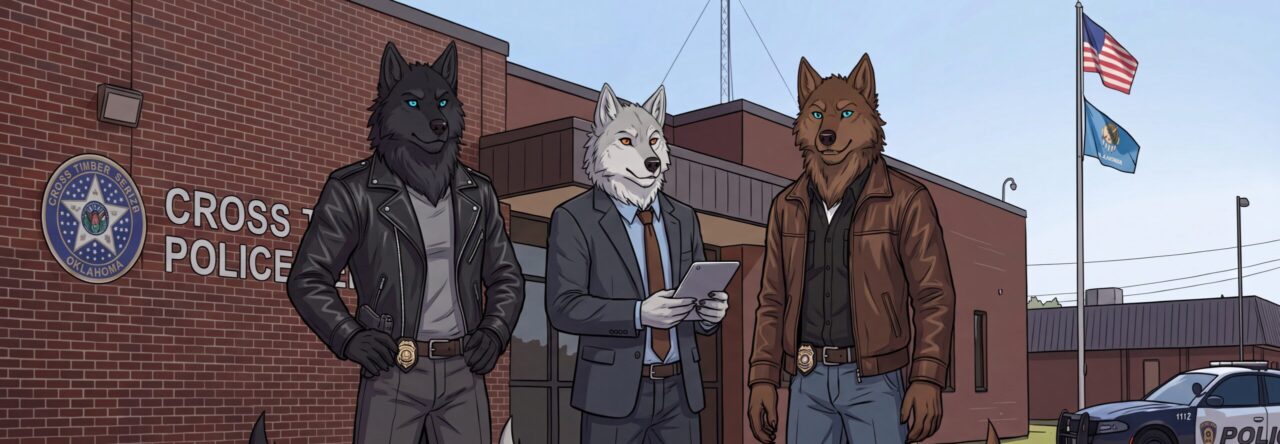
The west trailhead sat beyond the developed edge of Cross Timber, where the city gave way to creek beds, low woods, and service roads that had once belonged to ranch land before trails, picnic tables, and weathered information signs had tried to civilize them.
At night, it was mostly dark.
The trail kiosk stood beneath a single yellow security lamp. The lot was gravel and packed dirt, bordered by scrub oak and cedar. Beyond that, the tree line folded into blackness.
Storm clouds had swallowed the moon.
Thane drove the Humvee through the trailhead entrance and slowed as patrol tape appeared in the headlights.
The gray crossover sat at the far end of the lot, near the service-road gate.
Its headlights were off.
Its interior dome light glowed dimly through rain-speckled glass.
Two patrol cars blocked the entrance. A fire-rescue unit sat near the crossover with its emergency lights dark but ready. A maintenance truck stood beneath the kiosk awning, its driver beside an officer, both of them looking toward the vehicle as though staring hard enough might change what was inside it.
Thane parked where Bell had directed over the radio.
Gabriel was out before the Humvee’s engine had fully settled.
Mark followed with his case bag and notebook tucked beneath one arm. He had not yet customized the notebook cover with anything other than his name and a tiny gold-star sticker that still clung near the bottom corner.
Voss and Rusk arrived seconds later in an unmarked SUV.
Bell met them at the edge of the taped perimeter.
He wore a patrol jacket over his uniform, rain darkening the shoulders. His eyes went first to Voss, then to the trio.
“Victim is female,” he said. “Early thirties, maybe. Maintenance worker found her about ten minutes ago. He says the vehicle was not here when he made his sunset check.”
“Doors?” Voss asked.
“Locked when he found it. Patrol documented that through body cam. Fire used a lockout tool on the passenger side because they had a possible medical emergency. EMS confirmed death once they got access. Driver-side door, trunk, and hood have not been touched beyond visual observation.”
“Any obvious trauma?” Rusk asked.
“Nothing obvious through the glass. Seatbelt was fastened. Purse is on the passenger floorboard. Keys are visible in the center console. No phone that we can see.”
Voss looked toward the sky.
The clouds were moving low and fast over the tree line.
“And the rain?”
Bell glanced up.
“Forecast said twenty minutes.”
Gabriel looked at the black horizon.
“Forecast has never once been right when we need it to be.”
Bell’s mouth almost moved.
Almost.
Voss turned to the trio.
“Night Shift. This is yours.”
Mark straightened slightly.
Gabriel’s humor went quiet.
Thane looked through the rain-speckled glass at the woman in the driver’s seat.
“Do not hurry,” Voss said. “Do not freeze. Work.”
Thane nodded once.
“Yes.”
The woman sat reclined slightly behind the wheel.
Her head rested against the headrest at an angle that looked almost peaceful until a person looked long enough to understand it was not. Her seatbelt crossed her chest. One hand lay near her lap. The other rested loosely against the center console.
Her face was pale.
No obvious blood marked the glass or upholstery.
The purse on the passenger-side floor had tipped open just enough to show a wallet, a compact, a packet of tissues, and a set of keys on a ring separate from the vehicle key fob.
No phone.
No weapon.
No visible signs of a struggle.
A person could look at the scene and see a woman who had driven to a quiet trailhead, locked herself in her car, and died alone.
Thane did not look at it that way.
Not yet.
He stayed outside the vehicle, moving slowly around the perimeter without touching the doors or stepping too close to the tire impressions in the wet gravel.
Bell followed at a respectful distance, scene notebook open.
“What do you have?” Bell asked.
Thane lowered his head slightly near the rear driver-side door.
Rain was coming. He could smell it in the wind now—wet stone, cold soil, ozone, the heavy green smell of leaves about to be beaten down.
Under that, closer to the vehicle, something else lingered.
Bleach.
Not fresh enough to burn his nose. Not old enough to be irrelevant.
Floral hand sanitizer.
Artificial lavender, sweet and sharp, caught in the seam around the rear door and low along the rocker panel.
Another scent too.
Adult woman.
Recent.
Not the victim’s.
Thane moved toward the rear hatch, then paused.
The trunk seam carried a thin metallic note.
Possible blood.
Possible rust, old tools, contaminated fabric, anything.
Not enough to call it blood.
Not from outside.
Not yet.
He looked down.
The trailhead lot was mostly compacted gravel and pine needles, darkened by the first misting rain. Beneath the rear tire area, however, he caught damp clay and crushed wild mint.
That ground did not match the lot.
It smelled like the service road beyond the gate, where the terrain dropped toward a creek bed and the dirt stayed red longer after rain.
A second set of tire impressions sat near the rear passenger side of the crossover. Not clean enough to identify a make. Not yet. But something had backed close to the victim’s vehicle, then turned away toward the service road.
Thane stepped back.
“I have observations consistent with another person being near the vehicle recently,” he said.
Bell wrote.
“Go on.”
“Recent adult female scent around the driver-side exterior and rear hatch. Bleach, floral hand sanitizer, artificial lavender laundry scent near the rear door and office-side cabin area.” Thane paused. “I also detect a metallic odor around the trunk seam. It may be blood. It may not. I cannot identify source or age from exterior position.”
Bell nodded.
“Anything with the ground?”
“Red clay and crushed wild mint beneath the rear tire area. That does not match the lot. There are tire impressions consistent with a second vehicle backing near the crossover before leaving.”
“Can you place the second driver inside the car?”
“No.”
“Can you say why they were here?”
“No.”
Thane looked through the driver-side glass again.
“I can say the scene needs more than one explanation.”
Bell looked at him.
For a moment, the rain and lights seemed to fall away.
“Good,” Bell said quietly.
Not praise for Thane’s senses.
Praise for the sentence.
Thane felt it.
Then nodded.
“Mark needs the vehicle time data.”
Bell glanced toward the crossover.
“Go.”
Mark stood near the passenger side with an officer’s report in one hand and his notebook in the other. He had already written three short columns on the page.
Observed
Reported
Unverified
Thane stopped beside him.
“Anything?”
“The dash display reads 9:18,” Mark said. “The first patrol officer noted it because the center console was illuminated when they made emergency entry.”
“Time now is?”
“Ten-oh-seven.”
“Maybe it stopped.”
“Maybe.” Mark looked at the dark screen through the glass. “Or it was set wrong. The maintenance worker says he passed through at nine-thirty and the lot was empty. The trailhead camera shows a vehicle entering at nine-forty-two.”
Thane glanced toward the kiosk.
“That makes the worker wrong.”
Mark’s ears shifted once.
“Not necessarily.”
“Why?”
“Because the camera clock may be wrong. The dash clock may be wrong. The worker may be estimating. Three bad clocks do not make one liar.”
Thane looked at him.
Mark tapped the page.
“I asked dispatch for a comparison against the camera feed from an earlier patrol call. The trailhead camera captured a public-works truck at eight-thirty-six. Dispatch logged the truck’s radio contact at eight-twenty-four.”
“Twelve minutes fast,” Thane said.
“Probably.” Mark’s eyes brightened slightly. “If the camera is twelve minutes fast, it places the crossover entering at nine-thirty.”
“Exactly when the worker said he passed.”
“Yes.”
Thane looked toward the awning.
“So he was not wrong.”
Mark gave him a small look.
“The scene has an inaccurate clock. That does not make the witness inaccurate.”
Voss, approaching from the perimeter, heard it.
“Good,” she said. “Keep the difference.”
Mark nodded.
Thane looked toward Gabriel.
Gabriel had moved beneath the kiosk awning with the maintenance worker.
The man was maybe fifty-five, rain jacket zipped too high, baseball cap clenched in both hands. He looked wet, tired, and terrified that everyone at the scene was about to decide he had done something wrong.
Gabriel sat on the bench across from him rather than standing over him.
He kept his hands visible.
“You are Eli Booker?” Gabriel asked.
The man nodded.
“Yeah.”
“I’m Detective Gabriel. You found the vehicle?”
“Yeah.”
“Tell me what happened.”
Eli looked toward the crossover.
“I was checking the gate. Saw the car. Tried the door. Saw her inside. Called.”
Gabriel nodded.
“You are not in trouble for finding her when you found her.”
Eli’s mouth tightened.
“I should’ve been here earlier.”
Gabriel waited.
The rain began ticking harder against the kiosk roof.
“I do a pass at sunset,” Eli said. “Usually. I check the gate, make sure nobody’s parked back here after dark, see if the trail signs are still standing.” His eyes flicked toward the service-road gate. “I had to leave early.”
“For what?”
“My wife’s medicine. Pharmacy closes at seven. She’s got heart trouble, and I forgot to pick it up yesterday.” He swallowed. “So I left around six-fifteen. Came back a little after nine.”
“You think you should have found her sooner.”
“I should’ve been here.”
Gabriel’s expression stayed calm.
“Maybe. But right now I need the last time you were here before you found her.”
Eli rubbed both hands over his cap.
“Sunset. I don’t know. Nine-thirty, maybe. I drove through. Lot was empty.”
“You are sure?”
“Sure enough. I’d remember that car. It was right there, plain as day.”
Gabriel nodded.
“What else did you see?”
Eli frowned.
“Nothing.”
“Take your time.”
The man looked out toward the service road.
Then back.
“There was a white crossover by the gate.”
Gabriel waited.
“Before or after your pass through the lot?”
“Before. Maybe ten minutes before. I was coming in from the east road. It was just sitting there, engine on.”
“Did you see who was driving?”
“No.”
“Anyone else inside?”
“No.”
“Was it the same vehicle as the one at the trailhead?”
“No. Different shape. Taller. White.”
“Anything else?”
Eli closed his eyes.
“There was something in the back window. Bright.”
“Like what?”
“Safety vest, maybe. Reflective stripes. I thought it was a contractor. We get them sometimes.”
“Which way did it go?”
“Service road.”
“Toward the main exit?”
“No. The old road. Toward the creek.”
Gabriel wrote it down.
He did not say, That’s our suspect.
He did not say, That white crossover staged the scene.
He asked for the next fact.
“Could you identify the driver if you saw them again?”
Eli shook his head.
“Not really.”
“Could you identify the vehicle?”
“Maybe.”
“Okay.” Gabriel closed the notebook. “That is useful.”
Eli looked at him.
“Am I going to get fired?”
Gabriel’s face softened.
“I do not know your employer’s rules. But you did the right thing when you found her. You called. You stayed. You told us what you remembered.”
Eli nodded, breathing shakily.
Gabriel stood.
“An officer will stay with you until we are done here.”
As he walked back toward the vehicle, Rusk met him under the edge of the awning.
“Anything?”
“White crossover. Reflective vest in the rear window. Service-road direction around nine-twenty.”
Rusk looked toward the gate.
“Could be connected.”
“Could be a contractor.”
“Could be both.”
Gabriel nodded.
“Exactly.”
Rusk gave him a sideways glance.
“You are learning.”
“Try not to sound surprised.”
“My soul retired years ago. Surprise is all I have left.”
The victim’s name came from her wallet.
Alicia Monroe. Thirty-five.
Her sister was listed as emergency contact.
By the time Alicia’s identity had been confirmed through her driver’s license and the first records check, the rain had become a steady curtain beyond the trailhead lights.
Mara Monroe arrived in a raincoat over pajamas, hair pulled back badly, eyes wide enough to show she had driven too fast and would not remember doing it.
Voss met her near the patrol tape.
“Ms. Monroe?”
Mara nodded.
“My sister? Is she—”
Voss did not make her say it.
“I am sorry,” she said. “Your sister is dead.”
Mara’s face folded.
Not theatrically.
Not loudly.
She simply seemed to lose the shape of herself for a second.
Gabriel stepped close enough to support if she fell, but not close enough to touch without permission.
Mara turned toward the crossover.
“Can I see her?”
“Not yet,” Voss said gently. “We need to preserve the scene. I promise someone will talk you through what happens next.”
Mara pressed both hands over her mouth.
Gabriel stayed beside her.
After a moment, he said, “Could we sit somewhere dry?”
She looked at him.
Then nodded.
They moved to the back seat of a patrol SUV, warm air running low through the vents.
Gabriel sat across from her.
“Before we talk about anyone who may have hurt Alicia,” he said, “tell me about her.”
Mara blinked at him.
“What?”
“Tell me who she was.”
For a moment, the grief in her face changed.
Alicia became more than a body in a locked car.
“She was… organized,” Mara said, voice trembling. “Painfully organized. She made lists for vacations. She bought birthday gifts in July. She was always the one who remembered Mom’s prescriptions and Dad’s doctor appointments after he got sick.”
Gabriel nodded.
“What did she do for work?”
“Payroll compliance. Cedarline Contracting.”
“Did she like it?”
“She liked catching people being sloppy.” Mara almost smiled, then the expression broke. “She said payroll was numbers, but numbers told on people.”
Gabriel wrote that down.
“Did she have problems recently? Anyone she was afraid of?”
Mara looked out at the rain.
“Her ex-fiancé.”
“Nate Wilcox?”
“Yes.”
“What happened?”
“They broke up three weeks ago. He was angry. He kept saying she had ruined his life.”
“Did he threaten her?”
“He sent messages.”
“Do you still have them?”
“Some. She sent me screenshots.”
“Can we see them?”
Mara unlocked her phone with shaking fingers and pulled up the thread.
One message appeared in a screenshot.
YOU DO NOT GET TO WALK AWAY WITH WHAT IS MINE.
Another:
YOU THINK YOU CAN MAKE ME THE BAD GUY AND TAKE EVERYTHING.
A third, sent two days earlier:
I KNOW WHERE YOU GO WHEN YOU WANT TO FEEL IMPORTANT.
Gabriel stared at the words.
Mara’s voice became smaller.
“He has gambling debts. Alicia told me. He borrowed money from her. He wanted more.”
“Did he know her routine?”
“Yes.”
“Did he know she came out here?”
“Maybe.”
Gabriel nodded.
“Did Alicia mention anyone else?”
Mara shook her head.
“Work? Friends? A disagreement?”
“She was stressed.” Mara wiped at her face. “But I thought it was Nate.”
“Why?”
“Because that was what she talked about.”
Gabriel let the sentence sit.
Then asked, “Did she say anything about work?”
Mara frowned.
“Not exactly.”
“Anything you remember.”
“She said someone there was making her feel watched.” Mara looked down at her hands. “I thought she meant Nate. I kept telling her to block him.”
Gabriel wrote it down.
“What did she say?”
Mara closed her eyes, trying to hear her sister.
“‘Someone at work knows I found it.’”
Gabriel’s pen stopped.
“What did she find?”
“I don’t know.” Mara shook her head. “She wouldn’t tell me. Said she had to make sure before Monday.”
“Did she name anyone?”
“No.”
“Did she mention a meeting tonight?”
Mara’s expression changed.
“She said she had to stop by Cedarline. Something about a report. She was supposed to meet someone.”
“Who?”
“I don’t know.”
Gabriel looked through Alicia’s schedule notes in the case file.
No name yet.
But the shape of the case had shifted.
Not away from Nate.
Not entirely.
But wider.
When Gabriel stepped out of the SUV, Rusk waited beneath the open hatch of the crime-scene unit.
“Former fiancé?” Rusk asked.
“Strong lead,” Gabriel said. “Threats, debt, dark blue truck, knows her habits.”
Rusk waited.
Gabriel looked back toward Mara.
“Not a conclusion.”
Rusk’s tired face softened slightly.
“Good.”
The medical examiner arrived just as the rain became hard enough to turn the lot into a shining blur.
Dr. Ellen Ward was a compact woman in a dark waterproof shell, gray hair tied back under a hood. She moved with the calm of someone who had spent decades entering rooms after the worst part had already happened.
The evidence technicians had completed the first exterior documentation. Ward examined Alicia through the opened passenger side before allowing the body to be removed.
Voss, Rusk, Mark, Gabriel, and Thane stood beneath the crime-scene tent as Ward spoke.
“Preliminary only,” Ward said. “Do not write a cause of death into a report based on what I am about to say.”
“No one will,” Voss said.
Ward nodded.
“There is a small but serious impact injury concealed behind the victim’s left hairline. I have not completed an internal examination. I cannot tell you the exact mechanism or timing yet.”
“Could it be from a fall?” Rusk asked.
“Could be. Could be a strike. Could be contact with a hard surface. At this point, I am not going to guess.”
She looked toward the driver’s seat.
“But there is very little blood in the cabin. There is transfer in the hair, but not enough visible blood in the vehicle to support this being the primary injury location.”
“Meaning?” Mark asked.
Ward looked at him.
“Meaning the locked car may not be where she was injured.”
Thane looked toward the dark service road.
The white crossover.
The red clay.
The mint.
The second vehicle close behind Alicia’s.
Gabriel looked at the body being prepared for transport.
“So this is a staging scene.”
Ward gave him the careful answer.
“It is consistent with a staging scene.”
Voss nodded once.
“Good enough for now.”
The scene changed after that.
Not in volume.
In purpose.
The vehicle was no longer simply a locked car with a dead woman inside.
It was a question someone had arranged to make look simple.
Mark moved beneath the tent with his notebook already open.
“Scene log needs a secondary location for the service road,” he said. “We should lock down the gate and preserve both approaches before the rain destroys the track pattern.”
Voss looked at Bell.
“Get patrol on the service road. Nobody enters without logging.”
Bell nodded and keyed his radio.
“Three-oh-four, set a hard perimeter from the old gate to the creek crossing. No civilian traffic. Preserve tire and foot impressions as best you can.”
Thane looked at Voss.
“Authorization to work the road edge?”
Voss held his gaze.
“Special Capabilities Support. Exterior only. You point. Evidence collects.”
“Yes, Detective.”
Thane moved into the rain.
Bell went with him.
The service road ran behind the trailhead lot, narrow and uneven, with red clay exposed between patches of wet grass. In the dark, it looked like a black ribbon disappearing into trees.
Thane stayed at the edge until a crime-scene technician marked his route.
Then he worked slowly.
He found the second vehicle’s tire pattern where it had turned in from the old gate.
He found crushed wild mint along the shoulder.
He found fine industrial dust—pale gray, almost chalky—caught in the wet tread imprint near the place where the vehicle had backed close to Alicia’s crossover.
And three feet away, half pressed into mud, he found a small reflective safety clip.
Not a full vest.
A clip-on strip, the kind workers fastened to jackets or bags.
The technician photographed it before lifting it.
Thane stood back.
“Same material?” Bell asked.
“Reflective strip. Could be related to what Eli saw. Could be unrelated.”
“Anything else?”
Thane closed his eyes for one second, drawing in the rain-heavy air.
The scents were washing out already.
But the path remained.
White crossover at the service road.
Close to Alicia’s vehicle.
Something transferred from the service road to the rear of the crossover.
No clear sign of Nate’s truck.
No sharp gasoline-and-cigarette trace from his vehicle.
No familiar dark pickup tire pattern.
Thane opened his eyes.
“I cannot place the white-crossover driver in Alicia’s vehicle,” he said. “I can place a second vehicle near this location after Alicia’s arrival, with trace material linking the service road to the rear of the victim vehicle.”
Bell looked at him.
“That is the sentence.”
Thane nodded.
“Put it in the report.”
Nate Wilcox was located at a sports bar on the south edge of Cross Timber just after eleven.
Patrol found his dark blue pickup in the lot.
The truck had rain beading across the hood and a cracked tail light on the passenger side. It looked bad for him. Everything about Nate Wilcox looked bad for him.
He was at the bar.
He was angry.
He had been drinking.
He had sent messages that read like threats.
He was exactly the sort of man an entire city could decide had killed someone before he ever sat across from a detective.
Rusk and Gabriel met him in an interview room at the station.
Nate had sobered enough to be loud rather than incoherent.
He sat in a plastic chair with his arms crossed, face red, eyes hard.
“You people already decided,” he said.
Gabriel took the chair across from him.
“You are a strong lead.”
Nate laughed without humor.
“Same thing.”
“No,” Gabriel said. “It is not.”
Nate looked at him.
Gabriel’s voice stayed quiet.
“Being a strong lead means we have reasons to ask questions. It does not mean you are guilty. Tell me what you know.”
Nate looked at Rusk.
Rusk leaned against the wall near the door, arms folded.
“You can talk to the black wolf,” he said. “He is irritatingly competent.”
Gabriel glanced back at him.
“Thank you.”
“That was not praise.”
Nate rubbed both hands over his face.
“I yelled at her.”
“What about?”
“Money.”
“Whose money?”
“Mine. Hers. I don’t know.” He stared at the table. “She kept saying I had to get help. Like I didn’t know that.”
“Did you ask her for money?”
“Yes.”
“Did she give you any?”
“Before. Not lately.”
“Did she tell you why?”
“She said she had things going on. Work things.”
“Did you threaten her?”
“I sent messages.”
“Did you mean them?”
Nate’s jaw tightened.
“I was mad.”
“That is not what I asked.”
Nate looked at him.
Then away.
“I wanted her to answer.”
“Did you intend to hurt her?”
“No.”
“Did you hurt her?”
“No.”
“Were you at the trailhead tonight?”
“No.”
“Your truck was seen in the area?”
“I drove past her apartment around eight. Then I went to the bar.”
“What time?”
“Eight-thirty. Maybe eight-forty-five.”
“Can anyone confirm that?”
“The bartender. People there.”
“Did you leave after you got there?”
“No.”
“Not once?”
“No.”
Gabriel watched him.
Not for a tremor. Not for the kind of theatrical lie detectives saw on television.
For what could be checked.
“Why did you drive by her apartment?”
“I wanted to apologize.”
“Did you?”
“No.”
“Why not?”
Nate’s face twisted.
“Because I saw a light on. I figured she was ignoring me. So I went to the bar.”
Rusk left the room briefly.
When he returned, he had a phone in his hand.
“Bartender says he remembers him,” Rusk said. “Nate complained about the Thunder game before nine. Security footage has him entering at eight-forty-eight. He does not leave until after ten-fifteen.”
Nate looked at Gabriel.
“So?”
Gabriel held his gaze.
“So you did not put Alicia at the trailhead.”
Nate’s face changed.
Not relief.
Not completely.
Something like grief trying to find a place to go.
“You think somebody did?”
Gabriel looked down at the file.
“I think somebody did.”
Nate swallowed.
“You think I helped?”
“I do not know.”
“I didn’t.”
“Then keep telling us what you know.”
Nate’s shoulders lowered a fraction.
“She said somebody at work was stealing,” he said. “She told me that once. I thought she was making excuses.”
“Who?”
“She didn’t say.” He looked at the table. “She was always talking about this finance lady, though. Marin. Said she was too polished. Too nice.”
Gabriel looked up.
“Marin who?”
“Cole. Finance director, I think.”
“Did Alicia meet her tonight?”
“I don’t know.”
“Did you ever see Marin’s vehicle?”
Nate frowned.
“White crossover. Like a Buick. She had one of those little reflective vest things in the back because she went out to job sites.”
Gabriel and Rusk looked at each other.
Nate saw it.
“What?”
Gabriel stood.
“Thank you, Nate.”
“That’s it?”
“For now.”
“You believe me?”
Gabriel paused at the door.
“I believe the facts that support you.”
Then he left.
In the hallway, Rusk looked at him.
“How do you feel about clearing the guy everyone hated?”
Gabriel leaned against the wall.
“Like that is why we have to do it.”
Rusk nodded.
“Welcome to detectives.”
By midnight, Cedarline Contracting had become the center of the case.
Mark sat in the Night Shift office with a laptop, three printed spreadsheets, Alicia Monroe’s calendar metadata, and a legal pad covered in dates.
Voss stood behind him.
Rusk had returned with Gabriel. Thane and Bell came in from the trailhead with rain darkening their jackets and a fresh evidence supplement already submitted to the case file.
The office no longer felt new.
It felt used.
Files spread across the desks. Evidence requests printing from the small machine by the wall. A map of Cross Timber filling with circles and arrows. Coffee cooling untouched beside a stack of property logs.
Mark had been working through Cedarline’s payroll records obtained under the emergency preservation request and the warrant Voss had secured while the crime scene was still active.
Alicia Monroe’s job title had sounded boring until the numbers began to line up.
Payroll compliance analyst.
She checked duplicate payments.
Inactive employee IDs.
Vendor reimbursements.
Project labor allocations.
The small errors that did not matter until someone added them together.
Mark tapped one line on the screen.
“This account should have been closed eleven months ago.”
Voss leaned closer.
“Why was it not?”
“It belongs to an employee who left Cedarline last year. His ID remained active in the reimbursement system.” Mark clicked again. “Small payments continued after his departure.”
“How small?” Gabriel asked.
“Two hundred forty dollars. Three hundred eighty. Five hundred. Different descriptions. Fuel. site cleanup. specialty tools.”
“Total?”
“Over thirty thousand dollars in seven months.”
Rusk whistled softly.
Mark pulled up a second spreadsheet.
“Several reimbursements route through a vendor called Redline Project Services. There is no physical office listed. The business registration address is a mailbox store in Norman.”
“Who approved them?” Voss asked.
Mark looked at the authorization records.
“Finance director.”
The room quieted.
“Marin Cole,” Mark said.
Thane stood near the whiteboard, rainwater dripping slowly from the edge of his jacket onto the floor mat.
“What did Alicia find?”
Mark opened a recovered draft folder from Alicia’s corporate account.
A single file sat under a personal directory.
CHECK BEFORE MONDAY
He clicked.
The document contained screenshots of inactive employee IDs, vendor payment patterns, and a note Alicia had started but not finished.
Reimbursement pattern is not accidental. MC is approving payee records after employee separation. Need confirm whether she knows company vehicle logs—
The note ended there.
Mark looked up.
“Alicia was not just finding a payroll error,” he said. “She was building a fraud report.”
Voss looked at the screen.
“And Marin knew.”
“Probably,” Mark said. “Alicia had a calendar event at seven-forty-five tonight. Meeting title: ‘Records Review.’ Attendee: Marin Cole.”
Gabriel leaned forward.
“Where?”
“Cedarline office.”
“Was the building open?”
“Not officially. Most staff leave by six.”
Thane looked toward the whiteboard.
The locked car.
The white crossover.
The safety clip.
The blood scent at the trunk.
The washed-out service road.
“Alicia met Marin,” he said.
“Likely,” Voss said.
“Then something happened at Cedarline,” Thane continued.
“Likely,” Voss repeated.
“And the trailhead was where Marin left her.”
Rusk looked at him.
“Strong theory.”
Thane nodded.
“Not a conclusion.”
Gabriel’s mouth moved at one corner.
Mark did not look away from the screen.
But his ears lifted.
Voss pointed at the employee-access report.
“Keep going.”
Mark brought up badge data.
“Alicia entered Cedarline at seven-forty-one. Marin’s badge registered at seven-thirty-eight.”
“Anyone else?” Voss asked.
“Not according to the main entrance log.”
“What about rear access?”
Mark scrolled.
“At eight-sixteen, the rear loading entrance opened.”
“By whom?”
“Badge log does not identify the person. It was a request-to-exit sensor.”
“Camera?”
“Preserved but not yet downloaded.”
“What else?”
“Marin’s badge registers near the loading corridor at eight-nineteen. Alicia’s badge never registers leaving.”
The room went still.
“Marin’s vehicle?” Rusk asked.
“White crossover exits the rear gate at eight-thirty-one.”
Thane’s eyes went to the clock on the wall.
“Trailhead car arrives at nine-thirty,” he said.
“Approximately,” Mark said. “Once the camera clock is corrected.”
“An hour,” Gabriel said.
“The missing hour,” Mark said quietly.
The phrase settled over the office.
Alicia entered Cedarline alive.
Marin entered Cedarline alive.
An hour later, Marin’s white crossover left through the rear gate.
Another hour later, Alicia’s vehicle appeared at the trailhead with Alicia dead inside it.
The first theory had been Nate.
A clean story of rage and an ex-fiancé who looked terrible.
But the facts had done something harder.
They had opened another door.
Gabriel looked down at Alicia’s case photo on the file.
“Mara thought Alicia was scared of Nate.”
“She may have been,” Rusk said.
“Yeah,” Gabriel said. “But she was also scared of work.”
Thane looked at the board.
“Phone.”
Voss looked at him.
“Alicia’s phone is gone,” he said. “If Marin knew Alicia had records, she may have taken the phone to destroy the rest.”
Mark’s eyes sharpened.
“Her sister said Alicia changed the phone password because she thought someone at work tried to look through it.”
Rusk picked up his keys.
“Get a warrant for Marin’s vehicle, home, office, work devices, and account records.”
“I am already drafting it,” Voss said.
Gabriel looked at the laptop.
“Can we see whether Marin accessed Alicia’s files after Alicia died?”
Mark’s paws moved across the keyboard.
“Maybe.”
He opened the company remote-access logs.
The page loaded slowly.
Rain battered the windows.
For a few seconds, only the old coffee maker gurgled in the corner.
Then Mark stopped moving.
“What?” Voss asked.
Mark leaned closer to the screen.
“Marin’s work laptop connected remotely at ten-oh-two.”
“From where?” Rusk asked.
“Unknown network at the moment.”
“What did it access?”
Mark’s face changed.
“Alicia’s payroll folder.”
Voss stepped behind him.
“Is it still active?”
Mark clicked again.
A red progress line appeared across the screen.
The folder list was shrinking.
One file vanished.
Then another.
Then another.
“She is deleting it now,” Mark said.
The room snapped into motion.
“Lock the account,” Voss said.
“I am requesting it.”
“Call IT.”
“Already calling.”
Rusk grabbed the warrant packet from the printer tray.
“Where is Marin?”
Mark pulled up the employee file.
“Cross Timber home address. But she has a company vehicle and access to three active Cedarline project sites.”
Gabriel stepped toward the map.
“Can we track the company vehicle?”
“Maybe, if the telematics account is active.”
“Maybe?” Gabriel asked.
Mark’s ears shifted.
“Do you want me to make it work faster by being insulted?”
Gabriel lifted both hands.
“No. Please continue being terrifyingly competent.”
Thane looked through the rain-smeared office window.
The storm had moved east, hard and low, swallowing the far streetlights in gray water.
“She has an hour,” he said.
Gabriel looked at him.
“Why an hour?”
Thane turned toward the wall map.
“Because once the storm reaches the eastern roads, every service route gets worse. Low-water crossings. gravel access. Construction sites. She knows where the cameras are and where they are not.”
Rusk looked at the map too.
“You think she is running.”
“I think she knows the files are gone if she stays.”
Voss took the warrant packet.
“Then we find her before the rain hides the rest.”
The new office disappeared behind movement.
Mark had IT on speaker, preserving what it could from Marin’s remote session.
Gabriel called Mara Monroe again, asking whether Alicia had ever mentioned Marin’s address, family, habits, or favorite places.
Rusk called patrol units toward the company sites.
Voss reviewed the warrant language one last time.
Thane stood at the map, eyes on the eastern edge of Cross Timber.
Three project sites.
A home address.
A white crossover.
A missing phone.
An hour that did not fit.
The city outside had gone dark under the storm.
Their first night as detectives had begun with a locked car at the edge of the woods.
By midnight, they had a murdered woman, a false answer, a disappearing trail—
—and one hour to catch the truth before the rain carried it away.