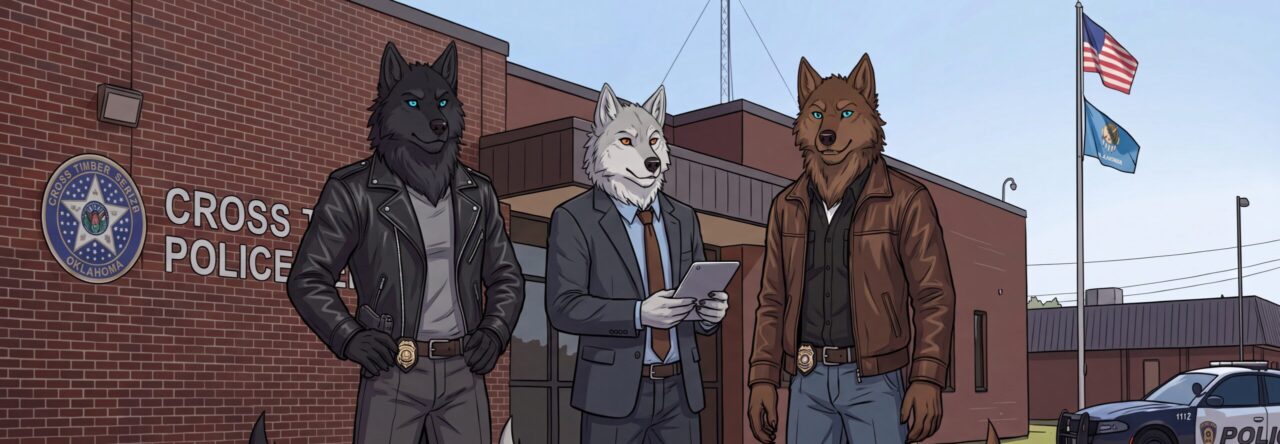
Night Shift Header

Author: Thane

Chapter 3 — Strength Is Easy

“You said we were keeping this low-profile,” Gabriel said.

Thane shut off the Humvee.

The engine died with a rough metallic shudder that rolled across the parking lot, bounced off the brick front of the training annex, and made two young men near the entrance turn around like something had exploded politely.

“This is low-profile,” Thane said.

Gabriel looked through the windshield.

The Humvee sat angled across three parking spaces, matte green, broad as a small building, and about as subtle as a riot.

Mark leaned forward from the back seat and studied the painted lines beneath them.

“We are taking up three spaces.”

“That’s a design flaw,” Thane said.

“It is a parking lot.”

“Exactly.”

Gabriel opened his door. “To be fair, if your goal was to arrive without anyone noticing, bringing the military vehicle was inspired.”

Thane stepped out onto the pavement, clawed feet landing with a soft scrape against the asphalt. “We are not hiding.”

“No,” Gabriel said, climbing down from the passenger side. “The Humvee helped with that.”

Mark got out last, folder in one hand, phone in the other, gray and white fur already too neat for the situation. He shut the heavy rear door and gave the Humvee a long, resigned look.

“I still think we should have taken the Xterra.”

“You always think we should take the Xterra,” Thane said.

“It fits in one parking space.”

“It complains more.”

“It does not complain.”

“It has opinions.”

Gabriel walked around the front of the Humvee and looked at the three crooked parking spaces again.

“The Humvee has a manifesto.”

Mark opened his mouth, probably to explain the difference between mechanical reliability and owner projection.

Thane pointed at him.

“No.”

Mark closed his mouth.

They stood there for a moment in the pale evening light, three werewolves in a law enforcement training center parking lot, surrounded by sedans, pickup trucks, a couple of municipal SUVs, and one very nervous-looking compact car that had the misfortune of being parked beside them.

The building itself was not impressive. Low brick, tinted windows, a flagpole out front, and a sign that read:

Cross Timber Public Safety Training Annex

Beneath that, on a temporary board with black plastic letters:

LAW ENFORCEMENT TRAINING INFORMATIONAL SESSION — 6:30 PM

Thane stared at the sign.

“We go in,” he said. “We listen. We leave.”

Gabriel nodded. “That remains the official lie.”

“It is not a lie.”

Mark glanced at his phone. “We are six minutes early.”

Thane looked at him.

Mark’s ears angled back. “For informational purposes.”

“Of course,” Gabriel said. “Wouldn’t want to be late to the thing we are not interested in.”

Thane growled and started toward the entrance.

The two young men near the doors tried very hard not to stare as the three of them approached. One did a poor job. The other did worse. Both were maybe early twenties, human, clean-cut, gym-built in the way people were when they still believed muscle solved most problems.

One wore a polo shirt tucked too neatly into jeans. The other had a buzz cut and a veteran’s posture, shoulders back, eyes sharp, chin lifted like a challenge he had not been asked to issue.

Thane ignored them.

Gabriel smiled at them.

That was worse.

Mark nodded politely.

That somehow made them look even more uncertain.

Inside, the annex smelled like floor wax, printer toner, old coffee, stress, and nervous ambition.

Thane hated it immediately.

The lobby had a reception desk, a bulletin board covered in flyers, framed photos of graduating academy classes, and a row of plastic chairs clearly designed by someone who hated bodies with knees. A few applicants stood around in loose clusters. Some wore business casual. Some wore department polos. One woman in dark jeans and a plain green jacket leaned against the wall with her arms crossed, watching the room like she had already decided where every exit was.

Her eyes went to Thane first.

Then Gabriel.

Then Mark.

She did not look away quickly.

That was interesting.

The receptionist did.

She looked up from her computer, froze for half a second, then recovered with the brittle smile of someone whose customer service training had not included werewolves.

“Good evening,” she said. “Are you here for the informational session?”

Gabriel glanced back at the sign outside through the glass doors.

“No, ma’am,” he said. “We’re here to discuss ballroom rental.”

Mark closed his eyes.

The receptionist blinked.

Thane pointed one claw at Gabriel without looking at him. “Ignore him.”

“Most people do,” Gabriel said.

Mark stepped forward before the receptionist could decide whether to laugh or call someone.

“We are here for the CLEET informational session,” he said. “I registered us online.”

Thane turned slowly.

“You did what?”

Mark kept his eyes on the receptionist. “Informationally.”

“That is not a word.”

“It is tonight.”

The receptionist typed something.

“Names?”

“Thane, Gabriel, and Mark,” Mark said.

The receptionist waited.

Mark waited back.

After a moment, she cleared her throat. “Last names?”

Gabriel leaned slightly toward Thane. “And there it is.”

Thane’s ears angled back.

Mark said, very evenly, “We generally just use first names.”

The receptionist’s smile strained.

“I need something for the sign-in sheet.”

Gabriel placed one hand on the counter. “Could write ‘the wolves Voss warned everybody about.’ That may already be in the system.”

A voice from the hallway behind the desk said, “It is now.”

The receptionist relaxed so visibly that Thane immediately looked past her.

A man stood in the hallway with a Styrofoam cup in one hand and a file folder in the other. Late forties, maybe early fifties. Medium height. Square build. Close-cropped hair going gray at the temples. A mustache that looked less decorative than structural. His dark blue polo had an embroidered training division logo on it. His belt carried a radio, keys, and the exhausted authority of someone who had spent years telling young men not to mistake confidence for competence.

He looked at Thane.

Then Gabriel.

Then Mark.

Then toward the glass doors and the Humvee outside.

“You parked the tank?”

“Humvee,” Thane said.

The man sipped his coffee.

“Did it come with parking instructions?”

Gabriel smiled.

Thane did not.

Mark said, “We can move it.”

“No,” the man said. “Leave it. If anyone steals it, I want to meet them.”

Gabriel’s smile widened.

The man turned to the receptionist.

“They’re with me.”

She looked relieved enough that it might have hurt his feelings if he had not already expected it.

He stepped into the lobby.

“Sergeant Hale,” he said. “Training coordinator. Voss said you might show.”

Thane’s ears lifted slightly.

“Might?”

“She said one of you would refuse, one of you would make jokes, and one of you would register everybody before admitting interest.”

Gabriel looked at Mark.

Mark looked at the wall.

Thane looked at Hale.

Hale took another sip of coffee.

“She also said the brown one would be the problem.”

Gabriel made a pleased sound. “Accurate.”

“I am not the problem,” Thane said.

Hale looked him up and down.

“You’re standing in my lobby barefoot with claws on your hands, teeth in your mouth, and a military vehicle across three spaces.”

Thane narrowed his eyes. “Your chairs are too small.”

“Didn’t ask about the chairs.”

“You were going to.”

Hale’s mouth twitched.

Not a smile.

Maybe the ghost of one.

“Room B,” he said, turning. “Try not to scare anyone who hasn’t earned it.”

Gabriel leaned toward Mark as they followed.

“I like him.”

“You like anyone who insults Thane efficiently,” Mark said.

“Yes. I respect craftsmanship.”

Room B smelled like dry erase markers and old carpet. Rows of folding chairs faced a projector screen at the front. A long table held stacks of handouts, cheap pens, and a coffee urn that looked like it had been here since the first misdemeanor.

A dozen people were already seated.

Conversation thinned as the three werewolves entered.

Thane felt it pass through the room like cold air.

He was used to it.

That did not make it invisible.

Some people stared openly. Some looked away too fast. One older man in a sheriff’s office polo gave them a slow, appraising look and then returned to his handout as if deciding they were not his problem tonight. The woman in the green jacket from the lobby chose a seat near the side wall, one chair away from the aisle, where she could see the door and the front of the room.

Smart seat.

Mark noticed too.

Gabriel noticed Mark noticing.

Thane noticed both and wished everyone would stop noticing things.

Hale walked to the front and looked at the room.

Then at Thane.

Then at the chairs.

“They’re rated for three hundred pounds,” he said.

Gabriel turned to Thane. “How honest are we being tonight?”

Thane growled.

Mark raised one hand slightly. “Is standing acceptable?”

Hale nodded. “Standing is encouraged if the alternative is paperwork.”

Thane crossed his arms and took a place along the back wall.

Gabriel stood beside him.

Mark hesitated, then took one of the chairs near the aisle after testing it with careful dignity. It creaked but held.

Gabriel leaned down. “Brave.”

“Quiet.”

“Historic moment.”

“Quiet.”

Hale set his folder on the front table and looked over the room again.

“All right. Let’s start.”

The lights dimmed halfway.

The projector screen came on with a slide titled:

LAW ENFORCEMENT TRAINING: EXPECTATIONS, REQUIREMENTS, REALITY

Gabriel whispered, “Reality sounds ominous.”

“It should,” Hale said from the front without looking at him.

Gabriel’s eyebrows lifted.

Thane smirked despite himself.

Hale clicked to the next slide.

“My name is Sergeant Daniel Hale. I coordinate pre-academy outreach, agency training support, and occasionally babysit people who watched too many police shows and decided a badge looked fun.”

A few nervous laughs moved through the room.

Hale did not smile.

“If you came here because you want power, leave.”

The room quieted.

“If you came here because you like winning arguments, leave. If you came here because you think people will respect you once you have a badge, leave now and save everyone trouble.”

Thane shifted his weight.

Gabriel’s expression sharpened.

Mark stopped looking at the handout.

Hale walked slowly in front of the screen.

“This job is not about being the strongest person in the room. It is not about being the loudest. It is not about being the most certain. In fact, those things will get you in trouble faster than fear.”

His eyes moved across the applicants.

They landed on Thane for half a second longer than necessary.

Thane noticed.

Of course he noticed.

Hale continued.

“Strength is easy.”

The room seemed to lean toward him.

“Authority is not. Restraint is not. Writing down exactly what happened after your adrenaline crashes is not. Standing in court while an attorney tries to make you sound like an idiot is not. Knocking on a parent’s door at two in the morning is not. Deciding not to use force when every angry part of you wants to is not.”

No one laughed now.

Good, Thane thought unwillingly.

This part did not feel like recruitment.

It felt like warning labels.

Hale clicked to another slide.

“Training exists because instinct is unreliable. Good intentions are unreliable. Anger is extremely unreliable. And before anyone asks, yes, we train people who are stronger, faster, bigger, smarter, meaner, younger, older, richer, poorer, former military, former corrections, former security, and former idiots.”

Gabriel murmured, “Former is optimistic.”

Hale looked directly at him.

“Some remain in progress.”

Gabriel nodded respectfully. “Fair.”

Hale moved on.

He covered basics first. Application paths. Agency sponsorship. Background checks. Written exams. Physical requirements. Medical clearance. Psychological evaluation. Academy expectations. Classroom hours. Practical skills. Firearms. Emergency driving. Defensive tactics. Ethics. Report writing.

Report writing got its own slide.

Thane hated that on principle.

Mark sat forward.

Gabriel saw it and whispered, “Try not to wag.”

Mark did not look back. “I do not wag.”

“You spiritually wag.”

“I will bite you quietly.”

“Growth.”

Hale clicked again.

“Some of you are already employed by departments. Some are exploring options. Some of you are here because someone told you this was a good idea and you have not yet forgiven them.”

His eyes flicked toward the back wall.

Gabriel raised one hand halfway.

Hale ignored him.

“This informational session does not enroll you. It does not certify you. It does not make you special. It does not make you interesting.”

Thane heard someone two rows ahead mutter, “Too late for that.”

It was the buzz-cut applicant from outside.

Not quiet enough.

Gabriel’s ears shifted.

Mark’s head turned slightly.

Thane stayed still.

Hale stopped talking.

The room felt the stop.

Hale looked at the buzz-cut man.

“Name?”

The man straightened. “Brent, sir.”

“Brent. You want to share with the room?”

Brent glanced back at Thane, then forward again.

“Nothing, Sergeant.”

“You sure? Because it sounded like you had a thought and lost control of it.”

A few people looked down.

Gabriel’s mouth curved.

Brent’s jaw tightened. “Just saying some people don’t have to try to be interesting.”

Hale watched him.

“That bother you?”

“No, sir.”

“You sure?”

“Yes, sir.”

Hale nodded once.

“Good. Because if you get into this job, every person you meet will come with something you didn’t choose. Size. Money. Language. Species. Religion. Politics. Fear. Rage. Grief. A camera phone. A weapon. A lawyer. A screaming child. If different bothers you, quit before different calls 911.”

The room went very still.

“Yes, sir,” he said.

Hale looked at Thane then.

Not warmly.

Not apologetically.

Just evenly.

“And if being noticed bothers you,” Hale said, “same advice.”

Thane’s eyes narrowed.

Hale turned back to the room.

“Everybody gets challenged here. Nobody gets worshipped. Nobody gets hunted. Nobody gets special treatment unless the law requires an accommodation, and even then, accommodation does not mean lowered expectations.”

Mark raised his hand.

Gabriel whispered, “There it is.”

Hale pointed at him. “Gray and white.”

Mark lowered his hand. “Mark.”

“Mark.”

“You said accommodation does not mean lowered expectations. What happens when the standards were written for human bodies?”

A few people shifted.

Hale did not.

“Example?”

Mark glanced once toward Thane, then back to Hale. “Furniture. Shoes. Firearms grip size. Vehicle controls. Defensive tactics designed around human hands. Physical standards that assume human stride length and weight distribution. Uniform requirements. Anything involving fingerprints if pads and claws interfere. Even written policies that assume certain body mechanics.”

Gabriel stared at him.

Thane stared too.

Mark’s ears angled back. “What?”

Gabriel said softly, “That was a list.”

“It was an obvious list.”

“It was an entire government subcommittee.”

Hale looked at Mark with the first expression that might have been actual interest.

“Good question,” he said.

Mark sat a little straighter.

Thane pretended not to notice.

Hale set the clicker down.

“Standards exist for reasons. Some reasons are safety. Some are tradition. Some are because nobody asked better questions when the form was made twenty years ago. If a standard tests what it needs to test, we keep it. If it tests whether you fit somebody’s old assumption, we look at it.”

He picked up his coffee.

“That does not mean the world bends around you. It means we figure out what the job actually requires. Can you operate a vehicle safely? Can you handle a weapon safely if required? Can you restrain someone without turning them into soup? Can you write a report? Can you testify? Can you follow lawful orders? Can you keep your temper when someone tries to bait you?”

His eyes shifted to Thane again.

Thane showed teeth.

Hale sipped his coffee.

“Some standards matter more than shoes.”

A woman near the side wall raised her hand.

Hale pointed. “Green jacket.”

“Cass,” she said.

“Cass.”

“Has anyone like them gone through before?”

Them.

The room felt the word.

Not cruel.

Not soft either.

Just direct.

Hale looked at the three werewolves.

Then back to Cass.

“No.”

That answer moved through the room.

Thane felt eyes on his fur, his claws, his feet, his teeth. He hated how many questions people could ask without opening their mouths.

Hale let it sit.

Then he added, “Not here.”

Cass nodded slowly. “So this would be new.”

“Yes.”

“Messy?”

“Probably.”

“Expensive?”

The receptionist in the lobby sneezed as if summoned.

Hale’s mouth twitched.

“Almost certainly.”

Cass leaned back. “Interesting.”

Gabriel murmured, “I like her too.”

Thane said, “You’re collecting people.”

“It’s a gift.”

Hale resumed.

The next section covered background investigations.

That part felt less funny.

Credit history. Employment. Criminal record. References. Interviews. Social media. Character. Associates. Past conduct. Truthfulness.

Thane listened with growing irritation.

Gabriel listened with growing amusement that did not quite reach his eyes.

Mark listened like every bullet point was becoming a spreadsheet in his head.

Hale paced slowly.

“If there is something in your past you think nobody will find, assume they will. If there is something you think you can explain later, explain it early. If there is something you are proud of that looks bad on paper, congratulations, paper wins until facts catch up.”

Thane’s arms tightened across his chest.

Gabriel’s voice went low enough only Thane could hear.

“Breathe.”

“I am breathing.”

“You are grinding your teeth.”

“They grow back.”

“That is not the calming point you think it is.”

Hale clicked to a slide titled:

USE OF FORCE

The room changed again.

Not as sharply as when Voss had said Emma’s name, but close.

Hale did not rush.

“Force is not punishment,” he said. “Force is not revenge. Force is not frustration leaving your body. Force is not how you prove someone should have listened sooner.”

Thane stared at the slide.

Black text. White background.

Too simple for something so ugly.

“Force is a tool used under law,” Hale continued. “A tool with consequences. Physical, legal, moral, political, personal. Every time you put hands on someone, point a weapon, deploy a restraint, use pain compliance, or escalate a scene, you own what happens next.”

Brent shifted in his chair.

Cass watched Hale without blinking.

Mark’s eyes lowered briefly.

Gabriel stopped leaning.

Hale looked around the room.

“If you are bigger than the person in front of you, you own that difference. If you are stronger, you own that. If you are armed and they are not, you own that. If they are scared, drunk, high, angry, confused, mentally ill, or just stupid, you own your response to that too.”

His gaze found Thane.

This time it stayed there.

“You do not get to say, ‘They made me.’ Not if you want authority. Not if you want trust. Not if you want to go home knowing you were still yourself at the end of the night.”

Thane felt the words hit somewhere beneath his ribs.

He hated that too.

Gabriel did not look at him.

Mark did not either.

That made it worse.

Hale turned back to the slide.

“Some of you think you want this job because you want to stop bad people.”

He clicked again.

The slide changed.

MOST CALLS ARE NOT MONSTERS

“Most calls are people at their worst,” Hale said. “Not evil. Not enemies. Just drunk, scared, angry, broke, sick, grieving, desperate, or too proud to admit they need help. If your only tool is domination, you will make those calls worse.”

Gabriel’s expression shifted.

That one had found him.

Thane knew why.

Gabriel could talk a boiling room down before Thane finished deciding which wall a person needed to hit. He had done it in bars, parking lots, hospitals, family arguments, old bloodline meetings, and once in a grocery store when a man with a knife and a shaking hand had started crying in the cereal aisle.

Gabriel joked because jokes opened doors anger locked.

Mark followed rules because rules made bridges over instincts.

Thane had always preferred the direct route.

The direct route looked different under fluorescent lights.

Hale moved on to ethics.

Then testimony.

Then academy discipline.

Then physical training.

At the phrase “group exercises,” Thane muttered something under his breath.

Gabriel leaned closer. “Was that a threat against a clipboard?”

“No.”

“It sounded clipboard-adjacent.”

Mark, from his chair, whispered, “Please do not threaten office supplies in a law enforcement facility.”

“No promises.”

Hale stopped mid-sentence.

The room waited.

He looked at the back wall.

“You three need a separate session?”

Gabriel pointed at Thane. “He’s having a private emotional journey.”

Thane glared.

Hale looked at Thane. “Is it productive?”

“Not yet,” Thane said.

A few people laughed.

Even Hale gave half a nod.

“Let me know when it gets there.”

Gabriel whispered, “I definitely like him.”

Thane muttered, “You would.”

The session lasted ninety minutes.

It felt longer.

Not boring.

Worse.

Relevant.

By the end, Thane had learned several things he did not want to know.

He had learned the academy was not a badge factory. He had learned that half the room wanted in for reasons he did not trust and the other half seemed afraid enough to maybe be worth trusting. He had learned Hale had no intention of being impressed by claws, size, night vision, muscle, teeth, or reputation.

He had learned Mark looked too comfortable with handouts.

He had learned Gabriel got quiet when the conversation turned from bad guys to broken people.

And he had learned that the packet at home had not been the problem.

The problem was that the packet had a point.

Hale ended without drama.

“If you are still interested after tonight, contact the listed office or speak with your agency sponsor if you have one. If you are not affiliated with an agency, there are paths, but do not mistake possible for simple. Read everything. Ask questions. Tell the truth. If you decide this is not for you, good. That means tonight saved you time.”

He closed his folder.

“If you decide it is for you, better. Show up ready to learn that wanting to help is not enough.”

The lights came up.

Chairs scraped.

People stood, stretched, gathered papers, avoided eye contact, sought eye contact, talked too loudly, or slipped out fast enough to pretend they had never been there.

Brent walked past the back wall without looking at Thane.

Then, because wisdom arrives unevenly in young men, he muttered, “Bet defensive tactics would be easy for some people.”

Thane’s ears turned.

Gabriel closed his eyes.

Mark said, very quietly, “Do not.”

Thane looked at Brent.

Brent stopped walking.

The room noticed.

Of course it did.

Thane stepped away from the wall.

Not fast.

Not threatening.

That was worse.

Brent’s shoulders squared on instinct, but his scent changed. Sweat. Nerves. Regret trying to arrive before pride blocked the road.

Thane stopped a few feet away.

Close enough that Brent had to look up.

“Strength is easy,” Thane said.

Brent swallowed.

Thane let the words sit.

Then he stepped aside.

Brent blinked.

Gabriel’s eyebrows lifted.

Mark stared.

Hale watched from the front of the room with unreadable eyes.

Brent gave a stiff nod, not quite apology, not quite respect, and left.

Thane returned to the back wall.

Gabriel looked delighted.

“Look at you,” he said. “Having a productive emotional journey.”

“Shut up.”

Mark stood, folder against his chest. “That was actually very restrained.”

“I know.”

Gabriel smiled. “He hates that too.”

“I do,” Thane said.

Hale approached before Gabriel could make it worse.

Up close, he smelled like old coffee, clean laundry, gun oil, and the kind of patience that had been built by losing it professionally many years ago.

“You listened,” Hale said.

Thane looked at him. “That surprise you?”

“Yes.”

Gabriel laughed.

Mark tried not to.

Thane growled at both of them.

Hale continued, “Voss said you were stubborn.”

“Voss talks too much.”

“Voss talks exactly enough to become my problem.”

Gabriel said, “That sounds like her.”

Hale looked at Gabriel. “You’re the mouthy one.”

Gabriel placed a hand over his chest. “I prefer verbally agile.”

“You prefer incorrectly.”

Mark made a small sound.

Hale turned to him. “You’re the organized one.”

Mark looked down at the folder in his hands.

“Yes,” he said, because denial was pointless.

Then Hale looked back at Thane.

“And you’re the one who thinks every locked door is an insult.”

Thane’s ears angled forward. “Depends what’s behind it.”

“That answer is why you’ll either wash out fast or learn something useful.”

“I did not say I was applying.”

“No,” Hale said. “You parked a Humvee outside a CLEET info session and stood through ninety minutes of me telling you why strength is overrated. That’s much more subtle.”

Gabriel looked at Thane. “He has you there.”

Mark nodded. “Objectively.”

Thane pointed at them both. “No one asked.”

Hale held out three sheets from his folder.

“Supplemental information. Application paths. Contacts. Medical accommodation questions. Agency sponsorship notes.”

Mark took them before Thane could object.

Hale’s eyes flicked to him. “Of course.”

Mark’s ears tipped back.

Gabriel smiled.

Thane said, “We came to listen.”

“And now you listened.”

“That does not mean anything.”

“It means whatever you do next is less ignorant than what you did before.”

That landed hard.

Thane did not answer.

Hale lowered his voice slightly.

“I don’t care what happened last week.”

Gabriel went still.

Mark’s fingers tightened on the folder.

Thane’s eyes narrowed.

Hale looked from one to the next.

“I care what happens next. Voss does too. That’s why you’re here instead of being somebody’s rumor file until the next time something bad happens in the woods.”

Thane’s jaw tightened.

Hale did not soften.

“If you come back, come back because you want the hard version. Not because you want a badge to bless what you already think.”

Gabriel’s expression lost its humor.

Mark nodded once, slowly.

Thane stared at Hale.

“And if we don’t come back?”

Hale shrugged. “Then don’t waste my chairs again unless you mean it.”

Gabriel laughed under his breath. “He really does care about furniture.”

“It’s a budget issue,” Hale said.

Mark looked at the rows of folding chairs. “Understandable.”

“Do not bond with him over inventory,” Thane said.

Hale’s mouth twitched again.

This time it was definitely almost a smile.

He turned away.

“Drive safe,” he said. “Preferably between the lines. Parking and otherwise.”

They left through the lobby.

The receptionist watched them go with the exhausted relief of a person who had survived an event she would later describe poorly to someone over dinner.

Outside, the evening had cooled. The sky over Cross Timber was streaked purple and gray, the last light catching on windshields and the flagpole rope tapping softly against metal. The Humvee waited exactly where they had left it, occupying more territory than necessary and apologizing for none of it.

Gabriel stopped at the passenger door.

“Well,” he said. “That was less stupid than expected.”

Thane grunted.

Mark unlocked his phone.

Thane turned. “No.”

Mark paused. “I have not done anything.”

“You are about to do something.”

“I was checking the application deadline.”

Gabriel leaned across the hood. “For the thing we are not doing?”

“For planning purposes,” Mark said.

Thane stared at him.

Mark looked at the phone anyway.

“Friday.”

Gabriel smiled. “Of course it is.”

“We are not applying,” Thane said.

“Of course not,” Gabriel said.

“We listened. We learned. We are done.”

“Completely.”

Mark tapped something.

Thane’s eyes narrowed. “What did you just add?”

“Nothing.”

“Mark.”

“A reminder.”

“No reminders.”

“It is just a deadline reminder.”

Gabriel opened the passenger door. “What did you title this one?”

Mark glanced at the screen.

Thane leaned closer.

Mark tried to lower the phone.

Too late.

On the calendar, Friday at noon, he had entered:

Bad Idea — Application Deadline

Gabriel laughed hard enough to lean against the Humvee.

Thane stared at the words.

Then at Mark.

Mark’s ears flattened. “It seemed consistent with the naming convention.”

Thane opened his mouth.

Closed it.

Pointed at the phone.

Then at Gabriel.

Then at the building.

Finally, he growled, “Get in.”

Gabriel was still laughing as he climbed into the passenger seat.

Mark got into the back, clutching the folder like sacred contraband.

Thane stood outside a moment longer.

Through the annex windows, he could see Hale stacking papers at the front of Room B. Cass in the green jacket spoke to him briefly, then left with her hands in her pockets. Brent stood near his truck, staring down at his phone, no longer quite as tall as he had been an hour before.

The world had not changed.

Not really.

Cross Timber still had locked doors, bad roads, missing posters, porch lights, court dates, unanswered calls, and people who believed the dark belonged to them.

But something had shifted.

Not in the city.

In him.

Thane hated that most of all.

He climbed into the Humvee and shut the door.

Gabriel looked over. “We are absolutely not applying?”

“No.”

Mark said from the back, “That answer had a pause.”

“It did not.”

“It did,” Gabriel said.

Thane started the engine.

The Humvee rumbled awake, loud enough to make a man on the sidewalk turn around.

Thane backed carefully out of the three spaces.

Mark noticed.

Of course he noticed.

“You are driving between the lines,” Mark said.

Thane pulled onto the road.

“Shut up.”

Gabriel smiled out the window at the darkening city.

“That’s his indoor voice.”

Mark made the smallest amused sound from the back seat.

Thane growled, but there was no bite in it.

Not yet.

The training annex disappeared behind them.

Ahead, Cross Timber’s streetlights blinked on one by one, small islands of gold against the coming night.

They had not applied.

They had not agreed.

They had not crossed the line.

But for the second time in a week, they had walked right up to it and looked down.

And this time, none of them had stepped back.

Chapter 2 — The Packet

The CLEET packet sat on Thane’s lap like an accusation.

He had not put it there.

Mark had.

Thane had tossed it onto the center console somewhere between the police station and the first traffic light. Mark had watched it slide, waited exactly three seconds, then reached forward from the back seat and set it neatly across Thane’s thigh as if restoring order to the universe.

Thane looked down at it.

Then into the rearview mirror.

Mark looked back at him with perfect innocence.

“No,” Thane said.

“I didn’t say anything,” Mark replied.

“You moved it.”

“It was getting bent.”

“It deserves to be bent.”

Gabriel sat in the passenger seat with one elbow against the window, black fur catching the pale morning light, blue eyes half-lidded in the way that meant he was amused and trying not to make it worse.

Trying poorly.

“It is a brochure,” Gabriel said. “Not a confession.”

Thane growled.

The dashboard vibrated faintly.

Gabriel smiled. “Audio confirmed.”

Mark sighed from the back seat. “We have already retired that joke.”

“You retired it. I appealed.”

“There is no appeal process.”

“Exactly what someone losing an appeal would say.”

Thane gripped the steering wheel harder.

The 2014 Nissan Xterra rattled slightly as it rolled over a rough seam in the road. It was old enough to have opinions, boxy enough to suit him, and sturdy enough that Thane trusted it more than most people. The driver’s seat had been modified years ago, the pedals adjusted, the floor mats replaced with heavy rubber that did not care about clawed feet, mud, or blood.

Usually, driving calmed him.

Not today.

Behind them, the Cross Timber Police Department shrank into the morning. Ahead, the city stretched north and east under a low gray sky, all wet asphalt, stoplights, fast-food signs, churches, schools, medical offices, strip centers, and half-finished subdivisions pushing into land that had once been pasture and blackjack oak.

Cross Timber, Oklahoma.

Too big to be a small town. Too small to admit it wanted to be Oklahoma City.

It sat along the northern edge of the metro, close enough to borrow the city’s traffic and far enough out to keep its secrets in tree lines, creek beds, old barns, and gravel roads no GPS handled correctly.

Thane liked the edges better than the center.

The edges made more sense.

“You’re reading it,” Gabriel said.

Thane glanced over.

Gabriel pointed with one claw.

Thane looked down. His eyes had dropped to the packet without permission.

He shoved it toward the console.

“I am not reading it.”

“You were looking at words.”

“I was glaring at them.”

“Advanced literacy.”

Mark leaned forward between the seats. “Technically, visual hostility toward text still requires processing the text.”

Thane looked at him in the mirror.

Mark settled back.

“Noted,” he said.

The packet slid again as Thane turned onto a wider road lined with new construction. A coffee shop sat on one corner. A bank on the other. Beyond them, a field had been scraped clean for another neighborhood with a cheerful sign promising luxury homes starting in the low six hundreds, as if luxury could be ordered by the pallet and installed before closing.

Gabriel watched it pass.

“Remember when that was all trees?”

“Remember when you said development was inevitable and we should buy land before everyone else noticed?” Mark asked.

Gabriel smiled. “I enjoy being right.”

Thane snorted. “You enjoy people knowing you’re right.”

“That is the main benefit.”

Mark looked out the window. “We got lucky.”

“No,” Gabriel said. “We got paranoid before it became fashionable.”

That was closer to true.

Years ago, before Cross Timber had started swelling at the seams, before every pasture became a zoning fight and every old county road became a shortcut for people late to brunch, the three of them had bought land northeast of town. More land than anyone thought they needed. More trees than any realtor knew how to describe. A slope, a creek, a long gravel drive, and enough distance from the nearest neighbor that three full-time werewolves could step outside at midnight without becoming somebody’s blurry social media post.

The money had come from code and nerves.

A cybersecurity platform first. Then emergency systems integration. Then a monitoring tool Mark had built because he was tired of vendors saying certain things were impossible. Thane had handled infrastructure, field testing, and the kind of meetings where executives needed to understand that “secure enough” was not a technical term. Gabriel handled clients, contracts, and the delicate art of smiling while telling people their million-dollar plan was stupid.

They sold too early, according to Mark.

They sold at the perfect time, according to Gabriel.

They sold before Thane bit a venture capital guy, according to everyone.

The merger had not made them private-island rich. It had made them free.

Bills paid. Land bought. House built. Work optional. Consulting selective. No fluorescent office, no mandatory team-building retreat, no quarterly vision statement written by someone who thought “synergy” was a personality.

It was supposed to mean peace.

Thane looked down at the packet again.

Apparently, peace had paperwork.

Gabriel reached over and plucked the packet off the console.

Thane snapped his eyes toward him.

“What are you doing?”

“Relax. I’m not joining. I’m mocking.”

He flipped to the first page.

“Council on Law Enforcement Education and Training,” Gabriel read. “That sounds deeply unpleasant.”

“Good,” Thane said. “Throw it out the window.”

Mark’s ears lifted. “Do not litter.”

“Fine. We’ll burn it.”

“That is still improper disposal.”

Gabriel turned a page. “There’s probably a section on improper disposal.”

“There is,” Mark said.

Gabriel paused.

Thane stared into the rearview mirror.

Mark looked out the side window.

Gabriel slowly turned around. “You already read it.”

“I skimmed.”

“You read government training material in a moving vehicle before breakfast.”

“I was curious.”

“You were seduced.”

“I was informed.”

Thane pointed ahead without looking. “Both of you stop flirting with the police pamphlet.”

Gabriel looked back down at it. “It has standards, Thane. Mark never stood a chance.”

Mark made a sound that was almost dignified.

Almost.

They left the denser part of Cross Timber behind. The lanes narrowed. The gas stations thinned out. Fences appeared, then trees, then stretches of land where red dirt showed through winter grass. The city did not end so much as loosen its grip.

Thane turned off the paved road onto gravel.

The Xterra’s tires crunched.

Gabriel grew quieter as the trees closed in.

They all did.

The road curved twice, dipped past a creek crossing, then climbed toward the ridge. The house came into view slowly, first the roofline, then the stone chimney, then the wide front porch supported by cedar posts thick enough to look grown instead of built.

The cabin was not really a cabin.

That had started as a joke and become a lie everyone kept using.

It was a log home big enough to make delivery drivers question their maps. Massive timbers, broad windows, reinforced doors, deep overhangs, a wraparound porch, and a garage that had been expanded twice because Thane’s idea of “reasonable vehicle storage” had never survived contact with reality.

The Humvee sat under the side carport like a sleeping animal.

Matte green. Broad. Ugly. Perfect.

Gabriel eyed it as they pulled in.

“You know,” he said, “if we ever do become police-adjacent, arriving in that would not help the public image.”

“We are not becoming police-adjacent,” Thane said.

Mark unbuckled. “You said we weren’t becoming cops. Police-adjacent may still be undecided.”

Thane turned in the seat.

Mark opened the rear door before the glare could fully land.

Clawed feet touched gravel. No shoes, no socks, no attempt to pretend otherwise. None of them bothered. They were werewolves. Fully, always. Hands clawed, feet clawed, fur visible, ears expressive no matter how inconvenient. The world had known werewolves existed for generations, but knowing and seeing were different things.

Most bloodlines had thinned. Most remaining werewolves never changed at all, or changed rarely, or treated the old form like an embarrassing family illness.

Thane, Gabriel, and Mark did not have that option.

Or maybe they had never wanted it.

They were what they were.

The porch steps creaked under Thane but did not complain. He had rebuilt them himself after the first set had failed under less dramatic circumstances than Gabriel liked to imply.

Inside, the house smelled of cedar, stone, coffee, old books, and the faint metallic tang of last night’s rain still clinging to their fur. The entryway opened into a great room with a vaulted ceiling and exposed beams. The fireplace could have roasted an elk. The furniture was oversized, heavy, and chosen for the single practical question that governed their domestic lives:

Would it survive Thane sitting down angry?

So far, mostly yes.

Gabriel dropped into one of the chairs near the fireplace with the grace of someone who had claimed it years ago and considered the matter legally settled.

Mark went straight to the kitchen island and set the CLEET packet in the exact center.

Thane stopped in the doorway.

“No.”

Mark looked at him. “It is not radioactive.”

“It is worse.”

Gabriel leaned back. “It does have more forms.”

Thane crossed the room, picked up the packet, and moved it to the far end of the island.

Mark watched him.

Then calmly moved it back to the center.

Thane’s eyes narrowed.

Mark’s ears angled forward.

Gabriel raised one hand. “Before this becomes territorial, I would like breakfast.”

“It is not staying on the island,” Thane said.

“It is the only thing we need to talk about,” Mark said.

“No. We need to talk about coffee. Food. Sleep. Possibly bleaching the police station smell out of my nose.”

Gabriel sniffed his shoulder. “You smell like interrogation room and moral ambiguity.”

Thane pointed at him. “You smell like sarcasm and bad decisions.”

“Thank you.”

“Not a compliment.”

“I know.”

Mark opened the refrigerator.

“Eggs?”

Thane grunted.

Gabriel lifted two fingers. “Yes, but emotionally supportive eggs.”

Mark ignored that, which was usually the safest response.

For a few minutes, the house settled into routine.

Coffee maker growling. Pan heating. Refrigerator door opening and closing. Gabriel pretending not to read the packet from across the room. Thane pacing once from the kitchen to the windows and back, claws clicking softly against the hardwood. Mark cracking eggs with too much precision for someone who claimed not to be nervous.

Outside, the woods stood still under the gray morning.

No police station.

No mirror.

No file folder.

No little girl’s picture on a table.

Just home.

That made it worse somehow.

Thane stopped by the window, looking out toward the trees beyond the porch.

Gabriel noticed first.

He always did.

“Thane.”

“I’m fine.”

“Nobody asked.”

“You were about to.”

“I was about to say you’re blocking the view.”

Thane huffed.

Mark slid a mug of coffee onto the island. It stopped near Thane’s hand.

Thane looked at it.

Then at Mark.

“Bribe?”

“Stabilization effort.”

Gabriel lifted his mug. “I support peacekeeping operations.”

Thane took the coffee.

For a while, breakfast happened without much conversation. Scrambled eggs, leftover steak cut into strips, toast for Gabriel because Gabriel insisted toast made breakfast civilized, and a bowl of fruit Mark put out because Mark believed in nutritional balance even on mornings that smelled like homicide.

Thane did not sit until Mark did.

The packet remained between them.

A fourth place at the table.

Uninvited.

Gabriel tapped one claw lightly against his mug.

“So,” he said. “We are not becoming cops.”

“No,” Thane said.

“Obviously not.”

“Correct.”

“Which is why we should discuss why we are absolutely not attending the informational session next week.”

Thane set his fork down.

Mark kept eating.

Thane looked at him. “You too?”

Mark swallowed before answering. “I did not say we should attend.”

Gabriel smiled. “You arranged the packet perpendicular to the table edge. That’s practically a marriage proposal.”

“I arranged it because you tossed it down crooked.”

“You see? Passion.”

Mark looked at Thane. “I think we should talk about it.”

“No.”

“Talking is not agreeing.”

“It is with you. You talk until the rest of us are too tired to fight.”

Gabriel nodded. “That is his hunting style.”

Mark folded his hands around his coffee mug.

“I think Voss had a point.”

Thane’s ears lowered.

Gabriel’s expression shifted, humor easing back into caution.

Mark did not look away.

“I’m not saying she was right about everything,” Mark continued. “I’m not saying we owe anyone anything. I am saying she put a packet on the table for a reason.”

“Yeah,” Thane said. “Because cops like paperwork.”

“Because she thinks we are going to keep ending up near trouble.”

Gabriel murmured, “Historically supported.”

Thane ignored him.

Mark’s voice stayed calm. “And because if people like us keep ending up near trouble, someone eventually decides whether that makes us useful or dangerous.”

The word hung there.

Dangerous.

Thane leaned back in his chair.

“We are dangerous.”

“Yes,” Mark said.

No hesitation.

That landed harder than if he had argued.

Mark glanced toward the window, toward the trees, toward the world beyond them.

“That does not mean wrong. It does not mean bad. It means dangerous. There is a difference.”

Gabriel turned his mug slowly between both hands.

“Voss sees it too,” he said.

Thane looked at him.

Gabriel shrugged. “She wasn’t scared of us.”

“She should be smarter.”

“She was measuring us.”

Mark nodded. “Yes.”

Thane growled under his breath. “Great. Two of you.”

“She didn’t bring us in to solve last night,” Gabriel said. “She brought us in to decide what we are.”

Thane’s eyes sharpened.

“And what are we?”

Gabriel held his gaze.

“That is probably why the packet is on the table.”

Mark said nothing.

The house seemed to quiet around them.

Thane pushed back from the table and stood.

The chair legs scraped against the floor.

“I know what I am.”

Gabriel looked up at him. “Do you?”

Thane’s lips pulled back just enough to show teeth.

Mark’s ears tilted, but he did not interrupt.

Gabriel’s voice stayed even. Not soft. Not afraid.

“Because last night you were ready to tell Voss the whole system failed.”

“It did.”

“Sure.”

“There is no sure. It did. That man walked over and over and over because everyone who knew what he was had their hands tied.”

Gabriel nodded once.

“Yes.”

Thane jabbed one claw toward the packet.

“And now the same system wants us to sit in a classroom and learn how to tie ours.”

“No,” Mark said.

Thane swung his gaze to him.

Mark set his mug down.

“The system does not want us,” he said. “Not yet. Maybe not ever. One detective handed us a packet because she saw three people who might become a problem and decided to put a line in front of them before someone else put a target on them.”

Gabriel looked at Mark with open appreciation.

“That was annoyingly clear.”

Mark sighed. “Thank you.”

“I hate when you’re right,” Thane said.

“I know.”

“I especially hate when you’re right before noon.”

“I also know that.”

Thane turned away from the table and walked into the great room.

His clawed feet were quiet now despite his size. That was another thing people misunderstood. They expected werewolves to stomp, crash, snarl, announce themselves like monsters in old movies. Thane could move silently when he wanted to.

He usually did not want to.

Today, the quiet came on its own.

He stopped near the fireplace and stared at the cold ash from the night before.

Gabriel came to stand a few feet behind him.

Mark remained at the table.

Smart.

“Do you want my honest answer?” Gabriel asked.

“No.”

“Good. I was going to give it anyway.”

Thane closed his eyes.

Gabriel leaned one shoulder against the mantel.

“I think becoming cops sounds awful.”

Thane opened one eye.

Gabriel continued. “The hours are bad. The politics are worse. Everyone lies to you. Half the public hates you until they need you. You get blamed for the law, the budget, the weather, and probably potholes. There are forms. So many forms. Mark will thrive. It’ll be disgusting.”

“I can hear you,” Mark called.

“I counted on that.”

Thane’s mouth twitched despite himself.

Gabriel’s smile faded.

“But I also think access matters,” he said. “Information matters. Being allowed through the tape matters. Knowing where the missing kid was last seen before the trail goes cold matters. Getting called before everything is already ruined matters.”

Thane said nothing.

Gabriel lowered his voice.

“And maybe having rules would not be the worst thing for us.”

Thane looked at him then.

Gabriel did not flinch.

“Us?”

Gabriel’s blue eyes stayed calm. “Yes. Us.”

Thane wanted to argue.

He had arguments ready. Good ones. Angry ones. Ones with teeth.

But the truth was sitting in the room with them, quiet and heavy as the packet on the table.

The girl was home.

That mattered.

The dead man would never hurt anyone again.

That mattered too.

But Voss’s words had followed him home no matter how fast he drove.

Monsters do not get to decide what justice is.

Thane hated that sentence.

He hated it because part of him agreed.

The television clicked on behind them.

Thane turned.

Mark stood with the remote in one hand.

“I thought you were making more coffee,” Gabriel said.

“I was,” Mark replied. “Then I saw the alert.”

The screen showed a local morning news broadcast. The volume was low at first, then Mark raised it.

A woman in a blue coat stood outside Cross Timber Police Department, hair moving slightly in the wind, microphone held near her chin. Behind her, cruisers sat in the lot like the morning had not changed anything.

“—five-year-old Emma Kincaid was found alive early this morning after being missing for more than two weeks,” the reporter said. “Police are not releasing many details at this time, but sources confirm Emma was located at her family’s home shortly after three a.m. and transported for medical evaluation.”

The screen changed to a photo of Emma.

Same missing poster picture.

Same smile.

Same missing tooth.

Thane’s throat tightened.

Gabriel stopped leaning against the mantel.

Mark lowered the remote slowly.

The reporter continued.

“Her parents released a brief statement asking for privacy and thanking law enforcement, volunteers, neighbors, and everyone who helped bring their daughter home. Police have not confirmed whether a suspect is in custody, but investigators are reportedly searching a rural property north of the city connected to the case.”

Gabriel’s ears angled back.

Thane stared at the screen.

Then the broadcast cut to shaky footage outside a house. Not close. Respectful distance. A front porch. A police cruiser at the curb. A woman holding onto a man in the driveway while another adult tried to guide them away from cameras.

Emma’s mother.

No sound from her at first.

Then the clip shifted to a short recorded statement. Her face was pale and swollen from crying, her hair pulled back carelessly, one hand gripping the man beside her as if gravity had become unreliable.

“We just want to say thank you,” she said, voice breaking. “To everyone who searched. Everyone who prayed. Everyone who didn’t give up on our baby.”

She stopped.

The man beside her put an arm around her shoulders.

She tried again.

“Whoever brought her home…” Her mouth trembled. “Thank you. Thank you for bringing our little girl home.”

The clip ended.

The studio returned.

Mark muted the television.

No one moved.

Outside, wind pushed through the trees. The house creaked softly around them, old wood answering cold air. The world felt too large and too small at the same time.

Thane looked away first.

Gabriel cleared his throat.

“Well,” he said quietly. “That was unfair.”

Mark set the remote down. “Yes.”

Thane walked to the window.

Again.

Same view. Same trees. Same wet morning light.

He could still see the porch from the news clip. Not in detail. Not like memory, exactly. More like the shape of it. The little girl wrapped in green. Tiny feet. Big eyes. A voice too small for the dark she had survived.

The big wolves brought me.

Thane pressed one clawed hand against the window frame.

Not the glass.

The frame.

He did not trust himself with glass.

Behind him, Mark picked up the packet.

Paper shifted.

Thane’s ears turned toward the sound.

“You’re really reading it now?” Gabriel asked.

“I’m looking at dates,” Mark said.

“Of course you are.”

“There is an informational session next Thursday.”

“We know. Voss said that.”

“It starts at six-thirty.”

“Mark.”

“It says registration is recommended but not mandatory.”

“Mark.”

“There is a contact number.”

“Mark.”

“What?”

Gabriel pointed at Thane’s back.

Mark looked up.

Thane did not turn around.

The room went still again, but it was not the same stillness as before.

This one waited.

Thane hated waiting rooms. Waiting questions. Waiting decisions.

He hated the way both of them knew him well enough not to push.

Finally, he spoke.

“We go.”

Gabriel said nothing.

Mark said nothing.

Thane turned from the window.

“We go,” he repeated. “We listen. Then we leave.”

Gabriel’s mouth curved faintly. “That is historically how all our worst ideas begin.”

“We are not applying.”

“Of course not.”

“We are not becoming cops.”

“Obviously.”

“We are not letting some detective with a folder and a guilt complex shove us into the world’s most annoying career.”

Mark nodded. “Understood.”

Thane narrowed his eyes. “You’re agreeing too fast.”

“I am trying positive reinforcement.”

“Do it less.”

Gabriel walked back to the table and looked down at the packet.

“Six-thirty next Thursday,” he said. “That gives us a week to come up with a good reason not to go.”

“We have several,” Thane said.

“Excellent. We can bring them with us.”

Mark reached for his phone.

Thane’s head snapped toward him. “What are you doing?”

“Checking the calendar.”

“No.”

“Purely hypothetically.”

“No.”

Gabriel leaned over Mark’s shoulder. “Do we have anything Thursday?”

Mark tapped the screen. “Consulting call at two. Nothing after four.”

“Cancel the call,” Thane said.

Mark looked up. “Why?”

“Because I don’t want to be annoyed twice in one day.”

Gabriel smiled. “That sounds like preparation.”

“That sounds like threat management.”

Mark typed something.

Thane pointed at him. “Do not put CLEET on the calendar.”

Mark paused.

Gabriel looked delighted.

“What did you title it?”

Mark did not answer.

Thane crossed the room.

Mark angled the phone away.

Thane leaned over him.

On the calendar, next Thursday at six-thirty, Mark had entered:

Bad Idea — Informational Only

Gabriel laughed.

Thane stared at it.

Then at Mark.

Mark’s ears tilted back. “It seemed accurate.”

Thane held the glare for another second.

Then he looked at Gabriel.

“If this becomes a thing, I am blaming both of you.”

Gabriel put a hand over his heart. “I accept no responsibility and all narrative credit.”

Mark picked up the packet and stood.

“I’ll make copies.”

“No copies,” Thane said.

“One working copy. One backup.”

“No.”

“One digital scan.”

“Mark.”

“What if someone spills coffee on it?”

“I will spill coffee on it.”

“That is why we need a scan.”

Gabriel touched Thane’s shoulder as he passed. “Let him have this. He’s bonding.”

“With a police brochure.”

“We all grieve differently.”

Thane growled, but there was less force in it now.

Mark disappeared toward the office.

Of course he did. The office was his real den: monitors, servers, radio equipment, network gear, labeled bins, cable runs so clean they made other technicians emotional. If the house had a brain, it was in that room. If anything in the state connected to anything else, Mark could probably map it, secure it, or explain why someone had done it wrong.

Gabriel lingered near the table.

“You know,” he said, “if we ever did this, Mark would be insufferable.”

“He already is.”

“Worse.”

“Impossible.”

“He would read every manual.”

“He reads appliance manuals.”

“He would score highest on every test.”

Thane looked toward the office doorway.

From inside came the sound of a scanner warming up.

Thane closed his eyes.

Gabriel nodded. “Already started.”

“I hate this.”

“I know.”

Thane opened his eyes. “Do you?”

Gabriel’s expression softened.

“Yes.”

For once, no joke followed.

Thane looked back at the muted television. Emma’s picture was gone now, replaced by weather. A cheerful map promised drizzle before noon and colder air by evening.

Ordinary things.

The world always had the nerve to keep being ordinary.

Gabriel leaned against the island.

“We don’t have to decide today.”

“We decided to go.”

“That’s not the same thing.”

Thane grunted.

Gabriel looked toward the windows, toward the woods.

“We built this place so we could be left alone,” he said. “Remember?”

“Yes.”

“No neighbors staring. No landlords complaining about claw marks. No jobs that required pretending conference room chairs were made for us. No explaining ourselves every day.”

Thane said nothing.

Gabriel’s voice lowered.

“And now we’re talking about walking into a system where every room is too small, every rule is written for humans, and every person we meet will have an opinion about what we are.”

Thane looked at him.

That was the part Gabriel had not said in the truck.

The real part.

Werewolves were known.

Rare, but known.

People said they were fine with it until one stood too close in line at a grocery store. Until claws touched the card reader. Until blue eyes looked back from a muzzle full of teeth. Until a child pointed and a parent pulled them away. Until someone remembered an old story their grandfather swore was true.

Thane was used to being stared at.

He was less used to voluntarily signing up for more.

Mark returned with the packet in a neat folder.

Because apparently it had already needed a folder.

“I scanned it,” he said.

Thane stared.

Mark added, “For reference.”

Gabriel nodded solemnly. “The bond deepens.”

Mark ignored him and set the folder on the island.

Then he looked at both of them.

“I know what this costs.”

Gabriel’s humor faded.

Thane waited.

Mark rested one hand on the folder.

“If we go, even just to listen, people will know. If we keep going after that, people will talk. Not just cops. Everyone. News. Neighbors. Old bloodline families. People who think werewolves should stay quiet. People who think we’re animals. People who think we’re useful animals.”

Thane’s jaw tightened.

Mark continued.

“I am not excited about that.”

Gabriel gave him a small smile. “You hide your excitement well.”

“I am serious.”

“I know.”

Mark looked at Thane.

“I like our life,” he said. “I like this house. I like choosing our work. I like not having to prove every day that I’m safe to stand near.”

That one hurt.

Because Mark did not say things like that often.

Thane’s anger cooled into something heavier.

“Then why are you pushing?”

Mark looked down at the folder.

“Because Emma is home.”

No one answered.

“And because next time, maybe there is no porch. No doorbell. No second chance. Maybe next time the police do not know where to look, and we do. Or they know and cannot get there fast enough. Or they get there first and need something only we can do.” He looked up. “I don’t know if becoming part of that world is the answer. I just know standing outside it forever is also a choice.”

Gabriel was quiet for a long moment.

Then he said, “That was worse than unpleasantly mature.”

Mark’s ears dipped. “Sorry.”

“No, I mean effective. Which is worse.”

Thane rubbed both hands over his face, claws combing through the fur along his muzzle.

“I said we’d go.”

Mark nodded.

“Informational only.”

Another nod.

“If anyone says obstacle course, I’m leaving.”

Gabriel’s smile returned. “Liar.”

“If anyone says group exercise, I’m biting the nearest clipboard.”

Mark lifted one finger. “That would make a poor first impression.”

“I am not trying to impress them.”

“You will anyway,” Gabriel said.

Thane looked at him.

Gabriel shrugged. “Not always in the way they want.”

A faint sound escaped Thane before he could stop it.

Not a laugh.

Close enough that Gabriel noticed.

Mark noticed too, but wisely pretended not to.

The morning stretched around them.

Coffee cooled. Eggs disappeared. The scanner in the office clicked once as if approving of its own productivity. Outside, the woods stayed quiet, keeping their secrets.

Thane picked up the folder.

It looked absurd in his clawed hand. Thin paper. Government formatting. Dates and bullet points and polite instructions for people who wanted permission to carry authority.

He thought of Voss’s face across the table.

He thought of the old detective’s nod in the hallway.

He thought of Emma’s mother saying thank you to whoever brought her home.

He set the folder back down.

Carefully.

“Next Thursday,” he said.

Gabriel nodded. “Next Thursday.”

Mark looked relieved enough that Thane immediately regretted giving him anything.

“And until then,” Thane said, “we do not talk about this.”

Gabriel opened his mouth.

Thane pointed at him.

“We do not joke about this.”

Gabriel closed his mouth.

Mark picked up his coffee.

“We should probably research CLEET requirements.”

Thane turned slowly.

Mark took a sip and added, “Silently.”

Gabriel smiled into his mug.

Thane looked between them.

His home. His pack. His problem.

Same as always.

He walked toward the office.

Gabriel straightened. “Where are you going?”

“To look at the requirements.”

Mark’s ears lifted.

Thane stopped in the doorway and looked back.

“Silently,” he said.

Gabriel’s grin widened.

Mark tried not to smile and failed.

Thane growled once, mostly for dignity, and disappeared into the office.

On the television, the weather map shifted from drizzle to a seven-day forecast.

On the island, the folder waited.

Outside, Cross Timber woke fully into the gray morning, all its roads and schools and churches and locked doors, all its ordinary people carrying ordinary fears, all its hidden places where bad things thought they could stay hidden.

The three werewolves had not decided to become cops.

Not even close.

They had only decided to listen.

But in the quiet house at the edge of the woods, with Emma Kincaid alive and Harold Caine dead and a police packet scanned into Mark’s computer under a folder he had probably already labeled, the line between no and maybe had become thinner than any of them wanted to admit.

Chapter 1 — The Interview Room

The interview room had been built for humans.

That was the first problem.

The second problem was the chair.

Thane sat in it anyway, shoulders hunched forward, brown fur brushing both sides of the cheap plastic backrest while his knees crowded the underside of the table. His blue eyes stayed fixed on the mirror across the room, the one everyone pretended was just a mirror and not a window with three cops standing behind it trying to decide whether he was a suspect, a witness, or a problem they did not have a large enough cage for.

Beside him, Gabriel looked entirely too comfortable.

That was Gabriel’s gift. Black fur, blue eyes, lean posture, one ankle crossed over the other as if they were waiting for a table at a bad diner instead of sitting in a police station at six in the morning. He had found the one chair in the room that did not squeak under werewolf weight, which Thane suspected was less luck and more quiet arrogance.

Mark sat on Thane’s other side, gray and white fur neatly groomed despite the hour, brown eyes moving with careful precision from the camera in the upper corner, to the recorder on the table, to the detective’s notepad, to the door, and back to the recorder.

“Everything in this room is recording,” Mark said quietly.

Gabriel glanced up at the camera. “Even the chair screaming under Thane?”

“It may become evidence,” Mark said.

Thane growled low in his throat.

Gabriel smiled without looking at him. “See? Audio confirmed.”

The detective across from them did not flinch.

Thane gave her that much credit.

She was maybe in her mid-forties, dark hair pulled back tight, sleeves rolled to the elbows, badge clipped at her belt instead of displayed on her chest. Detective Mara Voss had introduced herself five minutes earlier with the tired calm of someone who had already seen too much before sunrise. She had not offered them coffee.

That was probably wise.

The man beside her, Detective Owen Rusk, looked older and heavier in the eyes. He had the gray skin of a man who had lived under fluorescent lights and bad news for too long. A file folder sat closed in front of him. His hand rested on top of it.

Not gripping.

Not guarding.

Just there.

Thane did not like the file.

He knew what was in it. Maybe not every detail. But enough.

Detective Voss folded her hands on the table.

“Let’s talk about the little girl,” she said.

The room changed.

The jokes stopped.

Even Gabriel’s expression lost its lazy edge.

Mark went very still.

Thane’s claws flexed once beneath the table, the tips clicking softly against the underside. The sound was small, but sharp enough to make Detective Voss’s eyes drop for half a second.

She noticed.

Of course she noticed.

Good detective, Thane thought.

Bad morning for it.

“What little girl?” Gabriel asked.

His voice was smooth. Almost bored.

Thane did not look at him. Neither did Mark.

Detective Rusk’s mouth twitched, but not into a smile.

“Careful,” Rusk said. “That answer only works if you don’t care whether we believe you.”

Gabriel tilted his head. “I care deeply. That’s why I’m trying to establish which little girl you mean. There are, sadly, several missing persons cases in this county.”

Mark breathed out through his nose.

“Technically accurate,” he murmured.

“Not helping,” Thane muttered.

“Usually my line,” Mark said.

Voss opened the folder.

There was a photo on top.

She did not slide it across the table. Thane appreciated that more than he wanted to.

The girl in the picture was five years old. Maybe just barely. Blonde hair, round cheeks, missing front tooth. Pink shirt with a cartoon unicorn on it. She was smiling at someone outside the frame with the absolute trust of a child who had not yet learned the world had teeth.

Thane looked away first.

Not from guilt.

From anger.

“Emma Kincaid,” Voss said. “Five years old. Missing for fifteen days. Taken from her grandmother’s backyard while her mother was inside packing her lunch.”

Gabriel’s jaw tightened once, very slightly.

Mark’s ears angled back.

Thane stared at the mirror.

Voss continued, voice even. Professional. Thin at the edges.

“She was found at three-seventeen this morning sitting on her parents’ front porch wrapped in a green wool blanket. Dehydrated. Malnourished. Bruised. Scared half out of her mind.” Voss paused. “Alive.”

No one spoke.

The word sat between them.

Alive.

That was the only word in the whole room that mattered.

Rusk leaned back in his chair.

“Her parents found her after she rang the doorbell,” he said. “Security camera caught the porch. She comes into frame from the left, climbs the steps, rings the bell, and sits down. No car. No adult. No visible escort.”

Gabriel’s eyes flicked to Mark.

Mark said nothing.

Voss drew another photograph from the file and placed it on the table, still closer to her side than theirs. It was a still image from a doorbell camera. Grainy. Night vision. A tiny girl wrapped in a blanket too large for her, hair tangled, bare feet dirty, one hand pressed to the doorframe.

Thane’s stomach twisted.

He had seen that porch.

He had seen her feet.

He had seen the way she had clutched the blanket like letting go would make the dark take her back.

Voss watched him.

Thane did not look at her.

“She told her parents someone brought her home,” Voss said.

“Good,” Gabriel said softly.

“Very good,” Rusk agreed.

The older detective tapped one finger against the folder.

“She also told them who.”

Thane kept his breathing steady.

Gabriel did not move.

Mark looked down at the table.

Voss slid a printed transcript forward. Not all the way. Just enough for the top lines to be visible.

Thane saw childish words typed by an adult hand.

Big wolves.

Bad man.

They carried me.

One had blue eyes.

The room became too small.

Gabriel exhaled through his nose.

“Well,” he said, “blue eyes. That narrows it to half the people at a rodeo and every husky on the internet.”

Mark closed his eyes.

“Gabriel,” he said.

“What? It’s a valid statistical point.”

Thane finally looked at him. “Shut up.”

Gabriel leaned back. “That’s his indoor voice.”

Rusk gave the smallest huff. It was almost a laugh, but too tired to make it all the way.

Voss did not laugh.

“She said there were three wolves,” Voss said. “Big ones. Bigger than people. One brown. One black. One gray and white.”

Gabriel looked down at himself, then at Mark, then at Thane.

“Unfortunate,” he said.

Mark’s ears flattened. “Please stop talking.”

“I’m handling the tension.”

“You’re manufacturing evidence.”

“I am absolutely not. I’m manufacturing plausible annoyance.”

Voss leaned forward.

“Emma said the wolves saved her from the bad man.”

That ended Gabriel’s performance.

For a moment, the only sound was the faint buzz of the fluorescent light overhead.

Thane could hear the people behind the mirror breathing. Three of them. One had a cough he was trying to suppress. One smelled like coffee and wintergreen gum. One smelled like old rain, gun oil, and a grief that had gone stale from being carried too long.

Thane knew that smell.

Every cop in the building probably did.

Voss closed the folder halfway.

“Do you know who the bad man was?” she asked.

“No,” Mark said.

Too fast.

Thane looked at him.

Mark’s face remained composed, but his claws had curled lightly against his palms.

Gabriel answered more carefully. “We know what everyone knows.”

“And what does everyone know?”

Gabriel’s smile came back, but there was no humor in it now.

“That Harold Caine had very expensive attorneys.”

Rusk’s eyes lowered.

Voss did not react.

Harold Caine.

The name did what names like that always did. It took a monster and dressed him up like a taxpayer.

Developer. Donor. Businessman. Church volunteer when cameras were around. Friend of judges. Friend of commissioners. Friend of anyone who liked campaign checks and steak dinners. A man who had been too close to too many missing children and too far from enough evidence to matter.

Cases had been built.

Cases had fallen apart.

Witnesses had gone quiet.

Search warrants had come too late.

Evidence had disappeared, been mishandled, been ruled inadmissible, or been buried under the weight of lawyers who wore five-thousand-dollar suits and spoke in polished circles until truth became a technicality.

Everyone knew.

Nobody could prove.

Until the forest proved something in a language no court wanted to translate.

Voss turned a page in the file.

“At four-fifty-two this morning, deputies located a cabin eleven miles north of Lake Carl Blackwell. Remote property. Registered through two shell companies and a trust connected to Caine’s business manager.”

Mark’s eyes sharpened despite himself.

“That fast?” he asked.

Rusk looked at him.

Mark shifted slightly in his chair, suddenly aware he had said it out loud.

Voss answered anyway.

“Fast enough when a missing child comes home after fifteen days and gives us enough to start looking.” Her gaze stayed on him. “You always notice details like that, Mark?”

Mark’s ears angled back.

“I notice when people skip over the important parts.”

Gabriel glanced at him. “He also notices when restaurants alphabetize the dessert menu wrong.”

“They shouldn’t do that,” Mark said.

For the first time, something almost like amusement touched Voss’s face.

“Good,” she said. “Then notice this. That cabin wasn’t a rumor anymore. It was real. And everything inside it mattered.”

Rusk pulled another photo from the file, then stopped.

He looked at the three werewolves. Really looked at them.

Then he placed the photo facedown.

Thane appreciated that too.

“We found Caine in the woods about two hundred yards from the cabin,” Rusk said.

He did not say shredded.

He did not say pieces.

He did not say the blood had frozen black into the leaves or that the trees around the clearing still smelled like terror, rage, and old copper.

He did not need to.

“Animal attack?” Gabriel asked.

Rusk looked at him.

“Medical examiner hasn’t made a ruling.”

“Coyotes are getting ambitious.”

Mark made a small sound. It might have been pain.

Voss’s gaze cut toward Gabriel. “You think this is funny?”

Gabriel’s eyes went cold.

“No,” he said. “I think if I stop making jokes, I may say something honest. And I suspect that would be inconvenient for everyone in this room.”

Silence.

Good answer, Thane thought.

Dangerous answer.

But good.

Voss held his stare for a few seconds, then looked back at the file.

“The cabin had restraints,” she said. “A small bed. Children’s clothing. Several locks installed on the outside of interior doors.” Her voice remained level through force alone. “We found evidence connected to at least three open cases.”

Rusk rubbed both hands over his face.

Thane heard the scrape of stubble against palm.

“Three confirmed so far,” Rusk said. “Maybe more once the lab gets through it.”

Thane wanted to bite something.

He wanted the table between them gone. He wanted the mirrored glass gone. He wanted the whole clean little room gone so everyone could stop pretending the world was built out of paperwork and start admitting some men only understood one language.

Mark’s hand touched his arm under the table.

Not hard.

Just enough.

Straight and narrow, that touch said.

Thane drew in a slow breath.

He smelled Mark’s worry. Gabriel’s controlled anger. Voss’s exhaustion. Rusk’s grief.

And beneath it all, under the bleach and stale coffee and rain-damp coats of the police station, he smelled relief.

No one wanted to say it.

But it was there.

Harold Caine would never touch another child.

No lawyer could undo that.

Voss slid one final page across the table.

This one came all the way to their side.

It was a blurry trail camera image.

Three shapes moved between trees.

Huge.

Low.

Almost impossible to define in the grainy dark.

One darker than the rest. One broad and brown. One pale gray-white blur near the rear.

No faces. No scale reference. No timestamp visible in the crop.

Just ghosts with claws.

Gabriel leaned over it.

“Could be bears,” he said.

Mark stared at him.

Gabriel shrugged. “Large, organized, morally outraged bears.”

Thane snorted despite himself.

Rusk looked away.

The detective behind the mirror with the wintergreen gum coughed once, poorly disguising what might have been a laugh.

Voss pressed her fingers against her forehead for half a second.

“Do you three understand how serious this is?”

“Yes,” Mark said immediately.

“No,” Thane said.

Gabriel and Mark both looked at him.

Thane leaned forward. The chair protested under him.

“I understand that a little girl is home,” he said. “I understand that you found the cabin. I understand that you found proof he was what everyone said he was. I understand Harold Caine is dead.” His blue eyes locked on Voss. “What I don’t understand is why you sound disappointed.”

The room held its breath.

Voss did not blink.

“I’m not disappointed he’s dead,” she said.

Thane’s ears angled forward.

Rusk looked at her, but she did not look back.

“I spent eighteen months trying to build a case that would survive his attorneys,” Voss said. “I watched parents sit in rooms like this while men in suits explained why their pain had insufficient evidentiary value. I watched a mother vomit in a courthouse bathroom after a judge threw out the one piece of evidence she thought would finally matter.” Her voice tightened. “So no, I am not disappointed Harold Caine is dead.”

“Then what are we doing here?”

Voss leaned in.

“I’m disappointed that I can’t put him on trial.”

That landed differently.

Thane felt it, though he did not want to.

Mark looked down.

Gabriel’s expression shifted, the sarcasm fading into something more thoughtful.

Voss tapped the folder.

“You think death is the only justice that counts because it’s clean. It’s final. It feels honest.” Her eyes hardened. “But there are parents who needed to hear him sentenced. There are families who needed his name dragged into daylight. There are other victims who may never know if he was the reason their child didn’t come home. And now every answer we get depends on what survived in that cabin and what the lab can pull from it.”

Thane’s jaw worked.

He had no answer ready.

He hated that.

Rusk spoke next, quieter.

“And there’s another problem.”

Gabriel glanced at him. “Only one?”

Rusk ignored it.

“You three keep showing up near things you shouldn’t know about. Domestic calls where the suspect suddenly decides moving to Texas sounds healthy. Drug dealers with broken hands and improved manners.”

Thane’s eyes narrowed.

“Sounds like you’ve had a productive year.”

“Sounds like we’ve had civilians interfering with police work,” Voss said.

“Sounds like people needed help.”

“Both can be true,” Mark said quietly.

Thane looked at him.

Mark did not back down.

The room went still again, but this time for a different reason.

Gabriel turned his head slightly, watching Mark now with interest.

Mark folded his hands on the table.

“If someone helped that girl,” Mark said carefully, “then she is alive because of it. That matters.”

Thane stared at him.

“But?”

Mark’s ears tilted back.

“But people who decide they’re the only ones allowed to fix things usually become dangerous. Maybe not at first. Maybe not when everyone agrees the bad guy deserved it.” He glanced at the folder, then back at Thane. “But eventually.”

The room went quiet.

Thane’s jaw tightened.

“You taking their side?”

“I’m saying there’s a difference between protecting people and becoming something people need protection from.”

The words hit harder than Thane expected.

Gabriel looked between them and gave a quiet, humorless smile.

“Well,” he said. “That was unpleasantly mature.”

Mark sighed. “Thank you.”

“It was not a compliment.”

“I know.”

Rusk watched them with an unreadable expression.

Then he closed the folder.

That sound felt final.

“You’re not under arrest,” he said.

Thane’s eyes shifted to him.

“Should we be?”

Voss answered.

“If we had enough to arrest you, we wouldn’t be having this conversation.”

Gabriel spread his hands. “Refreshing honesty.”

“We have a traumatized five-year-old talking about wolves,” Voss said. “A blurry trail camera. No usable tracks because the ground was frozen and half the search team contaminated the area before anyone knew what they were looking at. No witness who can place you at the cabin. No murder weapon because the alleged murder weapon would apparently be teeth.”

Gabriel raised one finger. “Allegedly.”

Mark put his face in one hand.

Thane almost smiled.

Almost.

Voss’s eyes flicked toward Gabriel. “You’re very funny.”

“I get that a lot.”

“Not from people who like you, I’m guessing.”

That time, Gabriel smiled for real.

“Detective, I’m wounded.”

“Not according to the medical examiner,” she said.

Rusk made a sound into his fist.

Thane decided he liked Voss a little.

That was annoying.

Voss stood.

“So here’s where we are. We can’t prove you were there. We can’t prove what happened to Caine. And frankly, there are people in this building who do not seem especially motivated to try.”

The mirror remained silent.

“But,” she continued, “if you keep doing this, eventually you’ll make a mistake we can prove. Or you’ll get someone killed. Or you’ll ruin a case. Or all three.”

Thane rose slowly.

The chair scraped backward.

Rusk’s eyes flicked to Thane’s hands, then back to his face.

Voss did not move.

Thane towered over her. He knew what he looked like. Brown fur. Blue eyes. Teeth too visible when he spoke. A predator shape wearing a man’s anger.

“You think we’re the problem?” he asked.

“No,” Voss said. “I think you’re a solution with no rules.”

That stopped him cold.

Gabriel uncrossed his ankle.

Mark looked up.

Voss reached into the folder again and pulled out a thin packet of papers. She set it on the table.

Not evidence.

Forms.

Thane looked at them like she had dropped a dead rat between them.

“What is that?” he asked.

“Information on CLEET certification,” Voss said.

Gabriel blinked.

Then he laughed once.

“Oh, that is funny.”

Mark leaned forward despite himself.

Thane did not.

“CLEET?” he said.

Rusk nodded. “Council on Law Enforcement Education and Training. State certification. Academy. Firearms. Law. Procedure. Defensive tactics. Reports. All the boring things that keep people out of prison for the wrong reasons and put them in prison for the right ones.”

“I know what CLEET is,” Thane said.

“Good,” Voss said. “Then you know it exists for a reason.”

Gabriel picked up the packet and flipped through the first few pages.

“You’re recruiting us?”

“No,” Voss said.

Rusk shrugged. “A little.”

Voss shot him a look.

He lifted both hands. “What? We are.”

She looked back at the werewolves.

“I am telling you that whatever happened last night cannot become a pattern,” Voss said. “Not for you. Not for us. Not for this city.”

Thane’s ears angled forward.

“You got a better idea?”

“Yes,” Voss said. “Stop working from the dark.”

Gabriel gave her a thin smile. “We weren’t aware we were working.”

“No,” Voss said. “I’m sure you were just out for a peaceful moonlit stroll near a hidden cabin connected to a missing child.”

Mark looked down at the table.

Thane’s jaw tightened.

Voss let the silence sit for a moment.

“You want to understand why we do things the hard way? Learn it. You want to help without making every cop in this building pretend they don’t know what they know? Learn it. You want to prove you’re more than teeth in the dark?” She tapped the packet once. “Learn it.”

Gabriel glanced at Mark. “She’s good.”

Mark was already looking at the packet despite himself.

Thane did not touch it.

“You think a classroom fixes what’s wrong out there?”

“No,” Voss said. “But neither do claws.”

Thane’s mouth opened.

Then closed.

Gabriel’s eyebrows lifted.

Mark looked almost impressed.

“She’s not wrong,” Mark said.

Thane turned on him. “You enjoying this?”

“No,” Mark said. “I’m deeply uncomfortable. But she’s not wrong.”

Rusk stood too, slower than Voss.

“There’s a captain who thinks this is insane,” he said. “There’s a deputy chief who thinks it’s political suicide. There’s a city attorney who may actually burst a vein if this conversation becomes official.”

“And you?” Gabriel asked.

Rusk looked toward the mirror.

For a second, the tired mask slipped.

“I think Emma Kincaid is home.”

No one spoke.

Rusk swallowed.

“I also think Detective Voss is right. We can’t have shadows doing police work. Even shadows with good intentions.”

Voss picked up the CLEET packet and held it out.

Mark took it first.

Of course he did.

Thane stared at him.

Mark adjusted the papers neatly against the table edge.

“There would be prerequisites,” Mark said. “Background checks. Psychological evaluations. Physical standards. Agency sponsorship depending on route. Field training after certification.”

Gabriel stared.

“You read one paragraph.”

“I skimmed.”

“You skim like a tax auditor hunts prey.”

Mark ignored him.

Thane looked at Voss.

“You really think a police academy is going to know what to do with three werewolves?”

Voss’s mouth twitched.

“No,” she said. “I think it’ll be the best entertainment law enforcement training has seen in years.”

Gabriel nodded slowly. “I’m listening.”

“Don’t encourage her,” Thane said.

Rusk walked to the door and opened it.

The hallway beyond was busy in the way police stations were always busy: phones ringing, printers coughing, radios murmuring, boots crossing tile, someone laughing too loudly at something not funny enough because exhaustion made everything either hilarious or unbearable.

Voss stepped aside.

“You’re free to go,” she said.

Thane moved first.

He had to turn slightly to clear the doorway. Gabriel followed, packet now stolen from Mark’s hands and held loosely at his side. Mark immediately took it back without looking, which made Gabriel smile.

The three of them stepped into the hall, clawed feet quiet against the tile despite their size.

The station noticed.

Not obviously. Cops were too practiced for that. But conversations dipped half a beat. Eyes moved. A young officer at a desk pretended to study his report while watching over the top of his monitor. A dispatcher looked up, then away, then back again.

Werewolves were rare enough to draw attention anywhere.

Three fully-shifted werewolves walking out of an interview room at dawn drew more than attention.

They drew questions no one wanted answered on paper.

Halfway down the hall, Thane caught the scent from behind the mirror.

Old rain. Gun oil. Stale grief.

A man stood outside a side office, one shoulder against the doorframe, coffee untouched in his hand. Late fifties maybe. Brown skin weathered around the eyes. Mustache gone mostly gray. Tie loose. Shirt wrinkled. Badge on his belt.

The kind of detective who had not gone home because going home meant the case might follow him there.

His eyes met Thane’s.

For a moment, nothing moved.

Then the detective gave a single nod.

Small.

Controlled.

Not gratitude.

Not approval.

Not anything that could be written in a report.

Just a nod.

Thane felt it more than he wanted to.

Gabriel saw it too. His expression softened, only for a second.

Mark lowered his eyes respectfully as they passed.

No one said a word.

Outside, dawn had turned the sky pale gray. The parking lot smelled of wet asphalt, exhaust, and the weak coffee someone had spilled near the steps. The city was waking up like nothing had happened. Like a little girl had not come home wrapped in a green blanket. Like a dead man had not been found in the trees. Like three werewolves had not walked out of a police station with their freedom, their secrets, and an application packet none of them had asked for.

Gabriel stopped beside Thane’s truck and looked down at the papers in Mark’s hands.

“So,” he said. “Police academy.”

“No,” Thane said.

Mark looked up. “No?”

“No.”

Gabriel leaned against the truck. “That was quick. Very open-minded.”

Thane pointed toward the station. “They drag us in, dance around accusing us of killing that piece of filth, then hand us homework?”

Mark’s ears angled forward.

“Technically, it is not homework until we enroll.”

Gabriel nodded. “Comforting distinction.”

Thane glared at both of them.

Mark held up the packet.

“She was right.”

Thane’s growl returned.

Mark did not retreat.

“She was,” he said. “Emma is alive. That matters most. But if there are other victims tied to that cabin, evidence matters too. Procedure matters. Reports matter. The law matters.”

“The law let him walk.”

“Yes,” Mark said. “And maybe if people like us understood it better, we could help make sure the next one doesn’t.”

That one landed.

Thane looked away.

The station doors opened behind them. Voss stepped outside, hands in her coat pockets. She did not approach at first. She let the cold air move between them.

Then she came down the steps.

“Forgot one thing,” she said.

Gabriel looked at her. “If it’s coffee, apology accepted.”

“It’s not coffee.”

“Then this relationship is already strained.”

Voss ignored him and looked at Thane.

“You were right about one thing in there.”

Thane waited.

“I’m not disappointed Caine is dead.”

Her voice was quiet enough that it did not carry to the officers smoking near the far end of the lot.

“But I have spent my whole career trying to prove that monsters don’t get to decide what justice is.” Her eyes held his. “That includes the ones I agree with.”

Thane said nothing.

Voss pulled a business card from her pocket and tucked it under the clip on the CLEET packet.

“There’s an informational session next week,” she said. “If you show up, ask for Sergeant Hale. He owes me a favor and has bad judgment.”

Gabriel looked delighted. “Our kind of man.”

“He’ll hate you,” Voss said.

“Also our kind of man.”

Mark studied the card.

Voss turned to leave.

Thane stopped her with one word.

“Detective.”

She looked back.

He wanted to say a lot of things.

That Caine deserved worse.

That Emma had cried without making a sound.

That the cabin had smelled like fear layered over fear.

That when they found her, she had asked if the bad man could still find her, and Thane had promised no because in that moment there was no law in the world stronger than the promise of a wolf to a child.

He said none of it.

Instead he asked, “How is she?”

Voss’s expression changed.

Not much.

Enough.

“She’s with her parents,” she said. “Doctors say she’ll recover physically.”

Physically.

The word did a lot of work.

Thane nodded once.

Voss held his gaze a moment longer.

Then she said, “For what it’s worth, she told her mother the brown wolf had kind eyes.”

Gabriel turned slowly toward Thane.

Mark’s ears lifted.

Thane stared at Voss.

“She was traumatized,” he said.

“Obviously,” Gabriel said. “No reliable witness would say that.”

Mark made the mistake of smiling.

Thane bared his teeth at both of them.

Voss actually smiled then.

Barely.

“Try not to get arrested before next week,” she said.

Gabriel put a hand over his heart. “Detective, we’ll do our best.”

“That’s what worries me.”

She went back inside.

The glass doors closed behind her.

For a while, none of them moved.

Traffic hissed on the street beyond the lot. Somewhere nearby, a siren wailed once and faded. The city kept breathing. The world kept turning. Bad men still existed. Lost children still needed finding. Rules still stood between rage and justice, thin as paper and twice as easy to tear.

Mark looked down at the packet again.

Gabriel looked at Thane.

Thane looked at the police station.

“No,” he said again.

Gabriel waited.

Mark waited.

Thane hated them both.

He held out his hand.

Mark gave him the packet.

Thane glanced at the top page. Training requirements. Application steps. Standards. Dates. Deadlines. A whole ugly machine of rules, tests, instructors, reports, and people telling him when he was allowed to use his teeth.

He imagined Detective Voss across an interview table.

He imagined the old detective’s silent nod.

He imagined Emma Kincaid on her porch in a green blanket, tiny hand on a doorbell, alive because the dark had teeth too.

Thane folded the packet once and tucked it under his arm.

Gabriel smiled.

Mark wisely did not.

Thane opened the truck door.

“We are not becoming cops,” he said.

Gabriel climbed in on the passenger side. “Of course not.”

Mark opened the back door. “Absolutely not.”

Thane started the engine.

The truck rumbled awake.

Gabriel looked out the windshield at the station and said, “But hypothetically, if we were not becoming cops, we should probably attend the informational session for the thing we are not doing.”

Mark buckled his seatbelt.

“Purely for research.”

Thane pulled out of the parking lot.

Behind them, the police station shrank in the mirror.

Ahead, the morning opened gray and cold and full of things that did not care about the law.

Thane drove for almost a full minute before he spoke.

“If either of you tells anyone about the kind eyes thing, I’m biting you.”

Gabriel looked at Mark.

Mark looked at Gabriel.

Gabriel smiled.

“Noted, Detective Fluffy.”

Thane growled so loud the dashboard vibrated.

And for the first time since the cabin, Gabriel laughed.

Not because any of it was funny.

Because the girl was home.

Because the monster was dead.

Because the line between justice and vengeance had just been drawn in front of them, and all three of them knew they were going to spend the rest of their lives trying not to cross it.

The packet slid against Thane’s arm as he turned east.

CLEET.

Training.

Rules.

A badge.

He hated the idea.

He hated even more that Mark was right.

And somewhere behind his anger, buried under the growl and the grief and the memory of a child’s shaking hand tangled in his fur, something else stirred.

Not excitement.

Not yet.

Purpose.

Thane tightened his grip on the steering wheel.

Gabriel watched the road with a faint smile.

Mark was already reading the packet in the back seat.

The sun broke over the city in a thin line of pale gold.

The night was over.

Their shift was just beginning.

Page 4 of 4

COPYRIGHT 2026 © THREE WEREWOLVES LLC. ALL RIGHTS RESERVED.