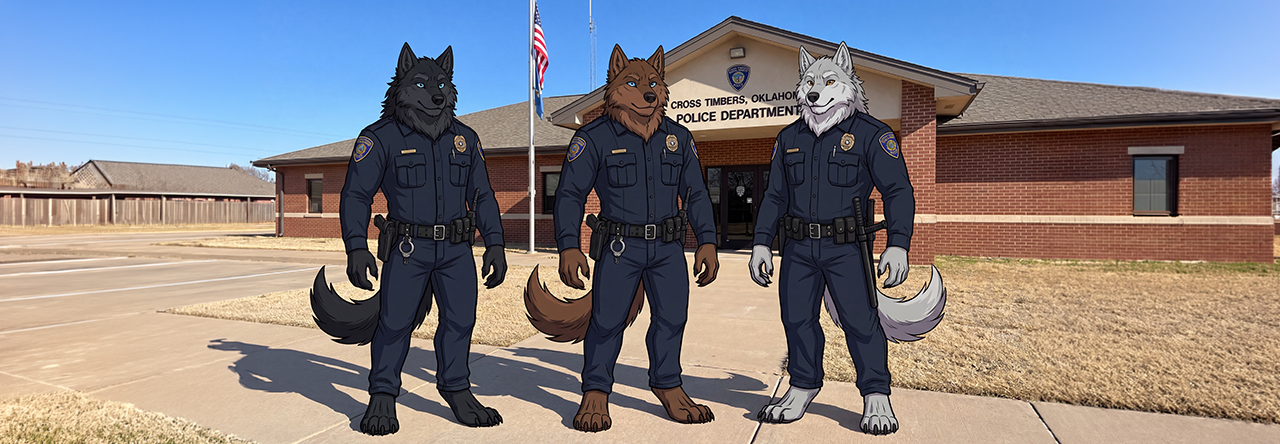
Night Shift Header

Month: June 2026

Chapter 10 — The Wrong Ruler

The accommodations meeting had a name that sounded harmless.

That was how Thane knew it was lying.

He stood outside Conference Room C at the Cross Timber Public Safety Training Annex, staring at a printed sign taped to the door.

APPLICANT ACCOMMODATION REVIEW

Beneath it, in smaller letters:

TRAINING / LEGAL / HR / EQUIPMENT / SAFETY

Gabriel leaned beside him, black fur sleek, blue eyes bright with anticipation.

“That sign has too many departments on it.”

Mark stood on Thane’s other side holding one notebook, one pen, and the strained expression of a wolf trying very hard not to have prepared a binder.

“It is a multidisciplinary meeting.”

Gabriel looked at him. “That means too many departments.”

“It means multiple areas of expertise.”

“It means someone in there has a spreadsheet called Werewolf Problems.”

Thane looked at Mark.

Mark did not answer quickly enough.

Thane’s eyes narrowed. “Do you have a spreadsheet called Werewolf Problems?”

“No.”

Gabriel smiled. “He renamed it.”

Mark’s ears angled back. “It is called Applicant Accommodation Matrix.”

Thane closed his eyes.

Gabriel whispered, “That is somehow worse.”

Before Thane could respond, the door opened.

Sergeant Hale stood inside with a coffee cup, a stack of folders, and the look of a man who had accepted that his day would become a story told in training meetings forever.

“You’re early.”

Mark lifted his notebook. “Four minutes.”

Hale looked at the notebook.

“Still just one?”

“Yes.”

Hale stared at him.

Mark stared back.

Hale looked at Gabriel. “Is he okay?”

Gabriel shook his head. “No, but he’s brave.”

“I am standing right here,” Mark said.

“I know. We’re all standing right here. That’s why this is meaningful.”

Hale stepped aside. “Come in before someone adds another department.”

Conference Room C had been rearranged.

That was the first thing Thane noticed.

The normal chairs had been pushed back against the wall. A heavy bench had been placed on one side of the table. Two reinforced folding chairs stood nearby with yellow tags still hanging from their frames, as if maintenance had purchased them under protest.

Hale saw Thane looking.

“Don’t get emotional.”

Thane grunted. “I wasn’t.”

“You looked at the bench like it understood you.”

Gabriel patted the bench. “It’s nice to be seen.”

Around the table sat a collection of people who looked like they had all been invited to different meetings and only recently discovered they were in the same one.

Assistant City Attorney Priya Shah sat with her legal pad and aligned pens.

Officer Talia Ross, the defensive tactics evaluator, leaned back with arms crossed and the comfortable posture of someone who expected nonsense and planned to enjoy surviving it.

A woman in a burgundy blazer with a city ID badge read MARLENE GIVENS — HR. She had kind eyes, anxious hands, and a stack of forms thick enough to qualify as a defensive barrier.

Beside her sat a broad man with a shaved head, salt-and-pepper beard, and a uniform polo stretched across shoulders that had probably moved file cabinets recreationally. His badge read QUARTERMASTER DALTON PIKE. He had a measuring tape, a tablet, and the haunted look of a man who had been told “custom uniform solutions” by someone who did not have to solve them.

At the far end sat a thin man in glasses with a laptop already open and a department IT badge.

Mark noticed him instantly.

The man noticed Mark noticing him.

A silent exchange of technical suspicion passed between them.

Gabriel leaned toward Thane. “The nerds have made eye contact.”

Thane whispered, “Which one wins?”

“Mark. Always. But the other one may not know yet.”

Hale shut the door.

“All right,” he said. “Purpose of today’s meeting: determine practical accommodations for three non-standard applicants entering pre-academy orientation and potential law enforcement training.”

Gabriel lifted one claw. “Non-standard feels generous.”

Pike muttered, “Non-standard is doing a lot of work.”

Hale pointed at him. “Dalton, do not start grieving yet.”

“I saw the physical assessment report,” Pike said. “I’ve already been grieving.”

Ross smiled. “He read the part about the grip tester.”

Pike looked at Thane. “Did you really crack it?”

Thane folded his arms. “Barely.”

“That is not better.”

“It was small.”

“It was calibrated.”

Gabriel said, “Briefly.”

Shah took a breath. “Before this becomes a memorial service for equipment, I’d like to establish the legal framework.”

Hale sat. “Please do. It’ll make the chaos feel expensive.”

Shah ignored him, which was probably wise.

“Accommodation does not mean lowered standards,” she said. “It means identifying what a standard is actually intended to measure and whether there is a reasonable equivalent method for applicants whose physiology does not match assumptions built into existing policy.”

Mark’s ears lifted.

Gabriel whispered, “Careful. She’s speaking your language.”

Mark whispered back, “It was a very good sentence.”

Shah looked at him. “Thank you.”

Gabriel smiled. “Strong room.”

Shah continued.

“If the standard is ‘wear boots,’ that may not be meaningful here. If the standard is ‘maintain safe traction and protect the foot from normal hazards,’ then we evaluate whether their natural anatomy satisfies or exceeds that requirement.”

Thane looked down at his clawed feet.

His pads were thick, dark, and tough enough to handle gravel, asphalt, heat, broken glass, and the kind of terrain that made humans invent footwear in the first place. His claws curved against the floor, visible, useful, part of him.

Pike leaned forward.

“So we’re really starting with no shoes?”

“Yes,” Thane said.

“No boots?”

“No.”

“Custom tactical footwear?”

“No.”

“Protective overshoes?”

Thane stared at him.

Gabriel said, “I admire your optimism.”

Mark added, “Footwear would interfere with claw articulation, traction, balance, and sensory feedback through the pads. Their footpads are substantially tougher than human soles.”

Pike blinked.

Mark cleared his throat. “Our footpads.”

Gabriel smiled. “He briefly became a field guide.”

Ross looked under the table toward Thane’s feet.

“You can run on asphalt, gravel, broken terrain?”

“Yes,” Thane said.

“Glass?”

“Yes.”

“Nails?”

“Depends.”

Pike brightened. “Aha.”

Thane looked at him.

Mark said, “A nail through the pad would be painful but not operationally disabling for long.”

Marlene from HR lowered her pen very slowly.

“Not operationally disabling for long,” she repeated.

Gabriel gave her a sympathetic smile. “You’re doing great.”

“I don’t feel like I am.”

“You’re still writing.”

“That may be panic.”

Hale sipped coffee. “Panic documentation is still documentation.”

Ross leaned forward.

“Fine. No shoes. But we document traction testing, puncture concerns, blood exposure concerns, and scene contamination concerns.”

Thane’s ears angled.

“Scene contamination?”

Shah nodded. “Bare feet at a crime scene may transfer trace material.”

Mark leaned in despite himself. “We could establish a protocol for scene entry. Disposable path covers where needed. Limited stepping zones. Photo documentation of foot impressions if unavoidable.”

Hale pointed at him. “No policy draft.”

Mark sat back.

“That was a protocol concept.”

“No.”

Gabriel said, “He’s vibrating again.”

Mark looked down at his notebook and did not write.

Heroic.

Pike scrolled on his tablet.

“Next: uniforms.”

The room’s mood shifted.

Not darker.

More doomed.

Pike looked at the three werewolves.

Then at his tablet.

Then back at them.

“I’ll be honest,” he said. “Standard sizing is dead.”

Gabriel lowered his head solemnly. “It died bravely.”

Pike ignored him.

“Shirts can be custom. Pants are… complicated.”

Thane’s ears lifted.

Mark said, “Tail clearance, hip structure, range of motion.”

Gabriel added, “And dignity.”

Pike nodded. “That too.”

Marlene looked at her form. “Are pants required?”

The room went still.

Thane stared at her.

Marlene’s face reddened. “I mean as a uniform standard. I am asking as HR.”

Gabriel placed both hands on the table.

“Marlene, that may be the bravest question anyone has asked in this room.”

Hale closed his eyes.

Shah looked at the ceiling.

Ross laughed once into her hand.

Mark said, with painful seriousness, “Uniform coverage standards can be met with modified tactical trousers or duty kilt-style configurations depending on anatomy and mobility requirements.”

Everyone looked at him.

Mark’s ears went back. “What?”

Gabriel whispered, “Duty kilt.”

“No,” Thane said.

“I did not recommend it. I said it was an option.”

“Remove the option.”

Pike typed something.

Thane pointed at him. “Do not type duty kilt.”

Pike did not look up. “Too late.”

Gabriel made a sound of pure joy.

Hale pointed at Gabriel. “If that phrase leaves this room, I will assign you paperwork until retirement.”

“I’m not even hired.”

“I’ll get creative.”

Shah regained control by force of will.

“Uniform objective: clear identification, professional appearance, safety, equipment support, and public recognizability. We can consider custom tactical shirts, modified pants, and external identification panels if needed.”

Gabriel nodded. “So no duty kilt.”

Thane growled.

Gabriel smiled. “Just confirming for the record.”

Pike moved on quickly.

“Body armor.”

“No,” Thane said.

Pike blinked.

Shah looked up.

Marlene’s pen paused.

Ross’s eyebrows lifted.

Hale’s coffee stopped halfway to his mouth.

Gabriel nodded. “Also no.”

Mark said, “Correct.”

Pike stared at them. “You’re refusing body armor?”

“Yes,” Thane said.

Pike looked like someone had kicked his procurement budget.

“Why?”

Gabriel leaned back. “Because we can get shot or stabbed multiple times and heal almost instantly.”

Marlene made a small sound.

Not quite a gasp.

Not quite a prayer.

Mark added, “Ballistic armor may still reduce immediate kinetic trauma, but it would also restrict movement, interfere with heat regulation, complicate fit, and provide minimal benefit relative to our healing capacity.”

Ross looked at Thane. “Multiple shots?”

Thane shrugged. “Depends where.”

Hale set his coffee down. “Do not shrug at bullet wounds.”

Thane looked at him. “You asked.”

“I did not ask. Dalton asked. I was hoping he wouldn’t.”

Pike rubbed his forehead.

“I have never had applicants refuse armor because bullets are inefficient.”

Gabriel smiled. “First time for everything.”

Shah’s expression sharpened.

“Let’s be precise. You are not invulnerable.”

“No,” Mark said. “But substantially resilient.”

“Fatal injury is possible?”

“Yes.”

“Long-term incapacitation?”

“Possible, but unlikely from ordinary gunshot or stab wounds unless damage is extreme, repeated, or involves specific vulnerabilities.”

Marlene wrote specific vulnerabilities and then seemed to regret having words.

Hale looked at Thane.

“What about pain?”

Thane shrugged again.

Hale pointed at him. “I swear.”

Thane huffed. “It hurts. Then it heals.”

Gabriel added, “He gets cranky.”

“I am already cranky.”

“Yes, but with ventilation.”

Pike slowly set his tablet down.

“I need a minute.”

Ross grinned. “Take two.”

Shah made notes.

“Policy concern: refusal of standard protective equipment. We’ll need a waiver, medical confirmation, risk assessment, and probably language stating that refusal is based on physiological redundancy, not bravado.”

Gabriel leaned toward Thane. “Physiological redundancy. That’s you.”

Thane glared.

Mark wrote it down.

Thane looked at him.

Mark covered the notebook with one hand.

Hale sighed. “Moving on before Dalton quits.”

Pike picked up his tablet again with the grim courage of a man returning to battle.

“Gloves.”

“No,” all three werewolves said at once.

Marlene flinched.

Pike stared.

Hale nodded slowly. “Efficient.”

Shah asked, “Reason?”

Mark answered. “Reduced tactile sensitivity, interference with claws, poor fit, low need for biological protection. We do not contract human diseases and cannot transmit them through ordinary contact.”

Marlene looked up.

“You don’t get sick?”

Gabriel tilted his hand. “We can get poisoned, injured, burned, annoyed, and occasionally emotionally cornered by psychologists.”

Thane grunted.

“But colds, flu, stomach bugs, bloodborne pathogens?” Gabriel shook his head. “No.”

Marlene looked like HR had just discovered a new species of paperwork and wanted to pet it from a distance.

“So no sick leave?”

Gabriel smiled.

Mark said, “That is not what he said.”

Hale pointed at Marlene. “Do not get excited.”

“I am not excited,” she said. “I am… recalculating.”

Thane looked at Gabriel. “You made HR recalculate.”

“I have that effect.”

Ross tapped the table.

“Gloves may still be needed for evidence handling.”

Mark nodded. “For contamination prevention, yes. But standard gloves will tear on claws. We may need modified evidence handling tools or oversized nitrile barriers adapted for claws.”

Pike whispered, “Custom gloves.”

Thane said, “No gloves.”

Pike looked up. “Evidence gloves.”

Thane paused.

Gabriel leaned toward him. “That’s how they get you.”

Mark said, “Evidence integrity matters.”

Thane sighed. “Fine. Evidence gloves if needed.”

Pike looked relieved.

Then nervous.

“I have no idea what those are.”

Mark opened his mouth.

Hale pointed without looking. “No.”

Mark closed it.

The IT man finally spoke.

“Body cameras?”

Everyone turned to him.

He straightened slightly. “Trevor Lin, systems.”

Gabriel murmured, “The challenger emerges.”

Mark’s eyes narrowed. “Body camera placement is a valid concern.”

Trevor nodded. “Standard chest mount may capture muzzle, fur obstruction, or be angled too low or too high depending on posture.”

Gabriel looked down at his chest.

“If it points too high, it records the suspect’s final view before Thane explains consequences.”

Mark nodded. “That is exactly why camera angle matters.”

Hale stared at them.

“I hate that both of you are right.”

Trevor clicked something on his laptop.

“We could test shoulder mounts.”

Ross shook her head. “Too much movement.”

“Collar mount?”

All three werewolves looked at him.

Trevor froze.

Gabriel’s smile became dangerous and polite.

“Would you like to rephrase that?”

Trevor swallowed.

“Upper harness mount.”

“Better,” Thane said.

Marlene wrote upper harness mount very quickly.

Mark leaned forward. “A sternum harness with stabilizing straps may work if it is positioned below the line of the muzzle and above equipment interference. It would need breakaway safety or reinforced attachment depending on use-of-force risk.”

Trevor looked interested despite himself.

“Yes. We could run test footage.”

Hale looked between them.

“No one is bonding over camera calibration.”

Mark and Trevor both looked disappointed.

Gabriel whispered, “Nerd duel became nerd courtship.”

Mark’s ears went back. “It did not.”

Trevor said, “It absolutely did not.”

Thane looked at Gabriel. “You’re enjoying this too much.”

“I have been given gifts.”

Pike scrolled to the next section.

“Duty belt.”

Mark immediately said, “May need harness integration instead of belt-only carry.”

Pike looked at him.

Mark lowered his pen. “Sorry.”

“No,” Pike said. “That’s probably right.”

Mark looked both vindicated and afraid.

Pike continued. “Standard belts assume human waist, hip structure, equipment spacing, and reach. Firearm, radio, cuffs, less-lethal, baton, gloves, medical kit, flashlight—”

“No baton,” Ross said.

Pike looked at her.

Ross nodded toward Thane. “If he needs a stick after showing up with those arms, we have failed as a species.”

Gabriel raised one claw. “Can I have a baton for theatrical purposes?”

“No,” Hale said.

“Worth asking.”

Shah looked at the equipment list.

“Firearms.”

The room quieted slightly.

Not heavily.

Just enough.

Gabriel’s smile faded into attention.

Pike said, “If academy path requires firearms training, we need modified grip evaluation. Trigger guard clearance with claws. Retention holster. Range safety.”

Thane flexed one clawed hand.

“I can shoot.”

Hale looked at him. “No one asked if you can make holes in paper.”

“I can.”

“Again, not the concern.”

Shah leaned forward.

“The concern is how a prosecutor explains a werewolf with claws, teeth, exceptional strength, near-instant healing, and a pistol to a jury after any use-of-force incident.”

Gabriel lifted one finger. “So the issue is that the werewolf with built-in knives might also have a gun.”

“Yes,” Shah said.

Gabriel lowered his finger. “That is fair.”

Mark said, “If sworn officers are generally armed, unequal disarmament could create legal and operational questions.”

Shah nodded. “Correct.”

Ross added, “Also, firearms aren’t just about need. They’re about standard training, threat response, retention, and knowing what not to do with one.”

Hale pointed at Ross. “That.”

Thane looked at the table.

“I don’t need one.”

Hale’s voice sharpened.

“That sentence is dangerous.”

Thane’s ears angled forward.

Hale met his eyes.

“You don’t get to decide training is beneath you because your body came with extra options.”

The room went still.

Gabriel did not joke.

Mark did not intervene.

Hale continued.

“You may not need a gun to survive. But you need to understand firearms law, safety, escalation, retention, and what every officer around you is carrying. You need to know what happens when a suspect has one. You need to know what happens when an officer drops one. You need to know why not needing something does not make you exempt from respecting it.”

Thane held his gaze.

Then nodded once.

“Fine.”

Hale leaned back.

“Progress.”

Gabriel whispered, “He used one percent.”

Thane looked at him.

Gabriel gave him a mild smile.

Ross turned a page.

“Less-lethal.”

Pike brightened slightly, then seemed to remember the candidates.

“Taser exposure?”

“No,” Thane said.

Pike’s hope died.

Mark clarified, “Minimal effect.”

Ross leaned forward. “Minimal?”

Gabriel shrugged. “It tingles.”

Hale looked pained. “It tingles.”

“For me,” Gabriel said. “Thane gets annoyed.”

“Everything annoys Thane.”

“Exactly.”

Pike looked at Ross. “Less-lethal rounds?”

Thane shrugged.

Hale pointed. “Stop shrugging at impacts.”

“They bruise.”

Mark added, “Briefly.”

Marlene whispered, “Briefly.”

Shah wrote something that probably cost the city money.

Ross’s eyes sharpened.

“Pepper spray?”

The room changed.

All three werewolves went still.

Gabriel’s ears angled back first.

Mark’s nose wrinkled.

Thane’s eyes narrowed.

Ross smiled slowly.

“Oh.”

Hale looked delighted. “Finally.”

Pike leaned in. “Pepper spray works?”

Gabriel said, “Worse.”

Thane growled. “Much worse.”

Mark adjusted his posture. “Our olfactory sensitivity makes chemical irritants significantly more debilitating. Ocular recovery is fast. Nasal and respiratory overstimulation is the larger issue.”

Ross looked at Hale. “So pepper spray is our emergency stop button.”

“No,” Thane said immediately.

Gabriel pointed at Ross. “Dangerous phrase.”

Hale smiled into his coffee.

Thane turned toward him. “Do not enjoy this.”

“I am learning.”

“You are enjoying.”

“Both can be true.”

Ross leaned back.

“Training exposure?”

Gabriel’s ears flattened. “Absolutely not.”

Mark said, “Standard OC exposure may be excessive.”

Thane said, “No.”

Ross looked at Hale.

Hale looked at Shah.

Shah looked at Mark.

Mark looked like he wanted to be anywhere else.

“Controlled minimal exposure may be necessary if chemical agents are part of the environment,” Shah said carefully. “But standard exposure could be medically inappropriate.”

Gabriel said, “There are many words in that sentence and I hate all of them.”

Marlene asked, “Could exposure cause permanent harm?”

Mark shook his head. “Unlikely. Temporary incapacitation, extreme discomfort, sensory overload, possible disorientation.”

Hale looked at Thane. “So if someone sprays you in the field?”

“I get very angry.”

Everyone went quiet.

Thane heard it after he said it.

He closed his mouth.

Price’s voice, memory only, crossed his mind.

Name it first.

Move second.

Thane exhaled slowly.

“I would need to disengage or be guided out until I recover,” he said. “Because I would be angry and less useful.”

Hale’s expression changed.

Not much.

Enough.

Ross nodded. “That goes in the plan.”

Shah wrote.

Mark wrote too.

Gabriel glanced at Thane, something warm and proud hidden under the corner of his mouth.

Thane pretended not to see it.

Pike looked relieved to move on.

“Vehicles.”

Hale immediately said, “Before anyone says Humvee, no.”

Thane closed his mouth.

Gabriel leaned back, delighted. “He’s learning you.”

“I wasn’t going to say Humvee.”

Mark looked at him.

Gabriel looked at him.

Hale looked at him.

Pike looked hopeful and horrified.

Thane growled. “Fine. I was thinking it.”

Hale nodded. “No.”

Pike pulled up a diagram of a patrol SUV on the room screen.

“Standard patrol vehicles have issues. Seat size, partition clearance, pedal spacing, steering wheel clearance, radio controls, equipment console, seatbelt length, and upholstery survivability.”

Gabriel smiled. “Upholstery survivability sounds like Thane’s biography.”

Pike ignored him with the thousand-yard stare of a man who had priced custom seats.

Mark leaned forward.

“A modified seat track and reinforced seat may be sufficient. Partitioned prisoner transport would likely need to be handled by another unit unless vehicle cage dimensions are altered. Footwell clearance for claws is critical. Pedal modifications may be needed. Controls should be accessible without claw strike.”

Trevor, the IT man, added, “Radio mic mounting too.”

Mark nodded.

Thane looked between them.

“They’re doing it again.”

Gabriel whispered, “Let them. It’s beautiful and terrible.”

Hale pointed at both Mark and Trevor. “No redesigning the fleet today.”

Pike muttered, “Please redesign the fleet today.”

Shah said, “Absolutely do not.”

Pike sighed.

Marlene shuffled her forms.

“Public interaction.”

Everyone looked at her.

She looked like she wished the forms had kept quiet.

“I mean, if uniforms identify them as law enforcement trainees or future officers, how do we manage public concern? Citizen complaints? Media questions? Children?”

Gabriel’s expression sharpened.

That was his arena.

Not because it was easy.

Because he understood stories.

“You’re not just fitting gear,” he said. “You’re fitting the story people will tell when they see us in it.”

The room went quiet.

Shah’s pen stopped.

Hale watched him.

Gabriel continued.

“If people see three werewolves in tactical gear, some will think monsters. Some will think mascots. Some will think weapons. Some will think politics. Some will record us hoping we do something they can post before we finish speaking.” His smile was faint, without humor. “The uniform can’t make us look normal. It needs to make us look accountable.”

Marlene wrote that down.

So did Shah.

Hale looked at Gabriel for a long moment.

“That was annoyingly useful.”

Gabriel placed one hand over his heart. “I live for your praise.”

“Do less.”

Ross tapped the table.

“Defensive tactics.”

Thane already disliked the way she said it.

Ross looked directly at him.

“Your biggest problem is not winning fights. It’s not accidentally ending them.”

No one joked.

That helped the words land.

Ross continued.

“Standard control techniques assume comparable anatomy and force. That will not apply. If you grab someone like a human officer grabs someone, you may break them. If you pin someone, you may crush them. If you react to pain compliance, it may not matter. If someone tries to fight you, you may forget how fragile they are.”

Thane’s jaw tightened.

Report before motion.

Name it first.

Move second.

One percent.

Ross saw his face.

Good.

“Training focus for you is minimal contact, positioning, barriers, disengagement, verbal control, and handoff. You will learn how to be present without putting hands on people unless necessary.”

Gabriel looked at Thane. “Present is one of your stronger skills.”

Thane glared.

Ross said, “He’s not wrong. Presence can be a tool. It can also be intimidation.”

“Sometimes intimidation works,” Thane said.

Ross nodded. “And sometimes it turns a scared idiot into a desperate idiot.”

That was also fair.

Annoyingly fair.

Mark asked, “Would we train with human partners?”

Ross looked at Hale.

Hale looked at Shah.

Shah looked tired.

Ross answered. “Eventually, yes. Carefully. With supervision. Nobody learns control without something to control. But we start with pads, dummies, restraint devices, and instructors who signed waivers they probably should have read.”

Pike said, “Do I need to order stronger dummies?”

Ross looked at Thane.

“Yes.”

Thane said, “I haven’t broken a dummy.”

“Yet,” Gabriel said.

Hale pointed at him. “Stop helping.”

Marlene raised another hand slightly.

“What about infection control?”

Gabriel looked at Mark.

Mark answered, “As stated, we do not contract human pathogens. We heal quickly. We do not require standard PPE for personal protection from disease, though PPE may still be required for contamination control, public confidence, evidence preservation, or policy consistency.”

Marlene blinked.

Gabriel leaned toward her. “Translation: we don’t need gloves to stay healthy, but we may need them so everyone else stops screaming.”

Mark thought about that.

“Yes.”

Marlene wrote public confidence and underlined it twice.

The meeting went on.

Classroom seating.

Bench placement.

Table height.

Door clearance.

Restroom access.

Locker room privacy.

Emergency medical protocols.

Whether standard injury reporting applied when injuries healed before a supervisor arrived.

It did.

Whether blood exposure policies applied when their blood might be gone by the time someone found a bandage.

Also yes.

Whether bite force needed to be documented.

“No,” Shah said.

“Absolutely not,” Hale said.

Pike whispered, “I was curious.”

Gabriel said, “A lot of people are, Dalton. Fight it.”

Whether claws counted as weapons under academy policy.

The room went silent at that one.

Shah removed her glasses.

“They are part of your body.”

Ross nodded. “But they are also capable of lethal injury.”

Hale looked at Thane. “So is your fist.”

“More so,” Gabriel said.

Thane looked at him.

Gabriel shrugged. “Accurate.”

Mark said, “Policy should classify claws as anatomical force capability, not carried weapons.”

Hale stared at him.

Shah slowly nodded.

“That may actually work.”

Mark sat a little straighter.

Hale pointed at him. “Do not look proud.”

“I am not.”

“You are glowing in regulatory language.”

Gabriel whispered, “He is.”

By the second hour, Marlene had filled three pages. Pike looked like he wanted to retire into a cabin without uniforms. Trevor and Mark had been forbidden from discussing camera firmware twice. Ross seemed deeply entertained. Shah had consumed one entire legal pad page and part of another.

Hale looked at the wall clock.

“All right. Summary.”

Everyone looked relieved.

“Shoes: no, with traction and contamination protocol. Gloves: no for disease protection, yes or adapted tools for evidence handling. Body armor: refused, pending medical and risk documentation. Bodycams: custom harness testing. Uniforms: custom. Duty kilts: dead.”

Thane pointed at him. “Dead.”

Gabriel sighed. “A loss for history.”

“Vehicles: modified seating assessment. Firearms: standard safety and legal training with modified grip review. Less-lethal: tasers and impact rounds minimally effective for training assumptions. Pepper spray: unfortunately very effective.”

“Unfortunately?” Gabriel asked.

Hale smiled thinly. “For you.”

Thane growled.

“Defensive tactics: minimal contact and control emphasis. Classroom: reinforced seating. Public interaction: accountable visibility.”

Gabriel nodded once. “That phrase works.”

Marlene looked at her notes. “Accountable visibility. Yes.”

Shah closed her notebook.

“I’ll draft the formal accommodation memo.”

Mark made a tiny sound.

Everyone looked at him.

He cleared his throat. “May I review for technical accuracy?”

“No,” Hale said.

Shah said, “Yes.”

Hale turned to her. “Priya.”

She shrugged. “I’d rather have him catch the impossible parts before someone with a worse attitude does.”

Gabriel smiled at Hale. “You lost custody of the memo.”

Hale looked wounded in a way he would deny under oath.

Mark looked like he had been handed a sacred duty.

Thane leaned toward Gabriel. “We’ll never see him again.”

“He’ll live in the margins now.”

Mark ignored them with dignity that fooled no one.

Pike pushed back from the table.

“I still need measurements.”

Thane’s ears angled forward.

“For uniforms,” Pike said quickly.

“Say that first next time.”

Pike picked up his measuring tape.

Gabriel looked delighted.

Thane looked betrayed by the universe.

Hale stood. “I’m leaving before this becomes theater.”

Gabriel said, “It became theater when someone said duty kilt.”

“Enough.”

Pike approached Thane with the measuring tape and the caution of a man approaching an expensive horse with anger issues.

“Arms out?”

Thane stared.

Pike waited.

Thane slowly lifted his arms.

Gabriel’s grin widened.

Thane looked at him. “Say nothing.”

Gabriel pressed his lips together.

Pike measured shoulder width.

Then stopped.

Checked the tape.

Measured again.

Marlene looked up. “Problem?”

Pike said, “No. Just emotionally processing fabric cost.”

Ross laughed.

Mark was next and cooperated fully, which made the process fast and boring until Pike measured around his tail clearance and Gabriel whispered, “Historic.”

Mark kicked backward without looking.

Gabriel stepped out of range because he had lived this long for a reason.

Gabriel’s measurements turned into a performance despite Hale’s absence. He stood with theatrical patience while Pike measured and made small noises.

“Do all of you have to be this… non-standard?” Pike asked.

Gabriel looked at him. “I could slouch.”

“Please don’t.”

When Pike finished, he lowered the tape and stared at his notes.

“I need a new vendor.”

Trevor muttered from his laptop, “I need a new camera mount.”

Marlene whispered, “I need a new form.”

Ross leaned back. “I’m having a great day.”

Thane looked at her.

“You enjoy chaos.”

“I teach defensive tactics,” Ross said. “Chaos pays my bills.”

At last, the meeting broke apart.

Shah gathered her legal pad. Marlene stacked her forms like they might run. Trevor packed his laptop while Mark asked one extremely restrained question about camera data retention and was rewarded with a business card. Pike left muttering about fabric, harnesses, and “no duty kilt, apparently.” Ross paused by the door and looked at Thane.

“One percent,” she said.

Thane looked at her.

She tapped the table.

“Remember it when we start control work.”

Then she left.

Gabriel watched her go. “I like her.”

Thane grunted. “You like everyone who threatens me constructively.”

“Constructive threats are how adults bond.”

Mark was reading Trevor’s business card.

Thane took it from his hand.

“Hey.”

“No firmware courtship.”

“It is not courtship.”

Gabriel leaned close. “You’re blushing in binary.”

Mark snatched the card back.

Hale reappeared in the doorway like he had been waiting for the worst to end.

“Everyone alive?”

Marlene, from the hallway, called, “Define alive.”

Hale nodded. “Good enough.”

He stepped into the room and handed Mark a sheet.

“Pre-academy orientation. Monday morning. Full group.”

Mark looked at the paper.

His ears lifted.

“Full group?” Gabriel asked.

Hale looked at him. “Yes.”

“How full?”

“Enough.”

“That’s not a number.”

“It’s a warning.”

Thane looked at the sheet.

Names, time, room, instructions.

A real orientation.

Not a special meeting.

Not a private review.

A full group.

Humans. Applicants. Instructors. Chairs that hopefully knew what they were getting into.

Hale crossed his arms.

“Congratulations. The system has decided you are possible.”

Gabriel blinked.

“That sounds less flattering than I hoped.”

“It was a fight to get that wording.”

Mark looked down at the page, then at Hale.

“Possible is not accepted.”

“No,” Hale said. “Possible is the door before accepted.”

Thane took the sheet from Mark and read it.

Monday.

Eight a.m.

Pre-academy orientation.

Dress: business casual or agency uniform if applicable.

He looked down at himself.

Gabriel leaned over.

“Business casual werewolf. That’ll be fun.”

Mark murmured, “We need to define that.”

Hale pointed at him. “No spreadsheet.”

Mark looked personally wounded.

Gabriel smiled. “Applicant Accommodation Matrix Two: Fashion Crimes.”

Thane handed the sheet back to Mark.

“We are still not cops.”

Gabriel nodded. “No.”

Mark folded the sheet carefully. “But we are possible.”

Thane looked toward the conference room table, where the wrong rulers had failed one after another and somehow produced something like a path.

No shoes.

No armor.

No gloves unless evidence demanded it.

Pepper spray as a nightmare.

Cameras, harnesses, vehicles, claws, reports, policies, and a room full of humans trying, badly but seriously, to measure what mattered.

For once, the system had not said fit the box.

It had asked what the box was for.

That was new.

Hale opened the door wider.

“Go home. Monday will be worse.”

Gabriel stepped into the hall. “You always know what to say.”

“Years of practice.”

Mark followed, already reading the orientation sheet.

Thane paused beside Hale.

The sergeant looked up at him.

“What?”

Thane glanced back at the room.

“All that because we don’t wear shoes.”

Hale sipped his coffee.

“All that because the city is trying to figure out whether three werewolves can stand inside the rules without the rules pretending you’re human.”

Thane said nothing.

Hale added, “Wrong ruler. Right question.”

That sounded too much like a chapter title.

Thane hated it.

“Monday,” Hale said.

Thane nodded.

They walked out through the side hall, past the classrooms, past the locked equipment room, past the vending machine Gabriel still considered a crime against snacks, and into the parking lot where the Xterra waited in its proper space.

The day was bright and windy.

Mark looked at the orientation sheet.

Gabriel looked at Mark.

Thane looked at both of them.

“What did you name it?”

Mark’s ears angled back.

Gabriel smiled. “There it is.”

Mark looked at his phone.

“Pre-Academy Orientation.”

Gabriel groaned. “You are killing the brand.”

“It is accurate.”

Thane opened the driver’s door.

“Leave it.”

Gabriel stared at him. “You too?”

Thane looked back toward the annex.

Possible.

Not accepted.

Not trusted.

Not ready.

But possible.

For today, normal words were enough.

He climbed into the Xterra.

Gabriel got in beside him, muttering about lost artistic standards.

Mark sat in the back with the orientation sheet on his lap and the expression of a wolf trying not to smile at a schedule.

Thane started the engine.

As they pulled out of the lot, a gust of wind pushed dry leaves across the pavement. They scattered under the tires, light and quick and impossible to organize.

Gabriel looked at the annex shrinking behind them.

“No shoes, no armor, no gloves, hates pepper spray, breaks grip testers, emotionally wounds quartermasters.”

Mark nodded. “Accurate summary.”

Gabriel turned to Thane. “They still said possible.”

Thane kept his eyes on the road.

“Yeah.”

The word felt strange.

Small.

Heavy.

Ahead, Cross Timber waited, full of rules written for human hands, human feet, human bodies, human fear.

Behind them, a room full of people had started rewriting the ruler.

Not to make the standard easier.

To find out what it was actually measuring.

Thane drove home with his claws light on the wheel, the road bright ahead, and Monday waiting like a door someone had finally unlocked but not yet opened.

Chapter 9 — One Percent

The morning after night shift, Thane woke up before the sun and hated that it felt appropriate.

He stood in the kitchen with one hand around a mug of coffee, staring through the dark window over the sink while the woods slowly became shapes instead of shadows. The house was quiet. Not asleep, exactly. A house with three werewolves in it was never fully asleep. It listened. It breathed. It creaked around them like old timber settling under familiar weight.

Outside, the trees held the last blue of night.

Inside, the radio was still in his head.

Not one radio.

All of them.

Dispatch voices. Unit numbers. Static. Nina saying, “You called the right number.” Voss saying, “Talk me through it.” Hale saying, “You don’t know where to run yet.” Walter Reed whispering about lost mail beneath a concrete footbridge.

The old man’s elbow had felt fragile under Thane’s hand.

That bothered him more than the rest.

Not because Walter had been weak. Humans were always weaker than they thought. Werewolves too, sometimes, just in more embarrassing places.

It bothered him because Thane had almost used too much.

Not visibly. Not enough for anyone to notice. But he had felt it, that first surge when Voss finally told him to help. His body had wanted to lift, carry, solve, finish. One hand could have hauled Walter up the slope like a duffel bag.

Instead, he had used one hand.

Barely one hand.

One percent.

The coffee steamed against his muzzle.

Behind him, Gabriel entered the kitchen with the slow, silent grace of someone who had woken up before his sarcasm but expected it to catch up. His black fur was ruffled along one side, blue eyes half-open, expression somewhere between sleepy and suspicious.

He looked at Thane.

Then at the coffee.

Then at the window.

“You’re brooding before breakfast.”

Thane grunted.

Gabriel opened a cabinet. “That’s ambitious.”

“I’m not brooding.”

“No, of course not. You’re standing alone in the dark staring at trees like they owe you money.”

Thane took a drink of coffee.

Gabriel poured his own.

“You saved a mailman and didn’t eat a single policy manual,” Gabriel said. “Strong night.”

Thane looked over. “Former mailman.”

From the dining table, Mark said, “Walter Reed. Eighty-two. Retired postal carrier. Dementia diagnosis. Located approximately forty-four minutes after initial call.”

Gabriel froze with the coffee pot in hand.

Thane looked toward the table.

Mark sat there with his notebook open, gray and white fur neat, brown eyes focused, a pen resting between two claws. There was no folder. No binder. No tabs. Just the one notebook Voss had allowed.

Somehow that made it worse.

Gabriel slowly set the coffee pot down.

“Were you there the whole time?”

“Yes.”

“How long?”

“Twenty-two minutes.”

Gabriel looked at Thane. “We’re losing him.”

Mark did not look up. “I am reviewing observations.”

“You wrote observations at dawn.”

“I wrote preliminary observations last night. These are refinements.”

Thane walked to the table and looked down at the notebook.

Mark angled it away.

Thane’s ears lifted. “You protective of that now?”

“It is my only notebook.”

Gabriel sat across from him. “He’s bonded.”

Mark ignored that.

Thane read upside down.

“Dispatch workflow. Radio prioritization. Scene containment. Scent translation. Officer response patterns.”

Gabriel leaned in. “Any notes under ‘Thane did not sprint into the drainage ditch like an angry missile’?”

Mark turned a page. “Actually—”

Thane pointed at him. “No.”

Mark closed his mouth.

Gabriel smiled. “There is definitely a section.”

“There is not a section.”

“A paragraph?”

Mark looked down.

Gabriel tapped the table. “Ha.”

Thane sat heavily enough that the chair complained. It held, but only because he had built it himself.

Mark looked at him carefully.

“Your appointment is at ten.”

“I know.”

“With Dr. Price.”

“I know.”

Gabriel took a cautious sip of coffee. “The woman who asks questions shaped like knives.”

Thane’s jaw tightened. “I know.”

Mark’s ears angled back. “We can come with you.”

“She wants me alone.”

“For the appointment, yes. But we can wait outside.”

Thane looked at him.

Mark held his gaze.

Gabriel’s humor softened. “You don’t have to make the whole trip by yourself just because the hard part is yours.”

Thane stared at his coffee.

That sounded too reasonable for morning.

“I’m driving,” he said.

Gabriel nodded. “Obviously.”

Mark closed the notebook.

Thane looked at it.

Mark said, “I am not bringing it.”

Gabriel blinked. “Who are you and what have you done with Mark?”

Mark stood. “I am adapting.”

“That is becoming your most frightening phrase.”

The psychologist’s office looked even softer in daylight.

That made Thane distrust it more.

The waiting room had pale walls, low lamps, a row of chairs, a small table with magazines no one had touched honestly in years, and the same glass bowl of mints Gabriel had previously identified as a trap. A diffuser sent lavender into the air with grim persistence.

Gabriel eyed it as they entered.

“The mint trap remains.”

Mark sat carefully in one of the chairs. “Please do not start a conflict with candy.”

Thane stood near the wall.

Gabriel sat beside Mark and picked up a magazine.

Then immediately put it down.

“No.”

Mark glanced over. “What?”

“It says ‘simple ways to reduce stress.’ I don’t trust it.”

The receptionist at the desk smiled as if she had heard worse, which in this building was probably true.

A door opened.

Dr. Lillian Price stepped out with a tablet in one hand.

“Thane?”

He pushed away from the wall.

Gabriel looked up at him.

No joke.

Mark nodded once.

Not encouragement exactly. More like a promise.

Thane followed Price into her office.

The door closed behind them.

Price’s office had not changed. Same couch. Same chair. Same bookshelf. Same window overlooking the courtyard with the ornamental tree that looked like it regretted landscaping. The only difference was the light. Last time, the rain had made everything gray. Today, sunlight fell across the rug in clean rectangles.

Thane chose the floor again.

Price sat across from him.

“Still not trusting the chair?”

“Still optimistic.”

She smiled faintly.

“Fair.”

She set the tablet on her knee but did not look at it right away.

“How are you feeling this morning?”

Thane stared at her.

Price waited.

He sighed.

“Tired.”

“That is a start.”

“Annoyed.”

“Also expected.”

“With you?”

“Possibly.”

“Yes.”

Price nodded as if this was a perfectly ordinary thing to record, though she did not write it down.

“Why annoyed?”

“Because you’re going to ask questions I already know are coming, and I still don’t know how to answer them.”

“That sounds frustrating.”

“That is not a question.”

“No,” Price said. “It is an observation.”

Thane huffed.

She let the silence sit.

He hated that.

Eventually, she said, “Tell me about Walter Reed.”

Thane looked toward the window.

“He was cold.”

“What else?”

“Confused. Scared. Wet. Thought he was still delivering mail.”

“What did you do?”

“Found him.”

Price tilted her head.

“Try again.”

Thane’s claws rested against his knees.

“I smelled where he went. Gabriel heard him under the bridge. Mark helped read the tracks. Voss called it in. Officers held the perimeter. Medical staged.”

“And what did you do?”

Thane’s ears angled back.

“I told Voss what I knew.”

Price nodded.

“That is different from ‘I found him.’”

“I helped find him.”

“Yes.”

The distinction irritated him.

It also mattered.

Price asked, “When the call came in, what did you want to do?”

“Run.”

No hesitation.

No point pretending.

“Where?”

“Pine Draw.”

“Did you know where he was?”

“No.”

“Did you know where to start?”

“Not exactly.”

“What stopped you?”

Thane almost said Hale.

Then Voss.

Then Gabriel’s hand on his arm.

Then Mark looking at him like he already knew the shape of the mistake before it happened.

All true.

Not enough.

“I didn’t know where to run yet,” he said.

Price’s expression shifted.

“Whose words are those?”

“Hale’s.”

“And you listened.”

Thane looked down.

“Yes.”

“Why?”

“Because he was right.”

“That was hard to say.”

“Yes.”

Price made a note.

Thane watched the stylus move.

It did not bother him as much this time.

That bothered him too.

Price looked back up.

“What did waiting feel like?”

His jaw tightened.

“Wrong.”

“Wrong how?”

“Like standing beside a fire with water in your hands and waiting for someone to explain which part is burning.”

Price nodded slowly.

“That is a good description.”

“It wasn’t good.”

“It was clear.”

He looked away.

She continued.

“What did reporting feel like?”

“Slow.”

“Was it?”

Thane thought of Voss’s radio. Units shifting. Perimeter. Medical. The officer stopping before contaminating the path. Walter found without being frightened deeper into the drainage channel.

“No.”

Price waited.

He exhaled.

“It felt slow. It wasn’t.”

“What was it?”

Thane stared at the sunlight on the rug.

“Useful.”

Price did not smile.

But something in her face warmed.

“That matters.”

He said nothing.

She leaned back slightly.

“You keep treating restraint as the absence of action. It isn’t.”

Thane looked at her.

“Restraint is action under command,” Price said. “It is not doing nothing. It is choosing the action that fits the moment instead of the action your body wants most.”

Thane’s claws flexed once against his knees.

That sentence was going to stay.

He could already tell.

Price continued.

“When you supported Walter up the slope, how much strength did you use?”

Thane gave her a flat look.

“Do you want a number?”

“Yes.”

He frowned.

“I don’t know. Barely any.”

“Estimate.”

“One percent.”

The words came out before he meant to give them.

Price heard the weight in them.

“Hale’s phrase?”

Thane nodded.

“One percent when one percent is enough,” she said.

He hated that Hale had said something useful enough for a psychologist to repeat.

“Yes.”

“What happens when ten percent is enough?”

“Use ten.”

“And when one hundred percent is needed?”

Thane looked at her.

The room went still.

“Then I use it.”

Price held his gaze.

“And who decides?”

There it was.

The same question in another coat.

Thane looked at the window.

Outside, the ornamental tree shifted slightly in a breeze. Thin branches. Small leaves. Roots hidden under decorative rocks.

“I do,” he said.

Price did not write.

Thane looked back at her.

“But not alone.”

“Explain.”

“I decide what my body does. Nobody else can. Not Voss. Not Hale. Not Mark. Not Gabriel. If something happens fast enough, there may not be time for anyone to stop me.”

Price waited.

“So I need the line before the moment,” he said. “Not during it.”

Price nodded once.

“What is the line?”

Thane did not answer right away.

The old answer was easy.

Protect the innocent.

Stop the threat.

Make sure the monster never hurts anyone again.

All true.

All incomplete.

He thought of the tape line in dispatch. His foot crossing it by half an inch. Nina telling him not to stand on it. The ridiculousness of tape mattering. The usefulness of knowing where not to step.

He thought of Voss’s voice.

Talk me through it.

He thought of the scent trail in the drainage ditch, how naming it had made it part of the system instead of just part of him.

“Say it first,” he said.

Price tilted her head.

Thane looked down at his hands.

“If I smell something, hear something, know something, I say it before I move. Unless someone is dying right now. Unless waiting means immediate harm. Otherwise I say it first.”

Price watched him.

“Why?”

“Because if I have to say it out loud, I have to know what I’m acting on.”

“And if you can’t say it?”

“Then maybe I don’t know enough to move.”

She wrote that down.

This time, Thane did not hate the sound.

Price said, “That sounds like an operational rule.”

“Don’t call it therapy.”

“I was not going to.”

“You were thinking it.”

“I think many things.”

He huffed.

Price continued, “Give it words.”

“I just did.”

“Shorter.”

Thane’s ears angled back.

She waited.

He thought of the drainage. The radio. Walter’s elbow under his hand. The difference between running and helping.

“Report before motion,” he said.

Price nodded.

“Good.”

He looked away.

It did sound good.

That made it irritating.

Price asked, “What happens when Gabriel and Mark are not there?”

Thane’s body went still.

The room sharpened.

There it was.

The real blade under the soft questions.

“What do you mean?”

“You listed Hale’s words, Voss’s command, Gabriel’s hand, Mark’s presence. They all helped stop you from running. What happens when none of them are there?”

Thane stared at the rug.

The sunlight had moved.

He did not know when.

“I don’t know.”

Price’s voice was calm. “That answer is honest. It is not sufficient.”

His eyes lifted.

She did not soften.

“If you proceed, there will be moments when you are alone. Maybe only for seconds. Maybe at a doorway. Maybe in a hallway. Maybe with a suspect, a victim, or someone who is both. Your pack cannot be your only conscience.”

Thane wanted to growl.

He did not.

Progress, maybe.

“What do you want me to say?”

“The truth.”

“I don’t know if I trust myself alone yet.”

Price’s expression shifted.

Not alarm.

Attention.

Thane forced himself to continue.

“I trust myself to protect someone. I trust myself to take a hit. I trust myself to go into danger. I trust myself not to enjoy hurting people.” His jaw tightened. “But alone, with someone I know is guilty and someone else hurt because of them? I don’t know if I trust the first thing I want to do.”

Price made no note.

For several seconds, she only looked at him.

Then she said, “That is exactly why I am more comfortable clearing you today than I was last week.”

Thane stared.

“That makes no sense.”

“It does.”

“I just told you I don’t fully trust myself.”

“Yes,” she said. “That is why.”

He frowned.

Price leaned forward slightly.

“The most dangerous applicants are not the ones who know they carry anger. They are the ones who believe their anger is always righteous. You are not safe because you lack violent impulses. You are safer because you can identify them before obeying them.”

Thane’s throat tightened.

He looked away before his face decided to make that visible.

Price let him.

Then she said, “I am not clearing you because you are safe.”

His ears lifted.

“I am clearing you because you know you are not.”

The words settled into the room with more weight than he expected.

Not comfort.

Not absolution.

Something heavier.

Something useful.

Price picked up her tablet.

“My recommendation will be that you proceed, conditionally, with continued monitoring around restraint, provocation, and moral urgency. I’ll include the operational cue you developed.”

“Report before motion?”

“Yes.”

Thane’s ears angled back. “Hale is going to love that.”

“He will probably pretend not to.”

“That’s worse.”

Price almost smiled.

“One more thing,” she said.

“Of course.”

“When you feel the first impulse to act, where do you feel it?”

Thane stared.

“In my body.”

“That is not specific.”

“I’m a werewolf.”

“I noticed. Specific anyway.”

He sighed.

“Chest. Shoulders. Hands. Jaw.”

“Good. Those are early signals. When you feel them, you name what you know before you move.”

“Report before motion.”

“Yes.”

“And if there is no time?”

“Then afterward, you tell the truth about why there was no time.”

That one mattered too.

He nodded slowly.

Price closed the tablet.

“That’s enough for today.”

Thane stood.

The office looked the same as when he had entered.

Somehow that felt unfair.

He had expected, not consciously, maybe not even reasonably, that a room should change after pulling that much honesty out of someone.

But the couch was still the couch. The bookshelf was still full. The ornamental tree still tried too hard in the courtyard.

Price walked him to the door.

“Thane.”

He stopped.

She looked at him.

“You did well today.”

He huffed. “You people keep saying that after making everything miserable.”

“That may also continue.”

“Great.”

He opened the door.

Gabriel and Mark looked up instantly.

Too instantly.

Gabriel had a mint in one hand.

Mark had no notebook, no folder, and the expression of someone who had been forced to think without tools.

Thane looked at the mint.

Gabriel followed his gaze.

“I took one.”

“Trap worked?”

“I’m evaluating.”

Mark stood. “How did it go?”

Thane looked at Price.

Price said, “I’ll send the recommendation to Sergeant Hale today.”

Gabriel tilted his head. “Recommendation?”

“To proceed,” Price said.

Mark’s shoulders lowered.

Gabriel’s eyes softened.

Thane looked at the floor.

Price added, “Conditionally.”

Gabriel nodded. “That word is becoming family.”

Mark said, “Thank you, Doctor.”

Price looked at him. “You’re welcome.”

Gabriel held up the mint. “May I take this?”

“It is there to be taken.”

“That is what makes it suspicious.”

Price actually smiled.

A little.

They stepped into the hallway.

Thane expected to make it to the exit.

He should have known better.

Hale stood near the reception desk, coffee in hand, talking to the receptionist as if he had materialized from municipal irritation.

Gabriel stopped.

“Do you haunt every building we enter?”

Hale turned. “Only the ones that call me afterward.”

Thane’s eyes narrowed. “Price call you?”

“No.”

“Then why are you here?”

“Professional curiosity.”

Gabriel pointed at him. “Spectacle.”

Hale looked at him. “Partly.”

Mark’s ears lifted. “Dr. Price is recommending continuation.”

“I know.”

Thane stared. “You said she didn’t call you.”

“She texted.”

Gabriel looked delighted. “That is technically different.”

Hale looked at Thane.

“How’d it go?”

“I’m still not crazy.”

“That was never the bar.”

Gabriel nodded. “Good, because the bar keeps moving.”

Hale took a sip of coffee. “The bar is exactly where it was. You’re just starting to see it.”

Thane hated that.

Because it was good.

Hale held out a sheet of paper.

Mark took half a step forward, then stopped himself with visible effort.

Hale noticed.

“You okay?”

Mark’s ears flattened. “Yes.”

“That looked painful.”

Gabriel patted Mark’s shoulder. “He’s paper sober.”

Hale ignored that and handed the sheet to Thane.

“Next steps. Monday accommodations meeting. Training staff, legal, equipment, HR, me, probably someone who will ask a question so dumb it adds ten minutes to the meeting.”

Gabriel said, “Can we guess who?”

“No.”

Mark leaned in despite himself.

“What accommodations?”

Hale looked at him. “That is literally the meeting.”

Mark nodded, pained. “Right.”

“After that, assuming nobody panics, pre-academy orientation.”

Thane looked down at the paper.

Dates.

Times.

Rooms.

Names.

The machine kept moving.

Not fast.

Not slow.

Moving.

Hale pointed at the page.

“Bring questions. Reasonable questions. Do not bring alternative policy drafts.”

Mark looked personally attacked.

Gabriel whispered, “He has one.”

“I do not,” Mark said.

Thane looked at him.

Mark added, “Yet.”

Hale sighed.

Then his gaze returned to Thane.

“Price give you homework?”

Thane folded the paper carefully.

“Report before motion.”

Hale’s expression did something very small.

Something almost approving.

“Good.”

“You already knew?”

“No. But it sounds like something she’d make you say because it’s useful and annoying.”

Thane huffed.

Gabriel smiled. “Useful and annoying. Hale’s love language.”

Hale pointed at Gabriel. “You’re next if you keep talking.”

“For therapy or violence?”

“Both can be arranged.”

Mark looked between them. “That is not an appropriate instructor statement.”

Hale’s mouth twitched. “See you Monday.”

He started down the hall.

Gabriel called after him, “Should we bring the Humvee?”

“Only if you want the accommodations meeting to start in the parking lot.”

Thane looked at Gabriel.

Gabriel lifted both hands. “I was asking for science.”

They left the building under a sky too bright for the conversation they had just survived.

The parking lot smelled of sun-warmed asphalt, cut grass, car exhaust, and the faint sweetness of the mints Gabriel had apparently decided were safe enough to eat.

Mark walked beside Thane in silence for several steps.

That never lasted.

“What did Price ask?”

Thane opened the driver’s door, then paused.

Gabriel stopped at the passenger side.

Mark waited near the back.

Thane looked toward the street. Cars moved past. Ordinary people doing ordinary things, unaware that one of the city’s strangest applicants had just been told he was not safe and that this was somehow progress.

“She asked what happens when you two aren’t there.”

Gabriel’s expression changed.

Mark’s ears dipped.

Thane continued.

“I told her I don’t know if I fully trust myself alone yet.”

Mark looked down.

Gabriel said nothing for once.

Thane glanced at them.

“Apparently that was the right answer.”

Gabriel exhaled through his nose. “That woman is terrifying.”

“Yes.”

Mark’s voice was quiet. “She’s right, though.”

Thane looked at him.

Mark held his gaze.

“If we are stronger than everyone else, our mistakes are stronger too.”

Gabriel winced. “I hate when you make math emotional.”

Mark’s mouth twitched, but his eyes stayed serious.

Thane nodded once.

Not because he liked it.

Because it was true.

Gabriel opened the passenger door.

“So what did we learn?”

Thane looked at the paper in his hand.

Then toward the city beyond the lot.

“Report before motion.”

Mark nodded. “That’s good.”

Gabriel smiled faintly. “Sounds less dramatic than ‘rip first, explain later.’”

Thane turned his head slowly.

Gabriel opened the door wider. “Which we were never using as official policy.”

Mark climbed into the back seat.

Thane got behind the wheel.

For a moment, he did not start the engine.

The memory of the radio sat underneath everything now. Dispatch voices. Unit numbers. Nina’s tape line. Voss’s command. Walter’s shaking elbow. The knowledge that saying a thing out loud could turn instinct into help.

Name it first.

Move second.

One percent when one percent was enough.

Thane started the Xterra.

Gabriel buckled in.

Mark looked at his phone, then hesitated.

Thane saw it in the mirror.

“What are you naming Monday?”

Mark’s ears angled back.

Gabriel turned. “Oh, this should be good.”

Mark looked at the screen.

Then said, “Accommodations Meeting.”

Gabriel groaned. “You are becoming aggressively normal.”

Mark looked at Thane.

Thane looked back.

The normal title said more than a joke would have.

“Fine,” Thane said.

Gabriel leaned back. “Fine? That’s it?”

“It’s accurate.”

Mark smiled slightly.

Gabriel stared at them both.

“I’m living with two people having character development and I don’t like it.”

Thane pulled out of the parking lot.

The city opened ahead of them, bright and loud and full of people who would never know how much effort it took not to run toward every scream.

That was probably the job.

Or part of it.

Not running.

Not yet.

Not until the thing had a name.

Not until motion had a reason.

Thane drove home with both hands on the wheel, claws resting lightly against worn leather, and the new rule sitting in his chest like weight.

Not a chain.

Not permission.

Aim.

Chapter 8 — The Radio Never Sleeps

Mark brought one notebook.

One.

He held it like an insult.

Gabriel noticed before they were even out of the Xterra.

“You look wounded.”

Mark shut the rear door with more care than necessary. “It has no sections.”

“It is a notebook.”

“It has no tabs.”

“Still a notebook.”

“No pockets.”

Gabriel glanced at Thane over the roof of the truck. “He’s spiraling.”

Thane looked toward the side entrance of the Cross Timber Police Department.

“Let him.”

Mark’s ears angled back. “I am not spiraling. I am adapting.”

Gabriel smiled. “That’s what spiraling says when it learns vocabulary.”

The evening had gone dark blue around the edges. The sun was down but not gone, leaving a fading band of amber behind the police station roof. The main parking lot was busy with shift change: patrol cars idling, officers crossing between vehicles and side doors, radios murmuring from open windows, the smell of exhaust, rain-damp pavement, coffee, and human nerves.

It was different after dark.

The building felt awake in a way it had not during the day.

Not louder, exactly.

Hungrier.

Thane shut the driver’s door and looked at the side entrance Voss had told them to use. It had a keypad, a camera, and a small sign that read:

AUTHORIZED PERSONNEL ONLY

Gabriel followed his gaze.

“We are not authorized personnel.”

“Observers,” Mark said.

“That sounds authorized-adjacent.”

Thane walked toward the door. “We knock.”

“There is no doorbell.”

“Then we stand here until someone decides what we are.”

Gabriel leaned against the brick beside the door. “That is becoming a theme.”

Before Thane could answer, the door opened.

Sergeant Hale stood on the other side with a coffee cup in one hand and the expression of a man who had expected them and still resented being correct.

“You’re early.”

Mark looked relieved. “Six minutes.”

Hale looked at the notebook in Mark’s hand.

“One?”

Mark’s ears lifted. “One.”

Hale stared.

Gabriel said, “We’re proud of him.”

“I’m suspicious,” Hale said.

“As you should be.”

Hale stepped aside. “Inside.”

They entered into a narrow hallway that smelled like old carpet, radio equipment, disinfectant, and the faint stale edge of night shift food. Somewhere deeper in the building, a phone rang twice and stopped. A radio crackled. A printer woke angrily.

Hale let the door close behind them.

“Rules,” he said.

Thane sighed.

Hale pointed at him. “That reaction is why we start with rules.”

Gabriel folded his hands. “We are listening with open hearts.”

“No one believes that.” Hale turned and walked. “You observe dispatch first. You do not touch anything. You do not lean over anyone’s shoulder. You do not suggest system improvements.”

Mark opened his mouth.

Hale stopped walking.

Mark closed it.

“Good,” Hale said. “You do not answer phones. You do not react loudly to radio traffic. You do not leave the room because something sounds interesting.”

Thane’s ears angled forward.

Hale looked at him. “Especially you.”

“I didn’t say anything.”

“You got taller.”

Gabriel glanced at Thane. “He does that when he’s about to become a problem.”

Thane growled.

Hale continued down the hall. “After dispatch, patrol briefing. You stand in the back. You do not interrupt. You do not correct terminology. You do not intimidate anyone who says something stupid unless I approve it first.”

Gabriel lifted a finger. “Is there a form for that?”

“Yes,” Hale said. “It’s called my face.”

They passed through a secured door into a different part of the building. The sound changed immediately.

The dispatch center was not large, but it felt larger than it was because everything inside it moved.

Screens glowed from every desk. Maps. Call logs. Unit statuses. Camera feeds. Radio channels. Timers. Colored boxes. Blinking alerts. Three dispatchers sat at consoles wearing headsets, their hands moving between keyboards, mice, touchscreens, and radios with a speed that made Mark’s ears lift in involuntary respect.

Voices overlapped.

Not chaos.

Almost chaos.

Controlled by habit, caffeine, and people who had no time to explain why they were impressive.

A woman at the center console raised one finger without turning around.

“Do not come closer until I finish lying to this man about how calm he sounds.”

Gabriel’s eyes lit up.

Hale pointed at him.

“No.”

Gabriel whispered, “I didn’t say anything.”

“You admired loudly.”

The woman spoke into her headset, voice smooth and warm in a way that did not match the sharpness of her posture.

“Sir, I understand. Officers are on the way. I need you to put the golf club down and step away from the mailbox.”

A pause.

“No, sir, I do not believe the mailbox started it.”

Gabriel turned slowly toward Thane.

Thane said, “Don’t.”

Mark looked at the call log on one of the side monitors from a respectful distance. His entire body wanted to move closer.

Hale noticed.

“Mark.”

“I am not touching anything.”

“Your thoughts have fingerprints.”

Mark clasped the notebook against his chest.

The dispatcher finished the call, clicked something on her screen, spoke into the radio, updated a line in the system, and finally turned her chair.

She was maybe late thirties, with dark hair pulled into a messy knot, brown eyes, a headset over one ear, and the expression of someone who had heard every version of human stupidity and still occasionally found new material disappointing.

“Nina Alvarez,” she said. “Dispatch supervisor. I don’t care if you’re werewolves, vampires, visiting senators, or Hale’s emotional support circus. If you stand behind me and breathe on my neck, I will staple you to the wall.”

Gabriel looked enchanted.

Thane respected her immediately.

Mark asked, “Would that be with standard office staples or—”

Nina pointed at him. “Do not test the metaphor.”

Mark nodded. “Understood.”

Hale gestured toward them.

“Thane. Gabriel. Mark. Applicants. Observers. Do not let them help.”

Nina looked at the three of them.

“Werewolves who are not allowed to help. That seems sustainable.”

Gabriel smiled. “We specialize in sustainable poor choices.”

“I can tell.”

She turned back to her screens and pointed to a taped line on the floor about six feet behind the consoles.

“You stand behind that. You listen. You ask questions only when I’m not on a call, not transmitting, not typing, and not looking like I’m about to bite someone myself.”

Thane glanced at the line.

Gabriel stepped behind it.

Mark followed.

Thane did too, though he disliked obeying tape on principle.

Hale leaned against the wall near the door.

Nina looked over her shoulder.

“And you.”

Hale lifted his coffee. “Me?”

“You smirk, you leave.”

Hale’s mouth flattened.

Gabriel whispered, “She has authority.”

Nina turned back to her console.

For the first fifteen minutes, the radio never stopped.

A traffic stop.

A business alarm.

A welfare check.

A noise complaint.

A medical assist.

A shoplifting call where the caller was less upset about the theft than the suspect’s attitude.

A suspicious vehicle behind a church.

Two officers clearing from a crash.

Someone asking for animal control because a raccoon had entered a garage and “looked organized.”

Gabriel leaned slightly toward Thane.

“Organized raccoon feels like Mark’s jurisdiction.”

Mark did not look away from the screens. “Raccoons are naturally dexterous and opportunistic.”

“So yes.”

Nina said, without turning, “Tape line also hears whispers.”

Gabriel straightened.

Thane listened.

At first, he listened like he always did: for danger. Fear. Anger. Breath changing. The moment before something turned sharp.

But dispatch was different.

Everything came through incomplete.

A woman laughing too loudly while reporting a man in her yard.

A store clerk trying to sound bored while his voice trembled under the edges.

An elderly caller who could not remember his own address but knew someone had taken his red truck, which Nina found after three questions was parked in his own driveway.

A teenager whispering from a bathroom because her mother’s boyfriend was yelling in the kitchen.

That one changed the room.

Nina’s voice became softer.

Not weaker.

Softer like a hand around a match flame.

“Okay, honey. You’re doing good. I need you to keep your voice low. Is the bathroom door locked?”

Thane’s whole body went still.

Gabriel’s smile vanished.

Mark stopped writing.

Hale watched them from the wall.

Nina typed, clicked, listened, spoke to the girl, then keyed the radio with another hand.

“Units copy disturbance in progress, possible domestic, juvenile caller locked in bathroom, address confirmed…”

Her voice never shook.

Thane could smell the reaction in the room anyway. The other dispatchers changed posture. One muted a call long enough to listen. Another shifted a unit on the screen. Hale’s coffee lowered.

The girl on the line said something Thane could not hear.

Nina answered, “No, you are not in trouble. You called the right number.”

Thane’s claws curled.

Not into his palms. Not hidden.

Just there, visible at the ends of his fingers, suddenly too present.

Gabriel’s voice came low beside him.

“Not our call.”

Thane did not look at him.

“I know.”

Hale said nothing.

That helped.

Barely.

The radio moved. Units acknowledged. One asked for prior history. Nina answered. Another dispatcher pulled the address notes. The call expanded, changed shape, became a thing with numbers and units and times and warnings.

Thane wanted to move.

Every part of him wanted to move.

Instead he stood behind a strip of tape.

Nina kept the girl talking.

That was the part Thane had not expected.

The girl stayed on the line while officers drove. Nina asked about pets. About school. About whether she could sit in the bathtub and keep the phone close to the floor. About whether the yelling was closer or farther away now.

Not once did Nina sound afraid.

But Thane could hear the care inside every word.

A unit arrived.

Then another.

A door opened somewhere in a house miles away, and the girl on the phone started crying.

Nina stayed with her until an officer’s voice came over the line, close enough for the phone to catch.

“We got her.”

The room breathed.

Not dramatically.

No cheering.

No applause.

Just a tiny shift in everyone’s shoulders as one fire stopped spreading.

Nina ended the call, logged notes, updated the screen, and took a sip of coffee that had gone cold.

Gabriel said quietly, “You kept her from panicking.”

Nina glanced back.

“She kept herself from panicking. I gave her something to hold.”

Gabriel nodded.

No joke.

Mark wrote that down.

Nina saw him.

“That better not be a system suggestion.”

“No,” Mark said. “It was a good sentence.”

Nina looked at him for a second.

Then turned back to the radio.

“Fine. That one’s free.”

The calls kept coming.

Some were strange enough to be funny.

A man wanted officers to remove his adult son from the house because the son had eaten the last frozen pizza.

A caller reported “satanic chanting” that turned out to be a neighbor’s karaoke machine and poor taste in classic rock.

A woman called to ask whether police could make her husband stop using the leaf blower after dark.

“Is there a noise ordinance violation?” Mark asked.

Nina looked over her shoulder.

“There is a marriage violation.”

Gabriel nearly laughed, but caught himself before Hale could point.

Then came a call that seemed funny for three seconds and stopped.

A convenience store clerk reported a man acting weird in the parking lot, talking to himself, maybe drunk.

Nina asked the right questions.

The man had no shoes.

Thane’s ears angled.

The clerk said the man seemed confused.

He was trying to open car doors but did not seem to know why.

Then he sat down on the curb and started crying.

Nina changed the call from suspicious person to welfare check before Mark had finished writing.

Gabriel noticed.

“Fast.”

Nina’s fingers moved across the keyboard.

“Suspicious person is what people call someone they don’t understand. Welfare check is what I send when they might need help.”

Thane looked at the screen.

A small change in wording.

A different response.

Maybe a different night.

The radio never slept because the city never stopped becoming complicated.

After an hour, Hale led them out.

Mark looked back at the dispatch room as if leaving a museum before finishing the exhibit.

Gabriel noticed.

“You want to live there now.”

“No,” Mark said.

“You want to improve their CAD interface.”

Mark said nothing.

Hale looked over his shoulder.

“Say it and I turn this observation around.”

Mark closed his notebook.

“Understood.”

Patrol briefing was held in a larger room down the hall with rows of chairs, a whiteboard, a wall map, a projector, and officers in various stages of night shift readiness. Some looked alert. Some looked caffeinated. Some looked like they had woken up angry at the concept of pants.

Conversation dipped when the three werewolves entered.

Not as much as before.

But enough.

A few officers stared. One grinned. One whispered something to another and immediately stopped when a woman at the front of the room looked at him.

She was short, broad-shouldered, and built like bad weather. Her hair was tied back tight. Her uniform was sharp. Her eyes were sharper.

Lieutenant Dana Crowe, according to the nameplate on the podium.

She looked at Hale.

“These my observers?”

Hale nodded. “Unfortunately.”

Gabriel smiled. “We prefer conditionally.”

Crowe looked at him.

Gabriel’s smile became respectful at remarkable speed.

Thane approved.

Crowe faced the room.

“All right, listen up. Yes, they’re werewolves. No, you may not ask if they chase laser pointers. Anyone who makes a leash joke writes reports in the lobby until retirement.”

Gabriel leaned toward Thane.

“I like her.”

“You like authority figures who insult other people.”

“It’s refreshing.”

Crowe’s eyes flicked to him. “I hear whispers too.”

Gabriel straightened.

Hale looked almost proud.

Briefing began.

It was faster than Thane expected.

Crowe moved through the city like a map had been burned into her brain.

Stolen blue Ford F-150, partial plate, last seen near Eastview.

Catalytic converter thefts behind the medical plaza.

Construction zone hazard on Danforth extension.

Domestic address on Cedar Hollow flagged for prior weapons and threats against officers.

Missing juvenile possibly with older boyfriend, not yet confirmed runaway.

Two business alarms tripped three nights in a row at the same storage facility.

Reminder: bodycams on before contact, not halfway through the argument.

Reminder: reports completed before end of shift unless someone bleeds, screams, or sets something on fire.

Gabriel whispered, “That last policy has room for interpretation.”

Mark whispered back, “It likely does not.”

Thane watched the officers.

Some took notes. Some knew the information already. Some looked bored until one specific address came up and everyone’s posture shifted. The city was not one thing to them. It was layers. Houses with histories. People with patterns. Roads that flooded. Dogs that bit. Doors that opened safely last week and might not tonight.

Crowe pointed toward the back.

“Our observers are not backup. They are not mascots. They are not a dare. They do not go hands-on. They do not ride with you tonight. You do not test them, challenge them, borrow them, photograph them, or ask them to smell your lunch.”

An officer near the front slowly lowered his hand.

Crowe stared.

“Bell.”

The young officer froze.

“Tell me that hand was about police work.”

Officer Bell, who looked about twelve despite probably being twenty-four, cleared his throat.

“I was going to ask if enhanced scent detection could be useful for vehicle searches.”

Crowe held the stare.

Bell added, “In a controlled, policy-approved future context.”

Hale muttered, “He panicked into improvement.”

Gabriel smiled.

Crowe looked at Mark. “You want to answer that?”

Mark blinked. “Me?”

“You look like you have a policy answer fighting to escape.”

Gabriel whispered, “She sees everyone.”

Mark looked from Crowe to Hale, then back.

“In theory, yes,” he said carefully. “In practice, it would require standards. Documentation. Probable cause independent of species-specific ability unless the law recognizes the detection method. Reliability testing. Handler neutrality, though that term may not apply. Chain of custody. Defense challenge preparation. Also probably case law that does not exist yet.”

The room was silent.

Crowe stared.

Hale stared.

Gabriel looked delighted.

Thane crossed his arms.

Bell slowly lowered his hand the rest of the way.

Crowe looked at Hale. “You brought me a Supreme Court footnote with ears.”

Hale sighed. “I know.”

Mark’s ears went back. “Was that wrong?”

Crowe shook her head. “No. That’s what made it annoying.”

A few officers laughed.

The tension eased.

Briefing continued.

Then dispatch broke through the room speaker.

“Units copy for missing endangered adult, eighty-two-year-old male, dementia history, walked away from residence near Pine Draw and 184th, last seen approximately thirty minutes ago wearing brown cardigan, blue pajama pants, possibly disoriented, family reports he may head toward drainage area behind property.”

The room changed instantly.

Crowe stopped mid-sentence.

Thane’s head lifted.

Gabriel’s hand touched his arm.

Not hard.

Enough.

Mark looked at him, then at Hale.

Crowe was already moving.

“Who’s closest?”

Two officers answered.

Dispatch assigned units.

Hale watched Thane.

Thane watched the map.

Pine Draw. 184th. Drainage area. Trees, creek, dark, cooling air.

An old man in pajama pants.

Thirty minutes.

Dementia.

Thane could already feel his body preparing to move.

Hale’s voice was quiet beside him.

“You don’t know where to run yet.”

Thane’s eyes snapped to him.

Hale did not flinch.

“That’s what dispatch is for.”

Thane hated the words.

Needed them.

Crowe turned to Voss, who had entered the room at some point without Thane noticing. That annoyed him later. Not then.

Voss listened to the radio, then looked at the three werewolves.

No one spoke.

The room waited.

Crowe said, “K-9 available?”

Dispatch answered over the speaker.

“K-9 tied up on county assist, ETA at least forty.”

The air shifted.

Thane felt Gabriel beside him go still.

Mark’s notebook lowered.

Voss looked at Crowe.

“They’re not sworn,” Crowe said.

“I know.”

“They’re observers.”

“I know.”

“They go nowhere alone.”

“I know.”

Crowe’s eyes narrowed. “You have a plan?”

Voss looked at Thane.

“Yes.”

Thane did not like being the plan.

He liked even less how much he wanted to be.

Voss pointed at him, then Gabriel and Mark.

“You come with me. You stay in sight. You do not make contact unless I tell you. You do not run ahead. You do not touch evidence, doors, fences, vehicles, or people unless there is immediate danger to life. You smell something, hear something, see something, you say it out loud. Understand?”

Thane’s voice was low. “Yes.”

Gabriel nodded. “Yes.”

Mark said, “Understood.”

Hale looked at Voss.

“This your call?”

Voss nodded. “Yes.”

Crowe looked at Hale. “You going?”

Hale looked pained.

“I was hoping someone wouldn’t ask.”

Gabriel smiled. “Professional curiosity?”

Hale pointed toward the door. “Move.”

They moved.

Not running.

That was the first test.

Thane could have cleared the hallway in seconds. Could have been at the Xterra before Hale finished grabbing his jacket. Could have hit the street and followed the smell of age, medication, fear, wet wool, anything.

Instead he walked.

Fast, but walked.

Gabriel stayed beside him.

Mark behind him.

Voss in front.

Hale at the rear, because apparently even grumpy training coordinators could become shepherds when necessary.

They took two unmarked department SUVs.

Voss drove the first. Thane sat in the passenger seat, too large for it and too aware of every second. Gabriel and Mark sat in back. Hale followed in the second vehicle, probably to witness disaster or file it properly.

The radio filled the car.

Officers arrived at the residence.

Family confirmed the missing man’s name: Walter Reed. Eighty-two. Alzheimer’s. Former mail carrier. Loved walking. Hated being told not to. Had once been found two blocks away trying to deliver junk mail from 1997.

Gabriel leaned forward slightly.

“Former mail carrier,” he said.

Voss glanced at him. “You got something?”

“Patterns matter. Even broken ones.”

Mark nodded. “He may follow familiar routes.”

Thane stared out the windshield.

The city slid past in flashes. Porch lights. Wet streets. A gas station. A church sign. Dark trees beyond a row of houses. Every red light felt personal.

Voss did not speed recklessly.

That also felt personal.

They reached Pine Draw in eight minutes.

It felt like an hour.

The neighborhood sat on the edge of one of Cross Timber’s unfinished borders: newer homes backing up to a wooded drainage channel where development had scraped the land but not yet tamed it. Police lights flashed blue and red against garage doors. Family members stood in a driveway with an officer. Another officer swept a flashlight along the fence line.

The air was cooler here.

Damp.

Thane stepped out and immediately smelled too much.

People. Cars. Cut grass. Trash bins. Rain in soil. Dogs. Fear from the family. Exhaust. Flashlight batteries warming. Hale’s coffee from the second SUV. Voss’s controlled focus. Gabriel’s concern. Mark’s tension.

And under it all—

Thane’s ears angled forward.

Voss came around the front of the SUV.

“Talk me through it.”

Thane looked at her.

The instinct was to move.

Her words held him in place.

Talk me through it.

He breathed in again.

“Older male,” he said. “Medication. Sweat. Wool. Damp fabric.”

Voss lifted her radio.

“Direction?”

Thane turned slowly.

The world narrowed.

Not less complex.

More.

He could smell where Walter had stood near the side gate. Where hands had touched the wood. Where an officer had stepped over the scent and muddied it. Where a family member had walked in a circle, crying. Where the old man had gone through the gate and brushed against wet shrubs.

“That way,” Thane said, pointing. “Through the side yard. Gate. Along the fence.”

Voss spoke into the radio. “Possible track from side gate heading east along rear fence line. Units hold perimeter. Do not contaminate drainage entrance if avoidable.”

An officer near the gate stopped mid-step.

Thane appreciated that more than he wanted to.

Gabriel moved beside him, eyes scanning the houses, the windows, the people.

“He didn’t climb,” Gabriel said.

Voss looked at him.

Gabriel pointed to the gate latch. “Someone opened it. Family probably thinks it was closed. He knew how to work it.”

Mark added, “Former mail carrier. Repetitive route memory. He may not think he’s missing.”

Voss nodded once.

“Good. Keep talking.”

They moved as a group.

Voss first, flashlight low.

Thane beside her but half a step back because she had said stay in sight and not run ahead.

It was one of the hardest things he had ever done.

Gabriel and Mark followed.

Hale trailed behind, quiet now.

No jokes.

No coffee comments.

The drainage entrance was a gap between two fences where the grass fell away into a shallow wooded channel. Rainwater trickled over concrete and mud below. Trees leaned over the drainage ditch, black against the last bruised light of evening.

Thane smelled creek water.

Damp wool.

Fear.

Not sharp panic.

Confused fear.

“He went down,” Thane said.

Voss keyed her radio. “Track indicates descent into drainage. Need units at east and south exits. Med standby stage nearby.”

They climbed down carefully.

Or Voss, Gabriel, Mark, and Hale climbed carefully.

Thane could have dropped straight down and landed like a thought.

He did not.

The ditch smelled worse below.

Mud. Rotting leaves. Standing water. Raccoon. Dog. Old beer cans. Human footprints layered over animal tracks. A place where the city threw water and forgot people might follow it.

Thane moved slowly, nose working, ears turning.

Voss stayed close enough that her flashlight beam crossed where he pointed.

“Don’t chase the strongest scent,” she said.

Thane looked at her.

“Why?”

“Because the strongest scent may be where he stopped, not where he is. Talk it out.”

He breathed.

She was right.

Damn her.

“Here,” he said, pointing toward a low branch. “He grabbed that. Hand. Confused. Slipped there.”

Mark crouched near the mud but did not touch it.

“Drag mark?”

Voss angled the light.

“No,” Mark said. “Knee. He fell, got back up.”

Thane moved forward.

Gabriel suddenly lifted one hand.

“Wait.”

Everyone stopped.

Voss looked at him.

Gabriel pointed left, toward a concrete support under a walking path.

“Sound.”

Thane listened.

Water.

Distant radio.

Officer moving above.

A dog barking.

Then—

A soft scrape.

Fabric against concrete.

A breath.

Thane’s whole body locked.

“There,” he said.

Voss lifted the radio. “Possible contact beneath footbridge east of Pine Draw entrance. Hold traffic on walking path. Approach controlled.”

Thane was already moving.

Voss’s hand caught his arm.

Not hard enough to stop him physically.

Hard enough to remind him he had agreed.

He stopped.

Every muscle hated it.

Voss looked at him.

“Controlled,” she said.

The word was not a command.

It was a line.

Thane swallowed the growl in his throat.

“Controlled.”

They approached the footbridge.

Voss went first.

Thane stayed beside her, half a step back, hands open, claws visible and useless on purpose.

The flashlight found Walter Reed curled beneath the bridge in a brown cardigan soaked dark at the elbows. He was thin, white-haired, shivering, one slipper gone, blue pajama pants muddy to the knees. His eyes were open but unfocused.

He looked at the light and flinched.

Voss lowered the beam immediately.

“Walter?” she said, voice softer. “My name is Mara. Your family’s looking for you.”

Walter blinked.

“I have to finish the route,” he said.

Gabriel’s face changed.

Mark looked away for a second.

Thane stayed very still.

Voss crouched, not too close.

“The route’s done for tonight,” she said. “You did good. We’re going to get you warm.”

Walter’s eyes shifted past her.

To Thane.

Fear flickered.

There it was.

Always there eventually.

Thane stepped back.

Voss glanced at him, quick approval in her eyes, then back to Walter.

“This is Thane,” she said. “He helped us find you.”

Walter stared.

Thane lowered himself slowly to one knee, making himself smaller in the only way available.

Walter’s breath shook.

“Big dog,” he whispered.

Gabriel made a small sound behind him.

Not a laugh.

Something gentler.

Thane kept his voice low.

“Big wolf.”

Walter seemed to consider that.

Then he nodded, as if it made perfect sense.

“Mailman doesn’t like dogs.”

“Most don’t,” Thane said.

Walter’s mouth trembled.

“I lost the mail.”

Voss’s face softened.

“That’s all right. We found you instead.”

The radio crackled.

Hale called in their exact location. Medical moved closer. Officers shifted perimeter. Dispatch acknowledged.

The system moved around them.

Not slow.

Not perfect.

But moving.

Thane stayed kneeling until Walter let Voss and the first responding officer help him up. He did not touch the old man. He did not lift him, though he could have done it with one arm. He did not take over when the officer struggled slightly on the muddy slope.

He waited until Voss looked back and said, “Thane, steady his left side.”

Then he moved.

One percent.

One hand, open and careful, supporting Walter’s elbow with less pressure than he would use to hold a paper cup.

Walter leaned into him.

Not afraid now.

Just cold and tired.

They got him up the slope.

His family saw him and broke apart in the driveway.

Crying. Relief. Too many hands. Officers creating space. Medical checking him. A daughter saying, “Dad,” over and over like the word itself might keep him there.

Thane stepped back before he became the story.

Gabriel stood beside him.

Mark joined them, notebook closed.

Hale came up last, mud on one boot and annoyance on his face because apparently nature had insulted him.

Voss watched Walter’s family for a moment.

Then turned to Thane.

“You did good.”

Thane looked at her.

“Because I didn’t run?”

“Because you reported what you knew before you acted on it.”

He looked toward the drainage ditch.

The scent trail still existed in his head. Every step. Every stumble. Every place Walter had brushed a branch or touched concrete or paused in confusion.

He could have found him alone.

Probably faster.

Maybe.

But the radio had moved units. Voss had controlled approach. Medical had staged. Officers had held the perimeter. Dispatch had kept the family updated. No one had trampled the track after Voss called it. No one had scared Walter into running deeper into the dark.

Thane had not been slower.

He had been connected.

That was different.

Gabriel leaned close enough only Thane could hear.

“You’re having another productive emotional journey.”

“Shut up.”

“That’s his outdoor voice,” Gabriel said to Mark.

Mark’s mouth twitched.

Hale pointed at all three of them. “Do not get smug. You found one lost mailman in a ditch.”

Gabriel said, “Former mailman.”

“Do not get accurate either.”

Mark looked down at his notebook.

Too late.

They returned to the station after Walter was transported and his daughter had hugged Voss hard enough to make the detective visibly uncomfortable.

Dispatch was still moving when they came back.

Of course it was.

The radio had not paused for Walter Reed. It had kept going. Traffic stop. Alarm. Suspicious noise. Medical assist. A fight outside a bar. A caller asking whether fireworks were legal if they were “small but enthusiastic.”

Nina looked over as they entered.

“You find him?”

Voss nodded. “Alive.”

Nina’s shoulders dropped half an inch.

Then she keyed the radio, answered another line, and went right back to work.

Gabriel watched her.

“That’s it?”

Nina clicked through a screen. “That’s it.”

“No victory music?”

“I have three calls holding.”

Mark wrote something.

Nina looked at him. “That better not be about music.”

“It is not.”

She looked at Thane. “You did okay?”

Thane glanced at Voss.

Voss did not help.

He looked back at Nina.

“I understand why the radio never sleeps.”

Nina’s expression softened for maybe half a second.

Then she said, “Good. Don’t stand on my tape.”

Thane looked down.

One clawed foot was barely over the line.

He stepped back.

Gabriel smiled.

Mark wrote that down too.

Later, after briefing had ended, after dispatch rolled into the next crisis, after Hale had declared the observation “less disastrous than projected,” they stood in the side hallway near the exit.

The building hummed around them.

Not mechanical.

Alive.

Phones. Radios. Footsteps. Voices. Doors. Printers. Laughter. Frustration. Fear. Relief. Reports beginning before calls had fully ended.

Voss stood with them, arms crossed.

“You wanted the badge to slow you down,” she said.

Thane looked through the small interior window toward dispatch, where Nina’s voice moved officers through the dark.

“Maybe not slow,” he said.

Voss waited.

Gabriel and Mark both looked at him.

Thane watched the radio lights blink.

“Maybe aim.”

Voss studied him.

Then nodded once.

“Better.”

Hale opened the side door.

“Sentiment time is over. Go home before somebody decides you’re useful again.”

Gabriel stepped into the night air. “Too late.”

Mark followed. “We were useful in a limited observer capacity.”

Hale sighed. “That sentence is going to haunt me.”

Thane paused in the doorway and looked back once.

Dispatch kept moving.

Patrol units rolled under streetlights.

Somewhere in Cross Timber, Walter Reed was warm, alive, and probably confused about why everyone was making such a fuss.

Somewhere else, another call was starting.

The night did not care that one person had been found.

It kept opening doors.

Kept ringing phones.

Kept asking who would answer.

Thane stepped outside.

The air smelled like wet pavement, gasoline, cooling grass, and the edge of autumn.

Gabriel leaned against the Xterra.

“So,” he said, “night shift.”

Mark checked his notebook. “Observation one complete.”

Thane looked at him. “You named it already.”

Mark hesitated.

Gabriel’s eyes lit up. “What did you call it?”

Mark looked down.

Then, quietly, “The Radio Never Sleeps.”

Gabriel’s smile faded into something warmer.

Thane looked toward the station, where light spilled from the windows into the dark.

For once, he did not complain.

He opened the driver’s door.

“We are still not cops.”

Gabriel opened the passenger door. “No.”

Mark climbed into the back. “But we are learning.”

Thane started the engine.

The Xterra rumbled awake.

As they pulled out of the lot, a patrol car rolled past them in the opposite direction, lights off, radio alive, heading toward whatever the city had become next.

Thane watched it go.

The night stretched over Cross Timber, full of voices.

For the first time, he wondered how many of them he might learn to hear without running ahead of the answer.

Chapter 7 — The Weight of Paper

Detective Voss did not meet them in the lobby.

That was the first sign the morning would be unpleasant.

The receptionist looked up when the three of them entered, recognized them, and smiled with the slightly nervous warmth of someone who had learned they were not going to eat the furniture but had not entirely ruled out the possibility of paperwork.

“Detective Voss said to send you straight back,” she said.

Gabriel glanced toward the hallway. “That sounds ominous.”

“She also said if you asked whether it was ominous, I should say yes.”

Gabriel blinked.

Then smiled. “I respect preparation.”

Mark adjusted the folder tucked under his arm.

Thane looked at him. “Why did you bring that?”

Mark’s ears angled back. “It has our schedule.”

“We know the schedule.”

“It also has blank paper.”

“For what?”

“Notes.”

Gabriel leaned toward Thane. “He brought emotional support stationery.”

Mark frowned. “It is practical.”

The receptionist’s mouth twitched.

Thane pointed at Gabriel. “Don’t encourage her.”

“I didn’t say anything.”

“You existed with intent.”

Gabriel put a hand over his heart. “Finally, someone understands me.”

The hallway beyond the lobby smelled different from the training annex. Less floor wax, more coffee, paper, printer toner, wet coats, old carpet, and the faint metallic edge of stress that lived in police buildings no matter how many air fresheners tried to deny it.

The walls held framed photos of officers, city events, community programs, missing persons bulletins, commendations, and one poster reminding employees to report suspicious emails.

Mark slowed slightly at that.

Gabriel noticed.

“Do not audit their cyber hygiene on the way to the crime files.”

“I wasn’t.”

“You were breathing judgment.”

“There is a difference between judgment and concern.”

“Not on your face.”

Thane ignored both of them and kept walking.

His clawed feet were quiet against the tile. Gabriel’s were quieter. Mark’s had the careful rhythm of someone trying not to look around too much and failing because every system in the building was probably already organizing itself into categories in his head.

At the end of the hall, Detective Rusk waited beside an open conference room door.

He had a paper cup of coffee in one hand and the tired eyes of a man who had once again seen sunrise from the wrong side.

“Morning,” he said.

Thane nodded.

Gabriel gave him a small smile. “This where Voss hides the ominous?”

Rusk looked into the room.

“Some of it.”

That killed the joke gently.

Gabriel’s expression shifted.

Rusk stepped aside.

The conference room was colder than the hallway. A long table sat in the center. On it were four cardboard file boxes, several closed folders, three legal pads, three pens, a laptop, and a coffee cup that already belonged to Voss by force of personality.

Voss stood at the far end of the table, sleeves rolled up, hair pulled back, expression unreadable.

No Hale.

No Mercer.

No city attorney.

No psychologist.

Just Voss, Rusk, and paper.

Somehow that felt worse.

Thane stopped just inside the door.

Voss looked at Mark’s folder.

“No.”

Mark blinked. “No what?”

“No outside notes.”

Mark’s ears lifted. “You have not even seen them.”

“I know you. Put it on the counter.”

“You do not know me that well.”

Voss looked at the folder.

Then at him.

Mark hesitated.

Gabriel whispered, “This is his use-of-force test.”

Mark shot him a look.

Voss pointed to a side counter.

Mark set the folder down with the care of someone leaving a pet at surgery.

Gabriel watched it go. “Be strong.”

“It is paper,” Mark said.

“And yet.”

Voss waited until the folder was down.

“Today is not training,” she said. “It is not academy orientation. It is not a test you pass by being clever, strong, charming, or organized.”

Gabriel quietly said, “There goes the whole room.”

Voss looked at him.

He smiled politely.

She continued.

“You’ve seen what monsters do in the dark. Today you learn what happens after the lights come on.”

No one answered.

Voss gestured to the open side of the table.

“Stand or sit. I don’t care. Just don’t rearrange anything.”

Mark’s ears dipped.

Gabriel placed one hand on his shoulder. “She sees you.”

Mark shrugged him off.

Thane remained standing.

Gabriel leaned against the wall near him.

Mark looked at the chairs, then the table, then the files, and chose to stand because apparently the day was already cruel enough.

Rusk closed the door.

The room seemed to shrink.

Voss opened the first box.

Inside were case files arranged in hanging folders. Color-coded tabs. Labels. Dates. Names.

All of it ordinary.

All of it heavy.

She pulled one file and set it on the table.

“This is a domestic assault case from two years ago,” she said.

Thane’s ears angled slightly.

Voss opened the file but did not turn it toward them yet.

“Responding officer arrived on a noise complaint. Neighbor heard screaming. Victim answered the door and said everything was fine. Husband stood behind her. No visible injury from the doorway. No one wanted to talk.”

Gabriel’s expression changed.

He knew rooms like that.

Not as a cop. Not officially. But everyone who paid attention knew them. The too-clean smile. The person in the background. The air that smelled like fear and bleach.

Voss slid a report across the table.

Mark looked first.

Then Gabriel.

Thane last.

The report was dense. Date. Time. Address. Weather. Names. Observations. Statements. Body camera notation. Photographs logged. Follow-up referral. Evidence collected.

Boring, at first glance.

Voss tapped one paragraph.

“The officer wrote down the exact words the victim used when she first opened the door.”

Mark read aloud quietly. “‘He didn’t mean to. I made him mad.’”

The room went still.

Voss nodded.

“She recanted the next day. Wouldn’t testify. Said she fell. Said we misunderstood. Said she wanted everything dropped.”

Thane looked at the report.

Voss continued.

“But the officer documented the words. Documented the broken lamp visible through the doorway. Documented the neighbor’s statement. Documented the victim’s hand shaking when she signed the refusal. Photos showed bruising she tried to hide. Body camera caught the husband telling her to shut up from inside the house.”

Gabriel’s jaw tightened.

Rusk leaned against the wall, coffee forgotten.

Voss turned a page.

“Case held. Not perfectly. Not easily. But enough. He pled before trial. She and the kids left town.”

Thane stared at the report.

“That sentence mattered?” he asked.

Voss looked at him.

“Yes.”

“She said it and then took it back.”

“People take back the truth all the time,” Voss said. “Fear does that. Love does that. Money does that. Shame does that. A good report remembers what fear tries to erase.”

Mark’s eyes lowered to the page.

Gabriel’s sarcasm was nowhere to be found.

Voss let them sit with it.

Then she closed the file.

“That is paperwork doing its job.”

She set the file aside and pulled another.

“This one is paperwork failing.”

The second file was thinner.

That seemed like a bad sign.

Voss opened it.

“Burglary and assault. Suspect was guilty.”

Thane looked up.

Voss’s voice stayed flat.

“Not probably. Not maybe. Guilty. We knew it. Victim knew it. The suspect knew it.”

Gabriel said, “And?”

“And the case fell apart.”

She slid a court order across the table.

Mark read it first because he could not help himself.

His ears slowly angled back.

“Suppression,” he said.

Voss nodded.

Thane looked at him. “Meaning?”

Mark chose his words carefully. “Evidence excluded.”

Gabriel leaned closer. “Because?”

Mark looked at Voss.

She answered.

“Bad search. Officer entered a detached garage without enough legal basis. Found stolen property and a bloodied shirt. Thought he was saving time.”

Thane’s jaw tightened.

“Was he right?”

“That the suspect was guilty? Yes.”

“Then—”

“No,” Voss said.

The word cut cleanly through his sentence.

Thane’s eyes narrowed.

Voss did not back down.

“No,” she repeated. “Being right is not a warrant. Being angry is not exigent circumstances. Being sure is not probable cause in a judge’s head if you can’t explain how you got there.”

Thane looked at the order.

Voss tapped the file.

“That officer was not corrupt. He was not lazy. He was frustrated. He thought the rules were slowing him down. So he skipped one.”

Gabriel looked at Thane without turning his head.

Mark did not.

He did not need to.

Voss continued.

“The evidence was suppressed. The victim refused to go through trial without it. Suspect walked.”

Thane’s claws rested against the edge of the table.

He realized it and moved his hand away.

Voss saw.

Of course she saw.

“He hurt someone else four months later,” she said.

The room went colder.

Rusk looked down.

Thane stared at the file.

“That’s not fair.”

“No,” Voss said. “It isn’t.”

“The victim pays because an officer made one mistake?”

“Yes.”

“That’s insane.”

“Yes.”

Gabriel’s voice came quietly. “But it’s real.”

Voss looked at him.

Gabriel did not smile.

“It’s real,” he repeated.

Voss closed the file.

“That is paperwork not doing its job because someone decided the result mattered more than the path.”

Thane’s growl was low.

Not directed.

Just there.

Voss looked at him.

“Do not growl at evidence.”

“It deserves it.”

“Most of it does.”

That actually helped.

A little.

The third file was not a criminal conviction.

Voss warned them before opening it.

“This one involves force. No graphic photos. No names you need to remember. The point is not the incident itself. The point is what came after.”

Gabriel shifted.

Mark’s attention sharpened.

Thane folded his arms because he did not trust his hands near the table.

Voss laid out a short timeline.

Domestic disturbance. Man armed with a knife. Officer arrives first. Woman injured. Children in the back bedroom. Subject refuses commands. Moves toward the hallway. Officer fires. Subject dies. Shooting ruled legally justified.

“Good shoot?” Gabriel asked.

Voss’s eyes flicked to him.

The phrase seemed to taste bad in the room.

“Lawful,” she said.

Gabriel nodded once. Correction accepted.

“Lawful,” Voss continued. “Necessary, based on what we know. The officer saved the woman and probably the children.”

“Then why is this in the box?” Thane asked.

Rusk answered.

“Because lawful didn’t make it clean.”

Voss opened a folder of statements.

“Family said we murdered him. Neighbors said we waited too long. Others said we acted too fast. Bodycam showed most of it, not all of it. The officer second-guessed every second anyway. The woman survived and blamed herself. The kids heard the shot. Social media made a circus. The officer was cleared and still resigned nine months later.”

Thane listened.

He did not like where the lesson was going.

Voss looked at him.

“Force can be necessary and still break things.”

The room stayed quiet.

“It can be lawful and still leave scars. It can save a life and still ruin part of yours. If you think the question is just whether someone deserved it, you are not ready.”

Gabriel leaned against the wall, eyes lowered.

Mark’s hands were clasped so tightly his claws pressed into his own fur.

Thane stared at the file.

He thought of the woods.

Of anger.

Of certainty.

Of Harold Caine beneath the trees.

He pushed the thought away before it grew teeth.

Voss closed the file.

“Legal is not the same as clean. Remember that.”

She stacked the first three files neatly.

Then she did not reach for the box.

Rusk did.

That was when Thane knew what came next.

Rusk took a file from a separate folder he had carried in himself. Older. Thicker. Worn at the edges. Several colored tabs stuck out from the side. A rubber band held it closed.

He set it in front of Voss.

She looked at it for a moment before touching it.

The room knew the name before she said it.

“Harold Caine.”

Gabriel went still.

Mark’s ears lowered.

Thane looked at the closed file and felt the forest under his feet again.

Voss did not open it right away.

“This is not about what happened last week,” she said.

No one believed that.

She looked up.

“It is not about proving anything. It is not about asking questions you won’t answer. It is not about his death.”

Thane’s jaw tightened.

Voss rested her hand on the file.

“It is about everything before.”

She removed the rubber band.

The file opened.

There were reports. Transcripts. Search requests. Warrants. Denials. Photos turned facedown. Witness statements. Maps. Timelines. Notes. Pages and pages and pages of trying.

Thane had expected anger.

He had not expected volume.

Voss pulled the first section.

“First complaint. Eight years ago. Not enough. Family withdrew. Caine’s attorney threatened suit.”

Another section.

“Second. Anonymous tip. Property searched. Nothing found. Tipster disappeared.”

Another.

“Third. Interview with a child who later changed details after family pressure. Defense expert would have destroyed the testimony.”

Another.

“Fourth. Digital lead. Device wiped before warrant returned.”

Mark’s eyes sharpened painfully.

“Returned late?” he asked.

Voss nodded.

“Too late.”

Mark looked like someone had struck him.

Gabriel stared at the table.

Voss kept going.

“Fifth. Possible witness. Recanted. Sixth. Financial link to a rental property. Trust structure obscured ownership until after cleanup. Seventh. Vehicle sighting near an abduction. Camera resolution too poor.”

Rusk took over when Voss’s voice thinned.

“Last year we had him close. Closer than before. Then one piece got tossed. One witness got scared. One judge decided the affidavit leaned too hard on pattern.”

Thane heard himself speak.

“You knew.”

Voss looked at him.

“Yes.”

“You knew and couldn’t stop him.”

The sentence came out harsher than he intended.

Rusk’s face changed.

Not anger.

Pain.

Voss accepted it without flinching.

“Yes,” she said.

Thane looked at the file again.

All that paper.

All that weight.

All that failure stacked in folders.

His anger shifted, found no clean target, and turned inward like a blade.

“You thought we did nothing,” Voss said.

Thane did not answer.

She did not need him to.

“We did everything we could prove.”

The room went silent.

Voss’s hand rested flat on the file.

“That is not me defending the system. That is not me saying it worked. It did not work. It failed those families. It failed Emma until it didn’t. It failed us too, if that matters.”

Thane looked at her.

Voss’s eyes were tired, but not empty.

“It matters,” Mark said quietly.

Voss’s gaze moved to him.

Mark looked at the file.

“It should matter.”

Rusk rubbed one hand over his jaw.

Gabriel finally spoke.

“What happens to the rest of it now?”

Voss looked at him.

“The cabin evidence may close some old cases. It may not. Families may get answers. Some won’t. Caine is dead, so there won’t be a trial. No conviction. No sentencing. No allocution. No day in court where every page in this file becomes part of the record.”

Thane stared at the paper.

He had thought death ended things.

It did not.

It only changed who had to carry what was left.

Voss turned one page around.

Not a photo.

A report.

Highlighted lines.

“This is from a mother whose daughter disappeared six years ago,” Voss said. “She called every month for two years. Then every holiday. Then on the girl’s birthday. Then she stopped calling.”

Thane read the highlighted line.

Please just tell me if I am crazy for still thinking he did it.

His throat closed.

Gabriel looked away.

Mark’s eyes shone and he hated that they did.

Voss’s voice stayed steady by force.

“Paperwork is not the opposite of justice. Sometimes it is the only thing that remembers the shape of what happened when everyone else gets tired.”

Thane looked at the stacks.

The domestic report.

The bad search.

The lawful shooting.

Caine’s file.

He had hated paperwork because it slowed the hunt.

He had not understood that sometimes it was the only trail left.

Voss closed Caine’s file carefully.

Too carefully.

Like it might make noise if handled wrong.

Nobody spoke for a while.

Then Gabriel, quietly, said, “I miss the push-ups.”

Voss did not look up.

“Most people do.”

The small laugh that escaped Mark surprised everyone, including Mark.

Even Rusk smiled faintly.

The room breathed again.

Barely.

Voss set Caine’s file aside and pulled a thinner folder from the top of the nearest box.

“Now,” she said, “Gabriel.”

Gabriel lifted his head.

“Oh good. I was hoping to be personally attacked.”

“You’re welcome.”

She opened the folder.

“Interview transcript. Witness to a robbery. Detective led too hard. Asked questions that suggested the answer. Witness became more confident but less reliable.”

Gabriel’s expression sharpened.

Voss slid the transcript toward him.

He read.

At first, his face stayed neutral.

Then his ears lowered slightly.

Mark looked over, but Gabriel angled the page away.

Interesting.

Voss said, “Being good with people is useful. It can also be dangerous.”

Gabriel did not joke.

Voss continued.

“You can steer a room. I saw it in the interview room. Price saw it in evaluation. Hale sees it every time you open your mouth and somehow avoid consequences.”

Gabriel lifted one finger. “Not always.”

“Enough.”

He lowered the finger.

Voss tapped the transcript.

“If you go in wanting someone to say a thing, you may get them to say it. That does not make it true. It makes it yours.”

Gabriel’s eyes stayed on the paper.

That landed.

Thane watched him quietly.

Gabriel had talked plenty of people through fear, anger, panic, grief, and stupidity. He had a gift for finding the loose thread in a person and pulling gently until the knot opened.

But Voss was right.

A gift could become a weapon just by aiming it wrong.

Gabriel pushed the transcript back.

“Understood,” he said.

Voss studied him.

“Try again.”

His eyes lifted.

For once, the smile came late.

Not defensive.

Small.

“I understand that making someone comfortable enough to talk is not the same as making them safe enough to tell the truth.”

Voss nodded.

“Better.”

Gabriel leaned back against the wall, quieter than before.

Then Voss looked at Mark.

Mark was already braced.

Gabriel noticed and murmured, “Incoming.”

Voss opened another file.

“This is a missing persons case. Adult. No crime proven at first. Conflicting witness statements. Bad timeline. Family drama. Substance use history. Half the reports contradicted each other.”

Mark’s ears angled forward despite himself.

Voss slid him a packet.

“Build the timeline.”

Mark took it automatically.

Then froze.

Voss said, “Go ahead.”

Mark looked at the pages. Then at the table. Then at Voss.

“May I use the legal pad?”

“No.”

Mark looked personally wounded.

Gabriel whispered, “Cruel and unusual.”

Voss leaned back. “Build it in your head.”

Mark’s claws tightened slightly on the packet.

He read.

The room waited.

At first he moved quickly. Too quickly. Eyes scanning, details catching, sequence forming. Thane could almost see the structure building behind his eyes.

Then Mark stopped.

His ears shifted.

He went back three pages.

Then forward.

Then back again.

“It doesn’t line up,” he said.

Voss nodded.

“Why?”

Mark frowned. “Witness two gives a time that conflicts with the store receipt. Witness four says she saw him after that, but her location makes that unlikely unless she misremembered the day or saw someone else. The sister’s statement changes between initial call and follow-up.”

“Conclusion?”

Mark hesitated.

“He left voluntarily, then something happened later.”

Voss did not answer.

Mark’s eyes dropped back to the packet.

Gabriel watched him.

Thane watched Voss.

She gave nothing away.

Mark read again, slower.

His ears lowered.

“No,” he said quietly.

Voss waited.

Mark swallowed.

“The sister wasn’t lying. She was guessing. She didn’t know she was guessing. The store receipt time is wrong because the register clock was off.” He looked up. “The timeline is messy because people were scared and tired, not because the facts were useless.”

Voss nodded once.

“Body was found two days later,” she said. “Creek bed. Accident, most likely. But the first investigator dismissed the family’s timeline as unreliable and lost search time.”

Mark looked down at the packet.

Voss’s voice was not unkind.

“By the book matters. But people are not books. Trauma does not sort itself into chronological order because you prefer it.”

Mark was very still.

Gabriel did not tease him.

Thane wanted to, briefly, because that was how they usually saved each other from feelings. But this was not the time.

Mark set the packet down.

“I understand.”

Voss tilted her head. “Do you?”

Mark’s jaw moved once.

“I understand that messy does not mean useless.”

Voss nodded.

“Good.”

Rusk picked up the empty coffee cup and tossed it into the trash.

It landed cleanly.

Gabriel looked at him. “Nice.”

Rusk shrugged. “Paperwork is not my only skill.”

Voss closed the last folder and stacked it with the others.

The table looked different now.

Not cleaner.

Never cleaner.

But arranged.

Domestic violence. Suppressed evidence. Lawful force. Failed child cases. A bad interview. A missing person timeline.

No monsters with glowing eyes.

No cinematic villains.

Just people.

Broken, scared, cruel, guilty, innocent, complicated people.

The kind of people who called 911 and then regretted it. The kind who lied because truth cost too much. The kind who hurt others. The kind who survived and then had to keep surviving in statements, reports, photos, recordings, and court dates.

Thane looked at the paper.

“I understand why the reports matter now,” he said.

The words came out quieter than he expected.

Gabriel glanced at him.

Mark did too.

Voss studied Thane for a long moment.

No victory in her face.

No satisfaction.

Just recognition.

“Good,” she said.

Then she picked up Caine’s file and slid it back into Rusk’s folder.

Thane watched it go.

Part of him wanted it left open.

Part of him never wanted to see it again.

Voss rested both hands on the back of a chair.

“Still want in?”

Gabriel looked at Mark.

Mark looked at Thane.

Thane stared at the files.

Want was the wrong word.

He did not want the reports. The rules. The court orders. The mothers calling every holiday until hope exhausted itself. The lawful shootings that still broke everyone. The cases where being right was not enough and being wrong was fatal.

He did not want any of it.

That was probably why the question mattered.

“I don’t know,” he said.

Gabriel’s eyebrows lifted slightly.

Mark looked worried.

Voss did not.

She nodded.

“Best answer you could give.”

Thane frowned. “That was not an answer.”

“It was honest. I’ll take honest over eager.”

Gabriel’s smile returned faintly. “We can do honest. Eager was never likely.”

Rusk walked toward the door.

“Then we move on.”

Thane looked at him. “To what?”

Voss answered.

“Observation.”

Mark’s ears lifted.

Gabriel said, “That sounds less ominous than review.”

Voss looked at him.

He sighed. “Still ominous?”

“Yes.”

“Worth asking.”

Voss picked up a sheet from the end of the table and handed it to Mark.

Mark took it like a sacred object before remembering not to appear too happy about paper.

“Tomorrow night,” Voss said. “You observe patrol briefing and dispatch for the first half of shift. No field work. No ride-alongs yet. You listen. You watch. You do not interfere.”

Thane looked at the sheet.

“Dispatch?”

“Yes.”

“We sit in a room and listen to calls?”

“You sit in a room and learn that the radio never shuts up.”

Gabriel leaned toward Mark. “That sounds like your nightmare.”

Mark read the sheet. “It sounds informative.”

“That is your nightmare wearing a tie.”

Voss continued.

“After dispatch, you sit in on night shift patrol briefing. You do not talk unless asked. You do not correct anyone’s terminology.” She looked at Mark. “You do not audit their systems.”

Mark’s mouth closed.

Gabriel smiled.

Voss turned to Gabriel. “You do not entertain the room.”

Gabriel bowed his head. “Devastating but understood.”

Then she looked at Thane.

“You do not solve the city in one shift.”

Thane folded his arms. “Wasn’t planning to.”

Voss looked at him for half a second too long.

Thane growled.

Quietly.

She ignored it.

“Night shift begins at seven. Be here at six-thirty. Use the side entrance. Hale will know.”

Gabriel glanced at Rusk. “Is Hale always involved?”

Rusk opened the door.

“When something is likely to become weird, yes.”

Mark looked at the observation sheet. “Should we bring identification?”

“Yes,” Voss said.

“Notebook?”

“Yes.”

“Folder?”

“No.”

Mark looked pained.

Gabriel patted his shoulder.

Voss added, “One notebook. Each. No binders. No tabs. No prepared matrices.”

Mark stared at her.

“You do know me.”

“Yes.”

Thane almost smiled.

Voss began gathering files.

The orientation was over.

But Thane did not leave immediately.

His eyes went to the folder Rusk held.

Caine’s file.

Rusk noticed.

He paused.

Then, very quietly, he said, “We’re still working it.”

Thane looked at him.

Rusk’s face was tired.

Not defeated.

Just tired.

“Cabin evidence,” Rusk said. “Old connections. Families. We may not get all of it. But we’re still working it.”

Thane nodded once.

It was not enough.

It was all there was.

Gabriel opened the door fully and stepped into the hall. Mark followed with the observation sheet held carefully in one hand. Thane came last.

The hallway felt louder after the conference room. Phones. Printers. Radios. Footsteps. Someone laughing too hard at the far end. Someone else saying, “No, ma’am, I understand,” into a phone with the dead-eyed patience of public service.

They passed a patrol officer carrying a stack of citations. He looked at them, looked at the observation sheet in Mark’s hand, and wisely kept walking.

At the lobby, the receptionist looked up.

“Everything okay?”

Gabriel paused.

Then said, “I miss the medical scale.”

She blinked.

Mark said, “It was a difficult orientation.”

“Emotionally,” Gabriel added.

Thane pushed the front door open before he could add anything else.

Outside, Cross Timber was loud with afternoon traffic. The sky had cleared into a sharp blue that made everything look too honest. Cars moved along the street. A delivery truck idled across the road. Somewhere, a dog barked and then stopped abruptly when it caught their scent.

They walked to the Xterra.

No one got in right away.

Mark looked at the observation sheet.

Gabriel looked at the police building.

Thane looked at his own reflection in the driver’s window.

Brown fur. Blue eyes. Teeth. Claws. A shape the world called dangerous before asking what he wanted.

Behind that reflection, the department doors opened and closed as people came and went carrying files, coffee, radios, problems, and pieces of other people’s worst days.

Paperwork had weight.

He knew that now.

Not enough to like it.

Enough to respect it.

Gabriel leaned against the passenger door.

“So tomorrow night we learn why the radio never shuts up.”

Mark checked the sheet. “Six-thirty.”

Thane looked at him. “Don’t name it something stupid.”

Mark’s ears angled back.

Gabriel turned slowly. “Too late?”

Mark looked at his phone.

Thane closed his eyes.

“What did you call it?”

Mark hesitated.

Then said, “Night Shift Observation.”

Gabriel frowned. “Again with normal?”

Mark looked toward the police station.

Then at the paper in his hand.

“Today seemed like a normal title day.”

Gabriel’s expression softened.

Thane opened the driver’s door.

“We are still not cops.”

Gabriel opened the passenger door. “Not even close.”

Mark climbed into the back. “Observers.”

Thane got in and started the engine.

The Xterra rumbled awake.

He looked once more at the building.

Tomorrow night, they would come back after dark.

No claws in the woods.

No rumors.

No shadows.

Just dispatch tones, patrol briefing, officers with tired faces, and a radio full of people calling for help before anyone knew whether the night would give them back.

Thane shifted into gear.

The files stayed behind.

The weight came with them.

Chapter 6 — The Line

Monday morning arrived without rain.

That felt suspicious.

Thane stood on the back porch with a mug of coffee in one clawed hand, staring out at the woods while pale sunlight slipped between the trees and made the wet leaves shine. The world had no right looking that calm.

Behind him, through the open kitchen window, he could hear Mark moving around the island.

Not printing.

Not scanning.

Not stapling.

That was the problem.

Mark preparing nothing was worse than Mark preparing everything.

Gabriel appeared beside Thane with his own coffee, black fur catching a thin edge of gold from the morning light. He leaned one shoulder against a porch post and looked out at the trees.

“Beautiful morning for being judged by committee.”

Thane grunted.

“Too early?”

“Too Gabriel.”

“That’s fair.”

Inside, Mark closed a cabinet with deliberate care.

Gabriel tilted one ear toward the sound. “He’s quiet.”

“I know.”

“I don’t like it.”

“I know.”

“When Mark stops organizing things, I assume civilization has already failed.”

Thane took a drink of coffee.

The woods smelled clean. Damp earth. Cedar. Red dirt. Leaves warming under sunlight. Somewhere out beyond the creek, a squirrel made the terrible life choice of yelling at three werewolves before breakfast.

Thane ignored it.

Mostly.

Gabriel watched him. “You slept?”

“No.”

“Good. Hate for you to break pattern.”

The back door opened.

Mark stepped onto the porch holding one mug, one tablet, and no folder.

Gabriel stared.

“No folder?”

Mark’s ears angled back. “No folder.”

“No backup folder?”

“No.”

“No emergency documentation packet?”

Mark looked offended. “There is a digital copy.”

Gabriel nodded. “There he is.”

Thane looked over. “What did you put on the calendar?”

Mark blinked. “What?”

“The review.”

Mark looked down at the tablet.

Gabriel smiled slowly. “Oh, now I need this.”

Mark sighed.

Thane waited.

Mark said, “Suitability Review.”

Gabriel frowned. “That’s disappointingly normal.”

“I thought about ‘Bad Idea — Judgment Day.’”

Thane turned.

Mark added, “I decided that was unprofessional.”

Gabriel placed one hand over his heart. “You showed restraint. Hale will be so proud.”

Thane looked back at the woods.

“Hale can choke on a clipboard.”

Mark took a careful sip of coffee. “Please do not say that at the review.”

“I know when to shut up.”

Gabriel made a sound.

Thane glared at him.

Gabriel looked innocent. Badly.

Mark leaned against the porch rail. “We should leave in twenty minutes.”

“We are taking the Xterra,” Thane said.

Gabriel’s eyebrows lifted. “Look at that. Growth.”

“I’m not giving the city attorney three parking spaces to complain about.”

Mark nodded. “That is actually a good point.”

“I have them.”

“Occasionally.”

Thane looked at him.

Mark drank coffee.

Gabriel watched the trees, humor fading a little.

“We can still walk away,” he said.

Mark went still.

Thane did not answer.

Gabriel’s voice remained light, but only on the surface. “The folders are in, but nothing is sworn. Nothing is signed in blood. Unless Mark found a form I missed.”

“No blood forms,” Mark said.

“Yet.”

“No.”

Gabriel looked at Thane. “We can still decide this is more trouble than it’s worth.”

Thane stared into the woods.

There was a version of his life where they stayed right there. The cabin. The land. The consulting work they accepted only when it interested them. The quiet roads. The privacy. The right to be left alone by people who did not know what to do with three werewolves unless they needed something lifted, tracked, scared, or fixed.

It was a good life.

They had built it with intention.

Then a little girl had rung a doorbell at three in the morning wrapped in a green blanket, and the good life had stopped feeling like enough.

Thane set his coffee on the porch rail.

“We go.”

Gabriel nodded once.

Mark looked relieved, which annoyed Thane for reasons that were becoming less convincing by the day.

“We go,” Thane repeated. “We listen. We answer. Then we see.”

Gabriel raised his mug. “A bold continuation of our official policy of not knowing what we’re doing.”

Mark said, “We know some things.”

“Mark, we are three werewolves voluntarily attending a suitability review for law enforcement training after a medical scale surrendered.”

“It did not surrender.”

“It flashed error. That’s machine language for surrender.”

Thane stepped toward the door.

“Truck. Now.”

The Cross Timber Public Safety Training Annex looked less harmless on a Monday.

On Friday, it had been a place to drop off forms. On Thursday, it had been a place to listen. Today, it looked like a door with teeth.

Thane parked the Xterra in one space.

Perfectly.

Mark said nothing.

Gabriel said nothing.

That made it worse.

They walked in together.

The receptionist looked up, saw them, and did not freeze this time. That was either progress or fatigue.

“Good morning,” she said.

Gabriel gave her a polite smile. “We brought the smaller problem again.”

She smiled back. “Sergeant Hale is expecting you.”

Thane muttered, “Of course he is.”

From the hallway, Hale’s voice called, “I heard that.”

Gabriel leaned toward the reception desk. “He says that because he loves us.”

Hale appeared with a coffee cup in one hand and a folder in the other.

“I say that because you’re loud.”

Thane looked at the folder. “That ours?”

“No. Mine.” Hale glanced at Mark. “I don’t carry your emotional support paperwork.”

Mark’s ears lifted. “I did not bring any.”

Hale paused.

Then looked at Gabriel.

Gabriel nodded gravely. “We’re all worried.”

Hale studied Mark for a second. “You feeling all right?”

Mark sighed. “Can we proceed?”

“Miracles first,” Hale said. “Then bureaucracy.”

He led them down a hallway they had not used before, past classrooms, a locked equipment room, a break area with a coffee machine that smelled like old choices, and a framed poster about ethics that Thane found personally invasive.

At the end of the hall was a conference room.

The door was closed.

Hale stopped before opening it.

His expression changed.

Not softer.

Sharper.

“This is not a trial,” he said.

Thane stared at the door. “Feels like one.”

“It’s not. Nobody in that room is accusing you of a crime.”

Gabriel’s voice went dry. “Comforting distinction.”

Hale looked at him. “Don’t charm. Don’t perform.”

Gabriel’s smile faded.

Hale turned to Mark. “Don’t over-explain unless someone asks you to.”

Mark’s ears tilted back. “Understood.”

Then Hale looked at Thane.

Thane waited.

Hale said, “Don’t fight the question.”

Thane’s eyes narrowed. “What does that mean?”

“It means some questions are going to sound like traps. Some are traps. Some just feel that way because you don’t like the answer.” Hale lowered his voice. “Do not win the room. Tell them where the line is.”

Thane felt the words settle somewhere behind his ribs.

The line.

He looked at the door again.

“What if they don’t like where it is?”

Hale held his gaze.

“Then better they know now.”

He opened the door.

The conference room was larger than the one from Friday but still too small for what waited inside.

A long table sat in the middle. Six chairs around it. Three chairs had been pulled away from one side, leaving open space.

For them.

Thane noticed.

Mark noticed.

Gabriel definitely noticed.

At the far side sat Detective Voss, arms folded, dark hair pulled back, face unreadable. Beside her was Dr. Price, tablet in front of her, calm as she had been in her office. Next to Price sat a woman Thane had not met: mid-fifties, silver-blond hair cut in a blunt bob, navy blazer, reading glasses, and the expression of someone who could make a budget bleed.

Hale gestured toward her.

“Deputy Chief Elaine Mercer.”

Mercer looked them over with cool, direct eyes.

“Good morning.”

Her tone suggested morning was a legal fact, not a promise.

Beside Mercer sat another unfamiliar woman, younger, maybe late thirties, brown skin, black hair pulled into a low knot, suit jacket over a cream blouse. A tablet, legal pad, and three pens were aligned in front of her.

Hale continued. “Assistant City Attorney Priya Shah.”

Shah gave them a brief nod.

“Good morning.”

Gabriel leaned slightly toward Mark. “Her pens are aligned.”

Mark whispered, “I noticed.”

Shah looked up. “So did I.”

Gabriel straightened. “Strong room.”

Thane almost smiled.

Almost.

Hale shut the door and took the chair at the end of the table, leaving the three of them standing opposite the panel.

Voss’s eyes moved from Gabriel to Mark to Thane.

She did not smile.

She did not nod.

But something in her face said she was glad they came.

That irritated Thane less than expected.

Mercer folded her hands.

“Thank you for coming. This review is to determine whether your applications should proceed to the next phase. It is not a certification decision. It is not an employment offer. It is not academy admission.”

“Then what is it?” Thane asked.

Mark’s ears flattened.

Gabriel’s eyes closed for half a second.

Mercer did not blink.

“It is a decision about whether Cross Timber is willing to keep investing time, resources, and liability into finding out if this unprecedented idea is merely difficult or actively stupid.”

Silence.

Gabriel nodded slowly.

“I appreciate clarity.”

Mercer’s eyes moved to him. “I have more.”

“Wonderful.”

Shah spoke next, voice measured.

“There are obvious legal and operational concerns. Physical differences. Equipment standards. Use-of-force implications. Public reaction. Media exposure. Accommodation requirements. Insurance. Training modifications. Precedent.”

Thane growled softly before he could stop it.

Shah looked at him.

“Those concerns exist whether they are fair or not.”

The growl died in his throat.

Good answer.

Annoying answer.

Price folded her hands over her tablet.

“There are also psychological suitability questions. That does not mean anyone has failed. It means questions remain.”

Thane looked at her. “About me.”

“Yes,” Price said.

No hesitation.

Thane respected that.

Hated it, but respected it.

Voss leaned forward.

“About all three of you,” she said. “But mostly you.”

Gabriel made a quiet sound. “Subtle.”

Voss looked at him. “You want subtle, leave law enforcement out of your hobbies.”

Hale took a drink of coffee.

Thane glanced at him.

Hale’s expression said nothing.

Mercer tapped one finger lightly against the table.

“We’ll ask questions. You answer. You may ask for clarification. If you need a break, say so. If any question touches protected medical information beyond the scope of this review, Dr. Price or Attorney Shah will redirect. Understood?”

Mark answered, “Understood.”

Gabriel nodded.

Thane said, “Fine.”

Mercer looked at him.

Thane exhaled through his nose.

“Understood.”

“Better,” Hale said quietly.

Thane shot him a look.

Hale sipped coffee.

Price started with Gabriel.

That surprised Thane.

Gabriel straightened from where he stood, one shoulder near the wall, trying very hard to look like a man who had not been hoping to go third.

Price looked at her tablet.

“Gabriel, your evaluation notes describe you as socially intelligent, observant, persuasive under pressure, and prone to using humor to control discomfort.”

Gabriel placed a hand over his heart.

“Finally, a professional appreciates me.”

Price waited.

Gabriel lowered his hand.

“And there’s the controlling discomfort,” he said.

Voss’s mouth twitched.

Price asked, “Why do you make jokes in serious moments?”

Gabriel’s smile softened into something more real.

“Because serious moments are usually already serious enough.”

“That is an answer. Is it the full one?”

“No.”

“Try again.”

Gabriel looked toward the table, then away.

For once, he took his time.

“People panic,” he said. “When they panic, they stop hearing. They stop thinking. They lock up or lash out. A joke gives them a second to breathe. Sometimes it makes them angry at me instead of scared of everything else. Sometimes it gives them a way to step back without admitting they needed one.”

Price listened.

Gabriel’s eyes flicked toward Thane.

“And sometimes I do it because if I say the honest thing first, it comes out sharper than useful.”

Voss leaned back.

Shah wrote something.

Mercer asked, “Can you stop?”

Gabriel met her eyes.

“Yes.”

“Will you?”

“If the situation needs silence, yes.”

Hale said, “And if the situation needs you to stop performing because you’re annoying the room?”

Gabriel looked at him.

“That feels targeted.”

“It is.”

Gabriel smiled faintly. “Then yes, Sergeant. I can stop.”

Hale nodded once.

Price turned to Mark.

“Mark, your evaluation notes describe high attention to detail, high rule orientation, excellent stress discipline, and significant discomfort with ambiguity.”

Gabriel whispered, “She met you.”

Mark ignored him.

Price asked, “How do you function when the correct answer is not available?”

Mark did not like that question.

Thane could tell by the way his ears went still.

“I look for the best available answer,” Mark said.

“And if there is not enough information?”

“Then I determine what information is missing.”

“And if there is not time?”

Mark’s jaw tightened.

“Then I make the safest decision I can with what I have.”

Price waited.

Mark’s claws curled slightly against his palms.

“I do not like it,” he added.

“No one asked if you liked it.”

“I know.”

Mercer leaned forward. “Law enforcement often requires action before certainty. Does that conflict with how you operate?”

“Yes,” Mark said.

Gabriel turned his head.

Thane looked at him.

Mark swallowed once, then continued.

“It conflicts with how I prefer to operate. Not how I can operate.”

Mercer’s eyes sharpened. “Explain the difference.”

Mark looked down at the table, at the folders, at the tablets, at all the clean human tools pretending life could be sorted if someone labeled enough tabs.

“I prefer systems,” he said. “Documentation. Verification. Redundancy. Plans. Backups. If there is time, those things prevent mistakes.” He looked up. “If there is not time, then the system has to be inside the person making the decision. Training. Ethics. Priorities. What matters first. Life first. Safety. Containment. Communication. Evidence. I can work inside uncertainty if I know what my priorities are.”

Hale’s eyes moved to Price.

Price made a note.

Gabriel looked impressed and tried to hide it.

Thane did not bother hiding it.

Shah asked, “Would you be able to challenge Thane or Gabriel if you believed they were crossing a line?”

Mark looked at her like the question was strange.

“Yes.”

Gabriel sighed. “With enthusiasm.”

Thane grunted. “Constantly.”

Mark did not look away from Shah.

“Yes,” he repeated. “And I would expect them to challenge me.”

Gabriel’s humor faded.

Thane’s ears angled slightly.

Mark added, “We work because none of us gets to be right alone.”

The room got quiet.

Voss wrote something down.

Hale looked into his coffee as if it might have an opinion.

Mercer nodded once.

Then everyone looked at Thane.

There it was.

The real review.

The part the room had been walking toward since the door opened.

Thane crossed his arms, then uncrossed them because it felt defensive, then hated that he cared how it looked.

Gabriel noticed.

Mark noticed.

Voss noticed.

Of course they did.

Price spoke first.

“Thane, in your evaluation, I asked whether you believe some people deserve to die. You answered yes.”

Thane’s gaze dropped to the table.

Then lifted.

“Yes.”

Shah’s pen moved.

Price continued. “I asked whether you believed you should be the one to decide that. You answered no.”

“Yes.”

Mercer asked, “Do you still stand by both answers?”

“Yes.”

Gabriel went very still beside him.

Mark’s ears shifted back.

Mercer’s face gave nothing away.

“Explain.”

Thane looked at Voss.

He did not mean to.

It just happened.

Voss watched him from across the table with the same tired eyes from the interview room. Emma’s file was not here. Harold Caine’s name had not been spoken. But both of them were in the room anyway.

Thane looked back at Mercer.

“There are people who destroy lives and keep breathing,” he said. “Pretending I don’t know that would be lying.”

Price nodded slightly.

Thane forced his hands to stay open.

“But if I decide that means I get to be judge, jury, and punishment, then I’m not protecting anyone. I’m just stronger than the person in front of me.”

Voss’s expression shifted.

Only a little.

Enough.

Shah asked, “What makes that distinction meaningful in the moment? When emotions are high?”

Thane exhaled slowly.

That was the question.

Not the clean one.

The real one.

“I don’t know if it means anything without rules,” he said. “And people. Training. Someone watching. Someone who can say stop and be heard.”

His eyes flicked toward Mark.

Then Gabriel.

“Alone, anger sounds too much like truth.”

The room stayed silent.

Gabriel’s face softened.

Mark looked down.

Hale stopped pretending to drink coffee.

Price asked, “If you became involved in law enforcement, who would be allowed to tell you no?”

Thane’s jaw tightened.

“My instructors. Supervisors. The law.”

Price waited.

Thane hated that.

“And them,” he said, nodding toward Gabriel and Mark.

Mercer leaned back. “What if the person telling you no is wrong?”

Thane almost answered too fast.

He caught it.

Hale noticed.

Voss noticed.

Everyone noticed.

Thane breathed once.

“Then I can argue later.”

“And in the moment?”

“If it is lawful and nobody is going to die because I wait, I follow it.”

Shah looked up. “And if someone might die?”

“Then I act to save life.”

“Not punish?”

Thane held her gaze.

“Not punish.”

Voss leaned forward.

“Let’s test that.”

Thane looked at her.

Her voice was calm. Too calm.

“Missing child. Last seen near a house. You know the man inside has a history. Nothing that stuck. No warrant yet. No exigent circumstances anyone can prove. You can smell fear, but you cannot prove from the sidewalk whose fear it is or why. He opens the door and smiles at you.”

Thane’s throat tightened.

Voss did not blink.

“What do you do?”

Gabriel’s breathing changed.

Mark’s claws pressed lightly against his own wrist.

Thane looked at the table.

In his mind, the house built itself. Porch light. Door. Man smiling. Wrong smell underneath. Fear somewhere inside or maybe old fear soaked into carpet. A child’s life possibly on the other side of a legal line thin as paint.

His first answer had teeth.

He did not give it.

“I keep him talking,” Thane said.

Voss waited.

“I don’t enter without a legal reason. I call it in. I get more people there. I use what I can observe. Sounds. Smells. Anything visible. Anything he says. I try to build the reason.”

“And if he starts closing the door?”

Thane’s claws flexed once.

Against air.

Not table.

Not palm.

Air.

“I let him close it unless I have something that says someone is in immediate danger.”

Voss’s eyes stayed on him.

“Could you?”

The same question Price had asked.

Different room.

Same blade.

Thane looked up.

“I don’t know how easy it would be.”

“That’s not what I asked.”

“No,” he said. “But it’s the honest part.”

Voss did not let him go.

“And the answer?”

Thane’s voice went low.

“Yes. I could.”

“Why?”

Because Mark would be there.

Because Gabriel would be there.

Because Hale’s voice would crawl out of the back of his skull and call him an idiot.

Because Voss would look at him like this.

Because Emma’s mother had said thank you, and he did not want the next mother’s case ruined by his rage.

Because if he could not stand outside that door and hold the line, then the line meant nothing.

“Because if I break the rules before I know I’m saving someone,” he said, “then I’m not making an exception. I’m making myself the rule.”

Voss leaned back.

For a moment, nobody moved.

Then Hale set his coffee down.

It sounded loud.

Mercer looked at Price.

Price nodded once, but did not speak.

Shah reviewed her notes.

The silence stretched too long.

Gabriel looked like he wanted to fill it and knew better.

That alone might have passed part of his review.

Mercer said, “I have a concern.”

Thane almost laughed.

Only one?

Mercer continued. “Not about your physical capacity. That concern is obvious but manageable. Not about your public visibility. Complicated, but manageable. My concern is that all three of you have operated independently for a long time. You are used to choosing your own work, your own rules, your own privacy. Law enforcement does not work that way.”

Thane said nothing.

Mark nodded.

Gabriel’s expression stayed attentive.

Mercer’s eyes moved across them.

“If this proceeds, you will be accountable to people you do not always respect. Policies you find inefficient. Supervisors who are less capable than you in certain ways. Citizens who fear you. Citizens who admire you for the wrong reasons. Attorneys who would love to make you the story instead of the case.”

Shah added, “And if any of you uses force, every detail will be magnified. Not because you are being treated unfairly, though at times you may be. Because the consequences are greater.”

Gabriel’s voice was quiet. “We understand.”

Shah looked at him.

“Do you?”

Gabriel held her gaze.

“No,” he said. “Probably not fully.”

That seemed to surprise her.

Gabriel continued. “I understand it as a concept. I understand being stared at. I understand people deciding what I am before I speak. But no, I probably do not understand what a courtroom will do with claws yet.”

Shah’s pen moved.

Gabriel added, “That seems like the kind of thing we should learn before it matters.”

Voss looked at him for a long moment.

“Good answer,” she said.

Gabriel glanced at Thane. “I have them sometimes.”

Mark said softly, “Rare but documented.”

Gabriel put one hand to his chest. “Betrayal.”

Hale muttered, “There’s the deflection.”

Gabriel lowered his hand. “Right. Sorry.”

Price turned back to Thane.

“One more question.”

Thane’s ears angled forward.

Price asked, “What do you want from the badge?”

The room changed again.

Not because the question was aggressive.

Because it was not.

Thane looked at her.

He had answers.

Bad ones.

Easy ones.

Access. Authority. Permission. A way through the tape. A way to get there sooner. A way to make people listen before someone got hurt. A way to keep the next Harold Caine from hiding behind money and procedure.

But none of those felt like the answer.

He thought of the cabin in the woods.

He thought of the police station hallway.

The old detective’s nod.

Voss saying she was not disappointed Caine was dead, only that she could not put him on trial.

Hale saying the badge did not bless what he already thought.

Mark saying he would rather be a person in a file than a shadow in a hallway.

Thane looked at his hands.

Clawed. Furred. Strong enough to break most things in the room by accident.

“I want it to make me slower,” he said.

Gabriel looked at him.

Mark’s eyes lifted.

Price said nothing.

Thane kept going because stopping felt worse.

“When I’m angry, I move fast. That’s not always bad. Sometimes fast saves people. But sometimes fast is just anger getting there before sense does.” He looked at Voss. “If we do this, if I do this, I want the badge to be weight. Not permission. Weight.”

Voss’s face went still.

Hale looked down.

Mercer folded her hands.

Shah stopped writing.

Thane’s voice dropped.

“I don’t need help being dangerous. I need help being worth trusting.”

The room went completely silent.

It lasted long enough for Thane to regret every word.

Then Hale said, very quietly, “That’s the first smart thing you’ve said since I met you.”

Gabriel whispered, “High praise.”

Thane did not look at him.

Price made one final note.

Mercer looked at Shah.

Shah nodded slightly.

Then Mercer stood.

“We’re going to step out for a few minutes.”

Thane frowned. “You’re leaving us in here?”

Hale stood too. “Don’t eat the table.”

Gabriel looked offended. “Why does everyone assume Thane goes after furniture?”

“Pattern,” Mark said.

Thane growled at both of them.

The panel filed out: Mercer, Shah, Price, Voss, then Hale. The door closed behind them.

The room felt much smaller without them.

Gabriel immediately exhaled.

“Well,” he said. “That was horrible.”

Mark sat down in one of the chairs the room had left available for ordinary humans, then seemed to remember himself and stood back up.

Gabriel noticed. “Commit to the chair or don’t, Mark.”

“I’m thinking.”

“About the chair?”

“No.”

Thane walked to the far wall and stared at the framed city map hanging there. Cross Timber spread across it in neat lines and color-coded zones. Residential. Commercial. Industrial. Parks. Schools. Roads. Little boxes pretending the city was understandable from above.

It left out the dark.

Maps always did.

Mark came to stand beside him.

“You did well.”

Thane grunted.

Gabriel joined them. “That means something, coming from the wolf who just got professionally diagnosed with hating uncertainty.”

“I was not diagnosed.”

“You were described with medical accuracy.”

Mark ignored him and looked at Thane.

“You did,” he said. “You didn’t fight the questions.”

“I wanted to.”

“I know.”

Thane looked at him.

Mark’s ears tilted gently.

“That is not the same as doing it.”

Gabriel leaned against the wall on Thane’s other side.

“For what it’s worth, wanting the badge to slow you down was good.”

Thane stared at the map.

“It sounded stupid.”

“No,” Gabriel said. “It sounded like the kind of thing people write down and use against you in a graduation speech.”

Thane looked at him in horror.

Mark’s eyes widened slightly. “He’s right.”

“I am leaving.”

Gabriel smiled. “See? Still you.”

They waited.

Five minutes.

Ten.

At twelve, Mark began pacing.

At fifteen, Gabriel started making guesses about the conversation outside.

“Mercer is saying we’re expensive.”

Mark nodded. “Accurate.”

“Shah is saying claws plus liability equals aneurysm.”

“Also accurate.”

“Price is saying Thane has emotional depth, but unfortunately it growls.”

Thane looked at him.

Gabriel smiled. “Am I wrong?”

“Hale is saying something about chairs,” Mark said.

Gabriel turned to him, delighted. “Look at you joining in.”

Mark frowned. “It was a reasonable inference.”

At nineteen minutes, the door opened.

They all stopped.

Hale stepped in first.

His expression told them nothing.

Behind him came Mercer, Shah, Price, and Voss.

Everyone returned to their seats.

Nobody smiled.

Thane’s stomach tightened.

That annoyed him too.

Mercer folded her hands on the table.

“We’ve made a decision.”

Gabriel went very still.

Mark clasped his hands behind his back.

Thane looked at Mercer and forced himself not to brace like a fight was coming.

Mercer continued.

“Your applications will proceed.”

For one second, the words did not land.

Then Mark inhaled.

Gabriel’s mouth curved, just barely.

Thane felt something inside his chest loosen so suddenly it almost made him angry.

Mercer lifted one finger.

“Conditionally.”

There it was.

Of course.

Hale muttered, “Never trust the first sentence.”

Mercer gave him a look.

He lifted his coffee cup in surrender.

Shah took over.

“The conditions are as follows. First, all three of you will complete additional use-of-force review before any academy placement. Second, accommodations will be documented in writing before physical training begins. Third, psychological follow-up will continue through the pre-academy process.”

Gabriel’s eyebrows lifted. “All three of us?”

Price answered. “Yes.”

Gabriel nodded slowly. “Equal opportunity discomfort.”

Price almost smiled.

Shah looked at Thane.

“Fourth, Thane will complete an additional suitability follow-up with Dr. Price focused specifically on anger response, restraint under provocation, and decision-making under perceived moral urgency.”

Thane’s ears lowered.

Gabriel looked at him.

Mark did too.

Thane forced his jaw to unclench.

“Fine.”

Price said, “It is not punishment.”

“Feels like it.”

“I know.”

He looked at her.

She held his gaze.

“It is support,” she said. “If you use it.”

That was irritatingly difficult to argue with.

Mercer continued.

“Fifth, before final academy admission is considered, you will meet with Detective Voss for a case-based orientation.”

Thane looked at Voss.

Voss leaned back.

“A what?”

“A conversation,” Voss said.

Gabriel’s smile returned faintly. “Those keep happening to us.”

Voss ignored him.

“You need to understand what cases look like before they become headlines. Not monsters. Not rumors. Cases. Victims. Reports. Mistakes. Court. Families. Waiting.”

Thane said nothing.

Mark asked, “When?”

“Wednesday,” Voss said.

Mark looked pleased to have a date.

Hale noticed.

“Don’t call it Bad Idea anything.”

Mark’s ears flicked. “I wasn’t going to.”

Gabriel leaned toward Thane. “He was.”

“I know,” Thane said.

Mercer looked at them over her reading glasses.

“This is the part where I make something clear. Proceeding does not mean acceptance. It does not mean endorsement. It does not mean this city has decided three werewolves in law enforcement is a good idea.”

Gabriel said, “Still deciding whether it’s actively stupid?”

“Exactly.”

Gabriel nodded. “Consistent.”

Mercer’s eyes shifted to Thane.

“You are not being advanced because you are unusual.”

Her gaze moved to Gabriel.

“You are not being advanced because you are charming.”

Gabriel looked mildly wounded.

Then to Mark.

“You are not being advanced because you are organized.”

Mark looked as if he wanted to ask whether organization had been properly weighted.

Mercer continued.

“You are being advanced because each of you demonstrated enough self-awareness to make further evaluation worthwhile.”

Hale looked at them.

“That’s bureaucratic for ‘don’t make us regret it.’”

Mercer said, “Crude, but accurate.”

Voss stood.

The meeting was over.

Again, no applause. No handshake line. No welcome to the family.

Just a conditional yes wearing work boots.

Thane did not know what to do with it.

Gabriel did.

Of course he did.

He smiled at the panel and said, “Thank you for continuing to consider whether we are difficult or actively stupid.”

Shah’s mouth twitched.

Mercer sighed. “Sergeant Hale, please get them out of my conference room before I reconsider.”

Hale stood. “With pleasure.”

Mark looked at Price. “Will the follow-up appointments be scheduled through your office?”

Price nodded. “You’ll receive times this afternoon.”

Mark nodded once, visibly resisting the urge to ask for them immediately.

Hale opened the door.

Gabriel stepped out first.

Mark followed.

Thane started to, then stopped when Voss said his name.

“Thane.”

He turned back.

The room had emptied enough that her voice felt different.

Less panel.

More detective.

Voss walked around the table toward him.

Hale paused in the doorway.

Voss glanced at him. “Give us a second.”

Hale looked at Thane.

Then Voss.

Then stepped out and pulled the door nearly closed behind him.

Nearly.

Voss noticed but let it stand.

Thane faced her.

She crossed her arms.

“You did better than I expected.”

Thane huffed. “Thanks.”

“That wasn’t an insult.”

“It wasn’t a compliment either.”

“No,” she said. “It was an observation.”

He waited.

Voss looked toward the table, then back at him.

“I pushed hard on the missing child scenario.”

“I noticed.”

“I needed to know whether you understood the difference between knowing and proving.”

Thane’s jaw tightened.

“I understand the difference.”

“Understanding it in here is easy.”

“Nothing in there was easy.”

“Good,” Voss said. “Then maybe you were paying attention.”

He looked away.

She lowered her voice.

“You keep thinking the law is the thing that slows good people down.”

His eyes returned to hers.

“Isn’t it?”

“Sometimes,” she said.

That answer surprised him.

Voss did not soften.

“Sometimes it is slow. Sometimes it is stupid. Sometimes it gets in its own way so badly you want to put your fist through a wall and call it reform.”

Thane’s ears angled forward.

“But the law is also the thing that tells someone like me I don’t get to become a monster just because I’m tired of chasing them.”

The words landed exactly where she aimed them.

Thane hated accurate people.

Voss reached into her folder and pulled out a single sheet.

She handed it to him.

It was not a form.

Not exactly.

A copy of a drawing.

Crayon.

Green scribble for grass. Brown rectangles for a house. A yellow sun in one corner. Three huge lopsided wolf shapes standing near a little girl with a pink triangle dress and hair made of yellow lines.

Above the picture, in uneven child letters, someone had helped write:

THE WOLVES BROUGHT ME HOME

Thane stopped breathing for a second.

Voss watched him.

“She drew it yesterday,” Voss said. “Her mother gave permission for me to show you. Not officially. Not as evidence. Not as anything.”

Thane held the paper carefully between claws that could have torn it in half without effort.

His throat felt tight.

Voss’s voice stayed quiet.

“She doesn’t know anything about panels or suitability or use-of-force policy. She knows she was scared and then she was home.”

Thane stared at the drawing.

The brown wolf was too big.

The black wolf had a smile.

The gray-and-white wolf looked like a snowman with ears.

Something inside him hurt.

Voss continued.

“You want to honor that? Learn the line. Because someday it won’t be her. It’ll be someone screaming, someone lying, someone guilty, someone innocent, someone both. And you won’t get to be only teeth in the dark.”

Thane looked at her.

“You think I can do this?”

Voss did not answer quickly.

That mattered.

“I think you can learn,” she said.

He looked back at the drawing.

“And if I can’t?”

“Then I’ll be the first one to tell you to walk away.”

He believed her.

That mattered too.

Voss nodded toward the door.

“Wednesday. Ten a.m. Don’t bring the Humvee.”

Thane’s mouth twitched despite himself.

“No promises.”

She almost smiled.

“Try.”

He folded the drawing carefully.

Voss saw the movement.

“It’s yours,” she said.

Thane looked at her.

“She made copies,” Voss added. “Apparently she was very clear each wolf needed one.”

That did it.

He looked away before his face gave him away.

Voss pretended not to notice.

Good detective.

Better person than she liked to show.

Thane opened the door.

Hale stood in the hallway with Gabriel and Mark.

All three looked like they had not been listening and absolutely had.

Gabriel’s eyes dropped to the folded paper in Thane’s hand.

He did not ask.

Mark did not either.

Hale looked at Voss behind him.

“Everything handled?”

“For now,” she said.

Hale nodded.

Then to the trio: “Come on. I have next steps, and I want them explained before one of you names them something stupid on a calendar.”

Mark’s ears tilted back.

Gabriel smiled. “Too late spiritually.”

They followed Hale to his office.

This time, there were three chairs removed from the wall and one heavy bench set along the side.

Thane looked at it.

Hale said, “Maintenance owed me.”

Gabriel sat on the bench experimentally.

It held.

He patted the space beside him. “Civilization advances.”

Mark sat next to him.

Thane remained standing because dignity still existed in fragments.

Hale handed Mark a printed schedule.

Mark’s eyes lit up.

Thane pointed at him. “Contain yourself.”

Mark looked offended. “I am contained.”

Gabriel glanced at the paper. “He is vibrating quietly.”

Hale sat behind his desk.

“Wednesday, Voss. Friday, Price follow-up. Next Monday, accommodations meeting with training staff and legal. If nobody loses their nerve, pre-academy orientation the week after.”

Thane stared.

“That fast?”

Hale leaned back.

“You thought the machine only moved slowly when you wanted answers?”

Gabriel nodded. “Spite-based scheduling. Efficient.”

Mark studied the sheet. “What is pre-academy orientation?”

“The place where we explain how the academy works before the academy explains it louder.”

“That sounds useful.”

“It is mostly paperwork, expectations, and watching people realize the fantasy version has died.”

Gabriel smiled. “We keep attending those.”

Hale looked at Thane.

“You passed the review.”

Thane’s ears lifted.

Hale held up a finger.

“Conditionally.”

“I heard.”

“Did you?”

“Yes.”

“Good. Because conditional means the door opened. It does not mean you own the room.”

Thane held his gaze.

“I know.”

Hale seemed to believe him.

Mostly.

He looked at Gabriel. “You stop making jokes when instructed.”

Gabriel nodded. “Working on it.”

“Work faster.”

“Yes, Sergeant.”

Then Mark.

“You stop trying to solve every unknown before the question is finished.”

Mark inhaled.

Then nodded. “Working on it.”

“Good.”

Hale stood.

“And all three of you remember this: the system did not make an exception today because you’re strong. It made room because you might be teachable.”

Gabriel’s smile faded into something more sincere.

Mark looked at the schedule.

Thane looked at the folded drawing in his hand.

Teachable.

He was not sure he liked the word.

He liked it more than suitable.

Outside, the annex hallway was busier than when they had arrived. Voices from a classroom. A copier running. A radio crackling somewhere behind a closed door. Ordinary sounds of a system that had decided, conditionally, to make space for them.

At the reception desk, the receptionist looked up.

Gabriel gave her a thumbs-up.

“Still difficult,” he said, “not yet actively stupid.”

She laughed before she could stop herself.

Hale sighed behind them. “That is not an official status.”

“It should be,” Gabriel said.

Mark looked thoughtful.

Hale pointed at him. “No.”

Mark closed his mouth.

They stepped outside into clear air.

The sky had opened while they were inside. The clouds had broken apart into white strips, and sunlight lay across the parking lot in hard bright patches. The Xterra waited exactly where Thane had left it.

One space.

Straight lines.

No spectacle.

For once, that felt right.

Gabriel leaned against the passenger door.

“So,” he said. “We passed.”

Mark unlocked his phone. “Conditionally.”

Gabriel looked at him. “Let me have one clean emotional moment.”

“No.”

Thane unfolded the drawing.

Just enough for both of them to see.

Gabriel’s face changed first.

The humor went quiet, not gone, just set aside. He reached out but stopped before touching the paper.

Mark leaned closer.

His eyes moved over the three wolves, the little girl, the crooked house, the big yellow sun.

“Oh,” Mark said softly.

Thane refolded it.

No one spoke for a moment.

Cars moved on the road beyond the lot. Somewhere nearby, someone laughed. A bird hopped along the curb like the world had not just shifted under their feet.

Gabriel swallowed.

“The black one’s smile is accurate.”

Thane looked at him.

Gabriel’s mouth curved faintly.

“What? She captured my essence.”

Mark’s voice was quiet. “The gray one is very round.”

Gabriel nodded. “Also accurate.”

Mark looked offended and emotional at the same time.

Thane tucked the drawing carefully into the inside pocket of his jacket.

Gabriel watched him do it.

Then looked toward the annex.

“Wednesday with Voss,” he said.

“Friday with Price,” Mark added.

“Orientation if nobody loses their nerve,” Gabriel said.

Thane opened the driver’s door.

“We are still not cops.”

Gabriel smiled and opened the passenger door. “No.”

Mark climbed into the back. “Applicants proceeding conditionally.”

Thane looked at him in the mirror.

Mark added, “Which is not cops.”

Gabriel buckled his seatbelt. “It is, however, dramatically closer than denial.”

Thane started the engine.

The Xterra rumbled awake.

For a moment, he did not put it in gear.

He looked back at the annex doors.

Somewhere inside were files with their names. Conditions. Schedules. Concerns. People deciding whether three werewolves could learn to stand inside the law without breaking it by existing too loudly.

Somewhere inside was Hale, probably writing another note.

Somewhere inside was Voss, who had given him a child’s drawing and a warning sharper than any accusation.

Thane touched the pocket where the paper rested.

The badge, if it ever came, would not make him good.

It would not make him safe.

It would not undo anything.

Maybe that was the point.

Maybe it was not supposed to make him anything.

Maybe it was supposed to weigh enough that he remembered what he was carrying before he moved.

He shifted into reverse.

Mark looked at his phone.

Thane saw it in the mirror.

“What are you naming Wednesday?”

Mark hesitated.

Gabriel turned around.

Mark said, “Voss Orientation.”

Gabriel frowned. “Also disappointingly normal.”

Mark glanced at Thane’s pocket.

Then back at the screen.

“I thought normal might be appropriate today.”

Thane said nothing.

Gabriel’s smile softened.

The Xterra backed out of the space.

Straight.

Controlled.

Between the lines.

Thane hated that Hale would have noticed.

He drove toward the road, sunlight flashing across the windshield, Cross Timber waiting beyond the lot with all its problems still intact.

They had not crossed the line yet.

But now they knew where it was.

And for the first time, Thane wondered if maybe that was what made crossing possible.

Chapter 5 — Built Different

The medical clinic had not been warned enough.

That was obvious from the scale.

The nurse stared at it.

The scale stared back.

Thane stood on the platform with his arms crossed, brown fur still damp from the rain outside, clawed feet planted on either side of the little black rubber foot outlines that had been printed for humans who owned shoes and fit into reasonable expectations.

The scale beeped once.

Then again.

Then flashed:

ERROR

Gabriel leaned against the wall with both hands in his jacket pockets, black fur sleek, blue eyes bright with the kind of delight that meant he had found a situation where someone else had to be polite.

“Well,” he said. “That was rude.”

Mark stepped closer.

“It may have a maximum capacity.”

Thane looked down at the machine.

“It may have a survival instinct.”

The nurse, whose badge read JANELLE, gave a nervous little laugh that clearly had not asked permission to leave her body. She was mid-thirties, tired-eyed, curly-haired, and holding a clipboard with both hands like it had become a shield. To her credit, she recovered quickly.

“I’m sorry,” she said. “Let me get the industrial scale from physical therapy.”

Gabriel’s ears lifted. “There’s an industrial scale?”

Mark nodded. “That makes sense. Bariatric and rehabilitation use.”

Gabriel looked at him. “Must you make everything less magical?”

“Yes.”

Thane stepped off the scale.

It beeped again, as if relieved.

From the corner of the exam room, Sergeant Hale sipped coffee from a paper cup and looked far too pleased for a man supposedly present in an official capacity.

Thane narrowed his eyes at him.

“Why are you here?”

Hale did not look away from the scale. “Coordination.”

“Liar.”

“Observation.”

“Closer.”

Hale took another sip. “Professional curiosity.”

Gabriel smiled. “There it is.”

Hale shrugged. “First three werewolf applicants this program has ever processed. I would be irresponsible not to observe.”

“You mean you wanted to watch the scale lose,” Thane said.

“That too.”

Janelle looked between them. “Is he always like this?”

Gabriel, Mark, and Thane all answered at once.

“Yes.”

“No.”

“Worse.”

Hale nodded toward Gabriel. “His answer is closest.”

The industrial scale arrived ten minutes later, pushed in by a physical therapy tech who managed not to stare until he thought no one was watching. It had a wider platform, a taller post, and the air of a machine that had seen things.

Thane stepped onto it.

The scale considered him.

Then displayed a number.

Janelle wrote it down.

Gabriel leaned sideways to see.

Thane pointed at him.

“Don’t.”

Gabriel straightened. “I respect your privacy.”

“No, you don’t.”

“I respect your ability to make my afternoon difficult.”

“Better.”

Mark was next. The scale accepted him without drama, which somehow seemed to disappoint Hale. Gabriel stepped on after that, glanced at the number, and said, “Rude, but believable.”

Janelle moved them through intake.

Height was difficult because the wall chart stopped too soon and Thane’s ears complicated the question of where, exactly, one stopped measuring.

“Top of the skull,” Mark said.

Gabriel touched one of his own ears. “That feels discriminatory.”

“It is medically standard.”

“My ears are part of me.”

“They are not structurally relevant.”

“They are emotionally relevant.”

Hale looked at Janelle. “Write down top of skull before this becomes case law.”

Blood pressure came next.

The first cuff did not fit Thane’s arm.

The second cuff barely fit.

The third cuff, found after another trip to physical therapy, worked but made Janelle squint at the reading.

“Is that normal for you?”

Thane looked at the numbers.

“No idea.”

Mark leaned over.

Janelle turned the screen away. “Sir.”

Mark blinked. “Sorry.”

Gabriel grinned. “He sees numbers and forgets ethics.”

Mark’s ears tilted back. “I do not forget ethics.”

“You negotiate with them.”

Janelle tried again. “Do any of you have a primary care physician?”

The room went quiet.

Not dramatically.

Just enough.

Hale noticed.

Of course he noticed.

Thane said, “Not really.”

Janelle looked at the form. “Not really?”

Gabriel gave her his best reassuring smile, which worked on clients, angry bartenders, and once a raccoon that had gotten into the pantry.

“We heal quickly,” he said.

Janelle’s pen paused.

Mark cleared his throat. “That answer is accurate but incomplete.”

“Then complete it,” Thane said.

Mark folded his hands. “Werewolf physiology complicates ordinary medical care. Minor injuries resolve quickly. Moderate injuries often resolve before scheduled follow-up. Major injuries are rare and tend to become… unusual.”

Hale lowered his coffee.

“Define unusual.”

Mark looked at him. “No.”

Gabriel smiled. “That means messy.”

Janelle wrote something very carefully.

“Allergies?” she asked.

Gabriel said, “Silver clichés and cheap cologne.”

Mark said, “No known medication allergies.”

Janelle looked grateful for Mark.

Thane looked bored.

Janelle moved on to reflexes.

That was a mistake.

She tapped Thane’s knee with the little rubber hammer.

His leg reacted.

The exam table did not enjoy the result.

Neither did the cabinet he nearly kicked.

Janelle froze.

Hale looked at the cabinet.

Gabriel whispered, “Medical violence.”

Thane glared at him. “It was a reflex.”

Mark looked at the dent in the cabinet.

“A strong one.”

Janelle slowly lowered the hammer.

“I think we can mark reflexes as present.”

Hale nodded. “And hostile.”

By the time they reached the vision test, Janelle had adapted.

She pointed them toward the eye chart.

Thane read the bottom line from across the room before she asked.

Janelle paused.

“Please wait until instructed.”

Thane folded his arms.

Gabriel glanced at the chart. “The print on the manufacturer’s label under the chart says VisionCare Medical Supply, Tulsa, Oklahoma.”

Janelle stared.

Gabriel added, “Would you like the serial number?”

“No,” she said.

Mark looked at the wall. “The serial number is partially obscured.”

“Thank you, Mark,” Gabriel said. “We were all worried.”

Hearing test was worse.

Not because they failed.

Because they did not.

Janelle put headphones on Mark first. He listened, pressed the button, and then politely asked if the machine was supposed to emit a faint hum between tones.

The audiologist arrived.

The machine was not supposed to emit a faint hum between tones.

Gabriel took his test and raised his hand halfway through.

“Yes?” Janelle asked.

“There is a printer jam down the hall.”

Everyone went still.

From somewhere beyond the door, faintly, a voice said, “Why is it eating the paper?”

Hale looked at Gabriel.

Gabriel smiled.

Thane’s test lasted forty seconds.

Janelle removed the headphones and wrote hearing exceeds standard range in a way that made it look like an accusation.

By the end of the medical screening, the clinic had developed a system.

Janelle asked the question.

Mark answered accurately.

Gabriel made it worse.

Thane endured the process with the patience of a storm cloud.

Hale drank coffee and took notes he refused to show anyone.

When Janelle finally clipped the forms together, she looked tired but alive.

“Pending physician review,” she said, “I don’t see anything immediately disqualifying.”

Gabriel looked offended. “Immediately?”

Hale stood. “Congratulations. You confused a clinic and survived.”

Thane looked at him. “Is that part of the academy?”

“For you? Maybe.”

The physical assessment was held at the annex gym.

The gym smelled like rubber mats, old sweat, disinfectant, and human confidence in the process. Hale had arranged for it to happen while the building was otherwise quiet, which Thane suspected was less kindness than damage control.

Two evaluators waited with clipboards.

One was a broad-shouldered officer named Dwyer who looked like he had once been a linebacker and had never quite forgiven his knees for aging. The other was a lean woman named Officer Talia Ross, who had sharp eyes, close-cropped hair, and the calm expression of someone who enjoyed finding out what people were bad at.

She looked at the trio.

Then at Hale.

“You brought me the special project.”

Hale sipped his coffee. “I brought you history.”

Ross looked at Thane. “History is usually shorter.”

Gabriel murmured, “I like her too.”

Thane looked at him. “You like too many people.”

“I’m expanding my brand.”

Mark held his folder tighter.

Ross went through the requirements without ceremony.

Push-ups.

Sit-ups.

Timed run.

Basic mobility.

Grip strength.

Obstacle assessment.

“Obstacle assessment?” Thane asked.

Ross pointed toward a section of the gym with cones, a low wall, a dummy, a crawl space, and a narrow opening between two padded barriers.

“It gives us a sense of movement, balance, coordination, and whether you can follow instructions under time.”

Thane looked at the crawl space.

The crawl space looked back.

Gabriel smiled. “That seems personal.”

Mark asked, “Are modifications allowed for body dimensions?”

Ross looked at Hale.

Hale looked at the crawl space.

Then at Thane.

“If the test measures fitness, we modify the route. If it measures whether you fit through that specific space, you fail and we call it architecture.”

Ross made a note. “Reasonable.”

Dwyer seemed less amused.

“We still need measurable performance,” he said.

Gabriel looked at the push-up area. “That may not be your biggest problem.”

It was not.

Mark went first because Mark believed in structure and because Gabriel whispered, “Go inspire the spreadsheet.”

Push-ups were easy.

Too easy.

Mark performed them with clean form, steady pace, and the expression of someone mentally verifying that his elbows reached the correct angle each time.

Ross counted.

Dwyer counted too, then stopped counting because Mark passed the benchmark long before looking tired.

“Enough,” Ross said.

Mark stopped immediately.

Gabriel clapped once. “Beautifully compliant.”

Mark stood. “That is the assignment.”

Gabriel went next.

He was less rigid, more fluid, dropping and rising with effortless grace while making eye contact with Thane in a way that was deeply irritating.

Ross called time.

Gabriel kept going for three extra reps.

Ross lifted one eyebrow.

Gabriel stopped.

“Sorry,” he said. “Rhythm.”

Thane went last.

The mat was too small.

He got down anyway.

Dwyer started the timer.

Thane began.

The first ten were slow because he was annoyed.

The next thirty were faster because he became more annoyed.

At fifty, Gabriel said, “Are we bored yet?”

At seventy, Mark said, “Form remains acceptable.”

At ninety, Hale said, “We get it.”

Thane did ten more.

Ross called it.

Thane stood.

Dwyer stared at the clipboard.

Gabriel leaned toward him. “You can just write yes.”

Sit-ups went the same way.

The timed run was worse.

The annex had a track loop behind the building used for training. Wet air hung low over the pavement, and the sky threatened more rain. Ross explained the route, the time standard, and the expectation that no one cut corners.

Thane looked at the track.

Then at Gabriel.

Then at Mark.

“No racing.”

Gabriel looked wounded. “I said nothing.”

“You were thinking.”

“I am often thinking.”

“Not like that.”

Mark stretched his legs. “We should maintain a reasonable pace.”

Gabriel nodded. “Define reasonable.”

“Passing without attracting attention.”

Thane looked around at Hale, Ross, Dwyer, and the two maintenance workers pretending to fix something near the fence.

“That died when we arrived.”

Ross blew the whistle.

They ran.

For the first hundred yards, they behaved.

For the second hundred, Gabriel drifted ahead with the casual cruelty of someone pretending not to compete.

Thane increased speed.

Mark made a frustrated sound and followed because being left behind offended him on principle.

By the halfway point, Dwyer had lowered the stopwatch.

By the final curve, Hale had taken out his phone, not recording, just checking something with the expression of a man wondering if policy had a section for this.

Thane crossed first by half a stride.

Gabriel crossed second, smiling.

Mark crossed third, looking irritated that he had allowed the pace to become inefficient.

Ross looked at the stopwatch.

Then at Hale.

“This is useless.”

Hale nodded. “Educational, though.”

Dwyer stared at the time. “That can’t be right.”

Gabriel put his hands on his hips. “We can do it again slower if it helps your feelings.”

Thane growled.

Mark said, “That would invalidate the first test.”

Ross wrote something on her clipboard.

“Cardiovascular standard exceeded,” she said. “Judgment questionable.”

Hale pointed his coffee cup at her. “That may be the title of their file.”

The obstacle assessment almost became an international incident.

Mark overanalyzed the route but completed it cleanly.

Gabriel completed it beautifully, then bowed to the dummy after dragging it to the finish.

Thane reached the narrow padded opening and stopped.

Ross checked the sheet.

“You’re supposed to pass through.”

Thane looked at the opening.

Then at her.

“I disagree.”

Dwyer said, “That’s the route.”

Thane stepped forward, turned slightly, and tried.

The pads compressed.

The metal frame did not.

Gabriel covered his mouth.

Mark looked at the floor.

Thane backed out slowly.

One of the pads came with him.

It peeled away from the frame and hung from his shoulder like defeated furniture.

Hale closed his eyes.

Ross wrote on her clipboard.

“What are you writing?” Thane asked.

“Architecture,” Ross said.

Gabriel lost the fight and laughed.

Thane removed the pad and handed it to Dwyer.

Dwyer accepted it with the haunted look of a man who had not expected the building to lose.

Grip strength ended when the device made a small cracking sound in Thane’s hand.

Ross held out her palm before he could speak.

“Stop.”

“I barely—”

“Stop.”

Gabriel leaned over. “Can I try?”

“No,” Ross and Hale said together.

By early afternoon, the physical assessment was complete.

There was nothing to fail.

That seemed to irritate the system.

Hale gathered the sheets and looked them over.

“Congratulations,” he said. “You can overpower gravity, distance, and at least one piece of gym equipment.”

Gabriel smiled. “Thank you. We train hard.”

“No, you exist loudly.” Hale looked at Thane. “Physical ability is not your problem.”

Thane folded his arms. “You keep saying that.”

“Because you keep acting like it should impress me.”

“It impresses most people.”

“I’m not most people.”

“No,” Gabriel said. “Most people blink.”

Hale ignored him.

Ross handed over her clipboard. “They pass the physical standard pending equipment notes.”

Dwyer looked at the cracked grip tester.

“Equipment notes,” he muttered.

Hale took the clipboard.

“Good. Now comes the fun part.”

Thane’s ears lowered.

“What part was this?”

“The part that makes people think they’re doing well.”

The background interviews happened in a conference room that afternoon.

That was Hale’s word for them.

Interviews.

Thane had another word.

Interrogations with better lighting.

A civilian investigator named Paula Kent sat across from them with a laptop, three files, and the kind of polite smile people used when they already knew something but wanted to see whether you would lie about it.

She was not intimidated by them.

That was becoming a theme.

Thane was starting to resent the department’s hiring standards.

Kent began with ordinary questions.

Addresses.

Employment history.

Financial background.

Triad Sentinel Systems.

Consulting work.

The sale.

No current employer.

No debt issues.

No criminal record.

No arrests.

No active lawsuits.

No restraining orders.

No bankruptcy.

No obvious problems.

Then she turned a page.

The mood shifted.

“I also have several incident reports where your names do not appear,” she said.

Gabriel smiled faintly. “That sounds efficient.”

Kent looked at him. “Reports where witnesses describe unusual animal activity shortly before or after a crime, disturbance, or missing persons event.”

Mark went still.

Thane leaned back.

Kent continued.

“A domestic disturbance three years ago. Victim declined to cooperate. Suspect left the state the following week. Neighbor reported hearing what she described as ‘large wolves growling on the porch.’”

No one spoke.

“Two years ago,” Kent said, “suspected narcotics distributor found zip-tied to a stop sign outside a closed gas station. Claimed he was attacked by monsters. Later recanted. Moved to Arkansas.”

Gabriel said, “A lot of people move to Arkansas.”

Thane looked at him.

Gabriel shrugged. “Statistically.”

Kent did not smile.

“Last winter, missing hiker located in a ravine after search dogs lost scent. Family says they were told where to look by a ‘big gray wolf’ standing near the tree line.”

Mark’s ears angled back.

Kent looked at him.

Mark said nothing.

Kent scrolled.

“Four months ago, a convenience store robbery ended before officers arrived. Suspect found unconscious in the dumpster behind the store with the stolen cash bag on his chest and a note that said, ‘Try a job application next time.’”

Gabriel slowly looked at Thane.

Thane did not look back.

Kent waited.

Hale stood near the back wall, arms crossed, coffee gone cold in one hand.

He looked less entertained now.

Kent folded her hands.

“I’m not asking if you were involved in any of these.”

“Good,” Gabriel said.

“I’m asking whether you understand why a background investigator would notice a pattern.”

Mark answered first.

“Yes.”

Thane looked at him.

Mark kept his eyes on Kent.

“We understand why someone would notice.”

Kent nodded.

Gabriel added, “Patterns are tricky. They can mean something. They can also make people invent meaning where coincidence would do.”

“True,” Kent said. “Do you believe this is coincidence?”

Silence.

Gabriel’s smile faded.

“That sounds like a question you said you weren’t asking.”

Kent acknowledged that with a small nod.

“Fair.”

Thane leaned forward.

The table was sturdier than the interview room’s had been.

Lucky table.

“Are we disqualified because people tell stories?”

Kent looked at him.

“No.”

“Then what are we doing?”

“Determining whether stories become risk.”

Thane’s jaw tightened.

Hale spoke from the back.

“Answer that carefully.”

Thane’s eyes flicked to him.

Hale’s expression was flat.

Not warning him to lie.

Warning him to think.

Thane hated how useful that was.

Gabriel answered instead.

“People see us and remember us,” he said. “Sometimes they blame us. Sometimes they thank us. Sometimes they exaggerate because three werewolves near trouble makes a better story than whatever actually happened.”

Kent typed a note.

“That is probably true.”

“It is true.”

“It is also incomplete.”

Gabriel’s eyes sharpened.

Kent turned to Mark.

“Do you believe people with unusual ability have an unusual responsibility to stay within limits?”

Mark looked down at his hands.

Claws. Fur. Strength built into bones. Everything about him visible before he said a word.

“Yes,” he said.

Kent turned to Gabriel.

“Do you?”

Gabriel’s tail stilled.

“Yes.”

Then Kent looked at Thane.

The room waited.

Thane stared at her.

“Yes,” he said finally.

Kent typed.

Thane’s claws tapped once against the table.

Kent looked at them.

He stopped.

The psychological evaluations were last.

Different building.

Different waiting room.

Softer chairs.

Worse smell.

Not bad, exactly. Clean carpet, lavender diffuser, filtered air, stress hiding under mints in a little glass bowl. The kind of place designed to convince people they were safe enough to say something dangerous.

Gabriel looked at the bowl of mints.

“Trap,” he said.

Mark sat beside him. “They are mints.”

“That is exactly what a trap would look like.”

Thane stood near the wall because the chairs looked expensive and fragile.

Hale sat across from them reading messages on his phone.

Thane looked at him.

“You still here?”

Hale did not look up. “Yes.”

“Professional curiosity?”

“Now it’s concern.”

Gabriel placed a mint on Mark’s knee.

Mark picked it up and put it back in the bowl without comment.

A door opened.

A woman stepped out with a tablet in one hand.

“Gabriel?”

Gabriel stood.

“Tell my story,” he said.

Thane grunted.

Mark said, “Answer honestly.”

Gabriel smiled. “Those are not always compatible.”

The woman did not react.

Gabriel followed her into the office.

The door closed.

Mark went next twenty minutes later.

He emerged looking thoughtful, unsettled, and slightly offended.

Gabriel leaned forward. “Well?”

Mark sat down.

“She asked how I handle uncertainty.”

Gabriel winced. “Cruel.”

“I answered accurately.”

“Which means badly.”

Mark glared.

The door opened again.

“Thane?”

The psychologist was Dr. Lillian Price. Early fifties, silver hair cut short, brown eyes, calm voice, no wasted movement. Her office had two chairs, one couch, a desk, a bookshelf, and a window overlooking a wet courtyard with a single ornamental tree trying its best.

Thane chose the floor.

Price noticed.

“Chair uncomfortable?”

“Chair optimistic.”

She smiled faintly. “Floor is fine.”

That helped.

Not enough, but some.

She sat across from him with her tablet resting on one knee.

“I know today has been long,” she said.

Thane said nothing.

“I also know some of these questions may feel insulting.”

“Then why ask them?”

“Because people who want authority rarely object to easy questions.”

Thane looked at her.

Price waited.

He hated that too.

She started simple.

Sleep.

Stress.

Anger.

Relationships.

Work history.

Conflict.

Childhood.

Werewolf bloodlines.

Public reactions.

What it was like to be feared before speaking.

That one slowed him down.

Price did not rush.

Thane answered more honestly than he intended and less completely than she probably wanted.

He talked about being stared at. About rooms going quiet. About people pretending not to cross the street. About kids being curious and adults being worse. About men who acted brave because they wanted witnesses. About women who clutched purses tighter and then apologized with their eyes when they realized he had noticed.

He did not talk about the cabin.

Not directly.

Price eventually asked, “Why law enforcement?”

Thane looked toward the window.

Rain streaked the glass.

“I don’t know.”

“Most applicants prepare a better answer.”

“I’m not most applicants.”

“No,” she said. “You are not.”

He looked back at her.

She did not flinch.

“Try anyway,” she said.

Thane’s claws rested against his knees.

“Because people get hurt while everyone argues over who is allowed to help.”

Price made a note.

“That sounds frustrating.”

“It is.”

“What do you do with that frustration?”

“Depends.”

“On?”

“Who is hurting who.”

Another note.

Thane heard the stylus tap against the tablet screen.

A small sound.

Too loud.

Price looked up.

“Do you believe some people deserve to die?”

The office became very still.

Thane could hear traffic on the road outside. A printer somewhere down the hall. Gabriel’s voice faintly through a wall, talking to Hale or Mark. Mark’s quieter answer. Hale’s coffee cup setting down.

He could lie.

He should probably lie.

The correct answer sat right there between them, clean and useless.

No.

No, Doctor, of course not.

All life has value.

The justice system exists for a reason.

He thought of Emma’s porch.

He thought of the green blanket.

He thought of Harold Caine.

“Yes,” Thane said.

Price’s hand stopped.

Only for a second.

But he heard it.

“Do you believe you should be the one to decide that?”

Thane looked at the floor.

That question was worse.

Because a week ago, in the woods, with the smell of fear soaked into old timber and a child too weak to stand, the answer had felt obvious.

In this office, under soft light, with rain tapping politely against the window, obvious things became harder to defend.

“No,” he said.

Price waited.

Thane’s jaw tightened.

“That’s why I’m here.”

Price studied him for a long moment.

Then made another note.

“Do you trust the system?”

Thane huffed.

“No.”

“Do you want to?”

That question was unfair.

He looked at her.

Price’s expression did not change.

Thane looked back out the window.

“I want the system to be worth trusting.”

“That is not the same thing.”

“I know.”

“Would you follow an order you disagreed with?”

“Depends on the order.”

“If it was lawful?”

“Probably.”

Price lifted one eyebrow.

Thane growled softly, more at himself than her.

“Yes,” he said. “If it was lawful.”

“If your instincts told you someone was guilty but the evidence did not support action?”

His claws pressed lightly into the carpet.

He made himself stop.

“I would hate it.”

“That was not the question.”

“I know.”

He looked back at her.

“I would hate it and follow the rules.”

Price watched him.

“Could you?”

Thane’s ears angled back.

“I just said I would.”

“No,” she said calmly. “You said the answer you know you need to give. I am asking if you could do it after seeing someone hurt.”

Thane hated her.

Not really.

But close enough for the moment.

He thought of Mark in the kitchen saying people who decide they are the only ones allowed to fix things usually become dangerous.

He thought of Gabriel saying access matters.

He thought of Voss saying monsters do not get to decide what justice is.

He thought of Hale saying one percent when one percent is enough.

“I don’t know,” he said.

Price’s expression softened slightly.

That somehow felt worse than disapproval.

“But I think,” Thane continued, “if I can’t learn to, I shouldn’t be there.”

The stylus moved again.

Price said, “That may be the most important answer you’ve given.”

Thane did not know whether that meant good or bad.

The evaluation ended fifteen minutes later.

When Thane stepped back into the waiting room, Gabriel immediately looked up.

So did Mark.

So did Hale.

That annoyed him.

“What?”

Gabriel studied his face. “That went well.”

Thane stared.

Gabriel nodded. “Meaning it clearly did not.”

Mark stood. “Are you okay?”

“I am not injured.”

“That is not what I asked.”

“I know.”

Hale pushed himself out of the chair.

“Price wants a few minutes.”

Thane’s ears lifted. “With who?”

“Me.”

“Why?”

Hale looked at him. “Because psychologists enjoy suspense.”

Gabriel watched Hale go through the office door.

Then looked at Thane.

“What did you say?”

Thane crossed his arms.

“Words.”

Mark’s ears angled back. “Which words?”

“Honest ones.”

Gabriel closed his eyes. “Oh no.”

“I did not confess to anything.”

“That is a much lower bar than I wanted.”

Mark stepped closer. “Thane.”

Thane looked at him.

The worry in Mark’s eyes did what the whole day had not.

It made him feel tired.

“She asked if some people deserve to die,” Thane said.

Gabriel went still.

Mark’s face tightened.

Thane looked away.

“I said yes.”

Gabriel exhaled slowly.

Mark did not speak for a moment.

Then he asked, “And the follow-up?”

Thane’s voice went quieter.

“She asked if I should be the one to decide.”

Gabriel watched him.

Mark barely moved.

Thane looked back at them.

“I said no.”

Mark’s shoulders lowered.

Gabriel rubbed both hands over his face.

“Okay,” Gabriel said. “That is… less catastrophic.”

“Less?” Thane asked.

“Less is good. We like less.”

Mark’s ears tilted. “What else?”

“She asked if I could follow the rules if I knew someone was guilty and couldn’t act.”

Gabriel’s mouth tightened.

Thane did not say anything.

Mark understood anyway.

“Oh.”

“Yeah,” Thane said.

Gabriel looked toward the closed office door.

“What did you answer?”

Thane stared at the little bowl of mints.

“I said I didn’t know.”

Mark closed his eyes.

Gabriel whispered something under his breath that was probably not academy-approved.

Thane’s growl rose.

“You wanted honest.”

Mark opened his eyes.

“Yes,” he said. “We did.”

Gabriel looked back at Thane.

“He’s right. That was the honest answer.”

“It was also the answer that gets us thrown out.”

Gabriel did not immediately deny it.

That was how Thane knew it might be true.

Hale came out of Price’s office ten minutes later.

He did not look pleased.

He did not look angry either.

That was worse.

“Come on,” he said.

“Where?” Thane asked.

“Conference room.”

Gabriel stood. “That sounds ominous.”

“It is.”

The conference room was small, windowless, and colder than it needed to be. Hale shut the door behind them and set three folders on the table.

Not their application folders.

New ones.

Thane hated new folders.

Hale sat.

The three of them did not.

Hale looked at them for a moment.

Then at Thane.

“Medical screening is fine pending accommodation notes. Physical assessment is fine pending equipment replacement.”

Gabriel lifted one finger. “The grip thing was not—”

Hale looked at him.

Gabriel lowered his finger.

“Background review is not complete,” Hale continued. “There are patterns. Not proof. Not disqualifiers by themselves. Patterns.”

Mark nodded once.

Gabriel’s expression stayed calm.

Thane felt anything but.

Hale tapped the top folder.

“Psychological evaluations are preliminary. Mark, you got notes for over-control, perfectionism, high stress response when uncertainty is introduced.”

Gabriel whispered, “Shocking.”

Mark looked at him.

Hale continued, “Gabriel, you got notes for deflection, charm under pressure, and a tendency to control conversations with humor.”

Thane muttered, “Shocking.”

Gabriel placed a hand over his heart. “Wounded.”

Hale did not smile.

Then he looked at Thane.

“Thane, yours is more complicated.”

The room lost its air.

Mark’s ears lowered.

Gabriel’s humor disappeared completely.

Thane stared at Hale.

“Say it.”

Hale folded his hands.

“You did not fail.”

Thane’s eyes narrowed.

“That is not the same as passing.”

“No,” Hale said. “It is not.”

Mark’s hand tightened around the back of a chair.

Gabriel looked away for half a second.

Hale’s voice stayed even.

“Price flagged suitability concerns. Not stability. Not competence. Suitability.”

Thane felt the word like a door closing.

“Because I told the truth.”

“Because your truth is exactly why people will worry.”

Thane leaned forward.

Hale did not move.

“You want me to lie better?”

“No,” Hale said. “I want you to understand why your honest answer scares the people responsible for handing out authority.”

Silence.

The fluorescent light buzzed overhead.

Hale continued.

“The question is not whether you can pass the run. It’s not whether you can survive a fight. It’s not whether you can scare the hell out of someone who deserves it.”

His eyes stayed on Thane.

“The question is whether you can stand in front of someone who deserves it and still be governed by something bigger than your anger.”

Thane said nothing.

He could not.

Hale opened the folder.

“There will be a suitability review.”

Mark spoke before Thane could.

“With whom?”

“Me. Voss. Price. Someone from administration. Possibly legal, if they decide to ruin everyone’s morning.”

Gabriel’s voice was careful. “Are we talking about a delay or a denial?”

Hale looked at him.

“I don’t know yet.”

That was the first answer all day that sounded like it cost him something.

Thane stepped back.

Mark’s ears tilted toward him.

Gabriel’s blue eyes stayed on Hale.

“When?” Gabriel asked.

“Monday.”

Thane laughed once.

No humor in it.

“Fast.”

“Voss pushed.”

That landed strangely.

Hale closed the folder.

“You go home. You wait. You do not call. You do not email. Mark, you do not send supplemental documentation.”

Mark’s mouth closed.

Gabriel looked at him. “He knows you.”

“I had considered it,” Mark admitted.

“Of course you had.”

Hale stood.

The meeting was over.

But none of them moved.

Thane looked at the folders on the table.

All day, the system had measured them with the wrong tools and somehow still found the right bruise.

Hale walked to the door, then stopped.

He looked back.

“For what it’s worth,” he said, “I’d rather have an applicant who knows he might be dangerous than one who thinks he isn’t.”

Thane looked up.

Hale’s expression gave nothing away.

“That does not mean you pass,” he said. “It means Monday matters.”

Then he left.

The door clicked shut.

For several seconds, no one spoke.

Gabriel finally exhaled.

“Well,” he said quietly. “That was less funny at the end.”

Mark looked at Thane.

Thane did not look back.

He stared at the closed door, at the little rectangle of frosted glass, at the shadow of Hale moving away down the hall.

Built different.

That was what people always said when they wanted difference to sound like praise.

But difference was not praise in a file.

Difference was a question.

A risk.

A meeting.

A folder with his name on it and the word suitability waiting inside.

Thane turned toward the exit.

“Let’s go.”

Gabriel did not joke.

Mark did not argue.

They walked out together, past the receptionist, past the bulletin board, past the framed academy photos full of humans smiling in matching uniforms. Outside, the rain had stopped, but the sky remained low and heavy over Cross Timber.

The Xterra waited in its one proper parking space.

Thane got behind the wheel.

Gabriel climbed in beside him.

Mark sat in the back and did not touch his phone.

For once, no one mentioned the calendar.

Thane started the engine.

The clinic, the gym, the annex, the forms, the folders, the questions — all of it sat behind them now.

Monday waited ahead.

No amount of strength could reach it faster.

No claws could tear it open.

No growl could make it answer.

They drove home in silence, the city sliding past in wet gray pieces, and for the first time since this whole bad idea began, Thane wondered if the line had not been whether they would apply.

Maybe the real line was whether the world would let them.

Chapter 4 — Bad Idea, In Triplicate

Friday morning arrived with rain on the windows and paperwork on the kitchen island.

Thane stopped in the doorway.

“No.”

Mark looked up from behind three neatly arranged folders, three pens, two clipboards, a stack of printed forms, a legal pad, and a mug of coffee positioned with surgical precision beside his laptop.

“Good morning,” Mark said.

Thane pointed at the island. “That is not a morning. That is an ambush.”

Gabriel sat at the far end with both hands wrapped around his coffee mug, black fur still slightly ruffled from sleep, blue eyes bright with the quiet joy of a man watching disaster unfold from a safe distance.

“To be fair,” Gabriel said, “it is a very organized ambush.”

“That does not make it better.”

“It makes it Mark.”

Mark adjusted one of the pens so it lined up with the folder beneath it.

“We have until noon if we want these submitted today.”

Thane stared at him.

“If?” he asked.

Mark’s ears angled back, but he held his ground.

“If.”

Gabriel took a sip of coffee. “That was almost casual. I’m proud of him.”

“You’re not helping,” Thane said.

“I’m observing.”

“You’re enjoying.”

“Also yes.”

Thane walked into the kitchen, clawed feet clicking softly against the hardwood. He had not slept well. None of them had. The informational session had followed him home like the smell of smoke, clinging to everything no matter how many windows he opened.

Strength is easy.

Hale’s voice had no business still being in his head.

The packet had turned into folders. The folders had turned into forms. The forms had multiplied overnight, because Mark left alone with a scanner and a deadline was how government bureaucracy reproduced.

Thane leaned over the island.

Each folder had a name on it.

Thane
Gabriel
Mark

No last names.

At least Mark knew where to start the fight.

Thane picked up his folder with two claws as if it might leak.

“Why is mine thicker?”

Mark did not look away fast enough.

Gabriel smiled into his mug.

Thane’s eyes narrowed. “Why is mine thicker, Mark?”

“There are a few supplemental notes.”

“What kind of notes?”

“Clarifications.”

Gabriel set his mug down. “That means warnings.”

“They are not warnings,” Mark said.

Thane opened the folder.

The top sheet was a checklist.

Under Vehicle Considerations, Mark had written:

Applicant may arrive in either Nissan Xterra or Humvee. Recommend Xterra for first official appointment.

Thane slowly looked up.

Mark’s ears dipped.

“That is practical.”

“You put my truck in an application folder.”

“It may come up.”

“How would my truck come up?”

Gabriel raised one hand. “It did take up three parking spaces and emotionally affect a receptionist.”

“The Humvee did not emotionally affect anyone.”

“It changed her.”

Mark cleared his throat. “There are also notes on seating accommodations.”

Thane flipped the page.

Chair weight rating
Table height
No shoe requirement possible due to anatomy
Flooring traction concerns
Doorway clearance in older municipal buildings

Thane stared.

Gabriel leaned over to look.

“Oh, that’s not bad. He didn’t even include ‘anger radius.’”

Mark frowned. “I considered it.”

Thane closed the folder.

“We are not doing this.”

Mark folded his hands.

Gabriel’s smile softened.

There it was.

The sentence they had all been carrying around since the annex. The official position. The defensive growl. The line in the dirt.

We are not doing this.

Except the folders were printed.

The deadline was real.

And none of them had thrown anything away.

Gabriel set his coffee down.

“Then say it and mean it,” he said.

Thane looked at him.

Gabriel’s voice was quiet now. No joke underneath.

“If we’re not doing it, we’re not doing it. We burn the forms, delete Mark’s scans, and never talk about Hale’s stupid chairs again.”

Mark’s ears angled slightly.

Thane looked from one to the other.

The rain ticked against the glass. Outside, the woods were gray and wet, every branch darkened, every leaf holding drops of water like the whole world had paused before deciding whether to fall.

Thane hated how quiet the house got when truth walked in.

Gabriel leaned back.

“But if we are doing it,” he said, “then we should stop insulting Mark’s office supplies and admit we’re doing it.”

“I have not insulted the office supplies,” Thane said.

“You threatened a clipboard.”

“That clipboard knows what it did.”

Mark sighed. “The clipboard has been professional.”

Thane rubbed both hands over his face, claws dragging through the fur along his muzzle.

“This is insane.”

“Yes,” Gabriel said.

“We don’t fit.”

“No.”

“Every person in that place is going to stare.”

“Yes.”

“They’ll make rules for us, about us, around us, and half of them will be wrong.”

“Probably.”

Thane looked at Mark. “And you still think we should apply.”

Mark did not answer right away.

That worried Thane more than if he had.

Finally, Mark said, “I think if we don’t, we keep being a rumor people use when they don’t know what else to do.”

Gabriel nodded slowly.

Mark looked down at the forms.

“If we apply, they have to answer us. Officially. Yes or no. With reasons. With standards. With records.” He tapped the top folder. “I would rather be a person in a file than a shadow in a hallway.”

Thane’s jaw tightened.

Gabriel’s gaze dropped to his coffee.

That line had hit both of them. Mark had a talent for that. He would be quiet for an entire argument, then say one simple thing that made everyone else feel like they had brought rocks to a knife fight.

Thane looked back at the rain.

“We sold a company so nobody could tell us where to sit.”

Gabriel smiled faintly. “Technically, we sold a company because you almost bit a venture capital guy.”

“He deserved it.”

“He did,” Mark said.

Thane glanced at him.

Mark shrugged. “He used the phrase ‘security theater’ six times in one meeting.”

Gabriel raised his mug. “There are crimes of taste.”

Thane almost smiled.

Almost.

Then the quiet returned.

They had built this life on purpose. The land. The house. The privacy. The right to walk outside as they were and not see curtains twitch in every window. The freedom to work when they chose, consult when they wanted, ignore calls when they did not. They had enough money to say no.

That was rarer than werewolf blood, some days.

And now they were talking about voluntarily walking into background checks, medical evaluations, interviews, rules, uniforms, policies, and people with opinions about their claws.

Thane looked at the folders again.

“What happens when they start digging?”

Mark’s face went still.

Gabriel’s humor faded.

There it was too.

Not guilt.

Not exactly.

But lives had history. Long lives had more. Werewolf lives had things ordinary forms did not know how to ask.

Mark answered carefully. “We tell the truth where the truth is required.”

“And where it isn’t?”

“We do not volunteer extra rope.”

Gabriel smiled. “That sounded almost criminal.”

“It sounded practical.”

“It sounded like you’ve been reading government forms for forty-eight hours.”

“I have.”

Thane groaned.

Mark continued. “There will be background interviews. Financial review. Criminal record checks. Possibly character references. Medical questions will be complicated. Psychological evaluation will be worse.”

Gabriel lifted his brows. “For them or us?”

“Yes.”

Thane folded his arms. “And you want to walk into that.”

“No,” Mark said.

That stopped him.

Mark looked up.

“I don’t want to. I like our life. I like the woods. I like not having to explain why shoes are not an option. I like not being measured by people who start with the wrong ruler.” His ears tilted back. “But Emma is home. And next time, maybe someone like her isn’t. If there is a way to be closer before it’s too late, I think we have to at least try.”

Gabriel stared into his coffee.

Thane had no quick answer.

The rain kept tapping.

Finally, Gabriel said, “I hate when he uses the child rescue argument.”

“It is not an argument,” Mark said.

“It is devastatingly argument-shaped.”

Thane exhaled hard through his nose.

He picked up the pen from his folder.

Mark went completely still.

Gabriel watched him.

Thane stared at the first form.

Name.

Of course it started with name.

“What do I put for last name?”

Mark released a breath so carefully it was almost funny.

“For legal consistency, use what is on your identification.”

Thane looked at him.

Mark added, “Even if we generally do not use it.”

Gabriel leaned forward. “Look at us. Growing as people. Submitting to boxes.”

Thane glanced down at the form.

Boxes.

That was exactly what they were.

Little empty rectangles waiting to turn a person into a file.

He wrote his name hard enough that the pen nearly tore the paper.

Mark winced.

“Legible,” he said.

“It is legible.”

“It is aggressive.”

“It is ink.”

Gabriel picked up his own pen. “Mine will be elegant and emotionally distant.”

Mark opened his folder. “Please use black ink.”

Gabriel looked at the blue pen in his hand.

Mark silently slid him a black one.

Gabriel stared at it.

“You prepared for my rebellion.”

“I have lived with you for years.”

“Fair.”

They began.

For ten minutes, the only sounds were rain, pen strokes, shifting paper, and Gabriel making small noises of disbelief at government phrasing.

Then he stopped.

“Oh, this is wonderful.”

Thane did not look up. “No.”

“You don’t even know what I’m reading.”

“I know your tone.”

Gabriel held up the form. “Identifying marks.”

Mark kept writing. “Fur color, eye color, scars, anything distinctive.”

Gabriel looked down at himself.

Then at Thane.

Then at Mark.

“We are three full-time werewolves applying to law enforcement training and the form wants to know if we have anything distinctive.”

Thane grunted. “Put yes.”

“I need more space.”

Mark reached into a stack and produced an additional sheet.

Gabriel slowly turned toward him.

“Of course you have an additional sheet.”

“It said attach additional sheet if necessary.”

“For identifying marks?”

“For any field.”

Gabriel accepted the sheet with reverence. “You are terrifying.”

Mark’s ears tipped back. “Thank you.”

“Still not a compliment.”

“I know.”

Thane read the next section.

Height.

Weight.

He stared at the boxes.

Then at Mark.

Mark did not look up. “Estimate honestly.”

“The box has three spaces.”

“Use the margin.”

“The margin is not a place for truth.”

Gabriel pointed his pen at Thane. “That may be the most profound thing you’ve ever said.”

Thane ignored him and wrote in the margin.

The next field was shoe size.

He stared at that longer.

Gabriel noticed.

“Oh, that one’s good.”

Mark looked up. “Write not applicable.”

Thane wrote NO SHOES.

Mark leaned over. “That is not the same as not applicable.”

“It is clearer.”

“It sounds hostile.”

“It is hostile.”

Gabriel wrote N/A — claws on his own form.

Mark saw it.

“Gabriel.”

“What? Mine is charming.”

“It is not charming.”

“It has personality.”

“It is an official form.”

“All the more reason.”

Mark pinched the bridge of his muzzle.

Thane smiled for the first time all morning.

The forms kept going.

Employment history was easy until it wasn’t.

The tech company had a name none of them had used in years: Triad Sentinel Systems. Mark had chosen it. Gabriel had mocked it. Thane had tolerated it because clients liked names that sounded like they could survive a server breach and a gunfight.

Under reason for leaving, Gabriel wrote:

Acquisition/merger. Also boredom.

Mark made him rewrite it.

Under supervisor, Thane wrote:

Each other. Unfortunately.

Mark made him rewrite that too.

Under special skills, Mark listed cybersecurity, network infrastructure, emergency systems integration, data analysis, radio communications, incident response, and technical documentation.

Gabriel wrote negotiation, interview skills, crisis communication, music, public speaking, and “not biting people who deserve it.”

Mark stared at the last one.

Gabriel sighed and crossed it out.

Thane wrote tracking, physical security, field operations, threat assessment, and heavy equipment operation.

Gabriel leaned over. “You forgot intimidation.”

“That’s not a skill.”

“It is when you do it.”

Mark said, “Do not write intimidation.”

“I wasn’t going to.”

Gabriel whispered, “He was considering it.”

“I know,” Mark said.

They reached emergency contacts.

All three wrote each other.

Then stopped.

Mark looked at the forms.

Gabriel looked at Mark.

Thane looked at both of them.

“That seems circular,” Mark said.

Gabriel nodded. “Very on brand.”

Thane tapped the page. “Who else would we put?”

Silence.

That one should not have been heavy.

It was.

Their world was not empty. They knew people. Had acquaintances. Clients. Neighbors at a distance. Old contacts. People who smiled when they saw them and relaxed when they left.

But emergency contact meant the person called when things broke beyond politeness.

That had always been each other.

Mark cleared his throat.

“We can list secondary contacts later.”

Gabriel’s voice softened. “Yeah.”

Thane wrote Gabriel first, then Mark.

The forms moved on.

Criminal history.

They all paused.

Gabriel looked at Thane. “Do parking tickets count?”

Mark answered. “If asked specifically.”

“I was asking spiritually.”

“No.”

Thane stared at the blank lines.

No convictions.

No arrests.

A life could be clean on paper and still leave footprints in places nobody wanted to search.

He filled in the required answer and moved on.

By late morning, the folders were full.

Mark reviewed everything.

Then reviewed it again.

Then arranged the pages in order.

Then added sticky notes.

Thane watched with increasing suspicion.

“How many sticky notes are allowed before this becomes a hostage situation?”

Mark did not look up. “They are removable.”

“That did not answer the question.”

Gabriel stood and stretched, claws flexing at the ends of his black-furred fingers.

“I will say this,” he said. “As bad ideas go, this one has excellent documentation.”

Thane closed his folder.

The sound felt too final.

Mark checked the time.

“If we leave in fifteen minutes, we can drop them off before noon.”

Thane looked outside.

The rain had eased into mist. The woods dripped. The sky stayed low and gray.

“We’re taking the Xterra,” Mark said.

Thane’s ears angled forward.

Mark met his eyes.

“For first official appointment,” he added.

Gabriel slowly backed away from the island. “I want it noted that I am neutral and value both of you.”

Thane looked toward the windows, where the Humvee sat under the carport, broad and ugly and ready for poor choices.

Then he looked at the folders.

Then at Mark’s face.

He hated that Mark had a point.

Again.

“Fine,” Thane said.

Mark blinked. “Fine?”

“Xterra.”

Gabriel placed one hand over his heart. “Personal growth is hideous.”

“Get in the truck.”

The drive to the annex was quieter than the drive home had been the week before.

No one joked about low-profile.

The Xterra took one parking space, which Mark did not comment on because even he had survival instincts. Thane parked near the side of the lot, away from other vehicles, and sat for a moment with both hands on the wheel.

The training annex looked the same. Low brick. Tinted windows. Flag out front. A few cars in the lot. Nothing dramatic.

That made it worse.

Big decisions should have the decency to look bigger.

Gabriel glanced at him.

“We can still leave.”

Thane looked at him.

Gabriel shrugged. “We won’t. But we can.”

Mark held the folders in his lap.

Thane opened the door.

“Come on.”

Inside, the receptionist looked up.

Recognition crossed her face, followed by relief when she saw no Humvee through the glass.

“Good morning,” she said.

Gabriel smiled. “We brought the smaller problem today.”

Thane muttered, “Gabriel.”

Mark stepped forward. “We have application materials for Sergeant Hale.”

The receptionist glanced toward the hallway.

“He’s in his office. One moment.”

She picked up the phone, pressed a button, and said quietly, “Sergeant? The wolves are here.”

Gabriel looked delighted.

Thane closed his eyes.

Mark’s ears flattened.

From somewhere down the hall, Hale’s voice carried clearly.

“Which ones?”

The receptionist looked up, startled.

Gabriel leaned toward the counter. “Tell him the ones with paperwork.”

She repeated it into the phone.

A pause.

Then Hale said, loud enough for all of them to hear, “That’s worse.”

Gabriel laughed.

Even the receptionist smiled this time.

Hale appeared a minute later with a coffee cup in hand and the expression of a man who had expected trouble but hoped it would wait until after lunch.

He looked at the three folders in Mark’s arms.

Then at Thane.

“You came back.”

“No,” Thane said.

Gabriel took the folders from Mark and held them out. “But these did.”

Hale stared at him.

Then accepted the folders.

“Cute.”

“I try.”

“Try less.”

Gabriel’s smile widened.

Hale looked at Mark. “Complete?”

“Yes,” Mark said. “Organized by section. Supplemental notes are flagged but removable. Copies retained for our records.”

Hale stared at him for another second.

“You and I are either going to get along great or ruin each other’s lives.”

Mark considered that seriously. “Both seem possible.”

Hale grunted and gestured down the hall.

“My office.”

Thane’s ears lifted. “Why?”

“Because I’m not reviewing werewolf applications in the lobby like we’re renewing fishing licenses.”

Gabriel leaned toward Thane. “That’s respectful.”

“It’s suspicious,” Thane said.

They followed Hale down the hall to a cramped office that smelled like coffee, printer toner, old carpet, and dry erase markers. There were certificates on the wall, a whiteboard covered in dates, two filing cabinets, and one visitor chair.

One.

Hale looked at it.

Then at them.

“Standing?”

“Standing,” Mark said.

“Good.”

Hale sat behind his desk and opened the first folder.

Thane’s, unfortunately.

He flipped through the pages.

No reaction.

That was somehow more irritating than a reaction.

Gabriel leaned casually against the wall. Mark stood straight with his hands folded. Thane crossed his arms and tried not to look like he cared.

Hale stopped at one page.

His eyebrows moved slightly.

He looked up. “Shoe size: no shoes.”

Thane stared back. “Correct.”

Hale looked at Mark.

Mark said, “I recommended not applicable.”

“Of course you did.”

Gabriel added, “I wrote N/A claws.”

Hale turned a page in Gabriel’s folder.

Paused.

“Found it.”

Gabriel gave a small bow.

Hale wrote something on a notepad.

Thane’s eyes narrowed. “What are you writing?”

“Administrative incident,” Hale said.

Gabriel pointed at him. “You said we were that.”

“You’re becoming a category.”

Mark looked both worried and interested.

Hale continued reviewing.

“Medical accommodations will need separate discussion. Physical standards may need interpretation, not reduction. Equipment fit will be a problem. Defensive tactics will be a problem. Vehicle operation may be a problem. Uniforms will definitely be a problem.”

Gabriel looked down at himself.

“I was hoping for tasteful navy.”

Hale did not look up. “I was hoping for retirement.”

Mark said, “What about fingerprints?”

Hale paused.

Then slowly looked up.

Mark’s ears angled back. “Pads and claws may complicate standard fingerprinting.”

Hale stared at him.

Then wrote another note.

Gabriel whispered, “Category deepens.”

Hale set the pen down.

“All right. Here’s what happens next.”

The room changed.

Thane felt it.

Not formal exactly. Not ceremonial. Hale was not the type.

But the folders were on the desk now.

Out of their hands.

That mattered.

“Applications get reviewed,” Hale said. “Background checks start if the initial review clears. That means interviews, records, finances, employment, references, the usual unpleasant crawl through your life.”

Gabriel lifted a finger. “Define usual for three full-time werewolves with a sold tech company and a Humvee.”

“No.”

“Fair.”

“Medical screening will be scheduled. Psychological evaluation too. Expect questions written for humans by humans who didn’t know they needed better questions.”

Mark nodded. “Expected.”

Hale looked at him. “Don’t help them too much.”

Mark blinked. “What?”

“You hear a bad question, answer the question they should have asked instead of the one they did. That’s useful once. Annoying by minute five.”

Gabriel smiled. “He has you there.”

Mark looked uncomfortable because he knew Hale did.

Hale turned to Thane.

“You will need to discuss use of force concerns early.”

Thane’s ears angled forward. “Meaning?”

“Meaning you are large, fast, strong, clawed, and visibly built to make humans remember campfire stories. That does not disqualify you. It does mean every instructor, evaluator, supervisor, city attorney, and insurance person within screaming distance will want to know you understand control.”

Thane held his gaze.

“I understand control.”

Hale leaned back.

“Good. Then you won’t mind proving it repeatedly.”

Gabriel murmured, “I think he might mind.”

“I mind now,” Thane said.

Hale nodded. “Excellent. Honesty.”

Mark shifted. “What about the physical requirements?”

Hale slid a sheet from the stack and passed it across the desk.

Mark took it.

Gabriel leaned over his shoulder.

Then laughed.

“Oh, that’s adorable.”

Hale’s eyes moved to him.

Gabriel tapped the page. “Push-ups. Sit-ups. Timed run. Basic strength and endurance. Thane can bench press a car.”

Thane frowned. “Not comfortably.”

Gabriel waved that away. “A small car.”

Mark looked at him. “Why have you measured this?”

“I live with him. One observes.”

Hale waited until Gabriel looked back.

“This is not about whether he can bench press a car.”

Gabriel opened his mouth.

Hale continued.

“It’s about whether he can stand beside a car where someone is screaming, bleeding, lying, panicking, reaching, maybe armed, maybe not, and make the correct choice before his temper does.”

Gabriel closed his mouth.

Hale looked at Thane.

“It’s about whether he can use one percent of what he has when one percent is enough.”

That one landed.

Thane felt Mark glance at him.

Gabriel did not.

Hale tapped the physical standards sheet.

“Physical ability is the easy part for you three. That does not make training easy. It means the hard parts will have nowhere to hide.”

The office went quiet.

Rain ticked softly against the small window behind Hale’s desk.

Thane stared at the physical sheet without really reading it.

He hated how often Hale made sense.

Gabriel recovered first because that was what Gabriel did.

“So no car bench press section.”

“No.”

“Shame. We finally had an event.”

“Do it in the parking lot and I’ll fail you for judgment.”

Mark said, “We are not bench pressing cars in the parking lot.”

Thane muttered, “We took the Xterra.”

Gabriel gave him a look. “That is not permission.”

Hale made another note.

“What now?” Thane asked.

“Nothing,” Hale said.

“You keep writing.”

“I keep needing to.”

Gabriel leaned against the wall again. “We inspire documentation.”

“You inspire headaches.”

Mark looked down at the folders. “When would we know if the applications clear initial review?”

“Soon,” Hale said.

“That is not a date.”

“It was not meant to be.”

Mark looked pained.

Hale almost smiled.

“Monday, probably. Maybe Tuesday. Depends who panics first.”

“Panics?” Thane asked.

Hale gestured vaguely with his coffee. “Administration. Legal. HR. Training board. Someone who discovers the word werewolf in a file and decides the day needs a meeting.”

Gabriel nodded. “We do have that effect.”

“You will have it more if this goes forward,” Hale said. “Understand that now. You will not be anonymous. People will have opinions. Some will be curious. Some will be hostile. Some will be supportive for the wrong reasons, which is sometimes worse.”

Mark’s expression tightened.

Thane looked toward him.

Hale noticed.

Good trainers noticed too much.

“If you want to back out, do it before the machine starts moving.”

Thane looked at the folders on the desk.

Gabriel’s tail was still. Mark’s ears had gone slightly back. The room smelled of coffee and rain and paper, all of it ordinary, all of it suddenly permanent.

Thane could say stop.

Right now.

He could take the folders back, walk out, drive home, return to the woods and the big house and the life they had built to avoid exactly this kind of room.

He thought of Emma on the porch.

He thought of her mother saying thank you.

He thought of Voss across the interview table.

He thought of Brent in the training room, pride shrinking under one sentence.

Strength is easy.

He looked at Hale.

“No.”

Gabriel’s eyes shifted toward him.

Mark went very still.

Hale asked, “No, what?”

Thane’s jaw tightened.

“No, we are not backing out.”

Gabriel looked down, hiding the faintest smile.

Mark released a breath.

Hale held Thane’s gaze for a few seconds, then nodded once.

“All right.”

That was it.

No congratulations. No handshake. No welcome aboard. No music rising under the moment.

Just all right.

Somehow, that was worse.

Hale closed the folders and stacked them neatly.

“I’ll submit these today.”

Mark looked relieved and horrified at the same time.

Gabriel pushed off the wall. “That sounds official.”

“It is.”

Thane did not like the way the word settled in the room.

Hale stood.

“One more thing.”

Thane closed his eyes. “Of course.”

“If this moves forward, Voss wants to meet with you.”

Thane’s eyes opened.

Gabriel’s expression sharpened.

Mark asked, “Why?”

“Because she started this mess.”

Gabriel said, “That’s fair.”

“And because she wants you to understand something before you get anywhere near actual training.”

Thane’s ears lifted. “What?”

Hale walked around the desk and opened the office door.

“That the badge doesn’t make you one of the good guys,” he said. “It just makes it easier for everyone to see what you do next.”

No one answered.

Hale gestured toward the hallway.

“Go home. Try not to create paperwork before Monday.”

Gabriel stepped into the hall. “No promises.”

Hale looked at him. “I know.”

The receptionist watched them pass through the lobby, then glanced toward Hale’s office where the folders had vanished.

“Everything turned in?” she asked.

Mark nodded. “Yes.”

She smiled, warmer this time.

“Good luck.”

Thane stopped.

The words should not have mattered.

They did anyway.

Gabriel gave her a polite nod. “Thank you.”

Outside, the rain had almost stopped. The parking lot shone dark under the low clouds. The Xterra waited in one space, modest and practical and, according to Mark, properly parked.

Thane walked to the driver’s door but did not open it.

Gabriel stood at the passenger side.

Mark lingered near the back door, phone already in hand.

Thane looked at him.

“What are you doing?”

Mark hesitated.

“Adding the next dates.”

“What next dates?”

“Possible Monday notification. Medical screening placeholder. Psychological evaluation placeholder. Voss meeting placeholder.”

Gabriel leaned both arms on the Xterra’s roof.

“What are we calling this one?”

Mark looked at the screen.

Thane braced himself.

Mark said, “Bad Idea — Pending Review.”

Gabriel laughed softly.

Thane stared at the training annex.

Their folders were inside now.

Their names. Their histories. Their strange bodies translated into inadequate fields and supplemental notes. Their lives clipped together in black ink and handed to a man who did not care if Thane could bench press a car.

The machine had not accepted them.

Not yet.

But it had noticed them.

That was enough to make the air feel different.

Thane opened the door.

“We are still not cops,” he said.

Gabriel opened the passenger door. “Not even close.”

Mark climbed into the back. “Technically, we are applicants pending initial review.”

Thane looked at him in the mirror.

Mark lowered his phone. “Which is not cops.”

Gabriel smiled. “But it is several forms closer.”

Thane started the engine.

The Xterra rumbled awake, less dramatic than the Humvee but more honest about what kind of day it was.

As they pulled out of the lot, Thane glanced once at the annex in the rearview mirror.

Low brick. Tinted windows. Flag in the rain.

Nothing impressive.

Nothing final.

But the folders were in there.

The decision was in there.

Somewhere between the kitchen island and Hale’s desk, the bad idea had stopped being a joke and become a record.

Gabriel looked out at the gray city.

Mark typed quietly in the back seat.

Thane drove toward home with both hands on the wheel, claws curved against worn leather, and a growl sitting low in his chest that had nowhere useful to go.

The application deadline had passed.

They had made it.

Or failed to escape it.

At that point, Thane was not sure there was a difference.

Chapter 3 — Strength Is Easy

“You said we were keeping this low-profile,” Gabriel said.

Thane shut off the Humvee.

The engine died with a rough metallic shudder that rolled across the parking lot, bounced off the brick front of the training annex, and made two young men near the entrance turn around like something had exploded politely.

“This is low-profile,” Thane said.

Gabriel looked through the windshield.

The Humvee sat angled across three parking spaces, matte green, broad as a small building, and about as subtle as a riot.

Mark leaned forward from the back seat and studied the painted lines beneath them.

“We are taking up three spaces.”

“That’s a design flaw,” Thane said.

“It is a parking lot.”

“Exactly.”

Gabriel opened his door. “To be fair, if your goal was to arrive without anyone noticing, bringing the military vehicle was inspired.”

Thane stepped out onto the pavement, clawed feet landing with a soft scrape against the asphalt. “We are not hiding.”

“No,” Gabriel said, climbing down from the passenger side. “The Humvee helped with that.”

Mark got out last, folder in one hand, phone in the other, gray and white fur already too neat for the situation. He shut the heavy rear door and gave the Humvee a long, resigned look.

“I still think we should have taken the Xterra.”

“You always think we should take the Xterra,” Thane said.

“It fits in one parking space.”

“It complains more.”

“It does not complain.”

“It has opinions.”

Gabriel walked around the front of the Humvee and looked at the three crooked parking spaces again.

“The Humvee has a manifesto.”

Mark opened his mouth, probably to explain the difference between mechanical reliability and owner projection.

Thane pointed at him.

“No.”

Mark closed his mouth.

They stood there for a moment in the pale evening light, three werewolves in a law enforcement training center parking lot, surrounded by sedans, pickup trucks, a couple of municipal SUVs, and one very nervous-looking compact car that had the misfortune of being parked beside them.

The building itself was not impressive. Low brick, tinted windows, a flagpole out front, and a sign that read:

Cross Timber Public Safety Training Annex

Beneath that, on a temporary board with black plastic letters:

LAW ENFORCEMENT TRAINING INFORMATIONAL SESSION — 6:30 PM

Thane stared at the sign.

“We go in,” he said. “We listen. We leave.”

Gabriel nodded. “That remains the official lie.”

“It is not a lie.”

Mark glanced at his phone. “We are six minutes early.”

Thane looked at him.

Mark’s ears angled back. “For informational purposes.”

“Of course,” Gabriel said. “Wouldn’t want to be late to the thing we are not interested in.”

Thane growled and started toward the entrance.

The two young men near the doors tried very hard not to stare as the three of them approached. One did a poor job. The other did worse. Both were maybe early twenties, human, clean-cut, gym-built in the way people were when they still believed muscle solved most problems.

One wore a polo shirt tucked too neatly into jeans. The other had a buzz cut and a veteran’s posture, shoulders back, eyes sharp, chin lifted like a challenge he had not been asked to issue.

Thane ignored them.

Gabriel smiled at them.

That was worse.

Mark nodded politely.

That somehow made them look even more uncertain.

Inside, the annex smelled like floor wax, printer toner, old coffee, stress, and nervous ambition.

Thane hated it immediately.

The lobby had a reception desk, a bulletin board covered in flyers, framed photos of graduating academy classes, and a row of plastic chairs clearly designed by someone who hated bodies with knees. A few applicants stood around in loose clusters. Some wore business casual. Some wore department polos. One woman in dark jeans and a plain green jacket leaned against the wall with her arms crossed, watching the room like she had already decided where every exit was.

Her eyes went to Thane first.

Then Gabriel.

Then Mark.

She did not look away quickly.

That was interesting.

The receptionist did.

She looked up from her computer, froze for half a second, then recovered with the brittle smile of someone whose customer service training had not included werewolves.

“Good evening,” she said. “Are you here for the informational session?”

Gabriel glanced back at the sign outside through the glass doors.

“No, ma’am,” he said. “We’re here to discuss ballroom rental.”

Mark closed his eyes.

The receptionist blinked.

Thane pointed one claw at Gabriel without looking at him. “Ignore him.”

“Most people do,” Gabriel said.

Mark stepped forward before the receptionist could decide whether to laugh or call someone.

“We are here for the CLEET informational session,” he said. “I registered us online.”

Thane turned slowly.

“You did what?”

Mark kept his eyes on the receptionist. “Informationally.”

“That is not a word.”

“It is tonight.”

The receptionist typed something.

“Names?”

“Thane, Gabriel, and Mark,” Mark said.

The receptionist waited.

Mark waited back.

After a moment, she cleared her throat. “Last names?”

Gabriel leaned slightly toward Thane. “And there it is.”

Thane’s ears angled back.

Mark said, very evenly, “We generally just use first names.”

The receptionist’s smile strained.

“I need something for the sign-in sheet.”

Gabriel placed one hand on the counter. “Could write ‘the wolves Voss warned everybody about.’ That may already be in the system.”

A voice from the hallway behind the desk said, “It is now.”

The receptionist relaxed so visibly that Thane immediately looked past her.

A man stood in the hallway with a Styrofoam cup in one hand and a file folder in the other. Late forties, maybe early fifties. Medium height. Square build. Close-cropped hair going gray at the temples. A mustache that looked less decorative than structural. His dark blue polo had an embroidered training division logo on it. His belt carried a radio, keys, and the exhausted authority of someone who had spent years telling young men not to mistake confidence for competence.

He looked at Thane.

Then Gabriel.

Then Mark.

Then toward the glass doors and the Humvee outside.

“You parked the tank?”

“Humvee,” Thane said.

The man sipped his coffee.

“Did it come with parking instructions?”

Gabriel smiled.

Thane did not.

Mark said, “We can move it.”

“No,” the man said. “Leave it. If anyone steals it, I want to meet them.”

Gabriel’s smile widened.

The man turned to the receptionist.

“They’re with me.”

She looked relieved enough that it might have hurt his feelings if he had not already expected it.

He stepped into the lobby.

“Sergeant Hale,” he said. “Training coordinator. Voss said you might show.”

Thane’s ears lifted slightly.

“Might?”

“She said one of you would refuse, one of you would make jokes, and one of you would register everybody before admitting interest.”

Gabriel looked at Mark.

Mark looked at the wall.

Thane looked at Hale.

Hale took another sip of coffee.

“She also said the brown one would be the problem.”

Gabriel made a pleased sound. “Accurate.”

“I am not the problem,” Thane said.

Hale looked him up and down.

“You’re standing in my lobby barefoot with claws on your hands, teeth in your mouth, and a military vehicle across three spaces.”

Thane narrowed his eyes. “Your chairs are too small.”

“Didn’t ask about the chairs.”

“You were going to.”

Hale’s mouth twitched.

Not a smile.

Maybe the ghost of one.

“Room B,” he said, turning. “Try not to scare anyone who hasn’t earned it.”

Gabriel leaned toward Mark as they followed.

“I like him.”

“You like anyone who insults Thane efficiently,” Mark said.

“Yes. I respect craftsmanship.”

Room B smelled like dry erase markers and old carpet. Rows of folding chairs faced a projector screen at the front. A long table held stacks of handouts, cheap pens, and a coffee urn that looked like it had been here since the first misdemeanor.

A dozen people were already seated.

Conversation thinned as the three werewolves entered.

Thane felt it pass through the room like cold air.

He was used to it.

That did not make it invisible.

Some people stared openly. Some looked away too fast. One older man in a sheriff’s office polo gave them a slow, appraising look and then returned to his handout as if deciding they were not his problem tonight. The woman in the green jacket from the lobby chose a seat near the side wall, one chair away from the aisle, where she could see the door and the front of the room.

Smart seat.

Mark noticed too.

Gabriel noticed Mark noticing.

Thane noticed both and wished everyone would stop noticing things.

Hale walked to the front and looked at the room.

Then at Thane.

Then at the chairs.

“They’re rated for three hundred pounds,” he said.

Gabriel turned to Thane. “How honest are we being tonight?”

Thane growled.

Mark raised one hand slightly. “Is standing acceptable?”

Hale nodded. “Standing is encouraged if the alternative is paperwork.”

Thane crossed his arms and took a place along the back wall.

Gabriel stood beside him.

Mark hesitated, then took one of the chairs near the aisle after testing it with careful dignity. It creaked but held.

Gabriel leaned down. “Brave.”

“Quiet.”

“Historic moment.”

“Quiet.”

Hale set his folder on the front table and looked over the room again.

“All right. Let’s start.”

The lights dimmed halfway.

The projector screen came on with a slide titled:

LAW ENFORCEMENT TRAINING: EXPECTATIONS, REQUIREMENTS, REALITY

Gabriel whispered, “Reality sounds ominous.”

“It should,” Hale said from the front without looking at him.

Gabriel’s eyebrows lifted.

Thane smirked despite himself.

Hale clicked to the next slide.

“My name is Sergeant Daniel Hale. I coordinate pre-academy outreach, agency training support, and occasionally babysit people who watched too many police shows and decided a badge looked fun.”

A few nervous laughs moved through the room.

Hale did not smile.

“If you came here because you want power, leave.”

The room quieted.

“If you came here because you like winning arguments, leave. If you came here because you think people will respect you once you have a badge, leave now and save everyone trouble.”

Thane shifted his weight.

Gabriel’s expression sharpened.

Mark stopped looking at the handout.

Hale walked slowly in front of the screen.

“This job is not about being the strongest person in the room. It is not about being the loudest. It is not about being the most certain. In fact, those things will get you in trouble faster than fear.”

His eyes moved across the applicants.

They landed on Thane for half a second longer than necessary.

Thane noticed.

Of course he noticed.

Hale continued.

“Strength is easy.”

The room seemed to lean toward him.

“Authority is not. Restraint is not. Writing down exactly what happened after your adrenaline crashes is not. Standing in court while an attorney tries to make you sound like an idiot is not. Knocking on a parent’s door at two in the morning is not. Deciding not to use force when every angry part of you wants to is not.”

No one laughed now.

Good, Thane thought unwillingly.

This part did not feel like recruitment.

It felt like warning labels.

Hale clicked to another slide.

“Training exists because instinct is unreliable. Good intentions are unreliable. Anger is extremely unreliable. And before anyone asks, yes, we train people who are stronger, faster, bigger, smarter, meaner, younger, older, richer, poorer, former military, former corrections, former security, and former idiots.”

Gabriel murmured, “Former is optimistic.”

Hale looked directly at him.

“Some remain in progress.”

Gabriel nodded respectfully. “Fair.”

Hale moved on.

He covered basics first. Application paths. Agency sponsorship. Background checks. Written exams. Physical requirements. Medical clearance. Psychological evaluation. Academy expectations. Classroom hours. Practical skills. Firearms. Emergency driving. Defensive tactics. Ethics. Report writing.

Report writing got its own slide.

Thane hated that on principle.

Mark sat forward.

Gabriel saw it and whispered, “Try not to wag.”

Mark did not look back. “I do not wag.”

“You spiritually wag.”

“I will bite you quietly.”

“Growth.”

Hale clicked again.

“Some of you are already employed by departments. Some are exploring options. Some of you are here because someone told you this was a good idea and you have not yet forgiven them.”

His eyes flicked toward the back wall.

Gabriel raised one hand halfway.

Hale ignored him.

“This informational session does not enroll you. It does not certify you. It does not make you special. It does not make you interesting.”

Thane heard someone two rows ahead mutter, “Too late for that.”

It was the buzz-cut applicant from outside.

Not quiet enough.

Gabriel’s ears shifted.

Mark’s head turned slightly.

Thane stayed still.

Hale stopped talking.

The room felt the stop.

Hale looked at the buzz-cut man.

“Name?”

The man straightened. “Brent, sir.”

“Brent. You want to share with the room?”

Brent glanced back at Thane, then forward again.

“Nothing, Sergeant.”

“You sure? Because it sounded like you had a thought and lost control of it.”

A few people looked down.

Gabriel’s mouth curved.

Brent’s jaw tightened. “Just saying some people don’t have to try to be interesting.”

Hale watched him.

“That bother you?”

“No, sir.”

“You sure?”

“Yes, sir.”

Hale nodded once.

“Good. Because if you get into this job, every person you meet will come with something you didn’t choose. Size. Money. Language. Species. Religion. Politics. Fear. Rage. Grief. A camera phone. A weapon. A lawyer. A screaming child. If different bothers you, quit before different calls 911.”

The room went very still.

“Yes, sir,” he said.

Hale looked at Thane then.

Not warmly.

Not apologetically.

Just evenly.

“And if being noticed bothers you,” Hale said, “same advice.”

Thane’s eyes narrowed.

Hale turned back to the room.

“Everybody gets challenged here. Nobody gets worshipped. Nobody gets hunted. Nobody gets special treatment unless the law requires an accommodation, and even then, accommodation does not mean lowered expectations.”

Mark raised his hand.

Gabriel whispered, “There it is.”

Hale pointed at him. “Gray and white.”

Mark lowered his hand. “Mark.”

“Mark.”

“You said accommodation does not mean lowered expectations. What happens when the standards were written for human bodies?”

A few people shifted.

Hale did not.

“Example?”

Mark glanced once toward Thane, then back to Hale. “Furniture. Shoes. Firearms grip size. Vehicle controls. Defensive tactics designed around human hands. Physical standards that assume human stride length and weight distribution. Uniform requirements. Anything involving fingerprints if pads and claws interfere. Even written policies that assume certain body mechanics.”

Gabriel stared at him.

Thane stared too.

Mark’s ears angled back. “What?”

Gabriel said softly, “That was a list.”

“It was an obvious list.”

“It was an entire government subcommittee.”

Hale looked at Mark with the first expression that might have been actual interest.

“Good question,” he said.

Mark sat a little straighter.

Thane pretended not to notice.

Hale set the clicker down.

“Standards exist for reasons. Some reasons are safety. Some are tradition. Some are because nobody asked better questions when the form was made twenty years ago. If a standard tests what it needs to test, we keep it. If it tests whether you fit somebody’s old assumption, we look at it.”

He picked up his coffee.

“That does not mean the world bends around you. It means we figure out what the job actually requires. Can you operate a vehicle safely? Can you handle a weapon safely if required? Can you restrain someone without turning them into soup? Can you write a report? Can you testify? Can you follow lawful orders? Can you keep your temper when someone tries to bait you?”

His eyes shifted to Thane again.

Thane showed teeth.

Hale sipped his coffee.

“Some standards matter more than shoes.”

A woman near the side wall raised her hand.

Hale pointed. “Green jacket.”

“Cass,” she said.

“Cass.”

“Has anyone like them gone through before?”

Them.

The room felt the word.

Not cruel.

Not soft either.

Just direct.

Hale looked at the three werewolves.

Then back to Cass.

“No.”

That answer moved through the room.

Thane felt eyes on his fur, his claws, his feet, his teeth. He hated how many questions people could ask without opening their mouths.

Hale let it sit.

Then he added, “Not here.”

Cass nodded slowly. “So this would be new.”

“Yes.”

“Messy?”

“Probably.”

“Expensive?”

The receptionist in the lobby sneezed as if summoned.

Hale’s mouth twitched.

“Almost certainly.”

Cass leaned back. “Interesting.”

Gabriel murmured, “I like her too.”

Thane said, “You’re collecting people.”

“It’s a gift.”

Hale resumed.

The next section covered background investigations.

That part felt less funny.

Credit history. Employment. Criminal record. References. Interviews. Social media. Character. Associates. Past conduct. Truthfulness.

Thane listened with growing irritation.

Gabriel listened with growing amusement that did not quite reach his eyes.

Mark listened like every bullet point was becoming a spreadsheet in his head.

Hale paced slowly.

“If there is something in your past you think nobody will find, assume they will. If there is something you think you can explain later, explain it early. If there is something you are proud of that looks bad on paper, congratulations, paper wins until facts catch up.”

Thane’s arms tightened across his chest.

Gabriel’s voice went low enough only Thane could hear.

“Breathe.”

“I am breathing.”

“You are grinding your teeth.”

“They grow back.”

“That is not the calming point you think it is.”

Hale clicked to a slide titled:

USE OF FORCE

The room changed again.

Not as sharply as when Voss had said Emma’s name, but close.

Hale did not rush.

“Force is not punishment,” he said. “Force is not revenge. Force is not frustration leaving your body. Force is not how you prove someone should have listened sooner.”

Thane stared at the slide.

Black text. White background.

Too simple for something so ugly.

“Force is a tool used under law,” Hale continued. “A tool with consequences. Physical, legal, moral, political, personal. Every time you put hands on someone, point a weapon, deploy a restraint, use pain compliance, or escalate a scene, you own what happens next.”

Brent shifted in his chair.

Cass watched Hale without blinking.

Mark’s eyes lowered briefly.

Gabriel stopped leaning.

Hale looked around the room.

“If you are bigger than the person in front of you, you own that difference. If you are stronger, you own that. If you are armed and they are not, you own that. If they are scared, drunk, high, angry, confused, mentally ill, or just stupid, you own your response to that too.”

His gaze found Thane.

This time it stayed there.

“You do not get to say, ‘They made me.’ Not if you want authority. Not if you want trust. Not if you want to go home knowing you were still yourself at the end of the night.”

Thane felt the words hit somewhere beneath his ribs.

He hated that too.

Gabriel did not look at him.

Mark did not either.

That made it worse.

Hale turned back to the slide.

“Some of you think you want this job because you want to stop bad people.”

He clicked again.

The slide changed.

MOST CALLS ARE NOT MONSTERS

“Most calls are people at their worst,” Hale said. “Not evil. Not enemies. Just drunk, scared, angry, broke, sick, grieving, desperate, or too proud to admit they need help. If your only tool is domination, you will make those calls worse.”

Gabriel’s expression shifted.

That one had found him.

Thane knew why.

Gabriel could talk a boiling room down before Thane finished deciding which wall a person needed to hit. He had done it in bars, parking lots, hospitals, family arguments, old bloodline meetings, and once in a grocery store when a man with a knife and a shaking hand had started crying in the cereal aisle.

Gabriel joked because jokes opened doors anger locked.

Mark followed rules because rules made bridges over instincts.

Thane had always preferred the direct route.

The direct route looked different under fluorescent lights.

Hale moved on to ethics.

Then testimony.

Then academy discipline.

Then physical training.

At the phrase “group exercises,” Thane muttered something under his breath.

Gabriel leaned closer. “Was that a threat against a clipboard?”

“No.”

“It sounded clipboard-adjacent.”

Mark, from his chair, whispered, “Please do not threaten office supplies in a law enforcement facility.”

“No promises.”

Hale stopped mid-sentence.

The room waited.

He looked at the back wall.

“You three need a separate session?”

Gabriel pointed at Thane. “He’s having a private emotional journey.”

Thane glared.

Hale looked at Thane. “Is it productive?”

“Not yet,” Thane said.

A few people laughed.

Even Hale gave half a nod.

“Let me know when it gets there.”

Gabriel whispered, “I definitely like him.”

Thane muttered, “You would.”

The session lasted ninety minutes.

It felt longer.

Not boring.

Worse.

Relevant.

By the end, Thane had learned several things he did not want to know.

He had learned the academy was not a badge factory. He had learned that half the room wanted in for reasons he did not trust and the other half seemed afraid enough to maybe be worth trusting. He had learned Hale had no intention of being impressed by claws, size, night vision, muscle, teeth, or reputation.

He had learned Mark looked too comfortable with handouts.

He had learned Gabriel got quiet when the conversation turned from bad guys to broken people.

And he had learned that the packet at home had not been the problem.

The problem was that the packet had a point.

Hale ended without drama.

“If you are still interested after tonight, contact the listed office or speak with your agency sponsor if you have one. If you are not affiliated with an agency, there are paths, but do not mistake possible for simple. Read everything. Ask questions. Tell the truth. If you decide this is not for you, good. That means tonight saved you time.”

He closed his folder.

“If you decide it is for you, better. Show up ready to learn that wanting to help is not enough.”

The lights came up.

Chairs scraped.

People stood, stretched, gathered papers, avoided eye contact, sought eye contact, talked too loudly, or slipped out fast enough to pretend they had never been there.

Brent walked past the back wall without looking at Thane.

Then, because wisdom arrives unevenly in young men, he muttered, “Bet defensive tactics would be easy for some people.”

Thane’s ears turned.

Gabriel closed his eyes.

Mark said, very quietly, “Do not.”

Thane looked at Brent.

Brent stopped walking.

The room noticed.

Of course it did.

Thane stepped away from the wall.

Not fast.

Not threatening.

That was worse.

Brent’s shoulders squared on instinct, but his scent changed. Sweat. Nerves. Regret trying to arrive before pride blocked the road.

Thane stopped a few feet away.

Close enough that Brent had to look up.

“Strength is easy,” Thane said.

Brent swallowed.

Thane let the words sit.

Then he stepped aside.

Brent blinked.

Gabriel’s eyebrows lifted.

Mark stared.

Hale watched from the front of the room with unreadable eyes.

Brent gave a stiff nod, not quite apology, not quite respect, and left.

Thane returned to the back wall.

Gabriel looked delighted.

“Look at you,” he said. “Having a productive emotional journey.”

“Shut up.”

Mark stood, folder against his chest. “That was actually very restrained.”

“I know.”

Gabriel smiled. “He hates that too.”

“I do,” Thane said.

Hale approached before Gabriel could make it worse.

Up close, he smelled like old coffee, clean laundry, gun oil, and the kind of patience that had been built by losing it professionally many years ago.

“You listened,” Hale said.

Thane looked at him. “That surprise you?”

“Yes.”

Gabriel laughed.

Mark tried not to.

Thane growled at both of them.

Hale continued, “Voss said you were stubborn.”

“Voss talks too much.”

“Voss talks exactly enough to become my problem.”

Gabriel said, “That sounds like her.”

Hale looked at Gabriel. “You’re the mouthy one.”

Gabriel placed a hand over his chest. “I prefer verbally agile.”

“You prefer incorrectly.”

Mark made a small sound.

Hale turned to him. “You’re the organized one.”

Mark looked down at the folder in his hands.

“Yes,” he said, because denial was pointless.

Then Hale looked back at Thane.

“And you’re the one who thinks every locked door is an insult.”

Thane’s ears angled forward. “Depends what’s behind it.”

“That answer is why you’ll either wash out fast or learn something useful.”

“I did not say I was applying.”

“No,” Hale said. “You parked a Humvee outside a CLEET info session and stood through ninety minutes of me telling you why strength is overrated. That’s much more subtle.”

Gabriel looked at Thane. “He has you there.”

Mark nodded. “Objectively.”

Thane pointed at them both. “No one asked.”

Hale held out three sheets from his folder.

“Supplemental information. Application paths. Contacts. Medical accommodation questions. Agency sponsorship notes.”

Mark took them before Thane could object.

Hale’s eyes flicked to him. “Of course.”

Mark’s ears tipped back.

Gabriel smiled.

Thane said, “We came to listen.”

“And now you listened.”

“That does not mean anything.”

“It means whatever you do next is less ignorant than what you did before.”

That landed hard.

Thane did not answer.

Hale lowered his voice slightly.

“I don’t care what happened last week.”

Gabriel went still.

Mark’s fingers tightened on the folder.

Thane’s eyes narrowed.

Hale looked from one to the next.

“I care what happens next. Voss does too. That’s why you’re here instead of being somebody’s rumor file until the next time something bad happens in the woods.”

Thane’s jaw tightened.

Hale did not soften.

“If you come back, come back because you want the hard version. Not because you want a badge to bless what you already think.”

Gabriel’s expression lost its humor.

Mark nodded once, slowly.

Thane stared at Hale.

“And if we don’t come back?”

Hale shrugged. “Then don’t waste my chairs again unless you mean it.”

Gabriel laughed under his breath. “He really does care about furniture.”

“It’s a budget issue,” Hale said.

Mark looked at the rows of folding chairs. “Understandable.”

“Do not bond with him over inventory,” Thane said.

Hale’s mouth twitched again.

This time it was definitely almost a smile.

He turned away.

“Drive safe,” he said. “Preferably between the lines. Parking and otherwise.”

They left through the lobby.

The receptionist watched them go with the exhausted relief of a person who had survived an event she would later describe poorly to someone over dinner.

Outside, the evening had cooled. The sky over Cross Timber was streaked purple and gray, the last light catching on windshields and the flagpole rope tapping softly against metal. The Humvee waited exactly where they had left it, occupying more territory than necessary and apologizing for none of it.

Gabriel stopped at the passenger door.

“Well,” he said. “That was less stupid than expected.”

Thane grunted.

Mark unlocked his phone.

Thane turned. “No.”

Mark paused. “I have not done anything.”

“You are about to do something.”

“I was checking the application deadline.”

Gabriel leaned across the hood. “For the thing we are not doing?”

“For planning purposes,” Mark said.

Thane stared at him.

Mark looked at the phone anyway.

“Friday.”

Gabriel smiled. “Of course it is.”

“We are not applying,” Thane said.

“Of course not,” Gabriel said.

“We listened. We learned. We are done.”

“Completely.”

Mark tapped something.

Thane’s eyes narrowed. “What did you just add?”

“Nothing.”

“Mark.”

“A reminder.”

“No reminders.”

“It is just a deadline reminder.”

Gabriel opened the passenger door. “What did you title this one?”

Mark glanced at the screen.

Thane leaned closer.

Mark tried to lower the phone.

Too late.

On the calendar, Friday at noon, he had entered:

Bad Idea — Application Deadline

Gabriel laughed hard enough to lean against the Humvee.

Thane stared at the words.

Then at Mark.

Mark’s ears flattened. “It seemed consistent with the naming convention.”

Thane opened his mouth.

Closed it.

Pointed at the phone.

Then at Gabriel.

Then at the building.

Finally, he growled, “Get in.”

Gabriel was still laughing as he climbed into the passenger seat.

Mark got into the back, clutching the folder like sacred contraband.

Thane stood outside a moment longer.

Through the annex windows, he could see Hale stacking papers at the front of Room B. Cass in the green jacket spoke to him briefly, then left with her hands in her pockets. Brent stood near his truck, staring down at his phone, no longer quite as tall as he had been an hour before.

The world had not changed.

Not really.

Cross Timber still had locked doors, bad roads, missing posters, porch lights, court dates, unanswered calls, and people who believed the dark belonged to them.

But something had shifted.

Not in the city.

In him.

Thane hated that most of all.

He climbed into the Humvee and shut the door.

Gabriel looked over. “We are absolutely not applying?”

“No.”

Mark said from the back, “That answer had a pause.”

“It did not.”

“It did,” Gabriel said.

Thane started the engine.

The Humvee rumbled awake, loud enough to make a man on the sidewalk turn around.

Thane backed carefully out of the three spaces.

Mark noticed.

Of course he noticed.

“You are driving between the lines,” Mark said.

Thane pulled onto the road.

“Shut up.”

Gabriel smiled out the window at the darkening city.

“That’s his indoor voice.”

Mark made the smallest amused sound from the back seat.

Thane growled, but there was no bite in it.

Not yet.

The training annex disappeared behind them.

Ahead, Cross Timber’s streetlights blinked on one by one, small islands of gold against the coming night.

They had not applied.

They had not agreed.

They had not crossed the line.

But for the second time in a week, they had walked right up to it and looked down.

And this time, none of them had stepped back.

Chapter 2 — The Packet

The CLEET packet sat on Thane’s lap like an accusation.

He had not put it there.

Mark had.

Thane had tossed it onto the center console somewhere between the police station and the first traffic light. Mark had watched it slide, waited exactly three seconds, then reached forward from the back seat and set it neatly across Thane’s thigh as if restoring order to the universe.

Thane looked down at it.

Then into the rearview mirror.

Mark looked back at him with perfect innocence.

“No,” Thane said.

“I didn’t say anything,” Mark replied.

“You moved it.”

“It was getting bent.”

“It deserves to be bent.”

Gabriel sat in the passenger seat with one elbow against the window, black fur catching the pale morning light, blue eyes half-lidded in the way that meant he was amused and trying not to make it worse.

Trying poorly.

“It is a brochure,” Gabriel said. “Not a confession.”

Thane growled.

The dashboard vibrated faintly.

Gabriel smiled. “Audio confirmed.”

Mark sighed from the back seat. “We have already retired that joke.”

“You retired it. I appealed.”

“There is no appeal process.”

“Exactly what someone losing an appeal would say.”

Thane gripped the steering wheel harder.

The 2014 Nissan Xterra rattled slightly as it rolled over a rough seam in the road. It was old enough to have opinions, boxy enough to suit him, and sturdy enough that Thane trusted it more than most people. The driver’s seat had been modified years ago, the pedals adjusted, the floor mats replaced with heavy rubber that did not care about clawed feet, mud, or blood.

Usually, driving calmed him.

Not today.

Behind them, the Cross Timber Police Department shrank into the morning. Ahead, the city stretched north and east under a low gray sky, all wet asphalt, stoplights, fast-food signs, churches, schools, medical offices, strip centers, and half-finished subdivisions pushing into land that had once been pasture and blackjack oak.

Cross Timber, Oklahoma.

Too big to be a small town. Too small to admit it wanted to be Oklahoma City.

It sat along the northern edge of the metro, close enough to borrow the city’s traffic and far enough out to keep its secrets in tree lines, creek beds, old barns, and gravel roads no GPS handled correctly.

Thane liked the edges better than the center.

The edges made more sense.

“You’re reading it,” Gabriel said.

Thane glanced over.

Gabriel pointed with one claw.

Thane looked down. His eyes had dropped to the packet without permission.

He shoved it toward the console.

“I am not reading it.”

“You were looking at words.”

“I was glaring at them.”

“Advanced literacy.”

Mark leaned forward between the seats. “Technically, visual hostility toward text still requires processing the text.”

Thane looked at him in the mirror.

Mark settled back.

“Noted,” he said.

The packet slid again as Thane turned onto a wider road lined with new construction. A coffee shop sat on one corner. A bank on the other. Beyond them, a field had been scraped clean for another neighborhood with a cheerful sign promising luxury homes starting in the low six hundreds, as if luxury could be ordered by the pallet and installed before closing.

Gabriel watched it pass.

“Remember when that was all trees?”

“Remember when you said development was inevitable and we should buy land before everyone else noticed?” Mark asked.

Gabriel smiled. “I enjoy being right.”

Thane snorted. “You enjoy people knowing you’re right.”

“That is the main benefit.”

Mark looked out the window. “We got lucky.”

“No,” Gabriel said. “We got paranoid before it became fashionable.”

That was closer to true.

Years ago, before Cross Timber had started swelling at the seams, before every pasture became a zoning fight and every old county road became a shortcut for people late to brunch, the three of them had bought land northeast of town. More land than anyone thought they needed. More trees than any realtor knew how to describe. A slope, a creek, a long gravel drive, and enough distance from the nearest neighbor that three full-time werewolves could step outside at midnight without becoming somebody’s blurry social media post.

The money had come from code and nerves.

A cybersecurity platform first. Then emergency systems integration. Then a monitoring tool Mark had built because he was tired of vendors saying certain things were impossible. Thane had handled infrastructure, field testing, and the kind of meetings where executives needed to understand that “secure enough” was not a technical term. Gabriel handled clients, contracts, and the delicate art of smiling while telling people their million-dollar plan was stupid.

They sold too early, according to Mark.

They sold at the perfect time, according to Gabriel.

They sold before Thane bit a venture capital guy, according to everyone.

The merger had not made them private-island rich. It had made them free.

Bills paid. Land bought. House built. Work optional. Consulting selective. No fluorescent office, no mandatory team-building retreat, no quarterly vision statement written by someone who thought “synergy” was a personality.

It was supposed to mean peace.

Thane looked down at the packet again.

Apparently, peace had paperwork.

Gabriel reached over and plucked the packet off the console.

Thane snapped his eyes toward him.

“What are you doing?”

“Relax. I’m not joining. I’m mocking.”

He flipped to the first page.

“Council on Law Enforcement Education and Training,” Gabriel read. “That sounds deeply unpleasant.”

“Good,” Thane said. “Throw it out the window.”

Mark’s ears lifted. “Do not litter.”

“Fine. We’ll burn it.”

“That is still improper disposal.”

Gabriel turned a page. “There’s probably a section on improper disposal.”

“There is,” Mark said.

Gabriel paused.

Thane stared into the rearview mirror.

Mark looked out the side window.

Gabriel slowly turned around. “You already read it.”

“I skimmed.”

“You read government training material in a moving vehicle before breakfast.”

“I was curious.”

“You were seduced.”

“I was informed.”

Thane pointed ahead without looking. “Both of you stop flirting with the police pamphlet.”

Gabriel looked back down at it. “It has standards, Thane. Mark never stood a chance.”

Mark made a sound that was almost dignified.

Almost.

They left the denser part of Cross Timber behind. The lanes narrowed. The gas stations thinned out. Fences appeared, then trees, then stretches of land where red dirt showed through winter grass. The city did not end so much as loosen its grip.

Thane turned off the paved road onto gravel.

The Xterra’s tires crunched.

Gabriel grew quieter as the trees closed in.

They all did.

The road curved twice, dipped past a creek crossing, then climbed toward the ridge. The house came into view slowly, first the roofline, then the stone chimney, then the wide front porch supported by cedar posts thick enough to look grown instead of built.

The cabin was not really a cabin.

That had started as a joke and become a lie everyone kept using.

It was a log home big enough to make delivery drivers question their maps. Massive timbers, broad windows, reinforced doors, deep overhangs, a wraparound porch, and a garage that had been expanded twice because Thane’s idea of “reasonable vehicle storage” had never survived contact with reality.

The Humvee sat under the side carport like a sleeping animal.

Matte green. Broad. Ugly. Perfect.

Gabriel eyed it as they pulled in.

“You know,” he said, “if we ever do become police-adjacent, arriving in that would not help the public image.”

“We are not becoming police-adjacent,” Thane said.

Mark unbuckled. “You said we weren’t becoming cops. Police-adjacent may still be undecided.”

Thane turned in the seat.

Mark opened the rear door before the glare could fully land.

Clawed feet touched gravel. No shoes, no socks, no attempt to pretend otherwise. None of them bothered. They were werewolves. Fully, always. Hands clawed, feet clawed, fur visible, ears expressive no matter how inconvenient. The world had known werewolves existed for generations, but knowing and seeing were different things.

Most bloodlines had thinned. Most remaining werewolves never changed at all, or changed rarely, or treated the old form like an embarrassing family illness.

Thane, Gabriel, and Mark did not have that option.

Or maybe they had never wanted it.

They were what they were.

The porch steps creaked under Thane but did not complain. He had rebuilt them himself after the first set had failed under less dramatic circumstances than Gabriel liked to imply.

Inside, the house smelled of cedar, stone, coffee, old books, and the faint metallic tang of last night’s rain still clinging to their fur. The entryway opened into a great room with a vaulted ceiling and exposed beams. The fireplace could have roasted an elk. The furniture was oversized, heavy, and chosen for the single practical question that governed their domestic lives:

Would it survive Thane sitting down angry?

So far, mostly yes.

Gabriel dropped into one of the chairs near the fireplace with the grace of someone who had claimed it years ago and considered the matter legally settled.

Mark went straight to the kitchen island and set the CLEET packet in the exact center.

Thane stopped in the doorway.

“No.”

Mark looked at him. “It is not radioactive.”

“It is worse.”

Gabriel leaned back. “It does have more forms.”

Thane crossed the room, picked up the packet, and moved it to the far end of the island.

Mark watched him.

Then calmly moved it back to the center.

Thane’s eyes narrowed.

Mark’s ears angled forward.

Gabriel raised one hand. “Before this becomes territorial, I would like breakfast.”

“It is not staying on the island,” Thane said.

“It is the only thing we need to talk about,” Mark said.

“No. We need to talk about coffee. Food. Sleep. Possibly bleaching the police station smell out of my nose.”

Gabriel sniffed his shoulder. “You smell like interrogation room and moral ambiguity.”

Thane pointed at him. “You smell like sarcasm and bad decisions.”

“Thank you.”

“Not a compliment.”

“I know.”

Mark opened the refrigerator.

“Eggs?”

Thane grunted.

Gabriel lifted two fingers. “Yes, but emotionally supportive eggs.”

Mark ignored that, which was usually the safest response.

For a few minutes, the house settled into routine.

Coffee maker growling. Pan heating. Refrigerator door opening and closing. Gabriel pretending not to read the packet from across the room. Thane pacing once from the kitchen to the windows and back, claws clicking softly against the hardwood. Mark cracking eggs with too much precision for someone who claimed not to be nervous.

Outside, the woods stood still under the gray morning.

No police station.

No mirror.

No file folder.

No little girl’s picture on a table.

Just home.

That made it worse somehow.

Thane stopped by the window, looking out toward the trees beyond the porch.

Gabriel noticed first.

He always did.

“Thane.”

“I’m fine.”

“Nobody asked.”

“You were about to.”

“I was about to say you’re blocking the view.”

Thane huffed.

Mark slid a mug of coffee onto the island. It stopped near Thane’s hand.

Thane looked at it.

Then at Mark.

“Bribe?”

“Stabilization effort.”

Gabriel lifted his mug. “I support peacekeeping operations.”

Thane took the coffee.

For a while, breakfast happened without much conversation. Scrambled eggs, leftover steak cut into strips, toast for Gabriel because Gabriel insisted toast made breakfast civilized, and a bowl of fruit Mark put out because Mark believed in nutritional balance even on mornings that smelled like homicide.

Thane did not sit until Mark did.

The packet remained between them.

A fourth place at the table.

Uninvited.

Gabriel tapped one claw lightly against his mug.

“So,” he said. “We are not becoming cops.”

“No,” Thane said.

“Obviously not.”

“Correct.”

“Which is why we should discuss why we are absolutely not attending the informational session next week.”

Thane set his fork down.

Mark kept eating.

Thane looked at him. “You too?”

Mark swallowed before answering. “I did not say we should attend.”

Gabriel smiled. “You arranged the packet perpendicular to the table edge. That’s practically a marriage proposal.”

“I arranged it because you tossed it down crooked.”

“You see? Passion.”

Mark looked at Thane. “I think we should talk about it.”

“No.”

“Talking is not agreeing.”

“It is with you. You talk until the rest of us are too tired to fight.”

Gabriel nodded. “That is his hunting style.”

Mark folded his hands around his coffee mug.

“I think Voss had a point.”

Thane’s ears lowered.

Gabriel’s expression shifted, humor easing back into caution.

Mark did not look away.

“I’m not saying she was right about everything,” Mark continued. “I’m not saying we owe anyone anything. I am saying she put a packet on the table for a reason.”

“Yeah,” Thane said. “Because cops like paperwork.”

“Because she thinks we are going to keep ending up near trouble.”

Gabriel murmured, “Historically supported.”

Thane ignored him.

Mark’s voice stayed calm. “And because if people like us keep ending up near trouble, someone eventually decides whether that makes us useful or dangerous.”

The word hung there.

Dangerous.

Thane leaned back in his chair.

“We are dangerous.”

“Yes,” Mark said.

No hesitation.

That landed harder than if he had argued.

Mark glanced toward the window, toward the trees, toward the world beyond them.

“That does not mean wrong. It does not mean bad. It means dangerous. There is a difference.”

Gabriel turned his mug slowly between both hands.

“Voss sees it too,” he said.

Thane looked at him.

Gabriel shrugged. “She wasn’t scared of us.”

“She should be smarter.”

“She was measuring us.”

Mark nodded. “Yes.”

Thane growled under his breath. “Great. Two of you.”

“She didn’t bring us in to solve last night,” Gabriel said. “She brought us in to decide what we are.”

Thane’s eyes sharpened.

“And what are we?”

Gabriel held his gaze.

“That is probably why the packet is on the table.”

Mark said nothing.

The house seemed to quiet around them.

Thane pushed back from the table and stood.

The chair legs scraped against the floor.

“I know what I am.”

Gabriel looked up at him. “Do you?”

Thane’s lips pulled back just enough to show teeth.

Mark’s ears tilted, but he did not interrupt.

Gabriel’s voice stayed even. Not soft. Not afraid.

“Because last night you were ready to tell Voss the whole system failed.”

“It did.”

“Sure.”

“There is no sure. It did. That man walked over and over and over because everyone who knew what he was had their hands tied.”

Gabriel nodded once.

“Yes.”

Thane jabbed one claw toward the packet.

“And now the same system wants us to sit in a classroom and learn how to tie ours.”

“No,” Mark said.

Thane swung his gaze to him.

Mark set his mug down.

“The system does not want us,” he said. “Not yet. Maybe not ever. One detective handed us a packet because she saw three people who might become a problem and decided to put a line in front of them before someone else put a target on them.”

Gabriel looked at Mark with open appreciation.

“That was annoyingly clear.”

Mark sighed. “Thank you.”

“I hate when you’re right,” Thane said.

“I know.”

“I especially hate when you’re right before noon.”

“I also know that.”

Thane turned away from the table and walked into the great room.

His clawed feet were quiet now despite his size. That was another thing people misunderstood. They expected werewolves to stomp, crash, snarl, announce themselves like monsters in old movies. Thane could move silently when he wanted to.

He usually did not want to.

Today, the quiet came on its own.

He stopped near the fireplace and stared at the cold ash from the night before.

Gabriel came to stand a few feet behind him.

Mark remained at the table.

Smart.

“Do you want my honest answer?” Gabriel asked.

“No.”

“Good. I was going to give it anyway.”

Thane closed his eyes.

Gabriel leaned one shoulder against the mantel.

“I think becoming cops sounds awful.”

Thane opened one eye.

Gabriel continued. “The hours are bad. The politics are worse. Everyone lies to you. Half the public hates you until they need you. You get blamed for the law, the budget, the weather, and probably potholes. There are forms. So many forms. Mark will thrive. It’ll be disgusting.”

“I can hear you,” Mark called.

“I counted on that.”

Thane’s mouth twitched despite himself.

Gabriel’s smile faded.

“But I also think access matters,” he said. “Information matters. Being allowed through the tape matters. Knowing where the missing kid was last seen before the trail goes cold matters. Getting called before everything is already ruined matters.”

Thane said nothing.

Gabriel lowered his voice.

“And maybe having rules would not be the worst thing for us.”

Thane looked at him then.

Gabriel did not flinch.

“Us?”

Gabriel’s blue eyes stayed calm. “Yes. Us.”

Thane wanted to argue.

He had arguments ready. Good ones. Angry ones. Ones with teeth.

But the truth was sitting in the room with them, quiet and heavy as the packet on the table.

The girl was home.

That mattered.

The dead man would never hurt anyone again.

That mattered too.

But Voss’s words had followed him home no matter how fast he drove.

Monsters do not get to decide what justice is.

Thane hated that sentence.

He hated it because part of him agreed.

The television clicked on behind them.

Thane turned.

Mark stood with the remote in one hand.

“I thought you were making more coffee,” Gabriel said.

“I was,” Mark replied. “Then I saw the alert.”

The screen showed a local morning news broadcast. The volume was low at first, then Mark raised it.

A woman in a blue coat stood outside Cross Timber Police Department, hair moving slightly in the wind, microphone held near her chin. Behind her, cruisers sat in the lot like the morning had not changed anything.

“—five-year-old Emma Kincaid was found alive early this morning after being missing for more than two weeks,” the reporter said. “Police are not releasing many details at this time, but sources confirm Emma was located at her family’s home shortly after three a.m. and transported for medical evaluation.”

The screen changed to a photo of Emma.

Same missing poster picture.

Same smile.

Same missing tooth.

Thane’s throat tightened.

Gabriel stopped leaning against the mantel.

Mark lowered the remote slowly.

The reporter continued.

“Her parents released a brief statement asking for privacy and thanking law enforcement, volunteers, neighbors, and everyone who helped bring their daughter home. Police have not confirmed whether a suspect is in custody, but investigators are reportedly searching a rural property north of the city connected to the case.”

Gabriel’s ears angled back.

Thane stared at the screen.

Then the broadcast cut to shaky footage outside a house. Not close. Respectful distance. A front porch. A police cruiser at the curb. A woman holding onto a man in the driveway while another adult tried to guide them away from cameras.

Emma’s mother.

No sound from her at first.

Then the clip shifted to a short recorded statement. Her face was pale and swollen from crying, her hair pulled back carelessly, one hand gripping the man beside her as if gravity had become unreliable.

“We just want to say thank you,” she said, voice breaking. “To everyone who searched. Everyone who prayed. Everyone who didn’t give up on our baby.”

She stopped.

The man beside her put an arm around her shoulders.

She tried again.

“Whoever brought her home…” Her mouth trembled. “Thank you. Thank you for bringing our little girl home.”

The clip ended.

The studio returned.

Mark muted the television.

No one moved.

Outside, wind pushed through the trees. The house creaked softly around them, old wood answering cold air. The world felt too large and too small at the same time.

Thane looked away first.

Gabriel cleared his throat.

“Well,” he said quietly. “That was unfair.”

Mark set the remote down. “Yes.”

Thane walked to the window.

Again.

Same view. Same trees. Same wet morning light.

He could still see the porch from the news clip. Not in detail. Not like memory, exactly. More like the shape of it. The little girl wrapped in green. Tiny feet. Big eyes. A voice too small for the dark she had survived.

The big wolves brought me.

Thane pressed one clawed hand against the window frame.

Not the glass.

The frame.

He did not trust himself with glass.

Behind him, Mark picked up the packet.

Paper shifted.

Thane’s ears turned toward the sound.

“You’re really reading it now?” Gabriel asked.

“I’m looking at dates,” Mark said.

“Of course you are.”

“There is an informational session next Thursday.”

“We know. Voss said that.”

“It starts at six-thirty.”

“Mark.”

“It says registration is recommended but not mandatory.”

“Mark.”

“There is a contact number.”

“Mark.”

“What?”

Gabriel pointed at Thane’s back.

Mark looked up.

Thane did not turn around.

The room went still again, but it was not the same stillness as before.

This one waited.

Thane hated waiting rooms. Waiting questions. Waiting decisions.

He hated the way both of them knew him well enough not to push.

Finally, he spoke.

“We go.”

Gabriel said nothing.

Mark said nothing.

Thane turned from the window.

“We go,” he repeated. “We listen. Then we leave.”

Gabriel’s mouth curved faintly. “That is historically how all our worst ideas begin.”

“We are not applying.”

“Of course not.”

“We are not becoming cops.”

“Obviously.”

“We are not letting some detective with a folder and a guilt complex shove us into the world’s most annoying career.”

Mark nodded. “Understood.”

Thane narrowed his eyes. “You’re agreeing too fast.”

“I am trying positive reinforcement.”

“Do it less.”

Gabriel walked back to the table and looked down at the packet.

“Six-thirty next Thursday,” he said. “That gives us a week to come up with a good reason not to go.”

“We have several,” Thane said.

“Excellent. We can bring them with us.”

Mark reached for his phone.

Thane’s head snapped toward him. “What are you doing?”

“Checking the calendar.”

“No.”

“Purely hypothetically.”

“No.”

Gabriel leaned over Mark’s shoulder. “Do we have anything Thursday?”

Mark tapped the screen. “Consulting call at two. Nothing after four.”

“Cancel the call,” Thane said.

Mark looked up. “Why?”

“Because I don’t want to be annoyed twice in one day.”

Gabriel smiled. “That sounds like preparation.”

“That sounds like threat management.”

Mark typed something.

Thane pointed at him. “Do not put CLEET on the calendar.”

Mark paused.

Gabriel looked delighted.

“What did you title it?”

Mark did not answer.

Thane crossed the room.

Mark angled the phone away.

Thane leaned over him.

On the calendar, next Thursday at six-thirty, Mark had entered:

Bad Idea — Informational Only

Gabriel laughed.

Thane stared at it.

Then at Mark.

Mark’s ears tilted back. “It seemed accurate.”

Thane held the glare for another second.

Then he looked at Gabriel.

“If this becomes a thing, I am blaming both of you.”

Gabriel put a hand over his heart. “I accept no responsibility and all narrative credit.”

Mark picked up the packet and stood.

“I’ll make copies.”

“No copies,” Thane said.

“One working copy. One backup.”

“No.”

“One digital scan.”

“Mark.”

“What if someone spills coffee on it?”

“I will spill coffee on it.”

“That is why we need a scan.”

Gabriel touched Thane’s shoulder as he passed. “Let him have this. He’s bonding.”

“With a police brochure.”

“We all grieve differently.”

Thane growled, but there was less force in it now.

Mark disappeared toward the office.

Of course he did. The office was his real den: monitors, servers, radio equipment, network gear, labeled bins, cable runs so clean they made other technicians emotional. If the house had a brain, it was in that room. If anything in the state connected to anything else, Mark could probably map it, secure it, or explain why someone had done it wrong.

Gabriel lingered near the table.

“You know,” he said, “if we ever did this, Mark would be insufferable.”

“He already is.”

“Worse.”

“Impossible.”

“He would read every manual.”

“He reads appliance manuals.”

“He would score highest on every test.”

Thane looked toward the office doorway.

From inside came the sound of a scanner warming up.

Thane closed his eyes.

Gabriel nodded. “Already started.”

“I hate this.”

“I know.”

Thane opened his eyes. “Do you?”

Gabriel’s expression softened.

“Yes.”

For once, no joke followed.

Thane looked back at the muted television. Emma’s picture was gone now, replaced by weather. A cheerful map promised drizzle before noon and colder air by evening.

Ordinary things.

The world always had the nerve to keep being ordinary.

Gabriel leaned against the island.

“We don’t have to decide today.”

“We decided to go.”

“That’s not the same thing.”

Thane grunted.

Gabriel looked toward the windows, toward the woods.

“We built this place so we could be left alone,” he said. “Remember?”

“Yes.”

“No neighbors staring. No landlords complaining about claw marks. No jobs that required pretending conference room chairs were made for us. No explaining ourselves every day.”

Thane said nothing.

Gabriel’s voice lowered.

“And now we’re talking about walking into a system where every room is too small, every rule is written for humans, and every person we meet will have an opinion about what we are.”

Thane looked at him.

That was the part Gabriel had not said in the truck.

The real part.

Werewolves were known.

Rare, but known.

People said they were fine with it until one stood too close in line at a grocery store. Until claws touched the card reader. Until blue eyes looked back from a muzzle full of teeth. Until a child pointed and a parent pulled them away. Until someone remembered an old story their grandfather swore was true.

Thane was used to being stared at.

He was less used to voluntarily signing up for more.

Mark returned with the packet in a neat folder.

Because apparently it had already needed a folder.

“I scanned it,” he said.

Thane stared.

Mark added, “For reference.”

Gabriel nodded solemnly. “The bond deepens.”

Mark ignored him and set the folder on the island.

Then he looked at both of them.

“I know what this costs.”

Gabriel’s humor faded.

Thane waited.

Mark rested one hand on the folder.

“If we go, even just to listen, people will know. If we keep going after that, people will talk. Not just cops. Everyone. News. Neighbors. Old bloodline families. People who think werewolves should stay quiet. People who think we’re animals. People who think we’re useful animals.”

Thane’s jaw tightened.

Mark continued.

“I am not excited about that.”

Gabriel gave him a small smile. “You hide your excitement well.”

“I am serious.”

“I know.”

Mark looked at Thane.

“I like our life,” he said. “I like this house. I like choosing our work. I like not having to prove every day that I’m safe to stand near.”

That one hurt.

Because Mark did not say things like that often.

Thane’s anger cooled into something heavier.

“Then why are you pushing?”

Mark looked down at the folder.

“Because Emma is home.”

No one answered.

“And because next time, maybe there is no porch. No doorbell. No second chance. Maybe next time the police do not know where to look, and we do. Or they know and cannot get there fast enough. Or they get there first and need something only we can do.” He looked up. “I don’t know if becoming part of that world is the answer. I just know standing outside it forever is also a choice.”

Gabriel was quiet for a long moment.

Then he said, “That was worse than unpleasantly mature.”

Mark’s ears dipped. “Sorry.”

“No, I mean effective. Which is worse.”

Thane rubbed both hands over his face, claws combing through the fur along his muzzle.

“I said we’d go.”

Mark nodded.

“Informational only.”

Another nod.

“If anyone says obstacle course, I’m leaving.”

Gabriel’s smile returned. “Liar.”

“If anyone says group exercise, I’m biting the nearest clipboard.”

Mark lifted one finger. “That would make a poor first impression.”

“I am not trying to impress them.”

“You will anyway,” Gabriel said.

Thane looked at him.

Gabriel shrugged. “Not always in the way they want.”

A faint sound escaped Thane before he could stop it.

Not a laugh.

Close enough that Gabriel noticed.

Mark noticed too, but wisely pretended not to.

The morning stretched around them.

Coffee cooled. Eggs disappeared. The scanner in the office clicked once as if approving of its own productivity. Outside, the woods stayed quiet, keeping their secrets.

Thane picked up the folder.

It looked absurd in his clawed hand. Thin paper. Government formatting. Dates and bullet points and polite instructions for people who wanted permission to carry authority.

He thought of Voss’s face across the table.

He thought of the old detective’s nod in the hallway.

He thought of Emma’s mother saying thank you to whoever brought her home.

He set the folder back down.

Carefully.

“Next Thursday,” he said.

Gabriel nodded. “Next Thursday.”

Mark looked relieved enough that Thane immediately regretted giving him anything.

“And until then,” Thane said, “we do not talk about this.”

Gabriel opened his mouth.

Thane pointed at him.

“We do not joke about this.”

Gabriel closed his mouth.

Mark picked up his coffee.

“We should probably research CLEET requirements.”

Thane turned slowly.

Mark took a sip and added, “Silently.”

Gabriel smiled into his mug.

Thane looked between them.

His home. His pack. His problem.

Same as always.

He walked toward the office.

Gabriel straightened. “Where are you going?”

“To look at the requirements.”

Mark’s ears lifted.

Thane stopped in the doorway and looked back.

“Silently,” he said.

Gabriel’s grin widened.

Mark tried not to smile and failed.

Thane growled once, mostly for dignity, and disappeared into the office.

On the television, the weather map shifted from drizzle to a seven-day forecast.

On the island, the folder waited.

Outside, Cross Timber woke fully into the gray morning, all its roads and schools and churches and locked doors, all its ordinary people carrying ordinary fears, all its hidden places where bad things thought they could stay hidden.

The three werewolves had not decided to become cops.

Not even close.

They had only decided to listen.

But in the quiet house at the edge of the woods, with Emma Kincaid alive and Harold Caine dead and a police packet scanned into Mark’s computer under a folder he had probably already labeled, the line between no and maybe had become thinner than any of them wanted to admit.

Chapter 1 — The Interview Room

The interview room had been built for humans.

That was the first problem.

The second problem was the chair.

Thane sat in it anyway, shoulders hunched forward, brown fur brushing both sides of the cheap plastic backrest while his knees crowded the underside of the table. His blue eyes stayed fixed on the mirror across the room, the one everyone pretended was just a mirror and not a window with three cops standing behind it trying to decide whether he was a suspect, a witness, or a problem they did not have a large enough cage for.

Beside him, Gabriel looked entirely too comfortable.

That was Gabriel’s gift. Black fur, blue eyes, lean posture, one ankle crossed over the other as if they were waiting for a table at a bad diner instead of sitting in a police station at six in the morning. He had found the one chair in the room that did not squeak under werewolf weight, which Thane suspected was less luck and more quiet arrogance.

Mark sat on Thane’s other side, gray and white fur neatly groomed despite the hour, brown eyes moving with careful precision from the camera in the upper corner, to the recorder on the table, to the detective’s notepad, to the door, and back to the recorder.

“Everything in this room is recording,” Mark said quietly.

Gabriel glanced up at the camera. “Even the chair screaming under Thane?”

“It may become evidence,” Mark said.

Thane growled low in his throat.

Gabriel smiled without looking at him. “See? Audio confirmed.”

The detective across from them did not flinch.

Thane gave her that much credit.

She was maybe in her mid-forties, dark hair pulled back tight, sleeves rolled to the elbows, badge clipped at her belt instead of displayed on her chest. Detective Mara Voss had introduced herself five minutes earlier with the tired calm of someone who had already seen too much before sunrise. She had not offered them coffee.

That was probably wise.

The man beside her, Detective Owen Rusk, looked older and heavier in the eyes. He had the gray skin of a man who had lived under fluorescent lights and bad news for too long. A file folder sat closed in front of him. His hand rested on top of it.

Not gripping.

Not guarding.

Just there.

Thane did not like the file.

He knew what was in it. Maybe not every detail. But enough.

Detective Voss folded her hands on the table.

“Let’s talk about the little girl,” she said.

The room changed.

The jokes stopped.

Even Gabriel’s expression lost its lazy edge.

Mark went very still.

Thane’s claws flexed once beneath the table, the tips clicking softly against the underside. The sound was small, but sharp enough to make Detective Voss’s eyes drop for half a second.

She noticed.

Of course she noticed.

Good detective, Thane thought.

Bad morning for it.

“What little girl?” Gabriel asked.

His voice was smooth. Almost bored.

Thane did not look at him. Neither did Mark.

Detective Rusk’s mouth twitched, but not into a smile.

“Careful,” Rusk said. “That answer only works if you don’t care whether we believe you.”

Gabriel tilted his head. “I care deeply. That’s why I’m trying to establish which little girl you mean. There are, sadly, several missing persons cases in this county.”

Mark breathed out through his nose.

“Technically accurate,” he murmured.

“Not helping,” Thane muttered.

“Usually my line,” Mark said.

Voss opened the folder.

There was a photo on top.

She did not slide it across the table. Thane appreciated that more than he wanted to.

The girl in the picture was five years old. Maybe just barely. Blonde hair, round cheeks, missing front tooth. Pink shirt with a cartoon unicorn on it. She was smiling at someone outside the frame with the absolute trust of a child who had not yet learned the world had teeth.

Thane looked away first.

Not from guilt.

From anger.

“Emma Kincaid,” Voss said. “Five years old. Missing for fifteen days. Taken from her grandmother’s backyard while her mother was inside packing her lunch.”

Gabriel’s jaw tightened once, very slightly.

Mark’s ears angled back.

Thane stared at the mirror.

Voss continued, voice even. Professional. Thin at the edges.

“She was found at three-seventeen this morning sitting on her parents’ front porch wrapped in a green wool blanket. Dehydrated. Malnourished. Bruised. Scared half out of her mind.” Voss paused. “Alive.”

No one spoke.

The word sat between them.

Alive.

That was the only word in the whole room that mattered.

Rusk leaned back in his chair.

“Her parents found her after she rang the doorbell,” he said. “Security camera caught the porch. She comes into frame from the left, climbs the steps, rings the bell, and sits down. No car. No adult. No visible escort.”

Gabriel’s eyes flicked to Mark.

Mark said nothing.

Voss drew another photograph from the file and placed it on the table, still closer to her side than theirs. It was a still image from a doorbell camera. Grainy. Night vision. A tiny girl wrapped in a blanket too large for her, hair tangled, bare feet dirty, one hand pressed to the doorframe.

Thane’s stomach twisted.

He had seen that porch.

He had seen her feet.

He had seen the way she had clutched the blanket like letting go would make the dark take her back.

Voss watched him.

Thane did not look at her.

“She told her parents someone brought her home,” Voss said.

“Good,” Gabriel said softly.

“Very good,” Rusk agreed.

The older detective tapped one finger against the folder.

“She also told them who.”

Thane kept his breathing steady.

Gabriel did not move.

Mark looked down at the table.

Voss slid a printed transcript forward. Not all the way. Just enough for the top lines to be visible.

Thane saw childish words typed by an adult hand.

Big wolves.

Bad man.

They carried me.

One had blue eyes.

The room became too small.

Gabriel exhaled through his nose.

“Well,” he said, “blue eyes. That narrows it to half the people at a rodeo and every husky on the internet.”

Mark closed his eyes.

“Gabriel,” he said.

“What? It’s a valid statistical point.”

Thane finally looked at him. “Shut up.”

Gabriel leaned back. “That’s his indoor voice.”

Rusk gave the smallest huff. It was almost a laugh, but too tired to make it all the way.

Voss did not laugh.

“She said there were three wolves,” Voss said. “Big ones. Bigger than people. One brown. One black. One gray and white.”

Gabriel looked down at himself, then at Mark, then at Thane.

“Unfortunate,” he said.

Mark’s ears flattened. “Please stop talking.”

“I’m handling the tension.”

“You’re manufacturing evidence.”

“I am absolutely not. I’m manufacturing plausible annoyance.”

Voss leaned forward.

“Emma said the wolves saved her from the bad man.”

That ended Gabriel’s performance.

For a moment, the only sound was the faint buzz of the fluorescent light overhead.

Thane could hear the people behind the mirror breathing. Three of them. One had a cough he was trying to suppress. One smelled like coffee and wintergreen gum. One smelled like old rain, gun oil, and a grief that had gone stale from being carried too long.

Thane knew that smell.

Every cop in the building probably did.

Voss closed the folder halfway.

“Do you know who the bad man was?” she asked.

“No,” Mark said.

Too fast.

Thane looked at him.

Mark’s face remained composed, but his claws had curled lightly against his palms.

Gabriel answered more carefully. “We know what everyone knows.”

“And what does everyone know?”

Gabriel’s smile came back, but there was no humor in it now.

“That Harold Caine had very expensive attorneys.”

Rusk’s eyes lowered.

Voss did not react.

Harold Caine.

The name did what names like that always did. It took a monster and dressed him up like a taxpayer.

Developer. Donor. Businessman. Church volunteer when cameras were around. Friend of judges. Friend of commissioners. Friend of anyone who liked campaign checks and steak dinners. A man who had been too close to too many missing children and too far from enough evidence to matter.

Cases had been built.

Cases had fallen apart.

Witnesses had gone quiet.

Search warrants had come too late.

Evidence had disappeared, been mishandled, been ruled inadmissible, or been buried under the weight of lawyers who wore five-thousand-dollar suits and spoke in polished circles until truth became a technicality.

Everyone knew.

Nobody could prove.

Until the forest proved something in a language no court wanted to translate.

Voss turned a page in the file.

“At four-fifty-two this morning, deputies located a cabin eleven miles north of Lake Carl Blackwell. Remote property. Registered through two shell companies and a trust connected to Caine’s business manager.”

Mark’s eyes sharpened despite himself.

“That fast?” he asked.

Rusk looked at him.

Mark shifted slightly in his chair, suddenly aware he had said it out loud.

Voss answered anyway.

“Fast enough when a missing child comes home after fifteen days and gives us enough to start looking.” Her gaze stayed on him. “You always notice details like that, Mark?”

Mark’s ears angled back.

“I notice when people skip over the important parts.”

Gabriel glanced at him. “He also notices when restaurants alphabetize the dessert menu wrong.”

“They shouldn’t do that,” Mark said.

For the first time, something almost like amusement touched Voss’s face.

“Good,” she said. “Then notice this. That cabin wasn’t a rumor anymore. It was real. And everything inside it mattered.”

Rusk pulled another photo from the file, then stopped.

He looked at the three werewolves. Really looked at them.

Then he placed the photo facedown.

Thane appreciated that too.

“We found Caine in the woods about two hundred yards from the cabin,” Rusk said.

He did not say shredded.

He did not say pieces.

He did not say the blood had frozen black into the leaves or that the trees around the clearing still smelled like terror, rage, and old copper.

He did not need to.

“Animal attack?” Gabriel asked.

Rusk looked at him.

“Medical examiner hasn’t made a ruling.”

“Coyotes are getting ambitious.”

Mark made a small sound. It might have been pain.

Voss’s gaze cut toward Gabriel. “You think this is funny?”

Gabriel’s eyes went cold.

“No,” he said. “I think if I stop making jokes, I may say something honest. And I suspect that would be inconvenient for everyone in this room.”

Silence.

Good answer, Thane thought.

Dangerous answer.

But good.

Voss held his stare for a few seconds, then looked back at the file.

“The cabin had restraints,” she said. “A small bed. Children’s clothing. Several locks installed on the outside of interior doors.” Her voice remained level through force alone. “We found evidence connected to at least three open cases.”

Rusk rubbed both hands over his face.

Thane heard the scrape of stubble against palm.

“Three confirmed so far,” Rusk said. “Maybe more once the lab gets through it.”

Thane wanted to bite something.

He wanted the table between them gone. He wanted the mirrored glass gone. He wanted the whole clean little room gone so everyone could stop pretending the world was built out of paperwork and start admitting some men only understood one language.

Mark’s hand touched his arm under the table.

Not hard.

Just enough.

Straight and narrow, that touch said.

Thane drew in a slow breath.

He smelled Mark’s worry. Gabriel’s controlled anger. Voss’s exhaustion. Rusk’s grief.

And beneath it all, under the bleach and stale coffee and rain-damp coats of the police station, he smelled relief.

No one wanted to say it.

But it was there.

Harold Caine would never touch another child.

No lawyer could undo that.

Voss slid one final page across the table.

This one came all the way to their side.

It was a blurry trail camera image.

Three shapes moved between trees.

Huge.

Low.

Almost impossible to define in the grainy dark.

One darker than the rest. One broad and brown. One pale gray-white blur near the rear.

No faces. No scale reference. No timestamp visible in the crop.

Just ghosts with claws.

Gabriel leaned over it.

“Could be bears,” he said.

Mark stared at him.

Gabriel shrugged. “Large, organized, morally outraged bears.”

Thane snorted despite himself.

Rusk looked away.

The detective behind the mirror with the wintergreen gum coughed once, poorly disguising what might have been a laugh.

Voss pressed her fingers against her forehead for half a second.

“Do you three understand how serious this is?”

“Yes,” Mark said immediately.

“No,” Thane said.

Gabriel and Mark both looked at him.

Thane leaned forward. The chair protested under him.

“I understand that a little girl is home,” he said. “I understand that you found the cabin. I understand that you found proof he was what everyone said he was. I understand Harold Caine is dead.” His blue eyes locked on Voss. “What I don’t understand is why you sound disappointed.”

The room held its breath.

Voss did not blink.

“I’m not disappointed he’s dead,” she said.

Thane’s ears angled forward.

Rusk looked at her, but she did not look back.

“I spent eighteen months trying to build a case that would survive his attorneys,” Voss said. “I watched parents sit in rooms like this while men in suits explained why their pain had insufficient evidentiary value. I watched a mother vomit in a courthouse bathroom after a judge threw out the one piece of evidence she thought would finally matter.” Her voice tightened. “So no, I am not disappointed Harold Caine is dead.”

“Then what are we doing here?”

Voss leaned in.

“I’m disappointed that I can’t put him on trial.”

That landed differently.

Thane felt it, though he did not want to.

Mark looked down.

Gabriel’s expression shifted, the sarcasm fading into something more thoughtful.

Voss tapped the folder.

“You think death is the only justice that counts because it’s clean. It’s final. It feels honest.” Her eyes hardened. “But there are parents who needed to hear him sentenced. There are families who needed his name dragged into daylight. There are other victims who may never know if he was the reason their child didn’t come home. And now every answer we get depends on what survived in that cabin and what the lab can pull from it.”

Thane’s jaw worked.

He had no answer ready.

He hated that.

Rusk spoke next, quieter.

“And there’s another problem.”

Gabriel glanced at him. “Only one?”

Rusk ignored it.

“You three keep showing up near things you shouldn’t know about. Domestic calls where the suspect suddenly decides moving to Texas sounds healthy. Drug dealers with broken hands and improved manners.”

Thane’s eyes narrowed.

“Sounds like you’ve had a productive year.”

“Sounds like we’ve had civilians interfering with police work,” Voss said.

“Sounds like people needed help.”

“Both can be true,” Mark said quietly.

Thane looked at him.

Mark did not back down.

The room went still again, but this time for a different reason.

Gabriel turned his head slightly, watching Mark now with interest.

Mark folded his hands on the table.

“If someone helped that girl,” Mark said carefully, “then she is alive because of it. That matters.”

Thane stared at him.

“But?”

Mark’s ears tilted back.

“But people who decide they’re the only ones allowed to fix things usually become dangerous. Maybe not at first. Maybe not when everyone agrees the bad guy deserved it.” He glanced at the folder, then back at Thane. “But eventually.”

The room went quiet.

Thane’s jaw tightened.

“You taking their side?”

“I’m saying there’s a difference between protecting people and becoming something people need protection from.”

The words hit harder than Thane expected.

Gabriel looked between them and gave a quiet, humorless smile.

“Well,” he said. “That was unpleasantly mature.”

Mark sighed. “Thank you.”

“It was not a compliment.”

“I know.”

Rusk watched them with an unreadable expression.

Then he closed the folder.

That sound felt final.

“You’re not under arrest,” he said.

Thane’s eyes shifted to him.

“Should we be?”

Voss answered.

“If we had enough to arrest you, we wouldn’t be having this conversation.”

Gabriel spread his hands. “Refreshing honesty.”

“We have a traumatized five-year-old talking about wolves,” Voss said. “A blurry trail camera. No usable tracks because the ground was frozen and half the search team contaminated the area before anyone knew what they were looking at. No witness who can place you at the cabin. No murder weapon because the alleged murder weapon would apparently be teeth.”

Gabriel raised one finger. “Allegedly.”

Mark put his face in one hand.

Thane almost smiled.

Almost.

Voss’s eyes flicked toward Gabriel. “You’re very funny.”

“I get that a lot.”

“Not from people who like you, I’m guessing.”

That time, Gabriel smiled for real.

“Detective, I’m wounded.”

“Not according to the medical examiner,” she said.

Rusk made a sound into his fist.

Thane decided he liked Voss a little.

That was annoying.

Voss stood.

“So here’s where we are. We can’t prove you were there. We can’t prove what happened to Caine. And frankly, there are people in this building who do not seem especially motivated to try.”

The mirror remained silent.

“But,” she continued, “if you keep doing this, eventually you’ll make a mistake we can prove. Or you’ll get someone killed. Or you’ll ruin a case. Or all three.”

Thane rose slowly.

The chair scraped backward.

Rusk’s eyes flicked to Thane’s hands, then back to his face.

Voss did not move.

Thane towered over her. He knew what he looked like. Brown fur. Blue eyes. Teeth too visible when he spoke. A predator shape wearing a man’s anger.

“You think we’re the problem?” he asked.

“No,” Voss said. “I think you’re a solution with no rules.”

That stopped him cold.

Gabriel uncrossed his ankle.

Mark looked up.

Voss reached into the folder again and pulled out a thin packet of papers. She set it on the table.

Not evidence.

Forms.

Thane looked at them like she had dropped a dead rat between them.

“What is that?” he asked.

“Information on CLEET certification,” Voss said.

Gabriel blinked.

Then he laughed once.

“Oh, that is funny.”

Mark leaned forward despite himself.

Thane did not.

“CLEET?” he said.

Rusk nodded. “Council on Law Enforcement Education and Training. State certification. Academy. Firearms. Law. Procedure. Defensive tactics. Reports. All the boring things that keep people out of prison for the wrong reasons and put them in prison for the right ones.”

“I know what CLEET is,” Thane said.

“Good,” Voss said. “Then you know it exists for a reason.”

Gabriel picked up the packet and flipped through the first few pages.

“You’re recruiting us?”

“No,” Voss said.

Rusk shrugged. “A little.”

Voss shot him a look.

He lifted both hands. “What? We are.”

She looked back at the werewolves.

“I am telling you that whatever happened last night cannot become a pattern,” Voss said. “Not for you. Not for us. Not for this city.”

Thane’s ears angled forward.

“You got a better idea?”

“Yes,” Voss said. “Stop working from the dark.”

Gabriel gave her a thin smile. “We weren’t aware we were working.”

“No,” Voss said. “I’m sure you were just out for a peaceful moonlit stroll near a hidden cabin connected to a missing child.”

Mark looked down at the table.

Thane’s jaw tightened.

Voss let the silence sit for a moment.

“You want to understand why we do things the hard way? Learn it. You want to help without making every cop in this building pretend they don’t know what they know? Learn it. You want to prove you’re more than teeth in the dark?” She tapped the packet once. “Learn it.”

Gabriel glanced at Mark. “She’s good.”

Mark was already looking at the packet despite himself.

Thane did not touch it.

“You think a classroom fixes what’s wrong out there?”

“No,” Voss said. “But neither do claws.”

Thane’s mouth opened.

Then closed.

Gabriel’s eyebrows lifted.

Mark looked almost impressed.

“She’s not wrong,” Mark said.

Thane turned on him. “You enjoying this?”

“No,” Mark said. “I’m deeply uncomfortable. But she’s not wrong.”

Rusk stood too, slower than Voss.

“There’s a captain who thinks this is insane,” he said. “There’s a deputy chief who thinks it’s political suicide. There’s a city attorney who may actually burst a vein if this conversation becomes official.”

“And you?” Gabriel asked.

Rusk looked toward the mirror.

For a second, the tired mask slipped.

“I think Emma Kincaid is home.”

No one spoke.

Rusk swallowed.

“I also think Detective Voss is right. We can’t have shadows doing police work. Even shadows with good intentions.”

Voss picked up the CLEET packet and held it out.

Mark took it first.

Of course he did.

Thane stared at him.

Mark adjusted the papers neatly against the table edge.

“There would be prerequisites,” Mark said. “Background checks. Psychological evaluations. Physical standards. Agency sponsorship depending on route. Field training after certification.”

Gabriel stared.

“You read one paragraph.”

“I skimmed.”

“You skim like a tax auditor hunts prey.”

Mark ignored him.

Thane looked at Voss.

“You really think a police academy is going to know what to do with three werewolves?”

Voss’s mouth twitched.

“No,” she said. “I think it’ll be the best entertainment law enforcement training has seen in years.”

Gabriel nodded slowly. “I’m listening.”

“Don’t encourage her,” Thane said.

Rusk walked to the door and opened it.

The hallway beyond was busy in the way police stations were always busy: phones ringing, printers coughing, radios murmuring, boots crossing tile, someone laughing too loudly at something not funny enough because exhaustion made everything either hilarious or unbearable.

Voss stepped aside.

“You’re free to go,” she said.

Thane moved first.

He had to turn slightly to clear the doorway. Gabriel followed, packet now stolen from Mark’s hands and held loosely at his side. Mark immediately took it back without looking, which made Gabriel smile.

The three of them stepped into the hall, clawed feet quiet against the tile despite their size.

The station noticed.

Not obviously. Cops were too practiced for that. But conversations dipped half a beat. Eyes moved. A young officer at a desk pretended to study his report while watching over the top of his monitor. A dispatcher looked up, then away, then back again.

Werewolves were rare enough to draw attention anywhere.

Three fully-shifted werewolves walking out of an interview room at dawn drew more than attention.

They drew questions no one wanted answered on paper.

Halfway down the hall, Thane caught the scent from behind the mirror.

Old rain. Gun oil. Stale grief.

A man stood outside a side office, one shoulder against the doorframe, coffee untouched in his hand. Late fifties maybe. Brown skin weathered around the eyes. Mustache gone mostly gray. Tie loose. Shirt wrinkled. Badge on his belt.

The kind of detective who had not gone home because going home meant the case might follow him there.

His eyes met Thane’s.

For a moment, nothing moved.

Then the detective gave a single nod.

Small.

Controlled.

Not gratitude.

Not approval.

Not anything that could be written in a report.

Just a nod.

Thane felt it more than he wanted to.

Gabriel saw it too. His expression softened, only for a second.

Mark lowered his eyes respectfully as they passed.

No one said a word.

Outside, dawn had turned the sky pale gray. The parking lot smelled of wet asphalt, exhaust, and the weak coffee someone had spilled near the steps. The city was waking up like nothing had happened. Like a little girl had not come home wrapped in a green blanket. Like a dead man had not been found in the trees. Like three werewolves had not walked out of a police station with their freedom, their secrets, and an application packet none of them had asked for.

Gabriel stopped beside Thane’s truck and looked down at the papers in Mark’s hands.

“So,” he said. “Police academy.”

“No,” Thane said.

Mark looked up. “No?”

“No.”

Gabriel leaned against the truck. “That was quick. Very open-minded.”

Thane pointed toward the station. “They drag us in, dance around accusing us of killing that piece of filth, then hand us homework?”

Mark’s ears angled forward.

“Technically, it is not homework until we enroll.”

Gabriel nodded. “Comforting distinction.”

Thane glared at both of them.

Mark held up the packet.

“She was right.”

Thane’s growl returned.

Mark did not retreat.

“She was,” he said. “Emma is alive. That matters most. But if there are other victims tied to that cabin, evidence matters too. Procedure matters. Reports matter. The law matters.”

“The law let him walk.”

“Yes,” Mark said. “And maybe if people like us understood it better, we could help make sure the next one doesn’t.”

That one landed.

Thane looked away.

The station doors opened behind them. Voss stepped outside, hands in her coat pockets. She did not approach at first. She let the cold air move between them.

Then she came down the steps.

“Forgot one thing,” she said.

Gabriel looked at her. “If it’s coffee, apology accepted.”

“It’s not coffee.”

“Then this relationship is already strained.”

Voss ignored him and looked at Thane.

“You were right about one thing in there.”

Thane waited.

“I’m not disappointed Caine is dead.”

Her voice was quiet enough that it did not carry to the officers smoking near the far end of the lot.

“But I have spent my whole career trying to prove that monsters don’t get to decide what justice is.” Her eyes held his. “That includes the ones I agree with.”

Thane said nothing.

Voss pulled a business card from her pocket and tucked it under the clip on the CLEET packet.

“There’s an informational session next week,” she said. “If you show up, ask for Sergeant Hale. He owes me a favor and has bad judgment.”

Gabriel looked delighted. “Our kind of man.”

“He’ll hate you,” Voss said.

“Also our kind of man.”

Mark studied the card.

Voss turned to leave.

Thane stopped her with one word.

“Detective.”

She looked back.

He wanted to say a lot of things.

That Caine deserved worse.

That Emma had cried without making a sound.

That the cabin had smelled like fear layered over fear.

That when they found her, she had asked if the bad man could still find her, and Thane had promised no because in that moment there was no law in the world stronger than the promise of a wolf to a child.

He said none of it.

Instead he asked, “How is she?”

Voss’s expression changed.

Not much.

Enough.

“She’s with her parents,” she said. “Doctors say she’ll recover physically.”

Physically.

The word did a lot of work.

Thane nodded once.

Voss held his gaze a moment longer.

Then she said, “For what it’s worth, she told her mother the brown wolf had kind eyes.”

Gabriel turned slowly toward Thane.

Mark’s ears lifted.

Thane stared at Voss.

“She was traumatized,” he said.

“Obviously,” Gabriel said. “No reliable witness would say that.”

Mark made the mistake of smiling.

Thane bared his teeth at both of them.

Voss actually smiled then.

Barely.

“Try not to get arrested before next week,” she said.

Gabriel put a hand over his heart. “Detective, we’ll do our best.”

“That’s what worries me.”

She went back inside.

The glass doors closed behind her.

For a while, none of them moved.

Traffic hissed on the street beyond the lot. Somewhere nearby, a siren wailed once and faded. The city kept breathing. The world kept turning. Bad men still existed. Lost children still needed finding. Rules still stood between rage and justice, thin as paper and twice as easy to tear.

Mark looked down at the packet again.

Gabriel looked at Thane.

Thane looked at the police station.

“No,” he said again.

Gabriel waited.

Mark waited.

Thane hated them both.

He held out his hand.

Mark gave him the packet.

Thane glanced at the top page. Training requirements. Application steps. Standards. Dates. Deadlines. A whole ugly machine of rules, tests, instructors, reports, and people telling him when he was allowed to use his teeth.

He imagined Detective Voss across an interview table.

He imagined the old detective’s silent nod.

He imagined Emma Kincaid on her porch in a green blanket, tiny hand on a doorbell, alive because the dark had teeth too.

Thane folded the packet once and tucked it under his arm.

Gabriel smiled.

Mark wisely did not.

Thane opened the truck door.

“We are not becoming cops,” he said.

Gabriel climbed in on the passenger side. “Of course not.”

Mark opened the back door. “Absolutely not.”

Thane started the engine.

The truck rumbled awake.

Gabriel looked out the windshield at the station and said, “But hypothetically, if we were not becoming cops, we should probably attend the informational session for the thing we are not doing.”

Mark buckled his seatbelt.

“Purely for research.”

Thane pulled out of the parking lot.

Behind them, the police station shrank in the mirror.

Ahead, the morning opened gray and cold and full of things that did not care about the law.

Thane drove for almost a full minute before he spoke.

“If either of you tells anyone about the kind eyes thing, I’m biting you.”

Gabriel looked at Mark.

Mark looked at Gabriel.

Gabriel smiled.

“Noted, Detective Fluffy.”

Thane growled so loud the dashboard vibrated.

And for the first time since the cabin, Gabriel laughed.

Not because any of it was funny.

Because the girl was home.

Because the monster was dead.

Because the line between justice and vengeance had just been drawn in front of them, and all three of them knew they were going to spend the rest of their lives trying not to cross it.

The packet slid against Thane’s arm as he turned east.

CLEET.

Training.

Rules.

A badge.

He hated the idea.

He hated even more that Mark was right.

And somewhere behind his anger, buried under the growl and the grief and the memory of a child’s shaking hand tangled in his fur, something else stirred.

Not excitement.

Not yet.

Purpose.

Thane tightened his grip on the steering wheel.

Gabriel watched the road with a faint smile.

Mark was already reading the packet in the back seat.

The sun broke over the city in a thin line of pale gold.

The night was over.

Their shift was just beginning.

Page 3 of 3

COPYRIGHT 2026 © THREE WEREWOLVES LLC. ALL RIGHTS RESERVED.